Article

Liver Regional Oxygen Saturation in Preterm Infants with Patent Ductus Arteriosus Status

Department of Pediatrics, College of Medicine, The Catholic University of Korea, Seoul 06591, Republic of Korea
*
Author to whom correspondence should be addressed.
Biomedicines 2026, 14(2), 361; https://doi.org/10.3390/biomedicines14020361

Submission received: 9 December 2025 / Revised: 31 January 2026 / Accepted: 1 February 2026 / Published: 4 February 2026
(This article belongs to the Special Issue Maternal-Fetal and Neonatal Medicine)

Abstract

Background/Objectives: Near-infrared spectroscopy measures regional oxygen saturation (RSO2) in target tissues. Cerebral and renal RSO2 are associated with hemodynamically significant patent ductus arteriosus (PDA) in preterm infants. The aim of this study was to determine whether liver RSO2 is associated with PDA status. Methods: Preterm infants born before 32 weeks of gestation and/or weighing <1.5 kg were enrolled. Cerebral, renal, and liver RSO2 values were recorded on day 2 (D2; 48–72 h), day 7 (D7; 7 ± 2 days), and day 14 (D14; 14 ± 3 days), along with the corresponding point-of-care echocardiographic findings. Results: Of the forty preterm infants enrolled (mean ± SD gestational age, 28.8 ± 2.2 weeks; birthweight, 1209.9 ± 364.2 g), 22 (55.0%) had spontaneous PDA closure, 18 (45.0%) underwent pharmacological closure, and 4 (10.0%) required surgical closure. Cerebral, renal, and liver RSO2 values were significantly lower in infants with PDA than those without. Liver RSO2 was significantly lower in the presence of PDA at D7 (68.19 ± 13.24 vs. 82.14 ± 5.58, p < 0.001) and D14 (59.33 ± 12.06 vs. 80.0 ± 6.48, p < 0.001). Liver RSO2 showed a strong inverse association with a higher LA/Ao ratio (β −38.71, 95%CI −55.03 to −22.40, p <0.001) in the linear mixed model analysis. Conclusions: Liver RSO2 was associated with different PDA statuses. Future studies exploring the potential utility of liver RSO2 as an adjunct parameter for detecting and guiding the management of hemodynamically significant PDA in preterm infants may be warranted.

1. Introduction

The ductus arteriosus is a vascular connection between the pulmonary artery and the descending aorta that normally closes within several hours to days after birth. However, ductal closure is often delayed in preterm infants. The prevalence of patent ductus arteriosus (PDA) in extremely preterm infants is approximately 21% at 27–28 weeks of gestation, 64% at 25–26 weeks, and 93% at 23–24 weeks of gestation [1]. Hemodynamically significant PDA (hsPDA) can impair organ perfusion depending on the magnitude of left-to-right shunting and is associated with several morbidities in preterm infants, including pulmonary edema, pulmonary hemorrhage, pulmonary hypertension, acute kidney injury, and intraventricular hemorrhage [2]. Therefore, timely management is essential to minimize these complications.
Echocardiography is the gold standard for detecting PDA; however, it is limited by inter-operator variability and the inability to monitor dynamic changes continuously [3]. Near-infrared spectroscopy (NIRS) is a potential adjunctive tool. NIRS provides indirect information on organ perfusion by assessing changes in cerebral and renal regional oxygen saturation (RSO2) and fractional tissue oxygen extraction, thereby aiding in the evaluation of hsPDA [4,5]. Its advantages include continuous real-time monitoring, non-invasiveness, and operator independence [6]. Several studies have reported an association between cerebral NIRS measurements and hsPDA [7,8].
Splanchnic circulation is primarily regulated by the sympathetic nervous system, with vasoconstriction mediated by angiotensin II [9]. Compared with the brain and kidneys, splanchnic organs possess less developed autoregulatory capacity and lack effective volume-preserving mechanisms, making them more susceptible to ischemia [10]. Consequently, splanchnic tissues may exhibit early changes in RSO2 in the presence of hsPDA. As a solid, relatively immobile organ, the liver may reflect splanchnic oxygenation more accurately than other organs [11], a concept validated in experimental animal models [12].
Therefore, in this study, we examined the relationship between liver RSO2 and PDA in preterm infants, focusing on the liver as a representative splanchnic organ. We aimed to determine whether liver RSO2 shows meaningful changes that could facilitate earlier detection of hsPDA compared with cerebral or renal RSO2. Specifically, the primary objective was to observe the trajectory of liver RSO2 changes in patients with hsPDA, in comparison to cerebral and renal RSO2. The secondary objective was to evaluate the RSO2 levels with regard to certain echocardiographic parameters reflecting hsPDA. We hypothesized that liver RSO2 would be (i) lower at earlier time points than its cerebral and renal counterparts and (ii) further reduced in the presence of more severe hypoperfusion associated with hsPDA.

2. Materials and Methods

2.1. Study Design and Enrollment

This prospective cohort study was conducted in a level IV neonatal intensive care unit (NICU). Preterm infants born before 32 weeks of gestation or with a birthweight below 1.5 kg between January 2023 and January 2025 were eligible for inclusion. The Institutional Review Board (IRB) of our institute approved the study (approval number: KC22ONSI0820 date: 16 November 2022). As this study was exploratory in nature, and reliable estimates of the expected effect size and variance for liver RSO2 in this context were not available, we aimed to enroll as many eligible infants as possible from the participating subunit over the study period through consecutive sampling. The infants were enrolled after obtaining written informed consent from their parents. The exclusion criteria were major congenital malformations, chromosomal or genetic abnormalities, and parental refusal to provide informed consent. Among the 67 infants who met the initial target population criteria, one infant with major congenital anomalies and six who died before enrollment were excluded. Additional exclusions were owing to parental refusal (n = 15) or withdrawal of informed consent (n = 5), resulting in a final sample of 40 infants. The patient enrollment scheme is presented in Supplementary Figure S1.

2.2. RSO2, Echocardiographic Parameters, and Clinical Data Collection Regarding PDA

Cerebral, renal, and liver RSO2 values were measured using near-infrared spectroscopy (INVOSTM PM7100 System, Medtronic, Dublin, Ireland) at three predefined time points: day 2 (D2, 48–72 h of life), day 7 (D7, 7 ± 2 days), and day 14 (D14, 14 ± 3 days). Probe placement was standardized using anatomical landmarks and confirmed by a member of the research team present at the time of placement according to a written protocol. For cerebral measurements, the probe was placed on the frontal region above the eyebrows and below the hairline, avoiding the sagittal suture and anterior fontanelle. For renal and liver measurements, the probe was placed over the posterior flank at the level of the kidney and over the right upper quadrant below the costal margin, respectively. Light-impermeable adhesive dressings were used to secure the probe and minimize ambient light interference. The monitor was zeroed and allowed to stabilize for several minutes after probe application, and readings with obvious motion artifacts (sudden step changes or loss of signal during handling or repositioning) were excluded or re-measured after repositioning the probe. The device performed internal calibration according to the manufacturer’s specifications. At each time point, point-of-care echocardiography was performed concurrently by neonatologists trained in targeted neonatal echocardiography (M.K., M.O., and S.K.Y., with 5, 3, and 10 years of experience, respectively) using a predefined standardized protocol for PDA assessment. An Affiniti 50 echocardiography system (Philips Ultrasound, Bothell, Seattle, WA, USA) equipped with an S12-4 neonatal cardiac transducer (4–12 MHz) was used for echocardiography.
A standardized protocol for PDA assessment conducted at the same three time points as the NIRS assessments, which included exemplary images with markers specifying measurement techniques for each parameter, was developed (by S.K.Y.) and distributed to all researchers prior to enrollment. This protocol included the evaluation of ductal patency, measurement of ductal diameter, determination of shunt direction (right-to-left, bidirectional, or left-to-right), peak systolic velocity, and classification of the Doppler flow pattern. The luminal diameter of the ductus was measured in the high parasternal view at its narrowest point near the pulmonary end using the 2D image [13]. hsPDA was assessed by evaluating echocardiographic parameters suggestive of pulmonary overcirculation and systemic hypoperfusion, along with ductal size and flow velocity. The evaluated parameters included the left pulmonary artery end-diastolic velocity (LPA EDV, cm/s), left atrium-to-aortic root ratio (LA/Ao), left ventricular end-diastolic diameter (LVEDD, mm) [14], and cerebral and renal perfusion indices. Specifically, echocardiographic indicators of hsPDA included a ductal diameter ≥ 1.5 mm, as well as markers of left ventricular volume loading, such as an LPA EDV ≥ 0.2 m/s and LA/Ao ratio ≥ 1.4 [15,16].
In addition to echocardiographic indices, hsPDA was clinically characterized by the presence of PDA-related signs, including: (1) a systolic or continuous cardiac murmur; (2) bounding peripheral pulses or hyperdynamic precordial activity; (3) difficulty maintaining adequate blood pressure (e.g., hypotension unresponsive to fluid resuscitation, requiring hydrocortisone and/or vasopressor(s), defined as arterial blood pressure below the lower limit for corrected gestational age); (4) worsening respiratory status; and (5) supportive radiographic findings, such as pulmonary congestion or cardiomegaly.
The echocardiography images were reviewed by a researcher (S.K.Y.) to ensure protocol coherence and measurement consistency. Clinical parameters, including blood pressure, respiratory symptoms, level of respiratory support, blood urea nitrogen, serum creatinine, and hourly urine output, were assessed on the same day as the NIRS and echocardiographic evaluations. For laboratory parameters, the nearest value within 3 days of the NIRS measurements was used.
The primary treatment strategy for PDA in the enrolled preterm infants included the initiation of pharmacological treatment when echocardiography demonstrated moderate-to-severe hsPDA associated with systemic hypoperfusion or cerebral hemodynamic instability [17,18]. Ibuprofen was used as the first-line agent [19], whereas paracetamol was administered to infants with contraindications to ibuprofen, such as active bleeding, severe intraventricular hemorrhage, necrotizing enterocolitis (stage 2 or 3), or oliguria [20]. If paracetamol proved ineffective and ibuprofen was no longer contraindicated, ibuprofen was administered as a second-line treatment. Surgical ductal closure was considered in infants with persistent symptoms and no response to medical therapy [21].

2.3. Other Clinical Data Collection

Baseline neonatal and maternal characteristics were recorded, including gestational age (weeks), birthweight (g), sex, mode of delivery (cesarean section or vaginal), 1- and 5 min Apgar scores, maternal age (years), maternal diabetes or hypertension, histologic chorioamnionitis, plurality (singleton or multiple gestation), mode of conception (natural or assisted reproductive technology), antenatal corticosteroid administration, and the mode of respiratory support (use and duration of invasive ventilation). Data collection was performed using REDCap (https://project-redcap.org/).

2.4. Statistical Analysis

Descriptive statistical analyses were performed using SPSS software (version 20.0; IBM Corp., Armonk, NY, USA). Infants were classified into two groups based on the presence or absence of PDA, and their blood pressure and cerebral, renal, and liver RSO2 values were compared. RSO2 values were compared in relation to echocardiographic parameters. Continuous variables were analyzed using Student’s t-test for those with a parametric distribution and the Mann–Whitney U test for those with a non-parametric distribution. Categorical variables were assessed using the chi-squared or Fisher’s exact tests, as appropriate. To assess longitudinal associations between ductal loading and RSO2 values, linear mixed-effects models (LMM) were fitted with random intercepts for subjects to account for intra-patient correlation and unbalanced repeated measurements using R version 4.5.2 (R Foundation for Statistical Computing, Vienna, Austria). Time (D2, D7, and D14) was incorporated as a categorical fixed effect, and each echocardiographic PDA index was entered into a separate model as the primary predictor. All models included gestational age, invasive ventilation, and mean blood pressure (BP) at the assessment time point as covariates. The covariates were chosen to represent factors that would potentially affect regional oxygenation, in the context of organ functional maturity in premature infants, respiratory condition necessitating a relatively higher magnitude of support, and the clinical effect of hsPDA as well as the result of vasopressor use, respectively. Additional respiratory and hemodynamic variables (e.g., fraction of inspired oxygen, vasopressor use, etc.) were not included in the final models to reduce overfitting and collinearity in this small cohort. Missing data regarding RSO2, PDA variables, and covariates were not imputed (missingness of PDA-related echocardiographic indices is presented in Supplementary Table S1). Instead, all linear mixed-effects models were fitted using restricted maximum likelihood, which uses all available observations under a missing-at-random assumption (MAR) for the longitudinal outcomes. RSO2 values were analyzed on the original percentage scale, without transformation, and model estimates are reported as absolute percentage-point differences in RSO2. Effect estimates are presented as regression coefficients with 95% confidence intervals (CIs), and p-values < 0.05 were considered statistically significant for all analyses.

3. Results

Forty preterm infants were enrolled in the study, and 116 echocardiographic assessments were performed. The mean gestational age at birth was 28.8 ± 2.2 weeks, and the mean birthweight was 1209.9 ± 364.2 g. The other baseline characteristics of the enrolled infants are presented in Table 1.
Among the 40 infants, 22 (55.0%) achieved spontaneous closure of the PDA, 18 (45.0%) underwent pharmacological closure, and 4 (10.0%) underwent surgical closure. All surgical closures were performed as secondary interventions after unsuccessful medical closure. The mean postnatal day and postmenstrual age at treatment initiation were 4.8 ± 2.6 days and 28.3 ± 2.6 weeks, respectively (Table 2). On postnatal days 2, 7, and 14 (D2, D7, and D14, respectively), ductal patency was observed in 33 (82.5%), 17 (43.6%), and 10 (27.0%) infants. The mean ductal diameter was greater at D14 than at D2 or D7 (1.78 vs. 1.66 and 1.62 mm, respectively). Similar trends were observed for LPA EDV and LA/Ao.
When cerebral, renal, and liver RSO2 values were compared between the PDA and no-PDA groups at different time points, all measurements were significantly lower in the presence of PDA (Table 3). When PDA was present at any time point during hospitalization, cerebral RSO2 was significantly lower (74.22 ± 10.14% vs. 80.47 ± 7.91%, p < 0.001), as were renal RSO2 (65.68 ± 14.29% vs. 72.51 ± 12.88%, p = 0.005) and liver RSO2 (65.32 ± 15.91% vs. 71.30 ± 10.62%, p = 0.010). Liver RSO2 was significantly lower in infants with PDA at D7 (68.19 ± 13.24 vs. 82.14 ± 5.58, p < 0.001) and D14 (59.33 ± 12.06 vs. 80.0 ± 6.48, p < 0.001). Systolic, diastolic, and mean BP values were significantly lower in the presence of PDA than in its absence, except for systolic BP measured on D2, which showed no significant differences (Supplementary Table S2). BP values demonstrated statistically significant positive Pearson correlation coefficients with each RSO2 measurement (Supplementary Table S3).
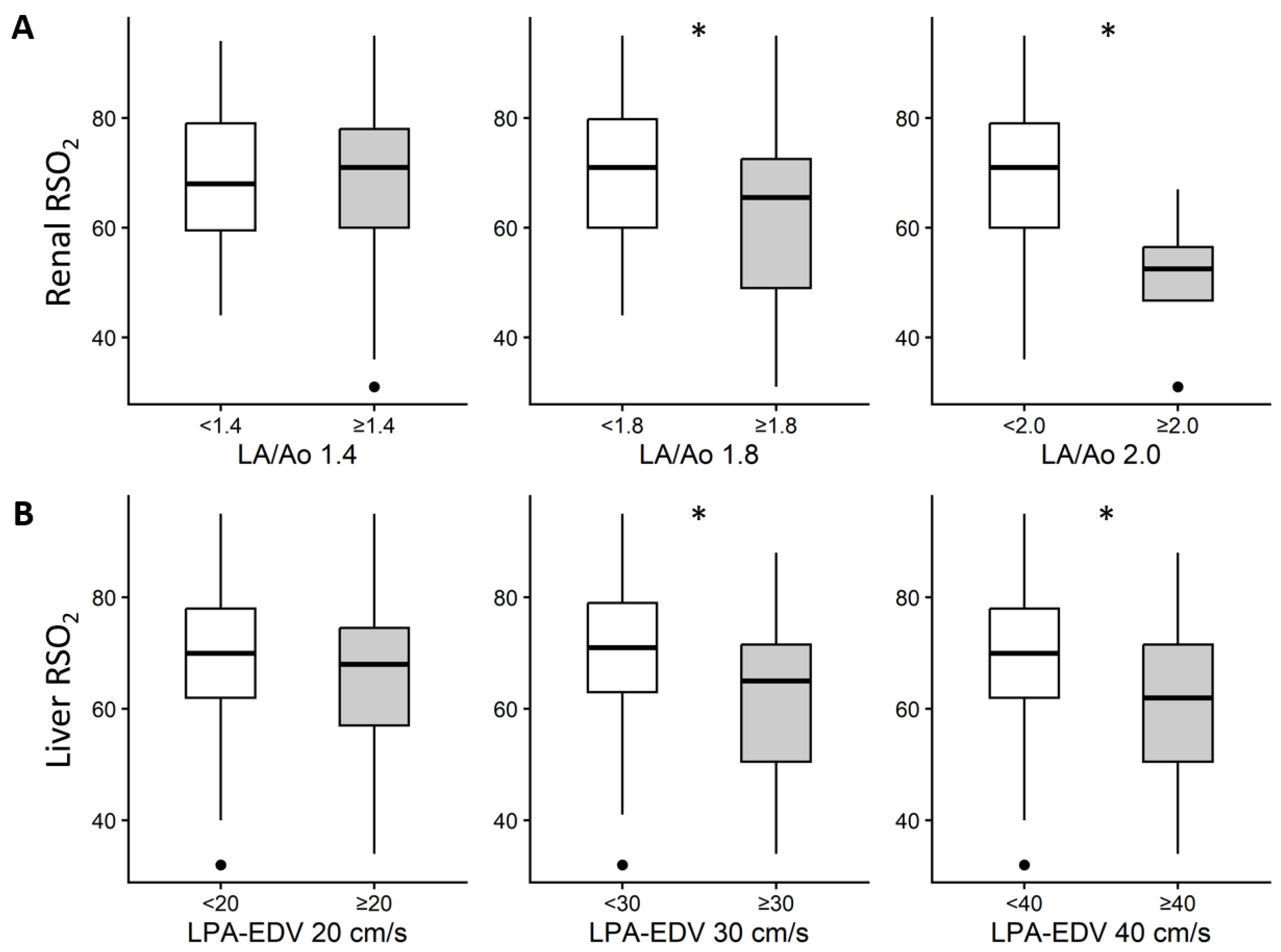
The key results of the RSO2 analysis based on echocardiographic parameters used to assess the hemodynamic significance of PDA are illustrated in Figure 1. Detailed findings of the exploratory analyses involving specific cutoffs of all echocardiographic parameters are presented in the Supplementary Table S4. Higher LA/Ao and LPA EDV cutoffs were associated with lower renal and liver RSO2, respectively, with the most pronounced differences at an LA/Ao ≥ 1.8 and LPA EDV ≥ 40 cm/s.
The LMM results are presented in Table 4. Cerebral RSO2 showed no clear association with any PDA indices, based on the small estimate effect with 95%CI spanning negative and positive values. In contrast, for a larger PDA size, renal RSO2 exhibited stronger inverse associations with PDA indices. For instance, a larger PDA size was associated with a lower renal RSO2 (β: −18.44; 95%CI: −30.87 to −6.01), and a higher LA/Ao showed an even more prominent inverse association (β: −41.37; 95%CI: −61.06 to −20.67). For liver RSO2, a higher LA/Ao ratio showed a strong inverse association (β: −38.71; 95%CI: −55.03 to −22.40). Among the covariates, D14 (versus D2), invasive ventilation, and lower mean BP were associated with lower renal and liver RSO2 in some models. To account for the potential influence of PDA treatment timing, a binary indicator of prior treatment status was included in the model; this covariate did not materially affect the LA/Ao-renal (estimate = −39.90; 95% CI: −55.50 to −19.80) or liver RSO2 association (estimate = −37.82; 95% CI: −50.84 to −20.96). As a sensitivity analysis, we repeated the LMMs in a complete-case dataset restricted to observations without missing RSO2, echocardiographic, or covariate data, which yielded effect estimates similar in direction and magnitude to the primary values.

4. Discussion

We investigated the association between hsPDA and NIRS-derived RSO2 in the liver. Although previous studies have explored the relationship between hsPDA and NIRS parameters, to the best of our knowledge, this study is the first to specifically report liver oxygenation in the context of hsPDA, representing a unique contribution to the field.
Despite advances in neonatal care, determining the optimal timing of PDA interventions remains challenging. Echocardiography is the gold standard for hsPDA diagnosis; however, it is limited by operator dependency and technical difficulties in extremely preterm infants [3]. In contrast, NIRS is noninvasive, simple, and allows continuous bedside monitoring [4]. Although cerebral NIRS provides direct information on cerebral perfusion, its application in preterm infants undergoing noninvasive ventilation is often limited by the difficulty of sensor placement beneath the headgear. Similarly, applying renal NIRS in extremely preterm infants may be challenging because sensor placement on the dorsal surface requires repositioning, which can be burdensome for caregivers owing to fragile skin and the risk of cerebral hemodynamic fluctuation. Although intestinal NIRS can theoretically provide a more direct measure of splanchnic perfusion, its accuracy is limited by several factors, including the presence of multiple intra-abdominal organs (such as the bladder and ureters), bowel peristalsis, and interference from high biliverdin content in the meconium or transitional stools, which affects light absorption [22,23]. In this context, we speculated that liver NIRS may serve as a practical alternative for representing splanchnic perfusion and as a surrogate marker of impaired organ perfusion, in addition to conventional PDA assessment [24].
In our study, liver RSO2, as well as cerebral and renal RSO2 values, were significantly lower in infants with PDA at certain assessment time points. This finding supports the potential applicability of liver NIRS for detecting PDA-related organ hypoperfusion alongside cerebral or renal RSO2 values, which have been more frequently reported in previous studies, including those involving preterm infants [7,8]. However, these RSO2 values represent only descriptive snapshots at predetermined time points, and potential confounders, such as postnatal maturation and concurrent clinical management, including fluid therapy, specific ventilator support mode or settings, vasopressor use, transfusion, etc., were not fully accounted for. Therefore, the observed differences in RSO2 values per se should not be interpreted as resulting from a direct cause-and-effect relationship with hsPDA. In addition, the clinical significance of modest (5–10%) differences in RSO2 remains uncertain. Previous studies have reported that reductions in renal RSO2 below 66% or cerebral RSO2 below 55–60% in preterm infants are associated with hsPDA and potential organ hypoperfusion [25,26]. However, smaller changes of less than 5% are unlikely to reflect clinically meaningful perfusion impairment and should be interpreted cautiously within the broader clinical context, including factors such as blood pressure, anemia, carbon dioxide levels, and glucose levels. This is particularly true for liver RSO2 where validated thresholds do not exist in the previous literature nor have they been generated in this study. In other words, the clinical advantage of liver NIRS lies in its role as an easily applicable and continuous bedside monitoring tool that may provide complementary information on hemodynamic impairment associated with hsPDA, that would prompt further evaluation for diagnosis and treatment, rather than as a stand-alone diagnostic criterion.
Some unexpected findings were observed in this study. We initially hypothesized that liver NIRS would be more sensitive to systemic hypoperfusion because perfusion of solid organs is more strongly influenced by the sympathetic nervous system, with less autoregulatory capacity and volume preservation than that of the brain or kidneys [10]. However, the decrease in liver RSO2 did not necessarily occur earlier than that in other affected organs, such as the brain and kidneys. One possible explanation for this is the dual blood supply to the liver. Hepatic perfusion is maintained by both the portal vein and hepatic artery; therefore, a reduction in mesenteric inflow due to PDA may be compensated for by an increase in hepatic arterial flow, thereby preserving RSO2 for a certain period [11]. This compensatory mechanism may partially explain the differences in liver RSO2 according to the degree of left heart loading in the current study.
We also expected that the liver RSO2 value would continue to decrease in the setting of a more prominent left heart load. Although RSO2 values across multiple organs, including the liver, showed significant differences when stratified by smaller PDA sizes (<1.5 mm and <1.75 mm), no such differences were observed when the groups were divided using a PDA size cutoff of 2 mm. These findings suggest that the hemodynamic burden imposed by PDA may not be solely determined by its diameter. Rather, the degree of shunt loading may vary regardless of ductal size [27]. Therefore, RSO2 levels in different organs may not consistently decrease with increasing PDA size alone (Table 4). Notably, these findings imply that NIRS is sensitive enough to detect changes in organ perfusion that are not readily discernible by ductal size alone on echocardiography, underscoring its potential utility in assessing PDA severity in clinical practice.
Liver RSO2 values were significantly reduced in infants with higher LPA EDV thresholds (>30 and >40 cm/s), but not in those with lower thresholds (>20 cm/s). Additionally, liver RSO2 decreased as the LA/Ao ratio increased. Based on the LMM results adjusted for time-varying effects and covariates, liver RSO2 showed a strong inverse association with the LA/Ao ratio. This finding may explain why liver RSO2 values further decreased with progressive PDA severity, particularly when assessed by LA/Ao ratio, rather than by ductal size. This finding aligns with those of the study by Schat et al., which reported that liver NIRS did not discriminate between infants with and without necrotizing enterocolitis (NEC) but could differentiate uncomplicated from complicated NEC [28]. These results suggest that changes in liver RSO2 may become more apparent or prominent in the setting of severe hypoperfusion. In addition, invasive ventilation and mean BP showed significant negative and positive associations, respectively, with liver RSO2, implying greater hemodynamic vulnerability of the liver compared with other organs. Indeed, the degree of respiratory and hemodynamic support forms part of the clinical severity criteria for hsPDA, as described by McNamara et al. [18]. Therefore, monitoring liver RSO2 in preterm infants, particularly those requiring higher levels of respiratory support, especially invasive ventilation or vasopressors, may be useful. These findings may prompt earlier or repeated echocardiographic assessment.
Notably, RSO2 in all three regions showed a negative association with time, which is in line with the findings of McNeill et al. [29], who reported a decreasing tendency for cerebral and renal RSO2 over the first three postnatal weeks in preterm infants. To what extent this pattern reflects maturational increases in oxygen consumption in our study is unclear, because factors such as changes in fluid status, hemoglobin concentration, adjustments in respiratory support, carbon dioxide levels, vasopressor use, exposure to nephrotoxic medications [30], and feeding status [31] were not systematically captured in our models owing to the limited sample size. However, the larger time-related decreases in liver RSO2 (β estimate) suggest that this vascular bed may be more susceptible to evolving hemodynamic and metabolic stresses in this population, consistent with our a priori hypothesis.
The limitations of our study include its relatively small sample size and single-institution setting. As this was a prospective observational study without randomization or intervention, we adopted a consecutive sampling method to include as many eligible participants as possible during the study period. Additionally, because multiple comparisons were performed across organs, time points, and echocardiographic indices, the risk of false-positive findings cannot be completely excluded. However, our conclusions are based on the magnitude and consistency of the estimated associations (e.g., the inverse relationship between liver RSO2 and LA/Ao) rather than on isolated p-values. Large-scale studies with appropriately calculated statistical power are necessary to validate and generalize our findings and to inform future research involving interventional analyses and outcome assessments. In addition, the timing of the assessments was defined within relatively broad windows (e.g., D2: 48–72 h of life). This approach reflected the practical need to account for the availability of researchers trained in targeted neonatal echocardiography, which inevitably requires flexibility in scheduling. Because echocardiographic assessments were performed by three neonatologists, a potential for variability in the measurements was present. Nonetheless, echocardiography was performed according to a protocol with predefined standards and sample images for each parameter (produced by S.K.Y.) that were distributed to the neonatologists before study initiation, and all three neonatologists had at least 3 years of experience in targeted echocardiography. Furthermore, the obtained images were reviewed by the most experienced investigator to ensure internal consistency of measurements. However, because echocardiographic assessments were performed by three neonatologists, some degree of inter-observer variability cannot be excluded, and formal intra-or inter-observer reliability testing (e.g., intraclass correlation coefficients) was not performed in this study, which represents an additional limitation that should be addressed in future work. Furthermore, although some clinically relevant covariates were incorporated into the LMM analyses, more detailed potential confounders, including the hemodynamic and metabolic factors mentioned above, were not included because of the small sample size. Additionally, our inference relies on the plausibility of the MAR assumption for missing data, and more extensive sensitivity analyses will be required in larger cohorts. Future studies should incorporate more variables to appropriately adjust for confounding factors including concurrent treatments (e.g., fluid therapy, transfusions, vasopressor use, etc.) in order to more robustly elucidate the potential impact of these unmeasured factors in the present study. Finally, because the infants included in our study did not develop NEC, the association between liver RSO2 and NEC, which could occur in the setting of mesenteric hypoperfusion, was not analyzed. Altogether, future studies aiming to verify and extend our findings will require a prospective design and a larger, multicenter cohort. Such studies should minimize inter-operator variability in echocardiographic assessments and incorporate more comprehensive clinical data.

5. Conclusions

In this exploratory study, we provide initial reference data on NIRS-derived regional, particularly liver, RSO2 in preterm infants with PDA. Liver RSO2 was significantly lower in the presence of PDA, as identified by specific echocardiographic parameters reflecting left heart loading. However, this finding does not establish a direct cause-and-effect relationship. Further studies with predefined objectives are needed to assess the clinical utility of this modality and to identify cutoffs that can differentiate between PDA that will not require treatment, PDA likely to require medical therapy, and PDA that is likely to require surgical ligation. Future studies incorporating additional clinically relevant confounders are warranted to further validate the usefulness of liver RSO2 as an auxiliary parameter and to suggest potentially actionable thresholds for detecting and assessing the severity of hsPDA, and guiding therapy in preterm infants.

Supplementary Materials

The following supporting information can be downloaded at: https://www.mdpi.com/article/10.3390/biomedicines14020361/s1, Figure S1: Patient enrolment scheme; Table S1: Number of missing indices by time; Table S2: Blood pressure values compared according to the PDA at different assessment time points; Table S3: Pearson correlation coefficients between blood pressure values and organ-specific RSO2 levels; Table S4: RSO2 measurements with respect to echocardiographic parameters.

Author Contributions

Conceptualization, M.K. and S.K.Y.; methodology, S.K.Y.; formal analysis, M.K. and S.K.Y.; investigation, M.K., M.-Y.O., Y.S. and S.K.Y.; resources, M.-Y.O. and S.K.Y.; data curation, M.K., M.-Y.O. and S.K.; writing—original draft preparation, M.K. and S.K.Y.; writing—review and editing, S.K.Y.; supervision, M.-Y.O. and S.K.Y.; project administration, M.-Y.O., S.K., Y.S. and J.S.; funding acquisition, S.K.Y. All authors have read and agreed to the published version of the manuscript.

Funding

This work was supported by a National Research Foundation of Korea (NRF) grant funded by the Korean government (MSIT) (No. RS-2022-00165829). The funding source had no role in the design and execution of the study or drafting of the manuscript.

Institutional Review Board Statement

The Institutional Review Board (IRB) of our institute approved this study (Approval No. KC22ONSI0820, date: 16 November 2022).

Informed Consent Statement

Written informed consent was obtained from the parents before enrollment. Exclusion criteria included major congenital malformations, chromosomal or genetic abnormalities, and parental refusal to provide informed consent.

Data Availability Statement

The data that support the findings of this study are available from the corresponding author, only upon reasonable request.

Conflicts of Interest

The authors declare no conflicts of interest.

Abbreviations

The following abbreviations are used in this manuscript:
RSO2Regional oxygen saturation
PDAPatent ductus arteriosus
hsPDAHemodynamically significant patent ductus arteriosus
NIRSNear-infrared spectroscopy
NICUNeonatal intensive care unit
D2Day 2
D7Day 7
D14Day 14
LA/AoLeft atrium-to-aorta
LPA EDVLeft pulmonary artery end-diastolic velocity
LVEDDLeft ventricular end-diastolic diameter
LMMLinear mixed-effects models
BPBlood pressure
CIConfidence intervals

References

  1. Sung, S.I.; Chang, Y.S.; Kim, J.; Choi, J.H.; Ahn, S.Y.; Park, W.S. Natural evolution of ductus arteriosus with non-interventional conservative management in extremely preterm infants born at 23–28 weeks of gestation. PLoS ONE 2019, 14, e0212256. [Google Scholar] [CrossRef]
  2. Patra, A.; Thakkar, P.S.; Makhoul, M.; Bada, H.S. Objective assessment of physiologic alterations associated with hemodynamically significant patent ductus arteriosus in extremely premature neonates. Front. Pediatr. 2021, 9, 648584. [Google Scholar] [CrossRef]
  3. Zonnenberg, I.; de Waal, K. The definition of a haemodynamic significant duct in randomized controlled trials: A systematic literature review. Acta Paediatr. 2012, 101, 247–251. [Google Scholar] [CrossRef]
  4. Navikiene, J.; Virsilas, E.; Vankeviciene, R.; Liubsys, A.; Jankauskiene, A. Brain and renal oxygenation measured by NIRS related to patent ductus arteriosus in preterm infants: A prospective observational study. BMC Pediatr. 2021, 21, 559. [Google Scholar] [CrossRef]
  5. Rugytė, D.Č.; Strumylaitė, L. Potential relationship between cerebral fractional tissue oxygen extraction (FTOE) and the use of sedative agents during the perioperative period in neonates and infants. Children 2020, 7, 209. [Google Scholar] [CrossRef] [PubMed]
  6. Bailey, S.M.; Mally, P.V. Review of splanchnic oximetry in clinical medicine. J. Biomed. Opt. 2016, 21, 091306. [Google Scholar] [CrossRef]
  7. Chock, V.Y.; Ramamoorthy, C.; Van Meurs, K.P. Cerebral oxygenation during different treatment strategies for a patent ductus arteriosus. Neonatology 2011, 100, 233–240. [Google Scholar] [CrossRef]
  8. Lemmers, P.M.A.; Toet, M.C.; van Bel, F. Impact of patent ductus arteriosus and subsequent therapy with indomethacin on cerebral oxygenation in preterm infants. Pediatrics 2008, 121, 142–147. [Google Scholar] [CrossRef]
  9. Harper, D.; Chandler, B. Splanchnic circulation. BJA Educ. 2016, 16, 66–71. [Google Scholar] [CrossRef]
  10. Meng, L.; Wang, Y.; Zhang, L.; McDonagh, D.L. Heterogeneity and variability in pressure autoregulation of organ blood flow: Lessons learned over 100+ years. Crit. Care Med. 2019, 47, 436–448. [Google Scholar] [CrossRef]
  11. Abshagen, K.; Kuhla, A.; Genz, B.; Vollmar, B. Anatomy and physiology of the hepatic circulation. In PanVascular Medicine; Lanzer, P., Ed.; Springer: Berlin/Heidelberg, Germany, 2015; pp. 3607–3629. [Google Scholar] [CrossRef]
  12. Nahum, E.; Skippen, P.W.; Gagnon, R.E.; Macnab, A.J.; Skarsgard, E.D. Correlation of transcutaneous hepatic near-infrared spectroscopy readings with liver surface readings and perfusion parameters in a piglet endotoxemic shock model. Liver Int. 2006, 26, 1277–1282. [Google Scholar] [CrossRef]
  13. Paudel, G.; Joshi, V. Echocardiography of the patent ductus arteriosus in premature infant. Congenit. Heart Dis. 2019, 14, 42–45. [Google Scholar] [CrossRef]
  14. Khositseth, A.; Nuntnarumit, P.; Chongkongkiat, P. Echocardiographic parameters of patent ductus arteriosus in preterm infants. Indian Pediatr. 2011, 48, 773–778. [Google Scholar] [CrossRef]
  15. Van Laere, D.; van Overmeire, B.; Gupta, S.; El-Khuffash, A.; Savoia, M.; McNamara, P.J. Application of neonatologist performed echocardiography in the assessment of a patent ductus arteriosus. Pediatr. Res. 2018, 84, 46–56. [Google Scholar] [CrossRef]
  16. Kumar, J.; Dutta, S.; Sundaram, V.; Saini, S.S.; Sharma, R.R.; Varma, N. Platelet transfusion for PDA closure in preterm infants: A randomized controlled trial. Pediatrics 2019, 143, e20182565. [Google Scholar] [CrossRef]
  17. Benitz, W.E.; Committee on Fetus and Newborn; American Academy of Pediatrics. Patent ductus arteriosus in preterm infants. Pediatrics 2016, 137, e20153730. [Google Scholar] [CrossRef] [PubMed]
  18. McNamara, P.J.; Sehgal, A. Towards rational management of the patent ductus arteriosus: The need for disease staging. Arch. Dis. Child. Fetal Neonatal Ed. 2007, 92, F424–F427. [Google Scholar] [CrossRef]
  19. Ohlsson, A.; Walia, R.; Shah, S.S. Ibuprofen for the treatment of patent ductus arteriosus in preterm and/or low birth weight infants. Cochrane Database Syst. Rev. 2013, 4, CD003481. [Google Scholar]
  20. Manalastas, M.; Zaheer, F.; Nicoski, P.; Weiss, M.G.; Amin, S. Acetaminophen therapy for persistent patent ductus arteriosus. NeoReviews 2021, 22, e320–e331. [Google Scholar] [CrossRef] [PubMed]
  21. Gillam-Krakauer, M.; Reese, J. Diagnosis and management of patent ductus arteriosus. NeoReviews 2018, 19, e394–e402. [Google Scholar] [CrossRef]
  22. Petrova, A.; Bhatt, M.; Mehta, R. Regional tissue oxygenation in preterm born infants in association with echocardiographically significant patent ductus arteriosus. J. Perinatol. 2011, 31, 460–464. [Google Scholar] [CrossRef] [PubMed]
  23. Ledo, A.; Aguar, M.; Núñez-Ramiro, A.; Saénz, P.; Vento, M. Abdominal near-infrared spectroscopy detects low mesenteric perfusion early in preterm infants with hemodynamic significant ductus arteriosus. Neonatology 2017, 112, 238–245. [Google Scholar] [CrossRef]
  24. Goldshtrom, N.; Isler, J.R.; Sahni, R. Comparing liver and lower abdomen near-infrared spectroscopy in preterm infants. Early Hum. Dev. 2020, 151, 105194. [Google Scholar] [CrossRef]
  25. Chock, V.Y.; Rose, L.A.; Mante, J.V.; Punn, R. Near-infrared spectroscopy for detection of a significant patent ductus arteriosus. Pediatr. Res. 2016, 80, 675–680. [Google Scholar] [CrossRef]
  26. Garvey, A.A.; Kooi, E.M.W.; Smith, A.; Dempsey, E.M. Interpretation of cerebral oxygenation changes in the preterm infant. Children 2018, 5, 94. [Google Scholar] [CrossRef]
  27. Choi, E.K.; Park, K.H.; Choi, B.M. Size of patent ductus arteriosus and echocardiographic markers of shunt volume in preterm infants based on postnatal age. Front. Pediatr. 2021, 9, 635616. [Google Scholar] [CrossRef] [PubMed]
  28. Schat, T.E.; Schurink, M.; van der Laan, M.E.; Hulscher, J.B.F.; Hulzebos, C.V.; Bos, A.F.; Kooi, E.M.W. Near-infrared spectroscopy to predict the course of necrotizing enterocolitis. PLoS ONE 2016, 11, e0154710. [Google Scholar] [CrossRef]
  29. McNeill, S.; Gatenby, J.C.; McElroy, S.; Engelhardt, B. Normal cerebral, renal and abdominal regional oxygen saturations using near-infrared spectroscopy in preterm infants. J. Perinatol. 2010, 31, 51–57. [Google Scholar] [CrossRef] [PubMed]
  30. Harer, M.W.; Chock, V.Y. Renal tissue oxygenation monitoring—An opportunity to improve kidney outcomes in the vulnerable neonatal population. Front. Pediatr. 2020, 8, 241. [Google Scholar] [CrossRef]
  31. Chen, J.; Fan, X.; He, S.; Lin, Z.; Su, Z.; Wu, F. Regional tissue oxygen saturation during minimal enteral feeding is associated with the subsequent feeding intolerance in very preterm infants. Sci. Rep. 2025, 15, 8558. [Google Scholar] [CrossRef]
Figure 1. Key findings of RSO2 measurements with respect to echocardiographic parameters. (A): Renal RSO2 according to LA/Ao cutoffs of 1.4, 1.8, and 2.0; (B): Liver RSO2 according to LPA EDV cutoffs of 20, 30, and 40 cm/s. Boxes indicate median and interquartile range; whiskers indicate the range excluding outliers. Asterisks indicate p < 0.05. LPA EDV, left pulmonary artery end-diastolic velocity; LA/Ao, left atrium-to-aortic root ratio; RSO2, regional oxygen saturation.
Biomedicines 14 00361 g001
Table 1. Demographics of the enrolled infants.
Number (%) or Mean ± SD
Gestational age (weeks)28.8 ± 2.2
Birthweight (grams)1209.9 ± 364.2
Male sex17 (42.5)
Singleton28 (70.0)
Cesarean delivery39 (97.5)
1 min Apgar4.4 ± 1.6
5 min Apgar7.0 ± 1.9
Mother age (years)35.6 ± 4.0
Assisted reproduction therapy10 (25.0)
PPROM12 (30.0)
Oligohydramnios3 (7.5)
Histologic chorioamnionitis8 (20.0)
Maternal diabetes6 (15.0)
Maternal hypertension10 (25.0)
Antenatal corticosteroid administration
Any39 (97.5)
Complete23 (57.5)
Respiratory support
Invasive ventilation19 (47.5%)
Duration of invasive ventilation (days)8.8 ± 7.4
Table 2. Trajectory of ductal patency and echocardiographic findings.
N (%) or Mean ± SD
PDA management
Spontaneous closure22 (55.0)
Medical treatment18 (45.0)
Ibuprofen only6 (33.3) *
Paracetamol only9 (50.0) *
Both3 (16.7) *
Surgical treatment4 (10.0)
Primary0 (0.0) *
Secondary4 (100.0) *
Chronological age at treatment initiation (days)4.8 ± 2.6
PMA at treatment initiation (weeks)28.3 ± 2.6
Echocardiographic assessmentD2D7D14
Hour of life at assessment  a67.7 [54.1–71.3]8 [7–9]14 [14–15]
PMA (weeks)29.3 ± 2.229.9 ± 2.330.9 ± 2.2
Prior PDA treatment
Medical0153 b
Surgical001
Ductal patency33 (82.5)17 (43.6) c10 (27.0) d
PDA size (mm) c1.66 ± 0.531.62 ± 0.581.78 ± 0.39
LPA end-diastolic velocity (cm/s) a,c21.20 [13.85–35.95]24.25 [6.80–46.58]30.25 [23.7–35.95]
LA/Ao a1.59 ± 0.271.60 ± 0.391.83 [1.49–1.89]
LVEDD (mm) a13.66 ± 2.3713.48 ± 2.7513.40 [12.68–14.70]
* N (%) in the medical treatment patient group or surgical treatment group, as appropriate. a Analyzed using the Mann–Whitney U test and presented as median [interquartile range]. b PDA treatment between D7 and D14 assessments. c Analyzed only in patients with ductal patency. d Analysis of 39 patients with D7, and 37 patients with D14. PDA, patent ductus arteriosus; PMA, postmenstrual age; LPA, left pulmonary artery; LA/Ao, left atrium-to-aortic root ratio; LVEDD, left ventricular end-diastolic diameter.
Table 3. RSO2 measurements were compared according to ductal patency assessed by echocardiography at different time points.
PDANo PDAp-Value
Ductal patency at any time point a6056-
Cerebral RSO274.22 ± 10.1480.47 ± 7.91<0.001
Renal RSO265.68 ± 14.2972.51 ± 12.880.005
Liver RSO265.32 ± 15.9171.30 ± 10.620.010
Ductal patency at D2 Echo b337-
Cerebral RSO278.56 ± 7.8287.71 ± 7.340.004
Renal RSO269.98 ± 11.5577.86 ± 15.950.065
Liver RSO270.41 ± 14.6973.0 ± 6.950.327
Ductal patency at D7 Echo b1722-
Cerebral RSO276.23 ± 9.5785.71 ± 5.710.008
Renal RSO268.68 ± 14.7674.14 ± 11.610.183
Liver RSO268.19 ± 13.2482.14 ± 5.58<0.001
Ductal patency at D14 Echo b1027-
Cerebral RSO2 72.17 ± 9.8877.60 ± 6.800.124
Renal RSO263.67 ± 15.1475.80 ± 8.200.046
Liver RSO259.33 ± 12.0680.0 ± 6.48<0.001
a All assessed cases, at D2, D7, and D14, are counted. b Number of infants. D2, day 2, D7, day 7, D14, day 14; PDA, patent ductus arteriosus; RSO2, regional oxygen saturation.
Table 4. LMM estimates for the association between echocardiographic PDA indices and cerebral, renal, and liver RSO2 a.
RSO2 PDA Index and Covariates Estimate 95%CI p-Value
CerebralPDA size4.24−3.87 to 12.340.287
LA/Ao−6.77−22.37 to 8.830.365
LPA-EDV−0.03−0.25 to 0.180.763
RenalPDA size−18.44−30.87 to −6.010.006
LA/Ao−41.37−62.36 to −20.370.002
LPA-EDV−0.46−0.77 to −0.150.005
LiverPDA size−9.03−22.09 to 4.030.164
LA/Ao−38.71−55.03 to −22.40<0.001
LPA-EDV−0.21−0.54 to 0.120.198
a The models were adjusted for gestational age, invasive ventilation, and mean BP. | BP, blood pressure; PDA, patent ductus arteriosus; CI, confidence interval; LPA EDV, left pulmonary artery end-diastolic velocity; LA/Ao, left atrium-to-aortic root ratio; LMM, linear mixed-effects models; RSO2, regional oxygen saturation.
Disclaimer/Publisher’s Note: The statements, opinions and data contained in all publications are solely those of the individual author(s) and contributor(s) and not of MDPI and/or the editor(s). MDPI and/or the editor(s) disclaim responsibility for any injury to people or property resulting from any ideas, methods, instructions or products referred to in the content.