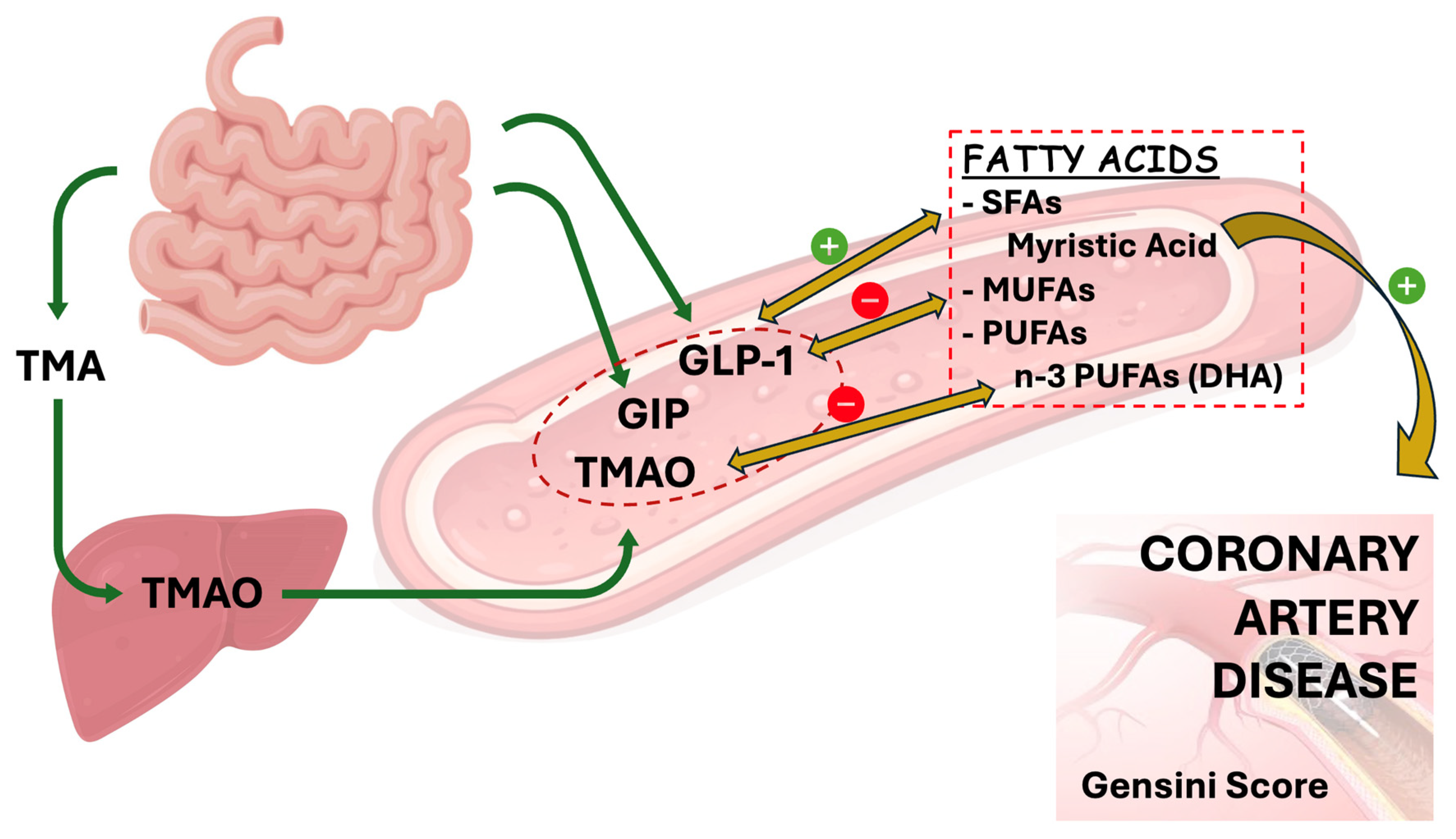
Exploratory Analysis of Circulating GLP-1, GIP, and TMAO in Relation to Coronary Artery Disease Severity in Patients with Exertional Angina

 , , , , , and
Abstract
1. Introduction
2. Materials and Methods
2.1. Study Design and Participants
2.2. Coronary Angiographic Data and Gensini Score Computation
2.3. Biological Sample Collection and Analyses of Routine Biochemical Parameters
2.4. Measurements of GLP-1, GIP, and TMAO Levels in Plasma
2.5. Fatty Acid Extraction and Analysis with GC–MS
2.6. Statistical Analysis
3. Results
3.1. Baseline Characteristics of the Study Population
3.2. Comparison of Patients According to Their Gensini Score
3.3. Correlations of the Variables with the Gensini Scores of the Patients
3.4. Correlation Analysis of GLP-1, GIP, and TMAO
4. Discussion
5. Conclusions
Author Contributions
Funding
Institutional Review Board Statement
Informed Consent Statement
Data Availability Statement
Acknowledgments
Conflicts of Interest
Abbreviations
| BMI | Body mass index |
| CAD | Coronary artery disease |
| CI | Confidence interval |
| CVD | Cardiovascular disease |
| DGLA | Dihomo gamma linolenic acid |
| DHA | Docosahexaenoic acid |
| FAME | Fatty acid methyl ester |
| FMO | Flavin-containing monooxygenas |
| GIP | Glucose-dependent insulinotropic peptide |
| GLP-1 | Glucagon-like peptide-1 |
| HDL | High-density lipoprotein |
| HOMA-IR | Homeostasis Model Assessment of Insulin Resistance |
| IQR | Interquartile range |
| LDL | Low-density lipoprotein |
| MUFAs | Monounsaturated fatty acids |
| OR | Odds ratio |
| PO | Proportional odds |
| PPOM | Partial proportional odds model |
| PUFAs | Polyunsaturated fatty acids |
| SD | Standard deviation |
| SFAs | Saturated fatty acids |
| TMA | Trimethylamine |
| TMAO | Trimethylamine N-oxide |
| VLDL | Very low-density lipoprotein |
References
- Hemmati, M.; Kashanipoor, S.; Mazaheri, P.; Alibabaei, F.; Babaeizad, A.; Asli, S.; Mohammadi, S.; Gorgin, A.H.; Ghods, K.; Yousefi, B.; et al. Importance of gut microbiota metabolites in the development of cardiovascular diseases (CVD). Life Sci. 2023, 329, 121947. [Google Scholar] [CrossRef]
- Nauck, M.A.; Quast, D.R.; Wefers, J.; Pfeiffer, A.F.H. The evolving story of incretins (GIP and GLP-1) in metabolic and cardiovascular disease: A pathophysiological update. Diabetes Obes. Metab. 2021, 3, 5–29. [Google Scholar] [CrossRef]
- Lehrke, M.; Marx, N. Cardiovascular effects of incretin-based therapies. Rev. Diabet. Stud. 2011, 8, 382–391. [Google Scholar] [CrossRef]
- Skrobucha, A.; Pindlowski, P.; Krajewska, N.; Grabowski, M.; Jonik, S. Anti-inflammatory effects of glucagon-like peptide-1 (GLP-1) in coronary artery disease: A comprehensive review. Front. Cardiovasc. Med. 2024, 11, 1446468. [Google Scholar] [CrossRef]
- Nauck, M.A.; Quast, D.R.; Wefers, J.; Meier, J.J. GLP-1 receptor agonists in the treatment of type 2 diabetes–state-of-the-art. Mol. Metab. 2021, 46, 101102. [Google Scholar] [CrossRef]
- Heimbürger, S.M.; Bergmann, N.C.; Augustin, R.; Gasbjerg, L.S.; Christensen, M.B.; Knop, F.K. Glucose-dependent insulinotropic polypeptide (GIP) and cardiovascular disease. Peptides 2020, 125, 170174. [Google Scholar] [CrossRef] [PubMed]
- Ascher, S.; Reinhardt, C. The gut microbiota: An emerging risk factor for cardiovascular and cerebrovascular disease. Eur. J. Immunol. 2018, 48, 564–575. [Google Scholar] [CrossRef] [PubMed]
- Verhaar, B.J.H.; Prodan, A.; Nieuwdorp, M.; Muller, M. Gut Microbiota in Hypertension and Atherosclerosis: A Review. Nutrients 2020, 12, 2982. [Google Scholar] [CrossRef] [PubMed]
- Xu, H.; Wang, X.; Feng, W.; Liu, Q.; Zhou, S.; Liu, Q.; Cai, L. The gut microbiota and its interactions with cardiovascular disease. Microb. Biotechnol. 2020, 13, 637–656. [Google Scholar] [CrossRef]
- Schoeler, M.; Caesar, R. Dietary lipids, gut microbiota and lipid metabolism. Rev. Endocr. Metab. Disord. 2019, 20, 461–472. [Google Scholar] [CrossRef]
- Gensini, G.G. A more meaningful scoring system for determining the severity of coronary heart disease. Am. J. Cardiol. 1983, 51, 606. [Google Scholar] [CrossRef]
- Routray, S.; Satpathy, C.; Mohanty, N.K.; Dash, B.K.; Satapathy, R.P. Comparison of Global Registry of Acute Coronary Events and Thrombolysis in Myocardial Infarction Risk Scores in non-ST-Elevation Acute Coronary Syndrome. J. Clin. Prev. Cardiol. 2021, 10, 106–111. [Google Scholar] [CrossRef]
- Bligh, E.G.; Dyer, W.J. A rapid method of total lipid extraction and purification. Can. J. Biochem. Physiol. 1959, 37, 911–917. [Google Scholar] [CrossRef] [PubMed]
- Christie, W.W. Preparation of ester derivatives of fatty acids for chromatographic analysis. Adv. Lipid Methodol. 1993, 2, e111. [Google Scholar]
- Francula-Zaninovic, S.; Nola, I.A. Management of Measurable Variable Cardiovascular Disease’ Risk Factors. Curr. Cardiol. Rev. 2018, 14, 153–163. [Google Scholar] [CrossRef]
- Banack, H.R.; Kaufman, J.S. The obesity paradox: Understanding the effect of obesity on mortality among individuals with cardiovascular disease. Prev. Med. 2014, 62, 96–102. [Google Scholar] [CrossRef] [PubMed]
- Chang, V.W.; Langa, K.M.; Weir, D.; Iwashyna, T.J. The obesity paradox and incident cardiovascular disease: A population-based study. PLoS ONE 2017, 12, e0188636. [Google Scholar] [CrossRef]
- Shramko, V.S.; Polonskaya, Y.V.; Kashtanova, E.V.; Stakhneva, E.M.; Ragino, Y.I. The Short Overview on the Relevance of Fatty Acids for Human Cardiovascular Disorders. Biomolecules 2020, 10, 1127. [Google Scholar] [CrossRef]
- Zong, G.; Li, Y.; Wanders, A.J.; Alssema, M.; Zock, P.L.; Willett, W.C.; Hu, F.B.; Sun, Q. Intake of individual saturated fatty acids and risk of coronary heart disease in US men and women: Two prospective longitudinal cohort studies. BMJ 2016, 355, i5796. [Google Scholar] [CrossRef]
- Ragino, Y.I.; Shramko, V.S.; Stakhneva, E.M.; Chernyak, E.I.; Morozov, S.V.; Shakhtshneider, E.V.; Polonskaya, Y.V.; Shcherbakova, L.V.; Chernyavskiy, A.M. Changes in the blood fatty-acid profile associated with oxidative-antioxidant disturbances in coronary atherosclerosis. J. Med. Biochem. 2020, 39, 46–53. [Google Scholar] [CrossRef]
- Soppert, J.; Lehrke, M.; Marx, N.; Jankowski, J.; Noels, H. Lipoproteins and lipids in cardiovascular disease: From mechanistic insights to therapeutic targeting. Adv. Drug Deliv. Rev. 2020, 159, 4–33. [Google Scholar] [CrossRef]
- Marklund, M.; Wu, J.H.Y.; Imamura, F.; Del Gobbo, L.C.; Fretts, A.; de Goede, J.; Shi, P.; Tintle, N.; Wennberg, M.; Aslibekyan, S.; et al. Cohorts for Heart and Aging Research in Genomic Epidemiology (CHARGE) Fatty Acids and Outcomes Research Consortium (FORCE). Biomarkers of Dietary Omega-6 Fatty Acids and Incident Cardiovascular Disease and Mortality. Circulation 2019, 139, 2422–2436. [Google Scholar] [CrossRef] [PubMed]
- Bui, T.V.A.; Hwangbo, H.; Lai, Y.; Hong, S.B.; Choi, Y.J.; Park, H.J.; Ban, K. The Gut-Heart Axis: Updated Review for The Roles of Microbiome in Cardiovascular Health. Korean Circ. J. 2023, 53, 499–518. [Google Scholar] [CrossRef]
- Nauck, M.A.; Meier, J.J. Incretin hormones: Their role in health and disease. Diabetes Obes. Metab. 2018, 20, 5–21. [Google Scholar] [CrossRef]
- Greenwell, A.A.; Chahade, J.J.; Ussher, J.R. Cardiovascular biology of the GIP receptor. Peptides 2020, 125, 170228. [Google Scholar] [CrossRef] [PubMed]
- Müller, T.D.; Finan, B.; Bloom, S.R.; D’Alessio, D.; Drucker, D.J.; Flatt, P.R.; Fritsche, A.; Gribble, F.; Grill, H.J.; Habener, J.F.; et al. Glucagon-like peptide 1 (GLP-1). Mol. Metab. 2019, 30, 72–130. [Google Scholar] [CrossRef]
- Yuan, W.; Shao, Y.; Zhao, D.; Zhang, B. Correlation analysis of lipid accumulation index, triglyceride-glucose index and H-type hypertension and coronary artery disease. PeerJ 2023, 11, e16069. [Google Scholar] [CrossRef]
- Nagase, C.; Tanno, M.; Kouzu, H.; Miki, T.; Nishida, J.; Murakami, N.; Kokubu, N.; Nagano, N.; Nishikawa, R.; Yoshioka, N.; et al. Reduction in GLP-1 secretory capacity may be a novel independent risk factor of coronary artery stenosis. Sci. Rep. 2021, 11, 15578. [Google Scholar] [CrossRef] [PubMed]
- Chen, X.; Nie, X.; Wang, H.; Yan, S.; Zhang, Y. Stearic acid induces CCK and GLP-1 upregulation via GPR120/PLC-beta, leading to reduced appetite in Hu sheep fed with rice straw. Front. Vet. Sci. 2022, 9, 948074. [Google Scholar] [CrossRef]
- Clara, R.; Langhans, W.; Mansouri, A. Oleic acid stimulates glucagon-like peptide-1 release from enteroendocrine cells by modulating cell respiration and glycolysis. Metabolism 2016, 65, 8–17. [Google Scholar] [CrossRef]
- Kahles, F.; Liberman, A.; Halim, C.; Rau, M.; Möllmann, J.; Mertens, R.W.; Rückbeil, M.; Diepolder, I.; Walla, B.; Diebold, S.; et al. The incretin hormone GIP is upregulated in patients with atherosclerosis and stabilizes plaques in ApoE−/− mice by blocking monocyte/macrophage activation. Mol. Metab. 2018, 14, 150–157. [Google Scholar] [CrossRef]
- Hirano, T.; Mori, Y. Anti-atherogenic and anti-inflammatory properties of glucagon-like peptide-1, glucose-dependent insulinotropic polypepide, and dipeptidyl peptidase-4 inhibitors in experimental animals. J. Diabetes Investig. 2016, 7, 80–86. [Google Scholar] [CrossRef]
- Asmar, M.; Simonsen, L.; Madsbad, S.; Stallknecht, B.; Holst, J.J.; Bülow, J. Glucose-dependent insulinotropic polypeptide may enhance fatty acid re-esterification in subcutaneous abdominal adipose tissue in lean humans. Diabetes 2010, 59, 2160–2163. [Google Scholar] [CrossRef]
- Marathe, C.S.; Pham, H.; Marathe, J.A.; Trahair, L.G.; Huynh, L.; Wu, T.; Phillips, L.K.; Rayner, C.K.; Nauck, M.A.; Horowitz, M.; et al. The relationship between plasma GIP and GLP-1 levels in individuals with normal and impaired glucose tolerance. Acta Diabetol. 2020, 57, 583–587. [Google Scholar] [CrossRef]
- Nauck, M.A.; El-Ouaghlidi, A.; Gabrys, B.; Hücking, K.; Holst, J.J.; Deacon, C.F.; Gallwitz, B.; Schmidt, W.E.; Meier, J.J. Secretion of incretin hormones (GIP and GLP-1) and incretin effect after oral glucose in first-degree relatives of patients with type 2 diabetes. Regul. Pept. 2004, 122, 209–217. [Google Scholar] [CrossRef] [PubMed]
- Agus, A.; Clément, K.; Sokol, H. Gut microbiota-derived metabolites as central regulators in metabolic disorders. Gut 2021, 70, 1174–1182. [Google Scholar] [CrossRef] [PubMed]
- Canyelles, M.; Borràs, C.; Rotllan, N.; Tondo, M.; Escolà-Gil, J.C.; Blanco-Vaca, F. Gut Microbiota-Derived TMAO: A Causal Factor Promoting Atherosclerotic Cardiovascular Disease? Int. J. Mol. Sci. 2023, 24, 1940. [Google Scholar] [CrossRef] [PubMed]

| Variable | Normal Coronary Artery (Gensini 0) | Moderate CAD (Gensini 1–23) | Severe CAD (Gensini > 23) | p |
|---|---|---|---|---|
| Number of patient (male/female) (n) | 3/6 | 15/16 | 15/6 | 0.105 |
| Lifestyle factors | ||||
| Smoking (n) (%) | 2/9 (22%) | 10/31 (32%) | 7/21 (33%) | 0.819 |
| Alcohol consumption (n) (%) | 1/9 (11%) | 4/31 (13%) | 4/21 (19%) | 0.784 |
| Clinical conditions | ||||
| Hypertension (n) (%) | 6/9 (67%) | 22/31 (71%) | 18/21 (86%) | 0.386 |
| Diabetes (n) (%) | 2/9 (22%) | 16/31 (52%) | 12/21 (57%) | 0.200 |
| Medications | ||||
| Anti-diabetic (n) (%) | 1/9 (11%) | 9/31 (29%) | 9/21 (43%) | 0.213 |
| Anti-platelet (n) (%) | 8/9 (89%) | 29/31 (94%) | 20/21 (95%) | 0.812 |
| Anti-hypertensive (n) (%) | 4/9 (44%) | 18/31 (58%) | 14/21 (67%) | 0.519 |
| Statins (n) (%) | 8/9 (89%) | 28/31 (90%) | 19/21 (90%) | 0.990 |
| Age (years) | 53 ± 13 | 60 ± 11 | 62 ± 11 | 0.143 |
| BMI (kg/m2) | 28.52 ± 5.27 | 32.65 ± 6.45 | 28.58 ± 5.16 | 0.040 |
| Gensini score | 0 (0–0) | 6.0 (3.5–10.5) | 45.0 (37.5–63.0) | <0.001 |
| GLP-1 (pg/mL) | 1.12 (1.00–1.23) | 1.11 (0.81–1.52) | 1.16(0.55–1.60) | 0.961 |
| GIP (pg/mL) | 259 (195–295) | 374 (197–484) | 143 (112–206) | 0.020 |
| TMAO (ng/mL) | 2.47 (2.39–2.63) | 2.70 (2.30–4.11) | 2.43 (2.12–2.70) | 0.246 |
| Glucose (mg/dL) | 110 (88–126) | 114 (105–149) | 117 (103–166) | 0.496 |
| Insulin (mU/L) | 7.99 (4.58–13.20) | 15.09 (7.52–22.20) | 9.93 (7.59–13.30) | 0.111 |
| HOMA-IR | 2.85 (1.04–3.45) | 4.83 (2.44–7.31) | 2.86 (1.95–3.92) | 0.074 |
| Triglyceride (mg/dL) | 99 (87–110) | 128 (87–165) | 149 (94–204) | 0.190 |
| Total cholesterol (mg/dL) | 184 ± 35 | 195 ± 58 | 178 ± 44 | 0.496 |
| VLDL (mg/dL) | 20 (17–22) | 26 (17–33) | 30 (19–41) | 0.190 |
| LDL (mg/dL) | 115 (90–145) | 115 (91.5–157) | 107 (87–130) | 0.596 |
| HDL (mg/dL) | 43 ± 10 | 42 ± 10 | 35 ± 11 | 0.075 |
| SFAs (%) | 65.27 (64.48–66.38) | 64.46 (62.01–67.09) | 64.90 (63.61–67.92) | 0.357 |
| Lauric acid (12:0) | 0.15 (0.13–0.17) | 0.15 (0.12–0.20) | 0.21 (0.14–0.35) | 0.113 |
| Myristic acid (14:0) | 1.05 ± 0.25 | 1.21 ± 0.30 | 1.42 ± 0.38 | 0.012 |
| Palmitic acid (16:0) | 43.68 ± 2.06 | 42.97 ± 2.71 | 43.98 ± 2.35 | 0.350 |
| Margaric acid (17:0) | 0.70 ± 0.14 | 0.63 ± 0.12 | 0.69 ± 0.14 | 0.129 |
| Stearic acid (18:0) | 18.21 ± 2.63 | 18.34 ± 1.54 | 18.02 ± 2.27 | 0.851 |
| Arachidic acid (20:0) | 0.23 (0.22–0.25) | 0.21 (0.19–0.25) | 0.22 (0.21–0.25) | 0.343 |
| Behenic acid (22:0) | 0.47 ± 0.12 | 0.42 ± 0.12 | 0.41 ± 0.14 | 0.577 |
| Lignoceric acid (24:0) | 0.29 (0.25–0.33) | 0.26 (0.22–0.36) | 0.29 (0.26–0.37) | 0.605 |
| MUFAs | 10.30 ± 1.64 | 10.62 ± 1.85 | 11.01 ± 1.85 | 0.576 |
| Palmitoleic acid (16:1) | 0.65 (0.48–0.86) | 0.68 (0.45–0.83) | 0.69 (0.44–0.91) | 0.951 |
| Oleic acid (18:1) | 8.03 ± 1.27 | 8.59 ± 1.56 | 8.92 ± 1.63 | 0.359 |
| PUFAs | 24.31 ± 1.38 | 24.59 ± 2.41 | 23.12 ± 2.12 | 0.063 |
| Linoleic acid (18:2) | 14.83 ± 1.96 | 15.77 ± 2.64 | 14.26 ± 2.22 | 0.090 |
| DGLA (20:3) | 1.33 ± 0.35 | 1.42 ± 0.37 | 1.40 ± 0.41 | 0.841 |
| Arachidonic acid (20:4) | 5.44 ± 1.37 | 4.82 ± 1.17 | 4.84 ± 0.82 | 0.305 |
| DHA (22:6) | 2.09 (1.61–2.59) | 1.74 (1.36–2.07) | 1.82 (1.48–2.24) | 0.686 |
| Total n-6 PUFAs | 21.96 ± 1.61 | 22.40 ± 2.49 | 20.90 ± 2.14 | 0.074 |
| Total n-3 PUFAs | 2.29 (1.76–2.83) | 2.04 (1.74–2.31) | 2.27 (1.67–2.60) | 0.682 |
| n-6/n-3 PUFAs | 9.43 (7.46–13.01) | 10.99 (9.66–14.00 | 9.81 (7.90–11.91) | 0.324 |
| Variable | β | OR | %95 CI | p |
|---|---|---|---|---|
| Age | 0.072 | 1.07 | 1.00–1.16 | 0.061 |
| Gender | 1.158 | 3.18 | 0.72–13.99 | 0.126 |
| BMI | −0.058 | 0.94 | 0.84–1.07 | 0.351 |
| GIP | ----- | ----- | ----- | >0.05 |
| Myristic acid | 1.254 | 3.50 | 1.25–9.81 | 0.007 |
| Variable | Gensini Score | |
|---|---|---|
| Spearman’s Rho | p-Value | |
| Age (years) | 0.165 | 0.203 |
| BMI (kg/m2) | −0.200 | 0.137 |
| GLP1 (pg/mL) | −0.036 | 0.783 |
| GIP (pg/mL) | −0.332 | 0.034 |
| TMAO (ng/mL) | −0.184 | 0.249 |
| Glucose (mg/dL) | 0.199 | 0.137 |
| Insulin (mU/L) | 0.030 | 0.829 |
| HOMA-IR | 0.086 | 0.527 |
| Triglyceride (mg/dL) | 0.217 | 0.105 |
| Total cholesterol (mg/dL) | −0.107 | 0.427 |
| VLDL (mg/dL) | 0.217 | 0.105 |
| LDL (mg/dL) | −0.157 | 0.243 |
| HDL (mg/dL) | −0.330 | 0.012 |
| SFAs (%) | 0.077 | 0.553 |
| Lauric acid (12:0) | 0.205 | 0.112 |
| Myristic acid (14:0) | 0.311 | 0.015 |
| Palmitic acid (16:0) | 0.067 | 0.607 |
| Margaric acid (17:0) | 0.100 | 0.445 |
| Stearic acid (18:0) | −0.013 | 0.922 |
| Arachidic acid (20:0) | −0.035 | 0.790 |
| Behenic acid (22:0) | −0.124 | 0.340 |
| Lignoceric acid (24:0) | 0.160 | 0.219 |
| MUFAs (%) | 0.060 | 0.646 |
| Palmitoleic acid (16:1) | −0.061 | 0.642 |
| Oleic acid (18:1) | 0.136 | 0.297 |
| PUFAs (%) | −0.159 | 0.221 |
| Linoleic acid (18:2) | −0.136 | 0.298 |
| DGLA (20:3) | 0.021 | 0.871 |
| Arachidonic acid (20:4) | −0.091 | 0.485 |
| DHA (22:6) | 0.036 | 0.784 |
| Total n-6 PUFAs | −0.177 | 0.172 |
| Total n-3 PUFAs | 0.073 | 0.575 |
| n-6/n-3 PUFAs | −0.126 | 0.333 |
| Variable | GLP1 (pg/mL) n = 61 | GIP (pg/mL) n = 41 | TMAO (ng/mL) n = 41 | |||
|---|---|---|---|---|---|---|
| Spearman’s Rho | p-Value | Spearman’s Rho | p-Value | Spearman’s Rho | p-Value | |
| Age (years) | 0.136 | 0.295 | −0.082 | 0.612 | −0.245 | 0.123 |
| BMI (kg/m2) | 0.181 | 0.179 | 0.201 | 0.219 | 0.142 | 0.374 |
| GLP1 (pg/mL) | - | - | 0.277 | 0.079 | −0.035 | 0.828 |
| GIP (pg/mL) | 0.277 | 0.079 | - | - | 0.185 | 0.319 |
| TMAO (ng/mL) | −0.035 | 0.828 | 0.185 | 0.319 | - | - |
| Glucose (mg/dL) | 0.014 | 0.920 | −0.171 | 0.286 | −0.058 | 0.720 |
| Insulin (mU/L) | 0.146 | 0.294 | −0.045 | 0.785 | 0.195 | 0.228 |
| HOMA-IR | 0.129 | 0.338 | −0.054 | 0.737 | 0.111 | 0.486 |
| Triglyceride (mg/dL) | −0.050 | 0.710 | 0.046 | 0.773 | 0.271 | 0.086 |
| Total cholesterol (mg/dL) | −0.045 | 0.740 | 0.260 | 0.101 | 0.300 | 0.057 |
| VLDL (mg/dL) | −0.050 | 0.710 | 0.046 | 0.773 | 0.271 | 0.086 |
| LDL (mg/dL) | −0.059 | 0.663 | 0.278 | 0.078 | 0.250 | 0.115 |
| HDL (mg/dL) | 0.104 | 0.440 | 0.108 | 0.502 | 0.149 | 0.353 |
| SFAs (%) | 0.326 | 0.010 | 0.011 | 0.944 | 0.079 | 0.624 |
| Lauric acid (12:0) | −0.076 | 0.562 | −0.105 | 0.511 | −0.026 | 0.870 |
| Myristic acid (14:0) | 0.033 | 0.803 | −0.136 | 0.394 | 0.070 | 0.662 |
| Palmitic acid (16:0) | 0.161 | 0.216 | −0.002 | 0.991 | 0.047 | 0.770 |
| Margaric acid (17:0) | 0.090 | 0.488 | −0.118 | 0.461 | −0.205 | 0.198 |
| Stearic acid (18:0) | 0.238 | 0.065 | 0.095 | 0.551 | 0.129 | 0.419 |
| Arachidic acid (20:0) | 0.302 | 0.018 | −0.161 | 0.314 | −0.080 | 0.619 |
| Behenic acid (22:0) | 0.102 | 0.433 | −0.132 | 0.410 | 0.074 | 0.644 |
| Lignoceric acid (24:0) | −0.024 | 0.853 | −0.230 | 0.148 | −0.028 | 0.862 |
| MUFAs (%) | −0.264 | 0.040 | −0.027 | 0.867 | −0.187 | 0.240 |
| Palmitoleic acid (16:1) | −0.011 | 0.932 | 0.144 | 0.366 | −0.082 | 0.611 |
| Oleic acid (18:1) | −0.270 | 0.035 | −0.085 | 0.594 | −0.194 | 0.224 |
| PUFAs (%) | −0.190 | 0.143 | 0.031 | 0.847 | 0.024 | 0.883 |
| Linoleic acid (18:2) | −0.074 | 0.570 | 0.060 | 0.708 | 0.147 | 0.357 |
| DGLA (20:3) | −0.034 | 0.793 | 0.132 | 0.410 | 0.037 | 0.819 |
| Arachidonic acid (20:4) | −0.113 | 0.386 | −0.105 | 0.513 | −0.104 | 0.516 |
| DHA (22:6) | −0.066 | 0.614 | −0.115 | 0.471 | −0.384 | 0.014 |
| Total n-6 PUFAs | −0.179 | 0.167 | 0.049 | 0.762 | 0.159 | 0.321 |
| Total n-3 PUFAs | −0.111 | 0.394 | −0.135 | 0.399 | −0.391 | 0.012 |
| n-6/n-3 PUFAs | 0.049 | 0.710 | 0.187 | 0.242 | 0.372 | 0.017 |
Disclaimer/Publisher’s Note: The statements, opinions and data contained in all publications are solely those of the individual author(s) and contributor(s) and not of MDPI and/or the editor(s). MDPI and/or the editor(s) disclaim responsibility for any injury to people or property resulting from any ideas, methods, instructions or products referred to in the content. |
© 2026 by the authors. Licensee MDPI, Basel, Switzerland. This article is an open access article distributed under the terms and conditions of the Creative Commons Attribution (CC BY) license.
Share and Cite
Batirel, S.; Cetinkaya, B.; Sahin, A.; Alakbarova, N.; Guctekin, T.; Ozben, B.; Tigen, M.K. Exploratory Analysis of Circulating GLP-1, GIP, and TMAO in Relation to Coronary Artery Disease Severity in Patients with Exertional Angina. Biomedicines 2026, 14, 260. https://doi.org/10.3390/biomedicines14020260
Batirel S, Cetinkaya B, Sahin A, Alakbarova N, Guctekin T, Ozben B, Tigen MK. Exploratory Analysis of Circulating GLP-1, GIP, and TMAO in Relation to Coronary Artery Disease Severity in Patients with Exertional Angina. Biomedicines. 2026; 14(2):260. https://doi.org/10.3390/biomedicines14020260
Chicago/Turabian StyleBatirel, Saime, Bengu Cetinkaya, Ali Sahin, Nodira Alakbarova, Tuba Guctekin, Beste Ozben, and Mustafa Kürşat Tigen. 2026. "Exploratory Analysis of Circulating GLP-1, GIP, and TMAO in Relation to Coronary Artery Disease Severity in Patients with Exertional Angina" Biomedicines 14, no. 2: 260. https://doi.org/10.3390/biomedicines14020260
APA StyleBatirel, S., Cetinkaya, B., Sahin, A., Alakbarova, N., Guctekin, T., Ozben, B., & Tigen, M. K. (2026). Exploratory Analysis of Circulating GLP-1, GIP, and TMAO in Relation to Coronary Artery Disease Severity in Patients with Exertional Angina. Biomedicines, 14(2), 260. https://doi.org/10.3390/biomedicines14020260