A total of 264 medical students from the University of Medicine, Pharmacy, Science and Technology of Târgu Mureș underwent standardized spirometry assessments of respiratory function, comprising 101 men and 163 women. We measured the lung capacity of medical students aged 18–30, with a median age of 20 years (p = 0.655). We found no significant difference in gender distribution, although more women than men were non-smokers (65.0% vs. 58.2%; p = 0.258). Spirometry was performed after adequate preparation. After 10 min of resting breathing, the subjects performed 4–5 deep inhalations and exhalations. The test was conducted in a sitting or standing position with the nose pinched. A disposable mouthpiece was placed on the spirometer, through which the subjects breathed in and out as instructed by the doctor. Participants were asked to take full inspiration and then exhale steadily into a mercury manometer via a rubber tube, maintaining a constant pressure of 40 mmHg. To meet the requirement, the individual had to retain the mercury column at this level for at least 6 s.
After a few quiet breaths, we asked the study participant to take a forced maximum inhalation, followed by a forced maximum exhalation. The forced expiratory volume (FVC) was measured three times, and the highest value was recorded. The subjects were prohibited from smoking or engaging in strenuous physical activity for at least 1 h before the test. This allowed us to rule out any negative respiratory function results caused by potential risk factors. After the functional test, we determined and analyzed the dynamic volumes. Of the time-dependent volumes, we placed particular emphasis on forced vital capacity (FVC), forced expiratory volume in one second (FEV1), the Tiffeneau index (FEV1/FVC), and forced expiratory vital capacity at 75%, 50% and 25% flow rates (MEF75, MEF50, MEF25).
Comparison of Medical Student Athletes Who Smoke and Smokers Who Lead a Sedentary Lifestyle
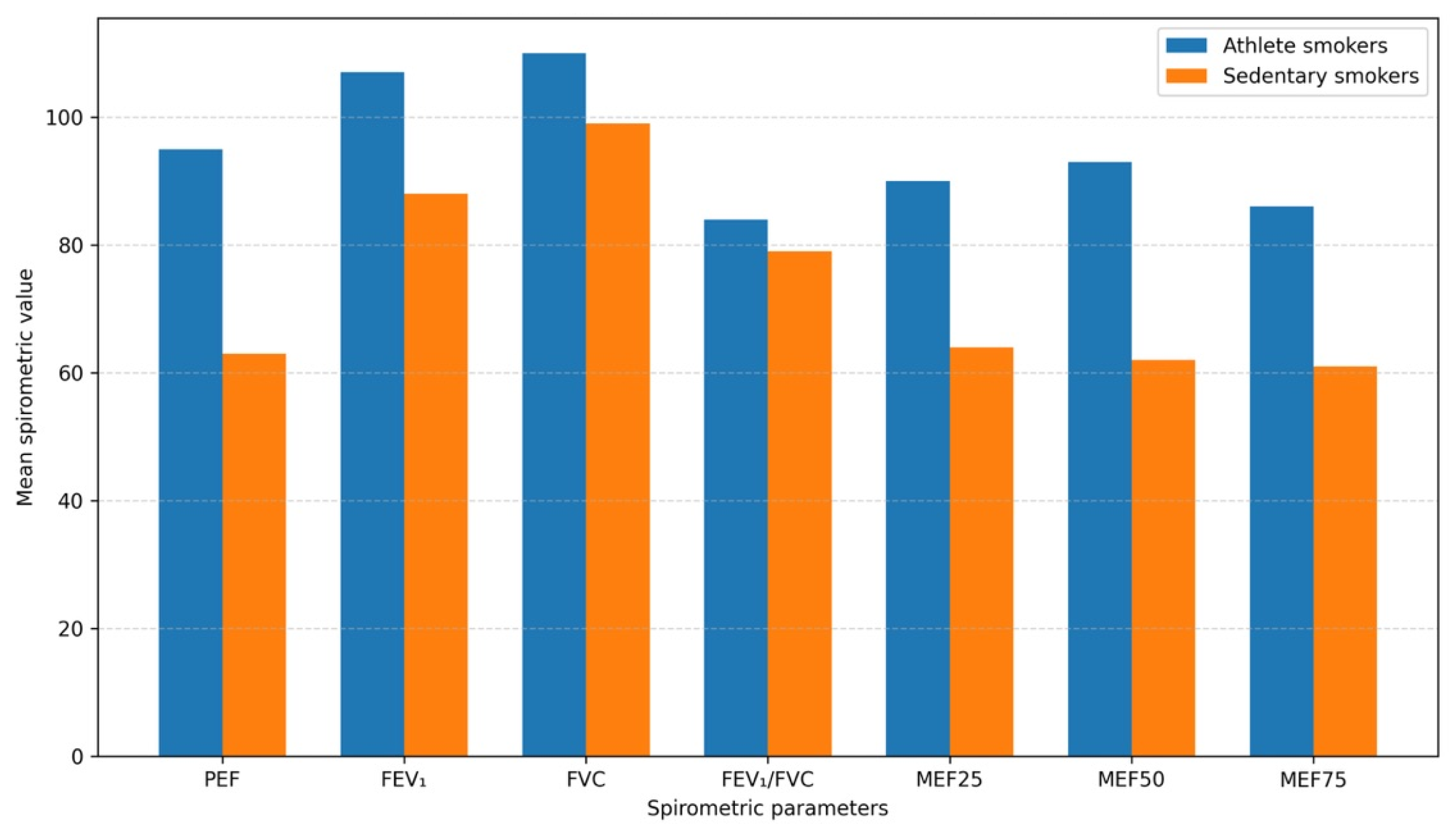
Comparative analyses were undertaken to examine differences in lung function between smoking medical students who engaged in regular physical activity (n = 56) and those who remained physically inactive. The results showed significant differences across all variables examined, confirming a significantly more favorable effect of regular physical activity on respiratory function. A comparable perspective was provided by a cross-sectional study conducted among the elderly population in India, which examined variations in respiratory function parameters, particularly maximal expiratory flow, between physically active individuals and their sedentary counterparts. The findings of this investigation highlight the crucial role of regular physical activity, particularly aerobic forms such as walking and swimming, in strengthening respiratory muscles and improving endurance. Moreover, the analysis confirmed that an active lifestyle exerted a protective association, mitigating the age-related decline in pulmonary function [
14].
Based on
Table 2, we can conclude that the median value of peak expiratory flow (PEF) (median: 95.0, IQR: 80.0–110.5) was significantly higher than that of medical students characterized by physical inactivity (median: 63.5, IQR: 56.0–76.0;
p < 0.001), reflecting better airway patency and more efficient ventilation performance. A similar trend was observed for forced expiratory volume in one second (FEV
1), where there was a significant difference between the median value for medical student athletes (106.5, IQR: 99.0–114.0) and physically inactive medical students (88.0, IQR: 82.75–95.0,
p < 0.001). The results for forced vital capacity (FVC) also showed a significant difference, with higher averages for medical student athletes (median: 109.64 ± 11.898), suggesting a more favorable preservation of lung function. The FEV
1/FVC ratio (Tiffeneau index) of athlete students was significantly more favorable (83.60) than that of medical students with a sedentary lifestyle (78.75;
p < 0.001), suggesting that ventilation disorders are less common in those with an active lifestyle. Numerous scientific studies have demonstrated that regular physical activity protects against the development of chronic diseases and reduces the risk of premature mortality. A fascinating Canadian study, which targeted people aged 45–85, analyzed healthy individuals, those with asthma, and those with very low FEV
1 values, and concluded that, in both healthy individuals and those with obstructive diseases, FEV
1 and FVC indices showed a positive correlation with physical activity. Thirty minutes of strength training or intense endurance training per day resulted in a 0.65 percentage point increase in the FEV
1 index, while the FVC increased by an average of 0.49 percentage points. These results suggest that physical activity may be beneficial for both healthy individuals and those with respiratory diseases [
15,
16]. In two population-based cohort studies involving children and young adults, Hancox et al. demonstrated that aerobic capacity is closely and positively correlated with FEV
1 and FVC values measured in young populations. However, they were unable to confirm a correlation between the FEV
1/FVC ratio and age, suggesting that aerobic performance is more closely related to lung volume than to airway diameter. Based on their findings, it can be inferred that the development of aerobic capacity in childhood and adolescence may have a beneficial effect on lung function in later life [
17].
In terms of flow parameters characteristic of the small airways (MEF
25, MEF
50, MEF
75), students with an active lifestyle also showed a clear advantage (89.8%, 92.5%, 86.0%), suggesting that regular physical activity has a beneficial effect on reducing airway resistance and preserving peripheral airway function. The incidence of airway obstruction showed a particularly striking difference between the two groups studied. At the level of the large airways, obstruction was identified in 25% of physically inactive medical students (
n = 17), whereas it did not occur in any of the medical student athletes (
p < 0.001). At the level of the small airways, peripheral dysfunction was detected in 21.4% of student athletes (
n = 12) and in 82.4% of medical students characterized by physical inactivity (
n = 56) (
p < 0.001). Overall, the data obtained (
Figure 1) clearly indicates that although both groups studied consisted of smokers, regular physical activity can significantly moderate the decline in lung function, reduce airway inflammation, and decrease the incidence of associated obstruction even in a smoking population. Moreover, the case–control analysis demonstrated that an active lifestyle was independently associated with a protective effect, attenuating the age-related decline in pulmonary function. Numerous systematic reviews have found that comprehensive treatment and rehabilitation programs developed for individuals with chronic obstructive pulmonary disease emphasize the recognized key role of physical activity in enhancing patient well-being, managing symptoms, and improving overall quality of life. A foreign systematic review, which assessed intervention studies that evaluated physical activity as an outcome measure in COPD patients, suggested that individuals with obstructive disease should monitor their daily and weekly physical activity and use objective measurement tools to track a minimum walking exercise program of at least 30 min per day, at least 3 times per week. At the same time, Kantorowski et al. proposed a system based on a behavior self-regulation theory, a pedometer, and a website to increase patients’ activity levels, allowing the COPD population to set goals, receive feedback, and access motivational and educational tips. These motivational techniques have been shown to increase daily step counts and improve lung capacity parameters [
18,
19].
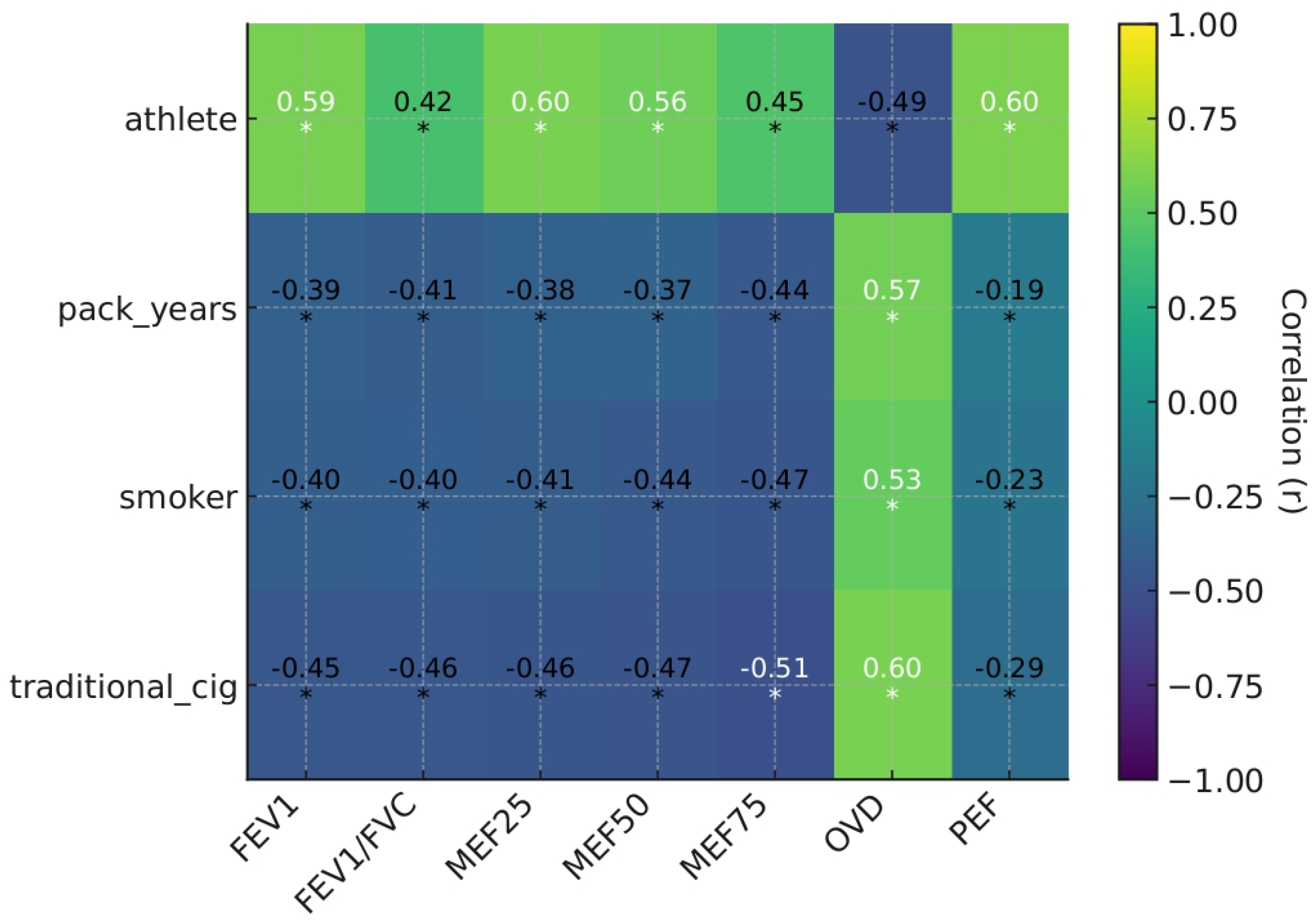
One of the primary objectives of our study was to examine the impact of classic cigarette consumption, smoking exposure (packs/year), and participation in sports activities on various respiratory function parameters in medical students from the University of Medicine, Pharmacy, Science, and Technology of Târgu-Mureș. During the analyses, we used Pearson’s correlation coefficient (r), coefficient of determination (r
2), and
p-values to evaluate the significance of the correlations. The results showed clear and statistically significant correlations between the lifestyle factors examined and respiratory function (
Table 3).
When comparing the data presented in
Table 3, we observed particularly pronounced differences between smokers and non-smokers in the MEF
25, MEF
50, and MEF
75 values, which reflect the function of the small airways. These parameters demonstrated a negative correlation with smoking, as tobacco use, irrespective of type, increased the likelihood of developing mild to moderate narrowing at the level of the distal airways. Our findings align with previous reports that the small airways are particularly susceptible to tobacco smoke-induced inflammatory and structural changes, resulting in increased mucus secretion, smooth muscle hypertrophy, and lumen narrowing, which may serve as an early indicator of functional airway narrowing [
20,
21]. Early indicators of peripheral narrowing caused by smoking are precisely reflected in the decrease in flow parameters. A foreign meta-analysis has highlighted that the MEF
75 value may be the most sensitive indicator for confirming increased exposure to cigarette smoke, and its decrease may be a primary marker for obstructive disease at the level of the small airways, even in individuals with FEV
1 within the normal range. However, it is essential to note that MEF
75 exhibits greater variability, is highly dependent on forced vital capacity, and has a wide range; therefore, it cannot replace FEV
1 as a standalone measure, which remains the primary indicator of airway flow impairment in smokers [
22].
Classic cigarette smoking showed a moderate to strong negative correlation with several respiratory function parameters. There was a strong positive correlation with distal ventilatory obstruction (OVD) (r = 0.595, r
2 = 0.354), which supports the well-known role of smoking in the pathophysiological mechanism of chronic obstructive pulmonary disease (COPD), causing persistent inflammation and distal airway damage. Long-term exposure caused not only changes in the larger airways, but also progressive signs of involvement of the peripheral airways, emphasizing the worsening of the obstructive pattern. A similar idea was expressed in a pivotal study involving 75 asymptomatic smokers with preserved spirometry values. It was observed that reduced MEF
25–75 parameters often occur even in the absence of flow limitation. In asymptomatic smokers, in addition to the early presence of small airway obstruction, a parallel deterioration in parameters obtained by classical spirometry was detected, indicating worsening flow limitation [
23]. The correlations between pack-years/index and respiratory function parameters are particularly valuable in assessing the effects of cumulative exposure. The decrease in MEF75 values (r = −0.438,
p < 0.001) and an increase in distal airway resistance (r = 0.575,
p < 0.001) suggest a more pronounced adverse effect of smoking duration and quantity, which over time leads to damage to the small airways. At the same time, in the case of the Tiffeneau index (FEV
1/FVC), it was observed that even at a relatively low r value (r = −0.41), the coefficient of determination represented an explanatory power of 15–20%, which may be of high clinical significance. These results are consistent with the recommendations of the Global Obstructive Lung Disease (GOLD) initiative, according to which smoking history is a key risk factor in predicting functional decline in the lung parenchyma [
24].
In contrast, significantly better respiratory function parameters were observed among medical students engaged in athletics. Athlete status showed a strong positive correlation with PEF (r = 0.602,
p < 0.001), FEV1 (r = 0.588,
p < 0.001), and MEF
25 (r = 0.598,
p < 0.001). In addition, sports activity moderately but significantly improved the FEV1/FVC ratio (r = 0.416,
p < 0.001) and had a favorable effect on small airway flow parameters, including MEF
50 (r = 0.558,
p < 0.001) and MEF
75 (r = 0.449,
p < 0.001). The beneficial effects of exercise have been confirmed by numerous studies, which show that regular aerobic exercise improves lung function and reduces obstructive airway symptoms, even in smokers. For example, in a foreign study, Andrade CHS et al. observed the effect of physical activity on the treatment of asthma patients. Based on their results, they demonstrated that increased physical performance improves psychosocial factors in individuals with obstructive pulmonary disease, reducing exercise-induced bronchoconstriction and the need for corticosteroid use. These results suggest that an active lifestyle may play a role in alleviating airway inflammation and associated narrowing [
25]. A novel observation is that exercise is negatively correlated with the onset of obstructive ventilation disorders (r = −0.488), leading to a decrease in distal airway resistance. This may suggest that an active lifestyle can partially offset the adverse peripheral airway effects of smoking, exerting a protective effect. The correlations we found were also directly reflected in a foreign meta-analysis, where the authors, comparing several randomized controlled trials, measured the positive impact of exercise on smoking cessation and stated that regular aerobic exercise not only improves cardiovascular and respiratory function, but also alleviates obstructive airway symptoms even among smokers [
26].
Overall, as confirmed by the correlation heat map (
Figure 2), respiratory function parameters show significant sensitivity to lifestyle factors. Smoking harms both large and small airway functions, and cumulative exposure further exacerbates functional decline. In contrast, regular physical activity has a beneficial effect on several parameters and can partially offset the harmful effects of lifestyle factors, compensating for the decrease in airway function. The strength and significance of the correlations confirm the clinical relevance of the data obtained, emphasizing the importance of smoking cessation and promoting physical activity from both a prevention and intervention perspective.
Peak expiratory flow (PEF) was significantly higher in the group using alternative tobacco products (88.5 vs. 73.0; p = 0.009), suggesting that maximum expiratory dynamics are better preserved in this student population.
The forced expiratory volume in the first second (FEV1) showed a particularly significant difference: in the e-cigarette/IQOS group, the mean function exceeded 100% (104.8 ± 11.3), while in traditional smokers, we recorded a significantly lower value (93.4 ± 14.9; p < 0.001). This trend was also reflected in the FEV1/FVC ratio, where the values for alternative product users were more favorable (84.6 vs. 80.7; p < 0.001), suggesting less obstructive abnormalities.
The flow parameters of the small airways (MEF
25, MEF
50, MEF
75) were consistently higher among e-cigarette/heated tobacco product users. For example, the median MEF
25 value was 87.5, compared to 68.0 for conventional smokers (
p < 0.001). These differences suggest that functional impairment of the peripheral airways is less pronounced in those who use e-cigarettes or heated tobacco products. However, a randomized crossover study found that acute, 5-day use led to a 25% increase in forced expiratory flow (MEF
25), suggesting that discontinuing the use of heated tobacco products reduced airway resistance, thereby improving lung function. Based on this, we can conclude that even short-term exposure to e-cigarette aerosol can lead to increased airway resistance and inflammation, which, however, may be reversible upon cessation of these products [
27].
In our study, we focused on comparing different smoking habits and assessing the negative impact of these harmful habits on respiratory function parameters. A total of 124 medical students who are smokers participated in the study, of whom 102 smoked conventional cigarettes, while 22 used heated tobacco products or e-cigarettes (IQOS/e-cigarettes). Some students fell into both categories. During the study, we found significant differences between the respiratory function indicators of traditional smokers and e-cigarette/IQOS users (
Table 4).
Peak expiratory flow (PEF) was significantly higher in the group using alternative tobacco products (88.5 vs. 73.0; p = 0.009), suggesting that maximum expiratory dynamics are better preserved in this population.
Forced expiratory volume in one second (FEV
1) showed a particularly significant difference: in the e-cigarette/IQOS group, the average function exceeded 100% (104.8 ± 11.3), while in traditional smokers, we recorded a significantly lower value (93.4 ± 14.9;
p < 0.001), predicting the possibility of developing obstructive pulmonary disease. A similar idea was expressed in a retrospective cohort study, which stated that FEV
1 is one of the most important parameters used in the diagnosis and monitoring of smoking-related diseases. Chronic exposure to cigarette smoke causes inflammation and narrowing of the airways, which, over time, leads to a gradual decline in FEV
1. This decline reflects airway obstruction and is associated with worsening respiratory symptoms, decreased physical performance, and an increased risk of exacerbations, confirming the clinical relevance of FEV
1 [
28]. The trend observed in FEV
1 levels was also reflected in the FEV
1/FVC ratio, where values were more favorable for users of alternative tobacco products (84.6 vs. 80.7;
p < 0.001), confirming fewer obstructive abnormalities in individuals belonging to this group. The flow parameters of the small airways (MEF
25, MEF
50, MEF
75) were consistently higher among users of e-cigarettes/heated tobacco products (IQOS). For example, the median MEF
25 value was 87.5, compared to 68.0 for conventional smokers (
p < 0.001). These differences suggest that functional impairment of the peripheral airways is less pronounced in those who use e-cigarettes or heated tobacco products. In contrast, a Greek study’s results showed that after using heated tobacco products, especially IQOS (“I-Quit-Ordinary-Smoking”), participants’ gas exchange and small airway functional parameters (SaO2, MEF
25%, MEF
50%, MEF
75%, PEF) significantly deteriorated. In contrast, there was an increase in exhaled CO levels and airway resistance measured at multiple frequencies (R5-R35 HZ), indicating acute airway stress and increased obstructive changes [
29]. However, a randomized crossover study found that acute, 5-day use led to a 25% increase in forced expiratory flow (MEF
25), suggesting that discontinuing the use of heated tobacco products reduced airway resistance, thereby improving lung function. Based on this, we can conclude that even short-term exposure to e-cigarette aerosol can lead to increased airway resistance and inflammation, which, however, may be reversible upon cessation of these products [
27].
Vital capacity (FVC) was also higher among e-cigarette/IQOS users (108.0 vs. 103.0). Still, the difference was not statistically significant (
p = 0.082), which suggests that total lung capacity is a less sensitive marker of the effects of different smoking habits and draws attention to the inevitable negative impact of e-cigarette aerosol exposure on the cardiovascular system. Similarly, an American study examining the cardiorespiratory effects of heated tobacco products found that e-cigarettes, e-liquids, and the aerosols they emit contain both known and unknown harmful chemicals that can cause increased arterial stiffness, vascular endothelial changes, and heightened airway reactivity and inflammation, similar to traditional tobacco products. Although e-cigarettes are advertised as a healthier alternative to conventional cigarettes, research findings to date show that the respiratory and cardiovascular systems undergo numerous changes and that the development of disease depends on how these changes combine with environmental and genetic factors [
30]. However, a recent study comparing smokers without chronic disease to a group of asthma patients treated with short-acting bronchodilators stated that exposure to a single electronic cigarette or heated tobacco product can cause immediate mechanical and respiratory changes in both study groups, with the intensity and duration of the changes being more pronounced in individuals with asthma symptoms [
31].
Overall, based on our test results, we can conclude that although both forms of smoking can cause damage to the respiratory system, respiratory function parameters were more favorable in several respects in users of e-cigarettes/heated tobacco products (IQOS). The most significant differences were observed in small airway flow values, as well as in FEV
1 and the FEV
1/FVC ratio, which clinically suggests that traditional smoking leads to faster and more severe respiratory function decline. Although alternative devices cannot be considered harmless, these results may support the idea that switching from conventional smoking may have certain physiological benefits, potentially leading to a reduction in the levels of pulmonary endothelial and inflammatory markers. Further prospective, long-term studies are needed to determine clinical relevance, more accurately assess the extent of risk reduction, and evaluate the potential for the development of obstructive lung diseases. Our findings revealed an inverse correlation compared with previously published reports, which concluded that heated tobacco products (HTPs), including IQOS, exhibit considerable toxicity and may trigger pathophysiological mechanisms like those induced by conventional cigarettes [
32]. In a 2024 study examining the effects of switching from traditional cigarettes to IQOS on pulmonary endothelial and inflammatory biomarkers, the authors reported that transitioning to heated tobacco products resulted in only modest improvements. In contrast, complete cessation was substantially more effective in restoring both immune function and pulmonary performance [
33]. Furthermore, an independent investigation conducted in 2018 among otherwise healthy adults—who reported smoking at least 10 conventional cigarettes per day over the preceding three years—demonstrated no significant differences in respiratory parameters between IQOS users and conventional smokers, thereby reinforcing evidence that HTPs exert detrimental effects by promoting airway inflammation and immunosuppression [
34].
Finally, but not least, we also compared the obtained lung function parameters between the group of medical student athletes and those with a sedentary lifestyle. The results presented in
Table 5 clearly demonstrate that athletically active medical students exhibited significantly more favorable lung function values compared with their sedentary counterparts. These differences were evident across a wide range of parameters, supporting the beneficial impact of regular physical activity on respiratory function and capacity. The peak expiratory flow (PEF) and forced expiratory volume (FEV
1) values were significantly higher in the group of student athletes, indicating improved expiratory performance and more efficient airway functioning. A similar trend can be observed in the case of vital capacity (FVC), where physically active medical students demonstrated a statistically significant difference in lung capacity compared to those with a physically inactive lifestyle. The FEV
1/FVC ratio also confirmed the more favorable respiratory function profile of student athletes, suggesting that sports activities contribute to maintaining airway elasticity and expiratory dynamics. A 2023 study examining anthropometric parameters in young athletes compared with individuals leading a sedentary lifestyle reported broad agreement regarding the beneficial role of regular aerobic exercise in reducing the burden of respiratory diseases. However, the direct effect of an active lifestyle on mortality and disease burden reduction remains inconclusive. The investigation nonetheless identified apparent differences in pulmonary function indices between athletes and non-athletes, with significantly higher PEF and FEV
1 values observed in the athletic cohort, thereby underscoring the respiratory benefits of sustained physical activity [
35]. Similarly, a 2024 descriptive study assessing pulmonary function parameters in individuals aged 18 to 80 years demonstrated that increased sedentary behavior is negatively associated with lung function indices and can be identified as a significant risk factor for the development of several chronic diseases, including respiratory disorders [
36].
Notably, the consistently higher values of small airway flow parameters (MEF
25, MEF
50, MEF
75) among individuals participating in competitive sports indicate better peripheral airway patency and more efficient airflow maintenance. In a descriptive and comparative cross-sectional study conducted over six months in 2023, in which sedentary individuals were compared with elite athletes, it was reported that elite athletes may also develop maladaptive alterations at the level of the respiratory system, such as intra- and extra-thoracic obstructions, expiratory flow limitation, respiratory muscle fatigue, and exercise-induced hypoxemia. Nevertheless, the study demonstrated that athletes exhibit superior airway patency and more favorable small-airway flow parameters (MEF
25–75). The reduced airway resistance may partly explain the findings of increased alveolar compliance and improved overall lung elasticity observed in elite athletes [
37].
Overall, these results confirm that regular physical activity has a beneficial effect not only on the cardiovascular system but also on respiratory function. The significant differences observed in student athletes reflect multidimensional improvements in lung mechanics and airway function. Accordingly, the findings support the conclusion that regular exercise functions as a protective factor against the decline in respiratory function and contributes substantially to the maintenance of long-term respiratory health.
To obtain a more refined and robust understanding of the detrimental effects of smoking and the beneficial impact of physical activity, we conducted a multivariable regression analysis adjusted for sex and age. This approach allowed us to account for key demographic confounders and thereby strengthen the validity and interpretability of our findings (
Table 6).
Across all multivariable models, the influence of smoking-related variables on ventilatory function was generally limited, whereas demographic and lifestyle predictors demonstrated more consistent and clinically meaningful associations. For the PEF (% predicted) model (R
2 = 0.436), none of the smoking-related variables showed significant independent effects, including smoking status, pack-years, classical cigarettes, or electronic/heat-not-burn devices. Only age, male sex, and particularly regular sports activity emerged as significant positive predictors, underscoring physiological growth effects and the beneficial influence of cardiorespiratory conditioning (
Table 7).
This pattern was also evident in the regression model for FEV1/FVC (R
2 = 0.365), where classical smoking indicators, including smoking status and pack-years, did not emerge as significant determinants of expiratory flow (
Table 8). Although some trends were observable (e.g., pack-years approaching significance for FEV1/FVC), these effects remained modest and imprecise, suggesting that early smoking exposure in this predominantly young population has not yet translated into measurable impairments in flow ratios (
Table 8).
Similarly, in the multivariable linear regression model for FEV1% (R
2 = 0.459), most smoking-related predictors did not demonstrate significant independent associations. Neither current smoking status nor the use of conventional cigarettes showed meaningful effects on FEV1%, and pack-years displayed only a borderline negative trend. Electronic cigarette/IQOS use showed a modest positive association, though this should be interpreted with caution given the potential for behavioral or selection-related bias. Age and sex were again not significant predictors. Regular physical activity emerged as the strongest determinant of FEV1%, being independently associated with substantially higher values, underscoring the prominent role of lifestyle factors in preserving ventilatory capacity within this cohort (
Table 9).
This pattern was also evident in the regression models for MEF25 (R
2 = 0.483), MEF50 (R
2 = 0.454), and MEF75 (R
2 = 0.382), where classical smoking indicators, including smoking status and pack-years, did not emerge as significant determinants of expiratory flow (
Table 10,
Table 11 and
Table 12). Although some trends were observable (e.g., pack-years approaching significance for MEF75), these effects remained modest and imprecise, suggesting that early smoking exposure in this predominantly young population has not yet translated into measurable impairments in flow–volume curve segments (
Table 12).
In contrast, as shown in
Table 10 and
Table 11, electronic cigarette or heated tobacco use showed small but statistically significant positive associations in several models (MEF
25 and MEF
50). While statistically detectable, these effects are unlikely to represent physiological improvement; they may instead reflect behavioral patterns, differences in inhalation technique, or residual confounding. Such findings should therefore be interpreted with caution.
Age exerted significant positive effects on MEF
25 but did not influence the other flow parameters or ratios, likely reflecting the relatively narrow age distribution of the cohort. Being male was associated with lower FEV
1/FVC values and showed borderline effects in other models, a finding consistent with known sex-related differences in airway geometry and spirometry performance. Across all models, engaging in regular sports activity was among the strongest predictors of improved expiratory flow, demonstrating robust positive effects on MEF
25, MEF
50, MEF
75, and, to a lesser extent, FEV
1/FVC. These results underscore the protective influence of physical conditioning and respiratory muscle performance, which may partially counterbalance early adverse exposures (
Table 8,
Table 10,
Table 11 and
Table 12).
As shown in
Table 6 and
Table 13, the logistic regression models consistently identified cumulative smoking exposure (pack-years) as the only significant smoking-related predictor of distal airway obstruction, demonstrating a clear dose–response relationship. Current smoking, classical cigarette use, and electronic cigarette/heat-not-burn use showed non-significant associations, indicating no measurable independent effect in this cohort. Age and sex were likewise non-significant predictors. In contrast, regular sports participation emerged as a strong and consistent protective factor, markedly reducing the odds of distal airflow obstruction. Overall, the combined findings indicate that cumulative smoke exposure is the key determinant of early distal airway involvement, while sustained physical activity provides substantial protection. For proximal obstruction (large-airway DVO ≥ 1), the pattern was similar, with minimal influence from smoking-related variables and a protective trend associated with sports participation. These findings reinforce the concept that in young individuals, airflow limitation, when present, is more closely linked to cumulative exposure rather than smoking status alone, and that physical activity plays a central role in preserving airway function.
For proximal obstruction (large-airway DVO ≥ 1), the pattern was similar, with minimal influence from smoking-related variables and a protective trend associated with sports participation. These findings reinforce the concept that in young individuals, airflow limitation, when present, is more closely linked to cumulative exposure rather than smoking status alone, and that physical activity plays a central role in preserving airway function.
Overall, the collective results suggest that demographic and lifestyle factors currently outweigh smoking-related predictors in determining spirometry performance within this cohort. The early and subtle trends associated with cumulative smoking exposure highlight the potential for progression, emphasizing the importance of longitudinal follow-up. The consistently strong beneficial effects of regular sports activity across all outcomes underscore its relevance as a modifiable determinant of respiratory health, even among individuals with early exposure to tobacco or nicotine products.




 ,
,