Article

Albumin-Bound Fatty Acids Modulate Endogenous Angiotensin-Converting Enzyme (ACE) Inhibition

1
Division of Clinical Physiology, Department of Cardiology, Faculty of Medicine, University of Debrecen, 4032 Debrecen, Hungary
2
Kálmán Laki Doctoral School, University of Debrecen, 4032 Debrecen, Hungary
3
Department of Surgery, Faculty of Medicine, University of Debrecen, 4032 Debrecen, Hungary
4
Department of Emergency Medicine, Faculty of Medicine, University of Debrecen, 4032 Debrecen, Hungary
*
Author to whom correspondence should be addressed.
These authors contributed equally to this work.
Biomedicines 2026, 14(1), 103; https://doi.org/10.3390/biomedicines14010103
Submission received: 29 November 2025 / Revised: 27 December 2025 / Accepted: 1 January 2026 / Published: 4 January 2026
(This article belongs to the Special Issue Renin-Angiotensin System in Cardiovascular Biology, 2nd Edition)

Abstract

Background/Objectives: Human serum albumin (HSA) is a major endogenous inhibitor of angiotensin-converting enzyme (ACE) and helps fine-tune the activity of the renin–angiotensin–aldosterone system (RAAS), thereby potentially influencing the development of cardiovascular (CV) diseases. As the principal transport protein for free fatty acids (FFAs), HSA may have its ACE-inhibitory capacity modified by its FFA cargo and, through this mechanism, may also affect CV disease risk. We therefore tested the hypothesis that the composition of HSA-bound FFAs determines the magnitude of endogenous ACE inhibition. Methods: We quantified endogenous ACE inhibition and examined the effect of FFA concentration on this inhibition in clinical patients (n = 161 and n = 101, respectively). We measured the effects of HSA treated with saturated, monounsaturated, and polyunsaturated FFAs, as well as FFA-free HSA, on recombinant ACE and on tissue ACE. Results: Endogenous ACE inhibition was stronger in patients with higher serum HSA concentrations (Spearman’s rho = 0.422, 95% CI 0.281–0.544, p < 0.001), whereas total FFA concentration was not associated with endogenous ACE inhibition (Spearman’s rho = 0.088, p = 0.38, n = 101). However, removal of free fatty acids substantially worsened the ACE-inhibitory effect of HSA on recombinant ACE (charcoal-treated HSA: IC50 = 23.24 [19.40–29.78] g/L vs. control HSA: 7.84 [6.58–9.75] g/L, p < 0.001) and on tissue ACE isolated from lung, heart, and lymph node. FFA chain length, degree and position of unsaturation, and cis/trans configuration all differentially modulated endogenous ACE inhibition. Among saturated fatty acids, stearic acid (IC50 = 7.98 [7.04–9.23] g/L), and among omega-3 and omega-6 fatty acids, α-linolenic (IC50 = 5.60 [4.28–6.15] g/L) and γ-linolenic acids (IC50 = 5.09 [4.28–6.15] g/L) produced the greatest enhancement of the ACE-inhibitory capacity of HSA. Conclusions: The present results indicate that HSA concentration relates to endogenous ACE inhibition in serum, and in vitro experiments demonstrate that HSA-bound FFAs can modulate HSA-mediated ACE inhibition, a mechanism that may be relevant to cardiovascular physiology and disease.

1. Introduction

Dysregulation of the renin–angiotensin–aldosterone system (RAAS) underpins the pathogenesis of several major cardiovascular diseases [1,2]. In these high-burden conditions—such as hypertension, heart failure, and stroke—randomized trials and meta-analyses show that inhibition of angiotensin-converting enzyme (ACE) reduces cardiovascular events and mortality [3,4]. ACE, present in both membrane-bound and soluble forms, is prominently expressed on vascular endothelium and at epithelial surfaces in key organs (e.g., lung, heart, kidney, intestine) and generates angiotensin II, the principal RAAS effector [5]. Consequently, ACE inhibitors exert their benefits chiefly by limiting angiotensin II formation and downstream AT1-receptor–mediated vasoconstriction, sodium retention, and adverse remodeling [6].
Beyond pharmacological inhibition, ACE activity is also shaped in vivo by endogenous regulation. At the genetic level, ACE expression is largely influenced by the common insertion/deletion (I/D) polymorphism—DD carriers show approximately 1.5–2-fold higher circulating ACE than II carriers [7]—yet this variation has little or at most inconsistent impact on cardiovascular morbidity and mortality [8]. A plausible explanation is that human serum albumin (HSA) acts as a strong endogenous inhibitor of ACE at physiological concentrations, thereby buffering genotype-driven differences in ACE expression [9]. At physiological concentrations (~35–52 g/L), HSA suppresses circulating ACE activity by almost 90%, and it also inhibits membrane-bound ACE where local HSA concentrations within tissues are sufficiently high [9].
Nonetheless, multiple studies have confirmed that low—or even low-normal—HSA is consistently associated with higher cardiovascular morbidity and mortality [10,11]. Lower HSA may imply weaker HSA-mediated endogenous ACE inhibition; thus, ACE inhibitors may be particularly effective in such patients by pharmacologically substituting for a missing physiological brake on angiotensin II generation [12]. Notably, HSA is the predominant plasma carrier for a wide range of biomolecules and drugs, including non-esterified (free) fatty acids (FFA). HSA contains multiple, non-equivalent long-chain fatty-acid binding sites, and fatty-acid binding induces reproducible conformational and surface-property changes that can remodel HSA’s interactions with partner proteins [13,14,15].
FFAs themselves may relate to cardiovascular risk. Higher intake of the plant omega-3 fatty acid α-linolenic acid (ALA) is associated with modest reductions in cardiovascular diseases (CVD) and coronary mortality, and ALA-rich flaxseed lowers blood pressure in randomized trials [16,17]. Likewise, greater intake and circulating levels of the omega-6 fatty acid linoleic acid are associated with lower risks of CVD and mortality [18,19]. However, elevations in total circulating FFAs have been unfavorably linked to cardiovascular risk [20], even as specific FFA species may confer benefits. These observations raise the questions central to this work: do the level of HSA-bound FFAs modulate the degree of endogenous ACE inhibition, and can specific FFAs confer cardiovascular benefit, at least in part, by enhancing this endogenous inhibition?

2. Materials and Methods

2.1. Subjects, Samples and Ethical Approval

To investigate the relationship between endogenous ACE inhibition and HSA concentration, 161 adults were enrolled from the staff of the Department of Cardiology, University of Debrecen, and from patients attending its outpatient clinic. None of the participants were receiving ACE inhibitor therapy, as verified by medication history and biochemical measurements [21]. All participants provided written informed consent prior to inclusion. The study protocol was approved by the Scientific and Research Ethics Committee of the University of Debrecen and by the Scientific and Research Ethics Committee of the Medical Research Council, Budapest, Hungary (ETT TUKEB, research authorization number: 33327-1/2015/EKU; approved on 23 June 2015). Basic information and key laboratory findings of this group are provided in the Appendix A Table A1.
For the analysis of the association between endogenous ACE inhibition and total FFA concentration, laboratory results from 101 serum samples submitted for diagnostic ACE activity measurement to the Division of Clinical Physiology, Department of Cardiology, University of Debrecen, were analyzed. This part of the study was approved by the Regional and Institutional Ethics Committee, Clinical Centre, University of Debrecen (research authorization number: 5925-2021, approved on 15 December 2021). Basic information and key laboratory findings of this group are provided in the Appendix A Table A2.
Blood samples were collected from all participants using standard aseptic technique into Vacutainer tubes (Cat. No. 367955, Becton Dickinson, Franklin Lakes, NJ, USA). Serum was separated after clotting by centrifugation at 1500× g for 15 min at room temperature. The serum samples were stored at −20 °C until analysis.

2.2. Production and Purification of Recombinant, Human ACE

The plasmid used for recombinant human ACE (recACE) production was obtained from GeneCopoeia (custom clone, N-terminal His-tagged; Cat. No. CS-Y4341-I03-02, Rockville, MD, USA). The plasmid sequence was codon-optimized for expression in insect cells, and the coding sequence corresponding to the membrane-anchoring region was deleted (see Supplementary Figure S1. for the plasmid sequence). The plasmid (10 ng) was introduced into DH10Bac competent E. coli cells (100 µL, Cat. No. 10361-012, Thermo Fisher Scientific, Waltham, MA, USA) by heat shock (45 s, 42 °C) according to the manufacturer’s instructions. The resulting bacmids were isolated (HiSpeed Plasmid Maxi Kit, Cat. No. 12662, Qiagen, Hilden, Germany) and transfected into Sf9 insect cells (Cat. No. 11496-015, Thermo Fisher Scientific) using Cellfectin II reagent (Cat. No. 10362100, Thermo Fisher Scientific, Waltham, MA, USA; 480 ng bacmid in SF900 medium containing 40 µg/mL Cellfectin II). The produced baculoviruses were harvested and used to infect fresh Sf9 cultures. Insect cells were maintained in serum-free medium (Sf-900 II SFM, Cat. No. 10902153, Thermo Fisher Scientific, Waltham, MA, USA) supplemented with 1 µM ZnCl2 at 28 °C. Recombinant protein production was monitored by measuring ACE activity in the culture supernatant. recACE appeared in the medium and reached its maximum enzymatic activity on the fourth day post-infection. The supernatant containing recACE was collected, and the recombinant protein was purified by HPLC using Ni-NTA Superflow agarose (Cat. No. 25215, Thermo Fisher Scientific, Waltham, MA, USA). The supernatant containing recACE was collected, and the recombinant protein was purified by immobilized metal affinity chromatography on a Ni–NTA Superflow agarose column (Cat. No. 25215; Thermo Fisher Scientific, Waltham, MA, USA). Two milliliters of recACE-containing medium were loaded onto a column packed with 10 mL resin at a constant flow rate of 1 mL/min. The sample was applied over 10 min in equilibration buffer (200 mM Na3PO4, 300 mM NaCl, 10 mM imidazole; pH 7.4), followed by a 10-min wash step (20 mM Na3PO4, 300 mM NaCl, 20 mM imidazole; pH 7.4) and a 10-min elution step (20 mM Na3PO4, 300 mM NaCl, 300 mM imidazole; pH 7.4). Fractions eluting between 24 and 28 min were concentrated using 100 kDa MWCO centrifugal concentrators (Vivaspin 500; Cat. No. Z614092; Merck, Darmstadt, Germany), and the purified protein was stored in 100 mM Tris buffer (pH 7.0) containing 50% (v/v) glycerol at −20 °C until use.

2.3. Measurement of ACE Activity, Endogenous ACE Inhibition, HSA and Total FFA Concentration

ACE activity was determined using our optimized fluorescent kinetic assay, published elsewhere [22]. The level of serum HSA-mediated endogenous ACE inhibition was calculated from dilution-corrected ACE activity values measured at 4-fold and 400-fold serum dilutions, as described previously [21]. Serum HSA concentration was measured using a Cobas Integra 400 Plus clinical chemistry analyzer (Roche Diagnostics, Basel, Switzerland) with the manufacturer’s bromocresol green assay (Cat. No. 03183688122). Total FFA concentration was determined on the same analyzer by a colorimetric enzymatic method using the Dialab FFA reagent (Cat. No. D07940, Dialab, Neudorf, Austria), together with the corresponding calibrator (Diacal Lipids, Cat. No. D13585SV) and control materials (normal control: Cat. No. D99486; pathological control: Cat. No. D11487), according to the manufacturer’s instructions.

2.4. Removal of FFAs from HSA

HSA solution (Albunorm 200 g/L infusion, Octapharma, Lachen, Switzerland) was diluted to a final concentration of 100 g/L with distilled water. Activated charcoal powder (Cat. No. C9157-500G, Sigma-Aldrich, St. Louis, MO, USA) was added to the solution at a final concentration of 20% (w/v). The suspension was incubated for 24 h at room temperature with continuous rotation (15 rpm), followed by centrifugation at 20,000× g for 30 min at +4 °C to remove the charcoal. The resulting FFA-free HSA solution was concentrated to approximately 200 g/L using a miVac DUO Concentrator (GeneVac Inc., Ipswich, UK) and sterilized by filtration through a 0.2 μm membrane filter (Cat. No. 4652, Pall Life Sciences, Cornwall, UK). The HSA concentration was determined as described above.

2.5. Treatment of FFA-Free HSA with Specific Fatty Acids

The sodium salt of each fatty acid was mixed with FFA-free HSA at a 4:1 molar ratio. The mixture contained 50 mM NaCl and was incubated overnight at room temperature with continuous rotation (15 rpm). After incubation, unbound fatty acids were removed by filtration using a Vivaspin 20 concentrator (30 kDa cut-off; Cat. No. 28-9323-61, GE Healthcare, Buckinghamshire, UK). The treated HSA was then washed three times with distilled water, and after each washing step, the sample was reconcentrated using the same ultrafiltration device. HSA concentration was determined by the bromocresol green method, as described above. The procedure was repeated for each tested fatty acid. The physicochemical properties of the examined fatty acids are summarized in Supplementary Table S1.

2.6. Immunoprecipitation of Tissue ACE

High-binding 96-well ELISA plates (Cat. No. 655061, Greiner Bio-One, Kremsmünster, Austria) were coated with 0.6 μg/well goat anti-mouse IgG (cat. No. 31168, Pierce, Rockford, IL, USA) to immobilize the mouse monoclonal anti-ACE antibody 9B9 (a kind gift from Prof. Sergei Danilov) [23]. Plates were incubated for 2 h at 37 °C with continuous horizontal shaking (200 rpm), followed by washing with PBST (PBS (Cat. No. 14190-094, ThermoFisher, Waltham, MA USA) containing 0.05% Tween-20). The wells were then coated with 0.5 μg/well of the 9B9 antibody (prepared as 10 μg/mL in PBS containing 1% BSA Cat. No. A7906, Merck KGaA, Darmstadt, Germany) and washed twice with PBST before sample loading. Human tissue samples were mechanically pulverized in liquid nitrogen using a mortar and pestle. On ice, 5 mL of 100 mM Tris–HCl (pH 7.0) was added per gram of tissue (wet weight). The samples were homogenized using a tissue homogenizer (Bio-Gen PRO200; PRO Scientific, Oxford, CT, USA) and centrifuged at 16,100× g for 5 min. The supernatants were collected and diluted 5–20-fold in PBS containing 1% (w/v) BSA and added to the antibody-coated wells. Plates were incubated under the same conditions as above, then washed twice with PBST and once with PBS. The prepared plates were subsequently used for HSA treatments. Serial twofold dilutions of control HSA and FFA-free HSA, starting from a final concentration of 90 g/L, were added to the wells, and ACE activity was measured as described in Section 2.3.

2.7. Statistical Analysis

Dose–response data were fitted using a four-parameter logistic inhibition model. IC50 values and 95% confidence intervals (profile likelihood) were obtained from the fits. Differences between IC50 values were evaluated using the extra-sum-of-squares F-test (‘Compare fits’ option). To account for multiple testing across planned comparisons of FFA-loaded HSA versus fatty acid–free HSA, p-values were adjusted using the Holm–Šidák method. Multivariable linear regression (ordinary least squares) was used to assess the independent associations of serum HSA concentration and other covariates with endogenous ACE inhibition. Models including additional clinical covariates were performed as complete-case analyses. Model diagnostics included assessment of residual normality and multicollinearity (variance inflation factors, VIF). Continuous variables were tested for normality and are presented as median [interquartile range]; group differences were assessed using the Mann–Whitney U test. Categorical variables were compared using the chi-square (χ2). A p value < 0.05 was considered statistically significant. Statistical analyses were performed using GraphPad Prism v10 (GraphPad Software, San Diego, CA, USA).

2.8. Role of Generative AI and AI-Assisted Technologies in the Writing Process

During the preparation of this work, the authors used ChatGPT (OpenAI, San Francisco, CA, USA, version 5.2) to improve the clarity, structure, and readability of the manuscript, including the abstract and cover letter. After using this tool, the authors carefully reviewed and edited the content and take full responsibility for the integrity and accuracy of the publication.

3. Results

3.1. Endogenous ACE Inhibition Depends on HSA Concentration and Its Bound Non-Aqueous Compounds

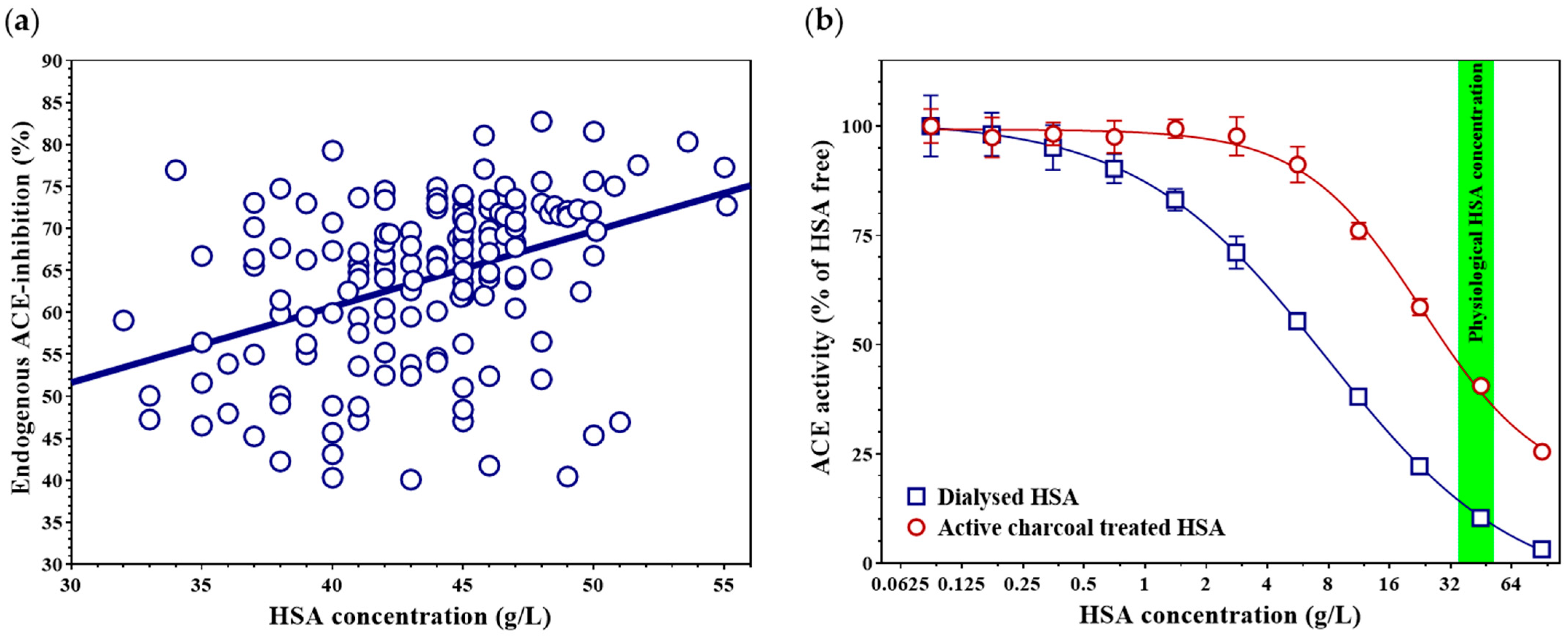
Endogenous ACE inhibition and HSA concentration were measured in 161 individuals (Figure 1a). The degree of inhibition increased with higher HSA levels (Spearman’s rho = 0.422, 95% CI 0.281–0.544, p < 0.0001). However, the linear fit to the data was only moderate (r2 = 0.164), suggesting that—besides HSA concentration—other factors may also influence the extent of endogenous ACE inhibition. To further explore potential confounders, we performed multivariable linear regression analyses. HSA concentration remained positively associated with endogenous ACE inhibition after adjustment for age and sex (Table A3), and this finding was confirmed in complete-case and extended models including BMI and eGFR (Table A4 and Table A5). Analyses in the smaller bilirubin subset are presented as exploratory (Table A6).
HSA serves as a major carrier protein for both water-soluble and water-insoluble molecules. Therapeutic HSA preparations are typically purified by dialysis, which effectively removes water-soluble substances but leaves water-insoluble compounds bound to HSA. HSA purified by dialysis markedly reduced recombinant ACE activity in a concentration-dependent manner (IC50 = 7.84 [6.58–9.75] g/L), resulting in approximately 90% inhibition at physiological HSA concentration (at 45 g/L; Figure 1b, blue squares). In contrast, removal of water-insoluble compounds from HSA by active-charcoal treatment significantly diminished its ACE-inhibitory capacity (IC50 = 23.24 [19.40–29.78] g/L, p < 0.001; Holm–Šidák-adjusted p = 0.001; Figure 1b, red circles), leading to a roughly fourfold increase in residual ACE activity at physiological HSA levels (41% at 45 g/L HSA concentration).

3.2. The Type, Rather than the Total Concentration of FFAs Determines the Extent of Endogenous ACE Inhibition

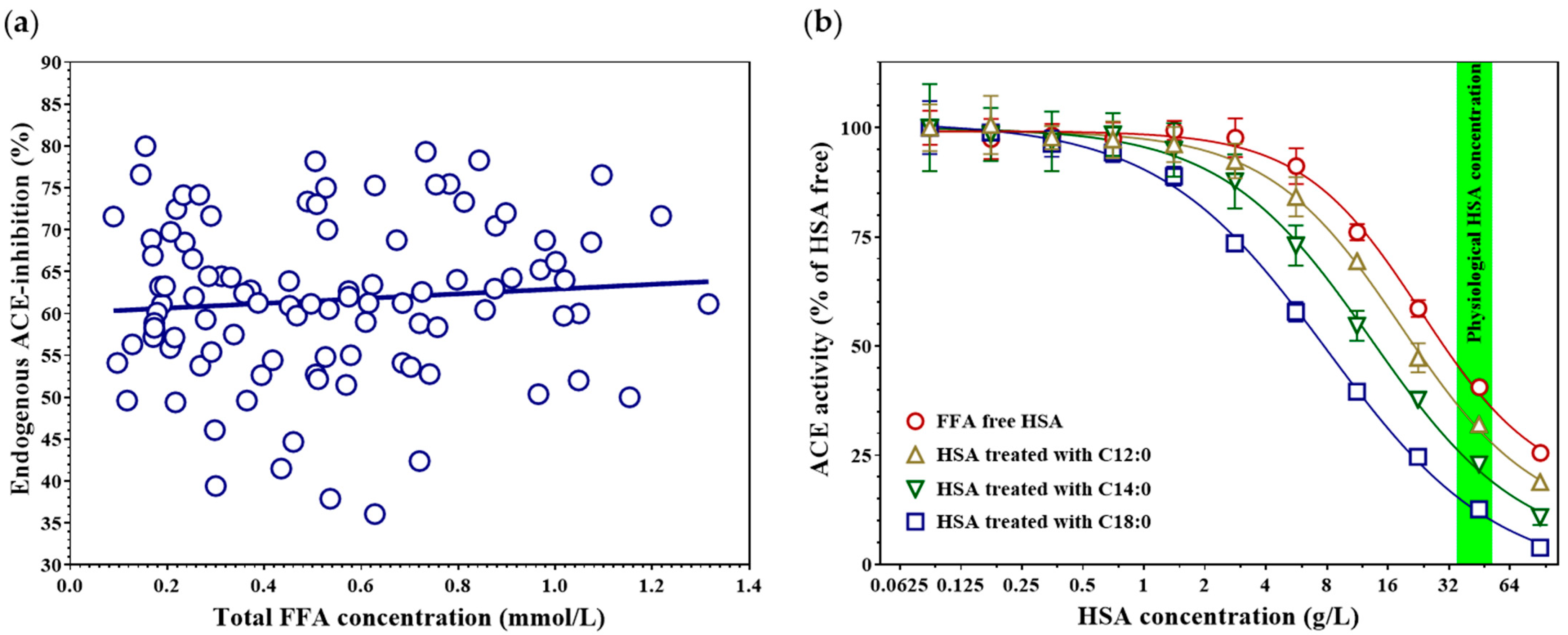
Measurement of serum FFA concentration and its comparison with the degree of endogenous ACE inhibition revealed no significant association between these parameters (Figure 2a; Spearman’s rho = 0.088, p = 0.38, r2 = 0.008, n = 101). This suggests that the total FFA concentration is not a key determinant of endogenous ACE inhibition. We hypothesized that the lack of correlation may arise from the fact that different FFA species exert distinct effects on HSA-mediated ACE inhibition. This lack of association remained unchanged in multivariable linear regression adjusting for age, sex, and serum HSA (Appendix A Table A7), and in sensitivity models additionally including hsCRP and eGFR (Appendix A Table A8) or total bilirubin as a HSA ligand (Appendix A Table A9).
To test this hypothesis, fatty acid–free HSA was treated with various saturated FFAs (Figure 2b). Treatment of HSA with dodecanoic acid (C12:0) did not significantly alter its ACE-inhibitory capacity compared to fatty acid–free HSA (IC50 = 18.69 [15.36–24.97] g/L; inhibition at 45 g/L HSA = 67.9 ± 0.4% vs. FFA-free HSA IC50 = 23.24 [19.40–29.78] g/L; inhibition at 45 g/L HSA = 59.4 ± 1.4%; p = 0.17). In contrast, treatment with myristic acid (C14:0) or stearic acid (C18:0) markedly enhanced the ACE-inhibitory effect of HSA (C14:0: IC50 = 13.26 [10.19–19.86] g/L; inhibition at 45 g/L HSA = 77.1 ± 1.0%; p = 0.006; Holm–Šidák-adjusted p = 0.023; C18:0: IC50 = 7.98 [7.04–9.23] g/L; inhibition at 45 g/L HSA = 87.4 ± 0.6%; p < 0.001, Holm–Šidák-adjusted p = 0.001).

3.3. The Chain Length of Saturated Fatty Acids Determines the Magnitude of HSA-Mediated ACE Inhibition

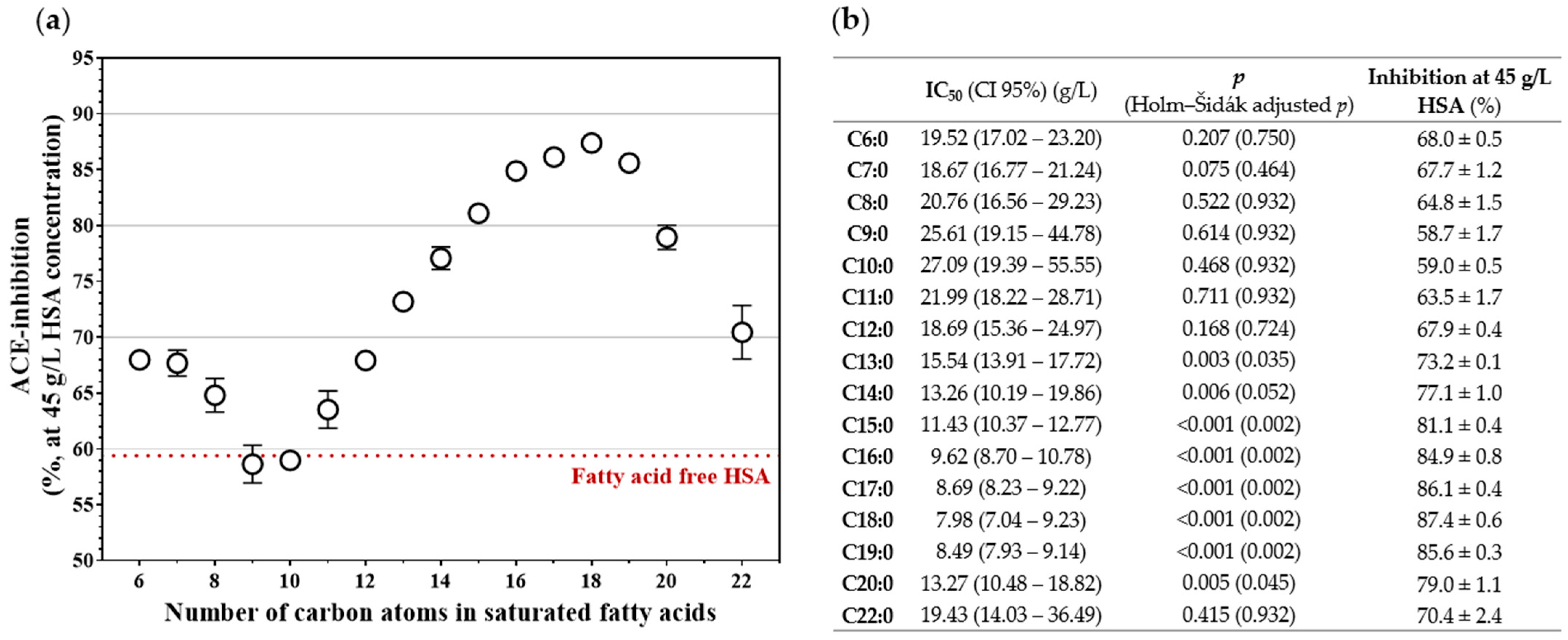
Our previous findings suggested that the chain length of FFAs may influence the extent of HSA-mediated ACE inhibition. To further investigate this relationship, concentration–response curves were established for saturated FFAs with different carbon chain lengths (Supplementary Figure S2). Based on these data, we determined the level of ACE inhibition at physiological HSA concentration (Figure 3a) and calculated the corresponding IC50 values (Figure 3b). Among the tested FFAs, stearic acid (C18:0) exerted the strongest HSA-mediated inhibitory effect on ACE activity (87.4 ± 0.6%, p < 0.001, Holm–Šidák-adjusted p = 0.002), while capric acid (C10:0) showed no appreciable effect compared to fatty acid–free HSA (59.0 ± 0.5%, p = 0.468, Holm–Šidák-adjusted p = 0.932). In parallel, the IC50 values of the FFA–HSA complexes gradually decreased from capric acid (C10:0, IC50 = 27.09 [19.39–55.55] g/L) to stearic acid (C18:0, IC50 = 7.98 [7.04–9.23] g/L), followed by a slight increase with longer-chain FFAs (Figure 3b).

3.4. The Presence and Position of a Double Bond Modulate the HSA-Mediated ACE-Inhibitory Effect

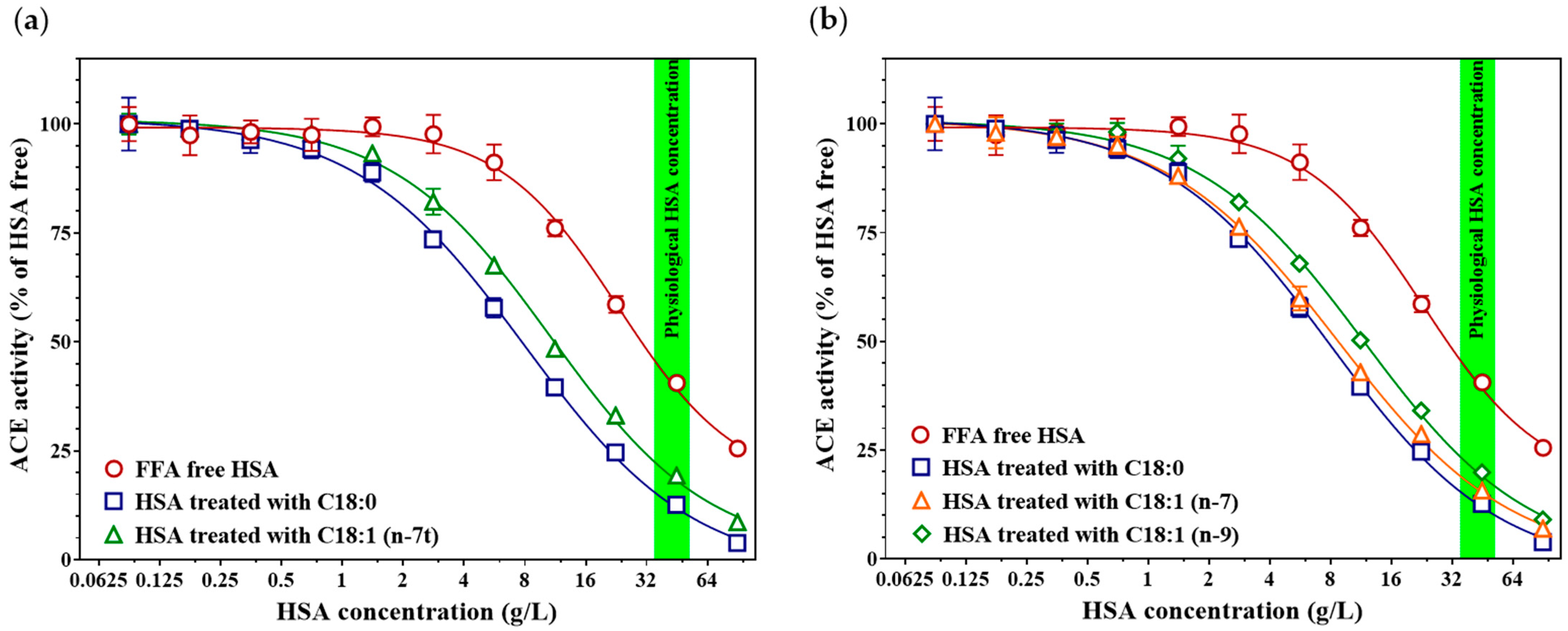
We examined whether the presence of a double bond in fatty acids of identical chain length affects the HSA-mediated inhibition of ACE (Figure 4). Elaidic acid, which contains a trans double bond at the n-7 position compared to stearic acid, retains a linear structure despite being unsaturated. This structural modification markedly altered its modulatory effect on the ACE-inhibitory capacity of HSA (C18:1 (n-7t), IC50 = 10.74 [9.71–12.05] g/L; inhibition at 45 g/L HSA = 80.7 ± 0.7%, vs. stearic acid C18:0, IC50 = 7.98 [7.04–9.23] g/L; inhibition at 45 g/L HSA = 87.4 ± 0.6%, p = 0.001, Figure 4a). In contrast, cis-vaccenic acid, which also contains a double bond at the n-7 position but in the cis configuration, did not show a significant difference in HSA-mediated ACE inhibition compared with stearic acid (C18:1 (n-7), IC50 = 8.70 [7.85–9.79] g/L; inhibition at 45 g/L HSA = 84.3 ± 0.7%, p = 0.317, Figure 4b). However, when this cis double bond was located at the n-9 position, as in oleic acid, the enhancement of HSA-mediated ACE inhibition was significantly lower (C18:1 (n-9), IC50 = 11.61 [10.35–13.28] g/L; inhibition at 45 g/L HSA = 80.1 ± 1.7%, p < 0.001).

3.5. Certain Omega-3 and Omega-6 Fatty Acids Markedly Enhance the HSA-Mediated ACE-Inhibitory Effect

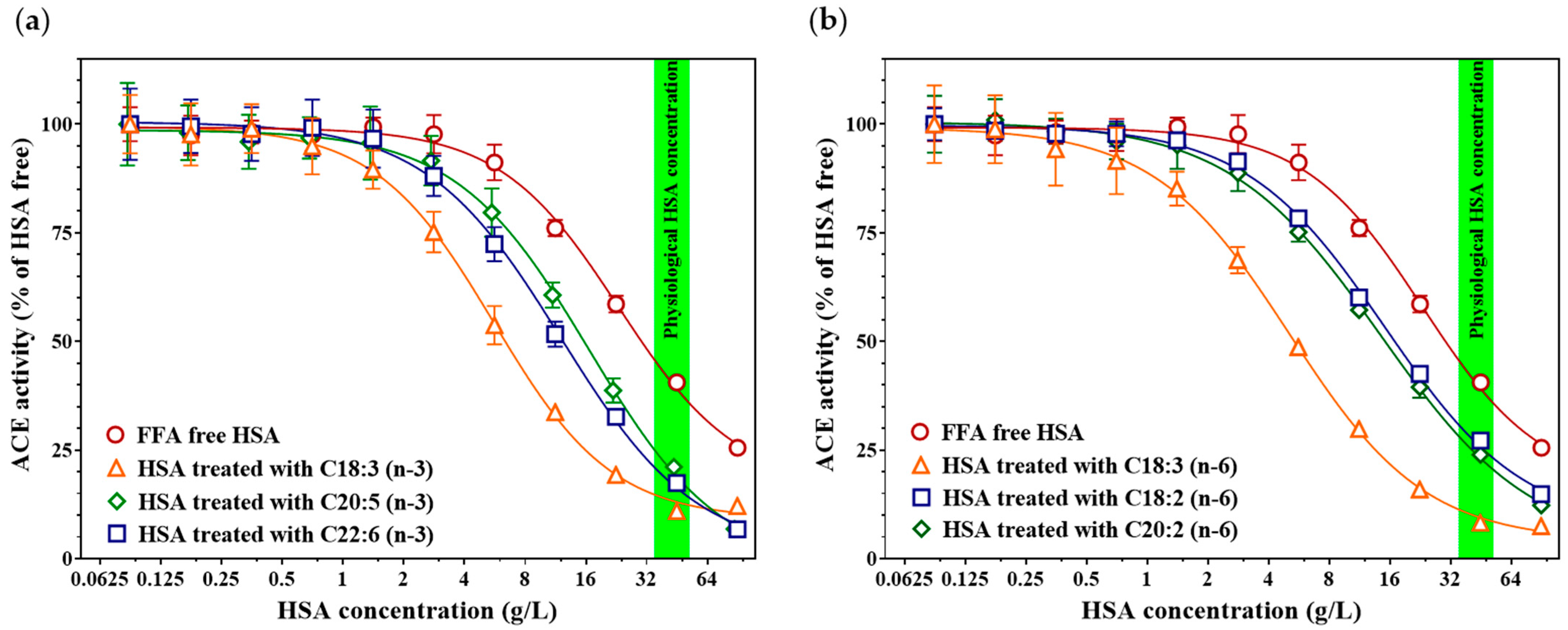
We next investigated whether polyunsaturated omega-3 and omega-6 fatty acids modulate the HSA-induced endogenous ACE inhibition. Among the omega-3 fatty acids tested (Figure 5a), α-linolenic acid produced the most pronounced enhancement of HSA mediated ACE inhibition (C18:3 (n-3), IC50 = 5.60 [4.28–6.15] g/L; inhibition at 45 g/L HSA = 89.0 ± 0.3%, p < 0.001, Holm–Šidák-adjusted p = 0.001), followed by docosahexaenoic acid (DHA), which showed a somewhat weaker yet still significant effect compared with FFA-free HSA (C22:6 (n-3), IC50 = 12.02 [9.86–15.06] g/L; inhibition at 45 g/L HSA = 82.6 ± 0.9%, p < 0.001, Holm–Šidák-adjusted p = 0.001). In contrast, the presence of eicosapentaenoic acid (EPA) on HSA did not significantly modify its IC50 value (C20:5 (n-3), IC50 = 16.56 [13.00–24.22] g/L; inhibition at 45 g/L HSA = 78.9 ± 0.9%, p = 0.059, Holm–Šidák-adjusted p = 0.114). Regarding omega-6 fatty acids (Figure 5b), γ-linolenic acid exhibited the strongest potentiating effect on the HSA-mediated ACE inhibition (C18:3 (n-6), IC50 = 5.09 [4.28–6.15] g/L; inhibition at 45 g/L HSA = 91.7 ± 0.2%, p < 0.001, Holm–Šidák-adjusted p = 0.001), while eicosadienoic acid and linoleic acid also significantly enhanced the inhibitory capacity, although to a lesser extent (C20:2 (n-6), IC50 = 14.41 [11.79–19.06] g/L; inhibition at 45 g/L HSA = 76.1 ± 1.7%, p = 0.001, Holm–Šidák-adjusted p = 0.023; C18:2 (n-6), IC50 = 15.04 [13.55–17.00] g/L; inhibition at 45 g/L HSA = 72.8 ± 1.3%, p = 0.001, Holm–Šidák-adjusted p = 0.005).

3.6. The HSA-Mediated ACE-Inhibitory Effect of FFAs Is Also Observed in Tissue-Derived ACE

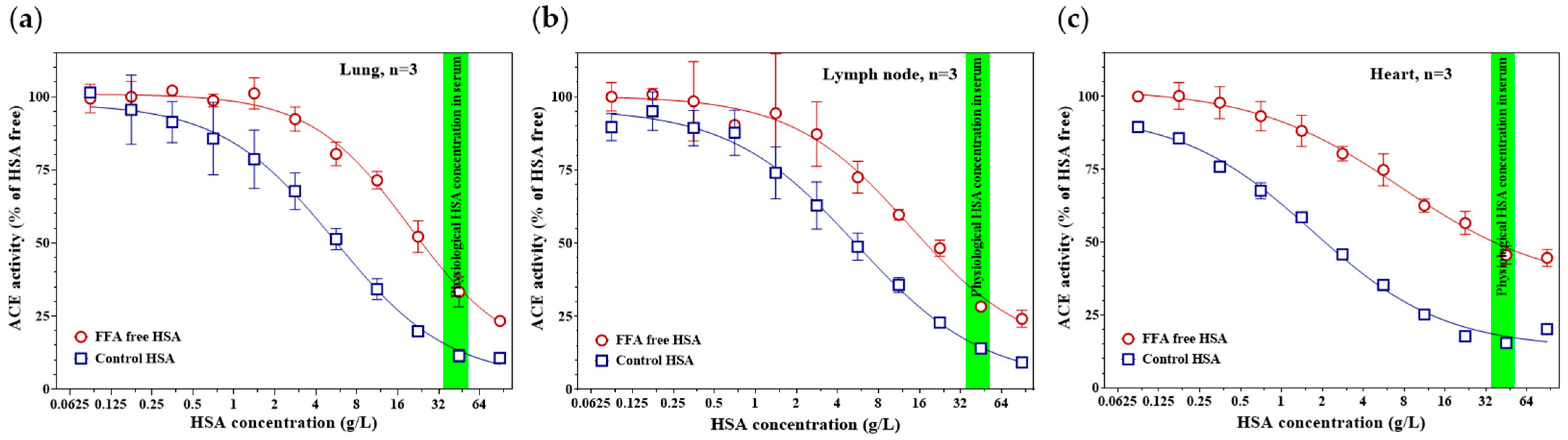
To assess whether the effect of FFAs on HSA-mediated ACE inhibition can also be detectable in tissue-derived ACE, we examined lung, lymph node, and cardiac tissue homogenates (Figure 6). ACE was immobilized onto ELISA plate surfaces using anti-ACE antibodies, followed by washing to remove unbound tissue proteins. When the immobilized ACE was exposed to HSA containing physiologically bound FFAs, a markedly stronger inhibition was observed compared to reactions containing fatty acid–free HSA. This difference was consistent across all tested tissues, including lung (IC50 = 5.52 [4.07–7.90] g/L; inhibition at 45 g/L HSA = 88.6 ± 2.1%, vs. IC50 = 19.55 [14.55–32.86] g/L; inhibition at 45 g/L HSA = 66.7 ± 5.2%, p < 0.001; Figure 6a), lymph node (IC50 = 5.52 [4.08–8.35] g/L; inhibition at 45 g/L HSA = 86.0 ± 1.6%, vs. IC50 = 13.40 [7.99–128.90] g/L; inhibition at 45 g/L HSA = 71.7 ± 1.2%, p = 0.019; Figure 6b), and cardiac homogenates (IC50 = 1.69 [1.36–2.03] g/L; inhibition at 45 g/L HSA = 84.7 ± 1.2%, vs. IC50 = 7.59 [5.01–17.38] g/L; inhibition at 45 g/L HSA = 54.41 ± 3.2%, p < 0.001; Figure 6c).

4. Discussion

Cardiovascular diseases remain the leading cause of death globally, accounting for an estimated 19.8 million deaths in 2022—about one in three deaths worldwide [24]. Therapeutic inhibition of ACE with ACE inhibitor drugs has been shown to reduce cardiovascular mortality by approximately 20–25% compared to other antihypertensive treatments [25], highlighting the essential role of ACE in cardiovascular pathology. We have previously reported that human serum albumin (HSA) endogenously inhibits circulating ACE activity [9,26], and that the lack of this inhibition may contribute to the development of cardiovascular diseases [12]. This hypothesis is further supported by numerous studies demonstrating that low-normal serum HSA concentration is an independent risk factor for cardiovascular morbidity and mortality [11,27,28].
In the present study, we demonstrate that the level of endogenous ACE inhibition is linearly related to HSA concentration. Higher circulating HSA levels may reduce the formation of the vasoconstrictor angiotensin II through ACE inhibition, suggesting that HSA potentially contribute to blood pressure reduction. Consistent with this hypothesis, other research groups have observed that HSA infusion can induce hypotension [29,30], and that high-normal serum HSA levels may protect against the development of hypertension [31,32].
HSA is a major carrier protein in the bloodstream, capable of binding both hydrophilic and hydrophobic molecules as well as a wide variety of drugs [13]. Our present results indicate that albumin-bound FFAs are key modulators of the HSA-mediated endogenous inhibition of ACE, as the removal of FFAs from HSA markedly diminished its inhibitory capacity. HSA possesses multiple well-characterized fatty acid binding sites with high or moderate affinity, and FFA binding to these sites induces substantial conformational changes in the protein structure [13,14,33]. These conformational changes may influence HSA–ACE interactions and thereby modulate the ACE-inhibitory efficacy of HSA. This concept is consistent with observations showing that the tyrosine residue (Tyr-138) in the FA1 site in subdomain IB plays a critical role in both FFA binding [33] and in the development of endogenous ACE inhibition [34]. Moreover, another potential ACE-binding site of HSA (Ala-213–Arg-218) [35] co-localizes with Sudlow site I (drug site I, FA7) in subdomain IIA [36], providing a plausible additional structural basis for the modulatory effect of FFAs.
Although elevated total FFA concentration in the circulation has been associated with insulin resistance [37] and type 2 diabetes mellitus [38], as well as with increased cardiovascular risk [39,40], growing evidence indicates that the qualitative composition of FFAs rather than their total amount determines their physiological impact [41,42,43]. In this context, our data show that total FFA concentration was not associated with endogenous ACE inhibition in our cohort, whereas our in vitro experiments indicate that the type of fatty acid bound to HSA can markedly alter this inhibitory capacity. Thus, beyond its transport role, HSA may also act as a regulator of ACE activity, with its inhibitory potency influenced by the composition of bound fatty acids.
In our experiments, among saturated fatty acids, stearate and palmitate most effectively enhanced HSA-mediated endogenous ACE inhibition. This observation is particularly relevant given that in obesity and insulin-resistant states, circulating FFA levels—especially palmitate and, to a lesser extent, stearate—are frequently elevated [44,45]. These findings raise the possibility that, under such metabolic conditions, shifts in the composition of HSA-bound fatty acids may enhance endogenous ACE inhibition and contribute to partial compensation against RAAS overactivation; however, the in vivo relevance of this concept remains to be determined.
Regular physical activity is a cornerstone of cardiovascular prevention and has been consistently associated with improved metabolic flexibility and reduced cardiovascular risk. Exercise enhances whole-body lipolysis and increases the release of FFAs such as palmitate and, in some settings, stearate, both at rest and during exertion [45,46]. Consequently, the elevated availability of HSA-bound FFAs could transiently amplify endogenous ACE inhibition, which may represent one potential mechanism contributing to the well-established cardioprotective effects of regular physical activity through modulation of the renin–angiotensin system.
Contemporary guidelines and evidence syntheses draw a nuanced picture regarding omega-3 fatty acids in cardiovascular prevention. Broad use of long-chain EPA/DHA supplements does not meaningfully reduce cardiovascular events or mortality [47]. Current practice guidelines restrict therapeutic recommendations largely to purified EPA in selected high-risk patients with persistently elevated triglycerides on statins and do not recommend routine fish-oil supplementation for general prevention [48]. In this context, we show that specific polyunsaturated fatty acids—most notably α-linolenic acid (ALA, 18:3 n-3) and γ-linolenic acid (GLA, 18:3 n-6)—markedly enhance HSA-mediated endogenous ACE inhibition, exceeding the effect of saturated fatty acids; at physiological HSA concentrations, ALA-bound HSA yielded ~90% inhibition and GLA-bound HSA 91.7% in our assays. These observations are compatible with human evidence: in a double-blind, randomized trial in patients with peripheral artery disease, daily ingestion of 30 g milled flaxseed (rich in ALA) for 6 months lowered systolic and diastolic blood pressure by ~10/7 mmHg versus placebo, with even larger reductions in those hypertensive at baseline (−15/−7 mmHg); circulating ALA levels rose in parallel [17]. Beyond single trials, recent meta-analyses of randomized controlled trials confirm that flaxseed interventions produce significant blood-pressure reductions, with larger effects in hypertensive cohorts [49]. A systematic review further reported that higher dietary ALA intake is associated with modestly lower risks of cardiovascular and coronary mortality [16]. One possible mechanism is that HSA-bound ALA/GLA may augment HSA-mediated ACE inhibition and thereby attenuate Ang II generation; however, this link to blood pressure lowering was not directly tested in the present study.
Our tissue-ACE–based data indicate that FFA-modulated, HSA-mediated regulation of ACE is not confined to the vascular lumen but extends to tissue ACE pools (myocardium, lung, lymphoid tissues). From a cardiovascular standpoint, ACE within the pulmonary vasculature and myocardium is central to local angiotensin II generation and hemodynamic control. Equally, ACE is expressed in immune cells and lymphoid organs, where it contributes to antigen processing and inflammatory tone [50]. Accordingly, qualitative shifts in the HSA-bound fatty-acid cargo (e.g., ALA/GLA enrichment or metabolic/inflammatory remodeling) could not only influence vascular RAAS activity but also fine-tune tissue and immune ACE activity within interstitial and lymphatic compartments via HSA-mediated endogenous inhibition. Together, these observations raise the hypothesis that diet- or disease-driven changes in HSA-bound fatty acids could influence both cardiovascular and immune-related ACE activity; this broader concept remains hypothesis-generating and warrants dedicated investigation.
Limitations: This study has limitations: (1) although activated charcoal–based defatting is a widely used approach to generate fatty acid–free HSA, it may also remove other hydrophobic HSA-bound ligands and/or subtly affect HSA conformation/aggregation, which could influence HSA-ACE interactions beyond FFA removal; (2) our in vitro reconstitution used a fixed FFA:HSA molar ratio (4:1) to ensure reproducible loading and to capture the maximal inhibitory potential of each fatty acid species, which may not fully reflect typical physiological FFA occupancy; (3) despite multivariable analyses, residual confounding cannot be excluded, as endogenous ACE inhibition may be influenced by unmeasured factors (e.g., detailed lipid profile parameters); and (4) because individual FFA species were not quantified in patient samples, clinical associations are limited to total FFA/FFA:HSA ratio and cannot be attributed to specific circulating fatty acids in vivo, which would require targeted lipidomics/FFA speciation.


5. Conclusions

Our data support that endogenous ACE inhibition is associated with serum HSA concentration and can be modulated by the qualitative composition of HSA-bound fatty acids. In vitro reconstitution experiments indicate that several FFAs—particularly long-chain saturated species and polyunsaturated ALA/GLA—enhance the ACE-inhibitory capacity of HSA, with effects observed not only on recombinant ACE but also on tissue-associated ACE. Collectively, these findings position albumin-bound FFAs as potentially important modulators of ACE/RAAS regulation and suggest that changes in metabolic milieu and fatty acid composition may be relevant to cardiovascular physiology.

Supplementary Materials

The following supporting information can be downloaded at: https://www.mdpi.com/article/10.3390/biomedicines14010103/s1, Table S1: Characteristics of the fatty acids examined in this study. The table lists each compound’s trivial name, carbon-chain nomenclature (C:D, n-x), distributor, catalogue number, reported purity, LOT number, and country of manufacture. All reagents were obtained from Merck and used without further purification; Figure S1: Plasmid sequence of ‘CS-Y4341-I03-02’; Figure S2: Concentration–response curves illustrating the effect of saturated fatty acids of increasing carbon-chain length on the ACE-inhibitory capacity of HSA. Panels (a–m) show recombinant ACE activity measured in the presence of fatty-acid–free HSA (control, blue dashed line) or HSA pretreated with individual saturated FFAs ranging from C6:0 to C22:0 (black line). ACE activity is expressed as a percentage of HSA-free ACE activity. The corresponding four-parameter logistic inhibition curves are presented together with the calculated IC50 values (95% CI). Error bars represent the mean ± SD of three independent measurements. The green shaded band indicates the physiological serum HSA concentration range (35–52 g/L).

Author Contributions

Conceptualization, M.F. and E.E.E.; methodology, M.F., E.E.E. and A.Á.S.; formal analysis, E.E.E., A.Á.S., I.S.M. and M.F.; investigation, E.E.E. and M.F.; resources, A.T. and Z.P.; data curation, E.E.E. and M.F.; writing—original draft preparation, E.E.E. and M.F.; writing—review and editing, A.Á.S., E.B., A.T. and Z.P.; visualization, M.F. and E.E.E.; supervision, M.F. and A.T.; project administration, T.B.P., C.V. and A.P.; funding acquisition, Z.P., A.T. and M.F. All authors have read and agreed to the published version of the manuscript.

Funding

Project no. K147173 (scholarship holder: Zoltán Papp) and K152363 (scholarship holder: Attila Tóth) have been implemented with the support provided by the Ministry of Culture and Innovation of Hungary from the National Research, Development and Innovation Fund. Supported by the University of Debrecen Program for Scientific Publication. The funders had no influence on any aspect of the research: they were not involved in the study design, collection, analysis, and interpretation of data, the writing of this article or the decision to submit it for publication.

Institutional Review Board Statement

The study was conducted in accordance with the Declaration of Helsinki, and approved by the Regional and Institutional Ethics Committee, Clinical Centre, University of Debrecen (research authorization number: 5925-2021, approved on 15 December 2021) and the Scientific and Research Ethics Committee of the Medical Research Council, Budapest, Hungary (ETT TUKEB, research authorization number: 33327-1/2015/EKU; approved on 23 June 2015).

Informed Consent Statement

Informed consent was obtained from all subjects involved in the study.

Data Availability Statement

The raw data can be obtained on request from the corresponding author.

Acknowledgments

We gratefully acknowledge Sergei M. Danilov for providing the monoclonal antibodies and for sharing his expertise with us. The research and results publicized here were reached with the sponsorship of Gedeon Richter Talentum Foundation in framework of Gedeon Richter Excellence PhD Scholarship of Gedeon Richter (scholarship holder: Attila Ádám Szabó).

Conflicts of Interest

The authors declare no conflicts of interest.

Abbreviations

The following abbreviations are used in this manuscript:
ACEangiotensin-converting enzyme
ALAα-linolenic acid
BMIbody mass index
BSAbovine serum albumin
CIconfidence interval
CVDcardiovascular disease
DDdeletion/deletion
DHAdocosahexaenoic acid
eGFRestimated glomerular filtration rate
EPAeicosapentaenoic acid
FFAfree fatty acid
GLAγ-linolenic acid
HSAhuman serum albumin
hsCRPhigh-sensitivity C-reactive protein
I/Dinsertion/deletion
IC50half maximal inhibitory concentration
PBSphosphate-buffered saline
PBSTphosphate-buffered saline with Tween® detergent
RAASrenin-angiotensin-aldosterone system
recACErecombinant angiotensin-converting enzyme
SEstandard error
VIFvariance inflation factors

Appendix A

Table A1. Demographic and laboratory characteristics of the study population (n = 161). Continuous variables are presented as median [IQR]; categorical variables are shown as counts (n). Differences between females and males were assessed using the Mann–Whitney U-test (nonparametric, unpaired, two-tailed) for continuous variables, and the chi-square (χ2) test for categorical variables (hypertension, diabetes mellitus, left ventricular EF). Individual p-values are not listed; an asterisk (*) indicates a statistically significant difference (p < 0.05). Absence of an asterisk denotes a non-significant result (p ≥ 0.05). For variables with missing data, the number of available observations is indicated as n in the row label. Abbreviations: ACE = angiotensin-converting enzyme; eGFR = estimated glomerular filtration rate; HSA = human serum albumin; EF = ejection fraction; IQR = interquartile range.
FemaleMaleTotal
n7190161
Age (years, median [IQR])52.0 [37.0–57.0]52.7 [40.8–63.3]52.0 [39.0–60.0]
BMI (kg/m2, median [IQR], nfemale/male = 56/61)25.8 [23.1–29.9]28.1 [25.0–30.1]27.2 [24.3–30.0]
Creatinine (μmol/L, median [IQR], nfemale/male = 49/58)58 [49–70] *76 [64–89] *67 [57–82]
Urea (mmol/L, median [IQR], nfemale/male = 49/55)4.5 [3.7–5.7]4.8 [3.9–5.7]4.6 [3.8–5.7]
eGFR (mL/min/1.73 m2, median [IQR], nfemale/male = 49/58)90 [90–90]90 [90–90]90 [90–90]
Total bilirubin (μmol/L, median [IQR], nfemale/male = 24/40)7.4 [5.4–10.2]8.0 [5.7–11.2]7.7 [5.5–11.0]
Serum ACE activity (U/L, median [IQR])9.81 [7.95–11.31]9.41 [7.23–11.66]9.71 [7.61–11.34]
Endogenous ACE-inhibition (%, median [IQR])66.85 [54.10–71.78]65.74 [59.50–71.93]66.38 [56.48–71.84]
HSA concentration, (g/L, median [IQR])45.0 [41.0–46.6]44.0 [40.8–46.1]44.0 [41.0–46.5]
Hypertension (n)324375
Diabetes mellitus (n)71320
Left ventricular EF (%, median [IQR])60 [57–63]58 [55–64]59 [56–63]
Table A2. Demographic and laboratory characteristics of the FFA-analysis group (n = 101). All continuous variables are presented as median [IQR]. Differences between females and males were evaluated using the Mann–Whitney U-test (nonparametric, unpaired, two-tailed). The table does not display exact p-values; an asterisk (*) marks statistically significant differences (p < 0.05), while the absence of an asterisk indicates no significant difference (p ≥ 0.05). For variables with missing data, the number of available observations is indicated as n in the row label. Abbreviations: ACE = angiotensin-converting enzyme; eGFR = estimated glomerular filtration rate; HSA = human serum albumin; FFA = free fatty acids; IQR = interquartile range.
FemaleMaleTotal
n5546101
Age (years, median [IQR])55.6 [42.4–67.2] *46.7 [36.3–60.1] *49.6 [39.2–65.3]
Serum ACE activity (U/L, median [IQR])10.47 [9.78–12.61]10.94 [9.74–12.94]10.79 [9.80–12.75]
Endogenous ACE-inhibition (%, median [IQR])62.20 [57.47–68.12]60.64 [54.03–69.08]61.27 [55.32–68.79]
FFA concentration (mM, median [IQR])0.508 [0.285–0.782]0.501 [0.217–0.721]0.505 [0.254–0.737]
HSA concentration (g/L, median [IQR])44.69 [42.04–47.46]44.99 [42.02–47.44]44.87 [42.02–47.40]
FFA:HSA ratio0.77 [0.42–1.16]0.72 [0.33–1.06]0.75 [0.38–1.15]
hsCRP (mg/L, median [IQR], nfemale/male = 37/30)5.54 [1.66–15.46]4.59 [1.95–12.75]4.84 [1.71–14.79]
Creatinine (μmol/L, median [IQR], nfemale/male = 41/39)62 [52–69] *79 [69–89] *69 [59–81]
Urea (mmol/L, median [IQR], nfemale/male = 41/39)4.5 [3.8–5.7] *5.5 [4.1–6.3] *5.1 [4.0–6.0]
eGFR (mL/min/1.73 m2, median [IQR], nfemale/male = 41/39)90 [82–90]90 [90–90]90 [86–90]
Total bilirubin (μmol/L, median [IQR], nfemale/male = 21/10)71 [67–76]70 [66–75]71 [67–75]
Table A3. Multiple linear regression for endogenous ACE inhibition (n = 161). Predictors included HSA, age, and sex. Unstandardized coefficients (β) are shown with SE and 95% CI. Model summary: F(3,157) = 11.60, p < 0.0001; R2 = 0.1815.
Predictorβ (Estimate)SE95% CIp
HSA (g/L)0.94520.16270.6239 to 1.267<0.0001
Age (years)0.089730.05243−0.01382 to 0.19330.0889
Sex (Male vs. Female)0.79801.495−2.155 to 3.7510.5943
Table A4. Age- and sex-adjusted multiple linear regression for endogenous ACE inhibition in the complete-case subset used for the clinical covariate model (n = 87). Predictors included HSA, age, and sex. Unstandardized coefficients (β) are shown with SE and 95% CI. Model summary: F(3,83) = 3.444, p = 0.0204; R2 = 0.1107.
Predictorβ (Estimate)SE95% CIp
HSA (g/L)0.76360.25420.2580 to 1.2690.0035
Age (years)0.10260.08384−0.06417 to 0.26930.2246
Sex (Male vs. Female)1.5462.294−3.016 to 6.1090.5022
Table A5. Age- and sex-adjusted multiple linear regression for endogenous ACE inhibition in the complete-case subset used for the clinical covariate model (n = 87). Predictors included HSA, age, sex, BMI, eGFR. Unstandardized coefficients (β) are shown with SE and 95% CI. Model summary: F(5,81) = 3.782, p = 0.0040; R2 = 0.1893.
Predictorβ (Estimate)SE95% CIp
HSA (g/L)0.77690.24590.2876 to 1.2660.0022
Age (years)0.15110.08369−0.01541 to 0.31760.0747
Sex (Male vs. Female)1.6142.223−2.808 to 6.0370.4697
BMI (kg/m2)−0.57360.2170−1.005 to −0.14180.0099
eGFR (mL/min/1.73 m2)−0.098580.07331−0.2444 to 0.047290.1825
Table A6. Exploratory multiple linear regression including total bilirubin in the subset with available bilirubin data (n = 64). Predictors included HSA, age, sex, and total bilirubin. Unstandardized coefficients (β) are shown with SE and 95% CI. Model summary: F(4,59) = 1.719, p = 0.1578; R2 = 0.1044.
Predictorβ (Estimate)SE95% CIp
HSA (g/L)0.77690.24590.2876 to 1.2660.0022
Age (years)0.15110.08369−0.01541 to 0.31760.0747
Sex (Male vs. Female)1.6142.223−2.808 to 6.0370.4697
Total bilirubin (µM)0.37460.3695−0.3648 to 1.1140.3148
Table A7. Multiple linear regression for endogenous ACE inhibition (n = 101). Dependent variable: endogenous ACE inhibition (%). Predictors: FFA, HSA, age, and sex. Unstandardized coefficients (β) are shown with SE and 95% CI. Model summary: F(4,96) = 2.467, p = 0.0499; R2 = 0.0932.
Predictorβ (Estimate)SE95% CIp
FFA (µM)0.56753.269−5.921 to 7.0560.8625
HSA (g/L)−0.35220.1939−0.7371 to 0.032670.0724
Age (years)0.10520.06552−0.02487 to 0.23520.1117
Sex (Female vs. Male)0.69121.885−3.051 to 4.4330.7147
Table A8. Sensitivity multiple linear regression for endogenous ACE inhibition (n = 65). Dependent variable: endogenous ACE inhibition (%). Predictors: FFA, HSA, age, sex, hsCRP, and eGFR. Unstandardized coefficients (β) are shown with SE and 95% CI. Model summary: F(6,58) = 1.539, p = 0.1817; R2 = 0.137.
Predictorβ (Estimate)SE95% CIp
FFA (µM)0.006254.201−8.404 to 8.4160.9988
HSA (g/L)−0.08420.2982−0.6811 to 0.51260.7786
Age (years)0.02210.0966−0.1711 to 0.21540.8195
Sex (Female vs. Male)−0.80182.281−5.367 to 3.7640.7265
hsCRP (mg/L)0.08030.0449−0.00958 to 0.17010.0790
eGFR (mL/min/1.73 m2)−0.06800.0899−0.2481 to 0.11200.4526
Table A9. Sensitivity multivariable regression including total bilirubin (n = 55). Dependent variable: endogenous ACE inhibition (%). Predictors: FFA, HSA, age, sex, and total bilirubin. Unstandardized coefficients (β) are shown with SE and 95% CI. Model summary: F(5,49) = 2.079; p = 0.0839; R2 = 0.175.
Predictorβ (Estimate)SE95% CIp
FFA (µM)−2.6984.126−10.99 to 5.5940.5163
HSA (g/L)−0.51140.2103−0.9341 to −0.088750.0187
Age (years)0.076530.08177−0.08781 to 0.24090.3540
Sex (Female vs. Male)−1.7232.340−6.426 to 2.9800.4650
Total bilirubin (µM)0.31400.2818−0.2522 to 0.88030.2705

References

  1. Pop, D.; Dădârlat-Pop, A.; Tomoaia, R.; Zdrenghea, D.; Caloian, B. Updates on the Renin-Angiotensin-Aldosterone System and the Cardiovascular Continuum. Biomedicines 2024, 12, 1582. [Google Scholar] [CrossRef]
  2. Grobbee, D.E.; Filippatos, G.; Desai, N.R.; Coats, A.J.S.; Pinto, F.; Rosano, G.M.C.; Cleland, J.G.F.; Kammerer, J.; de Arellano, A.R. Epidemiology and Risk Factors for Hyperkalaemia in Heart Failure. ESC Heart Fail. 2024, 11, 1821–1840. [Google Scholar] [CrossRef]
  3. MacMahon, S.; Neal, B.; Tzourio, C.; Rodgers, A.; Woodward, M.; Cutler, J.; Anderson, C.; Chalmers, J.; Ohkubo, T.; Bouser, M.G.; et al. Randomised Trial of a Perindopril-Based Blood-Pressure-Lowering Regimen among 6105 Individuals with Previous Stroke or Transient Ischaemic Attack. Lancet 2001, 358, 1033–1041. [Google Scholar] [CrossRef]
  4. Yusuf, S.; Sleight, P.; Pogue, J.; Bosch, J.; Davies, R.; Dagenais, G. Effects of an Angiotensin-Converting-Enzyme Inhibitor, Ramipril, on Cardiovascular Events in High-Risk Patients. N. Engl. J. Med. 2000, 342, 145–153. [Google Scholar] [CrossRef]
  5. Acharya, K.R.; Gregory, K.S.; Sturrock, E.D. Advances in the Structural Basis for Angiotensin-1 Converting Enzyme (ACE) Inhibitors. Biosci. Rep. 2024, 44, BSR20240130. [Google Scholar] [CrossRef]
  6. Herman, L.L.; Padala, S.A.; Ahmed, I.; Bashir, K. Angiotensin-Converting Enzyme Inhibitors (ACEI). In StatPearls [Internet]; StatPearls Publishing: Treasure Island, FL, USA, 2023. Available online: https://www.ncbi.nlm.nih.gov/books/NBK431051/ (accessed on 18 November 2025).
  7. Rigat, B.; Hubert, C.; Alhenc-Gelas, F.; Cambien, F.; Corvol, P.; Soubrier, F. An Insertion/Deletion Polymorphism in the Angiotensin I-Converting Enzyme Gene Accounting for Half the Variance of Serum Enzyme Levels. J. Clin. Invest. 1990, 86, 1343–1346. [Google Scholar] [CrossRef]
  8. Bai, Y.; Wang, L.; Hu, S.; Wei, Y. Association of Angiotensin-Converting Enzyme I/D Polymorphism with Heart Failure: A Meta-Analysis. Mol. Cell Biochem. 2012, 361, 297–304. [Google Scholar] [CrossRef]
  9. Fagyas, M.; Úri, K.; Siket, I.M.; Fülöp, G.B.Á.; Csató, V.; Daragó, A.; Boczán, J.; Bányai, E.; Szentkirályi, I.E.; Maros, T.M.; et al. New Perspectives in the Renin-Angiotensin-Aldosterone System (RAAS) II: Albumin Suppresses Angiotensin Converting Enzyme (ACE) Activity in Human. PLoS ONE 2014, 9, e87844. [Google Scholar] [CrossRef]
  10. Nishikawa, T.; Ueyama, J.; Shimizu, S.; Shibata, Y.; Yamada, S. Redox State of Human Serum Albumin as a Post-Discharge Prognostic Marker in Patients Hospitalized for Heart Failure. Int. J. Cardiol. 2024, 416, 132497. [Google Scholar] [CrossRef]
  11. Huang, T.; An, Z.; Huang, Z.; Gao, W.; Hao, B.; Xu, J. Serum Albumin and Cardiovascular Disease: A Mendelian Randomization Study. BMC Cardiovasc. Disord. 2024, 24, 196. [Google Scholar] [CrossRef]
  12. Fagyas, M.; Úri, K.; Siket, I.M.; Daragó, A.; Boczán, J.; Bányai, E.; Édes, I.; Papp, Z.; Tóth, A. New Perspectives in the Renin-Angiotensin-Aldosterone System (RAAS) III: Endogenous Inhibition of Angiotensin Converting Enzyme (ACE) Provides Protection against Cardiovascular Diseases. PLoS ONE 2014, 9, e93719. [Google Scholar] [CrossRef]
  13. Ashraf, S.; Qaiser, H.; Tariq, S.; Khalid, A.; Makeen, H.A.; Alhazmi, H.A.; Ul-Haq, Z. Unraveling the Versatility of Human Serum Albumin—A Comprehensive Review of Its Biological Significance and Therapeutic Potential. Curr. Res. Struct. Biol. 2023, 6, 100114. [Google Scholar] [CrossRef]
  14. Wu, D.; Gucwa, M.; Czub, M.P.; Cooper, D.R.; Shabalin, I.G.; Fritzen, R.; Arya, S.; Schwarz-Linek, U.; Blindauer, C.A.; Minor, W.; et al. Structural and Biochemical Characterisation of Co2+-Binding Sites on Serum Albumins and Their Interplay with Fatty Acids. Chem. Sci. 2023, 14, 6244–6258. [Google Scholar] [CrossRef]
  15. Enyedi, E.E.; Petukhov, P.A.; Kozuch, A.J.; Dudek, S.M.; Toth, A.; Fagyas, M.; Danilov, S.M. ACE Phenotyping in Human Blood and Tissues: Revelation of ACE Outliers and Sex Differences in ACE Sialylation. Biomedicines 2024, 12, 940. [Google Scholar] [CrossRef]
  16. Naghshi, S.; Aune, D.; Beyene, J.; Mobarak, S.; Asadi, M.; Sadeghi, O. Dietary Intake and Biomarkers of Alpha Linolenic Acid and Risk of All Cause, Cardiovascular, and Cancer Mortality: Systematic Review and Dose-Response Meta-Analysis of Cohort Studies. BMJ 2021, 375, n2213. [Google Scholar] [CrossRef]
  17. Rodriguez-Leyva, D.; Weighell, W.; Edel, A.L.; Lavallee, R.; Dibrov, E.; Pinneker, R.; Maddaford, T.G.; Ramjiawan, B.; Aliani, M.; Guzman, R.; et al. Potent Antihypertensive Action of Dietary Flaxseed in Hypertensive Patients. Hypertension 2013, 62, 1081–1089. [Google Scholar] [CrossRef]
  18. Farvid, M.S.; Ding, M.; Pan, A.; Sun, Q.; Chiuve, S.E.; Steffen, L.M.; Willett, W.C.; Hu, F.B. Dietary Linoleic Acid and Risk of Coronary Heart Disease: A Systematic Review and Meta-Analysis of Prospective Cohort Studies. Circulation 2014, 130, 1568–1578. [Google Scholar] [CrossRef]
  19. Marklund, M.; Wu, J.H.Y.; Imamura, F.; Del Gobbo, L.C.; Fretts, A.; De Goede, J.; Shi, P.; Tintle, N.; Wennberg, M.; Aslibekyan, S.; et al. Biomarkers of Dietary Omega-6 Fatty Acids and Incident Cardiovascular Disease and Mortality. Circulation 2019, 139, 2422–2436. [Google Scholar] [CrossRef]
  20. Djoussé, L.; Benkeser, D.; Arnold, A.; Kizer, J.R.; Zieman, S.J.; Lemaitre, R.N.; Tracy, R.P.; Gottdiener, J.S.; Mozaffarian, D.; Siscovick, D.S.; et al. Plasma Free Fatty Acids and Risk of Heart Failure: The Cardiovascular Health Study. Circ. Heart Fail. 2013, 6, 964–969. [Google Scholar] [CrossRef]
  21. Szabó, A.Á.; Enyedi, E.E.; Altorjay, I.T.; Hajnal, P.; Pintér, T.B.; Mányiné, I.S.; Váradi, C.; Bányai, E.; Tóth, A.; Papp, Z.; et al. Get Reliable Laboratory Findings—How to Recognize the Deceptive Effects of Angiotensin-Converting Enzyme Inhibitor Therapy in the Laboratory Diagnostics of Sarcoidosis? Clin. Chem. Lab. Med. 2024, 62, 1393–1401. [Google Scholar] [CrossRef]
  22. Csongrádi, A.; Enyedi, A.; Takács, I.; Végh, T.; Mányiné, I.S.; Pólik, Z.; Altorjay, I.T.; Balla, J.; Balla, G.; Édes, I.; et al. Optimized Angiotensin-Converting Enzyme Activity Assay for the Accurate Diagnosis of Sarcoidosis. Clin. Chem. Lab. Med. 2018, 56, 1117–1125. [Google Scholar] [CrossRef]
  23. Danilov, S.; Jaspard, E.; Churakova, T.; Towbin, H.; Savoie, F.; Wei, L.; Alhenc-Gelas, F. Structure-Function Analysis of Angiotensin I-Converting Enzyme Using Monoclonal Antibodies: Selective Inhibition of the Amino-Terminal Active Site. J. Biol. Chem. 1994, 269, 26806–26814. [Google Scholar] [CrossRef]
  24. WHO Cardiovascular Diseases (CVDs). Available online: https://www.who.int/news-room/fact-sheets/detail/cardiovascular-diseases-(cvds) (accessed on 10 November 2025).
  25. Salvador, G.L.O.; Marmentini, V.M.; Cosmo, W.R.; Junior, E.L. Angiotensin-Converting Enzyme Inhibitors Reduce Mortality Compared to Angiotensin Receptor Blockers: Systematic Review and Meta-Analysis. Eur. J. Prev. Cardiol. 2017, 24, 1914–1924. [Google Scholar] [CrossRef]
  26. Fagyas, M.; Úri, K.; Siket, I.M.; Daragó, A.; Boczán, J.; Bányai, E.; Édes, I.; Papp, Z.; Tóth, A. New Perspectives in the Renin-Angiotensin-Aldosterone System (RAAS) I: Endogenous Angiotensin Converting Enzyme (ACE) Inhibition. PLoS ONE 2014, 9, e87843. [Google Scholar] [CrossRef]
  27. Arques, S. Human Serum Albumin in Cardiovascular Diseases. Eur. J. Intern. Med. 2018, 52, 8–12. [Google Scholar] [CrossRef]
  28. Oda, E. Decreased Serum Albumin Predicts Hypertension in a Japanese Health Screening Population. Intern. Med. 2014, 53, 655–660. [Google Scholar] [CrossRef]
  29. Howard, G.; Downward, G.; Bowie, D. Human Serum Albumin Induced Hypotension in the Postoperative Phase of Cardiac Surgery. Anaesth. Intensive Care 2001, 29, 591–594. [Google Scholar] [CrossRef]
  30. Eriksson, M.; Nilsson, B.; Modig, J.; Acosta, R.; Johansson, B.; Larsson, A. [A Case Report. Hypotensive Reaction Caused by Albumin Infusion]. Lakartidningen 2001, 98, 439–442. [Google Scholar]
  31. Oda, E. Serum Albumin May Prevent Hypertension by Inhibiting Angiotensin Converting Enzyme. Intern. Med. 2014, 53, 2411. [Google Scholar] [CrossRef]
  32. Liu, Y.; Xu, S.; Chen, H.; Dai, S.; Hao, J.; Chen, X.; Zhang, J.; Li, S.; Liu, J.; Hu, F.; et al. Association between Serum Albumin Concentration Change Trajectory and Risk of Hypertension: A Cohort Study in China. Front. Cardiovasc. Med. 2024, 11, 1325899. [Google Scholar] [CrossRef]
  33. Roy, D.; Kumar, V.; James, J.; Shihabudeen, M.S.; Kulshrestha, S.; Goel, V.; Thirumurugan, K. Evidence That Chemical Chaperone 4-Phenylbutyric Acid Binds to Human Serum Albumin at Fatty Acid Binding Sites. PLoS ONE 2015, 10, e0133012. [Google Scholar] [CrossRef]
  34. Nakagomi, K.; Fujimura, A.; Ebisu, H.; Sakai, T.; Sadakane, Y.; Fujii, N.; Tanimura, T. Acein-1, a Novel Angiotensin-I-Converting Enzyme Inhibitory Peptide Isolated from Tryptic Hydrolysate of Human Plasma. FEBS Lett. 1998, 438, 255–257. [Google Scholar] [CrossRef]
  35. Nakagomi, K.; Ebisu, H.; Sadakane, Y.; Fujii, N.; Akizawa, T.; Tanimura, T. Properties and Human Origin of Two Angiotensin-I-Converting Enzyme Inhibitory Peptides Isolated from a Tryptic Hydrolysate of Human Serum Albumin. Biol. Pharm. Bull. 2000, 23, 879–883. [Google Scholar] [CrossRef]
  36. Curry, S. Plasma Albumin as a Fatty Acid Carrier. Adv. Mol. Cell Biol. 2003, 33, 29–46. [Google Scholar] [CrossRef]
  37. Bays, H.; Mandarino, L.; DeFronzo, R.A. Role of the Adipocyte, Free Fatty Acids, and Ectopic Fat in Pathogenesis of Type 2 Diabetes Mellitus: Peroxisomal Proliferator-Activated Receptor Agonists Provide a Rational Therapeutic Approach. J. Clin. Endocrinol. Metab. 2004, 89, 463–478. [Google Scholar] [CrossRef] [PubMed]
  38. Pankow, J.S.; Duncan, B.B.; Schmidt, M.I.; Ballantyne, C.M.; Couper, D.J.; Hoogeveen, R.C.; Golden, S.H. Fasting Plasma Free Fatty Acids and Risk of Type 2 Diabetes: The Atherosclerosis Risk in Communities Study. Diabetes Care 2004, 27, 77–82. [Google Scholar] [CrossRef]
  39. Zhang, H.W.; Zhao, X.; Guo, Y.L.; Zhu, C.G.; Wu, N.Q.; Sun, J.; Liu, G.; Dong, Q.; Li, J.J. Free Fatty Acids and Cardiovascular Outcome: A Chinese Cohort Study on Stable Coronary Artery Disease. Nutr. Metab. 2017, 14, 41. [Google Scholar] [CrossRef]
  40. Jakobsen, M.U.; O’Reilly, E.J.; Heitmann, B.L.; Pereira, M.A.; Bälter, K.; Fraser, G.E.; Goldbourt, U.; Hallmans, G.; Knekt, P.; Liu, S.; et al. Major Types of Dietary Fat and Risk of Coronary Heart Disease: A Pooled Analysis of 11 Cohort Studies. Am. J. Clin. Nutr. 2009, 89, 1425–1432. [Google Scholar] [CrossRef] [PubMed]
  41. Li, J.; Zhang, Y.; Liu, S.; Nong, C.; Chen, Q.; Zou, Y.; Peng, Y.; Chen, H.; Thiruvengadam, M.; Wang, Z.; et al. Associations of Polyunsaturated Fatty Acids and Genetic Predisposition with Cardiovascular Risk among Hypertensive Adults. Front. Nutr. 2025, 12, 1623962. [Google Scholar] [CrossRef]
  42. Li, Z.; Lei, H.; Jiang, H.; Fan, Y.; Shi, J.; Li, C.; Chen, F.; Mi, B.; Ma, M.; Lin, J.; et al. Saturated Fatty Acid Biomarkers and Risk of Cardiometabolic Diseases: A Meta-Analysis of Prospective Studies. Front. Nutr. 2022, 9, 963471. [Google Scholar] [CrossRef] [PubMed]
  43. Jung, Y.; Cho, Y.; Kim, N.; Oh, I.Y.; Kang, S.W.; Choi, E.K.; Hwang, G.S. Lipidomic Profiling Reveals Free Fatty Acid Alterations in Plasma from Patients with Atrial Fibrillation. PLoS ONE 2018, 13, e0196709. [Google Scholar] [CrossRef]
  44. Li, M.; Zhang, L.; Huang, B.; Liu, Y.; Chen, Y.; Lip, G.Y.H. Free Fatty Acids and Mortality among Adults in the United States: A Report from US National Health and Nutrition Examination Survey (NHANES). Nutr. Metab. 2024, 21, 72. [Google Scholar] [CrossRef]
  45. Annevelink, C.E.; Sapp, P.A.; Petersen, K.S.; Shearer, G.C.; Kris-Etherton, P.M. Diet-Derived and Diet-Related Endogenously Produced Palmitic Acid: Effects on Metabolic Regulation and Cardiovascular Disease Risk. J. Clin. Lipidol. 2023, 17, 577–586. [Google Scholar] [CrossRef] [PubMed]
  46. Jacobs, K.A.; Krauss, R.M.; Fattor, J.A.; Horning, M.A.; Friedlander, A.L.; Bauer, T.A.; Hagobian, T.A.; Wolfel, E.E.; Brooks, G.A. Endurance Training Has Little Effect on Active Muscle Free Fatty Acid, Lipoprotein Cholesterol, or Triglyceride Net Balances. Am. J. Physiol. Endocrinol. Metab. 2006, 291, E656–E665. [Google Scholar] [CrossRef]
  47. Jaca, A.; Durão, S.; Harbron, J. Omega-3 Fatty Acids for the Primary and Secondary Prevention of Cardiovascular Disease. S. Afr. Med. J. 2020, 110, 1158–1159. [Google Scholar] [CrossRef]
  48. Virani, S.S.; Newby, L.K.; Arnold, S.V.; Bittner, V.; Brewer, L.C.; Demeter, S.H.; Dixon, D.L.; Fearon, W.F.; Hess, B.; Johnson, H.M.; et al. 2023 AHA/ACC/ACCP/ASPC/NLA/PCNA Guideline for the Management of Patients With Chronic Coronary Disease: A Report of the American Heart Association/American College of Cardiology Joint Committee on Clinical Practice Guidelines. J. Am. Coll. Cardiol. 2023, 82, 833–955. [Google Scholar] [CrossRef]
  49. Fazeli Moghadam, E.; Khaghani, L.; Shekarchizadeh-Esfahani, P. Flaxseed Lowers Blood Pressure in Hypertensive Subjects: A Meta-Analysis of Randomized Controlled Trials. Clin. Nutr. Res. 2024, 13, 295. [Google Scholar] [CrossRef] [PubMed]
  50. Bernstein, K.E.; Cao, D.Y.; Shibata, T.; Saito, S.; Bernstein, E.A.; Nishi, E.; Yamashita, M.; Tourtellotte, W.G.; Zhao, T.V.; Khan, Z. Classical and Nonclassical Effects of Angiotensin-Converting Enzyme: How Increased ACE Enhances Myeloid Immune Function. J. Biol. Chem. 2024, 300, 107388. [Google Scholar] [CrossRef] [PubMed]
Figure 1. Dependence of endogenous ACE inhibition on HSA concentration (a). Blue circles represent the individual data points of 161 subjects. The thick blue line indicates the best-fit regression line. Effect of dialyzed (blue squares) and charcoal-treated (red circles) HSA on recombinant ACE activity (b). Symbols represent the mean and standard deviation of three independent measurements. The physiological HSA concentration range (35–52 g/L) is indicated by a green band.
Biomedicines 14 00103 g001
Figure 2. Serum FFA concentration plotted against the degree of endogenous ACE inhibition (a). Blue circles represent individual data points of 101 subjects. The blue line indicates the best-fit regression line. Concentration–response curves showing the effect of different saturated FFAs bound to fatty acid–free HSA on recombinant ACE activity (b). Dodecanoic acid (C12:0, mustard-yellow triangles), myristic acid (C14:0, green inverted triangles), and stearic acid (C18:0, blue squares) were added to HSA, and the resulting complexes were tested for their ACE-inhibitory capacity. The effect of FFA-free (control) HSA is indicated by red circles. Symbols represent the mean ± SD of three independent measurements. The physiological serum HSA concentration range (35–52 g/L) is indicated by the green band.
Biomedicines 14 00103 g002
Figure 3. ACE inhibition measured at physiological HSA concentration (45 g/L) as a function of the number of carbon atoms in saturated fatty acids (a). Circles represent the mean ± SD of three independent measurements. The dotted red line indicates the ACE inhibition level obtained with fatty acid–free HSA. IC50 values (95% confidence intervals) and the corresponding ACE inhibition at 45 g/L HSA (mean ± SD) are shown for saturated fatty acids ranging from C6:0 to C22:0 in panel (b), expressed as a percentage of HSA-free ACE activity, with raw and Holm–Šidák-adjusted p values reported for comparisons versus fatty acid–free HSA.
Biomedicines 14 00103 g003
Figure 4. Effects of elaidic acid (C18:1 (n-7t), green triangles) and stearic acid (C18:0, blue squares) on HSA-mediated ACE inhibition (a). The concentration–response curve of FFA-free (control) HSA on recombinant ACE activity is shown in red. Effects of cis-vaccenic acid (C18:1 n-7 cis, orange triangles) and oleic acid (C18:1 n-9 cis, green diamonds) on HSA-mediated ACE inhibition (b). Stearic acid (C18:0, blue squares) and fatty acid–free HSA control (red circles) are also included for comparison. The green band indicates the physiological serum HSA concentration range (35–52 g/L). Symbols represent the mean ± SD of three independent measurements.
Biomedicines 14 00103 g004
Figure 5. Effects of α-linolenic acid (C18:3 (n-3), orange triangles), docosahexaenoic acid (C22:6 (n-3), blue squares) and eicosapentaenoic acid (C20:5 (n-3), green diamonds) on HSA-mediated ACE inhibition (a). The concentration–response curve of FFA-free (control) HSA on recombinant ACE activity is shown in red. Effects of γ-linolenic acid (C18:3 n-6, orange triangles), eicosadienoic acid (C20:2 n-6, green diamonds), and linoleic acid (C18:2 n-6, blue squares) on HSA-mediated ACE inhibition (b). Fatty acid–free HSA control (red circles) is also included for comparison. The green band indicates the physiological serum HSA concentration range (35–52 g/L). Symbols represent the mean ± SD of three independent measurements.
Biomedicines 14 00103 g005
Figure 6. The ACE-inhibitory effects of HSA containing physiologically bound FFAs (blue squares) and fatty acid–free HSA (red circles) were tested using ACE immunoprecipitated from lung (a), lymph node (b), and cardiac (c) tissue homogenates. Representative graphs show the mean ± SD of three independent measurements. The green band indicates the physiological serum HSA concentration range.
Biomedicines 14 00103 g006
Disclaimer/Publisher’s Note: The statements, opinions and data contained in all publications are solely those of the individual author(s) and contributor(s) and not of MDPI and/or the editor(s). MDPI and/or the editor(s) disclaim responsibility for any injury to people or property resulting from any ideas, methods, instructions or products referred to in the content.