


Abstract
Adipose tissue is characterized by specialized lipid handling cells called adipocytes, which function as the primary energy reservoir. Like many other cell types, adipocytes have highly plastic properties, such as the conversion of white adipocytes into brown or beige adipocytes, which produce heat, and pink adipocytes into mammary cells synthesizing and secreting milk. Highly specialized adipose tissue depots are present in various species, such as male orangutans with prominent fat-filled facial flanges indicating hierarchical status, or cetaceans with the melon, a specialized adipose tissue for echolocation. Adipose tissue is now considered a true endocrine organ that regulates various physiological mechanisms through the hormonal secretion of adipokines, which modulate systemic metabolism and physiological processes. In particular, the role of adipokines in the control of the reproductive axis and their participation in the regulation of fertility have been widely reported. This review summarizes the current state of research on the effects of adipose-specific cytokines on the male and female reproductive systems.
Keywords:
adipokines; reproduction; white adipose tissue; adiponectin; leptin; omentin; resistin; visfatin 1. Introduction
The mechanism of storing energy in the form of lipids is highly conserved and shared by unicellular and multicellular organisms throughout evolutionary phylogeny [1]. Unicellular organisms, both prokaryotes and eukaryotes, store lipids in intracellular organelles known as lipid droplets or lipid bodies, whereas multicellular organisms have developed specialized cells to store them [2,3,4]. These specialized cells are found in both invertebrates and vertebrates, although they may have evolved convergently by sequestration of lipids from the extracellular environment [4].
Mammals have four main types of adipocytes—white (white adipose tissue, WAT), beige, brown (brown adipose tissue, BAT) and pink—scattered throughout the body in structured and distinct deposits [5]. Lipid storage and release are the responsibility of white adipocytes, while thermogenesis is the specialization of beige and brown adipocytes, capable of expending nutritional energy in the form of heat, and pink adipocytes are the result of transdifferentiation of white adipocytes into mammary alveolar cells during gestation and lactation [5]. Highly specialized adipose stores are present in some mammalian species [1]. Male orangutans display prominent fat-filled facial flanges that develop in adulthood and are largely absent in adult females and pubescent males [6]. These flanges determine the hierarchical status, dominance, and successful reproductive fitness of estrus females. Odontocetes use the melon, an oval-shaped organ formed by adipose tissue and located in the center of the forehead above the maxilla, for echolocation [7]. Ultrasound waves generated by phonic lips travel and collimate within the melon. Upon echoing, the return sound waves pass through the fat mass present in the jaw and are then perceived by the auditory system. Elephants evolved prominent plantar adipose tissue that dissipates pressure and protects adjacent skeletal structures from mechanical shock during gait and walking [8]. In addition to its shock-absorbing function, plantar adipose tissue has been hypothesized to participate in the perception of seismic signals [9]. Behavioral studies evidenced the capacity to perceive low-frequency seismic signals, even if its mechanism remains unclear. It has been suggested that elephants can perceive ground-based sound through the sound conduction capability of foot adipose and bone [9]. The prominent use of adipose deposits modified for sound conduction in odontocetes suggests the convergent evolution of this function in the plantar adipose of elephants. The humps in camels contain adipose tissue that plays an adaptive role in the desert environment [10]. During fasting periods, camels mobilize fatty acids from hump stores. The unique positioning of the adipose tissue in the humps, away from the body core, prevents the camels from overheating [10].
White, beige, and brown adipocytes exhibit endocrine activity—unlike pink adipocytes—so much that adipose tissue is considered the largest endocrine tissue in mammals [5]. Adipose tissues secrete a large number of bioactive compounds, called adipokines, that can be divided into adipose-specific cytokines directly released by adipocytes (adiponectin, leptin, omentin, resistin, and visfatin) and non-adipose-specific cytokines (such as retinol binding protein 4, lipocalin 4, irisin, chemerin, interleukin (IL) 6, IL1β, and tumor necrosis factor α) secreted by various cell types [11]. Adipokines modulate various physiological processes, such as the regulation of energy and appetite, hematopoiesis, insulin sensitivity, osteogenesis, thermogenesis, chondrogenesis, angiogenesis, atherosclerosis, blood pressure, and neuroendocrine and immune responses [11,12,13]. The hypothalamic–pituitary–gonadal axis is profoundly affected by adipokines, highlighting the substantial impact that these bioactive compounds have on reproductive function [14].
The aim of this review is to focus on specific adipokines produced by adipocytes and their effect on the reproductive physiology of male and female mammals.
2. Adiponectin
Adiponectin (APN) is the most abundant circulating adipokine secreted by WAT [15,16]. Its plasma levels show an inverse correlation with the degree of obesity and the amount of adipose tissue [17]. APN consists of approximately 240 amino acids and has a molecular weight of approximately 25 kDa, depending on the mammalian species considered [18]. APN is encoded by the APN gene [19] and shows three oligomeric complexes [20]: APN-LMW (low-molecular-weight trimer), APN-MMW (medium-molecular-weight hexamer), and APN-HMW (high-molecular-weight multimer). Three different receptors are available for APN; two (AdipoR1 and -R2) were initially identified [21], and later a third nonsignaling receptor for adiponectin, T-cadherin, was recognized [22]. The different forms of adiponectin bind to specific receptors: trimers bind to AdipoR1, hexamers bind to AdipoR2, and hexamers and high molecular weight multimers bind to T-cadherin [21,22]. APN triggers various signaling cascades, which involve phosphorylation of AMP-activated protein kinase (AMPK) and p38 mitogen-activated protein kinase (p38 MAPK), peroxisome-proliferator-activated receptor (PPAR) α and γ, PPARγ-coactivator-1α (PGC-1α) and insulin receptor substrates 1 (IRS-1) [23,24]. Adiponectin receptors have been identified in the hypothalamus, including the paraventricular nucleus and periventricular areas, and particularly in hypothalamic GnRH neuron cells [23]. Adiponectin inhibits the transcription of the kisspeptin (KISS) 1 gene and GnRH secretion [25,26]. Kiezun et al. [27] reported that APN treatment increases FSH release in primary pituitary cells (Table 1).
Table 1.
Effects of adipose-specific cytokines on the hypothalamic–pituitary axis.
In contrast, other authors found that APN reduces LH secretion and GnRH-induced LH release in pituitary cell cultures [28,29]. Adiponectin receptors have been identified in gonadotropin-producing cells in the pars distalis but not in the pars tuberalis of the pituitary [30]. Restricted feeding in prepubertal ewes increases serum adiponectin but alters the hypothalamic–pituitary–ovarian axis by downregulating GnRH, LHβ, and FSHβ production [31].
2.1. Male
The expression of genes encoding AdipoR1 and -R2 was detected in the rat testes, with developmental changes and gonadotropin regulation observed for AdipoR2 mRNA, and prominent levels of AdipoR1 found in seminiferous tubules [42]. Furthermore, recombinant adiponectin significantly inhibited basal and human chorionic gonadotropin-stimulated testosterone secretion ex vivo [42] (Table 2).
Table 2.
Effects of adipose-specific cytokines on male gonads.
On the contrary, in the MA-10 mouse Leydig cell line, APN treatment enhances progesterone production by increasing the expression of cholesterol carrier steroidogenic acute regulatory protein (StAR) and the cytochrome P450 (CYP) 11A1 enzyme, suggesting that high APN levels may induce testosterone production from Leydig cells [43]. In ovine species, AdipoRs expression has been demonstrated in the male reproductive tract [60] and in spermatozoa [44]. This latest research showed that certain indices of sperm motility, including curvilinear speed, rectilinear speed, mean walking speed, linearity, oscillation and straightness, were significantly correlated with AdipoR1 expression [44]. Regarding the parameters of the sperm, adiponectin was positively associated with the concentration of the sperm, the total sperm count, and the percentage of spermatozoa with normal morphology [45]. Recently, the presence, location, and gene expression of AdipoR1 in reproductive tissues of the male rams were reported, during their nonbreeding season [46]. Immunohistochemistry showed the presence of AdipoR1 in all glandular and germline epithelial cells. In testicles, epididymis, vas deferens, bulbourethral glands, seminal vesicles, and prostate, AdipoR1 transcription has been observed, with higher levels in the prostate. This study highlights the role of the APN/AdipoR1 system in the regulation of testicular activity in males during the nonreproductive season [46].
2.2. Female
In pigs, adiponectin stimulates genes involved in ovarian follicle remodeling, such as cyclooxygenase (COX) 2, prostaglandin (PG) E synthase, and vascular endothelial growth factor (VEGF), in granulosa cells [61] (Table 3).
Table 3.
Effects of adipose-specific cytokines on female reproductive tissues.
In bovine granulosa cells, adiponectin mRNA levels increase 25 h after GnRH treatment, while AdipoR2 mRNA is upregulated at 20, 25, and 60 h after GnRH [62]. In porcine luteal cells, adiponectin modulates genes involved in steroidogenesis, PG synthesis, and vascularization, thus influencing corpus luteum (CL) growth and function [63]. Adiponectin levels are also elevated during the mid and late luteal phases, indicating its potential involvement in sustaining CL activity [79]. Furthermore, adiponectin improves embryo development to the blastocyst stage in vitro [64] and affects both PG synthesis and VEGF expression in endometrial cells during pregnancy [65]. Both adiponectin and insulin modulate the steroidogenic enzymes StAR and CYP19A3 in endometrium and myometrium during pregnancy and the estrous cycle [66,67]. In sheep, maternal obesity alters the expression of fetal adiponectin, affecting adipogenesis and insulin sensitivity [83]. Increased maternal nutrition stimulates the expression of fetal leptin and adiponectin mRNA in perirenal fat depots [84,85]. During early lactation in dairy cows, adiponectin protein levels in adipose tissue are reduced at one week postpartum compared to five months of gestation, suggesting altered energy metabolism during this period [80].
3. Leptin
Leptin consists of 167 amino acids (16 kDa), encoded by a gene called obese (OB) in mice or leptin (Lep) in humans [15,86]. Leptin is a cytokine of the IL-6 family, which expresses its pleiotropic characteristic and action in various tissues through the leptin receptor (LEPR). This receptor belongs to the class I cytokine superfamily and exists in six isoforms (a–f) due to alternative RNA splicing [11]. LEPRb is the only isoform containing a full-length intracellular domain, enabling full activation of Janus kinase (JAK) 2 as well as the signal transducer and activator of transcription proteins (STAT) 3 and 5 pathways [87]. Leptin affects all components of the hypothalamic–pituitary–gonadal axis; it demonstrates stimulatory effects in the central nervous system and consequently indirectly modulates gonadic function through GnRH [32]. Although leptin stimulates GnRH secretion, GnRH neurons do not express LEPR [33], suggesting that leptin effects are mediated through neuropeptides, including kisspeptin [32], with leptin [88]. The processes modulating GnRH neurons—and potentially disrupting their pulsatile release—depend on the energy status and circulating leptin levels [14,34,35]. Pituitary gland cells express LEPR and respond to changes in leptin concentrations; in fact, leptin induces the expression of activin mRNA in gonadotropes, crucial for the synthesis of FSH [36,37]. The onset of puberty is defined by LH nocturnal pulses. In this context, Suter et al. [38] found that nocturnal leptin levels are significantly higher before the onset of puberty, such as those of growth hormone (GH) and insulin-like growth factor (IGF) 1, in monkey males. These authors [38] suggested that the GH–IGF-1 axis, and in turn GnRH and LH, is stimulated by leptin. In sheep, maternal undernutrition during pregnancy increases fetal hypothalamic leptin receptor expression, which normalizes with improved maternal nutrition later in gestation [89]. On the contrary, maternal obesity in sheep reduces leptin signaling in the pituitary and alters GH/IGF-1 regulation [90].
3.1. Male
The blood–testis barrier (BTB) can be crossed by leptin, resulting in its presence in testicular fluid and seminal plasma [91]. Leptin receptors are found on spermatozoa, germ cells, somatic cells, epididymis, Leydig cells, Sertoli cells and epithelial cells of seminal vesicles and prostate [47,48]. Leptin modulates testosterone production in Leydig cells and androgen-binding protein, testicular fluid, inhibin, activin, and factors necessary for spermatogenesis in Sertoli cells [49,50]. Leptin reduces oxidative stress and sperm apoptosis and positively influences mitochondrial function and energy sources [51]. Its absence or low concentration leads to decreased steroid hormones, increased germ cell apoptosis and expression of pro-apoptotic genes, and vacuolization in Sertoli cells [52,53,54]. In male ob/ob mice, the absence of leptin results in infertility, which can be restored with leptin therapy [92]. However, when leptin concentration is very high, apoptosis rates increase in all testicular cell types and abnormal sperm numbers increase, while motility and sperm concentration decrease, and BTB is disrupted [53,92,93]. Alterations in steroidogenic enzyme pathways and enzymes involved in sperm activity have been demonstrated in leptin-deficient mouse testes [52]. Furthermore, leptin deficiency leads to impaired spermatogenesis, increased germ cell apoptosis, and overexpression of pro-apoptotic genes within the testes [94].
3.2. Female
In pigs, leptin modulates estradiol secretion in vitro [68]. In sheep, food deprivation and, consequently, low leptin levels reduce oocyte quality [69,70]. During the luteal phase in pigs, leptin exhibits antiapoptotic properties by suppressing caspase-3 activity and counteracting the effects of IGF-I to maintain appropriate cell numbers in CL [71]. Leptin also promotes the nuclear and cytoplasmic maturation of oocytes by activating the MAPK pathway, increasing maturation to metaphase II, cyclin B1 expression, and embryo development [72,73]. Leptin protects porcine oocytes from high-glucose damage, enhancing glycolysis and maturation [74]. In sheep, leptin added to culture medium increases antrum formation, follicular growth, and the proportion of oocytes reaching metaphase II [75]. In sheep, fat mass regulates plasma leptin levels, although these can change during pregnancy [95,96,97].
4. Omentin
Omentin shows two homologous forms (omentin-1 and omentin-2), encoded by two adjacent genes [98]. Omentin-1, also called endothelial lectin HL-1, intelectin-1, or intestinal lactoferrin receptor, is composed of 313 amino acids and (35 kDa) [13,99]. Omentin-1 activates the c-Jun N-terminal kinase (JNK) via AMPK/endothelial nitric oxide synthase/nitric oxide and potentially blocks the extracellular signal-regulated kinase (ERK)/nuclear factor κ-light-chain-enhancer (NF-κ) B pathway [100,101]. Omentin-1 shows direct effects on hypothalamic neurons; even if the effects on GnRH release have not yet been proven [39]. A recent study [102] reported that the expression of omentin-1 depends on the concentrations of LH, FSH and GnRH, in the porcine anterior pituitary gland.
4.1. Male
The role of omentin-1 in the cellular and molecular mechanisms of the male reproductive system remains unclear [103]. Recent studies have localized omentin-1 in human sperm and male reproductive tissues [55,103]. Sperm omentin-1 has been reported to originate from seminal vesicles and that inflammatory conditions increase its levels, which negatively correlate with sperm parameters [55].
4.2. Female
Omentin-1 modulates the expression of mRNA of other adipokines and their receptors in porcine granulosa cells, reducing apelin levels and increasing those of leptin, while vaspin is unaffected [76]. These findings suggest that omentin-1 acts as an auto and paracrine regulator within the ovarian microenvironment in different pig breeds [76]. Elevated expression of omentin-1 was observed in ovarian follicles, with follicular fluid concentrations higher in Large White Pigs than in Meishan pigs [104]. In both breeds, omentin-1 levels increased throughout the estrous cycle. However, gonadotropins and steroids increased omentin-1 levels in both granulosa and theca cells of Large White pigs, while only LH and testosterone stimulated omentin-1 in Meishan pigs ERK1/2 and phosphoinositide 3-kinases signaling pathways [104]. In sheep, omentin-1 was identified in ovarian tissues [83]. In dairy cows, serum omentin-1 concentrations are significantly higher at delivery compared to pre- and post-parturition [77]. Omentin-1 was positively correlated with plasma glucose, non-esterified fatty acids, and β-hydroxybutyrate, and negatively with triglycerides [77]. These findings indicate that omentin-1 may play a role in energy metabolism during the peripartum period, especially around conception, when fetal energy demands peak [77].
5. Resistin
Resistin is a polypeptide of 108 amino acids, with a molecular weight of 12.5 kDa and a cysteine-rich structure, encoded by the resistin gene on chromosome 19 [105]. Toll-like receptor (TLR) 4 and adenylate-cyclase-associated protein (CAP) 1 have been identified as main resistin receptors, with subsequent activation of the JNK and p38 MAPK pathways [106]. Maillard et al. [107] reported that resistin also acts via the AMPK and ERK1/2 signaling pathways. Resistin increases the B-cell lymphoma (Bcl)-2-associated X protein (BAX)/Bcl-2 ratio and activates the MAPK3/1, protein kinase B (PKB), and STAT3 pathways [78]. Resistin inhibits LH secretion in mice, and its impact on pituitary cells appears to be concentration-dependent [40].
5.1. Male
In Leydig cells, resistin decreases STAR expression and, consequently, steroidogenesis by negatively modulating the AMPK pathway [56]. Wagner et al. [57] reported that Sertoli cells exposed to high resistin levels interrupt maturation, remain at prepubertal quiescent state, and negatively affecting spermatogenesis initiation and maintenance of spermatogenesis. Resistin adversely affects sperm vitality and morphology, but not basic sperm parameters [45]. Additionally, an inverse correlation has been reported between resistin levels in seminal fluid and sperm motility and vitality [58].
5.2. Female
Resistin improves porcine luteal cell viability by inducing autophagy, supporting CL function [78]. In bovine ovaries, resistin is abundant during CL regression and early pregnancy, with receptor expression suggesting local involvement in CL regulation [79]. In dairy cows during early lactation, plasma resistin concentration is lower before calving, peaks at one week postpartum and gradually declines to pre-calving levels by six weeks postpartum [80]. Weber et al. [81] similarly noted resistin concentrations rising toward pregnancy and falling to pre-calving levels within one week after calving. Resistin mRNA and protein levels are higher at one week post-partum, compared to five months of gestation [80]. Plasma resistin is positively correlated with non-esterified fatty acids and negatively with milk yield, dry matter intake, and energy balance [80]. Recombinant bovine resistin promoted glycerol release and stimulated adipose triglyceride lipase and hormone-sensitive lipase gene expression, increasing lipid mobilization [80]. Early lactation also reduces the phosphorylation of the insulin receptor β subunit, insulin receptor substrates (IRS) 1, IRS-2, PKB, and MAPK/ERK1/2, decreasing insulin sensitivity [80].
6. Visfatin
Visfatin is a protein of 491 amino acids with a molecular weight of 52 kDa, acting also as an intracellular enzyme, hence the second name nicotinamide phosphoribosyltransferase (NAMPT) [108,109]. Intracellular visfatin facilitates NAD+ biosynthesis, promoting lipid storage [86,110,111]. The extracellular isoform acts as a classical hormone with endocrine, paracrine, and autocrine actions [112,113]. Specific receptors for visfatin have not yet been identified, although visfatin shows affinity for insulin and TLR-4 receptors [25,114,115] and regulates ERK1/2, JAK2/STAT3, AMPK, and IκB kinase/NF-κB signaling [112,113,116]. Visfatin modulates the hypothalamic–pituitary–gonadal axis, influencing the secretion of GnRH from hypothalamus and LH from the pituitary [16]. High visfatin levels reduce KISS-1 hypothalamic neuron mRNA, suggesting that this adipokine negatively regulates GnRH and LH secretion through downregulation of the KISS-1 system [41].
6.1. Male
The role of visfatin in male fertility has not been well studied [117,118]. Visfatin induces testosterone secretion by cultured Leydig cells through Ras 1 kinase [59], while other studies report a negative correlation between visfatin and sperm parameters [41]. Visfatin is present in Sertoli and Leydig cells, as in well as spermatozoa [119,120]; in particular, decreased expression in Leydig cells results in lower serum testosterone levels [121].
6.2. Female
Visfatin expression in porcine ovarian follicles is upregulated by LH, FSH, estradiol and progesterone, downregulated by insulin, and modulated dose-dependently by PGE2 and PG2α [113]. In luteal cells, visfatin is increased by progesterone and decreased by PGs, with LH and insulin effects depending on cycle phase [113]. In bovine granulosa cells, visfatin mRNA expression is upregulated twenty hours after GnRH stimulation [62]. Visfatin supports the steroidogenesis and proliferation of bovine granulosa cells: when used alone or with IGF1, it increases estradiol and progesterone secretion and expression of StAR and 3β-hydroxysteroid dehydrogenase, promoting follicular function and oocyte maturation [82].
7. Conclusions and Future Directions
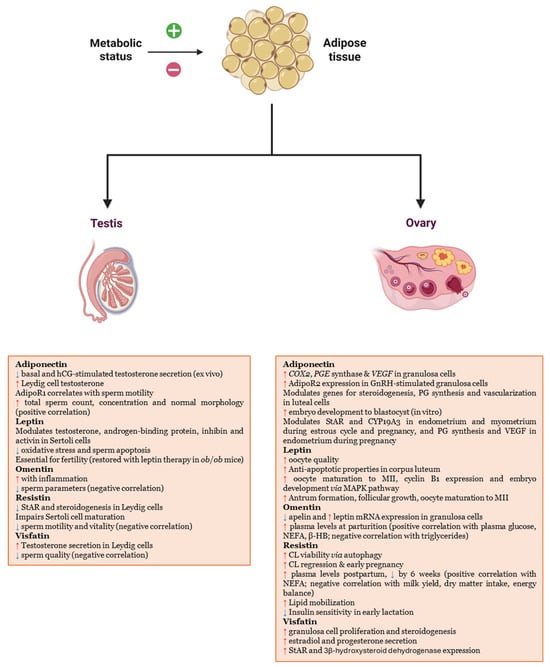
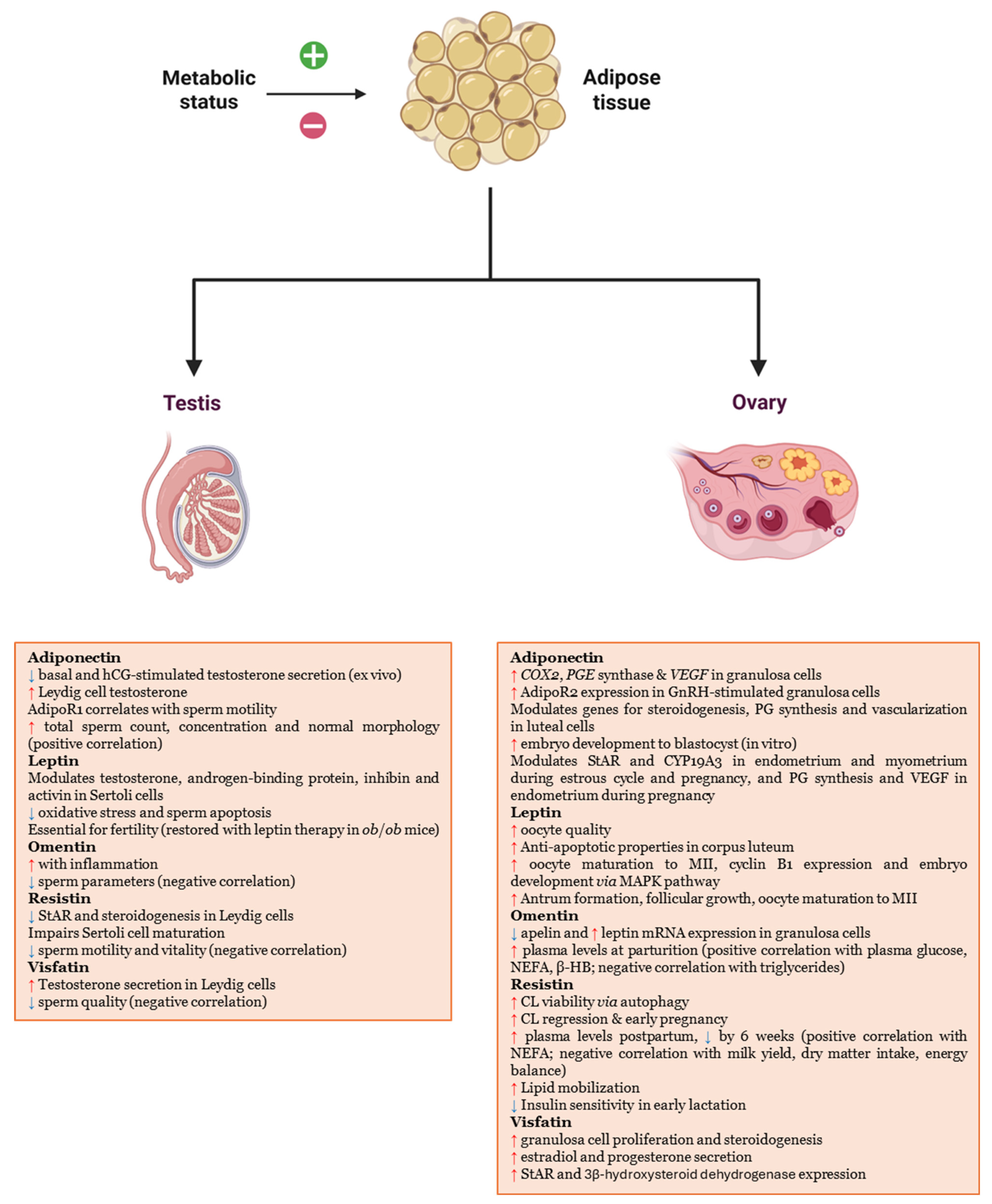
The discovery of the first adipose-specific cytokine, leptin, revealed that white adipose tissue (WAT) plays an important endocrine role, affecting systemic regulation of various organs and tissues—including those of reproductive interest—through the actions of subsequently identified adipokines. Metabolic status, reflected by changes in WAT and specific adipokine secretion profiles, impacts the morphophysiology of both male and female reproductive systems (Figure 1).
Figure 1.
Effect of specific-adipose adipokines on male and female gonads.
The complex interaction between adipokines and human reproductive functions has attracted considerable attention in recent years [122]: in women, body fat influences various reproductive parameters, including menstrual cycles, fertility, and pregnancy outcomes [14], while leptin and adiponectin determine ovarian reserve [123]; in males, a Mendelian randomization study [124] highlights how lipidome impacts male fertility.
This review focuses on adipose-specific cytokines, but the topic of adipokines is much broader, with studies meriting a review for each subject covered. Among the various examples, the link between obesity, adipokines, and cancer, especially breast cancer, is among the most studied. There is strong evidence linking increased adiposity with the development of 13 types of cancer, with important direct crosstalk between adipose tissue and various organs [125]. The connection between breast cancer and obesity depends on complex and interconnected biological mechanisms, including dysregulation of adipokines, which together generate a pro-tumorigenic environment, thus favoring the initiation, progression and recurrence of cancer [126]. Women with obesity have a higher chance of developing breast cancer and a greater risk of exacerbating the disease [127]. Adipokines have a significant impact on this link, especially leptin and adiponectin [128]. Leptin behaves as a growth factor in breast cancer, activating multiple oncogenic signaling pathways [129] and improving estrogen synthesis in adipose stromal cells [130]. Adiponectin is an anti-inflammatory factor with antiproliferative properties; in particular, it suppresses the proliferation of breast cancer cells, induces apoptosis, and alters metastatic potential [126]. Adiponectin counteracts leptin protumor effects, suggesting that obesity-associated breast carcinogenesis is mainly regulated by a leptin–adiponectin axis imbalance [126]. Recently, omentin-1 was suggested as a potential tumor suppressor, as it was found to be inversely related to abdominal fat, which is associated with a higher risk of breast cancer [131]. This relationship between omentin-1 and breast cancer has been proposed very recently, so more conclusive studies are needed [127].
From the large number of studies on the endocrine activity of adipose tissue and its effects on reproductive activity, two possible new fields of research emerge: brown adipose tissue and the gut microbiota. Brown adipose tissue is a metabolically active tissue that secretes a complex array of adipokines, called batokines [132], such as cytokines, factors, proteins, metabokines, and extracellular vescicles that signal and mediate different metabolic effects in target organs, including white adipose tissue [133], suggesting a possible effect on reproductive activity. Significant alterations in the composition and diversity of the gut microbiota, a condition known as dysbiosis, are associated with obesity [134]. The gut microbiota is a key environmental factor in the predisposition to adiposity, since it can regulate body fat storage, adipocyte metabolism, and inflammation of adipose tissue inflammation [135]. This evidence also suggests possible effects on reproductive activity, which will have to be demonstrated in future studies.
In conclusion, adipokines emerge as promising therapeutic targets that could clarify the mechanisms underlying fertility problems associated with altered nutritional status, in both human and veterinary contexts. Understanding the relationship between metabolic state, represented by adipose tissue and its adipokines, and reproductive dysfunctions can contribute to the development of new strategies for the treatment of male and female infertility.
Author Contributions
Conceptualization: M.M.-B., B.C.G. and M.Z.; literature search: E.C., M.M.-B., J.G.-D., M.M. and C.S.; writing—original draft preparation: A.B. and M.Z.; writing—review and editing: M.Z.; Supervision: M.M.-B. and B.C.G. All authors have read and agreed to the published version of the manuscript.
Funding
This research was funded by the European Union—Next Generation EU under the Italian Ministry of University and Research National Innovation Ecosystem grant ECS00000041—VITALITY and by CGB&ZM Officine Trust (Perugia, Italy).
Data Availability Statement
Not applicable.
Conflicts of Interest
Author Marcelo Martinez-Barbitta was employed by Sistema Reproductivo Veterinario Integral Uruguay, SRVI_UY. The remaining authors declare that the research was conducted in the absence of any commercial or financial relationships that could be construed as a potential conflict of interest.
Abbreviations
The following abbreviations are used in this manuscript:
| AdipoR | Adiponectin receptor |
| AMPK | AMP-activated protein kinase |
| APN | Adiponectin |
| BAT | Brown adipose tissue |
| BTB | Blood-testicular barrier |
| CAP1 | Adenylate-cyclase-associated protein 1 |
| CL | Corpus luteum |
| COX | Cyclooxygenase |
| CYP | Cytochrome P450 |
| ERK | Extracellular Signal-Regulated Kinase |
| GH | Growth hormone |
| HMW | High-molecular-weight |
| IGF | Insulin-like growth factor |
| IL | Interleukin |
| IRS | Insulin Receptor Substrates |
| IRβ | Insulin Receptor β subunit |
| ITLN | Intelectin |
| JAK | Janus kinase |
| JNK | c-Jun N-terminal kinase |
| KISS | Kisspeptin |
| LEPR | Leptin Receptor |
| LMW | Low-molecular-weight |
| MAPK | Mitogen-Activated Protein Kinase |
| MMW | Medium-molecular-weight |
| NAMPT | Nicotinamide Phosphoribosyltransferase |
| NF-κB | Nuclear Factor kappa-light-chain-enhancer |
| PG | Prostaglandin |
| PKB | Protein Kinase B |
| PPAR | Peroxisome-proliferator-activated receptor |
| StAR | Steroidogenic Acute Regulatory |
| STAT | Signal Transducer and Activator of Transcription |
| TLR | Toll-like receptor |
| VEGF | Vascular Endothelial Growth Factor |
| WAT | White adipose tissue |
References
- Zwick, R.K.; Guerrero-Juarez, C.F.; Horsley, V.; Plikus, M.V. Anatomical, Physiological, and Functional Diversity of Adipose Tissue. Cell Metab. 2018, 27, 68–83. [Google Scholar] [CrossRef] [Scilit]
- Müller, H. Fine structure and lipid formation in fat cells of the perimeningeal tissue of lampreys under normal and experimental conditions. Z. Zellforsch. Mikrosk. Anat. 1968, 84, 585–608. [Google Scholar] [CrossRef] [Scilit]
- Driskell, R.R.; Jahoda, C.A.B.; Chuong, C.-M.; Watt, F.M.; Horsley, V. Defining Dermal Adipose Tissue. Exp. Dermatol. 2014, 23, 629–631. [Google Scholar] [CrossRef] [Scilit]
- Ottaviani, E.; Malagoli, D.; Franceschi, C. The Evolution of the Adipose Tissue: A Neglected Enigma. Gen. Comp. Endocrinol. 2011, 174, 1–4. [Google Scholar] [CrossRef] [Scilit]
- Fève, B.; Cinti, S.; Beaupère, C.; Vatier, C.; Vigouroux, C.; Vali, A.; Capeau, J.; Grosfeld, A.; Moldes, M. Pink Adipose Tissue: A Paradigm of Adipose Tissue Plasticity. Ann. D’endocrinologie 2024, 85, 248–251. [Google Scholar] [CrossRef] [Scilit]
- Winkler, L.A. Morphology and Relationships of the Orangutan Fatty Cheek Pads. Am. J. Primatol. 1989, 17, 305–319. [Google Scholar] [CrossRef] [Scilit]
- Harper, C.J.; McLellan, W.A.; Rommel, S.A.; Gay, D.M.; Dillaman, R.M.; Pabst, D.A. Morphology of the Melon and Its Tendinous Connections to the Facial Muscles in Bottlenose Dolphins (Tursiops Truncatus). J. Morphol. 2008, 269, 820–839. [Google Scholar] [CrossRef] [Scilit]
- Weissengruber, G.E.; Egger, G.F.; Hutchinson, J.R.; Groenewald, H.B.; Elsässer, L.; Famini, D.; Forstenpointner, G. The Structure of the Cushions in the Feet of African Elephants (Loxodonta Africana). J. Anat. 2006, 209, 781–792. [Google Scholar] [CrossRef] [Scilit]
- O’Connell-Rodwell, C.E. Keeping an “Ear” to the Ground: Seismic Communication in Elephants. Physiology 2007, 22, 287–294. [Google Scholar] [CrossRef] [Scilit]
- Bengoumi, M.; Faulconnier, Y.; Tabarani, A.; Sghiri, A.; Faye, B.; Chilliard, Y. Effects of Feeding Level on Body Weight, Hump Size, Lipid Content and Adipocyte Volume in the Dromedary Camel. Anim. Res. 2005, 54, 383–393. [Google Scholar] [CrossRef] [Scilit]
- Silvestris, E.; De Pergola, G.; Rosania, R.; Loverro, G. Obesity as Disruptor of the Female Fertility. Reprod. Biol. Endocrinol. 2018, 16, 22. [Google Scholar] [CrossRef] [Scilit]
- Coelho, M.; Oliveira, T.; Fernandes, R. State of the Art Paper Biochemistry of Adipose Tissue: An Endocrine Organ. Arch. Med. Sci. 2013, 9, 191–200. [Google Scholar] [CrossRef] [Scilit]
- Kirichenko, T.V.; Markina, Y.V.; Bogatyreva, A.I.; Tolstik, T.V.; Varaeva, Y.R.; Starodubova, A.V. The Role of Adipokines in Inflammatory Mechanisms of Obesity. Int. J. Mol. Sci. 2022, 23, 14982. [Google Scholar] [CrossRef] [Scilit]
- Zheng, L.; Yang, L.; Guo, Z.; Yao, N.; Zhang, S.; Pu, P. Obesity and Its Impact on Female Reproductive Health: Unraveling the Connections. Front. Endocrinol. 2024, 14, 1326546. [Google Scholar] [CrossRef] [Scilit]
- Taylor, E.B. The Complex Role of Adipokines in Obesity, Inflammation, and Autoimmunity. Clin. Sci. 2021, 135, 731–752. [Google Scholar] [CrossRef] [Scilit]
- Mączka, K.; Stasiak, O.; Przybysz, P.; Grymowicz, M.; Smolarczyk, R. The Impact of the Endocrine and Immunological Function of Adipose Tissue on Reproduction in Women with Obesity. Int. J. Mol. Sci. 2024, 25, 9391. [Google Scholar] [CrossRef] [Scilit] [PubMed]
- Ahl, S.; Guenther, M.; Zhao, S.; James, R.; Marks, J.; Szabo, A.; Kidambi, S. Adiponectin Levels Differentiate Metabolically Healthy vs Unhealthy among Obese and Nonobese White Individuals. J. Clin. Endocrinol. Metab. 2015, 100, 4172–4180. [Google Scholar] [CrossRef] [Scilit] [PubMed]
- Nguyen, T.M.D. Adiponectin: Role in Physiology and Pathophysiology. Int. J. Prev. Med. 2020, 11, 136. [Google Scholar] [CrossRef] [Scilit]
- Choi, H.M.; Doss, H.M.; Kim, K.S. Multifaceted Physiological Roles of Adiponectin in Inflammation and Diseases. Int. J. Mol. Sci. 2020, 21, 1219. [Google Scholar] [CrossRef] [Scilit]
- Hada, Y.; Yamauchi, T.; Waki, H.; Tsuchida, A.; Hara, K.; Yago, H.; Miyazaki, O.; Ebinuma, H.; Kadowaki, T. Selective Purification and Characterization of Adiponectin Multimer Species from Human Plasma. Biochem. Biophys. Res. Commun. 2007, 356, 487–493. [Google Scholar] [CrossRef] [Scilit]
- Yamauchi, T.; Kamon, J.; Ito, Y.; Tsuchida, A.; Yokomizo, T.; Kita, S.; Sugiyama, T.; Miyagishi, M.; Hara, K.; Tsunoda, M.; et al. Cloning of Adiponectin Receptors That Mediate Antidiabetic Metabolic Effects. Nature 2003, 423, 762–769. [Google Scholar] [CrossRef] [Scilit] [PubMed]
- Hug, C.; Wang, J.; Ahmad, N.S.; Bogan, J.S.; Tsao, T.-S.; Lodish, H.F. T-Cadherin Is a Receptor for Hexameric and High-Molecular-Weight Forms of Acrp30/Adiponectin. Proc. Natl. Acad. Sci. USA 2004, 101, 10308–10313. [Google Scholar] [CrossRef] [Scilit]
- Rak, A.; Mellouk, N.; Froment, P.; Dupont, J. Adiponectin and Resistin: Potential Metabolic Signals Affecting Hypothalamo-Pituitary Gonadal Axis in Females and Males of Different Species. Reproduction 2017, 153, R215–R226. [Google Scholar] [CrossRef] [Scilit]
- Holland, W.L.; Xia, J.Y.; Johnson, J.A.; Sun, K.; Pearson, M.J.; Sharma, A.X.; Quittner-Strom, E.; Tippetts, T.S.; Gordillo, R.; Scherer, P.E. Inducible Overexpression of Adiponectin Receptors Highlight the Roles of Adiponectin-Induced Ceramidase Signaling in Lipid and Glucose Homeostasis. Mol. Metab. 2017, 6, 267–275. [Google Scholar] [CrossRef] [Scilit]
- Wen, J.-P.; Lv, W.-S.; Yang, J.; Nie, A.-F.; Cheng, X.-B.; Yang, Y.; Ge, Y.; Li, X.-Y.; Ning, G. Globular Adiponectin Inhibits GnRH Secretion from GT1-7 Hypothalamic GnRH Neurons by Induction of Hyperpolarization of Membrane Potential. Biochem. Biophys. Res. Commun. 2008, 371, 756–761. [Google Scholar] [CrossRef] [Scilit] [PubMed]
- Wen, J.-P.; Liu, C.; Bi, W.-K.; Hu, Y.-T.; Chen, Q.; Huang, H.; Liang, J.-X.; Li, L.-T.; Lin, L.-X.; Chen, G. Adiponectin Inhibits KISS1 Gene Transcription through AMPK and Specificity Protein-1 in the Hypothalamic GT1-7 Neurons. J. Endocrinol. 2012, 214, 177. [Google Scholar] [CrossRef] [Scilit]
- Kiezun, M.; Smolinska, N.; Maleszka, A.; Dobrzyn, K.; Szeszko, K.; Kaminski, T. Adiponectin Expression in the Porcine Pituitary during the Estrous Cycle and Its Effect on LH and FSH Secretion. Am. J. Physiol. Endocrinol. Metab. 2014, 307, E1038–E1046. [Google Scholar] [CrossRef] [Scilit]
- Rodriguez-Pacheco, F.; Martinez-Fuentes, A.J.; Tovar, S.; Pinilla, L.; Tena-Sempere, M.; Dieguez, C.; Castaño, J.P.; Malagon, M.M. Regulation of Pituitary Cell Function by Adiponectin. Endocrinology 2007, 148, 401–410. [Google Scholar] [CrossRef] [Scilit]
- Lu, M.; Tang, Q.; Olefsky, J.M.; Mellon, P.L.; Webster, N.J.G. Adiponectin Activates Adenosine Monophosphate-Activated Protein Kinase and Decreases Luteinizing Hormone Secretion in LβT2 Gonadotropes. Mol. Endocrinol. 2008, 22, 760–771. [Google Scholar] [CrossRef] [Scilit]
- Wilkinson, M.; Brown, R.; Imran, S.A.; Ur, E. Adipokine Gene Expression in Brain and Pituitary Gland. Neuroendocrinology 2007, 86, 191–209. [Google Scholar] [CrossRef] [Scilit]
- Wang, R.; Kuang, M.; Nie, H.; Bai, W.; Sun, L.; Wang, F.; Mao, D.; Wang, Z. Impact of Food Restriction on the Expression of the Adiponectin System and Genes in the Hypothalamic–Pituitary–Ovarian Axis of Pre-Pubertal Ewes. Reprod. Domest. Anim. 2016, 51, 657–664. [Google Scholar] [CrossRef] [Scilit]
- Pérez-Pérez, A.; Sánchez-Jiménez, F.; Maymó, J.; Dueñas, J.L.; Varone, C.; Sánchez-Margalet, V. Role of Leptin in Female Reproduction. Clin. Chem. Lab. Med. (CCLM) 2015, 53, 15–28. [Google Scholar] [CrossRef] [Scilit]
- Quennell, J.H.; Mulligan, A.C.; Tups, A.; Liu, X.; Phipps, S.J.; Kemp, C.J.; Herbison, A.E.; Grattan, D.R.; Anderson, G.M. Leptin Indirectly Regulates Gonadotropin-Releasing Hormone Neuronal Function. Endocrinology 2009, 150, 2805–2812. [Google Scholar] [CrossRef] [Scilit] [PubMed]
- Petrine, J.C.P.; Franci, C.R.; Del Bianco-Borges, B. Leptin Actions through the Nitrergic System to Modulate the Hypothalamic Expression of the Kiss1 mRNA in the Female Rat. Brain Res. 2020, 1728, 146574. [Google Scholar] [CrossRef] [Scilit]
- Childs, G.V.; Odle, A.K.; MacNicol, M.C.; MacNicol, A.M. The Importance of Leptin to Reproduction. Endocrinology 2021, 162, bqaa204. [Google Scholar] [CrossRef] [Scilit]
- Akhter, N.; CarlLee, T.; Syed, M.M.; Odle, A.K.; Cozart, M.A.; Haney, A.C.; Allensworth-James, M.L.; Beneš, H.; Childs, G.V. Selective Deletion of Leptin Receptors in Gonadotropes Reveals Activin and GnRH-Binding Sites as Leptin Targets in Support of Fertility. Endocrinology 2014, 155, 4027–4042. [Google Scholar] [CrossRef] [Scilit]
- Odle, A.K.; Akhter, N.; Syed, M.M.; Allensworth-James, M.L.; Beneš, H.; Melgar Castillo, A.I.; MacNicol, M.C.; MacNicol, A.M.; Childs, G.V. Leptin Regulation of Gonadotrope Gonadotropin-Releasing Hormone Receptors as a Metabolic Checkpoint and Gateway to Reproductive Competence. Front. Endocrinol. 2018, 8, 367. [Google Scholar] [CrossRef] [Scilit]
- Suter, K.J.; Pohl, C.R.; Wilson, M.E. Circulating Concentrations of Nocturnal Leptin, Growth Hormone, and Insulin-Like Growth Factor-I Increase before the Onset of Puberty in Agonadal Male Monkeys: Potential Signals for the Initiation of Puberty1. J. Clin. Endocrinol. Metab. 2000, 85, 808–814. [Google Scholar] [CrossRef] [Scilit] [PubMed]
- Brunetti, L.; Orlando, G.; Ferrante, C.; Recinella, L.; Leone, S.; Chiavaroli, A.; Di Nisio, C.; Shohreh, R.; Manippa, F.; Ricciuti, A. Orexigenic Effects of Omentin-1 Related to Decreased CART and CRH Gene Expression and Increased Norepinephrine Synthesis and Release in the Hypothalamus. Peptides 2013, 44, 66–74. [Google Scholar] [CrossRef] [Scilit] [PubMed]
- Dutta, S.; Sengupta, P.; Jegasothy, R.; Akhigbe, R.E. Resistin and Visfatin: ‘Connecting Threads’ of Immunity, Energy Modulations and Male Reproduction. Chem. Biol. Lett. 2021, 8, 192–201. [Google Scholar]
- Abdel-Fadeil, M.R.; Abd Allah, E.S.; Iraqy, H.M.; Elgamal, D.A.; Abdel-Ghani, M.A. Experimental Obesity and Diabetes Reduce Male Fertility: Potential Involvement of Hypothalamic Kiss-1, Pituitary Nitric Oxide, Serum Vaspin and Visfatin. Pathophysiology 2019, 26, 181–189. [Google Scholar] [CrossRef] [Scilit]
- Caminos, J.E.; Nogueiras, R.; Gaytán, F.; Pineda, R.; González, C.R.; Barreiro, M.L.; Castaño, J.P.; Malagón, M.M.; Pinilla, L.; Toppari, J.; et al. Novel Expression and Direct Effects of Adiponectin in the Rat Testis. Endocrinology 2008, 149, 3390–3402. [Google Scholar] [CrossRef] [Scilit]
- Landry, D.; Paré, A.; Jean, S.; Martin, L.J. Adiponectin Influences Progesterone Production from MA-10 Leydig Cells in a Dose-Dependent Manner. Endocrine 2015, 48, 957–967. [Google Scholar] [CrossRef] [Scilit]
- Kadivar, A.; Heidari Khoei, H.; Hassanpour, H.; Golestanfar, A.; Ghanaei, H. Correlation of Adiponectin mRNA Abundance and Its Receptors with Quantitative Parameters of Sperm Motility in Rams. Int. J. Fertil. Steril. 2016, 10, 127–135. [Google Scholar] [CrossRef] [Scilit]
- Thomas, S.; Kratzsch, D.; Schaab, M.; Scholz, M.; Grunewald, S.; Thiery, J.; Paasch, U.; Kratzsch, J. Seminal Plasma Adipokine Levels Are Correlated with Functional Characteristics of Spermatozoa. Fertil. Steril. 2013, 99, 1256–1263.e3. [Google Scholar] [CrossRef] [Scilit]
- Martínez-Barbitta, M.; Maranesi, M.; Mercati, F.; Marini, D.; Anipchenko, P.; Grispoldi, L.; Cenci-Goga, B.T.; Zerani, M.; Dall’Aglio, C. Presence, Tissue Localization, and Gene Expression of the Adiponectin Receptor 1 in Testis and Accessory Glands of Male Rams during the Non-Breeding Season. Animals 2023, 13, 601. [Google Scholar] [CrossRef] [Scilit] [PubMed]
- Jope, T.; Lammert, A.; Kratzsch, J.; Paasch, U.; Glander, H.-J. Leptin and Leptin Receptor in Human Seminal Plasma and in Human Spermatozoa. Int. J. Androl. 2003, 26, 335–341. [Google Scholar] [CrossRef] [Scilit] [PubMed]
- Almabhouh, F.A.; Osman, K.; Siti Fatimah, I.; Sergey, G.; Gnanou, J.; Singh, H.J. Effects of Leptin on Sperm Count and Morphology in Sprague-Dawley Rats and Their Reversibility Following a 6-Week Recovery Period. Andrologia 2015, 47, 751–758. [Google Scholar] [CrossRef] [Scilit] [PubMed]
- Ramos, C.F.; Zamoner, A. Thyroid Hormone and Leptin in the Testis. Front. Endocrinol. 2014, 5, 198. [Google Scholar] [CrossRef] [Scilit]
- Smith, L.B.; Walker, W.H. The Regulation of Spermatogenesis by Androgens. Semin. Cell Dev. Biol. 2014, 30, 2–13. [Google Scholar] [CrossRef] [Scilit]
- Gao, Y.; Zhao, G.; Song, Y.; Haire, A.; Yang, A.; Zhao, X.; Wusiman, A. Presence of Leptin and Its Receptor in the Ram Reproductive System and in Vitro Effect of Leptin on Sperm Quality. PeerJ 2022, 10, e13982. [Google Scholar] [CrossRef] [Scilit]
- Martins, F.F.; Aguila, M.B.; Mandarim-de-Lacerda, C.A. Impaired Steroidogenesis in the Testis of Leptin-Deficient Mice (Ob/Ob. -/-). Acta Histochem. 2017, 119, 508–515. [Google Scholar] [CrossRef] [Scilit]
- Önel, T.; Ayla, S.; Keskin, İ.; Parlayan, C.; Yiğitbaşı, T.; Kolbaşı, B.; Yelke, T.V.; Ustabaş, T.Ş. Leptin in Sperm Analysis Can Be a New Indicator. Acta Histochem. 2019, 121, 43–49. [Google Scholar] [CrossRef] [Scilit] [PubMed]
- Boutari, C.; Pappas, P.D.; Mintziori, G.; Nigdelis, M.P.; Athanasiadis, L.; Goulis, D.G.; Mantzoros, C.S. The Effect of Underweight on Female and Male Reproduction. Metabolism 2020, 107, 154229. [Google Scholar] [CrossRef] [Scilit]
- Moretti, E.; Signorini, C.; Noto, D.; Tripodi, S.A.; Menchiari, A.; Sorrentino, E.; Collodel, G. Seminal Levels of Omentin-1/ITLN1 in Inflammatory Conditions Related to Male Infertility and Localization in Spermatozoa and Tissues of Male Reproductive System. J. Inflamm. Res. 2022, 15, 2019–2031. [Google Scholar] [CrossRef] [Scilit]
- Roumaud, P.; Martin, L.J. Roles of Leptin, Adiponectin and Resistin in the Transcriptional Regulation of Steroidogenic Genes Contributing to Decreased Leydig Cells Function in Obesity. Horm. Mol. Biol. Clin. Investig. 2015, 24, 25–45. [Google Scholar] [CrossRef] [Scilit]
- Wagner, I.V.; Yango, P.; Svechnikov, K.; Tran, N.D.; Söder, O. Adipocytokines May Delay Pubertal Maturation of Human Sertoli Cells. Reprod. Fertil. Dev. 2019, 31, 1395–1400. [Google Scholar] [CrossRef] [Scilit]
- Moretti, E.; Collodel, G.; Mazzi, L.; Campagna, M.; Iacoponi, F.; Figura, N. Resistin, Interleukin-6, Tumor Necrosis Factor-Alpha, and Human Semen Parameters in the Presence of Leukocytospermia, Smoking Habit, and Varicocele. Fertil. Steril. 2014, 102, 354–360. [Google Scholar] [CrossRef] [Scilit] [PubMed]
- Hameed, W.; Yousaf, I.; Latif, R.; Aslam, M. Effect of Visfatin on Testicular Steroidogenesis in Purified Leydig Cells. J. Ayub Med. Coll. Abbottabad 2012, 24, 62–64. [Google Scholar] [PubMed]
- Rahmanifar, F.; Tabandeh, M.R. Adiponectin and Its Receptors Gene Expression in the Reproductive Tract of Ram. Small Rumin. Res. 2012, 105, 263–267. [Google Scholar] [CrossRef] [Scilit]
- Ledoux, S.; Campos, D.B.; Lopes, F.L.; Dobias-Goff, M.; Palin, M.F.; Murphy, B.D. Adiponectin Induces Periovulatory Changes in Ovarian Follicular Cells. Endocrinology 2006, 147, 5178–5186. [Google Scholar] [CrossRef] [Scilit] [PubMed]
- Thaqi, G.; Berisha, B.; Pfaffl, M.W. Expression Dynamics of Adipokines during Induced Ovulation in the Bovine Follicles and Early Corpus Luteum. Reprod. Domest. Anim. 2024, 59, e14624. [Google Scholar] [CrossRef] [Scilit] [PubMed]
- Szeszko, K.; Smolinska, N.; Kiezun, M.; Dobrzyn, K.; Maleszka, A.; Kaminski, T. The Influence of Adiponectin on the Transcriptomic Profile of Porcine Luteal Cells. Funct. Integr. Genom. 2016, 16, 101–114. [Google Scholar] [CrossRef] [Scilit] [PubMed]
- Chappaz, E.; Albornoz, M.S.; Campos, D.; Che, L.; Palin, M.F.; Murphy, B.D.; Bordignon, V. Adiponectin Enhances in Vitro Development of Swine Embryos. Domest. Anim. Endocrinol. 2008, 35, 198–207. [Google Scholar] [CrossRef] [Scilit]
- Brochu-Gaudreau, K.; Beaudry, D.; Blouin, R.; Bordignon, V.; Murphy, B.D.; Palin, M.-F. Adiponectin Regulates Gene Expression in the Porcine Uterus; Oxford University Press: Oxford, UK, 2008; ISBN 0006-3363. [Google Scholar]
- Maleszka, A.; Smolinska, N.; Nitkiewicz, A.; Kiezun, M.; Chojnowska, K.; Dobrzyn, K.; Szwaczek, H.; Kaminski, T. Adiponectin Expression in the Porcine Ovary during the Oestrous Cycle and Its Effect on Ovarian Steroidogenesis. Int. J. Endocrinol. 2014, 2014, 957076. [Google Scholar] [CrossRef] [Scilit]
- Kiezun, M.; Dobrzyn, K.; Zaobidna, E.; Rytelewska, E.; Kisielewska, K.; Gudelska, M.; Orzechowska, K.; Kopij, G.; Szymanska, K.; Kaminska, B.; et al. Adiponectin Affects Uterine Steroidogenesis during Early Pregnancy and the Oestrous Cycle: An in Vitro Study. Anim. Reprod. Sci. 2022, 245, 107067. [Google Scholar] [CrossRef] [Scilit]
- Gregoraszczuk, E.Ł.; Ptak, A. In Vitro Effect of Leptin on Growth Hormone (GH)- and Insulin-Like Growth Factor-I (IGF-I)-Stimulated Progesterone Secretion and Apoptosis in Developing and Mature Corpora Lutea of Pig Ovaries. J. Reprod. Dev. 2005, 51, 727–733. [Google Scholar] [CrossRef] [Scilit]
- Abecia, J.A.; Forcada, F.; Palacín, I.; Sánchez-Prieto, L.; Sosa, C.; Fernández-Foren, A.; Meikle, A. Undernutrition Affects Embryo Quality of Superovulated Ewes. Zygote 2015, 23, 116–124. [Google Scholar] [CrossRef] [Scilit]
- Estienne, A.; Brossaud, A.; Reverchon, M.; Ramé, C.; Froment, P.; Dupont, J. Adipokines Expression and Effects in Oocyte Maturation, Fertilization and Early Embryo Development: Lessons from Mammals and Birds. Int. J. Mol. Sci. 2020, 21, 3581. [Google Scholar] [CrossRef] [Scilit]
- Gregoraszczuk, E.L.; Rak, A.; Wójtowicz, A.; Ptak, A.; Wojciechowicz, T.; Nowak, K.W. Gh and Igf-i Increase Leptin Receptor Expression in Prepubertal Pig Ovaries: The Role of Leptin in Steroid Secretion and Cell Apoptosis. Acta Vet. Hung. 2006, 54, 413–426. [Google Scholar] [CrossRef] [Scilit]
- Craig, J.; Zhu, H.; Dyce, P.W.; Petrik, J.; Li, J. Leptin Enhances Oocyte Nuclear and Cytoplasmic Maturation via the Mitogen-Activated Protein Kinase Pathway. Endocrinology 2004, 145, 5355–5363. [Google Scholar] [CrossRef] [Scilit]
- Wołodko, K.; Castillo-fernandez, J.; Kelsey, G.; Galvão, A. Revisiting the Impact of Local Leptin Signaling in Folliculogenesis and Oocyte Maturation in Obese Mothers. Int. J. Mol. Sci. 2021, 22, 4270. [Google Scholar] [CrossRef] [Scilit]
- Silva, E.; Paczkowski, M.; Krisher, R.L. The Effect of Leptin on Maturing Porcine Oocytes Is Dependent on Glucose Concentration. Mol. Reprod. Dev. 2012, 79, 296–307. [Google Scholar] [CrossRef] [Scilit]
- Kamalamma, P.; Kona, S.S.R.; Praveen Chakravarthi, V.; Siva Kumar, A.V.N.; Punyakumari, B.; Rao, V.H. Effect of Leptin on in Vitro Development of Ovine Preantral Ovarian Follicles. Theriogenology 2016, 85, 224–229. [Google Scholar] [CrossRef] [Scilit] [PubMed]
- Pich, K.; Respekta-Długosz, N.; Dawid, M.; Rame, C.; Smolińska, N.; Dupont, J.; Rak, A. In Vitro Effect of Omentin-1 on Level of Other Adipokines in Granulosa Cells from Ovaries of Large White and Meishan Pigs. Anim. Reprod. Sci. 2025, 274, 107783. [Google Scholar] [CrossRef] [Scilit] [PubMed]
- Aygormez, S.; Atakisi, E. Investigation of Omentin-1 and Metabolic Parameters in Periparturient Cows. J. Hell. Vet. Med. Soc. 2021, 72, 2733–2740. [Google Scholar] [CrossRef] [Scilit]
- Kurowska, P.; Gazdzik, K.; Jasinska, A.; Mlyczynska, E.; Wachowska, D.; Rak, A. Resistin as a New Player in the Regulation of Porcine Corpus Luteum Luteolysis: In Vitro Effect on Proliferation/Viability, Apoptosis and Autophagy. J. Physiol. Pharmacol. 2023, 74, 21–30. [Google Scholar] [CrossRef] [Scilit]
- Thaqi, G.; Berisha, B.; Pfaffl, M.W. Expression of Locally Produced Adipokines and Their Receptors during Different Physiological and Reproductive Stages in the Bovine Corpus Luteum. Animals 2023, 13, 1782. [Google Scholar] [CrossRef] [Scilit]
- Reverchon, M.; Ramé, C.; Cognié, J.; Briant, E.; Elis, S.; Guillaume, D.; Dupont, J. Resistin in Dairy Cows: Plasma Concentrations during Early Lactation, Expression and Potential Role in Adipose Tissue. PLoS ONE 2014, 9, e93198. [Google Scholar] [CrossRef] [Scilit]
- Weber, M.; Locher, L.; Huber, K.; Kenéz, Á.; Rehage, J.; Tienken, R.; Meyer, U.; Dänicke, S.; Sauerwein, H.; Mielenz, M. Longitudinal Changes in Adipose Tissue of Dairy Cows from Late Pregnancy to Lactation. Part 1: The Adipokines Apelin and Resistin and Their Relationship to Receptors Linked with Lipolysis. J. Dairy Sci. 2016, 99, 1549–1559. [Google Scholar] [CrossRef] [Scilit]
- Reverchon, M.; Rame, C.; Bunel, A.; Chen, W.; Froment, P.; Dupont, J. VISFATIN (NAMPT) Improves in Vitro IGF1-Induced Steroidogenesis and IGF1 Receptor Signaling through SIRT1 in Bovine Granulosa Cells. Biol. Reprod. 2016, 94, 54. [Google Scholar] [CrossRef] [Scilit]
- French, A.T.; Knight, P.A.; David Smith, W.; Pate, J.A.; Miller, H.R.P.; Pemberton, A.D. Expression of Three Intelectins in Sheep and Response to a Th2 Environment. Vet. Res. 2009, 40, 1–13. [Google Scholar] [CrossRef] [Scilit]
- Muhlhausler, B.S.; Duffield, J.A.; McMillen, I.C. Increased Maternal Nutrition Stimulates Peroxisome Proliferator Activated Receptor-γ, Adiponectin, and Leptin Messenger Ribonucleic Acid Expression in Adipose Tissue before Birth. Endocrinology 2007, 148, 878–885. [Google Scholar] [CrossRef] [Scilit]
- Reynolds, C.M.; Vickers, M.H. The Role of Adipokines in Developmental Programming: Evidence from Animal Models. J. Endocrinol. 2019, 242, T81–T94. [Google Scholar] [CrossRef] [Scilit]
- Sahu, B.; Bal, N.C. Adipokines from White Adipose Tissue in Regulation of Whole Body Energy Homeostasis. Biochimie 2023, 204, 92–107. [Google Scholar] [CrossRef] [Scilit] [PubMed]
- Seoane-Collazo, P.; Martínez-Sánchez, N.; Milbank, E.; Contreras, C. Incendiary Leptin. Nutrients 2020, 12, 472. [Google Scholar] [CrossRef] [Scilit]
- Cravo, R.M.; Margatho, L.O.; Osborne-Lawrence, S.; Donato, J.; Atkin, S.; Bookout, A.L.; Rovinsky, S.; Frazão, R.; Lee, C.E.; Gautron, L.; et al. Characterization of Kiss1 Neurons Using Transgenic Mouse Models. Neuroscience 2011, 173, 37–56. [Google Scholar] [CrossRef] [Scilit] [PubMed]
- Adam, C.L.; Williams, P.A.; Milne, J.S.; Aitken, R.P.; Wallace, J.M. Orexigenic Gene Expression in Late Gestation Ovine Foetal Hypothalamus Is Sensitive to Maternal Undernutrition and Realimentation. J. Neuroendocrinol. 2015, 27, 765–771. [Google Scholar] [CrossRef] [Scilit]
- Tuersunjiang, N.; Odhiambo, J.F.; Shasa, D.R.; Smith, A.M.; Nathanielsz, P.W.; Ford, S.P. Maternal Obesity Programs Reduced Leptin Signaling in the Pituitary and Altered GH/IGF1 Axis Function Leading to Increased Adiposity in Adult Sheep Offspring. PLoS ONE 2017, 12, e0181795. [Google Scholar] [CrossRef] [Scilit]
- Obaideen, M.; Önel, T.; Yıldırım, E.; Yaba, A. The Role of Leptin in the Male Reproductive System. J. Turk. Ger. Gynecol. Assoc. 2024, 25, 247–258. [Google Scholar] [CrossRef] [Scilit]
- Malik, I.A.; Durairajanayagam, D.; Singh, H.J. Leptin and Its Actions on Reproduction in Males. Asian J. Androl. 2019, 21, 296. [Google Scholar] [CrossRef] [Scilit]
- Wang, X.; Zhang, X.; Hu, L.; Li, H. Exogenous Leptin Affects Sperm Parameters and Impairs Blood Testis Barrier Integrity in Adult Male Mice. Reprod. Biol. Endocrinol. 2018, 16, 55. [Google Scholar] [CrossRef] [Scilit]
- Bhat, G.K.; Sea, T.L.; Olatinwo, M.O.; Simorangkir, D.; Ford, G.D.; Ford, B.D.; Mann, D.R. Influence of a Leptin Deficiency on Testicular Morphology, Germ Cell Apoptosis, and Expression Levels of Apoptosis-Related Genes in the Mouse. J. Androl. 2006, 27, 302–310. [Google Scholar] [CrossRef] [Scilit]
- Delavaud, C.; Ferlay, A.; Faulconnier, Y.; Bocquier, F.; Kann, G.; Chilliard, Y. Plasma Leptin Concentration in Adult Cattle: Effects of Breed, Adiposity, Feeding Level, and Meal Intake. J. Anim. Sci. 2002, 80, 1317–1328. [Google Scholar] [CrossRef] [Scilit] [PubMed]
- Bispham, J.; Gopalakrishnan, G.S.; Dandrea, J.; Wilson, V.; Budge, H.; Keisler, D.H.; Broughton Pipkin, F.; Stephenson, T.; Symonds, M.E. Maternal Endocrine Adaptation throughout Pregnancy to Nutritional Manipulation: Consequences for Maternal Plasma Leptin and Cortisol and the Programming of Fetal Adipose Tissue Development. Endocrinology 2003, 144, 3575–3585. [Google Scholar] [CrossRef] [Scilit] [PubMed]
- Bispham, J.; Budge, H.; Mostyn, A.; Dandrea, J.; Clarke, L.; Keisler, D.H.; Symonds, M.E.; Stephenson, T. Ambient Temperature, Maternal Dexamethasone, and Postnatal Ontogeny of Leptin in the Neonatal Lamb. Pediatr. Res. 2002, 52, 85–90. [Google Scholar] [CrossRef] [Scilit]
- Kim, J.A.; Choi, K.M. Newly Discovered Adipokines: Pathophysiological Link between Obesity and Cardiometabolic Disorders. Front. Physiol. 2020, 11, 568800. [Google Scholar] [CrossRef] [Scilit]
- Dupont, J.; Pollet-Villard, X.; Reverchon, M.; Mellouk, N.; Levy, R. Adipokines in Human Reproduction. Horm. Mol. Biol. Clin. Investig. 2015, 24, 11–24. [Google Scholar] [CrossRef] [Scilit]
- Yamawaki, H. Vascular Effects of Novel Adipocytokines: Focus on Vascular Contractility and Inflammatory Responses. Biol. Pharm. Bull. 2011, 34, 307–310. [Google Scholar] [CrossRef] [Scilit] [PubMed]
- Zhong, X.; Li, X.; Liu, F.; Tan, H.; Shang, D. Omentin Inhibits TNF-α-Induced Expression of Adhesion Molecules in Endothelial Cells via ERK/NF-κB Pathway. Biochem. Biophys. Res. Commun. 2012, 425, 401–406. [Google Scholar] [CrossRef] [Scilit]
- Respekta, N.; Pich, K.; Mlyczyńska, E.; Dobrzyń, K.; Ramé, C.; Kamiński, T.; Smolińska, N.; Dupont, J.; Rak, A. Plasma Level of Omentin-1, Its Expression, and Its Regulation by Gonadotropin-Releasing Hormone and Gonadotropins in Porcine Anterior Pituitary Cells. Sci. Rep. 2023, 13, 19325. [Google Scholar] [CrossRef] [Scilit]
- Martins, F.F.; Amarante, M.d.S.M.; Oliveira, D.S.; Vasques-Monteiro, I.M.L.; Souza-Mello, V.; Daleprane, J.B.; Camillo, C.D.S. Obesity, White Adipose Tissue, and Adipokines Signaling in Male Reproduction. Mol. Nutr. Food Res. 2025, 69, e70054. [Google Scholar] [CrossRef] [Scilit]
- Pich, K.; Respekta, N.; Kurowska, P.; Rame, C.; Dobrzyń, K.; Smolińska, N.; Dupont, J.; Rak, A. Omentin Expression in the Ovarian Follicles of Large White and Meishan Sows during the Oestrous Cycle and in Vitro Effect of Gonadotropins and Steroids on Its Level: Role of ERK1/2 and PI3K Signaling Pathways. PLoS ONE 2024, 19, e0297875. [Google Scholar] [CrossRef] [Scilit]
- Patel, S.D.; Rajala, M.W.; Rossetti, L.; Scherer, P.E.; Shapiro, L. Disulfide-Dependent Multimeric Assembly of Resistin Family Hormones. Science 2004, 304, 1154–1158. [Google Scholar] [CrossRef] [Scilit] [PubMed]
- Tarkowski, A.; Bjersing, J.; Shestakov, A.; Bokarewa, M.I. Resistin Competes with Lipopolysaccharide for Binding to Toll-like Receptor 4. J. Cell. Mol. Med. 2010, 14, 1419–1431. [Google Scholar] [CrossRef] [Scilit]
- Maillard, V.; Elis, S.; Desmarchais, A.; Hivelin, C.; Lardic, L.; Lomet, D.; Uzbekova, S.; Monget, P.; Dupont, J. Visfatin and Resistin in Gonadotroph Cells: Expression, Regulation of LH Secretion and Signalling Pathways. Reprod. Fertil. Dev. 2017, 29, 2479–2495. [Google Scholar] [CrossRef] [Scilit] [PubMed]
- Kim, M.K.; Lee, J.H.; Kim, H.; Park, S.J.; Kim, S.H.; Kang, G.B.; Lee, Y.S.; Kim, J.B.; Kim, K.K.; Suh, S.W. Crystal Structure of Visfatin/Pre-B Cell Colony-Enhancing Factor 1/Nicotinamide Phosphoribosyltransferase, Free and in Complex with the Anti-Cancer Agent FK-866. J. Mol. Biol. 2006, 362, 66–77. [Google Scholar] [CrossRef] [Scilit]
- Sommer, G.; Garten, A.; Petzold, S.; Beck-Sickinger, A.G.; Blüher, M.; Stumvoll, M.; Fasshauer, M. Visfatin/PBEF/Nampt: Structure, Regulation and Potential Function of a Novel Adipokine. Clin. Sci. 2008, 115, 13–23. [Google Scholar] [CrossRef] [Scilit]
- Yoshino, J.; Mills, K.F.; Yoon, M.J.; Imai, S. Nicotinamide Mononucleotide, a Key NAD+ Intermediate, Treats the Pathophysiology of Diet-and Age-Induced Diabetes in Mice. Cell Metab. 2011, 14, 528–536. [Google Scholar] [CrossRef] [Scilit] [PubMed]
- Higgins, C.B.; Mayer, A.L.; Zhang, Y.; Franczyk, M.; Ballentine, S.; Yoshino, J.; DeBosch, B.J. SIRT1 Selectively Exerts the Metabolic Protective Effects of Hepatocyte Nicotinamide Phosphoribosyltransferase. Nat. Commun. 2022, 13, 1074. [Google Scholar] [CrossRef] [Scilit]
- Saddi-Rosa, P.; Oliveira, C.S.; Giuffrida, F.M.; Reis, A.F. Visfatin, Glucose Metabolism and Vascular Disease: A Review of Evidence. Diabetol. Metab. Syndr. 2010, 2, 21. [Google Scholar] [CrossRef] [Scilit] [PubMed]
- Mlyczyńska, E.; Kieżun, M.; Kurowska, P.; Dawid, M.; Pich, K.; Respekta, N.; Daudon, M.; Rytelewska, E.; Dobrzyń, K.; Kamińska, B.; et al. New Aspects of Corpus Luteum Regulation in Physiological and Pathological Conditions: Involvement of Adipokines and Neuropeptides. Cells 2022, 11, 957. [Google Scholar] [CrossRef] [Scilit]
- Kaminska, B.; Kurowicka, B.; Kiezun, M.; Dobrzyn, K.; Kisielewska, K.; Gudelska, M.; Kopij, G.; Szymanska, K.; Zarzecka, B.; Koker, O.; et al. The Role of Adipokines in the Control of Pituitary Functions. Animals 2024, 14, 353. [Google Scholar] [CrossRef] [Scilit] [PubMed]
- Shasa, D.R.; Odhiambo, J.F.; Long, N.M.; Tuersunjiang, N.; Nathanielsz, P.W.; Ford, S.P. Multigenerational Impact of Maternal Overnutrition/Obesity in the Sheep on the Neonatal Leptin Surge in Granddaughters. Int. J. Obes. 2015, 39, 695–701. [Google Scholar] [CrossRef] [Scilit]
- Heo, Y.J.; Choi, S.-E.; Jeon, J.Y.; Han, S.J.; Kim, D.J.; Kang, Y.; Lee, K.W.; Kim, H.J. Visfatin Induces Inflammation and Insulin Resistance via the NF-κB and STAT3 Signaling Pathways in Hepatocytes. J. Diabetes Res. 2019, 2019, 4021623. [Google Scholar] [CrossRef] [Scilit]
- Zorena, K.; Jachimowicz-Duda, O.; Ślęzak, D.; Robakowska, M.; Mrugacz, M. Adipokines and Obesity. Potential Link to Metabolic Disorders and Chronic Complications. Int. J. Mol. Sci. 2020, 21, 3570. [Google Scholar] [CrossRef] [Scilit]
- Cannarella, R.; Crafa, A.; Curto, R.; Condorelli, R.A.; La Vignera, S.; Calogero, A.E. Obesity and Male Fertility Disorders. Mol. Asp. Med. 2024, 97, 101273. [Google Scholar] [CrossRef] [Scilit]
- Ocon-Grove, O.M.; Krzysik-Walker, S.M.; Maddineni, S.R.; Hendricks, G.L.; Ramachandran, R. NAMPT (Visfatin) in the Chicken Testis: Influence of Sexual Maturation on Cellular Localization, Plasma Levels and Gene and Protein Expression. Reproduction 2010, 139, 217. [Google Scholar] [CrossRef] [Scilit]
- Riammer, S.; Garten, A.; Schaab, M.; Grunewald, S.; Kiess, W.; Kratzsch, J.; Paasch, U. Nicotinamide Phosphoribosyltransferase Production in Human Spermatozoa Is Influenced by Maturation Stage. Andrology 2016, 4, 1045–1053. [Google Scholar] [CrossRef] [Scilit]
- Jeremy, M.; Gurusubramanian, G.; Roy, V.K. Localization Pattern of Visfatin (NAMPT) in d-Galactose Induced Aged Rat Testis. Ann. Anat.-Anat. Anz. 2017, 211, 46–54. [Google Scholar] [CrossRef] [Scilit] [PubMed]
- Choubey, M.; Nikolettos, N. Editorial: Adipose Tissue and Adipokines: Their Roles in Human Reproduction. Front. Endocrinol. 2024, 15, 1497744. [Google Scholar] [CrossRef] [Scilit]
- Nikolettos, K.; Vlahos, N.; Pagonopoulou, O.; Nikolettos, N.; Zikopoulos, K.; Tsikouras, P.; Kontomanolis, E.; Damaskos, C.; Garmpis, N.; Psilopatis, I.; et al. The Association between Leptin, Adiponectin Levels and the Ovarian Reserve in Women of Reproductive Age. Front. Endocrinol. 2024, 15, 1369248. [Google Scholar] [CrossRef] [Scilit]
- Yang, Y.; Xue, X.; Zhou, J.; Qiu, Z.; Wang, B.; Ou, G.; Zhou, Q. Male Infertility Risk and Plasma Lipidome: A Mendelian Randomization Study. Front. Endocrinol. 2024, 15, 1412684. [Google Scholar] [CrossRef] [Scilit]
- Brown, K.A.; Scherer, P.E. Update on Adipose Tissue and Cancer. Endocr. Rev. 2023, 44, 961–974. [Google Scholar] [CrossRef] [Scilit]
- Reytor-González, C.; Simancas-Racines, D.; Román-Galeano, N.M.; Campuzano-Donoso, M.; Carella, A.M.; Zambrano-Villacres, R.; Marinelli, T.; Coppola, L.; Marchetti, M.; Galasso, M.; et al. Obesity and Breast Cancer: Exploring the Nexus of Chronic Inflammation, Metabolic Dysregulation, and Nutritional Strategies. Food Agric. Immunol. 2025, 36, 2521270. [Google Scholar] [CrossRef] [Scilit]
- Carapeto, B.F.A.; Pisani, L.P. Cancer and Obesity: The Role of Adipokines in Their Interaction. Nutrire 2025, 50, 31. [Google Scholar] [CrossRef] [Scilit]
- Duggan, C.; Irwin, M.L.; Xiao, L.; Henderson, K.D.; Smith, A.W.; Baumgartner, R.N.; Baumgartner, K.B.; Bernstein, L.; Ballard-Barbash, R.; McTiernan, A. Associations of Insulin Resistance and Adiponectin with Mortality in Women with Breast Cancer. J. Clin. Oncol. 2011, 29, 32–39. [Google Scholar] [CrossRef] [Scilit] [PubMed]
- Bocian-Jastrzębska, A.; Malczewska-Herman, A.; Kos-Kudła, B. Role of Leptin and Adiponectin in Carcinogenesis. Cancers 2023, 15, 4250. [Google Scholar] [CrossRef] [Scilit]
- Javed, S.R.; Skolariki, A.; Zameer, M.Z.; Lord, S.R. Implications of Obesity and Insulin Resistance for the Treatment of Oestrogen Receptor-Positive Breast Cancer. Br. J. Cancer 2024, 131, 1724–1736. [Google Scholar] [CrossRef] [Scilit]
- Dec, P.; Poniewierska-Baran, A.; Modrzejewski, A.; Pawlik, A. The Role of Omentin-1 in Cancers Development and Progression. Cancers 2023, 15, 3797. [Google Scholar] [CrossRef] [Scilit]
- Dobre, M.-Z.; Virgolici, B.; Timnea, O. Key Roles of Brown, Subcutaneous, and Visceral Adipose Tissues in Obesity and Insulin Resistance. Curr. Issues Mol. Biol. 2025, 47, 343. [Google Scholar] [CrossRef] [Scilit] [PubMed]
- Gómez-Hernández, A.; de las Heras, N.; Gálvez, B.G.; Fernández-Marcelo, T.; Fernández-Millán, E.; Escribano, Ó. New Mediators in the Crosstalk between Different Adipose Tissues. Int. J. Mol. Sci. 2024, 25, 4659. [Google Scholar] [CrossRef] [Scilit] [PubMed]
- Vetrani, C.; Di Nisio, A.; Paschou, S.A.; Barrea, L.; Muscogiuri, G.; Graziadio, C.; Savastano, S.; Colao, A.; on behalf of the Obesity Programs of Nutrition, Education, Research and Assessment (OPERA) Group. From Gut Microbiota through Low-Grade Inflammation to Obesity: Key Players and Potential Targets. Nutrients 2022, 14, 2103. [Google Scholar] [CrossRef] [Scilit]
- Martínez-Montoro, J.I.; Damas-Fuentes, M.; Fernández-García, J.C.; Tinahones, F.J. Role of the Gut Microbiome in Beta Cell and Adipose Tissue Crosstalk: A Review. Front. Endocrinol. 2022, 13, 869951. [Google Scholar] [CrossRef] [Scilit] [PubMed]

Disclaimer/Publisher’s Note: The statements, opinions and data contained in all publications are solely those of the individual author(s) and contributor(s) and not of MDPI and/or the editor(s). MDPI and/or the editor(s) disclaim responsibility for any injury to people or property resulting from any ideas, methods, instructions or products referred to in the content. |
© 2025 by the authors. Licensee MDPI, Basel, Switzerland. This article is an open access article distributed under the terms and conditions of the Creative Commons Attribution (CC BY) license (https://creativecommons.org/licenses/by/4.0/).