Review

Blood Cell-Derived Inflammatory Indices in Diabetic Macular Edema: Clinical Significance and Prognostic Relevance


1
Joint Shantou International Eye Center of Shantou University and The Chinese University of Hong Kong, Shantou 515041, China
2
Fifth Clinical Institute, Shantou University Medical College, Shantou 515041, China
*
Author to whom correspondence should be addressed.
Biomedicines 2025, 13(12), 2979; https://doi.org/10.3390/biomedicines13122979

Submission received: 14 September 2025 / Revised: 26 November 2025 / Accepted: 2 December 2025 / Published: 4 December 2025
(This article belongs to the Special Issue Advanced Research on Diabetic Retinopathy)

Abstract

Diabetic macular edema (DME) is a leading cause of vision loss in patients with diabetes. While VEGF-driven vascular permeability is central to its pathogenesis, inflammation plays a complementary and pivotal role in disease progression, morphological heterogeneity, and treatment response. Readily available blood cell-derived inflammatory indices, such as the neutrophil-to-lymphocyte ratio (NLR), platelet-to-lymphocyte ratio (PLR), systemic immune-inflammation index (SII), monocyte-to-high-density lipoprotein cholesterol ratio (MHR), monocyte-to-lymphocyte ratio (MLR), platelet-to-neutrophil ratio (PNR), and pan-immune-inflammation value (PIV), as well as platelet measures (MPV, PDW), have been investigated as low-cost markers of systemic inflammation in DME. Specifically, comparative studies have reported that an NLR ≥ 2.26 can effectively distinguish DME from non-DME with 85% sensitivity and 74% specificity. Elevated NLR is more associated with serous retinal detachment. Moreover, a baseline NLR ≤ 2.32 has been linked to a better anatomical response to treatment. This narrative review summarizes the evidence regarding these biomarkers’ diagnostic and prognostic utility and highlights their associations with OCT morphotypes and anti-VEGF responsiveness. We propose that multi-marker panels integrated with OCT features may enhance risk stratification and help personalize therapy, but emphasize that prospective, multi-center validation and harmonized thresholds are required before routine clinical application.

1. Introduction

Diabetic retinopathy (DR) and diabetic macular edema (DME) remain major causes of vision impairment worldwide [1]. Recent global estimates indicate a rising burden of DR and DME driven by aging populations and increasing diabetes prevalence [2,3,4]. DME is the most frequent cause of vision loss among patients with diabetes, and carries a significant risk of irreversible visual decline if untreated [5]. Current first-line therapy, intravitreal anti-vascular endothelial growth factor (VEGF) injections, improves vision for many patients but leaves a substantial proportion (approximately 40%) with persistent fluid or recurrence, and imposes a high follow-up burden [1,6,7]. These clinical gaps motivate the search for accessible biomarkers that predict disease activity, morphological phenotype, and treatment response.
The pathogenesis of DR and DME is multifactorial. Among them, inflammation is increasingly recognized as a driver of DME pathophysiology. Inflammatory mediators, including cytokines (IL-1β, IL-6, TNF-α), chemokines (MCP-1), complement fragments, and adhesion molecules (ICAM-1, VCAM-1), contribute to blood–retinal barrier (BRB) disruption, leukostasis, and altered fluid dynamics [8,9,10,11]. Importantly, peripheral blood counts and derived ratios provide inexpensive surrogates of systemic immune status and inflammatory activity, which are emerging as accessible indices for predicting disease severity and treatment outcomes, especially for anti-VEGF therapy [12,13,14,15].

2. Brief Overview of Diabetic Macular Edema

DME results from the abnormal accumulation of intraretinal or subretinal fluid due to BRB dysfunction and altered retinal fluid homeostasis [16]. Chronic hyperglycemia drives multiple pathogenic pathways, including polyol flux, advanced glycation end-product formation, protein kinase C system, oxidative stress, and the local renin–angiotensin system, leading to endothelial dysfunction, retinal pigment epithelium (RPE) impairment, and upregulation of VEGF and proinflammatory cytokines [17,18,19,20,21,22,23,24,25]. Activated retinal microglia and recruited monocyte-derived macrophages amplify local inflammation and vascular permeability [26,27].
Based on OCT features, DME presents with three common morphologies: (1) diffuse retinal thickening (DRT)—retinal thickening (>250 µm) with reduced intraretinal reflectivity and enlarged hyporeflective areas; (2) cystoid macular edema (CME)—intraretinal cystoid spaces appearing as round or oval hyporeflective cavities separated by hyperreflective septa; (3) serous retinal detachment (SRD)—subretinal accumulation of optically empty fluid beneath a hyperreflective, dome-shaped detached neurosensory retina [28]. These morphotypes reflect distinct anatomic patterns and, increasingly, differing inflammatory milieus.
Systemic risk factors for DME include poor glycemic control, hypertension, dyslipidemia, longer diabetes duration, diabetic nephropathy, and severe retinopathy. Specifically, each 1% increase in glycated hemoglobin (HbA1c) confers a 10–25% higher risk, while a 10-mmHg reduction in systolic blood pressure reduces risk by about 15% [29,30,31]. While systemic control reduces incidence and progression, it only explains a small element of individual risk variation, highlighting the need for additional biomarkers to refine individual prognosis.

3. Current Therapeutic Landscape

Anti-VEGF agents are the mainstay of DME treatment and effectively reduce macular thickness and improve visual acuity in many patients [32]. However, a considerable proportion of patients with DME exhibit poor response to early anti-VEGF therapy. Accumulating evidence indicates that elevated baseline levels of blood cell-derived inflammatory indices, such as the neutrophil-to-lymphocyte ratio (NLR), platelet-to-lymphocyte ratio (PLR), and systemic immune-inflammation index (SII), may predict a poorer response to anti-VEGF therapy and a potentially better response to steroids [33,34]. Corticosteroid implants target inflammatory pathways and are useful especially in steroid-responsive but anti-VEGF-refractory cases; however, their use is constrained by cataract progression and intraocular pressure elevation [35,36]. Pars plana vitrectomy remains an option for tractional or vitreomacular interface-related disease [32]. For refractory DME or persistent DME after PPV, micropulse laser can partially improve macular edema and visual function without the adverse effects associated with conventional laser therapy [37,38]. Systemic anti-inflammatory therapies are not routinely recommended due to limited evidence and systemic adverse effects [39].

4. Inflammation in DME: Mechanistic Links to Biomarkers

Chronic hyperglycemia induces metabolic stress in retinal glia, endothelial cells, and RPE, triggering the release of cytokines (e.g., IL-6, IL-1β, TNF-α) [9,40,41], chemokines (MCP-1) [42], matrix metalloproteinases (MMP-9), and complement components [43,44]. These mediators reduce tight-junction protein expression, promote leukocyte adhesion and transmigration, and increase vascular permeability, thereby driving blood–retinal barrier (BRB) disruption and fluid accumulation. Cytokine signaling pathways such as NF-κB, STAT3, and MAPK sustain this low-grade inflammatory state [8,45,46,47,48] and can be amplified by pro-angiogenic factors (notably VEGF), which further potentiate vascular leakage [44,48,49,50].
Systemic inflammation both mirrors and may exacerbate intraocular inflammation; activated circulating leukocytes, platelet reactivity, and dyslipidemia create a proinflammatory, pro-thrombotic milieu that plausibly contributes to BRB disruption and fluid accumulation. Consequently, peripheral indices that capture neutrophil, monocyte, lymphocyte, and platelet kinetics provide inexpensive, indirect readouts of the underlying pathobiology. The immune axes and mechanistic pathways associated with these inflammatory indices are summarized in Supplementary Information S1.

5. Blood Cell-Derived Inflammatory Indices in DME

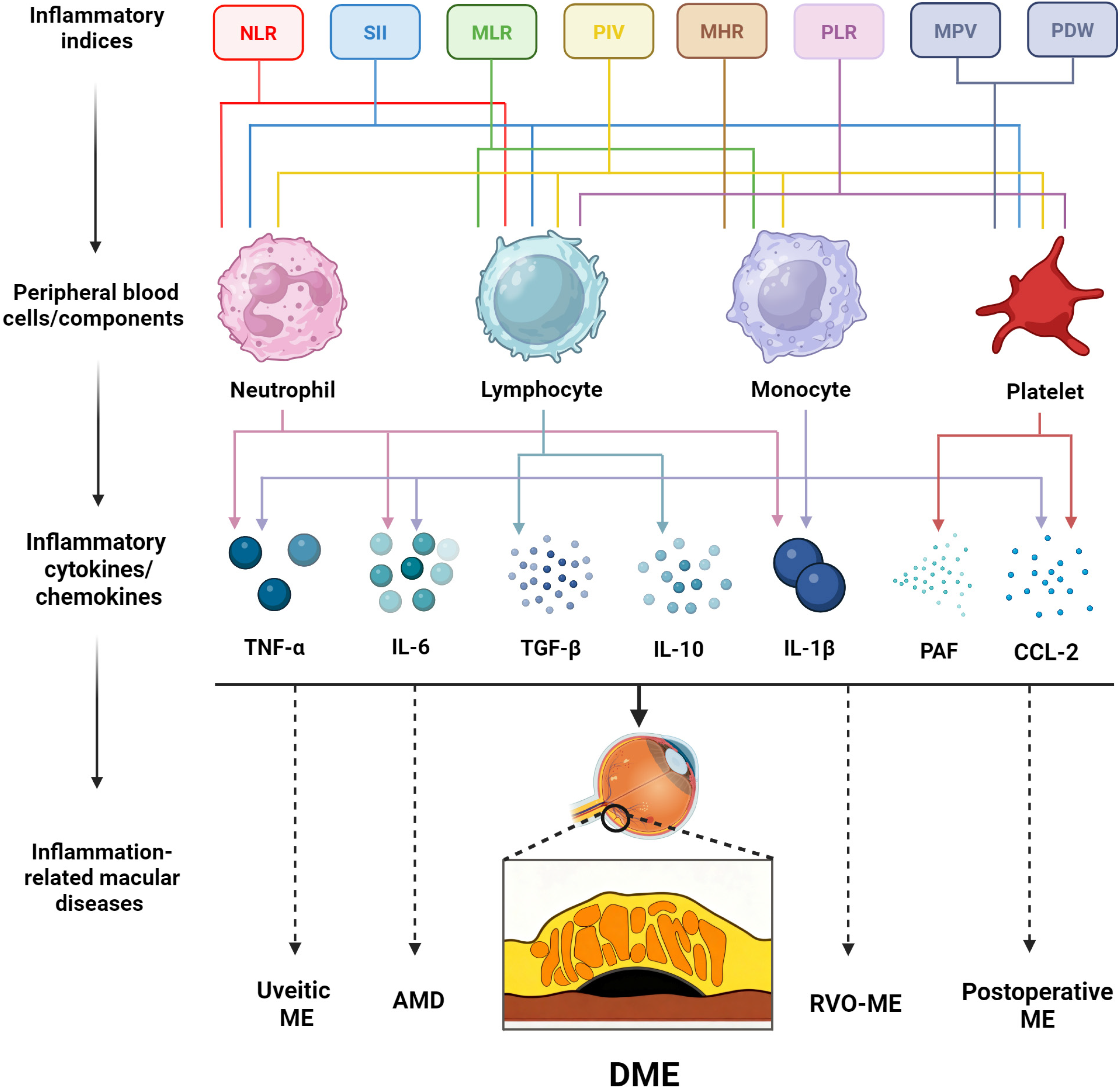
Blood cell-derived inflammatory indices are cost-effective surrogates of systemic inflammation and have been evaluated as potential biomarkers of DME activity and treatment response. Below, we summarize the most studied indices. For each marker, we outline its definition, key cross-sectional and longitudinal findings, associations with OCT morphotypes where available, and practical strengths and limitations. Table 1 summarizes the current research reports and main conclusions on blood cell-derived inflammatory indices for DME detection and discrimination of OCT-based subtypes, and Table 2 summarizes the current research reports and key findings on these indices for predicting anti-VEGF treatment response in DME patients. Figure 1 demonstrates the peripheral blood cell populations and associated inflammatory mediators captured by different blood-derived inflammatory indices, as well as their potential relevance to inflammation-related macular diseases.

5.1. White Blood Cell-Related Inflammatory Indices

5.1.1. Neutrophil-to-Lymphocyte Ratio (NLR)

NLR has been most extensively studied in DME. Compared with diabetic patients without DR (1.89 ± 0.70), NLR increases in those with DR but no DME (2.22 ± 1.51, p < 0.001) and is highest in patients with DME (3.40 ± 2.42, p < 0.001 vs. both groups). Several studies report thresholds (≈2.0–2.4) that discriminate DME from non-DME diabetes with moderate accuracy. For instance, one study suggests an NLR threshold of 2.0 for discriminating DME, with 75% sensitivity and 59% specificity (AUC 0.72) [33], while another report indicates an optimal cutoff of ≥2.26, showing 85% sensitivity and 74% specificity [51]. Higher NLR was significantly associated with the coexistence of DME (p = 0.002) [52]. In addition, NLR differs among optical coherence tomography (OCT) subtypes of DME, with higher NLR in patients with CME [13] and SRD [12,64] compared with DRT.
NLR also serves as a potential prognostic biomarker. Higher baseline NLR has been associated with greater central retinal thickness (CRT) after anti-VEGF therapy; however, its association with functional outcomes (BCVA) is inconsistent. Hu et al. identified pre-treatment NLR ≥ 2.27 as an independent predictor of poor visual outcomes following anti-VEGF therapy [60]. Lower NLRs have been observed in anti-VEGF responders compared with non-responders [60]. Consistently, Ergin et al. demonstrated that an NLR of <2.32 was associated with ≥10% CRT reduction one month after anti-VEGF treatment [34]. Elevated baseline NLR (≥2.31) has also been associated with higher rates of significant visual improvement after dexamethasone implantation [61]. Some studies have used the reciprocal of NLR, namely the lymphocyte-to-neutrophil ratio (LNR), for evaluation. For example, Karimi et al. found that higher LNR was associated with better visual improvement after anti-VEGF treatment [62].
The strengths of NLR include its accessibility, low cost, and robust association with both DME onset and treatment outcomes. However, its predictive value for visual functional outcomes is inconsistent. Furthermore, NLR is a nonspecific marker and may be influenced by a range of physiological or pathological conditions beyond DME, such as infection, systemic inflammation, and medications. Combining NLR with other indices or OCT features improves predictive performance.

5.1.2. Platelet-to-Lymphocyte Ratio (PLR)

PLR has emerged as another widely studied inflammation-related index following NLR. Current studies consistently report elevated PLR levels in patients with DME. One study demonstrated a PLR of 117.9 ± 59.1 in DME patients compared to 106.3 ± 28.7 in diabetic patients without DME [12]. Similarly, Mohamed et al. reported similar findings and, through ROC analysis, suggested that PLR provides incremental diagnostic value for differentiating DME from non-DME diabetes [53]. In addition, Gündoğdu et al. observed higher PLR values in DME cases with SRD compared to uncomplicated DME, although the difference did not reach statistical significance [12]. Cheng et al. further summarized that in DME patients with SRD, PLR levels were markedly elevated and correlated with imaging severity, thereby supporting the role of PLR as a component of multimarker inflammatory profiling [64].
Regarding functional and anatomical outcomes, PLR has also demonstrated predictive value. For example, Hu et al. identified baseline PLR as an independent negative predictor of BCVA improvement after anti-VEGF therapy [60]. Katić [15] and Ergin [34] similarly reported significantly higher baseline PLR in DME non-responders compared with responders, indirectly supporting the notion that elevated PLR reflects a more inflammatory DME phenotype. PLR was also predictive of CRT reduction following treatment, although its diagnostic accuracy was only moderate (AUC 0.63) [15,60]. Some studies have used the reciprocal of PLR, namely the lymphocyte-to-platelet ratio (LPR), for evaluation. For example, Karimi et al. found that higher LPR was associated with better visual improvement after anti-VEGF treatment; however, their analysis failed to show an association between LPR and CRT reduction, suggesting that LPR may be more closely linked to functional rather than anatomical outcomes [62].
The substantial inter-study variability in cut-off values and the overlap with comorbid conditions, such as cardiovascular disease and malignancies, limit the specificity of PLR as an inflammatory biomarker. Moreover, PLR is susceptible to the modulatory effects of antiplatelet therapy, which may modestly attenuate circulating platelet counts or perturb platelet production dynamics without necessarily exerting a concomitant impact on retinal inflammatory activity. Consequently, PLR values may decline in treated individuals even when systemic or intraocular inflammatory status remains unchanged, thereby introducing a potential confounding variable when comparing PLR between DME cohorts and other study populations.

5.1.3. Systemic Immune-Inflammation Index (SII)

The SII, calculated as platelet × neutrophil/lymphocyte, has emerged as a composite biomarker reflecting thrombotic, innate, and adaptive immune responses. Current evidence consistently indicates elevated SII levels in patients with DME, underscoring its close association with disease activity. One study reported a mean SII of 599.7 ± 279.2 in DME eyes compared with 464.9 ± 172.2 in diabetic controls without DME [12]. Among DME cases, patients with SRD exhibited significantly higher SII values than those with uncomplicated DME [12,64]. This evidence suggests a stepwise rise in SII alongside retinal fluid accumulation, supporting its role as a surrogate marker of systemic inflammation linked to BRB disruption.
The association between SII and both functional and anatomical outcomes has been well established. For instance, a baseline SII below 543.53 showed a greater reduction in central macular thickness after 30 days of anti-VEGF therapy [34]. In addition, baseline SII was markedly higher in anti-VEGF non-responders (675.3 ± 334.0) compared with responders (445.3 ± 166.3) [15]. Chen et al. incorporated SII into a nomogram and identified a cut-off value of 531.23 (AUC 0.613) for predicting visual prognosis. When combined with OCT biomarkers such as SRF and hyperreflective foci, the discrimination improved substantially (AUC 0.866) [63]. Importantly, these associations remained significant after adjustment for age, sex, diabetes duration, and CRP, highlighting the robustness of SII as a prognostic marker. Recently, a prospective study further confirmed that baseline SII was significantly higher in anti-VEGF non-responders compared with responders (886 ± 407 vs. 547 ± 183), with ROC analysis demonstrating an AUC of 0.788 for predicting anatomical response, superior to NLR and PLR [34].
The advantage of SII lies in its integration of platelet-driven thrombo-inflammation and neutrophil-mediated oxidative stress. However, reported cut-off values vary considerably (approximately 400–600), reflecting heterogeneity across studies. This heterogeneity may be attributed to differences in study populations, ethnic backgrounds, comorbidities, DME morphologic subtypes, DR severity, anti-VEGF regimens, and response criteria across studies. Variability in sampling conditions and laboratory methods may also affect SII measurement. These factors can influence SII distribution and limit the reproducibility of a universal cut-off value across diverse clinical settings. In addition, similar to PLR, antiplatelet therapy may influence SII through mechanisms beyond platelet count. These drugs attenuate platelet activation and suppress P-selectin-mediated adhesion, thereby inhibiting the formation of platelet–neutrophil and platelet–monocyte aggregates that amplify systemic inflammation [65]. Such immunomodulatory effects could reduce SII values even when the underlying inflammatory burden of DME remains unchanged. However, direct evidence in this specific clinical context remains limited, and this interpretation should be considered mechanistically plausible but speculative.

5.1.4. Monocyte-to-High-Density Lipoprotein Cholesterol Ratio (MHR)

The MHR has recently gained attention as a composite index linking innate immune activation with antioxidant reserve. One study reported that the MHR in the eyes of patients with DME (15.7 ± 5.7) was significantly higher than in diabetic patients without DME (13.2 ± 7.5) and in healthy controls (12.5 ± 3.9). ROC analysis identified a threshold of 13.9, which predicted DME with 81% specificity, superior to the specificity of NLR ≥ 2 (59%) [33]. However, MHR was also found to show no significant difference between patients with and without DME [54]. In addition, MHR demonstrated limited prognostic relevance for anatomical or functional outcomes. No significant associations were observed between baseline MHR and CRT or BCVA at presentation. In addition, MHR failed to predict changes in CRT and BCVA following anti-VEGF therapy, suggesting that MHR is not a reliable short-term marker of treatment response [33,54].

5.1.5. Monocyte-to-Lymphocyte Ratio (MLR)

The MLR levels are significantly higher in individuals with DME compared with diabetic individuals without DME and healthy controls, suggesting its potential as a biomarker for assessing disease severity and prognosis. In a study by Mohamed et al., a progressive and statistically significant rise in MLR was found, from healthy controls (0.153) to diabetic eyes without DME (0.157) and to eyes with DME (0.169, IQR) [53]. In addition, different DME subtypes exhibit distinct MLR levels. Liao et al. demonstrated that the CME group had significantly higher MLR than the DRT group [13], while Sun et al. observed that DME patients with SRD had higher MLR than other DME subtypes [55]; however, they did not find a significant difference between the DRT and CME groups. Further research is required to clarify the threshold values and diagnostic accuracy of MLR across different DME subtypes.
Evidence regarding the predictive role of MLR in treatment response remains heterogeneous. MLR has been identified as an independent predictor of early anatomical response to anti-VEGF therapy [60]. Ergin et al. report that baseline MLR was significantly higher in patients who failed to achieve an early anatomical response after intravitreal anti-VEGF therapy for diabetic macular edema [58]. Mani et al. similarly suggested that MLR could predict anatomical changes, although it was not correlated with functional visual improvement after treatment [52]. In contrast, Vural et al. reported that patients with high baseline MLR (≥0.30) achieved a higher proportion of ≥1-line visual improvement following intravitreal dexamethasone implantation [61]. One study introduced the reciprocal of MLR, namely the lymphocyte-to-monocyte ratio (LMR). However, they reported no significant association between the LMR and either visual improvement or CRT reduction following anti-VEGF therapy [62].

5.1.6. Platelet-to-Neutrophil Ratio (PNR)

The PNR has recently been investigated as a systemic biomarker for DME. A cohort study demonstrated a stepwise decrease in PNR: 100.66 in healthy controls, 92.39 in diabetics without DR, 95.63 in DR eyes without DME, and 50.73 in eyes with DME. A threshold of PNR ≤ 68.51 was identified as an independent risk factor for DME, with a diagnostic sensitivity of 80.2% and specificity of 75.6% [55]. Current evidence regarding the association of PNR with OCT subtypes and treatment response remains limited. While conceptually attractive as a marker of thrombo-inflammatory balance, PNR requires validation in prospective and heterogeneous cohorts.

5.1.7. Pan-Immune-Inflammation Value (PIV)

The PIV, calculated as (neutrophil × platelet × monocyte)/lymphocyte, has recently been advanced as a composite hematological index that captures neutrophil- and monocyte-driven innate immunity together with platelet-related thrombosis. Candan et al. conducted the first ophthalmology-focused evaluation of the role of PIV in DME and demonstrated an upward trend in PIV: 301 in healthy controls, 353 in diabetics without DR, and 452 in eyes with DME. A threshold of PIV > 427.7 effectively distinguished DME from healthy controls (sensitivity 81.7%, specificity 78.9%), while PIV > 451.3 differentiated DME from diabetics without DR (sensitivity 80.3%, specificity 77.5%) [56]. Both cut-off values are better than NLR and SII, suggesting that PIV may represent a promising novel biomarker for DME.

5.2. Platelet-Related Inflammatory Indices

5.2.1. Mean Platelet Volume (MPV)

MPV, a marker of platelet activation and systemic thrombo-inflammatory status, shows a significant upward trend in DME; Tetikoğlu et al. reported that MPV in the DME group (8.87 ± 0.80 fL) was significantly higher than that in healthy controls (8.32 ± 0.9 fL) [57] and similar conclusions were drawn by Ilhan [51] and Mohamed [53]. A cohort study conducted in a Chinese population demonstrated the same trend with higher absolute values: controls 10.41 ± 0.63, DR without DME 11.07 ± 1.06 fL, and DR with DME 11.27 ± 0.85 fL [53]. Another study showed that MPV in DME patients with SRD (8.49 ± 1.77 fL) was higher than in those without SRD (8.05 ± 1.39 fL) [12]. These findings suggest that MPV may serve as a biomarker for the early diagnosis of DME.
The role of MPV in differentiating DME subtypes remains uncertain. Sun et al. found no significant differences in MPV across CME (11.39 ± 1.16 fL), DRT (11.54 ± 1.38 fL), and SRD (11.60 ± 1.20 fL) subtypes [55]. Conversely, Özata et al. reported elevated MPV in the SRD subtype [12]. Moreover, studies investigating MPV as a predictor of treatment response are limited and mostly retrospective. One study attempted to stratify patients with refractory DME undergoing dexamethasone implant treatment according to a baseline MPV threshold of 10.6, but no correlation was observed with improvements in BCVA or reductions in CRT [66].
The limitations of MPV include threshold dependency on specific cohorts and a lack of external validation. Furthermore, MPV is highly sensitive to pre-analytical variables (e.g., timing of measurement, type of anticoagulant, storage temperature), yet existing studies seldom describe standardization of these conditions. Finally, concomitant systemic diseases, smoking, or antiplatelet therapy may also compromise result accuracy.

5.2.2. Platelet Distribution Width (PDW)

PDW, an index reflecting platelet heterogeneity and overall platelet mass, has also been investigated in DME. Li et al. observed a stepwise increase in PDW across the spectrum from healthy controls (11.93 ± 1.22) to diabetes (12.33 ± 1.28), DR (13.57 ± 2.25), and DME (13.89 ± 1.76). They suggested that PDW may reflect the inflammatory burden associated with retinal vascular injury [58]. However, other studies have not detected subtype-specific differences in PDW in DME. For instance, Zhu et al. reported that PDW in DME patients (16.28 ± 3.55%) was nearly identical to that in DR patients without DME (16.36 ± 6.86%; p = 0.933) [59]. Similarly, Sun et al. found PDW to be indistinguishable across CME, DRT, and SRD subtypes [55]. Tetikoğlu et al. noted only a non-significant upward trend in proliferative DR [57]. Taken together, the role of PDW in the diagnosis of DME and prediction of treatment outcomes remains to be clarified.

6. Evidence Grading and Clinical Classification

Based on a comprehensive review of observational studies identified from PubMed, Embase, and Web of Science, we evaluated the overall strength of evidence for each blood cell-derived inflammatory index in DME. Given the heterogeneity across studies with respect to populations, comparators, OCT-based DME subtypes, and outcome definitions, we followed the methodological guidance from the AHRQ Evidence-based Practice Center program and the GRADE Working Group [67,68], and graded the strength of findings by considering study design, sample size, clinical context (DME vs. non-DME, OCT-based subtypes, anti-VEGF treatment response), and the overall consistency of results. This approach allows readers to distinguish indices supported by relatively stronger observational evidence from those that remain in an exploratory stage. The detailed dataset, simplified risk-of-bias assessments, and methodological considerations are provided in Supplementary Information S2–S4. Evidence was assigned to one of three categories—moderate, limited, and very limited—and each index was further classified as a core, secondary, or exploratory clinical marker, as summarized in Table 3.

7. Summary and Perspectives

The shifts in the epidemiology of diabetes have led to a growing prevalence of DME among younger individuals [69]. Compared with older adults, younger patients often exhibit a more inflammation-dominant phenotype with marked vascular permeability but with relatively mild diabetic retinopathy grades [70]. In addition, age influences the spectrum of comorbidities contributing to or mimicking DME. In younger individuals, highly prevalent myopia-related tractional pathologies and uveitis-associated edema can closely resemble DME on OCT imaging, while in the elderly population, macular diseases such as retinal vein occlusion and neovascular age-related macular degeneration are common confounders due to overlapping exudative features [71,72]. This emphasizes the importance of incorporating epidemiological shifts into clinical decision-making for DME.
Recent advances have highlighted inflammation as a central pathogenic driver. Blood-derived inflammatory biomarkers, such as NLR, PLR, SII, and MPV, have emerged as promising tools for predicting DME onset and therapeutic response. These indices are inexpensive, easily obtainable, and may aid in distinguishing between DME subtypes. More severe forms, including SRD and CME, often exhibit higher biomarker levels than DRT, suggesting potential utility in subtype stratification and diagnosis. In addition, they also correlate with treatment outcomes, with elevated levels consistently linked to poor response to anti-VEGF therapy. This offers a practical framework for identifying patients who may benefit from alternative or combination strategies.
However, it should be noted that most existing studies are single-center, retrospective, and small in scale, with heterogeneous populations and a lack of standardized diagnostic criteria for DME, which limits the generalizability of their findings. In addition, the possibility of publication bias cannot be excluded, as studies reporting significant associations between markers and DME may be more likely to be published than those with null results. Reported cutoff values for these markers also vary widely across studies, with no consensus on standardized thresholds, which may cause confusion in clinical application. Furthermore, patient characteristics such as age, obesity, and diabetes control can influence circulating inflammatory marker levels and act as potential confounders. These factors make the direct integration of these indices into routine DME management or treatment decision-making challenging, and their practical application requires further clinical validation.
Future research may address several key directions. Firstly, large-scale, multicenter, prospective studies with long-term follow-up across diverse DME populations are needed to validate the predictive value of blood inflammatory markers and establish standardized cutoff values. Secondly, these markers should be integrated with multimodal data, such as OCT imaging features and AI models, to develop comprehensive predictive models. For example, combining NLR and PLR with central macular thickness and cystoid area volume with machine learning frameworks could improve the accuracy of predicting anti-VEGF treatment response. This could shift DME management toward greater precision and personalization. Moreover, interventional studies will be important, such as evaluating whether controlling systemic inflammation through optimized diabetes management or anti-inflammatory agents can modify DME outcomes and clarify causal relationships between changes in biomarkers and disease progression.

Supplementary Materials

The following supporting information can be downloaded at: https://www.mdpi.com/article/10.3390/biomedicines13122979/s1, Supplementary Information S1: details the immune mechanisms and pathways of peripheral blood-derived inflammatory indices in DME, Supplementary Information S2: outlines the specific workflow for evidence grading and the clinical classification of blood cell-derived inflammatory indices in DME, Supplementary Information S3: shows the data extraction from eligible literature that are used for the evidence-level grading, Supplementary Information S4: provides a summary of the simplified risk-of-bias assessment for the included observational studies. References [73,74] are cited in the Supplementary Materials.

Author Contributions

Conceptualization, Z.H.; methodology and data curation, C.L.; analysis and interpretation, C.L., W.Y. and S.W.; writing—original draft preparation, C.L.; writing—review and editing, Z.H.; final approval, Z.H., C.L., S.W. and W.Y.; funding acquisition, Z.H. All authors have read and agreed to the published version of the manuscript.

Funding

This research was funded by the National Natural Science Foundation of China, grant number 82471082; the Natural Science Foundation of Guangdong Province, China, grant number 2024A1515012992; and the Special Support Plan in Guangdong Province for Young Top Talents in Science and Technology Innovation.

Institutional Review Board Statement

Not applicable.

Informed Consent Statement

Not applicable.

Data Availability Statement

Not applicable.

Conflicts of Interest

The authors declare no conflicts of interest.

Abbreviations

The following abbreviations are used in this manuscript:
BRBBlood–retinal barrier
CMECystoid macular edema
CRTCentral retinal thickness
DMEDiabetic macular edema
DRDiabetic retinopathy
DRTDiffuse retinal thickening
LMRLymphocyte-to-monocyte ratio
LNRLymphocyte-to-neutrophil ratio
LPRLymphocyte-to-platelet ratio
MHRMonocyte-to-high-density lipoprotein cholesterol ratio
MLRMonocyte-to-lymphocyte ratio
MPVMean platelet volume
NLRNeutrophil-to-lymphocyte ratio
PDWPlatelet distribution width
PIVPan-immune-inflammation value
PLRPlatelet-to-lymphocyte ratio
PNRPlatelet-to-neutrophil ratio
RPERetinal pigment epithelium
SIISystemic immune-inflammation index
SRDSerous retinal detachment
VEGFVascular endothelial growth factor

References

  1. Chen, Y.T.; Radke, N.V.; Amarasekera, S.; Park, D.H.; Chen, N.; Chhablani, J.; Wang, N.K.; Wu, W.C.; Ng, D.S.C.; Bhende, P.; et al. Updates on medical and surgical managements of diabetic retinopathy and maculopathy. Asia Pac. J. Ophthalmol. 2025, 14, 100180. [Google Scholar] [CrossRef]
  2. Williams, R.; Karuranga, S.; Malanda, B.; Saeedi, P.; Basit, A.; Besançon, S.; Bommer, C.; Esteghamati, A.; Ogurtsova, K.; Zhang, P. Global and regional estimates and projections of diabetes-related health expenditure: Results from the International Diabetes Federation Diabetes Atlas. Diabetes Res. Clin. Pract. 2020, 162, 108072. [Google Scholar] [CrossRef] [PubMed]
  3. Teo, Z.L.; Tham, Y.-C.; Yu, M.; Chee, M.L.; Rim, T.H.; Cheung, N.; Bikbov, M.M.; Wang, Y.X.; Tang, Y.; Lu, Y. Global prevalence of diabetic retinopathy and projection of burden through 2045: Systematic review and meta-analysis. Ophthalmology 2021, 128, 1580–1591. [Google Scholar] [CrossRef]
  4. Steinmetz, J.D.; Bourne, R.R.; Briant, P.S.; Flaxman, S.R.; Taylor, H.R.; Jonas, J.B.; Abdoli, A.A.; Abrha, W.A.; Abualhasan, A.; Abu-Gharbieh, E.G. Causes of blindness and vision impairment in 2020 and trends over 30 years, and prevalence of avoidable blindness in relation to VISION 2020: The Right to Sight: An analysis for the Global Burden of Disease Study. Lancet Glob. Health 2021, 9, e144–e160. [Google Scholar] [CrossRef]
  5. Ixcamey, M.; Palma, C. Diabetic macular edema. Dis. Mon. 2021, 67, 101138. [Google Scholar] [CrossRef]
  6. Morya, A.K.; Ramesh, P.V.; Nishant, P.; Kaur, K.; Gurnani, B.; Heda, A.; Salodia, S. Diabetic retinopathy: A review on its pathophysiology and novel treatment modalities. World J. Methodol. 2024, 14, 95881. [Google Scholar] [CrossRef]
  7. Le, N.T.; Kroeger, Z.A.; Lin, W.V.; Khanani, A.M.; Weng, C.Y. Novel Treatments for Diabetic Macular Edema and Proliferative Diabetic Retinopathy. Curr. Diab Rep. 2021, 21, 43. [Google Scholar] [CrossRef]
  8. Noma, H.; Yasuda, K.; Shimura, M. Involvement of Cytokines in the Pathogenesis of Diabetic Macular Edema. Int. J. Mol. Sci. 2021, 22, 3427. [Google Scholar] [CrossRef]
  9. Das, A.; McGuire, P.G.; Rangasamy, S. Diabetic Macular Edema: Pathophysiology and Novel Therapeutic Targets. Ophthalmology 2015, 122, 1375–1394. [Google Scholar] [CrossRef]
  10. Batsos, G.; Christodoulou, E.; Christou, E.E.; Galanis, P.; Katsanos, A.; Limberis, L.; Stefaniotou, M. Vitreous inflammatory and angiogenic factors on patients with proliferative diabetic retinopathy or diabetic macular edema: The role of Lipocalin2. BMC Ophthalmol. 2022, 22, 496. [Google Scholar] [CrossRef]
  11. Shahulhameed, S.; Vishwakarma, S.; Chhablani, J.; Tyagi, M.; Pappuru, R.R.; Jakati, S.; Chakrabarti, S.; Kaur, I. A Systematic Investigation on Complement Pathway Activation in Diabetic Retinopathy. Front. Immunol. 2020, 11, 154. [Google Scholar] [CrossRef] [PubMed]
  12. Özata Gündoğdu, K.; Doğan, E.; Çelik, E.; Alagöz, G. Serum inflammatory marker levels in serous macular detachment secondary to diabetic macular edema. Eur. J. Ophthalmol. 2022, 32, 3637–3643. [Google Scholar] [CrossRef] [PubMed]
  13. Liao, W.; Liu, F.; Liu, W.; Xiao, C. Serum inflammation biomarkers level in cystoid and diffuse diabetic macular edema. Int. Ophthalmol. 2024, 44, 447. [Google Scholar] [CrossRef] [PubMed]
  14. Elbeyli, A.; Kurtul, B.E.; Ozcan, S.C.; Ozarslan Ozcan, D. The diagnostic value of systemic immune-inflammation index in diabetic macular oedema. Clin. Exp. Optom. 2022, 105, 831–835. [Google Scholar] [CrossRef]
  15. Katić, K.; Katić, J.; Kumrić, M.; Božić, J.; Tandara, L.; Šupe Domić, D.; Bućan, K. The Predictors of Early Treatment Effectiveness of Intravitreal Bevacizumab Application in Patients with Diabetic Macular Edema. Diagnostics 2024, 14, 992. [Google Scholar] [CrossRef]
  16. Zhang, J.; Zhang, J.; Zhang, C.; Zhang, J.; Gu, L.; Luo, D.; Qiu, Q. Diabetic Macular Edema: Current Understanding, Molecular Mechanisms and Therapeutic Implications. Cells 2022, 11, 3362. [Google Scholar] [CrossRef]
  17. Madonna, R.; Balistreri, C.R.; Geng, Y.J.; De Caterina, R. Diabetic microangiopathy: Pathogenetic insights and novel therapeutic approaches. Vasc. Pharmacol. 2017, 90, 1–7. [Google Scholar] [CrossRef]
  18. Lin, T.; Walker, G.B.; Kurji, K.; Fang, E.; Law, G.; Prasad, S.S.; Kojic, L.; Cao, S.; White, V.; Cui, J.Z.; et al. Parainflammation associated with advanced glycation endproduct stimulation of RPE in vitro: Implications for age-related degenerative diseases of the eye. Cytokine 2013, 62, 369–381. [Google Scholar] [CrossRef]
  19. Idris, I.; Gray, S.; Donnelly, R. Protein kinase C activation: Isozyme-specific effects on metabolism and cardiovascular complications in diabetes. Diabetologia 2001, 44, 659–673. [Google Scholar] [CrossRef]
  20. Denis, U.; Lecomte, M.; Paget, C.; Ruggiero, D.; Wiernsperger, N.; Lagarde, M. Advanced glycation end-products induce apoptosis of bovine retinal pericytes in culture: Involvement of diacylglycerol/ceramide production and oxidative stress induction. Free Radic. Biol. Med. 2002, 33, 236–247. [Google Scholar] [CrossRef]
  21. Aiello, L.P.; Avery, R.L.; Arrigg, P.G.; Keyt, B.A.; Jampel, H.D.; Shah, S.T.; Pasquale, L.R.; Thieme, H.; Iwamoto, M.A.; Park, J.E.; et al. Vascular endothelial growth factor in ocular fluid of patients with diabetic retinopathy and other retinal disorders. N. Engl. J. Med. 1994, 331, 1480–1487. [Google Scholar] [CrossRef] [PubMed]
  22. Sewduth, R.N.; Kovacic, H.; Jaspard-Vinassa, B.; Jecko, V.; Wavasseur, T.; Fritsch, N.; Pernot, M.; Jeaningros, S.; Roux, E.; Dufourcq, P.; et al. PDZRN3 destabilizes endothelial cell-cell junctions through a PKCζ-containing polarity complex to increase vascular permeability. Sci. Signal 2017, 10, eaag3209. [Google Scholar] [CrossRef] [PubMed]
  23. Patel, S.; Rauf, A.; Khan, H.; Abu-Izneid, T. Renin-angiotensin-aldosterone (RAAS): The ubiquitous system for homeostasis and pathologies. Biomed. Pharmacother. 2017, 94, 317–325. [Google Scholar] [CrossRef]
  24. Giese, M.J.; Speth, R.C. The ocular renin-angiotensin system: A therapeutic target for the treatment of ocular disease. Pharmacol. Ther. 2014, 142, 11–32. [Google Scholar] [CrossRef]
  25. Steckelings, U.M.; Rompe, F.; Kaschina, E.; Unger, T. The evolving story of the RAAS in hypertension, diabetes and CV disease: Moving from macrovascular to microvascular targets. Fundam. Clin. Pharmacol. 2009, 23, 693–703. [Google Scholar] [CrossRef]
  26. Arroba, A.I.; Valverde, Á.M. Modulation of microglia in the retina: New insights into diabetic retinopathy. Acta Diabetol. 2017, 54, 527–533. [Google Scholar] [CrossRef] [PubMed]
  27. Yu, Y.; Chen, H.; Su, S.B. Neuroinflammatory responses in diabetic retinopathy. J. Neuroinflammation 2015, 12, 141. [Google Scholar] [CrossRef]
  28. Kim, B.Y.; Smith, S.D.; Kaiser, P.K. Optical coherence tomographic patterns of diabetic macular edema. Am. J. Ophthalmol. 2006, 142, 405–412. [Google Scholar] [CrossRef]
  29. Lachin, J.M.; White, N.H.; Hainsworth, D.P.; Sun, W.; Cleary, P.A.; Nathan, D.M. Effect of intensive diabetes therapy on the progression of diabetic retinopathy in patients with type 1 diabetes: 18 years of follow-up in the DCCT/EDIC. Diabetes 2015, 64, 631–642. [Google Scholar] [CrossRef]
  30. Barr, C.C. Retinopathy and nephropathy in patients with type 1 diabetes four years after a trial of intensive insulin therapy, by The Diabetes Control and Complications Trial/Epidemiology of Diabetes Interventions and Complications Research Group. N. Engl. J. Med. 2000, 342, 381–389. [Google Scholar] [CrossRef]
  31. Do, D.V.; Wang, X.; Vedula, S.S.; Marrone, M.; Sleilati, G.; Hawkins, B.S.; Frank, R.N. Blood pressure control for diabetic retinopathy. Cochrane Database Syst. Rev. 2015, 1, Cd006127. [Google Scholar] [CrossRef]
  32. Tatsumi, T. Current Treatments for Diabetic Macular Edema. Int. J. Mol. Sci. 2023, 24, 9591. [Google Scholar] [CrossRef]
  33. Yalinbas Yeter, D.; Eroglu, S.; Sariakcali, B.; Bozali, E.; Vural Ozec, A.; Erdogan, H. The Usefulness of Monocyte-to-High Density Lipoprotein and Neutrophil-to-Lymphocyte Ratio in Diabetic Macular Edema Prediction and Early anti-VEGF Treatment Response. Ocul. Immunol. Inflamm. 2022, 30, 901–906. [Google Scholar] [CrossRef]
  34. Ergin, E.; Dascalu, A.M.; Stana, D.; Tribus, L.C.; Arsene, A.L.; Nedea, M.I.; Serban, D.; Nistor, C.E.; Tudor, C.; Dumitrescu, D.; et al. Predictive Role of Complete Blood Count-Derived Inflammation Indices and Optical Coherence Tomography Biomarkers for Early Response to Intravitreal Anti-VEGF in Diabetic Macular Edema. Biomedicines 2025, 13, 1308. [Google Scholar] [CrossRef] [PubMed]
  35. Boyer, D.S.; Yoon, Y.H.; Belfort, R., Jr.; Bandello, F.; Maturi, R.K.; Augustin, A.J.; Li, X.Y.; Cui, H.; Hashad, Y.; Whitcup, S.M. Three-year, randomized, sham-controlled trial of dexamethasone intravitreal implant in patients with diabetic macular edema. Ophthalmology 2014, 121, 1904–1914. [Google Scholar] [CrossRef] [PubMed]
  36. Avitabile, T.; Longo, A.; Reibaldi, A. Intravitreal triamcinolone compared with macular laser grid photocoagulation for the treatment of cystoid macular edema. Am. J. Ophthalmol. 2005, 140, 695–702. [Google Scholar] [CrossRef] [PubMed]
  37. Sabal, B.; Teper, S.; Wylęgała, E. Subthreshold Micropulse Laser for Diabetic Macular Edema: A Review. J. Clin. Med. 2022, 12, 274. [Google Scholar] [CrossRef]
  38. Bonfiglio, V.; Rejdak, R.; Nowomiejska, K.; Zweifel, S.A.; Justus Wiest, M.R.; Romano, G.L.; Bucolo, C.; Gozzo, L.; Castellino, N.; Patane, C.; et al. Efficacy and Safety of Subthreshold Micropulse Yellow Laser for Persistent Diabetic Macular Edema After Vitrectomy: A Pilot Study. Front. Pharmacol. 2022, 13, 832448. [Google Scholar] [CrossRef]
  39. Boscia, F. Current approaches to the management of diabetic retinopathy and diabetic macular oedema. Drugs 2010, 70, 2171–2200. [Google Scholar] [CrossRef]
  40. Urias, E.A.; Urias, G.A.; Monickaraj, F.; McGuire, P.; Das, A. Novel therapeutic targets in diabetic macular edema: Beyond VEGF. Vis. Res. 2017, 139, 221–227. [Google Scholar] [CrossRef]
  41. Joussen, A.M.; Poulaki, V.; Mitsiades, N.; Kirchhof, B.; Koizumi, K.; Döhmen, S.; Adamis, A.P. Nonsteroidal anti-inflammatory drugs prevent early diabetic retinopathy via TNF-α suppression. FASEB J. 2002, 16, 438–440. [Google Scholar] [CrossRef]
  42. Das, A.; McGuire, P.G.; Monickaraj, F. Novel pharmacotherapies in diabetic retinopathy: Current status and what’s in the horizon? Indian. J. Ophthalmol. 2016, 64, 4–13. [Google Scholar] [CrossRef]
  43. Joussen, A.M.; Poulaki, V.; Le, M.L.; Koizumi, K.; Esser, C.; Janicki, H.; Schraermeyer, U.; Kociok, N.; Fauser, S.; Kirchhof, B.; et al. A central role for inflammation in the pathogenesis of diabetic retinopathy. FASEB J. 2004, 18, 1450–1452. [Google Scholar] [CrossRef]
  44. Rübsam, A.; Parikh, S.; Fort, P.E. Role of Inflammation in Diabetic Retinopathy. Int. J. Mol. Sci. 2018, 19, 942. [Google Scholar] [CrossRef] [PubMed]
  45. Forrester, J.V.; Kuffova, L.; Delibegovic, M. The Role of Inflammation in Diabetic Retinopathy. Front. Immunol. 2020, 11, 583687. [Google Scholar] [CrossRef]
  46. Kocabora, M.S.; Telli, M.E.; Fazil, K.; Erdur, S.K.; Ozsutcu, M.; Cekic, O.; Ozbilen, K.T. Serum and Aqueous Concentrations of Inflammatory Markers in Diabetic Macular Edema. Ocul. Immunol. Inflamm. 2016, 24, 549–554. [Google Scholar] [CrossRef]
  47. Owen, L.A.; Hartnett, M.E. Soluble mediators of diabetic macular edema: The diagnostic role of aqueous VEGF and cytokine levels in diabetic macular edema. Curr. Diab Rep. 2013, 13, 476–480. [Google Scholar] [CrossRef]
  48. Starace, V.; Battista, M.; Brambati, M.; Cavalleri, M.; Bertuzzi, F.; Amato, A.; Lattanzio, R.; Bandello, F.; Cicinelli, M.V. The role of inflammation and neurodegeneration in diabetic macular edema. Ther. Adv. Ophthalmol. 2021, 13, 25158414211055963. [Google Scholar] [CrossRef] [PubMed]
  49. Daruich, A.; Matet, A.; Moulin, A.; Kowalczuk, L.; Nicolas, M.; Sellam, A.; Rothschild, P.R.; Omri, S.; Gélizé, E.; Jonet, L.; et al. Mechanisms of macular edema: Beyond the surface. Prog. Retin. Eye Res. 2018, 63, 20–68. [Google Scholar] [CrossRef] [PubMed]
  50. Rudraraju, M.; Narayanan, S.P.; Somanath, P.R. Regulation of blood-retinal barrier cell-junctions in diabetic retinopathy. Pharmacol. Res. 2020, 161, 105115. [Google Scholar] [CrossRef]
  51. Ilhan, C.; Citirik, M.; Uzel, M.M.; Kiziltoprak, H.; Tekin, K. The usefulness of systemic inflammatory markers as diagnostic indicators of the pathogenesis of diabetic macular edema. Arq. Bras. Oftalmol. 2020, 83, 299–304. [Google Scholar] [CrossRef] [PubMed]
  52. Mani, S.; Thirunavukkarasu, A. A Clinico-Haematologic Study of Diabetic Retinopathy. TNOA J. Ophthalmic Sci. Res. 2023, 61, 317–322. [Google Scholar] [CrossRef]
  53. Mohamed, A.; El-Emam, D.S.; Mohsen, T.A.; Hashish, A.M. Systemic Cellular Inflammatory Biomarkers in Diabetic Macular Edema. Egypt. J. Ophthalmol. (Mansoura Ophthalmic Cent.) 2024, 4, 150–159. [Google Scholar] [CrossRef]
  54. Tang, X.; Tan, Y.; Yang, Y.; Li, M.; He, X.; Lu, Y.; Shi, G.; Zhu, Y.; Nie, Y.; Li, H.; et al. Association of the Monocyte-to-High-Density Lipoprotein Cholesterol Ratio With Diabetic Retinopathy. Front. Cardiovasc. Med. 2021, 8, 707008. [Google Scholar] [CrossRef]
  55. Sun, H.; Li, Y.; Liu, S.; Pan, C.; Li, D.; Zhou, X. The diagnostic value of platelet-to-neutrophil ratio in diabetic macular edema. BMC Ophthalmol. 2025, 25, 167. [Google Scholar] [CrossRef]
  56. Candan, O.; Orman, G.; Ünlü, N.; Ozkan, G. Diagnostic efficiency of pan-immune-inflammation value to predict diabetic macular edema and its relationship with OCT-based biomarkers of inflammation. Int. Ophthalmol. 2025, 45, 365. [Google Scholar] [CrossRef]
  57. Tetikoğlu, M.; Aktas, S.; Sagdık, H.M.; Tasdemir Yigitoglu, S.; Özcura, F. Mean Platelet Volume is Associated with Diabetic Macular Edema in Patients with Type-2 Diabetes Mellitus. Semin. Ophthalmol. 2017, 32, 651–654. [Google Scholar] [CrossRef]
  58. Li, H.-D.; Mao, J.-B.; Cheng, D.; Shen, J.; Shen, L.-J. Correlation of mean platelet volume with diabetic macular edema in type 2 diabetic patients. Recent Adv. Ophthalmol. 2018, 6, 576–578. [Google Scholar]
  59. Zhu, Y.; Xu, M.; Li, J.; Li, J.; Li, L.; Zhou, Y.; Song, Y.; Cai, Q. Peripheral white blood cell subtypes and the development/progression of diabetic macular edema in type 2 diabetic patients: A comparative study. Ann. Palliat. Med. 2022, 11, 2887–2896. [Google Scholar] [CrossRef] [PubMed]
  60. Hu, Y.; Cheng, Y.; Xu, X.; Yang, B.; Mei, F.; Zhou, Q.; Yan, L.; Wang, J.; Wu, X. Pretreatment neutrophil-to-lymphocyte ratio predicts prognosis in patients with diabetic macular edema treated with ranibizumab. BMC Ophthalmol. 2019, 19, 194. [Google Scholar] [CrossRef]
  61. Vural, E.; Hazar, L. Assessment of Inflammation Biomarkers in Diabetic Macular Edema Treated with Intravitreal Dexamethasone Implant. J. Ocul. Pharmacol. Ther. 2021, 37, 430–437. [Google Scholar] [CrossRef]
  62. Karimi, S.; Arabi, A.; Shahraki, T.; Safi, S. Association of White Blood Cell Counts, Leukocyte Ratios, and Serum Uric Acid with Clinical Outcome of Intravitreal Bevacizumab in Diabetic Macular Edema. Korean J. Ophthalmol. 2022, 36, 244–252. [Google Scholar] [CrossRef]
  63. Yanxia, C.; Yongqiang, X.; Min, F.; Xiaoyun, K. A nomogram based on peripheral blood inflammatory indices and optical coherence tomography biomarkers for early prediction of anti-VEGF response in diabetic macular edema. Clin. Exp. Optom. 2025, 108, 1005–1013. [Google Scholar] [CrossRef]
  64. Cheng, S.; Chen, Z.; Peng, F.; Deng, P.; Wang, M.; Liu, S.; Du, Y.; Zuo, G. Exploration Progress on Inflammatory Responses and Immune Regulatory Mechanisms in Diabetic Retinopathy. J. Inflamm. Res. 2025, 18, 11895–11909. [Google Scholar] [CrossRef]
  65. Xiao, Z.; Théroux, P. Clopidogrel inhibits platelet-leukocyte interactions and thrombin receptor agonist peptide-induced platelet activation in patients with an acute coronary syndrome. J. Am. Coll. Cardiol. 2004, 43, 1982–1988. [Google Scholar] [CrossRef] [PubMed]
  66. Alyoruk, F.; Arican, E.; Turgut, B.; Ersan, I.; Erdogan, H.; Torun, S. Effects of blood HbA1c and mean platelet volume levels in diabetic macular edema patients who received dexamethasone implant. Eur. Eye Res. 2024, 4, 223–227. [Google Scholar] [CrossRef]
  67. Owens, D.K.; Lohr, K.N.; Atkins, D.; Treadwell, J.R.; Reston, J.T.; Bass, E.B.; Chang, S.; Helfand, M. AHRQ series paper 5: Grading the strength of a body of evidence when comparing medical interventions—Agency for healthcare research and quality and the effective health-care program. J. Clin. Epidemiol. 2010, 63, 513–523. [Google Scholar] [CrossRef]
  68. Balshem, H.; Helfand, M.; Schünemann, H.J.; Oxman, A.D.; Kunz, R.; Brozek, J.; Vist, G.E.; Falck-Ytter, Y.; Meerpohl, J.; Norris, S. GRADE guidelines: 3. Rating the quality of evidence. J. Clin. Epidemiol. 2011, 64, 401–406. [Google Scholar] [CrossRef] [PubMed]
  69. Romero-Aroca, P.; de la Riva-Fernandez, S.; Valls-Mateu, A.; Sagarra-Alamo, R.; Moreno-Ribas, A.; Soler, N. Changes observed in diabetic retinopathy: Eight-year follow-up of a Spanish population. Br. J. Ophthalmol. 2016, 100, 1366–1371. [Google Scholar] [CrossRef]
  70. Development and Progression of Diabetic Retinopathy in Adolescents and Young Adults with Type 2 Diabetes: Results from the TODAY Study. Diabetes Care 2021, 45, 1049–1055. [CrossRef]
  71. Warnakulasooriya, T.; Athulgama, P.; Abeyek, M.; Dius, S.; Ranwala, R.; Bandar, S.; Godage, S.; Senadeera, S.; Wijepala, J. Macular Edema: Comprehensive Differential Diagnosis, Prognostic Biomarkers, and Multidisciplinary Management Strategies. Uva Clin. Anesth. Intensive Care 2025, 1–16. [Google Scholar]
  72. Munk, M.R.; Sacu, S.; Huf, W.; Sulzbacher, F.; Mittermüller, T.J.; Eibenberger, K.; Rezar, S.; Bolz, M.; Kiss, C.G.; Simader, C.; et al. Differential diagnosis of macular edema of different pathophysiologic origins by spectral domain optical coherence tomography. Retina 2014, 34, 2218–2232. [Google Scholar] [CrossRef] [PubMed]
  73. Gu, W.; Wang, M.; Li, Z.; Xu, T. The association between peripheral blood inflammatory markers and anti-VEGF treatment response in patients with type 2 diabetic macular edema. Front. Med. 2025, 12, 1653753. [Google Scholar] [CrossRef] [PubMed]
  74. He, X.; Qi, S.; Zhang, X.; Pan, J. The relationship between the neutrophil-to-lymphocyte ratio and diabetic retinopathy in adults from the United States: Results from the National Health and nutrition examination survey. BMC Ophthalmol. 2022, 22, 346. [Google Scholar] [CrossRef] [PubMed]
Figure 1. Conceptual framework illustrating blood-derived inflammatory indices, the peripheral blood cell populations and components they reflect, and associated inflammatory mediators, as well as their potential relevance to inflammation-related macular diseases, exemplified by DME. Created in BioRender. Der, B. (2025) https://BioRender.com/azrzn4x (accessed on 13 September 2025). NLR: neutrophil-to-lymphocyte ratio; SII: systemic immune-inflammation index; MLR: monocyte-to-lymphocyte ratio; PIV: pan-immune-inflammation value; MHR: monocyte-to-high-density lipoprotein cholesterol ratio; PLR: platelet-to-lymphocyte ratio; MPV: mean platelet volum; PDW: platelet distribution width; TNF-α: tumor necrosis factor-alpha; IL-6: interleukin-6; TGF-β: transforming growth factor-beta; IL-10: interleukin-10; IL-1β: interleukin-1 beta; PAF: platelet-activating factor; CCL-2: chemokine (C-C motif) ligand 2; ME: macular edema; DME: diabetic macular edema; AMD: age-related macular degeneration; RVO: retinal vein occlusion. Dotted lines indicate associations that remain hypothetical and require further investigation.
Biomedicines 13 02979 g001
Table 1. Summary of studies and key findings on blood cell-derived inflammatory indices for DME detection and OCT-based subtypes classification.
Author and YearIndicesStudy
Design
NDiabetes TypeControl and Adjustment for Confounding FactorsMain OutcomesRef.
Özata
Gündoğdu et al., 2022
NLR, PLR, SII, MPVRetrospective120Not reportedControl: inflammation-related systemic diseases *
No adjustment
The DME group shows a numerically higher but not statistically significant PLR. SRD subtype exhibits higher NLR, SII, and MPV values than those without SRD.[12]
Liao
et al.,
2024
NLR, SII, MLRRetrospective50Not reportedControl: inflammation-related systemic diseases *
No adjustment
NLR ≥ 2.27, SII ≥ 447, and MLR ≥ 0.24 are diagnostic thresholds for CME.[13]
Elbeyli
et al.,
2022
NLR, PLR, SIIProspective150T2DMControl: anti-inflammatory or Immunosuppressive drugs, inflammation-related systemic diseases *
No adjustment
SII ≥ 399 is a diagnostic threshold for DME. The DME group demonstrates higher NLR, PLR, and SII values than
DR-without-DME group.
[14]
Yalinbas Yeter
et al.,
2022
NLR, MHRRetrospective, cross-sectional143T2DMControl: anti-inflammatory drugs, fibrates or niacin, inflammation-related systemic diseases *
No adjustment
NLR ≥ 2 and MHR ≥ 13.9 are diagnostic thresholds for DME.[33]
Ilhan
et al.,
2020
NLR, MPVProspective120T2DMControl: inflammation-related systemic diseases *
No adjustment
NLR ≥ 2.26 is a diagnostic threshold for DME. Patients with DME demonstrate the highest MPV.[51]
Mani
et al.,
2023
NLR, MPVCase-
control
114T2DMControl: anticoagulant or antiplatelet agents, smoke, inflammation-related systemic diseases *
Adjustment: age
Elevated NLR and MPV are associated with DME.[52]
Mohamed
et al.,
2024
PLR, MLR, MPVCohort120T2DMControl: inflammation-related systemic diseases *
No adjustment
The DME cohort exhibits elevated MLR, PLR, and MPV compared to diabetic patients without DME.[53]
Tang
et al.,
2021
MHRCross-sectional1378T2DMControl: anticoagulant or antiplatelet agents, inflammation-related systemic diseases *
Adjustment: age, sex
MHR is similar between non-DME and DME cases.[54]
Sun
et al.,
2025
PNR, MPVCross-sectional366T2DMControl: antibiotics, immunosuppressants, anticoagulants, antiplatelet agents, steroids, or contraceptives, inflammation-related systemic diseases *
Adjustment: DR severity
PNR ≤ 68.51 is a diagnostic threshold for DME. MPV fails to distinguish
OCT-defined DME
subtypes.
[55]
Candan
et al.,
2025
PIVCase–control155Not reportedControl: anti-inflammatory drugs, inflammation-related systemic diseases *
Adjustment: diabetes duration
PIV > 427.7 is a diagnostic threshold for DME. PIV > 451.3 separates DME from diabetes without retinopathy.[56]
Tetikoğlu
et al.,
2016
MPVRetrospective199Not reportedControl: antiplatelet agents, inflammation-related systemic diseases *
No adjustment
The DME cohort exhibits elevated MPV compared with diabetics without DME.[57]
Li
et al.,
2018
MPV, PDWRetrospective160T2DMControl: nephrotoxic agents or antiplatelet agents, inflammation-related systemic diseases *
Adjustment: sex
The DME group
demonstrates the highest MPV and PDW among healthy controls and diabetes without DME.
[58]
Zhu
et al.,
2022
PDWRetrospective114T2DMControl: inflammation-related systemic diseases *
No adjustment
There is no difference in PDW between the DME and DR-without-DME group.[59]
* Inflammation-related systemic diseases may include malignant tumors, liver and kidney dysfunction, autoimmune disorders, hematological diseases, coronary artery disease, and others. NLR: neutrophil-to-lymphocyte ratio; SII: systemic immune-inflammation index; MLR: monocyte-to-lymphocyte ratio; PIV: pan-immune-inflammation value; MHR: monocyte-to-high-density lipoprotein cholesterol ratio; PLR: platelet-to-lymphocyte ratio; PNR: platelet-to-neutrophil ratio; MPV: mean platelet volume; PDW: platelet distribution width; DME: diabetic macular edema; SRD: serous retinal detachment; CME: cystoid macular edema; T2DM: type 2 diabetes mellitus; DR: diabetic retinopathy; OCT: optical coherence tomography.
Table 2. Summary of studies and key findings on blood cell-derived inflammatory indices for predicting anti-VEGF response in DME.
Author and YearIndicesStudy
Design
NDiabetes TypeControl and Adjustment for Confounding FactorsMain OutcomesRef.
Katić
et al.,
2024
NLR, PLR, SII, MLRProspective78T2DMControl: anti-inflammatory drugs or substitutional vitamin D therapy, inflammation-related systemic diseases *
Adjustment: age, sex,
C-reactive protein, disease duration
Lower baseline NLR, PLR, SII, and MLR predict a more favorable CRT outcome following anti-VEGF therapy.[15]
Yalinbas Yeter
et al.,
2022
NLR, MHRRetrospective, cross-sectional143T2DMControl: anti-inflammatory drugs, fibrates or niacin, inflammation-related systemic diseases *
No adjustment
Higher NLR predicts inferior CRT outcomes with anti-VEGF.[33]
Hu
et al.,
2019
NLR, MLRRetrospective91Not reportedControl: anti-inflammatory drugs, inflammation-related systemic diseases *
No adjustment
Higher NLR contributes to inferior visual outcomes with anti-VEGF. MLR is negatively correlated with visual improvement following treatment.[60]
Ergin
et al.,
2025
NLR, PLR, SII, MLRRetrospective104T2DMControl: anti-inflammatory drugs, inflammation-related systemic diseases *
No adjustment
NLR ≤ 2.32, PLR ≤ 120.55, SII ≤ 543.53 and MLR ≤ 0.21 correlates with early
anti-VEGF therapeutic
response in DME.
[34]
Vural
et al.,
2021
NLR, MLRRetrospective64T2DMControl: inflammation-related systemic diseases *
No adjustment
Elevated baseline NLR and MLR associate with a ≥1-line visual improvement following dexamethasone implantation.[61]
Karimi
et al.,
2022
LNR, LPRProspective80Not reportedControl: inflammation-related systemic diseases *
No adjustment
Higher baseline LNR and LPR are correlated with larger improvement in visual acuity after
anti-VEGF therapy.
[62]
Chen
et al.,
2025
NLR, PLRRetrospective140T2DMControl: anti-inflammatory or immunosuppressive drugs, inflammation-related systemic diseases *
Adjustment: age, Scr, eGFR, TG
NLR > 2.57 and PLR > 98.93 are predictive indicators of poor visual prognosis after anti-VEGF therapy.[63]
* Inflammation-related systemic diseases may include malignant tumors, liver and kidney dysfunction, autoimmune disorders, hematological diseases, coronary artery disease, and others. NLR: neutrophil-to-lymphocyte ratio; SII: systemic immune-inflammation index; MLR: monocyte-to-lymphocyte ratio; MHR: monocyte-to-high-density lipoprotein cholesterol ratio; PLR: platelet-to-lymphocyte ratio; LNR: lymphocyte-to-neutrophil ratio; LPR: lymphocyte-to-platelet ratio; T2DM: type 2 diabetes mellitus; Scr: serum creatinine; eGFR: estimated glomerular filtration rate; TG: triglycerides; CRT: central retinal thickness; VEGF: vascular endothelial growth factor; DME: diabetic macular edema.
Table 3. Summary of evidence grading and clinical classification of blood cell-derived inflammatory indices in DME.
IndicesNo. of Studies (n)Prospective/Retrospective (n)Studies Per Context * (DME vs. Non-DME/OCT-Based DME SubTypes/Anti-VEGF Treatment Response)Total N per Study **, Median (Range)ROC/AUC Studies (n)AUC Range (Median) †Evidence Grade ‡Clinical Category §
NLR123/99/4/3120 (75–366)70.551–0.800 (0.686)Moderate (Grade B)Core indices
PLR103/77/3/3120 (75–366)40.586–0.719 (0.676)Moderate (Grade B)Core indices
SII82/65/4/3130 (75–366)40.613–0.788 (0.696)Moderate (Grade B)Core indices
MPV52/35/1/0120 (120–160)20.650–0.741 (0.696)Limited (Grade C)Secondary indices
MLR72/54/1/3120 (78–366)30.565–0.704 (0.638)Limited (Grade C)Secondary indices
MHR10/11/0/0143 (143–143)10.690–0.690 (0.690)Very
limited
Exploratory indices
* Number of independent studies evaluating each index in three predefined clinical contexts. ** Total sample size per study was approximated as the maximum total sample size (group 1 + group 2) reported for each index in each study. † AUC range and median among studies that reported ROC analyses for the given index. ‡ Evidence grades were assigned based on the domains of risk of bias, consistency, directness, and precision. § Clinical categories were pre-specified for this review and are not taken from any single guideline. NLR: neutrophil-to-lymphocyte ratio; PLR: platelet-to-lymphocyte ratio; SII: systemic immune-inflammation index; MPV: mean platelet volume; MLR: monocyte-to-lymphocyte ratio; MHR: monocyte-to-high-density lipoprotein cholesterol ratio; DME: diabetic macular edema; OCT: optical coherence tomography; VEGF: vascular endothelial growth factor; ROC: receiver operating characteristic; AUC: area under the curve.
Disclaimer/Publisher’s Note: The statements, opinions and data contained in all publications are solely those of the individual author(s) and contributor(s) and not of MDPI and/or the editor(s). MDPI and/or the editor(s) disclaim responsibility for any injury to people or property resulting from any ideas, methods, instructions or products referred to in the content.