Article

Efficacy and Safety of Anticoagulant Therapy in COVID-19-Related Pulmonary Embolism with Different Extension


1
National Institute for Infectious Diseases, Lazzaro Spallanzani, IRCCS, Via Portuense, 292, 00149 Rome, Italy
2
Department of Public Health and Infectious Disease, Sapienza University of Rome, Piazzale Aldo Moro n.5, 00185 Rome, Italy
3
UOC Cardiologia, Azienda Ospedaliera Santa Maria della Misericordia, ULSS5 Polesana, 45100 Rovigo, Italy
4
Department of Cardiology, De Gasperis Cardio Center, ASST Grande Ospedale Metropolitano Niguarda, 20162 Milan, Italy
*
Author to whom correspondence should be addressed.
Biomedicines 2023, 11(5), 1282; https://doi.org/10.3390/biomedicines11051282

Submission received: 31 March 2023 / Revised: 21 April 2023 / Accepted: 24 April 2023 / Published: 26 April 2023
(This article belongs to the Special Issue COVID-19-Related Pulmonary Conditions and Their Treatment)

Abstract

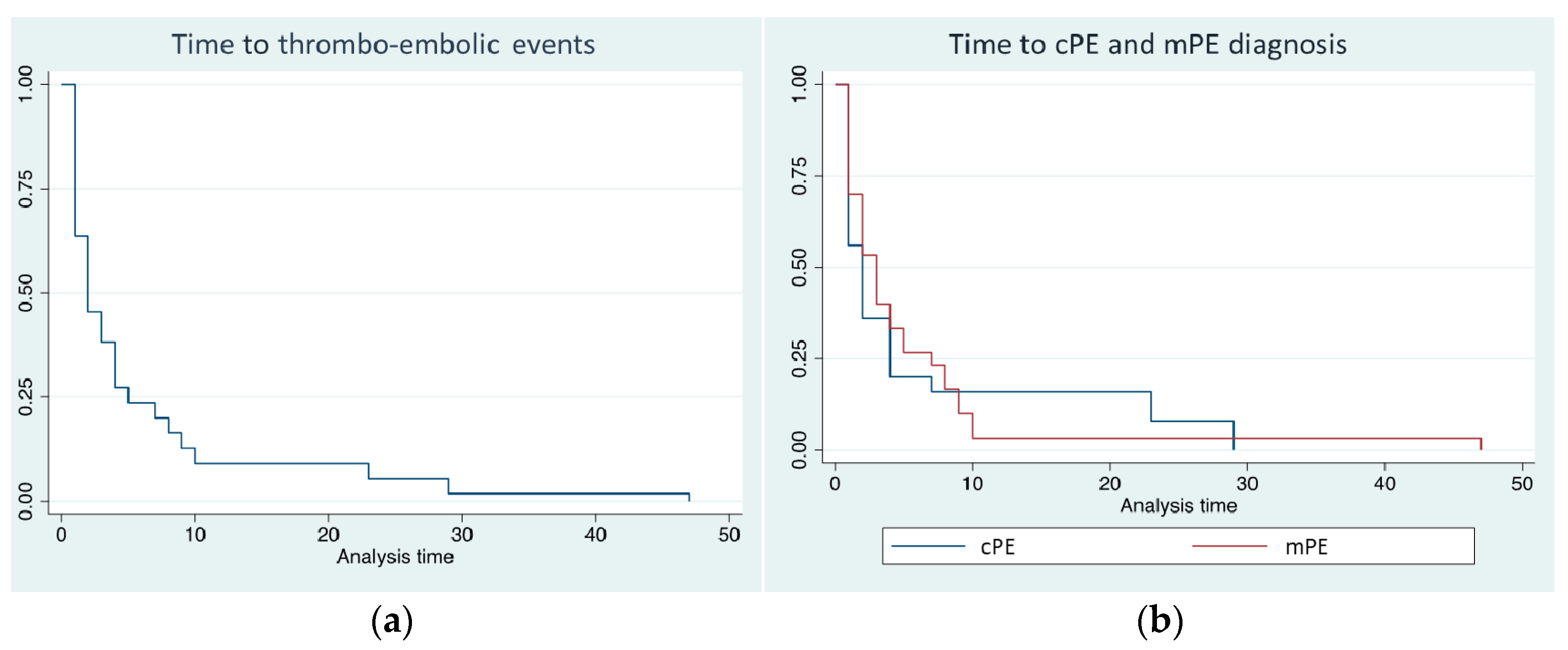
Pulmonary embolism (PE) has been associated with SARS-CoV-2 infection, and its incidence is highly variable. The aim of our study was to describe the radiological and clinical presentations, as well as the therapeutic management, of PEs that occurred during SARS-CoV-2 infection in a cohort of hospitalized patients. In this observational study, we enrolled patients with moderate COVID-19 who developed PE during hospitalization. Clinical, laboratory, and radiological features were recorded. PE was diagnosed on clinical suspicion and/or CT angiography. According to CT angiography results, two groups of patients were further distinguished: those with proximal or central pulmonary embolism (cPE) and those with distal or micro-pulmonary embolism (mPE). A total of 56 patients with a mean age of 78 ± 15 years were included. Overall, PE occurred after a median of 2 days from hospitalization (range 0–47 days) and, interestingly, the majority of them (89%) within the first 10 days of hospitalization, without differences between the groups. Patients with cPE were younger (p = 0.02), with a lower creatinine clearance (p = 0.04), and tended to have a higher body weight (p = 0.059) and higher D-Dimer values (p = 0.059) than patients with mPE. In all patients, low-weight molecular heparin (LWMH) at anticoagulant dosage was promptly started as soon as PE was diagnosed. After a mean of 16 ± 9 days, 94% of patients with cPE were switched to oral anticoagulant (OAC) therapy, which was a direct oral anticoagulant (DOAC) in 86% of cases. In contrast, only in 68% of patients with mPE, the prosecution with OAC was indicated. The duration of treatment was at least 3 months from PE diagnosis in all patients who started OAC. At the 3-month follow-up, no persistence or recurrence of PE as well as no clinically relevant bleedings were found in both groups. In conclusion, pulmonary embolism in patients with SARS-CoV-2 may have different extensions. Used with clinical judgment, oral anticoagulant therapy with DOAC was effective and safe.
Keywords: SARS-CoV-2; COVID-19; pulmonary embolism; anticoagulation therapy SARS-CoV-2; COVID-19; pulmonary embolism; anticoagulation therapy