Article

The Role of Transcranial Magnetic Stimulation, Peripheral Electrotherapy, and Neurophysiology Tests for Managing Incomplete Spinal Cord Injury

by
Katarzyna Leszczyńska
1,2,† and
Juliusz Huber
1,*,†
1
Department of Pathophysiology of Locomotor Organs, Poznan University of Medical Sciences, 28 Czerwca 1956 no 135/147, 60-545 Poznań, Poland
2
Department of Neurosurgery, Wroclaw Medical University, Borowska 213, 50-556 Wroclaw, Poland
*
Author to whom correspondence should be addressed.
These authors contributed equally to this work.
Biomedicines 2023, 11(4), 1035; https://doi.org/10.3390/biomedicines11041035

Submission received: 23 February 2023 / Revised: 20 March 2023 / Accepted: 24 March 2023 / Published: 27 March 2023
(This article belongs to the Special Issue Combined Treatments and Therapies to Cure Spinal Cord Injury)

Abstract

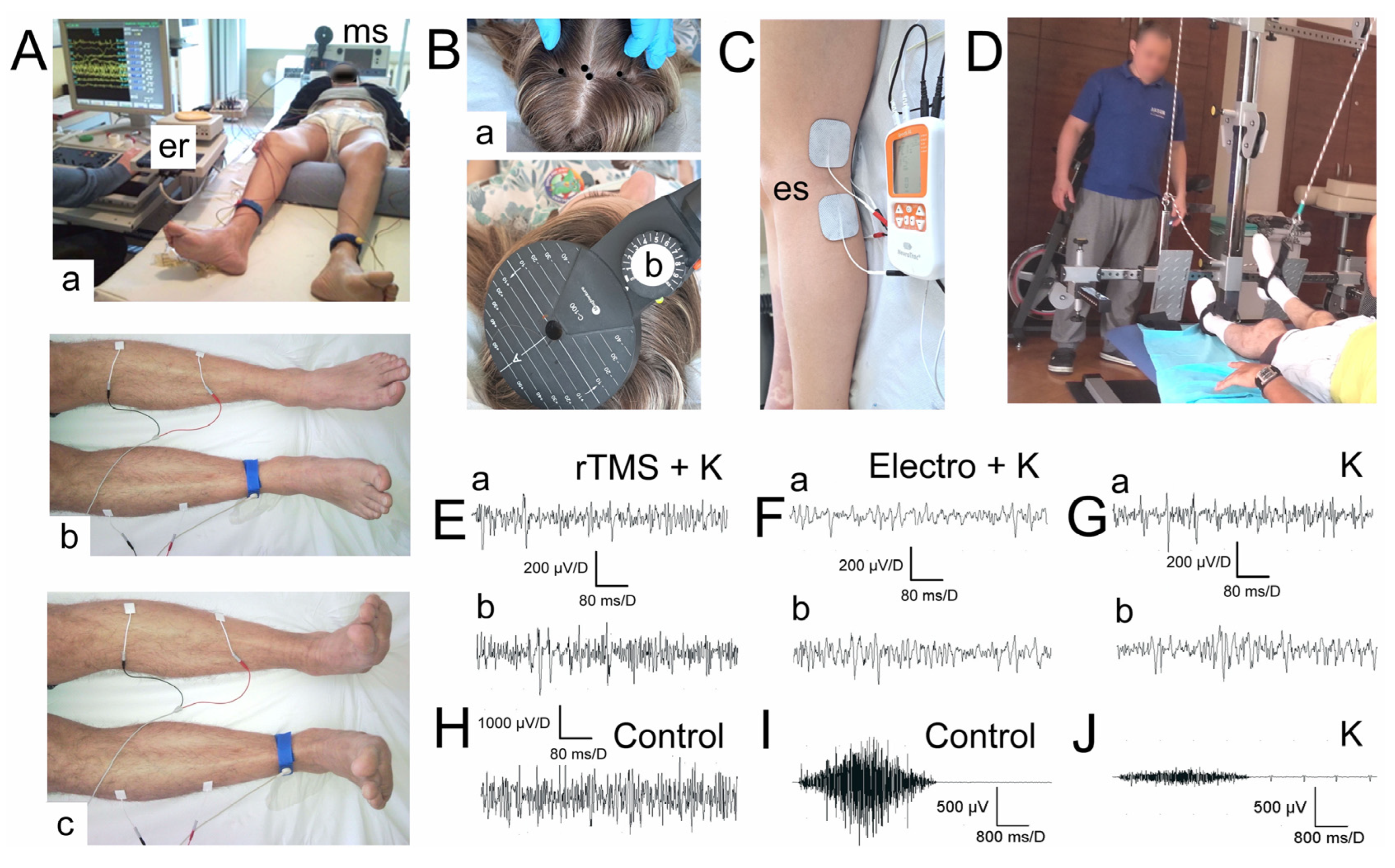
Efforts to find therapeutic methods that support spinal cord functional regeneration continue to be desirable. Natural recovery is limited, so high hopes are being placed on neuromodulation methods which promote neuroplasticity, such as repetitive transcranial magnetic stimulation (rTMS) and electrical stimulation used as treatment options for managing incomplete spinal cord injury (iSCI) apart from kinesiotherapy. However, there is still no agreement on the methodology and algorithms for treatment with these methods. The search for effective therapy is also hampered by the use of different, often subjective in nature, evaluation methods and difficulties in assessing the actual results of the therapy versus the phenomenon of spontaneous spinal cord regeneration. In this study, an analysis was performed on the database of five trials, and the cumulative data are presented. Participants (iSCI patients) were divided into five groups on the basis of the treatment they had received: rTMS and kinesiotherapy (N = 36), peripheral electrotherapy and kinesiotherapy (N = 65), kinesiotherapy alone (N = 55), rTMS only (N = 34), and peripheral electrotherapy mainly (N = 53). We present changes in amplitudes and frequencies of the motor units’ action potentials recorded by surface electromyography (sEMG) from the tibialis anterior—the index muscle for the lower extremity and the percentage of improvement in sEMG results before and after the applied therapies. The increase in values in sEMG parameters represents the better ability of motor units to recruit and, thus, improvement of neural efferent transmission. Our results indicate that peripheral electrotherapy provides a higher percentage of neurophysiological improvement than rTMS; however, the use of any of these additional stimulation methods (rTMS or peripheral electrotherapy) provided better results than the use of kinesiotherapy alone. The best improvement of tibialis anterior motor units’ activity in iSCI patients provided the application of electrotherapy conjoined with kinesiotherapy and rTMS conjoined with kinesiotherapy. We also undertook a review of the current literature to identify and summarise available works which address the use of rTMS or peripheral electrotherapy as neuromodulation treatment options in patients after iSCI. Our goal is to encourage other clinicians to implement both types of stimulation into the neurorehabilitation program for subjects after iSCI and evaluate their effectiveness with neurophysiological tests such as sEMG so further results and algorithms can be compared across studies. Facilitating the motor rehabilitation process by combining two rehabilitation procedures together was confirmed.
Keywords: incomplete spinal cord injury; neuromodulation methods; nerve electrostimulation; repetitive transcranial magnetic stimulation; kinesiotherapy; electromyography incomplete spinal cord injury; neuromodulation methods; nerve electrostimulation; repetitive transcranial magnetic stimulation; kinesiotherapy; electromyography