Abstract
Three Ir(III) complexes 1–3 were synthesized using phenyl-modified 2-phenylpyridine derivatives as the cyclometalating ligands. All complexes exhibited aggregation-induced phosphorescence emission (AIPE) in CH3CN/H2O, which facilitated highly sensitive detection of 2,4,6-trinitrophenol (TNP). Among them, complex 3 containing a phenyl group at the para-position of the phenyl moiety in 2-phenylpyridine showed superior detection performance with the limit of detection (LOD) of 74 nM. 1–3 demonstrated excellent anti-interference and selectivity performances for the detection of TNP in different common water samples. In addition, 1H NMR spectra, density functional theory calculations, and spectroscopic results indicate that the detection mechanism for TNP is attributed to the combined effects of photo-induced electron transfer and the inner-filter effect.
1. Introduction
In recent years, due to public safety, environmental pollution and other considerations, the rapid detection of explosives has attracted increasing concern [1,2]. 2,4,6-Trinitrophenol (TNP), commonly known as picric acid (PA), is an important component in the manufacture of explosives and has been widely used in industry. However, TNP leached from industrial wastewater can easily contaminate groundwater and soil, posing a serious threat to human health [3,4,5]. Therefore, developing a highly selective and sensitive approach for rapidly detecting TNP in water environments is essential.
To date, several methods have been used for the detection of TNP, among which photoluminescence (PL) analysis has received extensive attention from scientists due to its high sensitivity, practicality, low cost and ease of operation [6,7,8]. However, the aggregation-caused quenching (ACQ) phenomenon severely limits the ability of traditional organic luminescent materials to detect TNP, especially in aqueous media. Fortunately, Tang and coworkers [9] stated a new concept of aggregation-induced emission (AIE) for the first time in 2001, and further established a generally accepted mechanism of AIE, known as restriction of intramolecular motion (RIM) [10]. When in an aggregated state, the intramolecular motions of the AIE-active molecules are restricted, and energy is released in radiative leaps, thereby significantly enhancing the luminescence effect. The concept of AIE has effectively addressed the limitations imposed by the ACQ phenomenon. So far, a series of novel AIE materials have been developed and show great promise for application in many fields [9,11].
As typical phosphorescent materials, transition metal complexes, are widely used in chemosensors [12], bioimaging [13,14], photocatalysis [15,16], and optoelectronic devices [17]. In the past years, phosphorescent metal complexes exhibiting AIE properties have been discovered and reported. The AIE phenomenon based on phosphorescent metal complexes is known as the aggregation-induced phosphorescent emission (AIPE) [18]. Ir(III) complexes have become the “star molecules” of phosphorescent materials due to their strong phosphorescence emission, rich and tunable luminescence properties, excellent thermal and photochemical stability, and long luminescence lifetimes [19,20,21]. Up to now, a series of AIPE-active Ir(III) complexes have been developed for the detection of TNP.
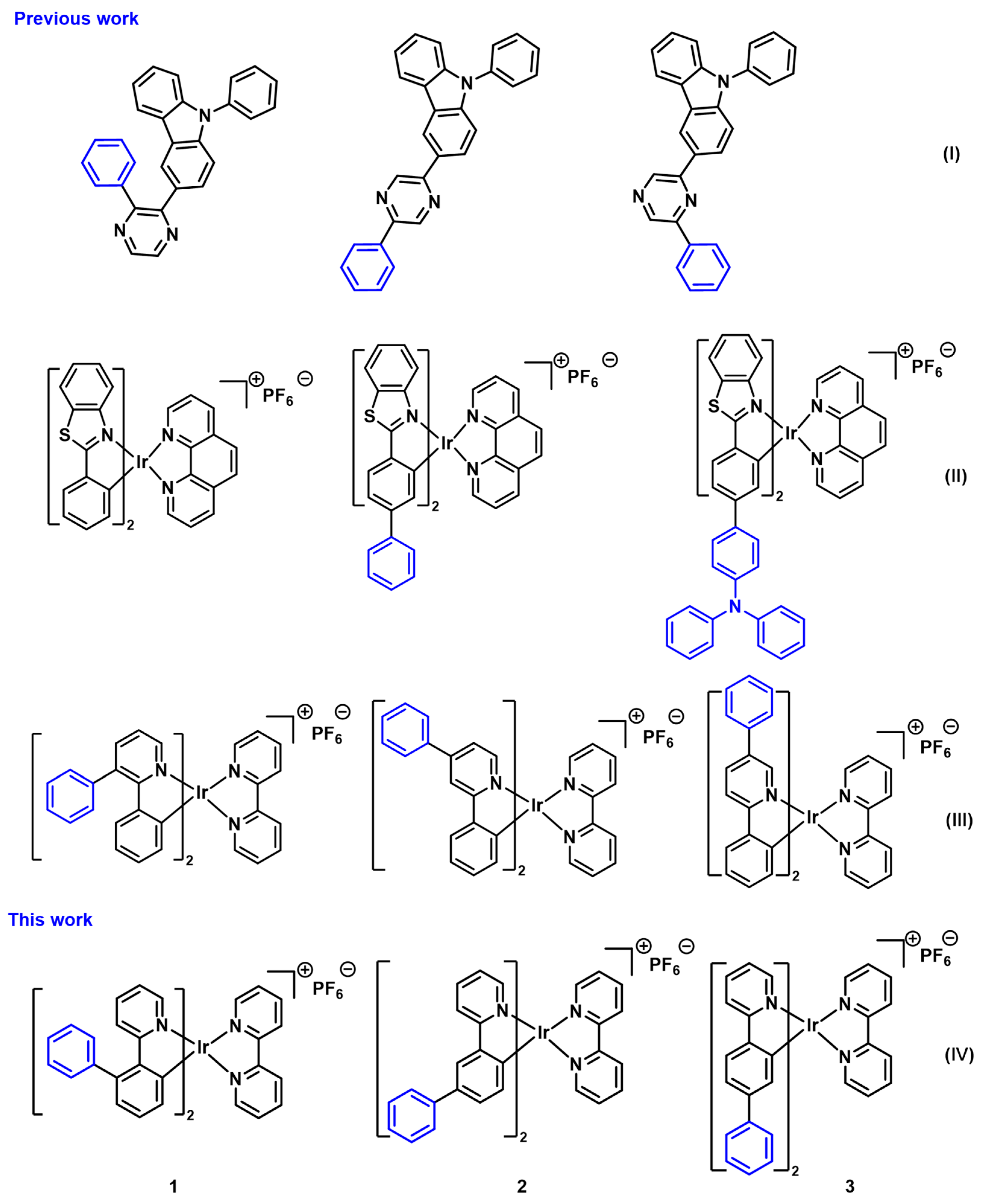
The phenyl group has a π-conjugation system, which could modify both the luminescence and application characteristics of the corresponding metal complexes. In 2020, Wu and co-workers [22] reported the effect of the position (ortho, meta, and para) of the phenyl group on luminescent properties of tetraphenyl pyrazine derivatives. They found that the meta- and para-phenyl groups could adjust the emission properties, whereas the ortho-substitution could distort the pyrazine plane due to steric hindrance, thereby activating the AIE properties (Scheme 1I). In 2023, our group [23] synthesized two Ir(III) complexes with the phenyl group or the triphenylamino group modified 2-phenylbenzothiazole derivatives at the 4-position of the phenyl moiety as the cyclometalating ligands. The phenyl group substitutions enhanced the AIE activity, prolonged phosphorescence lifetimes of complexes and improved the sensitivity and selectivity of the detection of TNP (Scheme 1II). Very recently, our group [24] reported three phenyl-substituted Ir(III) complexes and explored their effect on the detection of TNP by modulating the position of the phenyl group in the pyridine moiety of 2-phenylpyridine. Experimental results indicated that the complex introducing the phenyl group at 3-position has a lower limit of detection (LOD) (Scheme 1III). In this work, we further introduce a phenyl group at the ortho/meta/para positions of the phenyl moiety in 2-phenylpyridine to prepare Ir(III) complexes 1–3 (Scheme 1IV). The effects of different positions of the phenyl group on the luminescence and AIPE properties of 1–3 in CH3CN/H2O and the performances of 1–3 for detecting TNP have been investigated in detail.
Scheme 1.
(I) Molecular structures of three pyrazine-carbazole derivatives modified with phenyl groups; (II) Molecular structures of Ir(III) complexes modified with different rotatable groups; Molecular structures of Ir(III) complexes featuring 2-phenylpyridine derivatives as cyclometalating ligands, with phenyl modified on the pyridine moiety (III) and phenyl modified on the phenyl moiety (IV).
2. Materials and Methods
2.1. Instruments and Materials
For more information about the instruments and materials used in this work, please refer to the Supporting Information.
2.2. Synthesis and Characterization of Complexes
For the synthesis (Figures S1 and S2) and characterization (Figures S3–S11) of complexes, please refer to the Supporting Information. Among these, complexes 1 and 2 were synthesized for the first time in this work.
2.3. Tests for the Detection of TNP
First, stock solutions (100 µM) of CH3CN for 1–3 were prepared. Then, for samples of 1–3 with varying water fractions, stock solutions (300 µL) were diluted in a quartz cuvette to 3 mL (c = 10 µM) by adding CH3CN and H2O (deionized water). The UV-Vis absorption and emission spectra of these samples were recorded. Separately, samples of 1–3 (c = 10 μM, 200 mL) in CH3CN/H2O (fw = 60%) were prepared in volumetric flasks. Samples of 1–3 (3 mL) were transferred to quartz cuvettes and emission spectra of 11 independent blank samples per complex were recorded to determine the standard deviation (σ). Subsequently, TNP solutions (0.1–20.0 eq.) were prepared in CH3CN/H2O (fw = 60%). The samples of 1–3 after adding TNP solutions (30 μL) separately at different concentrations were subjected to spectroscopic testing, including emission spectra, UV-Vis absorption spectra, and lifetime decay curves. To perform anti-interference and selectivity studies for the detection of TNP, different analytes (c = 20 mM, 30 μL, 1,3-dinitrobenzene (1,3-DNB), p-cresol, m-nitrophenol (3-NP), nitrobenzene (NB), 4-methoxyphenol (MEHQ), m-cresol, and phenol) and different ionic compounds (c = 20 mM, 30 μL, NiCl2, AlCl3, KF, CaCl2, CuSO4, CoCO3, KBr, SnCl2, ZnCl2, and CH3COONa) were added to samples of 1–3 (3 mL), respectively, and their emission spectra were recorded. Next, TNP samples (c = 20 mM, 30 μL) were added to the above-mentioned analytes and ionic compounds, and their emission spectra were also recorded. To study the practical applicability of 1–3 for the detection of TNP in various water samples, samples of 1–3 were prepared using common water samples (lake water from Ling Shui Lake, seawater from Dalian Hei Shi Jiao, rainwater from Ling Shui Lake, and tap water from the western residential area of Dalian University of Technology) replacing deionized water, and their emission spectra were recorded before and after adding TNP (c = 20 mM, 30 µL).
3. Results and Discussion
3.1. Photophysical Properties
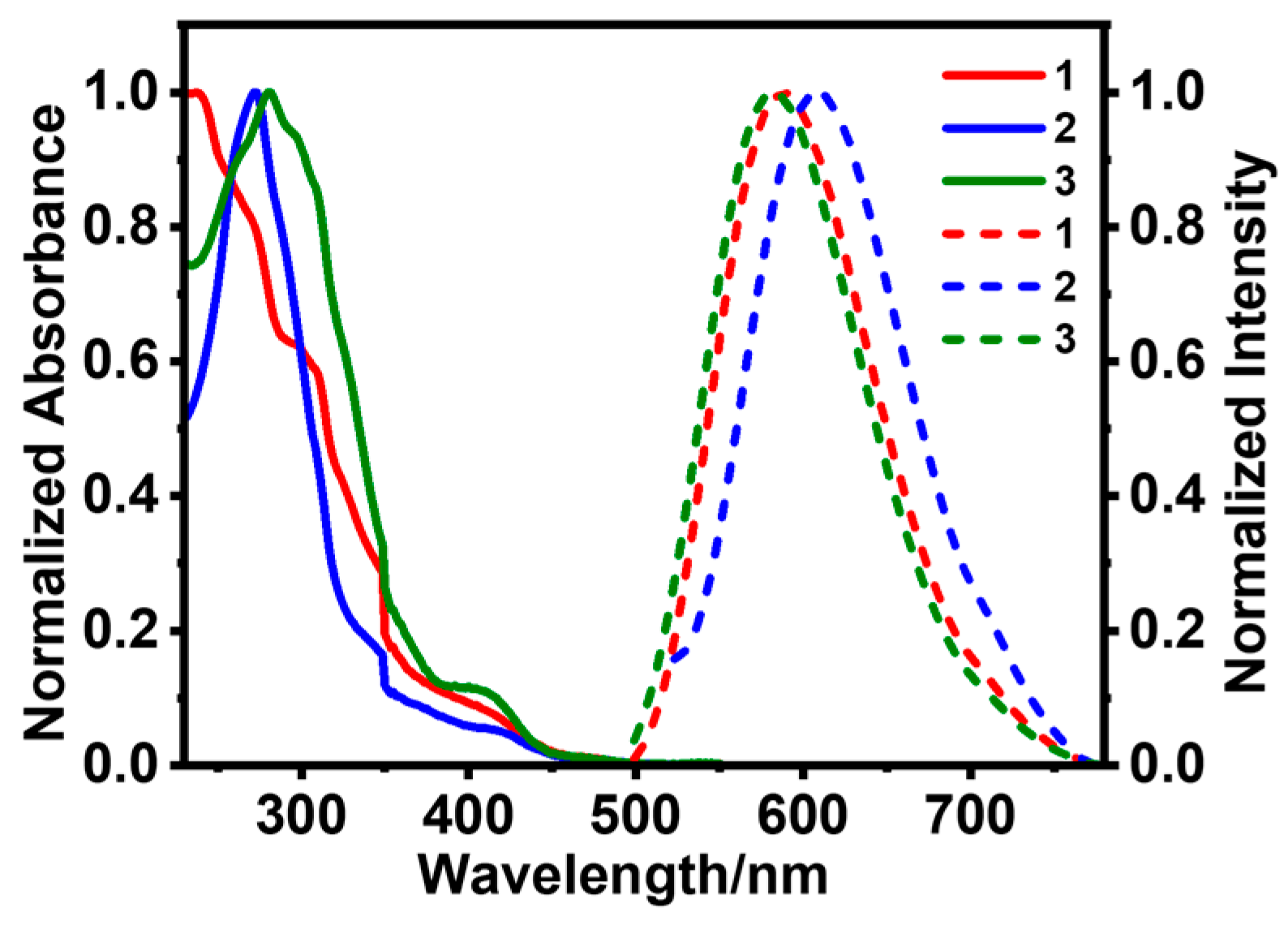
The UV-Vis absorption spectra of 1–3 (10 μM) in CH3CN were recorded at room temperature (Figure 1 left). Like most Ir(III) complexes, 1–3 have similar absorption peaks at 200–550 nm and exhibit two major absorption bands. The intense absorption band at 200–375 nm originates from the ligand spin-allowed π-π* transition. The weaker absorption bands in the range of 400–500 nm are assigned to metal-ligand charge transfer (MLCT) and ligand-ligand charge transfer (LLCT) [25,26,27,28]. Due to the change in the position of the phenyl substituent of 1–3, the maximum absorption wavelengths of the corresponding absorption spectra shift differently. Compared with 1 (239 nm), 2 is red-shifted by 33 nm, and 3 is red-shifted by 42 nm. The normalized emission spectra of 1–3 (Figure 1 right) show that the maximum emission wavelengths of 1–3 are 588 nm, 610 nm, and 582 nm, respectively. The luminescence quantum yields of 1–3 in CH3CN are 12.91%, 6.35%, and 13.98%, respectively. The molar extinction coefficients of 1–3 are 4.51 × 10⁴, 7.32 × 10⁴, and 6.21 × 10⁴ M−1·cm−1, respectively (Table S1). These results demonstrate that the introduction of a phenyl group at ortho/meta/para-positions of the phenyl moiety in 2-phenylpyridine also leads to a change in the maximum emission wavelength of 1–3.
Figure 1.
The normalized absorption (Left side: solid line) and emission (Right side: dashed line) spectra of 1–3 in CH3CN (excitation wavelength: 400 nm).
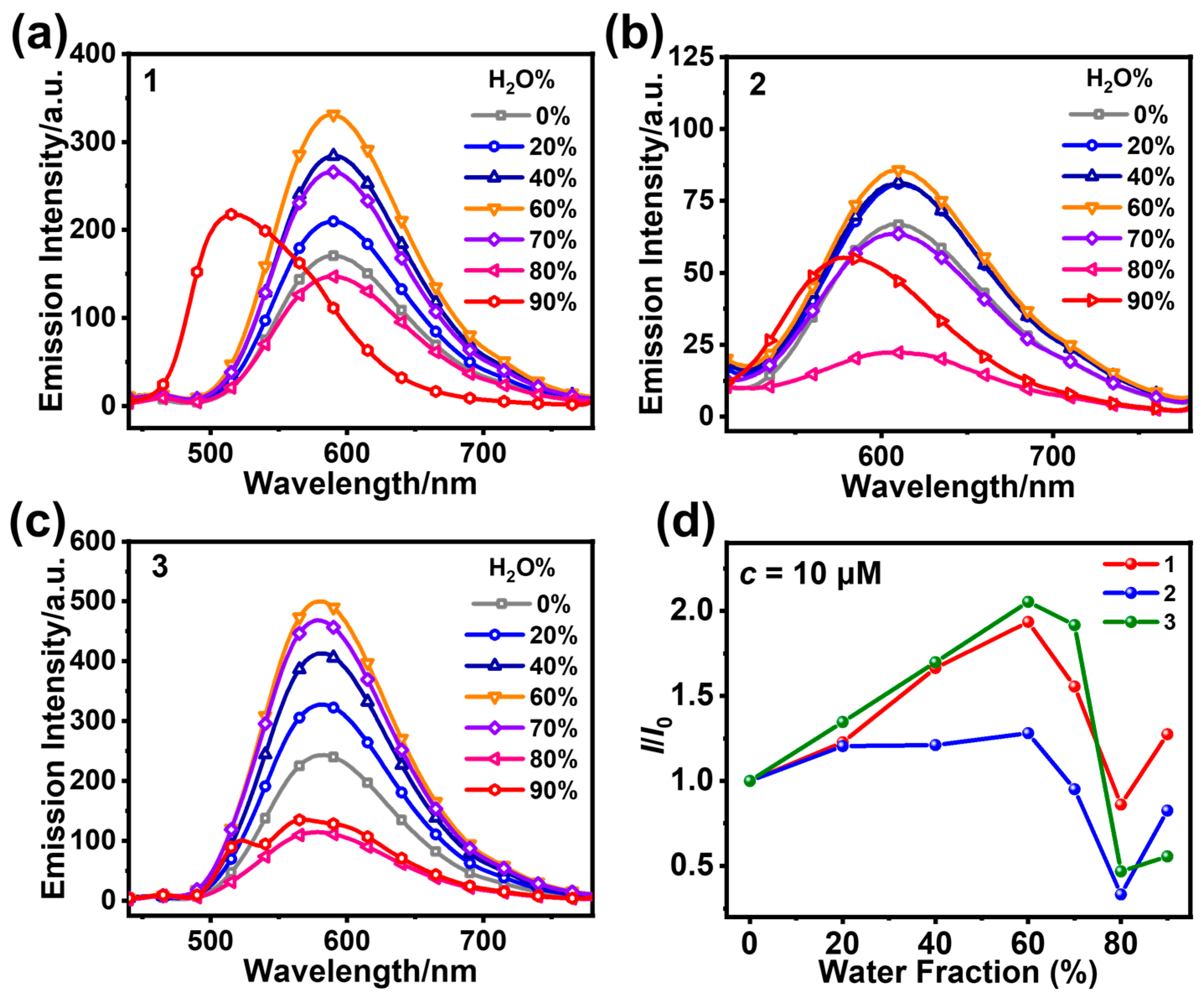
The emission spectra of 1–3 in CH3CN/H2O at different water fractions (c = 10 μM) were recorded (Figure 2a–c), and line plots of I/I0 (I: Maximum emission intensity at different water fractions; I0: Maximum emission intensity in CH3CN) with water fraction were generated (Figure 2d). The plots exhibit that the emission intensity of 1–3 reaches the maximum at a 60% water fraction. Compared with the emission intensity in CH3CN, their emission intensities are enhanced by 1.93, 1.28, and 2.05 times, respectively, indicating typical AIPE properties. The AIPE properties of 1–3 may be due to the aggregation of the complex molecules with increasing the water fraction, which makes the intramolecular movement of complexes restricted. When the molecules decay from the excited state to the ground state, the energy of the excited state is mainly consumed by radiative transitions, which leads to the enhancement of the luminescence of the complexes. The scanning electron microscope (SEM) image of 3 in CH3CN/H2O at the 60% water fraction showed that the molecules of 3 aggregated and formed nanosheets (Figure S12c). The nanospheres formed by 1 and 2 similarly demonstrate aggregation of the complex molecules (Figure S12a,b) [29]. In addition, as the water fraction continues to increase, the emission intensity gradually decreases, which may be attributed to the gradual increase in the sizes of the aggregates. At higher water fractions, the precipitation of aggregates results in the observed decrease in emission intensity [30].
Figure 2.
The emission spectra of (a) 1, (b) 2, and (c) 3 in CH3CN/H2O at various water fractions (0–90%) (λex = 400 nm, c = 10 µM). (d) Line plots of I/I0 of 1–3 with various water fractions in CH3CN/H2O (I: Maximum emission intensity at various water fractions; I0: Maximum emission intensity in CH3CN).
3.2. Detection of TNP
Notably, 1–3 exhibit AIPE properties in CH3CN/H2O, indicating their potential for the detection of TNP in water samples. As shown in Figure 2d, 1–3 exhibit the maximum emission intensity at a 60% water fraction. Therefore, the 60% water fraction is chosen for subsequent studies on the detection of TNP.
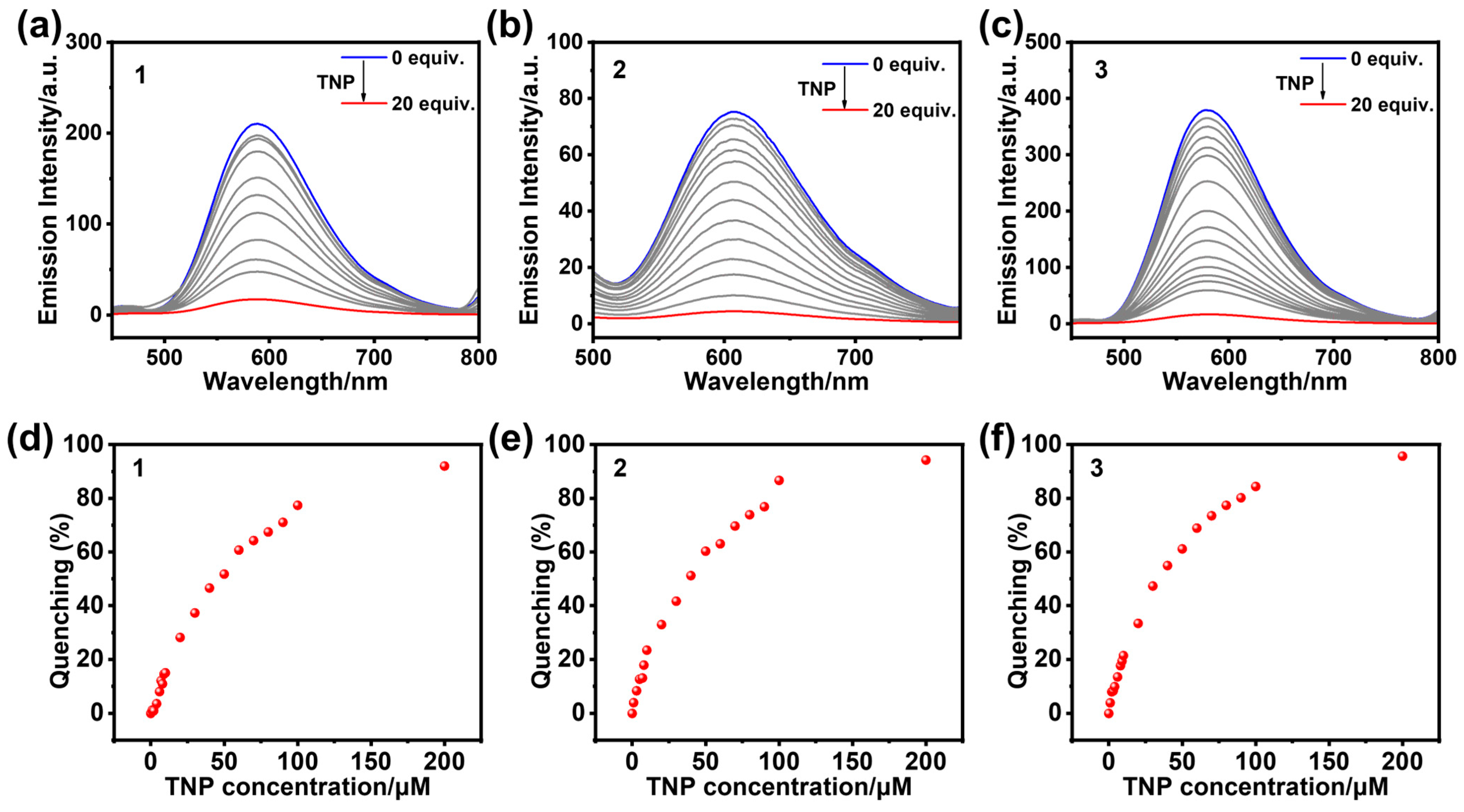
TNP at different concentrations was added to the equilibrated samples of 1–3 (3 mL) and the emission spectra were recorded (Figure 3a–c). With the TNP concentration increasing, the emission intensities of 1–3 gradually decreased, demonstrating a clear quenching effect. Meanwhile, the quenching efficiencies after adding TNP at different concentrations were calculated. As shown in Figure 3d–f, when TNP (20.0 eq.) was added, the quenching efficiencies of 1–3 reached 92%, 94%, and 96%, respectively.
Figure 3.
The emission spectra of (a) 1, (b) 2, and (c) 3 (10 μM) in CH3CN/H2O (fw = 60%) as a function of TNP concentration. The quenching percentages of (d) 1, (e) 2, and (f) 3 after adding TNP at different concentrations.
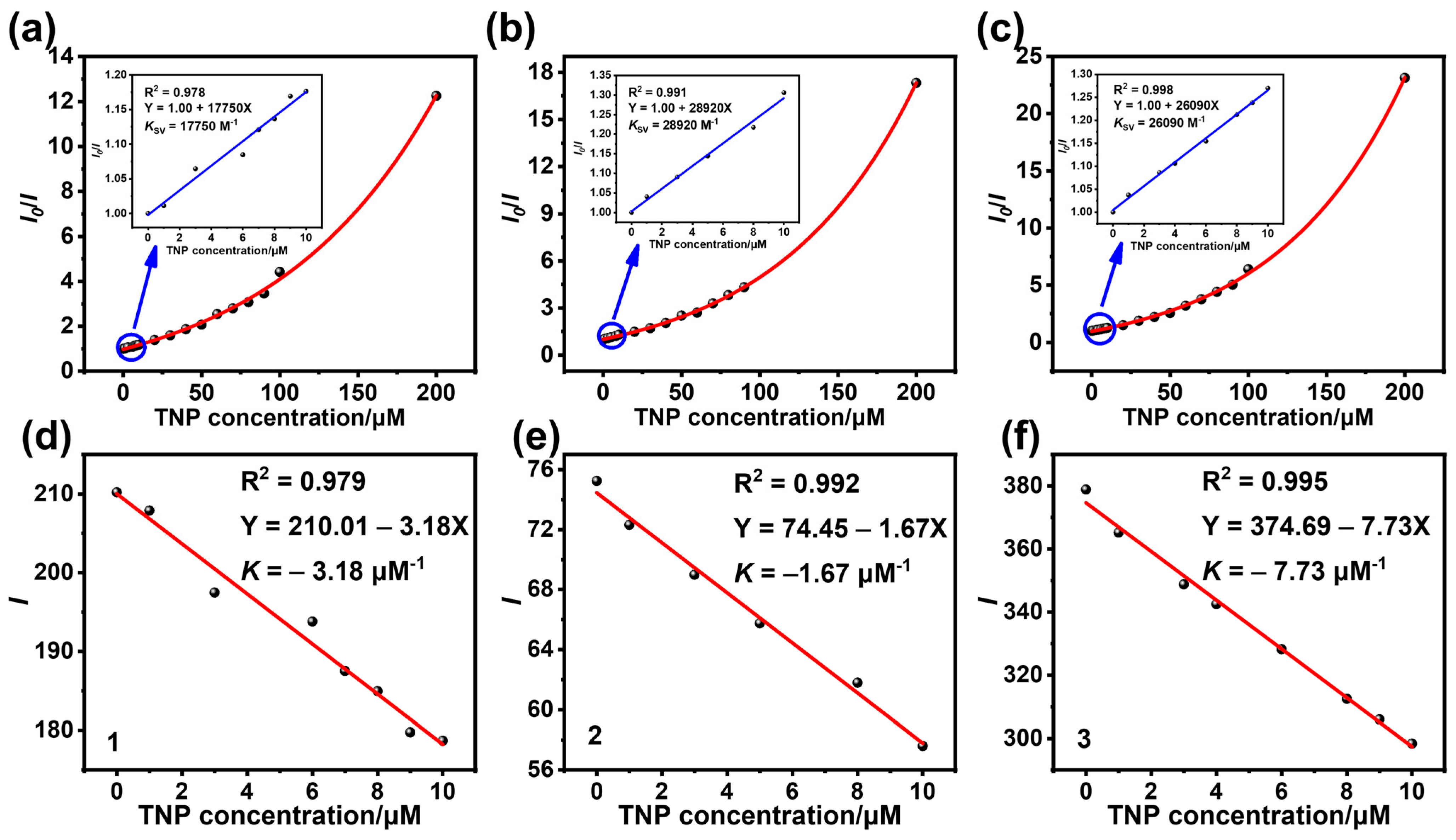
To further analyze the sensitivity of 1–3 for the detection of TNP, the Stern-Volmer plots were fitted to the correlation between I0/I (I0: without TNP; I: with TNP at different concentrations, emission intensity of 1–3) and [Q] (molar concentration of TNP) (Figure 4a–c). When adding TNP at low concentrations (0–10 μM), the Stern-Volmer plots all showed good linearity. However, as the concentration of TNP increased, the Stern-Volmer plots gradually deviated from linearity, which could be attributed to the existence of dynamic and static quenching in the luminescence quenching process [31]. The sensitivity of the detection of TNP was further analyzed by the Stern-Volmer equation I0/I = KSV[Q] + 1 when TNP (0–10 μM) was added to the samples of 1–3. The quenching constants (KSV) for the detection of TNP by 1–3 are 1.8 × 10⁴ M−1, 2.9 × 10⁴ M−1, and 2.6 × 10⁴ M−1, respectively.
Figure 4.
The Stern-Volmer curves for detecting TNP using (a) 1, (b) 2, and (c) 3: the inset shows the linear portion of curves. The linear plots of emission intensity versus TNP concentration for (d) 1, (e) 2, and (f) 3.
When adding TNP at low concentrations (0–10 μM), the emission intensity (I) of 1–3 and the molar concentrations of TNP were plotted (Figure 4d–f). The plots all show good linear relationships. The slopes K are −3.18 μM−1, −1.67 μM−1, and −7.73 μM−1, respectively. Based on the standard deviation (σ) (Figure S13, Table S2), the LODs of 1–3 were calculated as 150 nM, 197 nM, and 74 nM, respectively, by the formula LOD = 3σ/|K|. Therefore, it is clear that all of the complexes can be used as luminescent probes for high-efficiency detection of TNP. Building upon this work, we systematically compared these three complexes with previously reported complexes [23,24,32,33,34]. Notably, in our previous work, we reported three Ir(III) complexes with the phenyl group substituted 2-phenylpyridine derivatives at the pyridine moiety as cyclometalating ligands. All three complexes exhibit typical AIPE characteristics in CH3CN/H2O and enable highly sensitive detection of TNP in aqueous media. Among them, the complex with the phenyl substitution at the 3-position of the pyridine moiety demonstrates the lowest LOD of 164 nM [24]. In this work, the complex featuring a phenyl group at the para-position of the phenyl moiety (complex 3) further reduces the LOD to 74 nM. A comparison of all six complexes (with phenyl substitution at different sites of the ligand) provides valuable insight for the rational design of phosphorescent molecules with enhanced luminescence and detection capabilities.
It is worth noting that several reported complexes with modified benzothiadiazole ligands, such as those incorporating phenyl or triphenylamino substituents, exhibited even lower LODs than complex 3 [23,32]. Nevertheless, the systematic investigation of substitution position effects presented in this work offers a clear structure-property relationship that serves as a useful reference for future molecular design. The relevant comparison is provided in Table S3.
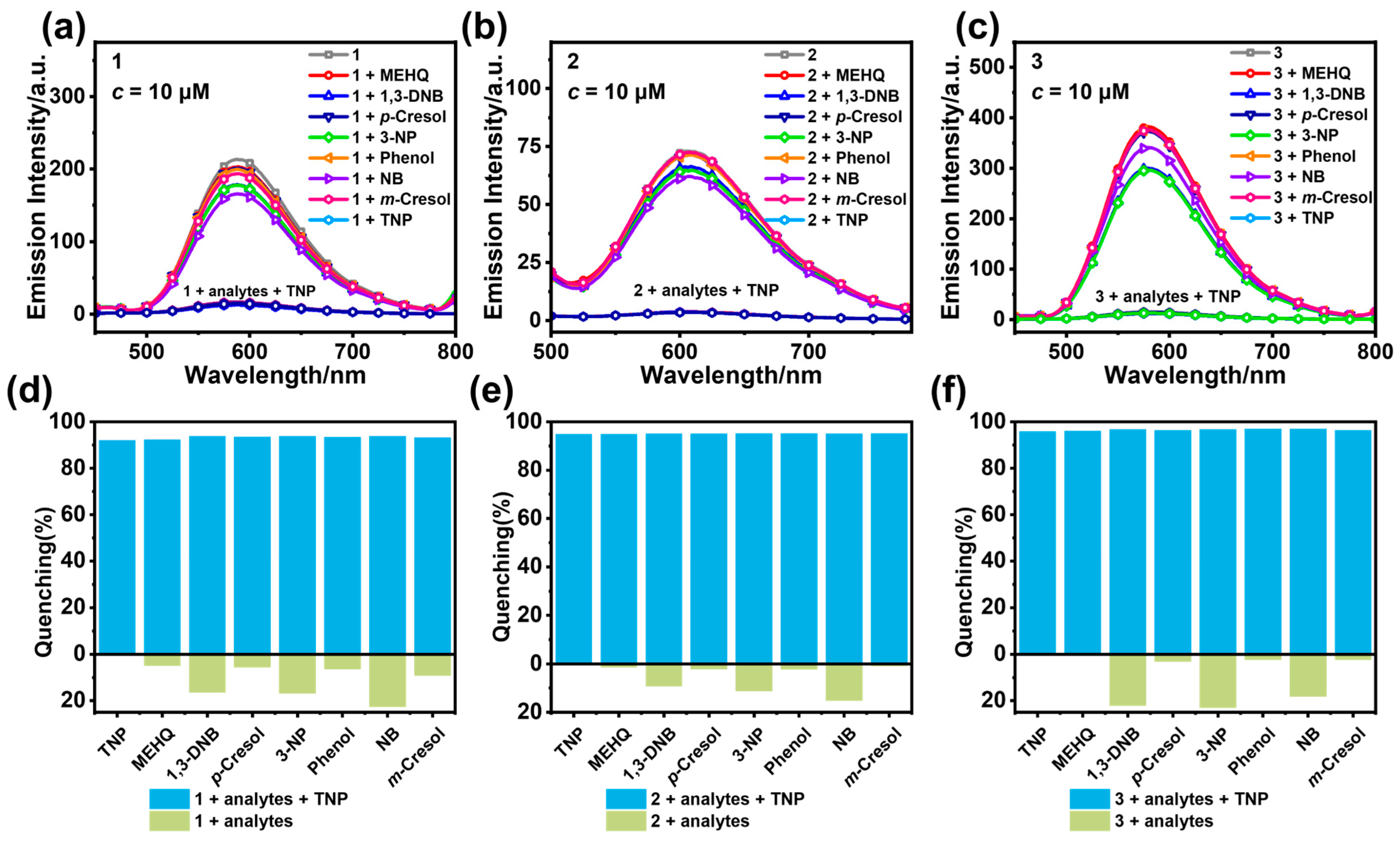
To investigate whether the detection of TNP by 1–3 had good selectivity and anti-interference, solutions of several common analytes (c = 20 mM) were prepared and individually added to the samples of 1–3. Anti-interference and selectivity experiments were performed under the same conditions used for TNP detection. These analytes included 1,3-DNB, NB, MEHQ, m-cresol, p-cresol, 3-NP, and phenol. As shown in Figure 5a–c, the luminescence intensity of 1–3 remains largely unchanged after the addition of other analytes except TNP. The quenching efficiencies of 1–3 are significantly improved after the addition of TNP, reaching approximately 95% (Figure 5d–f). These results indicate that 1–3 can selectively detect TNP in the presence of multiple analytes, respectively, without significantly influencing the detection of TNP, demonstrating excellent anti-interference and high selectivity.
Figure 5.
The emission spectra of (a) 1, (b) 2, and (c) 3 (10 µM) in CH3CN/H2O (fw = 60%) after adding 20 equivalents of different analytes. The quenching rates of (d) 1, (e) 2, and (f) 3 (10 µM, CH3CN/H2O) for 20 equivalents of different analytes.
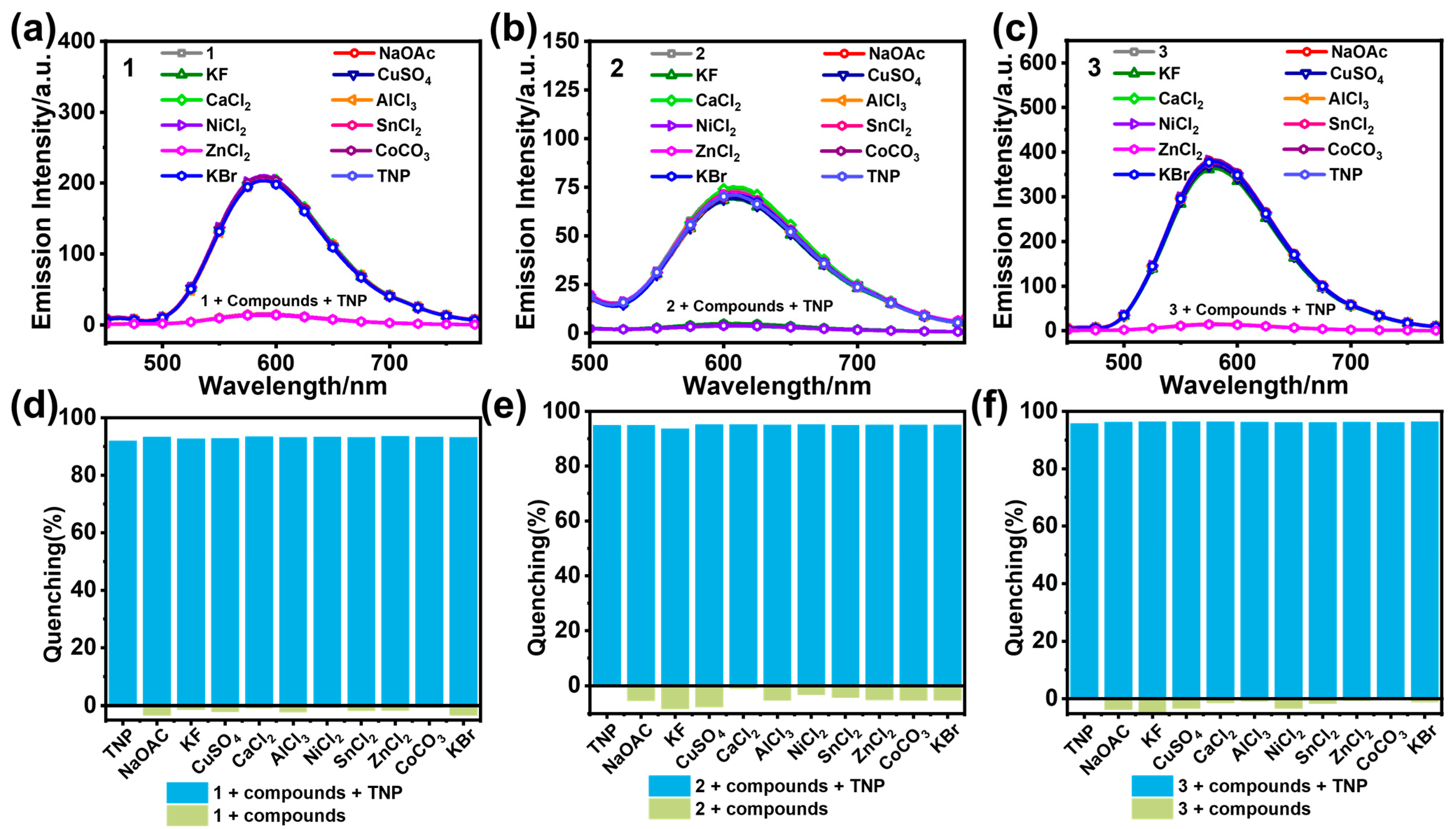
Furthermore, the detection of TNP in common water samples can be compromised by interference from various anions and cations. To further investigate whether the detection of TNP by 1–3 would be interfered by ionic compounds, a variety of common ionic compound solutions (c = 20 mM) were prepared for the ionic interference experiments, including KF, CuSO4, KBr, CH3COONa, AlCl3, SnCl2, CoCO3, ZnCl2, CaCl2, and NiCl2. After adding different ionic compound solutions to samples of 1–3, the luminescence performance of 1–3 is not significantly affected by the above ionic compounds (Figure 6a–c). Subsequently, after continuing to add TNP at the same concentration as the above-mentioned ionic compounds to samples of 1–3, the quenching efficiency of 1–3 is significantly improved (Figure 6d–f). This indicates that 1–3 can selectively detect TNP in the existence of various ionic compounds, respectively, showing good anti-interference and selectivity.
Figure 6.
The emission spectra of (a) 1, (b) 2, and (c) 3 (10 µM) in CH3CN/H2O (fw = 60%) after adding 20 equivalents of different ionic compounds. The quenching rates of (d) 1, (e) 2, and (f) 3 (10 µM, CH3CN/H2O) for 20 equivalents of different ionic compounds.
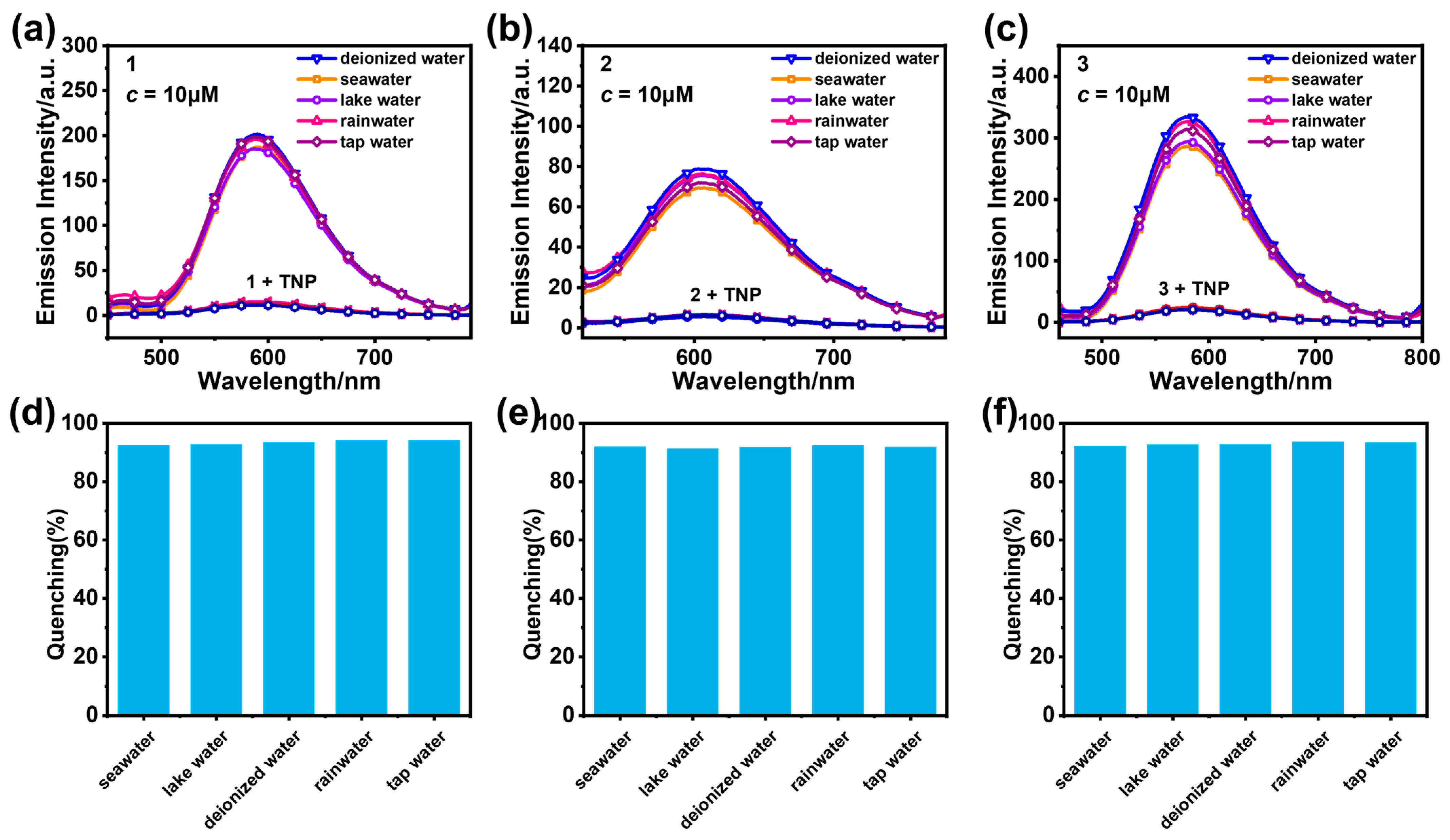
Finally, to further investigate the ability of 1–3 for the detection of TNP in the common environment, four types of water samples (lake water, rainwater, seawater, and tap water) were used to replace the deionized water in CH3CN/H2O to prepare the samples of 1–3. The emission spectra of these samples were then recorded. As shown in Figure 7a–c, the luminescence properties of 1–3 in common water samples are similar to those in deionized water samples. After adding TNP (c = 20 mM) to samples of 1–3, the quenching efficiencies are all higher than 90% (Figure 7d–f). Therefore, 1–3 shows great potential for application for detecting TNP in environmental water samples.
Figure 7.
The emission spectra of (a) 1, (b) 2, and (c) 3 (10 µM) in different water samples before and after adding TNP. The quenching rates of (d) 1, (e) 2, and (f) 3 (10 µM, CH3CN/H2O) after adding 20 equivalents of TNP in different water samples.
3.3. Sensing Mechanism
The quenching process of luminescent probes is mainly divided into static quenching and dynamic quenching. In static quenching [35,36,37], the luminescent molecule interacts with the quencher to form a non-luminescent ground-state compound, which does not affect the luminescence lifetime of the probe. But due to the formation of compounds after adding the quenching agent, new absorption peaks may appear, or the position and intensity of the existing peaks may change in the probe’s absorption spectrum. In dynamic quenching [38], the lifetime of the probe is shortened due to energy transfer or charge transfer occurring between the luminescent probe and the quencher during collisions.
To further investigate the luminescence quenching processes of 1–3 during the detection of TNP, the UV-Vis absorption spectra of 1–3 were recorded after adding TNP at different concentrations. As shown in Figure S14, after adding TNP, the absorption peaks at 308 nm in the absorption spectra of 1 and 3 are slightly red-shifted, and the absorption peak at 261 nm of 2 is slightly blue-shifted. These results suggest static quenching occurs during the luminescence quenching process of 1–3.
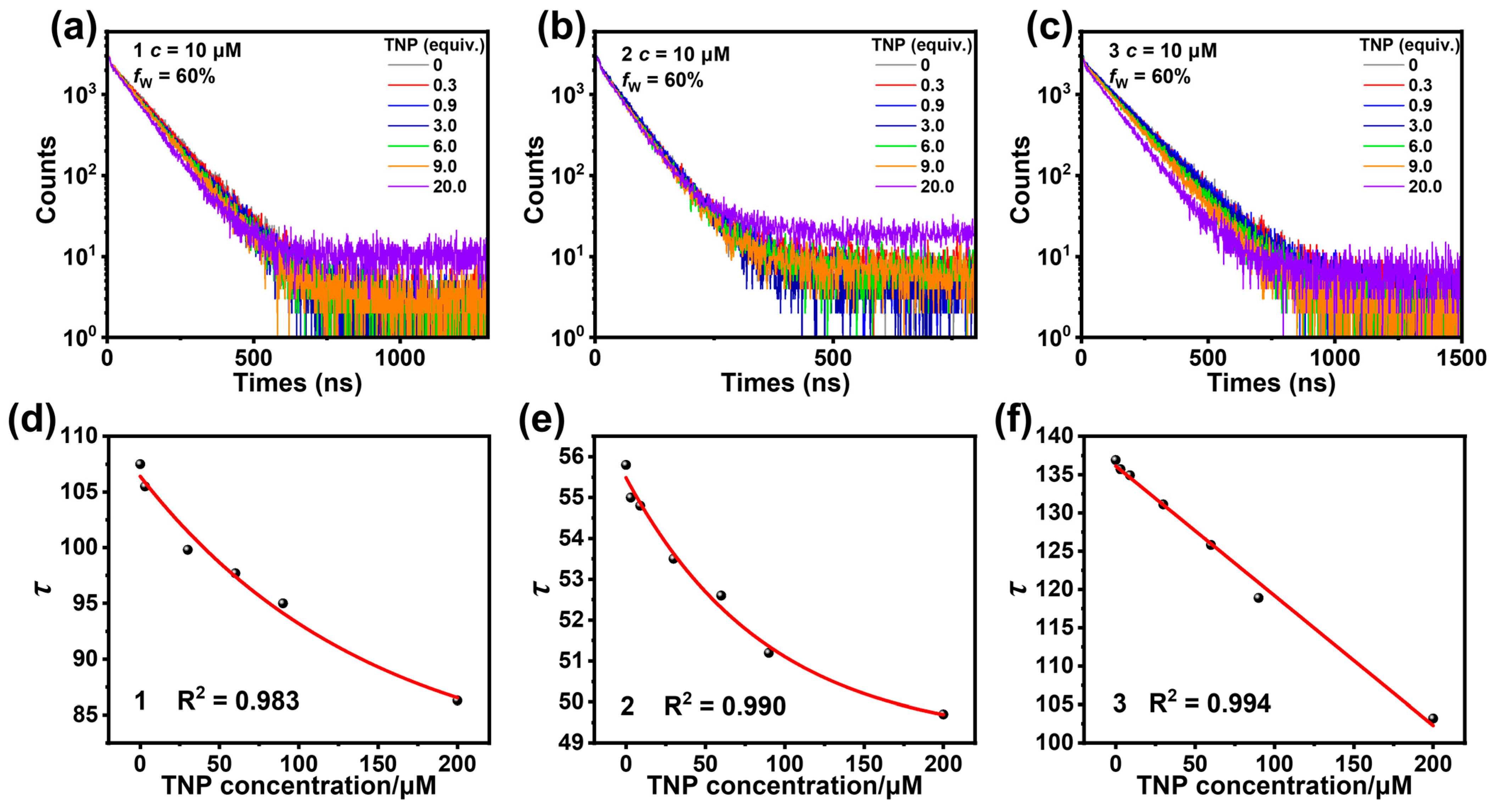
Subsequently, the luminescence lifetime decay traces of 1–3 were recorded after adding TNP at different concentrations, as shown in Figure 8a–c. As the concentration of TNP increased, the luminescence lifetimes of 1–3 are gradually shortened, indicating that dynamic quenching also exists during the luminescence quenching of 1–3. Meanwhile, based on the luminescence lifetime curves of 1–3 after adding TNP at different concentrations, it is evident that dynamic quenching occurs in the quenching process of 1–3 across both low and high concentration ranges of TNP (Figure 8d–f).
Figure 8.
The lifetime decay traces of (a) 1, (b) 2, and (c) 3 after adding TNP at different concentrations in CH3CN/H2O. Lifetime (τ) changes in (d) 1, (e) 2, and (f) 3 after adding TNP at different concentrations in CH3CN/H2O.
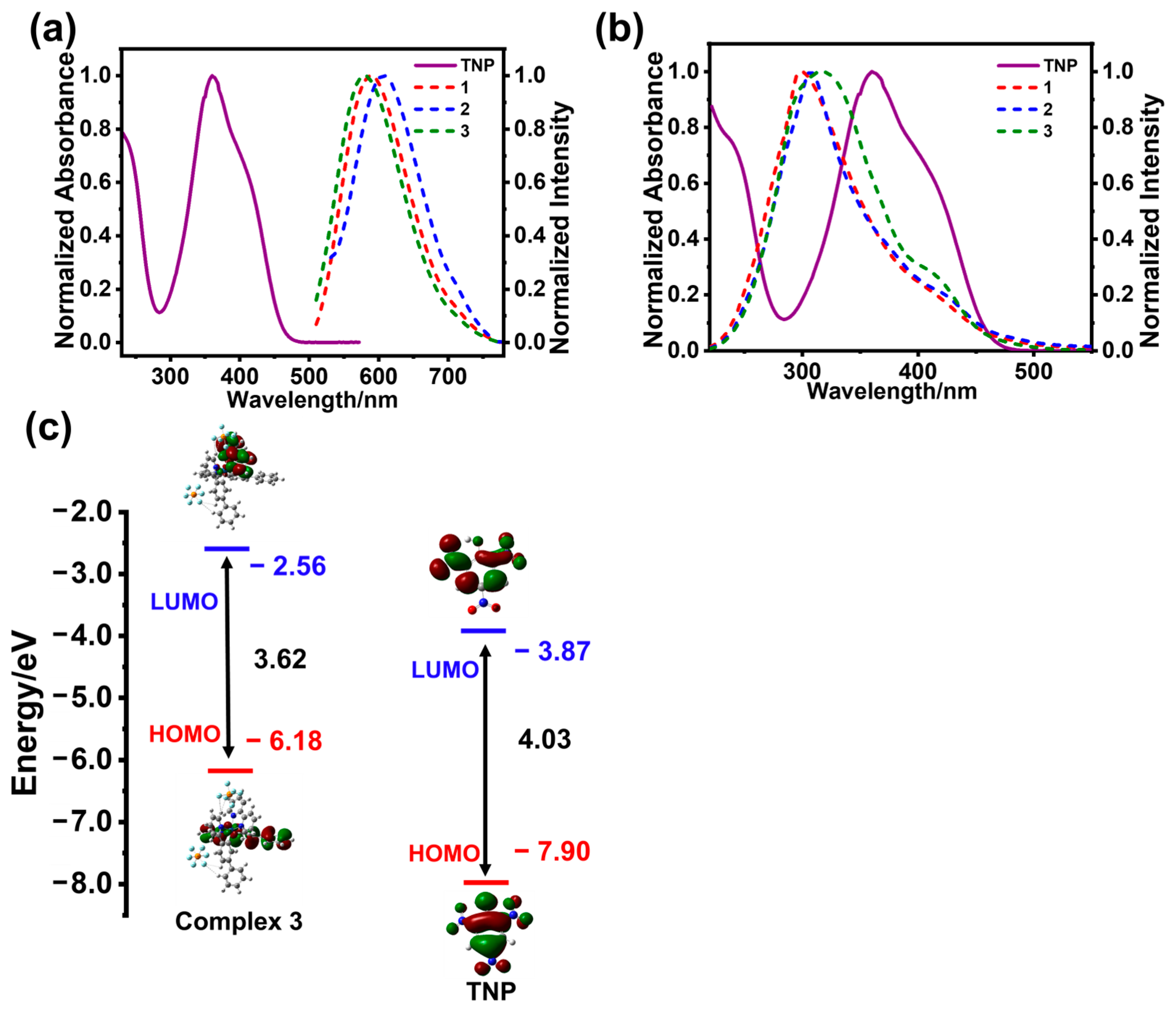
The common TNP detection mechanisms include Förster resonance energy transfer (FRET) [39,40], photo-induced electron transfer (PET) [41,42], and inner-filter effect (IFE) [43]. The UV-Vis absorption spectra of TNP were recorded to investigate whether there was overlap between the normalized absorption spectra of TNP (Figure 9a left) and the normalized emission spectra of 1–3 (Figure 9a right). As shown in Figure 9a, no overlap is observed between them. Therefore, FRET does not occur between 1–3 and TNP. Density functional theory calculations were performed on 3, which has the lowest detection limit, to determine the presence or absence of PET in the detection process. As shown in Figure 9c, the LUMO energy of 3 is higher than that of TNP. Therefore, the excited state electrons of 3 will be transferred from the LOMO of 3 to that of TNP and will not return to the HOMO of 3, and thus the luminescence of 3 will be quenched. The results indicate the possible existence of the PET process in the luminescence quenching of 3. Excitation spectra of 1–3 and UV-Vis absorption spectra of TNP overlap partially, indicating that IFE may occur during the detection of TNP (Figure 9b). Additionally, the quenching rates of 1–3 were calculated at different excitation wavelengths to evaluate the influence of IFE on quenching [44] (Figure S15). The results indicate that the influence of IFE on quenching is significantly less than that of PET during the quenching process. To further verify whether the luminescence quenching was caused by the decomposition of 1–3 due to the addition of TNP, the 1H NMR spectra were recorded. As shown in Figure S16, the addition of TNP does not influence the structural integrity of the complex (the complex does not decompose in the presence of TNP). Therefore, the 1H NMR spectra, density functional theory calculations, and spectroscopic results indicate that the detection mechanism for TNP is attributed to the combined effects of PET and IFE.
Figure 9.
(a) The normalized UV-Vis absorption spectra (Left side: solid line) of TNP and the normalized emission spectra (Right side: dashed line) of 1–3. (b) The normalized excitation spectra (dashed line) of 1–3 and the normalized UV-Vis absorption spectra (solid line) of TNP. (c) Energy level diagrams of 3 and TNP obtained from theoretical calculations.
4. Conclusions
In conclusion, Ir(III) complexes 1–3, with a phenyl group at the ortho/meta/para-positions at the phenyl moiety in 2-phenylpyridine, exhibit AIPE properties in CH3CN/H2O. These AIPE-active complexes enable highly selective and sensitive detection of TNP in aqueous media. The para-substituted complex 3 exhibits the lowest LOD of 74 nM. Luminescent lifetimes and UV-Vis absorption spectra of 1–3 indicate that both static and dynamic quenching processes occur during detection. 1H NMR spectra, density functional theory calculations, and spectroscopic results show that the detection mechanism for TNP is attributed to the combined effects of PET and IFE. This work investigates the influence of the phenyl substitution position on the luminescent properties and sensing performances of Ir(III) complexes. This provides a novel molecular design strategy for developing high-performance phosphorescent sensing materials.
Supplementary Materials
The following supporting information can be downloaded at: https://www.mdpi.com/article/10.3390/chemosensors13110384/s1, Figure S1. Synthesis route of ligands L1–L3; Figure S2. Synthesis route of Ir(III) complexes 1–3; Figure S3. The 1H NMR spectrum of 1 in DMSO-d6; Figure S4. The 13C NMR spectrum of 1 in DMSO-d6; Figure S5. The high-resolution mass spectrum of the cationic portion of 1; Figure S6. The 1H NMR spectrum of 2 in DMSO-d6; Figure S7. The 13C NMR spectrum of 2 in DMSO-d6; Figure S8. The high-resolution mass spectrum of the cationic portion of 2; Figure S9. The 1H NMR spectrum of 3 in DMSO-d6; Figure S10. The 13C NMR spectrum of 3 in DMSO-d6; Figure S11. The high-resolution mass spectrum of the cationic portion of 3; Table S1. Photophysical properties of 1–3; Figure S12. SEM images of aggregates (a) 1, (b) 2, and (c) 3 in CH3CN/H2O at a 60% water fraction; Figure S13. The emission spectra of 1–3 in 11 blank samples in CH3CN/H2O (fw = 60%, 10 μM); Table S2. Emission intensity and standard deviation of complexes 1–3 at the maximum emission wavelength; Table S3. Luminescence quenching performance of Ir(III) complexes with TNP; Figure S14. UV-Vis absorption spectra of (a) 1, (b) 2, and (c) 3 in CH3CN/H2O (fw = 60%) after adding TNP at different concentrations; Figure S15. the quenching rates of 1–3 (fw = 60%) at different excitation wavelengths (310–440 nm); Figure S16. 1H NMR spectra of 1–3, TNP, and 1–3 + TNP.
Author Contributions
Investigation, X.Y. and J.D.; data curation, writing—original draft preparation, X.Y., Q.Z. and J.D.; writing—review and editing, Q.Z., L.Z. and C.L.; supervision, C.L. All authors have read and agreed to the published version of the manuscript.
Funding
The authors thank the financial support from the National Natural Science Foundation of China (21978042) and the Fundamental Research Funds for the Central Universities (DUT22LAB610).
Institutional Review Board Statement
Not applicable.
Informed Consent Statement
Not applicable.
Data Availability Statement
Data are contained within the article.
Conflicts of Interest
The authors declare no conflicts of interest.
References
- Agarwal, A.; Bhatta, R.P.; Kachwal, V.; Laskar, I.R. Controlling the sensitivity and selectivity for the detection of nitro-based explosives by modulating the electronic substituents on the ligand of AIPE-active cyclometalated iridium(iii) complexes. Dalton Trans. 2023, 52, 14182–14193. [Google Scholar] [CrossRef] [PubMed]
- Verbitskiy, E.V.; Lipunova, G.N.; Nosova, E.V.; Charushin, V.N. Recent advances in design of fluorescent sensors based on azole and azine derivatives towards nitroaromatic explosives and related compounds. Dye. Pigment. 2025, 240, 112848. [Google Scholar] [CrossRef]
- He, G.; Peng, H.; Liu, T.; Yang, M.; Zhang, Y.; Fang, Y. A novel picric acid film sensor via combination of the surface enrichment effect of chitosan films and the aggregation-induced emission effect of siloles. J. Mater. Chem. 2009, 19, 7347–7353. [Google Scholar] [CrossRef]
- Kayser, E.G.; Burlinson, N.E. Migration of explosives in soil: Analysis of rdx, tnt, and tetryl from a 14c lysimeter study. J. Energetic Mater. 1988, 6, 45–71. [Google Scholar] [CrossRef]
- Yang, L.; Ma, J.; Yang, B. Fluorescent Carbon Dots Derived From Soy Sauce for Picric Acid Detection and Cell Imaging. J. Fluoresc. 2023, 33, 1981–1993. [Google Scholar] [CrossRef]
- Barata, P.D.; Prata, J.V. Fluorescent Calix [4]arene-Carbazole-Containing Polymers as Sensors for Nitroaromatic Explosives. Chemosensors 2020, 8, 128. [Google Scholar] [CrossRef]
- Noh, D.; Oh, E. Estimation of Environmental Effects and Response Time in Gas-Phase Explosives Detection Using Photoluminescence Quenching Method. Polymers 2024, 16, 908. [Google Scholar] [CrossRef]
- Liao, Z.-H.; Wang, F. Light-controlled smart materials: Supramolecular regulation and applications. Smart Mol. 2024, 2, e20240036. [Google Scholar] [CrossRef]
- Luo, J.; Xie, Z.; Lam, J.W.Y.; Cheng, L.; Chen, H.; Qiu, C.; Kwok, H.S.; Zhan, X.; Liu, Y.; Zhu, D.; et al. Aggregation-induced emission of 1-methyl-1,2,3,4,5-pentaphenylsilole. Chem. Commun. 2001, 18, 1740–1741. [Google Scholar] [CrossRef]
- Mei, J.; Leung, N.L.C.; Kwok, R.T.K.; Lam, J.W.Y.; Tang, B.Z. Aggregation-Induced Emission: Together We Shine, United We Soar! Chem. Rev. 2015, 115, 11718–11940. [Google Scholar] [CrossRef] [PubMed]
- Zhang, G.; Fu, X.; Zhou, D.; Hu, R.; Qin, A.; Tang, B.Z. Smart aggregation-induced emission polymers: Preparation, properties and bio-applications. Smart Mol. 2023, 1, e20220008. [Google Scholar] [CrossRef]
- Ma, D.-L.; Lin, S.; Wang, W.; Yang, C.; Leung, C.-H. Luminescent chemosensors by using cyclometalated iridium(iii) complexes and their applications. Chem. Sci. 2017, 8, 878–889. [Google Scholar] [CrossRef]
- Das, B.; Gupta, P. Multimetallic transition metal complexes:Luminescent probes for biomolecule sensing, ion detection, imaging and therapeutic application. Coord. Chem. Rev. 2024, 504, 215656. [Google Scholar] [CrossRef]
- Lee, L.C.-C.; Lo, K.K.-W. Shining New Light on Biological Systems: Luminescent Transition Metal Complexes for Bioimaging and Biosensing Applications. Chem. Rev. 2024, 124, 8825–9014. [Google Scholar] [CrossRef]
- Arora, A.; Oswal, P.; Datta, A.; Kumar, A. Complexes of metals with organotellurium compounds and nanosized metal tellurides for catalysis, electrocatalysis and photocatalysis. Coord. Chem. Rev. 2022, 459, 214406. [Google Scholar] [CrossRef]
- Ren, T.; Zhu, H.; Yang, X.; Jia, D. Heterometallic lead-iodocuprate hybrids with transition-metal complexes: Syntheses, structures, photoelectricity and photocatalysis. New J. Chem. 2025, 49, 9669–9677. [Google Scholar] [CrossRef]
- Gong, Z.-L.; Zhang, H.-J.; Cheng, Y.; Liu, J.; Ai, Y.; Li, Y.; Feng, Z.; Zhang, Q.; Gong, S.; Chen, Y.; et al. Recent progress on photoactive nonprecious transition-metal complexes. Sci. China Chem. 2025, 68, 46–95. [Google Scholar] [CrossRef]
- Manimaran, B.; Thanasekaran, P.; Rajendran, T.; Lin, R.-J.; Chang, I.J.; Lee, G.-H.; Peng, S.-M.; Rajagopal, S.; Lu, K.-L. Luminescence Enhancement Induced by Aggregation of Alkoxy-Bridged Rhenium(I) Molecular Rectangles. Inorg. Chem. 2002, 41, 5323–5325. [Google Scholar] [CrossRef]
- Mauro, M.; Cebrián, C. Aggregation-induced Phosphorescence Enhancement in Ir(III) Complexes. Isr. J. Chem. 2018, 58, 901–914. [Google Scholar] [CrossRef]
- Aoki, S.; Yokoi, K.; Hisamatsu, Y.; Balachandran, C.; Tamura, Y.; Tanaka, T. Post-complexation Functionalization of Cyclometalated Iridium(III) Complexes and Applications to Biomedical and Material Sciences. Top. Curr. Chem. 2022, 380, 36. [Google Scholar] [CrossRef]
- Schreier, M.R.; Guo, X.; Pfund, B.; Okamoto, Y.; Ward, T.R.; Kerzig, C.; Wenger, O.S. Water-Soluble Tris(cyclometalated) Iridium(III) Complexes for Aqueous Electron and Energy Transfer Photochemistry. Acc. Chem. Res. 2022, 55, 1290–1300. [Google Scholar] [CrossRef] [PubMed]
- Wu, H.; Song, X.; Zhang, B.; Wang, Z.; Zhang, T.; Qin, A.; Tang, B.Z. Each phenyl group performs its own functions on luminescence: Phenyl substituted effect in tetraphenylpyrazine. Mater. Chem. Front. 2020, 4, 1706–1713. [Google Scholar] [CrossRef]
- He, P.; Chen, Y.; Li, X.-N.; Yan, Y.-Y.; Liu, C. Aggregation-Induced Emission-Active Iridium(III) Complexes for Sensing Picric Acid in Water. Chemosensors 2023, 11, 177. [Google Scholar] [CrossRef]
- Yang, X.; Du, J.; Cai, R.; Liu, C. The Effect of the Position of a Phenyl Group on the Luminescent and TNP-Sensing Properties of Cationic Iridium(III) Complexes. Sensors 2025, 25, 839. [Google Scholar] [CrossRef]
- Jang, J.-H.; Park, H.J.; Park, J.Y.; Kim, H.U.; Hwang, D.-H. Orange phosphorescent Ir(III) complexes consisting of substituted 2-phenylbenzothiazole for solution-processed organic light-emitting diodes. Org. Electron. 2018, 60, 31–37. [Google Scholar] [CrossRef]
- Zhou, Y.; Gao, H.; Wang, X.; Qi, H. Electrogenerated Chemiluminescence from Heteroleptic Iridium(III) Complexes with Multicolor Emission. Inorg. Chem. 2015, 54, 1446–1453. [Google Scholar] [CrossRef]
- Dai, J.; Zhou, K.; Li, M.; Sun, H.; Chen, Y.; Su, S.; Pu, X.; Huang, Y.; Lu, Z. Iridium(iii) complexes with enhanced film amorphism as guests for efficient orange solution-processed single-layer PhOLEDs with low efficiency roll-off. Dalton Trans. 2013, 42, 10559–10571. [Google Scholar] [CrossRef]
- Rabha, M.; Lyngkhoi, D.L.; Patra, S.K.; Khatua, S. AIE-active cyclometalated iridium(iii) complexes for highly efficient picric acid detection in aqueous media. Inorg. Chem. Front. 2024, 11, 1434–1449. [Google Scholar] [CrossRef]
- Zhang, Q.; Chen, Y.; Liu, C. Living supramolecular polymerization of Ir(III) complexes. Mol. Chem. Eng. 2025, 1, 100008. [Google Scholar] [CrossRef]
- Chen, Y.; Shi, Y.; Gao, Z.; Wang, L.; Tang, Y.; Liu, J.; Liu, C. Supramolecular Copolymers Under Kinetic, Thermodynamic, or Pathway-Switching Control. Angew. Chem. Int. Ed. 2023, 62, e202302581. [Google Scholar] [CrossRef]
- Toprak, M.; Meryem Aydın, B.; Arık, M.; Onganer, Y. Fluorescence quenching of fluorescein by Merocyanine 540 in liposomes. J. Lumin. 2011, 131, 2286–2289. [Google Scholar] [CrossRef]
- He, P.; Chen, Y.; Li, X.-N.; Yan, Y.-Y.; Liu, C. AIPE-active cationic Ir(iii) complexes for efficient detection of 2,4,6-trinitrophenol and oxygen. Dalton Trans. 2023, 52, 128–135. [Google Scholar] [CrossRef]
- Xu, J.; Zhang, L.; Shi, Y.; Liu, C. Carbazolyl-Modified Neutral Ir(III) Complexes for Efficient Detection of Picric Acid in Aqueous Media. Sensors 2024, 24, 4074. [Google Scholar] [CrossRef]
- Liu, J.-W.; Xu, Y.-N.; Qin, C.-Y.; Wang, Z.-N.; Wu, C.-J.; Li, Y.-H.; Wang, S.; Zhang, K.Y.; Huang, W. Simple fluorene oxadiazole-based Ir(iii) complexes with AIPE properties: Synthesis, explosive detection and electroluminescence studies. Dalton Trans. 2019, 48, 13305–13314. [Google Scholar] [CrossRef]
- Iqbal, A.; Tian, Y.; Wang, X.; Gong, D.; Guo, Y.; Iqbal, K.; Wang, Z.; Liu, W.; Qin, W. Carbon dots prepared by solid state method via citric acid and 1,10-phenanthroline for selective and sensing detection of Fe2+ and Fe3+. Sens. Actuators B 2016, 237, 408–415. [Google Scholar] [CrossRef]
- Zu, F.; Yan, F.; Bai, Z.; Xu, J.; Wang, Y.; Huang, Y.; Zhou, X. The quenching of the fluorescence of carbon dots: A review on mechanisms and applications. Microchim. Acta 2017, 184, 1899–1914. [Google Scholar] [CrossRef]
- Das, D.; Maity, A.; Shyamal, M.; Maity, S.; Mudi, N.; Misra, A. Aggregation induced emission of 9-Anthraldehyde microstructures and its selective sensing behavior towards picric acid. J. Mol. Liq. 2018, 261, 446–455. [Google Scholar] [CrossRef]
- Shi, Z.; Li, W.; Pi, H.; Liu, H.; Chen, H.; Li, P.; Jiang, X. Trace amounts of mercaptans with key roles in forming an efficient three-component photoinitiation system for holography. Mater. Today Chem. 2022, 26, 100999. [Google Scholar] [CrossRef]
- P, K.; Cherian, A.R.; Sirimahachai, U.; Thadathil, D.A.; Varghese, A.; Hegde, G. Detection of picric acid in industrial effluents using multifunctional green fluorescent B/N-carbon quantum dots. J. Environ. Chem. Eng. 2022, 10, 107209. [Google Scholar] [CrossRef]
- Mahto, M.K.; Samanta, D.; Shaw, M.; Shaik, M.A.S.; Basu, R.; Mondal, I.; Bhattacharya, A.; Pathak, A. Blue-Emissive Nitrogen-Doped Carbon Dots for Picric Acid Detection: Molecular Fluorescence Quenching Mechanism. ACS Appl. Nano Mater. 2023, 6, 8059–8070. [Google Scholar] [CrossRef]
- Escudero, D. Revising Intramolecular Photoinduced Electron Transfer (PET) from First-Principles. Acc. Chem. Res. 2016, 49, 1816–1824. [Google Scholar] [CrossRef] [PubMed]
- Nishiyama, S.; Ochi, J.; Tanaka, K. Design for a Solid-State Luminescent Sensor Through Photo-Induced Electron Transfer Based on Pyrene-Modified o-Carborane. Asian J. Org. Chem. 2025, 14, e202400513. [Google Scholar] [CrossRef]
- Han, L.; Chen, Z.; Yu, C.; Tang, K.; Wang, Y.; Sun, W.; Zhang, X.; Yao, X.; Chen, J.; Wu, F.; et al. Upconversion luminescence nanosensor for detection of Fe3+ and phosphate ion based on the inner-filter effect. Anal. Bioanal. Chem. 2023, 415, 7139–7150. [Google Scholar] [CrossRef] [PubMed]
- Shyamal, M.; Maity, S.; Mazumdar, P.; Sahoo, G.P.; Maity, R.; Misra, A. Synthesis of an efficient Pyrene based AIE active functional material for selective sensing of 2,4,6-trinitrophenol. J. Photochem. Photobiol. A 2017, 342, 1–14. [Google Scholar] [CrossRef]
Disclaimer/Publisher’s Note: The statements, opinions and data contained in all publications are solely those of the individual author(s) and contributor(s) and not of MDPI and/or the editor(s). MDPI and/or the editor(s) disclaim responsibility for any injury to people or property resulting from any ideas, methods, instructions or products referred to in the content. |
© 2025 by the authors. Licensee MDPI, Basel, Switzerland. This article is an open access article distributed under the terms and conditions of the Creative Commons Attribution (CC BY) license (https://creativecommons.org/licenses/by/4.0/).