Review

Electrochemical Biosensors for Hormone Detection: Advances and Trends—An Update Since 2010


by
Rafael Mendes Coelho
1,
Thaís Machado Lima
1,
Patrick Wander Endlich
2,
Priscila Izabela Soares
1,
Ângelo Rafael Machado
1,
Geycson Figueiredo Dias
1,
Arnaldo César Pereira
3,
Diego Leoni Franco
4,* and
Lucas Franco Ferreira
1,*
1
Institute of Science and Technology, Federal University of the Jequitinhonha and Mucuri Valleys (UFVJM), Diamantina 39100-000, MG, Brazil
2
Faculty of Medicine of Mucuri, Federal University of the Jequitinhonha and Mucuri Valleys (UFVJM), Teófilo Otoni 39803-371, MG, Brazil
3
Department of Natural Sciences, Federal University of São João del-Rei (UFSJ), São João del-Rei 36301-160, MG, Brazil
4
Chemistry Institute, Federal University of Uberlândia (UFU), Patos de Minas 38700-002, MG, Brazil
*
Authors to whom correspondence should be addressed.
Chemosensors 2026, 14(6), 132; https://doi.org/10.3390/chemosensors14060132 (registering DOI)
Submission received: 9 April 2026 / Revised: 23 May 2026 / Accepted: 4 June 2026 / Published: 9 June 2026

Abstract

Hormones regulate numerous physiological processes and are essential for maintaining metabolic homeostasis. Accurate hormone quantification is crucial for the diagnosis and monitoring of endocrine and metabolic disorders. Electrochemical biosensors have recently emerged as promising platforms for hormone detection, offering simplicity, rapid response, cost-effectiveness, and high sensitivity compared to conventional techniques such as chromatography and mass spectrometry. This review summarizes the advances in electrochemical biosensors for detecting clinically relevant hormones, including cortisol, estrogen, progesterone, thyroid-stimulating hormone, parathyroid hormone, prolactin, and insulin, since 2010. Particular attention has been paid to developments in electrode modification strategies, including nanomaterials, redox enzymes, and novel recognition elements, which significantly improve the sensitivity and selectivity. These advances enable hormone detection at lower concentrations in various biological and environmental matrices. Despite these promising developments, challenges related to sensor stability, fabrication costs, and regeneration procedures limit their large-scale commercialization. Future research should focus on improving robustness, optimizing immobilization strategies, and integrating innovative materials to enhance the analytical performance. Continued collaboration among researchers, engineers, and healthcare professionals is essential. With ongoing technological progress, electrochemical biosensors are expected to play an important role in clinical diagnosis, point-of-care testing, and personalized medicine.

1. Introduction

Hormones are signaling molecules produced by endocrine glands that are released into the bloodstream [1,2,3]. They regulate a wide range of bodily functions by acting on specific tissues. These molecules are important for maintaining the body’s systems in balance and controlling metabolism, growth and development, reproduction, stress responses, and electrolyte balance [4,5,6,7,8,9,10]. Hormones can be grouped into three main types based on their chemical structure: steroid hormones, peptide or protein hormones, and amino acid derivatives [11,12,13,14]. Each type has its own way of being made, moving, interacting with receptors, and having biological effects [13]. Table 1 summarizes the main hormones discussed in this review, including their physiological functions, clinical significance, typical biological matrices, and physiological concentration range.
The endocrine system functions through an intricate network of feedback mechanisms that control hormone production and release. Hormone synthesis is regulated by hierarchical pathways in numerous endocrine axes, including the hypothalamus, pituitary gland, and peripheral endocrine organs [15]. This ensures a narrow range of normal levels for these hormones. Even minor fluctuations in circulating hormone levels can profoundly influence physiological functions and result in diverse pathological conditions [16,17].
Therefore, it is important to accurately measure hormone levels for the diagnosis, monitoring, and treatment of endocrine and metabolic disorders [18]. Hormonal biomarkers are routinely analyzed in clinical settings to evaluate conditions such as diabetes mellitus, thyroid dysfunction, reproductive disorders, adrenal insufficiency, and abnormalities in calcium metabolism [19]. The detection of hormones is difficult because many hormones are present in very low amounts, usually in the pico- to nanomolar range. Quantification is an important clinical strategy for preventing and diagnosing many diseases because of its central role in controlling various physiological functions [20,21].
Laboratory-based methods, such as radioimmunoassays (RIA), enzyme-linked immunosorbent assays (ELISA), and chromatographic methods combined with mass spectrometry, have been used to measure hormones [22,23,24,25,26]. These methods are highly sensitive and specific. However, these methods usually require complex equipment, trained staff, and long analysis times [27,28,29]. These constraints inhibit their use in decentralized or point-of-care diagnostic settings. Currently, the main techniques used for hormone quantification are chemiluminescence and enzyme immunoassays. Methods such as high-performance liquid chromatography (HPLC) coupled with fluorescence detection and gas chromatography coupled with mass spectrometry (GC-MS) offer high sensitivity and selectivity [30,31].
In addition to electrochemical biosensors, various other analytical and biosensing platforms have been investigated for hormone detection. These include optical biosensors, fluorescence-based assays, surface plasmon resonance systems and piezoelectric devices. Although these methods often deliver high sensitivity and selectivity, they typically present the same drawbacks regarding cost, time, and sampling. In this scenario, electrochemical biosensors are promising alternatives because of their simplicity, portability, minimal sample requirements, rapid response times, and compatibility with miniaturized and wearable diagnostic devices [32,33,34,35,36,37,38,39,40,41,42,43]. Electrochemical methods have several advantages, such as high sensitivity, rapid response times, low sample volume requirements, and the ability to miniaturize and incorporate into portable diagnostic devices [44,45,46]. These traits make electrochemical biosensors useful for detecting hormonal biomarkers in clinical diagnostics and environmental monitoring, as well as for point-of-care testing.
Table 1. Human hormones, physiological functions, clinical significance, and common biological matrices for detection.
HormoneHormone ClassPrimary Site of ProductionMain Physiological FunctionsMajor Disorders Associated with DysregulationTypical Biological SamplesTypical Physiological Concentration *Ref.
CORTSteroid hormone (glucocorticoid)Zona fasciculata of the adrenal cortexRegulation of glucose (Glc) metabolism, modulation of immune and inflammatory responses, maintenance of blood pressure, adaptation to physiological stressCushing’s syndrome (hypercortisolism), Addison’s disease (adrenal insufficiency), metabolic syndromeSerum, saliva, urineSerum: 45–227 ng/mL (morning) and 17–141 ng/mL (evening).
Saliva: 0.1–12 ng/mL (morning), 0.5–2 ng/mL (evening), and
2.2–4.1 ng/mL (night).
Urine: 21–150 μg pe die
[47,48,49,50,51,52,53,54,55,56,57,58]
Estrogens (mainly 17β-estradiol)Steroid hormonesOvaries (granulosa cells), placenta during pregnancy, peripheral aromatization in adipose tissueRegulation of female reproductive cycle, endometrial proliferation, development of secondary sexual characteristics, bone metabolism, cardiovascular protectionHypogonadism, infertility, osteoporosis, estrogen-dependent cancers (breast and endometrial)Serum, saliva, urineEstradiol
Early follicular phase:
90–180 pM
Pre-ovulatory phase:
700–1500 pM
Luteal phase:
280–1000 pM
Post-menopausal:
<80 pM
[59,60,61,62,63,64,65,66,67,68]
P4Steroid hormoneCorpus luteum, placenta, adrenal glandsPreparation of endometrium for implantation, maintenance of pregnancy, regulation of menstrual cycle, modulation of uterine contractilityLuteal phase deficiency, infertility, menstrual disorders, recurrent pregnancy lossSerum, salivaFollicular phase:
<5000 pM
Luteal phase:
20,000–100,000 pM
Just before menstruation:
<10,000 pM
[68,69,70,71,72,73]
TSHGlycoprotein hormoneAnterior pituitary (adenohypophysis)Regulation of thyroid hormone synthesis and release (T3 and T4); stimulation of thyroid gland growth and activityPrimary hypothyroidism, hyperthyroidism, pituitary disordersSerum~0.4–4.0 mIU/L[74,75,76,77,78]
T3Iodinated thyroid hormoneThyroid gland and peripheral conversion of T4Regulation of basal metabolic rate, thermogenesis, cardiovascular function, and neurological developmentHyperthyroidism, hypothyroidismSerumTotal T3: ~80–200 ng/dL[79,80,81,82,83]
T4Iodinated thyroid hormoneThyroid gland (follicular cells)Precursor of T3; regulation of metabolism, growth, and developmentHyperthyroidism, hypothyroidismSerumTotal T4: ~5–12 µg/dL[83,84,85,86,87]
PTHPolypeptide hormoneParathyroid glands (chief cells)Regulation of calcium and phosphate homeostasis: increased bone resorption, increased renal calcium reabsorption, decreased phosphate reabsorption, activation of vitamin D metabolismHyperparathyroidism, hypoparathyroidism, osteoporosis, calcium metabolism disordersSerum~10–65 pg/mL[88,89,90,91,92,93,94]
PRLPolypeptide hormoneAnterior pituitary (lactotroph cells)Stimulation and maintenance of lactation, development of mammary glands, modulation of reproductive endocrine axisHyperprolactinemia, prolactinoma, infertility, galactorrheaSerum~5–25 ng/mL[95,96,97,98,99,100,101,102,103,104]
INSPolypeptide hormonePancreatic β-cells (islets of Langerhans)Regulation of Glc homeostasis by promoting Glc uptake and anabolic metabolism; inhibition of hepatic Glc productionDiabetes mellitus, insulin resistance, metabolic syndrome, obesity, insulinomaSerum, plasma~2–25 µIU/mL (fasting)[105,106,107,108,109,110,111]
* Values represent approximate physiological ranges and may vary depending on the analytical method, biological matrix, sex, age, and circadian rhythm.
Electrochemical biosensors for hormone detection have experienced remarkable technological development since 2010, driven by advances in nanomaterials, electrode surface modification strategies, and miniaturized platforms. Many sensing concepts have been employed, including nanostructured electrodes, molecularly imprinted polymers, aptamer-based recognition systems, and portable point-of-care devices, which emerged or achieved significant analytical interest in the early 2010s. Consequently, the period beginning around 2010 represents an important stage in the technological consolidation of electrochemical biosensing strategies for hormone analysis. In this context, a broader temporal perspective enables a comprehensive understanding of the evolution of electrochemical sensing approaches for hormone detection over time. By examining studies reported since 2010, it is possible to identify not only recent analytical improvements but also the progressive development of electrode materials, recognition elements, and sensing designs for these devices. This approach provides a clearer view of the technological trajectory of the field and helps contextualize recent advances in the evolution of electrochemical biosensing.
Owing to the clinical significance of hormonal regulation and the increasing need for swift and dependable analytical techniques, the development of sensitive detection platforms has become a crucial area of research. The subsequent sections examine the significant human hormones of clinical and physiological importance, such as cortisol (CORT), estrogens (Estrone-E1, 17β-estradiol-E2, and estriol-E3), progesterone (P4), thyroid-stimulating hormone (TSH), triiodothyronine (T3), thyroxine (T4), parathyroid hormone (PTH), prolactin (PRL), and insulin (INS), emphasizing their biological functions and significance as analytical targets for electrochemical sensing. The survey focuses on biosensing platforms developed for the determination of CORT, Estrone-E1, 17β-estradiol-E2, estriol-E3, P4, TSH, T3, T4, PTH, PRL, and INS, as these hormones play important roles in disease monitoring and physiological regulation. The literature search was conducted using scientific databases and focused primarily on journals dedicated to electrochemical biosensors and hormone detection.
Scientific databases such as Web of Science, Scopus, PubMed, and Google Scholar were used to find the papers discussed in this review. The search strategy employed combinations of keywords such as “electrochemical biosensor”, “hormone detection”, “electrochemical immunosensor”, “aptasensor”, “molecularly imprinted polymer” and “wearable biosensor”, along with the specific hormone names. A total of 405 articles were found, and approximately 100 were chosen for inclusion in Section 3. The selection was based on scientific content that would be of significant interest to the reader, such as innovative systems that differ from traditional methods, offering alternatives in the field for developing intriguing biosensors, advancements within a research group in hormone determination over the years, the potential for multiple and/or simultaneous detection of various analytes, aligning with the current demand to provide not just a functional device but a comprehensive point-of-care system capable of generating multiple responses in a single measurement, and discussions on immobilization strategies, the use of diverse biomolecules, and electrode modification.

2. Electrochemical Biosensors for Hormone Detection

Biosensors integrate biological recognition components with transducers that can transform biochemical interactions into quantifiable analytical signals that correlate with the concentration of the target analyte [112,113,114,115,116,117,118,119,120,121]. Among the various transduction methods, electrochemical techniques have gained interest for hormone detection because of their high sensitivity, portability, low operational cost, and compatibility with miniaturized analytical platforms. Furthermore, electrochemical transducers provide substantial adaptability for surface modification through the use of nanostructures, molecularly imprinted polymers, self-assembled monolayers, conductive materials, dendrimers, and hybrid nanocomposites, which enhance analytical performance and the efficiency of bioreceptor immobilization [122,123,124,125,126,127,128].
Compared to traditional laboratory methods, electrochemical platforms offer several advantages for hormone analysis, including rapid response times, minimal sample requirements, relatively low costs, ease of operation, and the potential for integration into portable and wearable devices [112,113,119,120,121,129,130]. These features are crucial for hormone monitoring because many endocrine biomarkers exist at very low physiological levels, requiring fast and decentralized analytical assessments.
Among electrochemical techniques, differential pulse voltammetry (DPV), square-wave voltammetry (SWV), amperometry (AP), and electrochemical impedance spectroscopy (EIS) are the most commonly used methods for hormone detection. DPV and SWV are particularly attractive because of their high sensitivity and low background current, whereas EIS allows for label-free monitoring and highly sensitive interfacial analysis. The choice of electrochemical technique is closely linked to the sensing strategy, target hormone, biological matrix, and desired analytical performance of the sensor.
Various recognition elements have been investigated for use in electrochemical hormone biosensors, including antibodies, aptamers, enzymes, nucleic acid probes, and molecularly imprinted polymers (MIPs). Immunosensors based on antibodies are among the most commonly used methods because of their exceptional selectivity and strong antigen–antibody interactions, often resulting in low detection limits. Aptasensors have gained attention as promising alternatives to immunoassays because they are easy to synthesize, chemically stable, and possess high binding affinities. However, variability in aptamer conformation can impact reproducibility in complex biological environments. Sensors utilizing MIPs have also gained interest because they are cost-effective and resistant to harsh conditions. However, they may not be as selective as biological recognition elements. Enzyme-based biosensors offer high sensitivity but may suffer from enzyme denaturation and reduced long-term operational stability [68,131,132].
Despite recent advancements, electrochemical hormone detection continues to face analytical challenges. Hormones often exist in biological fluids at concentrations ranging from pico- to nanomolar levels, necessitating highly sensitive systems and effective signal amplification methods. Moreover, hormones with similar structures, particularly steroid hormones, can compromise selectivity owing to the possibility of cross-reactivity. Complex biological matrices, such as serum, saliva, sweat, and urine, also contribute to fouling effects and nonspecific adsorption, potentially affecting sensor stability, reproducibility, and analytical accuracy. These challenges are even more pronounced in portable and wearable sensing platforms designed for continuous or real-time hormone monitoring.
Recent advances in electrochemical hormone biosensing have increasingly emphasized the development of flexible and wearable devices, multiplexed determinations, nanostructured materials, paper-based systems, and smartphone-assisted devices. Furthermore, the incorporation of microfluidics, artificial intelligence (AI)-assisted signal processing, and miniaturized point-of-care platforms has expanded the applicability of electrochemical biosensors in personalized healthcare settings. These technological advances have improved the sensitivity, selectivity, portability, and applicability of hormone detection systems in real samples. Despite these advances, further improvements are essential for the implementation of electrochemical hormone biosensors in routine diagnostics.

3. Recent Developments of Electrochemical Biosensors for Hormone Detection

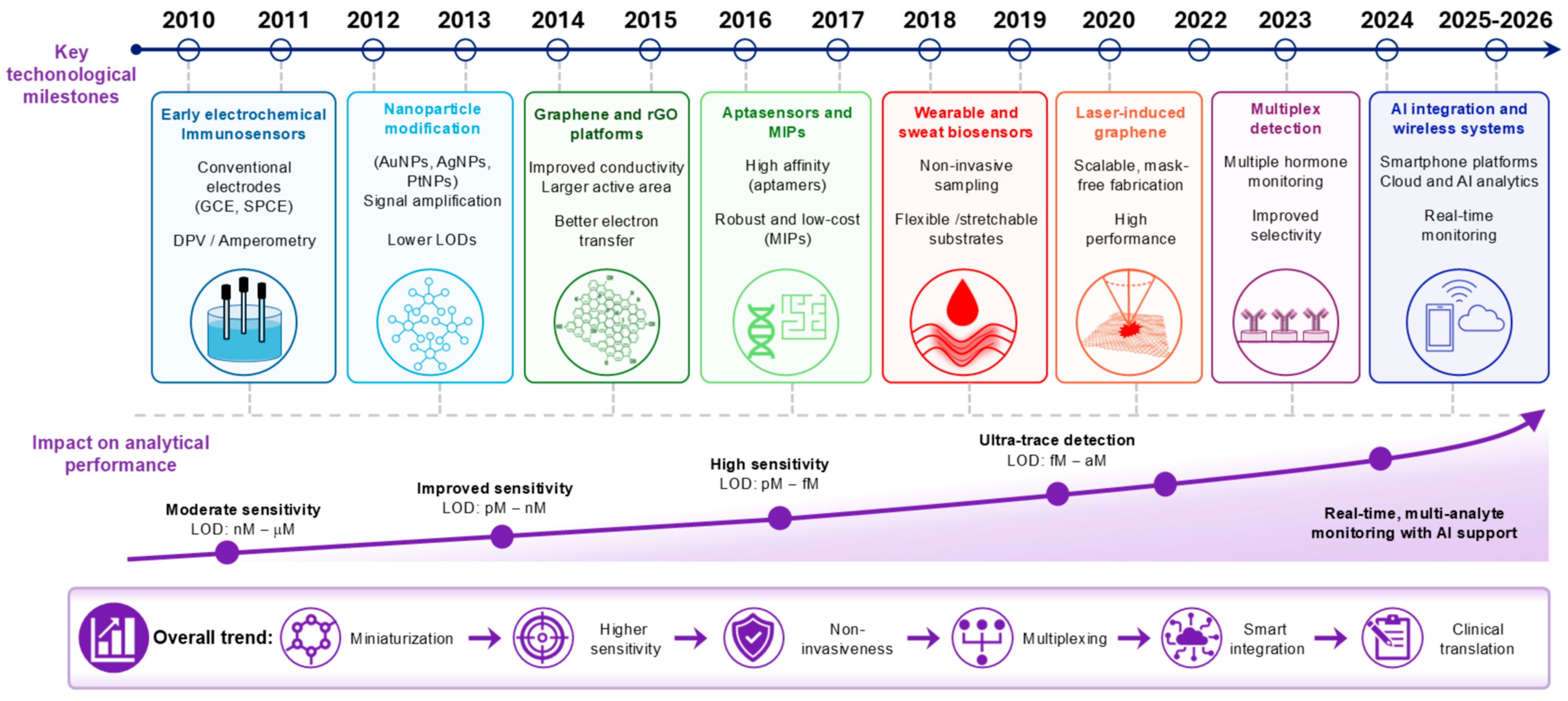
Since 2010, several electrochemical biosensors designed for laboratory hormonal analysis have been proposed for clinical applications. The sensitivity, ease of operation, simplicity, and portability of biosensors make them valuable devices for hormone detection, offering advantages over traditional methods such as ELISA, HPLC, and CG-MS. In this study, we focused on the use of electrochemical biosensors to detect the levels of CORT, E1, E2, E3, P4, TSH, T3, T4, PTH, PRL, and INS. These hormones play specific roles in the human body and are crucial for its proper functioning. The balance and appropriate regulation of these hormones are essential for maintaining health and ensuring the proper functioning of various physiological systems and processes. Figure 1 summarizes some of the major technological milestones in the development of electrochemical hormone biosensors since 2010.

3.1. Cortisol

Cortisol is a glucocorticoid steroid hormone produced in the zona fasciculata of the adrenal cortex. The hypothalamic–pituitary–adrenal (HPA) axis controls the release of glucocorticoids. Corticotropin-releasing hormone (CRH) from the hypothalamus causes the anterior pituitary to release adrenocorticotropic hormone (ACTH), which then causes the adrenal glands to produce and release CORT [49,52]. Cortisol is a key player in controlling metabolism because it affects the breakdown and utilization of carbohydrates, lipids, and proteins. It also helps produce Glc and maintain stable blood sugar levels when the body is under stress [56,57]. It also affects immune and inflammatory responses, helps maintain stable blood pressure and vascular tone, and is necessary for dealing with physical and mental stress [52,54,57].
Cortisol secretion disorders can cause serious endocrine system problems. Chronic hypercortisolism is linked to Cushing’s syndrome, whereas inadequate cortisol production can lead to adrenal insufficiency, including primary adrenal insufficiency (Addison’s disease) [48,57].
CORT is released in a circadian rhythm, with the highest levels usually observed in the early morning and the lowest levels observed at night. CORT levels may fluctuate due to stress, physical exertion, and physiological states [49,50]. CORT has gained significance as a biomarker in medical diagnostics due to its clinical relevance [52,55], prompting extensive research into the development of electrochemical biosensors for its detection, as outlined in Table S1.
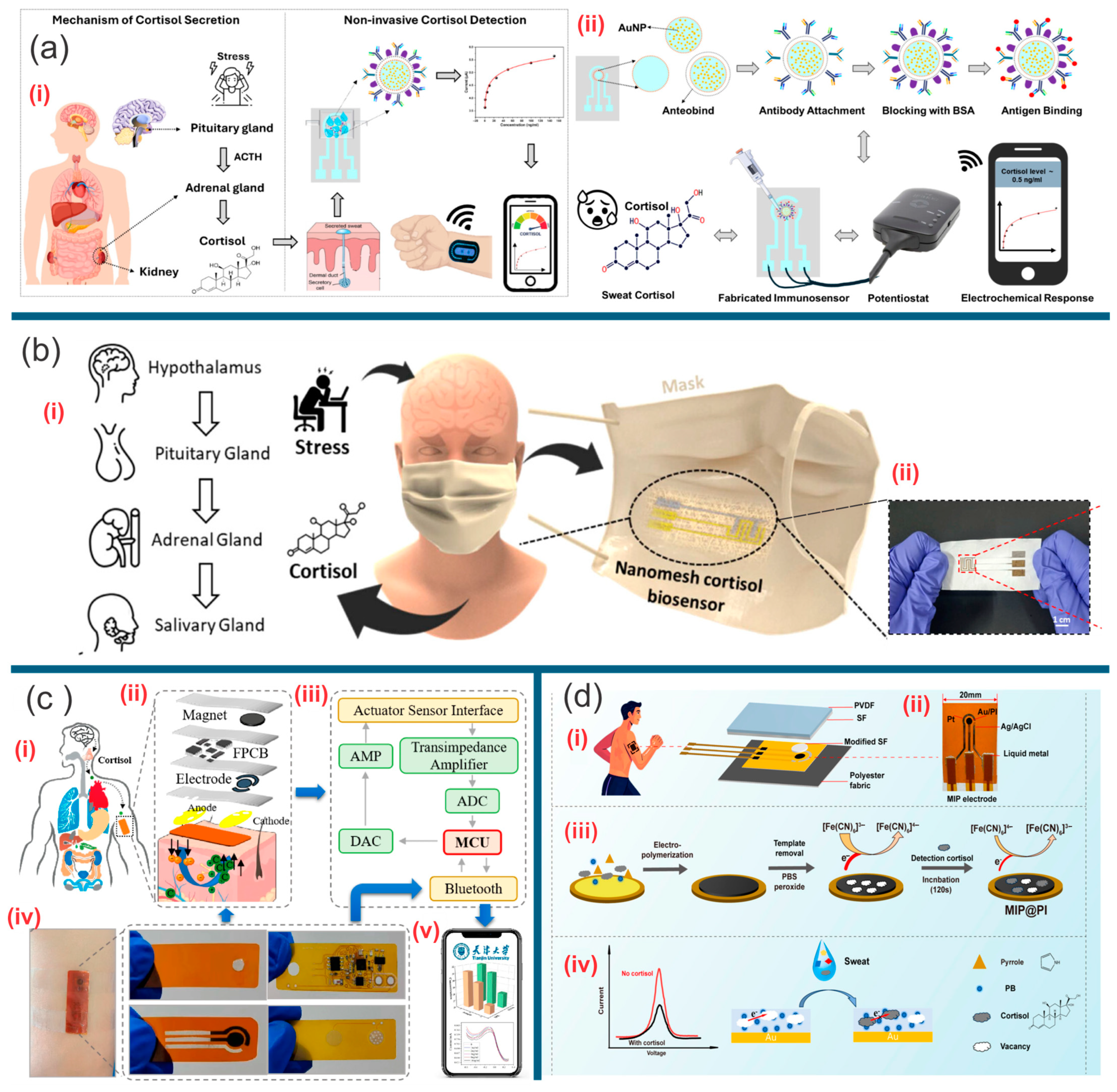
Among all the hormones in this review, CORT has had the largest number of published papers since 2010, mainly since 2017, when a significant increase in research on the subject was observed. One of the factors that may have contributed to this increase is the possibility of using non-invasive systems for quantification, especially through urine, saliva, and sweat, which has allowed researchers to develop wearable prototypes as patches on flexible and adjustable platforms on the skin (Figure 2). Interesting and innovative systems were also applied in the study by Cho et al. [133], who developed a face mask immunosensor to determine CORT levels in saliva (Figure 2b). This nanomesh-based system was built using an interdigitated Au electrode deposited using a shadow mask via thermal evaporation, followed by the immobilization of CORT monoclonal antibodies. The saliva was spread using an air-pressure regulator to simulate a mild cough. Although these systems still need to be connected to an electrochemical device, a wireless transmission module is being studied.
China and the USA have contributed a higher number of papers on this topic. In addition, some research groups have been dedicated to developing specific biosensors for this hormone. Therefore, it is interesting to highlight the work of Prasad and Bhansali. Bansali and coworkers have been working for more than a decade on biosensor development for CORT detection, with further papers found in this review (beginning in 2010). A common ground in most studies is the biomolecule (mostly antibodies) immobilization strategy on the working electrodes. Typically, this group uses a covalent bond formed through dithiobis(succinimidyl propionate) (DTSP). It is an interesting structure with a disulfide bridge, subject to forming self-assembled monolayers (SAMs) on Au electrode surfaces. Simultaneously, it presents a succinimide ring at the two extremes, which is excellent for forming covalent bonds through a nucleophilic acyl substitution reaction with antibody amino groups.
Prasad et al. have been working in the last few years, mainly with impedimetric immunosensors, through the immobilization of specific anti-CORT antibodies on electrodes using covalent bonds for label-free detection via impedance profile changes. It is worth noting how novel technologies drive the diversity of studies seeking better results and trustworthy systems, as happened with the advent of nanotechnology, the consolidation of aptamers, MIPs, and more recently, with the popularization and advancement of AI. The Prasad research group has been applying acquired knowledge over the years to functional skin sensor-based devices using AI through machine learning, allowing the computation of multiple sampling data and the identification of patterns, thereby making it possible to analyze the results with greater precision. Research groups have achieved significant results and developed functional and applicable real-time prototypes for CORT detection in sweat samples [134] individually or for analyzing CORT alongside Glc [135].
Figure 2. (a) (i) Illustration of an electrochemical immunosensor for non-invasive CORT detection via sweat. The sensor captures CORT secreted from the skin, generates an electrochemical signal, and wirelessly transmits real-time data to a smartphone for monitoring stress levels. (ii) Stepwise process illustration of immunosensor fabrication and sensing mechanism for CORT detection. Reproduced from [136] with permission from ACS Publishing. (b) (i) Overall schematic of the nanomesh CORT biosensor in the bioelectronic face mask. CORT levels are controlled by the hypothalamus–pituitary–adrenal axis and (ii) Bioelectrodes on the flexible nanomesh. Reproduced from [133] with permission from ACS Publishing. (c) The non-invasive, wearable CORT sensing system. (i) The secretion process of CORT in the human body when exposed to external stimuli; (ii) An explosion diagram of the sensing system; (iii) The working principle of the sensing system; (iv) An actual picture of the sensor and detection equipment, and (v) A schematic diagram of the mobile terminal detection interface. Reproduced from [137] with permission from MDPI Publishing. (d) MIP@PI device, molecular imprinting electrode preparation process, and schematic of specific recognition detection of CORT in sweat. (i) Schematic diagram of the wearable sensor tested on the skin surface and the structural schematic diagram of the device split, (ii) Physical diagram of the MIP electrode, (iii) Flowchart of the MIP electrode preparation process, and (iv) Schematic diagram of the sensor’s specific recognition of CORT in sweat (The illustration shows the substances represented by each symbol). Reproduced from [138] with permission from MDPI Publishing.
Chemosensors 14 00132 g002
Electrode modification using new platforms for biomolecule immobilization, such as MXenes, has also been explored. Since the development of Ti3AlC2 by Naguib et al. (2011) [139], similar systems have been applied for biosensor development, such as CORT [140,141,142,143]. Biomolecule immobilization can be performed using four basic methods: adsorption, covalent bonding, crosslinking, and entrapment. Suyoung Lee et al. [144] entrapped an anti-CORT antibody in a poly(ethylene glycol) diacrylate hydrogel to determine CORT levels in unpretreated human saliva through impedance analysis. Despite this study, covalent bonds remain the priority choice for biosensor development.
Two studies stand out from the usual aptamer, antibody, or MIP choices by choosing the immobilization of CORT on the electrode surface. Haseik Yang et al. [145] immobilized a commercial BSA-CORT sample on ITO electrodes. Diaphragorase (DI), a Bacillus stearothermophilus-modified anti-CORT antibody, was added to the system. The biosensor operates through a washing-free displacement immunosensor, which competes for antibody active sites between CORT bonded to the electrode and CORT in the sample in solution. The higher the CORT level in the solution, the more the antibody was displaced from the biosensor, leaving a freer active electrode area for the action of the osmium-based intermediate. Fangdi Hu et al. [146] immobilized CORT through adsorption on a glassy carbon electrode (GCE) previously modified with Nafion, magnetically functionalized reduced graphene oxide (mrGO), and gold nanoparticles (AuNPs). Similar to previous studies, CORT detection was performed using a competitive assay. A mixture of CORT from each sample was prepared using biotin-tagged anti-CORT antibody. The lower the CORT level in the sample, the greater the interaction between the antibodies and CORT over the electrode. Therefore, fewer antibodies were removed in subsequent steps. The biosensor was then immersed in a streptavidin-horseradish peroxidase (HRP) solution. After washing, the system, which relied on the strong interaction between antibody-biotin/streptavidin-HRP, was immersed in a hydrogen peroxide and o-diphenylamine solution. The enzymatic products were detected using DPV. Both systems were functional and generated viable nontraditional analyte immobilization systems.
Multiple biomolecular systems are commonly used for this purpose. Zhenzhong Guo et al. [147] built an ultrasensitive aptamer-antibody sandwich biosensor for CORT detection based on the specificity of the antibody and aptamer present toward the hormone. The electrode was covalently modified with aptamers. CORT samples were prepared using AuNP-tagged anti-CORT antibodies. Thus, an AuNP-antibody/CORT/aptamer/electrode sandwich was formed after the incubation. DPV was used for CORT detection based on the current differences in a ferricyanide/ferrocyanide solution. Bingqian Liu [148] inverted this system. The researchers immobilized the antibody on the electrode, and CORT interacted with the GOx-AuNP–aptamer conjugate in solution. After the formation of the sandwich upon contact of the electrode with the solution, Glc and 4-chloro-1-naftol were added, resulting in the precipitation of 4-chlorohexadienone. Precipitation in the presence of CORT results in simultaneous alterations in the electrode resistance and photocurrent quenching, enabling the determination of the hormone using two different techniques.
Several high-quality researchers have used acquired knowledge, new technologies, and different assembly strategies to meet the growing demand for simultaneous and multiplex detection, as performed in a previous study. Liu et al. presented a low limit of detection on a pg/mL scale, a wide linear range, excellent recovery rates, and dual-mode biosensor development, allowing the detection of a single molecule both photo-and electrochemically.
Similarly, Errachid et al. [149] developed a biosensor to detect CORT and N-terminal Natriuretic Peptide (NT-proBNP) as biomarkers of heart failure in saliva. Two Au electrodes were modified with anti-CORT antibodies, and the other two were modified with anti-NT-proBNP antibodies. Weihao Lu [150] developed an MIP over SPCE for the simultaneous detection of epinephrine, lactate, and CORT, which are biomarkers of stress levels. Polyaniline-co-3-aminophenylboronic acid/AuNPs were used for the MIP construction of lactate and epinephrine, and poly(glycicyl methacrylate-co-ethylene glycol dimethacrylate) was used for CORT. Kan Wang [151] developed a paper-based wearable biosensor for Glc, lactate, uric acid, CORT, and magnesium ions in sweat samples through a 3D origami structure. GOx, lactate oxidase, and uricase were used to generate hydrogen peroxide from their respective substrates. In the presence of peroxide, the HRP enzyme in solution catalyzes the reduction of TMB, generating a colorimetric response that can be quantified. A pH indicator using litmus and bromophenol blue in the presence of a chromium black T indicator was used to detect magnesium ions by color change. Finally, a pyrrole, FeCl3, and K3[Fe(CN)6] MIP was constructed for the electrochemical detection of CORT based on the voltammetric profile changes in Prussian blue films. The authors built a simple system for multiple-target detection in sweat samples using an efficient wearable device through multiple techniques, indicating the potential and importance of multiple and simultaneous detection.
CORT biosensors represent one of the most advanced classes of electrochemical hormone biosensors, mainly because of the growing interest in wearable and noninvasive monitoring systems. Significant progress has been achieved in terms of sensitivity, flexible substrates, and real-time analysis of sweat and saliva samples. However, important challenges remain, such as long-term operational stability and large-scale clinical validation.

3.2. Estrogens

Estrogens are steroid hormones primarily produced in the ovaries by granulosa cells. These cells convert androgen precursors into estrogen. The placenta is a major site of estrogen production during pregnancy. Peripheral tissues, such as fat tissue, also produce estrogen by converting androgens that are already present in the body [64]. E1, E2, and E3 are the most important naturally occurring estrogens in humans. 17β-estradiol is the most biologically active form and is the main estrogen produced during the reproductive years [60,67,152]. In contrast, estrone becomes more important after menopause. Estriol, which does not have much estrogenic activity, is produced in large amounts during pregnancy and is often found in the urine of pregnant women [67,152].
Estrogens are important for the functioning of the female reproductive system. They manage endometrial growth during the menstrual cycle and are involved in feedback systems that control the release of gonadotropins in the hypothalamic–pituitary–gonadal axis. Estrogens are also important for the growth and maintenance of secondary sexual traits, the maintenance of bone density, and the regulation of cardiovascular and metabolic functions. Changes in estrogen levels are linked to a number of health problems, such as infertility, hypogonadism, osteoporosis, and cancers that depend on estrogen, such as breast and endometrial carcinomas [152,153].
Estrogens are not only important for the body but are also thought to be environmental pollutants that people should be concerned about. Natural estrogens, such as estriol, can enter water after urination or defecation by humans and animals. Once in water, they can act as endocrine-disrupting chemicals. Their presence in aquatic ecosystems has been linked to endocrine disruption in aquatic organisms, notably the feminization of male fish, as documented in several ecological studies [154].
Different methods have been developed to analyze samples from the environment and living organisms to detect and quantify estrogens. Consequently, there is growing interest in different types of analytical platforms that can quickly and accurately detect analytes. In this context, electrochemical biosensors have emerged as promising instruments for estrogen monitoring [152], with representative examples of these sensing platforms summarized in Table S2.
The hormone 17β-estradiol is the target in most studies, probably because it is an endocrine-disrupting chemical (EDC) that can cause immune deficiency and cancer risk even at very low levels [155]. Other estrogens, such as estradiol [156,157,158], estriol [159], estrone [160], and estrogen receptor α (ER) [161], were also determined using electrochemical biosensors. The last example is a biomarker for breast cancer that was detected through an interesting immunoassay with magnetic nanoparticles (MN) in a multiple-electrode system as a microfluidic array device (µFED). While a screen-printed carbon electrode was modified with AuNP/glutathione/DNA, MNs were modified with specific antibodies and HRP enzymes. The biomarker was responsible for assembling the sandwich between the antibody in the solution and the DNA on the electrode. Thus, the presence of biomarkers was detected via the electrochemical reduction of the HRP catalytic product.
The µFED consists of eight independent electrodes and is an excellent example of a multiplex-based biosensor. Similarly, Xu et al. [162] developed a biosensor based on a recombinant human ER for 17β-estradiol, 4-nonylphenol (NP), and bisphenol A (BPA) detection. Thierry Noguer et al. [163] detected 17β-estradiol and ethinylestradiol using a competitive system with specific antibodies for each hormone through colorimetric and electrochemical assays. Jiu-Ju Feng et al. [164] also developed a dual-mode biosensor by detecting 17β-estradiol using photoelectrochemical and fluorescence techniques, and Yide Xia et al. [165] by using fluorescence photometry and differential pulse anodic stripping voltammetry (DPASV).
Qin Wei et al. [166] presented a system capable of multiple detection. First, estradiol and diethylstilbestrol were adsorbed onto the GCE/graphene sheet surface via π–π stacking. The magnetic nanoparticles were modified in solution with Pb2+ (Fe3O4-NH2-Pb2+) and Cd2+ (Fe3O4-NH2-Cd2+). The anti-estradiol antibody (AEA) was covalently bound to the plumb-modified nanoparticles (AEA-Fe3O4-NH2-Pb2+), and the anti-diethylstilbestrol antibody (ADA) was covalently bound to the Cd-modified nanoparticles (ADA-Fe3O4-NH2-Cd2+) through cross-linking with glutaraldehyde. Thus, both metals were immobilized on the electrode surface through analyte interactions. The metals were subsequently reduced in a solution containing Hg2+, forming a thin amalgam film at a negative potential during preconcentration. An anodic sweep was then applied to re-oxidize the metals during the stripping step.
Most biosensors have been developed for CORT determination using aptamers, antibodies, MIPs, or both, as shown by the work of Yang et al. [167], who developed a hybrid biosensor by integrating a 17β-estradiol aptamer with an MIP. However, there are many enzymatic examples of estradiol, particularly in the case of laccase. Pingarrón et al. and He et al. developed systems in which laccase was immobilized through crosslinking over a GCE modified with GO/Sb2O5 [159], rGO/rhodium nanoparticles [168], and poly(L-lysine)/citric acid@graphene [169]. The electrodes were immersed in a 17β-estradiol solution containing thionine mediators. In aerobic environments, the reduced form of thionine (Thred) is catalytically oxidized (Thox) by enzymes. ThOX mediates 17β-estradiol oxidation and returns to Thred. The electrochemical response originates from the oxidation of the reduced species.
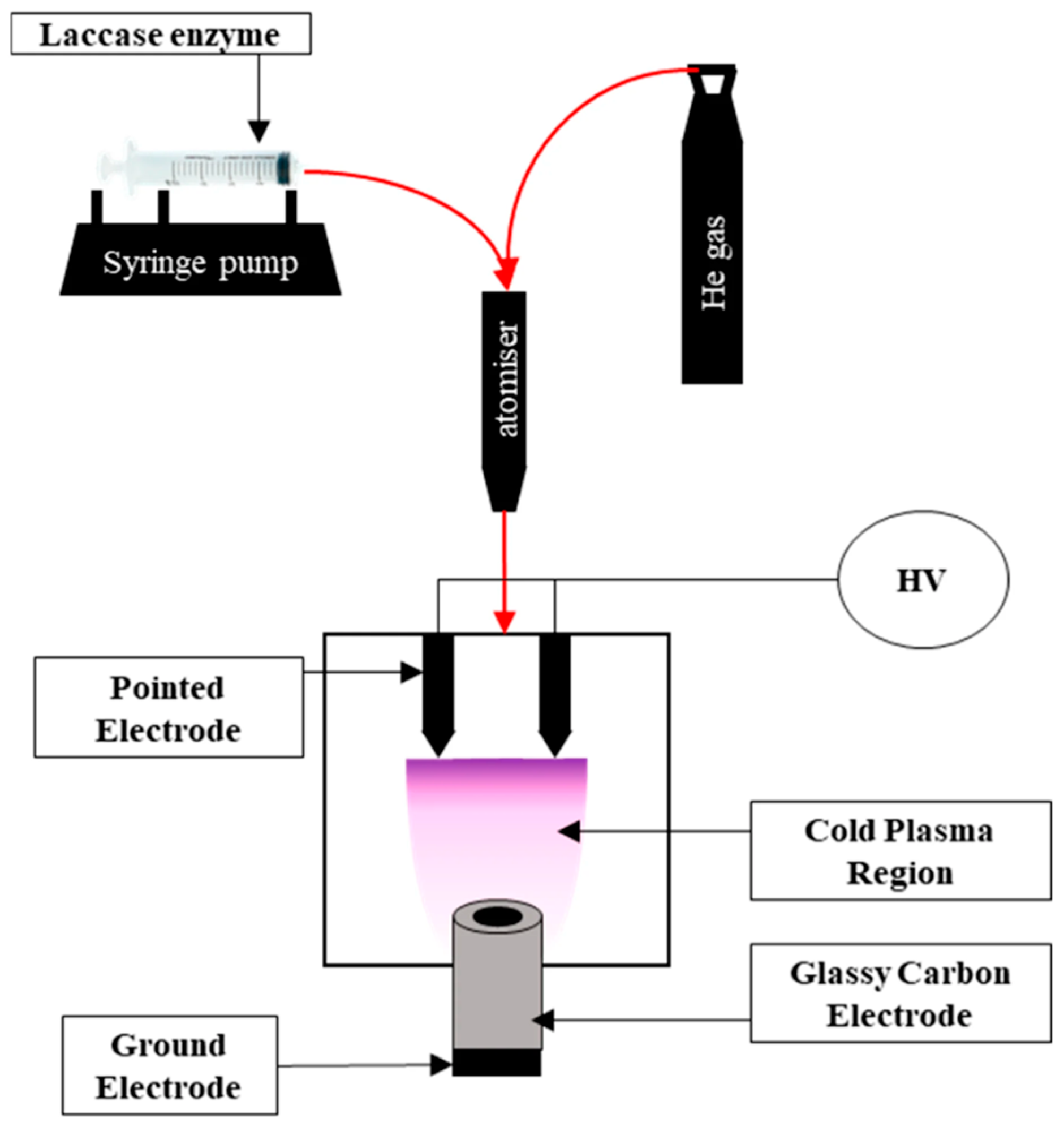
Another interesting approach using laccase is the study of Wardak et al. [170]. They used a new soft plasma polymerization (SPP) technique to immobilize the laccase enzyme over GCE. According to the authors, low-energy cold plasma corona discharges allow a combination of factors that enable the efficient immobilization of the enzyme with preserved catalytic activity (Figure 3). The best estradiol detection was obtained with the electrode modified with carbon nanofibers alongside carbon nanotubes, with an LOD of 0.026 µM, with good reproducibility and stability (RSD of 4.8% for four different biosensors over time and RSD of 7.73% using the same system after 21 days), no significant interference from other chemical species, and an excellent recovery rate using pharmacological and river water samples.
Two studies have used yeast to develop an estrogen biosensor. Gotthard Kunze et al. [171] developed a semi-online monitor called EstraMonitor based on Arxula adeninivorans yeast cells. These cells have two major functions: co-expressing a gene for the human ER to interact with estrogens and co-expressing a reporter gene that, in the presence of the same estrogens, induces the secretion of phytase enzymes into the sample. This enzyme catalyzes the conversion of 3-nitrophenylphosphate to 4-nitrophenol, which is reduced using a Pt-Ag/AgCl/Pt electrode. In the first study, the authors focused on 17β-estradiol. Later [172], the authors applied EstraMonitor to wastewater samples to detect 17β-Estradiol, 17α-Ethinylestradiol, estrone, estriol, 17α-Estradiol, and bisphenol A. EstraMonitor is an excellent example of a ready-to-use automated biosystem for determining estrogen, unlike many proof-of-concept examples without further endeavors for commercial availability.
SWV, DPV, EIS, CA, and CV are commonly used electrochemical techniques for developing electrochemical biosensors. However, many studies have employed photoelectrochemical (PEC) methods for estradiol detection [164,173,174,175]. Regardless of the methodology used, hormone detection was performed using ascorbic acid (AA) in solution. According to the authors, AA behaves as a sacrificial electron donor and an efficient hole-trapping agent that further amplifies the photocurrent and maintains its stability. Wei et al. adopted a different approach [176]. They developed a self-powered aptasensor using PEC and a three-electrode system. An ITO/FeOOH/In2S3 photoanode was used as the counter electrode, an ITO/CuInS2/aptamer photocathode as the working electrode, and Ag/AgCl as the reference electrode. The presence of estrogen decreased the photocurrent under intermittent light due to steric hindrance. The authors confirmed that the biosensor could operate without an additional electron acceptor or external potential, which is an example of a state-of-the-art self-powered system, in line with the technological advancements required for biosensing. Works such as these and other innovative ideas, such as estradiol detection in the gaseous phase due to the inhalation risks of an EDC in the air [177] or the use of a DNA-Y junction for ER detection, demonstrate the researchers’ capability to effectively meet the urgent demands in health areas.
Electrochemical biosensors for estrogen detection have demonstrated remarkable responses, particularly through the incorporation of nanostructured materials, aptamer-based systems, and molecularly imprinted polymers. However, selective detection remains challenging because of the structural similarities among estrogenic compounds.

3.3. Progesterone

P4 is a 21-carbon steroid hormone primarily produced by the corpus luteum in the ovary, after ovulation. The placenta is the primary source of P4 production during gestation. The adrenal glands also produce small amounts of it. P4 is an important hormone that is involved in female reproductive health. It helps control the menstrual cycle and initiates and maintains pregnancies. It facilitates the secretory transformation of the endometrium, preparing the uterus for embryo implantation and aiding in the preservation of uterine quiescence during early gestation. Moreover, P4 is involved in the feedback regulation of the hypothalamic–pituitary–gonadal axis [178].
Abnormal P4 levels can cause reproductive problems such as luteal phase deficiency, infertility, irregular periods, and pregnancy loss. In clinical practice, measuring P4 levels in the serum or plasma is a common method for assessing female reproductive health. Higher P4 levels after ovulation are a sign of the luteal phase and confirm ovulation. P4 is also commonly used in drugs to help with irregular periods, as part of hormonal birth control, and hormone replacement therapy during menopause [69].
After metabolism, P4 and its metabolites may be excreted and enter the environment. Consequently, the surveillance of P4 levels in both clinical and environmental specimens has garnered increasing interest [69]. Table S3 presents examples of electrochemical biosensors proposed for P4 detection using various types of electrodes and methods.
Although most studies have dealt with antibodies and aptamers, it is worth noting that, as observed for CORT and estrogen biosensors, many researchers have used enzymes, particularly HRP, as a tag. In such cases, hydrogen peroxide and hydroquinone are typically used to generate benzoquinone (BQ), which can be electrochemically reduced on the electrode surface. Four studies on P4 relied on the electrochemistry of BQ [179,180,181,182]. Another interesting approach involves the use of electrochemiluminescence (ECL) for biosensing. Qin Wei et al. [183] used an aptamer-modified supramolecular structure, cucurbit [7] uril, anchored to a copper nanocluster stabilized by 4,4′-thiobisbenzenethiol and ethylenediamine (aptamer-CET-Cu NC). The monomer 3-aminobenzeneboronic acid was electropolymerized on the GCE surface, followed by antibody immobilization. The polymer was chosen because of the possible interaction between the glycan chains of the antibody Fc fragment and the boronic acid groups from the polymer, forming stable pentagonal ring structures that orient the biomolecule toward the bulk solution. The system works by adding P4 samples to the electrode surface, followed by a sandwiching with aptamer-CET-Cu NCs. Therefore, the CET-Cu NCs were immobilized in the presence of the analyte, resulting in an ECL signal.
Jiu-Ju Feng et al. [184] used molecular biology knowledge to develop a biosensor using an enzyme-assisted cycling amplification strategy with exonuclease III (Exo. III). In the presence of P4, the aptamer of hairpin DNA 1 (HP-1) interacted with and changed its configuration. The addition of aptamer hairpin DNA 2 (HP-2) partially hybridized HP-1 and HP2. Exo. III promotes enzyme-assisted cycling amplification by releasing DNA into the medium. This DNA was formed only in the presence of P4. Therefore, hybridization occurred when the cDNA was immobilized on the modified GCE. An ECL signal was generated upon hybridization using ruthenium intercalators.
Among the hormones in this review, this section focuses on the most innovative systems developed for P4 determination using different electrode configurations, modifications, biomolecule types, and detection methods. Fernández et al. [179] used a controlled-pore glass rotating disk to develop a microfluidic biosensor for detecting P4. Regarding different electrodes, Zhuang Xie et al. [185] innovated by using a 3D micropyramidal electrode to develop a biosensor. This arrangement tends to increase the electrochemically active surface area compared to that of a typical flat electrode [186]. Xie observed an improved LoD of three orders of magnitude, reaching one of the lowest values presented in this review in the attomolar range. Jingdong Zhang et al. [187], Hedieh Asadi Samie and Majid Arvand [188], and Manoj K. Nayak et al. [189] used carbon dots or graphene quantum dots to aid biomolecule immobilization on carbon-based electrodes. Mark Grinstaff et al. [190] used the knowledge acquired in a previous study from the group through a microbial microverse for a bacterial allosteric transcription factor (aTF), SRTF1, responsive to P4, a different biomolecule in addition to the usual aptamers and antibodies. Jiameng Liu et al. [191] developed a zinc-air battery-driven self-powered aptasensor made of cobalt and zinc zeolitic imidazolate framework (ZIFs) and V2CTx MXene to determine P4 in raw milk using voltage-current curves and EIS.
P4 is the primary target of most studies. However, other hormones, especially those involved in multiple detection, were also evaluated. Pingarrón et al. developed an immunosystem for the simultaneous detection of P4 receptors (PR) and ER. The authors [192] modified magnetic microbeads (MB) with anti-PR antibodies. Next, PR from the samples was incubated with biotin-tagged anti-PR antibodies. Subsequently, streptavidin-tagged HRP was added to the solution. The strong affinity of biotin-streptavidin binding to antibodies against HRP. Therefore, the HRP was not washed away in the presence of the analyte. The same procedure was applied to the ER using an anti-ER antibody. Solutions containing (or not) HRP were magnetically attracted to a screen-printed dual carbon electrode (SPdCE) for simultaneous chronoamperometric analysis. In another study [182], the authors improved this system. A sandwich-type assay was performed using luteinizing hormone (LH) between a biotin-tagged capture antibody and an HRP-tagged detection antibody. The biotin section of this conjugate was bonded to the neutravidin-modified MB in solution. For P4, the protein-G-MB was modified with an anti-P4 antibody. The active sites of the antibodies competed between P4 and P4-tagged HRP. Therefore, in the presence of hormones, both solutions, with HRP from the LH assay and with less HRP from the P4 assay, were immersed in SPdCE for amperometric analysis.
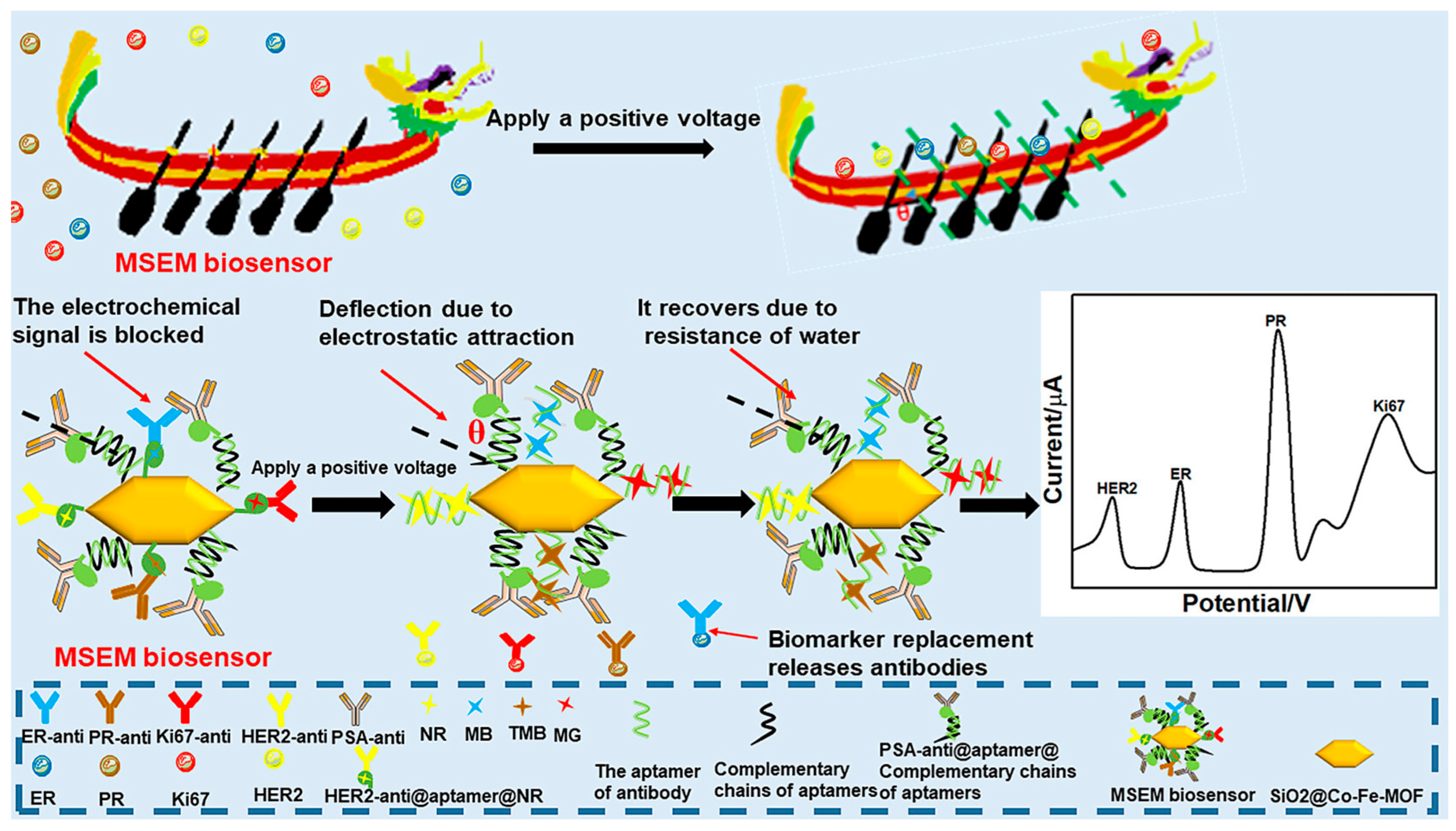
Moreover, Huo et al. [193] took the next step in the development of biosensors for the simultaneous detection of multiple biomarkers (Figure 4). The authors used a metal–organic framework (MOF) modified with a sequence of aptamers developed to interact with biomarker antibodies in an intricate manner. When the biosensor was assembled, the presence of antibodies hampered the electrochemical signal of active cationic organic molecules (methylene blue (MeB), neutral red (NR), 3,3′,5,5′-tetramethylbenzidine (TMB), and malachite green (MG)) modified at the 5′ end of an aptamer, called the antibody aptamer chain of the charged chemical signal. The four specific antibodies were displaced from the biosensor upon contact with the four breast cancer biomarkers (ER, PR, human epidermal growth factor receptor-2 (Her-2), and the cell proliferation biomarker (Ki67)) in solution, allowing the electrochemical oxidation of cationic organic molecules (NR at −0.6 V for Her2, MeB at −0.25 V for ER, TMB at +0.3 V for PR, and MG at +0.8 V for Ki67) using DPV. This work presents a state-of-the-art biosystem that uses chemistry/biochemistry knowledge to simultaneously detect all four well-established breast cancer biomarkers, which is important for research on health for one of the deadliest diseases in the world and an interesting direct application of electrochemical devices.
Although significant improvements in analytical sensitivity have been reported for P4 biosensors, many systems remain limited to proof-of-concept. Future developments should focus on improving operational stability, miniaturization, and applicability in routine point-of-care reproductive diagnostics.

3.4. Thyroid-Stimulating Hormone, Parathyroid Hormone, Thyroxine and Triiodothyronine

TSH is a glycoprotein hormone secreted by thyrotrophs in the anterior pituitary. Thyrotropin-releasing hormone (TRH) from the hypothalamus and negative feedback from thyroid hormones in the blood control their release. TSH is important for controlling thyroid gland functions. It does this by encouraging the thyroid follicular cells to grow and work, as well as encouraging the uptake of iodine and the production and release of thyroid hormones T3 and T4. Owing to its regulatory function, TSH is extensively used as a principal biochemical marker for the diagnosis of thyroid disorders. High TSH levels are usually linked to primary hypothyroidism, whereas low TSH levels are often observed in hyperthyroidism or when excessive thyroid hormone replacement therapy is administered [15,76].
The follicular cells of the thyroid gland produce T3 and T4, which are iodinated amino acid derivatives. The thyroid gland produces most of the T4 hormone, which is a prohormone that is converted to the active T3 hormone in the liver and kidneys. Thyroid hormones are important for controlling the basal metabolic rate and affect many body functions, such as thermogenesis, heart function, lipid and carbohydrate metabolism, normal growth, and brain development. Hyperthyroidism occurs when the thyroid produces excessive hormones, whereas hypothyroidism occurs when it does not produce enough hormones. These conditions are often linked to diseases such as Graves’ disease, Hashimoto thyroiditis, and iodine deficiency [15,75,77].
PTH is a polypeptide hormone released by the parathyroid glands. It is important to maintain stable calcium and phosphate levels in the body. PTH is released when calcium levels in the blood decrease. PTH works to bring calcium levels back to normal by performing a number of things, such as stimulating bone resorption, increasing the amount of calcium that the kidneys reabsorb, decreasing the amount of phosphate that the kidneys reabsorb, and indirectly increasing the amount of calcium that the intestines absorb by activating vitamin D (calcitriol). If PTH secretion does not function properly, it can cause problems such as primary hyperparathyroidism, which is when calcium levels are too high and bones lose minerals, or hypoparathyroidism, which is when calcium levels are too low and the nervous system is too active [87,88,90,92,194].
TSH, T3, T4, and PTH are important biomarkers in clinical diagnostics because they play a central role in regulating metabolism and maintaining mineral balance. Precise quantification of these hormones is crucial for the diagnosis and surveillance of endocrine disorders, such as thyroid dysfunction, parathyroid diseases, and metabolic bone disorders. In this context, electrochemical biosensors have been increasingly studied as promising analytical instruments for the sensitive and rapid detection of hormones [75,194]. Table S4 lists examples of electrochemical biosensors developed for the detection of TSH, PTH, T3 and T4.
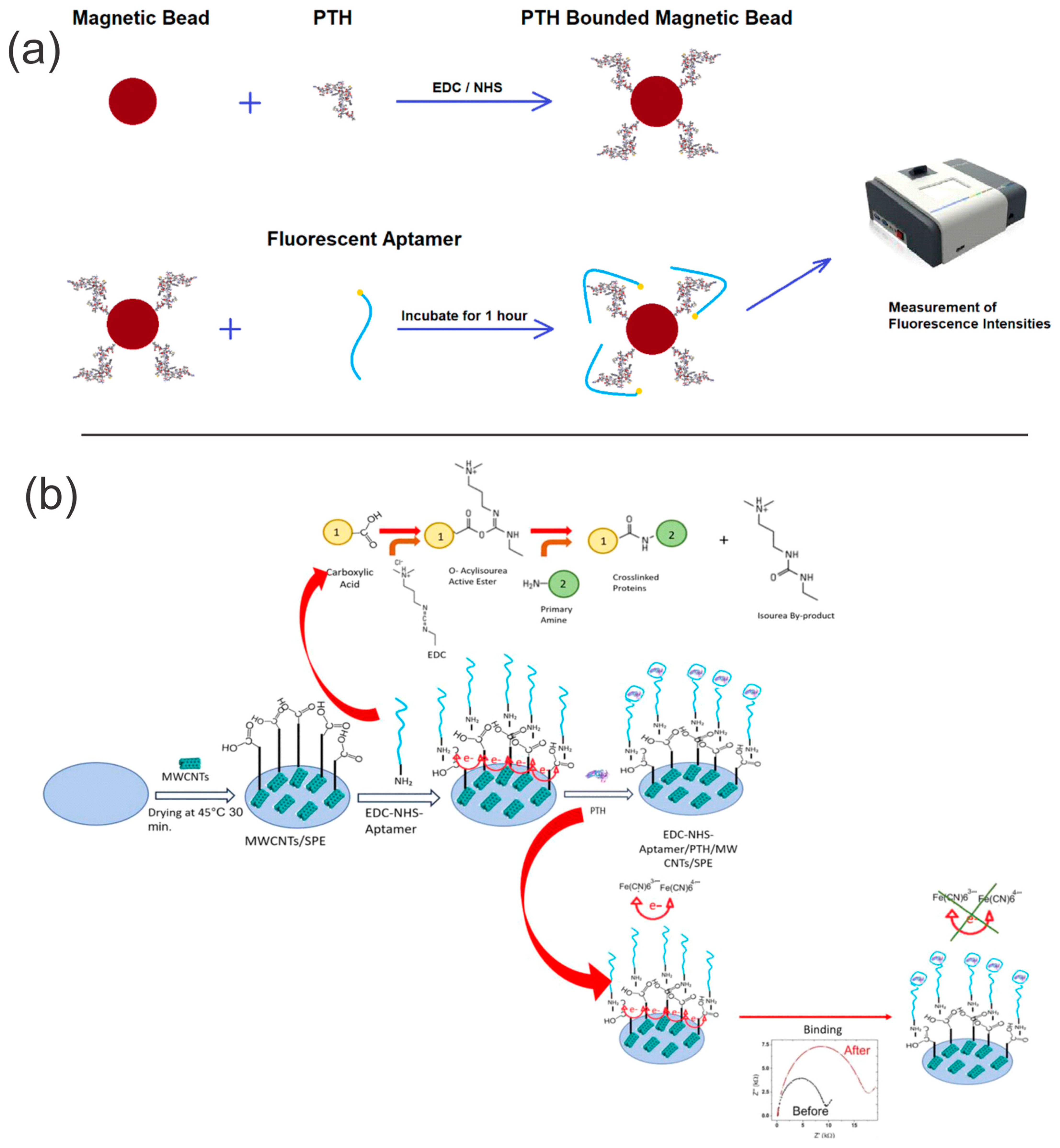
Contrary to the other studies discussed so far, all the studies presented for these hormones used only specific antibodies. No other biomolecules were observed, but the groundbreaking work of Reza Didarian et al. [195]. The authors developed a PTH aptamer based on the SELEX methodology using a novel magnetic bead-based selection process. Briefly, three distinct PTH peptide fragments were covalently bonded through EDC/NHS chemistry to carboxylated magnetic nanobeads. After the SELEX procedure with a DNA library, the magnetic nanobeads were separated using a magnet, and the aptamer was separated from the peptide to be amplified through PCR. After 12 cycles, the aptamer candidates were fluorescently labeled, and the sequence with the lowest Kd value, based on the fluorescence intensities obtained, was chosen for further biosensor development (Figure 5). This was the first time that this methodology was used, and the biosensor presented a very low LOD, remarkable selectivity, and excellent response to serum samples.
Another interesting study used MIP along with antibodies to simultaneously determine TSH and T4 levels [196]. A signaling Janus nanoparticle probe was assembled as an MIP with CdO targeting T4, and ZnO was used for TSH. In another vessel, a capture probe was assembled using magnetic nanoparticles, anti-T4, and anti-TSH antibodies. The analytes interact with both MIPs and antibodies. A sandwich structure was formed upon contact with the solution. The supernatant was separated from the conjugate using a magnetic stirrer. The metals react with the nitric acid solution to form active cations. Therefore, the electrochemical response was measured in a manner similar to that of estrogen by the detection of both metals through constant-current potentiometric stripping analysis (cc-PSA), proving the versatility of the system with the capability to detect multiple analytes in a single measurement [197].
Potentiometric systems are uncommon because most analyses rely on changes in current, charge, capacitance, or resistance. However, Zheng et al. [198] developed an interesting potentiometric biosensor for TSH aided by liposomes, demonstrating the authors’ thorough knowledge of the electrochemical possibilities involving the system. For the electrode assembly, an anti-TSH antibody (mAb1) was covalently bonded to the GCE surface. TSH samples containing biotin-tagged antibodies (pAb2) were added dropwise over the electrode sample, followed by streptavidin interactions. In a separate procedure, HRP enzymes were encapsulated into biotinylated liposomes made of hydrogenated soybean phospholipids, cholesterol, and 1,2-distearoyl-sn-glycero-3-phosphor ethanolamine-N-biotinyl[poly(ethylene glycol)]-2000, using a reverse-phase evaporation method. The biotinylated liposomes interacted with the streptavidin-coated electrode in a sandwich-like system owing to the presence of TSH. Triton-X was added to lyse the liposomes and release the HRP into the medium. 4-chloro-1-naphthol was chosen as the substrate and was catalyzed into benzo-4-chlorohexadienone, which is insoluble under these conditions. The precipitate is an uncharged organic compound with weak conductivity, which decreases the membrane potential when coated on the biosensor. Therefore, potentiometric analysis was performed to evaluate the potential changes upon precipitate formation.
Several research groups have developed biosensors for these hormones. Dong et al. have developed biosensors for TSH using different configurations of interdigitated microelectrodes (IDμE) with gold nanodots [199], gold films [200,201], and Cr/Au quasi-triangle nanodisks [202]. These systems rely on the interaction between TSH and an anti-TSH antibody immobilized by cross-linking on a (3-aminopropyl) triethoxysilane (APTES)-modified electrode. Next, an ALP-modified antibody was added to the biosensor. Ascorbic acid 2-phosphate is then catalyzed to ascorbic acid, which reduces silver ions to metallic silver. According to the authors, Ag deposition allowed the microgapped IDμE to be electrically connected, changing the IDµE electrical conductance, which was measured using linear sweep voltammetry (LSV). This is an interesting ongoing study, apart from the usual organic compound redox properties available in well-known metal electrochemistry.
On the other hand, Yang et al. have been working on the determination of both TSH and PTH in the past few years. The biosensor was assembled using avidin-modified ITO electrodes that interacted with specific biotinylated antibodies (anti-TSH or anti-PTH). The authors used different enzyme-tagged secondary antibodies, such as HRP [203], diaphorase [204,205,206,207,208], ecarin [209,210], flavin adenine dinucleotide-dependent Glc dehydrogenase [211], Glc dehydrogenase [205], and tyrosinase [212]. However, one notable observation is the variety of organic compounds tested as substrates for each enzyme. The authors worked with seven amide and one ester substrates to evaluate the best conditions for a biosensor using a diaphorase enzyme [208], phenol, and four phenol derivatives using tyrosinase [212], and presented excellent figures of merit using three different compounds in one study [207,210]. The authors also innovated their system by replacing the enzymes with metal nanoparticles and ammonia borane. In this study, palladium [197], platinum [213], and AuNPs [214] were used. Aided by metals as catalysts, ammonia-borane is a soluble and stable reductant that readily generates hydrogen for the catalytic reduction of organic compounds. Therefore, the group has been improving their well-established enzyme-tagging antibody systems to novel nanoparticle catalysts, clearly demonstrating their dedication to achieving excellence in biosensing, using hormones as key components to assess the best assays.
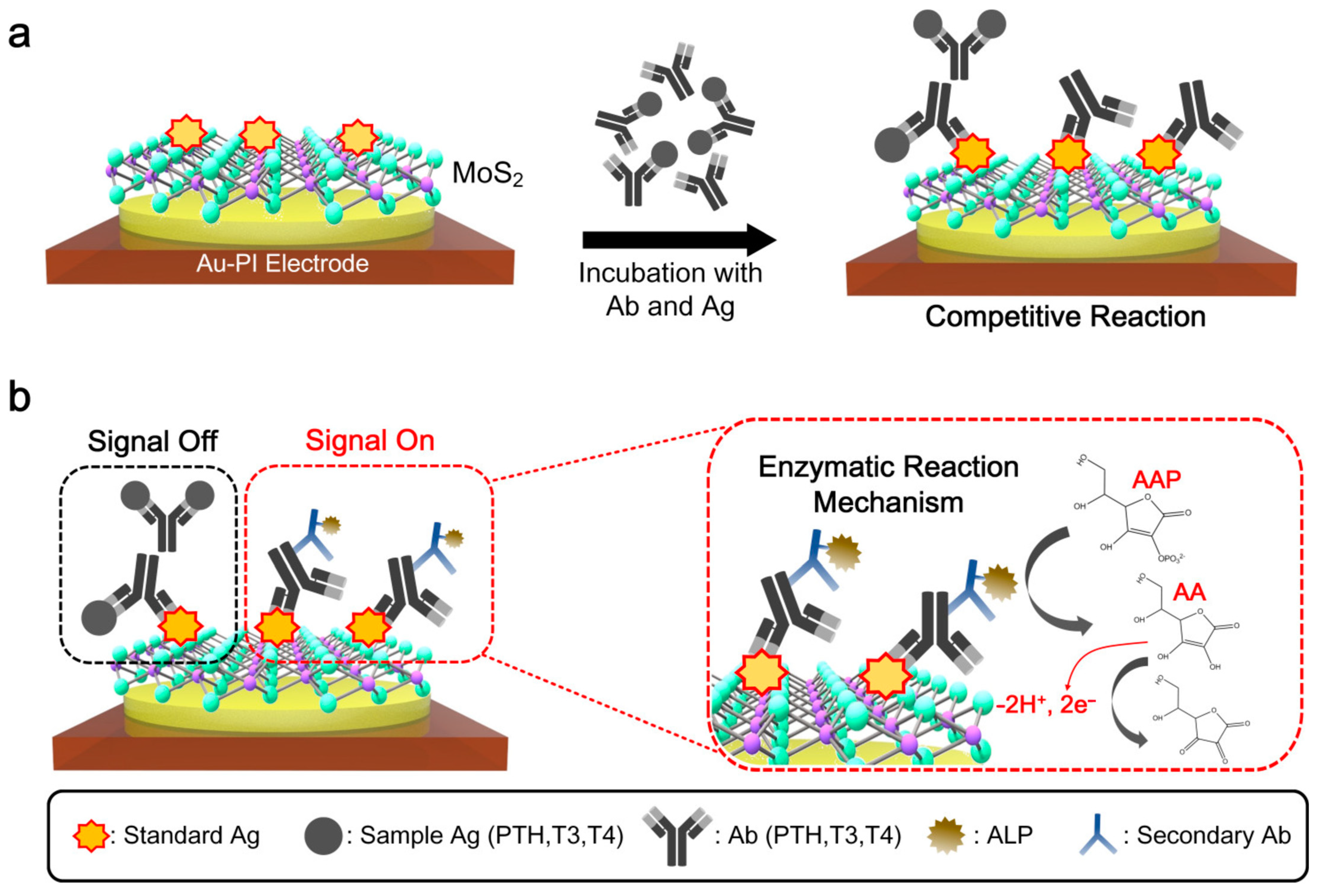
T3 and T4 have similar chemical structures, which facilitates the development of biosensors for the determination of both hormones. Min-Ho Lee et al. developed an impedimetric immunosensor for T3 by using a MoS2-modified ITO electrode. The authors described disulfide as a biocompatible graphene-like 2D nanomaterial that can be combined with flexible matrices [215]. In this study, ITO was pretreated with O2 plasma for hydrophilization, followed by CV scanning in an (NH4)MoS4 solution. Subsequently, the electrodes were modified with AuNPs. The biosensor was assembled using a dithiol compound as the crosslinking agent, followed by the immobilization of anti-T3 antibodies. EIS was used for direct label-free T3 detection. Simultaneously, the authors submitted another paper using the same MoS2 system with a few improvements [216]. ITO was exchanged with a Au electrode built over a flexible polyimide substrate (Figure 6). Molybdenum was deposited under high-vacuum conditions, followed by plasma-enhanced chemical vapor deposition. Instead of working solely with T3, the authors analyzed three hormones, T3, T4, and PTH, as antigens immobilized through adsorption over the modified electrode (not simultaneously). The biosensor operates in a competitive manner. Specific antibodies were mixed with hormones in each sample. After competition, free unbound antibodies were immobilized on the biosensor surface, followed by interaction with ALP-tagged secondary antibodies. Electrochemical measurements were performed using the CV signal generated from the oxidation of ascorbic acid, a product of the enzymatic reaction between ALP and the ascorbic acid 2-phosphate substrate. All three hormones were successfully detected using this system in artificial sera, patient sera (T3 and T4), and samples from patients with osteoporosis (PTH).
T3 and T4 are hormones secreted by the thyroid gland that exhibit biological and binding activities on thyroid hormone receptors (TRs) and thyroid hormone transporters (TTRs). These cellular signal transducers can be harnessed for biosensing instead of well-established antibodies and aptamers, thereby opening up possibilities for the development of novel biosensing designs. Zucolotto et al. [217] developed a biosensor for T3, T4, and two other synthetic antagonists simultaneously by immobilizing the ligand-binding domain (LBD) of a TR named TRβ1 over an interdigitated Au/Cr electrode. The hormones were detected by EIS using the capacitance values obtained at 1 KHz. The data obtained were statistically evaluated using principal component analysis (PCA), a powerful chemometric tool that is useful for separating distinguishable signals from T3, T4, and synthetic antagonists. Therefore, the authors explored the main advantages of a biosensor: cost-effectiveness using inexpensive electrodes, label-free, and simultaneous determination, with attractive possibilities for miniaturized devices using a fixed-potential impedance technique with small sample volumes. Shaoguo Ru et al. [218] also used LDB from TRβ and a TTR protein (transthyretin) to develop a T3 biosensor. In this study, the authors were interested in the indirect detection of thyroid-disrupting chemicals (TDC), such as bisphenol-A, which affect homeostasis regulated by the hypothalamus-pituitary-thyroid axis. Using biomolecules obtained from zebrafish, the biosensor responded to T3 and T4 with a high limit of detection and a wide linear range. The best results were obtained using TRβ and T3 interactions, which determined the influence of the system in the presence of different bisphenol compounds.
Other studies have used innovative systems as interesting approaches for hormone determination, such as those using TRs. Mònica Mir et al. [219] evaluated the usefulness of gold interdigitated electrode arrays in a biophotolithographic process for biomolecule patterning for three different analytes: oligonucleotides for breast cancer gene mutation detection, T4, and sarcosine/Glc. Min-Ho Lee et al. [220] built a 3-way junction (3WJ) DNA from two oligonucleotide sequences and a T4 aptamer with silver ions intercalating a C-C mismatched sequence for signal reporting. However, one of the oldest papers evaluated in this review also presented a different determination strategy using sequential injection analysis (SIA), a technique similar to flow injection analysis (FIA). The authors molded a carbon paste electrode using anti-T3 and anti-T4 antibodies [221]. Amperometric signals were recorded upon contact with the samples using the SIA. As the system is based on sequential injections, its limitation is solely based on the number of electrically actuated selection valve ports and the availability of antibodies, which enables countless simultaneous detections in a single experiment. To prove the high specificity of the proposed method, the same authors [222] applied SIA to simultaneously detect both L-T4 and D-T4 enantiomers.
Sharma et al. [223] developed a system to discriminate and detect the enantiomers L-T4 and D-T4. The authors used two distinct approaches for the Ag electrode. First, a SAM was formed over the electrode surface with a mercapto-silane structure and further functionalized into a vinyl acetate end decorated with carbon powder. Second, the MIP was formed at the end of the functionalized electrode using L-T4 or D-T4 as the template.
DPASV was used to detect T4 directly, which was enhanced by the catalytic properties of silver. The system was evaluated in aqueous, human blood serum, and pharmaceutical samples with very low limits of detection and 100% recovery rates. This is a highly essential determination, not only for the quantification of the species per se, but especially in the case of pharmaceuticals, to ensure the enantiopurity of the desired drug and enantioselective synthesis by organic chemists.
Electrochemical biosensors for thyroid-related hormones have demonstrated promising analytical performance within clinically relevant concentration ranges. However, practical implementation still faces important challenges, such as the limited number of studies involving clinical validation or direct comparison with established procedures. Compared with other hormones discussed in this review, electrochemical biosensors for parathyroid hormones remain less explored.

3.5. Prolactin

PRL is a polypeptide hormone synthesized by lactotrophs in the anterior pituitary gland (adenohypophysis). Inhibitory control of hypothalamic dopamine primarily regulates its release. PRL is important for the growth of mammary glands and for starting and maintaining lactation after childbirth. PRL also affects reproductive function by changing the amount of gonadotropin-releasing hormone (GnRH) released, which in turn affects the hypothalamic–pituitary–gonadal axis [97,101].
Hyperprolactinemia is a condition characterized by elevated PRL levels [100,101]. This can occur because of pituitary adenomas (prolactinomas), certain medications, or hypothalamic disorders [101]. Clinically, hyperprolactinemia is associated with reproductive dysfunctions, including infertility, menstrual irregularities, galactorrhea, and hypogonadism [95,96,224]. PRL levels are usually higher during pregnancy and breastfeeding, as this is how the body naturally produces milk [224].
Because PRL is an important biomarker for diagnosing reproductive and endocrine disorders, accurate measurement of this hormone is crucial [98,224]. However, compared to other hormones, there have been few studies on electrochemical biosensors for PRL detection in the past few years. Table S5 lists examples of electrochemical biosensors used to detect PRL.
As observed for TSH and PTH, only antibodies were used in nine studies that employed three different strategies. The authors chose an ELISA-like sandwich approach using PRL as the antigen between the two antibodies in solution for immunoassays [225,226] or directly on the graphite-based electrodes [227,228,229,230]. Interestingly, two studies from different research groups presented virtually the same biosensor assembly procedure [231,232] by immobilizing the antigen over the electrode prior to a competitive assay. In addition, Chung et al. [233] presented an immunosensor for PRL detection using DPV by interacting with a GCE-immobilized antibody.
In addition, sandwich assays rely on ALP-modified antibodies that use naphthyl phosphate as a substrate to generate oxidizable naphthol. HRP was also applied. Hadi Beitollahi used the same approach for TSH [234] and PRL determination [227] over an ionic liquid carbon paste electrode and 2-aminophenol as substrates, generating redox species derived from a phenoxazine-like structure. Rong Luo et al. [228] used differ by using a metal nanoenzyme composed of PdPt nanodendrimer-modified amino-rich Fe-based MOFs with peroxidase-like activity. The GCE modified with an amino-graphene sheet, AuNP, and a primary antibody completed the immunosensor for the catalytic oxidation/reduction of hydrogen peroxide. The other hormones analyzed so far have also applied antibodies in strategies similar to those presented for PRL, indicating that the reuse of functional immunosensors for different targets is reliable. Therefore, because of the importance of PRL detection in humans, a plausible explanation for the low number of publications on this hormone is unknown.
Although PRL biosensors have demonstrated promising responses, the number of reported studies remains relatively limited compared to other hormone targets, such as CORT. Additional efforts are required to improve the practical applicability of PRL determination using biosensors.

3.6. Insulin

INS is a peptide hormone produced and released by β-cells in the islets of Langerhans in the pancreas. It is essential for maintaining stable Glc levels because it helps INS-sensitive tissues, such as skeletal muscle and adipose tissue, take up Glc [106,107,109]. INS not only helps the body use Glc but also helps the body produce glycogen, store fats, and produce proteins. It also prevents the liver from producing Glc by stopping gluconeogenesis and glycogenolysis. INS is a key anabolic hormone that controls energy storage and the overall metabolic balance [109,235].
INS in the bloodstream affects more than just metabolism; it also affects protein metabolism and cellular growth. INS signaling is associated with vascular function and neural activity in the central nervous system [107,235]. Changes in the amount of INS produced or the response of tissues to INS can cause metabolic disorders such as diabetes mellitus, INS resistance, and metabolic syndrome [105,110].
Dysregulation of INS metabolism significantly contributes to the onset of type 2 diabetes mellitus, a chronic metabolic disorder linked to complications including cardiovascular disease, renal failure, neuropathy, and visual impairment [109]. Therefore, it is important to accurately measure INS levels in serum or plasma to determine how Glc is used and to diagnose and treat diabetes and other metabolic disorders. Table S6 presents examples of electrochemical biosensors developed for INS detection. These biosensors use different types of electrodes and electrochemical sensing methods for detection.
One of the most important features of an immunosensor is the possibility of two-way detection, as evaluated in the development of INS biosensors. Typically, an electrode is modified with a specific antibody to determine the analyte in a sample. This is the case for most studies (e.g., [236,237,238,239]), where anti-INS antibodies are immobilized on transducers with INS as the target. This is important as an already mentioned role in controlling blood Glc levels, classification of diabetes types, etc. However, Arjmand et al. used a different approach in which INS was immobilized on the electrode to detect specific antibodies. Accordingly, the presence of INS antibodies in individuals who have never been treated with INS is indicative of the continuing degradation of pancreatic beta cells in type 1 diabetes [240], an asymptomatic condition in the early stages that can take years to complete and can affect everyone at any time. In this study, we developed a biosensor for anti-INS antibodies using a Au electrode modified with polyaniline, AuNPs, and reduced L-glutathione. SWV and DPV are techniques based on current changes, as in ferricyanide solutions. Interestingly, there was an increase in the current upon interaction with the antibody, probably because of the provision of an electron transfer microchannel. This increase was also observed in other similar systems investigated by Majola et al. [241]. The authors stated that the square-wave voltammograms increased with antibody concentration, probably because the antigen–antibody complex promotes a structural arrangement that facilitates electron transfer from the redox probe to the working electrode. In other systems (such as in papers [238,239]), there is a higher resistance to antibody–antigen interactions, as measured by EIS. The authors also used a similar system to develop a biosensor for type 2 diabetes [242], indicating a variety of biosensor development possibilities for a set of complementary biomolecules.
The availability of various techniques has increased the possibility of assembling biosensors. PEC has been used to determine other hormones and has also been applied to INS [243,244]. Other interesting techniques used for INS detection include DPASV [245], hydrodynamic linear sweep voltammetry (HLSV) [246], alternating current voltammetry (ACV) [247] and, for the first time in this review, drain-to-source voltage versus drain current from a field-effect transistor (FET) [248]. The authors developed n-type silicon nanogratings (SiNGs) as sensing elements modified by crosslinking with anti-INS antibodies for INS detection. The FET biosensor presented an LOD of 10 fM based on a decrease in the drain current upon interaction with the analyte.
Huiyun Wu et al. [249] developed an off–on system based on a dual-signal aptasensor for INS. A thiolated DNA (DNA 1) probe partially hybridized with a methylene blue (MeB)-modified aptamer was first immobilized on Au electrodes using SAM. Subsequently, a ferrocene-tagged DNA (DNA2)-modified AuNP conjugate was immobilized on the electrode surface using an unhybridized section of DNA 1. The MeB-modified aptamer was released from the biosensor upon specific interaction with INS in the sample, decreasing the MeB reduction signal over the electrode. In the absence of the aptamer, the DNA strands became more flexible, closing the nanoparticle conjugate over the electrode and enhancing the ferrocene signal. Therefore, these systems rely on double and selective signals measured using SWV, thereby improving the reliability of the proposed device.
Wang et al. efficiently evaluated the innovative and simultaneous detection of two different hormones using a self-manufactured electrode. First [250], the authors published a very important paper describing the construction of a dual biomolecule chip using a sandwich ELISA-like assay with Glc and INS antibody immobilization over two different working electrodes, followed by a sandwich with secondary antibodies tagged with GOx (for Glc) and HRP (for INS) upon contact with the target in the sample. The authors [251] then applied the functional chip for the simultaneous determination of CORT and INS using the same principle. The only difference was the use of a secondary antibody tagged with ALP for the CORT measurements. Guozhen Liu et al. [252] used a commercial four-channel screen-printed electrode for the simultaneous determination of Glc and INS using an aptasensor. Specific MeB-modified Glc and INS aptamers were individually immobilized on the electrode surfaces. Upon contact with the targets, MeB reduction was hampered, which decreased the SWV current signals. As observed for other hormones, there is no further limitation for multiple biomolecule determination because commercial or self-made arrays of electrodes and a variety of different biomolecules are available for device assembly.
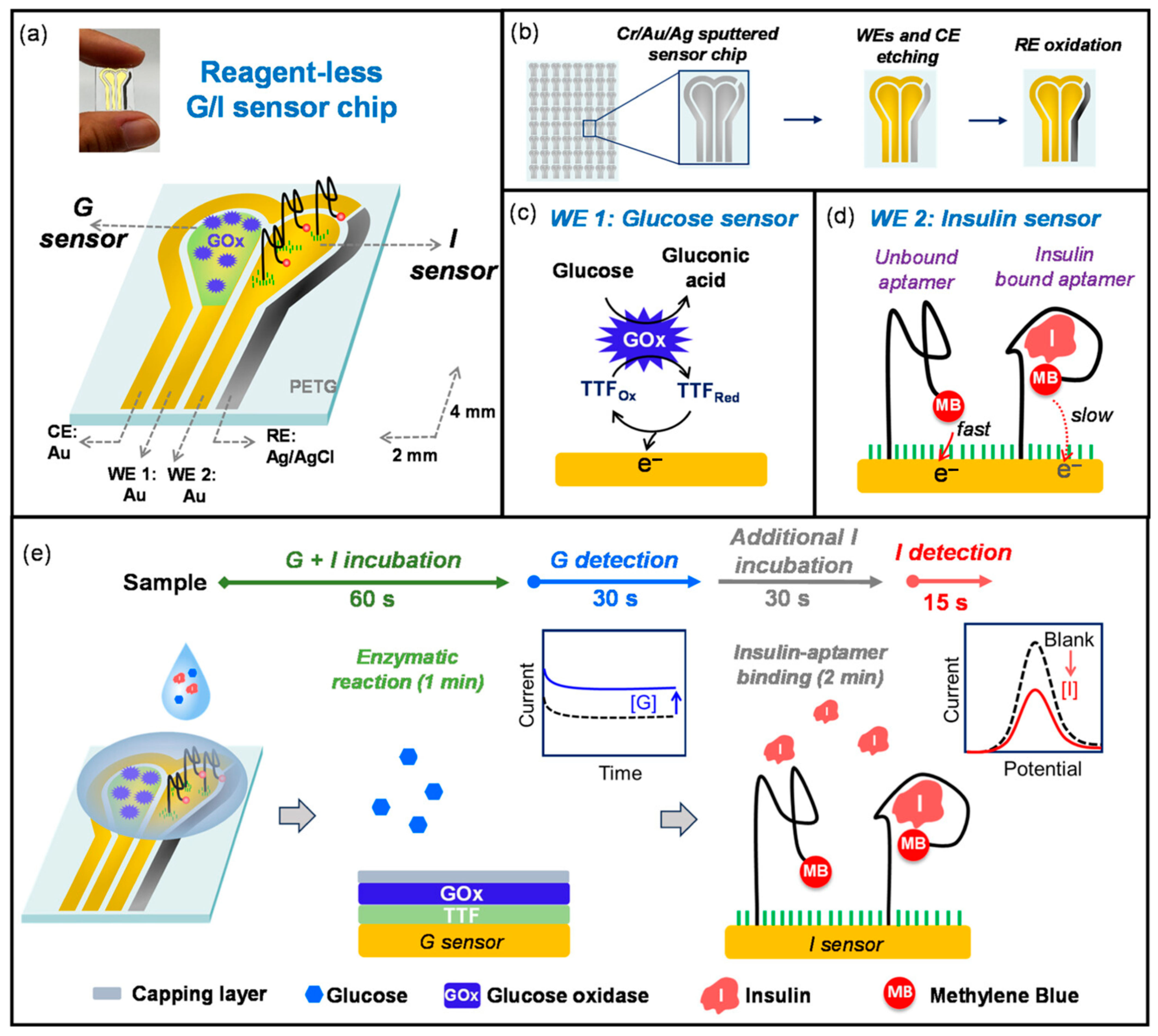
Nandhakumar et al. [253] investigated an innovative bioelectronic chip capable of detecting Glc and INS simultaneously and without reagents in just 2 min using a single microliter droplet sample. The authors developed a dual-analyte platform featuring a four-electrode configuration, which included two gold working electrodes, a shared Ag/AgCl reference electrode, and a gold counter electrode (Figure 7).
This setup allows the integration of distinct sensing strategies on a single chip. The Glc sensor utilizes a second-generation enzymatic amperometric approach employing glucose oxidase (GOx) alongside the redox mediator tetrathiafulvalene (TTF). INS detection was achieved using an electrochemical aptamer-based (E-AB) sensor, which uses a methylene-blue-tagged guanine-rich aptamer co-immobilized with 6-mercapto-1-hexanol. This design facilitates sequential yet rapid measurements, with Glc quantified amperometrically within the first 90 s (including a brief incubation period), followed by SWV detection of INS after an additional 30 s. Notably, the device demonstrated excellent analytical performance, achieving a low LOD of 800 pM for INS, underscoring the high sensitivity of the aptamer-based transduction mechanism employed. Importantly, comprehensive cross-reactivity studies revealed negligible crosstalk between the enzymatic and aptameric sensing interfaces, even when considering the significant physiological concentration differences between Glc (mM) and INS (pM–nM), confirming the robustness of the platform. The dual biosensor was successfully validated in complex biological matrices, including undiluted human serum and saliva, producing well-defined calibration profiles and LODs of 227 μM for Glc and 13.9 nM for INS in serum.
A drawback of many analytical and electrochemical systems for multiple determinations, especially when using a single electrode, is the lack of selectivity with overlapping signals. As observed for THP [217], chemometrics is a powerful data analysis tool. Pinto et al. [246] developed an MIP over a rotating thick-film boron-doped diamond electrode (TFBDDE) for the determination of three different compounds, INS, proinsulin (PIN), and C-peptide (CPT), based on the electrochemical oxidation of each structure. Unfortunately, the electrochemical MIP response to the three targets in solution is difficult to analyze because of oxidation at similar potentials. The authors used PARASIAS, a method for analyzing higher-order tensors with shifting profiles, and chemometric analysis was applied to the voltammetric data obtained for the simultaneous detection of target compounds [254]. Using PARASIAS in a MATLAB R2018a 64-bit environment, voltammetric data obtained from artificial human serum samples were analyzed with high specificity and validated using HPLC-UV for all three analytes. This study presents a biosensor proposal and a very important tool for overcoming one of the major problems in electroanalytical chemistry. As the authors state at the end of the work, this is a fresh motivation that can drive researchers to perform interesting and important analyses that have not been possible before in many areas of this field.
Among the hormones discussed in this review, INS stands out as one of the most clinically relevant analytes because of its central role in diabetes mellitus and metabolic disorders. Electrochemical INS biosensors have evolved through the incorporation of nanomaterials, multiplexed determination, and wearable monitoring platforms. However, some challenges limit its widespread clinical implementation. Future developments are expected to improve these devices, especially with the aid of AI and other technologies.
An analysis of studies reported since 2010 revealed a clear evolution in the development of electrochemical biosensors for hormone detection. In general, more recent platforms exhibit substantially lower detection limits, broader linear ranges, and improved compatibility with noninvasive biological matrices such as sweat, saliva, tears, and interstitial fluid. This is strongly associated with advances in nanostructured electrode materials, improved immobilization strategies, the aid based on computational programs, and the increasing use of label-free electrochemical approaches.
For several hormones discussed in this review, including CORT and 17β-estradiol, many recently reported biosensors exhibit detection limits below physiological concentration ranges (based on the data presented in Table 1), demonstrating their potential applicability in clinical monitoring. However, direct comparison among the reported systems remains difficult because the analytical performance is strongly influenced by differences in biological matrices, sample preparation, sensor design, and electrochemical detection methods.
Although extremely low detection limits have been frequently reported, their practical applicability depends not only on analytical sensitivity but also on reproducibility, operational stability, resistance to matrix effects, and long-term device reliability under real sample conditions.

4. Future Perspectives and Translational Challenges

Electrochemical biosensors for hormone detection have evolved since 2010 with the emergence of wearable devices, flexible electrodes, nanostructured materials, and miniaturized point-of-care systems. Recent advances have demonstrated a trend toward noninvasive and continuous hormone monitoring using biological fluids, such as sweat, saliva, tears, and interstitial fluid. In parallel, multiplexed sensing platforms capable of simultaneously detecting multiple biomarkers are becoming attractive to meet the growing demand for personalized medicine and real-time physiological monitoring.
Another emerging trend is the integration of biosensors with wireless communication systems, smartphone-based interfaces, cloud data processing, and AI-assisted analytical approaches. Machine learning algorithms may contribute to improving signal interpretation, reducing matrix interference, pattern recognition, and predictive clinical analysis, particularly in wearable sensing applications involving continuous data acquisition.
Although many studies have reported extremely low detection limits under controlled laboratory conditions, only a limited number of platforms have undergone extensive clinical validation. Future research should therefore focus not only on improving analytical sensitivity but also on robustness, standardization, and technology readiness for practical applications.
Stronger collaboration among researchers, clinicians, engineers, and regulatory agencies is essential to accelerate the transition of electrochemical hormone biosensors from laboratory prototypes to commercially viable diagnostic devices.

5. Conclusions

This thorough review shows the progress made in the field of electrochemical biosensors for hormone detection since 2010. Hormones are important chemical messengers that control several metabolic pathways and physiological processes in the body. Therefore, it is important to accurately measure these parameters for clinical diagnosis and monitoring. However, conventional analytical methods for hormone quantification frequently require intricate instrumentation, protracted procedures, and substantial operational expenses, prompting the exploration of alternative strategies.
In this context, biosensors have become promising tools for hormone detection because they are simple, rapid, and inexpensive. Electrochemical biosensors are particularly sensitive and can detect hormonal biomarkers at low concentrations. These traits make them appealing substitutes for traditional methods, such as chromatography and mass spectrometry, with growing possibilities for use in clinical diagnostics and environmental monitoring.
Electrochemical biosensors for hormone detection have been the subject of interest and technological evolution since 2010, driven by advances in nanostructured materials, surface engineering strategies, wearable sensing platforms, and miniaturized analytical systems. These developments have enabled remarkable improvements in analytical sensitivity, reduced sampling, and applicability toward non-invasiveness based on point-of-care devices.
Future research efforts should move beyond the pursuit of ultra-low detection limits to improvements in robustness, standardization, clinical validation, wearability, multiplexed detection, and novel technology for real applications. In this context, interdisciplinary collaboration is pivotal for accelerating the transition of electrochemical hormone biosensors from proof-of-concept prototypes to point-of-care devices.

Supplementary Materials

The following supporting information can be downloaded at: https://www.mdpi.com/article/10.3390/chemosensors14060132/s1, Table S1: Electrochemical biosensors for CORT detection. Table S2: Electrochemical biosensors for estrogen detection. Table S3: Electrochemical biosensors for P4 detection. Table S4: Electrochemical biosensors for TSH, PTH, T4 and T3 hormones detection. Table S5: Electrochemical biosensors for prolactin detection. Table S6: Electrochemical biosensors for INS detection.

Author Contributions

Conceptualization, R.M.C., T.M.L., D.L.F. and L.F.F.; Investigation: R.M.C., T.M.L., P.W.E., P.I.S., Â.R.M., D.L.F., A.C.P., G.F.D. and L.F.F.; Writing—original draft: R.M.C., T.M.L., P.I.S., Â.R.M., G.F.D., A.C.P., D.L.F. and L.F.F.; Writing—review and editing: R.M.C., T.M.L., P.W.E., D.L.F. and L.F.F.; Supervision, Funding acquisition and Project administration: L.F.F. All authors have read and agreed to the published version of the manuscript.

Funding

This research was funded by Fundação de Amparo à Pesquisa do Estado de Minas Gerais (FAPEMIG), grant numbers APQ-06566-24, and Coordenação de Aperfeiçoamento de Pessoal de Nível Superior (CAPES), grant numbers Finance Code 001, Brazil.

Institutional Review Board Statement

Not applicable.

Informed Consent Statement

Not applicable.

Data Availability Statement

Being a review, no new data were created.

Acknowledgments

The authors are grateful for the technical support from the Chemistry Institute (IQ) of the Federal University of Uberlândia (UFU), Department of Natural Sciences (DCNAT) of the Federal University of São João del-Rei (UFSJ), and Faculty of Medicine of Mucuri (FAMMUC) and Institute of Science and Technology (ICT) of the Federal University of the Jequitinhonha e Mucuri Valleys (UFVJM).

Conflicts of Interest

The authors declare no conflicts of interest.

References

  1. Stárka, L.; Dušková, M. What Is a Hormone? Physiol. Res. 2020, 69, S183–S185. [Google Scholar] [CrossRef]
  2. Rehfeld, J.F. Cholecystokinin and the Hormone Concept. Endocr. Connect. 2021, 10, R139–R150. [Google Scholar] [CrossRef]
  3. Caon, M. Endocrine System. In Examination Questions and Answers in Basic Anatomy and Physiology; Springer International Publishing: Cham, Switzerland, 2020; pp. 283–312. [Google Scholar]
  4. Sinha, R.A.; Yen, P.M. Metabolic Messengers: Thyroid Hormones. Nat. Metab. 2024, 6, 639–650. [Google Scholar] [CrossRef]
  5. Kraemer, W.J.; Ratamess, N.A.; Hymer, W.C.; Nindl, B.C.; Fragala, M.S. Growth Hormone(s), Testosterone, Insulin-Like Growth Factors, and Cortisol: Roles and Integration for Cellular Development and Growth With Exercise. Front. Endocrinol. 2020, 11, 33. [Google Scholar] [CrossRef] [PubMed]
  6. O’Connor, D.B.; Thayer, J.F.; Vedhara, K. Stress and Health: A Review of Psychobiological Processes. Annu. Rev. Psychol. 2021, 72, 663–688. [Google Scholar] [CrossRef] [PubMed]
  7. Townsend, L.K.; Steinberg, G.R. AMPK and the Endocrine Control of Metabolism. Endocr. Rev. 2023, 44, 910–933. [Google Scholar] [CrossRef]
  8. Blanco, A.M. Hypothalamic- and Pituitary-Derived Growth and Reproductive Hormones and the Control of Energy Balance in Fish. Gen. Comp. Endocrinol. 2020, 287, 113322. [Google Scholar] [CrossRef] [PubMed]
  9. Dedovic, K.; Duchesne, A.; Andrews, J.; Engert, V.; Pruessner, J.C. The Brain and the Stress Axis: The Neural Correlates of Cortisol Regulation in Response to Stress. Neuroimage 2009, 47, 864–871. [Google Scholar] [CrossRef] [PubMed]
  10. Funder, J.W.; Carey, R.M.; Mantero, F.; Murad, M.H.; Reincke, M.; Shibata, H.; Stowasser, M.; Young, W.F. The Management of Primary Aldosteronism: Case Detection, Diagnosis, and Treatment: An Endocrine Society Clinical Practice Guideline. J. Clin. Endocrinol. Metab. 2016, 101, 1889–1916. [Google Scholar] [CrossRef]
  11. Casarini, L.; Santi, D.; Brigante, G.; Simoni, M. Two Hormones for One Receptor: Evolution, Biochemistry, Actions, and Pathophysiology of LH and HCG. Endocr. Rev. 2018, 39, 549–592. [Google Scholar] [CrossRef]
  12. Lu, N.Z.; Wardell, S.E.; Burnstein, K.L.; Defranco, D.; Fuller, P.J.; Giguere, V.; Hochberg, R.B.; McKay, L.; Renoir, J.-M.; Weigel, N.L.; et al. International Union of Pharmacology. LXV. The Pharmacology and Classification of the Nuclear Receptor Superfamily: Glucocorticoid, Mineralocorticoid, Progesterone, and Androgen Receptors. Pharmacol. Rev. 2006, 58, 782–797. [Google Scholar] [CrossRef]
  13. Blanco, A.; Blanco, G. Biochemical Bases of Endocrinology (II) Hormones and Other Chemical Intermediates. In Medical Biochemistry; Elsevier: Amsterdam, The Netherlands, 2017; pp. 573–644. [Google Scholar] [CrossRef]
  14. Lai, D.C.Y.; Mueller, J.W. Understanding the Biochemistry of Hormones–Message in a Bottle. Essays Biochem. 2025, 69, 1–18. [Google Scholar] [CrossRef]
  15. Ortiga-Carvalho, T.M.; Chiamolera, M.I.; Pazos-Moura, C.C.; Wondisford, F.E. Hypothalamus-Pituitary-Thyroid Axis. In Comprehensive Physiology; Wiley: Hoboken, NJ, USA, 2016; pp. 1387–1428. [Google Scholar]
  16. Raff, H.; Sharma, S.T.; Nieman, L.K. Physiological Basis for the Etiology, Diagnosis, and Treatment of Adrenal Disorders: Cushing’s Syndrome, Adrenal Insufficiency, and Congenital Adrenal Hyperplasia. In Comprehensive Physiology; Wiley: Hoboken, NJ, USA, 2014; pp. 739–769. [Google Scholar]
  17. Lawrence, S.; Scofield, R.H. Post Traumatic Stress Disorder Associated Hypothalamic-Pituitary-Adrenal Axis Dysregulation and Physical Illness. Brain Behav. Immun. Health 2024, 41, 100849. [Google Scholar] [CrossRef] [PubMed]
  18. Lightman, S.L. Clinical Endocrinology—Time for a Reset? J. Endocr. Soc. 2024, 8, bvae024. [Google Scholar] [CrossRef]
  19. Heijboer, A.C.; Hillebrand, J.J.; Keevil, B.; Ladang, A.; Davies, E.; Mertens, J.; Ozben, T.; Stankovic, S.; van Herwaarden, A.E.; Raverot, V. EndoCompass Project: Endocrine Laboratory Medicine. Eur. J. Endocrinol. 2025, 193, ii161–ii169. [Google Scholar] [CrossRef]
  20. Nong, C.; Yang, B.; Li, X.; Feng, S.; Cui, H. An Ultrasensitive Electrochemical Immunosensor Based on In-Situ Growth of CuWO4 Nanoparticles on MoS2 and Chitosan-Gold Nanoparticles for Cortisol Detection. Microchem. J. 2022, 179, 107434. [Google Scholar] [CrossRef]
  21. Litwack, G. Steroid Hormones: Chemistry, Biosynthesis, and Metabolism. In Hormones; Elsevier: Amsterdam, The Netherlands, 2022; pp. 29–55. [Google Scholar]
  22. Karashima, S.; Osaka, I. Rapidity and Precision of Steroid Hormone Measurement. J. Clin. Med. 2022, 11, 956. [Google Scholar] [CrossRef]
  23. Wudy, S.A.; Schuler, G.; Sánchez-Guijo, A.; Hartmann, M.F. The Art of Measuring Steroids. J. Steroid Biochem. Mol. Biol. 2018, 179, 88–103. [Google Scholar] [CrossRef] [PubMed]
  24. Vignesh, V.; Castro-Dominguez, B.; James, T.D.; Gamble-Turner, J.M.; Lightman, S.; Reis, N.M. Advancements in Cortisol Detection: From Conventional Methods to Next-Generation Technologies for Enhanced Hormone Monitoring. ACS Sens. 2024, 9, 1666–1681. [Google Scholar] [CrossRef]
  25. Brouillard, A.; Davignon, L.-M.; Cernik, R.; Giguère, C.-É.; Findlay, H.; Juster, R.-P.; Lupien, S.J.; Marin, M.-F. Comparing Immunoassay and Mass Spectrometry Techniques for Salivary Sex Hormone Analysis. Psychoneuroendocrinology 2025, 174, 107379. [Google Scholar] [CrossRef]
  26. Dlugash, G.; Rauh, M.; Carré, J.M.; Marcellus, A.; Plachecki, S.; Schultheiss, O.C. Multicenter Comparison of LC-MS/MS, Radioimmunoassay, and ELISA for Assessment of Salivary Cortisol and Testosterone. Psychoneuroendocrinology 2026, 183, 107618. [Google Scholar] [CrossRef]
  27. Trusso Sfrazzetto, G.; Santonocito, R. Nanomaterials for Cortisol Sensing. Nanomaterials 2022, 12, 3790. [Google Scholar] [CrossRef]
  28. Khelifa, L.; Hu, Y.; Jiang, N.; Yetisen, A.K. Lateral Flow Assays for Hormone Detection. Lab Chip 2022, 22, 2451–2475. [Google Scholar] [CrossRef]
  29. Korol, D.; Nikiforow, K.; Borowicz, P.; Sharma, P.S.; Cieplak, M. Flexible Hand-Made Carbon Electrode Decorated with Metronidazole Imprinted Polymer. Analyst 2025, 150, 2554–2563. [Google Scholar] [CrossRef]
  30. Conklin, S.E.; Knezevic, C.E. Advancements in the Gold Standard: Measuring Steroid Sex Hormones by Mass Spectrometry. Clin. Biochem. 2020, 82, 21–32. [Google Scholar] [CrossRef] [PubMed]
  31. Hameedat, F.; Hawamdeh, S.; Alnabulsi, S.; Zayed, A. High Performance Liquid Chromatography (HPLC) with Fluorescence Detection for Quantification of Steroids in Clinical, Pharmaceutical, and Environmental Samples: A Review. Molecules 2022, 27, 1807. [Google Scholar] [CrossRef]
  32. Rossi, F.; Trakoolwilaiwan, T.; Gigli, V.; Tortolini, C.; Lenzi, A.; Isidori, A.M.; Thanh, N.T.K.; Antiochia, R. Progress in Nanoparticle-Based Electrochemical Biosensors for Hormone Detection. Nanoscale 2024, 16, 18134–18164. [Google Scholar] [CrossRef] [PubMed]
  33. Nikkhah, M.; Karami, S.; Khatami, S.H.; Taheri-Anganeh, M.; Savardashtaki, A.; Mahmoodzadeh, A.; Shabaninejad, Z.; Vakili, O.; Mousavi, P.; Ghanizadeh Gerayeli, F.; et al. Review of Electrochemical and Optical Biosensors for Testosterone Measurement. Biotechnol. Appl. Biochem. 2023, 70, 318–329. [Google Scholar] [CrossRef] [PubMed]
  34. Pérez, D.; Orozco, J. Wearable Electrochemical Biosensors to Measure Biomarkers with Complex Blood-to-Sweat Partition Such as Proteins and Hormones. Microchim. Acta 2022, 189, 127. [Google Scholar] [CrossRef]
  35. Ghoshal, K. Recent Advances in Biosensing Technologies for Detecting Hormones. In Advanced Sensor Technology; Elsevier: Amsterdam, The Netherlands, 2023; pp. 261–295. [Google Scholar]
  36. Haroon, N.; Stine, K.J. Electrochemical Detection of Hormones Using Nanostructured Electrodes. Coatings 2023, 13, 2040. [Google Scholar] [CrossRef]
  37. Waifalkar, P.P.; Noh, D.; Derashri, P.; Barage, S.; Oh, E. Role of Estradiol Hormone in Human Life and Electrochemical Aptasensing of 17β-Estradiol: A Review. Biosensors 2022, 12, 1117. [Google Scholar] [CrossRef]
  38. Li, Z.; Luo, D.; Zhang, Y.; Niu, X.; Liu, H. Smart Health Monitoring: Review of Electrochemical Biosensors for Cortisol Monitoring. Adv. Healthc. Mater. 2025, 14, e2404454. [Google Scholar] [CrossRef]
  39. Atay, I.; Yigit, F.F.; Kurbanoglu, S. Hormones Detection Using Voltammetric Sensors. In Advancements in Voltammetry for Biosensing Applications; Springer Nature: Singapore, 2025; pp. 305–335. [Google Scholar]
  40. Duan, H.; Peng, S.; He, S.; Tang, S.; Goda, K.; Wang, C.H.; Li, M. Wearable Electrochemical Biosensors for Advanced Healthcare Monitoring. Adv. Sci. 2025, 12, e2411433. [Google Scholar] [CrossRef]
  41. Komal; Duhan, J.; Dhuva, B.; Obrai, S. A Review on Electrochemical and Optical Nanobiosensor for the Detection of Progesterone and Estradiol. ChemistrySelect 2026, 11, e202506371. [Google Scholar] [CrossRef]
  42. Akther, M.; Mia, M.S.; Akter, S.; Ahammed, M.S.; Islam, M.R.; Uddin, M.R.; Alam, M.M. Electrochemical Sensors for Detection of Thyroid Hormones (TSH, FT-3, and FT-4): A Promising Approach for Point-of-Care Monitoring and Diagnosis. Electrochem. Mater. Technol. 2025, 4, 20254059. [Google Scholar] [CrossRef]
  43. Lalik, A.; Szreder, J.; Grymel, M.; Żabczyński, S.; Bajkacz, S.; Pielok, M.; Cieślik, M.; Kicińska, A.; Wawrzkiewicz-Jałowiecka, A. Estrogens and Progestogens in Environmental Waters: Analytical Chemistry and Biosensing Perspectives on Methods, Challenges, and Trends. Anal. Chem. 2025, 97, 8654–8683. [Google Scholar] [CrossRef]
  44. Elmacı, G.; Ertürk, A.S. Advances in Electrochemical Instrumentation and Techniques. In Electrochemistry of Organic and Organometallic Compounds; Elsevier: Amsterdam, The Netherlands, 2025; pp. 3–29. [Google Scholar]
  45. Zhang, W.; Wang, R.; Luo, F.; Wang, P.; Lin, Z. Miniaturized Electrochemical Sensors and Their Point-of-Care Applications. Chin. Chem. Lett. 2020, 31, 589–600. [Google Scholar] [CrossRef]
  46. Kim, J.; Jeong, J.; Ko, S.H. Electrochemical Biosensors for Point-of-Care Testing. Biodes. Manuf. 2024, 7, 548–565. [Google Scholar] [CrossRef]
  47. Levine, A.; Zagoory-Sharon, O.; Feldman, R.; Lewis, J.G.; Weller, A. Measuring Cortisol in Human Psychobiological Studies. Physiol. Behav. 2007, 90, 43–53. [Google Scholar] [CrossRef]
  48. James, K.A.; Stromin, J.I.; Steenkamp, N.; Combrinck, M.I. Understanding the Relationships between Physiological and Psychosocial Stress, Cortisol and Cognition. Front. Endocrinol. 2023, 14, 1085950. [Google Scholar] [CrossRef] [PubMed]
  49. Lightman, S.L.; Birnie, M.T.; Conway-Campbell, B.L. Dynamics of ACTH and Cortisol Secretion and Implications for Disease. Endocr. Rev. 2020, 41, 470–490. [Google Scholar] [CrossRef]
  50. Mohd Azmi, N.A.S.; Juliana, N.; Azmani, S.; Mohd Effendy, N.; Abu, I.F.; Mohd Fahmi Teng, N.I.; Das, S. Cortisol on Circadian Rhythm and Its Effect on Cardiovascular System. Int. J. Environ. Res. Public Health 2021, 18, 676. [Google Scholar] [CrossRef]
  51. Pearlmutter, P.; DeRose, G.; Samson, C.; Linehan, N.; Cen, Y.; Begdache, L.; Won, D.; Koh, A. Sweat and Saliva Cortisol Response to Stress and Nutrition Factors. Sci. Rep. 2020, 10, 19050. [Google Scholar] [CrossRef]
  52. Knezevic, E.; Nenic, K.; Milanovic, V.; Knezevic, N.N. The Role of Cortisol in Chronic Stress, Neurodegenerative Diseases, and Psychological Disorders. Cells 2023, 12, 2726. [Google Scholar] [CrossRef]
  53. Oakley, R.H.; Cidlowski, J.A. The Biology of the Glucocorticoid Receptor: New Signaling Mechanisms in Health and Disease. J. Allergy Clin. Immunol. 2013, 132, 1033–1044. [Google Scholar] [CrossRef]
  54. Jones, C.; Gwenin, C. Cortisol Level Dysregulation and Its Prevalence—Is It Nature’s Alarm Clock? Physiol. Rep. 2021, 8, e14644. [Google Scholar] [CrossRef]
  55. Dziurkowska, E.; Wesolowski, M. Cortisol as a Biomarker of Mental Disorder Severity. J. Clin. Med. 2021, 10, 5204. [Google Scholar] [CrossRef]
  56. Ortiz, R.; Kluwe, B.; Lazarus, S.; Teruel, M.N.; Joseph, J.J. Cortisol and Cardiometabolic Disease: A Target for Advancing Health Equity. Trends Endocrinol. Metab. 2022, 33, 786–797. [Google Scholar] [CrossRef]
  57. Russell, G.; Lightman, S. The Human Stress Response. Nat. Rev. Endocrinol. 2019, 15, 525–534. [Google Scholar] [CrossRef]
  58. Santonocito, R.; Puglisi, R.; Cavallaro, A.; Pappalardo, A.; Trusso Sfrazzetto, G. Cortisol Sensing by Optical Sensors. Analyst 2024, 149, 989–1001. [Google Scholar] [CrossRef]
  59. Geraghty, P. Physiology of Menopause. In Each Woman’s Menopause: An Evidence Based Resource; Springer International Publishing: Cham, Switzerland, 2022; pp. 69–90. [Google Scholar]
  60. Hwang, W.J.; Lee, T.Y.; Kim, N.S.; Kwon, J.S. The Role of Estrogen Receptors and Their Signaling across Psychiatric Disorders. Int. J. Mol. Sci. 2020, 22, 373. [Google Scholar] [CrossRef]
  61. Gruber, C.J.; Tschugguel, W.; Schneeberger, C.; Huber, J.C. Production and Actions of Estrogens. New Engl. J. Med. 2002, 346, 340–352. [Google Scholar] [CrossRef] [PubMed]
  62. Findlay, J.K.; Liew, S.H.; Simpson, E.R.; Korach, K.S. Estrogen Signaling in the Regulation of Female Reproductive Functions. In Fertility Control. Handbook of Experimental Pharmacology; Springer: Berlin/Heidelberg, Germany, 2010; pp. 29–35. [Google Scholar]
  63. Sho, T.; Hachisuga, T.; Koi, C.; Kurita, T.; Kagami, S.; Kawagoe, T.; Matsuura, Y.; Yoshimura, K.; Hisaoka, M. 17β-Estradiol Induces Proliferation of Endometrial NK Cells (CD56+) in Postmenopausal Women. Climacteric 2017, 20, 571–576. [Google Scholar] [CrossRef]
  64. Cui, J.; Shen, Y.; Li, R. Estrogen Synthesis and Signaling Pathways during Aging: From Periphery to Brain. Trends Mol. Med. 2013, 19, 197–209. [Google Scholar] [CrossRef]
  65. Xiang, D.; Liu, Y.; Zhou, S.; Zhou, E.; Wang, Y. Protective Effects of Estrogen on Cardiovascular Disease Mediated by Oxidative Stress. Oxid. Med. Cell. Longev. 2021, 2021, 5523516. [Google Scholar] [CrossRef] [PubMed]
  66. Jayasena, C.N.; Devine, K.; Barber, K.; Comninos, A.N.; Conway, G.S.; Crown, A.; Davies, M.C.; Ewart, A.; Seal, L.J.; Smyth, A.; et al. Society for Endocrinology Guideline for Understanding, Diagnosing and Treating Female Hypogonadism. Clin. Endocrinol. 2024, 101, 409–442. [Google Scholar] [CrossRef]
  67. Bellem, A.; Meiyappan, S.; Romans, S.; Einstein, G. Measuring Estrogens and Progestagens in Humans: An Overview of Methods. Gend. Med. 2011, 8, 283–299. [Google Scholar] [CrossRef] [PubMed]
  68. Høj, P.H.; Møller-Sørensen, J.; Wissing, A.L.; Alatraktchi, F.A. Electrochemical Biosensors for Monitoring of Selected Pregnancy Hormones during the First Trimester: A Systematic Review. Talanta 2023, 258, 124396. [Google Scholar] [CrossRef]
  69. Kolatorova, L.; Vitku, J.; Suchopar, J.; Hill, M.; Parizek, A. Progesterone: A Steroid with Wide Range of Effects in Physiology as Well as Human Medicine. Int. J. Mol. Sci. 2022, 23, 7989. [Google Scholar] [CrossRef]
  70. Barros, L.A.; Tufik, S.; Andersen, M.L. The Role of Progesterone in Memory: An Overview of Three Decades. Neurosci. Biobehav. Rev. 2015, 49, 193–204. [Google Scholar] [CrossRef]
  71. Taraborrelli, S. Physiology, Production and Action of Progesterone. Acta Obstet. Gynecol. Scand. 2015, 94, 8–16. [Google Scholar] [CrossRef]
  72. Jewson, M.; Purohit, P.; Lumsden, M.A. Progesterone and Abnormal Uterine Bleeding/Menstrual Disorders. Best Pract. Res. Clin. Obstet. Gynaecol. 2020, 69, 62–73. [Google Scholar] [CrossRef]
  73. Huang, X.; Yin, T.; Song, M.; Pan, J. Association of Estrogen Receptor and Progesterone Receptor Genetic Polymorphisms with Recurrent Pregnancy Loss: A Systematic Review and Meta-Analysis. Eur. J. Obstet. Gynecol. Reprod. Biol. 2024, 296, 65–75. [Google Scholar] [CrossRef]
  74. Szkudlinski, M.W.; Fremont, V.; Ronin, C.; Weintraub, B.D. Thyroid-Stimulating Hormone and Thyroid-Stimulating Hormone Receptor Structure-Function Relationships. Physiol. Rev. 2002, 82, 473–502. [Google Scholar] [CrossRef]
  75. Pirahanchi, Y.; Toro, F.; Jialal, I. Physiology, Thyroid Stimulating Hormone; StatPearls Publishing: Treasure Island, FL, USA, 2026. [Google Scholar]
  76. Casis, O.; Echeazarra, L.; Sáenz-Díez, B.; Gallego, M. Deciphering the Roles of Triiodothyronine (T3) and Thyroid-Stimulating Hormone (TSH) on Cardiac Electrical Remodeling in Clinical and Experimental Hypothyroidism. J. Physiol. Biochem. 2024, 80, 1–9. [Google Scholar] [CrossRef]
  77. Louzada, R.A.; Carvalho, D.P. Similarities and Differences in the Peripheral Actions of Thyroid Hormones and Their Metabolites. Front. Endocrinol. 2018, 9, 394. [Google Scholar] [CrossRef]
  78. Jonklaas, J.; Bianco, A.C.; Bauer, A.J.; Burman, K.D.; Cappola, A.R.; Celi, F.S.; Cooper, D.S.; Kim, B.W.; Peeters, R.P.; Rosenthal, M.S.; et al. Guidelines for the Treatment of Hypothyroidism: Prepared by the American Thyroid Association Task Force on Thyroid Hormone Replacement. Thyroid 2014, 24, 1670–1751. [Google Scholar] [CrossRef]
  79. Mansourian, A.R. Metabolic Pathways of Tetraidothyronine and Triidothyronine Production by Thyroid Gland: A Review of Articles. Pak. J. Biol. Sci. 2010, 14, 1–12. [Google Scholar] [CrossRef]
  80. Salvatore, D.; Porcelli, T.; Ettleson, M.D.; Bianco, A.C. The Relevance of T3 in the Management of Hypothyroidism. Lancet Diabetes Endocrinol. 2022, 10, 366–372. [Google Scholar] [CrossRef]
  81. Salas-Lucia, F.; Bianco, A.C. T3 Levels and Thyroid Hormone Signaling. Front. Endocrinol. 2022, 13, 1044691. [Google Scholar] [CrossRef]
  82. Mallya, M.; Ogilvy-Stuart, A.L. Thyrotropic Hormones. Best Pract. Res. Clin. Endocrinol. Metab. 2018, 32, 17–25. [Google Scholar] [CrossRef]
  83. Li, T.; Liu, C.; Zhou, H.; Zhou, H. Relationship between Plasma Atherogenic Index and Thyroid Function: Evidence from NHANES 2007–2012. Sci. Rep. 2025, 15, 23870. [Google Scholar] [CrossRef]
  84. Köhrle, J. Thyroid Hormones and Derivatives: Endogenous Thyroid Hormones and Their Targets. In Thyroid Hormone Nuclear Receptor; Humana Press: New York, NY, USA, 2018; pp. 85–104. [Google Scholar]
  85. Holzer, G.; Roux, N.; Laudet, V. Evolution of Ligands, Receptors and Metabolizing Enzymes of Thyroid Signaling. Mol. Cell. Endocrinol. 2017, 459, 5–13. [Google Scholar] [CrossRef]
  86. Witkowska-Sędek, E.; Kucharska, A.M.; Rumińska, M.; Paluchowska, M.; Pyrżak, B. Decreased Thyroxine Levels during RhGH Therapy in Children with Growth Hormone Deficiency. J. Clin. Med. 2021, 10, 5100. [Google Scholar] [CrossRef]
  87. Guerri, G.; Bressan, S.; Sartori, M.; Costantini, A.; Benedetti, S.; Agostini, F.; Tezzele, S.; Cecchin, S.; Scaramuzza, A.; Bertelli, M. Hypothyroidism and Hyperthyroidism. Acta Biomed. 2019, 90, 83–86. [Google Scholar] [CrossRef]
  88. Nikitovic, D.; Kavasi, R.-M.; Berdiaki, A.; Papachristou, D.J.; Tsiaoussis, J.; Spandidos, D.A.; Tsatsakis, A.M.; Tzanakakis, G.N. Parathyroid Hormone/Parathyroid Hormone-Related Peptide Regulate Osteosarcoma Cell Functions: Focus on the Extracellular Matrix (Review). Oncol. Rep. 2016, 36, 1787–1792. [Google Scholar] [CrossRef][Green Version]
  89. Cheloha, R.W.; Gellman, S.H.; Vilardaga, J.-P.; Gardella, T.J. PTH Receptor-1 Signalling—Mechanistic Insights and Therapeutic Prospects. Nat. Rev. Endocrinol. 2015, 11, 712–724. [Google Scholar] [CrossRef]
  90. Blaine, J.; Chonchol, M.; Levi, M. Renal Control of Calcium, Phosphate, and Magnesium Homeostasis. Clin. J. Am. Soc. Nephrol. 2015, 10, 1257–1272. [Google Scholar] [CrossRef]
  91. Horwitz, M.J.; Tedesco, M.B.; Sereika, S.M.; Syed, M.A.; Garcia-Ocaña, A.; Bisello, A.; Hollis, B.W.; Rosen, C.J.; Wysolmerski, J.J.; Dann, P.; et al. Continuous PTH and PTHrP Infusion Causes Suppression of Bone Formation and Discordant Effects on 1,25(OH)2Vitamin D. J. Bone Miner. Res. 2005, 20, 1792–1803. [Google Scholar] [CrossRef]
  92. Fuggle, N.; Rizzoli, R.; Beaudart, C.; Cortet, B.; Curtis, E.M.; Hiligsmann, M.; Kaufman, J.-M.; Veronese, N.; Albergaria, B.H.; Al-Daghri, N.; et al. Parathyroid Hormone Receptor Agonists in the Management of Osteoporosis. Nat. Rev. Rheumatol. 2025, 21, 599–611. [Google Scholar] [CrossRef]
  93. Lombardi, G.; Ziemann, E.; Banfi, G.; Corbetta, S. Physical Activity-Dependent Regulation of Parathyroid Hormone and Calcium-Phosphorous Metabolism. Int. J. Mol. Sci. 2020, 21, 5388. [Google Scholar] [CrossRef]
  94. Cavalcante, L.B.C.P.; Brandão, C.M.Á.; Chiamolera, M.I.; Biscolla, R.P.M.; Junior, J.V.L.; de Sá Tavares Russo, P.; Morgado, J.P.M.; de Francischi Ferrer, C.M.A.; Vieira, J.G.H. Big Data-Based Parathyroid Hormone (PTH) Values Emphasize Need for Age Correction. J. Endocrinol. Investig. 2023, 46, 2525–2533. [Google Scholar] [CrossRef]
  95. Bernard, V.; Young, J.; Binart, N. Prolactin—a Pleiotropic Factor in Health and Disease. Nat. Rev. Endocrinol. 2019, 15, 356–365. [Google Scholar] [CrossRef]
  96. Lopez-Vicchi, F.; De Winne, C.; Brie, B.; Sorianello, E.; Ladyman, S.R.; Becu-Villalobos, D. Metabolic Functions of Prolactin: Physiological and Pathological Aspects. J. Neuroendocrinol. 2020, 32, e12888. [Google Scholar] [CrossRef]
  97. Pirchio, R.; Graziadio, C.; Colao, A.; Pivonello, R.; Auriemma, R.S. Metabolic Effects of Prolactin. Front. Endocrinol. 2022, 13, 1015520. [Google Scholar] [CrossRef]
  98. Kirsch, P.; Kunadia, J.; Shah, S.; Agrawal, N. Metabolic Effects of Prolactin and the Role of Dopamine Agonists: A Review. Front. Endocrinol. 2022, 13, 1002320. [Google Scholar] [CrossRef]
  99. Langan, E.A.; Foitzik-Lau, K.; Goffin, V.; Ramot, Y.; Paus, R. Prolactin: An Emerging Force along the Cutaneous–Endocrine Axis. Trends Endocrinol. Metab. 2010, 21, 569–577. [Google Scholar] [CrossRef]
  100. Macotela, Y.; Triebel, J.; Clapp, C. Time for a New Perspective on Prolactin in Metabolism. Trends Endocrinol. Metab. 2020, 31, 276–286. [Google Scholar] [CrossRef]
  101. Macotela, Y.; Ruiz-Herrera, X.; Vázquez-Carrillo, D.I.; Ramírez-Hernandez, G.; Martínez de la Escalera, G.; Clapp, C. The Beneficial Metabolic Actions of Prolactin. Front. Endocrinol. 2022, 13, 1001703. [Google Scholar] [CrossRef]
  102. Arnold, K.C.; Flint, C.J. Hyperprolactinemia, Galactorrhea, and Pituitary Adenomas. In Handbook of Gynecology; Springer International Publishing: Cham, Switzerland, 2023; pp. 561–567. [Google Scholar]
  103. Czyzyk, A.; Kurzawa, R. Hyperprolactinemia Associated with Macroprolactinoma in a 17-Year-Old: A Case Report. Case Rep. Womens Health 2019, 22, e00111. [Google Scholar] [CrossRef]
  104. Gautam, K.; Cherian, K.E.; Jose, A.; Aleyamma, T.K.; Kapoor, N.; Paul, T.V. Persistent Idiopathic Prolactin Elevation Merits Macroprolactin Estimation. J. Hum. Reprod. Sci. 2021, 14, 206–210. [Google Scholar] [CrossRef]
  105. Szablewski, L. Changes in Cells Associated with Insulin Resistance. Int. J. Mol. Sci. 2024, 25, 2397. [Google Scholar] [CrossRef]
  106. Rahman, M.S.; Hossain, K.S.; Das, S.; Kundu, S.; Adegoke, E.O.; Rahman, M.A.; Hannan, M.A.; Uddin, M.J.; Pang, M.-G. Role of Insulin in Health and Disease: An Update. Int. J. Mol. Sci. 2021, 22, 6403. [Google Scholar] [CrossRef]
  107. Tokarz, V.L.; MacDonald, P.E.; Klip, A. The Cell Biology of Systemic Insulin Function. J. Cell Biol. 2018, 217, 2273–2289. [Google Scholar] [CrossRef]
  108. Park, J.E.; Han, J.S. HM-Chromanone Suppresses Hepatic Glucose Production via Activation of AMP-Activated Protein Kinase in HepG2 Cell. Eur. J. Pharmacol. 2022, 928, 175108. [Google Scholar] [CrossRef]
  109. Norton, L.; Shannon, C.; Gastaldelli, A.; DeFronzo, R.A. Insulin: The Master Regulator of Glucose Metabolism. Metabolism 2022, 129, 155142. [Google Scholar] [CrossRef]
  110. Lee, S.-H.; Park, S.-Y.; Choi, C.S. Insulin Resistance: From Mechanisms to Therapeutic Strategies. Diabetes Metab. J. 2022, 46, 15–37. [Google Scholar] [CrossRef]
  111. Elshimy, G.; Techathaveewat, P.; Alsayed, M.; Jyothinagaram, S.; Correa, R. Simple Reason for Hypoglycemia: ACE Inhibitor-Induced Severe Recurrent Hypoglycemia in a Nondiabetic Patient. Cureus 2019, 11, e5449. [Google Scholar] [CrossRef]
  112. Nazare, A.; Pal, K.; Maji, S. Electrochemical Biosensors. In Food, Medical, and Environmental Applications of Polysaccharides; Elsevier: Amsterdam, The Netherlands, 2020; pp. 403–441. [Google Scholar] [CrossRef]
  113. Zhang, Z.; Zhou, J.; Du, X. Electrochemical Biosensors for Detection of Foodborne Pathogens. Micromachines 2019, 10, 222. [Google Scholar] [CrossRef]
  114. Thévenot, D.R.; Toth, K.; Durst, R.A.; Wilson, G.S. Electrochemical Biosensors: Recommended Definitions and Classification. Biosens. Bioelectron. 2001, 16, 121–131. [Google Scholar] [CrossRef]
  115. Amaral, E.M.F.; de Andrade, J.C.B.; de Freitas, L.B.; Teixeira, G.T.L.; do Nascimento, J.P.L.; Gelamo, R.V.; Leite, N.B.; Moreto, J.A. Electrochemical Sensors and Biosensors: Their Basic Working Principles and Some Applications. Rev. Virtual Química 2022, 15, 519–535. [Google Scholar] [CrossRef]
  116. Cho, I.-H.; Kim, D.H.; Park, S. Electrochemical Biosensors: Perspective on Functional Nanomaterials for on-Site Analysis. Biomater. Res. 2020, 24, 6. [Google Scholar] [CrossRef]
  117. Iost, R.M.; Silva, W.C.D.; Madurro, J.M.; Madurro, A.G.B.; Ferreira, L.F.; Crespilho, F.N. Recent Advances in Nano-Based Electrochemical Biosensors: Application in Diagnosis and Monitoring of Diseases. Front. Biosci. Elite 2011, 3E, 663–689. [Google Scholar]
  118. Ronkainen, N.J.; Halsall, H.B.; Heineman, W.R. Electrochemical Biosensors. Chem. Soc. Rev. 2010, 39, 1747. [Google Scholar] [CrossRef]
  119. Pingarrón, J.M.; Campuzano, S.; González-Cortés, A.; Yáñez-Sedeño, P. Electrochemical Immunosensors for Clinical Diagnostics. In Encyclopedia of Interfacial Chemistry: Surface Science and Electrochemistry; Elsevier: Amsterdam, The Netherlands, 2018; pp. 156–165. [Google Scholar] [CrossRef]
  120. Rodríguez, B.A.G.; Ferreira, P.A.B.; Dutra, R.F. Impedimetric Immunosensors for Clinical Practices: Focus on Point-of-Care Diagnostics. In Tools and Trends in Bioanalytical Chemistry; Springer International Publishing: Cham, Switzerland, 2022; pp. 283–304. [Google Scholar]
  121. Kuswandi, B.; Ensafi, A.A. Perspective—Paper-Based Biosensors: Trending Topic in Clinical Diagnostics Developments and Commercialization. J. Electrochem. Soc. 2020, 167, 037509. [Google Scholar] [CrossRef]
  122. Karunakaran, R.; Keskin, M. Biosensors: Components, Mechanisms, and Applications. In Analytical Techniques in Biosciences; Elsevier: Amsterdam, The Netherlands, 2022; pp. 179–190. [Google Scholar] [CrossRef]
  123. Huang, X.; Zhu, Y.; Kianfar, E. Nano Biosensors: Properties, Applications and Electrochemical Techniques. J. Mater. Res. Technol. 2021, 12, 1649–1672. [Google Scholar] [CrossRef]
  124. Sharma, A.; Majdinasab, M.; Khan, R.; Li, Z.; Hayat, A.; Marty, J.L. Nanomaterials in Fluorescence-Based Biosensors: Defining Key Roles. Nano-Struct. Nano-Objects 2021, 27, 100774. [Google Scholar] [CrossRef]
  125. Crapnell, R.D.; Dempsey-Hibbert, N.C.; Peeters, M.; Tridente, A.; Banks, C.E. Molecularly Imprinted Polymer Based Electrochemical Biosensors: Overcoming the Challenges of Detecting Vital Biomarkers and Speeding up Diagnosis. Talanta Open 2020, 2, 100018. [Google Scholar] [CrossRef]
  126. Gerard, M.; Chaubey, A.; Malhotra, B.D. Application of Conducting Polymers to Biosensors. Biosens. Bioelectron. 2002, 17, 345–359. [Google Scholar] [CrossRef]
  127. Naresh, V.; Lee, N. A Review on Biosensors and Recent Development of Nanostructured Materials-Enabled Biosensors. Sensors 2021, 21, 1109. [Google Scholar] [CrossRef]
  128. Rocha-Santos, T.A.P. Sensors and Biosensors Based on Magnetic Nanoparticles. TrAC-Trends Anal. Chem. 2014, 62, 28–36. [Google Scholar] [CrossRef]
  129. Brett, C.M.A. Electrochemical Sensors for Environmental Monitoring. Strategy and Examples. Pure Appl. Chem. 2001, 73, 1969–1977. [Google Scholar] [CrossRef]
  130. Hanrahan, G.; Patil, D.G.; Wang, J. Electrochemical Sensors for Environmental Monitoring: Design, Development and Applications. J. Environ. Monit. 2004, 6, 657–664. [Google Scholar] [CrossRef]
  131. Bahadır, E.B.; Sezgintürk, M.K. Electrochemical Biosensors for Hormone Analyses. Biosens. Bioelectron. 2015, 68, 62–71. [Google Scholar] [CrossRef]
  132. Li, Z.; Gao, X.; Li, M.; Yan, Q.; Zhang, N.; Yu, B.; Zhang, B.; Zhang, S.; Helal, M.H.; Abu Ali, O.A.; et al. Steroid Hormone-Inducible Biosensor Based on EGFP-Tagged and Environmental Application. Environ. Res. 2022, 215, 114303. [Google Scholar] [CrossRef]
  133. Cho, S.; Won, C.; Kwon, C.; Kim, H.; Lee, S.; Yoon, K.; Lee, M.; Kim, J.; Lee, M.; Lee, S.; et al. Smart Bioelectronic Nanomesh Face Masks with Permeability and Flexibility for Monitoring Cortisol in Saliva. ACS Sens. 2025, 10, 148–158. [Google Scholar] [CrossRef]
  134. Shahub, S.; Upasham, S.; Ganguly, A.; Prasad, S. Machine Learning Guided Electrochemical Sensor for Passive Sweat Cortisol Detection. Sens. Biosensing Res. 2022, 38, 100527. [Google Scholar] [CrossRef]
  135. Sardesai, A.U.; Greyling, C.F.; Lin, K.C.; Kumar, R.M.; Muthukumar, S.; Prasad, S. A New Paradigm in Tracking the Dynamics of Glucose and Cortisol: An Observational Study from Human Sweat Enabled by a Skin Sensor. Biosens. Bioelectron. X 2023, 14, 100377. [Google Scholar] [CrossRef]
  136. Fande, S.; Sriram, D.; Goel, S. Flexible Electrochemical Biosensor for Non-Invasive, on-Site Cortisol Monitoring in Sweat and Saliva. ACS Meas. Sci. Au 2026, 6, 170–178. [Google Scholar] [CrossRef]
  137. Li, J.; Chen, Q.; Li, W.; Li, S.; Tan, C.S.; Ma, S.; Hou, S.; Fan, B.; Chen, Z. Rapid Mental Stress Evaluation Based on Non-Invasive, Wearable Cortisol Detection with the Self-Assembly of Nanomagnetic Beads. Biosensors 2025, 15, 140. [Google Scholar] [CrossRef]
  138. Chen, Y.; He, Z.; Wu, Y.; Bai, X.; Li, Y.; Yang, W.; Liu, Y.; Li, R.-W. A Wearable Molecularly Imprinted Electrochemical Sensor for Cortisol Stable Monitoring in Sweat. Biosensors 2025, 15, 194. [Google Scholar] [CrossRef]
  139. Naguib, M.; Kurtoglu, M.; Presser, V.; Lu, J.; Niu, J.; Heon, M.; Hultman, L.; Gogotsi, Y.; Barsoum, M.W. Two-Dimensional Nanocrystals Produced by Exfoliation of Ti3 AlC2. Adv. Mater. 2011, 23, 4248–4253. [Google Scholar] [CrossRef]
  140. Liu, J.; Tao, Z.; Zhang, Y.; Ni, T.; Liu, B.; Zhang, Z. Dual-Modal Flexible Zinc-Air Battery-Driven Self-Powered and Impedimetric Aptasensor Based on the Hybrid of V2CTx MXene and Bimetallic Layered Double Hydroxide for the Detection of Cortisol. Microchem. J. 2024, 197, 109757. [Google Scholar] [CrossRef]
  141. Tian, L.; Jiang, M.; Su, M.; Cao, X.; Jiang, Q.; Liu, Q.; Yu, C. Sweat Cortisol Determination Utilizing MXene and Multi-Walled Carbon Nanotube Nanocomposite Functionalized Immunosensor. Microchem. J. 2023, 185, 108172. [Google Scholar] [CrossRef]
  142. Laochai, T.; Yukird, J.; Promphet, N.; Qin, J.; Chailapakul, O.; Rodthongkum, N. Non-Invasive Electrochemical Immunosensor for Sweat Cortisol Based on L-Cys/AuNPs/MXene Modified Thread Electrode. Biosens. Bioelectron. 2022, 203, 114039. [Google Scholar] [CrossRef]
  143. Nah, J.S.; Barman, S.C.; Zahed, M.A.; Sharifuzzaman, M.; Yoon, H.; Park, C.; Yoon, S.; Zhang, S.; Park, J.Y. A Wearable Microfluidics-Integrated Impedimetric Immunosensor Based on Ti3C2Tx MXene Incorporated Laser-Burned Graphene for Noninvasive Sweat Cortisol Detection. Sens. Actuators B Chem. 2021, 329, 129206. [Google Scholar] [CrossRef]
  144. Lee, S.; Cho, E.; Song, J.; Ramakrishnan, N.; Shin, D.-S.; Kwon, Y.; Kim, J. PEGDA Hydrogel-Based Biosensor for Continuous Salivary Cortisol Monitoring without Pre-Treatment. Talanta 2026, 304, 129518. [Google Scholar] [CrossRef] [PubMed]
  145. Nandhakumar, P.; Haque, A.M.J.; Lee, N.S.; Yoon, Y.H.; Yang, H. Washing-Free Displacement Immunosensor for Cortisol in Human Serum Containing Numerous Interfering Species. Anal. Chem. 2018, 90, 10982–10989. [Google Scholar] [CrossRef]
  146. Sun, B.; Gou, Y.; Ma, Y.; Zheng, X.; Bai, R.; Ahmed Abdelmoaty, A.A.; Hu, F. Investigate Electrochemical Immunosensor of Cortisol Based on Gold Nanoparticles/Magnetic Functionalized Reduced Graphene Oxide. Biosens. Bioelectron. 2017, 88, 55–62. [Google Scholar] [CrossRef] [PubMed]
  147. Huang, Z.; Chen, H.; Ye, H.; Chen, Z.; Jaffrezic-Renault, N.; Guo, Z. An Ultrasensitive Aptamer-Antibody Sandwich Cortisol Sensor for the Noninvasive Monitoring of Stress State. Biosens. Bioelectron. 2021, 190, 113451. [Google Scholar] [CrossRef] [PubMed]
  148. Ran, J.; Luo, D.; Liu, B. A Dual-Mode Biosensor for Salivary Cortisol with Antibody-Aptamer Sandwich Pattern and Enzyme Catalytic Amplification. J. Solid State Electrochem. 2023, 27, 399–408. [Google Scholar] [CrossRef]
  149. Ghedir, E.K.; Baraket, A.; Benounis, M.; Zine, N.; Errachid, A. Electrochemical Multiplexed N-Terminal Natriuretic Peptide and Cortisol Detection in Human Artificial Saliva: Heart Failure Biomedical Application. Chemosensors 2023, 11, 416. [Google Scholar] [CrossRef]
  150. Mugo, S.M.; Robertson, S.V.; Lu, W. A Molecularly Imprinted Screen-Printed Carbon Electrode for Electrochemical Epinephrine, Lactate, and Cortisol Metabolites Detection in Human Sweat. Anal. Chim. Acta 2023, 1278, 341714. [Google Scholar] [CrossRef] [PubMed]
  151. Cheng, Y.; Feng, S.; Ning, Q.; Li, T.; Xu, H.; Sun, Q.; Cui, D.; Wang, K. Dual-Signal Readout Paper-Based Wearable Biosensor with a 3D Origami Structure for Multiplexed Analyte Detection in Sweat. Microsyst. Nanoeng. 2023, 9, 36. [Google Scholar] [CrossRef]
  152. Bartkowiak-Wieczorek, J.; Jaros, A.; Gajdzińska, A.; Wojtyła-Buciora, P.; Szymański, I.; Szymaniak, J.; Janusz, W.; Walczak, I.; Jonaszka, G.; Bienert, A. The Dual Faces of Oestrogen: The Impact of Exogenous Oestrogen on the Physiological and Pathophysiological Functions of Tissues and Organs. Int. J. Mol. Sci. 2024, 25, 8167. [Google Scholar] [CrossRef]
  153. Chen, P.; Li, B.; Ou-Yang, L. Role of Estrogen Receptors in Health and Disease. Front. Endocrinol. 2022, 13, 839005. [Google Scholar] [CrossRef] [PubMed]
  154. Adeel, M.; Song, X.; Wang, Y.; Francis, D.; Yang, Y. Environmental Impact of Estrogens on Human, Animal and Plant Life: A Critical Review. Environ. Int. 2017, 99, 107–119. [Google Scholar] [CrossRef]
  155. Nazari, E.; Suja, F. Effects of 17β-Estradiol (E2) on Aqueous Organisms and Its Treatment Problem: A Review. Rev. Environ. Health 2016, 31, 465–491. [Google Scholar] [CrossRef]
  156. Ojeda, I.; López-Montero, J.; Moreno-Guzmán, M.; Janegitz, B.C.; González-Cortés, A.; Yáñez-Sedeño, P.; Pingarrón, J.M. Electrochemical Immunosensor for Rapid and Sensitive Determination of Estradiol. Anal. Chim. Acta 2012, 743, 117–124. [Google Scholar] [CrossRef]
  157. Zhang, X.; Peng, Y.; Bai, J.; Ning, B.; Sun, S.; Hong, X.; Liu, Y.; Liu, Y.; Gao, Z. A Novel Electrochemical Sensor Based on Electropolymerized Molecularly Imprinted Polymer and Gold Nanomaterials Amplification for Estradiol Detection. Sens. Actuators B Chem. 2014, 200, 69–75. [Google Scholar] [CrossRef]
  158. Han, Q.; Shen, X.; Zhu, W.; Zhu, C.; Zhou, X.; Jiang, H. Magnetic Sensing Film Based on Fe3O4@Au-GSH Molecularly Imprinted Polymers for the Electrochemical Detection of Estradiol. Biosens. Bioelectron. 2016, 79, 180–186. [Google Scholar] [CrossRef]
  159. Cincotto, F.H.; Canevari, T.C.; Machado, S.A.S.; Sánchez, A.; Barrio, M.A.R.; Villalonga, R.; Pingarrón, J.M. Reduced Graphene Oxide-Sb2O5 Hybrid Nanomaterial for the Design of a Laccase-Based Amperometric Biosensor for Estriol. Electrochim. Acta 2015, 174, 332–339. [Google Scholar] [CrossRef]
  160. Monerris, M.J.; D’Eramo, F.; Arévalo, F.J.; Fernández, H.; Zon, M.A.; Molina, P.G. Electrochemical Immunosensor Based on Gold Nanoparticles Deposited on a Conductive Polymer to Determine Estrone in Water Samples. Microchem. J. 2016, 129, 71–77. [Google Scholar] [CrossRef]
  161. Uliana, C.V.; Peverari, C.R.; Afonso, A.S.; Cominetti, M.R.; Faria, R.C. Fully Disposable Microfluidic Electrochemical Device for Detection of Estrogen Receptor Alpha Breast Cancer Biomarker. Biosens. Bioelectron. 2018, 99, 156–162. [Google Scholar] [CrossRef]
  162. Xia, W.; Li, Y.; Wan, Y.; Chen, T.; Wei, J.; Lin, Y.; Xu, S. Electrochemical Biosensor for Estrogenic Substance Using Lipid Bilayers Modified by Au Nanoparticles. Biosens. Bioelectron. 2010, 25, 2253–2258. [Google Scholar] [CrossRef] [PubMed]
  163. Kanso, H.; Barthelmebs, L.; Inguimbert, N.; Noguer, T. Immunosensors for Estradiol and Ethinylestradiol Based on New Synthetic Estrogen Derivatives: Application to Wastewater Analysis. Anal. Chem. 2013, 85, 2397–2404. [Google Scholar] [CrossRef] [PubMed]
  164. Zhu, J.H.; Wang, M.; Tu, L.H.; Wang, A.J.; Luo, X.; Mei, L.P.; Zhao, T.; Feng, J.J. Nanosheets-Assembled Hollow CdIn2S4 Microspheres-Based Photoelectrochemical and Fluorescent Dual-Mode Aptasensor for Highly Sensitive Assay of 17β-Estradiol Based on Magnetic Separation and Enzyme Catalytic Amplification. Sens. Actuators B Chem. 2021, 347, 130553. [Google Scholar] [CrossRef]
  165. Xia, Y.; Dai, R.; Zhang, X.; Zhao, F.; Zeng, B. Split-Type Dual-Mode Immunoassay of 17β-Estradiol Based on Liposome Encapsulated Copper Nanoclusters as Electrochemistry and Fluorescence Probes. Chem. Eng. J. 2025, 525, 170459. [Google Scholar] [CrossRef]
  166. Zhang, S.; Du, B.; Li, H.; Xin, X.; Ma, H.; Wu, D.; Yan, L.; Wei, Q. Metal Ions-Based Immunosensor for Simultaneous Determination of Estradiol and Diethylstilbestrol. Biosens. Bioelectron. 2014, 52, 225–231. [Google Scholar] [CrossRef]
  167. Yang, X.; Luo, Z.; Wang, Y.; Zhang, S.; Zhu, G.; Wang, C.; Wang, Q.; Yu, H. Hybrid Sensor with Aptamer and Molecularly Imprinted Polymers Based on AgNPs/NiMOF-Ni for Ultra-Trace Recognition of 17β-Estradiol. Electrochim. Acta 2026, 548, 147944. [Google Scholar] [CrossRef]
  168. Povedano, E.; Cincotto, F.H.; Parrado, C.; Díez, P.; Sánchez, A.; Canevari, T.C.; Machado, S.A.S.; Pingarrón, J.M.; Villalonga, R. Decoration of Reduced Graphene Oxide with Rhodium Nanoparticles for the Design of a Sensitive Electrochemical Enzyme Biosensor for 17β-Estradiol. Biosens. Bioelectron. 2017, 89, 343–351. [Google Scholar] [CrossRef]
  169. Wang, A.; Ding, Y.; Li, L.; Duan, D.; Mei, Q.; Zhuang, Q.; Cui, S.; He, X. A Novel Electrochemical Enzyme Biosensor for Detection of 17β-Estradiol by Mediated Electron-Transfer System. Talanta 2019, 192, 478–485. [Google Scholar] [CrossRef]
  170. Wardak, C.; Wólczyński, H.; Malinowski, S.; Paczosa-Bator, B.; Wardak, M. A Low-Cost and Environmentally Friendly Electrochemical Biosensor for the Determination of Estradiol. Materials 2025, 18, 2932. [Google Scholar] [CrossRef] [PubMed]
  171. Pham, H.T.M.; Giersberg, M.; Uhlig, S.; Hanke, G.; Simon, K.; Kunath, K.; Baronian, K.; Kunze, G. EstraMonitor-A Monitor for Amperometric Detection of Estrogenic Activity with Arxula adeninivorans Yeast Cells as the Biocomponent. Sens. Actuators B Chem. 2012, 161, 137–145. [Google Scholar] [CrossRef]
  172. Pham, H.T.M.; Kunath, K.; Gehrmann, L.; Giersberg, M.; Tuerk, J.; Uhlig, S.; Hanke, G.; Simon, K.; Baronian, K.; Kunze, G. Application of Modified Arxula adeninivorans Yeast Cells in an Online Biosensor for the Detection of Estrogenic Compounds in Wastewater Samples. Sens. Actuators B Chem. 2013, 185, 628–637. [Google Scholar] [CrossRef]
  173. Du, X.; Dai, L.; Jiang, D.; Li, H.; Hao, N.; You, T.; Mao, H.; Wang, K. Gold Nanrods Plasmon-Enhanced Photoelectrochemical Aptasensing Based on Hematite/N-Doped Graphene Films for Ultrasensitive Analysis of 17β-Estradiol. Biosens. Bioelectron. 2017, 91, 706–713. [Google Scholar] [CrossRef] [PubMed]
  174. Yan, T.; Wu, T.; Wei, S.; Wang, H.; Sun, M.; Yan, L.; Wei, Q.; Ju, H. Photoelectrochemical Competitive Immunosensor for 17β-Estradiol Detection Based on ZnIn2S4@NH2-MIL-125(Ti) Amplified by PDA NS/Mn:ZnCdS. Biosens. Bioelectron. 2020, 148, 111739. [Google Scholar] [CrossRef]
  175. Fan, L.; Zhao, G.; Shi, H.; Liu, M.; Wang, Y.; Ke, H. A Femtomolar Level and Highly Selective 17β-Estradiol Photoelectrochemical Aptasensor Applied in Environmental Water Samples Analysis. Environ. Sci. Technol. 2014, 48, 5754–5761. [Google Scholar] [CrossRef]
  176. Li, Y.; Liu, L.; Feng, J.; Ren, X.; Zhang, Y.; Yan, T.; Liu, X.; Wei, Q. A Self-Powered Photoelectrochemical Cathodic Aptasensor for the Detection of 17β-Estradiol Based on FeOOH/In2S3 Photoanode. Biosens. Bioelectron. 2020, 154, 112089. [Google Scholar] [CrossRef]
  177. Li, J.; Kim, B.K.; Wang, K.K.; Im, J.E.; Choi, H.N.; Kim, D.H.; Cho, S.I.; Lee, W.Y.; Kim, Y.R. Sensing Estrogen with Electrochemical Impedance Spectroscopy. J. Anal. Methods Chem. 2016, 2016, 9081375. [Google Scholar] [CrossRef]
  178. Nagy, B.; Szekeres-Barthó, J.; Kovács, G.L.; Sulyok, E.; Farkas, B.; Várnagy, Á.; Vértes, V.; Kovács, K.; Bódis, J. Key to Life: Physiological Role and Clinical Implications of Progesterone. Int. J. Mol. Sci. 2021, 22, 11039. [Google Scholar] [CrossRef] [PubMed]
  179. Arévalo, F.J.; Messina, G.A.; Molina, P.G.; Zón, M.A.; Raba, J.; Fernández, H. Determination of Progesterone (P4) from Bovine Serum Samples Using a Microfluidic Immunosensor System. Talanta 2010, 80, 1986–1992. [Google Scholar] [CrossRef]
  180. Monerris, M.J.; Arévalo, F.J.; Fernández, H.; Zon, M.A.; Molina, P.G. Integrated Electrochemical Immunosensor with Gold Nanoparticles for the Determination of Progesterone. Sens. Actuators B Chem. 2012, 166–167, 586–592. [Google Scholar] [CrossRef]
  181. Dong, X.X.; Yuan, L.P.; Liu, Y.X.; Wu, M.F.; Liu, B.; Sun, Y.M.; Shen, Y.D.; Xu, Z.L. Development of a Progesterone Immunosensor Based on Thionine-Graphene Oxide Composites Platforms: Improvement by Biotin-Streptavidin-Amplified System. Talanta 2017, 170, 502–508. [Google Scholar] [CrossRef]
  182. Serafín, V.; Arévalo, B.; Martínez-García, G.; Aznar-Poveda, J.; Lopez-Pastor, J.A.; Beltrán-Sánchez, J.F.; Garcia-Sanchez, A.J.; Garcia-Haro, J.; Campuzano, S.; Yáñez-Sedeño, P.; et al. Enhanced Determination of Fertility Hormones in Saliva at Disposable Immunosensing Platforms Using a Custom Designed Field-Portable Dual Potentiostat. Sens. Actuators B Chem. 2019, 299, 126934. [Google Scholar] [CrossRef]
  183. Zhang, X.; Kuang, X.; Ren, X.; Wang, Y.; Liu, X.; Li, Y.; Ju, H.; Wei, Q. Supramolecular Anchored Copper Nanoclusters for a Multipath Electrochemiluminescence Probe. Anal. Chem. 2023, 95, 16761–16770. [Google Scholar] [CrossRef]
  184. Pan, J.J.; Zhu, H.T.; Chen, J.; Ma, X.Q.; Wang, A.J.; Yuan, P.X.; Feng, J.J. The Dual ECL Signal Enhancement Strategy of Pd Nanoparticles Attached Covalent Organic Frameworks and Exonuclease Cycling Reaction for the Ultrasensitive Detection of Progesterone. Talanta 2024, 274, 125934. [Google Scholar] [CrossRef]
  185. Li, Z.; Chen, F.; Zhu, N.; Zhang, L.; Xie, Z. Tip-Enhanced Sub-Femtomolar Steroid Immunosensing via Micropyramidal Flexible Conducting Polymer Electrodes for At-Home Monitoring of Salivary Sex Hormones. ACS Nano 2023, 17, 21935–21946. [Google Scholar] [CrossRef]
  186. Senel, M.; Dervisevic, M.; Alhassen, S.; Alachkar, A.; Voelcker, N.H. Electrochemical Micropyramid Array-Based Sensor for In Situ Monitoring of Dopamine Released from Neuroblastoma Cells. Anal. Chem. 2020, 92, 7746–7753. [Google Scholar] [CrossRef]
  187. Zhu, Y.; Xu, Z.; Gao, J.; Ji, W.; Zhang, J. An Antibody-Aptamer Sandwich Cathodic Photoelectrochemical Biosensor for the Detection of Progesterone. Biosens. Bioelectron. 2020, 160, 112210. [Google Scholar] [CrossRef]
  188. Samie, H.A.; Arvand, M. Label-Free Electrochemical Aptasensor for Progesterone Detection in Biological Fluids. Bioelectrochemistry 2020, 133, 107489. [Google Scholar] [CrossRef]
  189. Disha; Kumari, P.; Nayak, M.K.; Kumar, P. A Bio-Sensing Platform Based on Graphene Quantum Dots for Label Free Electrochemical Detection of Progesterone. In Proceedings of the Materials Today: Proceedings; Elsevier: Amsterdam, The Netherlands, 2021; Volume 48, pp. 583–586. [Google Scholar]
  190. Sankar, K.; Baer, R.; Grazon, C.; Sabatelle, R.C.; Lecommandoux, S.; Klapperich, C.M.; Galagan, J.E.; Grinstaff, M.W. An Allosteric Transcription Factor DNA-Binding Electrochemical Biosensor for Progesterone. ACS Sens. 2022, 7, 1132–1137. [Google Scholar] [CrossRef]
  191. Liu, J.; Liu, J.; Zhang, B.; Qin, X.; Ren, Q.; Zhu, J.; Li, M.; Liu, Q.; Liu, B.; Ni, T. Sensitive Progesterone Detection by Self-Powered Impedimetric Aptasensor Using Heterostructured Nanocomposite with Zn-Air Battery System. Microchem. J. 2025, 218, 115690. [Google Scholar] [CrossRef]
  192. Eletxigerra, U.; Martinez-Perdiguero, J.; Merino, S.; Barderas, R.; Ruiz-Valdepeñas Montiel, V.; Villalonga, R.; Pingarrón, J.M.; Campuzano, S. Electrochemical Magnetoimmunosensor for Progesterone Receptor Determination. Application to the Simultaneous Detection of Estrogen and Progesterone Breast-Cancer Related Receptors in Raw Cell Lysates. Electroanalysis 2016, 28, 1787–1794. [Google Scholar] [CrossRef]
  193. Zhang, Y.; Liu, X.; Xu, Y.; Wang, Q.; Hou, J.; Hou, C.; Huo, D. A Clinically Feasible Diagnostic Electrochemical Micronano Motors Biosensor Built on Miniature Swimmer for Multiplex Detection and Grading of Breast Cancer Biomarkers. Anal. Chem. 2024, 96, 12316–12322. [Google Scholar] [CrossRef] [PubMed]
  194. Sarab, D.K. Some Physiological and Biochemical Changes in Women with Hyperthyroidism. Tikrit J. Pure Sci. 2023, 21, 37–40. [Google Scholar] [CrossRef]
  195. Didarian, R.; Bargh, S.; Gülerman, A.; Özalp, V.C.; Erel, Ö.; Yildirim-Tirgil, N. Selection of DNA Aptamers Against Parathyroid Hormone for Electrochemical Impedimetric Biosensor System Development. Biotechnol. Appl. Biochem. 2025, 72, 1351–1362. [Google Scholar] [CrossRef]
  196. Karami, P.; Gholamin, D.; Johari-Ahar, M. Electrochemical Immunoassay for One-Pot Detection of Thyroxin (T4) and Thyroid-Stimulating Hormone (TSH) Using Magnetic and Janus Nanoparticles. Anal. Bioanal. Chem. 2023, 415, 4741–4751. [Google Scholar] [CrossRef]
  197. Nandhakumar, P.; Kim, B.; Lee, N.S.; Yoon, Y.H.; Lee, K.; Yang, H. Nitrosoreductase-Like Nanocatalyst for Ultrasensitive and Stable Biosensing. Anal. Chem. 2018, 90, 807–813. [Google Scholar] [CrossRef]
  198. Cao, Y.; Zheng, M.; Cai, W.; Wang, Z. Enzyme-Loaded Liposome with Biocatalytic Precipitation for Potentiometric Immunoassay of Thyroid-Stimulating Hormone in Thyroid Carcinoma. Chin. Chem. Lett. 2020, 31, 463–467. [Google Scholar] [CrossRef]
  199. Wang, H.; Dong, P.; Di, D.; Wang, C.; Liu, Y.; Chen, J.; Wu, X. Interdigitated Microelectrodes Biosensor with Nanodot Arrays for Thyroid-Stimulating Hormone Detection. Micro Nano Lett. 2013, 8, 11–14. [Google Scholar] [CrossRef]
  200. Wang, H.; Wu, X.; Dong, P.; Wang, C.; Wang, J.; Liu, Y.; Chen, J. Electrochemical Biosensor Based on Interdigitated Electrodes for Determination of Thyroid Stimulating Hormone. Int. J. Electrochem. Sci. 2014, 9, 12–21. [Google Scholar] [CrossRef]
  201. Wang, H.; Wu, X.; Dong, P.; Wang, J.; Di, D.; Chen, J.; Wang, C. Interdigitated Microelectrodes Biosensor for Thyroid Stimulating Hormone Detection. In Proceedings of the BMEiCON 2013-6th Biomedical Engineering International Conference, Krabi, Thailand, 23–25 October 2013. [Google Scholar] [CrossRef]
  202. Di, D.; Wang, H.; Wu, X.; Dong, P.; Wang, C.; Wang, J.; Chen, J.; Li, S. A Microelectrode Biosensor with Cr/Au Quasi-Triangle Nanodisks for Thyroid-Stimulating Hormone Detection. Int. J. Electrochem. Sci. 2014, 9, 3618–3627. [Google Scholar] [CrossRef]
  203. Yan, K.; Haque, A.M.J.; Nandhakumar, P.; Bhatia, A.; Lee, N.S.; Yoon, Y.H.; Yang, H. Boosting Electrochemical Immunosensing Performance by Employing Acetaminophen as a Peroxidase Substrate. Biosens. Bioelectron. 2020, 165, 112337. [Google Scholar] [CrossRef] [PubMed]
  204. Bhatia, A.; Nandhakumar, P.; Kim, G.; Lee, N.S.; Yoon, Y.H.; Yang, H. Simple and Fast Ag Deposition Method Using a Redox Enzyme Label and Quinone Substrate for the Sensitive Electrochemical Detection of Thyroid-Stimulating Hormone. Biosens. Bioelectron. 2022, 197, 113773. [Google Scholar] [CrossRef] [PubMed]
  205. Nandhakumar, P.; Lee, W.; Nam, S.; Bhatia, A.; Seo, J.; Kim, G.; Lee, N.S.; Yoon, Y.H.; Joo, J.M.; Yang, H. Di(Thioether Sulfonate)-Substituted Quinolinedione as a Rapidly Dissoluble and Stable Electron Mediator and Its Application in Sensitive Biosensors. Adv. Healthc. Mater. 2022, 11, 2101819. [Google Scholar] [CrossRef]
  206. Haque, A.M.J.; Nandhakumar, P.; Kim, G.; Park, S.; Yu, B.; Lee, N.S.; Yoon, Y.H.; Jon, S.; Yang, H. Diaphorase-Catalyzed Formation of a Formazan Precipitate and Its Electrodissolution for Sensitive Affinity Biosensors. Anal. Chem. 2020, 92, 3932–3939. [Google Scholar] [CrossRef] [PubMed]
  207. Yang, H. DT-Diaphorase As a Promising Catalytic Label for Rapid and Sensitive Immunosensors. ECS Meet. Abstr. 2020, MA2020-01, 1899. [Google Scholar] [CrossRef]
  208. Prayikaputri, P.U.; Park, S.; Kim, S.; Yoon, Y.H.; Kim, S.; Yang, H. Sensitive Electrochemical Immunosensor via Amide Hydrolysis by DT-Diaphorase Combined with Five Redox-Cycling Reactions. Biosens. Bioelectron. 2023, 224, 115058. [Google Scholar] [CrossRef]
  209. Park, S.; Kim, J.; Kim, S.; Kim, G.; Lee, N.S.; Yoon, Y.H.; Yang, H. Combined Signal Amplification Using a Propagating Cascade Reaction and a Redox Cycling Reaction for Sensitive Thyroid-Stimulating Hormone Detection. Anal. Chem. 2019, 91, 7894–7901. [Google Scholar] [CrossRef]
  210. Yang, H.; Park, K. High Electrochemical Signal Amplification Using a Propagating Cascade Reaction and a Redox Cycling Reaction. ECS Meet. Abstr. 2020, MA2020-01, 2583. [Google Scholar] [CrossRef]
  211. Babu, S.; Lee, K.; Yang, H. Enzymatic Precipitation of Highly Electroactive and Ion-Transporting Prussian Blue for a Sensitive Electrochemical Immunosensor. ACS Sens. 2024, 9, 3224–3232. [Google Scholar] [CrossRef] [PubMed]
  212. Park, S.; Kwak, D.E.; Haque, A.M.J.; Lee, N.S.; Yoon, Y.H.; Yang, H. Phenolic Tyrosinase Substrate with a Formal Potential Lower than That of Phenol to Obtain a Sensitive Electrochemical Immunosensor. ACS Sens. 2022, 7, 790–796. [Google Scholar] [CrossRef]
  213. Nandhakumar, P.; Kim, G.; Park, S.; Kim, S.; Kim, S.; Park, J.K.; Lee, N.S.; Yoon, Y.H.; Yang, H. Metal Nanozyme with Ester Hydrolysis Activity in the Presence of Ammonia-Borane and Its Use in a Sensitive Immunosensor. Angew. Chem. Int. Ed. 2020, 59, 22419–22422. [Google Scholar] [CrossRef] [PubMed]
  214. Nandhakumar, P.; Bhatia, A.; Lee, N.S.; Yoon, Y.H.; Yang, H. Rapid Nanocatalytic Reaction Using Antibody-Conjugated Gold Nanoparticles for Simple and Sensitive Detection of Parathyroid Hormone. Int. J. Biol. Macromol. 2023, 241, 124574. [Google Scholar] [CrossRef]
  215. Yagati, A.K.; Go, A.; Vu, N.H.; Lee, M.H. A MoS2–Au Nanoparticle-Modified Immunosensor for T3 Biomarker Detection in Clinical Serum Samples. Electrochim. Acta 2020, 342, 136065. [Google Scholar] [CrossRef]
  216. Kim, H.U.; Kim, H.Y.; Seok, H.; Kanade, V.; Yoo, H.; Park, K.Y.; Lee, J.H.; Lee, M.H.; Kim, T. Flexible MoS2-Polyimide Electrode for Electrochemical Biosensors and Their Applications for the Highly Sensitive Quantification of Endocrine Hormones: PTH, T3, and T4. Anal. Chem. 2020, 92, 6327–6333. [Google Scholar] [CrossRef] [PubMed]
  217. Bendo, L.; Casanova, M.; Figueira, A.C.M.; Polikarpov, I.; Zucolotto, V. Nanostructured Sensors Containing Immobilized Nuclear Receptors for Thyroid Hormone Detection. J. Biomed. Nanotechnol. 2014, 10, 744–750. [Google Scholar] [CrossRef]
  218. Li, Y.; Zhang, Z.; Wang, J.; Shan, Y.; Tian, H.; Cui, P.; Ru, S. Zebrafish (Danio rerio) TRβ- and TTR-Based Electrochemical Biosensors: Construction and Application for the Evaluation of Thyroid-Disrupting Activity of Bisphenols. Environ. Pollut. 2023, 330, 121745. [Google Scholar] [CrossRef] [PubMed]
  219. Mir, M.; Dondapati, S.K.; Duarte, M.V.; Chatzichristidi, M.; Misiakos, K.; Petrou, P.; Kakabakos, S.E.; Argitis, P.; Katakis, I. Electrochemical Biosensor Microarray Functionalized by Means of Biomolecule Friendly Photolithography. Biosens. Bioelectron. 2010, 25, 2115–2121. [Google Scholar] [CrossRef]
  220. Park, S.Y.; Kim, J.; Yim, G.; Jang, H.; Lee, Y.; Kim, S.M.; Park, C.; Lee, M.H.; Lee, T. Fabrication of Electrochemical Biosensor Composed of Multi-Functional DNA/Rhodium Nanoplate Heterolayer for Thyroxine Detection in Clinical Sample. Colloids Surf. B Biointerfaces 2020, 195, 111240. [Google Scholar] [CrossRef] [PubMed]
  221. Staden, R.-I.S.; van Staden, J.F.; Aboul-Enein, H.Y.; Balcu, I.; Mirica, M.; Radu, G.-L. Determination of Free L-T4 and Free L-T3 from Blood Using the Immunosensors/Sequential Injection Analysis System. Anal. Lett. 2010, 43, 1119–1125. [Google Scholar] [CrossRef]
  222. van Staden, R.-I.S.; van Staden, J.F.; Y. Aboul-Enein, H.; Balcu, I. Simultaneous Determination of L- and D-T4 Using a Sequential Injection Analysis/Sensors System. Comb. Chem. High Throughput Screen. 2010, 13, 497–501. [Google Scholar] [CrossRef]
  223. Prasad, B.B.; Madhuri, R.; Tiwari, M.P.; Sharma, P.S. Layer-by-Layer Assembled Molecularly Imprinted Polymer Modified Silver Electrode for Enantioselective Detection of d- and l-Thyroxine. Anal. Chim. Acta 2010, 681, 16–26. [Google Scholar] [CrossRef]
  224. Wu, T.; Duan, Y.; Jiang, J.; Gu, T.; Zhang, P.; Bi, Y. A Century of Prolactin: Emerging Perspectives as a Metabolic Regulator. Diabetes Metab. Res. Rev. 2024, 40, 3836. [Google Scholar] [CrossRef]
  225. Arévalo, B.; Serafín, V.; Campuzano, S.; Yáñez-Sedeño, P.; Pingarrón, J.M. Electrochemical Immunosensor for the Determination of Prolactin in Saliva and Breast Milk. Microchem. J. 2021, 169, 106589. [Google Scholar] [CrossRef]
  226. Moreno-Guzmán, M.; González-Cortés, A.; Yáñez-Sedeño, P.; Pingarrón, J.M. A Disposable Electrochemical Immunosensor for Prolactin Involving Affinity Reaction on Streptavidin-Functionalized Magnetic Particles. Anal. Chim. Acta 2011, 692, 125–130. [Google Scholar] [CrossRef] [PubMed]
  227. Beitollahi, H.; Nekooei, S.; Torkzadeh-Mahani, M. Amperometric Immunosensor for Prolactin Hormone Measurement Using Antibodies Loaded on a Nano-Au Monolayer Modified Ionic Liquid Carbon Paste Electrode. Talanta 2018, 188, 701–707. [Google Scholar] [CrossRef]
  228. Zhang, F.; Huang, F.; Gong, W.; Tian, F.; Wu, H.; Ding, S.; Li, S.; Luo, R. Multi-Branched PdPt Nanodendrites Decorated Amino-Rich Fe-Based Metal-Organic Framework as Signal Amplifier for Ultrasensitive Electrochemical Detection of Prolactin. J. Electroanal. Chem. 2021, 882, 115032. [Google Scholar] [CrossRef]
  229. Li, S.; Yan, Y.; Zhong, L.; Liu, P.; Sang, Y.; Cheng, W.; Ding, S. Electrochemical Sandwich Immunoassay for the Peptide Hormone Prolactin Using an Electrode Modified with Graphene, Single Walled Carbon Nanotubes and Antibody-Coated Gold Nanoparticles. Microchim. Acta 2015, 182, 1917–1924. [Google Scholar] [CrossRef]
  230. Sun, X.; Jiang, Z.; Wang, H.; Zhao, H. Highly Sensitive Detection of Peptide Hormone Prolactin Using Gold Nanoparticles-Graphene Nanocomposite Modified Electrode. Int. J. Electrochem. Sci. 2015, 10, 9714–9724. [Google Scholar] [CrossRef]
  231. Serafín, V.; Agüí, L.; Yáñez-Sedeño, P.; Pingarrón, J.M. Determination of Prolactin Hormone in Serum and Urine Using an Electrochemical Immunosensor Based on Poly(Pyrrolepropionic Acid)/Carbon Nanotubes Hybrid Modified Electrodes. Sens. Actuators B Chem. 2014, 195, 494–499. [Google Scholar] [CrossRef]
  232. Sun, B.; Zhou, L.; Meng, F.; Ou, J.; Wang, Z.; Du, J.; Wu, P.; Li, J.; Piao, J. Investigation of Prolactin Based on a Novel Electrochemical Immunosensor. Int. J. Electrochem. Sci. 2017, 12, 10633–10641. [Google Scholar] [CrossRef]
  233. Sakthivel, R.; Lin, L.Y.; Lee, T.H.; Liu, X.; He, J.H.; Chung, R.J. Disposable and Cost-Effective Label-Free Electrochemical Immunosensor for Prolactin Based on Bismuth Sulfide Nanorods with Polypyrrole. Bioelectrochemistry 2022, 143, 107948. [Google Scholar] [CrossRef]
  234. Beitollahi, H.; Ivari, S.G.; Torkzadeh-Mahani, M. Application of Antibody–Nanogold–Ionic Liquid–Carbon Paste Electrode for Sensitive Electrochemical Immunoassay of Thyroid-Stimulating Hormone. Biosens. Bioelectron. 2018, 110, 97–102. [Google Scholar] [CrossRef]
  235. Dimitriadis, G.; Mitrou, P.; Lambadiari, V.; Maratou, E.; Raptis, S.A. Insulin Effects in Muscle and Adipose Tissue. Diabetes Res. Clin. Pract. 2011, 93, S52–S59. [Google Scholar] [CrossRef] [PubMed]
  236. Gao, Z.; Li, Y.; Zhang, C.; Zhang, S.; Li, F.; Wang, P.; Wang, H.; Wei, Q. Label-Free Electrochemical Immunosensor for Insulin Detection by High-Efficiency Synergy Strategy of Pd NPs@3D MoSx towards H2O2. Biosens. Bioelectron. 2019, 126, 108–114. [Google Scholar] [CrossRef]
  237. Park, Y.M.; Choi, Y.S.; Lee, H.R.; Heo, Y.S.; Bae, N.H.; Lee, T.J.; Lee, S.J. Flexible and Highly Ordered Nanopillar Electrochemical Sensor for Sensitive Insulin Evaluation. Biosens. Bioelectron. 2020, 161, 112252. [Google Scholar] [CrossRef]
  238. Xu, M.; Luo, X.; Davis, J.J. The Label Free Picomolar Detection of Insulin in Blood Serum. Biosens. Bioelectron. 2013, 39, 21–25. [Google Scholar] [CrossRef] [PubMed]
  239. Yagati, A.K.; Choi, Y.; Park, J.; Choi, J.W.; Jun, H.S.; Cho, S. Silver Nanoflower-Reduced Graphene Oxide Composite Based Micro-Disk Electrode for Insulin Detection in Serum. Biosens. Bioelectron. 2016, 80, 307–314. [Google Scholar] [CrossRef]
  240. Farrokhnia, M.; Amoabediny, G.; Ebrahimi, M.; Ganjali, M.; Arjmand, M. Ultrasensitive Early Detection of Insulin Antibody Employing Novel Electrochemical Nano-Biosensor Based on Controllable Electro-Fabrication Process. Talanta 2022, 238, 122947. [Google Scholar] [CrossRef] [PubMed]
  241. Majola, S.; Gengan, R.; Makhanya, T.; Sabela, M. Chromone Indole-Pyrazole Cobalt Nanoparticle-Based Electrochemical Immunosensor for Insulin Antibody Detection. ChemNanoMat 2025, 11, e202500316. [Google Scholar] [CrossRef]
  242. Farrokhnia, M.; Amoabediny, G.; Ebrahimi, M.; Ganjali, M.R.; Arjmand, M. Stability Improvement of Polyaniline Nanocomposite Immunosensor for Early Detection of Insulin Receptor Antibody as Biomarker of Type 2 Diabetes. Microchim. Acta 2022, 189, 439. [Google Scholar] [CrossRef]
  243. Fan, D.; Wang, H.; Khan, M.S.; Bao, C.; Wang, H.; Wu, D.; Wei, Q.; Du, B. An Ultrasensitive Photoelectrochemical Immunosensor for Insulin Detection Based on BiOBr/Ag2S Composite by in-Situ Growth Method with High Visible-Light Activity. Biosens. Bioelectron. 2017, 97, 253–259. [Google Scholar] [CrossRef]
  244. Wang, R.; Ma, H.; Zhang, Y.; Wang, Q.; Yang, Z.; Du, B.; Wu, D.; Wei, Q. Photoelectrochemical Sensitive Detection of Insulin Based on CdS/Polydopamine Co-Sensitized WO3 Nanorod and Signal Amplification of Carbon Nanotubes@polydopamine. Biosens. Bioelectron. 2017, 96, 345–350. [Google Scholar] [CrossRef]
  245. Prasad, B.B.; Madhuri, R.; Tiwari, M.P.; Sharma, P.S. Imprinting Molecular Recognition Sites on Multiwalled Carbon Nanotubes Surface for Electrochemical Detection of Insulin in Real Samples. Electrochim. Acta 2010, 55, 9146–9156. [Google Scholar] [CrossRef]
  246. Jalalvand, A.R.; Pinto, L. A Novel Triple Templates Molecularly Imprinted Biosensor Assisted by Second-Order Calibration Methods Based on Generation of Second-Order Hydrodynamic Linear Sweep Voltammetric Data for Simultaneous Biosensing of Insulin, Proinsulin and C-Peptide: Application to Comparing PARAFAC2 and PARASIAS. Chemom. Intell. Lab. Syst. 2023, 233, 104746. [Google Scholar] [CrossRef]
  247. Gerasimov, J.Y.; Schaefer, C.S.; Yang, W.; Grout, R.L.; Lai, R.Y. Development of an Electrochemical Insulin Sensor Based on the Insulin-Linked Polymorphic Region. Biosens. Bioelectron. 2013, 42, 62–68. [Google Scholar] [CrossRef]
  248. Regonda, S.; Tian, R.; Gao, J.; Greene, S.; Ding, J.; Hu, W. Silicon Multi-Nanochannel FETs to Improve Device Uniformity/Stability and Femtomolar Detection of Insulin in Serum. Biosens. Bioelectron. 2013, 45, 245–251. [Google Scholar] [CrossRef] [PubMed]
  249. Zhao, Y.; Xu, Y.; Zhang, M.; Xiang, J.; Deng, C.; Wu, H. An Electrochemical Dual-Signaling Aptasensor for the Ultrasensitive Detection of Insulin. Anal. Biochem. 2019, 573, 30–36. [Google Scholar] [CrossRef] [PubMed]
  250. Vargas, E.; Teymourian, H.; Tehrani, F.; Eksin, E.; Sánchez-Tirado, E.; Warren, P.; Erdem, A.; Dassau, E.; Wang, J. Enzymatic/Immunoassay Dual-Biomarker Sensing Chip: Towards Decentralized Insulin/Glucose Detection. Angew. Chem. Int. Ed. 2019, 58, 6376–6379. [Google Scholar] [CrossRef] [PubMed]
  251. Vargas, E.; Povedano, E.; Krishnan, S.; Teymourian, H.; Tehrani, F.; Campuzano, S.; Dassau, E.; Wang, J. Simultaneous Cortisol/Insulin Microchip Detection Using Dual Enzyme Tagging. Biosens. Bioelectron. 2020, 167, 112512. [Google Scholar] [CrossRef] [PubMed]
  252. Liu, S.; Shen, Z.; Deng, L.; Liu, G. Smartphone Assisted Portable Biochip for Non-Invasive Simultaneous Monitoring of Glucose and Insulin towards Precise Diagnosis of Prediabetes/Diabetes. Biosens. Bioelectron. 2022, 209, 114251. [Google Scholar] [CrossRef] [PubMed]
  253. Nandhakumar, P.; Djassemi, O.; Raucci, A.; Chang, A.-Y.; Cheung, C.; Dugas, Y.; Silberman, J.; Morales-Fermin, S.; S Sandhu, S.; Reynoso, M.; et al. Simultaneous and Rapid Detection of Glucose and Insulin: Coupling Enzymatic and Aptamer-Based Assays. Anal. Chem. 2024, 96, 18806–18814. [Google Scholar] [CrossRef]
  254. Yu, H.; Bro, R.; Gallagher, N.B. PARASIAS: A New Method for Analyzing Higher-Order Tensors with Shifting Profiles. Anal. Chim. Acta 2023, 1238, 339848. [Google Scholar] [CrossRef]
Figure 1. Timeline overview of the technological evolution of electrochemical biosensors for hormone detection from 2010 to 2026. The figure highlights representative milestones in the development of electrochemical sensing platforms, including nanoparticle-modified electrodes, graphene and reduced graphene oxide-based materials, aptamer and MIP-based recognition systems, wearable and sweat-based biosensors, LIG platforms, multiplexed detection strategies, and the recent integration of wireless communication, smartphone-assisted analysis, and AI-based data processing. Technological progression has demonstrated a clear trend toward higher analytical sensitivity, miniaturization, noninvasive monitoring, and improved applicability for point-of-care diagnostics.
Chemosensors 14 00132 g001
Figure 3. Scheme of set-up applied for laccase biorecognition layer deposition. Reproduced from [170] with permission from MDPI Publishing.
Chemosensors 14 00132 g003
Figure 4. Schematic representation of typing of breast cancer via (MSEM) biosensor for simultaneously detecting four biomarkers. Reproduced from [193] with permission from ACS Publishing.
Chemosensors 14 00132 g004
Figure 5. (a) Schematic of the characterization test for evaluating the PTH binding sensitivities of candidate aptamers obtained from SELEX cycles using the fluorescence-based method. (b) Schematic view of aptamer-based electrochemical biosensor system. CV and EIS measurements were performed on a bare electrode to obtain the aptamer’s Nyquist plots and calibration curve. MWCNT was drop-cast onto the electrodes and dried at 45 °C. After EDC/NHS activation, aptamer immobilization was carried out. The electrodes were tested with the target analyte at concentrations ranging from 2 to 600 pg/mL. Reproduced from [195] with permission from John Wiley and Sons.
Chemosensors 14 00132 g005
Figure 6. Process of Competitive Assay and Enzymatic Reaction Mechanism for PTH, T3, and T4 Antigens (Immune Complexes). (a) Immobilization of standard antigens (Ag) and competitive reaction between sample antigens and the antigen-conjugated surface of MoS2 on a flexible Au–PI electrode with corresponding antibodies (Ab) and (b) Signal on/off by competitive reaction with the enzymatic reaction mechanism. Reproduced from [216] with permission from ACS Publishing.
Chemosensors 14 00132 g006
Figure 7. Concept of reagent-less dual G–I biosensor chip. (a) Schematic of a sensor chip showing the two Au WEs for the glucose (G) and insulin (I) sensors, with Ag/AgCl as a RE and Au as a CE. The localized detection of G and I on a single sensor chip, showing the immobilized GOx enzyme and insulin aptamer bioreceptors. (b) Fabrication of the G–I sensing chip array on the PETG substrate. (c) Enzymatic and redox cycling process involved in the G sensor (WE1). G detection is performed amperometrically at +0.3 V on Au WE1 through the TTF-mediated enzymatic (GOx) oxidation of glucose. (d) I recognition involved a guanine-rich aptamer in I sensor (WE2) and insulin binding induced changes in the signaling aptamer probe, resulting in a decrease in measured voltammetric peak currents. (e) Timeline for reagent-less simultaneous G–I measurements: Glucose is measured amperometrically in 90 s, including a 60 s incubation period, followed by an additional 30 s of incubation for the SWV INS measurement. Reproduced from [253] with permission from ACS Publishing.
Chemosensors 14 00132 g007
Disclaimer/Publisher’s Note: The statements, opinions and data contained in all publications are solely those of the individual author(s) and contributor(s) and not of MDPI and/or the editor(s). MDPI and/or the editor(s) disclaim responsibility for any injury to people or property resulting from any ideas, methods, instructions or products referred to in the content.