Article

Construction and Application Study of a Non-Enzymatic Dopamine Sensor Based on Zinc Porphyrin–Chitosan-Functionalized Reduced Graphene Oxide

1
Tianjin Key Laboratory of Exercise Physiology and Sports Medicine, Institute of Sport, Exercise & Health, Tianjin University of Sport, No. 16 Donghai Road, West Tuanbo New Town, Jinghai District, Tianjin 301617, China
2
The Key Laboratory of Bioactive Materials, Ministry of Education, College of Life Science, Nankai University, Weijin Road No. 94, Tianjin 300071, China
*
Author to whom correspondence should be addressed.
Chemosensors 2026, 14(6), 127; https://doi.org/10.3390/chemosensors14060127
Submission received: 17 April 2026 / Revised: 29 May 2026 / Accepted: 1 June 2026 / Published: 3 June 2026

Abstract

Metalloporphyrins play an important role in biomedicine, catalysis, and energy, among other fields, due to their structural complexity and functional diversity. In this study, GO was used as the precursor support and chitosan was employed to reduce and functionalize GO into chitosan-functionalized rGO. Furthermore, metalloporphyrins were covalently linked to the amino side chains of chitosan via an amide crosslinking method, and a series of metalloporphyrin–chitosan-functionalized rGO nanocomposites were designed and synthesized. A set of poly(metalloporphyrin–chitosan)-functionalized rGO working electrodes was constructed by drop-coating onto glassy carbon electrodes, and their electrocatalytic performance toward dopamine was investigated in PBS solution. Finally, zinc(II) porphyrin, with the best performance, was selected as the core catalytic unit to fabricate an enzyme-free dopamine sensor. Under optimal working conditions, the sensor exhibited a sensitivity of 0.30 mA mM−1cm−2, a linear detection range of 0.001~1.0 mM, and a low detection limit of 0.05 μM (S/N = 3). The sensor showed anti-interference ability against various interfering ions and electroactive substances, as well as good stability and repeatability.

1. Introduction

Dopamine (DA) is a key catecholamine neurotransmitter that extensively participates in physiological processes such as motor control, reward regulation, cognitive function, and endocrine modulation. Abnormalities in the dopaminergic system are closely associated with neuropsychiatric disorders including Parkinson’s disease, schizophrenia, attention deficit hyperactivity disorder, and addiction. Accurate detection of dopamine levels holds significant research value for disease mechanism studies, clinical auxiliary diagnosis, treatment monitoring, and drug quality control [1,2]. However, dopamine in biological samples is characterized by low concentrations and susceptibility to oxidative degradation, and electroactive substances can cause electrochemical interference. Therefore, developing dopamine detection techniques with good sensitivity, high selectivity, and excellent stability is a key focus in neurotransmitter analysis.
Current mainstream methods for dopamine detection include high-performance liquid chromatography (HPLC)-based techniques, capillary electrophoresis, fluorescence/colorimetric analysis, and electrochemical analysis. Among these, chromatographic methods offer excellent separation capability and quantitative reliability but suffer from drawbacks such as complex instrumentation, laborious sample pretreatment, and high operational skill requirements [3]. Electrochemical analysis, leveraging the reversible redox properties of dopamine’s catechol structure, offers rapid response, low cost, easy miniaturization, and in situ detection capability, making it a common technique for neurotransmitter analysis [4,5,6]. Within electrochemical detection systems, enzyme-free electrochemical sensors—which rely on functional modified materials for electrocatalytic reactions without the need for biological enzyme-assisted catalysis—offer advantages over enzyme-based sensors that suffer from poor stability and complicated fabrication procedures. Enzyme-free sensors are simpler in structure, lower in cost, and exhibit excellent chemical stability and reproducibility, avoiding issues such as easy inactivation of natural enzymes, complex immobilization processes, and poor environmental adaptability. Consequently, they represent the mainstream direction for dopamine detection [5]. In recent years, constructing sensing interfaces using nanocomposites has become a research hotspot in enzyme-free sensors. Through synergistic material effects, these composites can significantly optimize dopamine oxidation kinetics and effectively improve sensing performance [7,8]. However, conventional bare electrodes and simply modified electrodes still face issues such as slow electron transfer kinetics, high oxidation overpotential, easy electrode passivation, and signal overlap from interferents [9,10]. Therefore, fabricating composite interfaces that combine high conductivity, molecular enrichment capability, anti-interference property, and electrocatalytic activity is the key to enhancing the performance of enzyme-free dopamine electrochemical sensing.
Carbon-based nanomaterials are commonly used as building blocks for electrochemical sensors. Among them, graphene and its derivatives are widely utilized due to their high specific surface area, excellent electrical conductivity, and tunable interfacial properties [11,12]. Reduced graphene oxide (rGO) can restore the π-conjugated conductive network of graphene oxide while retaining some oxygen-containing functional groups that provide binding sites for functional material loading. Chitosan, a natural cationic biopolymer, offers good film-forming ability, biocompatibility, and abundant amino and hydroxyl functional groups, as well as improving the aqueous dispersion stability of graphene-based materials and providing reaction sites for functional molecule immobilization [13]. The composite of the two, chitosan-functionalized rGO (CS-rGO), serves as an excellent conductive supporting skeleton and bridging matrix, suitable for constructing electrochemical sensing interfaces.
Porphyrins and metalloporphyrins are a class of functional compounds widely found in nature and play essential roles in life activities. With their tunable molecular structures, excellent catalytic performance, good stability, and reproducibility, they have become high-quality biosensing materials [14,15]. Natural porphyrins often exist as prosthetic groups in the active centers of biological enzymes, such as cytochrome P450, whose active center is ferroprotoporphyrin IX (heme). It relies on high-valent iron-oxo intermediates to complete substrate oxidative dehydrogenation, providing a theoretical reference for the development of artificial enzyme-mimicking materials [16]. Benefiting from the precisely tunable structural advantages of coordinated metals and peripheral substituents, the catalytic performance of metalloporphyrins is flexibly controllable. Solid-phase porphyrins also exhibit good sensitivity and selective adsorption properties, meeting the requirements for biosensor construction [17,18].
In biosensor research, the poor stability of natural enzymes limits their practical application, and artificial enzyme mimics offer an effective solution. Metalloporphyrins can mimic the structure of enzyme active centers and are widely used in the development of enzyme-free sensing systems. Faria et al. prepared manganese(III) and iron(III) porphyrins to mimic cytochrome P450, providing a reference for the study of solid-phase porphyrin sensors [19]. Wu et al. constructed a zinc porphyrin-based enzyme-free sensor that achieved highly sensitive detection of hydrogen peroxide and nitrite [20]. Yan et al. fabricated a zinc porphyrin composite film on graphene for accurate dopamine detection, confirming the application potential of zinc porphyrin in dopamine sensing [7]. Existing studies have shown that the synergistic effect of porphyrins and carbon materials can optimize sensing performance. Carbon materials such as graphene and rGO can amplify electrochemical signals and accelerate electron transfer. Combined with chitosan modification, the dispersibility and interfacial stability of the composite can be further improved. The study by Wang et al. also validated the suitability of chitosan-functionalized rGO for modifying materials such as metalloporphyrins and metal–organic frameworks [21].
Currently, metalloporphyrin-based dopamine sensors have evolved from single-molecule modification to porphyrin–carbon composites and porphyrin-based metal–organic framework sensing platforms. Existing research confirms that porphyrins can optimize dopamine detection signals and suppress interference through π-π interactions, electrostatic enrichment, and electrocatalytic effects [22,23]. Meanwhile, different central metals and composite structures significantly modulate sensing performance. Metalloporphyrin composites such as Co/Zn-TCPP, Cu-TCPP, and Co-TCPP(Fe) have all achieved highly sensitive detection of dopamine, demonstrating that multicomponent composite systems can simultaneously enhance sensor sensitivity and anti-interference capability [24,25,26]. Zinc metalloporphyrins also possess potential for dopamine electrochemical sensing applications [18].
In this study we prepare a metalloporphyrin–chitosan–functionalized reduced graphene oxide (rGO) composite interface for enzyme-free electrochemical detection of dopamine. Porphyrins are covalently immobilized onto the CS-rGO framework via amide crosslinking, and a series of composite materials are prepared by coordinating different central metal ions. On the one hand, the CS-rGO scaffold provides a stable conductive platform, enhancing the utilization of active sites. On the other hand, the electrocatalytic performance toward dopamine is systematically compared among central metal ions, leading to the selection of Zn(II) porphyrin material. A Zn(II)-PPIX-CS-rGO/GCE enzyme-free sensor is subsequently constructed, and its sensing performance and practical detection capability are comprehensively evaluated. This work provides experimental evidence for the application of metalloporphyrin–carbon composite interfaces in highly sensitive enzyme-free dopamine detection.

2. Experiments

2.1. Reagents and Instruments

2.1.1. Experimental Reagents

The reagents used in this experiment are as follows: Protoporphyrin IX, of analytical grade with a molecular weight (MW) of 562.66, was purchased from Shanghai Yuanye Bio-Technology Co., Ltd. (Shanghai, China); GO, with a flake size of 0.5~5 μm, a thickness of 0.8~1.2 nm, and a purity of ~99%, was purchased from Nanjing Xianfeng Nanomaterials Technology Co., Ltd. (Nanjing, China); N,N-Dimethylformamide (DMF, C3H7NO), of analytical grade with an MW of 73.09, was purchased from Shanghai Aladdin Biochemical Technology Co., Ltd. (Shanghai, China); Dopamine hydrochloride ((HO)2C6H3CH2CH2NH2·HCl, MW: 189.64), chitosan (medium molecular weight, deacetylation degree 75–85%), N,N′-Dicyclohexylcarbodiimide (DCC, puriss., ≥99.0% (GC)), anhydrous ferric chloride (FeCl3, ≥99.99% trace metals basis, MW: 162.20), cobalt(II) chloride (CoCl2, 99.999% trace metals basis, MW: 129.84), nickel chloride (NiCl2, 99.99% trace metals basis, MW: 129.60), copper(II) chloride dihydrate (CuCl2·2H2O, 99.999% trace metals basis, MW: 170.48), zinc chloride (ZnCl2, 99.999% trace metals basis, MW: 136.30), and manganese(II) chloride tetrahydrate (MnCl2·4H2O, 99.99% trace metals basis, MW: 197.91) were purchased from Sigma-Aldrich, Burlington, MA, USA; sodium hydroxide (NaOH), sulfuric acid (H2SO4), nitric acid (HNO3), hydrochloric acid (HCl), hydrogen peroxide (H2O2), disodium hydrogen phosphate (Na2HPO4), phosphoric acid (H3PO4), potassium chloride (KCl), and potassium ferricyanide (K3FeC6N6) were all of analytical grade, with molecular weights of 40.00, 98.078, 63.01, 36.46, 34.01, 119.98, 97.97, 74.55, and 329.25, respectively, and all were purchased from Tianjin Damao Chemical Reagent Factory (Tianjin, China); Dodecahydrate disodium hydrogen phosphate (Na2HPO4·12H2O), of analytical grade with an MW of 358, was purchased from Tianjin Sixth Chemical Reagent Factory (Tianjin, China).
All reagents used throughout the experiment, unless otherwise specified, are of analytical grade and were not further purified. All solutions, unless otherwise specified, were prepared with deionized water.

2.1.2. Instruments and Equipment

The experimental instruments used are as follows: A Potentiostat/Galvanostat 283A electrochemical workstation was purchased from EG&G Company, Princeton, NJ, USA. For the electrode testing system, the working electrode was a modified or unmodified glassy carbon electrode (φ = 3 mm), the reference electrode was a saturated KCl-filled Ag/AgCl glass electrode, and the counter electrode was a platinum wire (φ = 1 mm), all of which were purchased from Tianjin Aida Hengsheng Technology Development Co., Ltd. (Tianjin, China). A J26XP high-speed refrigerated centrifuge was purchased from Beckman Coulter, Brea, CA, USA; a Talos F200X high-resolution field emission transmission electron microscope (TEM), equipped with a high-angle energy dispersive X-ray detector (EDX), was purchased from FEI, Hillsboro, OR, USA; and a TENSOR 37 Fourier transform infrared spectrometer (FTIR) was purchased from BRUKER, Ettlingen and Leipzig, Germany.

2.2. Methods and Steps

2.2.1. Preparation of Metal Porphyrin–Chitosan–Functionalized rGO

A total of 20.0 mL of 1.0 mg/mL chitosan solution was prepared, and 0.1 M hydrochloric acid was added to promote dissolution. Separately, 5.0 mL of 1.0 mg/mL GO aqueous solution was prepared. Ultrasonic treatment was applied to fully disperse and mix them. After mixing, the reaction was carried out under magnetic stirring in a 90 °C oil bath for 12 h until the solution color changed from light brown to pure black. The mixture was centrifuged at 20,000 rpm for 30 min to remove excess chitosan in the supernatant. The precipitate was washed with deionized water, and the centrifugation and washing steps were repeated three times. The precipitate was resuspended in 5.0 mL of deionized water, equivalent to a 1.0 mg/mL GO solution. The hydroxyl groups and amino groups abundant on the molecular chains of chitosan possess strong electron-donating capacity. These groups can undergo nucleophilic reactions with the epoxy groups and hydroxyl groups on GO nanosheets. This yielded chitosan-functionalized reduced graphene oxide, which was denoted as CS-rGO. The chitosan-assisted reduction and stabilization of GO used here was consistent with a previously reported green preparation of rGO using chitosan as both a reducing and stabilizing agent [27].
Protoporphyrin, 2.0 mg, and DCC, 5.0 mg, were weighed and dissolved in 20.0 mL of DMF, and the above CS-rGO solution was then added. The reaction was magnetically stirred at 50 °C in a water bath for 12 h. The mixture was centrifuged at 20,000 rpm for 30 min to remove excess protoporphyrin and DCC in the supernatant. The precipitate was washed with deionized water, and the centrifugation and washing steps were repeated three times. The precipitate was resuspended in 5.0 mL of deionized water. Protoporphyrin–chitosan–functionalized rGO was obtained and denoted as PPIX-CS-rGO.
Solutions of FeCl3, CoCl2, NiCl2, CuCl2, ZnCl2, and MnCl2, each at 0.1 M, were prepared separately, and 1.0 mL of each solution was mixed with an equal volume of PPIX-CS-rGO solution. Ultrasonic reaction was conducted at 60 °C for 3 h. The mixtures were centrifuged at 17,000 rpm for 30 min, and the precipitates were resuspended in 1.0 mL of deionized water to obtain metal porphyrin–chitosan–functionalized rGO, which was denoted as Me-PPIX-CS-rGO, where Me = Fe(III), Co(II), Ni(II), Cu(II), Zn(II), or Mn(II).

2.2.2. Construction of the Me-PPIX-CS-rGO/GCE Sensing Interface

For each fabrication, a single glassy carbon electrode (GCE, φ = 3 mm) was used and sequentially polished with nano-alumina powders of 0.3 μm, 0.1 μm, and 0.05 μm to obtain a smooth mirror-like surface. Piranha solution (30% H2O2:98% H2SO4 = 1:3, v/v, 90 °C) was used only once for deep cleaning of a new or heavily contaminated GCE for 10 min and was not repeated before every electrochemical measurement. For routine electrode preparation before each independent experiment, the GCE was freshly polished, ultrasonically rinsed alternately in deionized water and anhydrous ethanol three times for 5 min each, and dried under high-purity nitrogen. This procedure maintains the reproducibility of the modified interface while improving operational practicality.
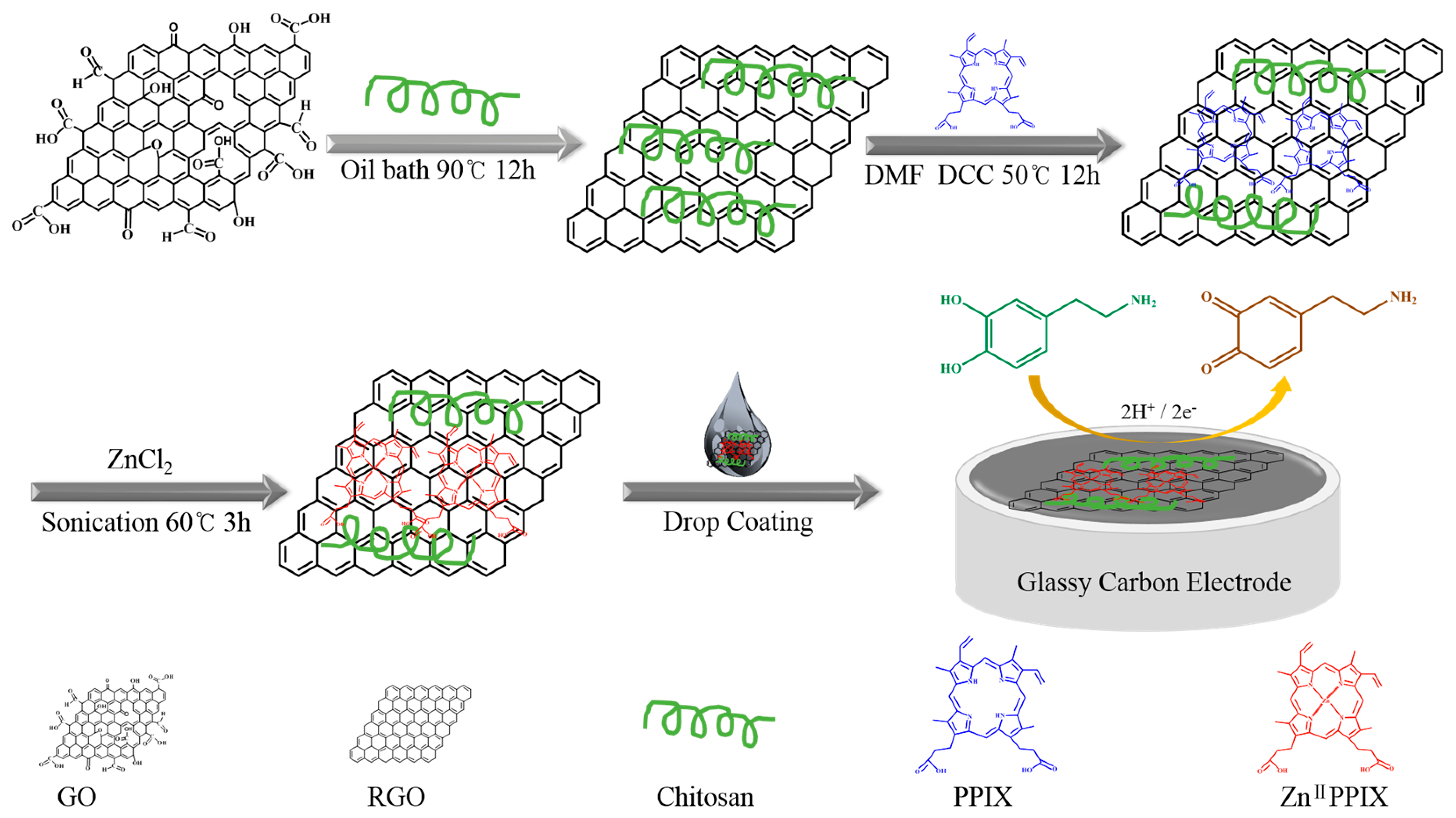
Ten microliters of each metal–organic nanocomposite material were dropped onto the freshly cleaned glassy carbon electrode surface and allowed to air-dry at room temperature for later use, labeled as Me-PPIX-CS-rGO/GCE (Me = Fe(III), Co(II), Ni(II), Cu(II), Zn(II), Mn(II)).The preparation process using Zn(II)-PPIX-CS-rGO/GCE as an example is shown in Figure 1.

2.3. Electrochemical Testing

All electrochemical tests in this study were carried out using a Potentiostat/Galvanostat 283A electrochemical workstation (equipped with M 270 data processing software, Microsoft Windows XP), employing a conventional three-electrode system. Different modified glassy carbon electrodes (Me-PPIX-CS-rGO/GCE) were used as the working electrodes, a platinum wire (φ = 1 mm) served as the counter electrode, and a saturated KCl-filled Ag/AgCl glass electrode was used as the reference electrode. Cyclic voltammetry (CV), differential pulse voltammetry (DPV), and other electrochemical analysis techniques were used to investigate the electrochemical catalytic performance of the prepared series of electrodes towards dopamine in a 0.1 M PBS system. All electrochemical tests were conducted at room temperature.

2.4. Sample Preparation Method for Sensing Interface Applicability

The DA samples came from commercial dopamine hydrochloride injections (specification: 2.0 mL 2.0 mg/vial) and were directly used for DA detection in this experiment. The serum samples were diluted human serum solutions, which were first diluted to 1% with 0.1 M PBS (pH 6.0) and centrifuged at 12,000 rpm and 4 °C for 30 min, and then the supernatant was filtered three times through a 0.2 μm microporous membrane and stored at 4 °C. Before testing, the samples were brought to room temperature.
All HPLC measurements were carried out on a Waters 1525 binary HPLC pump system (Milford, MA, USA), equipped with a Waters 717plus autosampler, a column heater, and a Waters 2996 photodiode array detector. Separation was achieved on a ZORBAX Eclipse Plus C18 column (4.6 × 150 mm, 5 μm) at 30 °C. The mobile phase consisted of methanol/0.1% formic acid in water delivered at a flow rate of 1.0 mL/min. The injection volume was 20 μL. A six-point external standard calibration curve was constructed using dopamine hydrochloride standard solutions (0.01–1.0 mM) freshly prepared in 0.1 M PBS (pH 6.0). The correlation coefficient (R2) was 0.9998.

3. Results and Discussion

3.1. Screening of Transition Metal Ions in Me-PPIX-CS-rGO Nanocomposites

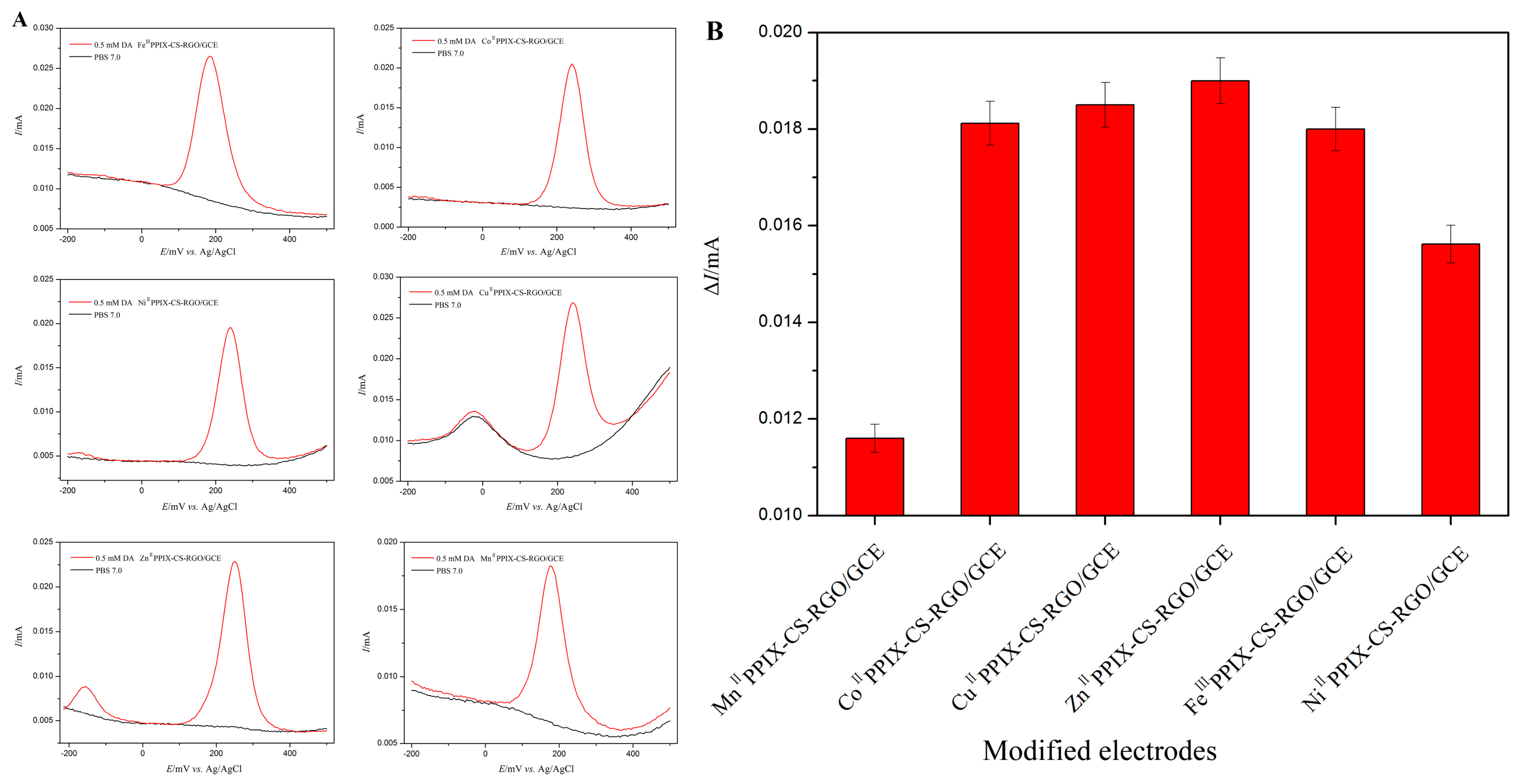
To screen for the transition metal ion with the best catalytic effect in the nanocomposite system proposed in this study, differential pulse voltammetry (DPV) was used to examine the electrochemical response of electrodes modified with different metal–organic complexes toward dopamine in 0.1 M PBS (pH 7.0).
The results are shown in Figure 2. As seen in Figure 2A, the six transition metal ions selected in this study all exhibit good catalytic effects on dopamine, with oxidation potentials around 200–250 mV. Among them, zinc ions show a peak around −150 mV, it is more reasonably interpreted as a DA-associated low-potential pre-wave/catalytic feature, arising from the interaction between DA and the Zn(II)-PPIX-CS-rGO interface, while copper ions have a Cu(I)/Cu(II) oxidation peak near 0 mV. Using the DPV voltammogram of the modified electrodes in 0.1 M PBS (pH 7.0) as the baseline, the corresponding current differences at the oxidation peak positions were obtained, as shown in Figure 2B. The figure indicates that the current difference corresponding to the oxidation peak for zinc ions is relatively large. Through one-way ANOVA analysis and post hoc multiple comparisons, the results showed F = 217.8, p < 0.001, indicating a very significant difference. Meanwhile, compared with other transition metal nanocomposites, the Zn(II)-PPIX-CS-rGO/GCE exhibits the highest response current. Therefore, zinc ions were chosen as the catalytic active center ion for the metal–organic nanocomposite constructed in this study.

3.2. Electrochemical Performance in the Potassium Ferricyanide System

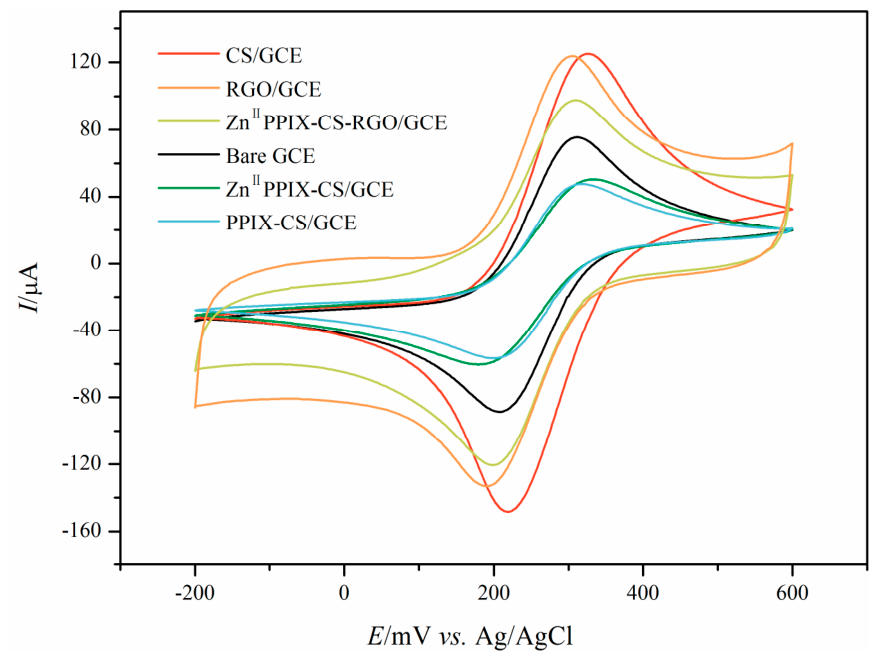
To further evaluate the influence of each component on the interfacial charge-transfer behavior and electroactive surface area, cyclic voltammetry was performed in the potassium ferricyanide system (Figure 3). Because [Fe(CN)6]3−/[Fe(CN)6]4− is a highly stable cyanoferrate redox couple, the enhanced current at CS/GCE maybe interpreted as dissociation of the complex followed by competitive Fe3+ chelation by chitosan. A more reasonable explanation is that protonated amino groups in chitosan provide positively charged sites that electrostatically accumulate the negatively charged [Fe(CN)6]3−/[Fe(CN)6]4− probe near the electrode surface, while the hydrated CS film also improves interfacial wettability and accessible electroactive area. After PPIX is coupled with CS through amide bonding, part of the amino groups are consumed and the organic layer becomes more compact, weakening ion accumulation and transport. When Zn(II)-PPIX-CS is combined with rGO, the current response increases because rGO supplies a high-conductivity pathway and a larger accessible surface area, rather than because of Fe3+ chelation by CS. Therefore, the conductivity trend in Figure 3 is attributed to electrostatic enrichment, film permeability, and rGO-mediated electron-transfer enhancement. The effective active area of different modified electrodes can be calculated using the Randles–Sevcik equation:
i p = 2.69 × 10 5 n 3 / 2 D 1 / 2 C 0 v 1 / 2 A e f f
In the formula, ip represents the peak current (μA); n represents the number of electrons transferred in the redox reaction, which is 1 in this case; D represents the molecular diffusion coefficient in the solution, which is (6.70 ± 0.02) × 10−6 cm2 s−1 here; C0 represents the concentration of probe molecules in the solution, which is 10 mol cm−3; v represents the scan rate, which is 50 mV s−1 in this case; Aeff corresponds to the effective active area of the modified electrode (cm2). The effective active area of Zn(II)-PPIX-CS-rGO/GCE is 1.29 times that of the bare electrode. It should be emphasized that the electroactive area estimated from the Randles–Sevcik equation should be interpreted with caution. Although the [Fe(CN)6]3−/[Fe(CN)6]4− redox couple is commonly used as a probe for glassy carbon electrodes, the reversibility of this redox process may be affected after surface modification. Therefore, the Aeff value obtained in this work should be regarded as an apparent electroactive area. Also, the result suggesting that the modified interface provides a larger accessible electroactive surface and enhances the probe response under the same experimental conditions. Ideal reversible electron transfer should be further evaluated using complementary methods to more accurately determine the electroactive surface area and charge-transfer behavior.

3.3. Characterization of Nanocomposites

3.3.1. FTIR Characterization

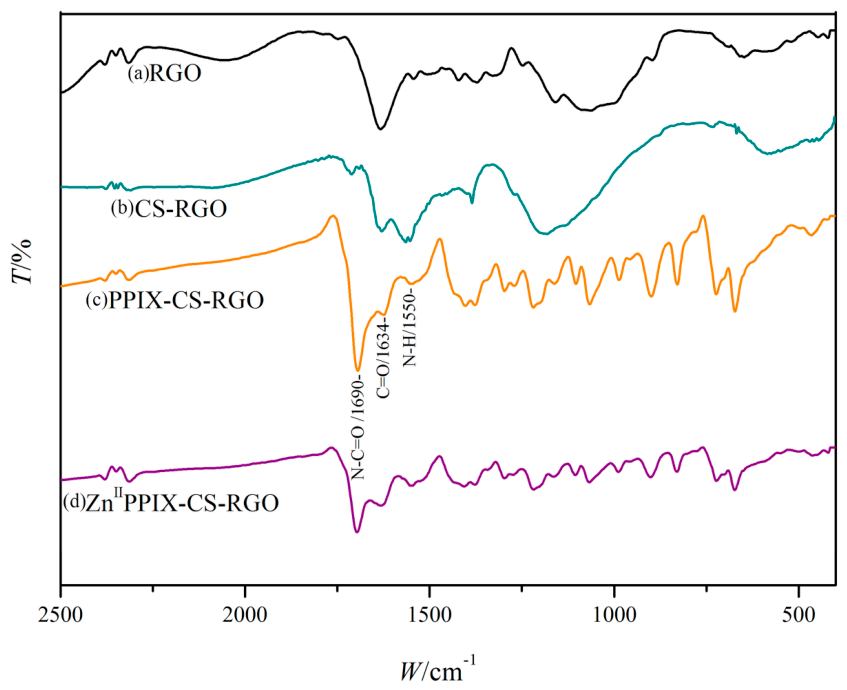
Figure 4 shows the FTIR spectra of several nanocomposites, including rGO, CS-rGO, PPIX-CS-rGO, and Zn(II)-PPIX-CS-rGO.
The peaks at 1550 cm−1, 1634 cm−1, and 1690 cm−1 correspond to the characteristic absorption bands of N-H, C=O, and N-C=O, respectively [28,29]. In curve a, the C=O absorption peak at 1634 cm−1 represents the oxygen-containing groups in rGO (mainly from carboxyl, carbonyl, and aldehyde groups); compared with curve a, the N-H peak at 1550 cm−1 in curve b originates from the amino groups in CS, indicating that CS has successfully modified the rGO [28,30,31]. Similarly, the N-C=O peak at 1690 cm−1 in curve d, compared with curve c, is generated by the amide bond formed between PPIX and CS, also indicating that PPIX has been successfully introduced into the CS-rGO composite. In curve d, all the above characteristic peaks are significantly reduced, which is presumably due to the chelation interaction between Zn2+ and PPIX affecting the absorption of other groups in the infrared spectrum. This also reflects the successful incorporation of Zn2+ into the PPIX-CS-rGO composite [32,33,34].

3.3.2. TEM and EDX Characterization

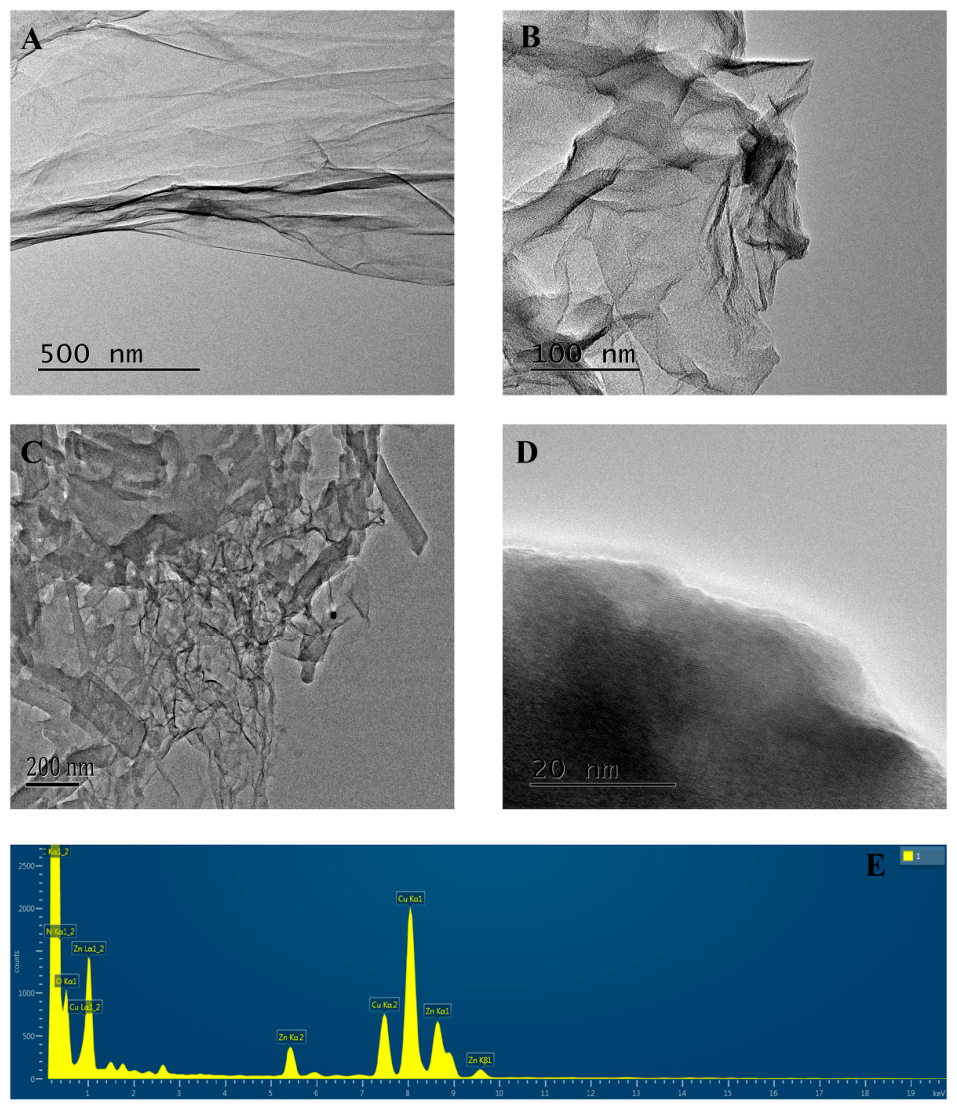
TEM images of GO (A), CS-rGO (B), and Zn(II)-PPIX-CS-rGO (C), and a locally enlarged image of Zn(II)-PPIX-CS-rGO shows in Figure 5.
In Figure 5A, the layered structure of GO can be clearly observed, while the morphology of rGO modified with CS (Figure 5B) does not show significant changes. When PPIX and Zn(II)-PPIX are introduced, under solid-phase conditions, part of PPIX and Zn(II)-PPIX forms amorphous crystals, with some dimensions reaching 50 × 200 nm, as shown in Figure 5C. Figure 5D shows a high-resolution local enlargement of Zn(II)-PPIX-CS-rGO, where a fuzzy CS layer covers the surface of the rGO sheets, while the lattice structure of rGO can still be clearly observed. Figure 5E shows the EDX spectrum of Zn(II)-PPIX-CS-rGO, where the N peak mainly originates from CS and PPIX, the Zn peak comes from the zinc ions chelated in Zn(II)-PPIX, and the Cu peak is generated by the copper TEM support grid. In summary, Zn(II)-PPIX-CS-rGO nanocomposites were successfully synthesized in this study.

3.4. Electrochemical Response of Dopamine to Zn(II)-PPIX-CS-rGO Nanocomposite

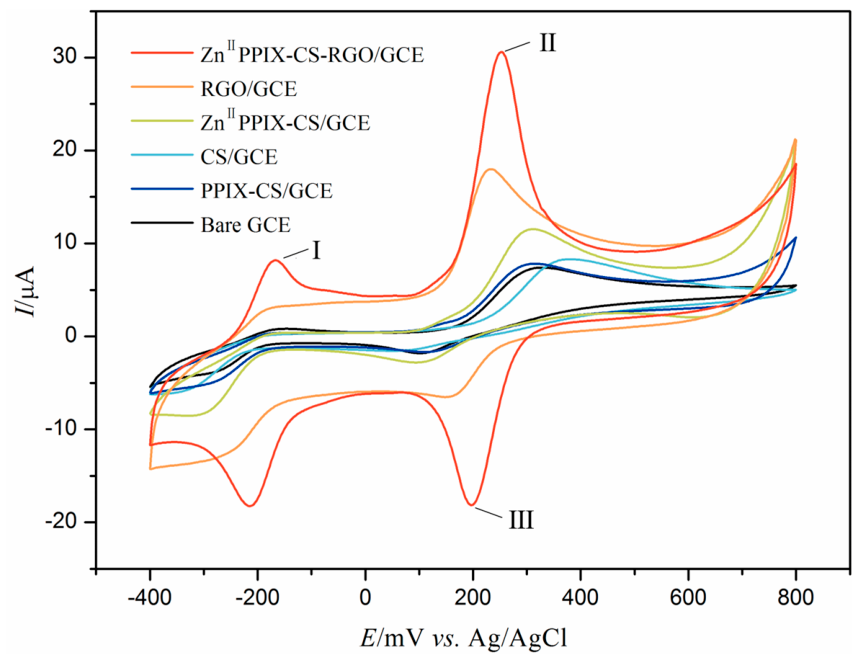
After screening zinc ions as the catalytically active center ions, in order to further investigate their crucial catalytic role in the nanocomposite materials, this experiment also examined the electrochemical response of dopamine (DA) to different composition methods among several components in the composite material [35,36], with the results shown in Figure 6.
For clarity, the principal voltametric features are labeled as peaks I–III in Figure 6: peak I corresponds to the low-potential redox feature associated with stepwise catechol hydroxyl oxidation/reduction, peak II corresponds to the main anodic oxidation of DA to dopamine-o-quinone, and peak III corresponds to the complementary cathodic response of the DA/dopamine-o-quinone redox couple. From the figure, it can be seen that bare glassy carbon electrodes, CS/GCE, and PPIX-CS/GCE have similar electrochemical responses to DA, with a relatively large oxidation peak potential appearing around 300 mV. This peak is produced by the simultaneous oxidation of the two phenolic hydroxyl groups in the DA molecule [37]. The corresponding reduction peak (100 mV) is relatively weak, indicating that DA undergoes a spontaneous oxidation process at the electrode surface potential at this time. At more negative potentials (−200/−300 mV), there is also a pair of relatively weak redox peaks, corresponding to the oxidation–reduction of a single phenolic hydroxyl group in the DA molecule. This also illustrates from another perspective that PPIX, as a ligand, and CS, as a support itself, do not have a catalytic effect on DA. When zinc ions are introduced into the PPIX-CS conjugated polymer, its response to dopamine is significantly enhanced, indicating that zinc ions indeed play a crucial catalytic role. As a supporting medium, rGO, due to its large specific surface area and good conductivity, can lead to a significant enrichment of DA on the electrode surface, so rGO/GCE exhibits a relatively high catalytic effect on dopamine. When rGO is combined with Zn(II)-PPIX-CS to form the composite material, an astonishing catalytic effect is shown, with a pair of symmetrical redox peaks appearing near −200 mV and 200 mV, indicating that at this time, DA undergoes a zinc ion-catalyzed reversible redox process on the electrode surface.

3.5. Influence of Scan Rate

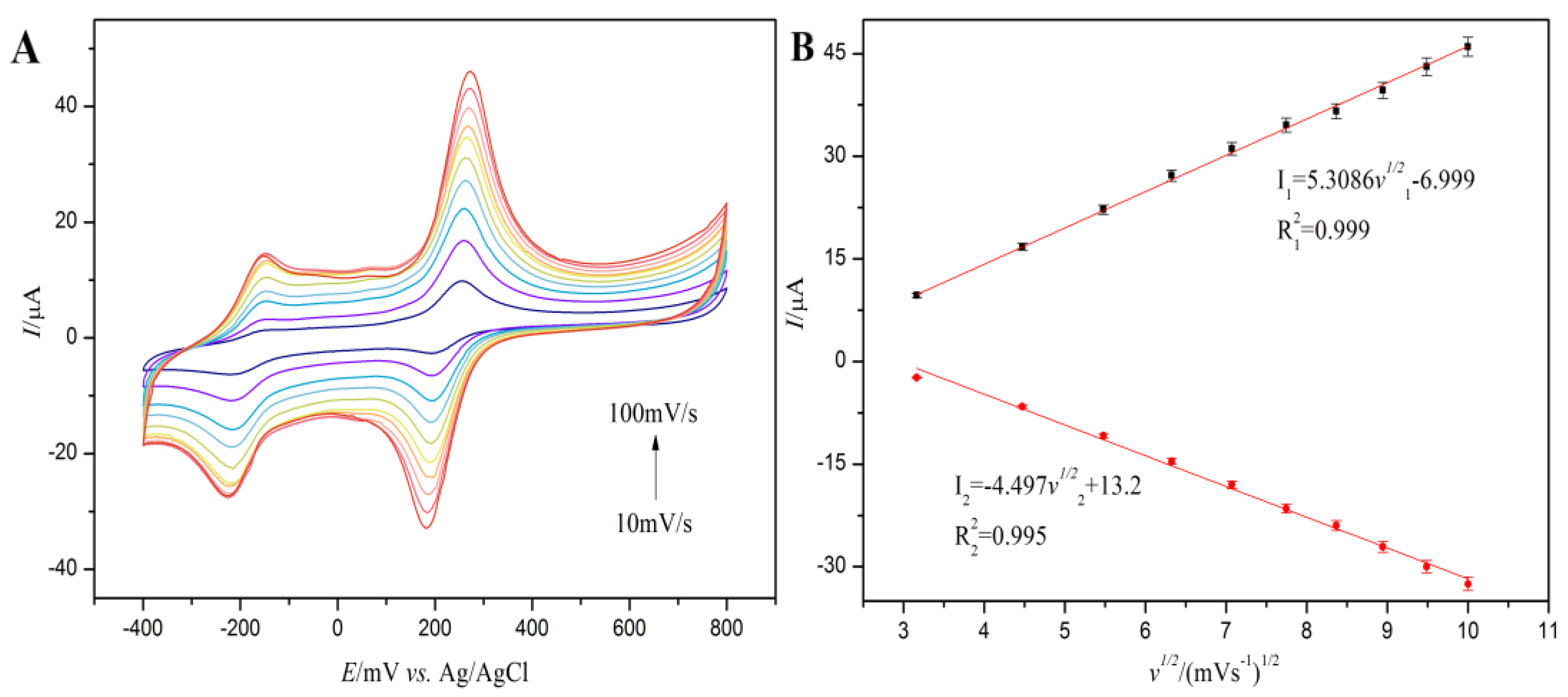
This experiment examined the electrochemical response of Zn(II)-PPIX-CS-rGO/GCE to dopamine at different scan rates. The results are shown in Figure 7.
As the scan rate increased, both the oxidation peak and the reduction peak currents increased correspondingly. By performing a linear fit of the larger redox peak currents against the square root of the scan rate, two linear regression equations were obtained. The linear regression equation for the oxidation current is I1 = 5.309v1/2 − 6.999 (R2 = 0.999), and the linear regression equation for the reduction current is I2 = −4.497v−1/2 + 13.200 (R2 = 0.995), indicating that the electrochemical redox of DA at this electrode surface is a diffusion-controlled process. The diffusion coefficient of DA can be calculated according to the equation as 6.1 × 10⁻⁷ cm2 s−1, with the value being consistent with previous reports for dopamine at carbon-based and chitosan-modified electrodes, where diffusion coefficients typically range from 5 × 10⁻⁷ to 2 × 10⁻⁶ cm2 s−1 [38,39,40].

3.6. Effect of pH Value

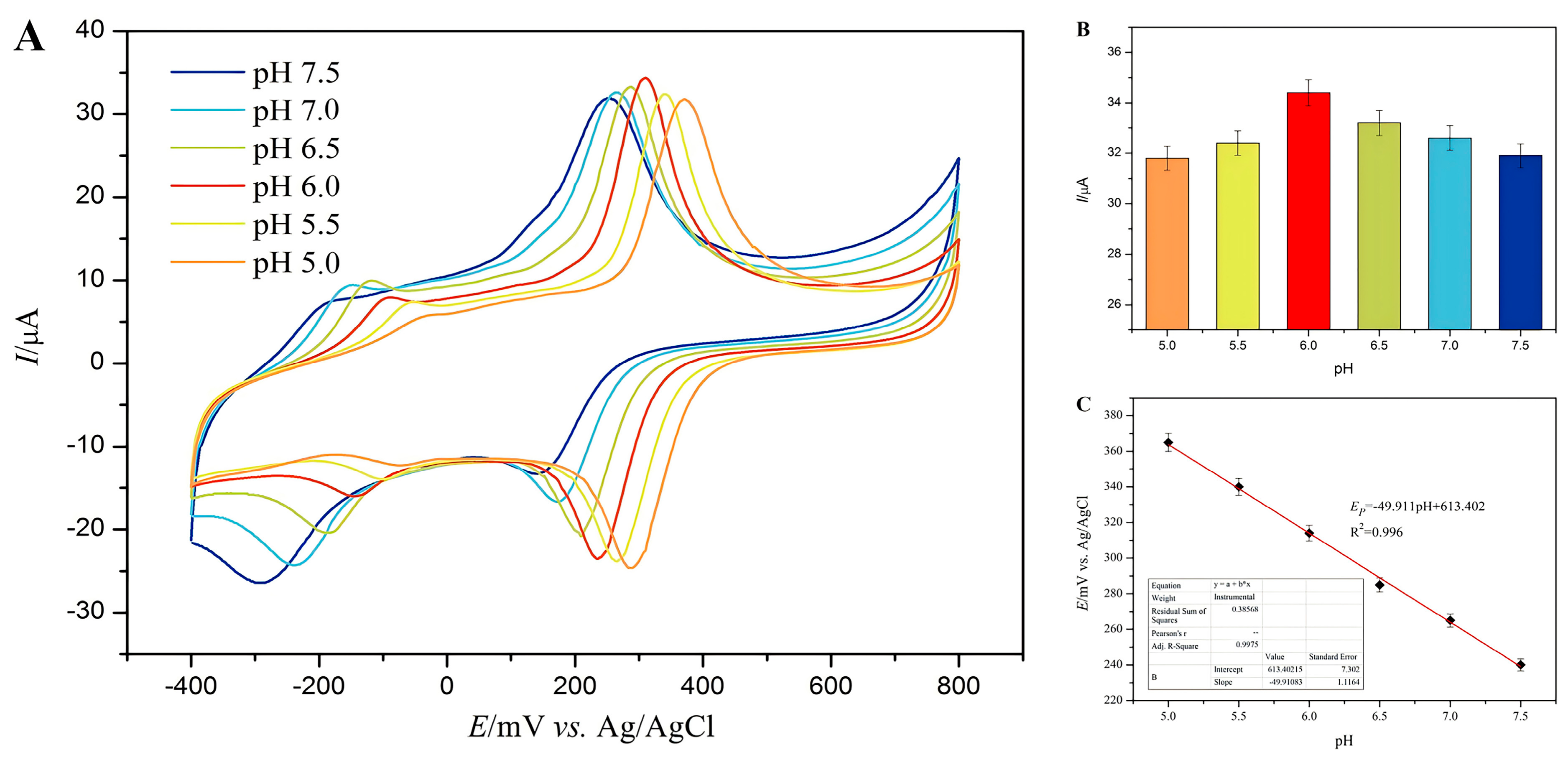
pH significantly affects the electrocatalytic oxidation behavior of dopamine. Cyclic voltammetry was used to explore the catalytic response of electrodes to dopamine under different pH conditions, so as to determine the optimal acidity for detection.
The redox activity of dopamine (DA) is greatly affected by pH. Within the pH range of 7–9, DA can undergo spontaneous oxidation. To investigate the optimal pH for catalytic oxidation of dopamine using the Zn(II)-PPIX-CS-rGO/GCE constructed in this study, the electrochemical response of DA was examined via cyclic voltammetry in the pH range of 5.0–7.5. The results are shown in Figure 8, where Figure 8A shows that the oxidation peak potential of DA shifts gradually toward negative potentials with decreasing pH, and the oxidation current reaches its maximum at pH 6.0 (Figure 8B). As discussed in the previous section, protons also participate in the electrocatalytic oxidation process of DA. Linear fitting of the oxidation peak potential of DA against pH gives the regression equation Ep = −49.911pH + 613.402 (R2 = 0.996) (Figure 8C). The slope of −49.911 mV is close to the theoretical Nernstian value of −59 mV·pH−1 (i.e., −0.059 V·pH−1) at 25 °C, which also indicates that the number of protons involved in the electrocatalytic oxidation of DA is equal to the number of electrons [41,42]. Therefore, pH 6.0 was chosen as the optimal reaction condition in this study.

3.7. Electrochemical Detection of Dopamine Using Zn(II)-PPIX-CS-rGO/GCE

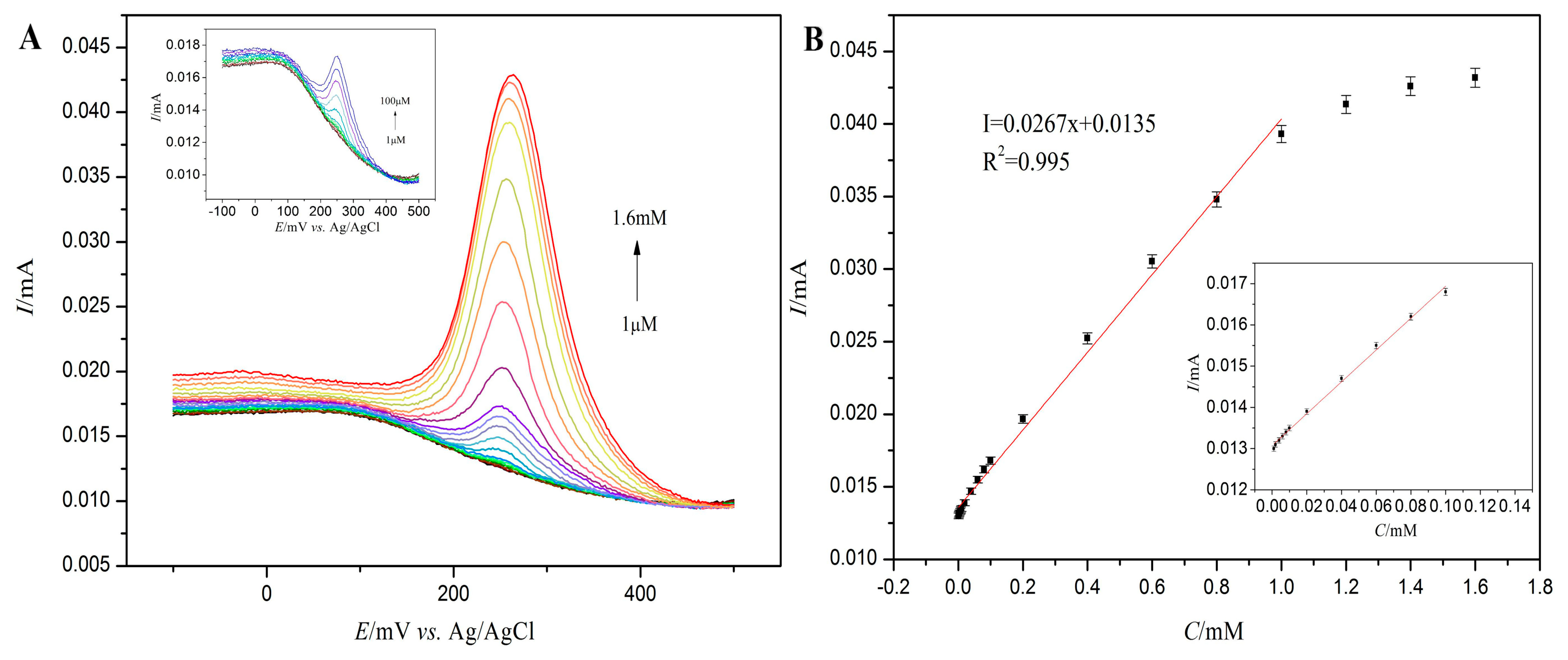
Differential pulse voltammetry was used to investigate the sensor’s response to dopamine at different concentrations, establish a quantitative detection method and evaluate the analytical performance. In this study, differential pulse voltammetry was used to evaluate the detection performance of the constructed non-enzymatic dopamine sensor (Zn(II)-PPIX-CS-rGO/GCE) toward DA in a 0.1 M PBS (pH 6.0) system. The results are shown in Figure 9.
This experiment investigated the electrocatalytic oxidation of DA on Zn(II)-PPIX-CS-rGO/GCE at 250 mV. As shown in Figure 9A, within a limited range, the oxidation peak current gradually increased with the increase in DA concentration, and a linear fit of the peak current versus DA concentration over the range of 0.001–1.0 mM yielded a linear regression equation: I = 0.0267x + 0.0135 (R2 = 0.995). Based on the slope of the linear regression equation, the sensitivity of the dopamine sensor constructed in this study was calculated as 0.30 mA mM−1 cm−2; additionally, the limit of detection (LOD) was calculated according to the standard method LOD = 3σ/S, where σ is the standard deviation of ten repeated measurements of the blank PBS solution, and S is the slope of the calibration curve. The calculated LOD was 0.05 μM at a signal-to-noise ratio of 3.
Table 1 compares the performance parameters of the Zn(II)-PPIX-CS-rGO/GCE constructed in this study with some previously reported non-enzymatic dopamine electrochemical sensors, showing that the sensor developed in this work that compared to some current reports exhibits a good detection range and a lower detection limit. However, there is still room for improvement in detection performance.

3.8. Evaluation of Reproducibility, Stability, Selectivity, and Applicability

The reproducibility and stability results were moved to the Supporting Information to reduce the number of main figures. As shown in Figure S1, five Zn(II)-PPIX-CS-rGO/GCE electrodes prepared by the same procedure gave similar DPV responses toward 0.5 mM DA in 0.1 M PBS (pH 6.0), with an oxidation peak-current RSD of 4.32%, indicating good fabrication reproducibility. As shown in Figure S2, the same Zn(II)-PPIX-CS-rGO/GCE retained 85.7% of its initial response after 90 days of storage, with measurements performed at 15-day intervals, demonstrating acceptable stability.
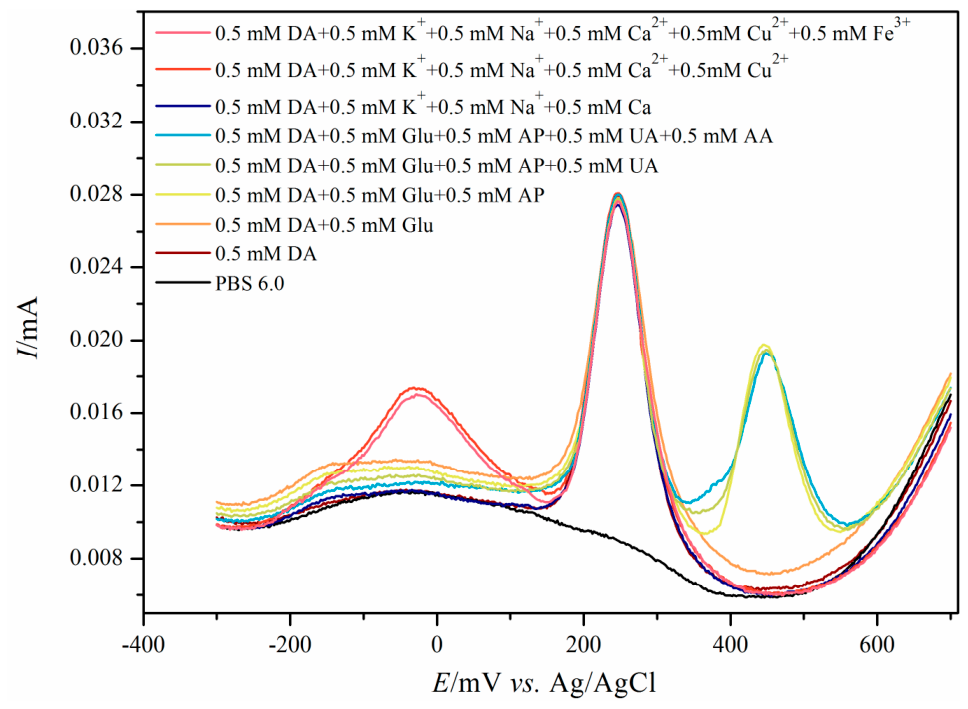
The selectivity of the sensor towards DA was evaluated by measuring the DPV response of DA in the presence of interfering substances at the same concentration, including glucose (Glu), acetaminophen (AP), uric acid (UA), ascorbic acid (AA), KCl, NaCl, CaCl2, CuCl2, and FeCl3. As shown in Figure 10, the tested ions, only Cu2+ shows an oxidation peak around 0 mV for Cu2+/Cu, but the presence of these ions has almost no interference on the response to DA. In addition, Glu has almost no effect on DA detection; UA and AP exhibited oxidation peaks at more positive potentials, which were separated from the DA oxidation peak under the present experimental conditions. AA is one of the most critical electroactive interferents in DA sensing. Under the tested condition, AA did not substantially interfere with the DA response at the Zn(II)-PPIX-CS-rGO/GCE, suggesting that the sensor possesses preliminary anti-interference capability against AA as well as the other tested interferents. However, this anti-interference evaluation still has limitations. The present study only examined a selected group of common interfering species under fixed concentration conditions, and the interference experiments were mainly conducted using individually added interferents. In real biological matrices, DA coexists with multiple electroactive and non-electroactive substances over broad concentration ranges, and the concentration of AA may vary substantially depending on the sample type and pretreatment procedure.
The applicability of the dopamine sensor developed in this study was evaluated by testing the recovery of DA in actual samples, and the results are shown in Table 2. As seen from the data in the table, the detection results of the DA sensor developed in this study are basically consistent with those of high-performance liquid chromatography (HPLC).The recovery of DA in actual samples ranged from 95.00% to 106.50%, with a relative standard deviation (RSD) of 2.97% to 5.01%. Also, an independent-samples t-test was used to compare the differences between the two methods. The results showed no statistically significant difference in dopamine detection results between the two methods (t = 0.356, p = 0.737), with these results indicating that the sensor has good applicability for the detection of DA in actual samples.

4. Conclusions

In this study, chitosan-reduced and -functionalized rGO was used as a support medium to synthesize a series of metal porphyrin–chitosan-rGO metal–organic nanocomposites. These were used as bio-sensitive materials to construct a series of enzyme-free working electrodes, and their electrocatalytic performance toward dopamine was investigated in a 0.1 M PBS system. Eventually, a zinc porphyrin-based nanocomposite was selected to construct a composite material centered on a “metalloporphyrin active center—chitosan interfacial bridging layer—reduced graphene oxide conductive backbone” and applied it to an enzyme-free dopamine electrochemical sensor, which exhibited efficient and specific catalysis for dopamine; compared with some previously reported enzyme-free dopamine sensors, it demonstrated a wider detection range, and good detection limit. Based on good repeatability, stability, and selectivity, the sensor also showed applicability in detecting real samples, indicating its potential for practical applications.

Supplementary Materials

The following supporting information can be downloaded at: https://www.mdpi.com/article/10.3390/chemosensors14060127/s1, Figure S1: Reproducibility of Zn(II)-PPIX-CS-rGO/GCE for DA detection. DPV responses of 0.5 mM DA recorded using five independently prepared Zn(II)-PPIX-CS-rGO/GCE electrodes in 0.1 M PBS (pH 6.0). Potential range: −100 to 500 mV vs. Ag/AgCl. The RSD of the oxidation peak current was 4.32% (n = 5); Figure S2: Storage stability of Zn(II)-PPIX-CS-rGO/GCE for DA detection. Response currents of the same Zn(II)-PPIX-CS-rGO/GCE toward 0.5 mM DA in 0.1 M PBS (pH 6.0), measured every 15 days over 90 days. Error bars represent ± standard deviation (n = 5).

Author Contributions

Conceptualization, B.H. and Y.C.; methodology, X.R.; validation, Y.Z. and Y.Q.; formal analysis, M.Z.; data curation, R.W.; writing—original draft preparation, X.R.; writing—review and editing, W.L. and A.C.; project administration, B.H. All authors have read and agreed to the published version of the manuscript.

Funding

This research was funded by Tianjin University of Sport Young Faculty Research Support Program.

Institutional Review Board Statement

Not applicable.

Informed Consent Statement

Not applicable.

Data Availability Statement

The original contributions presented in this study are included in the article/Supplementary Material. Further inquiries can be directed to the corresponding author(s).

Acknowledgments

Bingkai Han performed the experiments and analyzed the data, Xiangyu Ren proposed the fabrication methods and wrote the manuscript; Liu Lifang and Rundong Wang performed the morphological analysis; Yiru Zhang, Wenhao Liao and Anjie Cao contributed reagents/materials/analysis tools. Mengjin Zhai and Yukun Qin proposed the fabrication methods, Yuan Chen, Xiangyu Ren and Liu Lifang performed the experiments and Editing.

Conflicts of Interest

The authors declare no conflicts of interest.

References

  1. Beaulieu, J.M.; Gainetdinov, R.R. The physiology, signaling, and pharmacology of dopamine receptors. Pharmacol. Rev. 2011, 63, 182–217. [Google Scholar] [CrossRef]
  2. Juárez Olguín, H.; Calderón Guzmán, D.; Hernández García, E.; Barragán Mejía, G. The role of dopamine and its dysfunction as a consequence of oxidative stress. Oxid. Med. Cell. Longev. 2016, 2016, 9730467. [Google Scholar] [CrossRef]
  3. Bicker, J.; Fortuna, A.; Alves, G.; Falcão, A. Liquid chromatographic methods for the quantification of catecholamines and their metabolites in several biological samples—A review. Anal. Chim. Acta 2013, 768, 12–34. [Google Scholar] [CrossRef]
  4. Bucher, E.S.; Wightman, R.M. Electrochemical analysis of neurotransmitters. Annu. Rev. Anal. Chem. 2015, 8, 239–261. [Google Scholar] [CrossRef] [PubMed]
  5. Mondal, R.; Mukherjee, N.; Ahmed, S.F. A comprehensive review on the enzyme-free electrochemical dopamine sensing: Development and challenges since inception. Inorg. Chem. Commun. 2025, 178, 114449. [Google Scholar] [CrossRef]
  6. Kamal Eddin, F.B.; Wing Fen, Y. Recent advances in electrochemical and optical sensing of dopamine. Sensors 2020, 20, 1039. [Google Scholar] [CrossRef]
  7. Shao, S.; Zhang, J.; Deng, K.-Q.; Yang, J.; Yang, S.-M. Detection of Dopamine by Enzyme-Free Sensor Constructed by Nickel-Cobalt Bimetallic-porphyrin Organic Framework Composites. Chin. J. Appl. Chem. 2022, 39, 1098–1107. [Google Scholar] [CrossRef]
  8. An, N.; Su, N.; Li, X.-R.; Liu, J.-Y.; Wang, Q.-Y. Study on Dopamine Electrochemical Sensing Based on Au@MoS2. J. Electrochem. 2025, 31, 2407241. [Google Scholar] [CrossRef]
  9. Jackowska, K.; Krysinski, P. New trends in the electrochemical sensing of dopamine. Anal. Bioanal. Chem. 2013, 405, 3753–3771. [Google Scholar] [CrossRef]
  10. Sajid, M.; Nazal, M.K.; Mansha, M.; Alsharaa, A.; Jillani, S.M.S.; Basheer, C. Chemically modified electrodes for electrochemical detection of dopamine in the presence of uric acid and ascorbic acid: A review. TrAC Trends Anal. Chem. 2016, 76, 15–29. [Google Scholar] [CrossRef]
  11. Balkourani, G.; Brouzgou, A.; Tsiakaras, P. A review on recent advancements in electrochemical detection of dopamine using carbonaceous nanomaterials. Carbon 2023, 213, 118281. [Google Scholar] [CrossRef]
  12. Shao, Y.; Wang, J.; Wu, H.; Liu, J.; Aksay, I.A.; Lin, Y. Graphene based electrochemical sensors and biosensors: A review. Electroanalysis 2010, 22, 1027–1036. [Google Scholar] [CrossRef]
  13. Rinaudo, M. Chitin and chitosan: Properties and applications. Prog. Polym. Sci. 2006, 31, 603–632. [Google Scholar] [CrossRef]
  14. Badminton, M.N. From chemistry to genomics: A concise history of the porphyrias. Liver Int. 2024, 44, 2144–2155. [Google Scholar] [CrossRef] [PubMed]
  15. Montmeat, P.; Madonia, S.; Pasquinet, E.; Hairault, L.; Gros, C.; Barbe, J.-M.; Guilard, R. Metalloporphyrins as sensing material for quartz-crystal microbalance nitroaromatics sensors. IEEE Sens. J. 2005, 5, 610–615. [Google Scholar] [CrossRef]
  16. Gilardi, G.; Di Nardo, G. Heme iron centers in cytochrome P450: Structure and catalytic activity. Rend. Lincei 2017, 28, 159–167. [Google Scholar] [CrossRef]
  17. Basova, T. Phthalocyanine and Porphyrin Derivatives and Their Hybrid Materials in Optical Sensors Based on the Phenomenon of Surface Plasmon Resonance. Chemosensors 2024, 12, 56. [Google Scholar] [CrossRef]
  18. Bouicha, M.A.; Mabrouk, C.; Gassoumi, B.; Barhoumi, H.; Molton, F.; Loiseau, F.; Roisnel, T.; Medina, A.S.; Cornejo Bravo, J.M.; Lopez-Maldonado, E.A.; et al. New zinc(ii) metalloporphyrin: Molecular structure, spectroscopic characterization, electrochemical sensing of dopamine, and catalytic dye degradation. RSC Adv. 2025, 15, 9810–9827. [Google Scholar] [CrossRef]
  19. De Oliveira, I.; Pereira, J.V.D.; Pereira, E.C.d.S.; de Souza, M.S.; Cazetta, M.L.; da Cruz Neto, C.C.; da Silva Santana, V.; Araújo Pinto, V.H.; Rebouças, J.S.; da Silva Martins, D.C.; et al. Degradation of Dyes Catalyzed by Aminophenyl-Substituted Mn-Porphyrin Immobilized on Chloropropyl Silica Gel and Evaluation of Phytotoxicity. ACS Omega 2024, 9, 29516–29528. [Google Scholar] [CrossRef]
  20. El-Khalafy, S.H.; Hassanein, M.T.; Salahuddin, N.A.; Alaskary, M.M. Efficient oxidative degradation of Azo dyes by cobalt(II) porphyrin complex supported on modified bentonite and chitosan: Structural characterization and mechanistic insight. Sci. Rep. 2025, 15, 34282. [Google Scholar] [CrossRef]
  21. Wang, L.; Yang, H.; He, J.; Zhang, Y.; Yu, J.; Song, Y. Cu-Hemin Metal-Organic-Frameworks/Chitosan-Reduced Graphene Oxide Nanocomposites with Peroxidase-Like Bioactivity for Electrochemical Sensing. Electrochim. Acta 2016, 213, 691–697. [Google Scholar] [CrossRef]
  22. Wu, L.; Feng, L.; Ren, J.; Qu, X. Electrochemical detection of dopamine using porphyrin-functionalized graphene. Biosens. Bioelectron. 2012, 34, 57–62. [Google Scholar] [CrossRef]
  23. Lv, M.; Mei, T.; Zhang, C.; Wang, X. Selective and sensitive electrochemical detection of dopamine based on water-soluble porphyrin functionalized graphene nanocomposites. RSC Adv. 2014, 4, 9261–9270. [Google Scholar] [CrossRef]
  24. Ma, J.; Bai, W.; Liu, X.; Zheng, J. Electrochemical dopamine sensor based on bi-metallic Co/Zn porphyrin metal–organic framework. Microchim. Acta 2022, 189, 20. [Google Scholar] [CrossRef]
  25. Ji, L.; Wang, Q.; Gong, X.; Chen, J.; Zhu, X.; Li, Z.; Hu, P. Ultrasensitive and simple dopamine electrochemical sensor based on the synergistic effect of Cu-TCPP frameworks and graphene nanosheets. Molecules 2023, 28, 2687. [Google Scholar] [CrossRef] [PubMed]
  26. Yan, R.; Zhao, Y.; Geng, H.; Yan, M.; Wang, J.; Han, S. Electrochemical sensor capable of enhancing dopamine sensitivity based on micron-sized metal–organic frameworks. Biosensors 2025, 15, 348. [Google Scholar] [CrossRef] [PubMed]
  27. Guo, Y.; Sun, X.; Liu, Y.; Wang, W.; Qiu, H.; Gao, J. One pot preparation of rGO or Au (Ag) nanoparticle-rGO hybrids using chitosan as a reducing and stabilizing agent and their use in methanol electrooxidation. Carbon 2012, 50, 2513–2523. [Google Scholar] [CrossRef]
  28. Elhami, N.; Pazhang, M.; Beygi-khosrowshahi, Y.; Dehghani, A. Development of nanocomposites based on chitosan/rGO for wound healing application. Int. J. Biol. Macromol. 2024, 258, 128832. [Google Scholar] [CrossRef] [PubMed]
  29. Alharbi, Y.R.; Popoola, S.A.; Altaleb, H.A.; Fathalla, M. A facile synthesis of porphyrin–chitosan conjugate and its application for removing methyl orange and heavy metals from polluted water. J. Taibah Univ. Sci. 2025, 19, 2559475. [Google Scholar] [CrossRef]
  30. Gou, H.; He, J.; Nie, R.; Xu, D.; Rao, H.; Zhao, G. A stable electrochemical chiral interface based on graphene–chitosan composites for tyrosine enantiomers recognition. Microchem. J. 2023, 190, 108712. [Google Scholar] [CrossRef]
  31. Ren, Z.; Li, H.; Li, J.; Cai, J.; Zhong, L.; Ma, Y.; Pang, Y. Green synthesis of rGO/chitosan/gold nanoparticles composites and their catalytic activity for reduction of 4-nitrophenol. Int. J. Biol. Macromol. 2023, 229, 732–745. [Google Scholar] [CrossRef]
  32. Salamon, J.; Simi, A.; Prabu, H.J.; Sahayaraj, A.F.; Kennedy, A.J.S.; Johnson, I. Synthesis and characterization of rGO-ZnO/Elwendia persica seed reinforced hybrid nanocomposite for high-performance supercapacitor applications. J. Inorg. Organomet. Polym. Mater. 2024, 35, 342–355. [Google Scholar] [CrossRef]
  33. Kant, R.; Ahuja, V.; Joshi, K.; Gupta, H.; Bhardwaj, S. Tuning the dielectric characteristics and energy storage properties of Ni-ZnO/rGO nanocomposite. Vacuum 2022, 204, 111375. [Google Scholar] [CrossRef]
  34. Srirattanapibul, S.; Tang, I.M.; Thongmee, S. Photocatalytic reduction of Cr6+ by ZnO decorated on rGO nanocomposites. Mater. Res. Bull. 2020, 122, 110705. [Google Scholar] [CrossRef]
  35. Amanat, M.; Shahzadi, T.; Riaz, T.; Zaib, M.; Nawaz, F.; Tawfeek, A.M.; Khawar, M.R.; Park, S.J.; Choi, D. Enhanced catalytic degradation of amoxicillin by phyto-mediated synthesised ZnO NPs and ZnO-rGO hybrid nanocomposite: Assessment of antioxidant activity, adsorption, and thermodynamic analysis. Nanotechnol. Rev. 2024, 13, 20230189. [Google Scholar] [CrossRef]
  36. Zhang, H.; Qu, H.; Cui, J.; Duan, L. A simple electrochemical immunosensor based on a chitosan/rGO nanocomposite for sensitive detection of biomarkers of malignant melanoma. RSC Adv. 2022, 12, 25844–25851. [Google Scholar] [CrossRef] [PubMed]
  37. Hamid, F.H.; Rasyid, F.R.; Mashuni, M.; Ahmad, L.O.; Jahiding, M. Enhanced rGO/ZnO/chitosan nanozyme photocatalytic technology for efficient degradation of diazinon pesticide contaminated water. Adsorption 2024, 31, 22. [Google Scholar] [CrossRef]
  38. Liu, C.-Y.; Chou, Y.-C.; Tsai, J.-H.; Huang, T.-M.; Chen, J.-Z.; Yeh, Y.-C. Tyrosinase/Chitosan/Reduced Graphene Oxide Modified Screen-Printed Carbon Electrode for Sensitive and Interference-Free Detection of Dopamine. Appl. Sci. 2019, 9, 622. [Google Scholar] [CrossRef]
  39. Begum, H.; Ahmed, M.S.; Jeon, S. New Approach for Porous Chitosan-Graphene Matrix Preparation through Enhanced Amidation for Synergic Detection of Dopamine and Uric Acid. ACS Omega 2017, 2, 3043–3054. [Google Scholar] [CrossRef]
  40. Lopes, A.G.R.; Silva, R.M.; Fatibello-Filho, O.; Silva, T.A. Electrochemical Sensing of Dopamine Neurotransmitter by Deep Eutectic Solvent–Carbon Black–Crosslinked Chitosan Films: Charge Transfer Kinetic Studies and Biological Sample Analysis. Chemosensors 2015, 13, 254. [Google Scholar] [CrossRef]
  41. Chen, H.; You, Z.; Hong, Y.; Wang, X.; Zhao, M.; Luan, Y.; Ying, Y.; Wang, Y. Gas-responsive two-dimensional metal–organic framework composites for trace visualization of volatile organic compounds. Biosens. Bioelectron. 2024, 245, 115826. [Google Scholar] [CrossRef]
  42. Van Duy, L.; Thi Nguyet, T.; Hung, C.M.; Van Duy, N.; Hoa, N.D.; Catini, A.; Magna, G.; Paolesse, R.; Biasioli, F.; Tonezzer, M.; et al. Light-assisted room temperature ammonia gas sensor based on porphyrin-coated V2O5 nanosheets. Sens. Actuators B Chem. 2024, 409, 135–582. [Google Scholar] [CrossRef]
  43. Koch, M.; Caparrotti, H.; Pauly, C.; Janka, O.; Erzina, M.; Silina, Y. One-step Pd-NPs/tyrosinase/Nafion biosensor for dopamine detection in the low μM range: ORR interference, defect-rich surface chemistry effects, and sensing pathway differentiation. Sens. Bio Sens. Res. 2026, 51, 100942. [Google Scholar] [CrossRef]
  44. Liu, Z.F.; Wang, X.Y.; Wei, Y.H.; Xie, W.; Li, S.; Chen, Z. Photothermal enhanced biosensing platform of Fe3O4@CS-Au-Lac for dopamine detection. Microchem. J. 2024, 198, 110094. [Google Scholar] [CrossRef]
  45. Manimekalai, K.; Nadar, N.R.; Deepak, J.; Santhanalakshmi, P.; Sharma, S.; Krushna, B.R.; Sahu, S.; Akila, K.; Kumar, V.K. Copper-doped NiAl2O4 nanoparticles for enhanced electrochemical dopamine sensing: A novel approach for biosensor development. J. Indian Chem. Soc. 2026, 103, 102513. [Google Scholar] [CrossRef]
  46. Wang, C.C.; Zhang, Y.; Liu, Y.Y.; Zeng, X.; Jin, C.; Huo, D.; Hou, J.; Hou, C. A wearable flexible electrochemical biosensor with CuNi-MOF@rGO modification for simultaneous detection of uric acid and dopamine in sweat. Anal. Chim. Acta 2024, 1299, 342441. [Google Scholar] [CrossRef] [PubMed]
  47. Xu, C.H.; Gu, C.C.; Xiao, Q.; Chen, J.; Yin, Z.-Z.; Liu, H.; Fan, K.; Li, L. A highly selective and sensitive biosensor for dopamine based on a surface molecularly imprinted layer to coordinate nano-interface functionalized acupuncture needle. Chem. Eng. J. 2022, 436, 135203. [Google Scholar] [CrossRef]
Figure 1. Schematic illustration of CS-assisted reduction/functionalization of GO to CS-rGO, amide coupling with PPIX, Zn(II) metallization, and drop-casting of Zn(II)-PPIX-CS-rGO onto a GCE (φ = 3 mm) to prepare the Zn(II)-PPIX-CS-rGO/GCE sensing interface.
Chemosensors 14 00127 g001
Figure 2. (A) Differential pulse voltammograms of 0.5 mM DA (red) and 0.1 M PBS (pH 7.0) corresponding blank PBS baseline (black) with Mn(II)-, Co(II)-, Cu(II)-, Zn(II)-, Fe(III)-, and Ni(II)-PPIX-CS-rGO/GCE different modified electrodes. (B) Comparison of the oxide peak currents, error bars = ±standard deviation, n = 5.
Chemosensors 14 00127 g002
Figure 3. Cyclic voltammograms of 10 mM K3[Fe(CN)6] at bare GCE, rGO/GCE, CS/GCE, PPIX-CS/GCE, Zn(II)-PPIX-CS/GCE and Zn(II)-PPIX-CS-rGO/GCE recorded in 0.1 M KCl (pH 7.0). Scan rate: 50 mV s−1, scan area: −200~600 mV.
Chemosensors 14 00127 g003
Figure 4. FTIR spectra of rGO (a), CS-rGO (b), PPIX-CS-rGO (c) and Zn(II)-PPIX-CS-rGO (d).
Chemosensors 14 00127 g004
Figure 5. TEM images of GO (A), CS-rGO (B), and Zn(II)-PPIX-CS-rGO (C), high-resolution TEM image of Zn(II)-PPIX-CS-rGO (D), and EDX spectrum of Zn(II)-PPIX-CS-rGO with the scanned area shown in the inset (E). Scale bars are shown in the corresponding images.
Chemosensors 14 00127 g005
Figure 6. Cyclic voltammograms of 0.5 mM DA recorded at bare GCE, rGO/GCE, CS/GCE, PPIX-CS/GCE, Zn(II)-PPIX-CS/GCE, and Zn(II)-PPIX-CS-rGO/GCE in 0.1 M PBS (pH 6.0). scan rate: 50 mV s−1; potential window: −400 to 800 mV vs. Ag/AgCl. Peaks I–III are marked in the cyclic voltammogram of Zn(II)-PPIX-CS-rGO/GCE to match the discussion.
Chemosensors 14 00127 g006
Figure 7. (A) Cyclic voltammograms of 0.5 mM DA at Zn(II)-PPIX-CS-rGO/GCE in 0.1 M PBS (pH 6.0) at scan rates from 10 to 100 mV s−1; potential window: −400 to 800 mV vs. Ag/AgCl. (B) Linear fitting curves of oxidation and reduction peak currents versus v1/2. Error bars = ±standard deviation, n = 5.
Chemosensors 14 00127 g007
Figure 8. (A) Cyclic voltammograms of 0.5 mM DA at Zn(II)-PPIX-CS-rGO/GCE in 0.1 M PBS with pH values from 5.0 to 7.5; (B) oxidation peak currents at different pH values; (C) dependence of DA oxidation peak potential on pH. Scan rate: 50 mV s−1; potential window: −400 to 800 mV vs. Ag/AgCl; error bars = ±standard deviation, n = 5.
Chemosensors 14 00127 g008
Figure 9. (A) Differential pulse voltammograms of DA in a 0.1 M PBS (pH 6.0) at the Zn(II)-PPIX-CS-rGO/GCE in a series of concentrations. Scan area: −100~500 mV. (B) The linear fitting curve between response current and DA concentrations. Inset shows the lower concentration parts. Error bars = ±standard deviation, n = 5.
Chemosensors 14 00127 g009
Figure 10. Anti-interference DPV responses of Zn(II)-PPIX-CS-rGO/GCE toward 0.5 mM DA in 0.1 M PBS (pH 6.0) in the absence and presence of 0.5 mM Glu, AP, UA, AA, KCl, NaCl, CaCl2, CuCl2, and FeCl3.
Chemosensors 14 00127 g010
Table 1. Comparison of analytical parameters between Zn(II)-PPIX-CS-rGO/GCE and the electrochemical sensors previously reported by others.
Electrode MaterialElectrochemical TechniqueLiner Range (mM)LOD (μM)Sensitivity
(mA mM−1 cm−2)
Reference
Pd-NPs/Tyrosinase/NafionCV0.001–0.0150.21.817[43]
Fe3O4@CS-Au-LacDPV0.001~10.79-[44]
Copper-doped NiAl2O4 MCPEDPV0.001~0.70.4-[45]
CuNi-MOF@rGOCV0.001~0.59.410.019[46]
MIP/4-MPBA/AuNPs/ANEDPV0.005~10.14-[47]
Zn(II)-PPIX-CS-rGO/GCEDPV0.001~1.00.050.30 This work
Table 2. Recovery test of DA in real-life samples by Zn(II)-PPIX-CS-rGO/GCE.
SampleHPLC Detected (mM)Present Method (mM)RSD (%)DA Added (mM)DA Found (mM)Recovery (%)RSD (%)
DA sample 10.1280.1193.410.10.221102.003.97
DA sample 20.1070.0974.520.20.310106.503.65
DA sample 30.1160.1252.970.30.41797.334.32
Serum sample 1---0.10.09595.005.01
Serum sample 2---0.20.207103.502.99
Serum sample 3---0.30.29698.673.47
Disclaimer/Publisher’s Note: The statements, opinions and data contained in all publications are solely those of the individual author(s) and contributor(s) and not of MDPI and/or the editor(s). MDPI and/or the editor(s) disclaim responsibility for any injury to people or property resulting from any ideas, methods, instructions or products referred to in the content.