Article

Preparation and Application of Hydrophobic Plasmonic Filter Paper for Detecting Pesticides in Edible Oil by Raman Spectroscopy


1
College of Science, Liaoning Petrochemical University, Fushun 113001, China
2
School of Petrochemical Engineering, Liaoning Petrochemical University, Fushun 113001, China
3
PetroChina Fushun Petrochemical Company Institute, Fushun 113000, China
4
Center for Fluorescence Spectroscopy, Department of Biochemistry and Molecular Biology, University of Maryland School of Medicine, 721 West Lombard St., Baltimore, MD 21201, USA
*
Authors to whom correspondence should be addressed.
Chemosensors 2026, 14(5), 106; https://doi.org/10.3390/chemosensors14050106
Submission received: 7 March 2026 / Revised: 12 April 2026 / Accepted: 28 April 2026 / Published: 1 May 2026

Abstract

A flexible paper-based surface-enhanced Raman scattering substrate with a hydrophobic surface was fabricated through a simple route. The Ag nanoparticle was modified on filter paper through the in situ growth method. The hydrophobic filter paper/Ag substrate was prepared via soaking in 10−8 g/mL of 1-dodecanethiol with a 12 h growth time. The hydrophobic filter paper/Ag substrate exhibits excellent flexibility and hydrophobic properties with a contact angle of 130.2°. The diffusion of the aqueous solution was significantly suppressed on the hydrophobic filter paper/Ag substrate. The hydrophobic filter paper/Ag substrate could simultaneously improve the SERS signal and fluorescence of the analyte, and that was successfully used for detecting thiram from edible oil with a limit of detection at 1.8 × 10⁻⁸ M and monitoring melamine in aqueous solution. The hydrophobic filter paper/Ag substrate is a flexible, economical, and convenient method for detecting harmful ingredients from oil by SERS.

1. Introduction

Surface-enhanced Raman scattering (SERS) spectroscopy is an important analytical tool [1,2]. The SERS method was developed in recent decades with the emergence of nanotechnology, which could provide molecular information of the target down to the single-molecule level [3,4,5]. Currently, two mechanisms are widely recognized to synergistically contribute to the SERS enhancement effect: the electromagnetic (EM) enhancement effect and the chemical (CM) enhancement effect [6,7], among which the EM effect plays a dominant role [8,9]. Therefore, the fabrication of high-performance substrates is the core determinant in SERS technology. Conventional rigid SERS substrates, such as glass, silicon, and quartz, have inherent limitations in practical food safety analysis. For example, they can only come into close contact with flat or regularly shaped samples, while for irregular food substrates, such as curved fruit peels, porous oil-contaminated materials, and uneven food surfaces, rigid substrates cannot tightly adhere to the sample surface. This results in incomplete adsorption of target analytes, reduced efficiency of hotspot utilization, and thus affects detection sensitivity. In contrast, flexible paper-based SERS substrates exhibit excellent foldability, shape variability, and biocompatibility [10], which effectively overcome the disadvantages of rigid substrates and have significant advantages in practical food safety testing [11].
Cellulose is a natural polymer that can be degraded by microorganisms in soil or wastewater into non-toxic small molecules without causing secondary pollution. Meanwhile, the three-dimensional porous network structure of filter paper provides an ideal support for the uniform deposition of metal nanoparticles, and the micro-wrinkling of cellulose fibers can further increase the number of hotspots, which is extremely beneficial for improving SERS performance [12,13,14]. Therefore, the cellulose-based filter paper shows potential in SERS substrate [15,16,17,18]. At present, there are many methods for preparing paper-based SERS substrates by depositing filter paper with metallic NPs, such as in situ synthesis [19,20], inkjet printing [21,22], and self-assembly [23,24]. Although the substrates prepared by these methods exhibit good repeatability and sensitivity, the inherent hydrophilicity of cellulose can also lead to rapid diffusion and absorption of liquid analyte droplets on the paper surface. It not only leads to dilution of target molecules and loss of analytes outside the laser detection area, but also reduces the collection efficiency of analytes and the utilization of hotspots, which affects the detection sensitivity of trace hydrophobic analytes (such as pesticide residues in oil) and low-concentration aqueous analytes. To address the above critical issue, hydrophobic modification has been introduced into filter paper/Ag SERS substrates, and relevant studies have demonstrated that hydrophobic paper-based SERS substrates exhibit unique advantages in the detection of low-concentration targets [25,26,27,28]. For example, Xian et al. have loaded silver nanoparticles onto a cellulose nanocrystalline skeleton by an in situ growth method to prepare cellulose nanocrystalline silver (CNC-Ag) composite, which was further coated on the surface of filter paper to form a flexible substrate. The dodecyl mercaptan was employed for treating the surface with a hydrophobic feature, and the contact angle could reach 105°. The hydrophobic filter paper substrate was successfully used to detect phenylethanolamine A and metronidazole [29]. Natércia et al. have fabricated an SERS substrate by changing the relative amount of polymer/metal colloidal nanoparticles, the number of printing layers, and the hydrophobicity, in which the contact angle could be achieved to 146° [30]. In SERS detection of thiram in mineral water and apple juice, the limit of detection could be down to 0.024 ppm. Although various hydrophobic and flexible SERS substrates have been developed, they still face certain challenges in practical applications. For example, some substrates realize macroscopic droplet confinement through external deposition and surface hydrophobic modification of metal nanoparticles, but this may make it difficult to effectively regulate the interaction between analytes and SERS active interfaces [31]. In addition, another superhydrophobic SERS platform typically relies on complex processes such as vacuum thermal evaporation and plasma treatment, and the preparation process is cumbersome, which limits its application in practical field analysis [10].
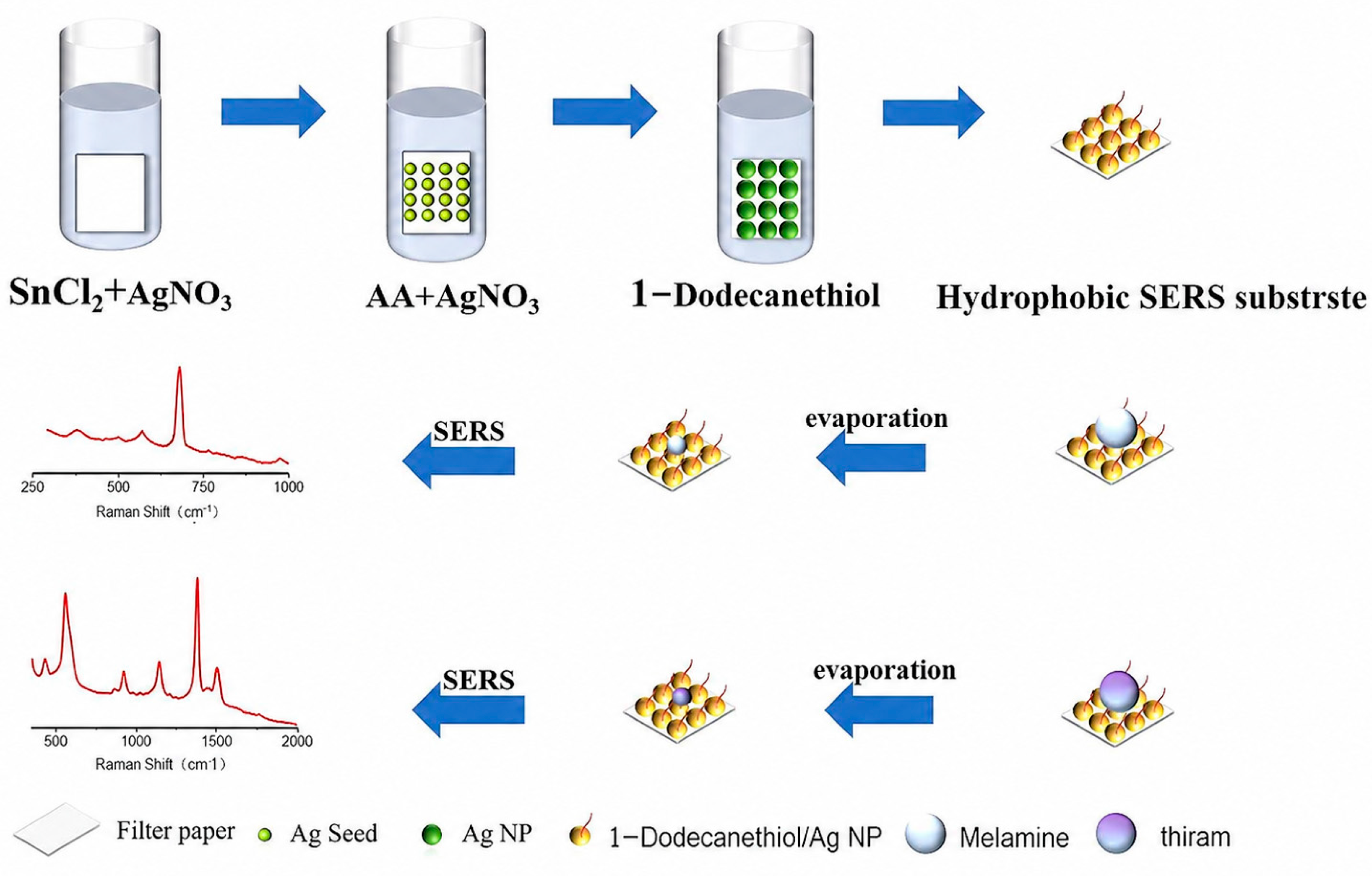
In this study, a simple, low-cost, and scalable strategy was proposed for manufacturing flexible hydrophobic filter paper SERS substrates as shown in Figure 1. Different from the complex preparation processes of reported hydrophobic SERS substrates, the dense, uniform Ag nanoparticles (Ag NPs) were deposited on filter paper within 10 min via a seed-mediated in situ growth method. This is in contrast with the one-step in situ growth method. In contrast to conventional one-step in situ growth, which often involves uncontrolled nucleation, broad particle size distribution, and weak nanoparticle–substrate interactions, the seed-mediated approach supports spatially confined nucleation and subsequent controlled growth on pre-anchored seeds. This strategy fundamentally improves the uniformity, density, and stability of Ag NPs on cellulose fibers. Importantly, such well-controlled nanostructures not only facilitate the formation of highly reproducible and densely distributed SERS hotspots but also provide a reliable platform for effective surface functionalization. The uniform and stable Ag NPs favor the formation of robust Ag–S covalent bonds with hydrophobic ligands, thereby enabling synergistic regulation between nanostructure morphology and interfacial chemistry. By adjusting the concentration of AgNO3 in the in situ growth system, precise control of Ag NPs loading can be achieved, thereby obtaining the substrate material with optimal SERS performance and avoiding excessive growth of nanoparticles. On this basis, we constructed a stable hydrophobic interface on the Ag NPs surface through the specific Ag-S covalent bond between 1-dodecanethiol and Ag NPs, which not only effectively confines liquid droplets to suppress the diffusion of analytes and realizes the localized enrichment of target molecules on hotspots, but also optimizes the interface interaction between analytes and SERS-active surfaces. Benefiting from the rational design of the hydrophobic SERS-active interface and the inherent flexibility of filter paper, this substrate can realize the direct SERS detection of thiram in edible oil and melamine in aqueous solution without any complex sample pretreatment. This provides a new practical platform for rapid on-site monitoring of trace harmful components in complex food matrices, and has broad application prospects in food safety analysis.

2. Experiment

2.1. Chemicals

Ascorbic acid (C6H8O6. AA) and hydrochloric acid (HCl) were supplied by Aladdin (Shanghai, China). Silver nitrate (AgNO3), Rhodamine6G (R6G) and thiram were purchased from Innochem (Beijing, China). Melamine was purchased from the Shanghai Reagent Company. 1-dodecanethiol was obtained from Alfa Aesar (Shanghai, China). Edible oil was purchased from the local supermarkets.

2.2. Preparation of SERS Substrate

First, filter paper (1 × 1 cm2) was immersed in 10 mL of a mixed SnCl2/HCl solution (20 mM/20 mM) for 30 s to adsorb Sn2+ onto the cellulose fibers, followed by rinsing thoroughly with ultrapure water to remove excess ions. Subsequently, the treated filter paper was immersed in 10 mL of 20 mM AgNO3 aqueous solution for seed deposition. Finally, the filter paper with Ag seeds was transferred into 20 mL of a freshly prepared mixed solution of ascorbic acid (AA) and AgNO3 (40 mM/30 mM, v/v = 1:1) for 20 s to allow seed-mediated growth of Ag NPs. After the reaction, the substrate was removed and rinsed thoroughly with ultrapure water. All the reactions were carried out at room temperature without additional stirring.

2.3. Hydrophobic Treatment

The prepared hydrophobic filter paper/Ag substrate was soaked in different concentrations of ethanol solution of 1-dodecanethiol(10−4, 10−6, 10−8, 10−10, 10−12, 10−14, 10−16, and 10−18 g/mL) for 12 h, and then washed with ethanol several times and dried at room temperature to obtain hydrophobic filter paper/Ag substrates.

2.4. Sample Preparation and SERS Testing

In the experimental detection, 3 μL of the target analyte solution was dropped onto the hydrophobic filter paper/Ag substrate. After air-drying at room temperature, the analyte molecules were enriched and deposited onto the Ag NP-coated fibers due to hydrophobic confinement during solvent evaporation. Raman spectra were then collected from the dried substrate surface, ensuring that the detected signals originated from analytes adsorbed on SERS-active sites rather than from the bulk solution. The Raman spectrum was measured using a portable Raman spectrometer (BWS465, B&W Tek, Newark, DE, USA). The excitation laser was set at 785 nm, the laser power was 30 MW, the integration time was 2 s, and the scanning times were 3 times.

2.5. Characterization and Analysis

The UV–vis spectra of the composites were measured by an Agilent UV-Vis-NIR spectrometer (Agilent, Palo Alto, CA, USA). The surface morphology of the sample was collected from a SU8010 scanning electron microscope (SEM) (Hitachi, Tokyo, Japan). Thermogravimetric analysis (TGA) was performed using Perkin-Elmer Q600 (PE, Shelton, CT, USA). ATR-FTIR was measured on a Nicolet iS50 infrared instrument (Perkin-Elmer, Waltham, MA, USA), and FTIR scanning was performed 32 times with a resolution of 4 cm−1. The water contact angle (WCA) test of the hydrophobic surface was conducted on the DSA100 instrument (KRUSS, Hamburg, Germany).

3. Results and Discussion

3.1. Morphology Characterization

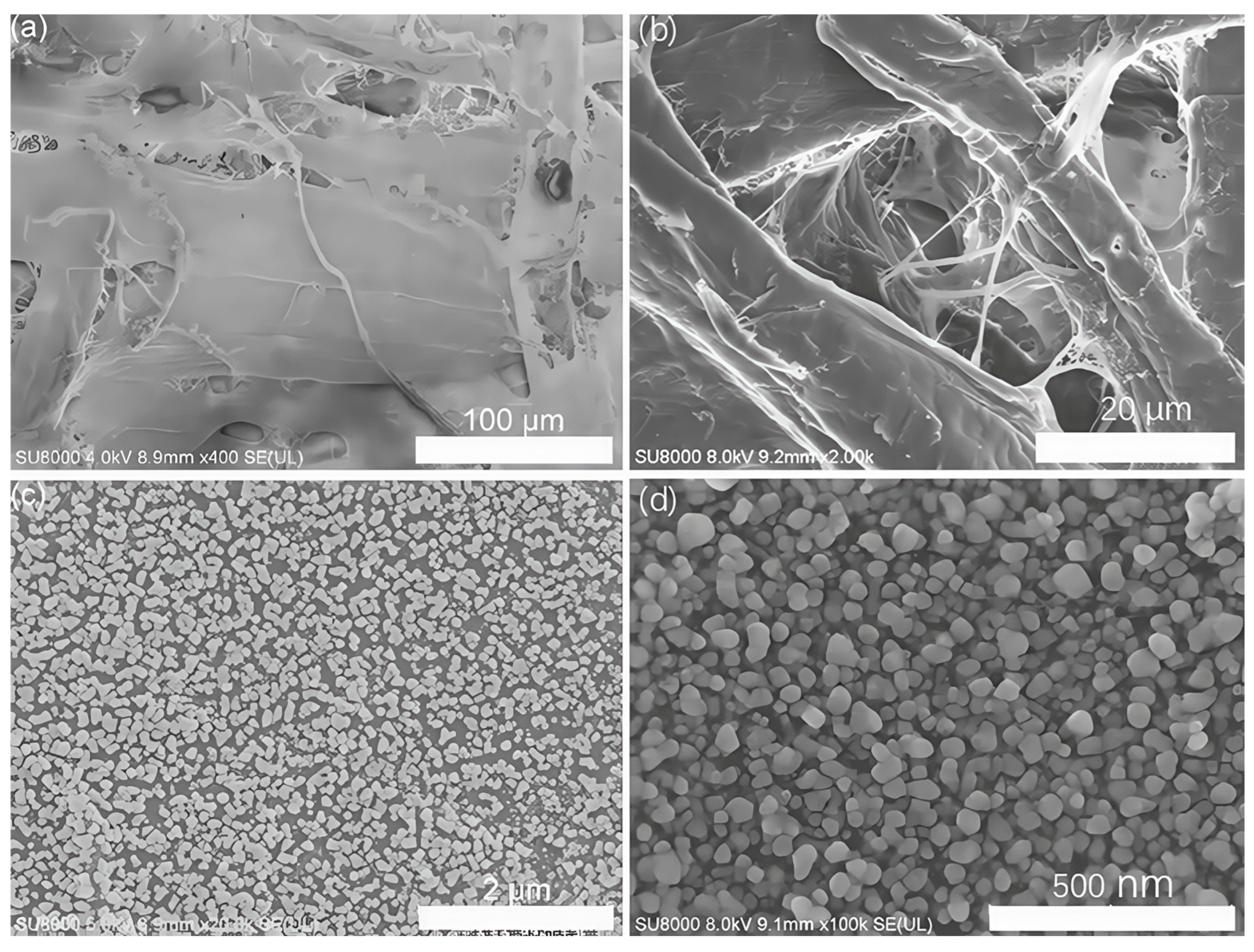
The filter paper/Ag substrate was prepared using in situ growth technology. The SEM images of the filter paper are shown in Figure 2a,b, in which the cellulose fiber was observed. When the filter paper was soaked in an aqueous solution of SnCl2, the Sn2+ was adsorbed onto the surface of the cellulose fiber through its affinity with hydroxyl groups. The cellulose ribbon on the surface of filter paper provides the area for the uniform distribution of Ag NPs. The reduction potential value of Sn4+/Sn2+ was 0.151 V, and the value was 0.80 V for Ag+/Ag0. Thus, the Ag+ was reduced to Ag and formed a nano-seed as encountered with Sn2+. When the filter paper with Ag seed was immersed in growth media, in which the AA acts as a mild reducing agent, silver seeds grew into larger Ag NPs in a mixed solution of AA and silver nitrate, and the particle size of silver seeds was also affected by the concentration of silver nitrate in the growth solution during the growth process. SEM image of the Ag NPs distributed on the surface of the filter is shown in Figure 2c,d, in which the size of Ag NPs is distributed within 60–80 nm.

3.2. Hydrophobic Property

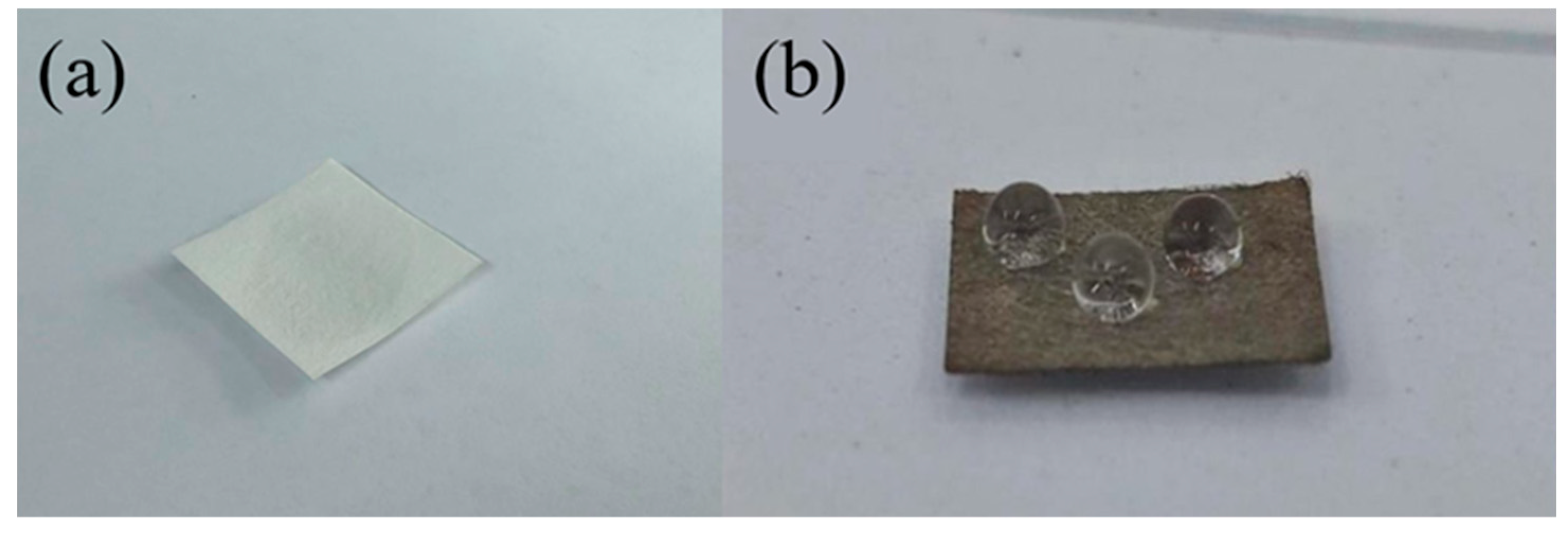
Since 1-dodecanethiol is insoluble in water, the dense 1-dodecanethiol coating on the surface of Ag NPs reduces the affinity between the SERS substrate and water molecules, thereby increasing its hydrophobicity compared with the hydrophobic filter paper/Ag substrate. To demonstrate the DMSF, we dropped 3 μL of deionized water onto the SERS substrate. As shown in Figure 3, the droplets appear spherical on the surface of the SERS substrate, which is due to the hydrophobic filter paper/Ag substrate, which can confine the water drop to minimize the contact area. When the SERS substrate is tilted to a certain angle, dropping deionized water onto its surface, it can be observed that the droplet naturally falls after contacting the surface, rather than being absorbed or diffused on the surface.
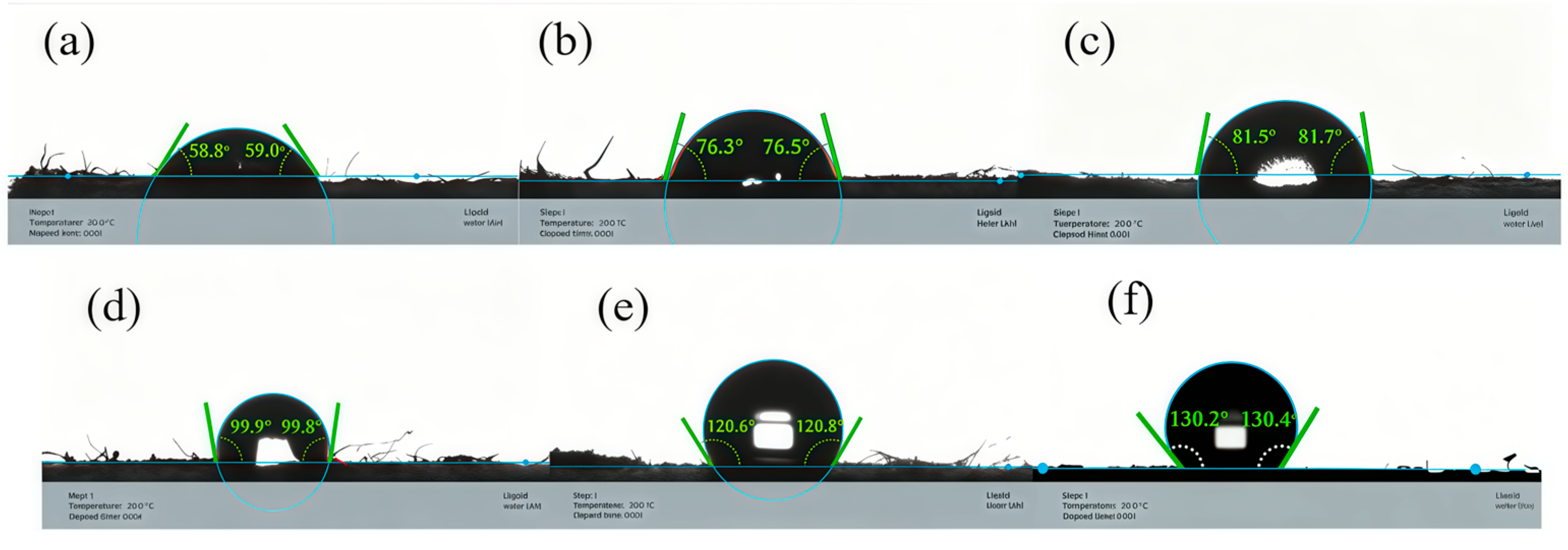
The hydrophobic filter paper/Ag substrate can also be assessed by measuring static water contact angles. The contact angle between 90° and 150° means a hydrophobic surface, and a contact angle greater than 150 corresponding to a superhydrophobic surface. As shown in Figure 4, after decorating 1-dodecanethiol, the filter paper/Ag substrate exhibits an excellent hydrophobic feature with a contact angle of 130.2°. Thus, the fabricated SERS substrate modified by 1-dodecanethiol shows excellent hydrophobicity, which can prevent the rapid absorption and diffusion of aqueous analyte solutions.

3.3. Uv-Vis Spectra Analysis of the Substrate

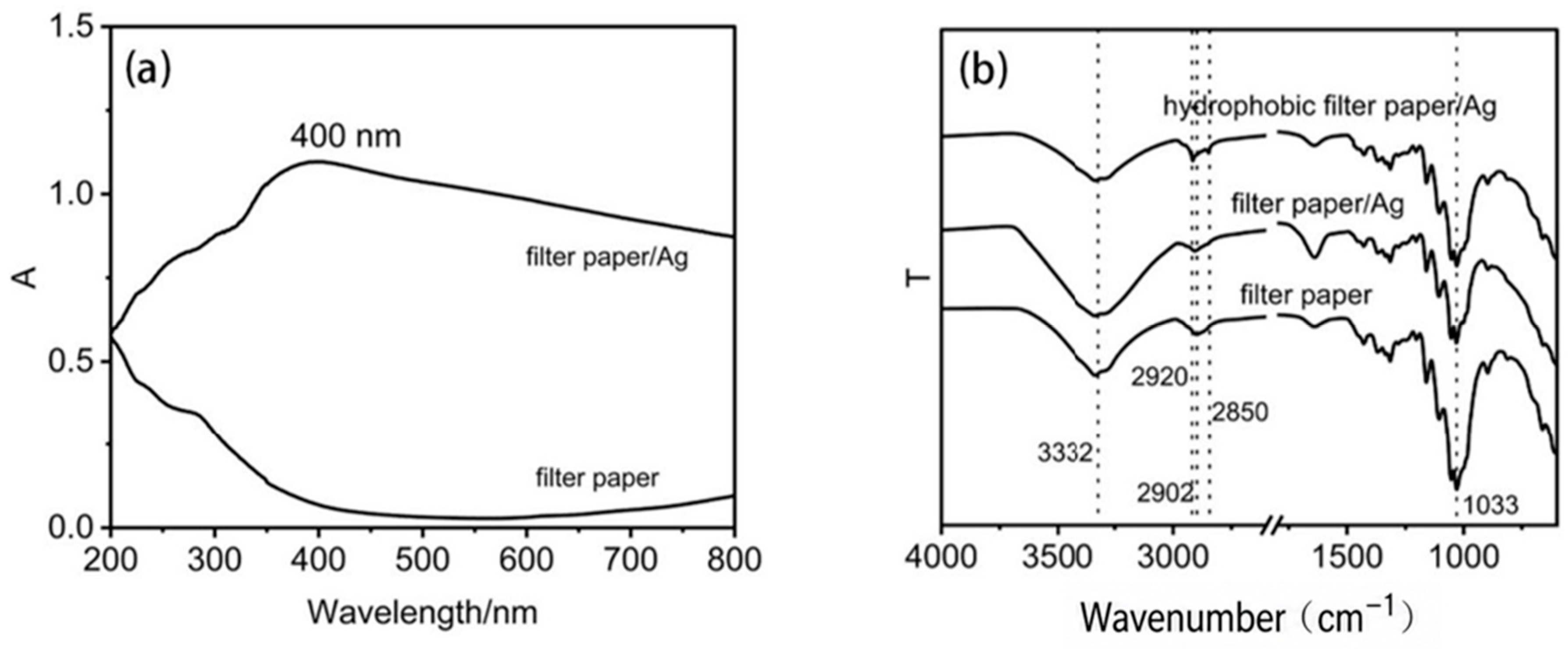
As shown in Figure 5a, the untreated filter paper sample has no absorption peak, while the hydrophobic filter paper/Ag substrate has a clear, broad peak at 400 nm. The Ag NPs prepared via the seed-mediated in situ growth method exhibit a relatively uniform size distribution in the range of 60–80 nm, as confirmed by SEM. In general, the LSPR peak of Ag NPs is strongly dependent on particle size, where an increase in size typically leads to peak broadening and a slight red-shift due to enhanced radiative damping effects. The observed broad LSPR band centered around ~400 nm can be attributed to the combined influence of particle size distribution and interparticle plasmon coupling on the cellulose fiber surface. The significant advantage of the SERS substrate prepared with the filter paper is that could be cut into any shape during the experimental process. The appearance of the untreated filter paper sample is white, while the filter paper/Ag substrate is grayish green, as shown in Figure 3b. UV-vis spectroscopy is commonly used to study the optical properties of the hydrophobic filter paper/Ag substrate. The size and shape of Ag NPs on the surface of the hydrophobic filter paper/Ag substrate determine the characteristics of LSPR.

3.4. FTIR Analysis of the Substrate

As shown in Figure 5b, the surface functional groups of the filter paper and filter paper/Ag substrate before and after modification with 1-dodecanethiol were determined by ATR infrared spectroscopy. For the pure filter paper, the peaks at 3332, 2902, and 1033 cm−1 are assigned to the stretching vibrations of —OH, C—H, and C—O groups [32] in cellulose, respectively. The ATR-FTIR spectrum of filter paper–Ag before hydrophobic modification is nearly identical to that of the pure filter paper, as Ag nanoparticles exhibit no obvious infrared absorption, and the cellulose functional groups still dominate the surface chemistry. After modification with 1-dodecanethiol, the hydrophobic filter paper/Ag substrate retains the characteristic cellulose peaks, while two additional absorption bands appear at 2920 and 2850 cm−1, which are attributed to the asymmetric and symmetric stretching vibrations of —CH2— groups from the long alkyl chain of 1-dodecanethiol, confirming the successful hydrophobic functionalization [33,34]. The ATR result further confirms that the hydrophobic feature was due to the hydrocarbon chain.

3.5. Thermogravimetric Analysis

The thermal behaviors of the filter paper and the hydrophobic filter paper/Ag substrate were studied by thermogravimetric (TGA) analysis in the temperature range from 30 °C to 600 °C. The TGA curves are presented in Figure S1. The two samples show very similar thermal features, suggesting that the hydrophobic modification does not noticeably affect the thermal stability of the filter paper substrate. A clear weight loss occurs at 293 °C for the filter paper and at 291 °C for the hydrophobic filter paper/Ag substrate, which can be attributed to the thermal decomposition of the paper matrix. In addition, further mass losses are observed at 530 °C and 488 °C for the filter paper and the hydrophobic filter paper/Ag substrate, respectively, corresponding to the continued pyrolysis of the cellulose framework. At high temperature, the filter paper is almost completely decomposed, whereas the hydrophobic filter paper/Ag substrate shows a residual weight of about 2.5 wt%. This remaining mass is assigned to the Ag nanoparticles loaded on the substrate, which confirms the successful deposition of Ag and provides an estimate of the Ag loading amount. Overall, the TGA results indicate that the hydrophobic treatment maintains the thermal stability of the substrate and verifies the presence of Ag NPs on the filter paper [35].

3.6. Application of the Hydrophobic Filter Paper/Ag Substrate

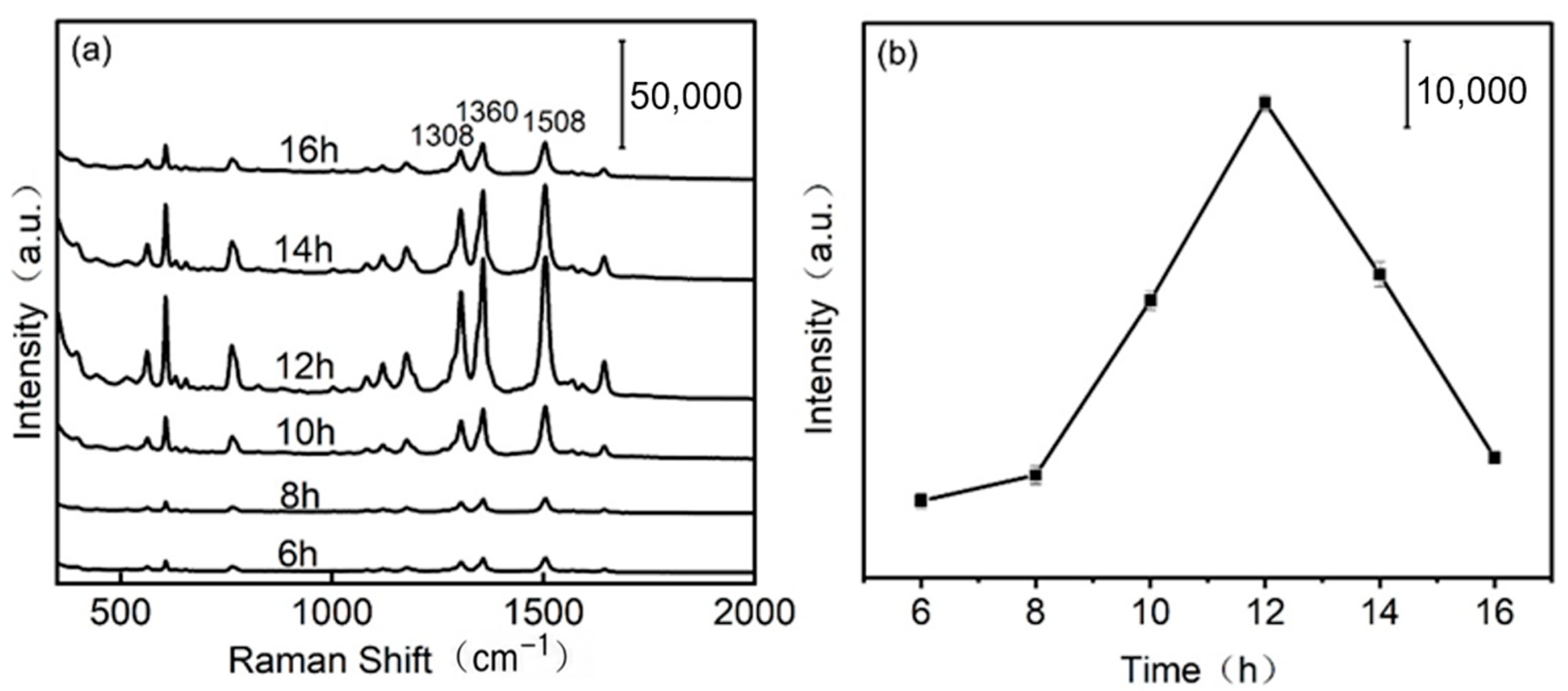
The filter paper/Ag substrate was immersed in an ethanol solution of 1-dodecanethiol for different reaction times (6, 8, 10, 12, 14, and 16 h). The enhancement effect of SERS substrates was evaluated by using R6G as a Raman probe molecule. A total of 3 µL of 10−4 mol/L R6G was dropped onto the surface of a hydrophobic filter paper/Ag substrate. After air-drying, the Raman spectra were collected and presented in Figure 6a. Several obvious Raman peaks were observed at 1308 cm−1, 1360 cm−1 and 1508 cm−1; these peaks were assigned to the stretching vibration mode of C—O—C and aromatic C—C groups of R6G [36]. At the initial stage, with a 6 h soaking time used in the system, the weak Raman spectra of R6G were obtained, because the Ag NPs were not fully modified by 1-dodecanethiol. The analyte would diffuse on the surface of the SERS substrate with low hydrophobicity, resulting in a low Raman signal. The Raman signal of R6G was increased as the soaking time was prolonged, and the soaking time of 12 h provided the highest SERS enhancement effect. From the comparison of the Raman intensity of R6G of the band at 1360 cm−1 from different filter paper/Ag substrates (Figure 6b), the substrate soaked in 1-dodecanethiol for 12 h was observed to show the best SERS enhancement. Further increasing the soaking time brings a decrease in the Raman signal, which may be due to the multilayer formed during the long soaking time used. The distance between the analyte and Ag NPs was increased. The duration of intensity of SERS spectra was measured at different sites on the same substrate, and the result from 10 independent measurements is shown in Figure S2, in which the RSD value was nearly at 8.6%. These results could verify the good repeatability of the hydrophobic filter paper/Ag substrate. Furthermore, the inter-batch reproducibility was also evaluated using five independent batches of substrates. The relative standard deviation (RSD) of SERS intensity was determined as 8.9% for inter-batch testing, as shown in Figure S3. These results confirm that the prepared hydrophobic filter paper/Ag SERS substrate possesses high uniformity and reliable reproducibility, even with the rough and porous cellulose structure, thus ensuring stable and consistent detection performance. The enhancement factor (EF) of the hydrophobic filter paper/Ag substrate was calculated using R6G as the probe molecule, and the EF value was determined to be 1.4 × 10⁵, demonstrating remarkable SERS activity and strong signal enhancement for trace target detection.
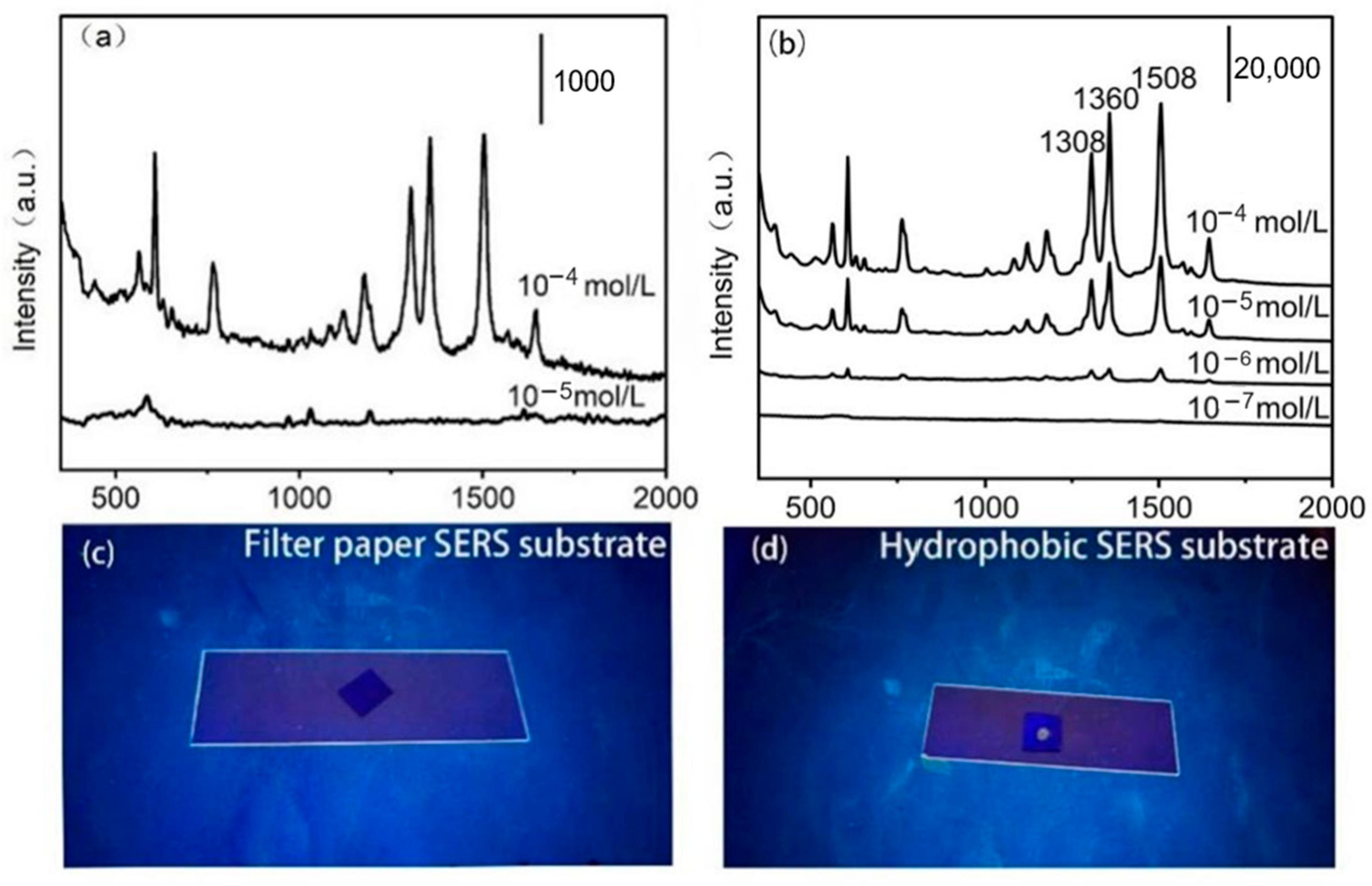
As shown in Figure 7c, there is no fluorescence image observed as the liquid drop was diffused on the common filter paper/Ag substrate. In the corresponding SERS spectra shown in Figure 7a, only a weak signal of R6G was observed at 10−5 M concentration. In contrast, after grafting 1-dodecanethiol, the obvious fluorescence of R6G was obtained on the surface of the hydrophobic filter paper/Ag substrate (Figure 7d). In that case, the droplet of R6G could stay on the hydrophobic surface of the substrate. And the Raman spectra of R6G (10−8 M) could be observed (Figure 7b). This improved fluorescence visibility is not due to inherent fluorescence enhancement, but rather to an increase in local concentration of the analyte caused by hydrophobic confinement. This effect helps visualize the distribution of analytes and enables the laser to accurately focus on the SERS active region.

3.7. Melamine and Thiram Detection

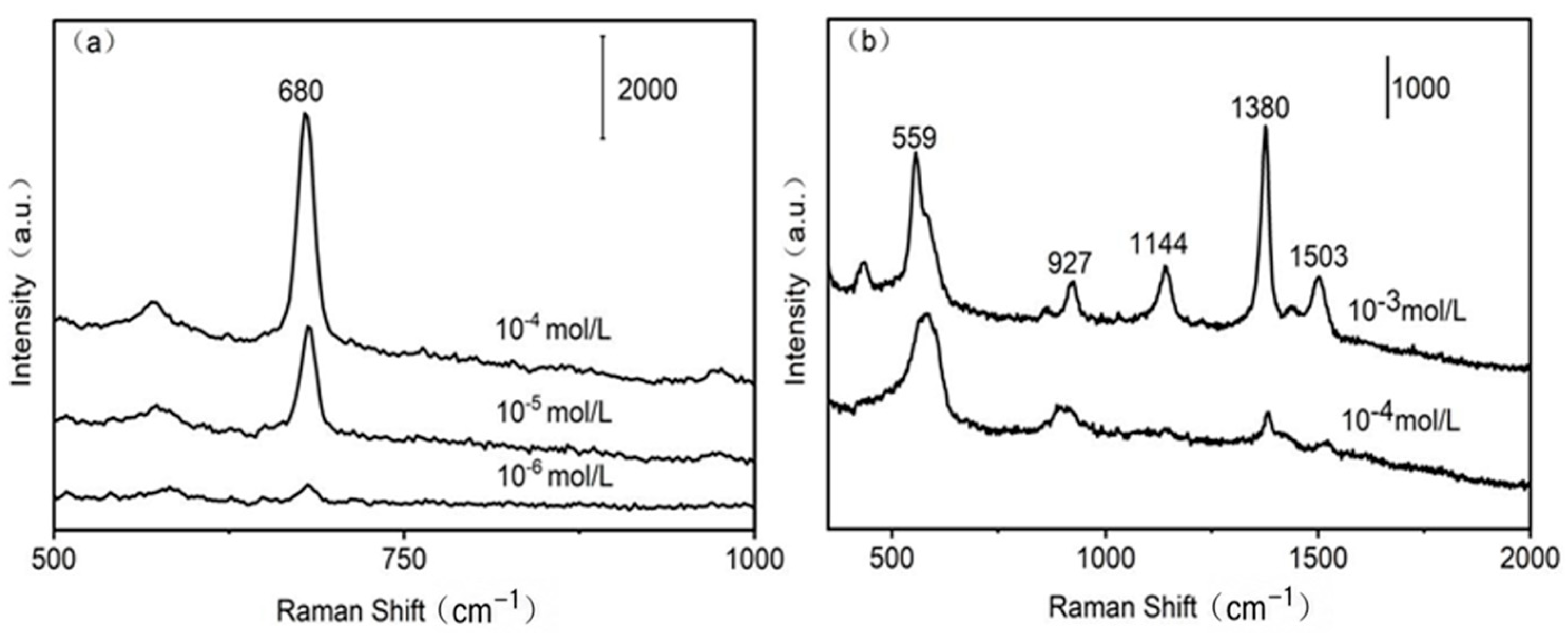
Melamine has been illegally added to dairy products, causing serious damage to human health [37]. Thiram is widely applied in agriculture as well as during food storage to prevent fungal contamination. The residues of thiram in food stuffs could pose a serious threat to human health [38]. The hydrophobic filter paper/Ag substrate was used to monitor melamine and thiram at different concentrations. The Raman spectra of melamine measured from the hydrophobic filter paper/Ag substrate are shown in Figure 8a. The characteristic peak of melamine was observed at 680 cm−1 [30], attributed to the in-plane deformation mode of the triazine ring [39]. The SERS spectra of thiram are shown in Figure 8b, in which several characteristic peaks were observed at 559 cm−1, 927 cm−1, 1144 cm−1, 1380 cm−1, and 1503 cm−1. The peak at 559 cm−1 is attributed to the stretching vibration of S-S, while the peak at 1144 cm−1 is attributed to the swinging vibration of CH3 and the stretching vibration of C—N. The peaks at 1380 cm−1 and 1503 cm−1 are attributed to the stretching vibration of CH3 and C=N [40]. The results verified that the hydrophobic filter paper/Ag substrate could be used for detecting melamine and thiram.

3.8. Sensing Pesticides from the Oil Phase

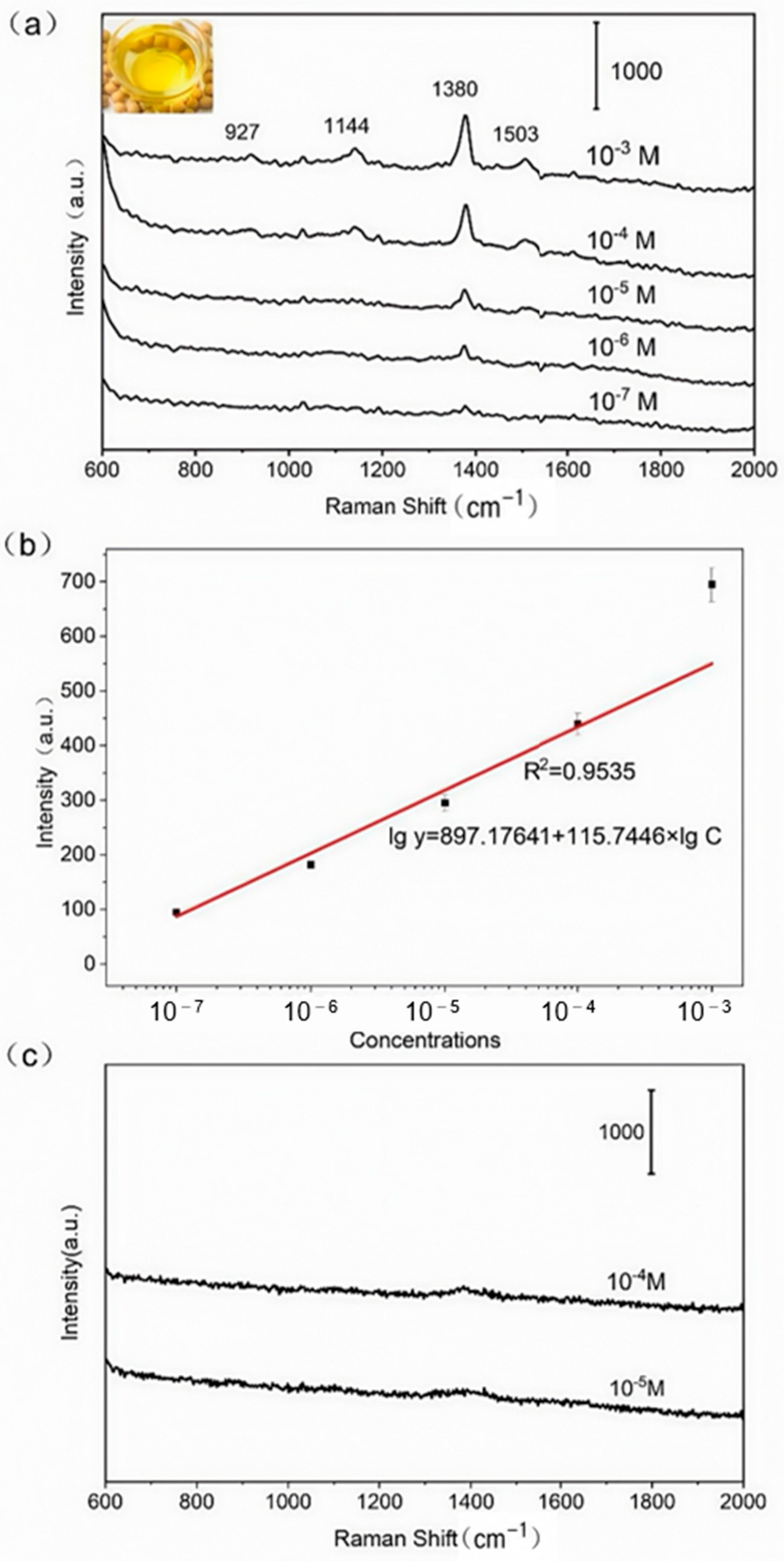
The hydrophobic filter paper/Ag substrate was applied for monitoring pesticides in real food samples. The thiram was artificially added into edible oil, and 3 uL oil sample with different concentrations of thiram were dropped onto the surface of the hydrophobic filter paper/Ag substrate. The Raman spectra of thiram measured from oil are shown in Figure 9a, in which the characteristic peak of thiram was observed. And the feature band at 1380 cm−1 could still be observed as the concentration went down to 10−7 M. In order to detect thiram from oil in a quantitative way, the curve was built between the concentration of thiram and peak intensity at 1380 cm−1 (Figure 9b) with a coefficient of determination (R2) at 0.9535. The limit of detection (LOD) was calculated as 1.8 × 10⁻⁸ M according to the 3σ/s criterion (signal-to-noise ratio S/N = 3) recommended by IUPAC, where σ is the standard deviation of the blank signal and s is the slope of the linear calibration curve [41,42]. To evaluate its practical significance, the obtained LOD was compared with the maximum residue limit (MRL) specified in Chinese National Food Safety Standard for Maximum Residue Limits of Pesticides in Food, where the MRL of thiram in edible oil is 0.05 mg/kg [43]. The achieved LOD is lower than the regulatory limit, indicating that the proposed method is sufficiently sensitive for practical monitoring of thiram residues in edible oil. The filter paper/Ag substrate without a hydrophobic surface was also used to detect thiram from edible oil; unfortunately, there was no feature peak of thiram obtained (Figure 9c). The potential matrix interference from edible oil was effectively alleviated by the hydrophobic–lipophilic interface constructed with 1-dodecanethiol. Under hydrophobic confinement, thiram molecules are locally enriched at the substrate surface. More importantly, the presence of sulfur-containing functional groups in thiram provides a strong affinity toward Ag NPs, promoting preferential adsorption onto SERS-active sites. In contrast, the main components of edible oil, such as triglycerides, are relatively bulky and lack specific binding groups for Ag, resulting in weaker adsorption [44]. As a result, competitive adsorption from the oil matrix is significantly suppressed, enabling reliable SERS detection of thiram in edible oil. As shown in Table 1 [30,45,46,47], several representative paper-based SERS substrates are listed, in which the hydrophobic filter/Ag substrate presents excellent performance for the detection of pesticides from the oil sample.

4. Conclusions

In summary, we developed a facile, low-cost, and scalable fabrication strategy for a hydrophobic filter paper SERS substrate, which combined rapid seed-mediated in situ growth of Ag NPs with surface modification of 1-dodecanethiol via Ag-S covalent bonding. The constructed hydrophobic interface exhibited excellent hydrophobicity with a water contact angle of 130.2°, which not only effectively confined liquid droplets and suppressed the diffusion of aqueous and oil-phase analytes on the substrate surface but also realized localized enrichment of target molecules on SERS-active hotspots. Benefiting from this rational interface regulation, the substrate enables analyte enrichment via hydrophobic confinement, which significantly enhances the SERS signal. Meanwhile, the localized accumulation of analyte molecules leads to spatially confined fluorescence emission, improving its visibility for auxiliary observation. This effect does not arise from intrinsic fluorescence enhancement, but from the increased local concentration of analytes, thereby facilitating accurate localization for reliable laser focusing. It achieves detection of melamine in aqueous solution, and for thiram in edible oil, its detection limit is as low as 1.8 × 10⁻⁸ M. The correlation coefficient R2 is 0.9535, showing a good linear relationship. Although linearity is somewhat influenced by the complexity of the edible oil matrix, the results still demonstrate the practicality of matrix quantitative detection in real-world samples. Compared with existing hydrophobic SERS substrates, this substrate has the characteristics of simple manufacturing, good flexibility, and good reproducibility (RSD = 8.6%). It not only optimizes the interaction between analytes and substrates and expands the applicability of paper-based SERS technology for oil phase food samples, but also provides a practical on-site analysis platform for sensitive and rapid monitoring of trace harmful components in complex food matrices.

Supplementary Materials

The following supporting information can be downloaded at: https://www.mdpi.com/article/10.3390/chemosensors14050106/s1, Figure S1. TGA of filter paper and hydrophobic filter/Ag. Figure S2 (a) Raman spectra of R6G collected from ten different sites on same hydrophobic filter paper/Ag substrate, and (b) Raman spectra and corresponding intensity at 1506 cm−1 for 10−4 M R6G. Figure S3 (a) Raman spectra of R6G collected from different batches of hydrophobic filter paper/Ag substrates, and (b) Raman spectra and corresponding intensity at 1506 cm−1 for 10−4 M R6G.

Author Contributions

Software, X.T.; Validation, J.G., H.Q. and K.S.; Formal analysis, W.Z., H.Q., X.T. and K.S.; Investigation, J.G., H.Q. and X.T.; Resources, X.T., Q.Y. and X.K.; Data curation, W.Z., H.Q. and Q.Y.; Writing—original draft, J.G. and X.T.; Writing—review & editing, Q.Y., X.K. and K.S.; Visualization, J.G.; Supervision, Q.Y., X.K. and K.S.; Project administration, W.Z., Q.Y., X.K. and K.S.; Funding acquisition, X.K. All authors have read and agreed to the published version of the manuscript.

Funding

This study was financially supported by the International Science and Technology Cooperation Project of Liaoning Province (2024JH2/101900019) and Fushun Revitalization Talents Program (No. FSYC202407002).

Institutional Review Board Statement

Not applicable.

Informed Consent Statement

Not applicable.

Data Availability Statement

Data are contained within the article.

Acknowledgments

The authors thank the editor, reviewers, and all team members for their valuable contributions to this work.

Conflicts of Interest

Author Hangming Qi was employed by the company PetroChina Fushun Petrochemical Company Institute. The remaining authors declare that the research was conducted in the absence of any commercial or financial relationships that could be construed as a potential conflict of interest.

References

  1. Zhang, S.; Fan, Q.; Guo, J.; Jiao, X.; Kong, X.; Yu, Q. Surface-enhanced Raman spectroscopy tandem with derivatized thin-layer chromatography for ultra-sensitive on-site detection of histamine from fish. Food Control 2022, 138, 108987. [Google Scholar] [CrossRef]
  2. Fu, Z.; Shen, Z.; Fan, Q.; Hao, S.; Wang, Y.; Liu, X.; Tong, X.; Kong, X.; Yang, Z. Preparation of multi-functional magnetic-plasmonic nanocomposite for adsorption and detection of thiram using SERS. J. Hazard. Mater. 2020, 392, 122356. [Google Scholar] [CrossRef] [PubMed]
  3. Pieczonka, N.P.; Aroca, R.F. Single molecule analysis by surfaced-enhanced Raman scattering. Chem. Soc. Rev. 2008, 37, 946–954. [Google Scholar] [CrossRef]
  4. Sun, C.; Zhang, S.; Wang, J.; Ge, F. Enhancement of SERS performance using hydrophobic or superhydrophobic cotton fabrics. Surf. Interfaces 2022, 28, 101616. [Google Scholar] [CrossRef]
  5. Yang, X.; Gu, C.; Qian, F.; Li, Y.; Zhang, J.Z. Highly sensitive detection of proteins and bacteria in aqueous solution using surface-enhanced Raman scattering and optical fibers. Anal. Chem. 2011, 83, 5888–5894. [Google Scholar] [CrossRef] [PubMed]
  6. Ricci, M.; Becucci, M.; Castellucci, E.M. Chemical enhancement in the SERS spectra of indigo: DFT calculation of the Raman spectra of indigo-Ag14 complexes. Vib. Spectrosc. 2019, 100, 159–166. [Google Scholar] [CrossRef]
  7. Wang, Y.; Liu, Q.; Sun, Y.; Wang, R. Magnetic field modulated SERS enhancement of CoPt hollow nanoparticles with sizes below 10 nm. Nanoscale 2018, 10, 12650–12656. [Google Scholar] [CrossRef]
  8. Stiles, P.L.; Dieringer, J.A.; Shah, N.C.; Van Duyne, R.P. Surface-enhanced Raman spectroscopy. Annu. Rev. Anal. Chem. 2008, 1, 601–626. [Google Scholar] [CrossRef] [PubMed]
  9. Chen, C.; Hutchison, J.A.; Clemente, F.; Kox, R.; Uji, I.H.; Hofkens, J.; Lagae, L.; Maes, G.; Borghs, G.; Van Dorpe, P. Direct evidence of high spatial localization of hot spots in surface-enhanced Raman scattering. Angew. Chem. Int. Ed. Engl. 2009, 48, 9932–9935. [Google Scholar] [CrossRef]
  10. Wang, K.-S.; Tseng, Z.-L.; Liu, C.-Y.; Kuan, T.-Y.; Jeng, R.-J.; Yang, M.-C.; Wang, Y.-L.; Liu, T.-Y. Novel strategy for flexible and super-hydrophobic SERS substrate fabricated by deposited gold nanoislands on organic semiconductor nanostructures for bio-detection. Surf. Coat. Technol. 2022, 435, 128251. [Google Scholar] [CrossRef]
  11. Lospinoso, D.; Colombelli, A.; Pal, S.; Cretì, P.; Martucci, M.C.; Giancane, G.; Licciulli, A.; Rella, R.; Manera, M.G. Sustainable and Flexible Surface-Enhanced Raman Scattering Transducer: Gold Nanoparticle-Bacterial Cellulose Composite for Pesticide Monitoring in Agrifood Systems. Biosensors 2025, 15, 69. [Google Scholar] [CrossRef]
  12. Luo, W.; Chen, M.; Hao, N.; Huang, X.; Zhao, X.; Zhu, Y.; Yang, H.; Chen, X. In situ synthesis of gold nanoparticles on pseudo-paper films as flexible SERS substrate for sensitive detection of surface organic residues. Talanta 2019, 197, 225–233. [Google Scholar] [CrossRef]
  13. Ogundare, S.A.; van Zyl, W.E. Amplification of SERS “hot spots” by silica clustering in a silver-nanoparticle/nanocrystalline-cellulose sensor applied in malachite green detection. Colloids Surf. A Physicochem. Eng. Asp. 2019, 570, 156–164. [Google Scholar] [CrossRef]
  14. Zong, C.; Xu, M.; Xu, L.J.; Wei, T.; Ma, X.; Zheng, X.S.; Hu, R.; Ren, B. Surface-Enhanced Raman Spectroscopy for Bioanalysis: Reliability and Challenges. Chem. Rev. 2018, 118, 4946–4980. [Google Scholar] [CrossRef] [PubMed]
  15. Li, D.; Duan, H.; Ma, Y.; Deng, W. Headspace-Sampling Paper-Based Analytical Device for Colorimetric/Surface-Enhanced Raman Scattering Dual Sensing of Sulfur Dioxide in Wine. Anal. Chem. 2018, 90, 5719–5727. [Google Scholar] [CrossRef] [PubMed]
  16. Li, D.; Ma, Y.; Duan, H.; Deng, W.; Li, D. Griess reaction-based paper strip for colorimetric/fluorescent/SERS triple sensing of nitrite. Biosens. Bioelectron. 2018, 99, 389–398. [Google Scholar] [CrossRef]
  17. Reokrungruang, P.; Chatnuntawech, I.; Dharakul, T.; Bamrungsap, S. A simple paper-based surface enhanced Raman scattering (SERS) platform and magnetic separation for cancer screening. Sens. Actuators B Chem. 2019, 285, 462–469. [Google Scholar] [CrossRef]
  18. Sartori, B.; Marmiroli, B. Recent advances in the functionalization of cellulose substrates for SERS sensors with improved performance. Front. Nanotechnol. 2025, 7, 1599944. [Google Scholar] [CrossRef]
  19. Tian, X.; Zhai, P.; Guo, J.; Yu, Q.; Xu, L.; Yu, X.; Wang, R.; Kong, X. Fabrication of plasmonic cotton gauze-Ag composite as versatile SERS substrate for detection of pesticides residue. Spectrochim. Acta Part A Mol. Biomol. Spectrosc. 2021, 257, 119766. [Google Scholar] [CrossRef]
  20. Lafuente, M.; Pellejero, I.; Clemente, A.; Urbiztondo, M.A.; Mallada, R.; Reinoso, S.; Pina, M.P.; Gandia, L.M. In Situ Synthesis of SERS-Active Au@POM Nanostructures in a Microfluidic Device for Real-Time Detection of Water Pollutants. ACS Appl. Mater. Interfaces 2020, 12, 36458–36467. [Google Scholar] [CrossRef]
  21. Weng, G.; Yang, Y.; Zhao, J.; Li, J.; Zhu, J.; Zhao, J. Improving the SERS enhancement and reproducibility of inkjet-printed Au NP paper substrates by second growth of Ag nanoparticles. Mater. Chem. Phys. 2020, 253, 123416. [Google Scholar] [CrossRef]
  22. Weng, G.; Yang, Y.; Zhao, J.; Zhu, J.; Li, J.; Zhao, J. Preparation and SERS performance of Au NP/paper strips based on inkjet printing and seed mediated growth: The effect of silver ions. Solid State Commun. 2018, 272, 67–73. [Google Scholar] [CrossRef]
  23. Chao, B.-K.; Cheng, H.-H.; Nien, L.-W.; Chen, M.-J.; Nagao, T.; Li, J.-H.; Hsueh, C.-H. Anti-reflection textured structures by wet etching and island lithography for surface-enhanced Raman spectroscopy. Appl. Surf. Sci. 2015, 357, 615–621. [Google Scholar] [CrossRef]
  24. Sun, X.; Wang, N.; Li, H. Deep etched porous Si decorated with Au nanoparticles for surface-enhanced Raman spectroscopy (SERS). Appl. Surf. Sci. 2013, 284, 549–555. [Google Scholar] [CrossRef]
  25. Kim, A.; Barcelo, S.J.; Williams, R.S.; Li, Z. Melamine sensing in milk products by using surface enhanced Raman scattering. Anal. Chem. 2012, 84, 9303–9309. [Google Scholar] [CrossRef]
  26. Mulvihill, M.; Tao, A.; Benjauthrit, K.; Arnold, J.; Yang, P. Surface-enhanced Raman spectroscopy for trace arsenic detection in contaminated water. Angew. Chem. Int. Ed. Engl. 2008, 47, 6456–6460. [Google Scholar] [CrossRef] [PubMed]
  27. Qian, X.M.; Nie, S.M. Single-molecule and single-nanoparticle SERS: From fundamental mechanisms to biomedical applications. Chem. Soc. Rev. 2008, 37, 912–920. [Google Scholar] [CrossRef]
  28. Lee, H.K.; Lee, Y.H.; Zhang, Q.; Phang, I.Y.; Tan, J.M.; Cui, Y.; Ling, X.Y. Superhydrophobic surface-enhanced Raman scattering platform fabricated by assembly of Ag nanocubes for trace molecular sensing. ACS Appl. Mater. Interfaces 2013, 5, 11409–11418. [Google Scholar] [CrossRef]
  29. Xian, L.; You, R.; Lu, D.; Wu, C.; Feng, S.; Lu, Y. Surface-modified paper-based SERS substrates for direct-droplet quantitative determination of trace substances. Cellulose 2019, 27, 1483–1495. [Google Scholar] [CrossRef]
  30. Martins, N.C.T.; Fateixa, S.; Fernandes, T.; Nogueira, H.I.S.; Trindade, T. Inkjet Printing of Ag and Polystyrene Nanoparticle Emulsions for the One-Step Fabrication of Hydrophobic Paper-Based Surface-Enhanced Raman Scattering Substrates. ACS Appl. Nano Mater. 2021, 4, 4484–4495. [Google Scholar] [CrossRef]
  31. Zhang, C.; You, T.; Yang, N.; Gao, Y.; Jiang, L.; Yin, P. Hydrophobic paper-based SERS platform for direct-droplet quantitative determination of melamine. Food Chem. 2019, 287, 363–368. [Google Scholar] [CrossRef] [PubMed]
  32. Abdelhamid, H.N.; Mathew, A.P. In-situ growth of zeolitic imidazolate frameworks into a cellulosic filter paper for the reduction of 4-nitrophenol. Carbohydr. Polym. 2021, 274, 118657. [Google Scholar] [CrossRef]
  33. Alzate-Sánchez, D.M.; Smith, B.J.; Alsbaiee, A.; Hinestroza, J.P.; Dichtel, W.R. Cotton Fabric Functionalized with a β-Cyclodextrin Polymer Captures Organic Pollutants from Contaminated Air and Water. Chem. Mater. 2016, 28, 8340–8346. [Google Scholar] [CrossRef]
  34. Kong, X.; Du, X. In Situ IRRAS Studies of Molecular Recognition of Barbituric Acid Lipids to Melamine at the Air–Water Interface. J. Phys. Chem. B 2011, 115, 13191–13198. [Google Scholar] [CrossRef] [PubMed]
  35. Yang, Z.; Guo, B.; Liu, K.; Zhu, Z.; Han, D.; Wang, C.; Song, J. Flexible and recyclable PI/Ag Nanofiber SERS substrates for ultrasensitive detection of pesticide residues. Mater. Sci. Semicond. Process. 2025, 199, 109835. [Google Scholar] [CrossRef]
  36. Kong, X.-M.; Reza, M.; Ma, Y.-B.; Hinestroza, J.-P.; Ahvenniemi, E.; Vuorinen, T. Assembly of metal nanoparticles on regenerated fibers from wood sawdust and de-inked pulp: Flexible substrates for surface enhanced Raman scattering (SERS) applications. Cellulose 2015, 22, 3645–3655. [Google Scholar] [CrossRef]
  37. Sun, F.; Ma, W.; Xu, L.; Zhu, Y.; Liu, L.; Peng, C.; Wang, L.; Kuang, H.; Xu, C. Analytical methods and recent developments in the detection of melamine. TrAC Trends Anal. Chem. 2010, 29, 1239–1249. [Google Scholar] [CrossRef]
  38. Guo, P.; Sikdar, D.; Huang, X.; Si, K.J.; Xiong, W.; Gong, S.; Yap, L.W.; Premaratne, M.; Cheng, W. Plasmonic core-shell nanoparticles for SERS detection of the pesticide thiram: Size- and shape-dependent Raman enhancement. Nanoscale 2015, 7, 2862–2868. [Google Scholar] [CrossRef]
  39. Wang, R.; Xu, Y.; Wang, R.; Wang, C.; Zhao, H.; Zheng, X.; Liao, X.; Cheng, L. A microfluidic chip based on an ITO support modified with Ag-Au nanocomposites for SERS based determination of melamine. Microchim. Acta 2016, 184, 279–287. [Google Scholar] [CrossRef]
  40. Zhu, Y.; Li, M.; Yu, D.; Yang, L. A novel paper rag as ‘D-SERS’ substrate for detection of pesticide residues at various peels. Talanta 2014, 128, 117–124. [Google Scholar] [CrossRef]
  41. Allegrini, F.; Olivieri, A.C. IUPAC-Consistent Approach to the Limit of Detection in Partial Least-Squares Calibration. Anal. Chem. 2014, 86, 7858−7866. [Google Scholar] [CrossRef] [PubMed]
  42. Kim, H.R.; Kim, S.; Jung, J.; Lee, H.; Ho, K.; Kim, B.; Oh, S. Enhancing LOD determination in gas chromatography: Validating the Hubaux-Vos method for gas concentration measurement. J. Chromatogr. A 2024, 1720, 464764. [Google Scholar] [CrossRef]
  43. GB 2763-2021; Chinese National Food Safety Standard for Maximum Residue Limits of Pesticides in Food. National Health Commission: Beijing, China; Ministry of Agriculture and Rural Affairs: Beijing, China; State Administration for Market Regulation: Beijing, China, 2021.
  44. Dickhout, J.M.; Kleijn, J.M.; Lammertink, R.G.H.; de Vos, W.M. Adhesion of emulsified oil droplets to hydrophilic and hydrophobic surfaces–Effect of surfactant charge, surfactant concentration and ionic strength. Soft Matter 2018, 14, 5452–5460. [Google Scholar] [CrossRef]
  45. Hou, M.; Li, N.; Tian, X.; Yu, Q.; Hinestroza, J.-P.; Kong, X. Preparation of SERS active filter paper for filtration and detection of pesticides residue from complex sample. Spectrochim. Acta Part A Mol. Biomol. Spectrosc. 2023, 285, 121860. [Google Scholar] [CrossRef] [PubMed]
  46. Martins, N.C.T.; Fateixa, S.; Trindade, T. Chitosan coated papers as sustainable platforms for the development of surface-enhanced Raman scattering hydrophobic substrates. J. Mol. Liq. 2023, 375, 121388. [Google Scholar] [CrossRef]
  47. Tao, X.; Zhang, Z.; Liu, Z.; Fan, X.; Yu, Q.; Xu, L.; Wang, H.; Guo, J.; Kong, X. Plasmonic filter paper for preconcentration, separation and SERS detection harmful chemicals in chili product by fluid flow. Spectrochim. Acta Part A Mol. Biomol. Spectrosc. 2024, 308, 123727. [Google Scholar] [CrossRef]
Figure 1. Fabricating and applying the hydrophobic SERS sensor.
Chemosensors 14 00106 g001
Figure 2. SEM image of filter paper (a,b) and filter paper/Ag (c,d).
Chemosensors 14 00106 g002
Figure 3. Digital photos of (a) pristine filter paper and (b) hydrophobic filter paper with Ag.
Chemosensors 14 00106 g003
Figure 4. Static water contact angles of filter paper/Ag substrates modified with 1-dodecanethiol at immersion times of (a) 2, (b) 4, (c) 6, (d) 8, (e) 10, and (f) 12 h.
Chemosensors 14 00106 g004
Figure 5. (a) UV-Vis spectra of filter paper and filter paper/Ag substrate. (b) ATR spectra of the filter paper, filter paper/Ag substrate, and hydrophobic filter paper/Ag substrate.
Chemosensors 14 00106 g005
Figure 6. (a) Raman spectra of R6G measured from hydrophobic filter paper/Ag substrate via different soaking times (6, 8, 10, 12, 14, and 16 h). (b) The corresponding curve of peak (1360 cm−1) intensity versus immersion time.
Chemosensors 14 00106 g006
Figure 7. Raman spectra of R6G measured from filter paper/Ag substrate (a) and hydrophobic filter paper/Ag substrate (b), pristine filter paper/Ag substrate (c), and hydrophobic filter paper/Ag substrate (d).
Chemosensors 14 00106 g007
Figure 8. (a) Raman spectra of aqueous solution of melamine (a) and thiram (b) measured from hydrophobic filter paper/Ag substrate.
Chemosensors 14 00106 g008
Figure 9. The Raman spectra of thiram measured from edible oil by filter paper substrate with (a) and without (c) hydrophobic surface, and dose–response curves of the Raman peaks at 1380 cm−1 (b).
Chemosensors 14 00106 g009
Table 1. Comparison of the existing paper SERS substrate.
SERS SubstrateAnalyteSampleLODReference
paper/Ag NPsThiramWater3.8 × 10−7 M[45]
hydrophobic filter paper/AgThiramWater4.1 × 10−6 M[46]
paper/Ag NPs/chitosan or N,N,N-trimethylCVWater10−7 M[30]
Plasma filter paper/AgSudan IIIWater10−6 M[47]
hydrophobic filter paper/AgThiramOil1.8 × 10−8 MThis work
Disclaimer/Publisher’s Note: The statements, opinions and data contained in all publications are solely those of the individual author(s) and contributor(s) and not of MDPI and/or the editor(s). MDPI and/or the editor(s) disclaim responsibility for any injury to people or property resulting from any ideas, methods, instructions or products referred to in the content.