Article

Enhanced Gas-Sensing Behavior of ErFeO3-Based Material via Medium-Entropy Engineering and Applied Magnetic Fields


1
Key Laboratory of Advanced Ceramics and Machining Technology of Ministry of Education, School of Materials Science and Engineering, Tianjin University, Tianjin 300350, China
2
State Key Laboratory of Advanced Materials for Intelligent Sensing, Tianjin University, Tianjin 300350, China
*
Authors to whom correspondence should be addressed.
Chemosensors 2026, 14(4), 91; https://doi.org/10.3390/chemosensors14040091
Submission received: 25 February 2026 / Revised: 19 March 2026 / Accepted: 1 April 2026 / Published: 4 April 2026
(This article belongs to the Section Materials for Chemical Sensing)

Abstract

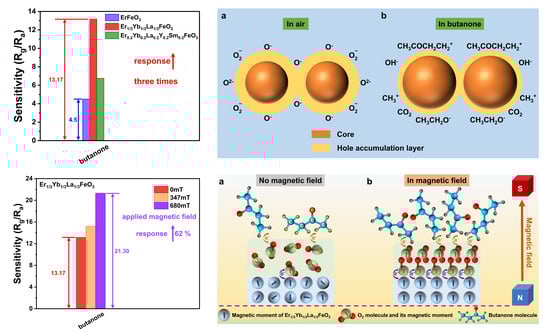
To detect volatile organic compounds, fabricating gas sensors with high sensitivity, excellent selectivity, low detection limits, and good long-term stability is critical. Herein, Er1/3Yb1/3La1/3FeO3 medium-entropy material was synthesized via the sol–gel method and characterized in terms of its morphological, structural, and chemical properties. The medium-entropy design induces significant lattice distortion and increased oxygen vacancies, leading to higher adsorbed oxygen content and hole concentration on the material surface, which enhances the activity of gas-sensing reactions. The Er1/3Yb1/3La1/3FeO3 sensor exhibits a response of 13.2 toward 10 ppm of butanone gas at the optimum operating temperature of 192 °C, which is nearly three times the response of the ErFeO3 sensor (4.5), along with excellent selectivity to butanone gas, a low detection limit (0.5 ppm), and long-term stability. Moreover, the applied magnetic fields improve the ordering of magnetic moments in both Er1/3Yb1/3La1/3FeO3 and O2 molecules, which facilitates gas adsorption and electron transfer, and further boosts the gas-sensing performance. The response of the Er1/3Yb1/3La1/3FeO3 sensor toward 10 ppm butanone is enhanced to 21.3 under the applied magnetic field of 680 mT, which improves the selectivity toward butanone. This work provides a novel material design strategy for the detection of VOCs and a feasible magnetic field-assisted approach for optimizing the gas-sensing performance of perovskite ferrite materials.

Graphical Abstract

1. Introduction

Gaseous pollutants in the environment are notable threats to human health [1]. Toxic and harmful volatile organic compounds (VOCs), which are widely used in chemical production [2], can exert adverse effects on the human skin, respiratory system, nervous system, and other organs when their concentrations in the air reach a certain level. For instance, individuals exposed to high concentrations of these VOCs for a long time have a significantly increased risk of developing severe diseases such as cancer (e.g., leukemia) [3]. Butanone is widely used as a denaturant and cleaning agent, as well as in the manufacture of textiles and paints. Short-term inhalation of butanone can cause irritation to the eyes, throat, etc., and may even depress the central nervous system. Prolonged exposure may cause coma and possibly death [4]. Therefore, it is crucial to fabricate gas sensors to meet the demand for monitoring these VOCs in the environment. Therefore, butanone is selected as the target analyte in this study. Metal oxide semiconductor (MOS)-based gas sensors are widely employed owing to their high gas response, simple structure, low fabrication cost, facile preparation process, and superior portability [5,6]. Multi-metal oxide perovskite materials hold promising prospects in gas-sensing research due to their structural stability, superior gas sensitivity, excellent long-term stability, and strong anti-interference capability [7]. The general chemical formula of perovskite-structured metal oxides is ABO3. By doping cations at the A-site or B-site, the crystal structure of perovskites can be tailored, which induces lattice distortion inside the material, generates oxygen vacancies or metal ion vacancies, increases the active sites for gas-sensing reactions, and ultimately optimizes the gas-sensing performance of the material. Among various perovskite-structured metal oxides, perovskite-type rare-earth ferrites (RFeO3, where R represents rare-earth elements) possess stable crystal structures, and their A-site can be composed of one or more rare-earth elements. Both rare-earth elements and the B-site element (Fe) are transition metals, which endow the materials with abundant physicochemical properties [8] and grant them great research potential in the field of gas-sensing materials [9]. As a perovskite ferrite with p-type semiconducting properties, ErFeO3 exhibits a unique structure, a suitable band gap, excellent chemical stability, and magnetic properties. In recent years, it has garnered widespread attention in fields such as photocatalysis, magnetic materials, and gas-sensing materials [10,11,12,13]. Wei et al. fabricated an ethylene glycol gas sensor based on perovskite-structured ErFeO3 nanofibers via a combination of uniaxial electrospinning and high-temperature calcination. The pores on the ErFeO3 nanofibers provide effective diffusion channels and sufficient gas-sensitive active sites for gas molecules, thereby enabling the sensor to exhibit a maximum response of 15.8 toward 100 ppm ethylene glycol at the optimal operating temperature of 230 °C [14]. Ying et al. synthesized orthorhombic perovskite ErFeO3 nanoparticles through sintering at 900 °C and acidization procedure after a facile hydrothermal method. The rough surface of ErFeO3 nanoparticles facilitates the gas sensor to deliver a response of 20 toward 100 ppm isopropanol at 270 °C [15]. Liu et al. synthesized porous Er1−xYbxFeO3 (x = 0, 0.3, 0.7, 1) materials via the sol–gel method. Among these samples, Er0.7Yb0.3FeO3 showed a response value of 12 toward 10 ppm butanone, which is 1.3 times that of pure ErFeO3 [16]. This result demonstrated the feasibility of enhancing gas-sensing performance through the co-doping of multiple rare-earth elements at the A-site of RFeO3. However, it remains a significant challenge for gas sensors based on perovskite-type ferrites to achieve both excellent selectivity toward the target gas and long-term stability.
In recent years, high-entropy ceramics (HECs) and medium-entropy ceramics (MECs) have garnered considerable research interest among scholars [17,18,19,20,21,22,23]. HECs, composed of multiple components, possess distinctive advantages, including high-entropy effect, thermal stability at elevated temperatures, and tunability of multiple excellent properties. By contrast, MECs not only achieve multicomponent regulation but also exhibit higher controllability and lower cost compared with HECs. These two materials open up new avenues for structural modulation and performance enhancement. Naganaboina et al. pioneered the application of the high-entropy oxide Gd0.2La0.2Ce0.2Hf0.2Zr0.2O2 in the field of gas sensors. The sensor displayed a response toward methane with a limit of detection (LOD) of 25 ppm [24]. Yan et al. designed a gas sensor based on (FeCoNi)100−xOx medium-entropy alloy oxides. Owing to the specific catalytic exothermic reactions of (FeCoNi)100−xOx toward H2/CO, the sensor exhibited high selectivity toward H2 and CO at 150 °C, with theoretical detection limits (LOD) of 0.3 ppm for H2 and 0.29 ppm for CO [25]. These aforementioned studies demonstrated the feasibility of high-entropy and medium-entropy engineering in the research of gas-sensing materials, which provides valuable insights for the material design of the present work. Based on the above research progress of medium/high-entropy gas-sensing materials, we selected ErFeO3 as the parent matrix, and introduced Yb3+, La3+, Y3+ and Sm3+ as A-site substituted cations for medium/high-entropy design. Er3+, Yb3+, La3+, Y3+ and Sm3+ are all typical trivalent rare-earth cations with matched ionic radii. These cations can be stably incorporated into the Er3+ site of the perovskite lattice without destroying the structural stability of the parent ErFeO3. Meanwhile, this graded radius design enables controllable tuning of lattice distortion and oxygen vacancy concentration, which is conducive to systematically investigating the enhancement effect of medium-entropy structure on gas-sensing performance.
In addition, the applied magnetic field assistance offers a novel approach for the optimization of gas-sensing performance. Ji et al. pioneered the introduction of an auxiliary magnetic field into the gas-sensing test environment, studied the VOC-sensing properties of BiFeO3 thermal–magnetic synergetic excitation, and found that applying the magnetic field decreased the optimum operating temperature, accelerated the response speed, and altered the selectivity, which is ascribed to the decreased domain-defects, activation of oxygen species, and excitation of VOC gas molecules with asymmetry electron cloud distributions [26]. Chakraborty et al. investigated the variation in gas-sensing performance of ferromagnetic Ni1−xVxO1−y under an applied magnetic field and found that the gas-sensing performance can be enhanced by regulating the remanent magnetic moment of the material and the excess negative charge on the surface via the applied magnetic field [27]. Sun et al. used an applied magnetic field to regulate the interface conductance and surface oxygen adsorption of Cu2O/NiO. The carriers were redistributed by the Lorentz force in a magnetic field, which changed the interface barrier and improved the response of the sensor to low concentrations (≤20 ppm) of H2S [28]. Due to the magnetic properties of ErFeO3-based materials [29], the applied magnetic fields modulate the orientations of magnetic moments in both the materials themselves and gas molecules, thereby regulating the gas-sensing performances of the materials [30]. Therefore, our work employs the strategy of applying external magnetic fields to investigate changes in gas-sensing properties of the materials.
In this work, medium-entropy Er1/3Yb1/3La1/3FeO3 gas-sensing material was synthesized via sol–gel method and annealing, together with ErFeO3 and high-entropy Er0.2Yb0.2La0.2Y0.2Sm0.2FeO3 reference samples. The phase composition, microstructure and morphology, specific surface area, and surface chemistry were characterized and analyzed. The medium-entropy design induces significant lattice distortion and increased oxygen vacancies, leading to higher adsorbed oxygen content and hole concentration on the material surface, which enhances the activity of gas-sensing reactions. Moreover, the applied magnetic fields improve the ordering of magnetic moments in both Er1/3Yb1/3La1/3FeO3 and O2 molecules, which facilitates the adsorption of gas molecules on the material surface, enhances electron transfer between the material and gas molecules, and further boosts the gas-sensing performance. The Er1/3Yb1/3La1/3FeO3 material provides a novel material design strategy for the detection of VOCs, while magnetic field-assisted regulation offers a feasible approach for optimizing the gas-sensing performance of perovskite ferrite materials.

2. Materials and Methods

2.1. Materials

In a typical synthesis, Er(NO3)3·5H2O, Yb(NO3)3·5H2O, La(NO3)3·6H2O, Y(NO3)3·6H2O, Sm(NO3)3·6H2O, Fe(NO3)3·9H2O, and PEG600 were purchased from Shanghai Aladdin Biochemical Technology Co., Ltd., Shanghai, China. Citric acid was purchased from Shanghai Macklin Biochemical Technology Co., Ltd., Shanghai, China. All of the reagents were analytical grade and used without further purification. Deionized water (Tianjin Yuanli Chemical Co., Ltd., Tianjin, China) was used in all experiments.

2.2. Synthesis of Gas-Sensing Materials

Medium-entropy Er1/3Yb1/3La1/3FeO3 material was prepared by sol–gel method and subsequent annealing, alongside ErFeO3 and high-entropy Er0.2Yb0.2La0.2Y0.2Sm0.2FeO3 reference samples. Er(NO3)3·5H2O, Yb(NO3)3·5H2O, La(NO3)3·6H2O, Y(NO3)3·6H2O, Sm(NO3)3·6H2O, Fe(NO3)3·9H2O were dissolved in deionized water according to the molar ratio of metal salts used in the synthesis to form a uniform solution. Then, citric acid (with a molar amount twice that of the total metal ions) and polyethylene glycol (accounting for about 10 wt% of the total mass of the solution) were added to the system. The solution was magnetically stirred at room temperature for 6 h, and then stirred in a water bath at 70 °C for 4 h to obtain a dark yellow sol. Then, the sol was dried in an oven at 100 °C for 12 h into gel, which was ground into powder and annealed in a muffle furnace at 900 °C for 3 h.

2.3. Characterization

The phase of the powders was characterized by X-ray diffraction (XRD, D8 Advanced, Bruker, Karlsruhe, Germany) with Cu-Kα radiation (λ = 0.154178 nm) in a scanning range 2θ of 10–90° and a scanning speed of 0.12°/s. The microstructure and morphology of the powders were characterized by field emission scanning electron microscopy (SEM, S4800, HITACHI, Tokyo, Japan). The content and distribution of the elements were obtained by energy dispersive spectroscopy (EDS, X-MAX20, Oxford, Abingdon, UK). The chemical states of the elements were obtained by X-ray photoelectron spectroscopy (XPS, ESCALAB 250 XI, Thermo, Waltham, MA, USA) with monochrome Al-Kα radiation. The specific surface area of the samples was characterized using N2 adsorption–desorption isotherms by the Brunauer–Emmett–Teller (BET) method with a volumetric adsorption analyzer (NOVA-2200e, Quantachrome, Boynton Beach, FL, USA). The magnetic properties were measured by the magnetic property measurement system (MPMS-VSM, Quantum Design, San Diego, CA, USA).

2.4. Fabrication and Measurement of Gas Sensor

A side-heated gas sensor based on an Al2O3 tube was employed in the gas-sensing measurements. A proper amount of ErFeO3/Er1/3Yb1/3La1/3FeO3/Er0.2Yb0.2La0.2Y0.2Sm0.2FeO3 powders were mixed with deionized water and stirred uniformly to form pastes, which were then coated onto the Al2O3 tube posited with a pair of ring-shape Au electrodes and four Pt wires. Each Au electrode is soldered with two Pt wires for electrical contact and resistance measurement. The dimensions of the Al2O3 tube are as follows: inner diameter Φ1 ≈ 0.8 mm, outer diameter Φ2 ≈ 1.2 mm, and length L ≈ 4.0 mm. The inter-electrode spacing is approximately 1.5 mm. The thickness of the sensitive layers is approximately 150 μm. The working temperature of the sensor was adjusted by changing the current of the Ni-Cr heating wire inserted in the Al2O3 tube. The Pt wires and heating wire were soldered onto a 6-pin base to connect to the test system. The fabricated gas sensor and schematic diagram of a typical gas sensor are displayed in Figure S1. Prior to the measurement, to ensure their stability and repeatability, the gas sensors were aged for 24 h at optimum working temperatures by an AS-20 sensor aging system (Elite Tech Co., Ltd., Beijing, China) for improving the mechanical strength and electrical contact. Gas-sensing performance was measured by a CGS-8 intelligent gas-sensing analysis system (Elite Tech Co., Ltd., Beijing, China). During the test, ambient air from the laboratory environment was used as the reference and diluting gas. The relative humidity (RH) of the air in the test chamber was maintained at approximately 35% throughout the experiments. An adequate amount of volatile liquid was injected into the closed chamber by a microinjector to get the desired gas concentration. When the test was completed, the chamber was opened to ambient air to facilitate the recovery of the sensors. The p-type sensor response is defined as S = Rg/Ra, where Rg and Ra are the resistances of the sensor in target gas and in air, respectively. The response and recovery times were defined as the duration required for the sensor to achieve 90% of the total resistance change during gas adsorption and desorption process, respectively. For gas-sensing performance tests under applied magnetic fields, the sensor was placed at the center of a commercially available electromagnet, and the variations in the sensor’s gas-sensing performance under magnetic field modulation were investigated by applying magnetic fields with varying intensities. The magnetic field strength was precisely regulated by adjusting the current and voltage applied to the electromagnet. The initial resistances (Ra) of the ErFeO3, Er1/3Yb1/3La1/3FeO3 and Er0.2Yb0.2La0.2Y0.2Sm0.2FeO3 sensors are approximately 112 MΩ, 18 MΩ and 34 MΩ, respectively.

3. Results and Discussion

3.1. Composition, Structure and Morphology

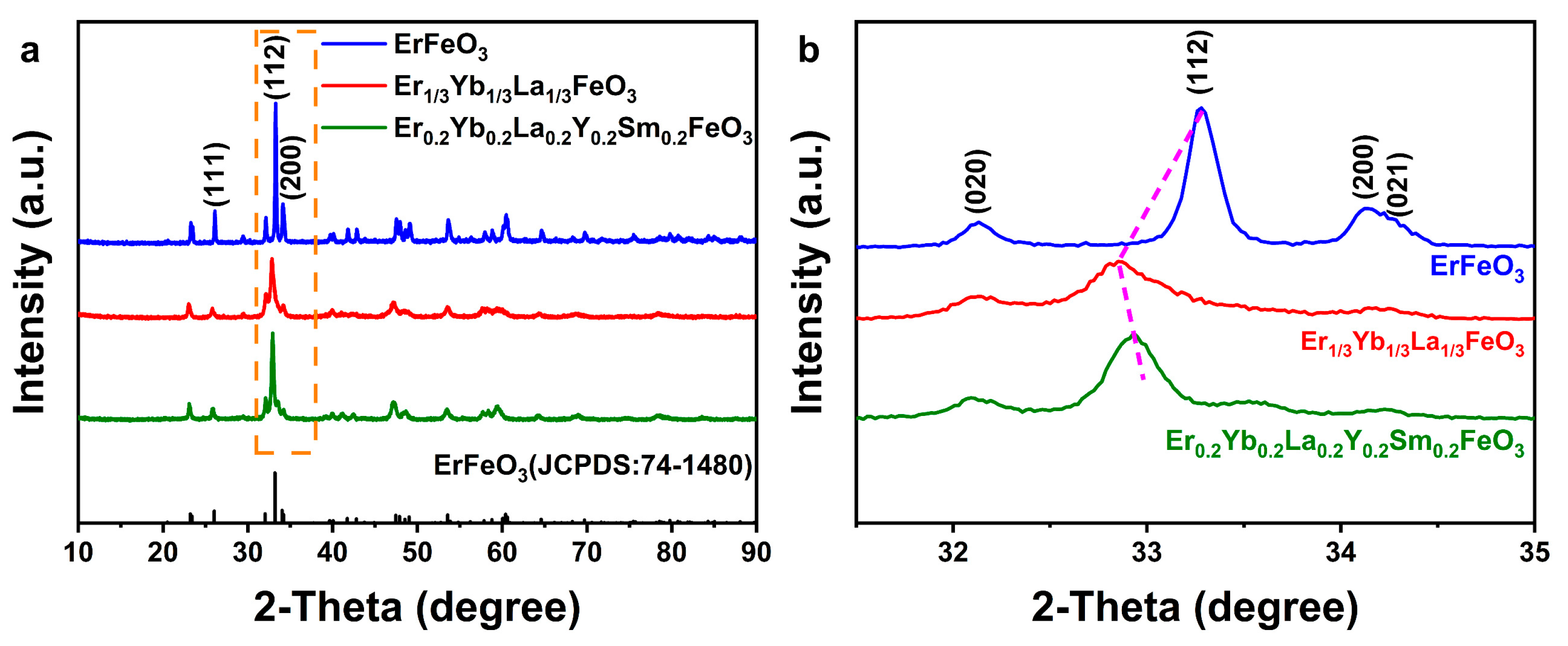
As shown in Figure 1a, the phase structure of the prepared Er1/3Yb1/3La1/3FeO3 sample was characterized by X-ray diffraction (XRD), with ErFeO3 and Er0.2Yb0.2La0.2Y0.2Sm0.2FeO3 samples also analyzed for comparison. All the samples exhibit diffraction peak profiles that are in good agreement with the JCPDS PDF (#74-1480), indicating that they are all orthorhombic perovskite-type materials. The (111), (112) and (200) diffraction peaks of ErFeO3 are relatively sharp, indicating its high crystallinity. In contrast, the characteristic peak intensities of Er1/3Yb1/3La1/3FeO3 and Er0.2Yb0.2La0.2Y0.2Sm0.2FeO3 show slight variations, which can be attributed to lattice distortion induced by multi-element co-doping, thereby impairing the crystallographic perfection. Figure 1b displays the magnified patterns of the (020), (112), (200) and (021) diffraction peaks for the three samples. The (112) peak, which is the strongest diffraction peak for all three samples, shifts toward lower diffraction angles in Er1/3Yb1/3La1/3FeO3 and Er0.2Yb0.2La0.2Y0.2Sm0.2FeO3 compared to that in ErFeO3. According to Bragg’s law, the reduced diffraction angle indicates an increase in interplanar spacing, suggesting an enlarged average ionic radius at the A-site. This is consistent with the ionic radius sequence of the relevant cations: La3+ (103.2 pm) > Sm3+ (96.4 pm) > Y3+ (90.0 pm) > Er3+ (89.0 pm) > Yb3+ (86.8 pm). Notably, the medium-entropy Er1/3Yb1/3La1/3FeO3 sample exhibits the most pronounced diffraction peak shift, which indicates the greatest expansion in interplanar spacing and increase in average ionic radius, thereby suggesting the most significant lattice distortion. In addition, compared with ErFeO3, the full width at half maximum (FWHM) of the (112) peak broadens in both Er1/3Yb1/3La1/3FeO3 and Er0.2Yb0.2La0.2Y0.2Sm0.2FeO3 samples. Based on the Scherrer equation (Equation (1)), the increase in the FWHM (β) and the decrease in the Bragg angle (θ) indicate that the medium-entropy or high-entropy design may lead to a reduction in the average grain size (D), where K is the Scherrer constant and λ is the X-ray wavelength.
D = K λ β cos θ
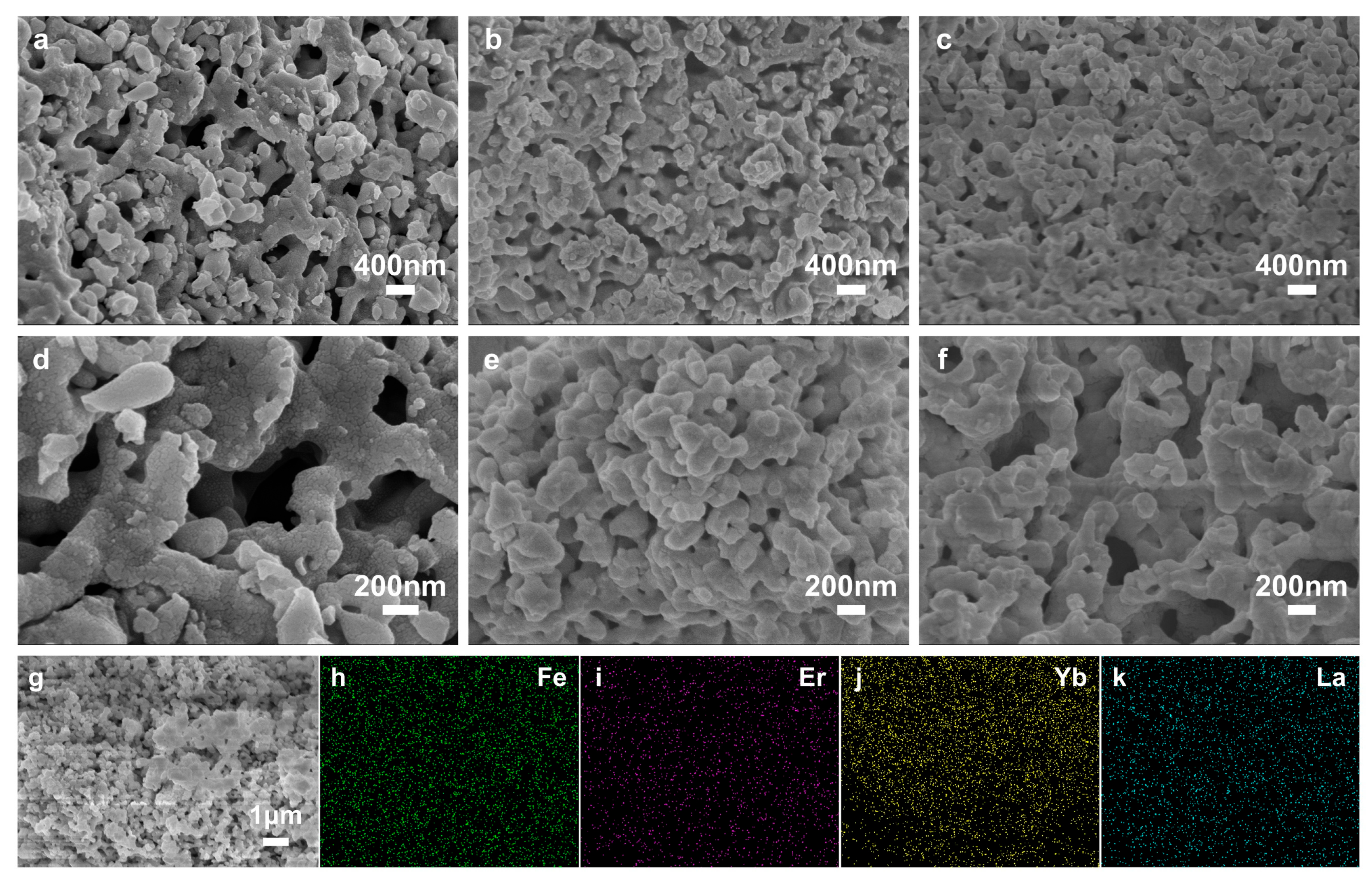
Figure 2a–f displays SEM images of ErFeO3, Er1/3Yb1/3La1/3FeO3 and Er0.2Yb0.2La0.2Y0.2Sm0.2FeO3 powder samples at different magnifications. The results indicate that all three samples possess an irregular porous structure. The particle diameter of ErFeO3 is approximately 400 nm, with a pore size of around 300 nm; Er1/3Yb1/3La1/3FeO3 has a particle diameter of about 200 nm and a pore size below 100 nm; while Er0.2Yb0.2La0.2Y0.2Sm0.2FeO3 exhibits a particle diameter of roughly 300 nm and a pore size of approximately 300 nm. Owing to the high degree of lattice distortion, the Er1/3Yb1/3La1/3FeO3 sample generates substantial internal stress, which increases the diffusion resistance between particles, thereby inhibiting the agglomeration and growth of particles [31]. On the other hand, the lattice distortion reduces atomic mobility, hindering the dissolution of small particles and the growth of large particles, suppressing Ostwald ripening, which results in smaller particle size and more uniform particle distribution. Meanwhile, the smaller and more uniformly distributed pores yield a more developed porous structure, which improves gas mass transfer efficiency, facilitates gas adsorption and thus ultimately boosts the activity of gas-sensing reactions. In contrast, the ErFeO3 sample shows particle agglomeration with lower pore content, which may impede gas adsorption and lead to a relatively low gas-sensing response. The uniformity of both particle size and pore size of Er0.2Yb0.2La0.2Y0.2Sm0.2FeO3 is inferior to that of Er1/3Yb1/3La1/3FeO3, which is likely to induce a degradation in gas-sensing performance. From the EDS elemental mapping images of Er1/3Yb1/3La1/3FeO3 (Figure 2g), the sample contains Fe, Er, Yb and La elements (Figure 2h–k), and all these elements are uniformly distributed throughout the whole porous powders, which verifies that all A-site elements have been incorporated into the perovskite lattice to form a homogeneous solid solution.
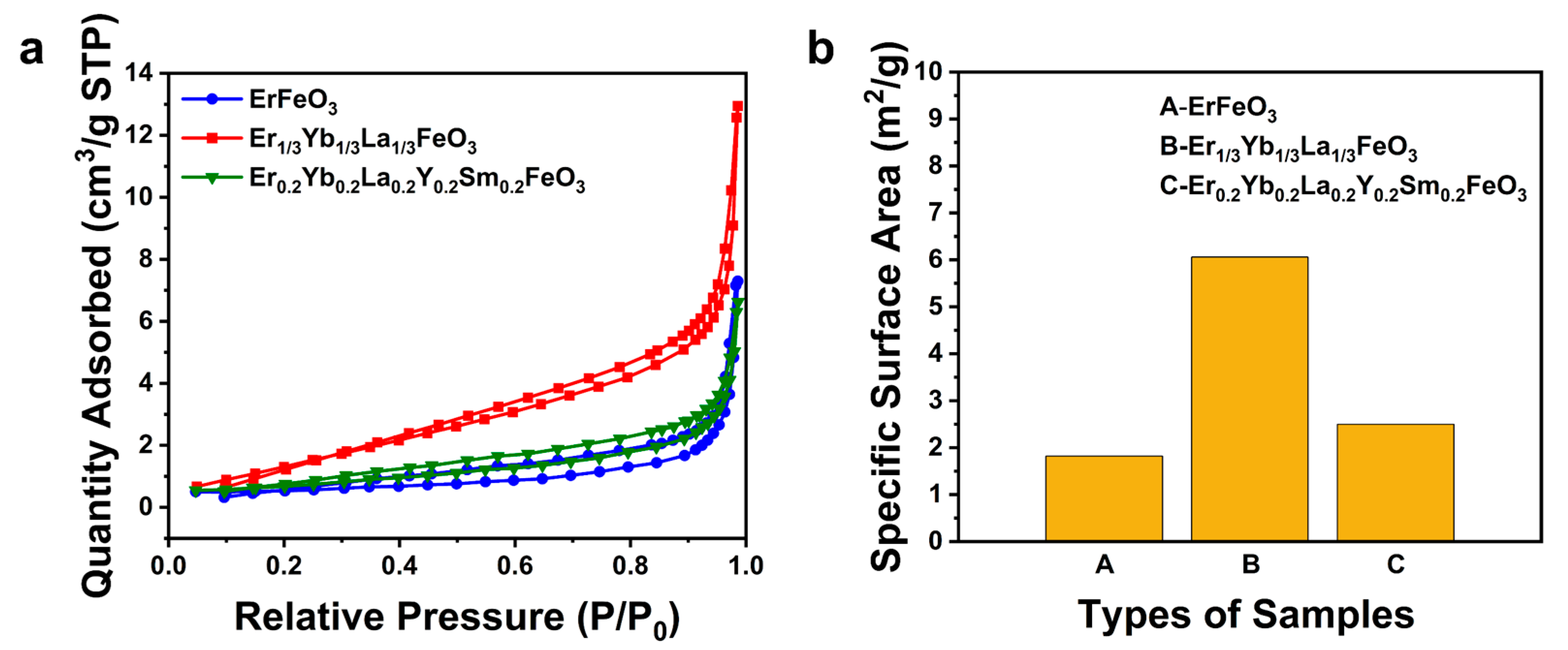
Nitrogen adsorption measurements were conducted at 77 K. As shown in Figure 3a, all the samples exhibit type-IV isotherms with the H3 hysteresis loop. Figure 3b presents the BET measurement results, where the specific surface areas of ErFeO3, Er1/3Yb1/3La1/3FeO3 and Er0.2Yb0.2La0.2Y0.2Sm0.2FeO3 are 1.8, 6.1, and 2.5 m2/g, respectively. Among these samples, Er1/3Yb1/3La1/3FeO3 has the largest specific surface area, which facilitates gas molecule adsorption and thus enhances the activity of gas-sensing reactions.
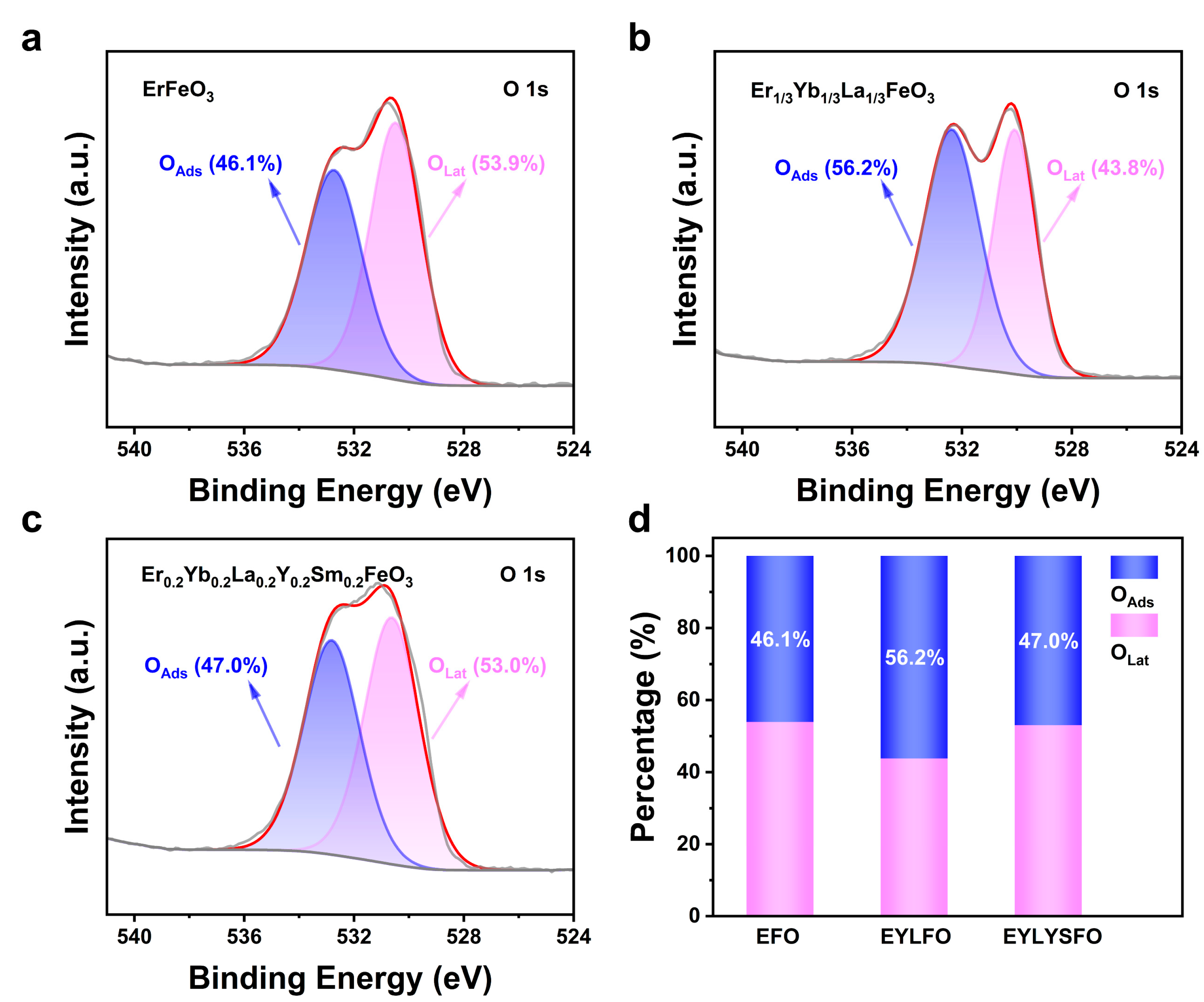
To further investigate the surface oxygen elements of ErFeO3, Er1/3Yb1/3La1/3FeO3 and Er0.2Yb0.2La0.2Y0.2Sm0.2FeO3, XPS measurements and analyses were performed. The O 1s peaks of all three materials were divided into two components via Gaussian fitting [32,33], corresponding to lattice oxygen (OLat) centered at approximately 530 eV and adsorbed oxygen (OAds) centered at around 532.5 eV in Figure 4. Figure 4a–c displays the high-resolution XPS spectrums of the O 1s peaks for surface oxygen species, while Figure 4d shows a comparison of the percentage contents of different oxygen species. Among the three materials, Er1/3Yb1/3La1/3FeO3 exhibits the highest percentage content of OAds (56.2%), indicating that more oxygen is adsorbed on the material surface, which is conducive to enhancing the activity of gas-sensing reactions [34]. The increase in adsorbed oxygen on the material surface promotes the release of more electrons from the material, leading to a thicker hole accumulation layer and a higher hole concentration, which consequently decreases the material resistance (Ra). When detecting reducing gases, the gases donate more electrons to the material, which increases the material resistance (Rg) and thereby enhances the sensitivity of gas-sensing reactions.

3.2. Gas-Sensing Properties

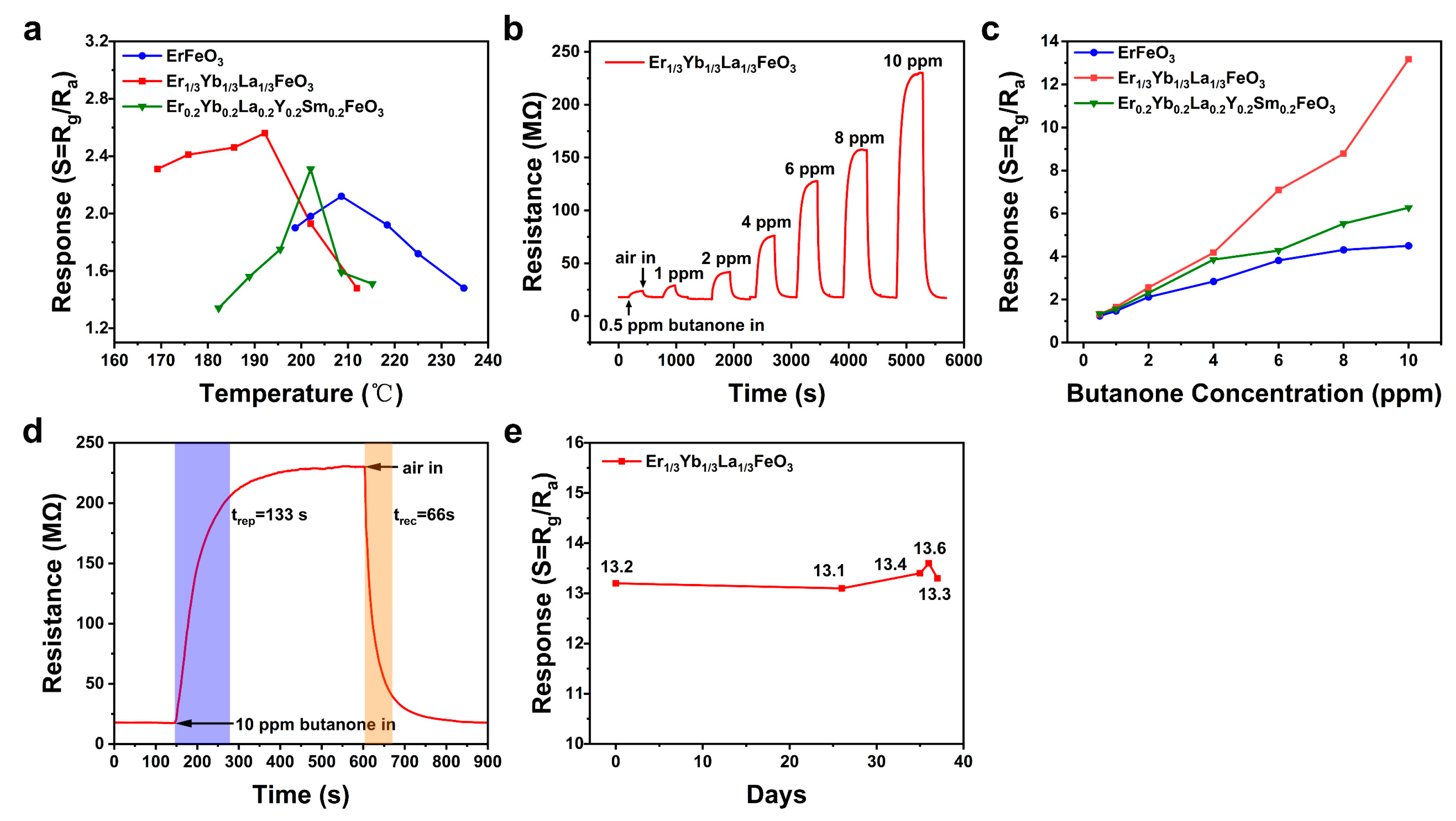
Figure 5a displays the variation in response values of ErFeO3, Er1/3Yb1/3La1/3FeO3 and Er0.2Yb0.2La0.2Y0.2Sm0.2FeO3 sensors toward 2 ppm of butanone gas at different operating temperatures. The operating temperature range of 150–250 °C was selected based on preliminary tests, as this range covers the optimal temperature peaks for all three samples. Below 150 °C, the response is extremely low due to insufficient surface activation, while above 250 °C, the response decreases rapidly due to the dominance of gas desorption. This design ensures the accuracy of the performance evaluation. As the operating temperature increases, the response values of all three sensors first increase and then decrease. The optimum operating temperatures of ErFeO3, Er1/3Yb1/3La1/3FeO3 and Er0.2Yb0.2La0.2Y0.2Sm0.2FeO3 sensors are 209 °C, 192 °C and 202 °C, respectively. This indicates that the medium-entropy and high-entropy designs of the A-site in ErFeO3 can reduce the optimum operating temperature, with the medium-entropy Er1/3Yb1/3La1/3FeO3 sensor exhibiting the lowest optimum operating temperature. Figure 5b depicts the dynamic response–recovery curve of the Er1/3Yb1/3La1/3FeO3 sensor to different concentrations of butanone at the optimum operating temperature. The responses of ErFeO3, Er1/3Yb1/3La1/3FeO3, and Er0.2Yb0.2La0.2Y0.2Sm0.2FeO3 sensors to different concentrations of butanone at respective optimum operating temperatures are presented in Figure 5c. As the concentration of butanone increases, the response of all three sensors increases, with the Er1/3Yb1/3La1/3FeO3 sensor demonstrating the highest response. The Er1/3Yb1/3La1/3FeO3 sensor exhibits responses of 1.3, 1.7, 2.6, 4.2, 7.1, 8.8 and 13.2 towards butanone at the concentrations of 0.5, 1, 2, 4, 6, 8, and 10 ppm, respectively. At the butanone concentration of 10 ppm, the three sensors deliver responses of 4.5, 13.2, 6.3 at their respective optimum operating temperatures. The response of the Er1/3Yb1/3La1/3FeO3 sensor reaches approximately three times that of the ErFeO3 sensor, illustrating that the medium-entropy design remarkably enhances the sensitivity of gas-sensing reactions. The reason is that the medium-entropy engineering induces a substantial variation in the average ionic radius of the A-site within the material, which leads to considerable lattice distortion, generates abundant oxygen vacancies, and increases the adsorbed oxygen content and hole concentration on the material surface, thereby enhancing the reactivity of gas-sensing reactions [35,36,37,38]. Another potential reason is that multi-element doping elevates the electronic density of states of Er1/3Yb1/3La1/3FeO3. Under thermal excitation, electrons in the valence band can more readily traverse the band gap and migrate to the conduction band, which facilitates the enhancement of gas-sensing sensitivity [16]. In contrast, the high-entropy design results in a smaller variation in the average ionic radius, which, in turn, gives rise to a lower degree of lattice distortion, thus leading to a less pronounced enhancement in gas-sensing performance compared with Er1/3Yb1/3La1/3FeO3. Figure 5d presents the dynamic response–recovery curve of the Er1/3Yb1/3La1/3FeO3 sensor towards 10 ppm of butanone at the optimum operating temperature of 192 °C, with the response and recovery times being 133 s and 66 s, respectively. As shown in Figure 5e, the long-term stability of the Er1/3Yb1/3La1/3FeO3 sensor was assessed by intermittent testing the response of the sensor to 10 ppm of butanone over a period of 37 days. During the long-term test, the fluctuation range of the response value is 99–103% of the initial response value, which demonstrates reliable long-term stability of the sensor and further verifies the stability of the Er1/3Yb1/3La1/3FeO3 material. Throughout the test, the relative humidity was kept constant at approximately 35% to avoid potential fluctuations caused by humidity variations and ensure the stability and reproducibility of the sensing measurements.
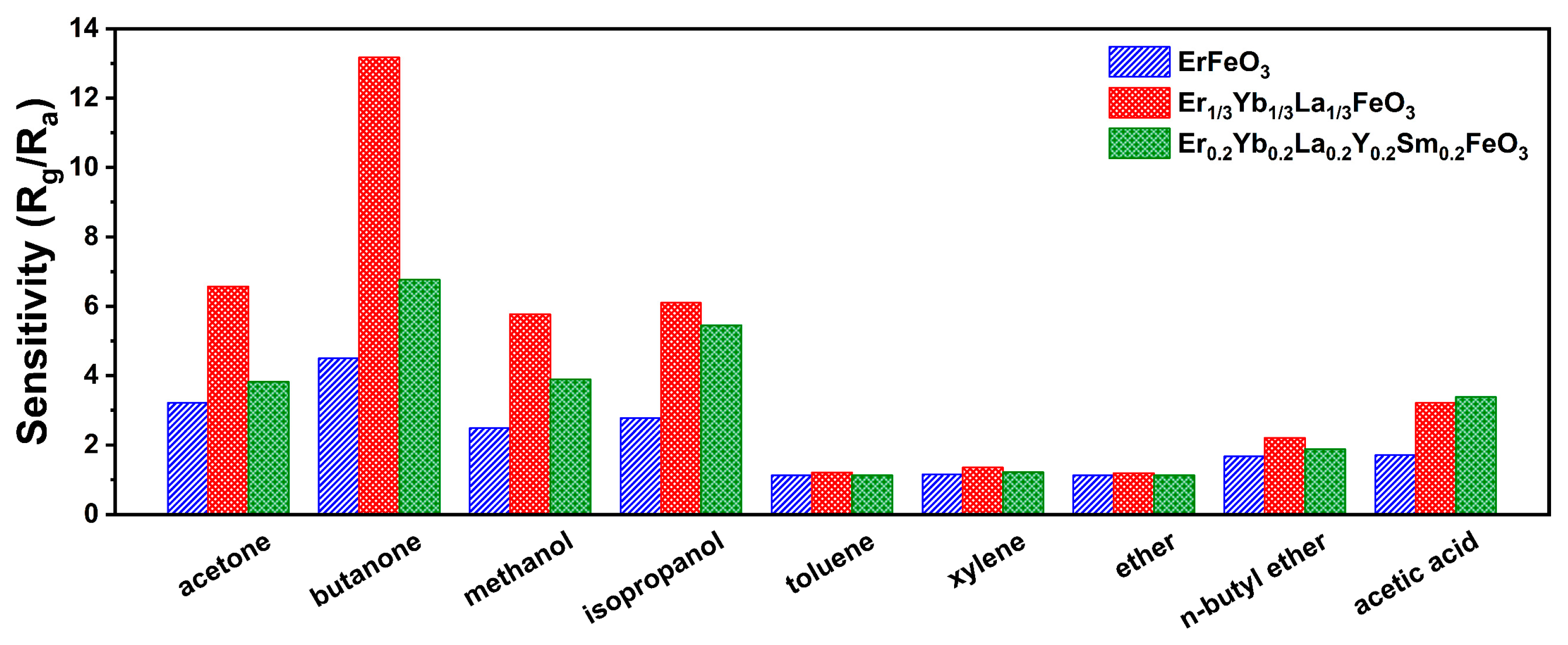
Selectivity is an important parameter for evaluating the gas-sensing performance of gas sensors [39]. For the selectivity test, a series of typical toxic and harmful VOCs commonly found in laboratory and industrial production were selected as interfering gases. These representative VOCs can effectively evaluate the selectivity of the sensor toward butanone. Figure 6 displays the responses of ErFeO3, Er1/3Yb1/3La1/3FeO3 and Er0.2Yb0.2La0.2Y0.2Sm0.2FeO3 sensors to 10 ppm of different VOCs at their respective optimum operating temperatures. The Er1/3Yb1/3La1/3FeO3 sensor exhibits responses of 6.6, 13.2, 5.8, 6.1, 1.2, 1.4, 1.2, 2.2 and 3.2 to acetone, butanone, methanol, isopropanol, toluene, xylene, ether, n-butyl ether, and acetic acid, respectively, indicating its relatively high selectivity toward butanone. Meanwhile, ErFeO3 and Er0.2Yb0.2La0.2Y0.2Sm0.2FeO3 sensors also show the highest response toward butanone compared with other VOCs. However, their selectivity toward butanone is inferior to that of the Er1/3Yb1/3La1/3FeO3 sensor. This demonstrates that the medium-entropy design effectively improves the selectivity of the material toward butanone.
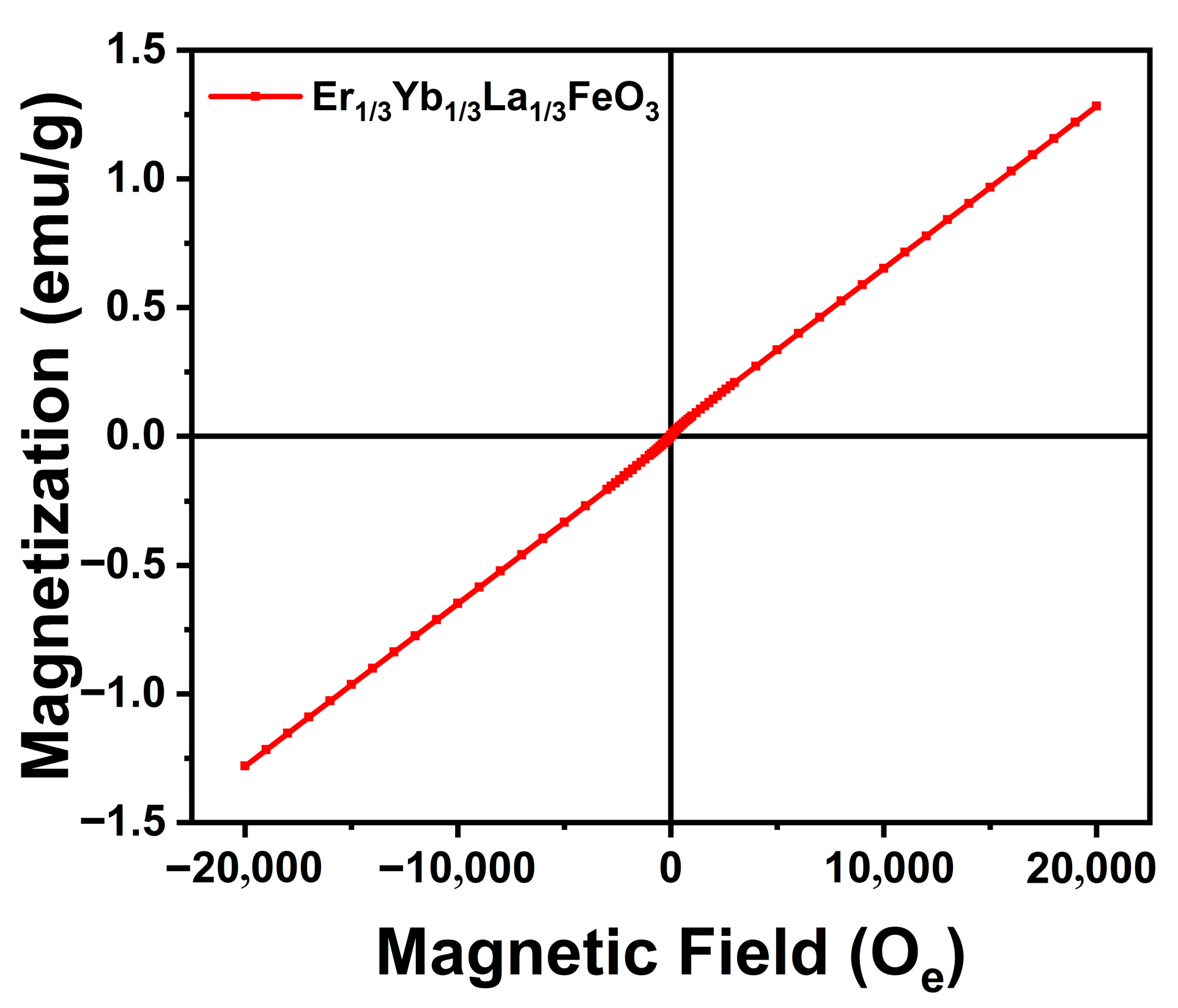
To investigate the effect of applied magnetic fields on the gas-sensing performance of the Er1/3Yb1/3La1/3FeO3 sensor, the magnetization curve of Er1/3Yb1/3La1/3FeO3 was first measured over an external magnetic field range of −20,000 to 20,000 Oe at 300 K (Figure 7). The magnetization curve of Er1/3Yb1/3La1/3FeO3 is approximately linear, indicating that the material exhibits paramagnetic behavior.
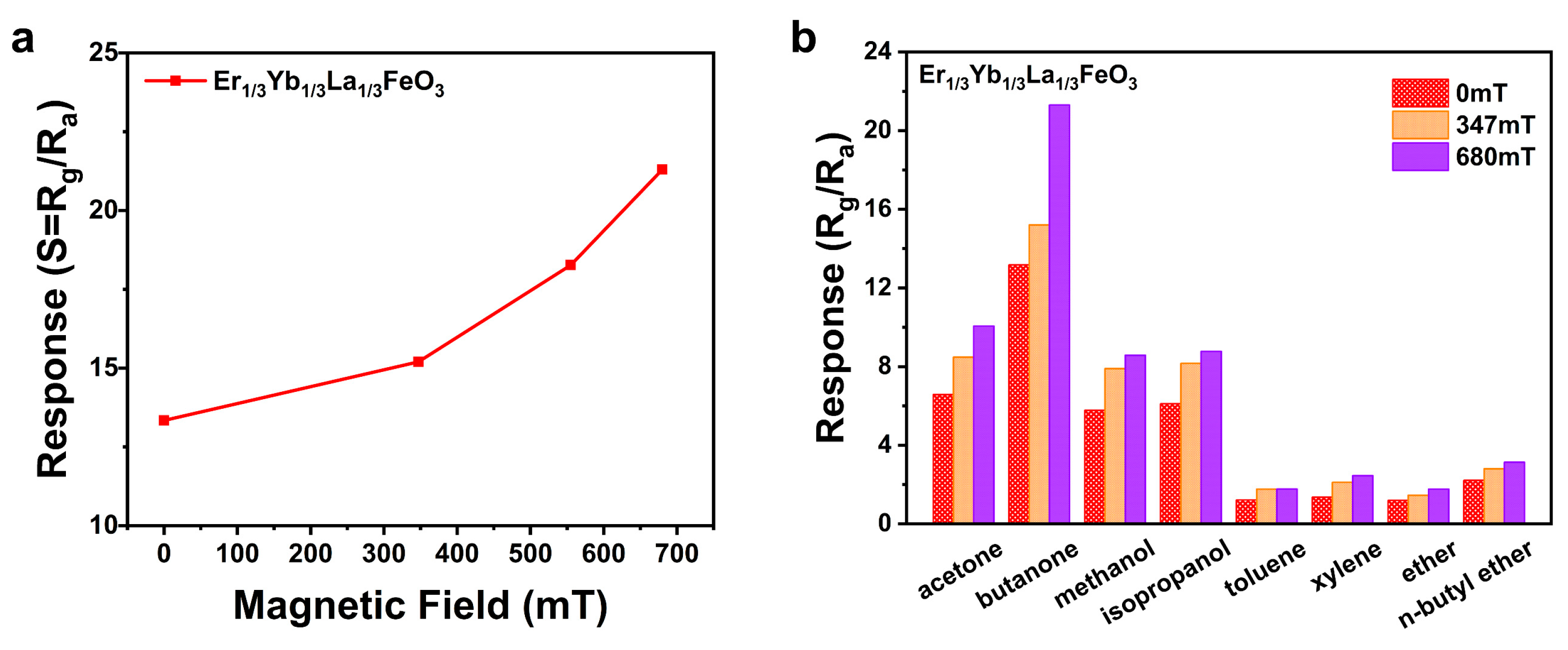
Further investigation was conducted on optimizing the gas-sensing performance of the Er1/3Yb1/3La1/3FeO3 sensor under applied magnetic fields. As illustrated in Figure 8a, the sensitivity of the Er1/3Yb1/3La1/3FeO3 sensor toward 10 ppm of butanone is enhanced with the increase in applied magnetic field intensity. The response of the Er1/3Yb1/3La1/3FeO3 sensor increases from 13.3 to 21.3 under the applied magnetic field of 680 mT, representing an approximate enhancement of 60% compared with the case without an applied magnetic field, which indicates a notable improvement in the sensitivity.
Figure 8b further presents the variation in sensitivity of the Er1/3Yb1/3La1/3FeO3 sensor toward 10 ppm of different VOCs under applied magnetic fields with varying intensities. The sensitivity of the sensor toward all VOCs is improved to varying degrees as the intensity of the applied magnetic field increases, wherein the enhancement is most pronounced for butanone, which consequently elevates the selectivity of the material toward this gas. The high response toward butanone can be attributed to the following reasons: First, the carbonyl group containing a π bond with low bond energy endows the molecule with high electron cloud mobility under the applied magnetic field. Furthermore, the relatively long carbon chain causes the electron cloud to shift to a greater extent toward the more electronegative oxygen, thus enhancing the mobility of the electron cloud [26]. The result confirms the feasibility of the strategy for optimizing the gas-sensing performance of perovskite ferrite materials via applied magnetic fields.

3.3. Gas-Sensing Mechanism

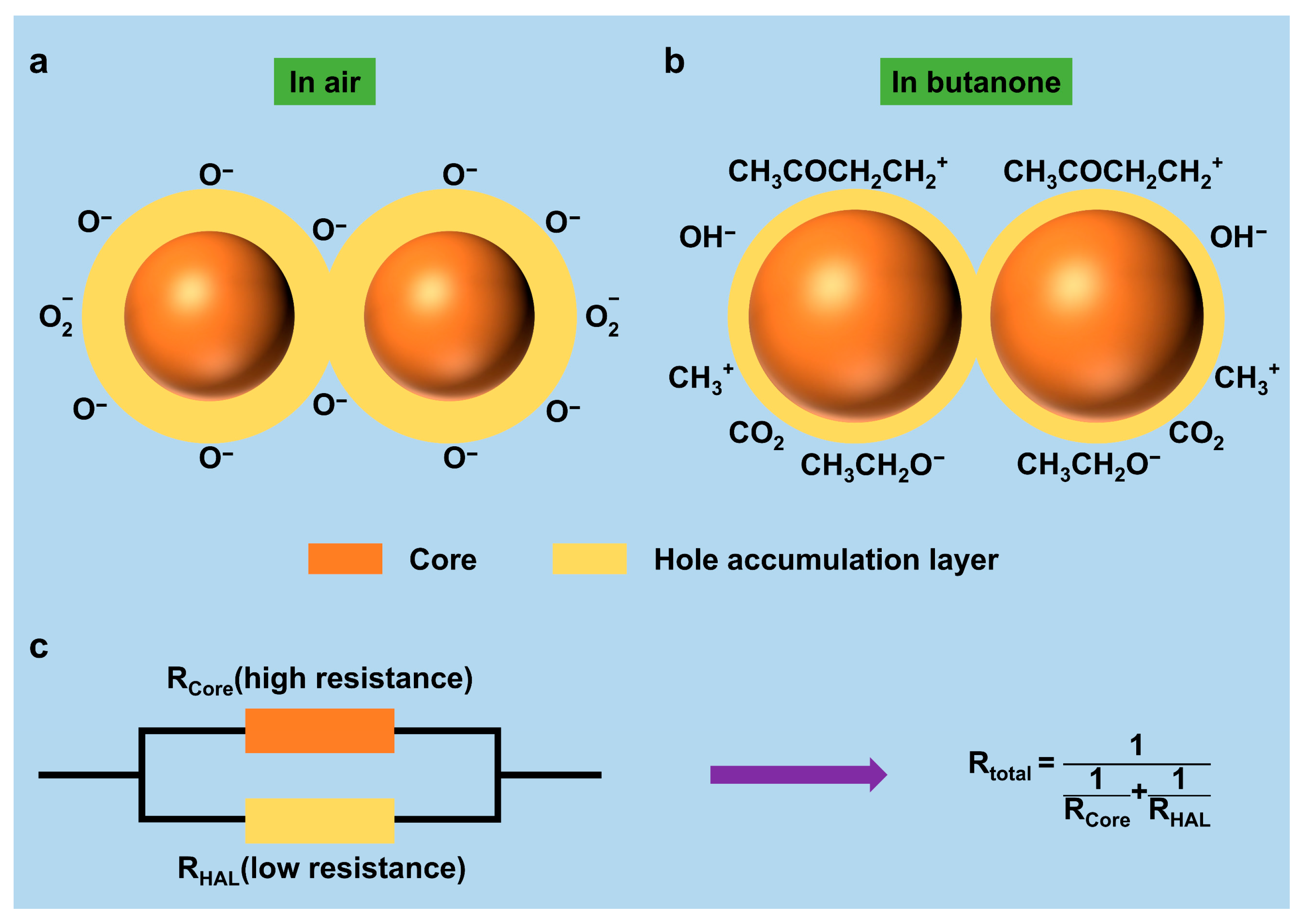
The gas-sensing mechanism under thermal excitation is analyzed. In this study, the gas-sensing mechanism is elucidated based on the redox reaction between butanone gas and the adsorbed oxygen species on the material surface. Gas-sensing investigations reveal that the Er1/3Yb1/3La1/3FeO3 sensor exhibits p-type detection behavior, characterized by an increase in sensor resistance following interaction with butanone gas (Figure 5b). Therefore, the typical concept of the hole accumulation layer (HAL) is employed to explain the detection interactions between the material and gas [40]. The p-type semiconductor possesses an electronic core–shell structure, namely, a high-resistance region at the core of the particles and a low-resistance HAL on the surface of the particles [41].
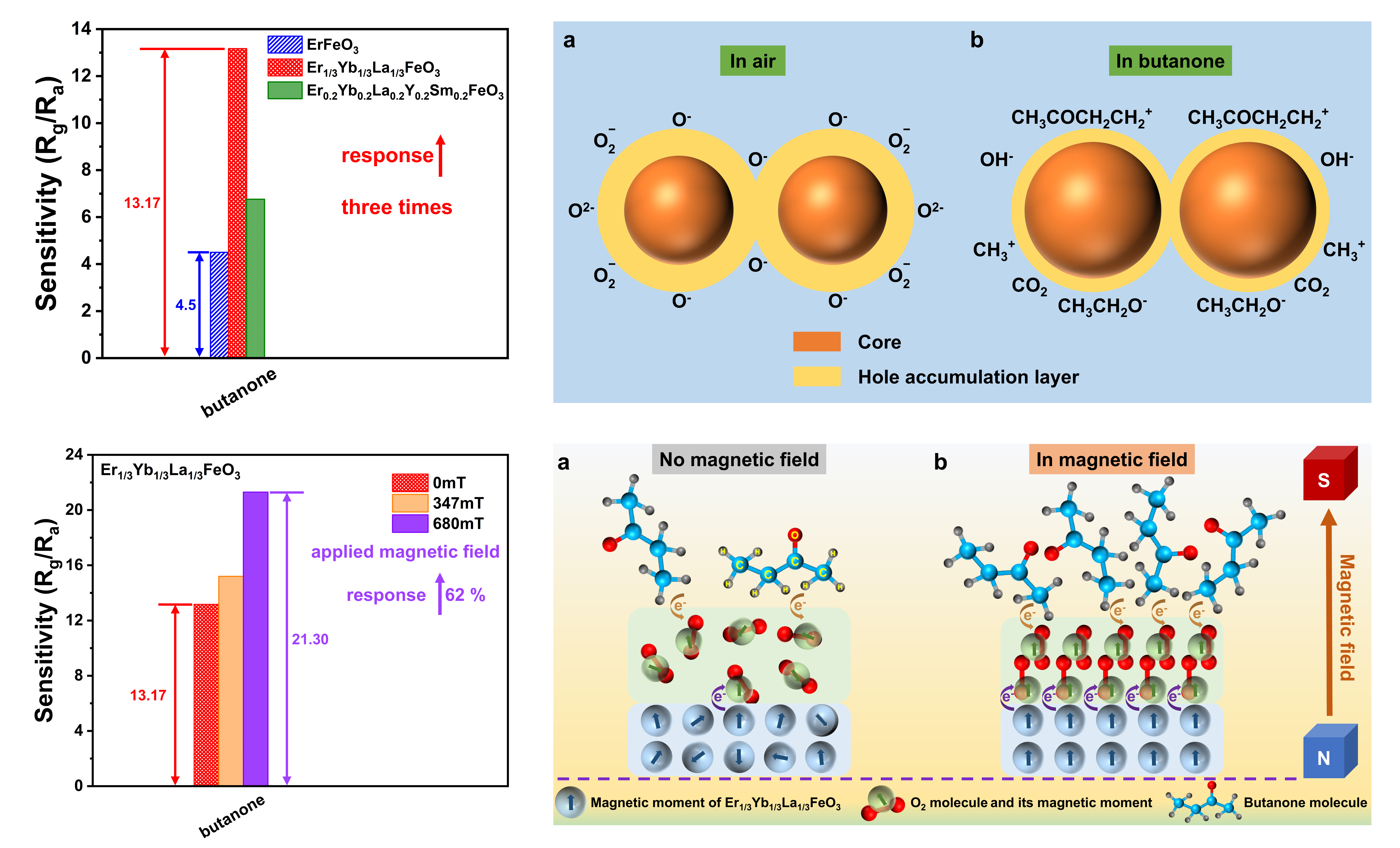
Figure 9 shows the schematic diagram of the gas-sensing mechanism of Er1/3Yb1/3La1/3FeO3. As shown in Figure 9a, when the material is exposed to air, oxygen molecules adsorb onto the surface of the material, capturing electrons from the conduction band to form various oxygen species, such as O2− (>300 °C), O (100–300 °C), and O 2 (<100 °C) [42], as illustrated in Equations (2)–(5). When the applied temperature is below the operating temperature range, the predominant adsorbed oxygen species on the material surface is O 2 . When the temperature reaches the operating temperature range of the sensor, namely, within the interval of 100–300 °C, the oxygen species involved in the gas-sensing reaction are dominated by O, accompanied by a small amount of O 2 , while O2− is barely present since it is mainly stable above 300 °C. Due to the capture of electrons in the material’s conduction band by adsorbed oxygen, the hole concentration of the material increases, which results in the emergence of the HAL and the enhancement of the material’s electrical conductivity. As depicted in Figure 9c, the equivalent resistance of the surface HAL is connected in parallel with that of the core to form the equivalent resistance of Er1/3Yb1/3La1/3FeO3. The conduction of carriers predominantly occurs in the surface HAL due to its lower resistance. The variation in the total resistance of the material (Rtotal) depends on that in the resistance of the surface HAL (RHAL). As shown in Figure 9b, when exposed to butanone gas, the material acquires the electrons released from pre-adsorbed oxygen species according to the reactions presented in Equations (6) and (7) [43]. Butanone reacts with the adsorbed oxygen on the material surface, releasing electrons that recombine with the holes on the material surface, which reduces the hole concentration and induces the shrinkage of the HAL. The material’s resistance increases because of the decrease in carrier concentration. It should be emphasized that the above gas-sensing mechanism is also applicable to the other two materials in this work.
O 2 ( gas )     O 2 ( ads )
O 2 ( ads ) + e     O 2 ( ads )
O 2 ( ads ) + e     2 O ( ads )
O ( ads ) + e     O 2 ( lat )
CH 3 COC H 2 C H 3 ( gas ) + O ( ads )     C H 3 COCH 2 CH 2 + + O H +   e
C H 3 COC H 2 CH 3 ( gas ) + 2 O ( ads )     C H 3 + + C O 2 + C H 3 C H 2 O + 2 e
When the material is re-exposed to the air and enters the recovery process, butanone gas desorbs from the material surface and diffuses into the air, which leads to the thickening of the HAL and the reduction in the material’s resistance and ultimately restores the material to its initial state.
The excellent selectivity toward butanone of Er1/3Yb1/3La1/3FeO3 can be attributed to the following reasons: First, the oxygen atom in the carbonyl group (C=O) of the butanone molecule possesses a lone pair of electrons, while Fe3+ exhibits strong electron-accepting capacity owing to its abundant 3d5 empty electron orbitals. Butanone molecules bind to the electron-accepting Lewis acid sites on the material surface, which enables the material to accept the lone pair electrons from the C=O and form coordinate bonds [44]. Second, the oxygen atom of the C=O is slightly negative, and the relatively long carbon chain causes the electron cloud to shift to a greater extent toward the more electronegative oxygen in the butanone molecule. The Fe-O bond has high covalency, and electrostatic interactions enhance the attraction between Fe and carbonyl oxygen, which, in turn, strengthens the adsorption of butanone molecules on the material surface [26,45,46]. Third, according to Equations (6) and (7), butanone decomposes into various active groups including CH3COCH2CH2+, CH3+, CH3CH2O in the gas-sensing reaction [16], releasing a substantial number of electrons, which induces more electron-hole recombination and results in a more significant increase in the material’s resistance, thus yielding a higher sensitivity of the gas-sensing reaction.
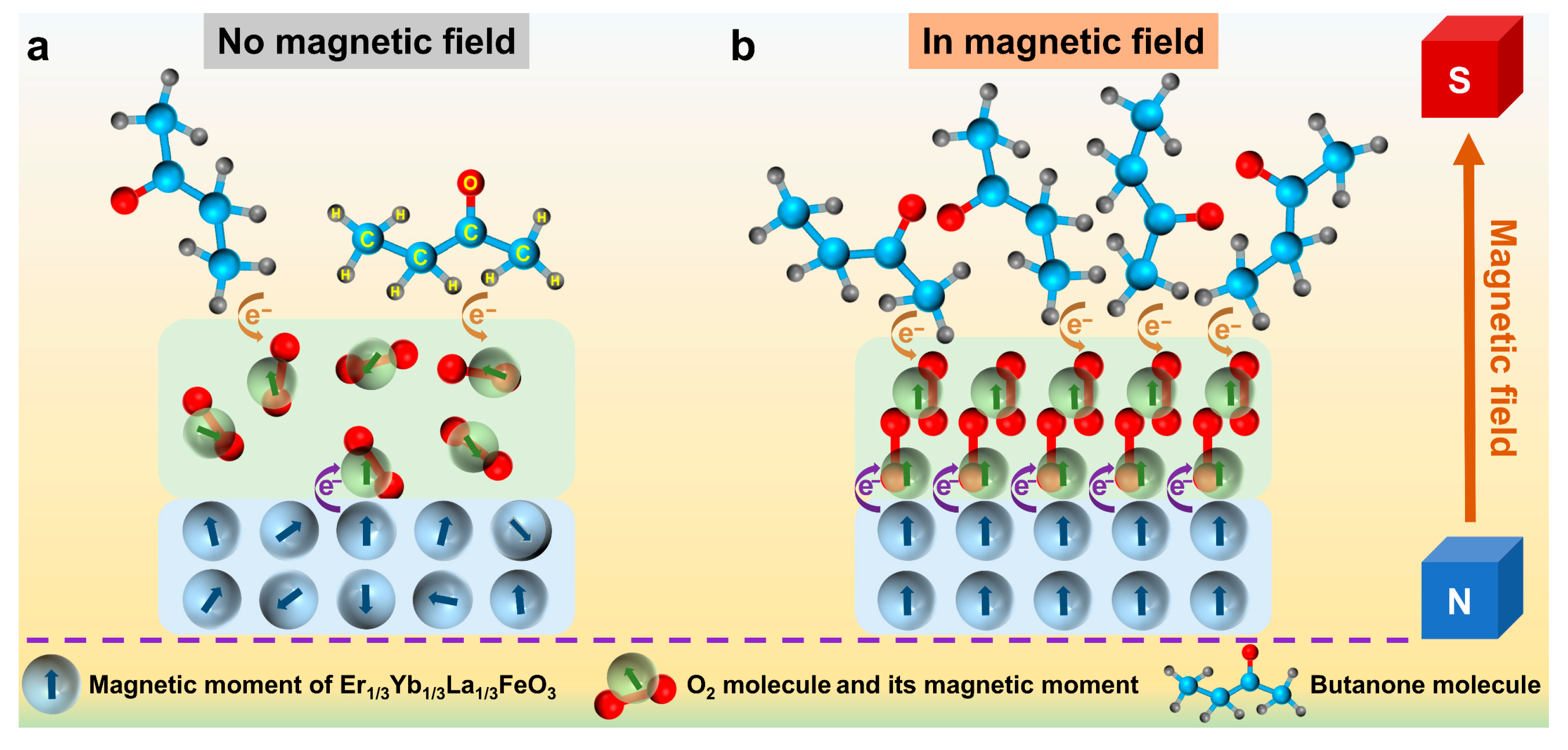
The gas-sensing reaction mechanism under the assistance of applied magnetic fields combined with thermal excitation is analyzed. First, both O2 molecules and Er1/3Yb1/3La1/3FeO3 are paramagnetic and possess intrinsic magnetic moments. As presented in Figure 10, the arrangement of magnetic moments of Er1/3Yb1/3La1/3FeO3 and O2 molecules is disordered without applied magnetic fields. As the intensity of the applied external magnetic field increases, the ordering of magnetic moments in both Er1/3Yb1/3La1/3FeO3 and the gas molecules is enhanced, and their magnetic moment directions tend to align with the magnetic field direction, which facilitates the adsorption of gas molecules on the material surface [30] and, in turn, favors the gas-sensing reaction. Meanwhile, molecular currents between the material and the gas molecules generate a micromagnetic field. When the magnetic moments of the material and gas molecules are aligned in the same direction, the Lorentz force causes them to attract each other, come into contact and exchange electrons [47], which facilitates electron transport and thus contributes to the enhancement of the gas-sensing reaction. Second, both the relatively long carbon chain, which causes the electron cloud to shift to a greater extent toward the more electronegative oxygen, and the carbonyl group containing a π bond with low bond energy endow the butanone molecule with high electron cloud mobility and further elevate the reactivity of the gas-sensing reaction.
Finally, the gas-sensing performance of the Er1/3Yb1/3La1/3FeO3 sensor is compared with other MOS-based sensors. As illustrated in Table 1, the Er1/3Yb1/3La1/3FeO3 sensor fabricated in this work, which exhibits a significantly higher response value than those of other reported MOS-based sensors, showcases superior comprehensive butanone sensing performance at a relatively lower operating temperature.

4. Conclusions

ErFeO3, medium-entropy Er1/3Yb1/3La1/3FeO3, and high-entropy Er0.2Yb0.2La0.2Y0.2Sm0.2FeO3 samples were synthesized via the sol–gel method and subsequent annealing, followed by a systematic investigation of their gas-sensing performances. ErFeO3 and Er0.2Yb0.2La0.2Y0.2Sm0.2FeO3 sensors present responses of 4.5 and 6.3 to 10 ppm butanone, respectively. By contrast, the Er1/3Yb1/3La1/3FeO3 sensor exhibits a significantly enhanced response of 13.2 toward 10 ppm of butanone gas at the optimum operating temperature of 192 °C. Meanwhile, the Er1/3Yb1/3La1/3FeO3 sensor shows high selectivity to butanone gas, a low detection limit of 0.5 ppm, and reliable long-term stability. The medium-entropy design induces significant lattice distortion and an increase in oxygen vacancies, leading to higher adsorbed oxygen content on the material surface and elevated hole concentration, which enhances the activity of gas-sensing reactions. Furthermore, the response of the Er1/3Yb1/3La1/3FeO3 sensor toward 10 ppm of butanone is enhanced to 21.3 under the applied magnetic field of 680 mT, which improves the selectivity toward butanone. The gas-sensing performance of Er1/3Yb1/3La1/3FeO3 toward butanone gas is significantly boosted under the applied magnetic field because of the improved ordering of magnetic moments in both Er1/3Yb1/3La1/3FeO3 and O2 molecules and the high electron cloud mobility of butanone molecules. Overall, the Er1/3Yb1/3La1/3FeO3 gas-sensing material presents a novel material design strategy for the detection of VOCs, while magnetic field-assisted regulation offers a feasible approach for optimizing the gas-sensing performance of perovskite ferrite materials.

Supplementary Materials

The following supporting information can be downloaded at: https://www.mdpi.com/article/10.3390/chemosensors14040091/s1, Figure S1: (a) Digital image of the gas sensor. (b) Schematic diagram of a typical gas sensor. Figure S2: (ac) Corresponding elemental mapping images of ErFeO3 of Fe and Er. Figure S3: (ag) Corresponding elemental mapping images of Er0.2Yb0.2La0.2Y0.2Sm0.2FeO3 of Fe, Er, Yb, La, Y and Sm. Figure S4: EDS spectrum of (a) ErFeO3, (b) Er1/3Yb1/3La1/3FeO3, and (c) Er0.2Yb0.2La0.2Y0.2Sm0.2FeO3. Figure S5: The dynamic response–recovery curve of the Er1/3Yb1/3La1/3FeO3 sensor to 10 ppm of butanone at the optimum operating temperature under different applied magnetic fields: (a) 0 mT; (b) 347 mT; (c) 680 mT.

Author Contributions

Conceptualization, H.J. and Y.Z.; methodology, Z.L.; software, Z.L.; validation, Z.L. and Z.X.; formal analysis, Z.L.; investigation, Z.L. and Z.X.; resources, H.J.; data curation, Z.L.; writing—original draft preparation, Z.L.; writing—review and editing, H.J. and Y.Z.; visualization, Z.L.; supervision, H.J. and Y.Z.; project administration, H.J. and Y.Z.; funding acquisition, Y.Z. All authors have read and agreed to the published version of the manuscript.

Funding

This work was supported by the National Natural Science Foundation of China (Grant. No.: 52231008).

Institutional Review Board Statement

Not applicable.

Informed Consent Statement

Not applicable.

Data Availability Statement

The original contributions presented in this study are included in the article/Supplementary Material. Further inquiries can be directed to the corresponding authors.

Conflicts of Interest

The authors declare no conflicts of interest.

Abbreviations

The following abbreviations are used in this manuscript:
VOCsVolatile organic compounds
HALHole accumulation layer

References

  1. Jia, Q.Q.; Ji, H.M.; Zhang, Y.; Chen, Y.L.; Sun, X.H.; Jin, Z.G. Rapid and selective detection of acetone using hierarchical ZnO gas sensor for hazardous odor markers application. J. Hazard. Mater. 2014, 276, 262–270. [Google Scholar] [CrossRef] [PubMed]
  2. Zhang, Y.W.; Ma, Y.L.; Wu, Z.; Qin, Z.B.; Ji, H.M.; Liu, X.J.; Zhang, W.H.; Hu, W.B. Abnormal p-type Gas-Sensing Response to Ether in Co-ZnO Nanocomposite Film and Its Significant Room-Temperature Magnetoresistance. Adv. Funct. Mater. 2025, 35, 2422705. [Google Scholar] [CrossRef]
  3. Hsu, C.Y.; Chiang, H.C.; Shie, R.H.; Ku, C.H.; Lin, T.Y.; Chen, M.J.; Chen, N.T.; Chen, Y.C. Ambient VOCs in residential areas near a large-scale petrochemical complex: Spatiotemporal variation, source apportionment and health risk. Environ. Pollut. 2018, 240, 95–104. [Google Scholar] [CrossRef] [PubMed]
  4. Meng, F.; Qin, L.; Gao, H.; Zhu, H.; Yuan, Z. Perovskite-structured LaFeO3 modified In2O3 gas sensor with high selectivity and ultra-low detection limit for 2-butanone. J. Alloys Compd. 2024, 970, 172464. [Google Scholar] [CrossRef]
  5. Bak, S.Y.; Lee, J.; Kim, Y.; Lee, S.H.; Woo, K.; Lee, S.; Yi, M. Sensitivity Improvement of Urchin-Like ZnO Nanostructures Using Two-Dimensional Electron Gas in MgZnO/ZnO. Sensors 2019, 19, 5195. [Google Scholar] [CrossRef]
  6. Zhu, L.; Zeng, W. Room-temperature gas sensing of ZnO-based gas sensor: A review. Sens. Actuator A Phys. 2017, 267, 242–261. [Google Scholar] [CrossRef]
  7. Shao, X.; Shi, Y.; Wang, H.Y.; Sun, X.F.; Yang, L.; Li, X.; Wang, M.H. A Review on Advances in the Gas-Sensitive Properties of Perovskite Materials. J. Electron. Mater. 2023, 52, 5795–5809. [Google Scholar] [CrossRef]
  8. Niu, X.S.; Du, W.M.; Du, W.P. Preparation, characterization and gas-sensing properties of rare earth mixed oxides. Sens. Actuator B Chem. 2004, 99, 399–404. [Google Scholar] [CrossRef]
  9. Ma, C.; Hao, X.D.; Yang, X.; Liang, X.S.; Liu, F.M.; Liu, T.; Yang, C.H.; Zhu, H.Q.; Lu, G.Y. Sub-ppb SO2 gas sensor based on NASICON and LaxSm1−xFeO3 sensing electrode. Sens. Actuator B Chem. 2018, 256, 648–655. [Google Scholar] [CrossRef]
  10. Alam, M.; Chakraborty, I.; Mandal, K. Microwave synthesis of surface functionalized ErFeO3 nanoparticles for photoluminescence and excellent photocatalytic activity. J. Lumin. 2018, 196, 387–391. [Google Scholar] [CrossRef]
  11. Wang, L.; Ran, X.; Xiao, B.; Lei, L.; Zhu, J.; Xi, X.; Feng, G.; Li, R.; Feng, J. Visible light assisted Fenton degradation of oxytetracycline over perovskite ErFeO3/porous g-C3N4 nanosheets p-n heterojunction. J. Environ. Chem. Eng. 2022, 10, 108330. [Google Scholar] [CrossRef]
  12. Shen, H.; Cheng, Z.X.; Hong, F.; Xu, J.Y.; Yuan, S.J.; Cao, S.X.; Wang, X.L. Magnetic field induced discontinuous spin reorientation in ErFeO3 single crystal. Appl. Phys. Lett. 2013, 103, 192404. [Google Scholar] [CrossRef]
  13. Liu, F.; Li, P.D.; Li, J.Z.; Shi, J.J.; Gao, X.W. ErFeO3/α-Fe2O3 nanocomposites derived from MIL-100(Fe) for acetone sensing. Ceram. Int. 2024, 50, 23721–23732. [Google Scholar] [CrossRef]
  14. Wei, J.S.; Ma, S.Y.; Cai, Y.H.; Xu, C.Y.; Liu, J.M.; Jiang, H.T. A high-performance ethylene glycol sensor based on fibrous ErFeO3 prepared by electrostatic spinning. Ceram. Int. 2023, 49, 32611–32618. [Google Scholar] [CrossRef]
  15. Yang, T.T.; Ma, S.Y.; Cao, P.F.; Xu, X.L.; Wang, L.; Pei, S.T.; Han, T.; Xu, X.H.; Yun, P.D.; Sheng, H. Synthesis and characterization of ErFeO3 nanoparticles by a hydrothermal method for isopropanol sensing properties. Vacuum 2021, 185, 110005. [Google Scholar] [CrossRef]
  16. Liu, X.H.; Qin, X.X.; Ji, H.M.; Wang, M.J. An enhanced butanone sensing performance of Er0.7Yb0.3FeO3 material with the proper electronic structure. J. Alloys Compd. 2019, 772, 263–271. [Google Scholar] [CrossRef]
  17. Liu, Y.P.; Tuo, P.; Dai, F.Z.; Yu, Z.Y.; Lai, W.; Ding, Q.; Yan, P.; Gao, J.; Hu, Y.F.; Hu, Y.X.; et al. A Highly Deficient Medium-Entropy Perovskite Ceramic for Electromagnetic Interference Shielding under Harsh Environment. Adv. Mater. 2024, 36, 2400059. [Google Scholar] [CrossRef]
  18. Mei, H.; Zhang, Y.X.; Zhang, P.P.; Ricciardulli, A.G.; Samorì, P.; Yang, S. Entropy Engineering of 2D Materials. Adv. Sci. 2024, 11, 2409404. [Google Scholar] [CrossRef]
  19. Wright, A.J.; Luo, J. A step forward from high-entropy ceramics to compositionally complex ceramics: A new perspective. J. Mater. Sci. 2020, 55, 9812–9827. [Google Scholar] [CrossRef]
  20. Wei, M.Y.; Xu, J.; Zhu, J.T.; Yang, R.W.; Meng, X.Y.; Zhang, P.; Yang, J.L.; Gao, F. Influence of size disorder parameter on the thermophysical properties of rare-earth-zirconate medium-entropy ceramics. J. Am. Ceram. Soc. 2023, 106, 2037–2048. [Google Scholar] [CrossRef]
  21. Liu, L.C.; Yang, W.M.; Mo, J.Y.; Chen, C.J.; Liu, H.S. Microstructure and mechanical properties of novel medium-entropy carbide ceramics. Comput. Mater. Sci. 2023, 230, 112464. [Google Scholar] [CrossRef]
  22. Lou, Z.H.; Zhang, P.; Zhu, J.T.; Gong, L.Y.; Xu, J.; Chen, Q.; Reece, M.J.; Yan, H.X.; Gao, F. A novel high-entropy perovskite ceramics Sr0.9La0.1(Zr0.25Sn0.25Ti0.25Hf0.25)O3 with low thermal conductivity and high Seebeck coefficient. J. Eur. Ceram. Soc. 2022, 42, 3480–3488. [Google Scholar] [CrossRef]
  23. Li, X.; Ma, J.X.; Chen, K.P.; Li, C.W.; Zhang, X.W.; An, L.N. Design and investigate the electrical properties of Pb(Mg0.2Zn0.2Nb0.2Ta0.2W0.2)O3-PbTiO3 high-entropy ferroelectric ceramics. Ceram. Int. 2022, 48, 12848–12855. [Google Scholar] [CrossRef]
  24. Naganaboina, V.R.; Anandkumar, M.; Deshpande, A.S.; Singh, S.G. Single-phase high-entropy oxide-based chemiresistor: Toward selective and sensitive detection of methane gas for real-time applications. Sens. Actuator B Chem. 2022, 357, 131426. [Google Scholar] [CrossRef]
  25. Yan, W.J.; Liu, Y.; Bai, Y.; Chen, Y.L.; Zhou, H.P.; Ahmad, W. Intelligent MEMS Sensor Based on an Oxidized Medium-Entropy Alloy (FeCoNi) for H2 and CO Recognition. ACS Appl. Mater. Interfaces 2024, 16, 49474–49483. [Google Scholar] [CrossRef] [PubMed]
  26. Ji, H.M.; Zhang, L.; Zhang, R. Gas sensitive performance and mechanism of multiferroic BiFeO3 under thermal-magnetic synergetic excitation. Inorg. Chem. Commun. 2023, 150, 110491. [Google Scholar] [CrossRef]
  27. Chakraborty, N.; Panda, S.N.; Mishra, A.K.; Barman, A.; Mondal, S. Ferromagnetic Ni1−xVxO1−y Nano-Clusters for NO Detection at Room Temperature: A Case of Magnetic Field-Induced Chemiresistive Sensing. Appl. Mater. Interfaces 2022, 14, 52301–52315. [Google Scholar] [CrossRef] [PubMed]
  28. Sun, H.M.; Cao, M.; Zhang, P.H.; Tian, X.J.; Lu, M.L.; Du, L.L.; Xue, K.F.; Cui, G.L. Magnetic-Field-Enhanced H2S Sensitivity of Cu2O/NiO Heterostructure Ordered Nanoarrays. ACS Sens. 2022, 7, 1903–1911. [Google Scholar] [CrossRef]
  29. Xiong, G.Z.; Huang, L.P.; Lin, H.B.; Zhang, Q.F.; Zhang, H.Y.; Shi, Y.T.; Xu, S.L.; Xiong, D.K.; Deng, W. Effect of sintering temperature on microstructure and magnetic properties of ErFeO3 ceramics. Ceram. Int. 2025, 51, 4693–4702. [Google Scholar] [CrossRef]
  30. Cao, J.; Zhang, Z.X.; Wang, S.M.; Sun, Z.Y.; Li, J.H.; Wang, Y.; Xu, X.X.; Ye, Z.X.; Zhang, H.M. Magnetic Field Assisted Enhanced Sensitivity of Nonferromagnetic Materials Boosting the Carrier Transfer: Mechanistic Studies. ACS Sens. 2024, 9, 4777–4787. [Google Scholar] [CrossRef]
  31. Wang, G.M.; Ma, Z.J.; Zheng, Y.S.; Cheng, L.; Xing, H.L.; Li, Z.M. Effect of rare-earth ytterbium doping on the microwave absorption performance of nickel-cobalt ferrite. RSC Adv. 2024, 14, 38345–38352. [Google Scholar] [CrossRef] [PubMed]
  32. Rida, K.; Benabbas, A.; Bouremmad, F.; Peña, M.A.; Sastre, E.; Martínez-Arias, A. Effect of calcination temperature on the structural characteristics and catalytic activity for propene combustion of sol-gel derived lanthanum chromite perovskite. Appl. Catal. A Gen. 2007, 327, 173–179. [Google Scholar] [CrossRef]
  33. Stanoiu, A.; Piticescu, R.M.; Simion, C.E.; Rusti-Ciobota, C.F.; Florea, O.G.; Teodorescu, V.S.; Osiceanu, P.; Sobetkii, A.; Badilita, V. H2S selective sensitivity of Cu doped BaSrTiO3 under operando conditions and the associated sensing mechanism. Sens. Actuator B Chem. 2018, 264, 327–336. [Google Scholar] [CrossRef]
  34. Wang, M.J.; Shen, Z.R.; Chen, Y.L.; Zhang, Y.; Ji, H.M. Atomic structure-dominated enhancement of acetone sensing for a ZnO nanoplate with highly exposed (0001) facet. Crystengcomm 2017, 19, 6711–6718. [Google Scholar] [CrossRef]
  35. Miracle, D.B.; Senkov, O.N. A critical review of high entropy alloys and related concepts. Acta Mater. 2017, 122, 448–511. [Google Scholar] [CrossRef]
  36. Wang, C.; Zhu, Y.; Ling, Y.H.; Gong, Y.S.; Wang, R.; Wang, H.W.; Jin, J.; Zhao, L.; He, B.B. Atomistic Insights into Medium-Entropy Perovskites for Efficient and Robust CO2 Electrolysis. ACS Appl. Mater. Interfaces 2023, 15, 45905–45914. [Google Scholar] [CrossRef]
  37. Zhuang, G.X.; Chen, Y.W.; Zhuang, Z.Y.; Yu, Y.; Yu, J.G. Oxygen vacancies in metal oxides: Recent progress towards advanced catalyst design. Sci. China Mater. 2020, 63, 2089–2118. [Google Scholar] [CrossRef]
  38. Shen, C.Y.; Liang, H.J.; Zhao, Z.Y.; Guo, S.Y.; Chen, Y.X.; Tan, Z.Q.; Song, X.Z.; Wang, X.F. Mo-Doped LaFeO3 Gas Sensors with Enhanced Sensing Performance for Triethylamine Gas. Sensors 2024, 24, 4851. [Google Scholar] [CrossRef]
  39. Hoa, N.D.; Duy, N.V.; El-Safty, S.A.; Hieu, N.V. Meso-/Nanoporous Semiconducting Metal Oxides for Gas Sensor Applications. J. Nanomater. 2015, 2015, 972025. [Google Scholar] [CrossRef]
  40. Ji, H.C.; Zeng, W.; Li, Y.Q. Gas sensing mechanisms of metal oxide semiconductors: A focus review. Nanoscale 2019, 11, 22664–22684. [Google Scholar] [CrossRef]
  41. Kim, H.-J.; Lee, J.-H. Highly sensitive and selective gas sensors using p-type oxide semiconductors: Overview. Sens. Actuator B Chem. 2014, 192, 607–627. [Google Scholar] [CrossRef]
  42. Yang, D.H.; Nguyen, T.T.T.; Navale, S.T.; Nguyen, L.H.T.; Dang, Y.T.; Mai, N.X.D.; Phan, T.B.; Kim, J.-Y.; Doan, T.L.H.; Kim, S.S.; et al. Novel amine-functionalized zinc-based metal-organic framework for low-temperature chemiresistive hydrogen sensing. Sens. Actuator B Chem. 2022, 368, 132120. [Google Scholar] [CrossRef]
  43. Zhang, Q.; Xu, M.K.; Shen, Z.R.; Wei, Q. A nanostructured Cr2O3/WO3 p-n junction sensor for highly sensitive detection of butanone. J. Mater. Sci. Mater. Electron. 2017, 28, 12056–12062. [Google Scholar] [CrossRef]
  44. Malakar, T.; Hanson, C.S.; Devery, J.J.; Zimmerman, P.M. Combined Theoretical and Experimental Investigation of Lewis Acid-Carbonyl Interactions for Metathesis. ACS Catal. 2021, 11, 4381–4394. [Google Scholar] [CrossRef]
  45. Zhang, R. Study on Gas Sensing Performance of Different Type Oxides (ZnO, BiFeO3) Assisted by Optical and Magnetic Excitation. Master’s Thesis, Tianjin University, Tianjin, China, 2019. [Google Scholar]
  46. Sun, L.H.; Hu, J.F.; Gao, F.; Qin, H.W. Adsorption of formaldehyde on the Fe site of clean and M2+ (Ca2+, Sr2+ and Ba2+) doped LaFeO3 (010) surface. Appl. Surf. Sci. 2011, 257, 8692–8695. [Google Scholar] [CrossRef]
  47. Zhang, Z.X.; Cao, J.; Wang, S.M.; Sun, Z.Y.; Li, J.H. Enhanced Sensitivity of ZnFe2O4 Based on Ordered Magnetic Moment Induced by Magnetic Field: A New Insight into Mechanism. Adv. Funct. Mater. 2023, 33, 2305253. [Google Scholar] [CrossRef]
  48. Theodoro, R.S.; Sá, B.S.; Perrone, O.M.; Perfecto, T.M.; Volanti, D.P. Tuning humidity for highly selective detection of methanol and 2-butanone using MOF-derivatives NiO microrods. J. Mater. Sci. Mater. Electron. 2023, 34, 2232. [Google Scholar] [CrossRef]
  49. Zito, C.A.; Perfecto, T.M.; Oliveira, T.N.T.; Volanti, D.P. Bicone-like ZnO structure as high-performance butanone sensor. Mater. Lett. 2018, 223, 142–145. [Google Scholar] [CrossRef]
  50. Zito, C.A.; Theodoro, R.S.; Perfecto, T.M.; Sá, B.S.d.; Vioto, G.C.N.; Volanti, D.P. Enhanced butanone chemoresistive sensor utilizing cobalt oxide nanoparticles. Ceram. Int. 2024, 50, 27147–27153. [Google Scholar] [CrossRef]
  51. Lourenço, V.H.; Theodoro, R.D.; de Sá, B.S.; Santos, G.S.M.; Perfecto, T.M.; Volanti, D.P. ZnFe2O4 nanoparticle-based sensor for 2-butanone detection. J. Mater. Sci. Mater. Electron. 2025, 36, 293. [Google Scholar] [CrossRef]
Figure 1. XRD patterns: (a) X-ray diffraction patterns of ErFeO3, Er1/3Yb1/3La1/3FeO3 and Er0.2Yb0.2La0.2Y0.2Sm0.2FeO3 samples. (b) The magnified patterns of the (020), (112), (200), and (021) diffraction peaks for the three samples.
Chemosensors 14 00091 g001
Figure 2. SEM images of (a,d) ErFeO3, (b,e) Er1/3Yb1/3La1/3FeO3, and (c,f) Er0.2Yb0.2La0.2Y0.2Sm0.2FeO3. (gk) Corresponding elemental mapping images of Er1/3Yb1/3La1/3FeO3 of Fe, Er, Yb and La.
Chemosensors 14 00091 g002
Figure 3. (a) N2 adsorption–desorption isotherms. (b) Specific surface area of ErFeO3, Er1/3Yb1/3La1/3FeO3 and Er0.2Yb0.2La0.2Y0.2Sm0.2FeO3.
Chemosensors 14 00091 g003
Figure 4. (ac) The high-resolution XPS spectra of O 1s peak of ErFeO3 (EFO), Er1/3Yb1/3La1/3FeO3 (EYLFO), and Er0.2Yb0.2La0.2Y0.2Sm0.2FeO3 (EYLYSFO). (d) Concentrations of various O species of ErFeO3, Er1/3Yb1/3La1/3FeO3, and Er0.2Yb0.2La0.2Y0.2Sm0.2FeO3.
Chemosensors 14 00091 g004
Figure 5. (a) The operating temperature-dependent response curves of ErFeO3, Er1/3Yb1/3La1/3FeO3, and Er0.2Yb0.2La0.2Y0.2Sm0.2FeO3 sensors to 2 ppm of butanone. (b) The dynamic response–recovery curve of the Er1/3Yb1/3La1/3FeO3 sensor to different concentrations of butanone at the optimum operating temperature. (c) The responses of ErFeO3, Er1/3Yb1/3La1/3FeO3, and Er0.2Yb0.2La0.2Y0.2Sm0.2FeO3 sensors to different concentrations of butanone at their respective optimum operating temperatures. (d) The dynamic response–recovery curve of the Er1/3Yb1/3La1/3FeO3 sensor to 10 ppm of butanone at 192 °C. (e) The long-term stability of the Er1/3Yb1/3La1/3FeO3 sensor to 10 ppm of butanone at 192 °C.
Chemosensors 14 00091 g005
Figure 6. The responses of ErFeO3, Er1/3Yb1/3La1/3FeO3, and Er0.2Yb0.2La0.2Y0.2Sm0.2FeO3 sensors to 10 ppm of different VOCs at their respective optimum operating temperatures.
Chemosensors 14 00091 g006
Figure 7. The Er1/3Yb1/3La1/3FeO3 magnetization curve.
Chemosensors 14 00091 g007
Figure 8. (a) Change in response of Er1/3Yb1/3La1/3FeO3 to 10 ppm of butanone at the optimum operating temperature with the change in the applied magnetic field. (b) The responses of Er1/3Yb1/3La1/3FeO3 sensor to 10 ppm of different VOCs at the optimum operating temperature under different applied magnetic fields.
Chemosensors 14 00091 g008
Figure 9. Schematic diagram of the gas-sensing mechanism of Er1/3Yb1/3La1/3FeO3: (a) in air; (b) in butanone. (c) Equivalent resistance of Er1/3Yb1/3La1/3FeO3.
Chemosensors 14 00091 g009
Figure 10. Schematic diagram of the gas-sensing mechanism: (a) no magnetic field; (b) in magnetic field.
Chemosensors 14 00091 g010
Table 1. Comparison of butanone sensing performance of reported MOS-based sensors.
MaterialsConcentration/ppmResponseOperating
Temperature/°C
References
NiO10∼1.6 a150[48]
ZnO10∼7.0 b400[49]
Co3O410∼1.2 a250[50]
WO310∼7.5 b180[43]
ZnFe2O410∼3.3 b300[51]
Er1/3Yb1/3La1/3FeO31013.2 a192This work
“a” stands for “Response (%) = Rg/Ra,” and “b” stands for “Response (%) = Ra/Rg,” where Ra and Rg represent the resistance of the sensor in air and test gases.
Disclaimer/Publisher’s Note: The statements, opinions and data contained in all publications are solely those of the individual author(s) and contributor(s) and not of MDPI and/or the editor(s). MDPI and/or the editor(s) disclaim responsibility for any injury to people or property resulting from any ideas, methods, instructions or products referred to in the content.