
Communication

Impedimetric Detection of Free Fatty Acids in Patient Serum Using Commercially Available Screen-Printed Carbon Electrode


by
İsmail Oran
1,*,
Halil İbrahim Özdemir
1,
Turgay Yılmaz Kılıç
2,
Hilmiye Deniz Ertuğrul Uygun
3,
Hakan Gökalp Uzun
4,
Barış Kılıçaslan
4,
Evrim Şimşek
5,
Yusuf Ali Altuncı
6,
Şadiye Mıdık
6 and
Ali Murat Ergin
7
1
Department of Radiology, Faculty of Medicine, Ege University, İzmir 35100, Türkiye
2
Ministry of Health Izmir City Hospital, Department of Emergency Medicine, İzmir 35530, Türkiye
3
Electronic Materials Manufacturing and Application Center, Dokuz Eylül University, İzmir 35390, Türkiye
4
Ministry of Health Izmir City Hospital, Department of Cardiology, İzmir 35530, Türkiye
5
Department of Cardiology, Faculty of Medicine, Ege University, İzmir 35100, Türkiye
6
Department of Emergency Medicine, Faculty of Medicine, Ege University, İzmir 35100, Türkiye
7
Department of Medical Informatics, Faculty of Medicine, Ege University, İzmir 35100, Türkiye
*
Author to whom correspondence should be addressed.
Chemosensors 2026, 14(3), 53; https://doi.org/10.3390/chemosensors14030053
Submission received: 14 January 2026 / Revised: 20 February 2026 / Accepted: 21 February 2026 / Published: 24 February 2026
(This article belongs to the Section Electrochemical Devices and Sensors)

Abstract

Objective: The performance of chrono-impedance measurement, a novel electrochemical method for determining free fatty acids (FA), was evaluated in a real-world clinical setting. Methods: Patients presenting to the emergency department with chest pain or discomfort were included. Routine diagnostic tests were performed in accredited laboratories. Chrono-impedance was measured using a screen-printed carbon electrode connected to a dedicated potentiostat. Serum total free-FA levels were determined by gas chromatography with flame ionization detection. Results: Among 104 patients, 21 received a specific diagnosis, while the remaining 83 patients were discharged with non-specific pain. Mean free-FA level was 0.9 ± 0.6 mM. Palmitic, linoleic, stearic, oleic, and arachidonic acids accounted for 74.9% of total free FAs. Impedance plots showed a characteristic logarithmic increase over time for all patients. When instantaneous impedance values at four different time points (10, 100, 376.6, and 500 s) were examined, a significantly strong correlation was observed between impedance and FA molarity (r = 0.8312, 0.9897, 0.9947, and 0.9951) and FA weight (r = 0.9572, 0.9878, 0.9996, and 0.9998), respectively. Conclusions: Chrono-impedance demonstrated a very high correlation with total free-FA levels in real patient samples.

1. Introduction

Fatty acids (FAs) exist predominantly in three esterified forms in the human body: triglycerides, phospholipids, and cholesterol esters. The fraction of FAs that circulates in a non-esterified form in serum is referred to as non-esterified fatty acids (NEFA) or free FAs. Free FAs are primarily transported in the bloodstream by serum albumin, which possesses at least seven well-defined binding sites.
Beyond classical risk factors such as cholesterol and lipoproteins, recent studies have demonstrated a close association between free-FA levels and the occurrence, severity, and complications of atherosclerosis, metabolic dysregulation, and related diseases. Elevated free-FA levels, for example, are associated with a significantly higher risk of cardiovascular mortality [1]. Free-FA levels are also linked to insulin resistance and the development of diabetes mellitus [2]. In patients with diabetes mellitus, serum free-FA concentrations can reflect the severity of coronary artery disease and carotid atherosclerotic plaques [3]. Furthermore, admission free-FA levels are independently associated with adverse outcomes in patients with acute heart failure [4], and elevated free FA is considered an independent risk factor and diagnostic marker for acute myocardial infarction [5]. In addition, free FAs are strongly associated with metabolic syndrome and serve as predictors of non-alcoholic fatty liver disease [6]. An increased molar ratio of free FA to albumin may represent both a causative factor and one of the earliest biomarkers of physiological aging, including age-related cataract formation and Alzheimer’s disease [7].
Currently available methods for quantifying free FA rely primarily on chromatographic and spectrometric techniques, which require multiple preparation steps and trained personnel. Given the rapidly expanding literature supporting free FA as a diagnostic and prognostic biomarker, there is a growing need for a rapid, reliable, and practical test suitable for routine clinical use.
In the literature, there are few experimental studies that use electrochemical techniques for long-chain FA determination. Most of these have used amperometric methods, and the sensors have been produced using highly intricate technologies such as immobilized antibodies, layer-by-layer enzyme assembly, and decorated nanostructures [8]. Another proposed method for short-chain FA detection uses electrochemical impedance spectroscopy (EIS) with a redox probe, which is based on an electrochemical impedance-transduced chemiresistive effect [9]. While classical or frequency-ranged Faradaic EIS is a highly sensitive method for detecting adsorbents on the sensor surface, it requires sample pretreatment, namely mixing with a redox probe. A single-frequency non-Faradaic impedance measure (i.e., chrono-impedance) is a variant of EIS and requires no redox probe.
In the present study, we aimed to conduct the first clinical investigation evaluating the performance of a newly developed method, chrono-impedance, for determining serum free-FA levels.

2. Materials and Methods

2.1. Patients

This study was conducted in accordance with the ethical standards of the 1964 Declaration of Helsinki and its later amendments. The study protocol was approved by the Ege University Institutional Review Board (No: 22-8.1T/23, Date: 25 August 2022). Consecutive patients presenting to the emergency department with chest pain and/or discomfort were included in the study. At admission, when blood samples were collected for routine biochemical tests, an additional tube of blood was drawn; after serum separation, the samples were divided into three Eppendorf tubes, temporarily stored at −20 °C, and transferred within 3 days to −80 °C for long-term storage until analysis. The clinical and laboratory course of all study patients was monitored for at least 12 h, and final diagnoses were determined by integrating clinical findings, ECG results, angiographic data, radiologic imaging, and laboratory evaluations.

2.2. Electrochemical Measurement

A PalmSens 3 potentiostat (Houten, The Netherlands) equipped with PSTrace v5.11 software and graphene oxide–coated, carbon-based screen-printed electrodes (DRP-110GPHOX, Metrohm-DropSens, Oviedo, Spain) was used. After being rinsed with double-distilled water, the electrodes were reduced electrochemically at −1.2 V for 600 s in 50 mM phosphate buffer (pH 6.5). The reduced graphene oxide electrodes were then rinsed again with double-distilled water. Immediately after removing excess water, 50 µL of patient serum—previously thawed at room temperature—was applied to the electrode surface, and measurements were initiated without the addition of a redox probe. Chrono-impedance parameters were set to 100 Hz by applying a 10 mV AC potential superimposed on a 180 mV DC potential [10]. For each serum sample, measurements were performed in triplicate using separate electrodes, and inter-electrode variability was determined to be <1%. The mean impedance values from the three measurements were plotted against time over a total of 500 s.

2.3. Free FA Measurement

The detailed steps of the analytical methods used have been described previously [11,12,13]. After thawing at room temperature, lipid extraction was performed using the Folch method. The dried lipid extract was mixed with an internal standard and subsequently trans-esterified to convert FAs to fatty acid methyl esters (FAMEs). Briefly, 10 mg of serum was mixed with 0.1 mL of 2 M potassium methoxide for 5 min, then 2 mL of isooctane was added, and the mixture was further mixed for 5 min. The mixture was then centrifuged at 3000 rpm for 5 min, and 0.5–1 mL of the supernatant was collected for injection.
Gas chromatography was performed using an Agilent HP-6890 Series GC system equipped with a flame ionization detector (FID) and a Supelco™ SP™-2560 capillary column (100 m × 0.25 mm × 0.20 µm film thickness). The initial column temperature was set to 140 °C and increased at a rate of 4 °C/min to 240 °C, with a final hold of 5 min. The detector temperature was set to 250 °C. Helium served as the carrier gas. Samples were injected in 1 µL aliquots. The peaks obtained from each sample were compared with those of a reference standard mixture containing 37 long-chain FAMEs, enabling individual identification of each FA. The internal standard was then used to calculate absolute FA concentrations. The coefficient of variation for repeated injections of the same sample (n = 3) was <10%.

2.4. Statistical Analysis

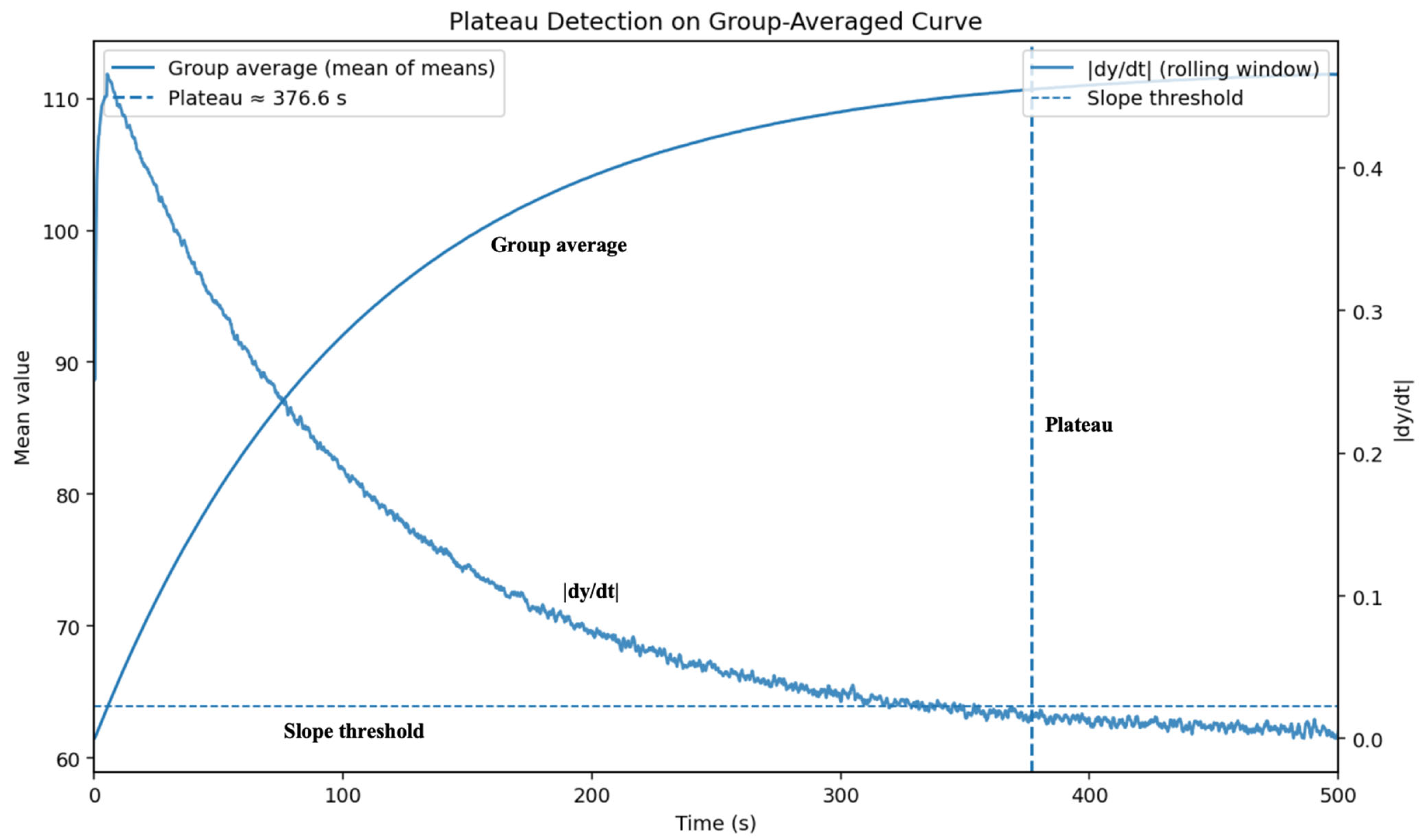
Impedance–time data obtained from 104 patients were visualized using individual overlaid (“spaghetti”) plots to illustrate inter-patient variability, followed by calculation of the mean impedance–time curve for the entire cohort. To identify the transition to the steady-state (plateau) phase, a slope-based detection algorithm was applied to the averaged curve. Plateau onset was defined as the earliest time point at which the absolute first derivative (|dy/dt|) fell below a predefined threshold and remained stable for at least 5 s. Following plateau detection, impedance values were extracted at four time points—10 s, 100 s, the plateau-onset time, and 500 s—and correlated with total FA concentrations using Spearman’s rank correlation analysis.
To determine whether the correlations obtained at different time points differed significantly from one another, Steiger’s Z-test for comparing dependent correlations sharing a common variable was applied [14].

3. Results

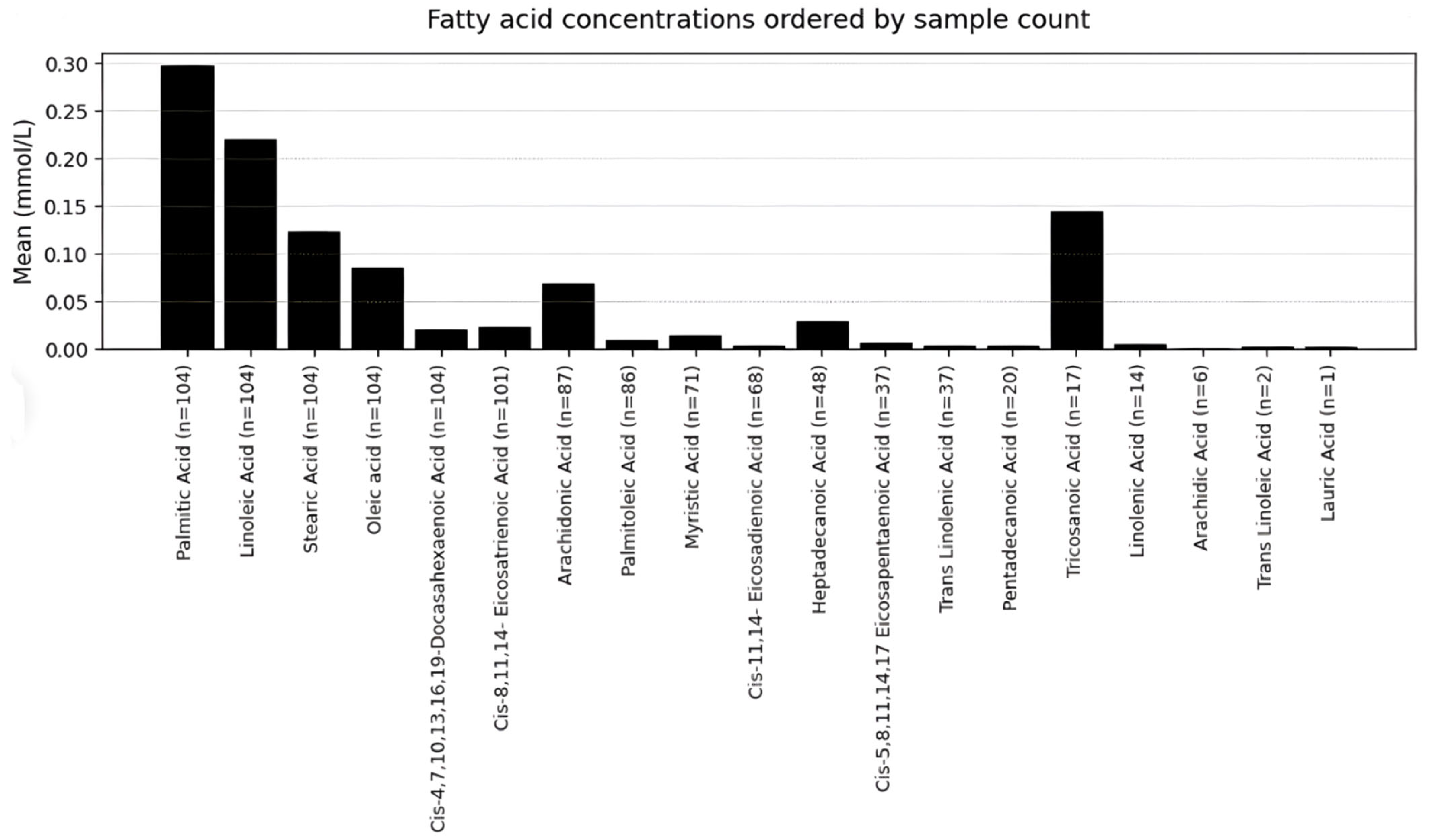
Of the 104 patients included in the study, 21 received a specific diagnosis, while the remaining 83 patients were discharged with non-specific pain and/or discomfort. The mean concentration of total free FAs was 0.9 ± 0.6 mM. Among individual FA species, the five most abundant were palmitic acid (0.3 ± 0.2 mM), linoleic acid (0.2 ± 0.2 mM), stearic acid (0.1 ± 0.1 mM), oleic acid (0.1 ± 0.1 mM), and arachidonic acid (0.1 ± 0.1 mM). Collectively, these five fatty acids accounted for 74.9% of the total free FA pool (Figure 1 and Supplementary Figure S1).
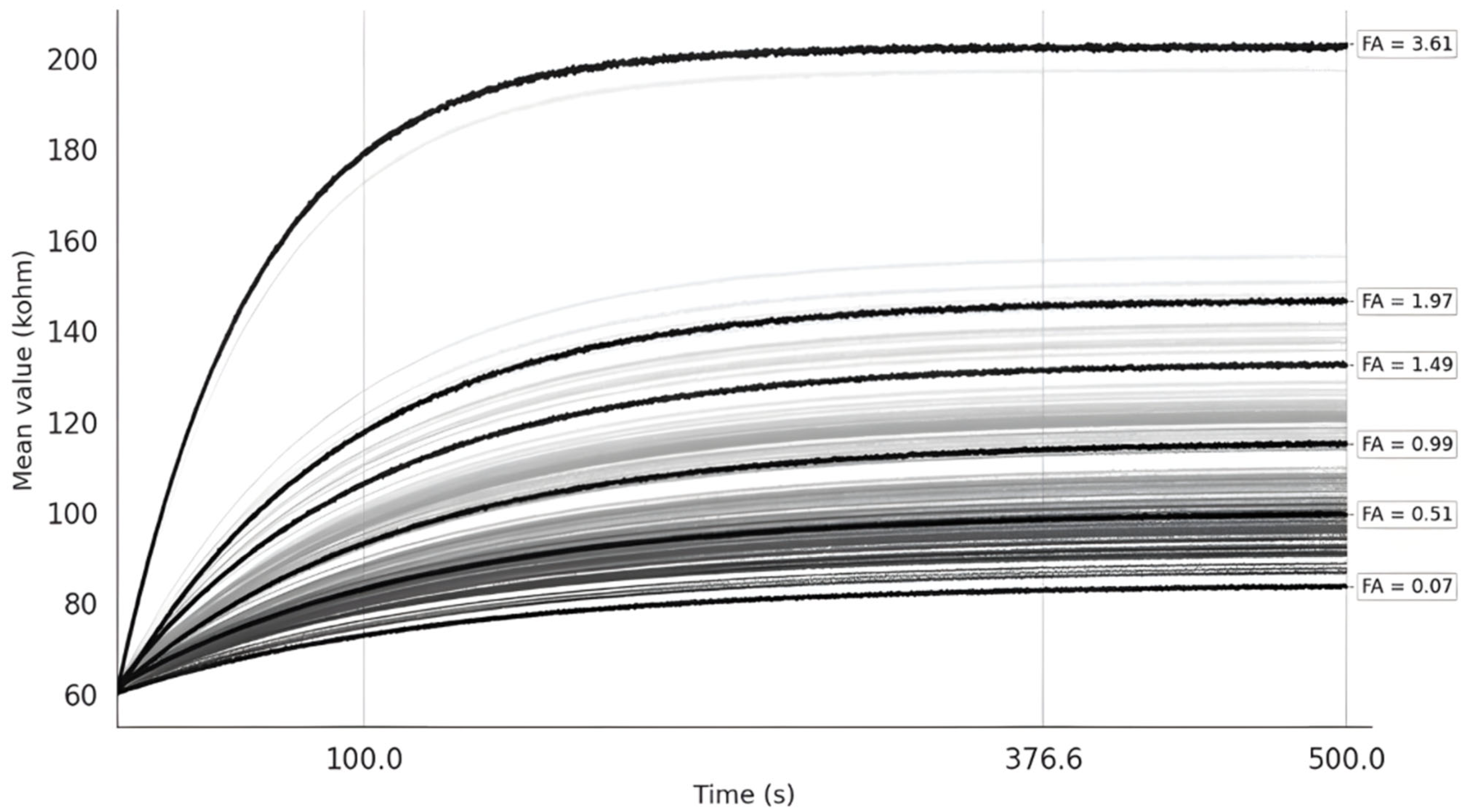
Chrono-impedance plots demonstrated a characteristic logarithmic increase over time in all patients. The increase in impedance was closely related to free-FA levels; higher free-FA concentrations were associated with greater impedance acceleration and higher plateau values (Figure 2).
Using a slope-based plateau-detection algorithm, the onset of the steady-state phase was identified at 376.6 s, indicating that impedance measurements beyond this time point showed only minimal incremental changes (Figure 3).
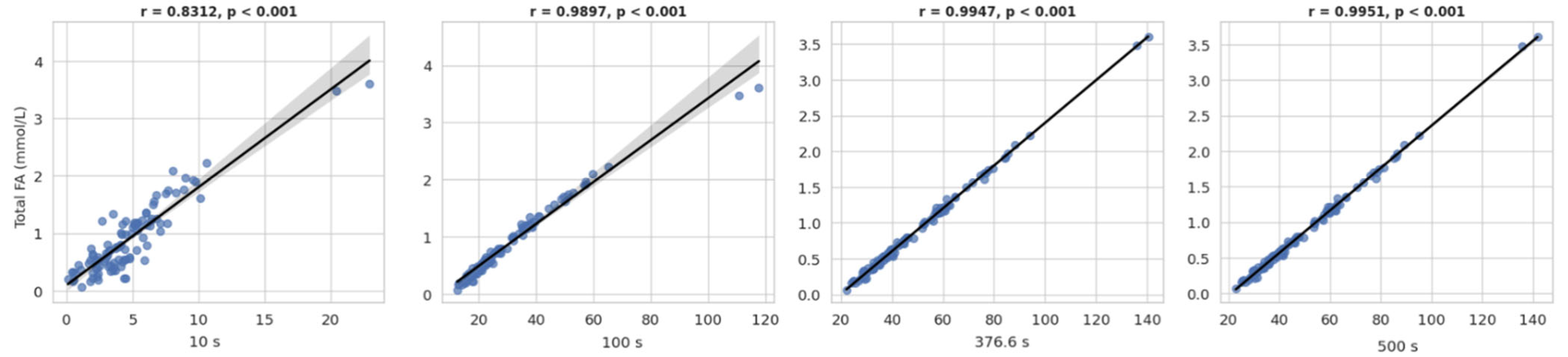
Spearman correlation analysis revealed a remarkably strong association between total free-FA levels expressed in molarity and chrono-impedance changes at all four evaluated time points (r = 0.8312, 0.9887, 0.9947, and 0.9951 at 10 s, 100 s, plateau onset [376.6 s], and 500 s, respectively; p < 0.001 for all comparisons) (Figure 4).
The same correlation analysis was also repeated by using the total free-FA level in weight. Again, a remarkably strong association between total free FAs and chrono-impedance changes was found across all four evaluated time points (r =0.9572, 0.9878, 0.9996, and 0.9998 at 10, 100, plateau-onset (376.6), and 500 s, respectively; p < 0.001 for all) (Supplementary Figure S2, Supplementary Table S1). Notably, at 10 s, the correlation based on weight was significantly stronger than that based on molarity (p < 0.001). In contrast, no statistically significant difference between the two approaches was observed at the later time points (p > 0.99).

4. Discussion

In this study, the total free-FA level was assessed using the novel chrono-impedance method in real patient serum samples for the first time, and we found an exceptionally high correlation (i.e., r > 0.99, when the sampling time is equal to or higher than 376.6 s) between measured impedance values and total free-FA concentrations. The most notable feature that distinguishes this method from classical approaches is that it does not require any pretreatment of patients’ blood samples, except for centrifugation.
In addition to well-established chromatographic and spectrometric techniques—which are reliable and sensitive but require multiple preparation steps and trained personnel—a widely used alternative is the enzymatic colorimetric assay. However, this method also requires sample pretreatment and skilled laboratory staff, and its sensitivity is lower than that of conventional analytic methods. It has even been reported to produce inaccurate measurements when free-FA levels exceed 1 mM in clinical practice [15].
The first electrochemical sensor inspired by enzymatic colorimetry was described by Sode et al. [16]. Subsequently, a new FA sensor was developed by modifying a carbon screen-printed electrode with a carbon nanotube/polymer composite and immobilizing enzymes layer-by-layer [17,18]. However, these devices have not yet been tested in clinical settings. Screen-printed electrodes have become increasingly popular due to their low cost, mass-production capability, reproducibility, and very low coefficient of variation. Additionally, modern portable potentiostats—battery-powered and smartphone-controlled—are now capable of performing complex electrochemical measurements, including electrochemical impedance spectroscopy (EIS) [19]. Despite these advances, no commercially available diagnostic system (i.e., disposable electrodes and/or devices) for serum free-FA quantification currently exists.
In this context, the electrochemical method developed by Uygun et al. [10] represents a potentially transformative approach. They utilized a disposable carbon-based screen-printed electrode decorated with graphene nanoparticles. It has long been known that ionic surfactants such as FAs adsorb from aqueous solutions onto hydrophobic carbon surfaces. The major driving force behind this high-affinity adsorption is the strong hydrophobic interaction between the fatty acid’s alkyl chain and the hydrophobic hexagonal carbon lattice. Adsorption is further favored by longer alkyl chains and carbon surfaces with fewer oxygen functional groups—that is, reduced graphene [20,21,22]. Through hydrophobic interactions, FA chains dissociate from albumin’s hydrophobic pockets and adsorb onto the carbon surface, even at neutral pH [23].
The adsorbed long-chain FA molecules displace structured water at the electrode interface and form an insulating hydrocarbon layer. This layer alters the dielectric constant of the Stern layer of the electrical double layer, thereby increasing impedance and decreasing double-layer capacitance [24,25].
Validation, characterization, and verification studies of this novel method have already been completed in simulated human serum with calibrated FA/Alb ratios and published by Uygun et al. [10]. They used a chrono-impedance—a single-frequency, probe-free variant of classical EIS. The measured chrono-impedance was directly proportional to FA concentration. They also performed classical EIS and reported a highly linear calibration curve (R2 = 0.9954) [10]. A key limitation, however, was that their simulated serum lacked lipoproteins (e.g., chylomicrons, VLDL, LDL, HDL), which were removed during preparation due to their relatively large size. Because approximately 20% of free FAs in normolipidemic individuals and up to 30% in hyperlipidemic individuals are lipoprotein-associated [26,27], results obtained using simulated serum may not fully reflect real-life conditions. Our clinical study addresses this limitation and demonstrates a remarkably strong correlation (i.e., r > 0.99)) between chrono-impedance measurements and total free-FA levels in actual patient samples when the sampling time is equal to or greater than 376.6 s.
In our analysis, impedance values at four time points were correlated with both FA molarity and FA weight. Because the carbon chain length directly influences impedance at the electrode surface, we hypothesized that FA weight (which reflects chain length) would correlate more strongly with impedance than FA molarity. Indeed, at the later time points (376.6 and 500 s), correlation coefficients for FA weight were slightly but not significantly higher. At 100 s, the small difference favored FA molarity. However, at 10 s, the difference was statistically significant (p < 0.001) (0.9572 vs. 0.8312), indicating a strong early contribution of longer-chain FAs to the impedance signal. This observation suggests that longer-chain FAs may dissociate more rapidly from albumin during the initial phase of the desorption-adsorption process. It is well established that polyunsaturated FAs exhibit reduced binding affinity to albumin due to structural differences introduced by double bonds [28,29]. Because most long-chain FAs (>20 carbons) in our dataset contained multiple unsaturated bonds, they may have dissociated more readily from albumin and adsorbed onto the carbon electrode at very early time points.

Limitations and Future Perspectives

One limitation of this study is that the patient population was not evenly distributed between individuals with elevated free-FA levels (e.g., those with diabetes mellitus or coronary heart disease) and healthy subjects. Nevertheless, approximately one-third of the 104 enrolled patients exhibited free-FA levels greater than 1 mM, which was considered sufficient for drawing reliable conclusions. Serum electrolyte balance and pH values can show disease-specific differences in each disease group. These differences can ultimately lead to deviations in the measured impedance values. Another limitation of this study is that it did not evaluate the possible effect of electrolyte and pH values on chrono-impedance values. In chrono-impedance measurements, physiologic FA transporters such as chylomicrons, VLDL, LDL, HDL, and plasma proteins, as potential surface adsorbents, can alter the signal. Another limitation of the study is that interference experiments using these elements were not performed.
In accordance with the original method, we employed a graphene oxide nanoparticle–modified carbon electrode that required electrochemical pretreatment prior to measurement. Future studies may utilize pre-packaged, pre-reduced graphene electrodes, which could further simplify the procedure and enhance reproducibility. The promising diagnostic performance of this novel approach may encourage additional research and advance the development of a practical, rapid, and user-friendly test suitable for routine clinical use.

5. Conclusions

The electrochemical chrono-impedance method used in this study demonstrated rapid, reliable, and robust diagnostic potential for the determination of free-FA levels in human serum. Further clinical investigations with larger cohorts and detailed subgroup analyses are warranted to validate these findings and broaden the method’s clinical applicability.

Supplementary Materials

The following supporting information can be downloaded at: https://www.mdpi.com/article/10.3390/chemosensors14030053/s1, Figure S1: Bar graph illustrating the distribution of individual FAs among all 104 patients. Figure S2: Correlation plot illustrating the relationship between total free FA levels expressed in weight and impedance at four different time points. Table S1: Patient-level impedance measurements and total free fatty acid (FA) levels.

Author Contributions

Conceptualization, İ.O.; methodology, İ.O., A.M.E., Y.A.A., E.Ş., Ş.M., H.G.U., B.K., T.Y.K.; software, İ.O., H.İ.Ö.; validation, İ.O., H.D.E.U.; formal analysis, H.İ.Ö.; investigation, A.M.E., Y.A.A., E.Ş., Ş.M., H.G.U., B.K., T.Y.K.; re-sources, H.İ.Ö.; data curation, H.İ.Ö.; writing—original draft preparation, İ.O.; writing—review and editing, İ.O., H.D.E.U.; visualization, İ.O.; supervision, H.D.E.U.; project administration, İ.O.; funding acquisition, İ.O. and H.İ.Ö. All authors have read and agreed to the published version of the manuscript.

Funding

The study was supported by the Scientific Research Project Office of Ege University (Project Number: BAP-ÖNAP: 23716).

Data Availability Statement

The original contributions presented in this study are included in the article/Supplementary Materials. Further inquiries can be directed to the corresponding author(s).

Acknowledgments

We thank Alperen Elek for his support in data analysis and visualization.

Conflicts of Interest

The authors declare no conflict of interest.

References

  1. Miedema, M.D.; Maziarz, M.; Biggs, M.L.; Zieman, S.J.; Kizer, J.R.; Ix, J.H.; Mozaffarian, D.; Tracy, R.P.; Psaty, B.M.; Siscovick, D.S.; et al. Plasma-free fatty acids, fatty acid-binding protein 4, and mortality in older adults (from the Cardiovascular Health Study). Am. J. Cardiol. 2014, 114, 843–848. [Google Scholar] [CrossRef]
  2. Johnston, L.W.; Harris, S.B.; Retnakaran, R.; Giacca, A.; Liu, Z.; Bazinet, R.P.; Hanley, A.J. Association of NEFA composition with insulin sensitivity and beta cell function in the Prospective Metabolism and Islet Cell Evaluation (PROMISE) cohort. Diabetologia 2018, 61, 821–830. [Google Scholar] [CrossRef]
  3. Zhang, M.H.; Cao, Y.X.; Wu, L.G.; Guo, N.; Hou, B.J.; Sun, L.J.; Guo, Y.L.; Wu, N.Q.; Dong, Q.; Li, J.J. Association of plasma free fatty acids levels with the presence and severity of coronary and carotid atherosclerotic plaque in patients with type 2 diabetes mellitus. BMC Endocr. Disord. 2020, 20, 156. [Google Scholar] [CrossRef] [PubMed]
  4. Yu, Y.; Jin, C.; Zhao, C.; Zhu, S.; Meng, S.; Ma, H.; Wang, J.; Xiang, M. Serum Free Fatty Acids Independently Predict Adverse Outcomes in Acute Heart Failure Patients. Front. Cardiovasc. Med. 2021, 8, 761537. [Google Scholar] [CrossRef] [PubMed]
  5. Kan, Y.; Wang, H.; Lu, J.; Lin, Z.; Lin, J.; Gong, P. Significance of plasma free fatty acid level for assessing and diagnosing acute myocardial infarction. Biomark. Med. 2020, 14, 739–747. [Google Scholar] [CrossRef]
  6. Li, F.; Ye, J.; Sun, Y.; Lin, Y.; Wu, T.; Shao, C.; Ma, Q.; Liao, X.; Feng, S.; Zhong, B. Distinct Dose-Dependent Association of Free Fatty Acids with Diabetes Development in Nonalcoholic Fatty Liver Disease Patients. Diabetes Metab. J. 2021, 45, 417–429. [Google Scholar] [CrossRef]
  7. Glaesser, D.; Iwig, M. Increased molar ratio of free fatty acids to albumin in blood as cause and early biomarker for the development of cataracts and Alzheimer’s disease. Exp. Eye Res. 2024, 243, 109888. [Google Scholar] [CrossRef] [PubMed]
  8. Giaretta, J.; Oveissi, F.; Naficy, S.; Farajikhah, S.; Dehghani, F. Thread-Based Bienzymatic Biosensor for Linoleic Acid Detection. ACS Omega 2024, 9, 43184–43192. [Google Scholar] [CrossRef]
  9. Yavarinasab, A.; Flibotte, S.; Liu, S.; Tropini, C. An impedance-based chemiresistor for the real-time, simultaneous detection of gut microbiota-generated short-chain fatty acids. Sens. Actuators B Chem. 2023, 393, 134182. [Google Scholar] [CrossRef]
  10. Uygun, Z.O.; Duman, S.; Oran, I. Impedimetric Detection of Albumin-Bound Fatty Acids Using Graphene Oxide Electrode. Chemosensors 2021, 9, 240. [Google Scholar] [CrossRef]
  11. Buchanan, C.D.C.; Lust, C.A.C.; Burns, J.L.; Hillyer, L.M.; Martin, S.A.; Wittert, G.A.; Ma, D.W.L. Analysis of major fatty acids from matched plasma and serum samples reveals highly comparable absolute and relative levels. Prostaglandins Leukot. Essent. Fatty Acids 2021, 168, 102268. [Google Scholar] [CrossRef] [PubMed]
  12. Cruz-Hernandez, C.; Thakkar, S.K.; Masserey-Elmelegy, I.; Buosi, W.; Fontannaz, P.; Giuffrida, F. Quantification of fatty acids in erythrocytes and plasma by fast gas chromatography. J. Sep. Sci. 2017, 40, 3289–3300. [Google Scholar] [CrossRef] [PubMed]
  13. Ren, J.; Mozurkewich, E.L.; Sen, A.; Vahratian, A.M.; Ferreri, T.G.; Morse, A.N.; Djuric, Z. Total Serum Fatty Acid Analysis by GC-MS: Assay Validation and Serum Sample Stability. Curr. Pharm. Anal. 2013, 9, 331–339. [Google Scholar] [CrossRef]
  14. Steiger, J.H. Comparing correlations: Pattern hypothesis tests between and/or within independent samples. In Contemporary Psychometrics: A Festschrift for Roderick P. McDonald; Lawrence Erlbaum Associates, Inc.: Mahwah, NJ, USA, 2005; pp. 377–414. [Google Scholar]
  15. Song, Y.; Zhou, L.; Jensen, M.D. Errors in measuring plasma free fatty acid concentrations with a popular enzymatic colorimetric kit. Clin. Biochem. 2019, 66, 83–90. [Google Scholar] [CrossRef] [PubMed]
  16. Sode, K.; Tamiya, E.; Karube, I.; Kameda, Y. Sensor for free fatty acids based on acyl coenzyme-A synthetase and acyl coenzyme-A oxidase. Anal. Chim. Acta 1989, 220, 251–255. [Google Scholar] [CrossRef]
  17. Kang, J.; Hussain, A.T.; Catt, M.; Trenell, M.; Haggett, B.; Yu, E.H. Electrochemical detection of non-esterified fatty acid by layer-by-layer assembled enzyme electrodes. Sens. Actuators B Chem. 2014, 190, 535–541. [Google Scholar] [CrossRef]
  18. Şahin, S.; Merotra, J.; Kang, J.; Trenell, M.; Catt, M.; Yu, E.H. Simultaneous electrochemical detection of glucose and non-esterified fatty acids (NEFAs) for diabetes management. IEEE Sens. J. 2018, 18, 9075–9080. [Google Scholar] [CrossRef]
  19. Burgos-Flórez, F.; Rodríguez, A.; Cervera, E.; Zucolotto, V.; Sanjuán, M.; Villalba, P.J. TBISTAT: An open-source, wireless portable, electrochemical impedance spectroscopy capable potentiostat for the point-of-care detection of S100B in plasma samples. PLoS ONE 2022, 17, e0263738. [Google Scholar] [CrossRef]
  20. Medina, S.; Benítez, J.J.; Castro, M.A.; Cerrillos, C.; Millán, C.; Alba, M.D. Monolayer arrangement of fatty hydroxystearic acids on graphite: Influence of hydroxyl groups. Thin Solid. Films 2013, 539, 194–200. [Google Scholar] [CrossRef]
  21. Wu, S.H.; Pendleton, P. Adsorption of anionic surfactant by activated carbon: Effect of surface chemistry, ionic strength, and hydrophobicity. J. Colloid Interface Sci. 2001, 243, 306–315. [Google Scholar] [CrossRef]
  22. Yang, T.; Berber, S.; Liu, J.-F.; Miller, G.P.; Tománek, D. Self-assembly of long chain alkanes and their derivatives on graphite. J. Chem. Phys. 2008, 128, 124709. [Google Scholar] [CrossRef] [PubMed]
  23. Chen, R.F. Removal of fatty acids from serum albumin by charcoal treatment. J. Biol. Chem. 1967, 242, 173–181. [Google Scholar] [CrossRef] [PubMed]
  24. Muñoz, J.; Montes, R.; Baeza, M. Trends in electrochemical impedance spectroscopy involving nanocomposite transducers: Characterization, architecture surface and bio-sensing. TrAC Trends Anal. Chem. 2017, 97, 201–215. [Google Scholar] [CrossRef]
  25. Świetlow, A.; Skoog, M.; Johansson, G. Double-layer capacitance measurements of self-assembled layers on gold electrodes. Electroanalysis 1992, 4, 921–928. [Google Scholar] [CrossRef]
  26. Chung, B.H.; Tallis, G.A.; Cho, B.; Segrest, J.P.; Henkin, Y. Lipolysis-induced partitioning of free fatty acids to lipoproteins: Effect on the biological properties of free fatty acids. J. Lipid Res. 1995, 36, 1956–1970. [Google Scholar] [CrossRef]
  27. Lagrost, L.; Florentin, E.; Guyard-Dangremont, V.; Athias, A.; Gandjini, H.; Lallemant, C.; Gambert, P. Evidence for nonesterified fatty acids as modulators of neutral lipid transfers in normolipidemic human plasma. Arterioscler. Thromb. Vasc. Biol. 1995, 15, 1388–1396. [Google Scholar] [CrossRef]
  28. Petitpas, I.; Grüne, T.; Bhattacharya, A.A.; Curry, S. Crystal structures of human serum albumin complexed with monounsaturated and polyunsaturated fatty acids. J. Mol. Biol. 2001, 314, 955–960. [Google Scholar] [CrossRef]
  29. Richieri, G.V.; Anel, A.; Kleinfeld, A.M. Interactions of long-chain fatty acids and albumin: Determination of free fatty acid levels using the fluorescent probe ADIFAB. Biochemistry 1993, 32, 7574–7580. [Google Scholar] [CrossRef]
Figure 1. Bar graph illustrating the distribution of individual FAs across patients. After lipid extraction of the sample was accomplished by the Folch method, the extract was subsequently trans-esterified to convert FAs to fatty acid methyl esters (FAMEs), and mixed with a reference standard mixture containing 37 long-chain FAMEs. The peaks obtained by Gas Chromatography from each sample were compared with those of a reference standard, which allows the determination and calculation of absolute FA concentrations for each sample.
Chemosensors 14 00053 g001
Figure 2. Chrono-impedance plots of all 104 patients are displayed in a single graph. Selected representative curves are highlighted in bold, with their corresponding free FA values (mM) indicated.
Chemosensors 14 00053 g002
Figure 3. Mean chrono-impedance curve of all patients demonstrating a plateau at 376.6 s. Beyond this time point, the rate decreased to less than 5% of its initial value, and the signal remained within 1% of its asymptotic value, indicating that measurements obtained thereafter do not provide additional information.
Chemosensors 14 00053 g003
Figure 4. Correlation plot illustrating the relationship between total free-FA levels expressed in molarity and impedance at four different time points. The x-axis represents impedance-based FA values obtained at fixed measurement durations (10 s, 100 s, 376.6 s, and 500 s), reflecting progressively longer signal acquisition times. Meanwhile, the y-axis represents total free-FA concentrations measured by the reference method. Pearson correlation coefficients (r) and corresponding p-values are shown for each time point.
Chemosensors 14 00053 g004
Disclaimer/Publisher’s Note: The statements, opinions and data contained in all publications are solely those of the individual author(s) and contributor(s) and not of MDPI and/or the editor(s). MDPI and/or the editor(s) disclaim responsibility for any injury to people or property resulting from any ideas, methods, instructions or products referred to in the content.