
Article

Bimetallic MOF-Derived NiO/In2O3 Heterojunctions for NO2 Sensing


College of Physics, Qingdao University, Qingdao 266071, China
*
Author to whom correspondence should be addressed.
These authors contributed equally to this work.
Chemosensors 2026, 14(3), 54; https://doi.org/10.3390/chemosensors14030054
Submission received: 24 December 2025 / Revised: 6 February 2026 / Accepted: 8 February 2026 / Published: 2 March 2026
(This article belongs to the Section Materials for Chemical Sensing)

Abstract

Low-temperature (including room-temperature) gas sensors are crucial for energy-efficient and safe detection applications. In this study, we report the synthesis of In2O3-sensitized NiO nanoparticles (NPs) for NO2 detection. The NiO/In2O3 hybrid materials were obtained by pyrolysis of Ni/In bimetallic metal–organic framework (MOF) nanosheets (NSs) fabricated through ultrasonic synthesis and cation exchange. Gas sensing tests revealed that the In2O3 sensitization significantly enhances the NO2 sensing performance of NiO, enabling a response of 1.5 at room temperature (RT) and an optimal response at 100 °C. The NiO/In2O3 sensor demonstrates enhanced selectivity toward NO2, an ultra-low detection limit (41 ppb), and long-term stability. This study presents an effective MOF-derived route for developing high-performance low-power gas sensors.

1. Introduction

As a product of automobile and industrial exhaust, nitrogen dioxide (NO2) is the main component of air pollutants [1]. Prolonged exposure to elevated NO2 concentrations poses significant risks to human health, and even a few ppm NO2 can cause serious damage to the respiratory system. The U.S. Environmental Protection Agency (EPA) mandates that ambient NO2 must not exceed 53 ppb [2]. Thus, there is an urgent demand for high-performance gas sensors capable of real-time monitoring of NO2 at ppb-level concentrations, featuring high sensitivity, superior selectivity, and low-power operation at room temperature (RT). This need arises from the practical limitations of conventional metal oxide sensors, which typically require high operating temperatures (often 200–400 °C) that entail substantial power consumption and potential safety risks [3].
Nickel oxide (NiO) is a p-type metal oxide semiconductor with promising applications in gas sensing [4,5,6] and other fields [7,8]. Its relatively wide band gap enables a pronounced resistance change upon interaction with gas molecules, which is a fundamental requirement for sensing [9]. The high operating temperatures of NiO-based gas sensors lead to material degradation, reduced stability and lifespan, increased power consumption, and safety concerns for flammable gas detection [10]. These issues collectively hinder their practical deployment. Therefore, achieving satisfactory sensing performance at lower or even RT is crucial for advancing the practical utility of NiO gas sensors [3].
Metal–organic frameworks (MOFs), characterized by their high specific surface area and surface-to-volume ratio, coordinated electronic structure, and ordered pore structure, have received extensive attention in many fields [11], such as gas storage [12], catalysis [13], and gas sensors [14,15]. Since MOF materials possess nanoscale cavities and open channels that provide influx and escape pathways for small molecules, they can be used as starting materials or templates for the manufacture of highly efficient gas sensors. For instance, MOF-derived materials have been employed in detecting various gases, such as acetone (Sun et al.) [16], NO2 (Hassan et al. using NiO/CdS-CdO composites) [17], and xylene (Hu et al. using a SnO2/NiO heterostructure) [18]. A critical analysis of these and other recent studies reveals a common, significant challenge: many high-performance MOF-derived sensors, particularly those based on Ni, still require elevated operating temperatures [19], which undermines their practicality. Therefore, it remains a research priority to develop high-sensitivity Ni-based gas sensors that can operate at significantly lower temperatures [20].
In this study, we aim to design a NO2 gas sensor based on a NiO-based heterojunction derived from a MOF precursor. A two-dimensional layered Ni/In MOF was first synthesized via an ultrasonic-assisted method combined with a cation exchange strategy, which was subsequently pyrolyzed to form NiO/In2O3 nanoparticles. The primary objective was to investigate the effect of introducing In2O3 on the gas-sensing performance of the resulting heterojunction, achieving enhanced gas-sensing performance of the material [21].

2. Experiment

2.1. Materials

All chemical reagents used in this work are analytical grade and without further purification. Reagents for synthesis such as Nickel (II) chloride hexahydrate (NiCl2·6H2O, ≥98%), Indium (III) chloride tetrahydrate (InCl3·4H2O, 36.1–37%), terephthalic acid (1,4-BDC, ≥99%), triethylamine (TEA, ≥99%), N,N-dimethylformamide (DMF, ≥99.5%), and ethanol (C2H5OH, ≥99.7%) were obtained from Sinopharm Chemical Reagent Co., Ltd. (Shanghai, China).

2.2. Synthesis of Ni MOF and Ni/In MOF

The Ni MOF was synthesized based on previous studies [22,23,24], with some modifications. 1,4-BDC (125 mg) was first dissolved in a mixed solution of DMF (30 mL), absolute ethanol (2 mL), and deionized water (2 mL) under vigorous stirring, and then 475 mg NiCl2·6H2O and TEA (1 mL) were further added under stirring for 10 min to form a uniform colloidal suspension. The mixture was ultrasonicated continuously for 2 h at RT using a KQ3200B ultrasonic instrument (Hangzhou Chuanheng Experimental Instrument Co., Ltd., Suzhou, China) to promote the growth of Ni MOF [25], thereby facilitating the subsequent cation exchange between In3+ and the preformed Ni MOF framework [26]. The precipitate was collected via centrifugation using a centrifuge (Hangzhou Chuanheng Experimental Instrument Co., Ltd., Hangzhou, Zhejiang, China) at 7000 r/min for 6 min, washed with ethanol for three times, and dried at 60 °C for 12 h.
The preparation process of Ni/In MOF was performed in accordance with Ni MOF. While NiCl2·6H2O and TEA were being added, InCl3·4H2O was additionally introduced at dosages of 73 mg and 146 mg, which corresponded to Ni:In molar ratios of 8:1 and 4:1, respectively. Resulting products were designated as Ni/In MOF-1 and Ni/In MOF-2.

2.3. Synthesis of NiO and NiO/In2O3 NPs Derived from MOF Precursors

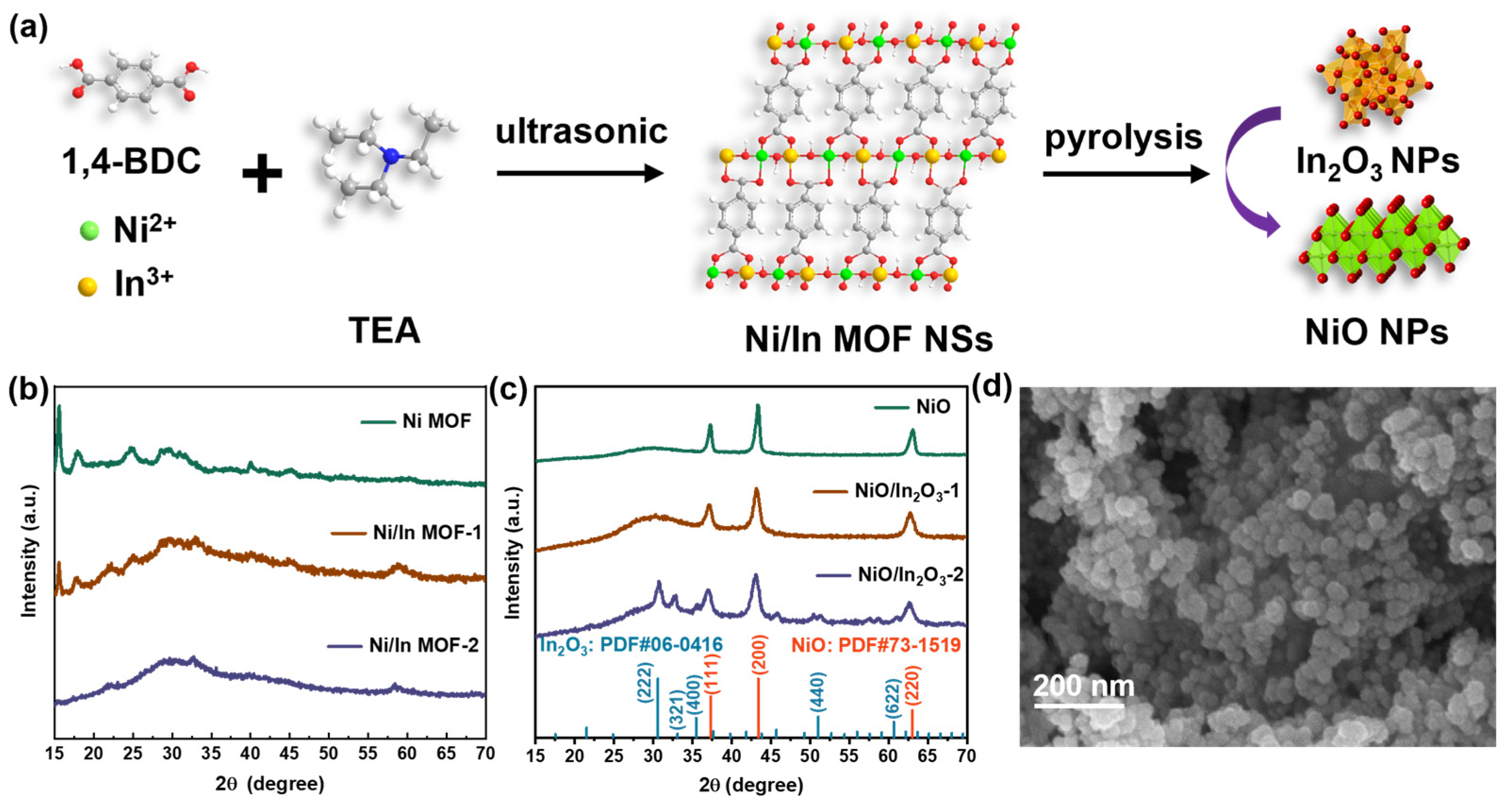
The obtained Ni/In MOF-1 and Ni/In MOF-2 were calcined in a tubular furnace (OTF-1200 X, Hefei Kejing Materials Technology Co., Ltd., Hefei, China) in air. The heating rate was 5 °C min−1 from RT to 500 °C and the samples were calcined at 500 °C for 3 h. After cooling to RT, the powders were collected. The resulting NiO/In2O3 nanoparticles (NPs) were denoted as NiO/In2O3-1 and NiO/In2O3-2. Figure 1a shows the schematic illustration of the formation of NiO/In2O3 NPs.

2.4. Gas Sensor Fabrication and Test

A total of 10 mg of NiO or NiO/In2O3 composite powder was dispersed in 0.5 mL of deionized water and thoroughly mixed to form a homogeneous slurry. Subsequently, 2 μL of the slurry was pipetted and drop-cast onto the surface of clean interdigital electrodes (IDEs) to construct the sensitive functional layer of the sensor. It is worth noting that the fabrication process of the IDEs used in this experiment has been detailed in our previous research [27]. After slurry deposition, the electrodes loaded with the sensitive layer were air-dried naturally at room temperature.
Gas-sensing performance of the sensors was evaluated via a static gas-sensing test method under ambient atmospheric pressure, following the specific procedure below: fabricated sensor devices were fixed on the test platform, exposed to air, and connected to the test circuit, which consisted of the test chamber connected to a source meter (Keithley 2400, Keithley Instruments, Inc., Cleveland, OH, USA); after baseline resistance of the sensors stabilized, the gas chamber lid was closed, and target gas was injected into the chamber to record the real-time resistance variation trend of the sensors; when resistance variation tended to stabilize, the chamber lid was opened, allowing the sensors to be re-expose to air and enter the resistance recovery stage.
Concentration gradient of the target gas was regulated via the quantitative syringe injection method: different volumes of the target gas were injected into the test chamber to create corresponding concentration atmospheres, thus enabling systematic characterization of sensor performance under varied concentrations.
A syringe was used to inject different volumes of target gas into the test chamber. Different volumes of gas represented different concentrations. For liquid target gas, the required liquid volume ( V l i q u i d ) is calculated as Equation (1):
V l i q u i d = V 0 · C · M · P ρ · R · T · w
V l i q u i d is the volume of the target liquid (mL). V 0 is the volume of the test chamber (L). C is the vapor concentration after liquid evaporation (ppm). M is the molecular weight of the target gas (g/mol). P is the atmospheric pressure (atm). ρ is the density of the liquid (g/mL). R is the molar gas constant (L·atm/mol·K). T is the room temperature (K). w is the purity factor (wt%) [28,29]. The purity value of ethanol is 99.7%; the purity value of triethylamine is 99%; the purity value of acetone is 99%; the purity value of formaldehyde is 89%; the purity value of methanol is 99.9%; and the purity value of N-butanol is 99.5%. All chemical reagents used in this work are analytical grade and without further purification. For the target gas with required gas volume (V), the formula is as shown in Equation (2):
V = C · V 0 C 0
where V 0 is the volume of the test chamber (mL) and C 0 is the concentration of the target gas. NO2 has a C 0 of 1000 ppm and was diluted with air.

2.5. Materials Characterization

The products were characterized by X-ray diffraction (XRD, Bruker D2 Phaser, Bruker AXS, Karlsruhe, Germany) with Cu Kα radiation (40 kV, 40 mA). A scanning electron microscope (SEM, Zeiss Sigma 300, Carl Zeiss Microscopy, Oberkochen, Germany) with 10 kV accelerating voltage was used to scan the microstructures. A transmission electron microscope (TEM, JEM2100Plus, JEOL Ltd., Tokyo, Japan) and high-resolution TEM (HRTEM, FEI Tecnai G20, FEI Company, Brno, Czech Repoblic) images were used to observe the structure of the prepared materials. X-ray photoelectron spectroscopy (XPS) was carried out on a Thermo ESCALAB 250 (Thermo Fisher Scientific, Waltham, MA, USA) with the Al Kα (1486.6 eV) anode. The peak binding energy at C1s was 284.8 eV. High-angle annular dark-field scanning transmission electron microscopy (HAADF-STEM) and energy dispersive X-ray spectroscopy (EDS) were used to obtain the elemental mapping (HAADF-STEM and EDS elemental mapping were performed on the FEI Tecnai G20 instrument, which was also used for HRTEM). Raman spectroscopy was performed on a Raman microscope (HORIBA-IHR550, HORIBA Scientific, Palaiseau/Longjumeau, France) using a 532 nm laser source (Cobolt 0532-04-01-0050-700) with a 50× objective.

3. Results and Discussion

3.1. Structure and Morphology

The crystallographic structure of the obtained materials is characterized by XRD analysis. Figure 1b,c represent the XRD patterns before and after calcination, respectively. In Figure 1b, the difference between Ni MOF and others is greater with the increase of the In content. In Figure 1c, the diffraction peaks at 2θ of 37.33°, 43.38°, and 63.02° correspond to the (110), (200), and (220) crystal planes of cubic NiO (JCPDS no. 73-1519), respectively. Meanwhile, the peaks at 2θ of 30.59°, 32.90°, 35.46°, 51.02°, and 60.67° are attributed to the (222), (321), (400), (440), and (622) crystal planes of cubic In2O3 (JCPDS no. 06-0416), respectively [30]. Moreover, the characteristic peaks of In2O3 become more obvious with the increase of In element content. Figure S1a,b show the surface morphologies of Ni MOF and Ni/In MOF-1, whose structures are layered nanosheets. Figure S1c,d and Figure 1d show the structure of NiO and NiO/In2O3. NiO is composed of extensive NPs, and there are abundant voids between particles, which helps to improve the gas adsorption of the sensing materials. It is observed that NiO/In2O3-1 and NiO/In2O3-2 have a surface morphology similar to NiO. In Figure 1d, NiO/In2O3-1 shows a porous aggregate of nanoparticles. This unique microstructure contributes to enhanced gas sensing properties by promoting gas adsorption and diffusion [31]. After calcination, MOF structures forms NPs with abundant voids, which can provide a larger specific surface area for target gas molecule adsorption and improves the sensing performance.
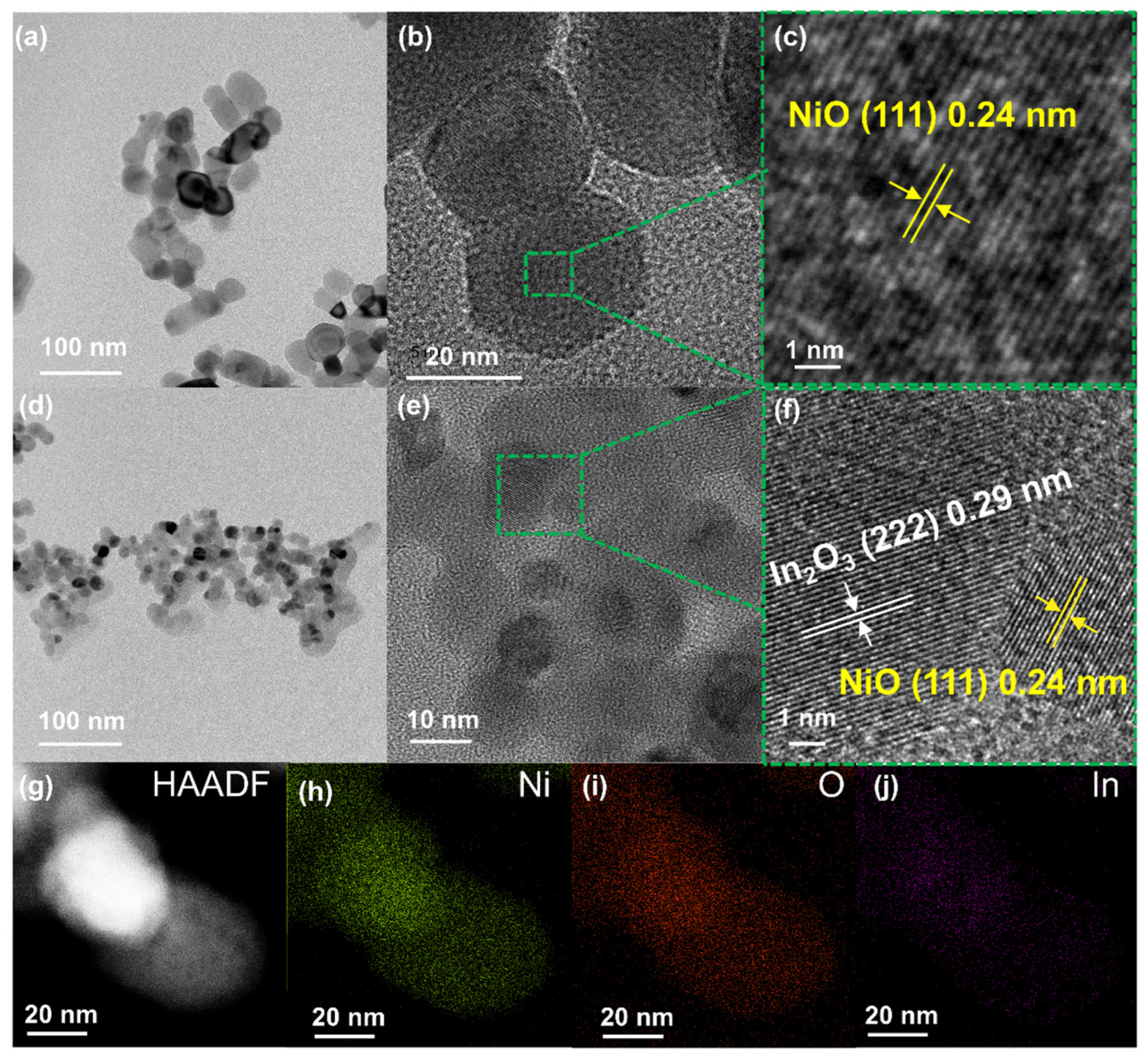
Figure 2a,d present the TEM images of NiO and NiO/In2O3-1, revealing their NPs morphology. In HRTEM, the high crystallinity of NiO and NiO/In2O3-1 is demonstrated. In Figure 2c, the lattice fringe spacing of 0.24 nm is indexed to the (111) crystal plane of NiO. In Figure 2f, the (111) plane of NiO and the (222) plane of In2O3 are clearly observed. The corresponding theoretical interplanar spacings for these crystal planes are provided in Table S1 for comparison. Figure S1d–f show the STEM-HAADF and EDS image of NiO NPs. Figure 2g shows the HAADF image of NiO/In2O3-1. Elemental mapping (Figure 2h–j) demonstrates the homogeneous distribution of Ni, O, and In elements within the NPs. Compared with Ni, the distribution of In is sparser, confirming the low content of In elements.
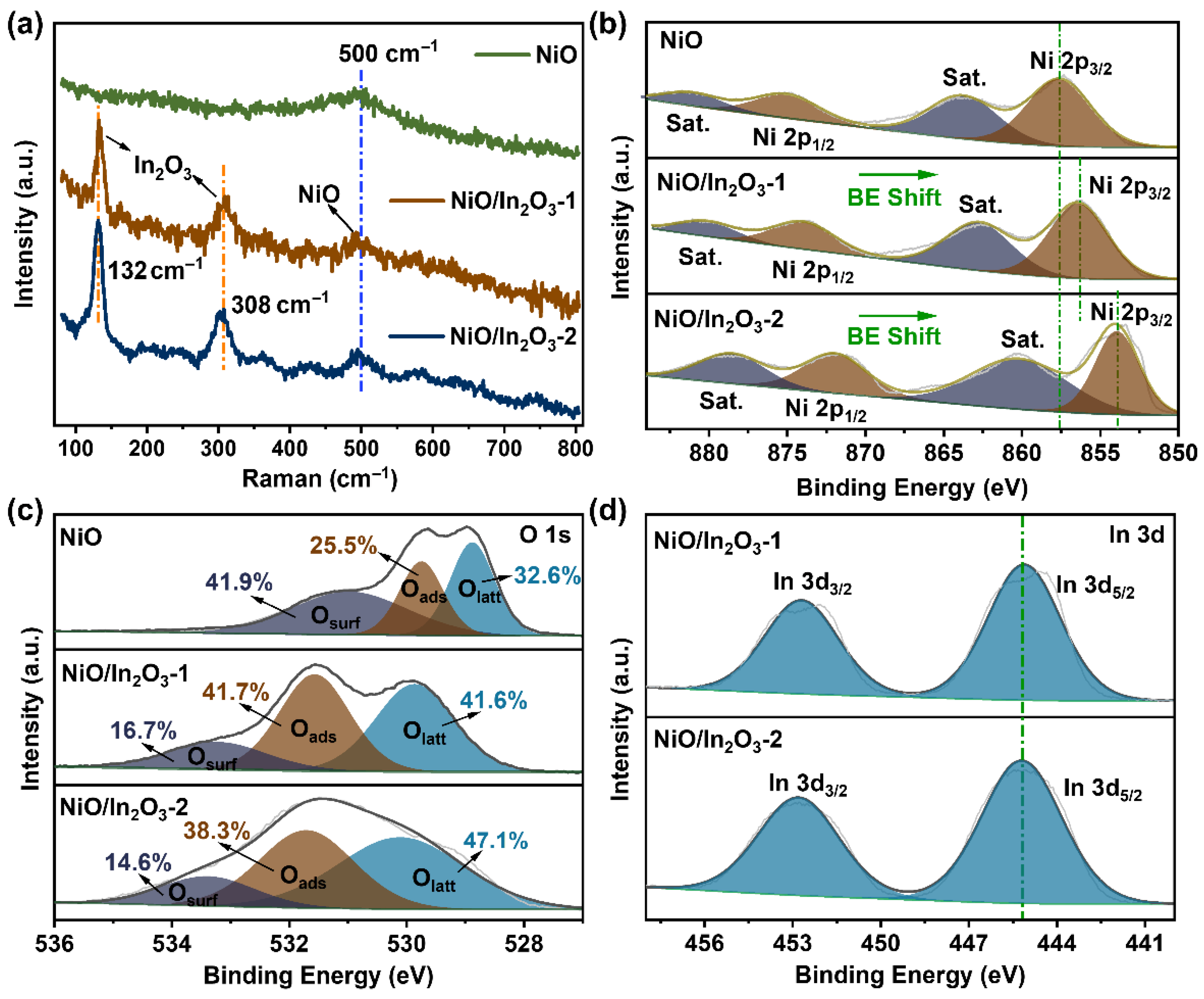
To verify the formation of heterostructure, Raman spectra were measured. As shown in Figure 3a, we recorded the Raman spectra of NiO, NiO/In2O3-1, and NiO/In2O3-2 in the 70–800 cm−1 range. Among them, the peaks at 132 cm−1 and 308 cm−1 are assigned to the In-O vibration of InO6 structural units and the δ-bending vibration of InO6 octahedrons, respectively [32]. The broad asymmetric peak at 500 cm−1 corresponds to the (1P + 1M) band of NiO, arising from the cooperative scattering of one-magnon (1M—40 cm−1) and one-phonon (TO—450 cm−1) excitations at the Brillouin-zone center [33,34]. The Raman signals are consistent with both NiO and In2O3.
Figure S2 shows the XPS survey spectra of NiO, NiO/In2O3-1, and NiO/In2O3-2, where characteristic peaks of Ni 2p, O 1s can be observed. At the same time, the XPS peak belonging to In 3d can be observed in NiO/In2O3-1 and NiO/In2O3-2. Table S2 shows weight percentages (wt%) of Ni, In, and O elements determined by XPS analysis. Figure 3b shows the Ni 2p spectra of the products. The peaks belong to Ni 2p1/2 and Ni 2p3/2; two satellite peaks are found in the scans. In addition, with the increase in In2O3 content, the binding energy gradually decreases. Table S3 presents the Ni 2p XPS fitting results for the three samples. This is attributed to the strong electronic interaction between NiO and In2O3 [35,36]. Figure 3c shows the O 1s XPS spectrum, where the O 1s peaks were deconvoluted into lattice oxygen (Olatt), adsorbed oxygen (Oads), and surface oxygen (Osurf) through peak fitting. For NiO, the three oxygen components exhibit binding energies of 528.9, 529.7, and 531.0 eV, respectively. For NiO decorated with In2O3, they are located at 529.9, 531.6, and 533.3 eV, respectively. The O 1s spectrum fitting results (Table S4) show that the introduction of In2O3 altered the relative content characteristics of oxygen species. Among them, Oads is mainly responsible for the sensing, and the sensing performance is mainly affected by the surface adsorbed oxygen content. The calculated Oads content of NiO/In2O3-1 is 41.7%, which is larger than that of NiO (25.5%) and NiO/In2O3-2 (38.3%). In addition, Figure 3d shows that the binding energy of In 3d3/2 and In 3d5/2 are positioned at 452.7 and 445.2 eV, respectively [37]. The XPS results indicate that the In2O3 content is 24.2 wt% for NiO/In2O3-1 and 32 wt% NiO/In2O3-2.

3.2. Gas Sensing Performances

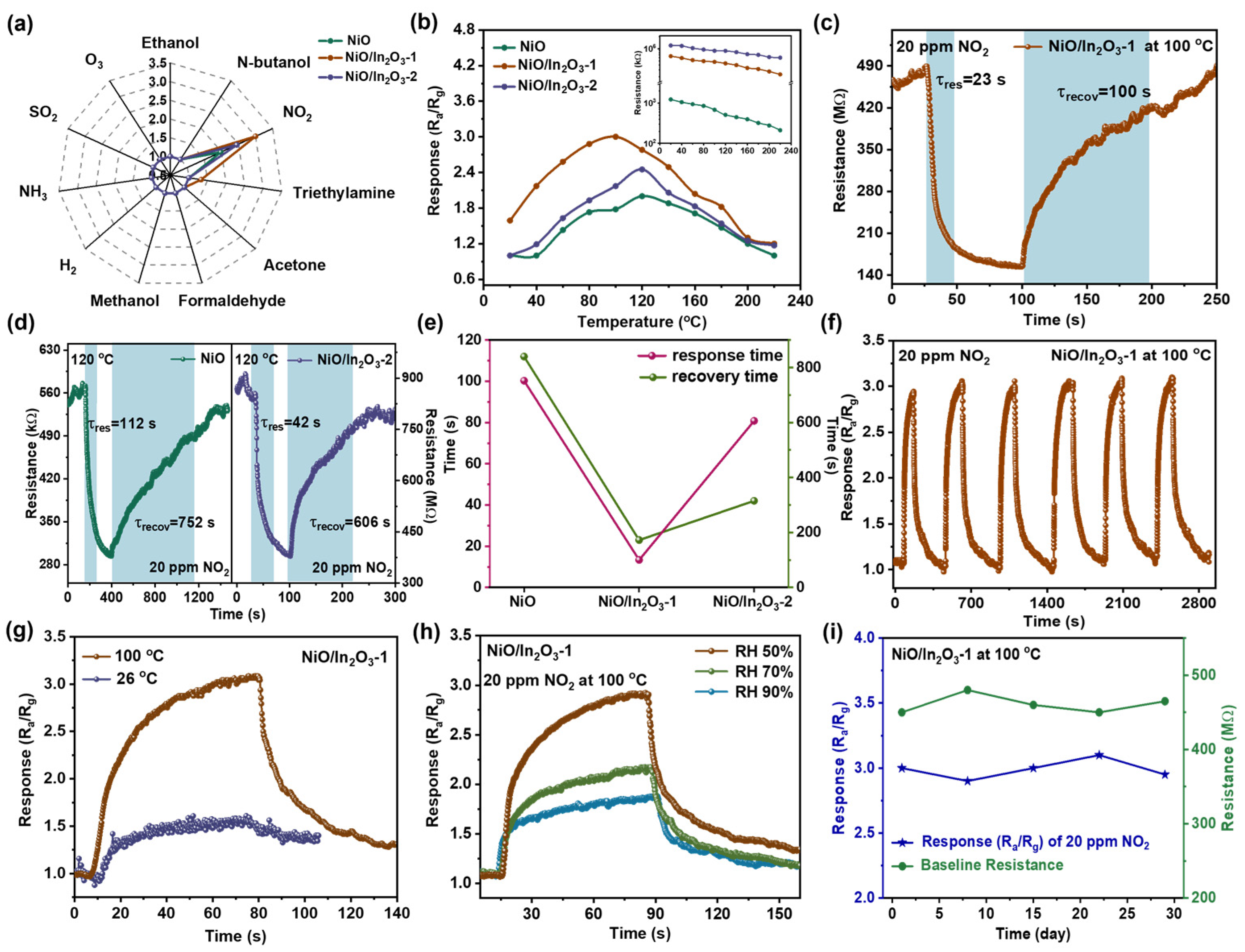
To study the effect of other gases on the sensor, the selectivity was tested as shown in Figure 4a. The numbers on the radar chart merely indicate the magnitude of the response values. NO2, SO2, and O3 are oxidizing gases, and the response of the NiO and NiO/In2O3 sensors is calculated as S = R a / R g . For reductive gases such as NH3, H2, ethanol, methanol, triethylamine, formaldehyde, acetone, and N-butanol, their responses are calculated as S = R g / R a , where R a is the initial resistance of the sensor in air and R g is the resistance of the sensor in the detected gas. Among the tested gases, the sensing characteristics for NO2 gas are significantly better than other gases, demonstrating the excellent selectivity of the NiO/In2O3. This can be attributed to the lone-pair electrons and high electron affinity of NO2 molecules, which promote strong interactions between NO2 and MOF-derived NiO/In2O3 [38]. This proves that the sensing materials derived from the MOF structure in this experiment have good selectivity for NO2. As shown in Figure 4b, the responses of NiO, NiO/In2O3-1, and NiO/In2O3-2 to 20 ppm NO2, as well as the resistances of the three sensors in the ambient environment, were measured at various temperatures. As illustrated in the inset of Figure 4b, all sensors exhibit inherent semiconductor behavior, with conductivity increasing with temperature. Moreover, In2O3 loading raises R a due to heterostructure-induced barrier enhancement and majority carrier reduction [39,40]. The NO2 response of NiO is significantly enhanced after In2O3 loading, and NiO/In2O3-1 exhibits good NO2 response at 100 °C. As the operating temperature increases, the response values of the three sensors all exhibit a trend of first increasing and then decreasing. The optimal operating temperature for NiO/In2O3-1 is 100 °C, while that for NiO and NiO/In2O3-2 is 120 °C. As the temperature rises further, reactive oxygen species readily desorb from the surface and the response decreases. The above results show that the NiO/In2O3-1 sensor has the better sensing performance than the NiO and NiO/In2O3-2 sensors. As shown in Figure 4c, the resistance curves of the NiO/In2O3-1 sensor were measured at 100 °C. After introducing the oxidizing gas (NO2), the sensor resistance decreases, exhibiting a typical p-type response. Meanwhile, the initial resistance of NiO loaded with In2O3 is much greater than the original NiO resistance (Figure 4d). The higher the In2O3 content, the greater the initial resistance. This is attributed to the fact that the work function of NiO is higher than that of In2O3 [41], leading to electron flow from In2O3 to NiO and resulting in increased resistance [42]. The response-recovery time of the NiO/In2O3-1 to 20 ppm NO2 is 23/100 s, and the response and recovery times of the three sensors are statistically analyzed in Figure 4e. According to the results of the three sensors, the NiO/In2O3-1 sensor exhibits the fastest response-recovery speed.
To further explore the sensor’s reproducibility, the cycling curve of the NiO/In2O3-1 sensor toward 20 ppm NO2 at 100 °C was investigated (Figure 4f). The six cycle curves show reasonable variation within a small range, demonstrating the excellent repeatability of the sensor. In order to study the low temperature performance, the NiO/In2O3-1 sensor was tested at RT, and the response curve is shown in Figure 4g. Even at RT, the response of the NiO/In2O3-1 sensor to 20 ppm NO2 reaches 1.5. The low operating temperature reduces the sensor’s power consumption and provides it with a wide range of practical applications. Additionally, evaluating the impact of ambient humidity on sensor performance is essential. Figure 4h presents the dynamic response curves of the NiO/In2O3-1 under various humidity environments. As relative humidity (RH) increases, the response of the sensor decreases significantly. It shows that the environmental humidity has an influence on the sensor. In high-humidity environments, enhanced competitive adsorption of H2O molecules on the sensitive layer surface occupies abundant active sites, thereby hindering the effective adsorption of surface oxygen species and NO2 molecules [43]. The reduced amount of adsorbed NO2 molecules ultimately leads to the decreased sensor response observed under high RH conditions [44]. Meanwhile, the response and baseline resistance data within one month is shown in Figure 4i. The results indicate that the response and resistance changes of NiO/In2O3-1 sensor are small, indicating that the sensor has reliable stability.
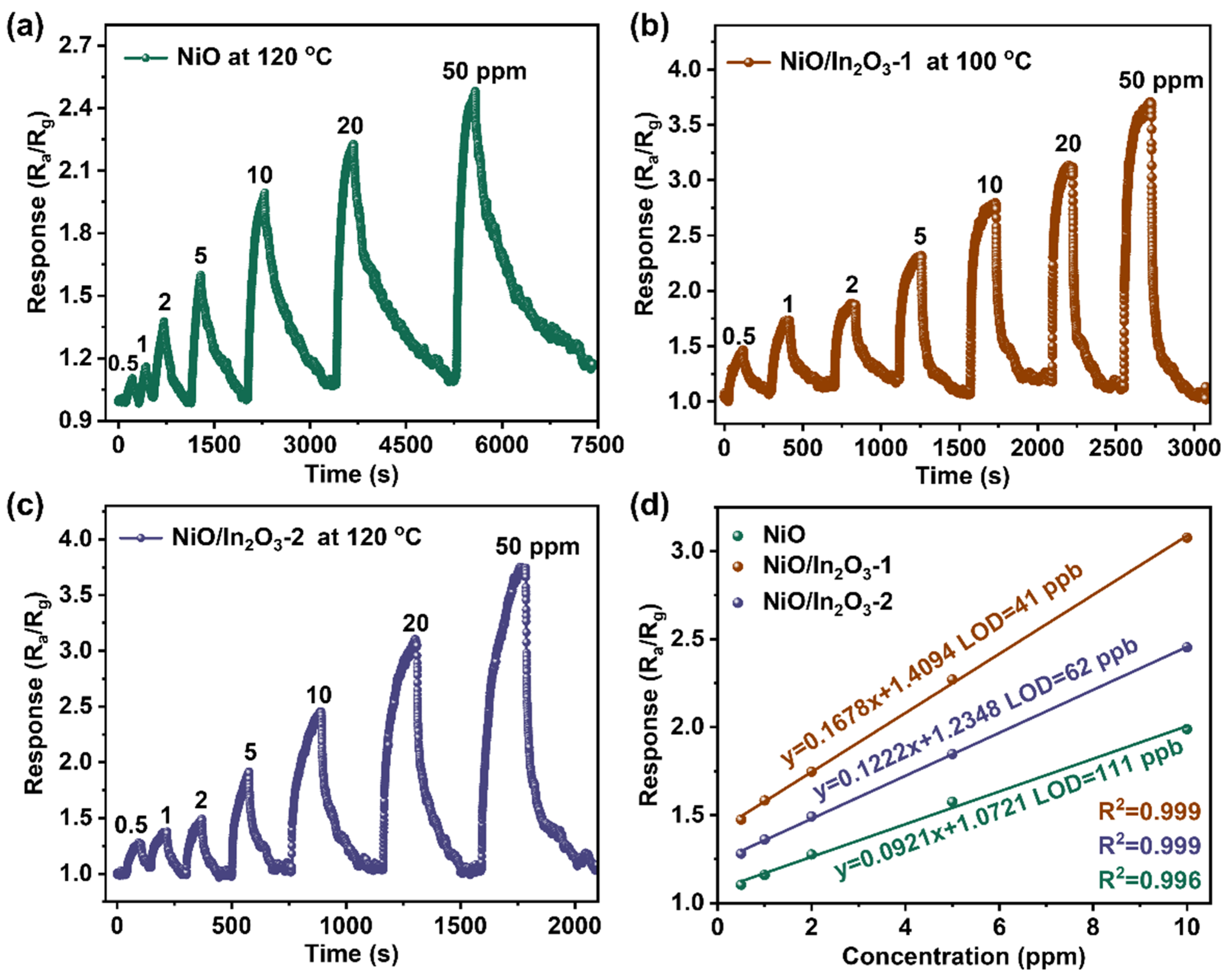
The sensing performance was tested at the optimal working temperature of the sensors. Figure 5a–c show the response curves of the NiO, NiO/In2O3-1, and NiO/In2O3-2 to different concentrations of NO2. In comparison, the response of the NiO loaded with In2O3 NPs is higher than that of the NiO sensor, demonstrating that the heterostructure can significantly improve the performance. To further evaluate the sensitivity, the concentration response curves are linearly fitted (Figure 5d), with the calculated LODs being 111, 41, and 62 ppb, respectively. This proves that the NiO/In2O3-1 sensor has the lowest LOD (41 ppb). The sensors with low LOD have better results in practical applications [45,46]. Meanwhile, the ability of the NiO/In2O3-1 sensor to detect trace NO2 was tested. Figure S3 shows the detection capability of the NiO/In2O3-1 sensor for 0.1 ppm and 0.2 ppm NO2. Significant response changes can be observed, proving that the sensor can detect very low concentrations of NO2, which can further justify the calculated LOD. Table 1 further highlights the performance advantages of the MOF-derived NiO/In2O3 sensor in detecting NO2 at 100 °C by comparing its performance with that of other NiO-based [19,46,47,48,49,50,51,52,53,54,55] and In2O3-based [56,57,58,59,60,61,62,63,64,65] NO2 sensors.

3.3. Gas Sensing Mechanism

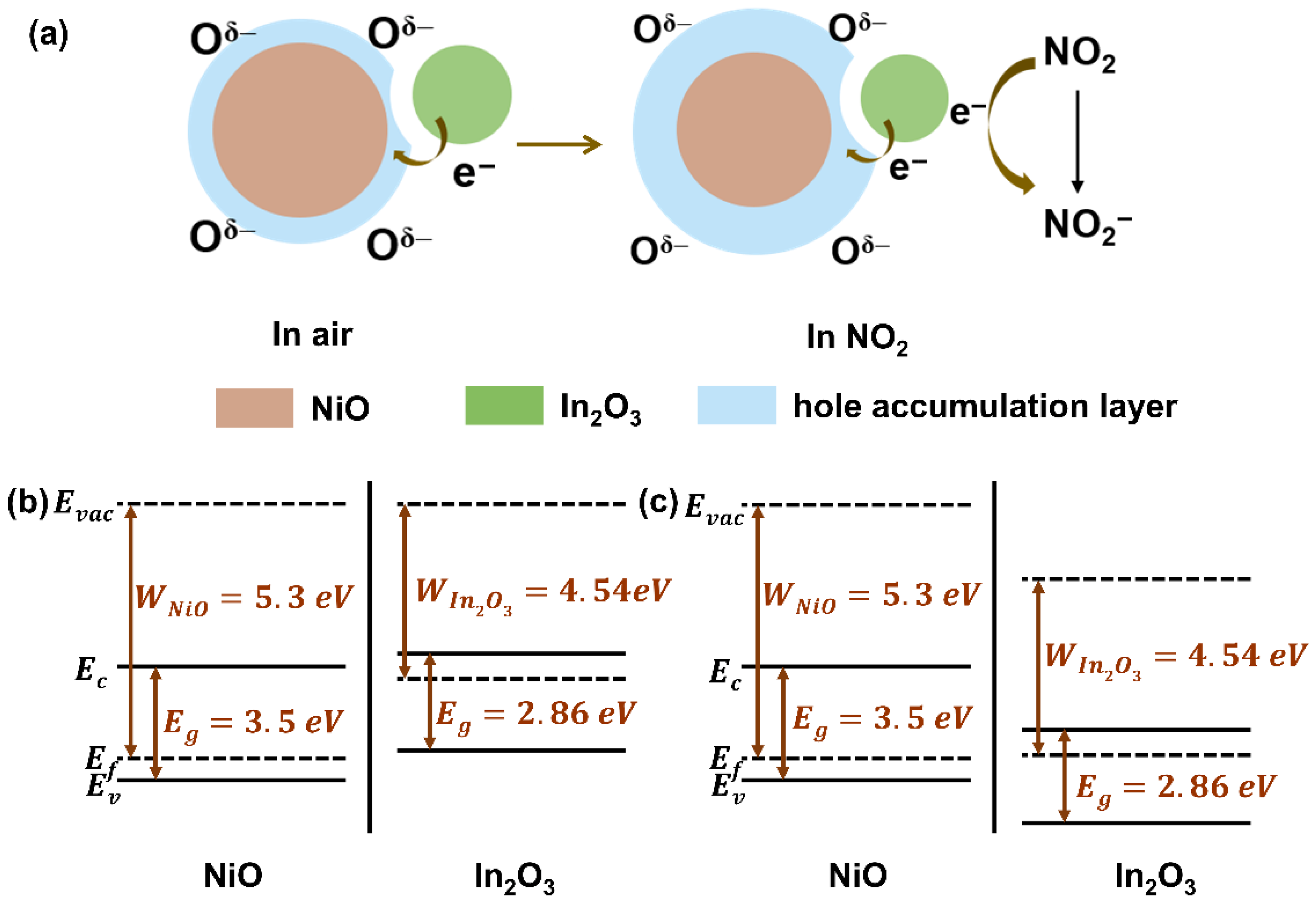
Figure 6a depicts a schematic illustration of the sensing mechanism for the NiO/In2O3 sensor. When the sensing material is exposed to air, electrons are transferred from its conduction band to oxygen molecules. These molecules adsorb onto the material surface to form chemically adsorbed oxygen species (O2−, O and O2), concurrently inducing the formation of a hole accumulation layer on the NiO surface [69]. Upon exposure to NO2 gas, a redox reaction occurs between the surface-adsorbed oxygen and NO2. This reaction extracts electrons from the conduction band, thereby further increasing the thickness of the hole accumulation layer. Concurrently, the material resistance is reduced, and the reaction mechanism is represented by Equations (3) and (4):
N O 2   g a s + e = N O 2   a d s
N O 2   g a s + O δ = N O 3 δ   a d s
For MOF-derived NiO/In2O3 heterostructure, the presence of In2O3 will cause more adsorbed oxygen to adhere to the material surface, thereby increasing the number of reactive sites for subsequent reactions. In addition, since the work function of In2O3 is smaller than that of NiO (Figure 6b), electrons are transferred from In2O3 to NiO until the Fermi level reaches equilibrium (Figure 6c). This process thins the thickness of the hole accumulation layer, leading to the resistance of NiO/In2O3 material being larger than that of NiO (Figure 4c,d). Due to the limited number of hole carriers in the material, gas adsorption will be confined to the material surface, which is advantageous for gas sensing [70,71]. The above analysis shows that MOF-derived NiO/In2O3 material will greatly improve the sensing ability to detect NO2.

4. Conclusions

In summary, NiO/In2O3 heterostructure NPs were synthesized by pyrolysis of MOF templates. The sensor exhibits a response of 1.5 to low-concentration NO2 at RT and an enhanced response of 3 at 100 °C. Meanwhile, the effect of In2O3 content on the NO2 gas-sensing performance of the material was investigated. Experiments demonstrated that the introduction of In2O3 enhanced the gas-sensing performance of NiO, enabling high-performance detection of NO2. The sensor exhibits a high response rate and excellent selectivity, as well as low LOD (41 ppb) for NO2 detection. The enhanced gas-sensing performance of the sensor is attributed to the synergistic effect between NiO and In2O3 nanoparticles. This work proposes a novel approach to electronically engineer NiO-based materials for gas sensors, achieving enhanced sensitivity while reducing power consumption.

Supplementary Materials

The following supporting information can be downloaded at: https://www.mdpi.com/article/10.3390/chemosensors14030054/s1. Figure S1. SEM images of (a) Ni MOF, (b) Ni/In MOF-1, (c) NiO and (d) NiO/In2O3-2; (e) HAADF-STEM and (f–g) EDS images of NiO; Figure S2. XPS analysis of NiO, NiO/In2O3-1 and NiO/In2O3-2; Table S1. Lattice fringe spacing and corresponding crystallographic planes identified from HRTEM analysis; Table S2. Determination of the weight percentages (wt%) of Ni, In and O by XPS analysis; Table S3. Fitting results of Ni 2p XPS for the three samples; Table S4. Content of different oxygen species in NiO, NiO/In2O3-1, and NiO/In2O3-2, as determined by XPS; Figure S3. The transient response curves of the NiO/In2O3-1 sensor to 0.1 and 0.2 ppm NO2.

Author Contributions

Conceptualization, Y.C. and G.L.; methodology, Y.C.; software, Y.C.; validation, G.L., Y.C. and X.W.; formal analysis, Y.C.; investigation, X.W.; resources, G.L.; data curation, H.J.; writing—original draft preparation, Y.C.; writing—review and editing, J.Z.; visualization, J.Z.; supervision, W.Z.; project administration, J.Z.; funding acquisition, J.Z. and X.L. All authors have read and agreed to the published version of the manuscript.

Funding

This research was funded by the National Natural Science Foundation of China grant numbers 52572174 and 62471271, and the Taishan Young Scholar Program of Shandong Province.

Institutional Review Board Statement

Not Applicable.

Informed Consent Statement

Not Applicable.

Data Availability Statement

The original contributions presented in this study are included in the article/Supplementary Materials. Further inquiries can be directed to the corresponding author.

Conflicts of Interest

The author is not influenced by any personal interests.

References

  1. Lu, G.-C.; Liu, X.-H.; Zheng, W.; Xie, J.-Y.; Li, Z.-S.; Lou, C.-M.; Lei, G.-L.; Zhang, J. UV-activated single-layer WSe2 for highly sensitive NO2 detection. Rare Met. 2022, 41, 1520–1528. [Google Scholar] [CrossRef]
  2. Gasso, S.; Sohal, M.K.; Mahajan, A. MXene modulated SnO2 gas sensor for ultra-responsive room-temperature detection of NO2. Sens. Actuators B 2022, 357, 131427. [Google Scholar] [CrossRef]
  3. Zhang, J.; Liu, X.H.; Neri, G.; Pinna, N. Nanostructured Materials for Room-Temperature Gas Sensors. Adv. Mater. 2016, 28, 795–831. [Google Scholar] [CrossRef]
  4. Zhu, J.Q.; Chen, L.C.; Ni, W.Z.; Cheng, W.W.; Yang, Z.; Xu, S.S.; Wang, T.; Zhang, B.W.; Xuan, F.Z. NiO/ZnO Nanocomposites for Multimodal Intelligent MEMS Gas Sensors. ACS Sens. 2025, 10, 2531–2541. [Google Scholar] [CrossRef] [PubMed]
  5. Guo, Y.J.; Qu, J.Y.; Zhang, Z.K.; Liu, Z.Y.; Yue, C.; Chen, Q.Y.; Yang, Z.G.; Mu, Y.; Wang, X.N.; Dastan, D.; et al. Outstandingly selective n-butanol gas sensor based on ZnS/NiO lychee-shaped nanospheres. Sens. Actuators B 2025, 433, 137573. [Google Scholar] [CrossRef]
  6. Zhu, H.M.; Yuan, Z.Y.; Ji, H.Y.; Liu, Y.; Zhang, R.Z.; Mu, Z.Z.; Shen, Y.B.; Gao, H.L.; Meng, F.L. Electronic structure analysis of NiO quantum dot-modified jackfruit-shaped ZnO sensors and sensing properties investigation of their highly sensitive and selective for butyl acetate. J. Colloid Interface Sci. 2023, 650, 466–479. [Google Scholar] [CrossRef] [PubMed]
  7. Liu, Z.; Zhang, C.Z.; Liu, H.; Feng, L.G. Efficient synergism of NiSe2 nanoparticle/NiO nanosheet for energy-relevant water and urea electrocatalysis. Appl. Catal. B-Environ. 2020, 276, 119165. [Google Scholar] [CrossRef]
  8. Saha, P.; Nath, N.C.D.; Islam, M.M.; Aziz, M.A.; Ahammad, A.J.S. Recent progress of high-energy density supercapacitors based on nanostructured nickel oxides. Electrochim. Acta 2024, 504, 144982. [Google Scholar] [CrossRef]
  9. Fu, J.C.; Zhao, C.H.; Zhang, J.L.; Peng, Y.; Xie, E.Q. Enhanced Gas Sensing Performance of Electrospun Pt-Functionalized NiO Nanotubes with Chemical and Electronic Sensitization. ACS Appl. Mater. Interfaces 2013, 5, 7410–7416. [Google Scholar] [CrossRef]
  10. Dey, A. Semiconductor metal oxide gas sensors: A review. Mater. Sci. Eng. B 2018, 229, 206–217. [Google Scholar] [CrossRef]
  11. Sun, Y.J.; Zhao, Z.T.; Suematsu, K.; Zhang, W.L.; Zhang, W.D.; Zhuiykov, S.; Shimanoe, K.; Hu, J. MOF-derived Au-NiO/In2O3 for selective and fast detection of toluene at ppb-level in high humid environments. Sens. Actuators B 2022, 360, 131223. [Google Scholar] [CrossRef]
  12. Furukawa, H.; Ko, N.; Go, Y.B.; Aratani, N.; Choi, S.B.; Choi, E.; Yazaydin, A.; Snurr, R.Q.; O’Keeffe, M.; Kim, J.; et al. Ultrahigh Porosity in Metal-Organic Frameworks. Science 2010, 329, 424–428. [Google Scholar] [CrossRef]
  13. Wang, S.L.; Xu, M.; Peng, T.Y.; Zhang, C.X.; Li, T.; Hussain, I.; Wang, J.Y.; Tan, B.E. Porous hypercrosslinked polymer-TiO2-graphene composite photocatalysts for visible-light-driven CO2 conversion. Nat. Commun. 2019, 10, 676. [Google Scholar] [CrossRef]
  14. Stassen, I.; Burtch, N.C.; Talin, A.A.; Falcaro, P.; Allendorf, M.D.; Ameloot, R. An updated roadmap for the integration of metal-organic frameworks with electronic devices and chemical sensors. Chem. Soc. Rev. 2017, 46, 3185–3241. [Google Scholar] [CrossRef]
  15. Wang, D.; Qin, R.-J.; Yu, J.-J.; Hu, J.-W.; Zhang, W.-H.; Xu, H.; Xu, J.-C.; Liao, Q.-B.; Li, H.-J.; Wang, X.-H. Bilayer cascade of WO3 nanofibers/Ag@CeO2 nanosheets for ppb-level xylene detection under the catalysis-gas sensitivity synergistic mechanism. Rare Met. 2025, 44, 4868–4880. [Google Scholar] [CrossRef]
  16. Sun, Y.; Zhao, Z.; Suematsu, K.; Li, P.; Zhang, W.; Hu, J. Moisture-resisting acetone sensor based on MOF-derived ZnO-NiO nanocomposites. Mater. Res. Bull. 2022, 146, 111607. [Google Scholar] [CrossRef]
  17. Hassan, M.; Liang, Z.; Liu, S.; Hussain, S.; Qiao, G.; Liu, G. Temperature-driven n- to p-type transition of a chemiresistive NiO/CdS-CdO NO2 gas sensor. Sens. Actuators B 2024, 398, 134755. [Google Scholar] [CrossRef]
  18. Xu, H.; Zhong, H.; Hu, J.; Rong, X.; Zhang, W.; Wang, Y.; Li, S.; Li, G.; Wang, D. Facile engineering of metal-organic framework derived SnO2@NiO core-shell nanocomposites based gas sensor toward superior VOCs sensing performance. Chem. Eng. J. 2024, 501, 157692. [Google Scholar] [CrossRef]
  19. Li, Q.Y.; Zhang, P.; Ning, T.G.; Sun, Y.S.; Ren, Q.Q.; Xu, M.Z.; Zhao, X.Y.; Luo, X.L.; Zhai, C.X.; Yan, J.F.; et al. Gas Sensor Based on Flower-like NiO Modified with WO3 Nanoparticles for NO2 Detection. ACS Appl. Nano Mater. 2024, 7, 7856–7864. [Google Scholar] [CrossRef]
  20. Arbia, M.B.; Comini, E. Growth Processing and Strategies: A Way to Improve the Gas Sensing Performance of Nickel Oxide-Based Devices. Chemosensors 2024, 12, 45. [Google Scholar] [CrossRef]
  21. Meng, W.W.; Tian, M.; Dai, L.; Wang, L.; Liu, Y.G.; Zhou, H.Z.; He, Z.X.; Li, Y.H. Impedimetric-type NO2 sensor based on the p-NiO/n-NiNb2O6 heterojunction sensing electrode. Sens. Actuators B 2022, 371, 132604. [Google Scholar] [CrossRef]
  22. Li, Q.; Wang, Q.; Li, Y.; Zhang, X.; Huang, Y. 2D bimetallic Ni/Fe MOF nanosheet composites as a peroxidase-like nanozyme for colorimetric assay of multiple targets. Anal. Methods 2021, 13, 2066–2074. [Google Scholar] [CrossRef]
  23. Rui, K.; Zhao, G.; Chen, Y.; Lin, Y.; Zhou, Q.; Chen, J.; Zhu, J.; Sun, W.; Huang, W.; Dou, S.X. Hybrid 2D dual-metal–organic frameworks for enhanced water oxidation catalysis. Adv. Funct. Mater. 2018, 28, 1801554. [Google Scholar] [CrossRef]
  24. Zhao, S.; Wang, Y.; Dong, J.; He, C.-T.; Yin, H.; An, P.; Zhao, K.; Zhang, X.; Gao, C.; Zhang, L.; et al. Ultrathin metal–organic framework nanosheets for electrocatalytic oxygen evolution. Nat. Energy 2016, 1, 16184. [Google Scholar] [CrossRef]
  25. Głowniak, S.; Szczęśniak, B.; Choma, J.; Jaroniec, M. Recent Developments in Sonochemical Synthesis of Nanoporous Materials. Molecules 2023, 28, 2639. [Google Scholar] [CrossRef] [PubMed]
  26. Son, D.H.; Hughes, S.M.; Yin, Y.; Alivisatos, A.P. Cation Exchange Reactions in Ionic Nanocrystals. Science 2004, 306, 1009–1012. [Google Scholar] [CrossRef]
  27. Lei, G.; Li, Z.; Lu, G.; Hu, J.; Shang, H.; Zhang, X.; Liu, X.; Zhang, J.; Guo, X. Tungsten oxide thin films for highly sensitive triethylamine detection. J. Mater. 2022, 8, 408–416. [Google Scholar] [CrossRef]
  28. Chen, G.-L.; Jiang, H.-Y.; Jiang, Y.; Deng, Z.-P.; Xu, Y.-M.; Huo, L.-H.; Gao, S. Temperature-tuned dual-selective NO2/diisopropylamine sensor based on (NH4)0.33WO3 doped γ-WO3 nanosheets-assembled hollow microspheres via simple pyrolysis of commercial ammonium metatungstate. Chem. Eng. J. 2025, 512, 162684. [Google Scholar] [CrossRef]
  29. Gao, R.; Wang, S.; Xu, Y.; Zhang, X.; Gao, J.; Zheng, M.; Zhou, X.; Huo, L. Dual-defect enhanced NO2 sensing performance at low power consumption of ZnO-ZnTe core-shell nanorods via one-step controllable assembly. J. Alloys Compd. 2025, 1029, 180794. [Google Scholar] [CrossRef]
  30. Zhao, N.; Chang, X.; Liu, X.; Li, J.; Zheng, W.; Zhang, J. Probing the Structural Dynamics of In2O3 Using in Situ Raman Spectroscopy: Bridging Material Dynamics and Sensor Functionality. Angew. Chem. Int. Ed. 2025, 64, e202512808. [Google Scholar] [CrossRef] [PubMed]
  31. Bulemo, P.M.; Cheong, J.Y. Review on Porosity Control in Nanostructured Semiconducting Metal Oxides and Its Influence on Chemiresistive Gas Sensing. ACS Appl. Nano Mater. 2023, 6, 1027–1049. [Google Scholar] [CrossRef]
  32. Xu, H.; Wang, Y.; Dong, X.; Zheng, N.; Ma, H.; Zhang, X. Fabrication of In2O3/In2S3 microsphere heterostructures for efficient and stable photocatalytic nitrogen fixation. Appl. Catal. B 2019, 257, 117932. [Google Scholar] [CrossRef]
  33. Mironova-Ulmane, N.; Kuzmin, A.; Sildos, I.; Puust, L.; Grabis, J. Magnon and Phonon Excitations in Nanosized NiO. Latv. J. Phys. Tech. Sci. 2019, 56, 61–72. [Google Scholar] [CrossRef]
  34. Bala, N.; Singh, H.K.; Verma, S.; Rath, S. Magnetic-order induced effects in nanocrystalline NiO probed by Raman spectroscopy. Phys. Rev. B 2020, 102, 024423. [Google Scholar] [CrossRef]
  35. Xie, J.; Liu, X.; Jing, S.; Pang, C.; Liu, Q.; Zhang, J. Chemical and Electronic Modulation via Atomic Layer Deposition of NiO on Porous In2O3 Films to Boost NO2 Detection. ACS Appl. Mater. Interfaces 2021, 13, 39621–39632. [Google Scholar] [CrossRef]
  36. Natile, M.M.; Glisenti, A. New NiO/Co3O4 and Fe2O3/Co3O4 Nanocomposite Catalysts:  Synthesis and Characterization. Chem. Mater. 2003, 15, 2502–2510. [Google Scholar] [CrossRef]
  37. Chen, Q.; Wang, X.; Liu, W.; Luo, T.; Jin, Z.; Zhang, Y.; Huang, J.; Zhang, H.; Wang, J.; Peng, F. Rapid photocatalytic reduction of Cr(VI) with high concentration in wastewater by In2S3-ZnIn2S4 heterostructure hierarchical microtubes under visible light. J. Solid State Chem. 2022, 306, 122721. [Google Scholar] [CrossRef]
  38. Li, N.; Hu, J.; Li, J.; Cheng, M.; Wei, T.; Liu, Q.; Wang, R.; Li, W.; Ling, Y.; Zhang, Y.; et al. Cu-MOF-74-derived Cu2O/CuO-C nanocomposite as an effective chemiresistive sensor for detection of NO2 at room temperature. J. Alloys Compd. 2024, 976, 173074. [Google Scholar] [CrossRef]
  39. Li, S.; Li, X.; Guo, J.; Liu, X.; Zhang, J. Heterostructured SnO2/CuO Hydrangea Nanocomposites for Highly Sensitive NO2 Detection. ACS Appl. Nano Mater. 2025, 8, 10549–10558. [Google Scholar] [CrossRef]
  40. Hu, C.; Feng, Y.; Huo, J.; Zhang, B.; Cui, H.; Wang, S.; Song, Q.; Cao, J.; Dong, X. Regulating microscopic surfaces and structures to boost n-butanol sensing performances in NiCo2O4/NiO composites. Sens. Actuators B 2025, 429, 137341. [Google Scholar] [CrossRef]
  41. Yu, Q.; Jin, R.; Zhao, L.; Wang, T.; Liu, F.; Yan, X.; Wang, C.; Sun, P.; Lu, G. MOF-derived mesoporous and hierarchical hollow-structured In2O3-NiO composites for enhanced triethylamine sensing. ACS Sens. 2021, 6, 3451–3461. [Google Scholar] [CrossRef]
  42. Yan, S.; Song, W.; Wu, D.; Jin, S.; Dong, S.; Hao, H.; Gao, W. Assembly of In2O3 nanoparticles decorated NiO nanosheets heterostructures and their enhanced gas sensing characteristics. J. Alloys Compd. 2022, 896, 162887. [Google Scholar] [CrossRef]
  43. Wu, K.; Debliquy, M.; Zhang, C. Room temperature gas sensors based on Ce doped TiO2 nanocrystals for highly sensitive NH3 detection. Chem. Eng. J. 2022, 444, 136449. [Google Scholar] [CrossRef]
  44. Zhang, S.; Zhou, L.; Hu, Y.; Liu, X.; Zhang, J. Metal-organic gel derived ZnO/α-Fe2O3 heterostructures for sensitive NO2 detection. Sens. Actuators B 2023, 396, 134524. [Google Scholar] [CrossRef]
  45. Zheng, W.; Lu, G.; Liu, X.; Fan, S.; Hu, Y.; Pinna, N.; Zhang, J. Mixed-dimensional heterojunction by 3D CdS nanowire arrays bridged with 2D WSe2 for ultrafast photoelectric gas sensor. Matter 2025, 8, 101914. [Google Scholar] [CrossRef]
  46. Fan, Y.; Li, L.; Song, B.; Wu, H.; Qi, L.; Khan, M.; Wu, H.; Shi, K. Heterostructures of hollow Co3O4 nanocages wrapped in NiO cilia for conductometric NO2 sensing at room temperature. Sens. Actuators B 2024, 404, 135299. [Google Scholar] [CrossRef]
  47. Shan, B.H.; Guo, J.B.; Liu, X.H.; Zhang, J. Pt/Pd-functionalized NiO nanorods for low-power NO2 detection at room temperature. Sens. Actuators B 2025, 444, 138334. [Google Scholar] [CrossRef]
  48. Zhao, H.; Ge, W.Y.; Tian, Y.; Wang, P.T.; Li, X.; Liu, Z.F. Pr2Sn2O7/NiO heterojunction for ultra-fast and low operating temperature to NO2 gas sensing. Sens. Actuators A: Phys. 2023, 349, 114100. [Google Scholar] [CrossRef]
  49. Niavol, S.S.; Budde, M.; Papadogianni, A.; Heilmann, M.; Moghaddam, H.M.; Aldao, C.M.; Ligorio, G.; List-Kratochvil, E.J.W.; Lopes, J.M.J.; Barsan, N.; et al. Conduction mechanisms in epitaxial NiO/Graphene gas sensors. Sens. Actuators, B 2020, 325, 128797. [Google Scholar] [CrossRef]
  50. Gawali, S.R.; Patil, V.L.; Deonikar, V.G.; Patil, S.S.; Patil, D.R.; Patil, P.S.; Pant, J. Ce doped NiO nanoparticles as selective NO2 gas sensor. J. Phys. Chem. Solids 2018, 114, 28–35. [Google Scholar] [CrossRef]
  51. Xu, H.; Zhang, J.W.; Rehman, A.U.; Gong, L.H.; Kan, K.; Li, L.; Shi, K.Y. Synthesis of NiO@CuO nanocomposite as high-performance gas sensing material for NO2 at room temperature. Appl. Surf. Sci. 2017, 412, 230–237. [Google Scholar] [CrossRef]
  52. Zou, M.M.; Meng, H.; Qu, F.D.; Feng, L.; Yang, M.H. A mesoporous Ni3N/NiO composite with a core-shell structure for room temperature, selective and sensitive NO2 gas sensing. RSC Adv. 2016, 6, 42917–42922. [Google Scholar] [CrossRef]
  53. Ueda, T.; Sakai, M.; Kamada, K.; Hyodo, T.; Shimizu, Y. Effects of composition and structure of sensing electrode on NO2 sensing properties of mixed potential-type YSZ-based gas sensors. Sens. Actuators B 2016, 237, 247–255. [Google Scholar] [CrossRef]
  54. Park, S.; Kim, S.; Sun, G.J.; Lee, C. NO2 Gas Sensing Performance of Co-Doped NiO Thin Film Sensors. Nanosci. Nanotechnol. Lett. 2015, 7, 713–717. [Google Scholar] [CrossRef]
  55. Nalage, S.R.; Chougule, M.A.; Sen, S.; Patil, V.B. Novel method for fabrication of NiO sensor for NO2 monitoring. J. Mater. Sci. Mater. Electron. 2013, 24, 368–375. [Google Scholar] [CrossRef]
  56. Cui, Y.F.; Ge, W.Y.; Yang, M.H.; Dong, X.; Zhang, B.C.; Wu, C.E. Ultralow ppb-level NO2 sensing at room temperature enabled by Ag-loaded MOF-templated In2O3. Vacuum 2026, 245, 114950. [Google Scholar] [CrossRef]
  57. Guo, Y.J.; Zhang, Z.X.; Feng, H.S.; Dai, Q.F.; Zhao, Q.N.; Duan, Z.H.; Guo, S.H.; Yang, L.; Hou, M.; Xia, Y. Electrostatic Self-Assembly of Heterostructured In2O3/Ti3C2Tx Nanocomposite for High-Selectivity NO2 Gas Sensing at Room Temperature. Chemosensors 2025, 13, 249. [Google Scholar] [CrossRef]
  58. Wei, W.T.; Luo, N.; Wang, X.W.; Xue, Z.G.; Shah, L.A.; Hu, Q.M.; Xu, J.Q. Amorphous RhOx decorated black indium oxide for rapid and flexible NO2 detection at room temperature. Sens. Actuators, B 2024, 414, 135944. [Google Scholar] [CrossRef]
  59. Vishnuraj, R.; Unnathpadi, R.; Rangarajan, M.; Pullithadathil, B. n-n type In2O3@WO3 heterojunction nanowires: Enhanced NO2 gas sensing characteristics for environmental monitoring. Microchim. Acta 2024, 191, 645. [Google Scholar] [CrossRef] [PubMed]
  60. Sahoo, S.J.; Das, A.; Maji, B.; Goutam, U.K.; Dash, P. Effect of a Ni-Substituted Cu-MOF Precursor toward Efficient NO2 Gas Detection: A Comprehensive Comparative Gas-Sensing Study of MOF-Derived and Traditionally Synthesized CuO/NiO-Based Nanocomposites. ACS Appl. Electron. Mater. 2024, 6, 2349–2368. [Google Scholar] [CrossRef]
  61. Han, J.Y.; Kong, D.H.; Zhou, W.R.; Gao, Y.B.; Gao, Y.; Liu, G.N.; Lu, G.Y. Interface-engineering in MOF-derived In2O3 for highly sensitive and dual-functional gas sensor towards NO2 and triethylamine. Sens. Actuators, B 2023, 395, 134491. [Google Scholar] [CrossRef]
  62. Liu, Y.S.; Liu, X.P.; Wang, Y.B.; Wang, R.; Zhang, T. Metal-organic-framework-derived In2O3 microcolumnar structures embedded with Pt nanoparticles for NO2 detection near room temperature. Ceram. Int. 2019, 45, 9820–9828. [Google Scholar] [CrossRef]
  63. Park, S.; An, S.; Ko, H.; Jin, C.; Lee, C. Enhanced Gas Sensing Properties of Bi2O3-Core/In2O3-Shell Nanorod Gas Sensors. Bull. Korean Chem. Soc. 2012, 33, 3368–3372. [Google Scholar] [CrossRef]
  64. Raju, P.; Rambeloson, J.; Ioannou, D.E.; Motayed, A.; Li, Q.L. Noble Metal-Decorated In2O3 for NO2 Gas Sensor: An Experimental and DFT Study. Chemosensors 2025, 13, 350. [Google Scholar] [CrossRef]
  65. Lu, Z.J.; Tian, Y.; Hong, B.; Xu, J.C.; Peng, X.L.; Li, J.; Chen, H.W.; Qiu, S.; Zhang, N.; Wang, X.Q. Enhanced room-temperature detection of ultra-low level nitrogen dioxide: Improved sensitivity, selectivity and stability through MXene-modified In2O3 microspheres. Talanta 2025, 293, 128145. [Google Scholar] [CrossRef]
  66. Plashnitsa, V.V.; Ueda, T.; Elumalai, P.; Kawaguchi, T.; Miura, N. Zirconia-based planar NO2 sensor using ultrathin NiO or laminated NiO-Au sensing electrode. Ionics 2008, 14, 15–25. [Google Scholar] [CrossRef]
  67. Yang, Z.M.; Zhang, D.Z.; Chen, H.N. MOF-derived indium oxide hollow microtubes/MoS2 nanoparticles for NO2 gas sensing. Sens. Actuators, B 2019, 300, 127037. [Google Scholar] [CrossRef]
  68. Liu, X.T.; Yang, W.Y.; Wang, T.Q.; Li, F.; Yu, H.; Yang, M.; Li, D.; Yang, Y. RGO functionalized MIL-68-derived In2O3 hollow hexagonal prisms as room temperature flexible NO2 sensor. J. Environ. Chem. Eng. 2025, 13, 118498. [Google Scholar] [CrossRef]
  69. Wang, X.; Zhang, W.; Wang, X.; Li, X.; Sui, X.; Jiang, H.; Liu, G.; Li, B.; Sheng, Y.; Zhou, J.; et al. Heterostructure engineering of NiO foam/In2S3 film for high-performance ethylene glycol gas sensors. Sens. Actuators, B 2023, 392, 134110. [Google Scholar] [CrossRef]
  70. Yang, W.; Feng, L.; He, S.; Liu, L.; Liu, S. Density gradient strategy for preparation of broken In2O3 microtubes with remarkably selective detection of triethylamine vapor. ACS Appl. Mater. Interfaces 2018, 10, 27131–27140. [Google Scholar] [CrossRef]
  71. Bi, H.; Shen, Y.; Zhao, S.; Zhou, P.; Gao, S.; Cui, B.; Wei, D.; Zhang, Y.; Wei, K. Synthesis of NiO-In2O3 heterojunction nanospheres for highly selective and sensitive detection of ppb-level NO2. Vacuum 2020, 172, 109086. [Google Scholar] [CrossRef]
Figure 1. (a) Schematic illustration of the formation NiO/In2O3 NPs; XRD patterns of samples (b) before and (c) after calcination; (d) SEM images of NiO/In2O3-1.
Chemosensors 14 00054 g001
Figure 2. (a) TEM, (b,c) HRTEM images of NiO; (d) TEM, (e,f) HRTEM (g) HAADF-STEM and (hj) EDS images of NiO/In2O3-1.
Chemosensors 14 00054 g002
Figure 3. (a) Raman spectra of NiO, NiO/In2O3-1, and NiO/In2O3-2; XPS analysis of (b) Ni 2p, (c) O 1s, (d) In 3d.
Chemosensors 14 00054 g003
Figure 4. (a) Selectivity of NiO, NiO/In2O3-1, and NiO/In2O3-2 to various gases at 20 ppm; (b) Response of the three sensors to 20 ppm of NO2 and resistance in the ambient environment at different operating temperatures; Dynamic resistance changes and response-recovery time of (c) NiO/In2O3-1 at 100 °C and (d) NiO, NiO/In2O3-2 at 120 °C under 20 ppm NO2; (e) Comparison of response-recovery times for NiO at 120 °C, NiO/In2O3-1 at 100 °C, and NiO/In2O3-2 at 120 °C; (f) Response of NiO/In2O3-1 to 20 ppm NO2 at 100 °C; (g) The response of the NiO/In2O3-1 to 20 ppm NO2 at 100 °C and 26 °C; (h) NiO/In2O3-1 response to 20 ppm NO2 at 100 °C under different RH; (i) Long-term stability and resistance change for baseline of NiO/In2O3-1 at 20 ppm NO2 at 100 °C.
Chemosensors 14 00054 g004
Figure 5. Dynamic response-recovery curve of (a) NiO at 120 °C, (b) NiO/In2O3-1 at 100 °C, and (c) NiO/In2O3-2 at 120 °C to varying NO2 concentrations; (d) Linear fitting of the three sensors.
Chemosensors 14 00054 g005
Figure 6. (a) Schematic illustration of the NO2 sensing mechanism of NiO/In2O3. (b,c) Energy band diagrams of NiO/In2O3 before and after equilibrium.
Chemosensors 14 00054 g006
Table 1. Performance comparison of representative NiO-based, In2O3-based, and related heterojunction NO2 sensors.
MeterialsT (°C)NO2 (ppm)ResponseLOD (ppb)Res./Rec.
Time (s)
Ref.
Co-NiO250107.22--[54]
WO3/NiO2001016.06209/13[19]
Pd/Pb/NiORT1019.684249.6/92.4[47]
NiO-NiVRT2012.42--[38]
Ce:NiO150-0.719% ppm--[50]
Ni3N/NiORT10.09300-[52]
NiO/Au6008049.1 mV-666/-[53]
NiO20020023.3%-20/498[55]
Pr2Sn2O7/NiO18025027.412/38[48]
NiO/CuORT10077.16%1 ppm2/-[51]
NiO-SE70040019 mV-<10/<10[66]
NiO/Gr/SiC1001033%-<60/4~5 h[49]
RhOX/B-In2O3RT51801 ppm8/17[58]
In2O3/Ti3C2TXRT10055.90.3 ppm197.6/93.8[57]
Bi2O3/In2O33005155.5%1 ppm-[63]
MOF-In2O33020012101298/18[61]
Pt/In2O340144.9--/7 min[62]
In2O3/MoS2RT200371.98.8-[67]
rGO/In2O3RT10039392.827/46[68]
CuO/NiOOM1106013.9%5 ppm18/29[60]
NiO/Co3O4RT10047.4101.3/9.6[46]
Ag-In2O3RT200980.0524/40[56]
In2O3/MXeneRT424.983.56409/-[65]
In2O3/WO32000.5182%50010/57[59]
Au/In2O3RT1038.9% [64]
NiO/In2O31002012.54123/100This work
Res./Rec. Time: response/recovery time; RT: room temperature.
Disclaimer/Publisher’s Note: The statements, opinions and data contained in all publications are solely those of the individual author(s) and contributor(s) and not of MDPI and/or the editor(s). MDPI and/or the editor(s) disclaim responsibility for any injury to people or property resulting from any ideas, methods, instructions or products referred to in the content.