Article

In Situ Formation of Quantum Dots as a Novel Fluorescence Probe for Phosphate Anion Detection


1
Faculty of Pharmacy, Fujian Medical University, Fuzhou 350122, China
2
College of Food Science, Fujian Agriculture and Forestry University, Fuzhou 350002, China
*
Authors to whom correspondence should be addressed.
These authors contributed equally to this work.
Chemosensors 2026, 14(2), 41; https://doi.org/10.3390/chemosensors14020041
Submission received: 31 December 2025 / Revised: 28 January 2026 / Accepted: 2 February 2026 / Published: 3 February 2026
(This article belongs to the Section Applied Chemical Sensors)

Abstract

A new fluorescence detection method for PO43− was developed through the in situ synthesis of cadmium sulfide quantum dots (CdS QDs). Without PO43−, the CdS QDs could not be effectively formed by only the S2− and Cd2+ in the solution. As a stabilizer, PO43− is an essential component to regulate the in situ synthesis of CdS QDs. The fluorescence intensity following the addition of different concentrations of PO43− was monitored for quantification. Under optimum conditions, the fluorescence intensity shows a linear relationship with concentrations ranging from 3.0 to 300 µM, and a detection limit of 2.9 µM. This assay was successfully employed to assess PO43− in tap water and wastewater. Compared with traditional methods, which require pre-synthesizing QDs and tethering them with recognition elements to achieve sample detection, the proposed method is simpler and quicker. It takes less than 5 min to complete PO43− detection.

Graphical Abstract

1. Introduction

Phosphate anion (PO43−), as a derivative of phosphorus, is a vital component of organisms and plays a significant role in diverse bioprocesses, such as intermediary metabolism, gene regulation, signal transmission, energy storage and transfer, etc. [1,2]. However, excessive PO43− existing in environmental water harms aquatic ecosystems and biological systems [3]. As a common pollutant anion in the environment, PO43− can cause water eutrophication which leads to the overgrowth of algae accompanied by red tides, consumes dissolved oxygen required for life, and reduces water quality [4]. In addition, an abnormal level of PO43− in the human body disturbs physiological functions [5], such as impairing the absorption of calcium ions, damaging to renal function and causing irreversible harm to the human body [6]. The recommended concentration standard for phosphate anions in drinking water by the World Health Organization (WHO) is 1 mg/L [7]. Therefore, it is urgent to establish an effective method for the determination of PO43− in aqueous solutions.
Compared to cations, PO43− possesses fewer binding sites and lower reactivity, which poses a major challenge for the detection of PO43− in the field of chemosensors [8,9]. To date, numerous methods have been established for the detection of phosphate anions, such as fluorimetry [10,11,12], time-resolved luminescence [13], colorimetry [14], electrochemistry [15], and chemiluminescence [16], etc. Among these, the fluorescence method has gained great attention due to its merits of high sensitivity, rapid detection, simple operation, and in vivo applicability [17,18]. Some sensors have been designed based on electrostatic or hydrogen-bonding interactions to recognize phosphate anions [19]. To avoid the competitive solvation effect generated by the highly polar substrates (for example, water), organic solvents were usually employed as the detection medium [20], which meant these methods could not detect PO43− in aqueous solutions. Schubert et al. used a bisterpyridine metallopolymer to achieve selective fluorescence detection of PO43− in tap water [21]. However, the complex and time-consuming detection process restricts its wide application. Thus, great efforts have been made to find new fluorescent probes for PO43− detection under aqueous or physiological conditions, such as organic dyes [22], metal–organic frameworks (MOFs) [23], gold-carbon nitride dots [24], carbon dots [25] and semiconductor quantum dots [26].
In comparison with traditional organic fluorophores, the associated advantages of quantum dots (QDs) include higher quantum yield, reduced photobleaching, higher molar extinction coefficient, longer lifetime, broad excitation spectra, and narrow emission spectra, making them fascinating fluorescent probes for analysis and detection [27]. Conventionally, semiconductor QDs are pre-synthesized and then used as labels modified with recognition molecules for sensing assays [28,29]. The production and purification processes of QDs before use are time consuming, which may complicate the sensing procedure. The detection principle is usually based on two modes: QDs decorated with recognition elements to determine affinity interactions or used as fluorescence donor/quencher probes for enzyme activity assays [30]. These analytical strategies are often affected by high background signals, which are caused by non-specific adsorption (without the addition of analytes) on the surface of modified QDs or the inadequate quenching of donor pairs. To overcome these drawbacks, novel unconventional routes need to be introduced to synthesize the QDs.
Recently, some biocatalysis methods have been used to synthesize metal nanoparticles (NPs), especially through enzyme-catalyzed reactions [31]. For example, alkaline phosphatase (ALP)-triggered enzyme-catalyzed reaction can reduce silver nitrate to metal silver [32,33]. Tang et al. proposed an enzyme-controllable production system to form copper hexacyanoferrate nanoparticles [34]. Au-based nanomaterials generated by the catalysis of ALP [35] or amino acid oxidase [36] have also been reported. The sensitivity of these assays is constrained by the use of a UV–vis spectrophotometer to determine the output signals generated by the metal NPs. Inspired by this, efforts have been made to produce fluorescent QDs in situ through the enzymatic reactions [37,38]. Usually, different kinds of enzymes are used to regulate the production amounts of capping agents, such as thiolated compounds (L-Cysteine) [39] or sulfur ions [40], which can affect the growth of QDs. Glutathione has been used as a stabilizer by our group to realize the in situ formation of QDs for colorimetric detection of copper ions [41].
Inspired by these reports, we hypothesized that the in situ formation of QDs can greatly reduce background signals and simplify the detection systems. Herein, a novel simple fluorescence assay based on in situ generation of fluorescent CdS QDs was developed for the determination of PO43−. To the best of our knowledge, this is the first time PO43− has been used as a stabilizer for the rapid synthesis of CdS QDs. Excess Cd was added to facilitate the formation of CdS QDs with high fluorescence intensity, which is consistent with previously reported pre-synthesis methods for QDs [42]. Compared with traditional QDs synthesis methods, the proposed in situ synthesis method is easy to operate and time saving. With the increase in PO43− concentration, the fluorescence intensity of CdS QDs gradually increases. The “turn-on” fluorescent strategy can avoid the false positive signals arising from environmental effects. In addition, this method does not require any costly reagents, and the detection process can be completed within 5 min. The method can be used for detecting PO43− in real water samples.

2. Materials and Methods

2.1. Materials and Instruments

Na3PO4 was purchased from Tianjin Zhiyuan Chemical Reagent Co., Ltd. (Tianjin, China). Na2S, CaCl2, AgNO3, KI, MgCl2, KCl, CuSO4, NaH2PO4, BaCO3, Na2CO3, NaHCO3, KSCN, and NaClO4 were obtained from Sinopharm Chemical Reagent Co., Ltd. (Shanghai, China). Cd(AC)2 was received from Tianjin Dengke Chemical Reagent Co., Ltd. (Tianjin, China). These reagents were analytically pure and were used directly upon receipt. Purified distilled water was used to prepare the solutions (Millipore, Bedford, MA, USA, 18.2 MΩ).
Fluorescence spectra were collected using a Hitachi F-4600 spectrophotometer (Tokyo, Japan) at room temperature. UV–vis absorption spectra were recorded using a Cary-300 ultraviolet spectrophotometer (Agilent, Santa Clara, CA, USA). Transmission electron microscopy (TEM) imaging was performed with a JEM-2100F high-resolution transmission electron microscope (JEOL, Tokyo, Japan) at an accelerating voltage of 200 kV. X-ray photoelectron spectroscopy (XPS) measurements were conducted on a Thermo Kalpha photoelectron spectrometer (Thermo, Brno, Czech Republic). The fluorescence quantum yield was measured using an Edinburgh FLS1000 fluorescence spectrometer (Edinburgh Company, Edinburgh, UK). Fluorescence lifetime measurement was conducted using an Edinburgh FS5 fluorescence spectrometer (Edinburgh Company, Edinburgh, UK).

2.2. Optimization of Synthetic Conditions of QDs

The single-variable method was employed to optimize the synthetic conditions, including the concentrations of Na2S, Cd(AC)2, as well as the reaction time and buffer pH. Different concentrations of Na2S (0.012 mM, 0.036 mM, 0.048 mM, 0.060 mM, 0.096 mM, 0.12 mM) were added to the reaction system, while other conditions were kept. The fluorescence spectrum in the range of 290–650 nm was scanned with excitation at 266 nm, and the fluorescence intensity at 470 nm was recorded. As mentioned above, the effects of different concentrations of Cd(AC)2 (0.25 mM, 0.35 mM, 0.45 mM, 0.55 mM, 0.75 mM, 0.85 mM), reaction time (2, 3, 4, 5, 6 min), and pH (6.0, 7.0, 8.0, 9.0, 10.0) were also investigated.

2.3. Fluorescence Detection of PO43− Based on In Situ Formed QDs

Firstly, 5.0 μL of 3.0 mM Na2S and 11.0 μL of 12.5 mM Cd(AC)2 were successively added to different concentrations of Na3PO4 solution under shaking at room temperature. Then, the final volume of the solution was made up to 250 μL with 20 mM Tris-HCl buffer (pH = 8.0). After reacting for 4 min, the fluorescence spectrum from 290 to 650 nm was scanned with excitation at 266 nm. The fluorescence intensity at 470 nm was recorded for the quantification of PO43−. To perform specificity experiments, other ions were used instead of PO43−, such as Cl, I, SO42−, and Na+, etc.

2.4. Detection of PO43− in Real Water Samples

The standard addition method was used to analyze the PO43− content in water samples. After being left overnight at room temperature, tap water taken from the laboratory was filtered with a 0.45 μm microporous membrane. Then, different volumes of standard PO43− solution were added to the pretreated tap water samples to achieve final concentrations of 0, 0.10, and 0.30 mM, respectively. Finally, the obtained PO43−-spiked water samples were tested according to the detection method for PO43−.

3. Results and Discussions

3.1. Determination Principle of the Fluorescence Assay for PO43−

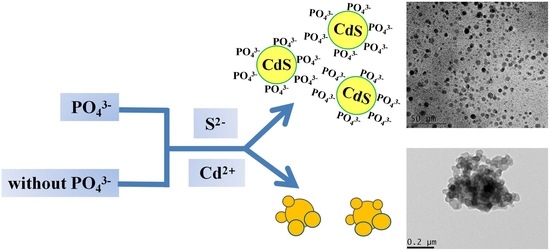
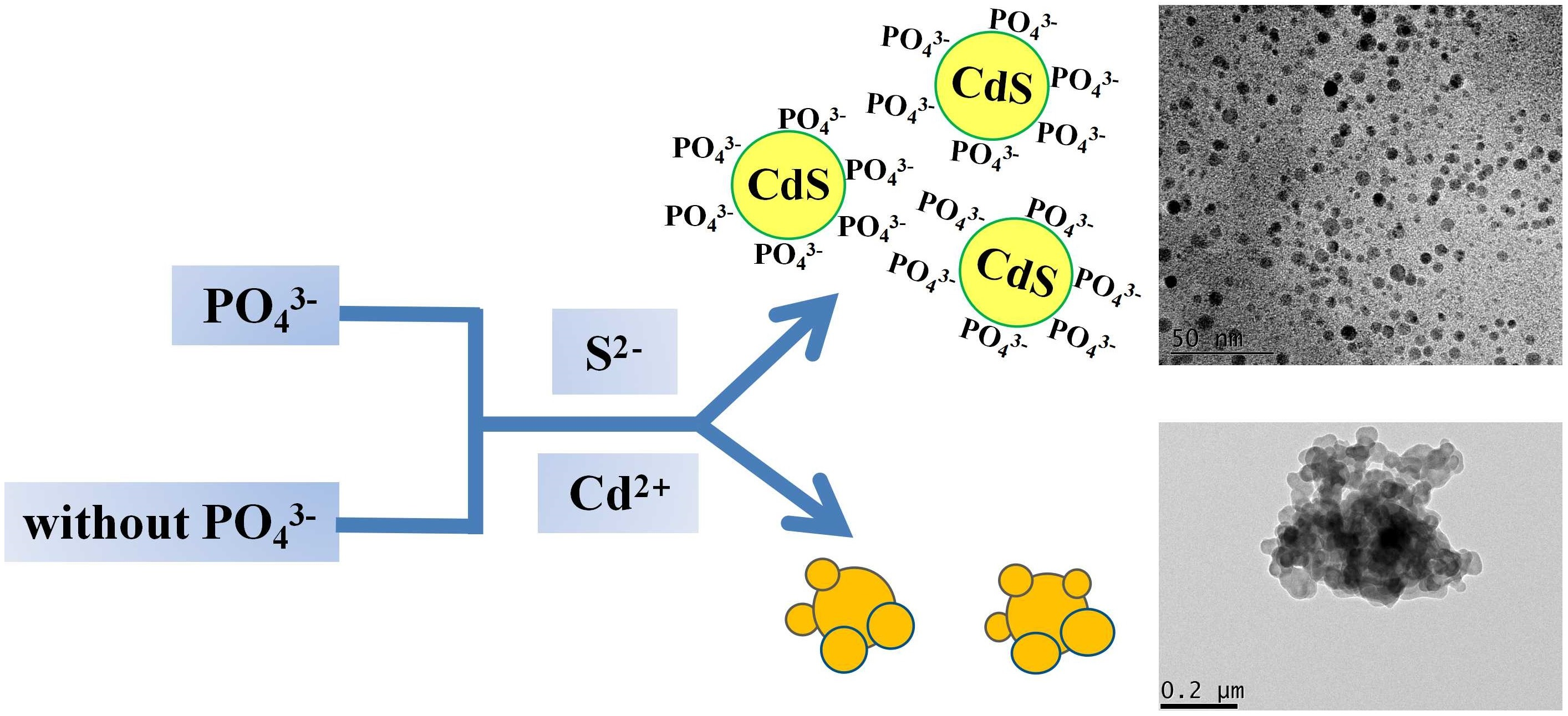
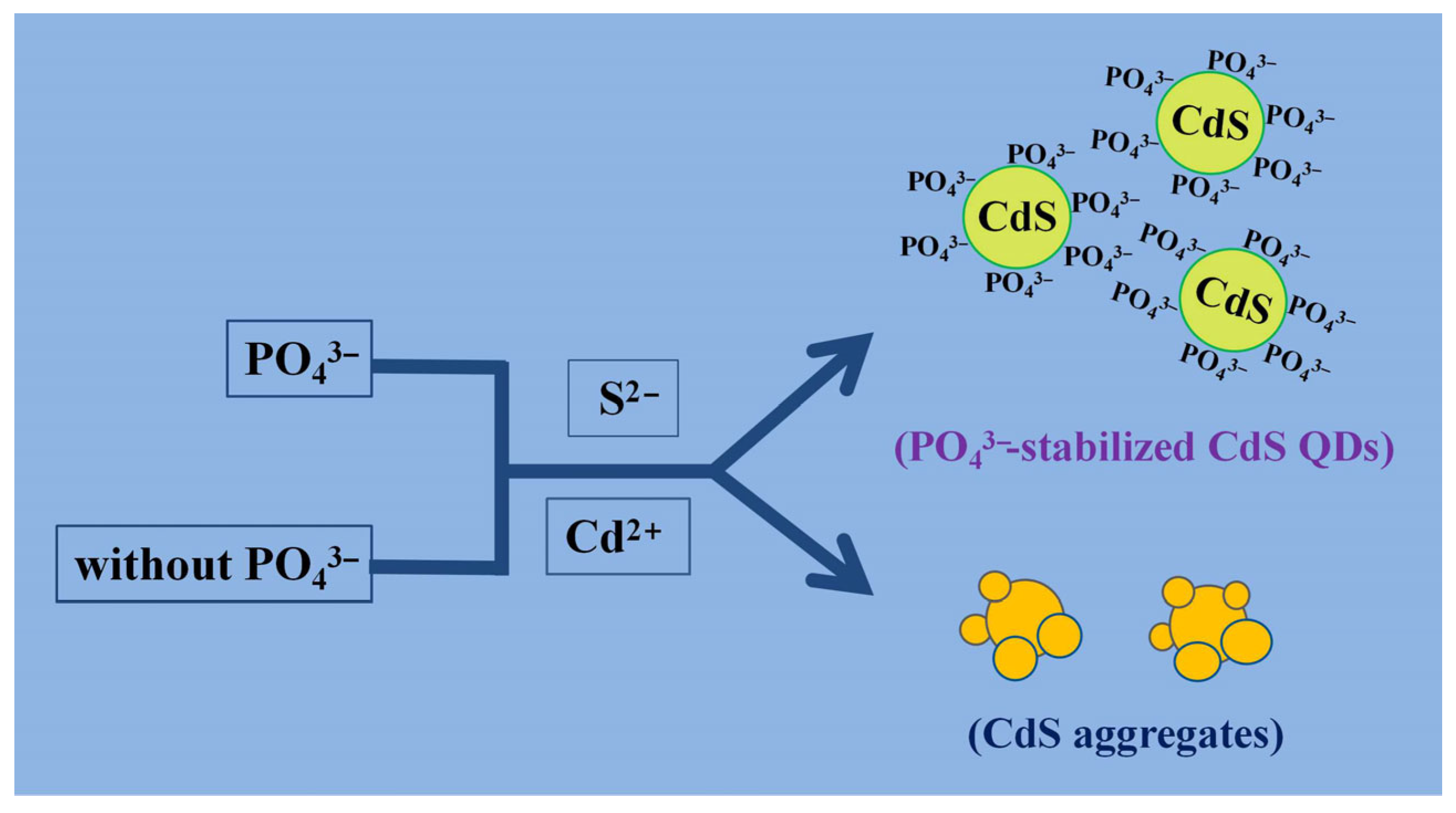
The schematic diagram of the fluorescence detection of PO43− is shown in Figure 1. In the presence of PO43−, S2− and Cd2+, CdS QDs with good dispersion, uniform particle size, and strong fluorescence properties can be produced in situ in an aqueous solution. However, in the absence of PO43− as a stabilizer, S2− and Cd2+ can only form many non-fluorescent aggregated CdS particles without fixed morphology and size. The concentration of PO43− was proportional to the fluorescence intensity. Different fluorescence intensities were obtained by varying the concentration of PO43−. As a result, the sensitive “turn-on” fluorescence detection of PO43− can be realized.

3.2. Characterization of Formed CdS QDs

The UV–vis absorption spectrum, fluorescence excitation spectrum (black line), and emission spectrum (red line) of PO43−-stabilized CdS QDs are shown in Figure S1. As can be seen from Figure S1A, the absorption signal in the wavelength range of 470–265 nm was enhanced due to the quantum confinement effect, which confirmed the existence of CdS QDs with a diameter around 4–6 nm [43]. A clear fluorescence peak with a maximum emission signal (F) at the wavelength of 470 nm was observed when excited at 266 nm (Figure S1B), indicating a homogeneous size distribution of the CdS QDs.
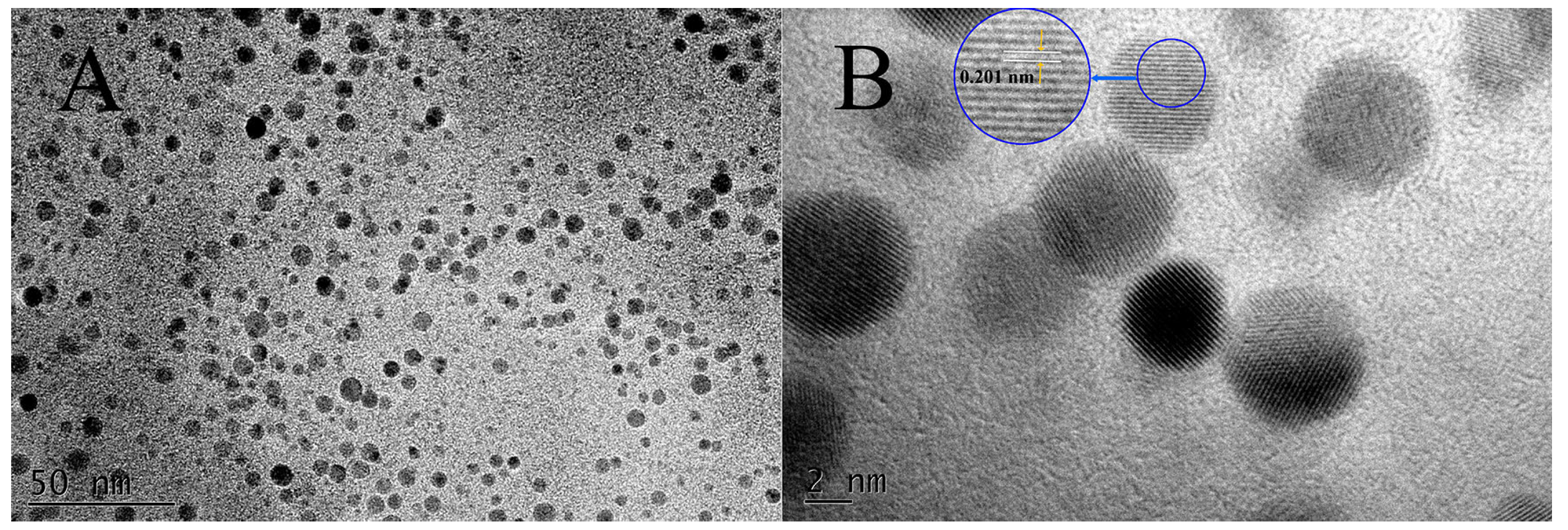
The morphology and size of the formed CdS QDs were further evaluated by transmission electron microscopy (TEM, Figure 2). It can be seen from Figure 2A that the synthesized CdS QDs were spherical, with good dispersion and uniform particle size. A particle size histogram has been generated to assess size distribution of CdS QDs. As shown in Figure S2, the median diameter of CdS QDs is approximately 5 nm. Figure 2B shows the HRTEM image of the CdS QDs, where regular lattice fringes can be observed. The measured lattice stripe spacing in the HRTEM image is 0.201 nm, which corresponds to the (220) crystal plane of CdS QDs [44,45].
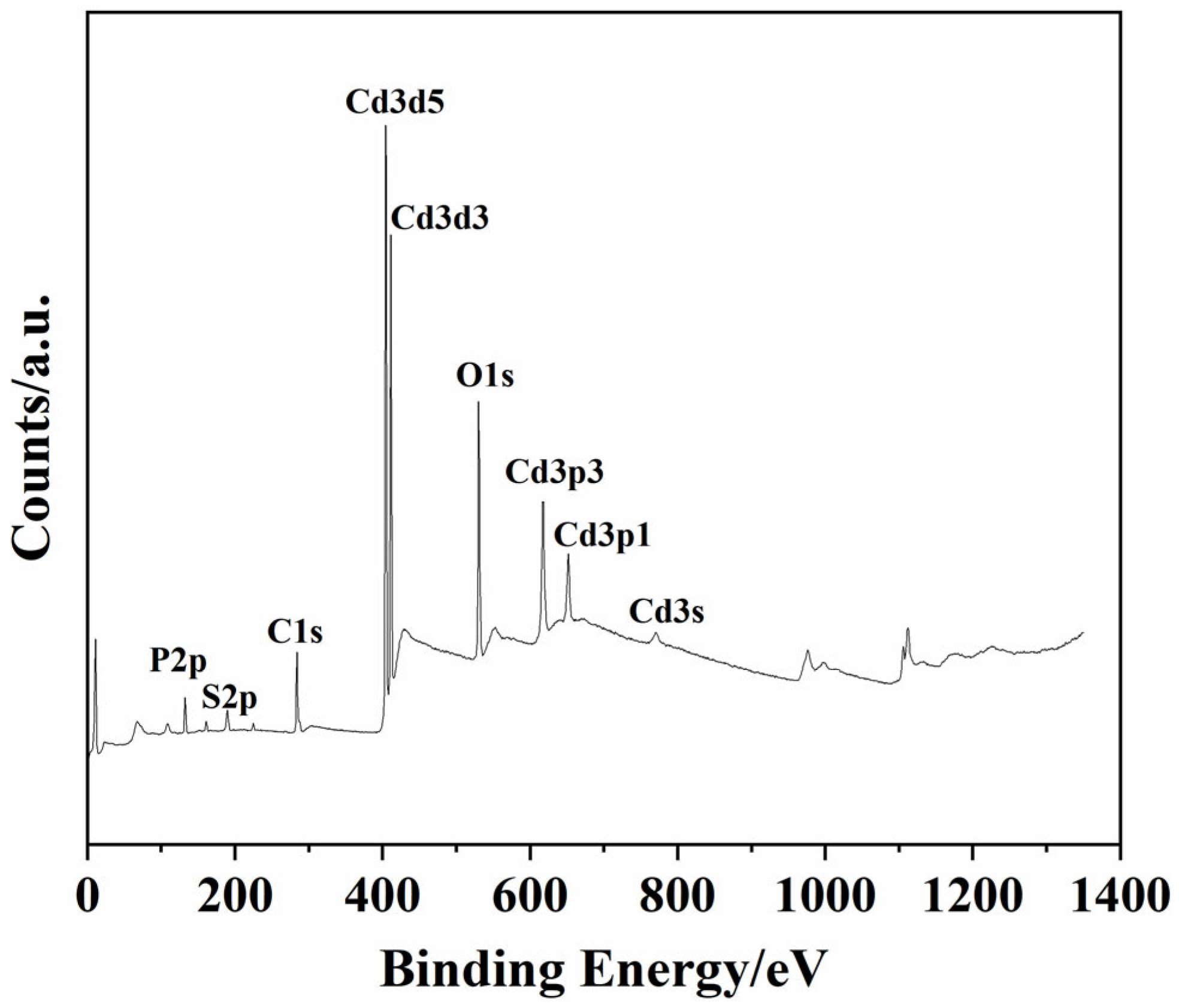
To investigate the composition of the synthesized QDs, XPS measurements were performed for elemental analysis. As shown in Figure 3, peaks originating from P, O, Cd, and S emerged. The high-resolution spectra of these elements were also recorded (Figure S3). By integrating the XPS peak area of each element, the relative atomic percentages of P, O, Cd, and S in the QDs were determined to be 11.52%, 47.79%, 17.64%, and 3.87%, respectively. The calculated atomic percentage ratio of O to P is close to 4, which is consistent with PO43−. The ratio of Cd to S is larger than 1, indicating that there are more Cd atoms than S atoms in a QD, and the prepared QDs have a Cd-enriched surface. This observation is plausible, as a larger amount of Cd precursor was added during the synthesis process. These results indicate that the QDs are mainly composed of PO43− and CdS, thus confirming the successful formation of PO43−-stabilized CdS QDs.

3.3. Sensing Mechanism of the Proposed Fluorescence Assay

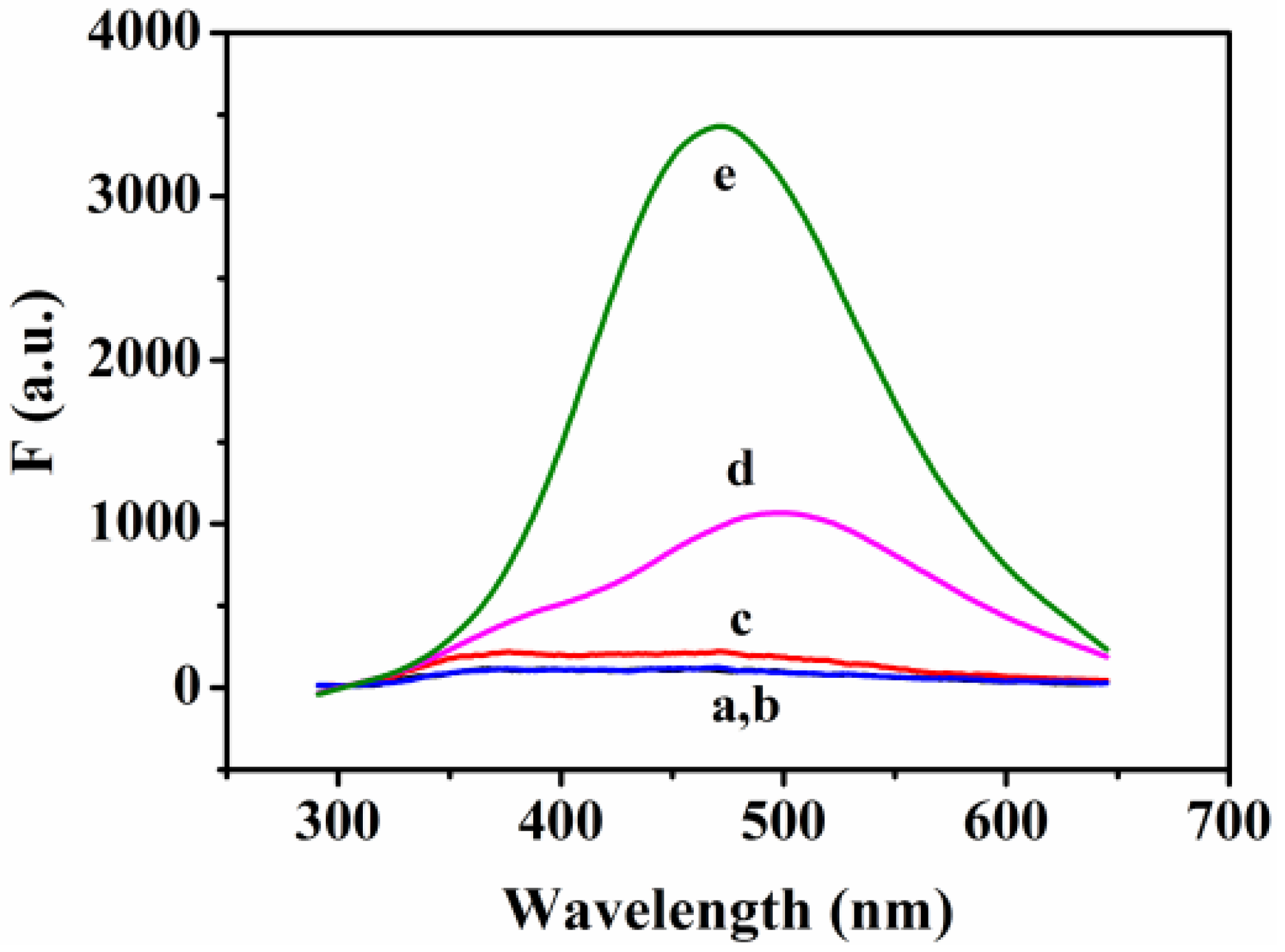
To confirm the proposed mechanism and feasibility of the fluorescence method, control experiments with one component omitted were performed. The results of these experiments are shown in Figure 4. It can be seen that a significant increase in the fluorescence signal (F) was only observed when all components were present in the detection system (Cd2+, S2−, and PO43−) (Curve d). In contrast, if any of the components was absent (Curve a–c), the observed fluorescence signal was very weak. It is worth noting that the fluorescence intensity was further enhanced by increasing PO43− concentration (Curve e). These results confirmed that the presence of PO43− is indispensable for the formation of fluorescent CdS QDs, and the proposed assay has potential for PO43− detection. A TEM image of the solution containing Cd2+ and S2− (without PO43− addition) was further acquired. As shown in Figure S4, only bulk aggregated particles are formed in the absence of PO43−. Thus, we deduced that PO43− acts as stabilizer to facilitate the formation of well-dispersed CdS QDs.

3.4. Optimization of the Experimental Conditions

To obtain optimal response signal, several experimental conditions, including the concentrations of Na2S, Cd(AC)2, the reaction time and the pH were optimized. The effect of S2− concentration on the fluorescence signal was investigated. As shown in Figure S5A, the fluorescence intensity increased rapidly when the concentration of Na2S changed from 0.012 to 0.060 mM, then decreased when the concentration was above 0.060 mM. Thus, a Na2S concentration of 0.060 mM was selected for the experiments. The effect of Cd2+ concentration was also investigated (Figure S5B). The fluorescence intensity reached a maximum value at the concentration of 0.55 mM. Thus, 0.55 mM Cd2+ was used in subsequent experiments. The CdS QDs formation time was further investigated. From Figure S5C, it can be seen that the fluorescence intensity tended to stabilize after 3 min. This result indicated that the reaction is very rapid, and the CdS QDs can be formed within 3 min. The effect of pH on the formation of CdS QDs was also investigated. The largest fluorescence intensity was produced at pH 8.0 (Figure S5D).

3.5. Sensitivity of the PO43− Detection System

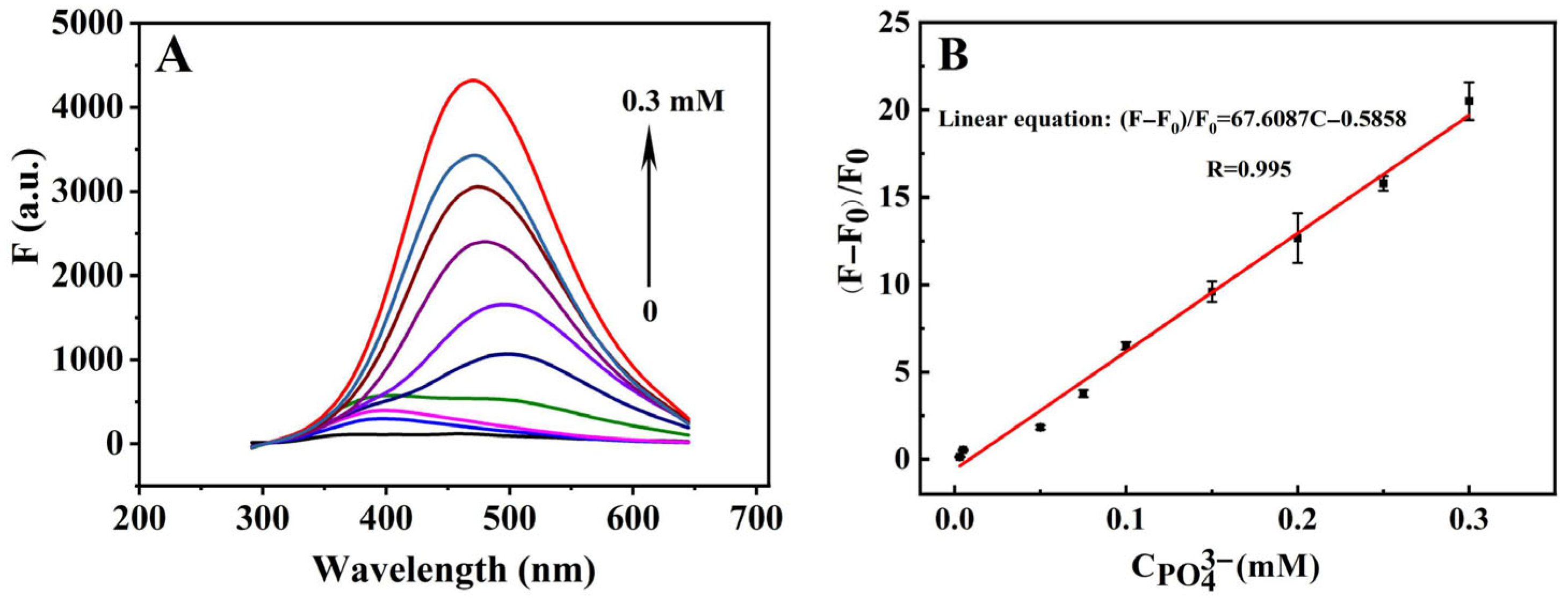
To estimate the detection sensitivity and linear range of the fabricated fluorescence assay, PO43− at different concentrations was detected under optimal conditions. It can be seen from Figure 5A that the fluorescence intensity (F) increased significantly with the increase in PO43− concentration up to 0.30 mM. It means that the more PO43− added, the more CdS QDs were formed. It should be noted that the PO43− concentration affects the physical and optical properties of the material. As shown in Figure 5, the increase in PO43− concentration leads to a blueshift in the emission peaks (at 470 nm) due to the decrease in the diameter of the resulting CdS QDs, caused by the quantum confinement of the electrons in the quantum dots [46]. The change in the fluorescence intensity caused by different concentrations of PO43− was more significant than the wavelength shift value. Therefore, the fluorescence intensity was used as the detection signal in subsequent work. There was a good linear relationship between the fluorescence intensity ratio and PO43− concentration in the range of 3.0–300 µM, with a correlation coefficient (R) of 0.995 (Figure 5B). By calculating the triplicate standard deviation of the blank signal (3σ), the obtained detection limit of PO43− was 2.9 µM. The fluorescence quantum yield and fluorescence lifetime of PO43−-stabilized CdS QDs were determined to be 3.12% and 25.37 ns (Figure S6), respectively.
Comparing the results of this study with those of other reported methods (Table S1), the sensitivity of the fabricated assay was higher than or equal to that of some published colorimetric and fluorescence assays [47,48,49,50,51,52,53,54,55]. In addition, this method has the characteristics of being label-free, easy to operate, rapid and economical. CdS QDs can be synthesized in situ under mild conditions in 5 min and do not require costly reagents such as precious metals, proteases or nucleic acids, etc.

3.6. Selectivity and Recovery Experiment of the Fluorescence Assay

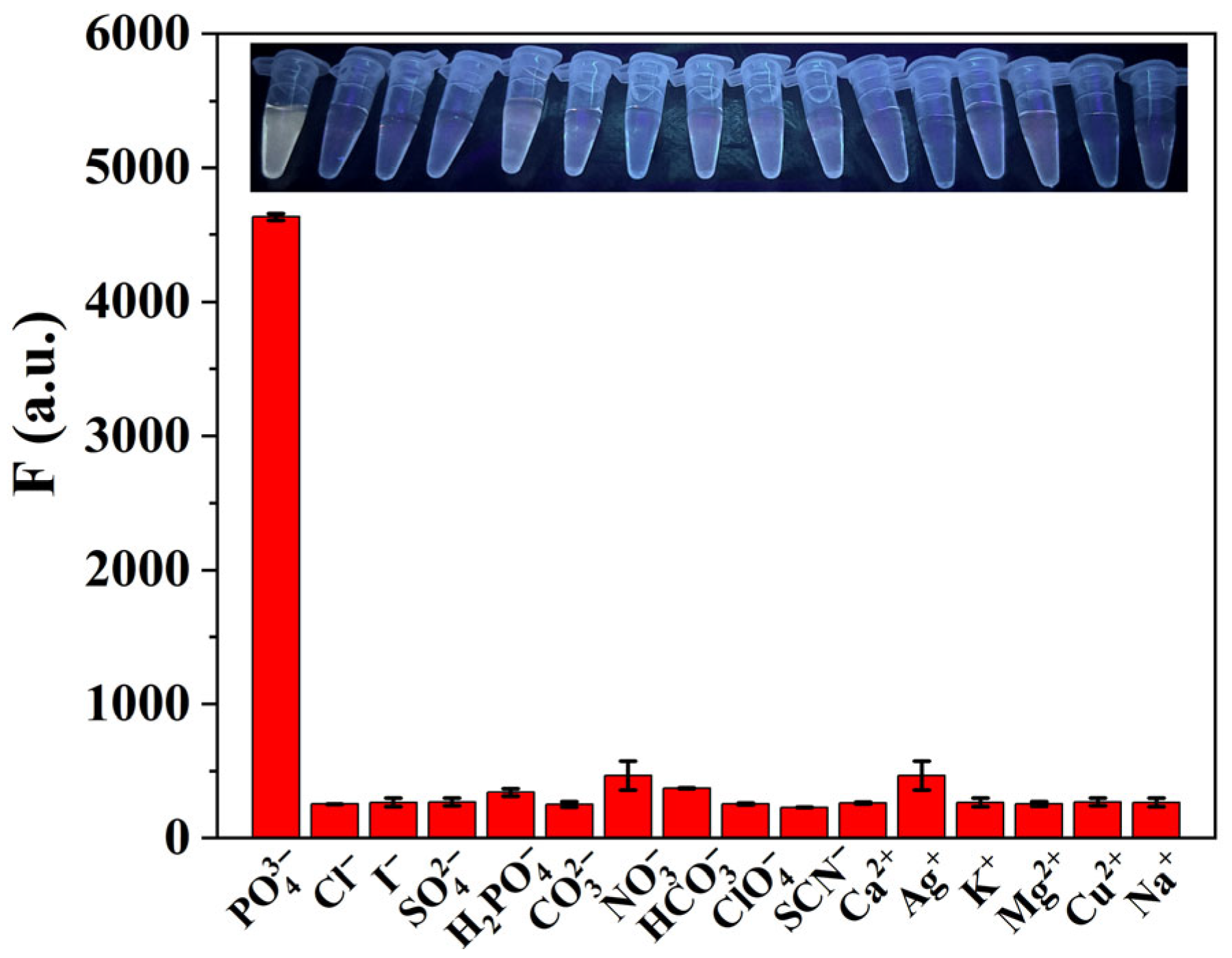
To verify the specificity of the fluorescence assay for PO43−, the fluorescence response of 15 types of interfering ions was studied under the same testing conditions. All of the anions were evaluated at concentrations at least 10 times that of PO43−. As shown in Figure 6, a significant fluorescence signal (F) recorded at 470 nm can only be induced by PO43−, whereas the other ions had little effect on the fluorescence intensity. To investigate the influence of common cations and anions on PO43− detection, competition experiments using mixtures of PO43− with various ions have been further performed (Figure S7). Under the same concentrations, the fluorescence intensity showed only a slight change in the presence of common ions with the exception of Ag+. The fluorescence intensity was significantly decreased in the presence of Ag+, which may be attributed to the fluorescence-quenching effect of Ag+ on CdS QDs. Typically, the concentration of Ag+ in environmental water samples such as tap water is much lower than that of PO43−. When the concentration of Ag+ decreases to the µM level, its impact on the fluorescence intensity is significantly diminished. These results indicated that other ions in the water will not have potential interference with the detection of PO43− and thus the proposed method has good selectivity for PO43−.
The practical applicability of the fluorescence assay was verified by determining PO43− in tap water and wastewater samples. Different amounts of standard PO43− were added to the collected tap water to prepare spiked samples. Each sample was tested three times in parallel (n = 3), and the results are listed in Table 1. Recovery rates in the range of 98.0–103.0% were obtained. The relative standard deviation (RSD) was less than 10%. The wastewater collected from a drainage outlet of a rare earth factory in Changting was tested (Figure S8), and the PO43− content was determined to be 0.159 mM. The result of our assay was compared with the traditional standard phosphomolybdate blue method to verify its accuracy. The detailed operation of the phosphomolybdate blue method was referred to that of previous work [56,57] and the standard curves for PO43− determination are listed in Figure S9. Figure S10 shows the absorption spectrum of the standard method for the detection of PO43− in wastewater samples. The content of PO43− in wastewater was determined to be 0.166 mM, which is close to the result of the QDs-based assay. These results showed that the proposed assay possesses good accuracy and repeatability for PO43− detection in environmental samples.

4. Conclusions

In conclusion, a label-free, simple, rapid, and economical fluorescence assay was constructed for the detection of PO43− based on in situ synthesized quantum dots, with high sensitivity and specificity. With the increase in PO43− concentration, the CdS QDs are rapidly formed in aqueous solutions with an excellent fluorescence enhancement response. The entire detection process can be completed within 5 min. The proposed fluorescence assay can be used to detect PO43− in the concentration range from 0.0030 to 0.30 mM with a detection limit of 2.9 µM. In addition, recovery experiments demonstrated the ability of the fluorescence assay to recognize and detect PO43− in real water sample analysis. Compared with traditional fluorescence assays in which QDs were pre-synthesized and then tethered with recognition elements to achieve analysis, our assay requires neither complex chemical modification procedures nor expensive biological agents (such as nucleic acids or proteases). It is worth mentioning that by combining with the enzyme-catalyzed reaction to regulate the production of PO43−, the present simple fluorescence assay can find broad application in bioanalytical fields.

Supplementary Materials

The following supporting information can be downloaded at: https://www.mdpi.com/article/10.3390/chemosensors14020041/s1, Figure S1: (A) UV-vis absorption spectrum and (B) fluorescence excitation (black lines) and emission (red lines) spectra of CdS QDs; Figure S2: Histogram of particle size distribution of the synthesized CdS QDs; Figure S3: XPS scan of different elements in the synthesized CdS QDs (A) P2p, (B) O1s, (C) Cd3d, and (D) S2p; Figure S4: TEM image of the solution without addition of PO43−; Figure S5: The influence of (A) Na2S concentration, (B) Cd(AC)2 concentration, (C) reaction time and (D) pH on the fluorescence intensity; Figure S6: Luminescence emission decay time of PO43−-stabilized CdS QDs; Figure S7: Interference study of the fluorescence assay under the mixed solution of PO43− with other ions individually; Figure S8: Fluorescence spectrum of PO43− detection in wastewater by the CdS QDs-based method; Figure S9: (A) UV-visible absorption spectra of standard phosphomolybdate blue method for the detection of PO43−, (B) linear relationship between different concentrations of PO43− against corresponding absorption values; Figure S10: Absorption spectrum of standard phosphomolybdate blue method for the detection of PO43− in wastewater sample; Table S1: Comparison of our present work with other methods for PO43− detection.

Author Contributions

X.Y.: Methodology, Material preparation, Formal analysis and Investigation, Writing—original draft preparation. Z.L.: Methodology, Investigation, Data collection and analysis. Y.W. (Youjiao Wu): Formal analysis, Investigation, Methodology, Writing—review and editing. X.M.: Resources, Formal analysis, Writing—review and editing. Y.W. (Yiwei Wang): Writing—review and editing, Resources, Supervision, Funding acquisition. S.T.: Methodology, Conceptualization, Formal analysis, Writing—review and editing, Funding acquisition. W.C.: Formal analysis, Supervision, Writing—review and editing. All authors have read and agreed to the published version of the manuscript.

Funding

This work was supported by the National Natural Science Foundation of China (21675024), the Natural Science Foundation of Fujian Province (2020J01635), the Special Fund for Scientific and Technological Innovation at Fujian Agriculture and Forestry University of China (CXZX2020114A), the Startup Fund for Scientific Research of Fujian Medical University (2018QH1013).

Institutional Review Board Statement

Not applicable.

Informed Consent Statement

Not applicable.

Data Availability Statement

The original contributions presented in this study are included in the article/Supplementary Materials. Data will be made available on request.

Conflicts of Interest

The authors declare no conflicts of interest.

References

  1. Xing, D.; Li, X.; Wang, Y.; Deng, S.; Jin, C.; Zhao, Y.; Guo, L. The comprehensive impact of phosphorus sources on microalgae biochemical metabolism and phosphorus transformation. J. Water Process Eng. 2023, 51, 103477. [Google Scholar] [CrossRef]
  2. Das, A.; Das, S.; Trivedi, V.; Biswas, S. A dual functional MOF based fluorescent sensor for intracellular phosphate and extracellular 4-nitrobenzaldehyde. Dalton Trans. 2019, 48, 1332−1343. [Google Scholar] [CrossRef]
  3. Velusamy, K.; Periyasamy, S.; Kumar, P.S.; Vo, D.V.N.; Sindhu, J.; Sneka, D.; Subhashini, B. Advanced techniques to remove phosphates and nitrates from waters: A review. Environ. Chem. Lett. 2021, 19, 3165–3180. [Google Scholar] [CrossRef]
  4. Warwick, C.; Guerreiro, A.; Soares, A. Sensing and analysis of soluble phosphates in environmental samples: A review. Biosens. Bioelectron. 2013, 41, 1–11. [Google Scholar] [CrossRef] [PubMed]
  5. Alipanahpour Dil, E.; Ghaedi, M.; Asfaram, A.; Tayebic, L.; Mehrabi, F. A ferrofluidic hydrophobic deep eutectic solvent for the extraction of doxycycline from urine, blood plasma and milk samples prior to its determination by high-performance liquid chromatography-ultraviolet. J. Chromatogr. A 2020, 1613, 460695. [Google Scholar] [CrossRef] [PubMed]
  6. Hebbar, S.D.; Trivedi, D.R. Discriminative ion detection of Hg2+ and Cu2+ and selective recognition of PO43− ions: Real time monitoring in food and water samples and molecular keypad lock integration. Spectrochim. Acta A 2025, 331, 125706. [Google Scholar] [CrossRef] [PubMed]
  7. Vervloet, M.G.; Sezer, S.; Massy, Z.A.; Johansson, L.; Cozzolino, M.; Fouque, D. The role of phosphate in kidney disease. Nat. Rev. Nephrol. 2017, 13, 27–38. [Google Scholar] [CrossRef]
  8. Zhao, S.; Xiao, J.; Zheng, T.; Liu, M.; Wu, H.; Liu, Z. Highly selective and sensitive detection of PO43− ions in aqueous solution by a luminescent terbium metal–organic framework. ACS Omega 2019, 4, 16378–16384. [Google Scholar] [CrossRef]
  9. Kumar, P.; Pachisia, S.; Gupta, R. Turn-on detection of assorted phosphates by luminescent chemosensors. Inorg. Chem. Front. 2021, 8, 3587–3607. [Google Scholar] [CrossRef]
  10. Chourasia, J.; Tohora, N.; Mahato, M.; Sultana, T.; Ahamed, S.; Maiti, A.; Ghanta, S.; Kumar Das, S. A sulfone-based fluorogenic probe for cascade detection of Zn2+ and PO43− ions. J. Mol. Struct. 2024, 1304, 137736. [Google Scholar] [CrossRef]
  11. Wei, W.; Wang, A.; Zhang, Y.; Yuan, C.; Feng, S.; Englert, U. A multifunctional fluorescent probe based on a Tb coordination polymer for the efficient detection of phosphate anions and tetracycline hydrochloride antibiotics in aqueous media. J. Lumin. 2025, 285, 121320. [Google Scholar] [CrossRef]
  12. Gamov, G.A.; Zavalishin, M.N.; Petrova, M.V.; Khokhlova, A.Y.; Gashnikova, A.V.; Kiselev, A.N.; Sharnin, V.A. Interaction of pyridoxal-derived hydrazones with anions and Co2+, Co3+, Ni2+, Zn2+ cations. Phys. Chem. Liq. 2021, 59, 666–678. [Google Scholar] [CrossRef]
  13. Panigrahi, G.; Pradhan, S.; Shukla, N.; Patra, A.K. Selective recognition of physiological phosphates by luminescent europium(III) probes via analyte-specific energy-transfer pathways. Chem. Eur. J. 2025, 31, e02440. [Google Scholar] [CrossRef] [PubMed]
  14. Huang, S.; Tang, X.; Yu, L.; Hong, S.; Liu, J.; Xu, B.; Liu, R.; Guo, Y.; Xu, L. Colorimetric assay of phosphate using a multicopper laccase-like nanozyme. Microchim. Acta 2022, 189, 378. [Google Scholar] [CrossRef]
  15. Jebali, M.; Fredj, Z.; Daboussi, S.; Ben Ali, M.; Hassen, M. Silicon Nanowires Sensor Modified with Cu (II) Phthalocyanine Derivative for Phosphate Monitoring. Chemosensors 2025, 13, 297. [Google Scholar] [CrossRef]
  16. Li, H.; Sun, Y.; Li, Y.; Du, J. Alkaline phosphatase activity assay with luminescent metal organic frameworks-based chemiluminescent resonance energy transfer platform. Microchem. J. 2021, 160, 105665. [Google Scholar] [CrossRef]
  17. Wu, Y.; Xu, X.; Zhu, Y.; Wan, J.; Wang, X.; Zhou, X.; Li, X.; Zhou, W. Research progress on multiplexed pathogen detection using optical biosensors. Biosensors 2025, 15, 378. [Google Scholar] [CrossRef]
  18. Gao, F.; Liu, L.; He, C.; Chang, Y.; Wang, W. A metal-organic hybrid composed of dual quenching cofactors as a nanoquencher for the fluorescent determination of protease caspase-3. Biosensors 2025, 15, 354. [Google Scholar] [CrossRef]
  19. Zhao, W.; Flood, A.H.; White, N.G. Recognition and applications of anion–anion dimers based on anti-electrostatic hydrogen bonds (AEHBs). Chem. Soc. Rev. 2020, 49, 7893–7906. [Google Scholar] [CrossRef]
  20. Pal, S.; Ghosh, T.K.; Ghosh, R.; Mondal, S.; Ghosh, P. Recent advances in recognition, sensing and extraction of phosphates: 2015 onwards. Coordin. Chem. Rev. 2020, 405, 213128. [Google Scholar] [CrossRef]
  21. Wild, A.; Winter, A.; Hager, M.D.; Schubert, U.S. Fluorometric sensor based on bisterpyridine metallopolymer: Detection of cyanide and phosphates in water. Analyst 2012, 137, 2333–2337. [Google Scholar] [CrossRef] [PubMed]
  22. Pan, G.; Xia, T.; He, Y. A tetraphenylethylene-based aggregation-induced emission sensor: Ultrasensitive “turn-on” fluorescent sensing for phosphate anion in pure water. Talanta 2021, 221, 121434. [Google Scholar] [CrossRef] [PubMed]
  23. Moumen, E.; Bazzi, L.; El Hankari, S. Metal-organic frameworks and their composites for the adsorption and sensing of phosphate. Coordin. Chem. Rev. 2022, 455, 214376. [Google Scholar] [CrossRef]
  24. Wang, Z.; Li, C.; Liang, A.; Jiang, Z. A new strategy for determination of trace PO43− using CNDAu as resonance Rayleigh scattering and fluorescence dual-mode probe. Microchem. J. 2020, 157, 104892. [Google Scholar] [CrossRef]
  25. Wu, Z.; Yang, H.; Pan, S.; Liu, H.; Hu, X. Fluorescence-scattering dual-signal response of carbon dots@ZIF-90 for phosphate ratiometric detection. ACS Sens. 2020, 5, 2211–2220. [Google Scholar] [CrossRef]
  26. Behera, P.; Jaiswal, K.; De, M. Time-resolved fluorescence sensor array for the discrimination of phosphate anions using transition metal dichalcogenide quantum dots and Tb(III). Luminescence 2023, 38, 1339–1346. [Google Scholar] [CrossRef]
  27. Castro, R.C.; Páscoa, R.N.M.J.; Saraiva, M.L.M.F.S.; Santos, J.L.M.; Ribeiro, D.S.M. Chemometric models for data processing in quantum dots-based photoluminescence methodologies. Coordin. Chem. Rev. 2024, 502, 215605. [Google Scholar] [CrossRef]
  28. John, V.L.; Joy, F.; Kollannoor, A.J.; Joseph, K.; Nair, Y.; Vinod, T.P. Amine functionalized carbon quantum dots from paper precursors for selective binding and fluorescent labelling applications. J. Colloid Interf. Sci. 2022, 617, 730–744. [Google Scholar] [CrossRef]
  29. Freitas, M.; Nouws, H.P.A.; Keating, E.; Fernandes, V.C.; Delerue-Matos, C. Immunomagnetic bead-based bioassay for the voltammetric analysis of the breast cancer biomarker HER2-ECD and tumour cells using quantum dots as detection labels. Microchim. Acta 2020, 187, 184. [Google Scholar] [CrossRef]
  30. Freeman, R.; Willner, I. NAD+/NADH sensitive quantum dots: Applications to probe NAD+-dependent enzymes and to sense the RDX explosive. Nano Lett. 2009, 9, 322−326. [Google Scholar] [CrossRef]
  31. Pei, M.; Liu, K.; Qu, X.; Wang, K.; Chen, Q.; Zhang, Y.; Wang, X.; Wang, Z.; Li, X.; Chen, F.; et al. Enzyme-catalyzed synthesis of selenium-doped manganese phosphate for synergistic therapy of drug-resistant colorectal cancer. J. Nanobiotechnol. 2023, 21, 72. [Google Scholar] [CrossRef] [PubMed]
  32. Xu, S.; Ouyang, W.; Xie, P.; Lin, Y.; Qiu, B.; Lin, Z.; Chen, G.; Guo, L. Highly uniform gold nanobipyramids for ultrasensitive colorimetric detection of influenza virus. Anal. Chem. 2017, 89, 1617–1623. [Google Scholar] [CrossRef] [PubMed]
  33. Pham, X.H.; Hahm, E.; Kim, T.H.; Kim, H.M.; Lee, S.H.; Lee, Y.S.; Jeong, D.H.; Jun, B.H. Enzyme-catalyzed Ag growth on Au nanoparticle-assembled structure for highly sensitive colorimetric immunoassay. Sci. Rep. 2018, 8, 6290. [Google Scholar] [CrossRef] [PubMed]
  34. Lai, W.; Guo, J.; Wang, Y.; Lin, Y.; Ye, S.; Zhuang, J.; Tang, D. Enzyme-controllable just-in-time production system of copper hexacyanoferrate nanoparticles with oxidase-mimicking activity for highly sensitive colorimetric immunoassay. Talanta 2022, 247, 123546. [Google Scholar] [CrossRef]
  35. Luo, L.; Luo, S.Z.; Jia, B.Z.; Zhang, W.F.; Wang, H.; Wei, X.Q.; Shen, Y.D.; Lei, H.T.; Xu, Z.L.; Yang, J.Y. A high-resolution colorimetric immunoassay for tyramine detection based on enzyme-enabled growth of gold nanostar coupled with smartphone readout. Food Chem. 2022, 396, 133729. [Google Scholar] [CrossRef]
  36. Martín-Barreiro, A.; De Marcos, S.; Galbán, J. Gold nanoparticle formation as an indicator of enzymatic methods: Colorimetric L-phenylalanine determination. Anal. Bioanal. Chem. 2022, 414, 2641–2649. [Google Scholar] [CrossRef]
  37. Saa, L.; Pavlov, V. Enzymatic growth of quantum dots: Applications to probe glucose oxidase and horseradish peroxidase and sense glucose. Small 2012, 8, 3449–3455. [Google Scholar] [CrossRef]
  38. Riskowski, R.A.; Nemeth, R.S.; Borgognoni, K.; Ackerson, C.J. Enzyme-catalyzed in situ synthesis of temporally and spatially distinct CdSe quantum dots in biological backgrounds. J. Phys. Chem. C 2019, 123, 27187–27195. [Google Scholar] [CrossRef]
  39. Hu, P.Y.; Zhou, R.H.; Wang, D.Y.; Luo, H.; Xiong, X.L.; Huang, K.; Li, L.C.; Chen, P.P. Cysteine mediated synthesis of quantum dots: Mechanism and application in visual detection of hydrogen peroxide and glucose. Sens. Actuators B-Chem. 2020, 308, 127702. [Google Scholar] [CrossRef]
  40. Saa, L.; Mato, J.M.; Pavlov, V. Assays for methionine γ-lyase and S-adenosyl-L-homocysteine hydrolase based on enzymatic formation of CdS quantum dots in situ. Anal. Chem. 2012, 84, 8961−8965. [Google Scholar] [CrossRef]
  41. Tang, S.; Wang, M.; Li, Z.; Tong, P.; Chen, Q.; Li, G.; Chen, J.; Zhang, L. A novel sensitive colorimetric sensor for Cu2+ based on in situ formation of fluorescent quantum dots with photocatalytic activity. Biosens. Bioelectron. 2017, 89, 866–870. [Google Scholar] [CrossRef] [PubMed]
  42. Veamatahau, A.; Jiang, B.; Seifert, T.; Makuta, S.; Latham, K.; Kanehara, M.; Teranishi, T.; Tachibana, Y. Origin of surface trap states in CdS quantum dots: Relationship between size dependent photoluminescence and sulfur vacancy trap states. Phys. Chem. Chem. Phys. 2015, 17, 2850–2858. [Google Scholar] [CrossRef] [PubMed]
  43. Ali, M.A.; Srivastava, S.; Pandey, M.K.; Agrawal, V.V.; John, R.; Malhotra, B.D. Protein–conjugated quantum dots interface: Binding kinetics and label-free lipid detection. Anal. Chem. 2014, 86, 1710−1718. [Google Scholar] [CrossRef] [PubMed]
  44. Sharma, B.; Lalwani, R.; Das, R.; Raghuwanshi, D.S. A systematic investigation on structural and optical properties of sol–gel spin coating fabricated CdS nanocrystalline thin films: Effect of Ni doping. J. Mater. Sci. Mater. Electron. 2021, 32, 20903–20911. [Google Scholar] [CrossRef]
  45. Habibah, S.; Husain, S.; Haryanti, N.H. Synthesize of CdS nanoparticles using liquid-gas method. J. Phys. Conf. Ser. 2021, 1816, 012112. [Google Scholar]
  46. Alivisatos, P. The use of nanocrystals in biological detection. Nat. Biotechnol. 2004, 22, 47−52. [Google Scholar] [CrossRef]
  47. He, G.; Zhao, L.; Chen, K.; Liu, Y.; Zhu, H. Highly selective and sensitive gold nanoparticle-based colorimetric assay for PO43− in aqueous solution. Talanta 2013, 106, 73−78. [Google Scholar] [CrossRef]
  48. Li, X.; Niu, X.; Liu, P.; Xu, X.; Du, D.; Lin, Y. High-performance dual-channel ratiometric colorimetric sensing of phosphate ion based on target-induced differential oxidase-like activity changes of Ce-Zr bimetal-organic frameworks. Sens. Actuators B Chem. 2020, 321, 128546. [Google Scholar] [CrossRef]
  49. Zhai, Y.; Li, Y.; Hou, Q.; Zhang, Y.; Zhou, E.; Li, H.; Ai, S. Highly sensitive colorimetric detection and effective adsorption of phosphate based on MOF-808(Zr/Ce). New J. Chem. 2022, 46, 15405−15413. [Google Scholar] [CrossRef]
  50. Yu, S.; Sun, X.; Yu, Z.; Jung, J.; Ishii, S.; Hayes, C.T.; Pierre, V.; Flood, A.H.; Azoulay, J.; Ng, T.N. Flexible point-of-use phosphate electrochemical sensors based on electrodeposited molybdenum oxide. Mater. Horiz. 2025, 12, 6784−6792. [Google Scholar] [CrossRef]
  51. Li, S.N.; You, Y.; Hu, W.G.; Gao, G.J.; Jiang, X.Y.; Yu, J.G. A sensitive single-layered graphene oxide-based sensor for electrochemical sensing of phosphate anion. Process Saf. Environ. 2023, 178, 786−794. [Google Scholar] [CrossRef]
  52. Mazzaracchio, V.; Sassolini, A.; Mitra, K.Y.; Mitra, D.; Stojanović, G.M.; Willert, A.; Sowade, E.; Baumann, R.R.; Zichner, R.; Moscone, D.; et al. A fully-printed electrochemical platform for assisted colorimetric detection of phosphate in saliva: Greenness and whiteness quantification by the AGREE and RGB tools. Green Anal. Chem. 2022, 1, 100006. [Google Scholar] [CrossRef]
  53. Li, L.; Zou, J.Y.; You, S.Y.; Liu, Y.W.; Cui, H.M.; Zhang, S.W. A dual luminescent chemosensor derived from a europium(III) metal-organic framework for quantitative detection of phosphate anions and acetylacetone in aqueous solution. Dyes Pigments 2020, 173, 108004. [Google Scholar] [CrossRef]
  54. Zhao, C.X.; Zhang, X.P.; Shu, Y.; Wang, J.H. Europium - pyridinedicarboxylate - adenine light-up fluorescence nanoprobes for selective detection of phosphate in biological fluids. ACS Appl. Mater. Interfaces 2020, 12, 22593−22600. [Google Scholar] [CrossRef]
  55. Zhang, K.; Chen, T.T.; Feng, C.C.; Shen, Y.J.; Yang, Z.R.; Zhu, C. Luminescent Sm(III) complex bearing dynamic imine bonds as a multi-responsive fluorescent sensor for F and PO43− anions together with Zn2+ cation in water samples. Anal. Chim. Acta 2020, 1118, 52−62. [Google Scholar] [CrossRef]
  56. Wang, Y.; Weng, W.; Xu, H.; Luo, Y.; Guo, D.; Li, D.; Li, D. Negatively charged molybdate mediated nitrogen-doped graphene quantum dots as a fluorescence turn on probe for phosphate ion in aqueous media and living cells. Anal. Chim. Acta 2019, 1080, 196−205. [Google Scholar] [CrossRef]
  57. Cheng, H.; Hui, P.; Peng, J.; Li, W.; Ma, W.; Wang, H.; Huang, J.; He, X.; Wang, K. Enzymatic behavior regulation-based colorimetric and electrochemiluminescence sensing of phosphate using the cobalt oxyhydroxide nanosheet. Anal. Chem. 2021, 93, 6770−6778. [Google Scholar] [CrossRef]
Figure 1. Schematic diagram of the fluorescence assay for phosphate anion detection based on the in situ formation of CdS QDs.
Chemosensors 14 00041 g001
Figure 2. (A) TEM image and (B) high-resolution lattice diagram of CdS QDs.
Chemosensors 14 00041 g002
Figure 3. XPS survey of the PO43−-stabilized CdS QDs.
Chemosensors 14 00041 g003
Figure 4. Fluorescence spectra of the system under different experimental conditions (Curve a: Cd2+ + PO43−, b: S2− + PO43−, c: Cd2+ + S2−, d: S2− + Cd2+ + PO43− (0.1 mM)), e: (S2− + Cd2+ + PO43− (0.25 mM)).
Chemosensors 14 00041 g004
Figure 5. (A) Fluorescence spectra of PO43− in the proposed assay with different concentrations (Down to up: 0, 0.003, 0.005, 0.05, 0.075, 0.10, 0.15, 0.20, 0.25, 0.30 mM); (B) The linear relationship between fluorescence signal ratio (F − F0)/F0 and PO43− concentration. (F refers to the fluorescence signal of the CdS QDs at 470 nm, F0 refers to the fluorescence signal of the blank, and C is the concentration of PO43−. The error lines represent the standard deviation of three determinations).
Chemosensors 14 00041 g005
Figure 6. Interference study of the fluorescence assay under the addition of different kinds of ions. (Inset: Photos of the corresponding solution under ultraviolet light. The concentration of PO43− was 0.30 mM, and other ions were 5.0 mM).
Chemosensors 14 00041 g006
Table 1. Analysis of PO43− in real water samples (n = 3).
SamplesAdded
(mM)
Found
(mM)
Recovery
(%)
RSD
(%)
Tap water0.000.013-0.10
0.100.11198.05.70
0.300.322103.09.90
Disclaimer/Publisher’s Note: The statements, opinions and data contained in all publications are solely those of the individual author(s) and contributor(s) and not of MDPI and/or the editor(s). MDPI and/or the editor(s) disclaim responsibility for any injury to people or property resulting from any ideas, methods, instructions or products referred to in the content.