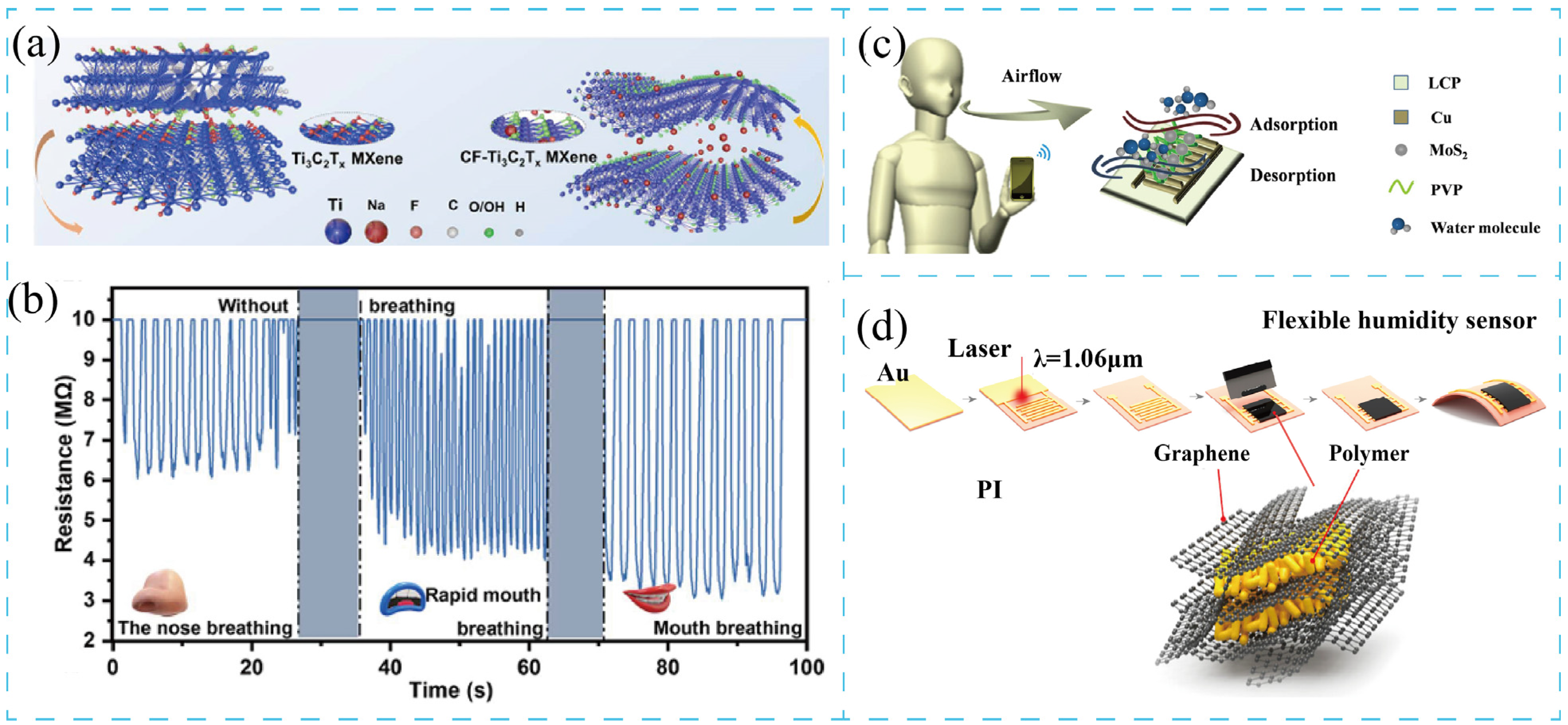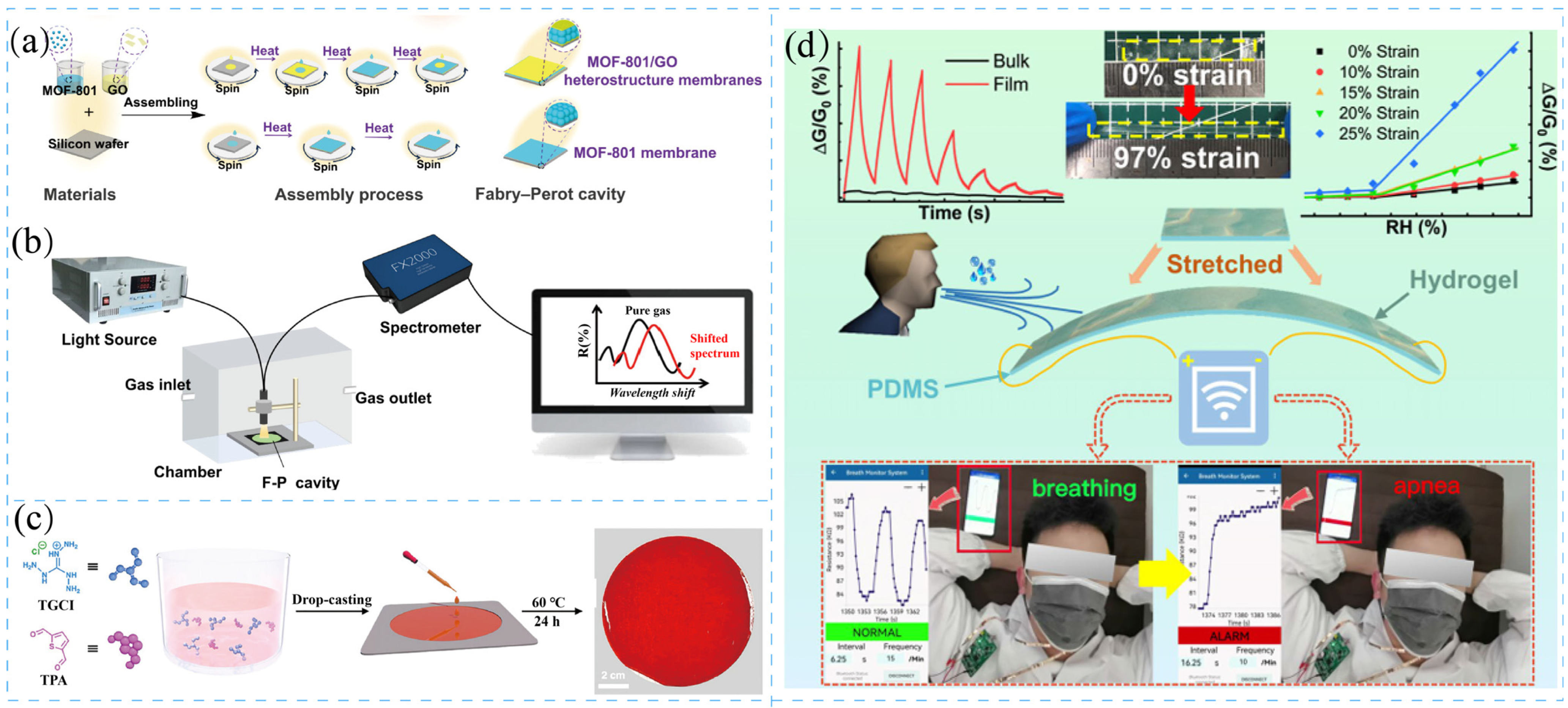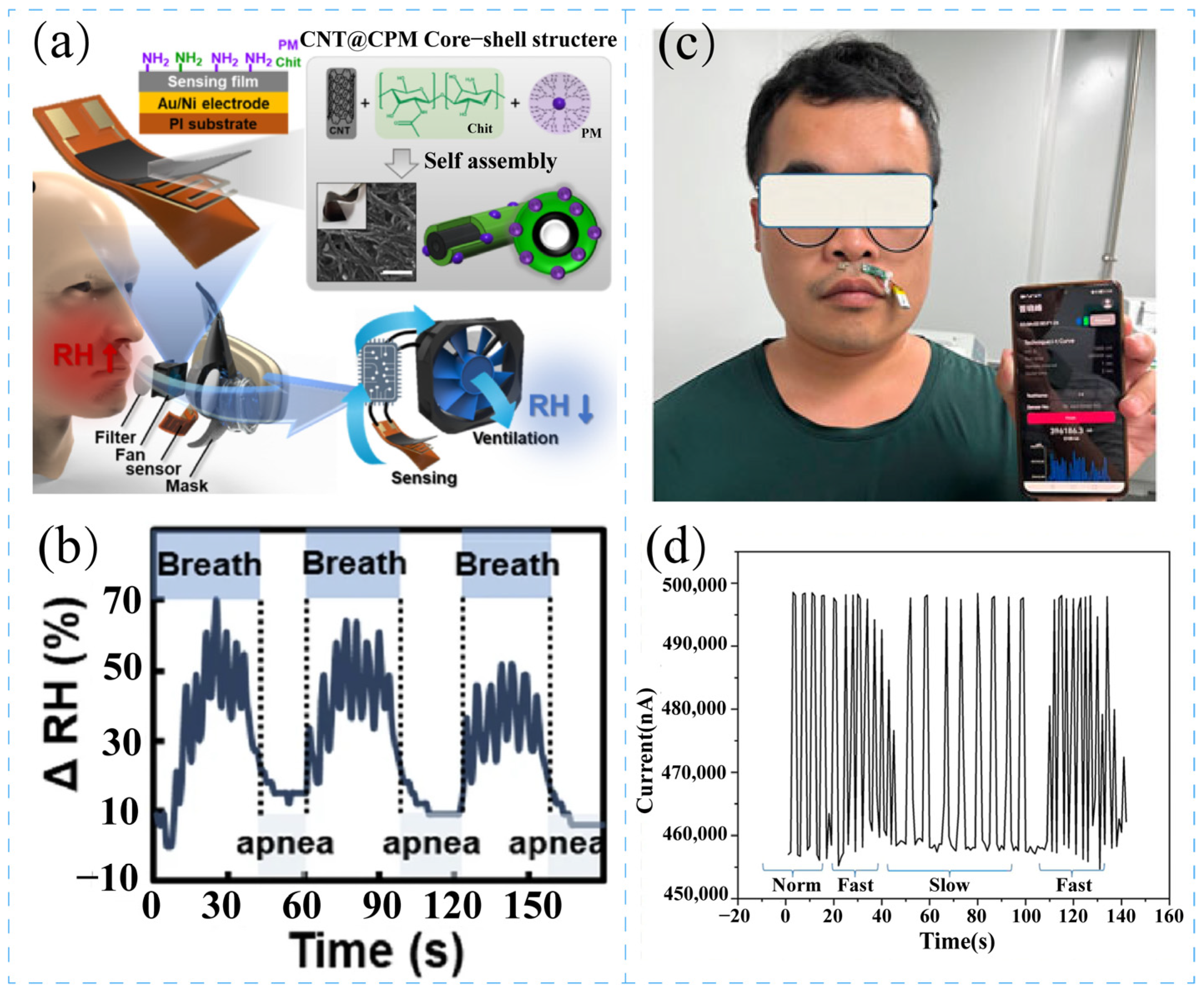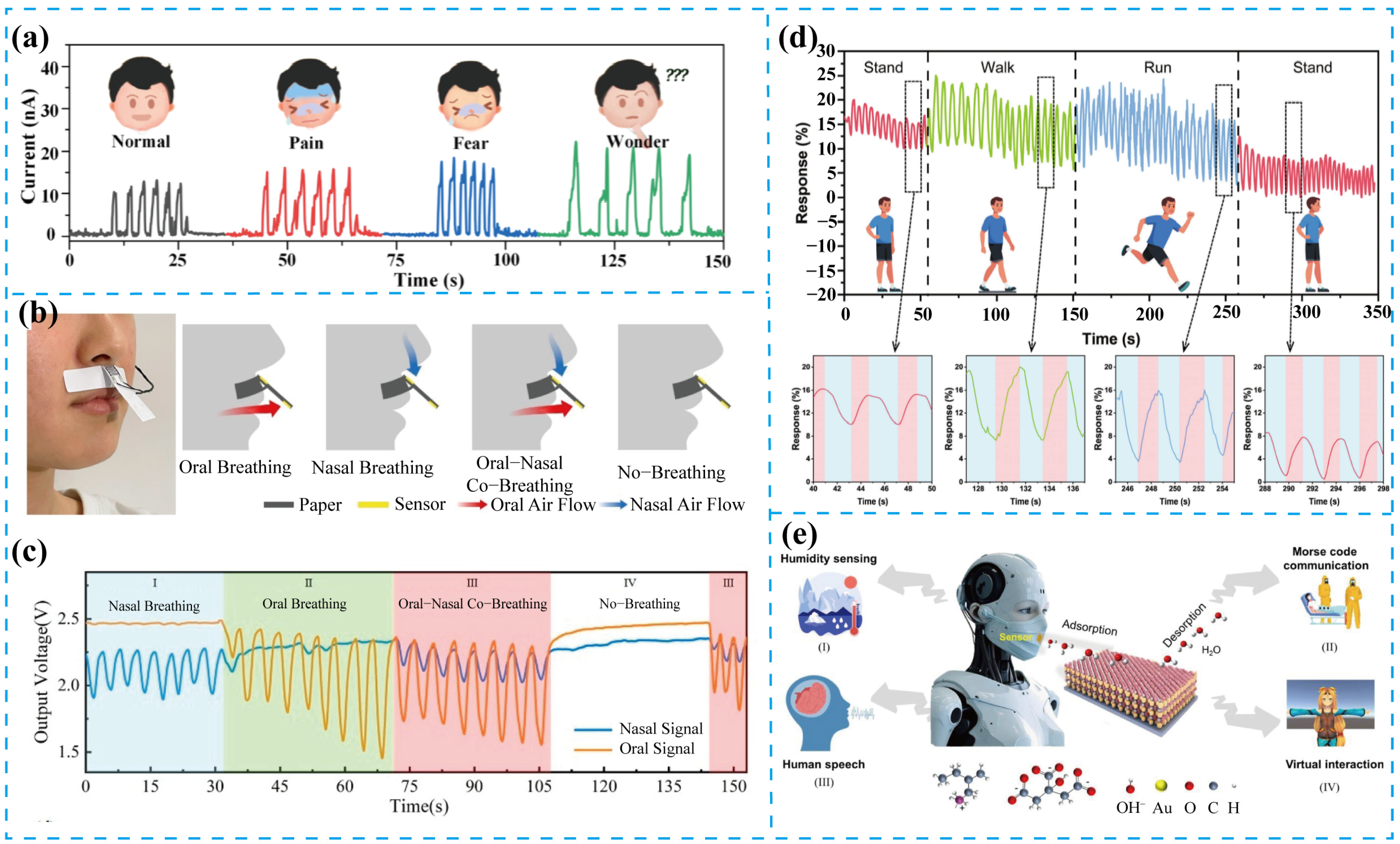
Advances and Prospects of Chemiresistive Breath Humidity Sensors

 ,
,  and
and 
Abstract
1. Introduction
2. Sensing Mechanisms of CRBHSs
2.1. Fundamental Principles of Chemiresistive Humidity Detection
2.2. Humidity-Specific Response of CRBHSs
3. Structural Tuning of Sensing Material Systems for CRBHSs
3.1. 0D Materials
3.1.1. Carbon Dots (CDs)
3.1.2. Quantum Dots (QDs)
3.1.3. Metal Oxide Nanoparticles (MOx NPs)

3.2. 1D Materials
3.2.1. Nanotubes
3.2.2. Nanowires
3.2.3. Nanofibers

3.3. 2D Materials
3.3.1. MXenes
3.3.2. Transition Metal Dichalcogenides (TMDs)
3.3.3. Graphene and Its Derivatives

3.4. 3D Materials
3.4.1. Metal–Organic Frameworks (MOFs)
3.4.2. Covalent Organic Frameworks (COFs)
3.4.3. Hydrogels

4. Device Architectures and Integrated Applications of CRBHSs
4.1. Medical Care
4.1.1. Disease Surveillance
4.1.2. Breathing Warning
4.2. Emotion and Behavior Monitoring
4.2.1. Emotion
4.2.2. Sleep
4.2.3. Exercise
4.2.4. Speech

5. Conclusions
6. Prospects
6.1. Optimizing Device Processing Methods
6.2. Advancing Multi-Parameter Synergistic Sensing
6.3. Enhancing Selectivity and Anti-Interference Capability
6.4. Improving Long-Term Stability Under Real Breathing Conditions
6.5. Promoting Integrated and Multifunctional Applications
6.6. Intelligent Upgrading
6.7. Advancing Interdisciplinary Integration to Unlock Novel Application Scenarios
Author Contributions
Funding
Institutional Review Board Statement
Informed Consent Statement
Data Availability Statement
Conflicts of Interest
References
- Zhang, Y.; Gao, X.; Wu, Y.; Gui, J.; Guo, S.; Zheng, H.; Wang, Z.L. Self-powered technology based on nanogenerators for biomedical applications. Exploration 2021, 1, 90–114. [Google Scholar] [CrossRef]
- Zhu, H.; Luo, H.; Cai, M.; Song, J. A multifunctional flexible tactile sensor based on resistive effect for simultaneous sensing of pressure and temperature. Adv. Sci. 2024, 11, 2307693. [Google Scholar] [CrossRef]
- Arminio-Ravelo, J.A.; Favero, S.; Escudero-Escribano, M. Why testing protocols matter in electrochemical methane oxidation: Insights from IrOx in acid. ACS Energy Lett. 2025, 10, 4842–4848. [Google Scholar] [CrossRef]
- Chen, M.; Chen, W.; Jiang, B.; Huang, Y.; Lei, T.; Zhang, F.; Wu, Y. Functional ionic liquid as phase separation trigger in biphasic absorption of CO2. Chem. Eng. J. 2024, 485, 149648. [Google Scholar] [CrossRef]
- Moshayedi, A.J.; Sohail Khan, A.; Hu, J.; Nawaz, A.; Zhu, J. E-nose-driven advancements in ammonia gas detection: A comprehensive review from traditional to cutting-edge systems in indoor to outdoor agriculture. Sustainability 2023, 15, 11601. [Google Scholar] [CrossRef]
- Song, Y.; Cai, R.; Wei, C.; Xu, H.; Liu, X. Multi-perspective: Research progress of probiotics on waste gas treatment and conversion. Sustainability 2025, 17, 8642. [Google Scholar] [CrossRef]
- Shepherd, S.; Fendler, A.; Au, L.; Byrne, F.; Wilkinson, K.; Wu, M.; Schmitt, A.; Joharatnam-Hogan, N.; Shum, B.; Del Rosario, L. 1557O Adaptive immunity to SARS-CoV-2 infection and vaccination in cancer patients: The capture study. Ann. Oncol. 2021, 32, S1129. [Google Scholar] [CrossRef]
- Wu, B.; Qi, Q.; Liu, L.; Liu, Y.; Wang, J. Wearable aerogels for personal thermal management and smart devices. ACS Nano 2024, 18, 9798–9822. [Google Scholar] [CrossRef] [PubMed]
- Heng, W.; Yin, S.; Min, J.; Wang, C.; Han, H.; Shirzaei Sani, E.; Li, J.; Song, Y.; Rossiter, H.B.; Gao, W. A smart mask for exhaled breath condensate harvesting and analysis. Science 2024, 385, 954–961. [Google Scholar] [CrossRef]
- Tai, H.; Wang, S.; Duan, Z.; Jiang, Y. Evolution of breath analysis based on humidity and gas sensors: Potential and challenges. Sens. Actuators B Chem. 2020, 318, 128104. [Google Scholar] [CrossRef]
- Xiao, X.; Liu, J. A state-of-art review of dew point evaporative cooling technology and integrated applications. Renew. Sustain. Energy Rev. 2024, 191, 114142. [Google Scholar] [CrossRef]
- Gu, R.; Ru, Y.; Liu, X.; Bai, X.; Wang, G.; Wang, Z.; Liu, M.; Nie, J. Improve the dew point recognition accuracy of QCM dew point sensor via electrode surface hydrophobic treatment. IEEE Sens. J. 2024, 24, 9726–9733. [Google Scholar] [CrossRef]
- Wang, R.; Du, Y.; Wan, X.; Xu, J.; Chen, J. On-mask magnetoelastic sensor network for self-powered respiratory monitoring. ACS Nano 2025, 19, 26862–26870. [Google Scholar] [CrossRef]
- Xue, Q.; Zhang, X.; Zhang, Y.; Hekmatmanesh, A.; Wu, H.; Song, Y.; Cheng, Y. Non-contact rPPG-based human status assessment via a spatial-temporal attention feature fusion network with anti-aliasing. Comput. Ind. 2025, 165, 104227. [Google Scholar] [CrossRef]
- Liang, A.; Dong, W.; Li, X.; Chen, X. A novel dual-mode paper fiber sensor based on laser-induced graphene and porous salt-ion for monitoring humidity and pressure of human. Chem. Eng. J. 2024, 502, 158184. [Google Scholar] [CrossRef]
- Qin, J.; Yang, X.; Shen, C.; Chang, Y.; Deng, Y.; Zhang, Z.; Liu, H.; Lv, C.; Li, Y.; Zhang, C. Carbon nanodot-based humidity sensor for self-powered respiratory monitoring. Nano Energy 2022, 101, 107549. [Google Scholar] [CrossRef]
- Zhang, Y. Wearable sensors: An ACS Sensors special Issue. ACS Sens. 2025, 10, 3189–3191. [Google Scholar] [CrossRef] [PubMed]
- Mirica, K.A. Unlocking the potential of wearable sensors in healthcare and beyond. ACS Sens. 2024, 9, 533–534. [Google Scholar] [CrossRef]
- Valentine, S.; Cunningham, A.C.; Klasmer, B.; Dabbah, M.; Balabanovic, M.; Aral, M.; Vahdat, D.; Plans, D. Smartphone movement sensors for the remote monitoring of respiratory rates: Technical validation. Digit. Health 2022, 8, 20552076221089090. [Google Scholar] [CrossRef] [PubMed]
- Zhang, Z.; Chen, G.; Xue, Y.; Duan, Q.; Liang, X.; Lin, T.; Wu, Z.; Tan, Y.; Zhao, Q.; Zheng, W. Fatigue-resistant conducting polymer hydrogels as strain sensor for underwater robotics. Adv. Funct. Mater. 2023, 33, 2305705. [Google Scholar] [CrossRef]
- Adib, M.R.; Lee, Y.; Kondalkar, V.V.; Kim, S.; Lee, K. A highly sensitive and stable rGO: MoS2-based chemiresistive humidity sensor directly insertable to transformer insulating oil analyzed by customized electronic sensor interface. ACS Sens. 2021, 6, 1012–1021. [Google Scholar] [CrossRef]
- Kwak, C.-H.; Kim, T.-H.; Jeong, S.-Y.; Yoon, J.-W.; Kim, J.-S.; Lee, J.-H. Humidity-independent oxide semiconductor chemiresistors using terbium-doped SnO2 yolk–shell spheres for real-time breath analysis. ACS Appl. Mater. Interfaces 2018, 10, 18886–18894. [Google Scholar] [CrossRef]
- Koo, W.-T.; Jang, J.-S.; Kim, I.-D. Metal-organic frameworks for chemiresistive sensors. Chem 2019, 5, 1938–1963. [Google Scholar] [CrossRef]
- Bulemo, P.M.; Kim, D.-H.; Shin, H.; Cho, H.-J.; Koo, W.-T.; Choi, S.-J.; Park, C.; Ahn, J.; Guntner, A.T.; Penner, R.M. Selectivity in chemiresistive gas sensors: Strategies and challenges. Chem. Rev. 2025, 125, 4111–4183. [Google Scholar] [CrossRef]
- Freddi, S.; Emelianov, A.V.; Bobrinetskiy, I.I.; Drera, G.; Pagliara, S.; Kopylova, D.S.; Chiesa, M.; Santini, G.; Mores, N.; Moscato, U. Development of a sensing array for human breath analysis based on swcnt layers functionalized with semiconductor organic molecules. Adv. Healthc. Mater. 2020, 9, 2000377. [Google Scholar] [CrossRef]
- Peng, G.; Trock, E.; Haick, H. Detecting simulated patterns of lung cancer biomarkers by random network of single-walled carbon nanotubes coated with nonpolymeric organic materials. Nano Lett. 2008, 8, 3631–3635. [Google Scholar] [CrossRef]
- Luo, Y.; Li, J.; Ding, Q.; Wang, H.; Liu, C.; Wu, J. Functionalized hydrogel-based wearable gas and humidity sensors. Nano-Micro Lett. 2023, 15, 136. [Google Scholar] [CrossRef] [PubMed]
- Ma, H.; Ding, J.; Zhang, Z.; Gao, Q.; Liu, Q.; Wang, G.; Zhang, W.; Fan, X. Recent advances in graphene-based humidity sensors with the focus on structural design: A review. IEEE Sens. J. 2024, 24, 20289–20311. [Google Scholar] [CrossRef]
- Shaukat, R.A.; Tamim, A.M.; Hwang, G.-T.; Jeong, C.K. Humidity sensors using 2D and 3D nanomaterials: From materials selection to technological aspects. Trans. Electr. Electron. Mater. 2024, 25, 123–140. [Google Scholar] [CrossRef]
- Duan, Z.; Zhang, M.; Jiang, Y.; Yuan, Z.; Tai, H. Emerging electrochemical humidity sensors for zero power consumption and self-powered humidity detection: A perspective. J. Mater. Chem. A 2024, 12, 14975–14985. [Google Scholar] [CrossRef]
- Xie, T.; Abdul Rahman, A.F.; Abu Bakar, A.; Arsad, A. Design and optimization of metal oxide-based humidity sensors: A review on mechanisms and material engineering. J. Clust. Sci. 2025, 36, 148. [Google Scholar] [CrossRef]
- Xiao, C.; Liu, X.; Zhao, Y.; Huang, C.; Zhou, N.; Mao, H. Flexible humidity sensors for diverse applications. Microsyst. Nanoeng. 2025, 11, 221. [Google Scholar] [CrossRef]
- Duan, Z.; Jiang, Y.; Tai, H. Recent advances in humidity sensors for human body related humidity detection. J. Mater. Chem. C 2021, 9, 14963–14980. [Google Scholar] [CrossRef]
- Lao, S.; Duan, Z.; Zhao, Q.; Yuan, Z.; Jiang, Y.; Tai, H. Recent advances in mass-sensing humidity sensors: Mechanisms, materials, and applications. Nanoscale 2025, 17, 23763–23787. [Google Scholar] [CrossRef]
- Xu, X.; San, S.; Lu, Z.; Boukhvalov, D.; Dai, L.; Liu, K.; Fang, C.; Wang, Y.; Zhang, X.; Duan, H. Grotthuss mechanism for stable zinc anodes: Time-resolved pH buffering in aqueous batteries. Adv. Energy Mater. 2025, 15, e01529. [Google Scholar] [CrossRef]
- Yong, K.; Wang, B.; Pan, X.; Ni, J.; Zhang, Q.; Wu, Y.; Li, Q.; Luo, Z.; Zhuang, S.; Lin, Z. Unlocking grotthuss proton energy storage in pyrochlore-type tungsten oxide. Adv. Mater. 2025, 37, e08929. [Google Scholar] [CrossRef] [PubMed]
- Korotcenkov, G. Based humidity sensors as promising flexible devices: State of the art: Part 1. general consideration. Nanomaterials 2023, 13, 1110. [Google Scholar] [CrossRef]
- Wang, L.; Zhang, P.; Gao, Z.; Wen, D. Artificial tactile sensing neuron with tactile sensing ability based on a chitosan memristor. Adv. Sci. 2024, 11, e2308610. [Google Scholar] [CrossRef]
- Dong, R.; Yang, M.; Zuo, Y.; Liang, L.; Xing, H.; Duan, X.; Chen, S. Conducting polymers-based gas sensors: Principles, materials, and applications. Sensors 2025, 25, 2724. [Google Scholar] [CrossRef]
- Mahlknecht, J.; Wuzella, G.; Lammer, H.; Khalifa, M. A smart functional surfactant activated conductive polymer coated on paper with ultra-sensitive humidity sensing characteristics. Mater. Adv. 2022, 3, 1804–1815. [Google Scholar] [CrossRef]
- Huang, X.; Li, C.; Tan, K.; Wen, Y.; Guo, F.; Li, M.; Huang, Y.; Sun, C.; Gozin, M.; Zhang, L. Applying machine learning to balance performance and stability of high energy density materials. iScience 2021, 24, 102240. [Google Scholar] [CrossRef] [PubMed]
- Pelalak, R.; Thi, T.T.; Golestanifar, F.; Aallaei, M.; Heidari, Z. Molecular dynamics insights into the adsorption mechanism of acidic gases over iron based metal organic frameworks. Sci. Rep. 2025, 15, 21924. [Google Scholar] [CrossRef]
- Zhang, Y.; Wu, C.; Fang, X.; Xu, L.; Shen, H.; Song, M.; Zhang, H.; Luan, G. Structural transitions and molecular interactions of zein induced by ethanol and extrusion. Food Chem. X 2025, 31, 103131. [Google Scholar] [CrossRef] [PubMed]
- Chen, X.; Allahyarov, E.; Li, Q.; Langhe, D.; Ponting, M.; Schuele, D.E.; Baer, E.; Zhu, L. Reducing dielectric loss by nanoconfined impurity ion transport in multilayer films under low electric fields. Compos. Part B Eng. 2020, 190, 107908. [Google Scholar] [CrossRef]
- Chen, J.; Qin, W.; Li, K.; Feng, L.; Chen, J.; Qiao, H.; Yang, M.; Tian, Z.; Li, X.; Gu, C.; et al. A high-sensitivity, fast-response and high-stability humidity sensor of curly flake Ti3C2Tx MXene prepared by electrolytic intercalation of NaOH solution. J. Mater. Chem. A 2022, 10, 22278–22288. [Google Scholar] [CrossRef]
- Hu, X.; Cao, H.; Liu, H.; Lv, H.; Ge, Y.; Zhou, T. A flexible polyethyleneimine film sensor for high humidity monitoring. J. Mater. Chem. A 2025, 13, 26268–26278. [Google Scholar] [CrossRef]
- Ma, X.; Zhang, S.; Zou, P.; Li, R.; Fan, Y. Paper-Based Humidity Sensor for Respiratory Monitoring. Materials 2022, 15, 6447. [Google Scholar] [CrossRef]
- Hermawan, A.; Amrillah, T.; Riapanitra, A.; Ong, W.J.; Yin, S. Prospects and challenges of MXenes as emerging sensing materials for flexible and wearable breath-based biomarker diagnosis. Adv. Healthc. Mater. 2021, 10, 2100970. [Google Scholar] [CrossRef]
- Sun, C.; Xi, R.; Fei, H. Organolead halide-based coordination polymers: Intrinsic stability and photophysical applications. Acc. Chem. Res. 2023, 56, 452–461. [Google Scholar] [CrossRef]
- Utzeri, M.; Cebeci, H.; Kumar, S. Autonomous Sensing Architected Materials. Adv. Funct. Mater. 2024, 35, 2411975. [Google Scholar] [CrossRef]
- Wang, L.; Chen, W.; Li, H.; Xu, X.; Zhang, Z.; Wu, L.; Xu, J.; Huang, Y.; Lu, B. Ultrasoft, anti-dehydrated, and highly stretchable carboxymethylcellulose-based organohydrogel strain sensors for non-invasive real-time plant growth monitoring. Carbohydr. Polym. 2025, 123753. [CrossRef]
- Li, J.; Ma, J.; Sun, H.; Yu, M.; Wang, H.; Meng, Q.; Li, Z.; Liu, D.; Bai, J.; Liu, G.; et al. Transformation of arginine into zero-dimensional nanomaterial endows the material with antibacterial and osteoinductive activity. Sci. Adv. 2023, 9, eadf865. [Google Scholar] [CrossRef] [PubMed]
- Yang, Z.; Xu, T.; Li, H.; She, M.; Chen, J.; Wang, Z.; Zhang, S.; Li, J. Zero-dimensional carbon nanomaterials for fluorescent sensing and imaging. Chem. Rev. 2023, 123, 11047–11136. [Google Scholar] [CrossRef] [PubMed]
- Rajendran, S.; Bhunia, S.K. Carbon dots decorated graphitic carbon nitride as a practical and flexible metal-free nanosensor for breath humidity monitoring. Carbon Lett. 2024, 34, 783–795. [Google Scholar] [CrossRef]
- Jlassi, K.; Mallick, S.; Ali, A.B.; Mutahir, H.; Salauddin, S.A.; Ahmad, Z.; Tennouga, L.; Chehimi, M. Polyvinylpyridine–carbon dots composite-based novel humidity sensor. Appl. Phys. A 2023, 129, 691. [Google Scholar] [CrossRef]
- Bai, Y.; Hao, M.; Ding, S.; Chen, P.; Wang, L. Surface chemistry engineering of perovskite quantum dots: Strategies, applications, and perspectives. Adv. Mater. 2022, 34, 2105958. [Google Scholar] [CrossRef]
- Guo, Y.; Zhang, M.; Wang, X.; Yang, H.; Zhang, D.; Zhang, M.; Wang, X.; Ferrari, J.L.; Yang, K.; Nie, G. The role of QDs@ MOFs composites in overcoming QDs’ limitations for biomedicine. Coord. Chem. Rev. 2026, 549, 217235. [Google Scholar] [CrossRef]
- Pi, C.; Chen, W.; Zhou, W.; Yan, S.; Liu, Z.; Wang, C.; Guo, Q.; Qiu, J.; Yu, X.; Liu, B. Highly stable humidity sensor based on lead-free Cs3Bi2Br9 perovskite for breath monitoring. J. Mater. Chem. C 2021, 9, 11299–11305. [Google Scholar] [CrossRef]
- Chaloeipote, G.; Samarnwong, J.; Traiwatcharanon, P.; Kerdcharoen, T.; Wongchoosuk, C. High-performance resistive humidity sensor based on Ag nanoparticles decorated with graphene quantum dots. R. Soc. Open Sci. 2021, 8, 210407. [Google Scholar] [CrossRef]
- Malik, P.; Duhan, S. High performance humidity sensor based on 3-D mesoporous SnO2 derived via nanocasting technique. J. Porous Mater. 2024, 31, 2261–2274. [Google Scholar] [CrossRef]
- Núñez-Martínez, M.; Dong, J.; García, I.; Liz-Marzán, L.M. Chiroptical hybrid nanomaterials based on metal nanoparticles and biomolecules. Adv. Colloid. Interface Sci. 2025, 341, 103501. [Google Scholar] [CrossRef]
- Liu, Y.; Wang, C.; Song, Y.; Li, Z.; Wang, X.; Qi, F.; Chen, J.; Liu, Y.; Gao, M.; Pan, H. Reduced graphene oxide/patronite composite as highly active catalyst precursors for enhancing the hydrogen desorption of MgH2. J. Magnes. Alloys 2025, 13, 4596–4609. [Google Scholar] [CrossRef]
- Lou, C.; Hou, K.; Zhu, W.; Wang, X.; Yang, X.; Dong, R.; Chen, H.; Guo, L.; Liu, X. Human respiratory monitoring based on Schottky resistance humidity sensors. Materials 2020, 13, 430. [Google Scholar] [CrossRef]
- Soni, N.; Dhariwal, N.; Yadav, P.; Kumar, V. To study the enhanced humidity-sensing performance of rGO/ZnO heterostructure compared to pure ZnO and its practical utility in contactless sensing device. J. Mater. Sci. Mater. Electron. 2024, 35, 1521. [Google Scholar] [CrossRef]
- Qin, J.-K.; Liao, P.-Y.; Si, M.; Gao, S.; Qiu, G.; Jian, J.; Wang, Q.; Zhang, S.-Q.; Huang, S.; Charnas, A.; et al. Raman response and transport properties of tellurium atomic chains encapsulated in nanotubes. Nat. Electron. 2020, 3, 141–147. [Google Scholar] [CrossRef]
- Xiang, Y.; Hu, C.; Wu, G.; Xu, S.; Li, Y. Nanomaterial-based microfluidic systems for cancer biomarker detection: Recent applications and future perspectives. Trends Anal. Chem. 2022, 158, 116835. [Google Scholar] [CrossRef]
- Zhu, P.; Kuang, Y.; Wei, Y.; Li, F.; Ou, H.; Jiang, F.; Chen, G. Electrostatic self-assembly enabled flexible paper-based humidity sensor with high sensitivity and superior durability. Chem. Eng. J. 2021, 404, 127105. [Google Scholar] [CrossRef] [PubMed]
- Liang, A.; Chen, X. A non-contact porous composite fiber paper-based humidity sensor for wearable breathing and skin humidity monitoring. J. Mater. Chem. A 2024, 12, 29081–29091. [Google Scholar] [CrossRef]
- Atalay, S.; Erdemoğlu, S.; Kolat, V.S.; İzgi, T.; Akgeyik, E.; Yılmaz, H.C.; Kaya, H.; Atalay, F.E. A rapid response humidity sensor for monitoring human respiration with TiO2-based nanotubes as a sensing layer. J. Electron. Mater. 2020, 49, 3209–3215. [Google Scholar] [CrossRef]
- Sehrawat, S.; Nehra, S.; Duhan, S. Real time respiration monitoring using a highly sensitive wearable mesoporous ZnO@ KIT-5 humidity sensor. Emerg. Mater. 2025, 8, 2115–2129. [Google Scholar] [CrossRef]
- Adhyapak, P.V.; Kasabe, A.M.; Bang, A.D.; Ambekar, J.; Kulkarni, S.K. Highly sensitive, room temperature operated gold nanowire-based humidity sensor: Adoptable for breath sensing. RSC Adv. 2022, 12, 1157–1164. [Google Scholar] [CrossRef]
- Lu, B.; Yuk, H.; Lin, S.; Jian, N.; Qu, K.; Xu, J.; Zhao, X. Pure PEDOT:PSS hydrogels. Nat. Commun. 2019, 10, 1043. [Google Scholar] [CrossRef]
- Lapshuda, V.; Koval, V.; Dusheiko, M.; Yasiievych, Y.; Barbash, V.; Yashchenko, O. Nanocellulose-based resistive sensors for air humidity measurements. Sci. Innov. 2024, 20, 49–60. [Google Scholar] [CrossRef]
- Xiang, H.; Gao, L.; Shi, D.; Jiao, L.; Cheng, B.; Deng, N.; Li, G.; Kang, W. Fast ion conductor nanofibers and aramid nanofibers with hydrogen bonds synergistically enhanced composite solid electrolytes. Adv. Fiber Mater. 2024, 6, 883–899. [Google Scholar] [CrossRef]
- Liu, Y.; Xing, L.; Zhu, H.; Liu, G.; Ren, J.; Sun, B. Inkjet-printed flexible, sensitive humidity sensor with high breathability on electrospun nanofibrous mats. Fibers Polym. 2024, 25, 1691–1700. [Google Scholar] [CrossRef]
- Meng, J.; Liu, T.; Meng, C.; Lu, Z.; Li, J. Porous carbon nanofibres with humidity sensing potential. Microporous Mesoporous Mater. 2023, 359, 112663. [Google Scholar] [CrossRef]
- Ronci, F.; Colonna, S.; Flammini, R.; De Crescenzi, M.; Scarselli, M.; Salvato, M.; Berbezier, I.; Jardali, F.; Lechner, C.; Pochet, P. High graphene permeability for room temperature silicon deposition: The role of defects. Carbon 2020, 158, 631–641. [Google Scholar] [CrossRef]
- Sun, H.; Dong, J.; Liu, F.; Ding, F. Etching of two-dimensional materials. Mater. Today 2021, 42, 192–213. [Google Scholar] [CrossRef]
- Lim, K.R.G.; Shekhirev, M.; Wyatt, B.C.; Anasori, B.; Gogotsi, Y.; Seh, Z.W. Fundamentals of MXene synthesis. Nat. Synth. 2022, 1, 601–614. [Google Scholar] [CrossRef]
- Malaki, M.; Varma, R.S. Wetting of MXenes and beyond. Nano-Micro Lett. 2023, 15, 116. [Google Scholar] [CrossRef]
- Parker, M. Searching for MXenes. Nat. Electron. 2024, 7, 256. [Google Scholar] [CrossRef]
- Han, Y.; Cao, H.; Cao, Y.; Wen, X.; Yao, Y.; Zhu, Z. Fast response flexible humidity sensors based on Ti3C2Tx MXene-heterostructures for multifunctional applications. J. Mater. Chem. C 2024, 12, 4809–4816. [Google Scholar] [CrossRef]
- Hu, X.; Wang, M.; Hu, R.; Yang, L.; Li, Q.; Yang, Z.; Yang, J.; Duan, Q.; Chen, J.; Yu, B. Disclosing synergistically kinetic regulation mechanism of WS2/MoS2/C microspheres to achieve high-efficiency sodium ion storage. J. Energy Storage 2024, 99, 113245. [Google Scholar] [CrossRef]
- Liang, Z.; Wang, M.; Liu, S.; Hassan, M.; Zhang, X.; Lei, S.; Qiao, G.; Liu, G. One-pot hydrothermal synthesis of self-assembled MoS2/WS2 nanoflowers for chemiresistive room-temperature NO2 sensors. Sens. Actuators B Chem. 2024, 403, 135215. [Google Scholar] [CrossRef]
- Adepu, V.; Bokka, N.; Mattela, V.; Sahatiya, P. A highly electropositive ReS2 based ultra-sensitive flexible humidity sensor for multifunctional applications. New J. Chem. 2021, 45, 5855–5862. [Google Scholar] [CrossRef]
- Duan, Z.H.; Zhao, Q.N.; Li, C.Z.; Wang, S.; Jiang, Y.D.; Zhang, Y.J.; Liu, B.H.; Tai, H.L. Enhanced positive humidity sensitive behavior of p-reduced graphene oxide decorated with n-WS2 nanoparticles. Rare Met. 2020, 40, 1762–1767. [Google Scholar] [CrossRef]
- Jin, X.; Zha, L.; Wang, F.; Wang, Y.; Zhang, X. Fully integrated wearable humidity sensor for respiration monitoring. Front. Bioeng. Biotech. 2022, 10, 1070855. [Google Scholar] [CrossRef] [PubMed]
- Liu, Y.; Ding, J.; Wang, Q.-Q.; Wen, M.-L.; Tang, T.-T.; Liu, Y.; Yuan, R.; Li, Y.-F.; An, M.-W. Research progress on the biomedical uses of graphene and its derivatives. New Carbon Mater. 2021, 36, 779–793. [Google Scholar] [CrossRef]
- Singh, R.; Alshaghdali, K.; Saeed, A.; Kausar, M.A.; Aldakheel, F.M.; Anwar, S.; Mishra, D.; Srivastava, M. Prospects of microbial-engineering for the production of graphene and its derivatives: Application to design nanosystms for cancer theranostics. Semin. Cancer Biol. 2022, 86, 885–898. [Google Scholar] [CrossRef]
- Qi, P.; Zhang, Y.; Zhang, Z.; Li, X.; Guo, C. Denatured bovine serum albumin particle decorated graphene oxide nanocomposite for ultrasensitive resistive humidity sensing. Mater. Adv. 2025, 6, 400–408. [Google Scholar] [CrossRef]
- An, J.W.; Hyeong, S.-K.; Kim, K.M.; Lee, H.R.; Park, J.-w.; Kim, T.-W.; Bae, S.; Lee, S.-K. Facile synthesis of laser-induced graphene oxide and its humidity sensing properties. Carbon Lett. 2024, 34, 1173–1185. [Google Scholar] [CrossRef]
- Peng, Y.; Zhao, Y.; Yuan, Y.; Meng, W.; Jiang, W.; Wang, X. High-response humidity sensing with graphene oxide/lignosulfonate and laser-induced graphene for respiratory health. RSC Adv. 2025, 15, 11739–11748. [Google Scholar] [CrossRef]
- Hou, J.; Zhu, X.; Zheng, L.; Li, W.; Gao, J.; Huang, H.; Li, Y.; Xu, M.; Wang, X. Ultrahigh-Response Humidity Sensor Arrays Based on a Graphene/Polymer Composite for Contactless Gesture Monitoring. ACS Mater. Au 2025, 5, 1061–1069. [Google Scholar] [CrossRef]
- Moradi, M.-A.; Eren, E.D.; Chiappini, M.; Rzadkiewicz, S.; Goudzwaard, M.; van Rijt, M.M.; Keizer, A.D.; Routh, A.F.; Dijkstra, M.; de With, G. Spontaneous organization of supracolloids into three-dimensional structured materials. Nat. Mater. 2021, 20, 541–547. [Google Scholar] [CrossRef]
- Ameen, S.; Lee, M.; Kang, M.S.; Cho, J.H.; Kim, B. Three-dimensional photo-cross-linkers for nondestructive photopatterning of electronic materials. Acc. Mater. Res. 2025, 6, 340–351. [Google Scholar] [CrossRef]
- Chen, S.; Liang, L.; Zhang, Y.; Lin, K.; Yang, M.; Zhu, L.; Yang, X.; Zang, L.; Lu, B. PEDOT:PSS-based electronic materials: Preparation, performance tuning, processing, applications, and future prospect. Prog. Polym. Sci. 2025, 166, 101990. [Google Scholar] [CrossRef]
- Mohanty, B.; Kumari, S.; Yadav, P.; Kanoo, P.; Chakraborty, A. Metal-organic frameworks (MOFs) and MOF composites based biosensors. Coord. Chem. Rev. 2024, 519, 216102. [Google Scholar] [CrossRef]
- Xiang, Y.; Wei, S.; Wang, T.; Li, H.; Luo, Y.; Shao, B.; Wu, N.; Su, Y.; Jiang, L.; Huang, J. Transformation of metal-organic frameworks (MOFs) under different factors. Coord. Chem. Rev. 2025, 523, 216263. [Google Scholar] [CrossRef]
- Wu, K.; He, Q. Highly sensitive low humidity sensor by directional construction of ionic liquid functionalized MOF-303. Sens. Actuators B Chem. 2025, 425, 15. [Google Scholar] [CrossRef]
- Prasetya, N.; Okur, S. Investigation of the free-base Zr-porphyrin MOFs as relative humidity sensors for an indoor setting. Sens. Actuators A Phys. 2024, 377, 16. [Google Scholar] [CrossRef]
- Morsy, M.; Hassan, S.S.; Shaker, H.M.; Ismail, K.M. Synthesis and characterization of MIL-88B(Fe) MOF for high-performance humidity sensing. Sens. Actuators B Chem. 2025, 438, 137806. [Google Scholar] [CrossRef]
- Zhang, Z.; Chen, Y.; Tian, Y.; Li, H.; Lu, Z.; Yang, L. Fabry-Pérot Cavity Based on Metal-Organic Framework/Graphene Oxide Heterostructure Membranes for Humidity Sensing. ACS Appl. Nano Mater. 2024, 7, 6148–6158. [Google Scholar] [CrossRef]
- Sahoo, R.; Mondal, S.; Pal, S.C.; Mukherjee, D.; Das, M.C. Covalent-organic frameworks (COFs) as proton conductors. RSC Adv. 2021, 11, 2102300. [Google Scholar] [CrossRef]
- Marrett, J.M.; Effaty, F.; Ottenwaelder, X.; Friščić, T. Mechanochemistry for metal-organic frameworks and covalent-organic frameworks (MOFs, COFs): Methods, materials, and mechanisms. Adv. Mater. 2025, 37, 2418707. [Google Scholar] [CrossRef]
- Chen, H.; Huang, X.; Jin, Z.; Li, Y. Covalent organic framework loaded with poly(ionic liquid) for the construction of fast-response humidity sensors with applications in contactless sensing. Colloids Surf. A Physicochem. Eng. Asp. 2025, 729, 138822. [Google Scholar] [CrossRef]
- Mei, A.; Chen, W.; Yang, Z.; Zhou, M.; Jin, W.; Yang, S.; Chen, K.; Liu, Y. Study of intermolecular reconfiguration of flexible COF-5 film and its ultra-high chemiresistive humidity sensitivity. Angew. Chem. 2023, 62, e202301440. [Google Scholar] [CrossRef]
- Liu, X.; Lin, W.; Wang, J.; Fang, F.; Yu, P.; Khashab, N.M. Ionic Covalent Organic Framework Membranes for Rapid Moisture-Driven Actuation and Sensing. Angew. Chem. Int. Ed. 2025, 137, e202521896. [Google Scholar] [CrossRef]
- Song, H.; Jung, D.H.; Cho, Y.; Cho, H.H.; Panferov, V.G.; Liu, J.; Heo, J.H.; Lee, J.H. Nanoparticle-integrated hydrogels as versatile colorimetric sensors. Coord. Chem. Rev. 2025, 541, 216835. [Google Scholar] [CrossRef]
- Yuan, Y.; Shen, S.; Fan, D. A physicochemical double cross-linked multifunctional hydrogel for dynamic burn wound healing: Shape adaptability, injectable self-healing property and enhanced adhesion. Biomaterials 2021, 276, 120838. [Google Scholar] [CrossRef]
- Yu, J.; Wan, R.; Tian, F.; Cao, J.; Wang, W.; Liu, Q.; Yang, H.; Liu, J.; Liu, X.; Lin, T. 3D printing of robust high-performance conducting polymer hydrogel-based electrical bioadhesive interface for soft bioelectronics. Small 2024, 20, 2308778. [Google Scholar] [CrossRef] [PubMed]
- Zhang, Q.; Liu, X.; Zhang, J.; Duan, L.; Gao, G. A highly conductive hydrogel driven by phytic acid towards a wearable sensor with freezing and dehydration resistance. J. Mater. Chem. A 2021, 9, 22615–22625. [Google Scholar] [CrossRef]
- Liang, Y.; He, J.; Li, M.; Li, Z.; Wang, J.; Li, J.; Guo, B. Polymer applied in hydrogel wound dressing for wound healing: Modification/functionalization method and design strategies. ACS Biomater. Sci. Eng. 2025, 11, 1921–1944. [Google Scholar] [CrossRef]
- Gharios, R.; Francis, R.M.; DeForest, C.A. Chemical and biological engineering strategies to make and modify next-generation hydrogel biomaterials. Matter 2023, 6, 4195–4244. [Google Scholar] [CrossRef] [PubMed]
- Ni, Y.; Zang, X.; Yang, Y.; Gong, Z.; Li, H.; Chen, J.; Wu, C.; Huang, J.; Lai, Y. Environmental stability stretchable organic hydrogel humidity sensor for respiratory monitoring with ultrahigh sensitivity. Adv. Funct. Mater. 2024, 34, 2402853. [Google Scholar] [CrossRef]
- Liang, Y.; Ding, Q.; Wang, H.; Wu, Z.; Li, J.; Li, Z.; Tao, K.; Gui, X.; Wu, J. Humidity sensing of stretchable and transparent hydrogel films for wireless respiration monitoring. Nano-Micro Lett. 2022, 14, 183. [Google Scholar] [CrossRef]
- Xuan, M.; Yan, S.; Xiao, C.; Zhong, X.; Zhang, S. High humidity exposures and mechanisms in respiratory disease. Ecotoxicol. Environ. Saf. 2025, 305, 119234. [Google Scholar] [CrossRef]
- Mandal, S.; Mantilla, H.M.; Loganathan, K.; Faber, H.; Sharma, A.; Gedda, M.; Yengel, E.; Goswami, D.K.; Heeney, M.; Anthopoulos, T.D. Ultra-fast moisture sensor for respiratory cycle monitoring and non-contact sensing applications. Adv. Mater. 2025, 37, 2414005. [Google Scholar] [CrossRef]
- Bao, W.; Chen, F.; Lai, H.; Liu, S.; Wang, Y. Wearable breath monitoring based on a flexible fiber-optic humidity sensor. Sens. Actuators B Chem. 2021, 349, 130794. [Google Scholar] [CrossRef]
- Hu, M.; Lim, J.W.; Yap, P.L.K.; Ha, N.H.L.; Yeo, P.S.; Xu, G.; Deng, R.; Wee, S.L.; Ying, J.Y. Smart diapers: From wetness monitoring to early diagnosis. Appl. Phys. Rev. 2025, 12, 011317. [Google Scholar] [CrossRef]
- Gershon, A.S.; Blazer, A.; Ko, D. Undertreating cardiovascular disease in people with chronic obstructive pulmonary disease (COPD). Thorax 2024, 79, 705–706. [Google Scholar] [CrossRef] [PubMed]
- Kim, H.-S.; Kang, J.-H.; Hwang, J.-Y.; Shin, U.S. Wearable CNTs-based humidity sensors with high sensitivity and flexibility for real-time multiple respiratory monitoring. Nano Converg. 2022, 9, 35. [Google Scholar] [CrossRef]
- Ward, C.; Patel, D.; Ruiz, B.; Garcia Acosta, M.; Memos, N.; Lusk, S.; Aissi, E.; Ray, R. Automation of the neonate autoresuscitation assay and its analysis. Physiology 2023, 38, 5730108. [Google Scholar] [CrossRef]
- Zhang, Z.; Li, J.; Chen, H.; Wang, H.; Luo, Y.; Si, R.; Xie, R.; Tao, K.; Yang, B.R.; Zhang, D. Scalable fabrication of uniform fast-response humidity field sensing array for respiration recognition and contactless human-machine interaction. Adv. Funct. Mater. 2025, 35, 2502583. [Google Scholar] [CrossRef]
- Liu, S.; Ye, M.; Pao, G.M.; Song, S.M.; Jhang, J.; Jiang, H.; Kim, J.-H.; Kang, S.J.; Kim, D.-I.; Han, S. Divergent brainstem opioidergic pathways that coordinate breathing with pain and emotions. Neuron 2022, 110, 857–873. e859. [Google Scholar] [CrossRef]
- Roig, M.; Cristini, J. Does dopamine mediate the effects of exercise on cognition? J. Phys. 2024, 602, 541–542. [Google Scholar] [CrossRef]
- Liu, X.; Xiao, C.; Yang, H.; Zhang, Q.; Zhou, N.; Mao, H. Humidity sensors for wearable health monitoring and human-machine interaction. Mater. Today Electron. 2025, 13, 100167. [Google Scholar] [CrossRef]
- He, D.; Chen, H.; Zhao, X.; Fan, C.; Xiong, K.; Zhang, Y.; Zhang, Z. Portable and self-powered sensing AI-enabled mask for emotional recognition in virtual reality. ACS Appl. Mater. Interfaces 2025, 17, 19175–19188. [Google Scholar] [CrossRef] [PubMed]
- Li, T.; Zhao, T.; Zhang, H.; Yuan, L.; Cheng, C.; Dai, J.; Xue, L.; Zhou, J.; Liu, H.; Yin, L.; et al. A skin-conformal and breathable humidity sensor for emotional mode recognition and non-contact human-machine interface. npj Flex. Electron. 2024, 8, 3. [Google Scholar] [CrossRef]
- Meyer, N.; Harvey, A.G.; Lockley, S.W.; Dijk, D.-J. Circadian rhythms and disorders of the timing of sleep. Lancet 2022, 400, 1061–1078. [Google Scholar] [CrossRef] [PubMed]
- Mukherjee, U.; Sehar, U.; Brownell, M.; Reddy, P.H. Mechanisms, consequences and role of interventions for sleep deprivation: Focus on mild cognitive impairment and Alzheimer’s disease in elderly. Ageing Res. Rev. 2024, 100, 102457. [Google Scholar] [CrossRef]
- Ding, S.; Jin, X.; Wang, B.; Niu, Z.; Ma, J.; Zhao, X.; Yang, M.; Wang, C.; Shi, Q.; Li, X. Integrating Ti3C2Tx MXene nanosheets with thermoplastic polyurethane nanofibers as wearable humidity sensors for noninvasive sleep monitoring and noncontact sensing. ACS Appl. Nano Mater. 2023, 6, 11810–11821. [Google Scholar] [CrossRef]
- Peng, X.; Dong, K.; Ning, C.; Cheng, R.; Yi, J.; Zhang, Y.; Sheng, F.; Wu, Z.; Wang, Z.L. All-nanofiber self-powered skin-interfaced real-time respiratory monitoring system for obstructive sleep apnea-hypopnea syndrome diagnosing. Adv. Funct. Mater. 2021, 31, 2103559. [Google Scholar] [CrossRef]
- D’Souza, A.C.; Lau, K.J.; Phillips, S.M. Exercise in the maintenance of weight loss: Health benefits beyond lost weight on the scale. Br. J. Sports Med. 2022, 56, 771–772. [Google Scholar] [CrossRef] [PubMed]
- Zhang, X.; Li, H.; Gao, Q.; Yuan, Z.; He, S.; Yu, X.; Wang, Z.L.; Cheng, T. Self-powered triboelectric mechanical motion sensor for simultaneous monitoring of linear-rotary multi-motion. Nano Energy 2023, 108, 108239. [Google Scholar] [CrossRef]
- Liu, T.; Qu, D.; Guo, L.; Zhou, G.; Zhang, G.; Du, T.; Wu, W. MXene/TPU composite film for humidity sensing and human respiration monitoring. Adv. Sens. Res. 2024, 3, 2300014. [Google Scholar] [CrossRef]
- Gong, G.; Chen, W.; Yan, R.; Ran, X.; Qin, W.; Huang, C.; Zhao, X. Flexible MXene/bamboo cellulose fiber/TPU membrane based humidity sensor for non-contact monitoring of human physiological signals. Cellulose 2024, 32, 1089–1104. [Google Scholar] [CrossRef]
- Zhang, R. Vocal release time of mandarin vowels at different pitch levels. J. Voice 2021, 35, 804.e1–804.e8. [Google Scholar] [CrossRef]
- Qiao, Z.; Kou, Z.; Zhang, J.; Lv, D.; Li, D.; Cui, X.; Liu, K. Optimal vocal therapy for respiratory muscle activation in patients with COPD: Effects of loudness, pitch, and vowels. Front. Physiol. 2025, 15, 1496243. [Google Scholar] [CrossRef] [PubMed]
- Wang, J.; Zhang, H.; Wu, X.; Gao, M.; Wen, H.; Zhang, Z.; Makasheva, K.; Li, W.J.; Wang, Z. A wearable AI-driven mask with humidity-sensing respiratory microphone for non-vocal communication. Adv. Sci. 2025, 12, e04343. [Google Scholar] [CrossRef] [PubMed]



| Dimension | Sensing Materials | Detection Range (%) | Response | Hysteresis | Sensitivity/(% RH)−1 | Ref. |
|---|---|---|---|---|---|---|
| 0D | TENG–CDs | 11–94 | – | – | 64.07% | [16] |
| C–dots@g–C3N5 | 7–85 | 1.5 s | – | – | [54] | |
| Cs3Bi2Br9QDs | 5–90 | 5.56 s | – | – | [58] | |
| SnO2 | 11–98 | 8.2 s | 1% | 1.15% | [60] | |
| rGO/ZnO | 11–90 | 1.5 s | 3.95% | 1.27% | [64] | |
| 1D | Paper–CNTs | 33–98 | 500 ms | – | 9.98% | [68] |
| ZnO/KIT-5 | 11–98 | 18 s | 1.2% | 1.15% | [70] | |
| AuNWs | 11–92 | 0.2 s | – | 49.5% | [71] | |
| Ag/SA/TPU | 12–96.9 | – | – | 24.6% | [75] | |
| 2D | CF–Ti3C2Tx | 11–97 | 2 s | 1.38% | 1.16% | [45] |
| Ti3C2Tx/SnO2 | 11–97 | 2 s | – | 1.10% | [82] | |
| ReS2/cellulose paper | 43–95 | 142.94 s | – | 0.77% | [85] | |
| GO/WS2 | 0–91.5 | 31 s | 3% | 0.18% | [86] | |
| MoS2/PVP | 11–94 | 0.8 s | – | 1.69% | [87] | |
| Laser-induced graphene oxide (LIGO) | 10–70 | 180 s | – | 0.75% | [91] | |
| GO/lignosulfonate (LS) | – | 12 s | 0.58% | 147.73% | [92] | |
| 3D | MOF-303 | 7–43 | 14.8 s | 0.2% | – | [99] |
| MOF-545 | 40–70 | – | – | – | [100] | |
| α-Fe2O3/MIL-88B (Fe) | 11–97 | 56 s | 4.2% | 1.09% | [101] | |
| PIL@COF | 11–98 | 2 s | 2% | 1.09% | [105] | |
| Glycerol/LiCl modified hydrogel | 40–85 | – | – | 2.3% | [114] | |
| PAM/cassava hydrogel | – | 1.41 s | 3.1% | 1.15% | [115] |
Disclaimer/Publisher’s Note: The statements, opinions and data contained in all publications are solely those of the individual author(s) and contributor(s) and not of MDPI and/or the editor(s). MDPI and/or the editor(s) disclaim responsibility for any injury to people or property resulting from any ideas, methods, instructions or products referred to in the content. |
© 2026 by the authors. Licensee MDPI, Basel, Switzerland. This article is an open access article distributed under the terms and conditions of the Creative Commons Attribution (CC BY) license.
Share and Cite
Qiao, Y.; Yang, M.; Rao, S.; Ji, C.; Duan, X.; Yang, X.; Chen, S.; Zang, L. Advances and Prospects of Chemiresistive Breath Humidity Sensors. Chemosensors 2026, 14, 33. https://doi.org/10.3390/chemosensors14020033
Qiao Y, Yang M, Rao S, Ji C, Duan X, Yang X, Chen S, Zang L. Advances and Prospects of Chemiresistive Breath Humidity Sensors. Chemosensors. 2026; 14(2):33. https://doi.org/10.3390/chemosensors14020033
Chicago/Turabian StyleQiao, Yiming, Mingna Yang, Siyu Rao, Cong Ji, Xuemin Duan, Xiaomei Yang, Shuai Chen, and Ling Zang. 2026. "Advances and Prospects of Chemiresistive Breath Humidity Sensors" Chemosensors 14, no. 2: 33. https://doi.org/10.3390/chemosensors14020033
APA StyleQiao, Y., Yang, M., Rao, S., Ji, C., Duan, X., Yang, X., Chen, S., & Zang, L. (2026). Advances and Prospects of Chemiresistive Breath Humidity Sensors. Chemosensors, 14(2), 33. https://doi.org/10.3390/chemosensors14020033