Article

Development of Green-Assessed and Highly Sensitive Spectrophotometric Methods for Ultra-Low-Level Nitrite Determination Using Rhodanine and 7-Hydroxycoumarin in Environmental Samples


by
Ahmed H. Naggar
1,*,
Atef Hemdan Ali
2,
Ebtsam K. Alenezy
1,
Tarek A. Seaf-Elnasr
1,
Salah Eid
1,
Tamer H. A. Hasanin
1,
Adel A. Abdelwahab
1,
Al-Sayed A. Bakr
3 and
Abd El-Aziz Y. El-Sayed
4
1
Department of Chemistry, College of Science, Jouf University, Sakaka 72341, Aljouf, Saudi Arabia
2
Production Sector at Egyptian Financial & Industrial Co. (EFIC), Assiut 71754, Egypt
3
Department of Analysis and Evaluation, Egyptian Petroleum Research Institute (EPRI), Nasr City, Cairo 11727, Egypt
4
Chemistry Department, Faculty of Science, Al-Azhar University, Assiut 71524, Egypt
*
Author to whom correspondence should be addressed.
Chemosensors 2026, 14(1), 23; https://doi.org/10.3390/chemosensors14010023
Submission received: 17 December 2025 / Revised: 8 January 2026 / Accepted: 9 January 2026 / Published: 14 January 2026
(This article belongs to the Section Optical Chemical Sensors)

Abstract

Rapid, sensitive, and environmentally sustainable spectrophotometric methods for the determination of nitrite ( N O 2 ) in environmental specimens are proposed. The presented procedures are grounded in the diazotization of sulphathiazole (STZ), followed by coupling with rhodanine (RDN) or 7-hydroxycoumarin (7-HC) in an alkaline medium, and the results were studied. This reaction gave an intense soluble red color at 504 nm and a pale red color at 525 nm for RDN and 7-HC, respectively. The conditions producing the maximum performance and other important analytical criteria in relation to the proposed procedures were investigated to enhance their sensitivity. Beer’s law was abided by for N O 2 over the concentration ranges of 0.08–2.0 µg mL−1 and 0.04–2.4 µg mL−1 using RDN and 7-HC, respectively. The lower limit of detection (LLOD), lower limit of quantification (LLOQ), molar absorptivity (ε), and Sandell’s sensitivity were calculated as follows: 0.0303 µg mL−1, 0.0918 µg mL−1, 4.20 × 10⁴ L mol−1 cm−1, and 1.63 × 10⁻⁶ µg cm−2 (in the case of RDN); and 0.0387 µg mL−1, 0.1172 µg mL−1, 6.90 × 10⁴ L mol−1 cm−1, and 1.00 × 10⁻⁶ µg cm−2 (in case of 7-HC). Furthermore, the ecological implications were assessed using three green assessment methodologies: Analytical Eco-Scale (ESA), Analytical GREEnness metric (AGREE), and Green Analytical Procedure Index (GAPI). Thus, our proposed procedures are fully validated and implemented in order to carry out N O 2 quantification in the selected ecological samples (water and soil samples).

1. Introduction

Nitrogen-containing species continue to receive considerable scientific attention due to their dual role as vital nutrients required for the sustenance of living organisms and as potential environmental pollutants capable of exerting adverse ecological and health effects [1,2].
Nitrite ( N O 2 ) is a reactive nitrogen-containing variety that has garnered growing attention across diverse areas because of its potential noxious and beneficial effects. In forensic chemistry, N O 2 is one of the principal inorganic products generated during primer detonation and gunpowder combustion [3]. Industrially, N O 2 is an authorized additive in meat products, serving as an antimicrobial, flavor enhancer, and colorant [4]. Medically, at specific concentrations, the dietary intake of N O 2 has a curative effect since it is considered as a replacement pathway for nitric oxide (NO) production, which is a potent cardiovascular relaxant [5]. N O 2 itself does not directly cause cancer, but it can react with intermediate species in the nitrogen cycle or during food manufacturing to form carcinogens [6]. N O 2 can oxidize iron in hemoglobin within red blood cells, resulting in methemoglobin production, which cannot transport oxygen. This can lead to methemoglobinemia, also known as “blue baby syndrome,” a condition especially detrimental for infants [7]. Furthermore, it has the potential to bind with secondary amines and amides in the digestive tract, resulting in carcinogenic N-nitroso compound formation [8,9]. The produced N-nitroso compounds were found to be responsible for inducing congenital malformations in central nervous system abnormalities [10], abortions [11], gastric and esophageal cancer [12], and spontaneous intrauterine growth restriction [13]. Trace levels of N O 2 can also exist in various excipients during the manufacturing and storage of pharmaceuticals, such as preservatives, dyes, and stabilizers, and may form nitrosamines when reacting with secondary amines under acidic conditions [14], which requires strict control by regulatory agencies according to the International Council for Harmonisation (ICH) [15].
N O 2 is an essential nitrogen nutrient for plants and can serve as a key water pollutant and an indicator of water quality [16]. Environmentally, N O 2 is one of the main contaminants of water resources due to the over-application of nitrogenous fertilizers, leading to N O 2 seepage into adjacent water sources (including groundwater, surface water, and treated drinking water) and soil [17]. Owing to its high water solubility and low retention in soils, N O 2 tends to relocate readily through groundwater. Increased N O 2 concentrations are considered a hazardous pollutant and are extremely toxic to aquatic systems, and they can lead to deleterious changes in biodiversity, triggering ecological system disruptions. Excessive N O 2 concentrations in aquatic systems prompt nutrient overloading, introduce stimulated algal blooms, diminish oxygen amounts, increase aquatic system temperatures, and finally, trigger disruptions in various life forms in the affected aquatic systems [18,19]. N O 2 enters the human body mainly through contaminated drinking water and nitrite-preserved foods, especially cured meats. It can also be formed endogenously through a reduction in dietary nitrate ( N O 3 ) by bacteria in the mouth and gastrointestinal tract. Minor exposure may occur via inhalation or dermal contact in occupational or environmental settings [20,21].
N O 2 concentrations in drinking water should not exceed 6.5 × 10⁻⁵ M (3.0 μg mL−1) and 2.17 × 10⁻⁵ M (1.0 μg mL−1), as per the norms of the World Health Organization (WHO) [20] and U.S. Environmental Protection Agency (U.S. EPA) [22], respectively. The acceptable daily intake for N O 2 is 0.06 and 0.07 mg Kg−1 body weight, as stated by the EU Scientific Committee for Food (SCF) [23] and Food and Agriculture Organization (FAO)/World Health Organization (WHO) [24], respectively.
Due to heightened concern regarding the quality of different water sources (such as tap water, bottled water, groundwater, rivers, wastewater, and industrial discharges), N O 2 concentrations, either individually or correlated with other constituents, can provide a pollution index in water, making the accurate monitoring of N O 2 and its concentration determination in water extremely important. This helps in evaluating pollution sources, assessing treatment efficiency, and ensuring compliance with international water quality standards. According to the literature, several analytical approaches have been utilized for N O 2 quantification in various disciplines. Such analytical techniques, including chromatography [25,26,27], electrophoresis [28,29], chemiluminescence [30,31], electrochemical methods [32,33,34], fluorescence spectrometry [35,36], flow-injection analysis (FIA) [37,38,39,40,41], and spectrophotometry [42,43,44,45,46,47,48,49,50,51,52,53,54,55,56,57,58,59,60], have been utilized in the determination of N O 2 in various applications.
The approved method for N O 2 analysis relies on sulfanilic acid, which is first diazotized, and the resulting diazonium salt is subsequently coupled with N-(1-naphthyl)ethylenediamine hydrochloride, a process that results in the formation of carcinogenic compounds [61].
Sulfa drugs showed promising results when utilized as an electrophilic reactant for eco-toxicant spectrophotometric analyses [46,47,56]. Herein, we use sulfathiazole (STZ) as an electrophilic reagent for N O 2 determination.
Both rhodanine (RDN) and 7-hydroxycoumarin (7-HC) were successfully utilized as effective coupling agents in diazotization reactions, forming brightly colored products that exhibit strong absorbance in the visible region, enabling spectrophotometric determination of various analytes [62,63].
Despite the rise of modern sensitive analytical methods, spectrophotometric analysis is still a cornerstone in various analytical laboratories, from environmental monitoring and water quality testing to pharmaceutical purity control and biochemical assays. Its high sensitivity and selectivity, versatility, practicality, simplicity, cost-effectiveness, high accuracy and precision, and speed make it an indispensable tool for both routine analyses and research applications [64,65].
The main objective of the current work was therefore to establish eco-friendly, specific, sensitive, cost-effective, and reliable analytical procedures that are potentially applied in nitrite ( N O 2 ) spectrophotometric quantification in different ecological specimens. The recommended procedures are based on the diazotization of STZ, which is then coupled with RDN or 7-HC. The attributes of the developed method (e.g., LLOD, LLOQ, ε, etc.) were determined and compared with other spectrophotometric methods. Furthermore, the greenness assessment related to the proposed procedures was investigated and proved using three green evaluation tools: the Analytical Eco-Scale (ESA), the Analytical GREEnness metric (AGREE), and the Green Analytical Procedure Index (GAPI).

2. Experimental Procedure

2.1. Apparatus

All absorption measurements were conducted at room temperature using a Labomed double-beam UV-visible programmable spectrophotometer supplied with 1 cm quartz cuvettes and operated by a PC running the spectrophotometric software UV Win V.5.0.4. A software program was utilized for absorbance measurements. All pH measurements were made using Hanna Instruments pH Meter HI 2210, USA, fitted with a combined glass electrode, and the total accuracy was 0.01 pH units.

2.2. Materials

All utilized chemicals were of analytical grade and comprised high-purity reagents, and they were employed without any purification steps. All chemicals utilized in this study, including sodium nitrite (NaNO2), RDN, 7-HC, STZ, hydrochloric acid (Conc. HCl), nitric acid (Conc. HNO3), potassium dichromate (K2Cr2O7), sodium hydroxide (NaOH), chloroform (CHCl3), potassium permanganate (KMnO4), ethylenediaminetetraacetic acid (EDTA), and sodium carbonate (Na2CO3), were procured from Sigma-Aldrich and BDH. Throughout the entire experimental work, all solutions were produced and diluted utilizing bi-distilled water. All glass tools were exhaustively immersed in an acidified solution of K2Cr2O7 and then flushed using Conc. HNO3; finally, they were washed repeatedly utilizing bi-distilled water.

2.3. Reagent and Standard Solution Preparation

Standard solution of 1000 µg mL−1 NaNO2 (Merck, Rahway, NJ, USA) was formulated as mentioned previously [37]. Then, 0.150 g of NaNO2 was dried for 4 h at 110 °C, dissolved in bi-distilled water, and shaken well, and the volume was brought to the mark using the same solvent and kept in a refrigerator. Some precautions were considered to ensure the stability of the prepared NaNO2 solution. A small quantity of NaOH was added to inhibit the degradation of N O 2 into nitrous acid (HNO2) [37]. A minimal amount of CHCl3 was added to prevent bacterial proliferation, and it was standardized according to KMnO4 [66,67]. NaNO2 stock solutions were serially diluted using bi-distilled H2O to obtain daily working solutions.
Since STZ is completely soluble in dilute acids [68], the STZ stock solution (9.79 × 10⁻⁴ M) was prepared by solubilizing 0.125 g of STZ in 0.6 M HCl, and the total volume (500 mL) was completed using the same solvent.
Stock solutions of RDN (3 × 10⁻³ M) and 7-HC (5 × 10⁻³ M) were prepared by dissolving the required quantity in a specific volume of methyl alcohol and sodium hydroxide, respectively; then, the total volume was completed up to 250 mL with the same solvent.
To study the foreign ions’ influence on the effectiveness of the outlined method, a set of potential interfering ions solutions was prepared at suitable concentrations, and they were used whenever required.

2.4. Recommended Procedure

2.4.1. Spectrophotometric Determination of N O 2 Using RDN

Using RDN, in a 10 mL volumetric flask, a solution containing a mixture of an aliquot of 0.08–2.0 µg mL−1 of NaNO2 and 0.4 mL of STZ 250 µg mL−1 was maintained for 2 min at ambient temperature to ensure that diazotization was achieved. Afterwards, 0.5 mL of RDN 3 × 10⁻³ mol/L and 1.5 mL of the NaOH-KCl buffer (pH ≈ 11.2) were subsequently added to the resulting diazonium salt, and bi-distilled H2O was employed to bring the final volume up to the mark. The resulting final solution was well mixed and permitted to settle for 5 min to ensure the complete progression of the coupling reaction. The final red-colored product was transferred into a quartz cuvette to measure its absorbance at λmax = 504 nm versus a blank solution.

2.4.2. Spectrophotometric Determination of N O 2 Using 7-HC

Using 7-HC, a specific volume of the 7-HC stock solution was added in a 10 mL volumetric flask filled with 0.4 mL of STZ 250 µg mL−1. The final NaNO2 concentration will lie in the range of 0.04–2.4 µg mL−1. This mixture was thoroughly shaken and left for 2 min. at room temperature to end the diazotization step. Afterwards, we added 3.2 mL of 7-HC (5 × 10⁻³ M) and 2.8 mL of 1.0 M NaOH and then adjusted the solution to the final volume with bi-distilled H2O. Using the corresponding blank reagent as a reference, the optical response of the produced azo dye was recorded at λmax = 525 nm.
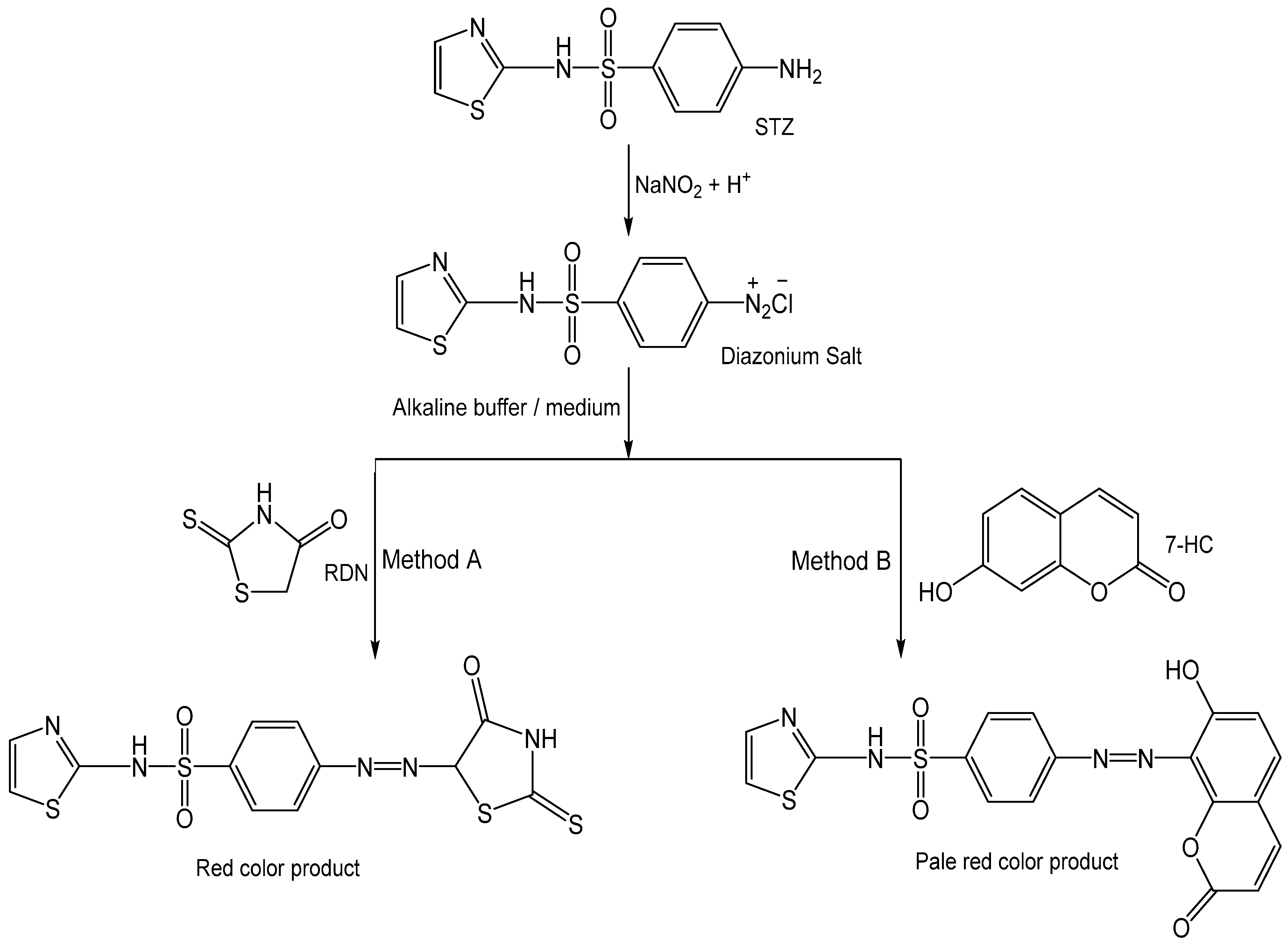
It should be noted that the maximum absorbance of the produced azo compound is recorded immediately without the need to wait after mixing all components. The mechanism of the suggested reaction is depicted in Figure 1.
Spectral changes during the reaction course were recorded (at 504 nm and 525 nm in case of RDN and 7-HC, respectively) against a blank solution, which was prepared identically, except that N O 2 was not added. The Beer law calibration curve was graphically represented by charting absorbance in relation to the computed N O 2 concentration.

2.4.3. Application of the Developed Methods for N O 2 Determination

The presented methods were suggested for N O 2 determination in different environmental samples: tap water, wastewater, and soil samples. N O 2 was determined directly in the made-up solutions utilizing the standard addition method, where absorbance was measured and recorded (at 504 nm and 525 nm in the case of RDN and 7-HC, respectively) against the blank solution, which was prepared under identical conditions but with N O 2 excluded.
Spectrophotometric Determination of N O 2 in Water Samples
Aliquots of water samples (either tap or wastewater) were exposed to a mixture of 0.5 mL of 1.0 M NaOH and 0.5 mL of 0.2 M EDTA and mixed thoroughly. The resulting precipitate was discarded by centrifugation. EDTA was added for the purpose of masking several metal ions, such as Co+2, Cu+2, and Fe+3, which may interfere with the proposed procedure [46]. A specified volume of the produced centrifugate was transferred to a series of 10 mL volumetric flasks. The used chemicals were added to each volumetric flask, as described in the proposed procedures (either using RDN of 7-HC). The constituents of each flask were mixed thoroughly and left to settle for 5 min., and then, the total volume was completed to the mark using bi-distilled water.
Spectrophotometric Determination of N O 2 in Soil Samples
Approximately 1.0 g of soil sample was weighed and introduced into a 50 mL beaker and extracted three times with 5.0 mL portions of the 1.0% Na2CO3 solution. The extract was filtered through Whatman 41 filter paper, and suitable aliquots of the sample solution were analyzed. In a series of 10 mL volumetric flasks, the above prescribed procedures (either using RDN or 7-HC) for N O 2 determination were carried out in the presence of a specified volume of soil filtrate, accompanied by successively increased volumes of the standard N O 2 solution. The ingredients of the individual flask were vigorously shaken and subsequently left to rest for 5 min. before being topped up to the mark with bi-distilled H2O.

3. Results and Discussion

3.1. Spectrophotometric Determination of N O 2 Using RDN

This method entails the diazotization step in an acidified medium between N O 2 and STZ, followed by coupling with RDN in an alkaline medium, yielding the red-colored azo dye depicted in the scheme in Figure 1.
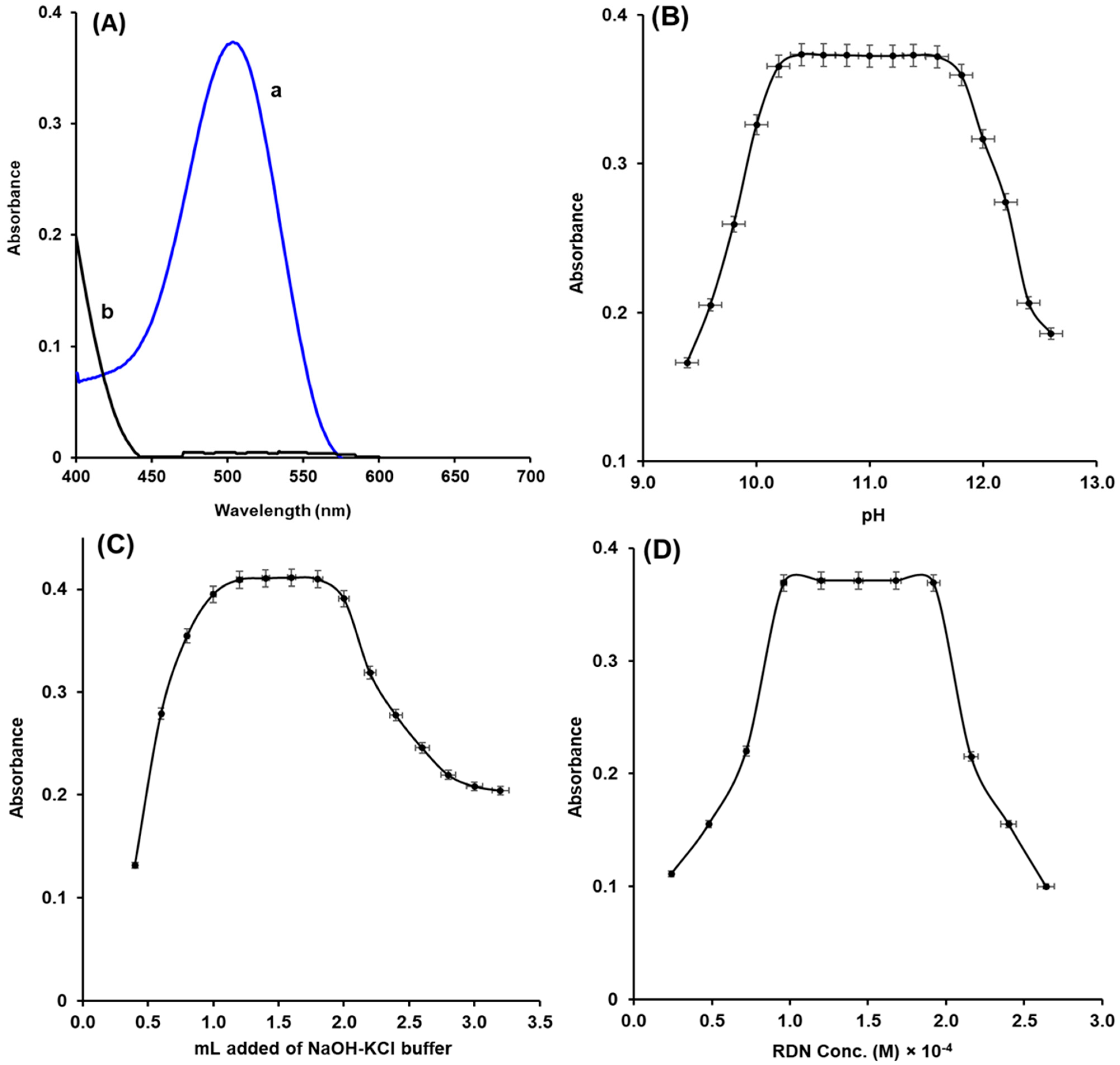
Figure 2A (spectrum a) shows the absorption spectra of the formed STZ-RDN azo compound, which consists of 10 µg mL−1 M STZ, 1.5 × 10⁻⁴ M of RDN, and a NaOH-KCl buffer (pH ≈ 11.2) in the presence of 0.4 µg mL−1 of N O 2 . This spectrum was recorded against the blank solution, which has the same composition except for the absence of N O 2 (Figure 2A (spectrum b)). The formed azo compound demonstrated maximum absorbance at 504 nm, while no absorbance was noticed in the blank solution at all.
An acidic medium is necessary for diazotization; if absent, N O 2 cannot efficiently convert into NO+, and the overall diazotization would not proceed [69]. Better results were attained when the HCl medium was used for diazonium cation formation since it cleanly generates HNO2 from NaNO2 and provides a non-oxidizing, weakly coordinating counter-ion (Cl) that yields soluble, relatively stable diazonium chlorides [70]. The current study examined HCl concentrations between 0.2 and 1.2 M to identify a suitable concentration for maximal diazotization. Accordingly, STZ was solubilized in 0.6 M HCl to ensure the highest color intensity.
The effect of pH on the formation of the colored azo STZ-RDN compound was investigated over the pH range of 2–13, which was adjusted with NaOH or HCl. This study was carried out using STZ (10 µg mL−1), 0.4 µg mL−1 of NaNO2, and 1.5 × 10⁻⁴ M of RDN. This study revealed that the maximum absorbance of sensitive azo-colored compounds was recorded in a basic medium with a pH range of 10.8–11.8. Accordingly, a pH value of approximately 11.2 was selected as the optimum condition for the spectrophotometric determination of N O 2 using RDN as the coupling reagent, as illustrated in Figure 2B.
To select the best buffer type in the current procedure, different buffers like NaOH (1.0 M), the universal buffer, and NaOH-KCl were investigated. The maximum and best absorbance was obtained using the NaOH-KCl buffer. The optimum volume of the NaOH-KCl buffer (pH ≈ 11.2) for coupling reactions between RDN and diazotized STZ was studied using different NaOH-KCl buffer volumes, ranging from 0.4 to 3.2 mL. This study revealed that constant and maximum absorbance was observed in the range between 1.2 and 1.8 mL. Based on this optimization, 1.5 mL of the NaOH-KCl buffer solution (pH ≈ 11.2) was employed in all subsequent experiments; the influence of the buffer volume is presented in Figure 2C.
The impact of RDN concentrations on the formation of the red azo color was investigated using 10 µg mL−1 of STZ and 0.4 µg mL−1 of NaNO2 in the presence of 1.5 mL of the NaOH-KCl buffer (pH ≈ 11.2). The RDN concentration ranged between 0.24 × 10⁻⁴ M and 2.6 × 10⁻⁴ M. Figure 2D shows the obtained concentration results. The optimum RDN concentration in the final concentration ranged between 0.96 × 10⁻⁴ M and 1.92 × 10⁻⁴ M. Consequently, the addition of 0.5 mL of 3 × 10⁻³ M RDN, corresponding to a final concentration of 1.5 × 10⁻⁴ M in a total volume of 10 mL, was found to be sufficient for the recommended procedure.

3.2. Spectrophotometric Determination of N O 2 Using 7-HC

This technique produces a pale red azo dye by diazotizing N O 2 and STZ in an acidic medium and then coupling the formed diazonium with 7-HC in an alkaline medium, as seen in the scheme in Figure 1.
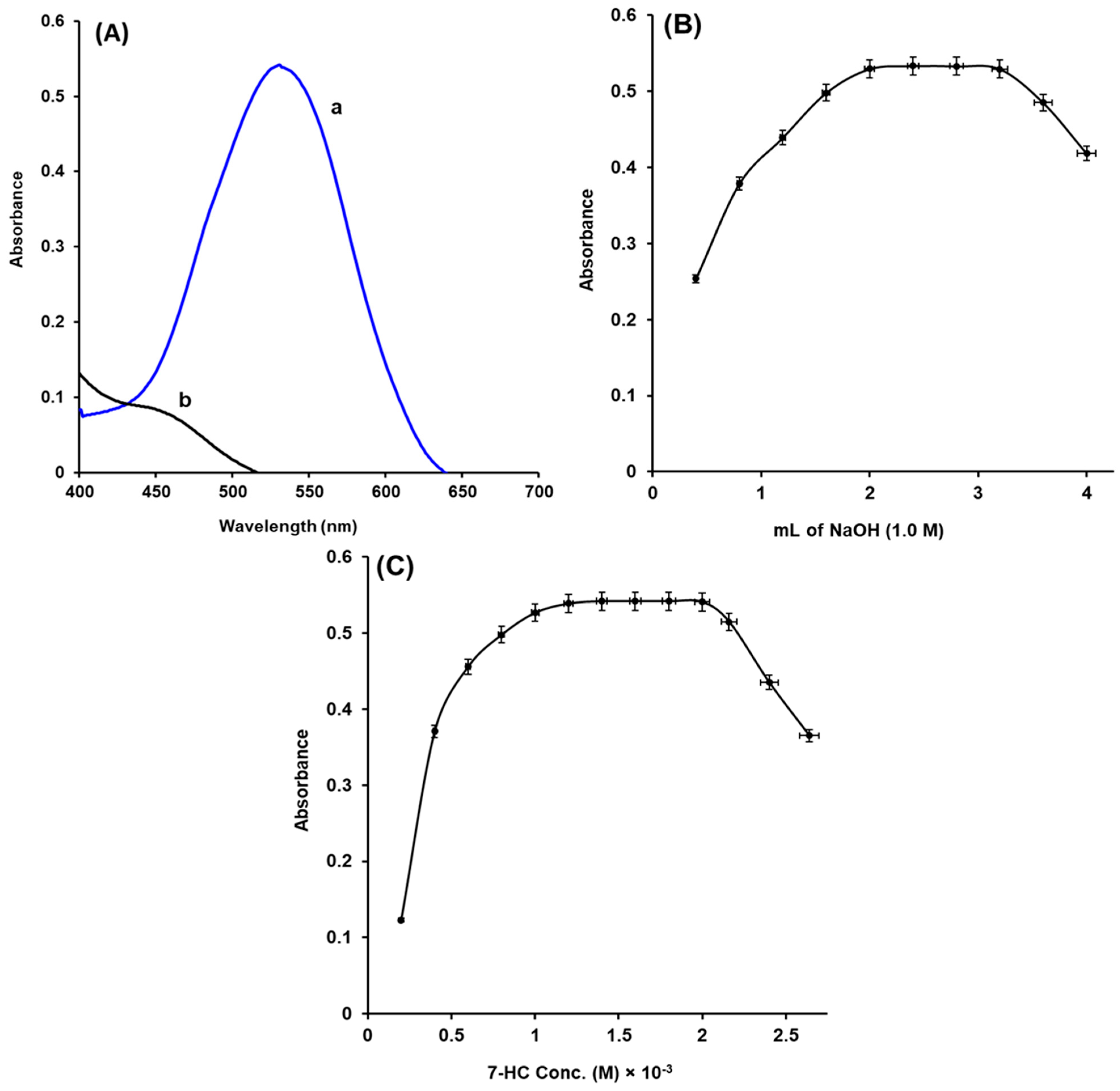
Figure 3A (curves a and b) shows the absorption spectra of diazotized STZ-7-HC and its blank solution (which has the same constituents except the presence of N O 2 ), respectively. An obvious spectrum with maximum absorbance recorded at 525 nm was recorded for a solution composed of 10 µg mL−1 STZ, 0.4 µg mL−1 of N O 2 , and 1.6 × 10⁻³ M of 7-HC in the presence of a specified volume of 1.0 M NaOH. In the overall scanned wavelength range, there was no noticeable absorbance from the blank solution.
Figure 3B shows the basicity impact on the formation of the azo product due to the coupling reaction of diazotized STZ with 7-HC. This study was carried out using 10 µg mL−1 STZ (dissolved in 0.6 M HCl), 0.4 µg mL−1 of NaNO2, and 1.6 × 10⁻³ M of 7-HC and gradually increasing volumes of 1.0 M NaOH. This effect was studied over a NaOH concentration range of 0.04–0.4 M. The absorbance for the azo product of STZ and 7-HC was found to be maximum and constant at λmax = 525 nm over the NaOH concentration range from 0.20 to 0.32 M. Therefore, 2.5 mL of 1.0 M NaOH in the final volume of 10-mL (0.25 M) was utilized in the recommended procedure for the quantitative determination of N O 2 .
The effectivity of 7-HC concentrations on the proposed procedure for N O 2 determination was studied using several 7-HC concentrations starting from 1.2 × 10⁻³ M and ending with 2.0 × 10⁻³ M, which were sequentially added to a series of 10 mL volumetric flasks, where each individual flask contained 10 µg mL−1 of STZ and 0.4 µg mL−1 of NaNO2, with the subsequent addition of 0.25 M of NaOH. From Figure 3C, which shows the obtained results for the 7-HC concentration study, we can conclude that 3.2 mL of 5 × 10⁻³ M 7-HC (1.6 × 10⁻³ M) was selected for the determination of N O 2 in the proposed procedure.

3.3. Effect of Time

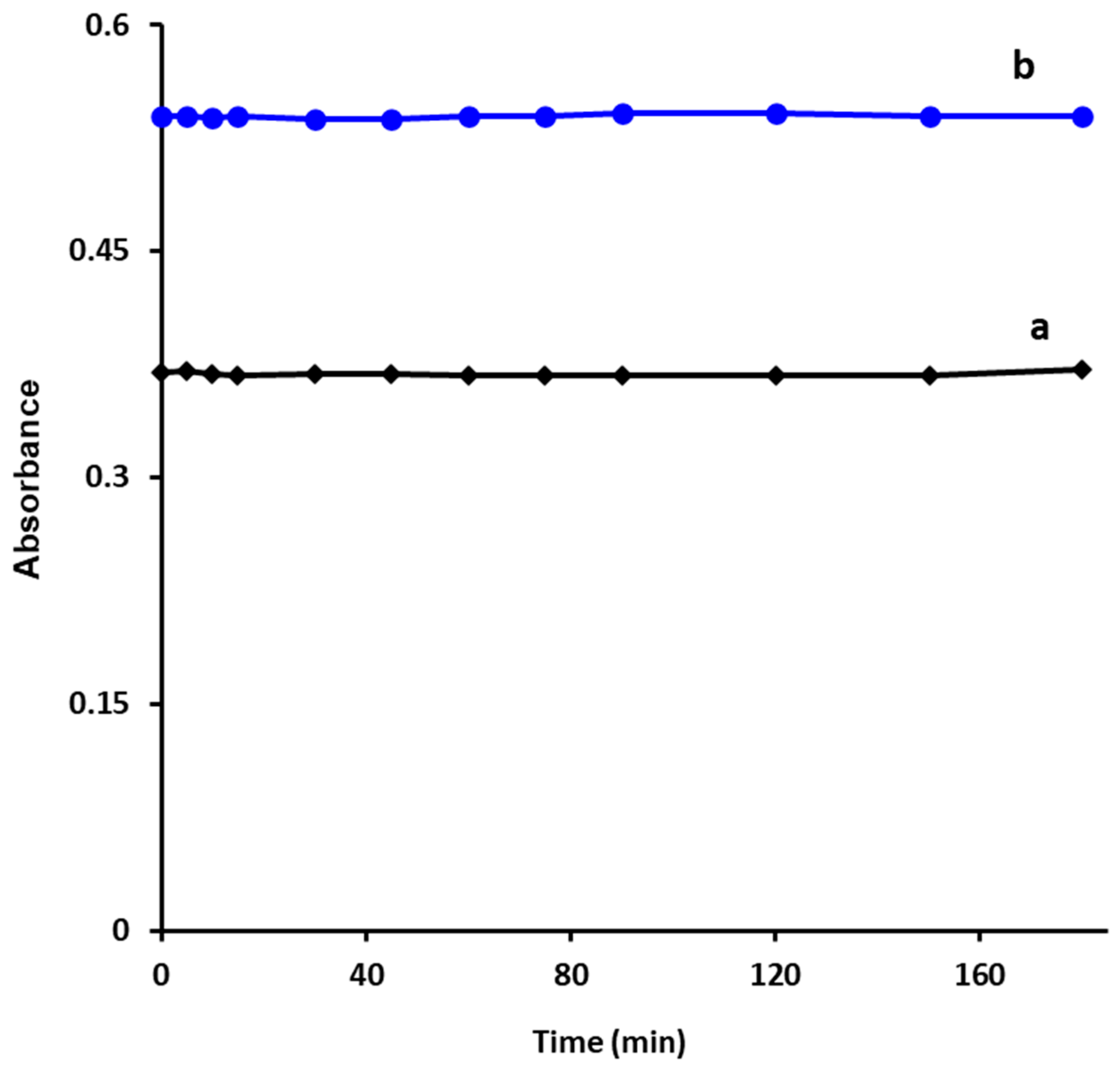
In the presence of 0.4 µg mL−1 of N O 2 and constant concentrations of all used coupling reagents (RDN or 7-HC), the effect of time on the formed azo dye was evaluated at different time intervals. The reaction proceeded instantaneously, and the resulting color, which appeared directly after completely the mixing of all constituents at room temperature, and the recorded absorbance of the formed azo dye was found to be approximately constant for more than three hours, and no changes were observed. The time-dependent behavior of the produced azo dye is depicted in Figure 4.

3.4. Analytical Data

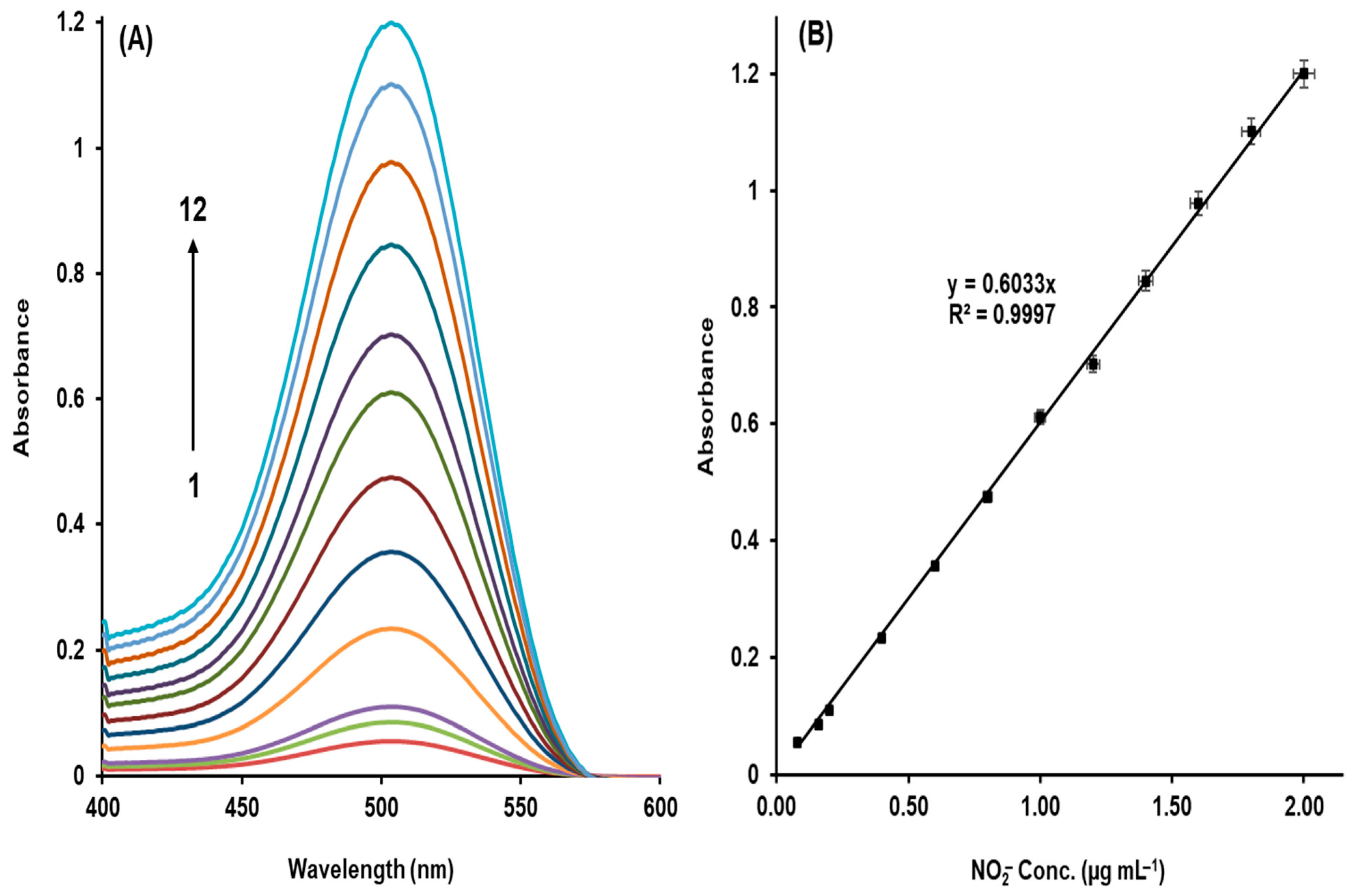
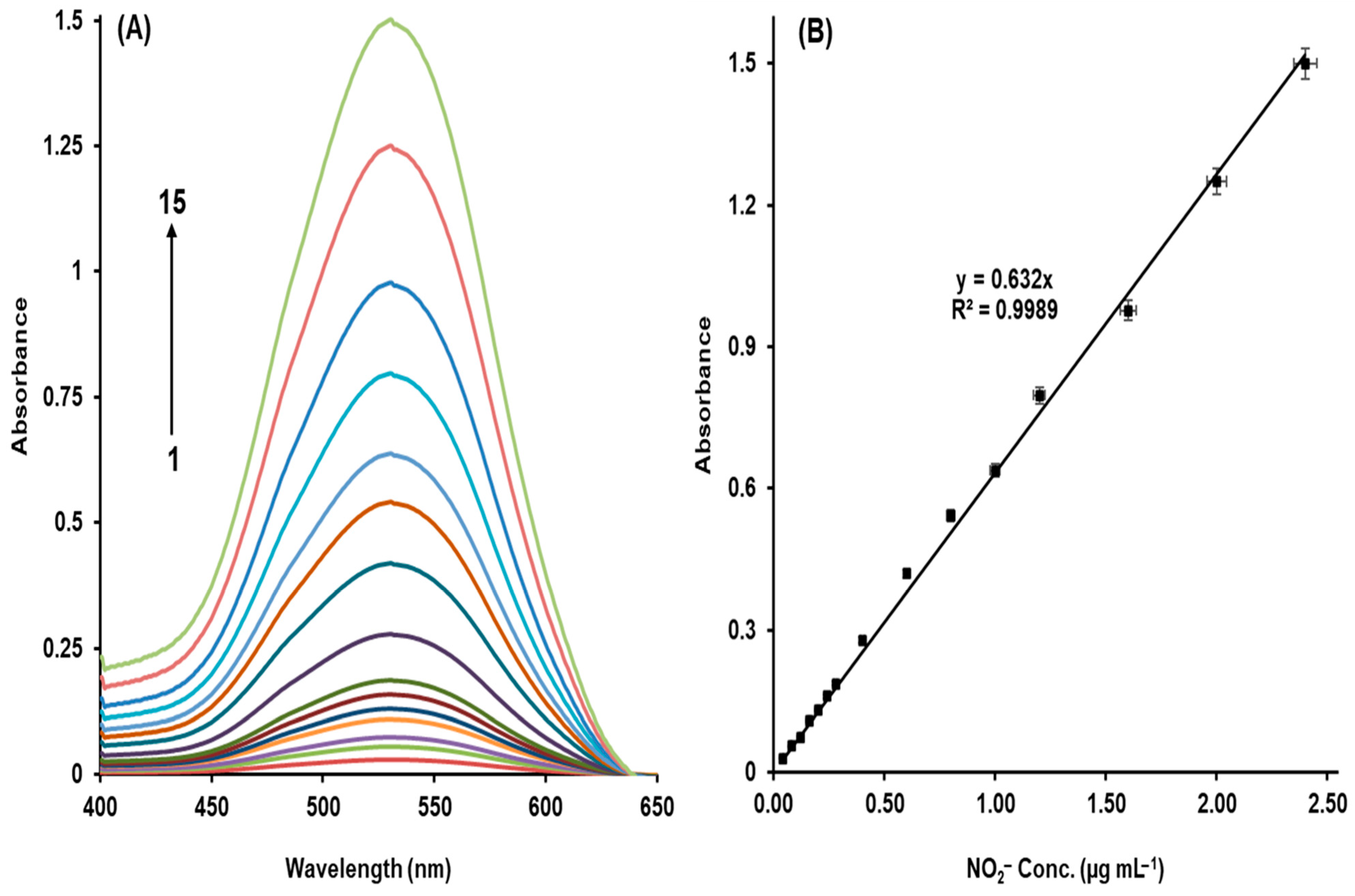
The recorded absorption reached its maximum in the absorption spectrum of the formed azo dye at λmax = 504 nm (Figure 5A in the case of RDN) and λmax = 525 nm (Figure 6A in the case of 7-HC), and the blank solution has insignificant absorption versus bi-distilled water in a 1.0 cm quartz cuvette. The calibration graph obtained by the recommended procedure for the determination of N O 2 using RDN and 7-HC is represented in Figure 5B and Figure 6B, respectively. The calibration graphs indicate that the recommended procedure conformed to Beer’s law within the N O 2 concentration range of 0.08–2.0 and 0.04–2.4 µg mL−1 for RDN and 7-HC, respectively. The most characteristic statistical data for the two proposed methods are given in Table 1. The lower limit of detection (LLOD = 3.3 σ/b) and lower limit of quantification (LLOQ = 10 σ/b) were obtained, where σ is the standard deviation of the intercept, and b is the slope of the calibration curve (n = 5) [71]. In compliance with Beer’s law, the shown calibration equations in Figure 5B and Figure 6B are expressed without intercepts since they are negligible and statistically insignificant. The obtained values of molar absorptivity (ε), Sandell’s sensitivity, correlation coefficients, and other characteristic statistical data shown in Table 1 indicated the good linearity of the constructed calibration graphs and the high precision of the determination of N O 2 using the proposed methods.
Since the calculated LLOD falls below the maximum contamination threshold for N O 2 in drinking water defined by the WHO (6.5 × 10⁻⁵ M (3.0 µg mL−1)) [20] and U.S. EPA (2.17 × 10⁻⁵ M (1.0 µg mL−1)) [22], our suggested spectrophotometric procedures have a considered and real practical application value in order to carry out N O 2 quantification in fresh and drinking water sources.

3.5. Interference Study

Either using RDN or 7-HC as chromogenic reagents for the determination of N O 2 , under the achieved optimal circumstances, the selectivity of the recommended methods was studied by the determination of 0.4 µg mL−1  N O 2 in coexistence with various ions that may exist with N O 2 in the same sample. The permissible limit was defined based on the concentration of ions causing interference. The experimental findings confirmed the absence of significant interference from the examined anions and cations. Accordingly, the proposed spectrophotometric techniques demonstrate high selectivity toward N O 2 quantification. Table 2 shows the results for such additives.

3.6. Application of the Proposed Methods

To investigate the appropriateness of the recommended procedures for N O 2 determination in real samples, it was applied to tap water, wastewater, and soil samples. The collected analysis results are tabulated in Table 3, which shows that the proposed method is accurate, and the results revealed very good recovery and excellent accommodation compared to the results obtained by the reference method [72].

3.7. Comparison with Previously Reported Methods

To confirm the effectiveness and suitability of our proposed methods, we made a comparison between analytical information obtained from our proposed methods and other spectrophotometric methods previously introduced for N O 2 determination. The information for this comparison is shown in Table 4. The tabulated data proved that our results are much better than most spectrophotometric methods or even very close to some of them. The listed spectrophotometric methods often possess some drawbacks, including reaction time, pH dependence, and the use of large volumes of amines, and sometimes, they are carcinogenic and toxic. Moreover, tabulated comparison data show that some references report lower linearity ranges and LLOD values than those obtained in our study, but these references have their own limitations [37,38,39,40,44,54,55]. Conversely, our proposed methods are simple, rapid, and low-cost, requiring minimal sample preparation while offering a satisfactory linearity range and high sensitivity, as they do not require special instruments, cumbersome extraction steps, or even expensive chemicals.

3.8. Greenness Assessment

Recently, there has been a growing global trend to develop new assessment methods, which in turn has become an essential requirement in contemporary research [73,74]. The core objective of these assessment methods is to prove that the proposed analytical method is eco-friendly, since it is executed using fewer hazardous chemicals, safer procedures, and still maintains remarkable analytical performance. To appraise the greenness of the analytical approaches, several evaluation metrics have been devised, including the Analytical Eco-Scale Assessment (ESA) [75], the Analytical GREEnness metric (AGREE) [76], the Green Analytical Procedure Index (GAPI) [77], and the National Environmental Methods Index (NEMI) [78]. Herein, the greenness of our proposed analytical procedures was investigated utilizing ESA, AGREE, and GAPI.

3.8.1. Analytical Eco-Scale Assessment (ESA)

On the analytical Eco-Scale Assessment (ESA), it is postulated that the ideal analytical method would achieve 100 points, and each departure from this ideality is designated as a penalty that is subtracted from a perfect score of 100, lowering the calculated final score for the proposed method. In the ESA system, there are numerous determinants, such as the type and quantity of used chemicals, energy consumption by the utilized electric instruments, waste formation and its processing, and finally, occupational hazards [75]. ESA is not graphically exemplified; instead, it is represented by tabulated numerical values, with a maximum score of 100. If the acquired score is greater than 75, it is regarded as an excellent green analysis; a score in the range of 50–74 is evidence for an acceptable green analysis, and finally, a score below 50 suggests inadequate green analysis. Based on these basic scores, the penalty points are calculated for the proposed spectrophotometric methods for N O 2 determination either using RDN (Method A) or 7-HC (Method B). As shown in Table 5, the calculated PPs were found to be 87 for the two proposed spectrophotometric methods. Upon this, the proposed analytical methods qualify as outstanding green analytical methods.

3.8.2. Analytical GREEnness Metric (AGREE)

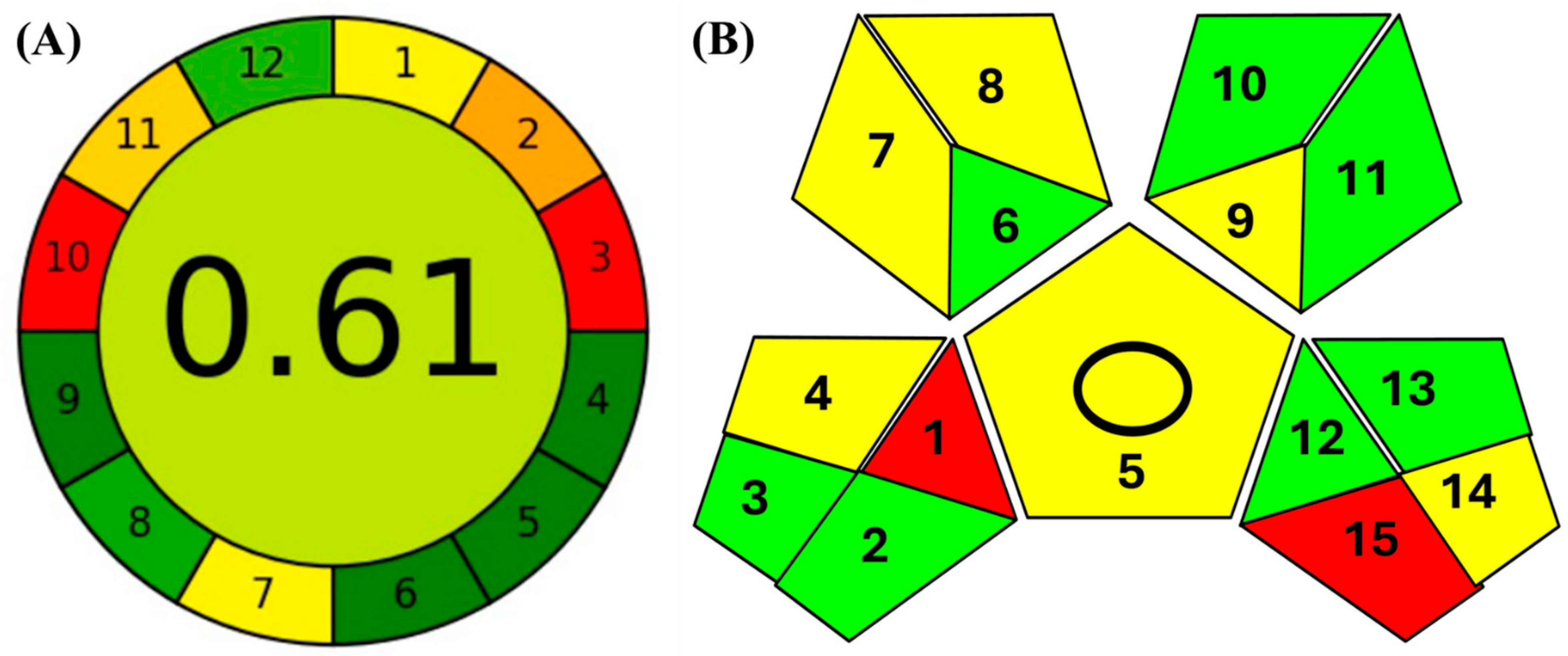
The Analytical GREEnness metric (AGREE) is an extensive metric framework in which the 12 precepts of green analytical chemistry are deemed to appraise greenness with respect to the presented analytical method. The ultimate score is displayed in the midpoint of 12 segmented pictograms, with each segment designated with a particular weight and color and associated with the analytical procedure’s performance. If the final score approaches 1, the segmented pictogram center acquires a darker green hue, implying a superior environmentally friendly procedure [76]. As indicated by the AGREE metrics, both proposed spectrophotometric procedures for N O 2 determination received a typical score of 0.61, with a segmented pictogram having a centered green color (Figure 7A). Also, the resulting pictogram for both suggested procedures was identical; the color for the individual segment in the pictogram related to Method A is identical to the color for the corresponding segment in the pictogram related to Method B. This similarity can be attributed to the use of the same chemicals, albeit in different quantities, in both proposed spectrophotometric procedures. Also, the use of RDN in Method A and 7-HC in Method B showed the same color in related segments since both have approximately the same hazardous effect. So, the proposed two spectrophotometric procedures are considered as green methods for N O 2 quantification.

3.8.3. Green Analytical Procedure Index (GAPI)

The Green Analytical Procedure Index (GAPI) is a late devised tool that assesses the environmental significance of a proposed method, encompassing every step included in assessed methods, starting from sample gathering to completing the analysis. The obtained outcomes are displayed in five pentagrams, each partitioned into subsections that exemplify diverse facets of the proposed methods: for instance, sample processing stages, amounts and risks of used chemicals, and utilized instrumentation specifications and requirements. Each segment is color-coded: green for low, yellow for medium, and red for high environmental impact [77]. The greenness assessment using GAPI is depicted in Figure 7B. We can assume that the resulting pictogram can be used to express the analytical greenness of both proposed spectrophotometric procedures for N O 2 determination. The result of the GAPI assessment showed seven green color segments and six yellow color segments, while the last two segments are shown in red color. The first red segment (1) is a result of utilizing offline sampling in research labs, where implementing online or inline approaches is challenging. The second red segment (15) is attributable to the absent waste treatment.
Based on the greenness assessment methods performed in the current article, we can confirm that the strength of our proposed spectrophotometric procedures lies in the use of small quantities of chemicals (since the total volume of the mixture is 10 mL) and the low energy required for the instruments used (UV-vis spectrophotometer and pH meter), with no heating required. Also, a significant weakness of the proposed method is the lack of a procedure for handling chemical waste from the proposed experiments (even though the waste quantities are less than 10 mL) since the used chemicals have a toxic effect, such as N O 2 , or a corrosive effect, such as HCl or NaOH.
Finally, the results obtained from greenness assessment using three different methods (ESA, AGREE, and GAPI) proved that the proposed spectrophotometric methods for N O 2 determination are characterized as moderate-to-good green methods of analysis.

4. Conclusions

In summary, we present two procedures for the spectrophotometric quantification of N O 2 in environmental specimens without the necessity for pretreatment or extraction. These methods were built upon a diazotization reaction of sulfathiazole, followed by a coupling reaction with RDN or 7-HC. The proposed procedures have significant advantages over several spectrophotometric methods found for N O 2 determination since they were found to be rapid, sensitive, selective, cost-effective, and environmentally friendly. According to the performed Greenness Assessments (ESA, AGREE, and GAPI), the proposed procedures were characterized as moderate-to-good green methods of analysis. The proposed procedures gave a satisfactory result when executed with respect to the N O 2 determination of N O 2 in water and soil specimens.

Author Contributions

Conceptualization, A.H.N., A.H.A. and T.A.S.-E.; methodology, A.H.A. and T.A.S.-E.; validation, A.H.N., A.-S.A.B., E.K.A. and A.E.-A.Y.E.-S.; formal analysis, S.E., A.A.A. and T.H.A.H.; writing—original draft preparation, A.H.N., A.H.A., E.K.A., T.A.S.-E. and S.E.; writing—review and editing, A.H.N., T.H.A.H., A.A.A., A.-S.A.B. and A.E.-A.Y.E.-S.; project administration and funding acquisition, A.H.N. All authors have read and agreed to the published version of the manuscript.

Funding

Deanship of Graduate Studies and Scientific Research at Jouf University under grant No. (DGSSR-2023-02-02308).

Institutional Review Board Statement

Not applicable.

Informed Consent Statement

Not applicable.

Data Availability Statement

The original contributions presented in this study are included in the article material. Further inquiries can be directed to the corresponding author.

Acknowledgments

This work was funded by the Deanship of Graduate Studies and Scientific Research at Jouf University under grant No. (DGSSR-2023-02-02308).

Conflicts of Interest

Author Atef Hemdan Ali was employed by the company Production Sector at Egyptian Financial & Industrial Co. (EFIC). The remaining authors declare that the research was conducted in the absence of any commercial or financial relationships that could be construed as a potential conflict of interest.

References

  1. Pobel, D.; Riboli, E.; Cornée, J.; Hémon, B.; Guyader, M. Nitrosamine, nitrate and nitrite in relation to gastric cancer: A case-control study in Marseille, France. Eur. J. Epidemiol. 1995, 11, 67–73. [Google Scholar]
  2. Thomsom, B.M.; Nokes, C.J.; Cressy, P. Intake and risk assessment of nitrate and nitrite from New Zealand foods and drinking water. Food Addit. Contam. 2007, 24, 113–121. [Google Scholar] [CrossRef] [PubMed]
  3. Maitre, M.; Kirkbride, K.P.; Horder, M.; Roux, C.; Beavis, A. Current perspectives in the interpretation of gunshot residues in forensic science: A review. Forensic Sci. Int. 2017, 270, 1–11. [Google Scholar] [CrossRef]
  4. Honikel, K.O. The use and control of nitrate and nitrite for the processing of meat products. Meat Sci. 2008, 78, 68–76. [Google Scholar] [CrossRef] [PubMed]
  5. Machha, A.; Schechter, A.N. Dietary nitrite and nitrate: A review of potential mechanisms of cardiovascular benefits. Eur. J. Nutr. 2011, 50, 293–303. [Google Scholar] [CrossRef] [PubMed]
  6. Guo, X.; Fan, Y. Determination of nitrite in food specimens using electrochemical sensor based on polyneutral red modified reduced graphene oxide paste electrode. Int. J. Electrochem. Sci. 2023, 18, 100290. [Google Scholar] [CrossRef]
  7. Katabami, K.; Hayakawa, M.; Gando, S. Severe methemoglobinemia due to sodium nitrite poisoning. Case Rep. Emerg. Med. 2016, 2016, 9013816. [Google Scholar] [CrossRef]
  8. Suzuki, H.; Iijima, K.; Moriya, A.; McElroy, K.; Scobie, G.; Fyfe, V.; McColl, K.E.L. Conditions for acid catalysed luminal nitrosation are maximal at the gastric cardia. Gut 2003, 52, 1095–1101. [Google Scholar] [CrossRef]
  9. Olajos, E.; Coulston, F. Comparative toxicology of N-nitroso compounds and their carcinogenic potential to man. Ecotox. Environ. Safe. 1978, 2, 317–367. [Google Scholar] [CrossRef]
  10. Brender, J.D.; Olive, J.M.; Felkner, M.; Suarez, L.; Marckwardt, W.; Hendricks, K.A. Dietary nitrites and nitrates, nitrosatable drugs, and neural tube defects. Epidemiology 2004, 15, 330–336. [Google Scholar] [CrossRef]
  11. Aschengrau, A.; Zierler, S.; Cohen, A. Quality of community drinking water and the occurrence of spontaneous abortion. Arch. Environ. Occup. Health. 1989, 44, 283–290. [Google Scholar] [CrossRef]
  12. Jakszyn, P.; González, C.A. Nitrosamine and related food intake and gastric and esophageal cancer risk: A systematic review of the epidemiological evidence. World J. Gastroenterol. 2006, 12, 4296–4303. [Google Scholar] [CrossRef]
  13. Lyall, F.; Greer, I.A.; Young, A.; Myatt, L. Nitric oxide concentrations are increased in the feto-placental circulation in intrauterine growth restriction. Placenta 1996, 17, 165–168. [Google Scholar] [CrossRef]
  14. Bhirud, D.; Agrawal, G.; Shah, H.; Patel, A.; Palkar, M.B.; Bhattacharya, S.; Prajapati, B.G. Nitrosamine impurities in pharmaceuticals: An empirical review of their detection, mechanisms, and regulatory approaches. Curr. Top. Med. Chem. 2024, 24, 503–522. [Google Scholar] [CrossRef]
  15. The International Council for Harmonisation of Technical Requirements for Pharmaceuticals for Human Use. Assessment and Control of DNA Reactive (Mutagenic) Impurities in Pharmaceuticals to Limit Potential Carcinogenic Risk. M7(R2). 2023. Available online: https://database.ich.org/sites/default/files/ICH_M7%28R2%29_Guideline_Step4_2023_0216_0.pdf (accessed on 11 December 2025).
  16. Ingles, J.; Louw, T.M.; Booysen, M.J. Water quality assessment using a portable UV optical absorbance nitrate sensor with a scintillator and smartphone camera. Water SA 2021, 47, 135–140. [Google Scholar] [CrossRef]
  17. Syers, J.K.; Mosier, A.; Freney, J.R. (Eds.) Agriculture and the Nitrogen Cycle: Assessing the Impacts of Fertilizer Use on Food Production and the Environment; Island Press: Washington DC, USA, 2013. [Google Scholar]
  18. Singh, S.; Anil, A.G.; Kumar, V.; Kapoor, D.; Subramanian, S.; Singh, J.; Ramamurthy, P.C. Nitrates in the environment: A critical review of their distribution, sensing techniques, ecological effects and remediation. Chemosphere 2022, 287, 131996. [Google Scholar] [CrossRef] [PubMed]
  19. Mai, Y.; Ghiasvand, A.; Gupta, V.; Edwards, S.; Cahoon, S.; Debruille, K.; Mikhail, I.; Murray, E.; Paull, B. Application of a portable ion chromatograph for real-time field analysis of nitrite and nitrate in soils and soil pore waters. Talanta 2024, 274, 126031. [Google Scholar] [CrossRef] [PubMed]
  20. World Health Organization (WHO). Guidelines for Drinking-Water Quality. In 4th Edition Incorporating the First Addendum; World Health Organization (WHO): Geneva, Switzerland, 2017. [Google Scholar]
  21. Schrenk, D.; Bignami, M.; Bodin, L.; Chipman, J.K.; del Mazo, J.; Grasl-Kraupp, B.; Hoogenboom, L.; Leblanc, J.C.H.; Nebbia, C.S.; Nielsen, E.; et al. Risk assessment of nitrate and nitrite in feed. EFSA J. 2020, 18, e06290. [Google Scholar] [CrossRef]
  22. U.S. Environmental Protection Agency (U.S. EPA). Drinking Water Standards and Health Advisories, EPA 822-R-04-005; U.S. Environmental Protection Agency: Washington DC, USA, 2004.
  23. EU Scientific Committee for Food (SCF). Opinion on: Nitrate and Nitrite (Expressed on 22 September 1995). Reports of the Scientific Committee for Food, 38th Series; European Commission: Brussels, Belgium, 1995. [Google Scholar]
  24. Food and Agriculture Organization/World Health Organization (FAO/WHO). Nitrite (and Potential Endogenous Formation of N-nitroso Compounds); WHO Food Additives Series; No. 50; WHO: Geneva, Switzerland, 2003; Available online: http://www.inchem.org/documents/jecfa/jecmono/v50je05.htm (accessed on 11 December 2025).
  25. Ahn, I.; Lee, S.; Jung, M.J.; Jeong, Y.; Kim, J.Y.; Kim, M.; Kim, P.S.; Lee, B.H.; Lee, Y.M.; Son, K.H. Development and application of analytical methods to quantitate nitrite in excipients and secondary amines in metformin API at trace levels using liquid chromatography-tandem mass spectrometry. Chemosensors 2025, 13, 307. [Google Scholar] [CrossRef]
  26. Coviello, D.; Pascale, R.; Ciriello, R.; Salvi, A.M.; Guerrieri, A.; Contursi, M.; Scrano, L.; Bufo, S.A.; Cataldi, T.R.I.; Bianco, G. Validation of an analytical method for nitrite and nitrate determination in meat foods for infants by ion chromatography with conductivity detection. Foods 2020, 9, 1238. [Google Scholar] [CrossRef]
  27. Aslani, R.; Esmaeili, S.; Akbari, M.E.; Molaee-Aghaee, E.; Sadighara, P.; Nazmara, S.; Mahmoudi, B. Determination of heavy metals, nitrate and nitrite in mineral and drinking bottled water in Tehran, Iran: A health risk assessment by Monte-Carlo simulation method. Heliyon 2024, 10, e40714. [Google Scholar] [CrossRef]
  28. Lucas, S.B.; Duarte, L.M.; Rezende, K.C.A.; Coltro, W.K.T. Nitrite determination in environmental water samples using microchip electrophoresis coupled with amperometric detection. Micromachines 2022, 13, 1736. [Google Scholar] [CrossRef]
  29. Wang, X.; Adams, E.; Van Schepdael, A. A fast and sensitive method for the determination of nitrite in human plasma by capillary electrophoresis with fluorescence detection. Talanta 2012, 97, 142–144. [Google Scholar] [CrossRef] [PubMed]
  30. Lin, Z.; Xue, W.; Chen, H.; Lin, J.M. Peroxynitrous-acid induced chemiluminescence of fluorescent carbon dots for nitrite sensing. Anal. Chem. 2011, 83, 8245–8251. [Google Scholar] [CrossRef]
  31. Yin, X.; Chen, Q.; Song, H.; Yang, M.; Wang, H. Sensitive and selective electrochemiluminescent detection of nitrite using dual-stabilizer-capped CdTe quantum dots. Electrochem. Commun. 2013, 34, 81–85. [Google Scholar] [CrossRef]
  32. Gurban, A.M.; Zamfir, L.G.; Epure, P.; Şuică-Bunghez, I.R.; Senin, R.M.; Jecu, M.L.; Jinga, M.L.; Doni, M. Flexible miniaturized electrochemical sensors based on multiwalled carbon nanotube-chitosan nanomaterial for determination of nitrite in soil solutions. Chemosensors 2023, 11, 224. [Google Scholar] [CrossRef]
  33. Faisal, M.; Alam, M.M.; Ahmed, J.; Asiri, A.M.; Algethami, J.S.; Altholami, R.H.; Harraz, F.A.; Rahman, M.M. Efficient nitrite determination by electrochemical approach in liquid phase with ultrasonically prepared gold-nanoparticle-conjugated conducting polymer nanocomposites. Front. Chem. 2024, 12, 1358353. [Google Scholar] [CrossRef]
  34. Fadil, M.A.; Abdel Hameed, R.M.; Mohamed, G.G.; Fouad, O.A. NiFe2O4 nanoparticles as highly sensitive electrochemical sensor for nitrite determination. Appl. Organomet. Chem. 2025, 39, e70043. [Google Scholar] [CrossRef]
  35. Zhang, J.; Chen, C.; Xu, X.; Wang, X.; Yang, X. Use of fluorescent gold nanoclusters for the construction of a NAND logic gate for nitrite. Chem. Commun. 2013, 49, 2691–2693. [Google Scholar] [CrossRef]
  36. Menon, S.; Vikraman, A.E.; Jesny, S.; Kumar, K.G. “Turn On” fluorescence determination of nitrite using green synthesized carbon nanoparticles. J. Fluoresc. 2016, 26, 129–134. [Google Scholar] [CrossRef]
  37. Shabani, A.M.H.; Ellis, P.; McKelvie, I. Simple flow injection analysis system for the spectrophotometric determination of trace amounts of nitrite in water samples. J. Flow Inject. Anal. 2010, 27, 146–150. [Google Scholar]
  38. Nouroozi, S.; Mirshafian, R. Flow injection kinetic spectrophotometric method for the determination of trace amounts of nitrite. Talanta 2009, 79, 1149–1153. [Google Scholar] [CrossRef] [PubMed]
  39. Mousavi, M.F.; Jabbari, A.; Nouroozi, S. A sensitive flow-injection method for determination of trace amounts of nitrite. Talanta 1998, 45, 1247–1253. [Google Scholar] [CrossRef] [PubMed]
  40. Wang, S.; Lin, K.; Chen, N.; Yuan, D.; Ma, J. Automated determination of nitrate plus nitrite in aqueous samples with flow injection analysis using vanadium (III) chloride as reductant. Talanta 2016, 146, 744–748. [Google Scholar] [CrossRef]
  41. Pasquali, C.E.L.; Hernando, P.F.; Alegría, J.S.D. Spectrophotometric simultaneous determination of nitrite, nitrate and ammonium in soils by flow injection analysis. Anal. Chim. Acta 2007, 600, 177–182. [Google Scholar] [CrossRef]
  42. Nagaraja, P.; Al-Tayar, N.G.S.; Shivakumar, A.; Shrestha, A.K.; Gowda, A.K. A simple and sensitive spectrophotometric method for the determination of trace amounts of nitrite in environmental and biological samples using 4-amino-5-hydroxynaphthalene-2,7-disulphonic acid monosodium salt. Spectroc. Acta Pt. A Molec. Biomolec. Spectr. 2010, 75, 1411–1416. [Google Scholar] [CrossRef]
  43. Aydın, A.; Ercan, Ö.; Taşcıoğlu, S. A novel method for the spectrophotometric determination of nitrite in water. Talanta 2005, 66, 1181–1186. [Google Scholar] [CrossRef]
  44. Filik, H.; Giray, D.; Ceylan, B.; Apak, R. A novel fiber optic spectrophotometric determination of nitrite using Safranin O and cloud point extraction. Talanta 2011, 85, 1818–1824. [Google Scholar] [CrossRef]
  45. Shariati-Rad, M.; Irandoust, M.; Mohammadi, S.H. Spectrophotometric determination of nitrite in soil and water using cefixime and central composite design. Spectroc. Acta Pt. A Molec. Biomolec. Spectr. 2015, 149, 190–195. [Google Scholar] [CrossRef]
  46. Sreekumar, N.V.; Narayana, B.; Hegde, P.; Manjunatha, B.R.; Sarojini, B.K. Determination of nitrite by simple diazotization method. Microchem. J. 2003, 74, 27–32. [Google Scholar] [CrossRef]
  47. Helaleh, M.I.H.; Korenaga, T. Sensitive spectrophotometric determination of nitrite in human saliva and rainwater and of nitrogen dioxide in the atmosphere. J. AOAC Int. 2001, 84, 53–58. [Google Scholar] [CrossRef] [PubMed]
  48. Fraihat, S.M. Green methods for the determination of nitrite in water samples based on a novel diazo coupling reaction. Green Process. Synth. 2017, 6, 245–248. [Google Scholar] [CrossRef]
  49. Irandoust, M.; Shariati-Rad, M.; Haghighi, M. Nitrite determination in water samples based on a modified Griess reaction and central composite design. Anal. Methods 2013, 5, 5977–5982. [Google Scholar] [CrossRef]
  50. Latvyte, E.; Greenwood, A.; Bogush, A.; Graves, J.E. Rapid and selective quantitative colourimetric analysis of nitrite in water using a S-nitrosothiol based method. Water Res. X 2024, 25, 100265. [Google Scholar] [CrossRef]
  51. Faraj, H.S.; Fakhre, N.A. Dispersive liquid-liquid microextraction spectrophotometric determination of human salivary nitrite content. Egypt. J. Chem. 2023, 66, 157–166. [Google Scholar]
  52. Narayana, B.; Sunil, K. A spectrophotometric method for the determination of nitrite and nitrate. Eurasian, J. Anal. Chem. 2009, 4, 204–214. [Google Scholar]
  53. Cherian, T.; Narayana, B. A new system for the spectrophotometric determination of trace amounts of nitrite in environmental samples. J. Braz. Chem. Soc. 2006, 17, 577–581. [Google Scholar] [CrossRef]
  54. Gauthama, B.U.; Narayana, B.; Sarojini, B.K.; Bello, K.; Suresh, N.K. Nitrate/nitrite determination in water and soil samples accompanied by in situ azo dye formation and its removal by superabsorbent cellulose hydrogel. SN Appl. Sci. 2020, 2, 1225. [Google Scholar] [CrossRef]
  55. Thipwimonmas, Y.; Jaidam, J.; Samoson, K.; Khunseeraksa, V.; Phonchai, A.; Thiangchanya, A.; Chang, K.H.; Abdullah, A.F.L.; Limbut, W. A simple and rapid spectrophotometric method for nitrite detection in small sample volumes. Chemosensors 2021, 9, 161. [Google Scholar] [CrossRef]
  56. Al-Okab, R.A.; Syed, A.A. Novel reactions for simple and sensitive spectrophotometric determination of nitrite. Talanta 2007, 72, 1239–1247. [Google Scholar] [CrossRef]
  57. Ozmen, H.; Polat, F.; Cukurovali, A. Spectrophotometric determination of nitrite in water samples with 4-(1-methyl-1-mesitylcyclobutane-3-yl)-2-aminothiazole. Anal. Lett. 2006, 39, 823–833. [Google Scholar] [CrossRef]
  58. Veena, K.; Narayana, B. Spectrophotometric determination of nitrite using new coupling agents. Indian, J. Chem. Technol. 2009, 16, 89–92. [Google Scholar]
  59. Rashid, C.M. Spectrophotometric determination of nitrite in curing meat samples using diazo-coupling reaction. Tikrit. J. Pure Sci. 2006, 11, 183–186. [Google Scholar]
  60. Zhang, H.; Qi, S.h.; Dong, Y.; Chen, X.; Xu, Y.; Ma, Y.; Chen, X. A sensitive colorimetric method for the determination of nitrite in water supplies, meat and dairy products using ionic liquid-modified methyl red as a colour reagent. Food Chem. 2014, 151, 429–434. [Google Scholar] [CrossRef] [PubMed]
  61. AOAC Method (36.1.21). Official Methods of Analysis of the Association of the Official Analytical Chemists, 16th ed.; AOAC International: Rockville, MD, USA, 1995. [Google Scholar]
  62. Akram, D.; Elhaty, I.A.; AlNeyadi Sh, S. Synthesis and spectroscopic characterization of rhodanine azo dyes as selective chemosensors for detection of iron(III). Chem. Data Collect. 2020, 28, 100456. [Google Scholar] [CrossRef]
  63. Amjad, R.; Munawar, M.A.; Khana Sh, R.; Naeem, M. Synthesis and spectral studies of some novel coumarin based disperse azo dyes. Pak. J. Sci. Ind. Res. 2009, 52, 117–121. [Google Scholar]
  64. Sirajunisa, T.; Umme, H. Spectrophotometric methods in pharmaceutical analysis: Principles, reagents, and applications. Int. J. Environ. Sci. Nat. Res. 2024, 34, 556391. [Google Scholar]
  65. Marczenko, Z.; Balcerzak, M. Chapter 3—Spectrophotometric methods. In Analytical Spectroscopy Library; Elsevier: Amsterdam, The Netherlands, 2000; pp. 39–52. [Google Scholar]
  66. Giné, M.F.; Bergamin, F.H.; Zagatto, E.A.G.; Reis, B.F. Simultaneous determination of nitrate and nitrite by flow injection analysis. Anal. Chim. Acta 1980, 114, 191–197. [Google Scholar] [CrossRef]
  67. Lew, R.B. Elimination of sulphite interference in the spectrophotometric determination of nitrite. Analyst 1977, 102, 476–479. [Google Scholar] [CrossRef]
  68. Kapoor, V.K. Analytical Profiles of Drug Substances and Excipients, Vol. 22; Academic Press, Inc.: London, UK, 1993; pp. 389–430. [Google Scholar]
  69. Wichitnithad, W.; Nantaphol, S.; Noppakhunsomboon, K.; Rojsitthisak, P. An update on the current status and prospects of nitrosation pathways and possible root causes of nitrosamine formation in various pharmaceuticals. Saudi Pharm. J. 2023, 31, 295–331. [Google Scholar] [CrossRef]
  70. Hu, T.; Baxendale, I.R.; Baumann, M. Exploring flow procedures for diazonium formation. Molecules 2016, 21, 918. [Google Scholar] [CrossRef]
  71. Miller, J.C.; Miller, J.N. Statistics for Analytical Chemistry, 4th ed.; Elsevier: New York, NY, USA, 1994. [Google Scholar]
  72. American Public Health Association (APHA). Standard Methods for the Examination of Water and Wastewater, 19th ed.; American Public Health Association (APHA): Washington, DC, USA, 1995. [Google Scholar]
  73. Cetinkaya, A.; Kaya, S.I.; Ozkan, S.A. An overview of the current progress in green analytical chemistry by evaluating recent studies using greenness assessment tools. TrAC-Trends Anal. Chem. 2023, 168, 117330. [Google Scholar] [CrossRef]
  74. Alqirsh Sh, M.; Magdy, N.; Abdel-Ghany, M.F.; El Azab, N.F. A comparative study of green solid contact ion selective electrodes for the potentiometric determination of letrozole in dosage form and human plasma. Sci. Rep. 2023, 13, 20187. [Google Scholar] [CrossRef]
  75. Gałuszka, A.; Migaszewski, Z.M.; Konieczka, P.; Namieśik, J. Analytical eco-scale for assessing the greenness of analytical procedures. TrAC-Trends Anal. Chem. 2012, 37, 61–72. [Google Scholar] [CrossRef]
  76. Pena-Pereira, F.; Wojnowski, W.; Tobiszewski, M. AGREE—Analytical GREEnness metric approach and software. Anal. Chem. 2020, 92, 10076–10082. [Google Scholar] [CrossRef]
  77. Płotka-Wasylka, J. A new tool for the evaluation of the analytical procedure: Green Analytical Procedure Index. Talanta 2018, 181, 204–209. [Google Scholar] [CrossRef] [PubMed]
  78. Keith, L.H.; Gron, L.U.; Young, J.L. Green analytical methodologies. Chem. Rev. 2007, 107, 2695–2708. [Google Scholar] [CrossRef] [PubMed]
Figure 1. Reaction scheme for the colored product of STZ using RDN (Method A) and 7-HC (Method B).
Chemosensors 14 00023 g001
Figure 2. (A) Spectral curve for the product of diazonium reaction of 10 µg mL−1 STZ (λmax = 504 nm) using RDN: (a) in the presence of 0.4 µg mL−1  N O 2 ; (b) in the absence of N O 2 . Influence of (B) pH, (C) NaOH-KCl buffer volume, and (D) RDN concentration on the formation efficiency of the produced azo compound.
Chemosensors 14 00023 g002
Figure 3. (A) Spectral curve for the product of diazonium reaction of 10 µg mL−1 STZ (λmax = 525 nm) using 7-HC: (a) in presence of 0.4 µg mL−1  N O 2 ; (b) in absence of N O 2 . Influence of (B) mL added of NaOH (1.0 M) and (C) 7-HC concentration on the formation efficiency of the produced azo-compound.
Chemosensors 14 00023 g003
Figure 4. Effect of time on the formed azo dye product using (a) RDN and (b) 7-HC in the presence of 0.4 µg mL−1 of N O 2 at room temperature.
Chemosensors 14 00023 g004
Figure 5. (A) Absorption spectra of diazotized STZ-RDN pale red product at λmax = 504 nm in the presence of different N O 2 concentrations, varying from 0.08 to 2.0 µg mL−1. (B) Calibration graph for the formed STZ-RDN azo compound over the concentration range of 0.08–2.0 µg mL−1 (0.08, 0.16, 0.2, 0.4, 0.6, 0.8, 1.0, 1.2, 1.4, 1.6, 1.8, 2.0 µg mL−1) for the N O 2 ion.
Chemosensors 14 00023 g005
Figure 6. (A) Absorption spectra of diazotized STZ-7-HC red product at λmax = 525 nm in the presence of different N O 2 concentrations, varying from 0.04 to 2.4 µg mL−1. (B) Calibration graph for the formed STZ-7-HC azo compound over the concentration range of 0.04 to 2.4 µg mL−1 (0.04, 0.08, 0.12, 0.16, 0.2, 0.24, 0.28, 0.4, 0.6, 0.8, 1.0, 1.2, 1.6, 2.0, 2.4 µg mL−1) for the N O 2 ion.
Chemosensors 14 00023 g006
Figure 7. Pictogram of (A) AGREE and (B) GAPI greenness assessment methods for both spectrophotometric procedures proposed for the quantification of N O 2 .
Chemosensors 14 00023 g007
Table 1. The characteristic statistical data for the determination of N O 2 with RDN and 7-HCN.
ParametersCharacteristic
Method A:
RDN
Method B:
7-HCN
ColorPale redRed
λmax (nm)504525
Beer’s law range (µg mL−1)0.08–2.00.04–2.4
Molar absorptivity (ε; L mol−1 cm−1) × 1044.206.90
Sandell’s sensitivity (µg cm−2) × 10−61.631.00
Detection limit (LLOD; µg mL−1)0.03030.0387
Quantification limit (LLOQ; µg mL−1)0.09180.1172
Correction coefficient (R2)0.99930.9983
Slope0.60330.6206
Standard deviation of slope (Sb) × 10−34.97.0
Standard deviation of intercept (Sy/x) × 10−35.67.3
Standard deviation 0.0110.0197
Relative standard deviation (RSD)2.0092.1896
Intra-day precision (n = 5), recoveries (%) for studied N O 2 concentrations *95.12–99.3295.75–98.82
Inter-day precision, 5 days, (n = 25) recoveries (%) for studied N O 2 concentrations *94.58–99.6595.23–99.45
Intra-day precision (n = 5), RSD (%) for studied N O 2 concentrations *2.452.75
Inter-day precision, 5 days, (n = 25) RSD (%) for studied N O 2 concentrations *4.254.65
* Studied N O 2 concentrations are 0.5, 1.0, and 1.5 µg mL−1.
Table 2. Effect of interfering ions on the determination of 0.4 µg mL−1  N O 2 ions using RDN or 7-HC as chromogenic reagents.
Foreign IonTolerance Limit (µg mL−1)
Na+, K+1, Ca+2, Pb+2, Mg+2, Al+3, Ti+4, EDTA10,000
SO4−2, F, Br, Cl, CO3−2, PO4−3, NO310,000
Bi+3, Ba+21000
Ni+2, Co+2, Mn+2, Cr+3500
Sr+2, Zn+2, Fe3+, Cu2+100
Table 3. Application of the proposed methods for the determination of N O 2 in tap water, wastewater, and soil.
Proposed MethodsSample N O 2 Added
(µg mL−1)
Proposed MethodStandard Methodt-TestF-Test
N O 2
Found * (µg mL−1)
Relative Error (%) N O 2
Found * (µg mL−1)
Relative Error (%)
Method A: RDNTap water0.20.2021.000.2031.500.4191.53
0.40.4030.750.4020.501.233.55
0.60.6050.830.6040.661.404.11
Waste-water0.30.3031.000.3020.660.851.63
0.50.5040.800.5051.001.604.12
0.70.7050.710.7040.571.252.43
Soil1.00.982−1.801.011.000.8944.24
1.21.221.601.232.141.402.45
1.41.421.401.442.852.441.23
Method B: 7-HCTap water0.20.2210.250.198−0.902.2361.00
0.40.4071.800.4184.502.001.20
0.60.5960.660.6061.001.402.70
Waste-water0.30.3031.000.3020.660.851.63
0.50.5040.800.5051.001.604.00
0.70.7050.710.7040.571.252.41
Soil0.40.4031.500.4020.501.634.00
0.60.5960.660.6061.001.402.70
0.81.8100.120.8263.252.2362.25
* Average of five determinations.
Table 4. Comparison of the proposed spectrophotometric methods and other spectrophotometric methods utilized for N O 2 determination.
ReagentLinearity Range *LOD *LOQ *ε *λmaxRemarksRefs.
STZ ** + RDN **0.08–2.000.03030.09184.20504Simple, rapid, non-extractive, highly sensitive, and stableThis work
STZ ** + 7-HC **0.04–2.400.03870.11726.90525This work
AHNDMS **0.1–1.60.00690.0212.60560Susceptibility to interference from some metal ions (particularly Fe3+)[37]
Barbituric acid0.00–3.220.01660.054781.53310Time-consuming; 30 min before NaOH addition[38]
Safranin O + PG **0.002–0.230.0005NA0.40610Require CPE ** using mixed micelle of a nonionic surfactant[39]
Cefixime + 1-naphthyl amine0.02–15.000.00430.0140.41360Time-consuming (max. absorption was reached at 30 min. after mixing)[40]
PNA ** + EAA **0.05–6.000.050.151.59507Less sensitive[41]
SAA ** + EAA **0.2–3.00.0670.201.22356Less sensitive[41]
STZ ** + NEDA **0.054–0.8160.0180.0544.61546Interference with higher thiosulfate and sulfite concentrations[42]
MTL ** + PG **2.50–30.001.605.280.538385Less sensitive[43]
SCL ** + PG **2.50–30.002.006.600.331385Less sensitive[43]
TNL ** + PG **2.50–30.001.805.940.366385Less sensitive[43]
3-nitroaniline + 1-naphthylamine0.01–1.700.00050.001653.12515Utilizing strongly acidic medium and multi-reagent diazotization coupling system[44]
Sodium-3-mercapto-1-propanesulfonate3.45–5519.22.075.520.129547Less sensitive[45]
DLLME ** + preconcentration then Griess color0.1–7.00.050.100.86410Less sensitive[46]
Sulfanilic acid + methyl anthranilate0.2–8.000.932.821.03493Less sensitive[47]
PNA ** + ethoxy ethylenemaleic ester0.5–16.000.070.215.04439Less sensitive[48]
PNA ** + ethylcyanoacetate0.2–18.000.050.151.21459Less sensitive[48]
Sulfanilic acid + resorcinol0.2–2.60.0030.0093.22385Less sensitive[49]
Redox reaction with iodide ions in an acidic condition0.0625–4.000.0250.085NA362Time consuming[50]
SAA ** + PNZ **0.13–1.00.080.2643.48540Less sensitive[51]
SMX ** + CPN **0.19–1.00.090.2972.57530Less sensitive[51]
SAA 3 + TPN **0.3–1.60.120.3961.60530Less sensitive[51]
MMCBAT ** + N,N-dimethyl aniline0.05–2.000.0120.03962.03482Less sensitive[52]
PNA ** + FRU **0.02–0.60.4851.4700.146680Less sensitive[53]
PNA ** + MPAT **0.4–2.00.5591.6950.331395Less sensitive[53]
SAA ** + Orcinol0.005–1.800.0030.0094.36427Very close or lower (ε) values[54]
N O 2 catalytic effect on oxidative degradation of [BMIM]MR ** by KBrO30.006–0.2870.0010.003NA518Expensive and require a complex procedure due to using IL ** and modified MR **; interference with higher concentration of regular interferent [55]
* Linearity range (µg mL−1); limit of detection (µg mL−1); limit of quantification (µg mL−1); molar absorptivity (ε) × 104 (L mol−1 cm−1). ** 7-HC: 7-Hydroxycoumarin; AHNDMS: 4-amino-5-hydroxy naphthalene-2,7-disulphonic acid mono sodium salt; CPE: cloud point extraction; CPN: 2-chlorophenoxazine; DLLME: dispersive liquid-liquid microextraction; EAA: ethyl acetoacetate; FRU: frusemide; MMCBAT: 4-(1-methyl-1-mesitylcylobutane-3-yl)-2-aminothiazole; MPAT: 5-methyl-4-{[(1E)-phenyl methylene]amino}-2,4-dihydro-3H-1,2,4-triazole-3-thione; MTL: metronidazole; NEDA: N-(1-naphthyl)ethylenediamine dihydrochloride; PG: pyrogallol; PNA: p-nitroaniline; PNZ: phenoxazine; RDN: rhodanine; SAA: sulfanilamide; SCL: secnidazole; SMX: sulfamethoxazole; STZ: sulfathiazole; TNL: tinidazole; TPN: 2-Trifluoromethylphenoxazine; [BMIM]MR: 1-butyl-3-methylimidazolium-modified methyl red; KBrO3: potassium bromate; IL: ionic liquids; MR: methyl red.
Table 5. Calculated PPs score according to the Analytical Eco-Scale (ESA) for the proposed spectrophotometric procedures for the quantification of N O 2 .
Method A: RDNMethod B: 7-HC
ItemCalculated PPsItemCalculated PPs
Chemicals Chemicals
 Water0 Water0
 HCl2 HCl2
 NaNO22 NaNO22
 STZ1 STZ1
 RDN1 7-HC1
 NaOH2 NaOH2
 KCl0
Instrument energy
 UV-Vis spectrophotometer
 pH meter
0Instrument energy
 UV-Vis spectrophotometer
 pH meter
0
Occupational hazard3Occupational hazard3
Waste2Waste2
ESA score13ESA score13
Disclaimer/Publisher’s Note: The statements, opinions and data contained in all publications are solely those of the individual author(s) and contributor(s) and not of MDPI and/or the editor(s). MDPI and/or the editor(s) disclaim responsibility for any injury to people or property resulting from any ideas, methods, instructions or products referred to in the content.