Review

Emerging Needs, Expanding Applications, and Recent Technological Advances in Biosensors, Especially in Fish Aquaculture

by
Biswaranjan Paital
1,*,
Sk Abdul Rashid
2,3,
Prajnyani Dikshit
4,
Dipak Kumar Sahoo
5,
Tejasweta Bhuyan
1,4,
Ashutosh Panigrahi
4,
Tapaswini Subudhi
4,6,
Akshama Noorenazar
4,
Samarjeet Pradhan
4,
Barsha Sarangi
4,7 and
Prasana Kumar Rath
8
1
Redox Regulation Laboratory, Department of Zoology, College of Basic Science and Humanities, Odisha University of Agriculture and Technology, Bhubaneswar 751003, Odisha, India
2
Department of Veterinary Pharmacology and Toxicology, College of Veterinary Science and Animal Husbandry, Odisha University of Agriculture and Technology, Bhubaneswar 751003, Odisha, India
3
Department of Biology, School of Applied Sciences, KIIT Deemed to be University, Bhubaneswar 751024, Odisha, India
4
Department of Zoology, College of Basic Science and Humanities, Odisha University of Agriculture and Technology, Bhubaneswar 751003, Odisha, India
5
Department of Veterinary Clinical Sciences, College of Veterinary Medicine, Iowa State University, Ames, IA 50011-1010, USA
6
DAV Public School, CDA Sector 6, Cuttack 753014, Odisha, India
7
Banadurga Vidyapitha Rajpat, Rajapata, Keonjhar 758027, Odisha, India
8
Department of Veterinary Pathology, College of Veterinary Science and Animal Husbandry, Odisha University of Agriculture and Technology, Bhubaneswar 751003, Odisha, India
*
Author to whom correspondence should be addressed.
Chemosensors 2026, 14(1), 13; https://doi.org/10.3390/chemosensors14010013
Submission received: 15 October 2025 / Revised: 18 December 2025 / Accepted: 29 December 2025 / Published: 2 January 2026
(This article belongs to the Section (Bio)chemical Sensing)

Abstract

Issues related to malnutrition are addressed primarily through the consumption of fish meat, as it is both affordable and accessible to economically weaker sections of the population. Therefore, challenges observed in the aquaculture and fishery sectors, such as the detection of environmental changes, disease outbreaks, hindered growth, and poor fish health management, need to be addressed to increase production. The employment of modern technologies, such as (bio)sensors, helps to enhance production in artisanal and large aquaculture systems, because these can timely detect challenges, including climate change factors, sea-level-rise-induced salinity load, changes in inland temperatures, ocean acidification, changes in precipitation patterns, ammonia toxicity, infectious diseases, and stress factors in aquatic systems. As a result, appropriate and timely measures can be taken at various stages of fish culture to address common problems. Using major scientific electronic databases, we comprehensively reviewed the topic of emerging needs, expanding applications, and recent technological advances in biosensors, with a particular focus on pisciculture. We highlight the biosensor technology used in the fisheries industry, which represents a pivotal step towards addressing its various aspects.

1. Introduction

Population growth-induced food security and nutritional challenges are among the significant problems in many countries [1]. Under such a scenario, the supply of nutritious food has been considered a major global issue, especially for the economically weaker section of the population [2]. In 2023, approximately 713 to 757 million people, or one in eleven, experienced hunger globally. As per the World Health Organization (WHO), approximately 2.5 billion adults and 149 million children under the age of 5 in 2022 experienced malnutrition [3]. This marks the beginning of the blue revolution in aquaculture worldwide, as fish meat is considered an accessible and affordable source of food for economically weaker sections of the population. Therefore, the use of modern technology, such as bio(sensors), to meet the challenges observed in the aquaculture sector to increase production is required [3].
The use of modern technology in aquaculture, including biosensors, over the last few decades, could be a reason for the enhanced production [4,5]. The UN’s latest edition of The State of World Fisheries and Aquaculture (SOFIA), published in 2024, states a 4.4% global expansion of fisheries and aquaculture, accounting for 223.3 million tonnes, from 2022 to 2024 [3]. The recent production of aquatic animals amounts to an astonishing value of 185.4 million tonnes, compared to 37.8 million tonnes of algal species [6]. This was predicted to meet the demand for digestible fish protein, addressing global food scarcity among economically weaker sections [7]. Global aquaculture production has increased threefold in response to current demands over the last twenty-five years. It has surpassed any other food industry and has successfully established itself as a massive international industry, constantly growing in leaps and bounds [8,9]. Asia became the leading player in the aquaculture industry, accounting for more than 91% of the total production in 2017, with an annual growth rate of 5.89%. The second position was occupied by the American continent with a yearly increase in the rate of 5.45% per annum in this industry, followed by Europe, accounting for 2.7% of global production at an increase rate of 2.7% per annum, and lastly the African continent, although producing 2% of the worldwide output but a higher rate of increase at 9.81% per year since 2000 [10]. The most significant factors contributing to the massive expansion of the aquaculture industry are the rise in global demand for fish consumption and the adoption of modern technologies, including biosensors [11]. For example, various problems, including toxicity form aminophenol in Labeo rohita fingerlings [12] and meloxicam in Cyprinus carpio [13], have already been proven to decrease fish farming production. Early detection can be used to adopt the appropriate measures utilizing modern technology against infections, diseases, pollution, and toxicity. The adoption of such technology in fish farming has led to its double expansion over the last 50 years, supassing meat and pork consumption by a significant margin [3,14,15]. The fish food industry is dominated by inland freshwater fish farming, which accounted for approximately 62% of the global live-weight volume and three-fourths of the global edible-weight volume in 2020 [3,9]. Although the most significant contributors to this industry are inland fishes, it also includes other marine organisms, ranging from the tiny unicellular Chlorella algae [16] to Atlantic salmon (Salmo salar) [3].
Although the above data explain the ever-evolving and flourishing aquaculture industry, which has thrived for centuries, it faces numerous challenges in detecting and managing problems at various levels, including environmental issues, seed production, supply chain management, pollution, disease outbreaks, and mismanagement of coastal areas [17,18]. Aquatic flora and fauna face alarming threats from human interventions, including oil spills, ocean warming, overexploitation, eutrophication, and the introduction of invasive species [19]. Advances in modern technology have introduced biosensors as promising tools for the early detection and timely management of crises detected in aquatic systems. Biosensors are analytical devices that detect chemical reactions between analytes and bioreceptors, with a transducer converting the bio-recognition signal into a measurable value [20]. Recent developments include point-of-care biosensors, which enable the immediate application of remedial measures at the site to minimize contamination following human intervention [21,22]. Biosensors offer early, continuous, and real-time monitoring of environmental parameters, facilitating the detection of stress or disease in aquatic organisms [23]. Conventional methods often fail to provide timely data acquisition, which is essential for effective fish farm management. Although most biosensors in biomedical sciences are primarily developed for clinical applications, such as in cancer and organ disorder detection [24,25], their use in fish farms has been limited to areas like disease detection and quality control [26,27]. Therefore, it was hypothesized that a comprehensive, updated review focusing specifically on biosensors used in fish aquaculture could help clarify their significance in the sector. This article examines advancements in the application of biosensor technologies in aquaculture, focusing on pathogen detection, informed decision-making, optimized feeding strategies, enhanced animal welfare, and sustainable aquaculture practices. It also critically examines existing limitations, emphasizing the potential of biosensor adoption to revolutionize the aquaculture industry.

2. Search Strategy

To review the topic of biosensors in fish aquaculture, a literature survey was conducted primarily in electronic databases. Major scientific electronic databases, including PubMed, ScienceDirect, Web of Science, Agricola, Google Scholar, and Scopus, were searched using relevant keywords. The keywords were mainly focused on fish and fisheries, with an addendum of words such as “challenges,” “disease,” “sensor,” “biosensor,” “marine water,” and “fresh water.” The published articles in the search results were only included in the study. Articles that merely contained any of the relevant terms but were out of the scope of the topic were excluded. Similarly, articles published in languages other than English were also excluded from the review. Articles that fell under the scope of the current review were included in the review, irrespective of the journal, book, chapter, religion, author, region, race, or country of publication. Authentic websites, such as those of the FAO and WHO, were also considered for the current review to gather information, facts, and figures about biosensors and aquaculture production in fish farming.

3. Current Status in Aquaculture

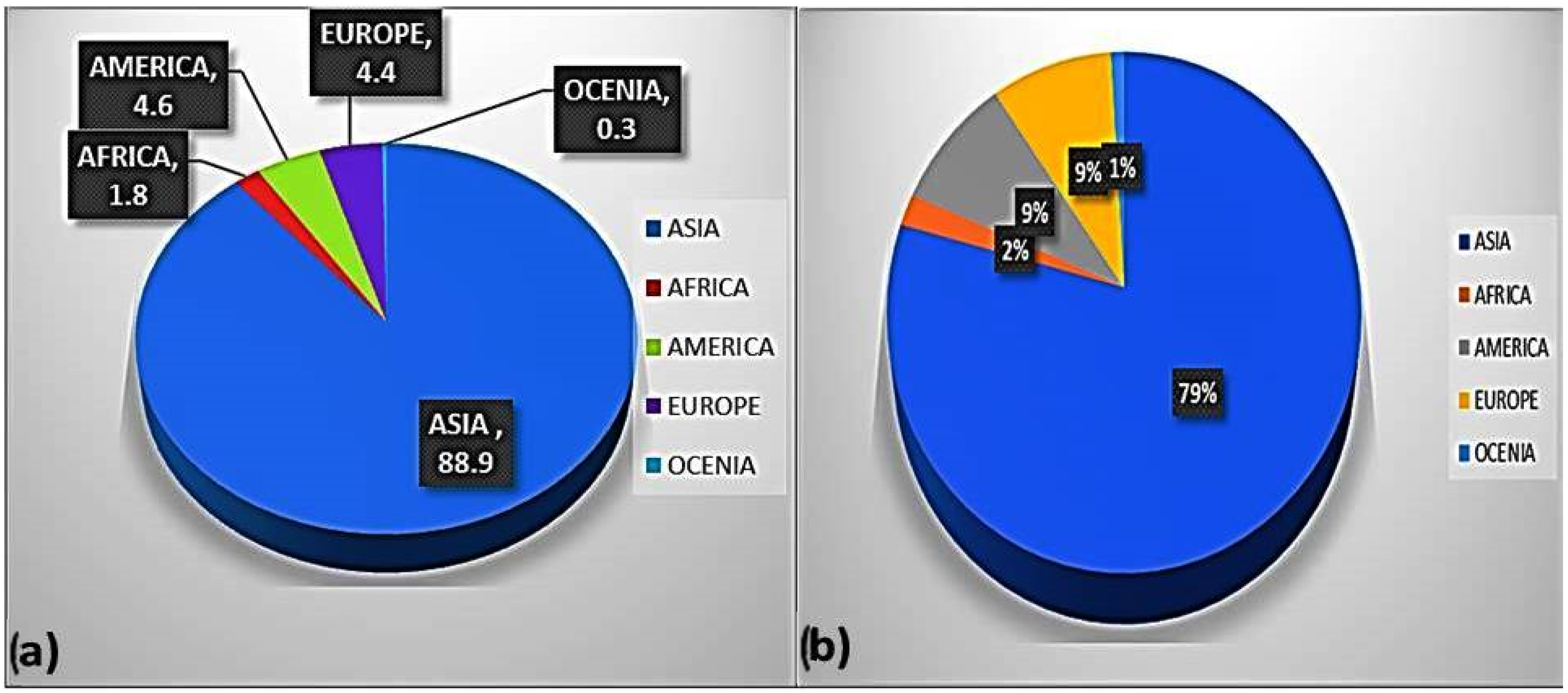
In 1987, 10 million tonnes of farmed fish and shellfish were cultivated, a figure that increased threefold to 29 million tonnes by 1997, alongside approximately 300 farmed species. It further increased to 80 million tonnes in 2017, which included 425 farmed species [3,10]. About 31.8 million tonnes of aquatic plants, 17.4 million tonnes of mollusks, and 8.4 million tonnes of crustaceans were produced, accounting for 28.4%, 15.4%, and 7.5% of the total aquaculture production, respectively. About 422,124 tonnes of the smaller marine and freshwater invertebrates were also produced [10]. Aquaculture provides 43% of the world’s aquatic fauna for human food consumption. It is expected that it will grow to address the future demand of the expanding population. Over the past 50 years, global aquaculture has experienced tremendous growth, increasing from approximately 52.5 million tonnes in 2008. The production was highest in Asia, accounting for 89% by volume and 79% by value [28] (Figure 1). The major product of the aquaculture industry is animal protein, which plays a crucial role in combating nutritional deficiencies and disorders. Edible products from the fisheries industry not only supply high-quality proteins but also essential vitamins, micronutrients, and minerals. For approximately 950 million people, fish remain the primary source of protein [29]. In Asia, aquaculture generates significant economic returns annually, being USD 471.66 billion by China alone in 2024. Japan alone imports an estimated 5400–10,000 tonnes of jellyfish products each year. At the same time, aquaculture practices have expanded to countries such as Namibia, Australia, the USA, and the UK to meet the rising demand [30].
In India, aquaculture exhibits an annual growth rate of approximately 7%, with catfish species accounting for 90% of total aquaculture production [31]. Globally, aquaculture production reached 214 million tonnes in 2020, reflecting a 0.2% increase from 2019 but a 0.6% decrease compared to 2018, primarily due to the COVID-19 pandemic [32]. Of this, aquatic animals for human consumption accounted for approximately 157 million tonnes. The total production from aquaculture comprised 87.5 million tonnes of aquatic animals intended for food. Other products include 35.1 million tonnes of seaweed and algae used for both food and non-food purposes, as well as 700 tonnes of shells and pearls designated for ornamental purposes. The rapid expansion of aquaculture, while addressing global nutritional demands, has also exposed the sector to emerging environmental and biological vulnerabilities [1]. These challenges underscore the critical need for adaptive strategies and resilience-building measures within aquaculture systems [4,5,11].

4. Challenges Associated with Aquaculture

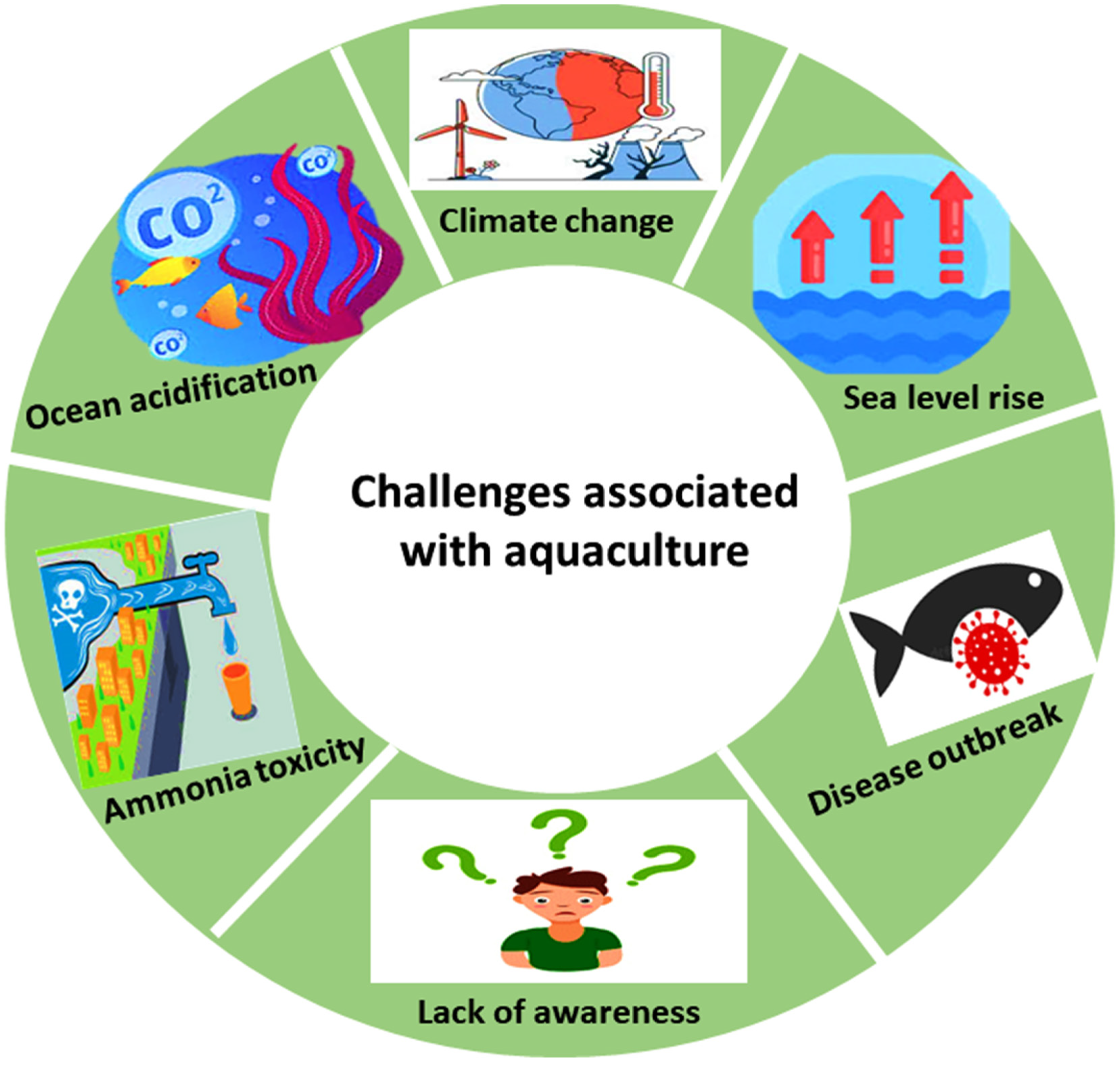
The rapidly expanding aquaculture industry, with its rising demand for fishery products, poses numerous challenges; therefore, it requires attention to sustain production. Among the major threats, climate change is particularly significant [33,34]. Finfish and shellfish are directly impacted through unpredictable alterations in their physiological traits, while shifts in primary and secondary productivity indirectly affect their health and ecosystem structure [33,34,35]. Rising sea levels and inland temperature fluctuations disrupt critical coastal ecosystems, such as mangroves and salt marshes, which lead to a decline in fish abundance and seed stock availability [36].
Effects of climate change on aquaculture are attributed to geography, climate zone, economics, farming methods, and the species cultivated [35,37,38,39,40,41,42,43]. Elevated temperature impairs the growth and development of aquatic animals, and prolonged thermal stress affects their endocrine and osmoregulatory systems [44]. Changes observed in sea surface temperature trigger algal blooms that deplete dissolved O2 and reduce reef fishery productivity through coral bleaching [36]. The early detection of temperature patterns may mitigate such threats, at least in artisanal aquatic sectors, when fish are cultured in open seas. Additionally, an increase in atmospheric CO2 levels leads to ocean acidification, resulting in a reduction in carbonate availability, which is crucial for the skeletal development of shell-forming organisms. As a result, it increases their vulnerability to predation and reduces their productivity [41,45,46,47,48,49].
Ocean acidification also increases production costs, forcing large producers to rely on hatcheries more frequently [44]. Furthermore, global warming alters precipitation patterns, and excessive rainfall causes floods that introduce invasive species into aquaculture systems. It degrades water quality and increases predation risks [44]. Conversely, drought intensifies stress on aquatic organisms. This leads to stock losses, elevated maintenance costs, and a reduction in overall production capacity [36]. Rising sea levels, along with natural phenomena such as storms and cyclones, can exacerbate salinity intrusion. It poses a significant threat to aquaculture [50]. Human activities, including coastal aquaculture operations, such as shrimp farming, also contribute to salinity intrusion, which has adverse effects on aquatic flora and fauna [50,51]. Ammonia toxicity, with LC50 concentrations ranging from 0.3 to 0.9 mg/L for cold-water fish, 0.7 to 3.0 mg/L for warm-water fish, 0.6 to 1.7 mg/L for marine fish, and 0.7 to 3.0 mg/L for marine shrimp, raises significant concerns in aquaculture [52]. Ammonia levels are inversely related to dissolved O2 levels, and their imbalance can lead to water eutrophication [52]. Parasitic, bacterial, viral, and fungal infections also heavily impact aquaculture, leading to severe fish health conditions, such as pancreatic necrosis in salmonids [53] and fin rot. In turn, it can cause severe tissue damage in Atlantic salmon and rainbow trout [54].
Another critical but less attended issue is the need for sex control to stabilize mating systems, maintain fish quality, and prevent precocious maturation. Altogether or alone, these can reduce feeding rates and hinder growth [55]. Production of mono-sex populations is desirable in species such as Nile tilapia, as males exhibit faster growth and better feed conversion efficiency compared to females [56]. Stress is a significant factor that affects aquaculture, particularly in farmed fish, and induces adverse effects on growth, reproduction, immune function, and disease susceptibility [57,58]. Diet plays a crucial role in modulating stress sensitivity [59], while feed quality, feeding rate, reproductive frequency, and male-to-female ratio are important for optimal growth and development [60]. The use of advanced technology to address the aforementioned issues is believed to be essential for enhancing productivity in the aquaculture sector [4,5,11]. Additionally, handling and transport are major stressors that indicate the need for stress-minimizing water quality management and oxygen maintenance during these processes [61]. Many aquaculturists who lack resources and knowledge on pond preparation under climate change and the above-mentioned conditions bear huge losses [36]. In such cases, the importance of early prediction of environmental or disease challenges and educating farmers on the use of modern technologies, including (bio)sensors, is crucial. Various obstacles to aquaculture are listed in Table 1 and illustrated in Figure 2. Given these operational challenges, the need for real-time monitoring and quality assessment technologies has become increasingly crucial in aquaculture systems.
Table 1. Challenges to aquaculture and their effects.
ChallengesEffectsReferences
Climate ChangeAlters physical and physiological aspects of finfish and shellfish; changes in primary and secondary productivity; ecosystem structure alterations.[33,34,35]
Sea-Level Rise and Inland Temperature ChangesDamages coastal ecosystems, mangroves, and salt marshes; reduces fish abundance and distribution.[36]
Geographical and Climatic VariationsVarying impacts on aquaculture based on location, climate zones, economy, production systems, and species.[35,37,38,39,40,41,42,43]
Rising TemperaturesAffects growth and development of aquatic animals; impacts endocrine and osmoregulatory systems; leads to algal blooms, reducing dissolved oxygen; coral bleaching affects reef fisheries.[36,44]
Ocean AcidificationDecline in pH-affecting shell-forming organisms like shrimps, mussels, oysters, and corals; increased vulnerability to predation; higher production costs due to reliance on hatcheries.[41,44,45,46,47,48,49]
Changes in Precipitation PatternsIncreased rainfall, causing floods and introducing invasive species; droughts leading to water stress, stock loss, and higher maintenance costs.[36,44]
Sea-Level Rise and Natural PhenomenaSalinity intrusions threatening aquaculture; anthropogenic activities, like shrimp farming, exacerbate salinity intrusion, affecting aquatic flora and fauna.[50,51,62]
Ammonia ToxicityHarmful effects on aquatic life; inverse relationship with dissolved oxygen; eutrophication due to imbalance in ammonia and nitrate levels.[52,63,64]
Disease OutbreaksParasitic, bacterial, viral, and fungal diseases cause significant harm; examples include pancreatic necrosis in salmonids and fin rot in Atlantic salmon and rainbow trout.[65,66,67,68]
Need for Sex ControlEnsures stability of mating systems; prevents precocious maturation; desire for mono-sex populations for better growth rates, e.g., male Nile tilapia grow faster.[55,56]
Stress FactorsNegatively impacts growth, reproduction, and immune function; influenced by diet, handling, and transport; poor water quality and oxygen levels exacerbate stress.[60,69,70]
Lack of Education and AwarenessAqua culturists, who are often poor, are inadequately prepared to adapt to changes, making them vulnerable to impacts on fish resources.[36]
Figure 2. Challenges associated with aquaculture (modified after Sarkar et al. [71]).
Chemosensors 14 00013 g002

5. Biosensors

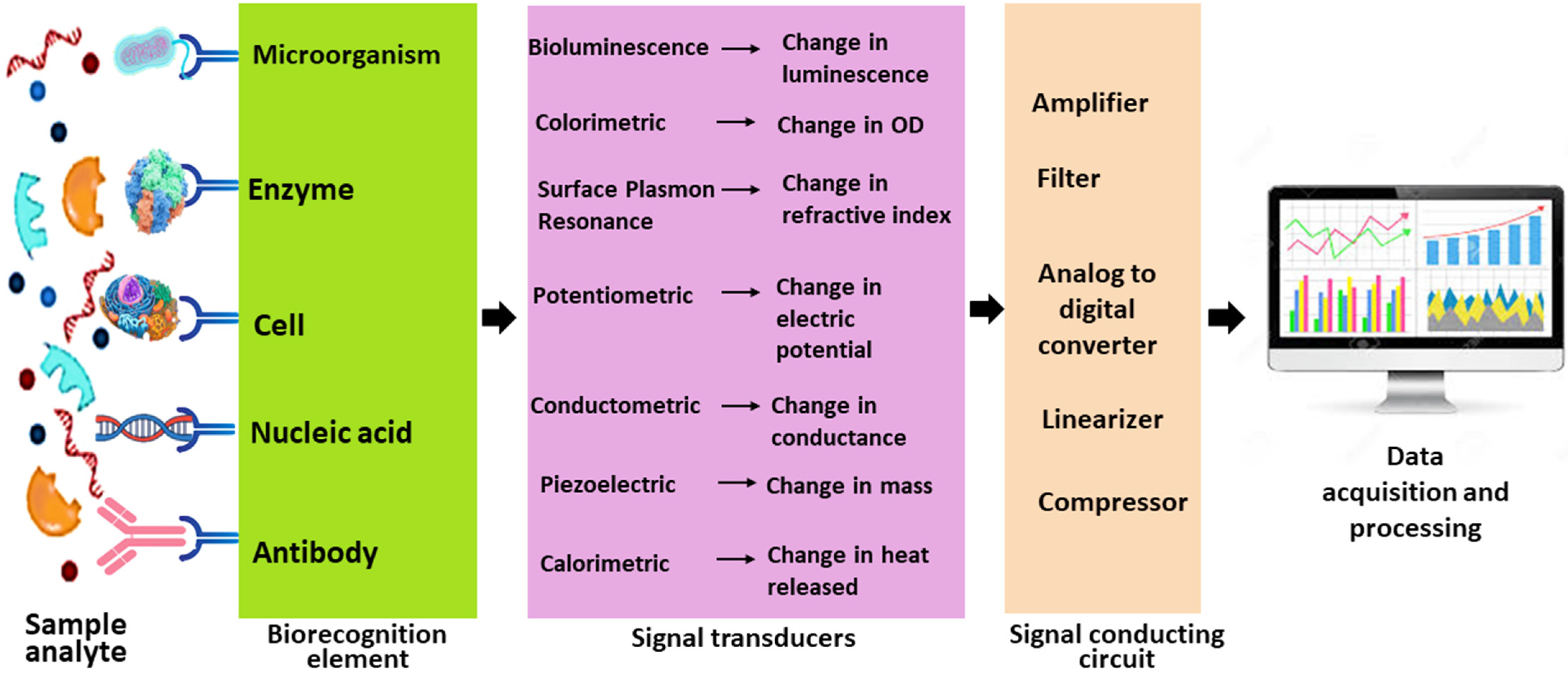
Since ancient times, humans have conducted bioanalysis using their senses, and the evolution of biosensors has advanced as an integrative tool for quality control, food safety, environmental impact assessment, and applications in medicine, agriculture, and industry [72]. A biosensor typically integrates biological recognition components (bio-receptors) with a transducer system to efficiently detect specific compounds or conditions, offering rapid, low-cost, on-site detection compared to conventional, time-consuming methods [72]. A standard biosensor comprises an analyte of interest; bioreceptors, such as enzymes, cells, aptamers, DNA, or antibodies that generate signals upon recognition; and a transducer that translates these signals in proportion to the analyte–bioreceptor interactions [20]. Electrical components then convert the signal into a digital output, which is displayed on devices, such as Liquid Crystal Display (LCD) screens, computers, or printers in various forms, including numeric, graphic, tabular, or image formats [20] (Figure 3).

5.1. Types of Biosensors Used in Pisciculture

The performance and application of biosensors are highly influenced by the design and functionality of their transducer modules. Accordingly, biosensors are classified into various types based on the nature of the transducer used (Table 2). Recent advancements in sensor technology have significantly enhanced detection accuracy, sensitivity, and operational stability, driving broader adoption across multiple domains, including aquaculture.

5.2. Mode of Detection

Various operation modules for specific types of biosensors are employed in aquaculture to address several challenges. Integrating specialized biosensor systems has enabled real-time monitoring of critical aquatic parameters that contribute to the sustainable management of aquaculture practices.

5.2.1. Wireless Sensor Network

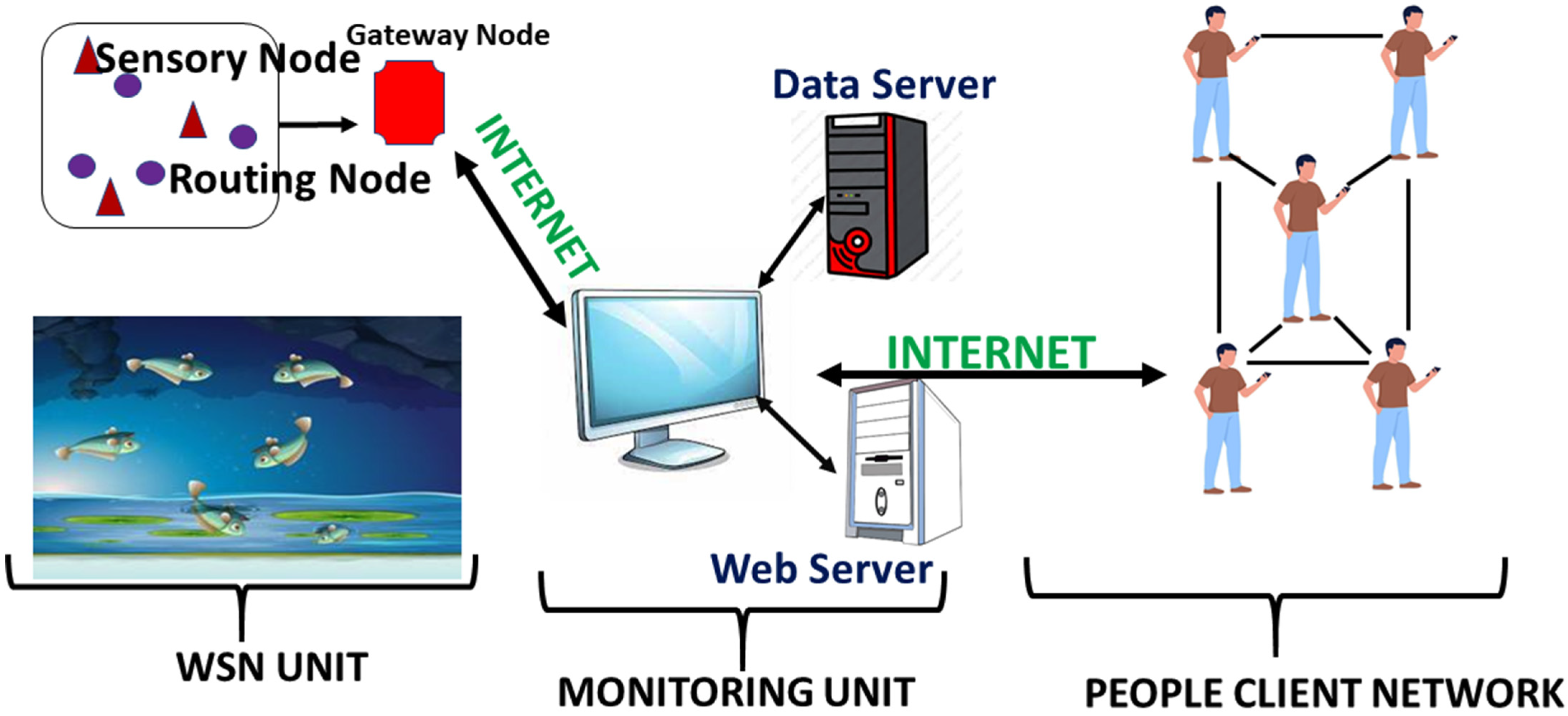
Wireless Sensor Networks (WSNs) have emerged as an alternative to conventional cable networks in aquaculture. These address challenges such as complexity, maintenance, and limitations on expansion [83]. In 2011, researchers at Jiangsu University developed a WSN system capable of real-time measurement of six to seven water quality parameters, including dissolved O2, pH, and temperature [84]. The WSN operates according to the Institute of Electrical and Electronics Engineers (IEEE) 802.15.4 standard, comprising sensor nodes, routing nodes, and a gateway node [85]. A simplified model consists of three components: the WSN Unit (with sensor, routing, and gateway nodes placed in the fish pond), a monitoring unit (data and web servers), and a client network [83]. Sensor nodes gather environmental data, routing nodes that optimize the transmission path to the gateway, and the collected information is processed by servers and relayed via the internet to authorized clients [83] (Figure 4). Recent advancements in nanotechnology have further enhanced the sensitivity and functionality of biosensing systems integrated into such networks, particularly through the application of nanoparticles. These developments introduce a new dimension to real-time aquatic monitoring, enabling the early detection of biological and chemical changes. In aquaculture, both environmental changes and changes induced by such changes in fish make them vulnerable to infection and death. For example, cold susceptibility of Nile tilapia (Oreochromis niloticus) or high temperature-induced infection of reovirus in grass carp (Ctenopharyngodon idella) [86,87]. Therefore, real-time monitoring of water parameters using WSN biosensors in aquaculture, combined with a client information alert system, is beneficial.

5.2.2. Nanoparticle Biosensor

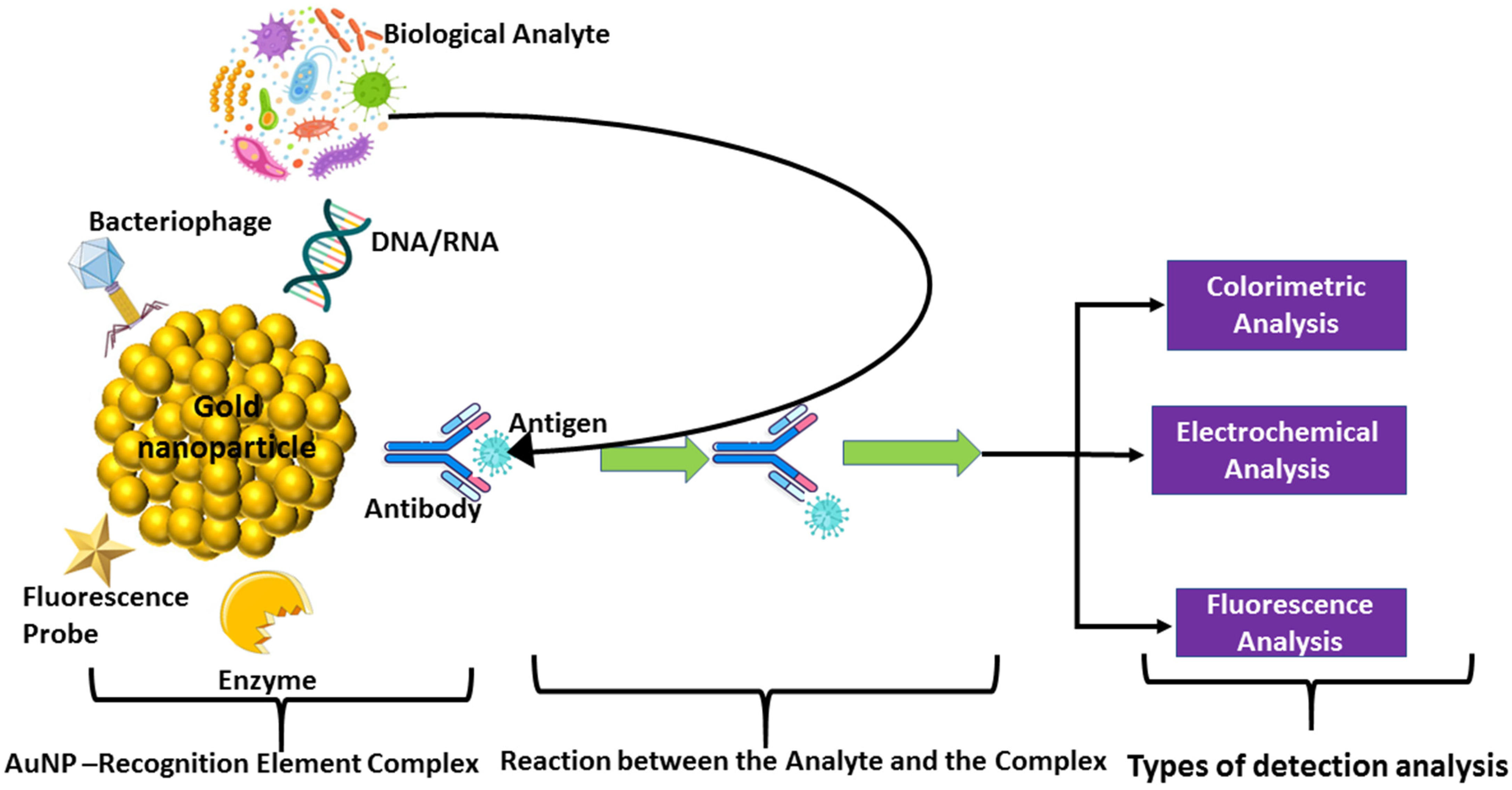
Nanoparticles ranging in size from 10 to 500 nm possess a spherical, polymeric structure that offers a high surface-area-to-volume ratio. It enables their applications across fields, including in the aquaculture sector [88]. They aid in disease detection, drug delivery, and the management of water quality. Designed nanosensors/-particles (diaminonaphthalene/Remazol Blue R-capped zinc oxide and carbon nanotubes) can help to detect hormones such as epinephrine in biological fluids [89,90]. Metal nanoparticles such as gold, silver, and platinum serve as ideal core materials due to their excellent conductivity and catalytic properties [91,92]. Interestingly, gold nanoparticles (AuNPs) appear ruby red rather than gold, and their size inversely influences enzyme stability and biosensor sensitivity [93]. Un-aggregated particles are ruby red, and their color varies with aggregation, whereas aggregated particles exhibit blue to black hues depending on the degree of aggregation [94,95,96]. AuNPs efficiently adsorb biomolecules to form recognition complexes, which is essential in aquaculture applications for water quality monitoring and disease detection [97]. These nanoparticles are coated with bio-recognition materials, such as DNA, RNA, enzymes, or antibodies, which interact with target analytes, enabling detection through fluorescence, colorimetric, or electrochemical methods (Figure 5).
AuNPs have shown promising results in disease diagnostics [22,98]. For example, a fiber-optic SPR biosensor was developed to detect nervous necrosis virus (NNV) early in infection by targeting viral coat proteins with AuNPs [22]. Shrimps are sensitive to the pathogen white spot syndrome virus (WSSV), which is characterized by calcium deposition and lethargy. It is identified using AuNPs functionalized with anti-WSSV antibodies via self-assembled alkanethiol monolayers [99]. Integrating AuNPs with optical sensing platforms, such as SPR biosensors, has significantly enhanced the sensitivity and specificity of aquatic disease diagnostics. These advances underline the critical role of SPR-based approaches in real-time monitoring of aquatic pathogens. Since the above methods provide quick results under extreme conditions, such as the rapid detection of viral disease outbreaks in fish, they enable for the adoption of timely and appropriate measures [100,101].
Figure 5. Mechanism of working of the nanoparticle biosensor (modified after Hegde et al., [102]. Curved arrow indicated antigens form the samples containing viral or bacterial infection while straight arrows indicate the forward steps.
Chemosensors 14 00013 g005

5.2.3. Surface Plasmon Resonance (SPR)

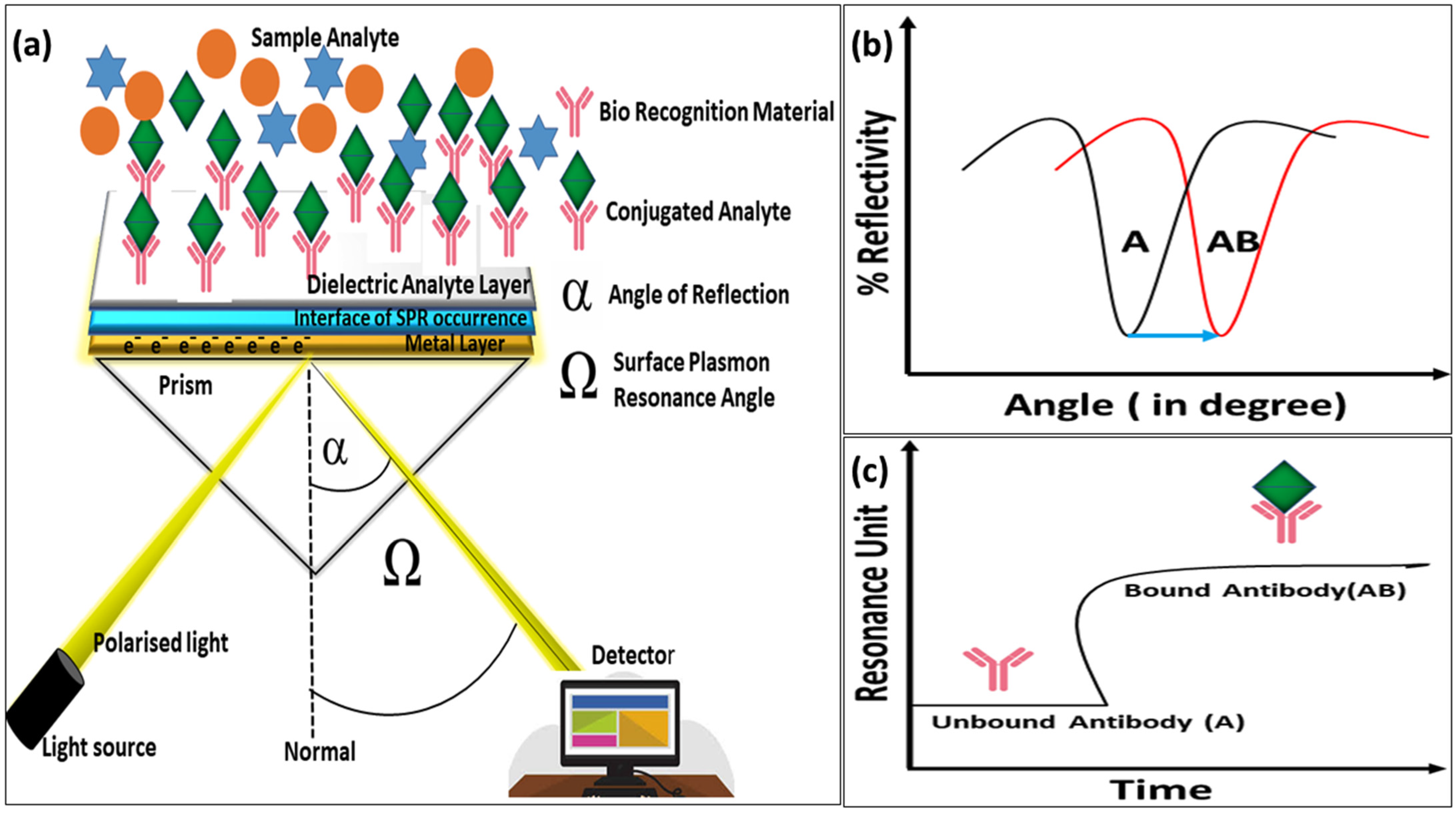
The SPR biosensors are optical instruments that detect changes in refractive angles during specific analyte binding events [103]. These sensors play a crucial role in aquaculture by detecting pathogens and toxins that are harmful to aquatic life. The Kretschmann configuration is the most widely used model that includes a dielectric-metal interface with a prism attached to a metal layer in an inverted position [104]. When plane-polarized light exceeds the critical incident angle, total internal reflection occurs, and it transfers energy to excite surface electrons (typically on gold), producing surface plasmon waves. Noble metals such as gold, silver, platinum, and palladium enhance optical absorption properties [105]. The plasmonic band, detected in the visible to near-infrared regions [106], shifts with analyte binding and is monitored by changes in resonance angles. Finally, it provides a highly sensitive method for analyte detection [107] (Figure 6).
SPR technology is increasingly applied in aquaculture for water quality monitoring. Excess nitrogenous compounds from uneaten feed, fertilizer leaching, and fish waste can induce toxicity risks, particularly due to the ammonia load [108]. An SPR biosensor using nitrate reductase from Aspergillus niger and glutamine synthetase from Escherichia coli on gold nanoparticles was developed to measure nitrate (NO3) and ammonium (NH4+) concentrations, offering an effective tool for water analysis [109]. Aquaculture intensification often degrades water quality, which leads to stress-related health issues in fish, and is influenced by factors such as pH, water flow, and temperature [110]. Prolonged exposure to poor water conditions elevates cortisol, urea, and creatinine levels beyond normal physiological ranges [111]. Addressing such issues, a polymer optical fiber coated with gold/platinum nanoparticles and anti-cortisol antibodies has been developed for direct cortisol monitoring in water bodies [112], which is proposed to enhance fish health surveillance. Therefore, the use of SPR-based technology for detecting toxins, such as tetrodotoxin, in water bodies or for detecting diseases by measuring pathogen products, is recommended in aquaculture [113]. In addition to water quality monitoring, biosensor innovations have expanded into pathogen detection, enabling early disease diagnosis in aquaculture systems. One such advancement involves cantilever-based biosensors, which offer remarkable sensitivity for detecting biological targets.
Figure 6. Surface plasmon resonance biosensor. (a) A schematic diagram representing the mechanism of the surface plasmon resonance for the reactive curve. (b) The figure illustartes the shift in the reactivity curve: where ‘A’ represents the unbound antibody, and ‘AB’ represents the bound antibody. (c) The figure represents a sensogram. Two cases are described: unbound antibody and bound antibody. e- indicates the electrons. (modified after Lifeasible (https://www.lifeasible.com/custom-solutions/plant/analytical-services/gene-function-analysis/surface-plasmon-resonance-spr/; accessed on 8 December 2025) [114]).
Chemosensors 14 00013 g006

5.2.4. Microcantilever Biosensor

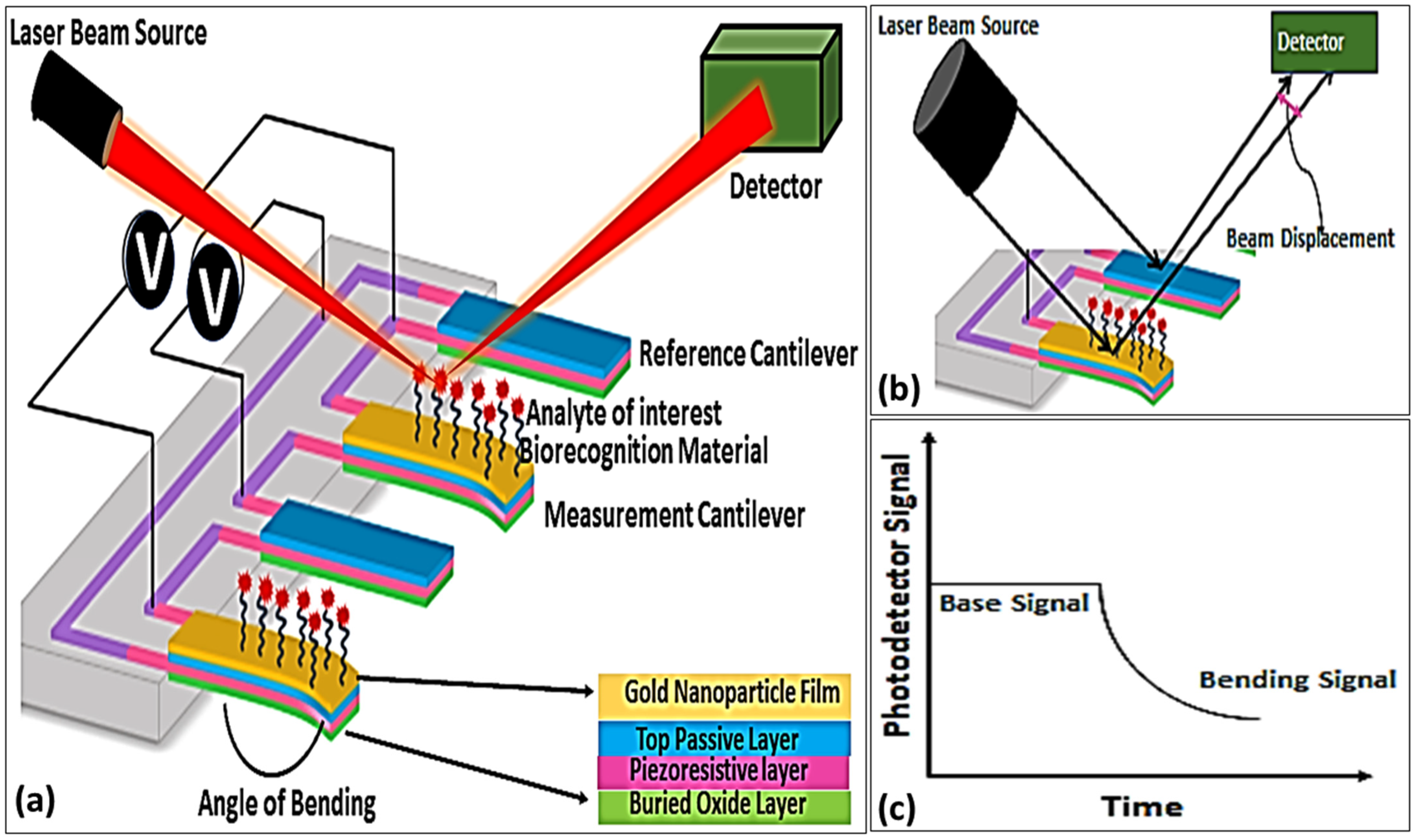
A cantilever is a structure fixed at one end and free at the other, similar to a diving board [115]. Micro-cantilevers are a relatively recent innovation in aquaculture and have been utilized for disease detection in fish. It offers exceptional sensitivity and low detection limits, making it a valuable tool in aquaculture [116]. These biosensors integrate microcantilevers with dynamic force microscopy (DFM) within an atomic force microscope (AFM), which detects shifts in resonance frequency upon binding of the target analyte [117]. The piezoelectric actuator detects mass loading, resulting in a decrease in the resonance frequency [118]. A study from Thailand demonstrated the first cantilever-based cholera detection, where a gold-coated microcantilever functionalized with antibodies specific to Vibrio cholerae O1 showed a decrease in resonance frequency proportional to the bacterial concentration [119].
Resonance frequency changes are measured via the optical beam deflection method, where a photodetector monitors a laser reflected from the cantilever, and the resulting photocurrents are processed through a data acquisition system [120]. The differential displacement between a reference and measurement cantilever determines the presence and concentration of analytes, as evidenced by a bending signal that is lower than the base signal (Figure 7). Overall, cantilever-based biosensors offer a promising approach for the early detection of waterborne pathogens, which helps to prevent disease outbreaks in aquaculture farms and artisanal fish farming. Despite their advantages, cantilever sensors can be limited by environmental disturbances, highlighting the need for alternative high-sensitivity detection platforms. Consequently, other biosensing technologies have been explored to further enhance diagnostic accuracy. Undoubtedly, ultrasensitive and rapid detection systems in microcantilever biosensors expand their diverse application fields, including aquaculture, to reduce the risk of contamination, particularly during disease outbreaks. Detection of V. cholerae in water samples using DFM is a notable example in the aquaculture industry [119]. Detection of the bacterium Escherichia coli using a V-shaped microcantilever sensor from water samples is another example [121]. Similarly, the detection of a 1 pg/mL level of okadaic acid is also achieved using an aptamer-based microcantilever-array biosensor. The measurement of glucose levels in bio-samples using an integration of glucose aptamer, glucose oxidase, and horseradish peroxidase enzymes with the substrate 2,2′-biazobis(3-ethylbenzothiazoline-6-sulfonic acid) is also noted at a sensitivity level of 0.013 mM [122].

5.2.5. Quartz Crystal Microbalance Biosensor

Traditional detection methods, such as microscopy, ELISA, and PCR, are often tedious, time-consuming, and prone to yielding false positive results in samples. Consequently, the development of biosensors has provided a more sensitive, efficient, and point-of-care alternative for analyte detection [123]. Quartz Crystal Microbalance (QCM) biosensors offer a low detection limit and high specificity that minimizes false positive results on one hand and limits the risk of biosensor damage on the other [124,125]. The QCM operates on the principle of piezoelectricity. It utilizes gold-coated quartz electrodes to detect changes in mass through shifts in resonance frequency, which facilitates analyte recognition [126]. The QCM with Dissipation Monitoring (QCM-D) system is an advancement of this technology. It measures both frequency changes and energy dissipation during analyte binding and removal, thereby enhancing analytical capabilities [127].
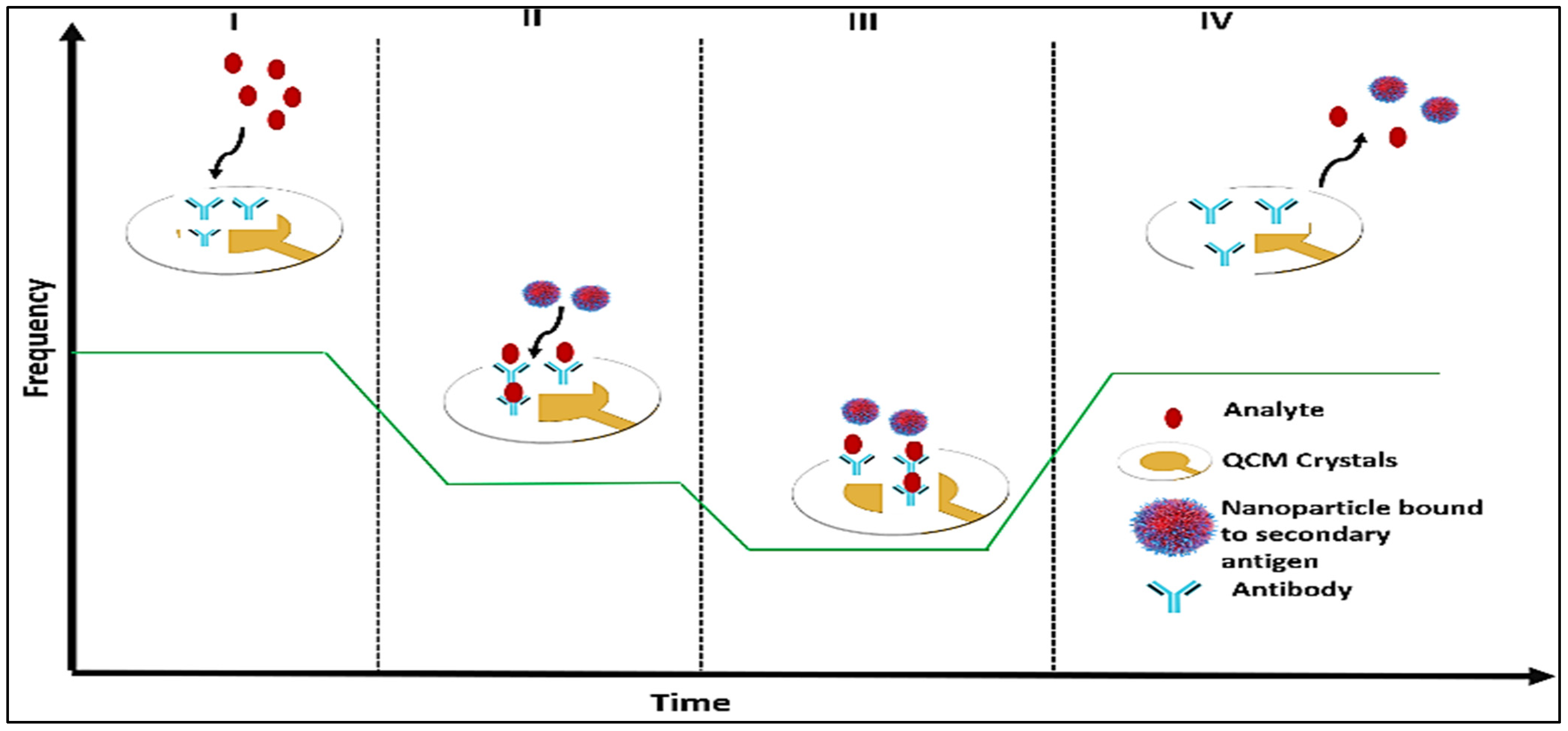
In QCM-D, a specific recognition material is immobilized on the quartz surface to selectively bind target analytes. It causes a mass increase coupled with a decrease in frequency. To further enhance the detection limit, nanoparticles can be attached to secondary antibodies without modification [128] or used directly to increase the detectable mass [129,130]. This multi-phase detection mechanism comprises initial antibody immobilization (highest frequency), analyte binding (reduced frequency), secondary antibody–nanoparticle conjugation (further decrease in frequency), and regeneration upon removal of bound entities (Figure 8). However, coatings of antibodies and nucleic acids are prone to denaturation when exposed to environmental fluctuations, which limits their stability. To overcome this issue, molecularly imprinted polymers (MIPs) have been introduced as synthetic alternatives to biological recognition elements. MIPs provide enhanced stability against pH, temperature, and ionic changes, which help maintain the integrity of the QCM-D biosensing system [131]. While QCM-D leverages mechanical responses to detect biomolecular interactions, electrochemical biosensors translate biochemical events into electrical signals, which offer complementary approaches for sensitive detection. These platforms continue to evolve by incorporating innovative materials and transduction strategies that broaden their applications in diagnostics and environmental monitoring. The detection of Vibrio harveyi bacterial pathogens in shrimp farms [132] and Aeromonas hydrophila bacterial pathogens in fish farms using QCM has already been documented.

5.2.6. Electrochemical Biosensor

Electrochemical biosensors incorporate biological compounds such as nucleic acids, antibodies, and enzymes, coupled with various types of transducers that define the specific biosensor category (Table 3). They offer high specificity, robustness, ultra-high sensitivity, low detection limits, and suitability for point-of-care diagnostics [134]. For example, potentiometric biosensors measure the potential difference between a working and a reference electrode. The biorecognition material coated on the working electrode facilitates the selective detection of the analyte compared to the reference [135]. Similarly, amperometric biosensors detect current changes in response to an applied potential. Its surface is coated with a redox-active analyte that undergoes oxidation or reduction, and the resulting electric current, which is directly proportional to the concentration of the analyte, is measured [136]. Conductometric biosensors monitor variations in electrical conductivity arising from the interaction between the biorecognition element and the target analyte [137]. Together, these approaches demonstrate the versatility and effectiveness of electrochemical reactions in biosensing applications [138]. For example, applications of electrochemical biosensors have been noted to detect NH4+ at a concentration of 0.65 μM using nanoparticle/polymethylene [139], and the measurement of xanthine with 97% accuracy, at a concentration of 47.96 nM, serving as an indicator of spoilage in stored fish, even after 30 days [140]. Therefore, the application of biosensors in aquaculture, specifically in fish farms, can enhance productivity by mitigating the associated on-field problems.
In summary, biosensors have the potential to mitigate several risks in the aquaculture sector, ranging from early, rapid, and real-time detection to auto-predicting solutions when integrated with AI- or IoT-based tools. They can be used for routine analysis at a cost-effective rate. Optical sensors can also be used for early, quick, and real-time monitoring of aquaculture systems with high precision in a non-invasive mode. While QCM biosensors offer superior mass sensitivity for detecting pathogen loads at the molecular level, they can be costly. Therefore, the choice to use specific biosensors can depend on the requirements (Table 3).

6. Application of Biosensors in Aquaculture

6.1. Biosensors for Fish Health Management

The physiological status and overall health of aquatic organisms can be assessed through the detection of various hormones, such as adrenaline [89] and epinephrine [90]. In addition to the above, enzymes and chemicals present in aquatic animals, including fish, can also be measured to assess their health status [141]. Key indicators such as blood glucose levels, cortisol, and lactic acid concentrations serve as important biomarkers for evaluating fish health [110,142,143,144,145]. For example, glucose oxidase is monitored by entrapping it in nano TiO2, which is discussed as a potential use for glucose biosensors. The device, known as ENFET, is designed to function as a field-effect transistor and utilize enzymes such as glucose oxidase as bioreceptors to indicate the sample glucose level with a sensitivity of 1.5 μA/0.0001 mM [146]. Traditional detection techniques, including liquid chromatography, fluorescence detection, as well as more recent developments like polymerase chain reaction (PCR) and flow cytometry, are often labor-intensive, time-consuming, and can induce significant stress during sample collection [147,148,149,150]. Advances in biotechnology have enabled the development of highly sensitive biosensors for use in aquaculture. They are preferable for measuring error-free results due to their target specificity, rapid detection, and ability to quantify minute analyte concentrations. These are considered promising tools for the future of the aquaculture industry, specifically in fish farming [151,152,153]. Various types of biosensors used for detecting fish diseases are listed in Table 3. Beyond disease detection, biosensors have also been utilized to address critical challenges in aquaculture breeding and reproductive management. Recent developments emphasize their role in enhancing the precision and efficiency of fish ovulation monitoring (Table 4).
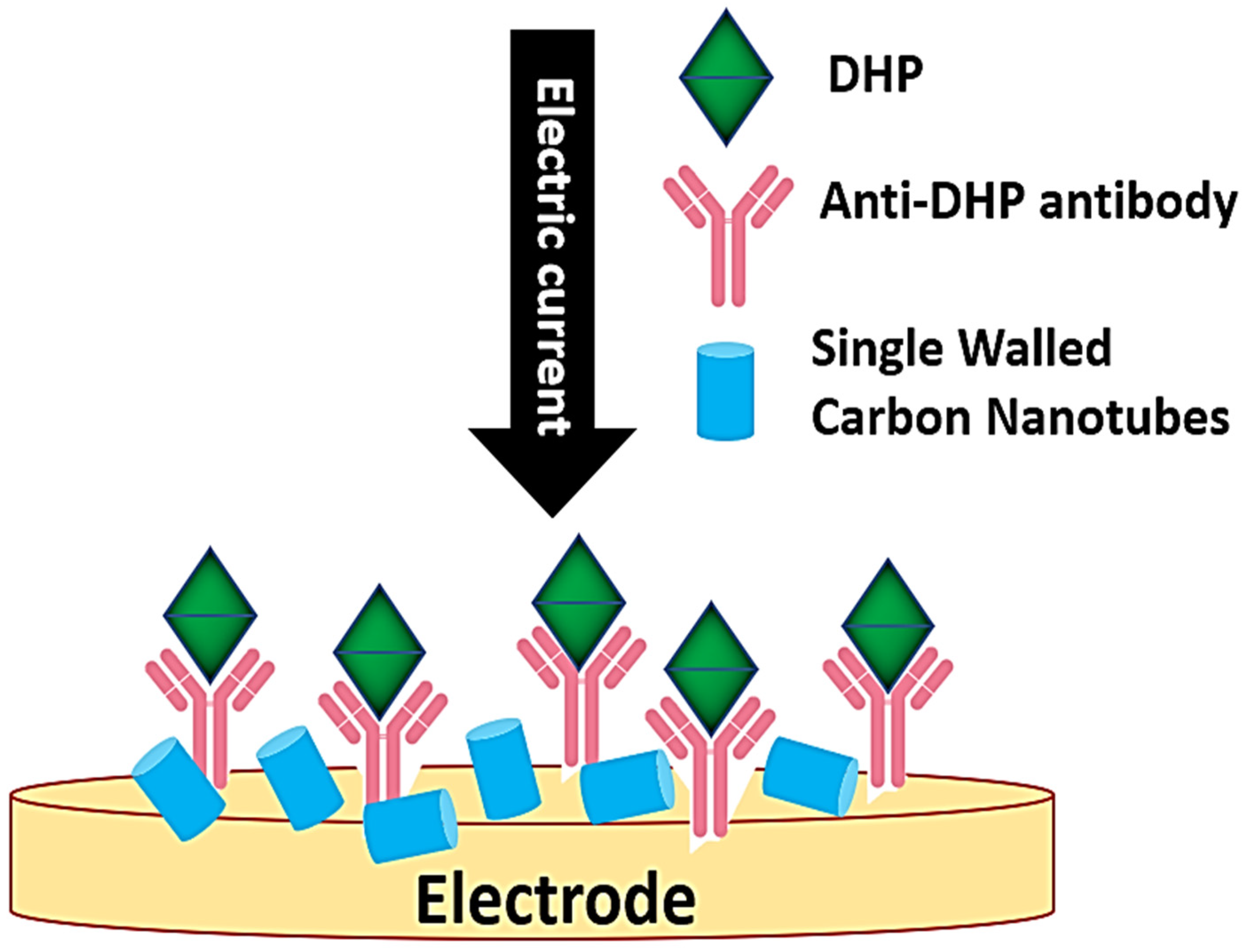
In aquaculture, the production and preservation of high-quality eggs are critical for successful breeding [175]. Ovulation timing varies with the environmental and physiological conditions of fish, making it difficult to predict accurately [110]. Biosensors have been developed to monitor dihydroprogesterone (DHP) levels, which rise sharply during egg maturation, and are used as a marker to enable more precise prediction of reproductive state [110]. The biosensor is operated by detecting changes in electric current caused by the interaction between DHP and immobilized anti-DHP antibodies on a gold nanoparticle-modified electrode surface [110]. To enhance sensitivity, Single-Walled Carbon Nanotubes (SWCNTs) are incorporated to improve conductivity [110] (Figure 9). Compared with the conventional ELISA method, which is invasive and labor-intensive, the biosensor demonstrated a strong correlation with ELISA results [110]. Such advancements in biomonitoring are crucial, as precise reproductive control has a direct impact on the efficiency of aquaculture and stock management.

6.2. Biosensors in Monitoring Stress Response

Current aquaculture practices aim to enhance fish development and growth by improving environmental conditions [176]. In addition to reproduction, continuous physiological monitoring has become essential for optimizing overall fish health and farm productivity. Monitoring the physiological status, particularly stress levels, of cultured fish is crucial for boosting productivity and reducing mortality [177]. Stress responses serve as an essential survival strategy but can have a negative impact on metabolism, reproduction, growth, and the nervous and immune systems [177]. Stressors in aquaculture commonly arise from routine practices such as collection, handling, sorting, holding, and transportation. Also, fluctuations in key water quality parameters, including temperature, pH, hardness, salinity, dissolved oxygen, carbon dioxide, nitrate, nitrite, ammonia, and alkalinity, influence fish health [69]. Additionally, competition within and between species further impairs fish growth [70,178]. Therefore, monitoring stress levels in fish is found to enhance their productivity.
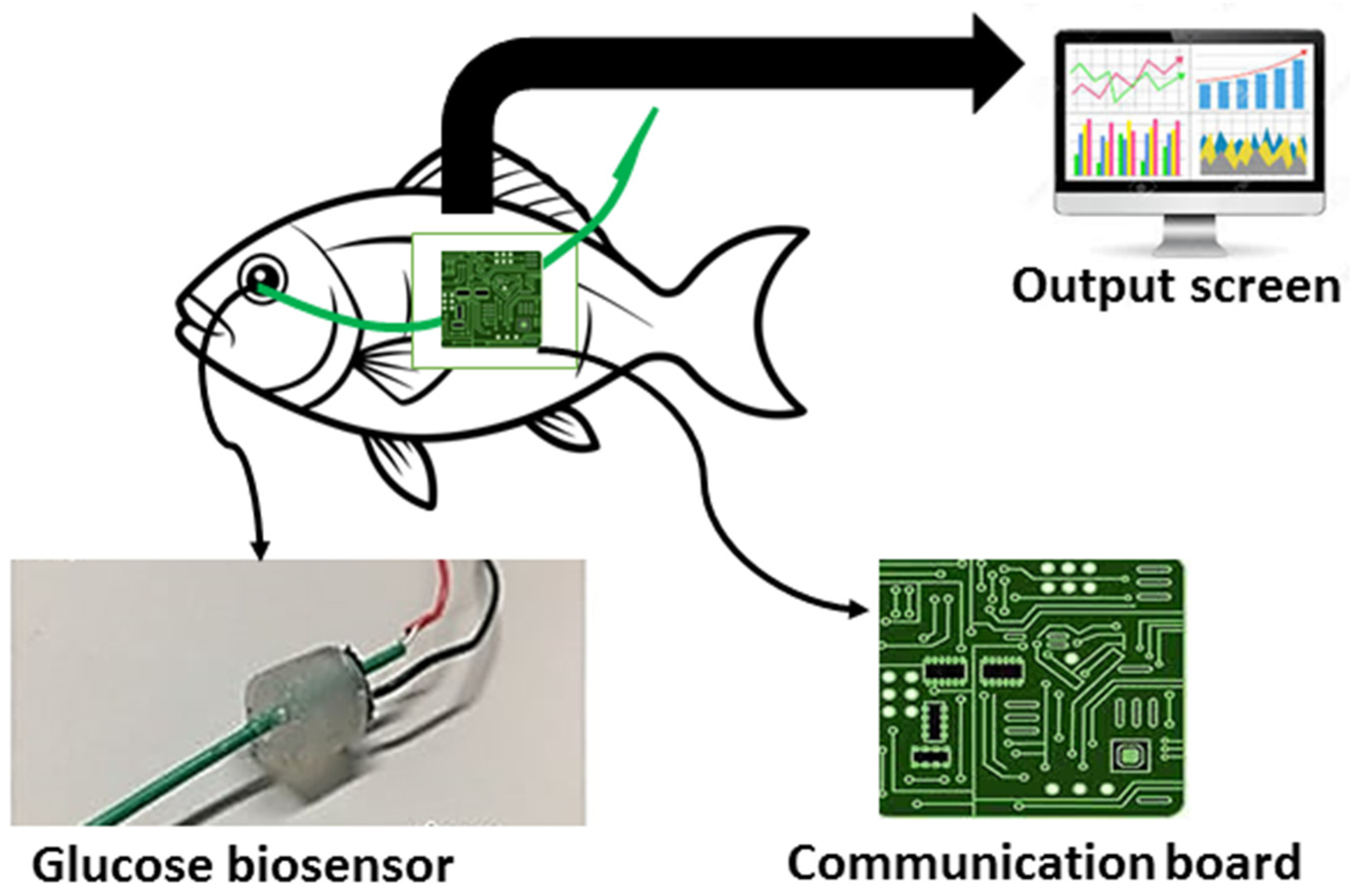
Blood analysis is a prevalent method for assessing fish health. Blood glucose and cortisol levels serve as primary indicators of stress [179]. The glucose level is strongly correlated with stress intensity and secondary stress responses, where the cortisol titer reflects the primary stress response [176]. However, conventional blood sampling methods are labor-intensive and may induce additional stress that limits accurate physiological assessment. To overcome these challenges, a wireless biosensor integrating an enzyme sensor with a communication device has been developed [159]. This system measures glucose in the scleral interstitial fluid beneath the fish’s eyeball, enabling continuous, real-time monitoring with rapid response, improved linearity, and enhanced reliability [180]. The scleral fluid around the fish’s eyeball is the most suitable site for glucose sampling due to its lower contamination and confirmed glucose detection [180]. A setup was designed to measure the stress level in fish using LED lights placed on a communication board attached to the glucose biosensor on the fish’s eyeball [174,181] (Figure 10). Various types of biosensors and their stress-detection mechanisms are mentioned in Table 5. In addition to monitoring stress, biosensors have emerged as valuable tools for pathogen detection, offering rapid and sensitive alternatives to conventional diagnostic methods. Early disease detection is critical for minimizing economic losses and ensuring sustainable aquaculture practices.

6.3. Biosensors in the Detection of Harmful Pathogens in Aquaculture

A significant risk in the aquaculture industry is disease caused by pathogen infections. This results in a loss of approximately $6 billion per year globally [186]. Different types of pathogenic diseases related to aquaculture include hepatopancreatic necrosis disease, tilapia lake virus, white spot syndrome virus (WSSV), and Infectious Salmon Anemia (ISA), among others [3]. Pathogens are detected using techniques such as biochemical methods, 16S rRNA typing, diagnostic PCR, serological tests, and associated protein detection methods [10]. These methods provide good results but are expensive. Recent innovative advanced techniques incorporated in the developed biosensors can detect pathogens in aquaculture. These biosensors are helpful to diagnose a wide range of bacterial (Table 6) and viral (Table 7) pathogens. In turn, it is noted that enhancing productivity in aquatic farms is beneficial.

6.4. Biosensors in the Detection of Adulterations in Fish

In addition to biological threats, post-harvest handling practices pose significant risks to the quality and safety of seafood. Due to the risk of protease activities and bacterial spoilage, fish are perishable after the post-harvest stage and should therefore be consumed in their fresh state [199]. To increase the profit margin, fishermen add hazardous and harmful chemicals, such as sodium benzoate, formaldehyde, and ammonia, to extend the storage life of fish and other seafood [200]. Various methods, including liquid chromatography, ultraviolet detection, mass spectrometry, fluorescence techniques, gravimetric methods, Eegriwe’s method, and Deniges’ method of colorimetric analysis, are used to detect adulteration in fish [30]. Various conventional techniques have been developed to detect these in adulterated foods, but they have certain limitations. To overcome such constraints, biosensors have been used to prevent post-harvest issues (Table 8).

6.5. Biosensors for the Detection of Fresh Aquaculture Products

Given the challenges associated with chemical adulteration and the need for rapid freshness evaluation, biochemical markers have gained significant attention. Hypoxanthine, generated through ATP degradation, exists either independently or alongside other ATP metabolites and serves as a key indicator to evaluate fresh fish [201,202]. Various enzymatic biosensors employing colorimetric and electrochemical methods have been developed to detect hypoxanthine levels [204]. Xanthine oxidase (XOD) is widely used for the detection of hypoxanthine and xanthine, often immobilized on electrodes through cross-linking with glutaraldehyde and bovine serum albumin (BSA) [205]. These biosensors exhibit a color change corresponding to hypoxanthine concentrations ranging from 0 to 1.13 mM, allowing for semi-quantitative freshness assessment by visual inspection.
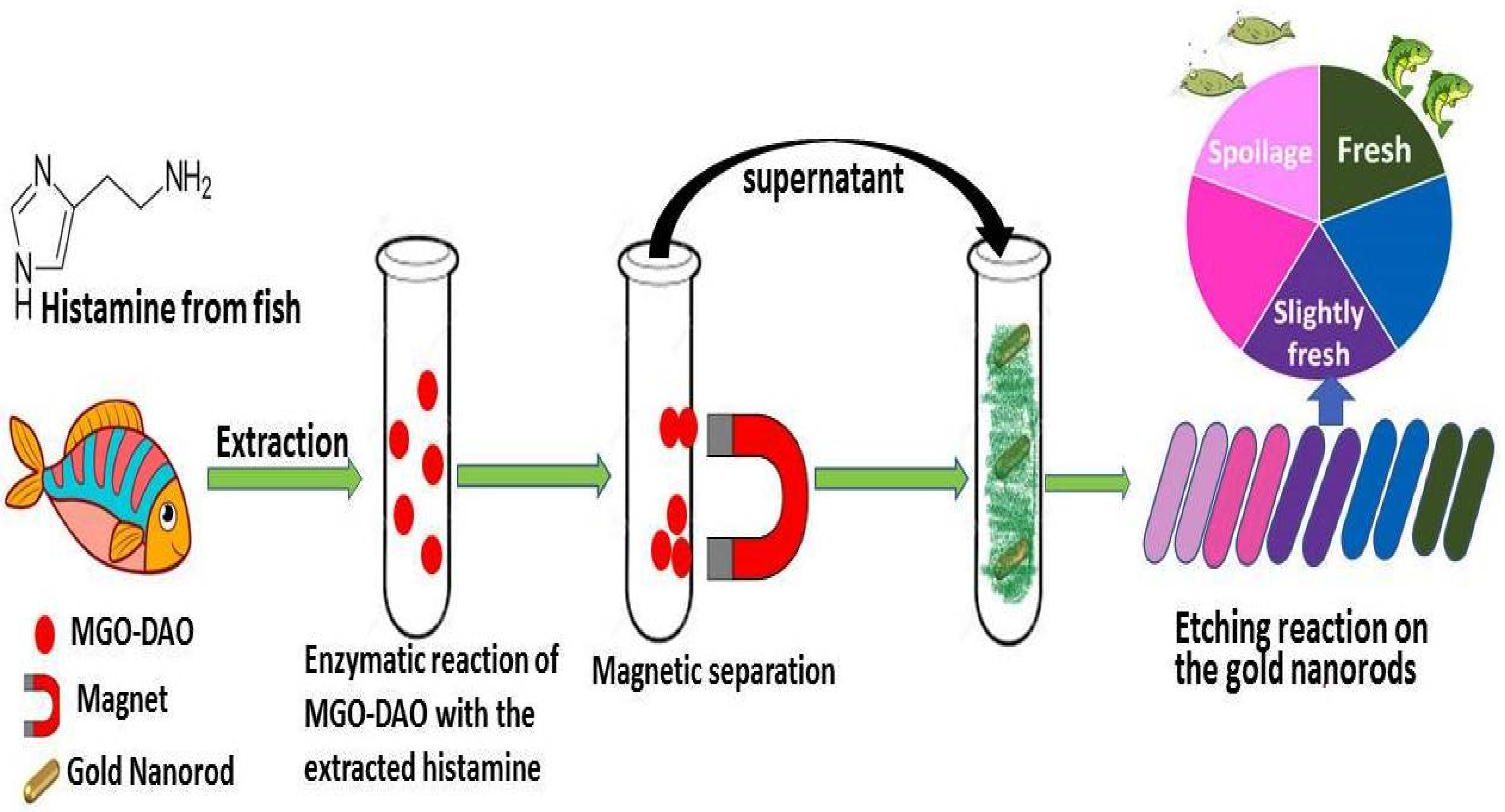
An alternative freshness assessment approach involves colorimetric analysis of histamine produced by the post-mortem decarboxylation of histidine, particularly in Scombridae species, such as mackerel and tuna [210,211]. According to FDA guidelines to avoid histamine poisoning, the permissible histamine limit is accepted as 200 ppm [212]. Recent studies have demonstrated the use of Magnetic Graphene Oxide (MGO) combined with Diamine Oxidase (DO) for histamine detection via a colorimetric assay [213]. Diamines, indicative of nitrogen metabolism, serve as biorecognition elements [214], while MGO provides a high surface area and magnetic separation capabilities [215]. In this method, histamine reacts enzymatically to produce hydrogen peroxide (H2O2). In the presence of gold nanorods (AuNRs) and iodide ions, a visible color change occurs, ranging from dark green to colorless, as the histamine concentration increases [130]. The etching reaction on the AuNRs produces a multicolor readout according to histamine concentration (Figure 11). Different colors correspond to the variation in the freshness of the fish according to the concentration of histamine (Figure 11).

6.6. Physiological Factors for Fish Health Management

Aquaculture has been expanding rapidly due to the increased demand for fish products. It necessitates intensive farming practices that are often reliant on antibiotics and growth factors, which pose risks to human health. As a result, non-pharmacological methods for monitoring fish health are in demand. Hemodiagnosis, which involves analyzing blood component concentrations, is a valuable tool for assessing the physiological status of fish [142,143]. Indicators, such as plasma total cholesterol and blood glucose levels, reflect fish health, where elevated glucose levels signify stress, and reduced cholesterol is correlated with lowered bacterial resistance [216]. Changes in cholesterol concentration can be used to evaluate immunity [217], the effects of toxins [218], metabolism [219], and sperm function [220]. Studies by Maita et al. in 1998 demonstrated that reductions in plasma lipid components are associated with a decrease in resistance capacity against bacterial infection in cultured fish [142,143]. Conventional colorimetric methods for hemodiagnosis were complex and costly, prompting the development of biosensor technologies that offer more straightforward and efficient health monitoring approaches in fish farming.
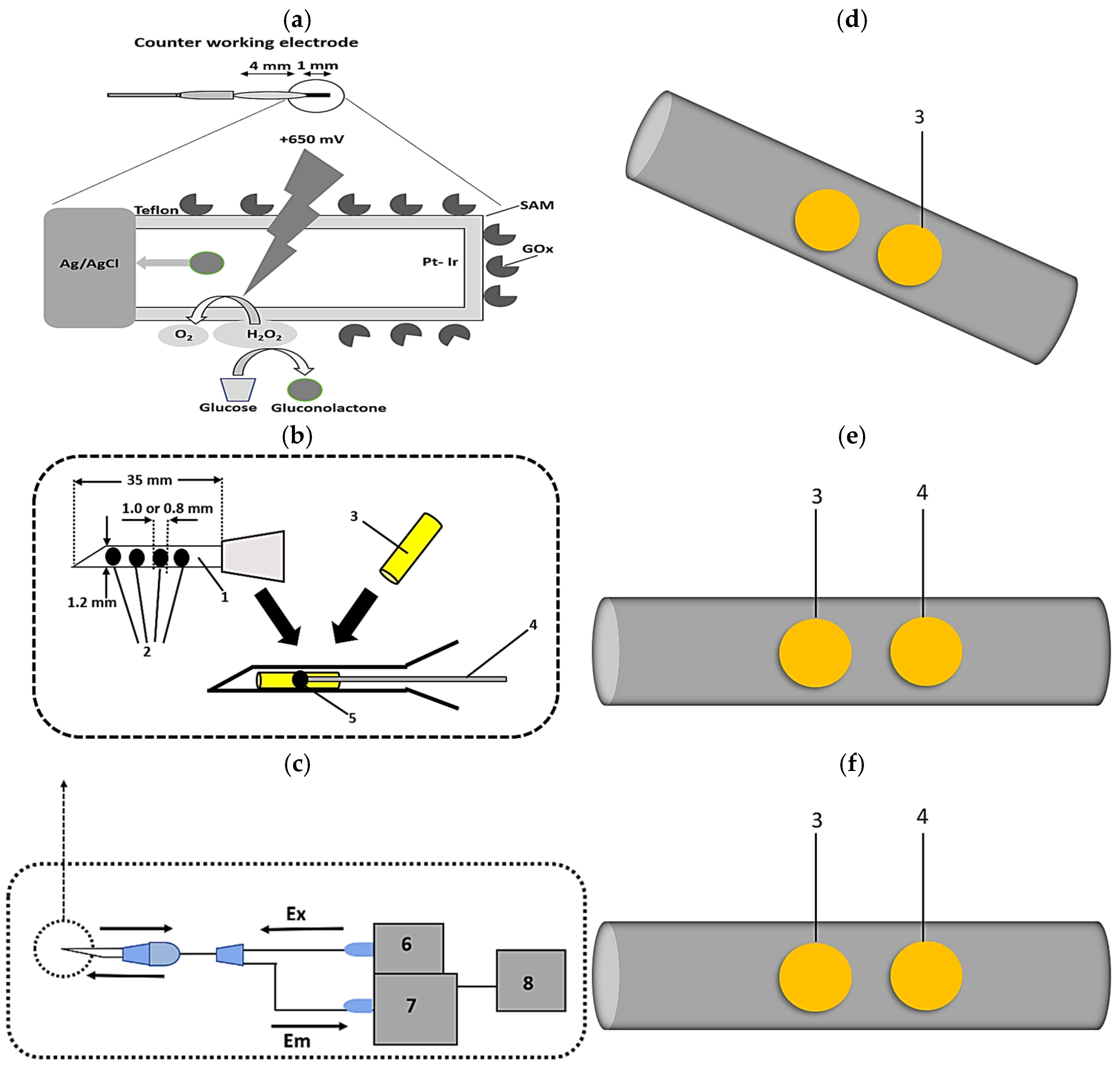
Yoneyama et al. (2009) [221] and Takase et al. (2014) [171] introduced a flow injection analysis (FIA)-based needle-type biosensor for the detection of total cholesterol. They have utilized a Teflon-coated Platinum–Iridium (PT-IR) electrode and a silver/silver chloride (Ag/AgCl) reference electrode with an enzyme-immobilized membrane at the tip. The sensor is inserted into the interstitial fluid (ISF) of the fish’s eye to measure cholesterol through a series of sequential enzymatic reactions that culminate in the electrocatalytic oxidation of H2O2. This generates a current proportional to cholesterol concentration but is sensitive to dissolved O2 levels (Figure 12). In contrast, mediator-based biosensors, which employ artificial electron mediators, minimize their dependence on oxygen [222,223]. Similar biosensors have been developed for glucose [174,221] and L-lactic acid [165] monitoring in the ISF, which facilitates stress assessment. Wireless systems enable continuous monitoring of total cholesterol for 24 h and glucose and L-lactic acid levels for up to 60 h. With existing biosensor methods, the integration of Artificial Intelligence (AI) has unlocked various pathways to successfully monitor the aquaculture ecosystem and production.

6.7. Integration of Biosensors and AI

The integration of biosensors and AI is transforming aquaculture by enhancing real-time monitoring, operational efficiency, and sustainability. Recent advancements demonstrate the use of sensing technologies coupled with machine learning for real-time data acquisition and automated decision-making [224]. A recent study tested a wireless biosensor network integrated with AI that yielded promising results. The system combined four core components: Random Forests (RFs), which predicted and maintained key environmental parameters such as temperature, pH, and dissolved oxygen; Support Vector Systems (SVSs), which enabled early pathogen detection to mitigate disease outbreaks; and Gradient Boosting Machines (GBMs), which optimized feeding schedules based on real-time conditions are used to reduce food waste, and improved efficiency and Neural Networks that controls equipment such as pump, temperature etc [225]. AI-driven systems thus offer smart monitoring, predictive analytics, and automated control mechanisms for aquaculture operations.
The performance and application of biosensors are highly influenced by the design and functionality of their transducer modules. Accordingly, biosensors are classified into various types based on the nature of the transducer used (Table 2). Recent advancements in sensor technology have significantly enhanced detection accuracy, sensitivity, and operational stability, driving broader adoption across multiple domains in aquaculture.
Several AI-based implementations have shown success at scale. The Japanese Kura Sushi chain, through its Kura Osakana production site, utilizes Umitron’s AI-powered feeding system. It significantly enhanced mackerel tuna production. Cermaq’s iFarm project utilizes AI for the early detection of sea lice and other pathogens, supporting sustainable fish farming practices. Bosch’s AI feeding system analyzes feeding sounds and environmental factors to minimize overfeeding and optimize feeding intervals. Despite these advancements, the deployment of AI in aquaculture necessitates robust regulatory frameworks to address data privacy, ownership, and ethical considerations. Ensuring animal welfare and maintaining environmental integrity must remain central to the responsible integration of AI technologies, especially sensors, in the aquaculture sector. Therefore, enhanced production is expected when sectors such as fish farming are free from diseases and associated issues, and biosensors are believed to be a major contributor to addressing such matters (Figure 13).

7. Conclusions and Prospective

The pressing global challenges of food security and malnutrition necessitate a significant increase in fish farming, surpassing the currently observed rate. Detection and management of the difficulties observed in fish farms would be beneficial in achieving the above goal in a sustainable manner. Sensor-based technology is used to detect such challenges, including environmental changes, disease detection and outbreak, growth assessment, production efficiency, and reproductive success. The application of contemporary technology, including biosensors, throughout various phases of fish culture has proven beneficial in addressing numerous prevalent challenges in the field. The potential to revolutionize the fishery industry by implementing biosensor technology represents a crucial advancement in addressing its various challenges. Despite the advancement of biosensor technology in aquaculture farms, the commercialization of multiple techniques and tools is still under investigation. The commercialization and production of miniatures of such techniques at a micro-level such as for brood stock management, need to be achieved. Most portable devices require integration with automated AI-based algorithms to provide a need-based interface control system for farmers. Remote management of aquaculture challenges, utilizing biosensors, remains to be addressed with AI- and IoT-based tools. A broad focus needs to be given to the development of such biosensors for both artisanal and large-scale fish farming sectors.


Author Contributions

Conceptualization, B.P. and S.A.R.; methodology and software, B.P., S.A.R., and P.D.; validation, T.B., A.P., and T.S.; formal analysis, B.P., S.A.R., A.N., and S.P.; investigation, B.P., S.A.R., and P.D.; resources, B.P. and D.K.S.; data curation, B.P., S.A.R., P.K.R., and P.D.; writing—original draft preparation and writing—review and editing, B.P., S.A.R., P.D., T.B., A.P., T.S., A.N., S.P., B.S., D.K.S., and P.K.R.; visualization, B.P. and S.A.R.; supervision, B.P.; project administration, B.P.; funding acquisition, B.P. All authors have read and agreed to the published version of the manuscript.

Funding

The DBT Star College Scheme (number HRD-11011/33/2022-HRD-DBT) provided by the Department of Biotechnology, Govt. of India, New Delhi to BRP at the College of Basic Science and Humanities is generously acknowledged.

Institutional Review Board Statement

Not applicable.

Informed Consent Statement

Not applicable.

Data Availability Statement

Data are provided in this article.

Acknowledgments

The authors are thankful to the Honorable Vice-Chancellor, OUAT, as well as the Director of the College of Basic Science and Humanities, Bhubaneswar, for their encouragement.

Conflicts of Interest

The authors have no conflicts of interest. “The funders had no role in the design of the study; in the collection, analyses, or interpretation of data; in the writing of the manuscript; or in the decision to publish the results”.

Abbreviations

The following abbreviations are used in this manuscript:
AFMAtomic force microscope
AuNPGold nanoparticles
BODBiological oxygen demand
BSABovine serum albumin
COVID-19Coronavirus disease 2019
CRISPR-CasClustered regularly interspaced short palindromic repeats
DFMDynamic force microscopy
DHPDihydroprogesterone
DMADimethylamine
DODiamine oxidase
ELISAEnzyme-linked immunosorbent assay
FAOFood and Agriculture Organization of the United Nations
FCMFlow cytometry
GBMGradient boosting machines
HIVHuman immunodeficiency virus
IEEEInstitute of Electrical and Electronics Engineers
LC50Lethal concentration 50
LCDLiquid crystal display
MGOMagnetic graphene oxide
MIPsMolecularly imprinted polymers
MOS-FETMetal oxide semiconductor
NNVNervous necrosis virus
PCRPolymerase chain reaction
PDMSPolydimethylsiloxane
QCMQuartz crystal microbalance
QCM-DQCM with dissipation monitoring
RSVRespiratory syncytial virus
SOFIAState of World Fisheries and Aquaculture
SPRSurface plasmon resonance
SVSSupport vector systems
SWCNTSingle-walled carbon nanotubes
TMATrimethylamine
TVBTotal volatile bases
WHOWorld Health Organization
WSNWireless sensor networks
WSSVWhite spot syndrome virus
XODXanthine oxidase

References

  1. Seid, A.; Debebe, Z.; Ayelign, A.; Abeje, M.; Endris, B.S.; Assefa, M.; Jemal, A. Malnutrition Diagnosed by Patient-Generated Subjective Global Assessment and the Risk of All-Cause Mortality in Adults with Gastrointestinal Cancer: A Systematic Review and Meta-Analysis. J. Hum. Nutr. Diet. 2025, 38, e70012. [Google Scholar] [CrossRef] [PubMed]
  2. Tan, P.Y.; Chan, C.L.; Som, S.V.; Dye, L.; Moore, J.B.; Caton, S.; Gong, Y. Prevalence and Key Determinants of the Triple Burden of Childhood Malnutrition in Southeast Asian Countries: A Systematic Review and Meta-Analysis within an Adapted Socio-Ecological Framework. Crit. Rev. Food Sci. Nutr. 2024, 65, 5683–5697. [Google Scholar] [CrossRef] [PubMed]
  3. FAO Report: Global Fisheries and Aquaculture Production Reaches a New Record High. Available online: https://www.fao.org/newsroom/detail/fao-report-global-fisheries-and-aquaculture-production-reaches-a-new-record-high (accessed on 29 April 2025).
  4. Trinh, T.N.D.; Nguyen, H.A.; Thi, N.P.A.; Nam, N.N.; Tran, N.K.S.; Trinh, K.T.L. Biosensors for Seafood Safety Control—A Review. Micromachines 2024, 15, 1509. [Google Scholar] [CrossRef] [PubMed]
  5. Ying, R.; Li, N.; Zhang, Y.; Chen, H.; Zhang, S.; Feng, R.; Li, J.; Wang, S.; Mao, X. Innovations in Smart Enzyme Biosensors: Advancing the Detection of Antibiotic Residues in Aquaculture. Biotechnol. Adv. 2025, 83, 108607. [Google Scholar] [CrossRef]
  6. In Brief to The State of World Fisheries and Aquaculture 2024. 2024. Available online: https://openknowledge.fao.org/items/fc009d49-a649-4b30-bf93-f88787d78402 (accessed on 16 July 2025).
  7. Beveridge, M.C.M.; Thilsted, S.H.; Phillips, M.J.; Metian, M.; Troell, M.; Hall, S.J. Meeting the Food and Nutrition Needs of the Poor: The Role of Fish and the Opportunities and Challenges Emerging from the Rise of Aquaculturea. J. Fish Biol. 2013, 83, 1067–1084. [Google Scholar] [CrossRef]
  8. Garlock, T.; Asche, F.; Anderson, J.; Bjørndal, T.; Kumar, G.; Lorenzen, K.; Ropicki, A.; Smith, M.D.; Tveterås, R. A Global Blue Revolution: Aquaculture Growth Across Regions, Species, and Countries. Rev. Fish. Sci. Aquac. 2020, 28, 107–116. [Google Scholar] [CrossRef]
  9. Naylor, R.L.; Hardy, R.W.; Buschmann, A.H.; Bush, S.R.; Cao, L.; Klinger, D.H.; Little, D.C.; Lubchenco, J.; Shumway, S.E.; Troell, M. A 20-Year Retrospective Review of Global Aquaculture. Nature 2021, 591, 551–563. [Google Scholar] [CrossRef]
  10. FAO. Report of the FAO/MSU/WB First Multi-Stakeholder Consultation on a Progressive Management Pathway to Improve Aquaculture Biosecurity (PMP/AB). In Proceedings of the Stakeholder Consultation on PMP for Improving Aquaculture Biosecurity, Washington, DC, USA, 10–12 April 2018. [Google Scholar]
  11. Yang, J.; Bhassu, S.; Rajamanikam, A. Charting the Future: Advanced Technologies for Sustainable Parasite Control in Aquaculture. Int. J. Mol. Sci. 2025, 26, 10738. [Google Scholar] [CrossRef]
  12. Renuka, S.; Poopal, R.K.; Ramesh, M.; Clara-Bindu, F. Responses of Labeo Rohita Fingerlings to N-Acetyl-p-Aminophenol Toxicity. Ecotoxicol. Environ. Saf. 2018, 157, 73–80. [Google Scholar] [CrossRef]
  13. Sheikhlangi, Z.; Gharaei, A.; Mirdar Harijani, J.; Davari, S.A.; Hassanein, P.; Rahdari, A. Toxicological Effects of Meloxicam on Physiological and Antioxidant Status of Common Carp (Cyprinus carpio). Vet. Med. Sci. 2023, 9, 2085–2094. [Google Scholar] [CrossRef]
  14. Edwards, P.; Zhang, W.; Belton, B.; Little, D.C. Misunderstandings, Myths and Mantras in Aquaculture: Its Contribution to World Food Supplies Has Been Systematically over Reported. Mar. Policy 2019, 106, 103547. [Google Scholar] [CrossRef]
  15. Naylor, R.L.; Kishore, A.; Sumaila, U.R.; Issifu, I.; Hunter, B.P.; Belton, B.; Bush, S.R.; Cao, L.; Gelcich, S.; Gephart, J.A.; et al. Blue Food Demand across Geographic and Temporal Scales. Nat. Commun. 2021, 12, 5413. [Google Scholar] [CrossRef]
  16. Görs, M.; Schumann, R.; Hepperle, D.; Karsten, U. Quality Analysis of Commercial Chlorella Products Used as Dietary Supplement in Human Nutrition. J. Appl. Phycol. 2009, 22, 265–276. [Google Scholar] [CrossRef]
  17. Rodríguez-Morales, A. Challenges for Fish Foodborne Parasitic Zoonotic Diseases. Recent Pat. Anti-Infect. Drug Discov. 2015, 10, 3–5. [Google Scholar] [CrossRef] [PubMed]
  18. Adams, A. Progress, Challenges and Opportunities in Fish Vaccine Development. Fish Shellfish Immunol. 2019, 90, 210–214. [Google Scholar] [CrossRef]
  19. Jenny, J.P.; Anneville, O.; Arnaud, F.; Baulaz, Y.; Bouffard, D.; Domaizon, I.; Bocaniov, S.A.; Chèvre, N.; Dittrich, M.; Dorioz, J.M.; et al. Scientists’ Warning to Humanity: Rapid Degradation of the World’s Large Lakes. J. Great Lakes Res. 2020, 46, 686–702. [Google Scholar] [CrossRef]
  20. Bhalla, N.; Jolly, P.; Formisano, N.; Estrela, P. Introduction to Biosensors. Essays Biochem. 2016, 60, 1–8. [Google Scholar] [CrossRef]
  21. Mehrotra, P. Biosensors and Their Applications—A Review. J. Oral. Biol. Craniofac Res. 2016, 6, 153–159. [Google Scholar] [CrossRef]
  22. Wang, Y.; Sun, W.; Li, Y.; Zhuang, X.; Tian, C.; Luan, F.; Fu, X. Imidazole Metal-Organic Frameworks Embedded in Layered Ti3C2Tx Mxene as a High-Performance Electrochemiluminescence Biosensor for Sensitive Detection of HIV-1 Protein. Microchem. J. 2021, 167, 106332. [Google Scholar] [CrossRef]
  23. Velusamy, K.; Periyasamy, S.; Kumar, P.S.; Rangasamy, G.; Nisha Pauline, J.M.; Ramaraju, P.; Mohanasundaram, S.; Nguyen Vo, D.V. Biosensor for Heavy Metals Detection in Wastewater: A Review. Food Chem. Toxicol. 2022, 168, 113307. [Google Scholar] [CrossRef]
  24. Jayanthi, V.S.P.K.S.A.; Das, A.B.; Saxena, U. Recent Advances in Biosensor Development for the Detection of Cancer Biomarkers. Biosens. Bioelectron. 2017, 91, 15–23. [Google Scholar] [CrossRef] [PubMed]
  25. Derin, E.; Inci, F. Advances in Biosensor Technologies for Acute Kidney Injury. ACS Sens. 2022, 7, 358–385. [Google Scholar] [CrossRef]
  26. SiouNing, A.S.; Seong, T.S.; Kondo, H.; Bhassu, S. MicroRNA Regulation in Infectious Diseases and Its Potential as a Biosensor in Future Aquaculture Industry: A Review. Molecules 2023, 28, 4357. [Google Scholar] [CrossRef]
  27. Quintanilla-Villanueva, G.E.; Maldonado, J.; Luna-Moreno, D.; Rodríguez-Delgado, J.M.; Villarreal-Chiu, J.F.; Rodríguez-Delgado, M.M. Progress in Plasmonic Sensors as Monitoring Tools for Aquaculture Quality Control. Biosensors 2023, 13, 90. [Google Scholar] [CrossRef]
  28. Bostock, J.; McAndrew, B.; Richards, R.; Jauncey, K.; Telfer, T.; Lorenzen, K.; Little, D.; Ross, L.; Handisyde, N.; Gatward, I.; et al. Aquaculture: Global Status and Trends. Philos. Trans. R. Soc. B Biol. Sci. 2010, 365, 2897–2912. [Google Scholar] [CrossRef] [PubMed]
  29. Pradeepkiran, J.A. Aquaculture Role in Global Food Security with Nutritional Value: A Review. Transl. Anim. Sci. 2019, 3, 903–910. [Google Scholar] [CrossRef]
  30. You, K.; Ma, C.; Gao, H.; Li, F.; Zhang, M.; Qiu, Y.; Wang, B. Research on the Jellyfish (Rhopilema esculentum Kishinouye) and Associated Aquaculture Techniques in China: Current Status. Aquac. Int. 2007, 15, 479–488. [Google Scholar] [CrossRef]
  31. Shetty, S.; Pai, R.M.; Pai, M.M.M. Design and Implementation of Aquaculture Resource Planning Using Underwater Sensor Wireless Network. Cogent Eng. 2018, 5, 1542576. [Google Scholar] [CrossRef]
  32. Food and Agriculture Organization of the United Nations. The State of World Fisheries and Aquaculture 2020. In Brief; Food and Agriculture Organization of the United Nations: Rome, Italy, 2020. [Google Scholar] [CrossRef]
  33. Handisyde, N.T.; Ross, L.G.; Badjeck, M.-C.; Allison, E.H. The Effects of Climate Change on World Aquaculture: A Global Perspective; Department for International Development: London, UK, 2014. [Google Scholar]
  34. Cochrane, K.; De Young, C.; Soto, D. Climate Change Implications for Fisheries and Aquaculture Overview of Current Scientific Knowledge; Food and Agriculture Organization of the United Nations: Rome, Italy, 2009. [Google Scholar]
  35. Adhikari, S.; Chaudhury, A.K.; Gangadhar, B.; Ramesh, R.; Mandal, R.N.; Sarosh, I.; Saha, G.S.; De, H.K.; Sivaraman, I.; Mahapatra, A.S.; et al. Adaptation and Mitigation Strategies of Climate Change Impact in Freshwater Aquaculture in Some States of India. J. FisheriesSciences.com 2018, 12, 016–021. [Google Scholar] [CrossRef]
  36. Tewabe, D. Climate Change Challenges on Fisheries and Aquaculture. Int. J. Aquac. Fish. Sci. 2014, 1, 006–011. [Google Scholar] [CrossRef]
  37. Merino, G.; Barange, M.; Blanchard, J.L.; Harle, J.; Holmes, R.; Allen, I.; Allison, E.H.; Badjeck, M.C.; Dulvy, N.K.; Holt, J.; et al. Can Marine Fisheries and Aquaculture Meet Fish Demand from a Growing Human Population in a Changing Climate? Glob. Environ. Change 2012, 22, 795–806. [Google Scholar] [CrossRef]
  38. Bell, J.D.; Ganachaud, A.; Gehrke, P.C.; Griffiths, S.P.; Hobday, A.J.; Hoegh-Guldberg, O.; Johnson, J.E.; Le Borgne, R.; Lehodey, P.; Lough, J.M.; et al. Mixed Responses of Tropical Pacific Fisheries and Aquaculture to Climate Change. Nat. Clim. Change 2013, 3, 591–599. [Google Scholar] [CrossRef]
  39. Cheung, W.W.L.; Watson, R.; Pauly, D. Signature of Ocean Warming in Global Fisheries Catch. Nature 2013, 497, 365–368. [Google Scholar] [CrossRef] [PubMed]
  40. Sae-Lim, P.; Kause, A.; Mulder, H.A.; Olesen, I. Breeding and Genetics Symposium: Climate Change and Selective Breeding in Aquaculture. J. Anim. Sci. 2017, 95, 1801–1812. [Google Scholar] [CrossRef] [PubMed]
  41. Barange, M.; Bahri, T.; Beveridge, M.C.M.; Cochrane, K.L.; Funge-Smith, S.; Poulain, F. (Eds.) Impacts of Climate Change on Fisheries and Aquaculture: Synthesis of Current Knowledge, Adaptation and Mitigation Options; Food and Agriculture Organization of the United Nations: Rome, Italy, 2018. [Google Scholar]
  42. Masson-Delmotte, V.; Zhai, P.; Pörtner, H.-O.; Roberts, D.; Skea, J.; Shukla, P.R.; Pirani, A.; Moufouma-Okia, W.; Péan, C.; Pidcock, R.; et al. Global Warming of 1.5 °C: An IPCC Special Report on the Impacts of Global Warming of 1.5 °C Above Pre-Industrial Levels and Related Global Greenhouse Gas Emission Pathways, in the Context of Strengthening the Global Response to the Threat of Climate Change, Sustainable Development, and Efforts to Eradicate Poverty. Edited by Science Officer Science Assistant Graphics Officer Working Group I Technical Support Unit. 2019. Available online: https://www.ipcc.ch/sr15/ (accessed on 12 July 2025).
  43. Zolnikov, T.R. (Ed.) Global Adaptation and Resilience to Climate Change; Springer International Publishing: Cham, Switzerland, 2019; Available online: https://link.springer.com/book/10.1007/978-3-030-01213-7 (accessed on 23 July 2025).
  44. Maulu, S.; Hasimuna, O.J.; Haambiya, L.H.; Monde, C.; Musuka, C.G.; Makorwa, T.H.; Munganga, B.P.; Phiri, K.J.; Nsekanabo, J.D.M. Climate Change Effects on Aquaculture Production: Sustainability Implications, Mitigation, and Adaptations. Front. Sustain. Food Syst. 2021, 5, 609097. [Google Scholar] [CrossRef]
  45. Richards, R.G.; Davidson, A.T.; Meynecke, J.O.; Beattie, K.; Hernaman, V.; Lynam, T.; van Putten, I.E. Effects and Mitigations of Ocean Acidification on Wild and Aquaculture Scallop and Prawn Fisheries in Queensland, Australia. Fish. Res. 2015, 161, 42–56. [Google Scholar] [CrossRef]
  46. Hoegh-Guldberg, O.; Mumby, P.J.; Hooten, A.J.; Steneck, R.S.; Greenfield, P.; Gomez, E.; Harvell, C.D.; Sale, P.F.; Edwards, A.J.; Caldeira, K.; et al. Coral Reefs under Rapid Climate Change and Ocean Acidification. Science 2007, 318, 1737–1742. [Google Scholar] [CrossRef]
  47. Weatherdon, L.V.; Magnan, A.K.; Rogers, A.D.; Sumaila, U.R.; Cheung, W.W.L. Observed and Projected Impacts of Climate Change on Marine Fisheries, Aquaculture, Coastal Tourism, and Human Health: An Update. Front. Mar. Sci. 2016, 3, 48. [Google Scholar] [CrossRef]
  48. Kibria, G.; Haroon, Y. Climate Change Impacts on Tropical and Temperate Fisheries, Aquaculture, and Seafood Security and Implications—A Review. Livest. Res. Rural. Dev. 2017, 29, 022. [Google Scholar]
  49. Blanchard, J.L.; Watson, R.A.; Fulton, E.A.; Cottrell, R.S.; Nash, K.L.; Bryndum-Buchholz, A.; Büchner, M.; Carozza, D.A.; Cheung, W.W.L.; Elliott, J.; et al. Linked Sustainability Challenges and Trade-Offs among Fisheries, Aquaculture and Agriculture. Nat. Ecol. Evol. 2017, 1, 1240–1249. [Google Scholar] [CrossRef]
  50. Alam, M.R.; Sharmin, S.; Islam, S.M.; Alam, M.A.; Ehiguese, F.O.; Pattadar, S.N.; Shahjahan, M. Salinity Intrusion Affects Early Development of Freshwater Aquaculture Species Pabda, Ompok pabda. Aquac. Rep. 2020, 18, 100476. [Google Scholar] [CrossRef]
  51. Hua, H.H.; Cremin, E.; Van Huynh, D.; Long, G.; Renaud, F.G. Impacts of Aquaculture Practices on the Sustainability of Social-Ecological Systems in Coastal Zones of the Mekong Delta. Ocean. Coast. Manag. 2024, 258, 107392. [Google Scholar] [CrossRef]
  52. Ammonia Nitrogen Dynamics in Aquaculture—Responsible Seafood Advocate. Available online: https://www.globalseafood.org/advocate/ammonia-nitrogen-dynamics-in-aquaculture/ (accessed on 14 May 2025).
  53. Benkaroun, J.; Muir, K.F.; Allshire, R.; Tamer, C.; Weidmann, M. Isolation of a New Infectious Pancreatic Necrosis Virus (IPNV) Variant from a Fish Farm in Scotland. Viruses 2021, 13, 385. [Google Scholar] [CrossRef]
  54. Cvetkovikj, A.; Radeski, M.; Blazhekovikj-Dimovska, D.; Kostov, V.; Stevanovski, V. Factors Affecting Fin Damage of Farmed Rainbow Trout. Maced. Vet. Rev. 2015, 38, 61–71. [Google Scholar] [CrossRef]
  55. Budd, A.M.; Banh, Q.Q.; Domingos, J.A.; Jerry, D.R. Sex Control in Fish: Approaches, Challenges and Opportunities for Aquaculture. J. Mar. Sci. Eng. 2015, 3, 329–355. [Google Scholar] [CrossRef]
  56. Ridha, M. Evaluation of Monosex Culture of GIFT and Non-Improved Strains of Nile Tilapia Oreochromis Niloticus in Recirculating Tanks. Int. Aquat. Res. 2011, 3, 189–195. [Google Scholar]
  57. Rehman, S.; Gora, A.H.; Ahmad, I.; Rasool, S.I. Stress in Aquaculture Hatcheries: Source, Impact and Mitigation. Int. J. Curr. Microbiol. Appl. Sci. 2017, 6, 3030–3045. [Google Scholar] [CrossRef]
  58. Canosa, L.F.; Bertucci, J.I. The Effect of Environmental Stressors on Growth in Fish and Its Endocrine Control. Front. Endocrinol 2023, 14, 1109461. [Google Scholar] [CrossRef] [PubMed]
  59. Sánchez-Velázquez, J.; Peña-Herrejón, G.A.; Aguirre-Becerra, H. Fish Responses to Alternative Feeding Ingredients under Abiotic Chronic Stress. Animals 2024, 14, 765. [Google Scholar] [CrossRef]
  60. Akalu, B. The Main Factors Affecting Growth Performance of Oreochromis niloticus L., (1758) in Aquaculture System. J. Fish. Livest. Prod. 2021, 9, 1000310. [Google Scholar]
  61. Harmon, T.S. Methods for Reducing Stressors and Maintaining Water Quality Associated with Live Fish Transport in Tanks: A Review of the Basics. Rev. Aquac. 2009, 1, 58–66. [Google Scholar] [CrossRef]
  62. Islam, R.; Ahmed, R.; Dey, B.; Haque, M.S.; Aktar, S.; Bhuiyan, M.S.; Arif, M.S.; Habib Ador, M.A.; Ul Haque, M.M.; Saha, N. Salinity Hazard Drives the Alteration of Occupation, Land Use and Ecosystem Service in the Coastal Areas: Evidence from the South-Western Coastal Region of Bangladesh. Heliyon 2023, 9, e18512. [Google Scholar] [CrossRef]
  63. Ammonia|US EPA. Available online: https://www.epa.gov/caddis/ammonia (accessed on 14 May 2025).
  64. Fan, B.; Li, J.; Wang, X.; Chen, J.; Gao, X.; Li, W.; Ai, S.; Cui, L.; Gao, S.; Liu, Z. Ammonia Spatiotemporal Distribution and Risk Assessment for Freshwater Species in Aquatic Ecosystem in China. Ecotoxicol. Environ. Saf. 2021, 207, 111541. [Google Scholar] [CrossRef] [PubMed]
  65. Ahmed, I.; Ishtiyaq, S.; Sayed, S.F. An Overview on Understanding the Major Bacterial Fish Diseases in Freshwater Salmonids. Front. Aquac. 2025, 4, 1515831. [Google Scholar] [CrossRef]
  66. Dopazo, C.P. The Infectious Pancreatic Necrosis Virus (IPNV) and Its Virulence Determinants: What Is Known and What Should Be Known. Pathogens 2020, 9, 94. [Google Scholar] [CrossRef]
  67. Roberts, R.J.; Pearson, M.D. Infectious Pancreatic Necrosis in Atlantic Salmon, Salmo salar L. J. Fish Dis. 2005, 28, 383–390. [Google Scholar] [CrossRef]
  68. Rimsta, E. Infectious Pancreatic Necrosis; CABI Compendium: Boston, MA, USA, 2019. [Google Scholar] [CrossRef]
  69. Portz, D.E.; Woodley, C.M.; Cech, J.J. Stress-Associated Impacts of Short-Term Holding on Fishes. Rev. Fish Biol. Fish. 2006, 16, 125–170. [Google Scholar] [CrossRef]
  70. Vijayan, M.M.; Leatherland, J.F. Effect of Stocking Density on the Growth and Stress-Response in Brook Charr, Salvelinus Fontinalis. Aquaculture 1988, 75, 159–170. [Google Scholar] [CrossRef]
  71. Sarkar, B.; Mahanty, A.; Gupta, S.K.; Choudhury, A.R.; Daware, A.; Bhattacharjee, S. Nanotechnology: A next-Generation Tool for Sustainable Aquaculture. Aquaculture 2022, 546, 737330. [Google Scholar] [CrossRef]
  72. Mandal, S.; Chandra Banik, G. Chemical Science Review and Letters Biosensor: Potential and Scope in Agriculture. Chem. Sci. Rev. Lett. 2021, 10, 116–122. [Google Scholar] [CrossRef]
  73. Oliveira, S.; Sharifuzzaman, M.; Moro, G.; Sinibaldi, A.; Altintas, Z.; Kumar, S.; Chiavaioli, F.; Marques, C. Advances in Optical Devices for the Detection of Contaminants in Food and Water. TrAC Trends Anal. Chem. 2025, 184, 118139. [Google Scholar] [CrossRef]
  74. Singh, S.; Kumar, V.; Dhanjal, D.S.; Datta, S.; Prasad, R.; Singh, J. Biological Biosensors for Monitoring and Diagnosis. In Microbial Biotechnology: Basic Research and Applications; Springer: Heidelberg/Berlin, Germany, 2020; pp. 317–335. [Google Scholar] [CrossRef]
  75. Huang, X.; Zhu, Y.; Kianfar, E. Nano Biosensors: Properties, Applications and Electrochemical Techniques. J. Mater. Res. Technol. 2021, 12, 1649–1672. [Google Scholar] [CrossRef]
  76. Das, S.; Singh, S.; Chawla, V.; Chawla, P.A.; Bhatia, R. Surface Plasmon Resonance as a Fascinating Approach in Target-Based Drug Discovery and Development. TrAC Trends Anal. Chem. 2024, 171, 117501. [Google Scholar] [CrossRef]
  77. Quadrini, L.; Laschi, S.; Ciccone, C.; Catelani, F.; Palchetti, I. Electrochemical Methods for the Determination of Urea: Current Trends and Future Perspective. TrAC Trends Anal. Chem. 2023, 168, 117345. [Google Scholar] [CrossRef]
  78. Jaffrezic-Renault, N.; Dzyadevych, S.V. Conductometric Microbiosensors for Environmental Monitoring. Sensors 2008, 8, 2569–2588. [Google Scholar] [CrossRef] [PubMed]
  79. Nehru, R.; Chen, C.W.; Dong, C. Di A Review of Smart Electrochemical Devices for Pesticide Detection in Agricultural Food and Runoff Contaminants. Sci. Total Environ. 2024, 935, 173360. [Google Scholar] [CrossRef] [PubMed]
  80. Chai, C.; Oh, S.W. Electrochemical Impedimetric Biosensors for Food Safety. Food Sci. Biotechnol. 2020, 29, 879–887. [Google Scholar] [CrossRef]
  81. Marrazza, G. Piezoelectric Biosensors for Organophosphate and Carbamate Pesticides: A Review. Biosensors 2014, 4, 301–317. [Google Scholar] [CrossRef]
  82. Shah, M.M.; Ren, W.; Irudayaraj, J.; Sajini, A.A.; Ali, M.I.; Ahmad, B. Colorimetric Detection of Organophosphate Pesticides Based on Acetylcholinesterase and Cysteamine Capped Gold Nanoparticles as Nanozyme. Sensors 2021, 21, 8050. [Google Scholar] [CrossRef]
  83. Shi, B.; Sreeram, V.; Zhao, D.; Duan, S.; Jiang, J. A Wireless Sensor Network-Based Monitoring System for Freshwater Fishpond Aquaculture. Biosyst. Eng. 2018, 172, 57–66. [Google Scholar] [CrossRef]
  84. Jianqing, H.; Weixing, W.; Sheng, J.; Daozong, S.; Guocheng, O.; Kanju, L.; Jianqing, H.; Weixing, W.; Sheng, J.; Daozong, S.; et al. Development and Test of Aquacultural Water Quality Monitoring System Based on Wireless Sensor Network. Trans. Chin. Soc. Agric. Eng. 2013, 29, 183–190. [Google Scholar] [CrossRef]
  85. Koubâa, A.; Alves, M.; Tovar, E. IEEE 802.15.4 for Wireless Sensor Networks: A Technical Overview. Comput. Sci. Eng. Environ. Sci. 2005. [Google Scholar]
  86. Abdel-Ghany, H.M.; El-Sayed, A.F.M.; Ezzat, A.A.; Essa, M.A.; Helal, A.M. Dietary Lipid Sources Affect Cold Tolerance of Nile Tilapia (Oreochromis niloticus). J. Therm. Biol. 2019, 79, 50–55. [Google Scholar] [CrossRef] [PubMed]
  87. Jiang, R.; Zhang, J.; Liao, Z.; Zhu, W.; Su, H.; Zhang, Y.; Su, J. Temperature-Regulated Type II Grass Carp Reovirus Establishes Latent Infection in Ctenopharyngodon idella Brain. Virol. Sin. 2023, 38, 440–447. [Google Scholar] [CrossRef]
  88. Berry, C.C.; Curtis, A.S.G. Functionalisation of Magnetic Nanoparticles for Applications in Biomedicine. J. Phys. D Appl. Phys. 2003, 36, R198. [Google Scholar] [CrossRef]
  89. Abdelwahab, A.A.; Eid, S.; Naggar, A.H.; Emran, M.Y.; El-Feky, H.H. A Novel Robust Biosensor Using Oxidized Copolymer Diaminonaphtalene/Remazol Blue R Capped Zinc Oxide Nanoparticles/Carbon Nanotubes Nanocomposite for Monitoring Adrenaline and Paracetamol in Bio-Fluids. Microchem. J. 2025, 215, 114160. [Google Scholar] [CrossRef]
  90. Emran, M.Y.; El-Safty, S.A.; Elmarakbi, A.; Reda, A.; El Sabagh, A.; Shenashen, M.A. Chipset Nanosensor Based on N-Doped Carbon Nanobuds for Selective Screening of Epinephrine in Human Samples. Adv. Mater. Interfaces 2022, 9, 2101473. [Google Scholar] [CrossRef]
  91. Youssef, F.S.; El-Banna, H.A.; Elzorba, H.Y.; Galal, A.M. Application of Some Nanoparticles in the Field of Veterinary Medicine. Int. J. Vet. Sci. Med. 2019, 7, 78. [Google Scholar] [CrossRef]
  92. Qian, J.M.; Feng, S.; Li, Y.; Tao, T.; Han, J.; Chen, Q.; Zuo, C. Single-Shot Absolute 3D Shape Measurement with Deep-Learning-Based Color Fringe Projection Profilometry. Opt. Lett. 2020, 45, 1842–1845. [Google Scholar] [CrossRef]
  93. Zhou, W.; Gao, X.; Liu, D.; Chen, X. Gold Nanoparticles for in Vitro Diagnostics. Chem. Rev. 2015, 115, 10575–10636. [Google Scholar] [CrossRef]
  94. Subara, D.; Jaswir, I. Gold Nanoparticles: Synthesis and Application for Halal Authentication in Meat and Meat Products. Int. J. Adv. Sci. Eng. Inf. Technol. 2018, 8, 1633–1641. [Google Scholar] [CrossRef]
  95. Kneipp, K.; Wang, Y.; Kneipp, H.; Perelman, L.T.; Itzkan, I.; Dasari, R.R.; Feld, M.S. Single Molecule Detection Using Surface-Enhanced Raman Scattering (SERS). Phys. Rev. Lett. 1997, 78, 1667. [Google Scholar] [CrossRef]
  96. Nie, S.; Emory, S.R. Probing Single Molecules and Single Nanoparticles by Surface-Enhanced Raman Scattering. Science 1997, 275, 1102–1106. [Google Scholar] [CrossRef]
  97. Huang, F.; Zhang, Y.; Lin, J.; Liu, Y. Biosensors Coupled with Signal Amplification Technology for the Detection of Pathogenic Bacteria: A Review. Biosensors 2021, 11, 190. [Google Scholar] [CrossRef]
  98. Thwala, L.N.; Ndlovu, S.C.; Mpofu, K.T.; Lugongolo, M.Y.; Mthunzi-Kufa, P. Nanotechnology-Based Diagnostics for Diseases Prevalent in Developing Countries: Current Advances in Point-of-Care Tests. Nanomaterials 2023, 13, 1247. [Google Scholar] [CrossRef]
  99. Lightner, D.V.; Redman, R.M.; Pantoja, C.R.; Tang, K.F.J.; Noble, B.L.; Schofield, P.; Mohney, L.L.; Nunan, L.M.; Navarro, S.A. Historic Emergence, Impact and Current Status of Shrimp Pathogens in the Americas. J. Invertebr. Pathol. 2012, 110, 174–183. [Google Scholar] [CrossRef]
  100. Valenzuela-Amaro, H.M.; Aguayo-Acosta, A.; Meléndez-Sánchez, E.R.; de la Rosa, O.; Vázquez-Ortega, P.G.; Oyervides-Muñoz, M.A.; Sosa-Hernández, J.E.; Parra-Saldívar, R. Emerging Applications of Nanobiosensors in Pathogen Detection in Water and Food. Biosensors 2023, 13, 922. [Google Scholar] [CrossRef]
  101. Dasari, R.; Vankara, A.P.; Khateef, R.; Shegu, V.R.T.; Degati, V.; Thummala, C. Role of Nanoparticles in Fish Disease Management: A Review. Biocatal. Agric. Biotechnol. 2024, 58, 103218. [Google Scholar] [CrossRef]
  102. Hegde, M.; Pai, P.; Shetty, M.G.; Babitha, K.S. Gold Nanoparticle Based Biosensors for Rapid Pathogen Detection: A Review. Environ. Nanotechnol. Monit. Manag. 2022, 18, 100756. [Google Scholar] [CrossRef]
  103. Piliarik, M.; Vaisocherová, H.; Homola, J. Surface Plasmon Resonance Biosensing. Methods Mol. Biol. 2009, 503, 65–88. [Google Scholar] [CrossRef] [PubMed]
  104. Hassan, M.M.; Sium, F.S.; Islam, F.; Choudhury, S.M. A Review on Plasmonic and Metamaterial Based Biosensing Platforms for Virus Detection. Sens. Bio-Sens. Res. 2021, 33, 100429. [Google Scholar] [CrossRef]
  105. Fattahi, Z.; Khosroushahi, A.Y.; Hasanzadeh, M. Recent Progress on Developing of Plasmon Biosensing of Tumor Biomarkers: Efficient Method towards Early Stage Recognition of Cancer. Biomed. Pharmacother. 2020, 132, 110850. [Google Scholar] [CrossRef]
  106. Akter, S.; Rahman, M.Z.; Mahmud, S. Highly Sensitive Open-Channels Based Plasmonic Biosensor in Visible to near-Infrared Wavelength. Results Phys. 2019, 13, 102328. [Google Scholar] [CrossRef]
  107. Naresh, V.; Lee, N. A Review on Biosensors and Recent Development of Nanostructured Materials-Enabled Biosensors. Sensors 2021, 21, 1109. [Google Scholar] [CrossRef]
  108. Díaz, V.; Ibáñez, R.; Gómez, P.; Urtiaga, A.M.; Ortiz, I. Kinetics of Nitrogen Compounds in a Commercial Marine Recirculating Aquaculture System. Aquac. Eng. 2012, 50, 20–27. [Google Scholar] [CrossRef]
  109. Vráblová, M.; Koutník, I.; Smutná, K.; Marková, D.; Veverková, N. Combined SPRi Sensor for Simultaneous Detection of Nitrate and Ammonium in Wastewater. Sensors 2021, 21, 725. [Google Scholar] [CrossRef]
  110. Endo, H.; Wu, H. Biosensors for the Assessment of Fish Health: A Review. Fish. Sci. 2019, 85, 641–654. [Google Scholar] [CrossRef]
  111. Li, M.; Singh, R.; Soares, M.S.; Marques, C.; Zhang, B.; Kumar, S. Convex Fiber-Tapered Seven Core Fiber-Convex Fiber (CTC) Structure-Based Biosensor for Creatinine Detection in Aquaculture. Opt. Express 2022, 30, 13898–13914. [Google Scholar] [CrossRef]
  112. Leitão, C.; Leal-Junior, A.; Almeida, A.R.; Pereira, S.O.; Costa, F.M.; Pinto, J.L.; Marques, C. Cortisol AuPd Plasmonic Unclad POF Biosensor. Biotechnol. Rep. 2021, 29, e00587. [Google Scholar] [CrossRef]
  113. Yakes, B.J.; Buijs, J.; Elliott, C.T.; Campbell, K. Surface Plasmon Resonance Biosensing: Approaches for Screening and Characterising Antibodies for Food Diagnostics. Talanta 2016, 156–157, 55–63. [Google Scholar] [CrossRef] [PubMed]
  114. Surface Plasmon Resonance (SPR)—Lifeasible. Available online: https://www.lifeasible.com/custom-solutions/plant/analytical-services/gene-function-analysis/surface-plasmon-resonance-spr/ (accessed on 7 December 2025).
  115. Cantilever|Construction, Engineering, Design|Britannica. Available online: https://www.britannica.com/technology/cantilever (accessed on 29 April 2025).
  116. Thundat, T.; Wachter, E.A.; Sharp, S.L.; Warmack, R.J. Detection of Mercury Vapor Using Resonating Microcantilevers. Appl. Phys. Lett. 1995, 66, 1695–1697. [Google Scholar] [CrossRef]
  117. Alunda, B.O.; Lee, Y.J. Review: Cantilever-Based Sensors for High Speed Atomic Force Microscopy. Sensors 2020, 20, 4784. [Google Scholar] [CrossRef]
  118. Lang, H.P.; Hegner, M.; Meyer, E.; Gerber, C. Nanomechanics from Atomic Resolution to Molecular Recognition Based on Atomic Force Microscopy Technology. Nanotechnology 2002, 13, 29–36. [Google Scholar] [CrossRef]
  119. Sungkanak, U.; Sappat, A.; Wisitsoraat, A.; Promptmas, C.; Tuantranont, A. Ultrasensitive Detection of Vibrio cholerae O1 Using Microcantilever-Based Biosensor with Dynamic Force Microscopy. Biosens. Bioelectron. 2010, 26, 784–789. [Google Scholar] [CrossRef]
  120. Loh, S.H.; Cheah, W.J. Optical Beam Deflection Based AFM with Integrated Hardware and Software Platform for an Undergraduate Engineering Laboratory. Appl. Sci. 2017, 7, 226. [Google Scholar] [CrossRef]
  121. Fathy, J.; Lai, Y. A V-Shaped Microcantilever Sensor Based on a Gap Method for Real-Time Detection of E. coli Bacteria. Biosensors 2022, 12, 194. [Google Scholar] [CrossRef]
  122. Liu, M.; Zhu, C.; Dong, Z.; Wang, Z.; Yang, H.; Li, J.; Li, K.; Shen, B.; Li, X.; Leng, P.; et al. Aptamer Proximal Enzyme Cascade Reactions for Ultrafast Detection of Glucose in Human Blood Serum. Microchimica Acta 2025, 192, 71. [Google Scholar] [CrossRef]
  123. Sin, M.L.; Mach, K.E.; Wong, P.K.; Liao, J.C. Advances and Challenges in Biosensor-Based Diagnosis of Infectious Diseases. Expert Rev. Mol. Diagn. 2014, 14, 225–244. [Google Scholar] [CrossRef] [PubMed]
  124. Allain, J.P.; Opare-Sem, O. Screening and Diagnosis of HBV in Low-Income and Middle-Income Countries. Nat. Rev. Gastroenterol. Hepatol. 2016, 13, 643–653. [Google Scholar] [CrossRef] [PubMed]
  125. Palladino, P.; Minunni, M.; Scarano, S. Cardiac Troponin T Capture and Detection in Real-Time via Epitope-Imprinted Polymer and Optical Biosensing. Biosens. Bioelectron. 2018, 106, 93–98. [Google Scholar] [CrossRef]
  126. Ogi, H. Wireless-Electrodeless Quartz-Crystal-Microbalance Biosensors for Studying Interactions among Biomolecules: A Review. Proc. Jpn. Acad. Ser. B Phys. Biol. Sci. 2013, 89, 401. [Google Scholar] [CrossRef] [PubMed]
  127. Cooper, M.A.; Singleton, V.T. A Survey of the 2001 to 2005 Quartz Crystal Microbalance Biosensor Literature: Applications of Acoustic Physics to the Analysis of Biomolecular Interactions. J. Mol. Recognit. 2007, 20, 154–184. [Google Scholar] [CrossRef] [PubMed]
  128. Tai, D.F.; Lin, C.Y.; Wu, T.Z.; Chen, L.K. Recognition of Dengue Virus Protein Using Epitope-Mediated Molecularly Imprinted Film. Anal. Chem. 2005, 77, 5140–5143. [Google Scholar] [CrossRef]
  129. Li, D.; Wang, J.; Wang, R.; Li, Y.; Abi-Ghanem, D.; Berghman, L.; Hargis, B.; Lu, H. A Nanobeads Amplified QCM Immunosensor for the Detection of Avian Influenza Virus H5N1. Biosens. Bioelectron. 2011, 26, 4146–4154. [Google Scholar] [CrossRef]
  130. Zhang, L.Q.; Shen, H.X.; Cheng, Q.; Liu, L.C. Sensitive Electrogravimetric Immunoassay of Hepatitis B Surface Antigen through Hyperbranched Polymer Bridge Linked to Multiple Secondary Antibodies. Chem. Pap. 2016, 70, 1031–1038. [Google Scholar] [CrossRef]
  131. Vasapollo, G.; Del Sole, R.; Mergola, L.; Lazzoi, M.R.; Scardino, A.; Scorrano, S.; Mele, G. Molecularly Imprinted Polymers: Present and Future Prospective. Int. J. Mol. Sci. 2011, 12, 5908–5945. [Google Scholar] [CrossRef]
  132. Buchatip, S.; Ananthanawat, C.; Sithigorngul, P.; Sangvanich, P.; Rengpipat, S.; Hoven, V.P. Detection of the Shrimp Pathogenic Bacteria, Vibrio Harveyi, by a Quartz Crystal Microbalance-Specific Antibody Based Sensor. Sens. Actuators B Chem. 2010, 145, 259–264. [Google Scholar] [CrossRef]
  133. Lim, H.J.; Saha, T.; Tey, B.T.; Tan, W.S.; Ooi, C.W. Quartz Crystal Microbalance-Based Biosensors as Rapid Diagnostic Devices for Infectious Diseases. Biosens. Bioelectron. 2020, 168, 112513. [Google Scholar] [CrossRef]
  134. Singh, P.; Pandey, S.K.; Singh, J.; Srivastava, S.; Sachan, S.; Singh, S.K. Biomedical Perspective of Electrochemical Nanobiosensor. Nanomicro Lett. 2016, 8, 193–203. [Google Scholar] [CrossRef]
  135. Upasham, S.; Banga, I.K.; Jagannath, B.; Paul, A.; Lin, K.C.; Muthukumar, S.; Prasad, S. Electrochemical Impedimetric Biosensors, Featuring the Use of Room Temperature Ionic Liquids (RTILs): Special Focus on Non-Faradaic Sensing. Biosens. Bioelectron. 2021, 177, 112940. [Google Scholar] [CrossRef]
  136. Belluzo, M.S.; Ribone, M.É.; Lagier, C.M. Assembling Amperometric Biosensors for Clinical Diagnostics. Sensors 2008, 8, 1366–1399. [Google Scholar] [CrossRef]
  137. Mikkelsen, S.R.; Rechnitz, G.A. Conductometric Transducers for Enzyme-Based Biosensors. Anal. Chem. 1989, 61, 1737–1742. [Google Scholar] [CrossRef]
  138. Su, X.; Sutarlie, L.; Loh, X.J. Sensors, Biosensors, and Analytical Technologies for Aquaculture Water Quality. Research 2020, 2020, 8272705. [Google Scholar] [CrossRef]
  139. Wang, C.; Wang, T.; Li, Z.; Xu, X.; Zhang, X.; Li, D. An Electrochemical Enzyme Biosensor for Ammonium Detection in Aquaculture Using Screen-Printed Electrode Modified by Gold Nanoparticle/Polymethylene Blue. Biosensors 2021, 11, 335. [Google Scholar] [CrossRef]
  140. Das, J.; Mishra, H.N. Electrochemical Biosensor for Monitoring Fish Spoilage Based on Nanocellulose as Enzyme Immobilization Matrix. J. Food Meas. Charact. 2023, 17, 3827–3844. [Google Scholar] [CrossRef]
  141. Fletcher, D.J. Plasma Glucose and Plasma Fatty Acid Levels of Limanda limanda (L.) in Relation to Season, Stress, Glucose Loads and Nutritional State. J. Fish Biol. 1984, 25, 629–648. [Google Scholar] [CrossRef]
  142. Maita, M.; Aoki, H.; Yamagata, Y.; Satoh, S.; Okamoto, N.; Watanabe, T. Plasma Biochemistry and Disease Resistance in Yellowtail Fed a Non-Fish Meal Diet. Fish Pathol. 1998, 33, 59–63. [Google Scholar] [CrossRef]
  143. Maita, M.; Satoh, K.I.; Fukuda, Y.; Lee, H.K.; Winton, J.R.; Okamoto, N. Correlation between Plasma Component Levels of Cultured Fish and Resistance to Bacterial Infection. Fish Pathol. 1998, 33, 129–133. [Google Scholar] [CrossRef]
  144. Oliveira, J.; Oliva-Teles, A.; Couto, A. Tracking Biomarkers for the Health and Welfare of Aquaculture Fish. Fishes 2024, 9, 289. [Google Scholar] [CrossRef]
  145. Lemos, L.S.; Angarica, L.M.; Hauser-Davis, R.A.; Quinete, N. Cortisol as a Stress Indicator in Fish: Sampling Methods, Analytical Techniques, and Organic Pollutant Exposure Assessments. Int. J. Environ. Res. Public Health 2023, 20, 6237. [Google Scholar] [CrossRef]
  146. Ravariu, C.; Parvulescu, C.C.; Manea, E.; Tucureanu, V. Optimized Technologies for Cointegration of MOS Transistor and Glucose Oxidase Enzyme on a Si-Wafer. Biosensors 2021, 11, 497. [Google Scholar] [CrossRef]
  147. Inoue, K.; Wada, M.; Higuchi, T.; Oshio, S.; Umeda, T.; Yoshimura, Y.; Nakazawa, H. Application of Liquid Chromatography–Mass Spectrometry to the Quantification of Bisphenol A in Human Semen. J. Chromatogr. B 2002, 773, 97–102. [Google Scholar] [CrossRef]
  148. Tschmelak, J.; Proll, G.; Gauglitz, G. Verification of Performance with the Automated Direct Optical TIRF Immunosensor (River Analyser) in Single and Multi-Analyte Assays with Real Water Samples. Biosens. Bioelectron. 2004, 20, 743–752. [Google Scholar] [CrossRef]
  149. Chilmonczyk, S.; Monge, D. Flow Cytometry as a Tool for Assessment of the Fish Cellular Immune Response to Pathogens. Fish Shellfish Immunol. 1999, 9, 319–333. [Google Scholar] [CrossRef]
  150. González, S.F.; Krug, M.J.; Nielsen, M.E.; Santos, Y.; Call, D.R. Simultaneous Detection of Marine Fish Pathogens by Using Multiplex PCR and a DNA Microarray. J. Clin. Microbiol. 2004, 42, 1414. [Google Scholar] [CrossRef]
  151. Yogeswaran, U.; Chen, S.M. A Review on the Electrochemical Sensors and Biosensors Composed of Nanowires as Sensing Material. Sensors 2008, 8, 290–313. [Google Scholar] [CrossRef]
  152. Windmiller, J.R.; Wang, J. Wearable Electrochemical Sensors and Biosensors: A Review. Electroanalysis 2013, 25, 29–46. [Google Scholar] [CrossRef]
  153. Grieshaber, D.; MacKenzie, R.; Vörös, J.; Reimhult, E. Electrochemical Biosensors—Sensor Principles and Architectures. Sensors 2008, 8, 1400. [Google Scholar] [CrossRef] [PubMed]
  154. Muramatsu, T.; Ohnuki, H.; Ushio, H.; Hibi, K.; Igarashi, M.; Hayashi, T.; Ren, H.; Endo, H. Electrochemical Flow Injection Immunoassay for Cortisol Using Magnetic Microbeads. Int. J. Environ. Anal. Chem. 2011, 91, 161–173. [Google Scholar] [CrossRef]
  155. Wu, H.; Ohnuki, H.; Murata, M.; Endo, H. Flow Immunosensor System with an Electrode Replacement Unit for Continuous Cortisol Monitoring for Fish. Sens. Bio-Sens. Res. 2017, 13, 122–127. [Google Scholar] [CrossRef]
  156. Wu, H.; Ohnuki, H.; Ren, H.; Endo, H. Carbon-Nanotube-Enhanced Label-Free Immunosensor for Highly Sensitive Detection of Plasma Cortisol Level in Fish. Sens. Mater. 2015, 27, 793–803. [Google Scholar]
  157. Wu, H.; Ohnuki, H.; Hibi, K.; Ren, H.; Endo, H. Development of a Label-Free Immunosensor System for Detecting Plasma Cortisol Levels in Fish. Fish Physiol. Biochem. 2016, 42, 19–27. [Google Scholar] [CrossRef] [PubMed]
  158. Wu, H.; Ohnuki, H.; Ota, S.; Murata, M.; Yoshiura, Y.; Endo, H. New Approach for Monitoring Fish Stress: A Novel Enzyme-Functionalized Label-Free Immunosensor System for Detecting Cortisol Levels in Fish. Biosens. Bioelectron. 2017, 93, 57–64. [Google Scholar] [CrossRef] [PubMed]
  159. Endo, H.; Yonemori, Y.; Hibi, K.; Ren, H.; Hayashi, T.; Tsugawa, W.; Sode, K. Wireless Enzyme Sensor System for Real-Time Monitoring of Blood Glucose Levels in Fish. Biosens. Bioelectron. 2009, 24, 1417–1423. [Google Scholar] [CrossRef] [PubMed]
  160. Endo, H.; Takahashi, E.; Murata, M.; Ohnuki, H.; Ren, H.; Tsugawa, W.; Sode, K. Wireless Monitoring of Blood Glucose Levels in Flatfish with a Needle Biosensor. Fish. Sci. 2010, 76, 687–694. [Google Scholar] [CrossRef]
  161. Endo, H.; Yonemori, Y.; Musiya, K.; Maita, M.; Shibuya, T.; Ren, H.; Hayashi, T.; Mitsubayashi, K. A Needle-Type Optical Enzyme Sensor System for Determining Glucose Levels in Fish Blood. Anal. Chim. Acta. 2006, 573–574, 117–124. [Google Scholar] [CrossRef]
  162. Tanaka, Y.; Salleh, N.A.B.M.; Tan, M.R.; Vij, S.; Wee, C.L.; Sutarlie, L.; Su, X. A Gold Nanoparticle-Based Cortisol Aptasensor for Non-Invasive Detection of Fish Stress. Biomolecules 2024, 14, 818. [Google Scholar] [CrossRef] [PubMed]
  163. Endo, H.; Muramatsu, T.; Yoshizaki, G.; Ren, H.; Ohnuki, H. Development of a Label-Free Immunosensor System for Detecting Oocyte Maturation-Inducing Hormone in Fish. Fish. Sci. 2011, 78, 391–398. [Google Scholar] [CrossRef]
  164. Hirai, M.; Muramatsu, T.; Ohnuki, H.; Hibi, K.; Ren, H.; Endo, H. Carbon Nanotube Enhanced Label-Free Immunosensor for Amperometric Determination of Oocyte Maturation-Inducing Hormone in Fish. Fish Physiol. Biochem. 2013, 39, 299–308. [Google Scholar] [CrossRef]
  165. Hibi, K.; Hatanaka, K.; Takase, M.; Ren, H.; Endo, H. Wireless Biosensor System for Real-Time L-Lactic Acid Monitoring in Fish. Sensors 2012, 12, 6269–6281. [Google Scholar] [CrossRef]
  166. Hibi, K.; Yoshiura, Y.; Ushio, H.; Ren, H.; Endo, H. Rapid Detection of Flavobacterium psychrophilum Using Fluorescent Magnetic Beads and Flow Cytometry. Sens. Mater. 2012, 24, 311–322. [Google Scholar]
  167. Hibi, K.; Ushio, H.; Fukuda, H.; Mitsubayashi, K.; Hayashi, T.; Ren, H.; Endo, H. Immunomagnetic Separation Using Carbonyl Iron Powder and Flow Cytometry for Rapid Detection of Flavobacterium psychrophilum. Anal. Bioanal. Chem. 2008, 391, 1147–1152. [Google Scholar] [CrossRef]
  168. Hibi, K.; Abe, A.; Ohashi, E.; Mitsubayashi, K.; Ushio, H.; Hayashi, T.; Ren, H.; Endo, H. Combination of Immunomagnetic Separation with Flow Cytometry for Detection of Listeria Monocytogenes. Anal. Chim. Acta 2006, 573–574, 158–163. [Google Scholar] [CrossRef]
  169. Ryumae, U.; Hibi, K.; Yoshiura, Y.; Ren, H.; Endo, H. Rapid and Highly Sensitive Detection of Flavobacterium psychrophilum Using High Gradient Immunomagnetic Separation with Flow Cytometry. Aquaculture 2010, 309, 125–130. [Google Scholar] [CrossRef]
  170. Ryumae, U.; Hibi, K.; Yoshiura, Y.; Ren, H.; Endo, H. Ultra Highly Sensitive Method for Detecting Flavobacterium psychrophilum Using High-Gradient Immunomagnetic Separation with a Polymerase Chain Reaction. Aquac. Res. 2012, 43, 929–939. [Google Scholar] [CrossRef]
  171. Takase, M.; Murata, M.; Hibi, K.; Ren, H.; Endo, H. Development of Mediator-Type Biosensor to Wirelessly Monitor Whole Cholesterol Concentration in Fish. Fish Physiol. Biochem. 2014, 40, 385–394. [Google Scholar] [CrossRef]
  172. Taogesi; Wu, H.; Murata, M.; Ren, H.; Endo, H. Carbon Nanotube-Enhanced Enzyme Sensor for Real-Time Monitoring of Cholesterol Levels in Free-Swimming Fish. Sens. Mater. 2015, 27, 805–815. [Google Scholar] [CrossRef]
  173. Endo, H.; Maita, M.; Takikawa, M.; Ren, H.; Hayashi, T.; Urano, N.; Mitsubayashi, K. Enzyme Sensor System for Determination of Total Cholesterol in Fish Plasma. Fish. Sci. 2003, 69, 1194–1199. [Google Scholar] [CrossRef]
  174. Wu, H.; Fujii, Y.; Nakano, T.; Arimoto, T.; Murata, M.; Matsumoto, H.; Yoshiura, Y.; Ohnuki, H.; Endo, H. Development of a Novel Enhanced Biosensor System for Real-Time Monitoring of Fish Stress Using a Self-Assembled Monolayer. Sensors 2019, 19, 1518. [Google Scholar] [CrossRef]
  175. Matsuyama, M.; Adachi, S.; Nagahama, Y.; Kitajima, C.; Matsuura, S. Annual Reproductive Cycle of the Captive Female Japanese Sardine Sardinops melanostictus: Relationship to Ovarian Development and Serum Levels of Gonadal Steroid Hormones. Mar. Biol. 1991, 108, 21–29. [Google Scholar] [CrossRef]
  176. Wu, H.; Yamada, K.; Murata, M.; Matsumoto, H.; Ohnuki, H.; Endo, H. A Novel Interactive Biosensor System for Real-Time Remote Stress Response Monitoring and Visualization by Using Bi-Directional Data Link. Biosens. Bioelectron. X 2022, 10, 100133. [Google Scholar] [CrossRef]
  177. Wu, H.; Aoki, A.; Arimoto, T.; Nakano, T.; Ohnuki, H.; Murata, M.; Ren, H.; Endo, H. Fish Stress Become Visible: A New Attempt to Use Biosensor for Real-Time Monitoring Fish Stress. Biosens. Bioelectron. 2015, 67, 503–510. [Google Scholar] [CrossRef]
  178. Bass, S.L.S.; Gerlai, R. Zebrafish (Danio rerio) Responds Differentially to Stimulus Fish: The Effects of Sympatric and Allopatric Predators and Harmless Fish. Behav. Brain Res. 2008, 186, 107–117. [Google Scholar] [CrossRef] [PubMed]
  179. Barton, B.A.; Iwama, G.K. Physiological Changes in Fish from Stress in Aquaculture with Emphasis on the Response and Effects of Corticosteroids. Annu. Rev. Fish Dis. 1991, 1, 3–26. [Google Scholar] [CrossRef]
  180. Yonemori, Y.; Takahashi, E.; Ren, H.; Hayashi, T.; Endo, H. Biosensor System for Continuous Glucose Monitoring in Fish. Anal. Chim. Acta 2009, 633, 90–96. [Google Scholar] [CrossRef] [PubMed]
  181. Wu, H.; Shinoda, R.; Murata, M.; Matsumoto, H.; Ohnuki, H.; Endo, H. Real-Time Fish Stress Visualization Came True: A Novel Multi-Stage Color-Switching Wireless Biosensor System. Biosens. Bioelectron. 2019, 130, 360–366. [Google Scholar] [CrossRef] [PubMed]
  182. Johari, S.A.; Kalbassi, M.R.; Soltani, M.; Yu, I.J. Application of Nanosilver-Coated Zeolite as Water Filter Media for Fungal Disinfection of Rainbow Trout (Oncorhynchus mykiss) Eggs. Aquac. Int. 2016, 24, 23–38. [Google Scholar] [CrossRef]
  183. Gupta, R.; Kulkarni, G.U. Removal of Organic Compounds from Water by Using a Gold Nanoparticle-Poly(Dimethylsiloxane) Nanocomposite Foam. ChemSusChem 2011, 4, 737–743. [Google Scholar] [CrossRef]
  184. Krishnani, K.K.; Srinives, S.; Mohapatra, B.C.; Boddu, V.M.; Hao, J.; Meng, X.; Mulchandani, A. Hexavalent Chromium Removal Mechanism Using Conducting Polymers. J. Hazard. Mater. 2013, 252–253, 99–106. [Google Scholar] [CrossRef]
  185. Chakraborty, P.; Krishnani, K.K. Emerging Bioanalytical Sensors for Rapid and Close-to-Real-Time Detection of Priority Abiotic and Biotic Stressors in Aquaculture and Culture-Based Fisheries. Sci. Total Environ. 2022, 838, 156128. [Google Scholar] [CrossRef]
  186. Pires, N.M.M.; Dong, T.; Yang, Z.; da Silva, L.F.B.A. Recent Methods and Biosensors for Foodborne Pathogen Detection in Fish: Progress and Future Prospects to Sustainable Aquaculture Systems. Crit. Rev. Food Sci. Nutr. 2021, 61, 1852–1876. [Google Scholar] [CrossRef]
  187. Vu, Q.K.; Tran, Q.H.; Vu, N.P.; Anh, T.-L.; Le Dang, T.T.; Matteo, T.; Nguyen, T.H.H. A Label-Free Electrochemical Biosensor Based on Screen-Printed Electrodes Modified with Gold Nanoparticles for Quick Detection of Bacterial Pathogens. Mater. Today Commun. 2021, 26, 101726. [Google Scholar] [CrossRef]
  188. Hou, Y.; Zhu, L.; Hao, H.; Zhang, Z.; Ding, C.; Zhang, G.; Bi, J.; Yan, S.; Liu, G.; Hou, H. A Novel Photoelectrochemical Aptamer Sensor Based on Rare-Earth Doped Bi2WO6 and Ag2S for the Rapid Detection of Vibrio parahaemolyticus. Microchem. J. 2021, 165, 106132. [Google Scholar] [CrossRef]
  189. Nakama, K.; Sedki, M.; Mulchandani, A. Label-Free Chemiresistor Biosensor Based on Reduced Graphene Oxide and M13 Bacteriophage for Detection of Coliforms. Anal. Chim. Acta 2021, 1150, 338232. [Google Scholar] [CrossRef]
  190. Norouz Dizaji, A.; Ali, Z.; Ghorbanpoor, H.; Ozturk, Y.; Akcakoca, I.; Avci, H.; Dogan Guzel, F. Electrochemical-Based “Antibiotsensor” for the Whole-Cell Detection of the Vancomycin-Susceptible Bacteria. Talanta 2021, 234, 122695. [Google Scholar] [CrossRef] [PubMed]
  191. Sheini, A. A Point-of-Care Testing Sensor Based on Fluorescent Nanoclusters for Rapid Detection of Septicemia in Children. Sens. Actuators B Chem. 2021, 328, 129029. [Google Scholar] [CrossRef]
  192. Ma, X.; Wang, C.; Qin, M.; Tian, X.; Fan, S.; Zu, H.; Lyu, M.; Wang, S. Rapid Detection of Aeromonas Hydrophila with a DNAzyme-Based Sensor. Food Control. 2021, 123, 107829. [Google Scholar] [CrossRef]
  193. Yin, L.; Duan, N.; Chen, S.; Yao, Y.; Liu, J.; Ma, L. Ultrasensitive Pathogenic Bacteria Detection by a Smartphone-Read G-Quadruplex-Based CRISPR-Cas12a Bioassay. Sens. Actuators B Chem. 2021, 347, 130586. [Google Scholar] [CrossRef]
  194. Gogola, J.L.; Martins, G.; Gevaerd, A.; Blanes, L.; Cardoso, J.; Marchini, F.K.; Banks, C.E.; Bergamini, M.F.; Marcolino-Junior, L.H. Label-Free Aptasensor for P24-HIV Protein Detection Based on Graphene Quantum Dots as an Electrochemical Signal Amplifier. Anal. Chim. Acta 2021, 1166, 338548. [Google Scholar] [CrossRef]
  195. Cao, M.; Sun, Q.; Zhang, X.; Ma, Y.; Wang, J. Detection and Differentiation of Respiratory Syncytial Virus Subgroups A and B with Colorimetric Toehold Switch Sensors in a Paper-Based Cell-Free System. Biosens. Bioelectron. 2021, 182, 113173. [Google Scholar] [CrossRef] [PubMed]
  196. Zhao, X.; Zhu, Z.; Zou, R.; Wang, L.; Gong, H.; Cai, C. An Enzyme-Free Three-Dimensional DNA Walker Powered by Catalytic Hairpin Assembly for H5N1 DNA Ratiometric Detection. Microchem. J. 2021, 170, 106728. [Google Scholar] [CrossRef]
  197. Boonkaew, S.; Yakoh, A.; Chuaypen, N.; Tangkijvanich, P.; Rengpipat, S.; Siangproh, W.; Chailapakul, O. An Automated Fast-Flow/Delayed Paper-Based Platform for the Simultaneous Electrochemical Detection of Hepatitis B Virus and Hepatitis C Virus Core Antigen. Biosens. Bioelectron. 2021, 193, 113543. [Google Scholar] [CrossRef] [PubMed]
  198. Wang, C.; Wang, C.; Wang, X.; Wang, K.; Zhu, Y.; Rong, Z.; Wang, W.; Xiao, R.; Wang, S. Magnetic SERS Strip for Sensitive and Simultaneous Detection of Respiratory Viruses. ACS Appl. Mater. Interfaces 2019, 11, 19495–19505. [Google Scholar] [CrossRef] [PubMed]
  199. Mohanty, B.P. Fish as Health Food. In Handbook of Fisheries and Aquaculture; ICAR-DKMA: New Delhi, India, 2011; pp. 843–861. [Google Scholar]
  200. Bandyopadhyay, K.; Misra, S.; Bhattacharya, S.; Mukherjee, A.; Shee, A. A Review on Utilization of Biosensors for Detection of Adulteration in Fish. Int. J. Mod. Trends Sci. Technol. 2020, 10, 50–55. [Google Scholar]
  201. Roberts, B.; Morris, B.A.; Clifford, M.N. Comparison of Radioimmunoassay and Spectrophotometric Analysis for the Quantitation of Hypoxanthine in Fish Muscle. Food Chem. 1991, 42, 1–17. [Google Scholar] [CrossRef]
  202. Yano, Y.; Kataho, N.; Watanabe, M.; Nakamura, T.; Asano, Y. Evaluation of Beef Aging by Determination of Hypoxanthine and Xanthine Contents: Application of a Xanthine Sensor. Food Chem. 1995, 52, 439–445. [Google Scholar] [CrossRef]
  203. Agüí, L.; Manso, J.; Yáñez-Sedeño, P.; Pingarrón, J.M. Amperometric Biosensor for Hypoxanthine Based on Immobilized Xanthine Oxidase on Nanocrystal Gold–Carbon Paste Electrodes. Sens. Actuators B Chem. 2006, 113, 272–280. [Google Scholar] [CrossRef]
  204. Lawal, A.T.; Adeloju, S.B. Progress and Recent Advances in Fabrication and Utilization of Hypoxanthine Biosensors for Meat and Fish Quality Assessment: A Review. Talanta 2012, 100, 217–228. [Google Scholar] [CrossRef]
  205. Lin, Z.; Sun, J.; Chen, J.; Guo, L.; Chen, Y.; Chen, G. Electrochemiluminescent Biosensor for Hypoxanthine Based on the Electrically Heated Carbon Paste Electrode Modified with Xanthine Oxidase. Anal. Chem. 2008, 80, 2826–2831. [Google Scholar] [CrossRef]
  206. Nakatani, H.S.; dos Santos, L.V.; Pelegrine, C.P.; Gomes, S.T.M.; Matsushita, M.; de Souza, N.E.; Visentainer, J.V. Biosensor Based on Xanthine Oxidase for Monitoring Hypoxanthine in Fish Meat. Am. J. Biochem. Biotechnol. 2005, 1, 85–89. [Google Scholar] [CrossRef]
  207. Yan, Z.; Niu, Q.; Mou, M.; Wu, Y.; Liu, X.; Liao, S. A Novel Colorimetric Method Based on Copper Nanoclusters with Intrinsic Peroxidase-like for Detecting Xanthine in Serum Samples. J. Nanoparticle Res. 2017, 19, 235. [Google Scholar] [CrossRef]
  208. Chang, L.Y.; Chuang, M.Y.; Zan, H.W.; Meng, H.F.; Lu, C.J.; Yeh, P.H.; Chen, J.N. One-Minute Fish Freshness Evaluation by Testing the Volatile Amine Gas with an Ultrasensitive Porous-Electrode-Capped Organic Gas Sensor System. ACS Sens. 2017, 2, 531–539. [Google Scholar] [CrossRef] [PubMed]
  209. Kuske, M.; Romain, A.C.; Nicolas, J. Microbial Volatile Organic Compounds as Indicators of Fungi. Can an Electronic Nose Detect Fungi in Indoor Environments? Build. Environ. 2005, 40, 824–831. [Google Scholar] [CrossRef]
  210. Pais, G.L.; Meloni, D.; Mudadu, A.G.; Crobu, L.; Pulina, A.; Chessa, G. Colorimetric Analysis and Determination of Histamine in Samples of Yellowfin Tuna (Thunnus albacares) Marketed in Sardinia (Italy) by a Combination of Rapid Screening Methods and LC-MS/MS. Foods 2022, 11, 639. [Google Scholar] [CrossRef]
  211. Colombo, F.M.; Cattaneo, P.; Confalonieri, E.; Bernardi, C. Histamine Food Poisonings: A Systematic Review and Meta-Analysis. Crit. Rev. Food Sci. Nutr. 2018, 58, 1131–1151. [Google Scholar] [CrossRef] [PubMed]
  212. FDA Issues Draft Compliance Policy Guide for Decomposition and Histamine in Scombrotoxin (Histamine)-Forming Fish and Fishery Products|FDA. Available online: https://www.fda.gov/food/hfp-constituent-updates/fda-issues-draft-compliance-policy-guide-decomposition-and-histamine-scombrotoxin-histamine-forming (accessed on 15 May 2025).
  213. Xu, X.; Wu, X.; Zhuang, S.; Zhang, Y.; Ding, Y.; Zhou, X. Colorimetric Biosensor Based on Magnetic Enzyme and Gold Nanorods for Visual Detection of Fish Freshness. Biosensors 2022, 12, 135. [Google Scholar] [CrossRef]
  214. Vasconcelos, H.; Coelho, L.C.C.; Matias, A.; Saraiva, C.; Jorge, P.A.S.; de Almeida, J.M.M.M. Biosensors for Biogenic Amines: A Review. Biosensors 2021, 11, 82. [Google Scholar] [CrossRef] [PubMed]
  215. Lingamdinne, L.P.; Koduru, J.R.; Karri, R.R. A Comprehensive Review of Applications of Magnetic Graphene Oxide Based Nanocomposites for Sustainable Water Purification. J. Environ. Manag. 2019, 231, 622–634. [Google Scholar] [CrossRef]
  216. Fukuda, Y.; Maita, M.; Satoh, K.I.; Okamoto, N. Influence of Dissolved Oxygen Concentration on the Mortality of Yellowtail Experimentally Infected with Enterococcus seriolicida. Fish Pathol. 1997, 32, 129–130. [Google Scholar] [CrossRef]
  217. Davis, C.R.; Marty, G.D.; Adkison, M.A.; Freiberg, E.F.; Hedrick, R.P. Association of Plasma IgM with Body Size, Histopathologic Changes, and Plasma Chemistries in Adult Pacific Herring Clupea Pallasi. Dis. Aquat. Organ. 1999, 38, 125–133. [Google Scholar] [CrossRef]
  218. Singh, R.; Singh, A.K.; Tripathi, M. Melatonin Induced Changes in Specific Growth Rate, Gonadal Maturity, Lipid and Protein Production in Nile Tilapia Oreochromis niloticus (Linnaeus 1758). Asian-Australas. J. Anim. Sci. 2012, 25, 37–43. [Google Scholar] [CrossRef] [PubMed]
  219. Řehulka, J.; Minařík, B. Cholesterolaemia and Triacylglycerolaemia in Farmed Rainbow Trout, Oncorhynchus Mykiss. Aquac. Res. 2012, 43, 1651–1659. [Google Scholar] [CrossRef]
  220. Lahnsteiner, F.; Mansour, N.; McNiven, M.A.; Richardson, G.F. Fatty Acids of Rainbow Trout (Oncorhynchus mykiss) Semen: Composition and Effects on Sperm Functionality. Aquaculture 2009, 298, 118–124. [Google Scholar] [CrossRef]
  221. Yoneyama, Y.; Yonemori, Y.; Murata, M.; Ohnuki, H.; Hibi, K.; Hayashi, T.; Ren, H.; Endo, H. Wireless Biosensor System for Real-Time Cholesterol Monitoring in Fish “Nile Tilapia”. Talanta 2009, 80, 909–915. [Google Scholar] [CrossRef]
  222. Dicks, J.; Cardosi, M.; Turner, A.; Karube, I. The Application of Ferrocene-Modified N-Type Silicon in Glucose Biosensors. Electroanalysis 1993, 5, 1–9. [Google Scholar] [CrossRef]
  223. van Staveren, D.R.; Metzler-Nolte, N. Bioorganometallic Chemistry of Ferrocene. Chem. Rev. 2004, 104, 5931–5985. [Google Scholar] [CrossRef]
  224. Sharma, D.; Kumar, R. Smart Aquaculture: Integration of Sensors, Biosensors, and Artificial Intelligence. In Biosensors in Agriculture: Recent Trends and Future Perspectives; Springer International Publishing: Cham, Switzerland, 2021; pp. 455–464. [Google Scholar] [CrossRef]
  225. Dhinakaran, D.; Gopalakrishnan, S.; Manigandan, M.D.; Anish, T.P. IoT-Based Environmental Control System for Fish Farms with Sensor Integration and Machine Learning Decision Support. Int. J. Recent. Innov. Trends Comput. Commun. 2023, 11, 203–217. [Google Scholar] [CrossRef]
Figure 1. Aquaculture across continents. (a) Global aquaculture quality by 2008 (except aquatic plants). (b) Global aquaculture quality by 2008. Data are collected from the Bostock et al. [28].
Chemosensors 14 00013 g001
Figure 3. Schematic representation of the basic mechanism of biosensors.
Chemosensors 14 00013 g003
Figure 4. Wireless sensor network (working mechanism) for determining water quality in the fishpond (modified after Shi et al. [83]). Double edged arrows indicate the interrelation between the indicated device and/or people, while the single headed arrows indicate unidirectional relation between the device and or people.
Chemosensors 14 00013 g004
Figure 7. Working of a micro-cantilever biosensor. (a) A schematic diagram representing the mechanism of the SPR. (b) Ray diagram of the displacement beam measuring the analyte concentration. (c) Photodetector vs. time graph (modified after Liu et al. [122]).
Chemosensors 14 00013 g007
Figure 8. The frequency versus time graph represents the four phases of the Quartz Crystal Microbalance method (modified after Lim et al. [133]). The arrows indicate the flow of action of the analytes (I) containing the antigens, antigen-antibody (primary/secondary) complex formation (II), nanoparticle bound to secondary antibody (III) and measurement of the signal (IV).
Chemosensors 14 00013 g008
Figure 9. Schematic representation of DHP biosensor (modified after Endo and Wu [110]).
Chemosensors 14 00013 g009
Figure 10. Schematic representation of a glucose biosensor in aquaculture (modified after Wu et al. [176]). Arrows indicate the workflow direction such as signal form the eyes of fish to sensors. The blue line indicate the signal being read in a monitor.
Chemosensors 14 00013 g010
Figure 11. Colorimetric method of detection of the freshness of fish. A schematic representation of the colorimetric biosensor method. The color-coded pie chart represents the color of etching on the AuNRs (modified after Xu et al. [213]). The colored line results obtained are correlated to whether the fish is fresh or spoiled. The intensity corresponds to the degree of spoilage.
Chemosensors 14 00013 g011
Figure 12. (a) A schematic diagram of a glucose biosensor. (bf) Schematic diagram of the needle-type enzyme sensor system (b,c) and images of the detector region (df). 1—needle-type hollow container, 2—round holes, 3—immobilized enzyme membrane, 4—optical fiber probe, 5—ruthenium complex, 6—excitation light source, 7—spectrometer, 8—personal computer (modified from Endo et al. [161], Endo and Wu [110], and Wu et al. [181]). The arrows indicate the workflow and the corresponding product formation.
Chemosensors 14 00013 g012
Figure 13. Enhanced production is expected in sectors such as fish farms when disease and related issues are eliminated, and biosensors are believed to play a significant role in addressing these challenges. The arrows indicate the order of work flow to indicate the product or expected result.
Chemosensors 14 00013 g013
Table 2. Types of biosensors and their applications in aquaculture.
Transducer TypeBiosensor TypeWorking PrincipleApplicationReference
OpticalBioluminescentLuminescence variationDetection of heavy metals, food toxicants, and pathogens[73]
FluorescenceInteraction with fluorescence-labeled biomoleculesBOD measurement, water availability assessment in plants, and pathogen detection[74]
ColorimetricChanges in optical densityIdentification of waterborne and foodborne pathogens[75]
Surface plasmon resonanceVariation in refractive index due to bioanalyte bindingDisease diagnosis, drug residue analysis, livestock monitoring, and toxic gas detection[76]
ElectrochemicalPotentiometricMeasures electric potentialDetection of urea, CO2, pesticides, sugars, and pH levels [77]
ConductometricVariation in electrical conductanceMonitoring environmental contamination, pesticide, and heavy metal detection[78]
AmperometricElectron transfer due to redox reactionsIdentification of organophosphate pesticides and pathogens[79]
ImpedimetricMeasures electrochemical cell impedanceDetection of peptides, small proteins, milk toxins, and foodborne pathogens[80]
PiezoelectricQuartz crystal microbalanceMass variations in biological componentsUsed as a humidity sensor, a food safety tool, and for detecting organophosphate and carbamate pesticides, as well as for glucose measurement[81]
ThermalCalorimetricHeat absorption and releaseDetection of organophosphate pesticides and food and waterborne pathogens[82]
Table 3. Comparative analysis of the electrochemical, optical, and QCM biosensors used in aquaculture systems.
ParameterElectrochemical SensorsOptical SensorsQCM Sensors
PrincipleElectrical changes in the form of current, voltage, and impedance from biochemical reactions are measuredChanges in light signals in the form of absorbance, fluorescence, Raman, and colorimetry are measuredMass change on the crystal surface via the shift in resonance frequency is detected
Typical TargetsWater parameters, such as NH3, NO2, pH, dissolved O2, metabolites, stress biomarkers, are measuredBiological molecules such as proteins, enzymes, hormones, pathogens, dissolved O2, turbidity, toxins, and physiological stress indicators can be measured.Titer and level of infection of pathogens, proteins, toxins, mucus biomarkers, and immune molecules can be measured
SensitivityHigh sensitivity, as low analyte levels can be measured with modified electrodesVery high because it uses fluorescence/Raman spectral signal and allows for multiplexingExtremely high because it uses mass measurement and is sensitive up to the ng–pg level
SelectivityModerate, but can be enhanced with the integration of additives, such as nanomaterials Optical probes provide highly selective moleculesAntibodies and aptamers provide high selectivity
Real-time MonitoringExcellent and can be used routinely Water transparency can hinder the signal, and a stable signal is needed for real-time monitoringUsually limited to real-time assays
Environmental InterferenceCan be affected by fouling and electrode change, such as degradationTurbidity, scattering, and ambient light can influence the signalPhysical parameters, such as temperature, viscosity, and water flow, may affect results
CostUsually lowUsually moderateUsually high
Ease of use in fish farmsEasyModerately easyLittle difficult
Major AdvantagesLow cost, fast response, portable, easy automationHighly sensitive, non-invasive, supports remote sensingUltra-sensitive, label-free, ideal for pathogen detection
Major LimitationsElectrode fouling; routine calibration is requiredUsually costly and can be affected by water transparency Environmental changes may affect the signaling
ExampleAmmonia (NH3/NH4+) electrochemical sensor, cortisol electrochemical immunosensor,
dissolved oxygen electrochemical sensor (Clark-type electrode), heavy metal detection sensor (Pb2+, Cd2+, Hg2+) sensors
Fluorescent DO sensor, Raman spectroscopy for fish pathogens, colorimetric ammonia sensor strip, fiber-optic pH sensor, fluorescence-based cortisol detectionQCM immunosensor for fish pathogens, QCM biosensor for fish mucus proteins, QCM for toxin detection (e.g., microcystins), aptamer-functionalized QCM for antibiotic residues
Table 4. Studies on biosensors and the detection of fish health parameters.
Name of BiosensorDetected SubstanceMechanismReferences
Cortisol BiosensorCortisol levels in fish plasmaElectrochemical immunoassay using glucose oxidase (Gox) as a signal amplifier[154,155,156,157,158]
Glucose BiosensorBlood glucose levelsNeedle-type optical enzyme sensor system[159,160,161]
Wireless Glucose BiosensorReal-time glucose monitoring in fishMicroelectrode with enzyme reaction, wireless transmission[159,160,162]
Ovulation Prediction Biosensor (DHP Sensor)17,20β-Dihydroxy-4-pregnen-3-one (DHP) for predicting spawning timeLabel-free immunosensor, carbon nanotube-enhanced electrochemical detection[163,164]
Pathogen Detection Biosensor (HGIMS-FCM and HGIMS-PCR)Detection of Flavobacterium psychrophilum in fishHigh-gradient immunomagnetic separation (HGIMS) with flow cytometry (FCM) or polymerase chain reaction (PCR)[165,166,167,168,169,170]
Total Cholesterol BiosensorWhole cholesterol concentration in fishWireless CNT-enhanced mediator-type sensor[171,172]
L-Lactic Acid BiosensorBlood L-lactic acid levelsEnzyme-based FIA biosensor[159,165,173]
Visual Stress Monitoring Biosensor (LED Biosensor)Fish stress response (glucose-based detection)Color-switching biosensor using LED indicators[174]
Table 5. Studies on biosensor and their stress detection mechanism in aquaculture.
Name of BiosensorStress DetectionMechanismReferences
Silver nanoparticle-coated zeolite filterFungal infections in rainbow trout cultureWater filtration using silver nanoparticle-coated zeolite to reduce fungal infections[182]
Gold-PDMS (Polydimethylsiloxane) filterRemoval of contaminants (thiophenol, thioanisole, toluene, sodium sulfide) from wastewater Gold-PDMS-based filtration system for contaminant removal[183]
Electrochemically synthesized conducting polymer-polyaniline sensor Detection of heavy metal contamination (Cr VI) in waterConducting polymer-based electrochemical sensor for chromium detection at low pH[184]
Fluorescence-based biosensorDetection of white spot syndrome virus in shrimp and ammonia-oxidizing bacteria in aquaculture soil and biofilmsFluorescence-based sensitive method for pathogen detection[185]
Table 6. Studies on biosensors developed for detecting bacteria.
Name of BiosensorTarget PathogenMechanismReferences
Electrochemical BiosensorEscherichia coli O157Uses anti-E. coli O157 antibody on carbon screen-printed electrodes (SPEs) with gold nanoparticle modification for stability and sensitivity.[187]
Photo-electrochemical BiosensorVibrio parahaemolyticusAptamer-based detection utilizing a layered assembly method for photocurrent response.[188]
Chemiresistor BiosensorEscherichia coli strainsM13 phage used to modify sensor material for F-pili selective detection via reduced graphene oxide.[189]
Electrochemical Impedance SpectroscopyStaphylococcus aureusUses vancomycin for bacterial binding.[190]
Fluorescence BiosensorStaphylococcus aureus, Streptococcus pyogenes, Escherichia coli, Pseudomonas aeruginosaUses fluorescence emission under UV light with gold and copper nanoclusters.[191]
Fluorescence DNAzyme SensorAeromonas hydrophilaDNAzyme-based fluorescence emission mechanism[192]
Colorimetric CRISPR-Cas12a SensorSalmonellaUses CRISPR-Cas12a technology for detection.[193]
Table 7. Studies on biosensors developed for detecting viruses.
Name of BiosensorTarget VirusMechanismReferences
Electrochemical BiosensorHIV (Human Immunodeficiency Virus)Uses graphene quantum dots to amplify electrochemical signal and immobilize p24-HIV aptamer for detection of p24 protein.[194]
Toehold Switch SensorRespiratory Syncytial Virus (RSV) (Subgroups A and B)Detects RSV RNA trigger sequences via a toehold switch mechanism, producing a colorimetric output.[195]
Fluorescence DNA Walker SensorH5N1 (Avian Influenza Virus)Uses DNA walker mechanism for fluorescence-based viral DNA detection[196]
Electrochemical ImmunosensorHepatitis B and C VirusesUses anti-HBV and anti-HCV antibodies to detect respective surface/core antigens.[197]
SERS-Based BiosensorInfluenza A H1N1 and Human Adenovirus (HAdV)Uses monoclonal antibodies with surface-enhanced Raman spectroscopy for detection.[198]
Electrochemiluminescence BiosensorHIV (HIV-1 Protein)Uses metal–organic framework (ZIF-8) for sensitive HIV detection.[22]
Table 8. Studies on biosensors and their mechanism for detecting fish freshness.
Name of BiosensorFreshness IndicatorMechanism References
Enzymatic BiosensorHypoxanthine (ATP degradation product)Xanthine oxidase (XOD) immobilized on electrodes detects hypoxanthine oxidation to xanthine and uric acid, producing H2O2. Colorimetric or electrochemical detection is used. [201,202,203,204,205,206]
Colorimetric SensorXanthine (byproduct of hypoxanthine oxidation)Uses oxidation of 3,3′,5,5′-tetramethylbenzidine (TMB) dye enhanced by copper nanoclusters in the presence of H2O2 (produced from xanthine oxidation).[207]
Gold Nanorods (GNRs)-Based SensorHypoxanthineHypoxanthine oxidized by XOD produces H2O2, which undergoes a Fenton reaction in the presence of Fe2+, leading to a visible color change. Different hypoxanthine concentrations generate different colors.[207]
Organic Semiconductor Gas SensorTotal volatile bases (TVB)-Ammonia, Dimethylamine (DMA), Trimethylamine (TMA)Uses a porous top metal electrode with a nanostructured surface to enhance gas adsorption, detecting volatile compounds linked to fish spoilage.[208]
Electronic Nose (E-nose) with MOS-FET Gas SensorVolatile compounds from fish spoilageUses metal oxide semiconductor (MOS-FET) sensors to detect volatile amines and microbial spoilage markers in fish.[209]
Disclaimer/Publisher’s Note: The statements, opinions and data contained in all publications are solely those of the individual author(s) and contributor(s) and not of MDPI and/or the editor(s). MDPI and/or the editor(s) disclaim responsibility for any injury to people or property resulting from any ideas, methods, instructions or products referred to in the content.