Article

Improvement of Laser-Induced Breakdown Spectroscopy Quantitative Performance Using Minimizing Signal Uncertainty as Signal Optimization Target: Taking the Ambient Pressure as an Example

1
State Key Laboratory of Power System Operation and Control, Department of Energy and Power Engineering, Tsinghua University, Beijing 100084, China
2
Tsinghua-Rio Tinto Joint Research Centre for Resources, Energy and Sustainable Development, International Joint Laboratory on Low Carbon Clean Energy Innovation, Institute for Carbon Neutrality, Tsinghua University, Beijing 100084, China
3
State Key Laboratory of Low-Carbon Smart Coal-Fired Power Generation and Ultra-Clean Emission, China Energy Science and Technology Research Institute Co., Ltd., Nanjing 210023, China
4
Shanxi Research Institute for Clean Energy, Tsinghua University, Taiyuan 030032, China
5
Key Laboratory of Intelligent Operation of New Energy Power System of Ministry of Education, School of Energy and Electrical Engineering, Qinghai University, Xining 810016, China
*
Author to whom correspondence should be addressed.
Chemosensors 2024, 12(12), 277; https://doi.org/10.3390/chemosensors12120277
Submission received: 3 November 2024 / Revised: 5 December 2024 / Accepted: 16 December 2024 / Published: 21 December 2024
(This article belongs to the Special Issue Application of Laser-Induced Breakdown Spectroscopy, 2nd Edition)

Abstract

Quantitative analysis performance is considered the Achilles’ heel of laser-induced breakdown spectroscopy. Improving the raw spectral signal is fundamental to achieving accurate quantification. Signal-to-noise ratio enhancement and uncertainty reduction are two targets to improve the raw spectral signal. Most LIBS studies choose the maximum signal-to-noise ratio as the target to optimize the signal. However, there are no precise conclusions about how to optimize signal until now. It has been insisted by our group that the lowest signal uncertainty should be the optimization criterion, which is verified in this article. This study performed quantitative analysis on brass samples at three typical pressures: atmospheric pressure (100 kPa), pressure corresponding to the maximal signal-to-noise ratio (60 kPa), and pressure corresponding to the lowest signal uncertainty (5 kPa) under the optimal spatiotemporal window at each pressure based on a previous study. The results indicate that a pressure of 60 kPa led to a decrease in the accuracy and an increase in the precision of the quantitative analysis; the pressure of 5 kPa led to the highest accuracy and the best precision of the quantitative analysis. Reasons for changes in quantitative analysis are analyzed in detail through matrix effects and signal uncertainty. Therefore, selecting the pressure that corresponds to the lowest signal uncertainty can better improve the LIBS quantitative analysis performance. Signal uncertainty reduction is recommended as a more important direction for the LIBS community.

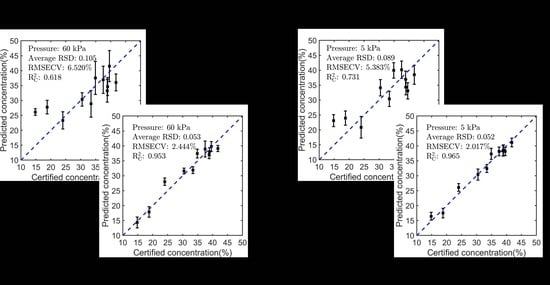
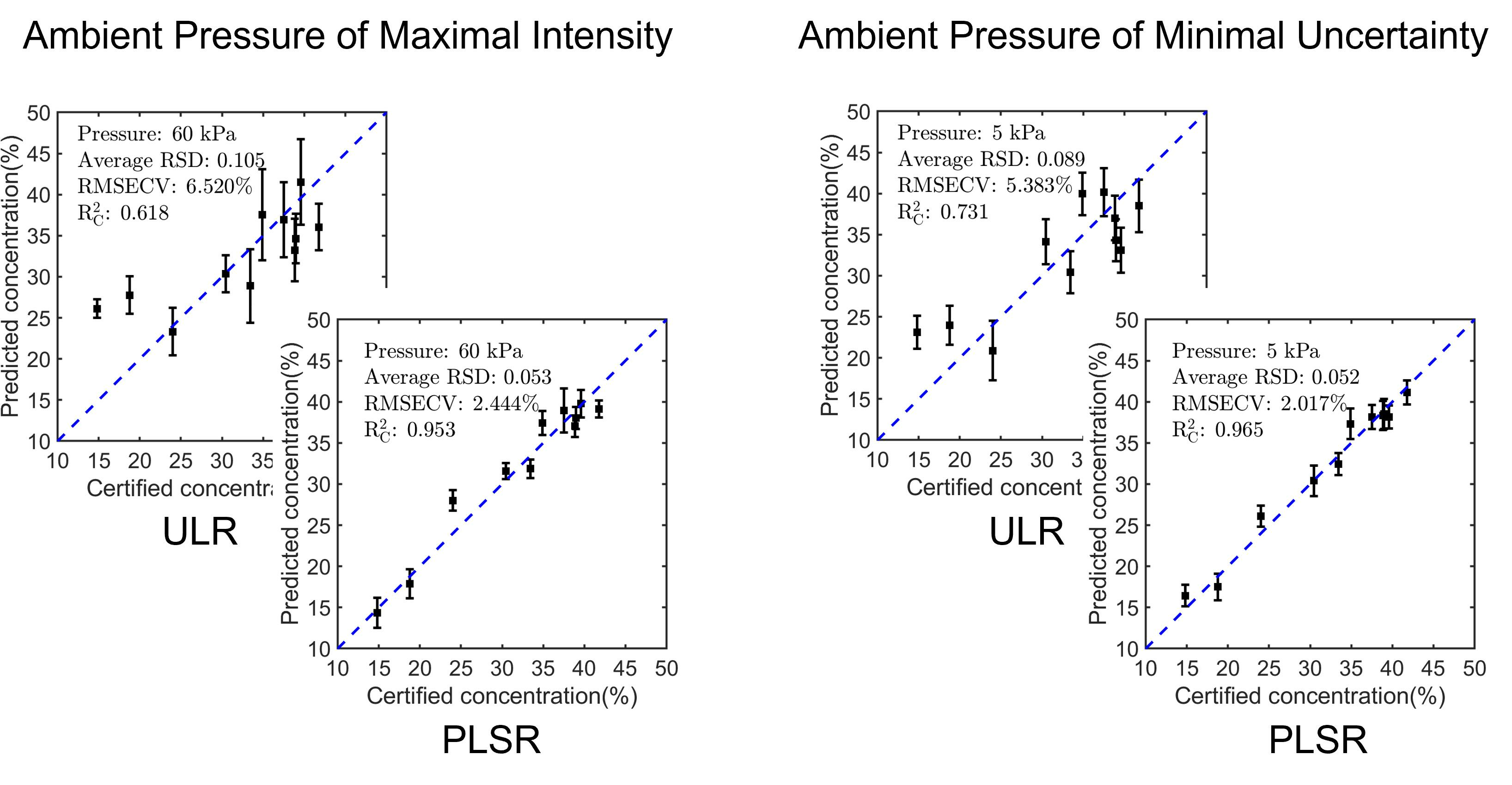
Graphical Abstract

1. Introduction

Laser-induced breakdown spectroscopy (LIBS) is regarded as the future superstar for chemical analysis [1]. It has been extensively used in coal analysis [2], mineral processing and metallurgy [3,4], space exploration [5,6], and biological and aerosol detection [7,8,9] due to its significant advantages such as simple sample preparation, real-time, rapid detection, and full elemental analysis [10]. However, the poor quantitative analysis performance of LIBS was considered its Achilles’ heel [11]. The foundation for achieving accurate quantification is to improve the raw signal quality of LIBS [12].
There are two targets for signal quality improvement: signal-to-noise ratio (SNR) enhancement or uncertainty reduction. Determining the appropriate target is crucial for achieving large-scale commercialization of LIBS technology. Techniques such as microwave-assisted LIBS [13,14], nano-particle enhancement LIBS [15], and double-pulse LIBS [16] focus more on enhancing LIBS signal-to-noise ratio, while techniques such as ambient gas mixture modulation [17] and beam-shaping [18] are more concerned with reducing LIBS signal uncertainty. Wall et al., [19] used microwave-assisted LIBS to enhance the signal-to-noise ratio of indium (451.13 nm) and improve the detection limit significantly. However, the correlation coefficient R 2 between SNR of indium (451.13 nm) and indium concentration decreased from 0.994 to 0.991 with the use of microwave-assisted LIBS. Jia et al., [20] used the beam-shaping method to decrease the relative standard deviation (RSD) of Mn signals from 30.17% to 5.89%. The correlation coefficient R 2 between the Mn 403.45 nm /Fe 404.58 nm intensity ratio and Mn concentration increased from 0.981 to 0.993. SNR enhancement may lead to worse quantitative analysis and uncertainty reduction could improve the quantitative analysis. Most LIBS studies choose the maximum SNR to optimize the spectral signal. Minimal signal uncertainty has always been the optimization criterion as our group insisted. There are no experiments directly comparing the effects of these two targets for quantitative analysis, as it is difficult to either enhance SNR or reduce signal uncertainty with the same method.
The variation of the ambient gas pressure directly affects the plasma spatiotemporal evolution process, which, in turn, has an impact on the spectral signal [21,22]. Previous studies [23] have indicated that when using the respective optimal spectral collection spatiotemporal window at each pressure, the SNR reaches a maximum at 60 kPa; the signal uncertainty reaches a minimum at 5 kPa, as the ambient pressure ranges from 0.1 kPa to 100 kPa. Thus, the prediction of sample concentration by LIBS at these three typical pressures (atmospheric pressure: 100 kPa, maximal SNR: 60 kPa, lowest signal uncertainty: 5 kPa) enables a comparison of the effects of SNR enhancement and signal uncertainty reduction on quantitative analysis.
In this study, brass samples were analyzed at the three typical ambient gas pressures. SNR and signal uncertainty of brass samples were obtained at the typical pressures. Elemental Zn concentrations were predicted by the univariate linear regression (ULR) model and partial least squares regression (PLSR) model. Reasons for variations in the results of quantitative analysis were investigated through matrix effects and signal uncertainty. Sample matrix effects were analyzed by differences in plasma temperature and electron density between samples. Different spectral signal relative standard deviations (RSD) were generated at the same pressure with different delay times, and the effect of the signal RSD on the accuracy of quantitative analysis was investigated. This study clarifies that selecting the ambient pressure corresponding to the lowest signal uncertainty could better improve the quantitative analysis performance of LIBS.

2. Experimental Setup and Sample Information

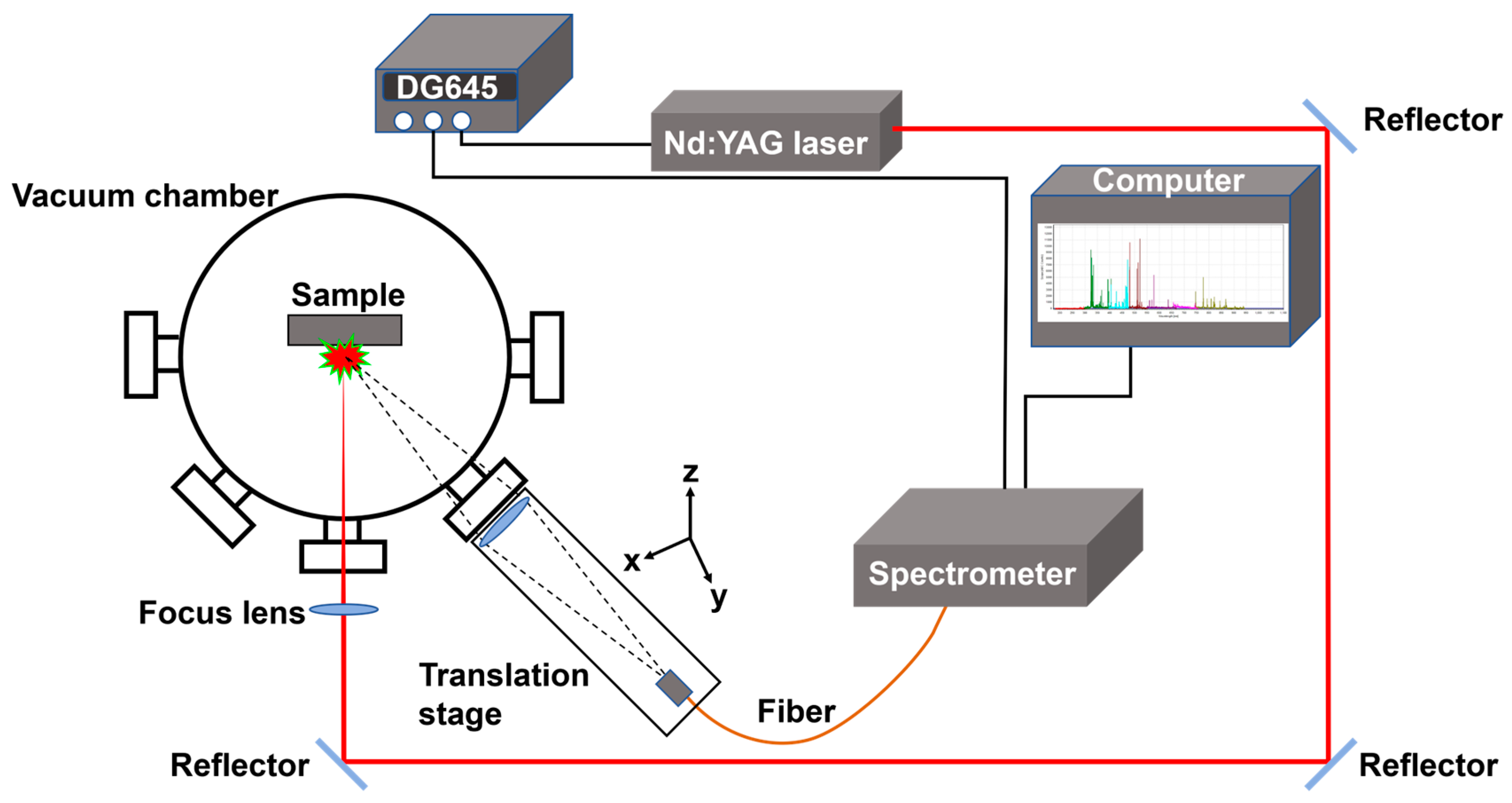
The schematic diagram of the LIBS experimental setup in a vacuum chamber is shown in Figure 1. A chamber is utilized in the experiment system, which can be evacuated to a base pressure of 0.1 kPa by a pump. Then, the air was filled into the chamber through a valve. A pulsed Nd:YAG laser (Dawa-200, Beamtech Optronics, Beijing with a wavelength of 1064 nm, pulse duration of 7 ns, and a repetition rate of 1 Hz was used for plasma generation. The laser beam was normally focused onto the target surface by a quartz lens with a 30 cm focal length. The laser power density was estimated to be 7.28 G W · c m 2 . The fluctuation of laser energy is about 2%. A digital delay generator (DDG) was used to synchronize the laser and spectrometer. The delay time of the spectrometer (AvaSpecULS2048-USB2, Avantes, The Netherlands) was optimized at each pressure, and the gate width was 1.05 ms as a default value determined by the instrument. Therefore, different temporal windows correspond to different delay times with fixed gate widths. The optimal temporal time is 400 ns, 300 ns, 90 ns at 100 kPa, 60 kPa, and 5 kPa. The spectral signal collection system was mounted on an x-y-z translation stage shown in Figure 1 which could be adjusted to reach the optimal spatial window. For each setting, 20 spectra were recorded at different positions. The distance between the points is 1 mm. The type of scanning is horizontal. The first spectrum was included in the 20 measurements. A series of brass samples were used in this study and were mounted on an x-y-z stage. Eleven ZBY series of brass alloy samples (Central Iron and Steel Research Institute of China) with certified reference concentrations were used for quantitative analysis. Sample element information is shown in Table 1. All the samples were polished with sandpaper and then rinsed with alcohol.

Prediction Model and Evaluation Indexes

The influence of ambient gas pressure on LIBS quantification was analyzed using the univariate linear regression (ULR) model and partial least squares regression (PLSR) model. The univariate linear regression model is based on the physical laws of plasma emission, making it more reliable and robust for samples outside of the calibration sample set [12]. Therefore, the results of the univariate linear regression model are more significant and meaningful. This study used a total of 11 samples and verified the performance of quantitative analysis at different pressures using leave-one-out cross-validation (LOOCV). The PLSR model can better handle data with strong collinearity. This study used the PLSR model as a representative of a multivariate model.
Uncertainty in the LIBS signal and prediction results were evaluated using the relative standard deviation (RSD). The relative standard deviation (RSD) could be calculated as
R S D = x i     x ¯ 2 n x ¯
where x i is each signal intensity or each prediction result, x ¯ is the mean value of each signal intensity or each prediction result, and n is the amount of data.
The accuracy of predicted outcomes was evaluated using the root mean square error of cross-validation (RMSECV) and coefficient of determination ( R 2 ). The precision of predicted results was evaluated using the average predicted concentration values’ RSD. The Root mean square error of cross-validation could be calculated as
R M S E C V = C i C ^ i 2 n
where C i is the real value of the elemental Zn concentration of the sample, C ^ i is the value of elemental Zn concentration in the sample predicted by the quantitative model based on the spectral signal intensity, and n is the amount of data. The coefficient of determination ( R C 2 ) could be calculated as
R C 2 = 1 C i C ^ i 2 C i C ¯ 2
where C ¯ is the mean Zn elemental concentration of a real sample in one calibration set. R C 2 is the coefficient of determination for one calibration set.

3. Results and Discussion

3.1. The Influence of Ambient Gas Pressure on LIBS Quantification

For this study, three typical ambient gas pressures were selected: 100 kPa at atmospheric pressure, 60 kPa corresponding to the maximal SNR of the LIBS signal, and 5 kPa with the lowest signal RSD of the LIBS signal according to a previous study [23]. At different ambient gas pressures, the spectra were collected in this study under the optimal spatiotemporal window at each pressure, which was optimized using pure copper samples according to the method described in the previous study [23]. The optimal temporal window is 400 ns, 300 ns, 90 ns at 100 kPa, 60 kPa, and 5 kPa. The optimal spatial window moves further away from the sample surface as the pressure decreases.
The element Zn was selected as the target element for quantitative analysis in this study. The Zn atomic line (636.235 nm) [24] was chosen as a representative spectral line to demonstrate the signal variation at different pressures. The average values of the SNR and RSD of the brass samples with the ambient gas pressure are in line with the previously obtained signal pattern [23], which is shown in Table 2. Compared to 100 kPa, the SNR is significantly enhanced at 60 kPa, while it remains almost the same at 5 kPa. The average value of the signal RSD decreases as the ambient gas pressure decreases.
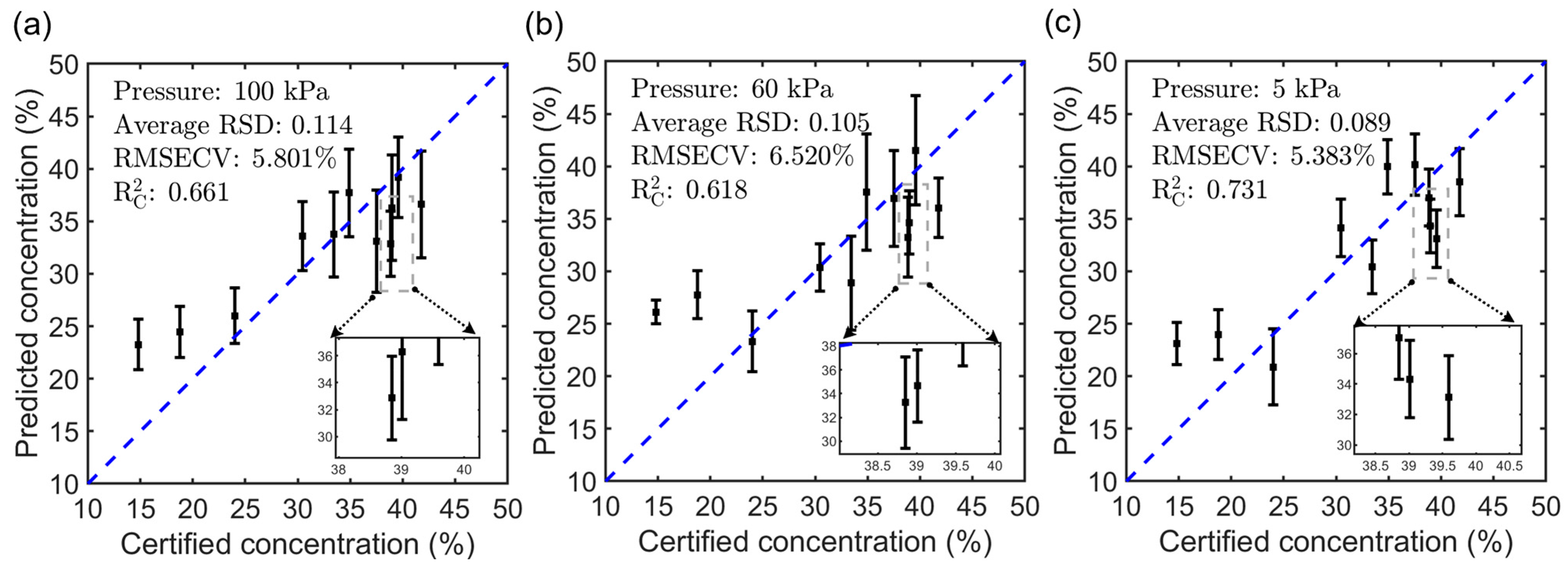
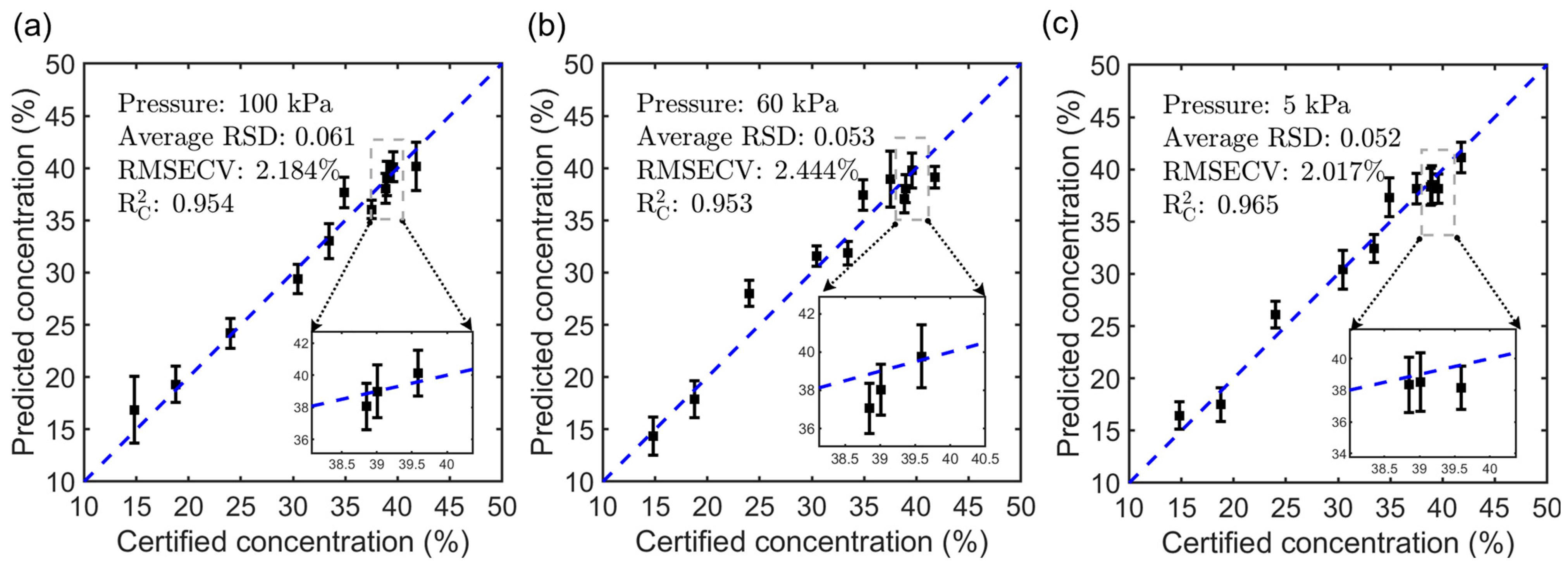
The univariate linear regression model was trained using the Zn atomic line (636.235 nm). Other Zn atomic lines (330.258 nm and 334.501 nm [24]) were also tested and produced similar results with pressure. Figure 2 shows the results of predicting elemental Zn concentration for all prediction sets of LOOCV. R C 2 is the coefficient of determination for one calibration set. Average RSD is the average relative standard deviation of the predicted concentrations for all prediction sets. RMSECV is the root mean square error of cross-validation. The error bar represents one standard deviation from the mean value. The blue dotted line indicates that the predicted concentration of the element Zn is equal to the certified concentration, and the closer the sample point is to the blue dotted line, the closer the model predicts the element Zn in the sample to be to the certified concentration.
Figure 2a shows that when the ambient gas pressure is 100 kPa, the R C 2 is 0.661, the average RSD is 0.114, and the RMSECV is 5.801%. It indicates poor signal quality of the spectral data obtained at 100 kPa. As shown in the Figure 2b, when the ambient gas pressure is 60 kPa, the R C 2 is 0.618, the average RSD is 0.105, and the RMSECV is 6.520%. Compared to 100 kPa, the R C 2 decreases, which indicates that the variation in sample elemental concentrations that can be explained by spectral line intensities is reduced and that the model fit becomes less effective. The average RSD decreases, which suggests an improved prediction precision consistent with the mean RSD of the spectral signal. The RMSECV increases, indicating an increase in prediction error and a decrease in accuracy.
As shown in the Figure 2c, when the ambient gas pressure is 5 kPa, the R C 2 is 0.731, the average RSD is 0.089, and the RMSECV is 5.383%. Compared to 100 kPa, the R C 2 increases, which indicates that the variation in sample elemental concentrations that can be explained by spectral line intensities is increased and that the model fit becomes more effective. The average RSD decreases, which suggests that the best prediction precision is consistent with the mean RSD of the spectral signal. The RMSECV decreases, which shows a decrease in prediction error and an increase in accuracy.
The specific spectral lines used for the PLSR model in this study were Zn I 481.053 nm and 636.235 nm, Zn II 492.401 nm and 589.436 nm, and Cu I 515.324 nm and 521.820 nm [24]. The spectral line information was confirmed by comparing to the NIST database. The number of principal components of the PLSR model was optimized to be three. The results of the PLSR model at different pressures are consistent with those of the univariate linear regression model as shown in Figure 3.
The above results demonstrate that as the ambient gas pressure decreased, the RSD of the spectral signals decreased. Consequently, the RSD of the sample concentration predicted by the model based on the spectral signal intensity decreased, leading to an improvement in the precision of the quantitative analysis. In terms of prediction accuracy, the prediction accuracy decreases at 60 kPa and improves at 5 kPa compared to the prediction at 100 kPa.
In general, many studies have focused on the enhancement of the LIBS signal-to-noise ratio. This study found that the SNR was significantly enhanced at 60 kPa, but the accuracy of the quantitative analysis deteriorated. At 5 kPa, the SNR was similar to that of 100 kPa, and the RSD was significantly reduced, resulting in improved accuracy. In the next section, this study investigated the reasons for the change in the accuracy of quantitative analysis.

3.2. The Reasons for Change in Accuracy of Quantitative Analysis at Different Pressures

Ambient gas pressure affects LIBS Signal-to-noise ratio and uncertainty, which, in turn, affects the quantitative analysis performance of LIBS. Previous research [12] has demonstrated that the quantitative analysis of LIBS is primarily influenced by two factors: signal uncertainty and matrix effects. Therefore, this section analyzes the reasons for the differences in the quantitative analysis results at different ambient gas pressures from the perspectives of signal uncertainty and matrix effects.

3.2.1. The Influence of Signal Uncertainty on LIBS Quantitative Analysis

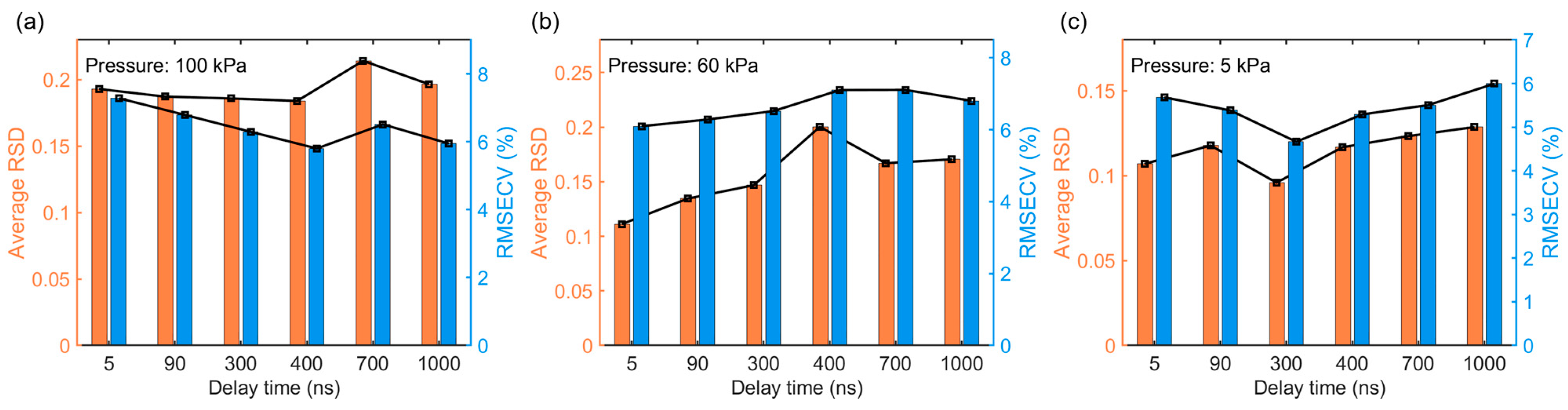
As shown in Table 2, the RSD of the Zn atomic line (636.235 nm) was 0.1840, 0.1469, and 0.1178 at the three ambient gas pressures of 100 kPa, 60 kPa, and 5 kPa, respectively. The RSD of the spectral line signal decreases as the ambient gas pressure decreases. In order to isolate the effect of the signal uncertainty, the spectral signals with different delay times were collected at the same pressure for quantitative analysis, as the signal RSD varies for different delay times. This study first optimized the optimal spatiotemporal windows for spectral acquisition under each ambient gas pressure. Six spectral collection delay times (5 ns, 90 ns, 300 ns, 400 ns, 700 ns, and 1000 ns) were then used under the obtained optimal spatial window conditions at each pressure. Spectral data were collected for a series of brass samples under each condition, and a total of 18 sets of data were collected. The performance of quantitative analysis in different settings was investigated using the univariate linear regression model and leave-one-out cross-validation (LOOCV). Figure 4 shows a comparison of the obtained RMSECV and the average RSD of the Zn atomic line (636.235 nm) for all samples at different delay times.
As shown in Figure 4a, the RSD of the Zn atomic line (636.235 nm) at 100 kPa exhibits a decreasing and increasing trend with increasing delay time, reaching its lowest value of 0.18 at 400ns. The RMSECV at 100 kPa follows a similar trend, reaching the lowest value of 5.801% at 400 ns. Figure 4b illustrates that at 60 kPa, the RSD of the Zn atomic line (636.235 nm) increases from 5 ns to 400 ns, then decreases when the delay time is 700 ns and 1000 ns. The lowest RSD is 0.11, while the lowest RMSECV is 6.10% when the delay time is 5 ns. Similarly, the trend of RMSECV is consistent with that of RSD. Figure 4c displays that at 5 kPa, the RSD of the Zn atomic line (636.235 nm) initially decreases and then increases with increasing delay time. At 300 ns, the RSD is as low as 0.10. Similarly, the RMSECV also decreases and then increases with the increasing delay time. At 300 ns, the RMSECV is as low as 4.67%.
The above results indicate that there is a correlation between the spectral line intensity RSD and the measurement accuracy of the prediction set. For a single measurement, when there are large fluctuations in the intensity of the spectral lines, the concentration information predicted by the quantitative model may also show outliers, leading to a decrease in the accuracy of the predictions and an increase in the RMSECV. Therefore, as the RSD of the spectral line intensity decreases, the range of spectral line intensity fluctuation also decreases, resulting in an increase in the accuracy of the prediction value obtained by the quantitative model, i.e., the RMSECV decreases. Therefore, to optimize the delay time for quantitative analysis, this study recommends using the lowest RSD as the criterion.

3.2.2. Matrix Effect at Different Pressures

The plasma temperature and electron density in the corresponding plasma region of the spectral collection system are affected by the physical properties and chemical compositions of different samples, which, in turn, affect the LIBS signal. In this study, we calculated the plasma temperature and electron density of each sample at different ambient gas pressures and analyzed the differences between samples to investigate matrix effects at different pressures.
Plasma Temperature
Under the assumptions that the plasma is in LTE and optically thin, the plasma temperature could be calculated with
ln I i j g i A i j = E i kT + ln N s U s ( T )
where I i j is the spectral intensity associated with the transition from the upper energy level i to the lower energy level j , g i is the statistical weight of the upper level, A i j is the transition probability, N s is the total number density of the Cu atoms, E i is the energy of the upper level, k is the Boltzmann’s constant, U s ( T ) is the partition function, and T is the plasma temperature [10,25]. The plasma temperature is obtained by calculating the slope 1 / k T . The spectral information is listed in Table 3 [26].
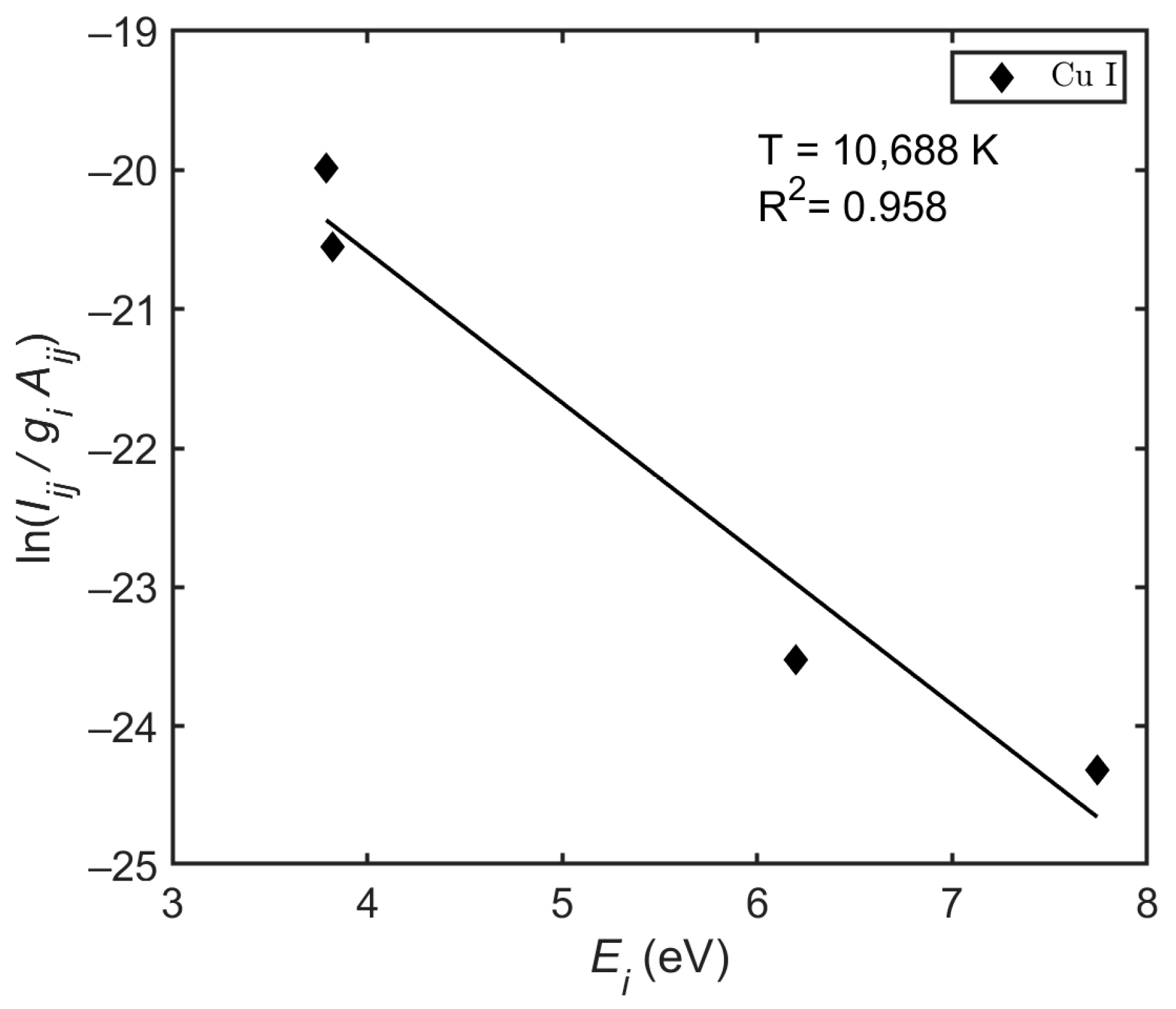
Figure 5 shows an example of the Boltzmann plot with 4 Cu atom lines for sample #1 at 100 kPa under the optimal spatiotemporal window of spectral collection. The plasma temperature calculated from the Boltzmann plot is 10,688 K, and the coefficient of determination, R 2 , for the Boltzmann plot fit is 0.958. The coefficients of determination of the Boltzmann plot fits were greater than 0.9 in all the samples at different ambient gas pressures.
This study further analyzes the differences in plasma temperature between samples at different ambient gas pressures. In this study, 20 spectra were collected for each sample, and 20 plasma temperatures were obtained. The 20 plasma temperatures were averaged to obtain the average plasma temperature for each sample. The standard deviation and relative standard deviation of the average plasma temperatures between the samples were calculated to analyze the differences between samples.
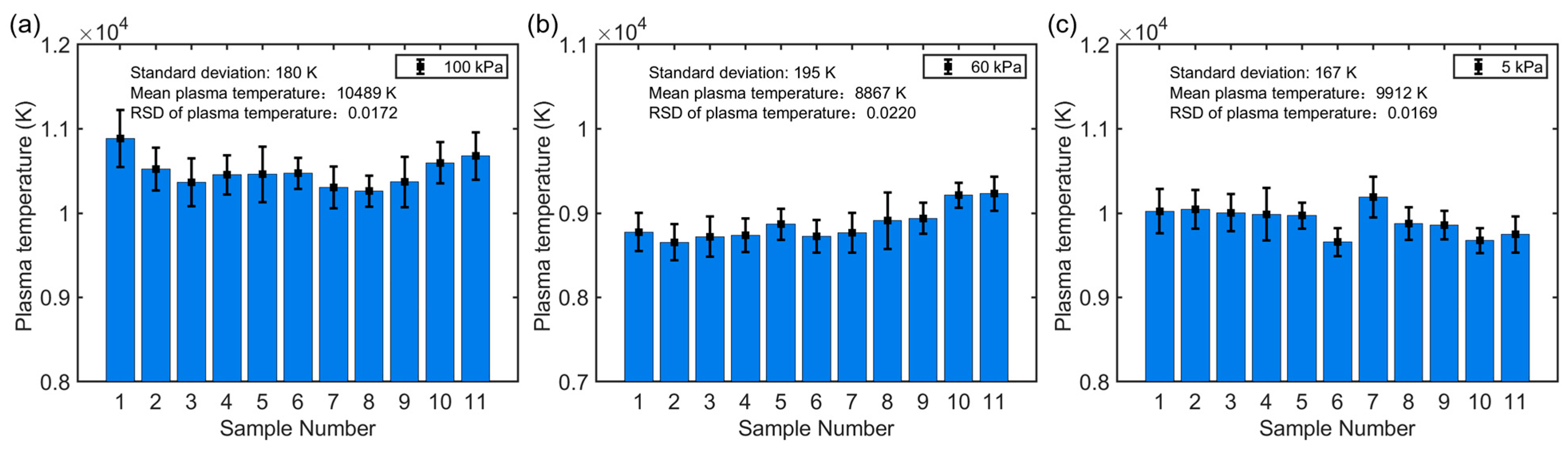
Figure 6 shows the variation in plasma temperature for each sample at different pressures. As shown in Figure 6a, at 100 kPa, the standard deviation of plasma temperature between samples was 180 K, with a mean value of 10,489 K. The relative standard deviation of plasma temperature between samples was 0.0172. The black squares and error bars in the figure represent the fluctuation of the plasma temperature for a single sample. Figure 6b shows that, at 60 kPa, the standard deviation of plasma temperature between samples is 195 K, with a mean value of 8867 K. The relative standard deviation of plasma temperature between samples is 0.0220. Compared to 100 kPa, the difference between samples in plasma temperature is more severe at 60 kPa. The average plasma temperature decreases. The optimal temporal window, i.e., the spectrometer delay time, used at 60 kPa is 300 ns, which is earlier compared to 400 ns at 100 kPa, but the average value of the plasma temperature decreases, which is due to the faster plasma decay at lower pressure [23]. Figure 6c displays that at 5 kPa, the standard deviation of plasma temperature between samples is 167 K, with a mean value of 9912 K. The relative standard deviation of plasma temperature between samples is 0.0169. Compared to 100 kPa, the difference in plasma temperature between samples at 5 kPa is relatively small. It should be noted that the optimal temporal window is 90 ns at 5 kPa. The earlier temporal window at 5 kPa results in higher average plasma temperatures than those obtained at 60 kPa.
Electron Density
Spectral line broadening in LIBS spectra is mainly contributed by Stark broadening [27]. For typical LIBS conditions, the contribution from ion broadening is negligible, and the spectral line broadening is described by the following equation
λ = 2 w n e 10 16
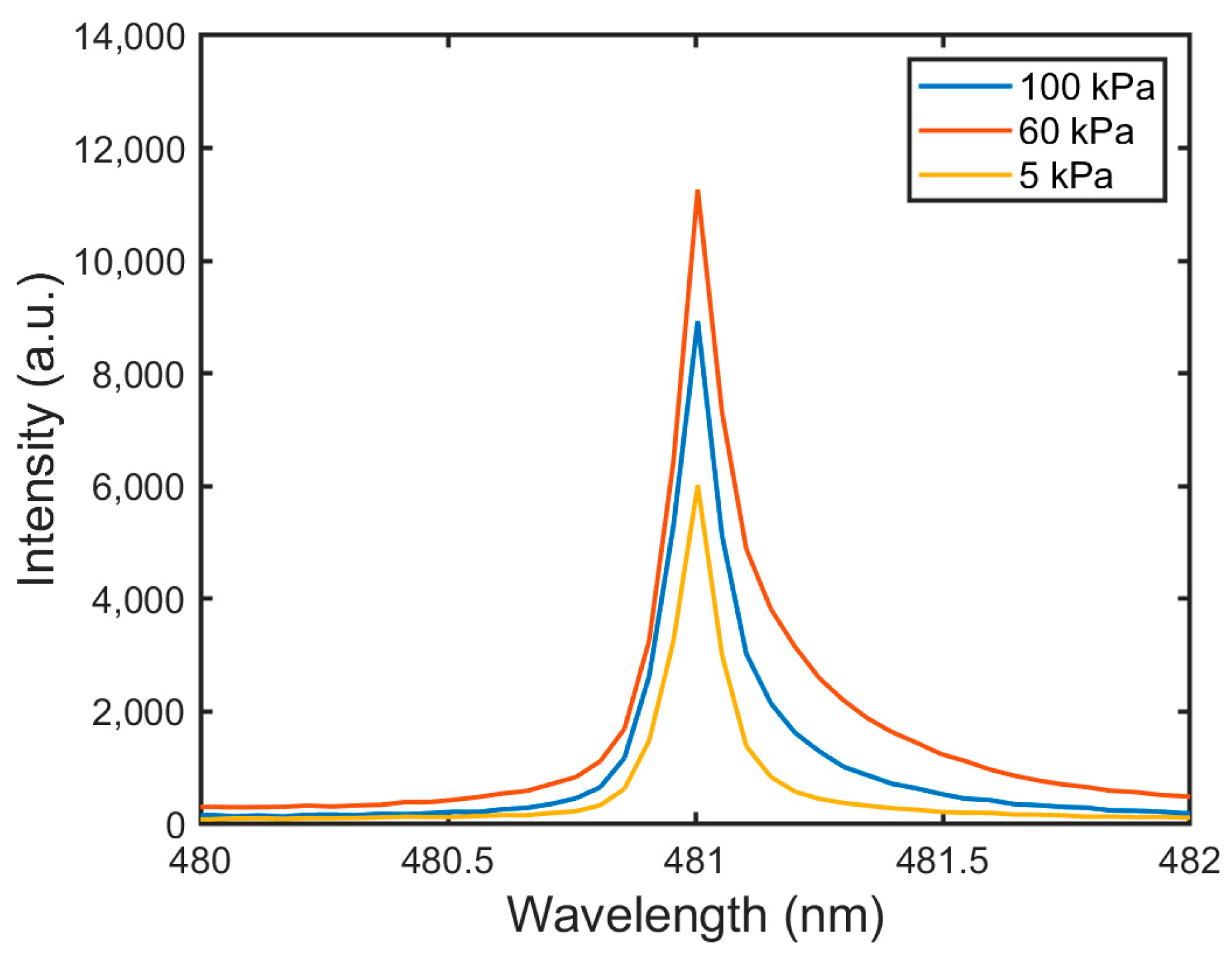
where λ is the full width at half maximum (FWHM) of the spectral line, w is the electron impact parameter, which could be found in the literature [28], and n e is the electron density. The FWHM can be obtained by fitting the Zn atomic line (481.053 nm) with a Lorentzian line pattern. The instrumental broadening is 0.05 nm and was subtracted when calculating the electron density. In this study, the FWHM of the Zn atomic line (481.053 nm) was used to calculate the magnitude of the electron density in the plasma and then to calculate the difference in plasma electron density between samples.
Figure 7 shows the Zn atomic line (481.053 nm) spectra of sample #1 at 100 kPa, 60 kPa and 5 kPa. The broadening of the spectral line increases at 60 kPa and decreases slightly at 5 kPa compared to 100 kPa. Lee et al., [29] found that the broadening of the Al atomic line (396.15 nm) spectrum at 13.3 kPa is lower than that at 100 kPa. Zhang et al., [30] found that the broadening of the H656 spectral line increased as the ambient gas pressure increased from 30 kPa to 100 kPa. The corresponding optimal temporal window used at 60 kPa is 300 ns, which is 100 ns earlier than that at 100 kPa. Moreover, the optimal spatial window was optimized at 60 kPa, which may be the reason for the inconsistency between this study and Zhang et al. [30] on the variation of spectral line broadening between 60 kPa and 100 kPa.
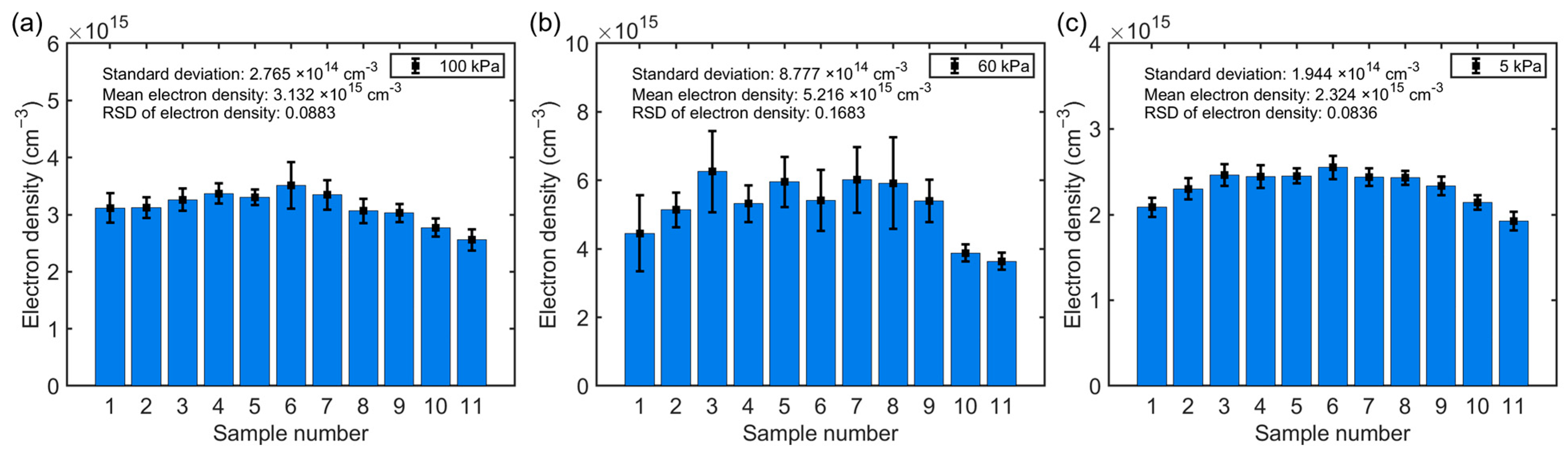
Figure 8 shows the differences in electron density for each sample at different pressures. As shown in Figure 8a, at 100 kPa, the standard deviation of electron density between samples is 2.765 × 10 14   c m 3 . The mean value of electron density between samples is 3.132 × 10 15   c m 3 . The relative standard deviation of electron density between samples is 0.0883. The black squares and error bars in the figure represent the fluctuation of the electron density for a single sample. Figure 8b shows that, at 60 kPa, the standard deviation of electron density between samples is 8.777 × 10 14   c m 3 . The mean value of electron density between samples is 5.216 × 10 15 c m 3 . The relative standard deviation of electron density between samples is 0.1683. Compared to 100 kPa, the difference between samples in electron density is more severe at 60 kPa. The average electron density increases, which is consistent with Figure 7. Figure 8c displays that at 5 kPa, the standard deviation of electron density between samples is 1.944 × 10 14   c m 3 . The mean value of electron density between samples is 2.324 × 10 15   c m 3 . The relative standard deviation of electron density between samples is 0.0836. Compared with 100 kPa, the standard deviation of plasma electron density between samples at 5 kPa decreases. The relative standard deviation of plasma electron density between samples slightly decreases.
Combining the plasma temperature and electron density at 100 kPa, 60 kPa, and 5 kPa, the matrix effect is more severe at 60 kPa, and the linear relationship between the spectral line intensity and the elemental concentration of the samples deteriorates, which negatively affects the accuracy of the quantitative analysis at 60 kPa, whereas the matrix effect is weakened at 5 kPa, and the linear relationship between the spectral line intensity and the elemental concentration of the samples becomes better, which improves the accuracy of quantitative analysis at 5 kPa.
To summarize, compared with 100 kPa, the matrix effect is more significant at 60 kPa, resulting in poorer accuracy of quantitative analysis; the mean value of signal RSD samples decreases from 0.1840 to 0.1469, which could improve the accuracy of quantitative analysis; the combination of the two factors ultimately results in the decrease in accuracy of quantitative analysis at 60 kPa. The matrix effect is attenuated at 5 kPa, leading to an increase in quantitative analysis accuracy; the signal RSD decreases from 0.1840 to 0.1178, improving quantitative analysis accuracy; the combination of the two factors ultimately leads to an increase in quantitative analysis accuracy at 5 kPa.

4. Conclusions

This study performed quantitative analysis on brass samples at three typical pressures (atmospheric pressure: 100 kPa, maximal SNR: 60 kPa, lowest signal uncertainty: 5 kPa) under the optimal spatiotemporal window at each pressure. The results showed that compared to 100 kPa, the accuracy of quantitative analysis decreased, and the precision increased at 60 kPa, while the accuracy of quantitative analysis increased, and the precision was best at 5 kPa. Analysis of the matrix effect at different ambient gas pressures revealed that the matrix effect was more significant at 60 kPa and weaker at 5 kPa compared to 100 kPa. This study experimentally verified that the reduction of signal RSD is beneficial in improving the accuracy of quantitative analysis. At 60 kPa, the matrix effect is significant, the RSD decreases, and the combination of the two factors results in poorer accuracy of quantitative analysis. At 5 kPa, the matrix effect was weakened, the RSD was minimal, and the combined effect of the two factors led to a better accuracy of quantitative analysis. The decrease in the RSD of the signals led to an increase in the precision of the quantitative analysis. Therefore, it is recommended that more attention should be paid to reducing the signal uncertainty to improve the quantitative analysis of LIBS.

Author Contributions

Conceptualization, K.Z. and Z.W.; Funding acquisition, Z.L. and Z.W.; Methodology, K.Z. and Z.H.; Project administration, Z.W.; Validation, Z.L.; Writing—original draft, K.Z.; Writing—review and editing, Z.L., J.J., Z.H. and Z.W. All authors have read and agreed to the published version of the manuscript.

Funding

This research was funded by the National Key Research and Development Program of China (No. 2023YFF0714900), the Car-bon Neutrality and Energy System Transformation (CNEST) Program led by Tsinghua University, Huaneng Group Science and Technology Research Project (No. HNKJ22-H105), and Open Project Program of State Key Laboratory of Low-carbon Smart Coal-fired Power Generation and Ultra-clean Emission.

Institutional Review Board Statement

Not applicable.

Informed Consent Statement

Not applicable.

Data Availability Statement

Data available on request from the authors.

Conflicts of Interest

Author Zhitan Liu was employed by the company Energy Science and Technology Research Institute Co., Ltd. The remaining authors declare that the research was conducted in the absence of any commercial or financial relationships that could be construed as a potential conflict of interest.

References

  1. Winefordner, J.D.; Gornushkin, I.B.; Correll, T.; Gibb, E.; Smith, B.W.; Omenetto, N. Comparing Several Atomic Spectrometric Methods to the Super Stars: Special Emphasis on Laser Induced Breakdown Spectrometry, LIBS, a Future Super Star. J. Anal. At. Spectrom. 2004, 19, 1061–1083. [Google Scholar] [CrossRef]
  2. Legnaioli, S.; Campanella, B.; Poggialini, F.; Pagnotta, S.; Harith, M.A.; Abdel-Salam, Z.A.; Palleschi, V. Industrial Applications of Laser-Induced Breakdown Spectroscopy: A Review. Anal. Methods 2020, 12, 1014–1029. [Google Scholar] [CrossRef]
  3. Hudson, S.W.; Craparo, J.; De Saro, R.; Apelian, D. Applications of Laser-Induced Breakdown Spectroscopy (LIBS) in Molten Metal Processing. Met. Mater. Trans. B 2017, 48, 2731–2742. [Google Scholar] [CrossRef]
  4. Fabre, C.; Ourti, N.E.; Ballouard, C.; Mercadier, J.; Cauzid, J. Handheld LIBS Analysis for in Situ Quantification of Li and Detection of the Trace Elements (Be, Rb and Cs). J. Geochem. Explor. 2022, 236, 106979. [Google Scholar] [CrossRef]
  5. Yumoto, K.; Cho, Y.; Kameda, S.; Kasahara, S.; Sugita, S. In-Situ Measurement of Hydrogen on Airless Planetary Bodies Using Laser-Induced Breakdown Spectroscopy. Spectrochim. Acta Part B At. Spectrosc. 2023, 205, 106696. [Google Scholar] [CrossRef]
  6. Zhao, Y.-Y.S.; Yu, J.; Wei, G.; Pan, L.; Liu, X.; Lin, Y.; Liu, Y.; Sun, C.; Wang, X.; Wang, J.; et al. In Situ Analysis of Surface Composition and Meteorology at the Zhurong Landing Site on Mars. Natl. Sci. Rev. 2023, 10, nwad056. [Google Scholar] [CrossRef]
  7. Cáceres, J.O.; Sainz de los Terreros, J.Y. A Real-World Approach to Identifying Animal Bones and Lower Pleistocene Fossils by Laser Induced Breakdown Spectroscopy. Talanta 2021, 235, 122780. [Google Scholar] [CrossRef]
  8. Limbeck, A.; Brunnbauer, L.; Lohninger, H.; Pořízka, P.; Modlitbová, P.; Kaiser, J.; Janovszky, P.; Kéri, A.; Galbács, G. Methodology and Applications of Elemental Mapping by Laser Induced Breakdown Spectroscopy. Anal. Chim. Acta 2021, 1147, 72–98. [Google Scholar] [CrossRef]
  9. Ren, Y.; Li, S.; Zhang, Y.; Tse, S.D.; Long, M.B. Absorption-Ablation-Excitation Mechanism of Laser-Cluster Interactions in a Nanoaerosol System. Phys. Rev. Lett. 2015, 114, 093401. [Google Scholar] [CrossRef]
  10. Miziolek, A.W.; Palleschi, V.; Schechter, I. (Eds.) Laser Induced Breakdown Spectroscopy; Cambridge University Press: Cambridge, UK, 2006; ISBN 978-0-521-85274-6. [Google Scholar]
  11. Hahn, D.W.; Omenetto, N. Laser-Induced Breakdown Spectroscopy (LIBS), Part I: Review of Basic Diagnostics and Plasma-Particle Interactions: Still-Challenging Issues Within the Analytical Plasma Community. Appl Spectrosc. 2010, 64, 335A–366A. [Google Scholar] [CrossRef]
  12. Wang, Z.; Afgan, M.S.; Gu, W.; Song, Y.; Wang, Y.; Hou, Z.; Song, W.; Li, Z. Recent Advances in Laser-Induced Breakdown Spectroscopy Quantification: From Fundamental Understanding to Data Processing. TrAC Trends Anal. Chem. 2021, 143, 116385. [Google Scholar] [CrossRef]
  13. Liu, Y.; Baudelet, M.; Richardson, M. Elemental Analysis by Microwave-Assisted Laser-Induced Breakdown Spectroscopy: Evaluation on Ceramics. J. Anal. At. Spectrom. 2010, 25, 1316. [Google Scholar] [CrossRef]
  14. Al Shuaili, A.A.; Al Hadhrami, A.M.; Wakil, M.A.; Alwahabi, Z.T. Improvement of Palladium Limit of Detection by Microwave-Assisted Laser Induced Breakdown Spectroscopy. Spectrochim. Acta Part B At. Spectrosc. 2019, 159, 105666. [Google Scholar] [CrossRef]
  15. De Giacomo, A.; Gaudiuso, R.; Koral, C.; Dell’Aglio, M.; De Pascale, O. Nanoparticle-Enhanced Laser-Induced Breakdown Spectroscopy of Metallic Samples. Anal. Chem. 2013, 85, 10180–10187. [Google Scholar] [CrossRef] [PubMed]
  16. Wang, Q.; Wang, J.-G.; Liang, Y.; Chen, X.; Wu, B.; Ni, Z.; Dong, F. Investigation on Emission Spectra of Reheating and Pre-Ablation Dual-Pulse Laser-Induced Breakdown Spectroscopy. In Proceedings of the 2011 International Conference on Optical Instruments and Technology: Optoelectronic Imaging and Processing Technology, Beijing, China, 6–9 November 2011; Volume 8201. [Google Scholar]
  17. Yu, J.; Hou, Z.; Ma, Y.; Li, T.; Fu, Y.; Wang, Y.; Li, Z.; Wang, Z. Improvement of Laser Induced Breakdown Spectroscopy Signal Using Gas Mixture. Spectrochim. Acta Part B At. Spectrosc. 2020, 174, 105992. [Google Scholar] [CrossRef]
  18. Ji, J.; Song, W.; Hou, Z.; Li, L.; Yu, X.; Wang, Z. Raw Signal Improvement Using Beam Shaping Plasma Modulation for Uranium Detection in Ore Using Laser-Induced Breakdown Spectroscopy. Anal. Chim. Acta 2022, 1235, 340551. [Google Scholar] [CrossRef]
  19. Wall, M.; Sun, Z.; Alwahabi, Z.T. Quantitative Detection of Metallic Traces in Water-Based Liquids by Microwave-Assisted Laser-Induced Breakdown Spectroscopy. Opt. Express 2016, 24, 1507. [Google Scholar] [CrossRef]
  20. Jia, J.; Fu, H.; Hou, Z.; Wang, H.; Wang, Z.; Dong, F.; Ni, Z.; Zhang, Z. Effect of Laser Beam Shaping on the Determination of Manganese and Chromium Elements in Steel Samples Using Laser-Induced Breakdown Spectroscopy. Spectrochim. Acta Part B At. Spectrosc. 2020, 163, 105747. [Google Scholar] [CrossRef]
  21. Wu, D.; Sun, L.; Liu, J.; Lyu, Y.; Wu, H.; Yuan, S.; Hai, R.; Li, C.; Feng, C.; Zhao, D.; et al. Parameter Optimization of the Spectral Emission of Laser-Induced Tungsten Plasma for Tokamak Wall Diagnosis at Different Pressures. J. Anal. At. Spectrom. 2021, 36, 1159–1169. [Google Scholar] [CrossRef]
  22. Fu, Y.-T.; Gu, W.-L.; Hou, Z.-Y.; Muhammed, S.A.; Li, T.-Q.; Wang, Y.; Wang, Z. Mechanism of Signal Uncertainty Generation for Laser-Induced Breakdown Spectroscopy. Front. Phys. 2021, 16, 22502. [Google Scholar] [CrossRef]
  23. Zhang, K.; Song, W.; Hou, Z.; Wang, Z. Effect of Ambient Pressures on Laser-Induced Breakdown Spectroscopy Signals. Front. Phys. 2024, 19, 42203. [Google Scholar] [CrossRef]
  24. Kramida, A.; Ralchenko, Y.; Reader, J.; NIST ASD Team. NIST Atomic Spectra Database; National Institute of Standards and Technology: Gaithersburg, MD, USA, 2005. Available online: https://physics.nist.gov/asd (accessed on 20 December 2024). [CrossRef]
  25. Borduchi, L.C.L.; Milori, D.M.B.P.; Villas-Boas, P.R. Study of the Effects of Detection Times in Laser-Induced Breakdown Spectroscopy and Missed Variation of Plasma Parameters with Gate Width. Spectrochim. Acta Part B At. Spectrosc. 2022, 191, 106409. [Google Scholar] [CrossRef]
  26. Farid, N.; Bashir, S.; Mahmood, K. Effect of Ambient Gas Conditions on Laser-Induced Copper Plasma and Surface Morphology. Phys. Scr. 2012, 85, 015702. [Google Scholar] [CrossRef]
  27. Gornushkin, I.B.; King, L.A.; Smith, B.W.; Omenetto, N.; Winefordner, J.D. Line Broadening Mechanisms in the Low Pressure Laser-Induced Plasma. Spectrochim. Acta Part B At. Spectrosc. 1999, 54, 1207–1217. [Google Scholar] [CrossRef]
  28. Djurović, S.; Blagojević, B.; Konjević, N. Experimental and Semiclassical Stark Widths and Shifts for Spectral Lines of Neutral and Ionized Atoms (A Critical Review of Experimental and Semiclassical Data for the Period 2008 Through 2020). J. Phys. Chem. Ref. Data 2023, 52, 031503. [Google Scholar] [CrossRef]
  29. Lee, K.-J.; Choi, S.-J.; Yoh, J.J. Stand-off Laser-Induced Breakdown Spectroscopy of Aluminum and Geochemical Reference Materials at Pressure below 1 Torr. Spectrochim. Acta Part B At. Spectrosc. 2014, 101, 335–341. [Google Scholar] [CrossRef]
  30. Zhang, Z.; Li, T.; Huang, S. Influence of the Pressure and Temperature on Laser Induced Breakdown Spectroscopy for Gas Concentration Measurements. Spectrochim. Acta Part B At. Spectrosc. 2019, 155, 24–33. [Google Scholar] [CrossRef]
Figure 1. Schematic diagram of the LIBS experimental setup.
Chemosensors 12 00277 g001
Figure 2. Predicted results with the ULR model at 100 kPa (a), 60 kPa (b), and 5 kPa (c).
Chemosensors 12 00277 g002
Figure 3. Predicted results with the PLSR model at 100 kPa (a), 60 kPa (b), and 5 kPa (c). The blue dotted line indicates that the predicted concentration of the element Zn is equal to the certified concentration.
Chemosensors 12 00277 g003
Figure 4. Average RSD and RMSECV with delay time at 100 kPa (a), 60 kPa (b), and 5 kPa (c).
Chemosensors 12 00277 g004
Figure 5. Example of a Boltzmann plot with 4 Cu atom lines for sample 1 at 100 kPa under the optimal spatiotemporal window.
Chemosensors 12 00277 g005
Figure 6. Plasma temperature for each sample at 100 kPa (a), 60 kPa (b), and 5 kPa (c).
Chemosensors 12 00277 g006
Figure 7. Zn atomic line (481.053 nm) spectra of sample number 1 at 100 kPa, 60 kPa, and 5 kPa.
Chemosensors 12 00277 g007
Figure 8. Electron density for each sample at 100 kPa (a), 60 kPa (b), and 5 kPa (c).
Chemosensors 12 00277 g008
Table 1. Element concentration of brass alloy samples.
Sample NumberSample NameCu (%)Zn (%)Pb (%)P (%)
1ZBY9017323.992.770.0043
2ZBY90264.4333.451.870.012
3ZBY90459.1438.851.50.011
4ZBY90558.0739.591.810.02
5ZBY90656.6241.760.5810.044
6ZBY90759.5534.923.060.02
7ZBY92159.8939.010.3180.084
8ZBY92261.8837.530.1080.039
9ZBY92369.0830.440.0180.011
10ZBY92480.918.750.0170.013
11ZBY92585.0614.790.0290.0052
Table 2. Average SNR and average signal RSD of different samples at different ambient gas pressures.
Ambient Pressure (kPa)Average SNR of
Zn I (636.235 nm) Line
Average Signal RSD of
Zn I (636.235 nm) Line
100290.110.1840
60750.250.1469
5326.200.1178
Table 3. The spectral information used to build the Boltzmann plots.
Wavelength (nm) g i A i j (s−1) E j (cm−1) E i (cm−1)
465.11243.04 × 10840,909.1662,403.33
510.55418 × 10611,202.6230,783.7
515.32352.4 × 10830,535.3249,935.2
578.21323.3 × 10613,245.4430,535.32
Disclaimer/Publisher’s Note: The statements, opinions and data contained in all publications are solely those of the individual author(s) and contributor(s) and not of MDPI and/or the editor(s). MDPI and/or the editor(s) disclaim responsibility for any injury to people or property resulting from any ideas, methods, instructions or products referred to in the content.