Article

Financing Regimes and Case-Mix Complexity in Psychiatric Hospitals Beyond the Pandemic Shock—Insights from a Regional European Healthcare System


by
Andrian Țîbîrnă
1,2,
Floris Petru Iliuta
1,2,*,
Mihnea Costin Manea
1,2,* and
Mirela Manea
1,2
1
Department of Psychiatry and Psychology, Faculty of Stomatology, “Carol Davila” University of Medicine and Pharmacy, 020021 Bucharest, Romania
2
“Prof. Dr. Alexandru Obregia” Clinical Hospital of Psychiatry, 041914 Bucharest, Romania
*
Authors to whom correspondence should be addressed.
Healthcare 2026, 14(9), 1181; https://doi.org/10.3390/healthcare14091181
Submission received: 17 February 2026 / Revised: 16 April 2026 / Accepted: 24 April 2026 / Published: 28 April 2026
(This article belongs to the Special Issue Healthcare Economics, Management, and Innovation for Health Systems)

Abstract

Background/Objectives: The COVID-19 pandemic intensified concerns regarding the resilience and financing architecture of mental health services, yet it remains unclear whether crisis-induced adjustments fundamentally altered hospital case-mix complexity or merely exposed pre-existing structural configurations. This study examines the relationship between financing regimes and case-mix complexity in psychiatric hospitals in Romania, a Central and Eastern European health system characterized by mixed financing arrangements and pronounced interregional heterogeneity. Methods: Using administrative data comprising 752 hospital section–year observations (2019–2024), we identify structural financing–organization regimes through a two-step clustering procedure (hierarchical Ward method followed by K-means refinement) based on revenue composition, expenditure allocation, workforce structure, and operational pressure indicators. Results: Three distinct regimes emerge, reflecting persistent institutional configurations rather than temporary crisis-induced groupings. Chi-square tests confirm that regime membership is statistically independent of pandemic timing. A multivariate regression model controlling for financing composition and expenditure structure shows that structural variables (particularly the share of contract-based revenues and the allocation of expenditures) exert systematic and economically meaningful effects on the case-mix index (CMI). Pandemic and post-pandemic indicators do not retain robust explanatory power once structural determinants are accounted for. Regional robustness analyses further demonstrate that financing architecture consistently outweighs temporal shock effects in explaining territorial variation in clinical complexity. Conclusions: The findings suggest that psychiatric hospital case-mix dynamics are structurally embedded within differentiated financing regimes whose influence persists beyond crisis periods. By integrating regime identification with outcome modeling in a Central and Eastern European context, this study contributes to the international literature on health system resilience and highlights the primacy of institutional financing architecture over episodic shock effects in shaping hospital complexity.

1. Introduction

The COVID-19 pandemic generated unprecedented pressures on health systems worldwide [1,2,3], exposing structural vulnerabilities in financing arrangements, resource allocation mechanisms, and service delivery models. Mental health services were particularly affected, as psychiatric hospitals faced simultaneous increases in clinical complexity, disruptions in referral pathways, workforce shortages, and reallocation of financial resources [4,5,6]. While many studies in the international literature [7,8,9] have focused on the immediate operational consequences of the pandemic, considerably less attention has been paid to the question of whether pandemic-related shocks have fundamentally altered the dynamics of hospital cases or merely amplified pre-existing structural configurations.
In European health systems characterized by mixed financing arrangements, including social health insurance, public subsidies, and budgetary transfers, the pandemic prompted rapid adjustments in funding flows and expenditure priorities [10,11,12]. Temporary increases in emergency allocations, shifts toward personnel expenditures, and constraints on capital investment were frequently observed. However, an open empirical question remains: did these pandemic-induced financing adjustments lead to structural transformations in hospital complexity, or did entrenched financing regimes continue to shape institutional performance beyond the crisis period?
This study is theoretically grounded in a dual framework combining institutional theory and health system resilience. Institutional theory suggests that hospital behavior is shaped by stable incentive structures embedded in financing arrangements, contractual rules, and administrative routines, which tend to persist over time despite external shocks. In parallel, resilience theory distinguishes between temporary adaptive responses and deeper structural transformation, emphasizing that health systems may absorb shocks without fundamentally altering their institutional architecture. Within this perspective, financing regimes are conceptualized as latent structural configurations that mediate the relationship between exogenous shocks and observed performance outcomes, including case-mix complexity.
Hospital case-mix complexity, commonly operationalized through the case-mix index (CMI) within DRG-based systems, represents a key proxy for clinical intensity, resource consumption, and service differentiation [13,14]. Changes in the CMI may reflect shifts in patient severity, access patterns, treatment intensity, or institutional specialization. Yet disentangling pandemic effects from structural determinants is methodologically challenging, particularly in health systems with pronounced regional heterogeneity.
The Central and Eastern European context remains underexplored in this regard. Empirical evidence based on administrative hospital-level data from this region is limited, especially in the field of psychiatric services. Romania provides a particularly relevant setting, as its mental health system combines contract-based financing through the national health insurance fund with public subsidies and regionally differentiated expenditure structures [15,16,17]. This institutional configuration creates potential for persistent structural heterogeneity in hospital organization and financing regimes. Against this background, the present study investigates whether pandemic and post-pandemic shifts significantly altered case-mix complexity in Romanian psychiatric hospitals or whether structural financing regimes represent the dominant explanatory mechanism.
In this context, Romania represents a particularly relevant case for examining the interaction between structural financing arrangements and crisis dynamics. The coexistence of contract-based reimbursement mechanisms with public subsidies and regionally differentiated resource allocation creates a layered institutional environment in which hospitals may respond heterogeneously to external shocks. This makes it possible to empirically distinguish between temporary pandemic effects and deeper structural determinants of hospital performance.
The main aim of this study is to examine the relationship between financing structures and case-mix complexity in psychiatric hospitals in Romania, with specific attention paid to pandemic and post-pandemic periods. To achieve this aim, the study pursues the following objectives:
O.1.
To identify structural typologies of psychiatric hospital financing and operational organization using multivariate clustering techniques.
O.2.
To assess the temporal robustness of identified financing regimes across pre-pandemic, pandemic, and post-pandemic periods.
O.3.
To evaluate the extent to which pandemic (PAN) and post-pandemic (POST) periods influence case-mix complexity.
O.4.
To determine whether structural financing composition exerts a stronger effect on CMI than pandemic timing.
O.5.
To explore regional disparities in case-mix complexity within identified financing regimes.
The analysis addresses the following research questions:
RQ.1.: Do distinct structural financing regimes characterize psychiatric hospitals in Romania?
RQ.2.: Are these regimes temporally stable across pandemic and post-pandemic periods?
RQ.3.: Does pandemic timing significantly affect hospital case-mix complexity once structural determinants are controlled for?
RQ.4.: To what extent do financing composition and expenditure structure explain regional disparities in case-mix outcomes?
Beyond its empirical contribution, this study has direct relevance for health policy and system design. By clarifying whether case-mix complexity is primarily driven by structural financing configurations or by temporary crisis effects, the analysis provides evidence on the effectiveness of existing reimbursement mechanisms and resource allocation strategies. In the Romanian context, where mental health services face persistent capacity constraints and regional disparities, understanding the structural drivers of hospital complexity is essential for designing targeted financing reforms, improving allocative efficiency, and ensuring the sustainability of psychiatric care provision.
The contribution of this study is threefold. It advances the literature on health system resilience by shifting the analytical focus from short-term pandemic shocks to structurally embedded financing regimes as primary determinants of hospital case-mix complexity. The study provides rare empirical evidence from a Central and Eastern European context, using administrative hospital-level data from Romania to enrich comparative research beyond Western European and OECD systems. Also, it adopts an integrated methodological approach that combines multivariate cluster analysis with regression-based outcome modeling, thereby linking latent institutional typologies to observable clinical complexity indicators and offering a more structurally grounded interpretation of hospital performance.

2. Literature Review

The analysis of the relationship between funding structure and hospital clinical complexity is part of a broad body of literature that intersects health economics, institutional theory, and studies on the resilience of public systems. Over the past two decades, research has progressively moved away from purely volume-based or cost-centric explanations of hospital performance and has begun to privilege the perspective of the institutional architecture of financing as a structural determinant of organizational behavior [18,19,20]. This conceptual shift reflects the recognition that hospitals do not respond exclusively to the absolute level of available resources, but rather to the configuration of incentives embedded in reimbursement mechanisms and budgetary structure [21,22,23].
In European systems characterized by mixed financing, combining contracts with social insurance funds, budget subsidies, and public transfers, the actual distribution of revenue sources and spending priorities generates differentiated organizational configurations at the institutional level. Even within a unified regulatory framework, hospitals can develop distinct profiles depending on the degree of contractual integration, the share of allocations for staff or investments, and the operational pressures associated with case volume. The institutional literature suggests that these configurations tend to become relatively stable over time, crystallizing into persistent organizational regimes anchored in administrative routines and resource allocation mechanisms that are difficult to reconfigure in the short term [24,25].
At the same time, the COVID-19 pandemic has generated a wave of research focused on the resilience of health systems, their ability to adapt to exogenous shocks, and the temporary effects of resource redistribution [26,27,28]. However, most studies have analyzed the immediate impact of the crisis on service volume, costs, or access to care, without systematically assessing whether the pandemic shock has structurally altered the relationship between funding architecture and clinical complexity [29,30,31,32]. Thus, it remains unclear whether the variations observed in performance indicators reflect profound institutional transformations or merely cyclical adjustments superimposed on pre-existing structural configurations.
This issue is particularly relevant in the field of mental health services. Psychiatric hospitals operate at the intersection of acute and chronic care, between admission pressure and budget constraints, and the complexity of the cases treated is influenced by both clinical severity and the structure of financial incentives [33,34,35]. The Case-Mix Index (CMI), widely used in DRG-based systems, thus becomes not only an indicator of clinical intensity, but also a result of the interaction between reimbursement mechanisms and organizational capacity [36,37,38].
In Central and Eastern European systems, this relationship has not been sufficiently investigated empirically. Most analyses of hospital financing and case complexity come from Western European systems or OECD economies with extensive statistical infrastructure [39,40,41]. In contrast, systems characterized by institutional transition, regional heterogeneity, and variable combinations of contractual financing and public subsidies remain relatively underrepresented in quantitative literature based on administrative panel data [42,43,44].
Therefore, this literature review aims to theoretically ground the analysis of the relationship between structural financing regimes and case complexity in psychiatric hospitals, clarify the debate on institutional stability in the face of pandemic shocks, and identify gaps in international research. The following sections analyze, in turn, the contributions regarding hospital funding typologies, the stability of institutional regimes in crisis contexts, the link between funding composition and clinical complexity, and the tension between structural determinants and the temporal effects of the pandemic.

2.1. Structural Financing Regimes in Psychiatric Hospitals

Health systems characterized by mixed financing arrangements frequently generate differentiated institutional configurations at the hospital level, even when they operate within a formally unified regulatory and reimbursement framework [45,46,47]. Variations in the relative weight of contract-based revenues, earmarked public subsidies, own-source revenues, and intergovernmental transfers tend to shape distinct financial profiles across institutions [48,49,50]. These differences are not merely accounting artifacts; rather, they structure managerial incentives, influence resource allocation priorities, and affect the strategic positioning of hospitals within the broader health system. Over time, recurring patterns in revenue composition, expenditure structure, workforce configuration, and operational workload may crystallize into relatively stable financing regimes. Such regimes reflect institutional path dependency and embedded resource allocation logics, rather than temporary managerial adjustments or short-term fluctuations in service demand [51,52].
The concept of a financing regime goes beyond the simple identification of dominant revenue sources. It implies the existence of internally coherent configurations in which financing structure, expenditure priorities, and organizational characteristics are mutually reinforcing. In hospital settings, a high reliance on contract-based revenues derived from social health insurance funds typically entails stronger exposure to case-based reimbursement incentives, greater emphasis on DRG coding accuracy, and closer alignment between clinical activity and contractual performance indicators [53,54,55]. Conversely, institutions more dependent on fixed public subsidies or budgetary transfers may exhibit different strategic behaviors, including greater stability of staffing structures, less responsiveness to marginal changes in case-mix intensity, or alternative service orientations [56,57]. These structural configurations tend to be reproduced over time through administrative routines, contractual renegotiations, and cumulative investment decisions, thereby reinforcing institutional heterogeneity within the same national system.
In psychiatric services, these dynamics become particularly salient. Unlike many acute care specialties characterized by short treatment cycles and highly standardized procedures, psychiatric hospitals operate at the intersection of acute episodes, chronic care management, rehabilitation services, and long-term social support [33,58,59]. The interaction between care intensity, workforce composition, and funding mechanisms is therefore especially tight. Personnel expenditures often represent a dominant share of total costs, given the labor-intensive nature of psychiatric treatment, while capital investments may be limited yet strategically important for specialized units [60,61,62]. Moreover, case-mix complexity in psychiatric settings is shaped not only by patient severity but also by referral patterns, length of stay practices, and institutional specialization. As a result, differences in financing composition are likely to translate into differentiated organizational profiles with implications for both clinical complexity and operational pressure [63,64].
Institutional theory provides an important analytical lens for understanding the persistence of such differentiated configurations. Healthcare organizations operate within dense regulatory environments that constrain rapid structural change [65,66]. Budgetary rules, contract templates, staffing norms, and reporting requirements create a framework of incentives and constraints that stabilizes financing patterns over time [67,68,69]. Even in the face of exogenous shocks or policy adjustments, deeply embedded financing architectures tend to display inertia. This path dependency implies that hospitals with historically high levels of contract-based integration or subsidy dependence are likely to maintain those structural characteristics unless confronted with substantial systemic reform [70,71,72]. Consequently, heterogeneity across hospitals should not be interpreted as random dispersion, but rather as the manifestation of underlying financing regimes.
Empirical studies in health economics have increasingly recognized that hospital performance cannot be fully explained by isolated variables such as total revenue or expenditure levels. Instead, combinations of financial and organizational indicators often cluster together in systematic ways [43,48,73]. Multivariate classification approaches applied in different national contexts have revealed recurring typologies of hospitals distinguished by their revenue mix, cost allocation patterns, staffing intensity, and workload ratios [74,75]. These findings suggest that the identification of regime-based configurations offers a more nuanced understanding of institutional diversity than single-variable analyses.
Within this theoretical and empirical framework, the identification of structural financing regimes in psychiatric hospitals constitutes a necessary first step in understanding performance dynamics [76,77,78,79]. If hospitals can indeed be grouped into internally coherent clusters defined by distinct financing and organizational profiles, then subsequent analysis of clinical complexity and cost patterns must account for these regime effects [19,80,81,82]. The existence of such regimes would imply that institutional heterogeneity is structured and systematic, rather than idiosyncratic. Accordingly, the following hypothesis is formulated:
H1. 
Psychiatric hospitals are characterized by distinct structural financing regimes reflecting heterogeneous institutional configurations.
This hypothesis rests on three interrelated arguments. First, mixed financing arrangements generate variability in revenue composition and expenditure priorities. Second, the labor-intensive and clinically heterogeneous nature of psychiatric services amplifies the organizational implications of these financial differences. Third, institutional path dependency fosters the persistence of coherent configurations over time. If supported empirically, H1 would establish the foundational premise that psychiatric hospitals operate within differentiated structural regimes, thereby providing the conceptual basis for examining how these regimes shape case-mix complexity and performance outcomes in subsequent analyses.

2.2. Temporal Stability Beyond the Pandemic Shock

The COVID-19 pandemic generated an unprecedented systemic stress test for health systems worldwide. Across Europe, emergency reallocations of financial resources, temporary subsidies, revised reimbursement rules, and rapid organizational adjustments were introduced to preserve service continuity [30,31,83]. In many countries, hospital budgets were supplemented through extraordinary transfers, elective activity was suspended, and contractual arrangements were temporarily relaxed or recalibrated [84,85,86]. These interventions were frequently interpreted as signals of structural transformation. However, the presence of short-term financial and operational adjustments does not necessarily imply a redefinition of the underlying institutional architecture that governs hospital behavior.
From an institutional theory perspective, organizations embedded in highly regulated environments, such as public health systems, tend to exhibit strong structural inertia [87,88,89]. North’s theory [90] of institutional path dependency emphasizes that formal rules, contractual arrangements, and administrative routines create self-reinforcing trajectories that resist abrupt change. Similarly, neo-institutional frameworks highlight the stabilizing effect of regulatory isomorphism and bureaucratic continuity, particularly in sectors characterized by public accountability and centralized oversight [91,92]. Financing architectures, once embedded in legal frameworks and contractual templates, typically evolve incrementally rather than through abrupt regime shifts.
Empirical evidence emerging from the pandemic period supports this interpretation. Comparative analyses across European health systems have shown that while emergency funds temporarily altered revenue flows, core reimbursement mechanisms, especially DRG-based or contract-based financing structures, remained largely intact [86,93,94]. Studies examining hospital payment systems in Germany, France, and Italy indicate that extraordinary pandemic compensations were layered onto pre-existing structures rather than replacing them [95,96,97,98]. In most cases, DRG-based reimbursement formulas were temporarily supplemented by lump-sum compensations for capacity retention or revenue shortfalls, but the fundamental logic of case-based contracting persisted [99,100,101].
In addition, research on health system resilience has increasingly distinguished between adaptive flexibility and structural transformation. Various academic studies [102,103,104] conceptualize resilience not as systemic redesign, but as the ability to absorb shocks while maintaining core institutional functions. This perspective implies that temporary operational disruptions do not automatically translate into durable institutional reconfiguration. Indeed, analyses of post-pandemic hospital financing patterns in several OECD countries reveal that once emergency measures expired, revenue composition and expenditure structures reverted closely to pre-pandemic distributions [105,106,107].
Importantly, the persistence of financing regimes extends beyond European health systems and is widely documented across diverse international contexts. Evidence from the United States shows that hospital responses to systemic shocks remain strongly shaped by pre-existing reimbursement frameworks, particularly within prospective payment and DRG-based systems, where core incentive structures remain stable despite temporary policy interventions [108,109]. Similarly, studies from Asia and Latin America indicate that hybrid financing arrangements generate heterogeneous yet structurally persistent patterns of hospital behavior, even in settings characterized by ongoing reforms or fiscal pressures [31,76,110].
Across these contexts, financing architectures tend to exhibit strong path dependency, with hospitals adapting to shocks within established institutional and regulatory constraints rather than undergoing fundamental structural change. This cross-regional evidence aligns with institutional perspectives emphasizing the durability of incentive structures and the incremental nature of organizational adaptation.
Taken together, these findings suggest that the resilience of financing regimes reflects a broader institutional regularity, reinforcing the generalizability of the structural perspective adopted in this study and highlighting the dominant role of enduring financing configurations in shaping hospital performance and case-mix complexity [111,112].
In psychiatric services, structural inertia may be even more pronounced. Unlike high-technology acute specialties, psychiatric hospitals rely heavily on stable workforce configurations and long-term care pathways [33,113,114]. Staffing structures, bed allocations, and institutional specialization cannot be rapidly reengineered in response to short-term shocks. Studies focusing on mental health services during COVID-19 report temporary changes in admission patterns and outpatient activity but do not document systemic shifts in financing architecture [115,116,117]. In many countries, funding for psychiatric units was protected or stabilized to ensure continuity of care, reinforcing rather than disrupting pre-existing structural arrangements [118,119,120].
The concept of regime stability also finds support in organizational ecology theory, which posits that organizations adapt within constrained niches defined by regulatory and resource environments [121,122]. Hospitals embedded in specific financing configurations, such as high contract-based revenue dependence or strong reliance on subsidies, are unlikely to alter their structural profile solely due to a transient external shock [55,123,124]. Instead, adaptation occurs within the boundaries of the existing regime. Even when temporary budgetary reallocations occur, the relative configuration of revenue shares, expenditure priorities, and staffing composition tends to remain structurally coherent.
Furthermore, longitudinal analyses of hospital financial statements in several European contexts indicate that the pandemic period did not generate statistically significant reclassification of hospitals into new financial typologies [125,126,127]. While revenue volatility increased in 2020–2021, clustering analyses conducted in Germany and Spain show persistent typological patterns when comparing pre- and post-pandemic years [128,129,130]. This suggests that financing regimes reflect deeper institutional logics rather than conjunctural fiscal fluctuations.
Within this conceptual and empirical framework, the expectation of temporal stability becomes analytically grounded. If financing regimes are structurally rooted in institutional rules, contractual design, and organizational routines, their configuration should remain broadly stable across pre-pandemic, pandemic, and post-pandemic periods [131,132,133]. Crisis timing may introduce temporary financial adjustments, but it is unlikely to generate systematic redefinition of regime membership. Accordingly, the following hypothesis is advanced:
H2. 
Identified financing regimes remain structurally stable across pandemic and post-pandemic periods, rather than being redefined by crisis timing.
This hypothesis emerges at the intersection of institutional persistence, empirical observations from European financing reforms during the COVID-19 period, and contemporary resilience theory. Highly regulated public sectors such as healthcare tend to display significant structural continuity, as financing architectures are embedded in legal frameworks, contractual routines, and administrative norms that are not easily displaced by short-term shocks [134,135]. Evidence from European hospital systems during the pandemic suggests that emergency funding mechanisms were predominantly superimposed onto existing reimbursement structures, rather than replacing their core logic [136,137,138]. At the same time, resilience scholarship increasingly interprets crisis response as a process of absorption and stabilization within established institutional arrangements, rather than as structural redesign. In this light, testing H2 provides an opportunity to assess whether the pandemic constituted a genuine institutional break or whether its effects were filtered through and ultimately contained by pre-existing financing configurations.

2.3. Financing Composition and Case-Mix Complexity

Hospital case-mix complexity, commonly operationalized through the Case-Mix Index (CMI) within DRG-based reimbursement systems, captures the relative clinical intensity and resource requirements of treated patients [54,139]. Although CMI is frequently interpreted as a proxy for patient severity alone, a substantial body of research in health economics demonstrates that it is also shaped by organizational behavior and financial incentives [21,140]. In other words, case-mix complexity is not purely an exogenous clinical outcome; it is partially structured by the institutional environment in which hospitals operate. Financing composition, defined by the relative weight of contract-based revenues, public subsidies, and expenditure allocation priorities, plays a critical role in shaping this environment.
The theoretical linkage between financing composition and case-mix complexity can be traced to principal-agent models of provider behavior under prospective payment systems [54,141]. Under DRG-based or contract-based reimbursement, hospitals receive payments tied to coded diagnostic categories, which embed explicit financial incentives. Empirical research from Germany, France, and the Nordic countries has shown that hospitals more deeply integrated into contract-based reimbursement schemes tend to exhibit higher average CMI levels, reflecting either genuine specialization in more complex cases or more intensive coding practices [142,143,144]. Specialized studies [109,145,146], for example, document how the expansion of DRG-based payment systems has changed hospital activity patterns and stimulated alignment between case portfolio and reimbursement structure.
Conversely, hospitals that rely more heavily on fixed subsidies or historical budget allocations often face weaker marginal incentives to adjust case composition in response to complexity-weighted payments. The literature examining budget-based systems in Southern and Eastern Europe indicates that where funding is less tightly linked to case-based output, hospitals may display lower sensitivity of case-mix to reimbursement incentives [46,147,148]. This does not imply inefficiency; rather, it suggests that financing structure shapes the strategic orientation of clinical activity.
Expenditure composition further reinforces these dynamics. A high share of personnel expenditures may signal labor-intensive service delivery, but it does not automatically translate into higher DRG-weighted complexity [149,150]. Studies in the United Kingdom and Italy have shown that personnel intensity can coexist with relatively stable or moderate case-mix levels when service specialization remains limited [151,152,153]. By contrast, higher capital investment shares, particularly in infrastructure supporting specialized treatment units, have been associated with the capacity to manage more complex clinical cases. Research on hospital specialization patterns demonstrates that institutions with stronger investment capacity often concentrate higher-acuity patients, which is reflected in elevated CMI values [14,154,155].
In psychiatric services, the relationship between financing composition and complexity may be especially pronounced. Psychiatric case-mix is influenced not only by diagnostic severity but also by length-of-stay policies, staffing ratios, and the availability of specialized subunits (e.g., acute care, pediatric psychiatry, neurotic disorders) [156,157]. Because psychiatric care is labor-intensive and often characterized by extended treatment episodes, revenue stability and contract design can significantly affect institutional capacity to manage complex cases. Studies examining mental health reimbursement reforms in Western Europe suggest that integration into performance-based contracts correlates with increased differentiation in service mix and intensity [147,158].
Moreover, organizational theory emphasizes that financial structures shape long-term capacity-building decisions. Hospitals embedded in stronger contractual frameworks may invest in coding expertise, specialized clinical teams, and service differentiation strategies aligned with reimbursement incentives [146,159,160]. Over time, these investments generate cumulative effects that reinforce higher case-mix intensity. In contrast, institutions constrained by rigid expenditure ceilings or heavily subsidy-dependent financing may prioritize stability over specialization, resulting in different case portfolio structures.
Recent empirical contributions reinforce this structural perspective. Analyses of hospital panel data in Germany and Spain show statistically significant associations between revenue composition variables and the CMI, even after controlling for demographic and regional factors [161,162,163]. Similarly, studies in Central and Eastern Europe indicate that variation in contract integration explains a non-trivial share of cross-sectional differences in case-mix complexity [139,164,165]. These findings suggest that financing composition exerts an independent influence beyond short-term demand fluctuations or exogenous shocks.
Comparable relationships have also been documented across a wide range of non-European health systems, suggesting that the link between financing structures and hospital complexity is not context-specific but institutionally embedded. Specialized studies in the United States indicates that DRG-based and prospective payment systems shape not only coding practices but also the strategic configuration of case portfolios, as hospitals respond to complexity-weighted incentives embedded in reimbursement schemes [166,167]. In this context, variations in observed case-mix often reflect a combination of clinical factors and financially driven organizational behavior.
Similarly, research from emerging and transitional health systems [168,169,170], including China and Brazil, shows that hybrid financing arrangements—combining public funding, social health insurance, and private payments—play a decisive role in structuring hospital specialization, resource allocation patterns, and case-mix intensity. Despite ongoing reforms and institutional volatility in these settings, financing composition continues to exert a persistent influence on hospital behavior, reinforcing stable patterns of service differentiation and clinical complexity.
Taken together, this cross-country evidence points to a broader institutional mechanism through which financing architectures shape hospital performance. Rather than being a feature specific to European health systems, the relationship between financing composition and clinical complexity appears to reflect a generalizable logic of incentive-driven organizational adaptation, in which reimbursement structures systematically influence both the organization of care and the measured intensity of clinical activity.
Importantly, this literature also cautions against interpreting CMI exclusively as a measure of patient severity. Coding intensity, institutional specialization, and reimbursement incentives interact to shape observed case-mix levels [171,172]. Financing composition thus becomes a structural determinant of how clinical complexity is recorded, managed, and strategically organized within hospitals. Within this conceptual and empirical context, the following hypothesis is formulated:
H3. 
Structural financing composition significantly explains variation in hospital case-mix complexity across psychiatric institutions.
This hypothesis is grounded in a cumulative body of theoretical and empirical insights suggesting that hospital case-mix complexity is shaped not only by clinical demand but also by the incentive structures embedded in financing arrangements. Prospective payment systems inherently connect revenue generation to complexity-weighted activity, thereby encouraging alignment between case portfolios and reimbursement design. At the same time, the internal allocation of expenditures conditions the institutional capacity for specialization, staffing configuration, and case management intensity, influencing how complexity is operationalized in practice. Empirical evidence from several European health systems further indicates that variation in revenue composition and expenditure priorities is statistically associated with differences in CMI levels across hospitals [73,127,173]. Within this framework, testing H3 enables a structured evaluation of whether psychiatric hospital complexity is primarily a reflection of patient-level characteristics or whether it is systematically embedded within differentiated financing architectures.

2.4. Pandemic Timing Versus Structural Determinants

The COVID-19 pandemic has generated a substantial body of research examining its impact on hospital activity, service utilization, and financial stability [174,175,176,177]. Many studies [178,179,180] documented abrupt declines in elective admissions, temporary shifts in case composition, and emergency reallocations of resources. In several European countries, psychiatric services experienced disruptions in outpatient care, modifications in referral pathways, and fluctuations in inpatient admissions during 2020–2021 [181,182,183]. However, while these descriptive findings highlight short-term turbulence, they do not necessarily establish that pandemic timing exerted an independent structural effect on case-mix complexity once institutional financing configurations are taken into account.
A central analytical distinction must therefore be drawn between unconditional temporal effects and conditional structural effects. Unconditional analyses compare pre-pandemic and pandemic averages without controlling for institutional heterogeneity. Conditional analyses, by contrast, assess whether pandemic timing retains explanatory power after structural determinants, such as revenue composition, expenditure allocation, and workforce configuration, are incorporated into the model. The latter approach aligns more closely with institutional economics and organizational theory, which posit that structural incentives mediate the impact of external shocks.
Empirical research across European hospital systems suggests that many observed pandemic effects attenuate once structural controls are introduced [184,185,186]. Studies have shown that although the total number of hospital admissions declined during the peak waves of COVID-19, the distribution of cases weighted by complexity remained significantly influenced by hospital specialization and funding integration. In DRG-based systems, complexity indices often rebounded to pre-pandemic trajectories once elective restrictions were lifted. Similar patterns were observed in various states, where hospital-level analyses showed that structural characteristics, particularly contractual integration and regional capacity, explained a greater share of case variation than dummy variables for the pandemic period [142,187,188].
In the mental health domain, several studies report temporary shifts in service modality, such as the expansion of telepsychiatry or reduced inpatient occupancy [116,189]. However, longitudinal analyses of psychiatric inpatient data in Northern Europe indicate that case severity distributions remained relatively stable across pre- and post-pandemic periods once institutional fixed effects were considered [190,191,192]. This finding suggests that while service delivery modalities adapted, the underlying structural determinants of complexity persisted.
Resilience theory further supports this interpretation. Contemporary scholarship distinguishes between “transformative resilience,” involving structural redesign, and “absorptive resilience,” characterized by stabilization within existing institutional frameworks [193,194]. Most European health systems appear to have exhibited the latter form during the pandemic: emergency funding measures were layered onto established reimbursement systems, and temporary compensations aimed to preserve institutional continuity rather than alter financing architecture. Consequently, pandemic timing may capture transient operational adjustments rather than durable structural change.
Moreover, statistical modeling studies emphasize the importance of avoiding over-attribution of temporal shocks when structural heterogeneity is present [195,196]. When hospital-level fixed effects or financing variables are omitted, period dummies can absorb variation that is in fact attributable to persistent institutional differences [197,198]. Once financing composition and expenditure structure are introduced, the independent effect of pandemic timing often declines or becomes statistically insignificant. This pattern has been documented in analyses of hospital productivity, coding intensity, and resource utilization across multiple OECD countries. Within this analytical context, the following hypothesis is formulated:
H4. 
Pandemic and post-pandemic timing have limited independent effects on case-mix complexity once structural financing determinants are controlled for.
The hypothesis does not deny the existence of pandemic-related disturbances. Rather, it posits that these disturbances are mediated by, and embedded within, pre-existing financing regimes. If structural determinants constitute the primary organizing logic of hospital activity, then temporal indicators (PAN and POST) should exhibit limited explanatory power once revenue shares and expenditure allocations are accounted for. Testing H4 therefore enables a rigorous distinction between shock-driven variation and structurally embedded institutional behavior.
Taken together, the literature suggests that hospital case-mix complexity is shaped by a combination of structural financing factors, internal resource allocation patterns, workforce composition, and operational pressure indicators, which should therefore be explicitly reflected in the empirical specification.
  • Research Gap
Despite the rapid expansion of post-pandemic research on hospital performance, important analytical gaps remain insufficiently addressed. A substantial share of the literature examining COVID-19 effects relies on descriptive before–after comparisons or on empirical specifications that do not incorporate detailed structural controls. In such settings, observed temporal shifts may conflate genuine shock-induced variation with persistent institutional heterogeneity, thereby obscuring the relative weight of structural determinants. At the same time, research focusing on financing composition and case-mix complexity has frequently developed independently of pandemic-oriented analyses, treating institutional architecture and crisis timing as separate domains of inquiry rather than as interacting dimensions within a unified framework.
An additional limitation concerns the geographical concentration of existing evidence. Quantitative panel analyses linking hospital financing structures to complexity indicators are disproportionately derived from Western European or high-income OECD systems, where data infrastructures are well established and payment reforms have been extensively studied. By contrast, Central and Eastern European health systems, particularly in the field of psychiatric services, remain comparatively underrepresented in longitudinal, hospital-level empirical research. This imbalance constrains the external validity of broader theoretical claims regarding financing architecture and institutional resilience.
Beyond these contextual gaps, the prevailing methodological orientation of the literature has tended to remain variable-centric. Much of the empirical work isolates individual coefficients, such as the marginal effect of a revenue share or a pandemic dummy, without identifying whether hospitals operate within coherent, internally consistent financing configurations. The absence of regime-based typologies limits the ability to interpret institutional heterogeneity as structured and systematic rather than as residual statistical noise. Only a limited number of studies integrate multivariate classification techniques with outcome modeling in order to connect structural typologies to measurable clinical indicators. These gaps also carry important implications for policy and practice. Without a clearer understanding of how financing regimes shape hospital behavior and case-mix complexity, policymakers may rely on uniform financing reforms that fail to account for institutional heterogeneity and may unintentionally reinforce regional or organizational disparities. In the field of mental health services, where clinical needs are complex and resource allocation is highly sensitive to institutional design, the absence of actionable evidence on financing structures limits the capacity of both decision-makers and hospital managers to develop targeted, efficient, and equitable interventions.
The present study responds to these shortcomings by adopting an integrated analytical design that simultaneously identifies structurally differentiated financing regimes, evaluates their temporal stability across pre-pandemic, pandemic, and post-pandemic periods, and estimates their explanatory relevance for case-mix complexity within a multivariate framework that explicitly controls for temporal indicators. By situating this approach within psychiatric hospitals in a Central and Eastern European setting, the analysis contributes novel empirical evidence to international debates on health system resilience, institutional persistence, and the structural determinants of hospital complexity.
  • Concluding Remarks on the Literature
The literature reviewed above converges on a central insight: hospital performance, including case-mix complexity, is shaped by institutional financing architecture as much as by clinical demand or exogenous shocks. Mixed financing arrangements generate heterogeneous configurations that may crystallize into persistent regimes. Institutional theory and resilience scholarship suggest that these regimes exhibit structural continuity even under crisis conditions. Empirical studies across Europe further indicate that financing composition and expenditure priorities are systematically associated with variation in the CMI, while pandemic timing effects tend to diminish once structural controls are introduced.
However, these strands of research have rarely been integrated within a single analytical design capable of distinguishing regime-based heterogeneity from temporal shock effects in psychiatric services. By articulating and empirically testing H1–H4, the present study positions itself at this intersection, advancing a structurally grounded interpretation of hospital case-mix dynamics. The following sections translate these theoretical expectations into an empirical strategy capable of evaluating whether psychiatric hospital complexity is primarily shock-driven or structurally embedded within differentiated financing regimes. From a policy and managerial perspective, this literature also indicates that financing architecture should not be treated as a neutral administrative background, but as an active determinant of hospital behavior, service differentiation, and resource allocation. A more nuanced understanding of financing regimes may therefore support the design of reimbursement systems better aligned with clinical needs, help hospital managers optimize staffing and expenditure priorities, and provide policymakers with a stronger basis for developing differentiated mental health policies adapted to institutional and regional diversity.

3. Materials and Methods

3.1. Data Collection, Ethical Considerations, and Dataset Structure

The empirical analysis is based on administrative panel data collected for 126 public and private healthcare institutions in Romania over the period 2019–2024. The unit of observation is the hospital section–year, with the dataset covering psychiatric services across all eight Romanian development regions within a common national regulatory and financing framework [199]. The database includes annual aggregated information on clinical activity, financial structure, expenditure composition, workforce characteristics, and operational workload. The dataset contains indicators related to confirmed cases, the Case-Mix Index (CMI), total cost per patient (TCP), revenue sources, expenditure categories, staffing structure, and service capacity, allowing for the construction of the structural and outcome variables used in the empirical analysis.
All data are reported at institutional and section level and originate from official administrative reporting sources [200]. No individual-level patient information, personal identifiers, or other sensitive data were included. The study relies exclusively on anonymized aggregated administrative records and does not involve human subjects research as defined under EU Regulation 2016/679 (GDPR), nor does it require individual informed consent. The analytical dataset can be made available upon reasonable request to the corresponding author, subject to institutional approval and applicable data sharing regulations.

3.2. Variable Construction and Operationalization

To ensure conceptual clarity and analytical consistency, all variables included in the empirical analysis are summarized in Table 1. The study distinguishes between outcome variables, structural financing indicators, expenditure composition measures, workforce structure variables, operational pressure indicators, and temporal controls. The primary dependent variable is the Case-Mix Index (CMI), which captures DRG-based clinical complexity, complemented by Total Cost per Patient (TCP) and the number of confirmed cases (CASEs) as additional outcome and scale indicators. The selection of explanatory variables is explicitly grounded in the existing literature on health economics, hospital financing, and institutional theory, ensuring that all relevant structural drivers of hospital performance and case-mix complexity are systematically captured. In line with prior empirical and theoretical contributions, the explanatory variables are organized into four core dimensions reflecting the institutional configuration of hospitals: financing structure, expenditure allocation, workforce composition, and operational pressure.
The explanatory variables reflect the structural configuration of hospital financing and organization and are selected based on established findings in the health economics and hospital performance literature, ensuring that the empirical specification captures the main institutional and operational drivers of case-mix complexity.
The financing structure is operationalized through the share of revenues from health insurance contracts (SH_CNAS), the share of public subsidies (SH_GRANTS), and the share of current revenues (SH_VCUR). The share of revenues from health insurance contracts (SH_CNAS) captures the degree of integration into contract-based reimbursement systems and is widely associated with incentive intensity, DRG-related behavior, and case-mix configuration [55,201]. The share of public subsidies (SH_GRANTS) reflects reliance on non-contractual public transfers, typically linked to softer budget constraints and reduced marginal incentives [50,202]. The share of current revenues (SH_VCUR) captures the overall weight of recurrent funding streams, reflecting financial stability and operational continuity [31,203].
The expenditure structure is captured through the share of personnel expenditures (SH_PERS), the share of goods and services expenditures (SH_GDS), the share of capital expenditures (SH_CAPEX), and the share of current expenditures (SH_CHELT_CUR). The share of personnel expenditures (SH_PERS) reflects labor intensity, which is particularly relevant in psychiatric services characterized by high dependence on human resources [204,205]. The share of goods and services expenditures (SH_GDS) captures operational expenditure intensity related to service delivery processes [124,206], The share of capital expenditures (SH_CAPEX) reflects investment capacity and infrastructure development, which are associated in the literature with hospital specialization and the ability to manage more complex clinical cases [150,207]. The share of current expenditures (SH_CHELT_CUR) captures the predominance of current expenditure commitments, reflecting the balance between recurrent operational spending and long-term investment capacity [73,208].
The workforce structure is operationalized through the share of psychiatrists (SH_PSYCH), the share of medium-level healthcare staff (SH_MED), and the share of auxiliary personnel (SH_AUX). The share of psychiatrists (SH_PSYCH) captures the availability of specialized medical expertise, which is directly linked to clinical complexity and treatment capacity [209,210]. The share of medium-level healthcare staff (SH_MED) reflects the contribution of nursing and intermediate staff, which play a key role in care delivery [211,212]. The share of auxiliary personnel (SH_AUX) captures support staff intensity, influencing operational efficiency and organizational structure [213,214].
Operational pressure is proxied by the number of cases per bed (CASES_PER_BED) and the number of cases per physician (CASES_PER_MED), which measure workload intensity and capacity constraints. The number of cases per bed (CASES_PER_BED) reflects infrastructure utilization pressure [124,215], while the number of cases per physician (CASES_PER_MED) captures staff workload intensity [216,217], both being widely used indicators in hospital efficiency and performance studies.
Temporal dynamics are incorporated through two dummy variables: pandemic period (PAN), capturing the period 2020–2021, and post-pandemic period (POST), reflecting the period 2022–2024, with 2019 serving as the baseline year. These variables allow for the identification of exogenous shock effects and the distinction between structural determinants and crisis-induced variation.
The dependent variables included in the empirical analysis are the Case-Mix Index (CMI), reflecting DRG-based clinical complexity, the total cost per patient (TCP), capturing resource intensity, and the number of confirmed cases (CASEs), reflecting activity volume. These variables allow for the joint assessment of clinical complexity, cost dynamics, and service scale within the hospital system.
To ensure comparability across heterogeneous indicators and to avoid scale dominance in multivariate procedures, all variables included in the clustering analysis were standardized using z-score transformation prior to estimation (Appendix A.1).

3.3. Empirical Strategy and Statistical Procedures

Given the objectives of this study, which aim to identify latent structural configurations of hospital financing and organization, a multivariate clustering approach is particularly appropriate. Unlike variable-centered methods, cluster analysis allows for the identification of internally coherent groups of hospital units characterized by similar patterns of revenue composition, expenditure allocation, workforce structure, and operational pressure. This enables the operationalization of “financing regimes” as empirical constructs and directly supports the identification of structural typologies (RQ1), which subsequently form the basis for testing temporal stability (RQ2) and outcome differences in case-mix complexity (RQ3–RQ4).
The empirical strategy follows a sequential design combining multivariate classification, temporal validation, and outcome modeling in order to distinguish structural financing regimes from pandemic-related effects.
The structural typologies of psychiatric hospitals are identified using a two-step clustering procedure. All variables included in the clustering analysis (financing structure, expenditure composition, workforce structure, and operational pressure indicators) were standardized using z-score transformation:
Z ( X i t ) = X i t X ¯ s X
where X i t denotes the value of structural indicator X for hospital section i in year t , X ¯ is the sample mean, and s X is the standard deviation.
A hierarchical clustering algorithm based on Ward’s method and squared Euclidean distance was initially applied to determine the optimal number of clusters. The inspection of the dendrogram and agglomeration schedule indicated a three-cluster solution, which was subsequently refined using K-means clustering. The resulting categorical variable, CLUSTER_FIN, captures distinct financing–organizational regimes.
Also, the temporal robustness of the identified clusters is assessed. The association between cluster membership and pandemic timing (PAN and POST) is examined using cross-tabulations and Pearson’s chi-square test:
χ 2 = O j k E j k ) 2 E j k
where O j k represents the observed frequency in cell j k , and E j k denotes the expected frequency under independence. Given the descriptive nature of this test, a more stringent validation is implemented through a split-sample approach, whereby clustering is estimated separately for the pre-pandemic and post-pandemic subsamples. The similarity between the resulting partitions is evaluated using the Adjusted Rand Index (ARI), which corrects for chance agreement. In addition, a centroid displacement analysis is conducted to assess the stability of cluster positions in the multidimensional space, based on Euclidean distances between matched centroids across periods.
The identified regimes are linked to clinical and financial outcomes. Differences in case-mix complexity are examined using a factorial ANOVA specification:
C M I i t = μ + α c ( i ) + β p ( t ) + ( α β ) c ( i ) p ( t ) + ε i t
where C M I i t represents the Case-Mix Index of hospital unit i in year t ; μ is the overall mean; α c ( i ) denotes the fixed effect associated with cluster membership c ; β p ( t ) represents the effect of pandemic status p (PAN); and ( α β ) c ( i ) p ( t ) captures the interaction between structural regime and pandemic period. The error term ε i t reflects unexplained variance.
To further assess the determinants of case-mix complexity, a multivariate regression model is estimated:
C M I i t = β 0 + β 1 P A N t + β 2 P O S T t + β 3 S H _ C N A S i t + β 4 S H _ G R A N T S i t + β 5 S H _ V C U R i t + β 6 S H _ P E R S i t + β 7 S H _ G D S i t + β 8 S H _ C A P E X i t + ε i t
where
C M I i t represents the Case-Mix Index of hospital unit i in year t , capturing DRG-based case complexity;
β 0 is the intercept, reflecting baseline case-mix in the reference year (2019);
P A N t is a dummy variable equal to 1 during the pandemic period (2020–2021) and 0 otherwise;
P O S T t is a dummy variable equal to 1 during the post-pandemic period (2022–2024) and 0 otherwise;
S H _ C N A S i t measures the share of revenues obtained through national health insurance contracts in total revenues;
S H _ G R A N T S i t captures the proportion of subsidies and public transfers in total revenues;
S H _ V C U R i t reflects the share of current revenues in total revenues;
S H _ P E R S i t , S H _ G D S i t , and S H _ C A P E X i t represent the allocation of total expenditures toward personnel, goods and services, and capital investment, respectively;
ε i t denotes the error term.
This specification incorporates both temporal indicators and structural financing variables, allowing for the identification of conditional effects and disentangling structural determinants from crisis-related variation. All estimations were conducted using IBM SPSS Statistics (version 26) and STATA (version 19). Statistical inference is based on conventional significance thresholds (p < 0.05), with effect sizes and model explanatory power evaluated jointly.
The empirical strategy outlined above enables a systematic identification of structural financing regimes, their temporal validation, and their linkage to clinical complexity outcomes. The following section presents the empirical results in a sequential manner, directly reflecting this analytical design and allowing for a coherent interpretation of regime-based differences and temporal dynamics.

4. Results

This section reports the empirical results in accordance with the sequential research design, moving from structural regime identification and temporal validation to outcome modeling, with explicit reference to the formulated hypotheses.

4.1. Sample Structure and Dispersion in Financing–Organization Indicators

The analytical sample comprises 752 hospital section–year observations for 2019–2024, covering psychiatric units across Romania’s eight development regions. The indicators used to identify financing–organization regimes display substantial cross-sectional variation in revenue composition, expenditure allocation, workforce structure, and operational pressure, which empirically supports both variable standardization and the use of multivariate clustering techniques.
At the aggregate level, the descriptive statistics indicate meaningful heterogeneity in the relative weight of CNAS revenues, grants and subsidies, current revenues, personnel expenditures, goods and services, capital expenditures, staff composition, and workload indicators. This variation suggests that psychiatric hospital units do not operate under a uniform institutional profile, but rather under differentiated structural configurations that may be expected to generate distinct financing–organization regimes.
Regional descriptive statistics, reported in Appendix A.2, further confirm that this heterogeneity is not random, but territorially patterned. Some regions combine relatively higher case-mix values with stronger workload pressure, while others display lower complexity and more balanced operational ratios. These differences provide additional support for the view that structural diversity within the Romanian psychiatric hospital system is persistent and analytically relevant.

4.2. Identification of Structural Financing Regimes: Hierarchical Clustering and K-Means Refinement

To uncover persistent financing–organization typologies, the first step applied hierarchical clustering using Ward’s linkage and squared Euclidean distance on standardized indicators capturing revenue composition, expenditure structure, workforce mix, and operational pressure. The hierarchical solution supported a three-cluster structure, which was then refined through K-means to obtain a stable partition of observations into internally coherent regimes.
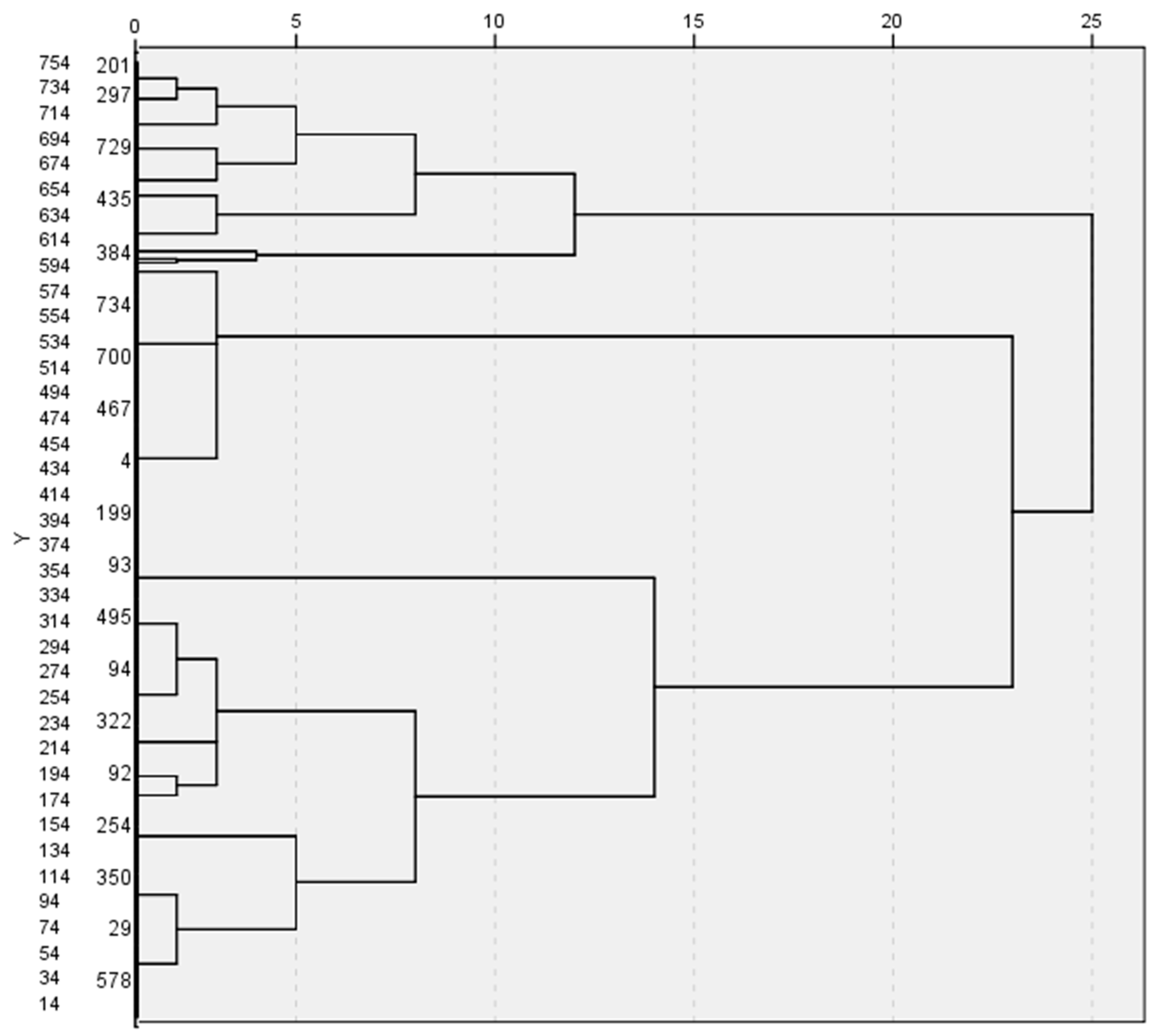
To enhance the transparency and robustness of the clustering procedure, the hierarchical clustering results are illustrated through the dendrogram presented in Figure 1, which visually supports the three-cluster solution based on Ward’s linkage and squared Euclidean distance.
The dendrogram reveals a clear separation of observations into three major clusters, with a substantial increase in linkage distance beyond this partition, confirming the appropriateness of the three-regime solution retained for subsequent analysis.
The resulting distribution is uneven but highly interpretable in institutional terms: Cluster 2 represents the dominant regime (430 observations; 57.2%), Cluster 3 forms a substantial secondary regime (292 observations; 38.8%), while Cluster 1 is a small but clearly differentiated group (30 observations; 4.0%) consistent with an “extreme configuration” rather than random noise (Table 2).
Rather than conceptualizing the pandemic as a uniform exogenous shock generating homogeneous institutional responses, the empirical evidence reveals that Romanian psychiatric hospitals operate within differentiated, path-dependent financing and organizational regimes that precede the crisis and continue to shape institutional dynamics beyond it. This structural persistence lends substantive support to the paper’s typology-driven argument (H1), highlighting the primacy of pre-existing regime configurations over purely temporal shock effects (Table 3).
The standardized cluster centroids reported in Table 3 confirm the existence of three structurally distinct financing–organization regimes, differentiated primarily by workload intensity, personnel composition, and expenditure priorities, thereby substantiating the typology-based interpretation advanced in this study.
To further assess the stability and consistency of the clustering solution, a cross-classification analysis was conducted between the hierarchical clustering results and the K-means partition (k = 3).
The results are reported in Table 4.
The cross-classification results indicate a substantial degree of agreement between the hierarchical and K-means clustering solutions, as reflected by the concentration of observations along the main diagonal. In particular, Cluster 2 and Cluster 3 exhibit strong consistency across methods, while limited reallocation is observed for a subset of observations in Cluster 2, suggesting the presence of borderline units. Overall, the results confirm the robustness and stability of the identified three-cluster structure.
This validation step reduces the risk of method-dependent classification bias and strengthens the interpretability of the identified financing regimes.

4.3. Temporal Robustness: Cluster Regimes Are Not “Pandemic-Made”

A central validation step examined whether cluster membership is mechanically associated with the pandemic period. Cross-tabulations of cluster assignment with PAN and POST indicate that all three regimes are represented both before and during/after the pandemic, with comparable within-cluster proportions across periods. The chi-square test of independence (Table 5) confirms the absence of a statistically significant association between cluster membership and PAN (χ2(2) = 1.819, p = 0.403), suggesting that the identified regimes are not directly driven by crisis timing.
However, as such cross-tabulations remain descriptive, a more stringent validation was implemented through a temporal split-sample approach. The clustering procedure was estimated separately for the pre-pandemic and post-pandemic subsamples using identical specifications, and the resulting partitions were compared using the Adjusted Rand Index (ARI). The computed ARI value of 0.269 indicates a low-to-moderate level of agreement between the two clustering solutions, pointing to partial structural continuity combined with non-negligible reallocation of units across regimes. Table 6 reports the contingency matrix between the pre-pandemic and post-pandemic cluster assignments.
The correspondence matrix reveals a partial structural alignment rather than one-to-one mapping between regimes. While the first pre-pandemic cluster is largely absorbed into a single post-pandemic configuration, the second and third clusters exhibit substantial redistribution across post-pandemic regimes. This fragmentation explains the moderate ARI value and indicates that the pandemic period acted not only as a stress test but also as a reconfiguration mechanism of existing institutional patterns.
The ARI test was computed using the standard formulation as follows:
A R I = i j n i j 2 i a i 2 j b j 2 n 2 1 2 i a i 2 j b j 2 i a i 2 j b j 2 n 2
where n i j denotes the contingency counts, a i and b j are cluster marginals, and n is the total number of observations (n = 752). The adjustment for chance ensures that the index equals zero under random partitioning and one under perfect agreement.
To complement the split-sample validation based on the Adjusted Rand Index, a centroid displacement analysis was conducted in order to assess whether the structural position of the clusters in the multidimensional space remains stable across periods.
The test involves computing the centroids (mean standardized values of the clustering variables) for each cluster in the pre-pandemic sample and comparing them with the corresponding centroids in the post-pandemic sample. The degree of structural change is quantified using the Euclidean distance between matched centroids:
D k = m = 1 M x ¯ k m p r e x ¯ k m p o s t 2
where D k denotes the displacement of cluster k , and x ¯ k m represents the centroid value for variable m in cluster k .
Based on the maximum overlap derived from the contingency matrix, clusters were matched across periods, and centroid distances were computed. The results indicate a heterogeneous pattern of structural change, with displacement values ranging from approximately 1.19 to 4.20.
Specifically, the cluster corresponding to PRE 2 → POST 1 exhibits the lowest displacement (D ≈ 1.19), indicating relatively strong structural continuity. In contrast, the cluster corresponding to PRE 3 → POST 3 shows moderate displacement (D ≈ 1.70), suggesting partial reconfiguration. The largest shift is observed for the cluster corresponding to PRE 1 → POST 3 (D ≈ 4.20), indicating a more substantial change in its multidimensional profile. These results point to asymmetric structural dynamics across clusters, where regimes remain broadly comparable in relative terms. This pattern is consistent with the ARI results, suggesting that temporal changes are driven not only by reallocation of units across clusters, but also by varying degrees of transformation in cluster profiles. The detailed cross-tabulations is reported in Appendix A.3.
Taken together, these results refine the interpretation of H2. While the absence of a significant association between cluster membership and pandemic timing supports the idea that regimes are not purely crisis-induced, both the ARI and centroid displacement analyses indicate that temporal stability is only partial. The identified regimes persist as recognizable structural configurations, but their internal composition and relative positioning evolve over time. Accordingly, H2 is only partially supported, with the evidence pointing to adaptive reconfiguration rather than strict invariance.

4.4. Regime-Linked Differences in Case-Mix Complexity and Costs

Having identified persistent regimes, the next step links typologies to clinical complexity (CMI) and resource intensity (TCP).
From a theoretical perspective, case-mix complexity is shaped by both structural and contextual factors, including financing arrangements, resource allocation mechanisms, and institutional organization, as well as exogenous shocks such as health crises. In this framework, the cluster-based typology captures latent structural configurations that integrate multiple dimensions of hospital functioning, allowing for a reduced-form representation of otherwise unobservable institutional drivers.
Mean comparisons indicate non-trivial differences in average CMI across regimes: Cluster 1 has the highest mean CMI (1.607; SD = 0.160; N = 30), Cluster 2 follows (1.570; SD = 0.248; N = 430), and Cluster 3 shows the lowest mean CMI (1.483; SD = 0.276; N = 292). The ordering is consistent with the interpretation that structurally “high-pressure” units and/or configurations with tighter staffing constraints may concentrate more complex cases or reflect higher DRG-weighted intensity in recorded activity. A complementary perspective emerges from TCP: Cluster 2 records the highest mean TCP (1661.684; SD = 184.414), while Cluster 1 shows the lowest (1528.367; SD = 114.410), with Cluster 3 in between (1590.795; SD = 177.186). This pattern is analytically valuable because it cautions against equating “higher costs” with “higher case-mix” in a mechanical way; rather, it suggests that cost intensity may reflect expenditure structure and procurement/service delivery modalities (e.g., goods and services reliance) in addition to clinical complexity. The descriptive evidence is summarized in Table 7.
The post-pandemic period is associated with a higher average CMI at the aggregate level (POST = 1 mean 1.570 vs. POST = 0 mean 1.490), and simultaneously a higher average TCP (1694.479 vs. 1532.639). While informative, these descriptive contrasts must be situated within the structural heterogeneity of the system, since observed period differentials may be shaped not only by temporal dynamics but also by pre-existing financing arrangements and organizational configurations.

4.5. ANOVA Validation: Regime Effects Dominate Simple Pandemic Shifts

To formally assess whether CMI differs across regimes and whether the pandemic period modifies these differences, a two-way UNIANOVA was estimated with CMI as the dependent variable and CLUSTER_FIN, PAN, and their interaction as fixed factors. Results show a statistically significant main effect of financing regime on CMI (F = 5.845, p = 0.003), while PAN is not significant (F = 0.359, p = 0.549), and the interaction CLUSTER_FIN × PAN is also not significant (F = 0.822, p = 0.440). The explained variance of this specification is relatively modest (R2 = 0.043; adjusted R2 = 0.036), which is expected given the parsimonious design of the model and the fact that case-mix complexity is influenced by a wide range of clinical and demographic factors not directly observable in aggregate data (Table 8).
To ensure the robustness of the estimated model, a set of post-estimation diagnostics was conducted. The homogeneity of variance assumption was assessed using Levene’s test (Table 9), which was not statistically significant (F(5, 746) = 1.097, p = 0.361). This indicates that the variance in the CMI is comparable across groups, supporting the robustness of the ANOVA estimates.
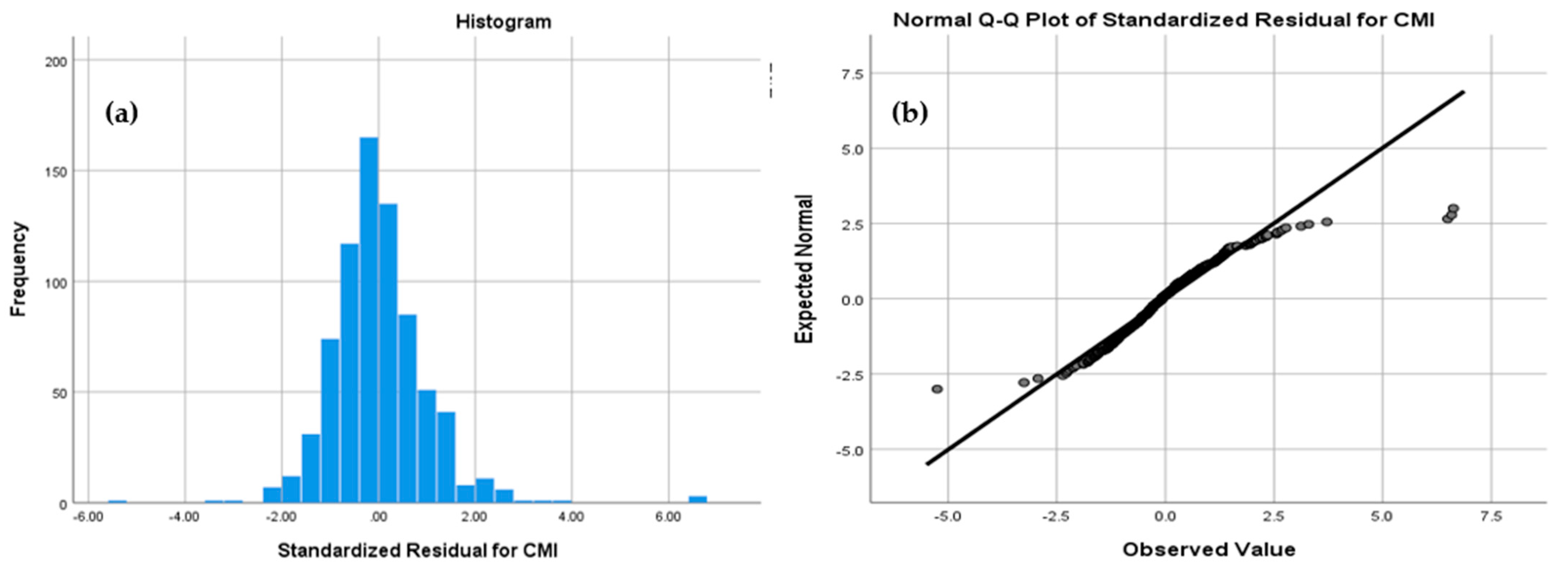
The distribution of standardized residuals was examined using histogram and normal Q–Q plots (Figure 2), which indicate an approximately normal pattern, despite some deviations in the tails.
Formal normality tests (Kolmogorov–Smirnov and Shapiro–Wilk) were statistically significant (p < 0.001), which is expected given the large sample size (N = 752) and their sensitivity to minor deviations. Skewness values (1.203) and kurtosis values (8.237) suggest some degree of asymmetry and leptokurtosis; however, such deviations are not uncommon in applied health data and do not invalidate ANOVA results, particularly in large samples. Overall, the residual distribution can be considered sufficiently close to normal for reliable inference.
While the explanatory power of the model is modest (R2 = 0.043), this is consistent with the inherently multifactorial nature of case-mix complexity, which is influenced by numerous clinical and institutional determinants not fully captured in administrative datasets. The model is therefore intentionally parsimonious, aiming to isolate the structural effect of financing–organization regimes rather than to provide a fully specified predictive framework.
To ensure the appropriateness of the estimation strategy, additional panel data diagnostics were conducted (Table 10), taking into account the longitudinal structure of the dataset (126 hospitals observed over six years).
A Hausman specification test was first performed in order to compare fixed effects and random effects estimators. The results indicate that the null hypothesis of no systematic difference between estimators cannot be rejected (χ2 = 0.332, p = 0.988 for the CMI model; χ2 = 1.767, p = 0.880 for the TCP model), suggesting that the random effects specification is consistent and that unobserved individual effects are not correlated with the regressors. In addition, a Breusch–Pagan Lagrange Multiplier (LM) test for random effects was performed to assess whether panel estimation is preferred over pooled OLS. The results indicate that the null hypothesis of no panel effects is rejected (chibar2 = 15.79, p < 0.001), confirming the presence of significant unobserved heterogeneity across hospital units. Taken together, these results support the use of a random effects specification as the most appropriate panel estimator. However, given the primary objective of the study—namely to identify structural relationships associated with financing composition—and for comparability with the typology-based analysis, pooled OLS estimates are retained as a baseline specification, while panel-based estimators are used to confirm the robustness of the findings. These findings confirm that the empirical results are robust across alternative specifications and reflect stable structural associations rather than artifacts of model selection.
This result provides a robust empirical bridge from the typology analysis to the paper’s core argument and directly aligns with the logic of H4: “pandemic timing” is not the primary driver once structural configurations are taken into account; instead, persistent financing–organization regimes shape the baseline level of case-mix complexity, a finding that remains consistent across alternative specifications and diagnostic tests.

4.6. Structural Financing Configuration Outweighs Pandemic Timing in Explaining Case-Mix Complexity

The final multivariate specification estimates the determinants of case-mix complexity (CMI) at the national level, incorporating both temporal indicators (PAN, POST) and structural financing and expenditure variables. The model is statistically significant overall (F(8, 743) = 6.218, p < 0.001), with an R2 of 0.063 (adjusted R2 = 0.053), indicating that structural factors explain a non-negligible share of cross-sectional variation in the CMI (Table 11).
Consistent with the typology-based framework, pandemic timing does not emerge as a robust predictor of case-mix complexity. The PAN dummy is statistically insignificant, while POST shows only marginal significance, suggesting that temporal effects, once structural determinants are controlled for, do not systematically alter the DRG-based complexity of hospital activity.
By contrast, structural financing variables display more consistent explanatory power. The share of revenues derived from national health insurance contracts (SH_CNAS) has a positive and statistically significant effect, indicating that hospitals more deeply embedded in contract-based reimbursement regimes systematically exhibit higher case-mix complexity. In contrast, the share of personnel expenditures (SH_PERS) is negatively associated with CMI, suggesting that labor intensity alone does not translate into higher DRG-weighted complexity once structural and temporal factors are jointly considered. The remaining variables do not display statistically robust effects in the global specification, reinforcing the interpretation that variation in clinical complexity is driven by specific components of financing architecture rather than by broad expenditure aggregates.
To assess the robustness of these findings, region-specific regressions were estimated (Table 12).
The results reveal substantial territorial heterogeneity in coefficient magnitude and statistical significance. However, despite this variability, a consistent pattern emerges: structural financing variables retain explanatory relevance across most regions, while pandemic timing remains weak or insignificant.
This evidence indicates that regional differences reflect variations in the intensity and configuration of structural effects rather than a shift toward temporally driven dynamics. In some regions, case-mix complexity is strongly associated with revenue composition and capital intensity, while in others the relationship is weaker or more diffuse. Nevertheless, the dominance of structural determinants over pandemic timing remains a recurrent empirical pattern.
Overall, the results support H4 and reinforce the central argument of the study: psychiatric hospital case-mix complexity is primarily embedded in differentiated financing regimes, while pandemic effects, although observable at the descriptive level, do not constitute a dominant explanatory factor once structural characteristics are taken into account.

5. Discussion and Policy Implications

The findings of this study provide a structurally grounded reinterpretation of the relationship between financing architecture and clinical complexity in psychiatric hospitals operating within a centralized health insurance system. Contrary to narratives that attribute post-2020 shifts in hospital performance primarily to the COVID-19 shock, the empirical evidence demonstrates that case-mix complexity is predominantly shaped by persistent financing configurations rather than by temporary pandemic timing. This distinction is analytically important, because it reorients the explanatory focus from exogenous crisis events to endogenous institutional architecture. The identification of three structurally distinct financing–organization regimes confirms that psychiatric hospitals in Romania operate within differentiated institutional configurations, even under a formally unified national financing framework. The absence of a statistically significant association between cluster membership and pandemic timing further strengthens this interpretation: the regimes uncovered by the clustering procedure are not crisis-induced categories but rather entrenched structural typologies. In this respect, this study advances the literature on health system resilience by illustrating that resilience may manifest not only as adaptive reconfiguration but also as structural persistence under stress.
The multivariate results deepen this interpretation. The global regression model demonstrates that the share of contract-based revenues (SH_CNAS) is positively associated with case-mix complexity, while personnel expenditure shares exhibit a negative relationship. Pandemic timing variables do not retain robust explanatory power once structural controls are introduced. This finding is theoretically significant because it challenges the assumption that crisis periods necessarily produce lasting shifts in clinical workload patterns. Instead, the results suggest that the structural incentives embedded in financing composition play a more decisive role in shaping case-mix intensity.
From a comparative perspective, this contribution addresses a clear gap in the international literature. Much of the empirical evidence on hospital financing and DRG-based complexity originates from Western European systems or from high-income OECD contexts where detailed micro-level data are available. Central and Eastern European systems remain underrepresented in quantitative studies relying on administrative hospital-level panel data. By combining clustering techniques with multivariate regression on a multi-year national dataset, the present research extends empirical evidence to an institutional setting characterized by transitional financing arrangements and uneven territorial capacity. The study thus contributes to bridging the East–West empirical divide in health economics research.
Another important contribution lies in the integration of structural typology analysis with outcome modeling. Rather than examining financing variables in isolation, the study first identifies regime-based configurations and then links them to clinical outcomes. This two-step approach allows the analysis to move beyond variable-level associations toward a regime-based understanding of institutional behavior. In doing so, the paper aligns with institutionalist perspectives in public finance and organizational economics, which emphasize the role of structural arrangements over short-term shocks in explaining performance variation.
The regional robustness analysis further reinforces the structural interpretation. Although explanatory power varies across regions, financing composition consistently emerges as a key determinant of case-mix complexity. Even where coefficients differ in magnitude or direction, the dominance of structural variables over pandemic timing remains evident. This territorial heterogeneity underscores the importance of contextualized policy responses rather than uniform national interventions. The policy implications of these findings are substantial and extend beyond the Romanian case.
The strong association between contract-based revenue shares and case-mix complexity suggests that financing incentives embedded in health insurance contracts influence not only revenue stability but also the clinical composition of treated cases. Policymakers should therefore reassess the design of psychiatric service contracts to ensure that reimbursement formulas do not inadvertently encourage case selection behaviors or distort clinical prioritization. Rather than relying exclusively on volume-based or historical contract allocations, a more nuanced adjustment mechanism incorporating regional workload intensity and structural staffing ratios could enhance allocative fairness.
The negative association between personnel expenditure share and case-mix complexity raises questions about the efficiency and strategic alignment of staffing structures. This does not imply that higher staffing reduces complexity per se; rather, it suggests that expenditure concentration on personnel, without complementary investment in service diversification or infrastructure, may not translate into higher DRG-weighted activity. A potential policy direction would involve introducing performance-sensitive budgeting frameworks that link personnel expansion to demonstrable improvements in service mix complexity, rather than maintaining rigid expenditure ceilings detached from outcome indicators.
The regional heterogeneity observed in the robustness analysis indicates that a “one-size-fits-all” financing policy is unlikely to produce optimal outcomes. Regions exhibiting strong structural sensitivity to financing composition may benefit from targeted contractual recalibration, while regions displaying structural stability may require different levers, such as service integration mechanisms or coordinated referral networks. The findings therefore support a territorially differentiated policy approach within the broader national financing architecture.
The absence of a robust pandemic effect in the presence of structural controls suggests that crisis-related funding adjustments should not be interpreted as substitutes for long-term structural reform. Temporary infusions of resources during emergencies may stabilize operations, but they do not fundamentally alter the institutional drivers of clinical complexity. Sustainable reform must therefore address financing architecture rather than relying on episodic fiscal injections.
The identification of high-pressure regimes characterized by elevated cases per bed and per physician highlights the need for structural workload monitoring mechanisms. Instead of reactive staffing adjustments, policymakers could implement forward-looking capacity planning models integrating workload ratios, contract composition, and case-mix indicators to anticipate imbalances before they translate into quality deterioration or workforce burnout.
The policy implications emerging from these findings extend beyond conventional resource expansion strategies and instead point toward structural recalibration of financing architecture. Rather than focusing exclusively on aggregate funding increases or uniform staffing adjustments, the results indicate the need for incentive-consistent contract design, differentiated regional calibration of reimbursement parameters, and closer alignment between expenditure composition and case-mix intensity. In this framework, financing policy becomes a structural instrument shaping clinical configuration, not merely a fiscal envelope. Effective reform therefore requires integrating workload indicators, revenue composition, and expenditure structure into coordinated budgeting and contracting mechanisms capable of addressing territorially differentiated institutional configurations.

6. Conclusions

This study addresses a central question in the post-pandemic health policy debate: whether variation in hospital performance is primarily driven by exogenous shocks or by structural financing architectures that shape institutional behavior over time. Focusing on psychiatric hospitals within a unified national health insurance system, the analysis disentangles temporal effects from structural configurations in explaining case-mix complexity.
The empirical evidence consistently indicates that psychiatric hospitals do not operate as homogeneous entities reacting uniformly to crisis conditions. Instead, they form distinct financing–organization regimes defined by specific combinations of revenue composition, expenditure allocation, workforce structure, and operational pressure. These regimes are not temporally contingent: although descriptive tests suggest compositional stability, more stringent validation (ARI and centroid analysis) shows that structural persistence coexists with moderate reconfiguration across periods. This implies that regimes are not “pandemic-made,” but neither are they fully invariant.
Within the multivariate framework, structural financing characteristics emerge as the primary drivers of case-mix complexity. In contrast, pandemic timing does not retain robust explanatory power once these structural factors are controlled for. This finding supports a structurally grounded interpretation of hospital behavior, in which financing architecture exerts a more durable influence than temporary crisis-related disturbances.
This study contributes to the literature by advancing a typology-based analytical framework that integrates multivariate clustering with outcome modeling. Applied to a longitudinal administrative dataset from a Central and Eastern European context, this approach provides novel empirical evidence in a field largely dominated by studies from Western European and OECD systems. The results highlight that even within a formally unified financing system, institutional heterogeneity remains structured and analytically significant.
At the same time, the relatively low explanatory power of the regression models suggests that case-mix complexity is influenced by additional factors not captured in the current specification, including clinical pathways, referral mechanisms, and unobserved organizational practices. Rather than undermining the results, this limitation reinforces the interpretation that structural financing variables represent only one dimension of a more complex institutional process.
Several limitations should be acknowledged. The use of aggregated administrative data constrains the analysis to institutional-level relationships and does not allow for patient-level or quality-of-care evaluation. The absence of dynamic specifications limits the ability to capture persistence in case-mix evolution, while spatial interactions between hospitals are not explicitly modeled. Future research should extend the analysis using dynamic panel models, spatial econometric approaches, and micro-level clinical data, as well as comparative cross-country designs.
From a policy perspective, the findings indicate that structural incentive design represents a more effective lever than short-term crisis interventions. Financing architecture—through revenue composition, expenditure allocation, and contractual design—shapes hospital behavior in a persistent manner. Consequently, reform efforts should focus less on episodic adjustments and more on the underlying configuration of incentives that governs institutional performance.
Overall, the analysis suggests that psychiatric hospital case-mix complexity is structurally embedded within differentiated financing regimes that persist across temporal disruptions, while allowing for adaptive reconfiguration. By foregrounding financing architecture as a central explanatory dimension, this study contributes to a more nuanced understanding of health system resilience, emphasizing the interplay between structural continuity and institutional adaptation.

Author Contributions

Conceptualization, A.Ț. and M.M.; methodology, A.Ț.; software, F.P.I. and M.C.M.; validation, A.Ț. and F.P.I.; formal analysis, A.Ț.; investigation, A.Ț.; resources, A.Ț.; data curation, A.Ț.; writing—original draft preparation, A.Ț.; writing—review and editing, M.C.M. and M.M.; visualization, M.C.M.; supervision, M.M.; project administration, A.Ț. All authors have read and agreed to the published version of the manuscript.

Funding

This research received no external funding.

Institutional Review Board Statement

Ethical review and approval were waived for this study due to the data consist exclusively of institutional, financial, and aggregated clinical indicators. No individual-level patient information, personal identifiers, or sensitive data were included in the dataset. The data were obtained from official administrative reporting sources of the Romanian Ministry of Public Health (https://monitorizarecheltuieli.ms.ro/centralizator, accessed on 19 January 2026).

Informed Consent Statement

Not applicable.

Data Availability Statement

The anonymized analytical dataset used in this study can be made available to interested researchers upon reasonable request to the corresponding author, subject to institutional approval and applicable data-sharing regulations.

Acknowledgments

The publication of this paper was supported by the University of Medicine and Pharmacy Carol Davila, through the institutional program Publish not Perish.

Conflicts of Interest

The authors declare no conflicts of interest.

Appendix A

Appendix A.1. Explained Variables and Formulas Included in Empirical Analysis

VariablesSymbol/FormulaDefinitionAdministrative SourceStandardized Variables *
A.
Outcome Variables
CMICase-Mix Index (DRG-based case complexity indicator)Clinical reporting
TCPTotal Cost per PatientFinancial reporting
CASEsNumber of confirmed cases (annual volume)Clinical reporting
B.
Financing Structure Variables
SH_CNASShare of revenues from health insurance contracts in total revenuesF1ZSH_CNAS
S H _ C N A S i t = R e v e n u e s   f r o m   i n s u r a n c e   c o n t r a c t s   ( F 1 | 13 ) i t T o t a l   r e v e n u e s   ( F 1 | 1 ) i t
SH_GRANTSShare of subsidies in total revenuesF1ZSH_GRANTS
S H _ G R A N T S i t = S u b s i d i e s   ( F 1 | 35 + F 1 | 40 + F 1 | 42 + F 1 | 43 ) i t T o t a l   r e v e n u e s   ( F 1 | 1 ) i t
SH_VCURShare of current revenues in total revenuesF1ZSH_VCUR
S H _ V C U R i t = C u r r e n t   r e v e n u e s   ( F 1 | 2 ) i t T o t a l   r e v e n u e s   ( F 1 | 1 ) i t
SH_CHELT_CURShare of current expenditures in total expendituresF1
S H _ C H E L T _ C U R i t = C u r r e n t   e x p e n d i t u r e s   ( F 1 | 57 ) i t T o t a l   e x p e n d i t u r e s   ( F 1 | 56 ) i t
C.
Expenditure Structure Variables
SH_PERSShare of personnel expenditures in total expendituresF1ZSH_PERS
S H _ P E R S i t = P e r s o n n e l   e x p e n d i t u r e s   ( F 1 | 58 ) i t T o t a l   e x p e n d i t u r e s   ( F 1 | 56 ) i t
SH_GDSShare of goods and services expenditures in total expendituresF1ZSH_GDS
S H _ G D S i t = G o o d s   a n d   s e r v i c e s   ( F 1 | 59 ) i t T o t a l   e x p e n d i t u r e s   ( F 1 | 56 ) i t
SH_CAPEXShare of capital expenditures in total expendituresF1ZSH_CAPEX
S H _ C A P E X i t = C a p i t a l   e x p e n d i t u r e s   ( F 1 | 65 ) i t T o t a l   e x p e n d i t u r e s   ( F 1 | 56 ) i t
D.
Workforce Structure Variables
SH_PSYCHShare of psychiatrists in total medical staffF2ZSH_PSYCH
S H _ P S Y C H i t = N u m b e r   o f   p h y s i c i a n s   ( F 2 | 6 ) i t T o t a l   m e d i c a l   s t a f f i t
SH_MEDShare of medium-level healthcare staff in total staffF2ZSH_MED
S H _ M E D i t = M e d i u m l e v e l   s t a f f   ( F 2 | 11 ) i t T o t a l   s t a f f i t
SH_AUXShare of auxiliary staff in total staffF2ZSH_AUX
S H _ A U X i t = Auxiliary   staff   ( F 2 | 12 ) i t T o t a l   s t a f f i t
E.
Operational Pressure Indicators
CASES_PER_BEDCASEs divided by number of bedsF2ZCASES_PER_BED
C A S E S _ P E R _ B E D i t = C A S E s i t N u m b e r   o f   b e d s   ( F 2 | 1 ) i t
CASES_PER_MEDCASEs divided by number of physiciansF2ZCASES_PER_MED
C A S E S _ P E R _ M E D i t = C A S E s i t N u m b e r   o f   p h y s i c i a n s   ( F 2 | 6 ) i t
F.
Temporal Indicators
PANDummy variable = 1 for 2020–2021; 0 otherwise
POSTDummy variable = 1 for 2022–2024; 0 otherwise
2019Baseline year
* Used in cluster analysis only.

Appendix A.2. Regional Descriptive Statistics for Clustering Variables (N = 752)

RegionStatisticsCMICASEsTCPSH_CNASSH_GRANTSSH_PERSSH_GDSSH_CAPEXSH_PSYCHSH_MEDSH_AUXCASES_PER_BEDCASES_PER_MEDSH_VCURSH_CHELT_CUR
1Mean1.394975.6461693.4000.4170.5010.7550.1960.0310.1150.5260.3171.76517.8940.4940.973
SE.Mean0.01959.49917.8940.0060.0100.0090.0070.0030.0030.0040.0050.2363.3090.0100.003
ST.Dev0.222678.391204.0180.0670.1100.0990.0810.0360.0310.0500.0582.68837.7270.1090.036
2Mean1.4651089.2821575.7690.4260.5050.7680.1920.0390.1040.5220.3362.50636.8070.4820.965
SE.Mean0.02074.49317.9710.0080.0110.0080.0050.0070.0050.0050.0090.1823.3580.0110.007
ST.Dev0.175657.901158.7200.0720.1000.0750.0460.0640.0480.0460.0811.60929.6580.0950.066
3Mean1.577930.7421561.2920.4500.4870.7570.2020.0300.1110.5280.3242.63742.4930.5090.972
SE.Mean0.02549.33113.6430.0080.0070.0080.0060.0040.0030.0050.0060.2195.5960.0070.004
ST.Dev0.232465.385128.7120.0720.0670.0760.0600.0340.0250.0470.0562.07052.7960.0690.034
4Mean1.531956.3271616.5920.3820.4760.7710.1810.0370.1610.5440.2602.13611.9710.5190.966
SE.Mean0.02694.23517.5160.0080.0150.0120.0090.0070.0030.0020.0030.2231.4440.0140.007
ST.Dev0.181659.643122.6100.0580.1020.0840.0630.0510.0230.0160.0221.56410.1080.0990.051
5Mean1.526517.7251653.0440.4920.4470.7000.2510.0250.1140.4820.3620.90315.1200.5480.978
SE.Mean0.02341.43826.4710.0100.0080.0070.0050.0030.0040.0070.0100.0571.6920.0090.003
ST.Dev0.217395.296252.5130.0990.0790.0700.0520.0260.0390.0630.0940.54216.1440.0810.027
6Mean1.653832.1191645.5510.4270.4760.7160.2320.0350.1210.5340.3081.53315.5370.5150.968
SE.Mean0.03645.33116.7960.0050.0080.0060.0050.0030.0030.0060.0050.1712.8440.0080.003
ST.Dev0.390492.417182.4530.0560.0880.0680.0580.0340.0300.0610.0511.85630.8960.0890.034
7Mean1.470667.5321580.1380.4090.4840.7320.2080.0430.1230.5150.3321.38414.6660.4940.961
SE.Mean0.01937.35712.3490.0060.0090.0080.0060.0050.0040.0070.0090.0561.6700.0100.005
ST.Dev0.184362.190119.7250.0570.0910.0780.0550.0490.0400.0640.0850.54516.1890.0940.050
8Mean1.683922.4371655.6500.4810.4460.6870.2860.0190.1260.5100.3062.24015.6790.5440.983
SE.Mean0.01739.16517.6720.0090.0090.0060.0060.0030.0030.0050.0050.4191.7610.0110.003
ST.Dev0.177397.480179.3530.0900.0880.0660.0570.0330.0340.0550.0484.25517.8700.1070.031
TotalMean1.538857.1221628.8390.4380.4780.7330.2210.0320.1200.5190.3201.84620.9690.5130.971
SE.Mean0.00919.9496.6920.0030.0030.0030.0030.0020.0010.0020.0030.0861.1700.0040.002
ST.Dev0.260547.064183.5240.0800.0930.0830.0690.0410.0370.0560.0702.35232.0790.0970.042

Appendix A.3. Cluster Profiling/External Validation

Cluster Number of CaseCluster Number of Case × PAN CrosstabulationCluster Number of Case × POST Crosstabulation
PANTotalPOSTTotal
0101
C1Count26430121830
% within Cluster Number of Case86.7%13.3%100.0%40.0%60.0%100.0%
2Count35674430165265430
% within Cluster Number of Case82.8%17.2%100.0%38.4%61.6%100.0%
3Count23260292128164292
% within Cluster Number of Case79.5%20.5%100.0%43.8%56.2%100.0%
TotalCount614138752305447752
% within Cluster Number of Case81.6%18.4%100.0%40.6%59.4%100.0%

References

  1. Rosenthal, A.; Waitzberg, R. The Challenges Brought by the COVID-19 Pandemic to Health Systems Exposed Pre-Existing Gaps. Health Policy OPEN 2023, 4, 100088. [Google Scholar] [CrossRef]
  2. Bolatov, A.; Baikanova, R.; Igenbayeva, B.; Seisembekov, T. Health Care Providers Have Faced the Pandemic Altruistically, but Financial Support is Important for Their Well-Being and Motivation to Work. Public Health 2025, 240, 119–124. [Google Scholar] [CrossRef]
  3. Mannion, J.; Kingston, L.; Maria, N.; Tierney, A.; Burke, P.; McCarthy, M.; Steed, F.; Curley, H.; Pettigrew, J. Patient Experience of Care in an Interprofessional Field Hospital During the COVID-19 Pandemic: A Qualitative Study. J. Prim. Care Community Health 2025, 16, 21501319251326780. [Google Scholar] [CrossRef]
  4. Gourret Baumgart, J.; Kane, H.; El-Hage, W.; Deloyer, J.; Maes, C.; Lebas, M.-C.; Marazziti, D.; Thome, J.; Fond-Harmant, L.; Denis, F. The Early Impacts of the COVID-19 Pandemic on Mental Health Facilities and Psychiatric Professionals. Int. J. Environ. Res. Public Health 2021, 18, 8034. [Google Scholar] [CrossRef]
  5. Vyas, A.; Butakhieo, N.; Vyas, L. Consequences of the Pandemic on Mental Health of Healthcare Workers in the NHS. Behav. Sci. 2024, 14, 1208. [Google Scholar] [CrossRef]
  6. Schuster, A.M.; Alwan, N.A.; Callard, F.; Chen, E.Y.H.; Gilbody, S.; Graham, B.M.; Hatch, S.L.; Jones, E.; Jordan, A.; Knapp, M.; et al. The Implications of the COVID-19 Pandemic for Clinical Mental Health Care. Lancet Psychiatry 2026, 13, 140–161. [Google Scholar] [CrossRef] [PubMed]
  7. Aljuneidi, T.; Bhat, S.A.; Boulaksil, Y. A Comprehensive Systematic Review of the Literature on the Impact of the COVID-19 Pandemic on Supply Chains. Supply Chain Anal. 2023, 3, 100025. [Google Scholar] [CrossRef]
  8. Hosseinzadeh, P.; Zareipour, M.; Baljani, E.; Moradali, M.R. Social Consequences of the COVID-19 Pandemic. A Systematic Review. Investig. Educ. Enferm. 2022, 40, e10. [Google Scholar] [CrossRef]
  9. Williams, B.A.; Jones, C.H.; Welch, V.; True, J.M. Outlook of Pandemic Preparedness in a Post-COVID-19 World. npj Vaccines 2023, 8, 178. [Google Scholar] [CrossRef] [PubMed]
  10. World Health Organization. Responding to the Health Financing Emergency: Immediate Measures and Longer-Term Shifts. Available online: https://www.who.int/publications/i/item/9789240117587 (accessed on 19 January 2026).
  11. Jamison, D.T.; Summers, L.H.; Chang, A.Y.; Karlsson, O.; Mao, W.; Norheim, O.F.; Ogbuoji, O.; Schäferhoff, M.; Watkins, D.; Adeyi, O.; et al. Global health 2050: The Path to Halving Premature Death by Mid-Century. Lancet 2024, 404, 1561–1614. [Google Scholar] [CrossRef] [PubMed]
  12. Antohi, V.M.; Ionescu, R.V.; Zlati, M.L.; Mirica, C. Approaches Related to the Effects of COVID-19 Pandemics on Financing of the Healthcare System in Romania. Front. Public Health 2022, 10, 940021. [Google Scholar] [CrossRef]
  13. Pi, S.; Masterson, J.; Ma, S.P.; Corbin, C.K.; Milstein, A.; Chen, J.H. Using Case Mix Index within Diagnosis-Related Groups to Evaluate Variation in Hospitalization Costs at a Large Academic Medical Center. AMIA Annu. Symp. Proc. 2023, 2023, 1201–1208. [Google Scholar] [PubMed]
  14. Kaposi, A.; Nagy, A.; Gomori, G.; Kocsis, D. Application of the Case-Mix Index and Length of Stay for Hospital Waste Management Comparison: Introduction of a New Adjusted Metric. Front. Public Health 2025, 13, 1623725. [Google Scholar] [CrossRef]
  15. Radu, C.-P.; Pana, B.C.; Pele, D.T.; Costea, R.V. Evolution of Public Health Expenditure Financed by the Romanian Social Health Insurance Scheme from 1999 to 2019. Front. Public Health 2021, 9, 795869. [Google Scholar] [CrossRef]
  16. OECD. OECD Reviews of Health Systems: Romania 2025; OECD: Paris, France, 2025. [Google Scholar]
  17. Petre, I.; Barna, F.; Gurgus, D.; Tomescu, L.C.; Apostol, A.; Petre, I.; Furau, C.; Năchescu, M.L.; Bordianu, A. Analysis of the Healthcare System in Romania: A Brief Review. Healthcare 2023, 11, 2069. [Google Scholar] [CrossRef] [PubMed]
  18. Joseph, J.; Sengul, M. Organization Design: Current Insights and Future Research Directions. J. Manag. 2024, 51, 249–308. [Google Scholar] [CrossRef]
  19. Ștefan, S.C.; Popa, I.; Breazu, A. Healthcare Organizations and Performance: The Role of Environment, Strategic Orientation, and Organizational Structure. Systems 2025, 13, 1018. [Google Scholar] [CrossRef]
  20. Steinmann, G.; Daniels, K.; Mieris, F.; Delnoij, D.; van de Bovenkamp, H.; van der Nat, P. Redesigning Value-Based Hospital Structures: A Qualitative Study on Value-Based Health Care in the Netherlands. BMC Health Serv. Res. 2022, 22, 1193. [Google Scholar] [CrossRef]
  21. Jegan, R.; Rose, A.; Dierickx, K. Institutional Financial Incentives in Healthcare: A Review of Normative Considerations. BMC Med. Ethics 2025, 26, 92. [Google Scholar] [CrossRef] [PubMed]
  22. Allers, S.; Eijkenaar, F.; van Raaij, E.M.; Schut, F.T. The Long and Winding Road towards Payment for Healthcare Innovation with High Societal Value but Limited Commercial Value: A Comparative Case Study of Devices and Health Information Technologies. Technol. Soc. 2023, 75, 102405. [Google Scholar] [CrossRef]
  23. Alarcón-Ramirez, D.; Oliveros-Romero, J.; Mahn, D. Performance Comparison of Public–Private Partnerships and Traditionally Procured Hospitals. Constr. Manag. Econ. 2026, 44, 79–97. [Google Scholar] [CrossRef]
  24. World Bank Group. Hospitals in Health Systems: Opportunities for Efficient, High-Quality, and Integrated Care; World Bank Group: Washington, DC, USA, 2024. [Google Scholar]
  25. van der Ham, A.; Van Raak, A.; Ruwaard, D.; van Merode, F. Exploring Changes in Integration, Differentiation, Rules, Coordination and Performance Following the Introduction of a Hospital Planning Centre: A Case Study. J. Health Organ. Manag. 2022, 36, 158–178. [Google Scholar] [CrossRef]
  26. Betto, F.; Garengo, P. A Circular Pathway for Developing Resilience in Healthcare during Pandemics. Int. J. Prod. Econ. 2023, 266, 109036. [Google Scholar] [CrossRef]
  27. OECD/European Observatory on Health Systems and Policies. Strengthening Health Systems: A Practical Handbook for Resilience Testing. Available online: https://www.oecd.org/en/publications/strengthening-health-systems_3a39921e-en.html (accessed on 26 January 2026).
  28. Ellis, L.A.; Saba, M.; Long, J.C.; Lyng, H.B.; Haraldseid-Driftland, C.; Churruca, K.; Wiig, S.; Austin, E.; Clay-Williams, R.; Carrigan, A.; et al. The Rise of Resilient Healthcare Research during COVID-19: Scoping Review of Empirical Research. BMC Health Serv. Res. 2023, 23, 833. [Google Scholar] [CrossRef]
  29. Filip, R.; Gheorghita Puscaselu, R.; Anchidin-Norocel, L.; Dimian, M.; Savage, W.K. Global Challenges to Public Health Care Systems During the COVID-19 Pandemic: A Review of Pandemic Measures and Problems. J. Pers. Med. 2022, 12, 1295. [Google Scholar] [CrossRef]
  30. OECD. Ready for the Next Crisis? Investing in Health System Resilience; OECD: Paris, France, 2023. [Google Scholar]
  31. Hanson, K.; Brikci, N.; Erlangga, D.; Alebachew, A.; De Allegri, M.; Balabanova, D.; Blecher, M.; Cashin, C.; Esperato, A.; Hipgrave, D.; et al. The Lancet Global Health Commission on Financing Primary Health Care: Putting People at the Centre. Lancet Glob. Health 2022, 10, e715–e772. [Google Scholar] [CrossRef] [PubMed]
  32. Berardi, C.; Schut, F.; Paolucci, F. The Dynamics of International Health System Reforms: EVIDENCE of a New Wave in Response to the 2008 Economic Crisis and the COVID-19 Pandemic? Health Policy 2024, 143, 105052. [Google Scholar] [CrossRef] [PubMed]
  33. Johnson, S.; Dalton-Locke, C.; Baker, J.; Hanlon, C.; Salisbury, T.T.; Fossey, M.; Newbigging, K.; Carr, S.E.; Hensel, J.; Carrà, G.; et al. Acute Psychiatric Care: Approaches to Increasing the Range of Services and Improving Access and Quality of Care. World Psychiatry 2022, 21, 220–236. [Google Scholar] [CrossRef]
  34. Iversen, H.W.; Riley, H.; Lorem, G.F. Paradoxes in Mental Healthcare: Exploring Service Gaps in Treatment and Care for Patients with Extensive Hospitalization Experience. Qual. Health Res. 2025, 10497323241309260. [Google Scholar] [CrossRef]
  35. Bratt, S. Structural and Cultural Barriers to Integrated Care for Co-Existing Mental Health and Substance Use: A Morphogenetic Analysis. Discov. Public Health 2025, 22, 354. [Google Scholar] [CrossRef]
  36. Mendez, C.M.; Harrington, D.W.; Christenson, P.; Spellberg, B. Impact of Hospital Variables on Case Mix Index as a Marker of Disease Severity. Popul. Health Manag. 2014, 17, 28–34. [Google Scholar] [CrossRef]
  37. Wang, Z.; Chang, W.; Luo, A. A Medical Insurance Fund Operation Performance Evaluation System Under the DRG Payment Mode Reform. Front. Public Health 2025, 13, 1549575. [Google Scholar] [CrossRef]
  38. Du, L.; Fang, S.; Zhang, Q. Trend Analysis of Medical Expenses under DRG Payment Reform in China. Sci. Rep. 2025, 15, 36961. [Google Scholar] [CrossRef]
  39. Grigorakis, N.; Galyfianakis, G.; Tsoukatos, E. Assessing the Responsiveness of Out-of-Pocket Healthcare Expenditure to Macro-Fiscal Factors and Different Health Financing Systems: Evidence from the European and OECD Area. EuroMed J. Bus. 2021, 17, 193–217. [Google Scholar] [CrossRef]
  40. Lupu, D.; Tiganasu, R. COVID-19 and the Efficiency of Health Systems in Europe. Health Econ. Rev. 2022, 12, 14. [Google Scholar] [CrossRef]
  41. Kittipittayakorn, C. Association between Healthcare Resources, Healthcare Systems, and Population Health in European Countries. BMC Health Serv. Res. 2025, 25, 720. [Google Scholar] [CrossRef] [PubMed]
  42. Gabani, J.; Mazumdar, S.; Suhrcke, M. The Effect of Health Financing Systems on Health System Outcomes: A Cross-Country Panel Analysis. Health Econ. 2023, 32, 574–619. [Google Scholar] [CrossRef] [PubMed]
  43. Mbau, R.; Musiega, A.; Nyawira, L.; Tsofa, B.; Mulwa, A.; Molyneux, S.; Maina, I.; Jemutai, J.; Normand, C.; Hanson, K.; et al. Analysing the Efficiency of Health Systems: A Systematic Review of the Literature. Appl. Health Econ. Health Policy 2023, 21, 205–224. [Google Scholar] [CrossRef]
  44. Hadipour, A.; Delavari, S.; Bayati, M. What is the Role of Institutional Quality in Health Outcomes? A Panel Data Analysis on 158 Countries from 2001–2020. Heliyon 2023, 9, e20251. [Google Scholar] [CrossRef]
  45. Bialynicki-Birula, P.; Burianová, L.; Klich, J.; Mertl, J.; Šimčík, A. One or More Payers for Healthcare Financing: The Experience From Poland and Czechia. Econ. Politics 2025, 37, 616–637. [Google Scholar] [CrossRef]
  46. World Health Organization. Rehabilitation in Health Financing. Available online: https://www.who.int/publications/b/64843 (accessed on 26 January 2026).
  47. Ziegler, S.; Bozorgmehr, K. Translating Restrictive Law into Practice: An Ethnographic Exploration of the Systemic Processing of Legally Restricted Health Care Access for Asylum Seekers in Germany. Int. J. Equity Health 2024, 23, 208. [Google Scholar] [CrossRef] [PubMed]
  48. Molander, P. Public Versus Private Healthcare Systems in the OECD Area—A Broad Evaluation of Performance. Eur. J. Health Econ. HEPAC Health Econ. Prev. Care 2025, 26, 1163–1173. [Google Scholar] [CrossRef] [PubMed]
  49. Porto, A.; Puig, J.P.; Vidal, B. Intergovernmental Transfers and Dynamic Adjustment of Subnational Budgets. Int. Tax Public Financ. 2026. [Google Scholar] [CrossRef]
  50. OECD. Fiscal Sustainability of Health Systems; OECD: Paris, France, 2024. [Google Scholar]
  51. Bertheussen, B.A. Institutional Logics and Soft Budget Constraints: A Study of Financial Management Practices at a Public University Faculty. J. Public Budg. Account. Financ. Manag. 2025, 37, 129–155. [Google Scholar] [CrossRef]
  52. Azambuja, R.; Islam, G. Middle-Managerial Deviance as a Response to Structural Strain: Rescoping, Reconfiguring and Replacing Norms. J. Manag. Stud. 2024, 61, 994–1035. [Google Scholar] [CrossRef]
  53. Zhang, H.; Fu, X.; Wu, Y.; Tang, Y.; Jin, H.; Xie, B. The Impact of DRG-Based Payment Reform on Inpatient Healthcare Utilization: Evidence from a Natural Experiment in China. Healthcare 2025, 13, 2424. [Google Scholar] [CrossRef]
  54. Huang, X.; Zhu, J.; Zhang, J. Impacts of DRG Point-Based Payment System on Healthcare Resource Utilization and Provider Behavior: A Pilot Quasi-Experimental Study in China. Front. Public Health 2025, 13, 1678259. [Google Scholar] [CrossRef]
  55. Zeng, W.; Boiangiu, M.; Trachsel, N.; Jarawan, E.; Turbat, V.; Meessen, B. What Affects the Performance of Hospital Financing Interventions in Low and Lower-Middle Income Countries from the Program Design and Implementation Perspective? A Scoping Review. Health Policy Plan. 2025, 40, 1127–1141. [Google Scholar] [CrossRef]
  56. Wang, X.; Coyte, P.C. The Relationship Between Structural Characteristics of Long-Term Care Institutions and Their Initial Operating Budgets. Front. Public Health 2025, 13, 1669451. [Google Scholar] [CrossRef]
  57. Piedra-Peña, J.; Prior, D. Analyzing the Effect of Health Reforms on the Efficiency of Ecuadorian Public Hospitals. Int. J. Health Econ. Manag. 2023, 23, 361–392. [Google Scholar] [CrossRef]
  58. Lin, C.-X.; Liu, X.-R.; Lin, K.-B. Acute Poisoning and Psychological Trauma: Bridging Emergency Care to Long-Term Mental Health Rehabilitation. World J. Psychiatry 2025, 15, 111516. [Google Scholar] [CrossRef] [PubMed]
  59. Edwards, C.L.; Membreno Lopez, A.S.; Green, C.; Jones, D.A.; Wiggins, C.; Bullock, S.M.; James, N.; Fryman, M.J.; Bryson, W.J.; Jackson, L.; et al. Implicit Bias in Pain Management: The Intersection of Stigma, Race, and Chronic Disease in Sickle Cell Disease. J. Natl. Med. Assoc. 2026. [Google Scholar] [CrossRef]
  60. Ki, Y.; McAleavey, A.A.; Moger, T.A.; Moltu, C. Cost Structure in Specialist Mental Healthcare: What are the Main Drivers of the Most Expensive Episodes? Int. J. Ment. Health Syst. 2023, 17, 37. [Google Scholar] [CrossRef]
  61. Stein, D.J.; Shoptaw, S.J.; Vigo, D.V.; Lund, C.; Cuijpers, P.; Bantjes, J.; Sartorius, N.; Maj, M. Psychiatric Diagnosis and Treatment in the 21st Century: Paradigm Shifts versus Incremental Integration. World Psychiatry 2022, 21, 393–414. [Google Scholar] [CrossRef] [PubMed]
  62. McGorry, P.D.; Mei, C.; Chanen, A.; Hodges, C.; Alvarez-Jimenez, M.; Killackey, E. Designing and Scaling up Integrated Youth Mental Health Care. World Psychiatry 2022, 21, 61–76. [Google Scholar] [CrossRef]
  63. Blæhr, E.E.; Gallo Cordoba, B.; Skipper, N.; Søgaard, R. Variation in Psychiatric Hospitalisations: A Multiple-Membership Multiple-Classification Analysis. Int. J. Environ. Res. Public Health 2024, 21, 973. [Google Scholar] [CrossRef]
  64. OECD. A New Benchmark for Mental Health Systems: Tackling the Social and Economic Costs of Mental Ill-Health; OECD: Paris, France, 2021. [Google Scholar]
  65. Gilmore, A.B.; Fabbri, A.; Baum, F.; Bertscher, A.; Bondy, K.; Chang, H.-J.; Demaio, S.; Erzse, A.; Freudenberg, N.; Friel, S.; et al. Defining and Conceptualising the Commercial Determinants of Health. Lancet 2023, 401, 1194–1213. [Google Scholar] [CrossRef]
  66. Dunbar, P.; Keyes, L.M.; Browne, J.P. Determinants of Regulatory Compliance in Health and Social Care Services: A Systematic Review Using the Consolidated Framework for Implementation Research. PLoS ONE 2023, 18, e0278007. [Google Scholar] [CrossRef]
  67. Homauni, A.; Markazi-Moghaddam, N.; Mosadeghkhah, A.; Noori, M.; Abbasiyan, K.; Jame, S.Z.B. Budgeting in Healthcare Systems and Organizations: A Systematic Review. Iran. J. Public Health 2023, 52, 1889–1901. [Google Scholar] [CrossRef]
  68. De Vries, N.; Lavreysen, O.; Boone, A.; Bouman, J.; Szemik, S.; Baranski, K.; Godderis, L.; De Winter, P. Retaining Healthcare Workers: A Systematic Review of Strategies for Sustaining Power in the Workplace. Healthcare 2023, 11, 1887. [Google Scholar] [CrossRef] [PubMed]
  69. Choi, E.; Wu, Y. Impact of Stringent Budget Stabilization Fund Rules on US State Savings: Generalized Synthetic Control Method and Panel Data Analysis. Public Budg. Financ. 2025, 45, 74–109. [Google Scholar] [CrossRef]
  70. Burns, L.R.; Asch, D.; Muller, R. Vertical Integration of Physicians and Hospitals: Three Decades of Futile Building upon a Shaky Foundation. In Seemed Like a Good Idea: Alchemy Versus Evidence-Based Approaches to Healthcare Management Innovation; Pauly, M., Winston, F., Naylor, M., Volpp, K., Burns, L.R., Muller, R., Asch, D., Werner, R., Desai, B., Chaiyachati, K., et al., Eds.; Cambridge University Press: Cambridge, UK, 2022; pp. 161–245. ISBN 9781316519035. [Google Scholar]
  71. Tebaldi, D.; Stokes, J. Defining Pooled’ Place-Based’ Budgets for Health and Social Care: A Scoping Review. Int. J. Integr. Care 2022, 22, 16. [Google Scholar] [CrossRef] [PubMed]
  72. Li, B.; Long, J.; Li, Y. Geospatial Analysis of Healthcare and Older Adult Care Institutions in Wuhan: A Multimethod Approach to Assessing Spatial Equity. Front. Public Health 2025, 13, 1580630. [Google Scholar] [CrossRef]
  73. Vărzaru, A.A. Assessing the Relationships of Expenditure and Health Outcomes in Healthcare Systems: A System Design Approach. Healthcare 2025, 13, 352. [Google Scholar] [CrossRef] [PubMed]
  74. Chemkomnerd, N.; Pannakkong, W.; Tanantong, T.; Huynh, V.-N.; Karnjana, J. A Scenario-Driven Simulation Approach to Sustainable Hospital Resource Management: Aging Society, Pandemic Preparedness and Referral Enhancement. BMC Health Serv. Res. 2025, 25, 982. [Google Scholar] [CrossRef]
  75. Puiu, I.-A.; Bîlbîie, A. Measuring Productivity in the Healthcare Sector: A Bibliometric and Content Analysis. Health Econ. Rev. 2025, 15, 24. [Google Scholar] [CrossRef]
  76. Tobar, C.I.V.; Escandon-Barbosa, D.; Salas-Paramo, J.; Giménez, V. Efficiency Dynamics in Latin American healthcare Reforms: A Comprehensive Growth Mixture Analysis within Institutional Theory. J. Health Organ. Manag. 2025, 39, 158–176. [Google Scholar] [CrossRef]
  77. Aivalli, P.; Dada, S.; Gilmore, B.; Srinivas, P.N.; De Brún, A. Power Dynamics and Intersectoral Collaboration for Health in Low- and Middle-Income Countries: A Realist Review. Health Policy Plan. 2025, 40, 661–683. [Google Scholar] [CrossRef]
  78. Dincă, M.S.; Antohi, V.M.; Andronic, M.L.; Szeles, M.R.; Baba, C.M. Modelling Health Financing Performance in Europe in the Context of Macroeconomic Uncertainties. Economies 2023, 11, 299. [Google Scholar] [CrossRef]
  79. Moeenian, M.; Ghazinoory, S.; Yaghmaie, P. Analysing the Performance of a Health Innovation Ecosystem in the COVID-19 Crisis: Complexity and Chaos Theory Perspective. Health Res. Policy Syst. 2024, 22, 59. [Google Scholar] [CrossRef]
  80. Drago, C.; Costantiello, A.; Savorgnan, M.; Leogrande, A. Macroeconomic and Labor Market Drivers of AI Adoption in Europe: A Machine Learning and Panel Data Approach. Economies 2025, 13, 226. [Google Scholar] [CrossRef]
  81. Cuppens, T.; Kaur, M.; Kumar, A.A.; Shatto, J.; Ng, A.C.-H.; Leclercq, M.; Reformat, M.Z.; Droit, A.; Dunham, I.; Bolduc, F.V. Developing a Cluster-Based Approach for Deciphering Complexity in Individuals with Neurodevelopmental Differences. Front. Pediatr. 2023, 11, 1171920. [Google Scholar] [CrossRef] [PubMed]
  82. Leichsenring, F.; Fonagy, P.; Heim, N.; Kernberg, O.F.; Leweke, F.; Luyten, P.; Salzer, S.; Spitzer, C.; Steinert, C. Borderline Personality Disorder: A Comprehensive Review of Diagnosis and Clinical Presentation, Etiology, Treatment, and Current Controversies. World Psychiatry 2024, 23, 4–25. [Google Scholar] [CrossRef]
  83. European Union. State of Health in the EU: Companion Report 2021. Available online: https://health.ec.europa.eu/system/files/2022-02/2021_companion_en.pdf (accessed on 27 January 2026).
  84. Waitzberg, R.; Gerkens, S.; Dimova, A.; Bryndová, L.; Vrangbæk, K.; Jervelund, S.S.; Birk, H.O.; Rajan, S.; Habicht, T.; Tynkkynen, L.-K.; et al. Balancing Financial Incentives during COVID-19: A Comparison of Provider Payment Adjustments Across 20 Countries. Health Policy 2022, 126, 398–407. [Google Scholar] [CrossRef]
  85. Friebel, R.; Fistein, J.; Maynou, L.; Anderson, M. Emergency Contracting and the Delivery of Elective Care Services Across the English National Health Service and Independent Sector During COVID-19: A Descriptive Analysis. BMJ Open 2022, 12, e055875. [Google Scholar] [CrossRef]
  86. European Court of Auditors. Special Report 18/2024: EU Financial Support for Health Systems in Selected Partner Countries—Broad Strategic Objectives Followed But Interventions Affected by Coordination and Sustainability Issues; European Court of Auditors: Luxembourg, 2024.
  87. Aksom, H. Institutional Inertia and Practice Variation. J. Organ. Change Manag. 2022, 35, 463–487. [Google Scholar] [CrossRef]
  88. Panda, D.K. From the Inertia of Tradition to Organizational Absorption of Strategy Practices: A Grounded Theory Study in Indian Higher Educational Institutions. Public Adm. Q. 2024, 49, 125–142. [Google Scholar] [CrossRef]
  89. Bobini, M.; Cicchetti, A. Chasing Environmental Sustainability in Healthcare Organizations: Insights from the Italian Experience. BMC Health Serv. Res. 2025, 25, 978. [Google Scholar] [CrossRef] [PubMed]
  90. Dugger, W.M.; Douglass, C. North’s New Institutionalism. J. Econ. Issues 1995, 29, 453–458. [Google Scholar] [CrossRef]
  91. Butzbach, O.; Fuller, D.B.; Schnyder, G.; Svystunova, L. State-Owned Enterprises as Institutional Actors: A Hybrid Historical Institutionalist and Institutional Work Framework. Manag. Organ. Rev. 2022, 18, 1032–1076. [Google Scholar] [CrossRef]
  92. Nieto-Morales, F.; Cejudo, G.M. Resisting the Tide: The Role of Organizational Routines in Mitigating Policy Dismantling. Policy Stud. 2025, 1–23. [Google Scholar] [CrossRef]
  93. Quentin, W.; Stephani, V.; Berenson, R.A.; Bilde, L.; Grasic, K.; Sikkut, R.; Touré, M.; Geissler, A. How Denmark, England, Estonia, France, Germany, and the USA Pay for Variable, Specialized and Low Volume Care: A Cross-Country Comparison of In-Patient Payment Systems. Int. J. Health Policy Manag. 2022, 11, 2940–2950. [Google Scholar] [CrossRef]
  94. Kwilinski, A.; Vysochyna, A. Efficiency of Healthcare Financing: Case of European Countries. Int. J. Financ. Stud. 2024, 12, 87. [Google Scholar] [CrossRef]
  95. Copello, F.; Dattaro, M.; Leporatti, L.; Montefiori, M. Adjusting Hospital Reimbursements to the Onset of a New Disease: Lesson from COVID-19. Health Policy OPEN 2025, 9, 100148. [Google Scholar] [CrossRef]
  96. Schmidt, A.E.; Merkur, S.; Haindl, A.; Gerkens, S.; Gandré, C.; Or, Z.; Groenewegen, P.; Kroneman, M.; de Jong, J.; Albreht, T.; et al. Tackling the COVID-19 Pandemic: Initial Responses in 2020 in Selected Social Health Insurance Countries in Europe. Health Policy 2022, 126, 476–484. [Google Scholar] [CrossRef] [PubMed]
  97. Fiske, A.; Galasso, I.; Eichinger, J.; McLennan, S.; Radhuber, I.; Zimmermann, B.; Prainsack, B. The Second Pandemic: Examining Structural Inequality through Reverberations of COVID-19 in Europe. Soc. Sci. Med. 2022, 292, 114634. [Google Scholar] [CrossRef] [PubMed]
  98. Konechni, B.; Recchi, E. The Three Acts of Pandemic Governance: A Comparison Between France, Germany, Italy, and the UK. In Social Life During COVID-19 in France, Germany, Italy and the UK; Naumann, E., Biolcati Rinaldi, F., Nandi, A., Recchi, E., Eds.; Springer Nature: Cham, Switzerland, 2025; pp. 15–51. ISBN 978-3-031-99349-7. [Google Scholar]
  99. Kentikelenis, A.; Stubbs, T. Austerity Redux: The Post-Pandemic Wave of Budget Cuts and the Future of Global Public Health. Glob. Policy 2022, 13, 5–17. [Google Scholar] [CrossRef]
  100. Schrecker, T. Building Back Worse? The Prognosis for Health Equity in the Post-Pandemic World. In The Unequal Costs of COVID-19 on Well-Being in Europe; Dalingwater, L., Boullet, V., Costantini, I., Gibbs, P., Eds.; Springer International Publishing: Cham, Switzerland, 2022; pp. 21–39. ISBN 978-3-031-14425-7. [Google Scholar]
  101. OECD. Strengthening Economic Resilience Following the COVID-19 Crisis: A Firm and Industry Perspective; OECD: Paris, France, 2021. [Google Scholar]
  102. Ismail, S.A.; Bell, S.; Chalabi, Z.; Fouad, F.M.; Mechler, R.; Tomoaia-Cotisel, A.; Blanchet, K.; Borghi, J. Conceptualising and Assessing Health System Resilience to Shocks: A Cross-Disciplinary View. Wellcome Open Res. 2022, 7, 151. [Google Scholar] [CrossRef]
  103. Capoani, L.; Fantinelli, M.; Giordano, L. The Concept of Resilience in Economics: A Comprehensive Analysis and Systematic Review of Economic Literature. Contin. Resil. Rev. 2025, 7, 121–145. [Google Scholar] [CrossRef]
  104. Mori, E.; Cantoni, F.; Bisogni, P.G.; Zuffada, E. Hospitals’ Resilience: An Evidence-Based Framework for Sustaining the “Coping” Phase in Non-Linear and Continuous Crises. J. Public Aff. 2025, 25, e70085. [Google Scholar] [CrossRef]
  105. OECD. Securing Medical Supply Chains in a Post-Pandemic World; OECD: Paris, France, 2024. [Google Scholar]
  106. Melnick, G.; Maerki, S. Post-COVID trends in Hospital Financial Performance: Updated Data from California paint an Improved but Challenging Picture for Hospitals and Commercially Insured Patients. Health Aff. Sch. 2023, 1, qxad039. [Google Scholar] [CrossRef]
  107. OECD. OECD Journal on Budgeting, Volume 2022 Issue 3; OECD: Paris, France, 2022. [Google Scholar]
  108. Cook, A.; Averett, S. Do Hospitals Respond to Changing Incentive Structures? Evidence from Medicare’s 2007 DRG Restructuring. J. Health Econ. 2020, 73, 102319. [Google Scholar] [CrossRef]
  109. Milstein, R.; Schreyögg, J. The End of an Era? Activity-Based Funding Based on Diagnosis-Related Groups: A Review of Payment Reforms in the Inpatient Sector in 10 High-Income Countries. Health Policy 2024, 141, 104990. [Google Scholar] [CrossRef]
  110. Kyambade, M.; Mwesigwa, R.; Alinda, K.; Tumwine, S.; Lwanga, F. Drivers of Sustainability Performance in Health and Sanitation Projects: A Systematic Literature Review. Soc. Sci. Humanit. Open 2025, 12, 102046. [Google Scholar] [CrossRef]
  111. Øyri, S.F.; Wiig, S. Linking Resilience and Regulation across System Levels in Healthcare—A multilevel Study. BMC Health Serv. Res. 2022, 22, 510. [Google Scholar] [CrossRef]
  112. Arebo, M.J. Asymmetric Analysis of the Financial Inclusion—Growth Nexus: A NARDL Approach. Res. Glob. 2025, 11, 100316. [Google Scholar] [CrossRef]
  113. Maier, M.; Powell, D.; Murchie, P.; Allan, J.L. Systematic Review of the Effects of Decision Fatigue in Healthcare Professionals on Medical Decision-Making. Health Psychol. Rev. 2025, 19, 717–762. [Google Scholar] [CrossRef]
  114. Pawlaczyk-Szymańska, D.; Gębczyńska-Janowicz, A.; Zdrojewska, J.; Szarejko, W. User Well-Being as a Paramount Challenge in Contemporary Built Environment Design: The Architecture of Psychiatric Hospitals and Its Influence on Treatment Processes and the Health, Safety, and Comfort of Patients and Medical Staff—A Systematic Literature Review and Insights from the New European Bauhaus Initiative. Buildings 2025, 15, 558. [Google Scholar] [CrossRef]
  115. Miller, L.H.; Parks, J.; Yowell, R.; Penaskovic, K.; Reed, R.; Kannarkat, J. The Impact of COVID-19 on Financing of Psychiatric Services. Psychiatr. Clin. 2022, 45, 161–177. [Google Scholar] [CrossRef] [PubMed]
  116. Stepanova, E.; Thompson, A.; Yu, G.; Fu, Y. Changes in Mental Health Services in Response to the COVID-19 Pandemic in High-income Countries: A Rapid Review. BMC Psychiatry 2024, 24, 103. [Google Scholar] [CrossRef]
  117. Rodrigues, C.A.; Rodrigues, N.; Nascimento, M.; Oliveira-Silva, J. Patterns of Adult and Youth Inpatient Admissions before and after the COVID-19 Pandemic in a Psychiatric Ward: An Observational Study. BMC Health Serv. Res. 2022, 22, 1048. [Google Scholar] [CrossRef] [PubMed]
  118. Horvat Golob, K.; Temeljotov Salaj, A.; Novak Šarotar, B. Transition of Mental Health Services from Institutional to Community-Based Care Abroad and Its Context for Slovenia-Advantages and Risks. Int. J. Environ. Res. Public Health 2025, 22, 1066. [Google Scholar] [CrossRef]
  119. Toreyhi, Z.; Rezai-Mersagh, A.M.; Kheradmand, A.; Mehrvar, R. Impacts of Disruptive Events on Addictive Behavioral Patterns: A Cross-Sectional Study of Methadone Maintenance Therapy During the COVID-19 Pandemic in Iran. Health Sci. Rep. 2025, 8, e71580. [Google Scholar] [CrossRef]
  120. Haver, E.; Baruch, Y.; Kotler, M. The Structural Reform of Mental Health Services. Isr. J. Psychiatry Relat. Sci. 2003, 40, 235–239. [Google Scholar]
  121. Morin, J.-F.; Beaumier, G. The Organizational Ecology of the Global Space Industry. Rev. Int. Political Econ. 2024, 31, 1865–1893. [Google Scholar] [CrossRef]
  122. Reinsberg, B. Institutional Overlap and the Survival of Intergovernmental Organisations. West Eur. Politics 2025, 48, 29–57. [Google Scholar] [CrossRef]
  123. Karakolias, S. Rethinking Financial Distress in public Healthcare: Evidence from Greek Hospitals’ Governance Attributes. Front. Public Health 2025, 13, 1690901. [Google Scholar] [CrossRef]
  124. OECD. Health at a Glance 2023; OECD: Paris, France, 2023. [Google Scholar]
  125. Golinelli, D.; Sanmarchi, F.; Toscano, F.; Bucci, A.; Nante, N. Analyzing the 20-year Declining Trend of Hospital Length-of-Stay in European Countries with Different Healthcare Systems and Reimbursement Models. Int. J. Health Econ. Manag. 2024, 24, 375–392. [Google Scholar] [CrossRef]
  126. Belfiore, A.; Cuccurullo, C.; Aria, M. Financial Configurations of Italian Private Hospitals: An Evolutionary Analysis. Health Policy 2022, 126, 661–667. [Google Scholar] [CrossRef]
  127. Dubas-Jakóbczyk, K.; Ndayishimiye, C.; Szetela, P.; Sowada, C.; Kocot, E. Financial Performance of Hospitals in Europe—A Scoping Review. BMC Health Serv. Res. 2025, 25, 933. [Google Scholar] [CrossRef] [PubMed]
  128. Vašaničová, P.; Košíková, M.; Jenčová, S.; Miškufová, M.; Korečko, J. Financial Performance-Based Clustering of Spa Enterprises in Slovakia. J. Risk Financ. Manag. 2025, 18, 482. [Google Scholar] [CrossRef]
  129. Habershon, S.; Nenoff, K.; Kraemer, G.; Schüler, L.; Zozmann, H.; Calabrese, J.M.; Attinger, S.; Mahecha, M.D. The Spatiotemporal Dynamics of COVID-19 in Europe: Time-Series Clustering Maps 5 Distinct Trajectories to Spatial Patterns. Popul. Health Metr. 2025, 23, 44. [Google Scholar] [CrossRef]
  130. Kaklauskas, A.; Milevicius, V.; Kaklauskiene, L. Effects of country success on COVID-19 cumulative cases and excess deaths in 169 countries. Ecol. Indic. 2022, 137, 108703. [Google Scholar] [CrossRef]
  131. Beck, T. Access to finance: Adaptability and Resilience During a Global Pandemic. Account. Bus. Res. 2023, 53, 565–579. [Google Scholar] [CrossRef]
  132. Wiegratz, J.; Behuria, P.; Laskaridis, C.; Pheko, L.L.; Radley, B.; Stevano, S. Common Challenges for All? A Critical Engagement with the Emerging Vision for Post-pandemic Development Studies. Dev. Change 2023, 54, 921–953. [Google Scholar] [CrossRef]
  133. Edwards, F.L.; Ott, J.S. Lessons Learned, Opportunities Developed: Building Administrative and Governance Capacities Through the Pandemic and Post-Pandemic Eras. Public Organ. Rev. 2023, 23, 421–429. [Google Scholar] [CrossRef]
  134. Herrera, C.A.; Bascolo, E.; Villar-Uribe, M.; Houghton, N.; Bennett, S.; Castro, M.C.; Massuda, A.; Bauhoff, S.; Cunningham Kain, M.K.; Figueroa, J.P.; et al. No Time to Wait: Resilience as a Cornerstone for Primary Health Care across Latin America and the Caribbean, a World Bank-PAHO Lancet Regional Health Americas Commission. Lancet Reg. Health-Am. 2025, 50, 101240. [Google Scholar] [CrossRef]
  135. World Economic Forum. Reimagining Real Estate: A Framework for the Future; World Economic Forum: Geneva, Switzerland, 2024. [Google Scholar]
  136. Tesche, T. Pandemic Politics: The European Union in Times of the Coronavirus Emergency. JCMS J. Common Mark. Stud. 2022, 60, 480–496. [Google Scholar] [CrossRef]
  137. Luo, C.-M. The COVID-19 Crisis: The EU Recovery Fund and its Implications for European Integration—A Paradigm Shift. Eur. Rev. 2022, 30, 374–392. [Google Scholar] [CrossRef]
  138. Brooks, E.; de Ruijter, A.; Greer, S.L.; Rozenblum, S. EU Health Policy in the Aftermath of COVID-19: Neofunctionalism and Crisis-Driven Integration. J. Eur. Public Policy 2023, 30, 721–739. [Google Scholar] [CrossRef]
  139. Gavurova, B.; Kubak, M.; Vaculcikova, Z. Quantification of Factors Influencing Differences in the Case Mix Index and their Significance for Health Systems Sustainability. Econ. Res. Istraž. 2024, 37, 2341216. [Google Scholar] [CrossRef]
  140. Burns, L.R. Group Purchasing Organizations (GPOs): An Overview. In The Healthcare Value Chain: Demystifying the Role of GPOs and PBMs; Burns, L.R., Ed.; Springer International Publishing: Cham, Switzerland, 2022; pp. 45–110. ISBN 978-3-031-10739-9. [Google Scholar]
  141. Gajadien, C.S.; Dohmen, P.J.G.; Eijkenaar, F.; Schut, F.T.; van Raaij, E.M.; Heijink, R. Financial Risk Allocation and Provider Incentives in Hospital–Insurer Contracts in The Netherlands. Eur. J. Health Econ. 2023, 24, 125–138. [Google Scholar] [CrossRef] [PubMed]
  142. Messerle, R.; Schreyögg, J. Country-Level Effects of Diagnosis-Related Groups: Evidence from Germany’s Comprehensive Reform of Hospital Payments. Eur. J. Health Econ. HEPAC Health Econ. Prev. Care 2024, 25, 1013–1030. [Google Scholar] [CrossRef] [PubMed]
  143. Dubas-Jakóbczyk, K.; Ndayishimiye, C.; Szetela, P.; Sowada, C. Hospitals’ Financial Performance across European Countries: A Scoping Review Protocol. BMJ Open 2024, 14, e077880. [Google Scholar] [CrossRef] [PubMed]
  144. Timofeyev, Y.; Goldenova, V.; Mantaeva, E.; Jakovljevic, M. The Impact of Hospital Competition on the Quality of Care in Europe: A Systematic Review. Healthcare 2024, 12, 2218. [Google Scholar] [CrossRef]
  145. Dong, X.; He, X.; Wu, J. Can DRG Payment under Global Budget with Price Adjustment curb the Soaring Healthcare Costs? Insights from China’s Reform and Its Underlying Mechanism. BMC Public Health 2025, 25, 3891. [Google Scholar] [CrossRef]
  146. Lin, A.-L.; Hou, J.-H. Diagnosis-Related Groups Payment Reform and Hospital Cost Control. Technol. Health Care 2025, 33, 17–24. [Google Scholar] [CrossRef]
  147. Ádám, I.; Callenbach, M.; Németh, B.; Vreman, R.A.; Tollin, C.; Pontén, J.; Dawoud, D.; Elvidge, J.; Crabb, N.; van Waalwijk van Doorn-Khosrovani, S.B.; et al. Outcome-Based Reimbursement in Central-Eastern Europe and Middle-East. Front. Med. 2022, 9, 940886. [Google Scholar] [CrossRef]
  148. Dubas-Jakóbczyk, K.; Davidovics, K.; Dimova, A.; Habicht, T.; Hroboň, P.; Imre, L.; Kasekamp, K.; Minev, M.; Murauskienė, L.; Smatana, M.; et al. Paying for Hospital Care in Seven Central and Eastern European Countries—A Comparative Analysis. Health Econ. Rev. 2026, 16, 20. [Google Scholar] [CrossRef]
  149. OECD. How Workers Use, or Don’t Use, Their Skills in the Workplace; OECD: Paris, France, 2026. [Google Scholar]
  150. OECD. Health at a Glance 2025; OECD: Paris, France, 2025. [Google Scholar]
  151. Francetic, I.; Gibson, J.; Spooner, S.; Checkland, K.; Sutton, M. Skill-Mix Change and Outcomes in Primary Care: Longitudinal Analysis of General Practices in England 2015–2019. Soc. Sci. Med. 2022, 308, 115224. [Google Scholar] [CrossRef]
  152. Bianchi, P.; Lombardi, M.; Croce, L.; Caserta, A.; Speziale, R. The Impact of Support Intensity Needs on Person-Centred Case Management. Healthcare 2025, 13, 2697. [Google Scholar] [CrossRef]
  153. lo Storto, C. Evaluating the Efficiency of the Private Healthcare Facilities in Italy: A Game Cross-Efficiency DEA Modeling Framework. Adm. Sci. 2025, 15, 355. [Google Scholar] [CrossRef]
  154. Danilov, A.V. Scenarios for Restructuring the Regional Inpatient Healthcare System based on Efficiency Indicators and Specialization Indices. Int. J. Healthc. Manag. 2022, 15, 230–237. [Google Scholar] [CrossRef]
  155. Bhatia, A.; Swaminathan, J.M. Measuring Consistency in Service Delivery: Examining the Effect of Process Standardization on Hospital Performance. Prod. Oper. Manag. 2025, 35, 395–414. [Google Scholar] [CrossRef]
  156. Barruel, D.; Perozziello, A.; Lefèvre, H.; Msellati, A.; Launay, C.; Dauriac-Le Masson, V. Predictors of the Length of Stay in Psychiatric Inpatient Units: A Retrospective Study for the Paris Psychiatry Hospital Group. Front. Psychiatry 2024, 15, 1463415. [Google Scholar] [CrossRef]
  157. Corrao, G.; Monzio Compagnoni, M.; Conflitti, C.; Sacchi, P.; Lora, A. Association between Organizational Characteristics of Community-Oriented Mental Health Facilities and Treatment Adequacy. A Multilevel Analysis from Lombardy, Italy. Front. Health Serv. 2025, 5, 1655225. [Google Scholar] [CrossRef]
  158. World Health Organization. Health Care Accreditation and Quality of Care: Exploring the Role of Accreditation and External Evaluation of Health Care Facilities and Organizations. Available online: https://www.who.int/publications/i/item/9789240055230 (accessed on 27 January 2026).
  159. Rossier, L.; Snäkä, T.; Graciotti, M.; Hernandez, M.; Matzinger, O.; Bernier, J.; Kandalaft, L. Clinical research in private hospitals: A Perspective. J. Transl. Med. 2026, 24, 151. [Google Scholar] [CrossRef]
  160. Teymourifar, A. Contract Mechanisms for Value-Based Technology Adoption in Healthcare Systems. Systems 2025, 13, 655. [Google Scholar] [CrossRef]
  161. Ortega Perals, P.; Cruz Rambaud, S.; Sánchez García, J. How Macroeconomic Factors and Educational Level Impact on the Quality of Healthcare Status: Some Dynamic Panel Data Evidence from Europe. Qual. Quant. 2025, 59, 2053–2067. [Google Scholar] [CrossRef]
  162. Schoffer, O.; Schriefer, D.; Werblow, A.; Gottschalk, A.; Peschel, P.; Liang, L.A.; Karmann, A.; Klug, S.J. Modelling the Effect of Demographic Change and Healthcare Infrastructure on the Patient Structure in German Hospitals—A Longitudinal National Study Based on Official Hospital Statistics. BMC Health Serv. Res. 2023, 23, 1081. [Google Scholar] [CrossRef] [PubMed]
  163. Carnazza, G.; Lagravinese, R.; Liberati, P.; Torrini, I. Monetary Flows for Inter-Regional Health Mobility: The case of Italy. Pap. Reg. Sci. 2025, 104, 100063. [Google Scholar] [CrossRef]
  164. Ndayishimiye, C.; Tambor, M.; Behmane, D.; Dimova, A.; Dūdele, A.; Džakula, A.; Erasti, B.; Gaál, P.; Habicht, T.; Hroboň, P.; et al. Factors Influencing Health Care Providers Payment Reforms in Central and Eastern European Countries. Inquiry 2024, 61, 469580241287626. [Google Scholar] [CrossRef]
  165. Callenbach, M.H.E.; Ádám, L.; Vreman, R.A.; Németh, B.; Kaló, Z.; Goettsch, W.G. Reimbursement and Payment Models in Central and Eastern European as well as Middle Eastern Countries: A Survey of their Current Use and Future Outlook. Drug Discov. Today 2023, 28, 103433. [Google Scholar] [CrossRef] [PubMed]
  166. Gluckman, T.J.; Spinelli, K.J.; Wang, M.; Yazdani, A.; Grunkemeier, G.; Bradley, S.M.; Wasfy, J.H.; Goyal, A.; Oseran, A.; Joynt Maddox, K.E. Trends in Diagnosis Related Groups for Inpatient Admissions and Associated Changes in Payment from 2012 to 2016. JAMA Netw. Open 2020, 3, e2028470. [Google Scholar] [CrossRef]
  167. Crespin, D.; Dworsky, M.; Levin, J.; Ruder, T.; Whaley, C.M. Upcoding Linked to Up to Two-Thirds of Growth in Highest-Intensity Hospital Discharges in 5 States, 2011–2019. Health Aff. 2024, 43, 1619–1627. [Google Scholar] [CrossRef]
  168. Shishkin, S.; Sheiman, I.; Potapchik, E.; Sazhina, S.; Vlassov, V. How the Hybrid Rules of Free and Paid Medical Care Affect the Post-Socialist Health System. BMC Health Serv. Res. 2026, 26, 370. [Google Scholar] [CrossRef]
  169. Nunes Marinho, L.; Campbell, S.M.; da S. T. Amaral, I.B.; Reis e Silva, R.; Godman, B.; Meyer, J.C.; Godói, I.P.D. Public Health Financing in Brazil (2019–2022): An Analysis of the National Health Fund and Implications for Health Management. Front. Public Health 2025, 13, 1568351. [Google Scholar] [CrossRef]
  170. Hajji, O.; El Abbadi, B.; Akhnif, E.H. Systematic Review of Financing Functions for Universal Health Coverage in Low- and Middle-Income Countries: Reforms, Challenges, and Lessons Learned. Public Health Rev. 2025, 46, 1607745. [Google Scholar] [CrossRef] [PubMed]
  171. Amaravadi, H.; Prusynski, R.A.; Fishman, P.A.; Leland, N.E.; Mroz, T.M. Too Sick to be True? Evaluating Potentially Problematic Diagnosis Coding Practices in Medicare’s Patient-Driven Payment Model. Health Serv. Res. 2026, 61, e70084. [Google Scholar] [CrossRef]
  172. Cha, J.; Lee, K.-H.; Choi, D. Is Co-production a Silver Bullet? Examining the Effect of Co-production on Organizational Performance. Public Perform. Manag. Rev. 2026, 49, 1–31. [Google Scholar] [CrossRef]
  173. Grad, D.; Chen-Xu, J.; Economou, M.; Mahrouseh, N.; Haneef, R.; Balaj, M.; Unim, B.; Spijker, J.; von der Lippe, E.; Varga, O. Differences in Health Expenditure in 29 European Countries. Eur. J. Public Health 2025, 35, ckaf161.1082. [Google Scholar] [CrossRef]
  174. Rhodes, J.H.; Santos, T.; Young, G. The Early Impact of the COVID-19 Pandemic on Hospital Finances. J. Healthc. Manag. 2023, 68, 38–55. [Google Scholar] [CrossRef] [PubMed]
  175. Moynihan, R.; Sanders, S.; Michaleff, Z.A.; Scott, A.M.; Clark, J.; To, E.J.; Jones, M.; Kitchener, E.; Fox, M.; Johansson, M.; et al. Impact of COVID-19 Pandemic on Utilisation of Healthcare Services: A Systematic Review. BMJ Open 2021, 11, e045343. [Google Scholar] [CrossRef]
  176. Olesińska, W.; Biernatek, M.; Lachowicz-Wiśniewska, S.; Piątek, J. Systematic Review of the Impact of COVID-19 on Healthcare Systems and Society—The Role of Diagnostics and Nutrition in Pandemic Response. J. Clin. Med. 2025, 14, 2482. [Google Scholar] [CrossRef]
  177. Gautier, L.; Noda, S.; Chabrol, F.; David, P.-M.; Duhoux, A.; Hou, R.; Rosana de Araújo Oliveira, S.; Traverson, L.; Zinszer, K.; Ridde, V. Hospital Governance During the COVID-19 Pandemic: A Multiple-Country Case Study. Health Syst. Reform 2023, 9, 2173551. [Google Scholar] [CrossRef]
  178. Hangartner, N.; Di Gangi, S.; Elbl, C.; Senn, O.; Bisatz, F.; Fehr, T. Impact of the COVID-19 Pandemic on Emergency Outpatient Consultations and Admissions of Non-COVID-19 Patients (ECCO)-A Cross-Sectional study. PLoS ONE 2022, 17, e0269724. [Google Scholar] [CrossRef]
  179. Petanidis, S.; Chandramouli, K.; Floros, G.; Nifakos, S.; Kolomvatsos, K.; Tsekeridou, S.; Magalini, S.; Gui, D.; Kosmidis, C. Optimizing Emergency Response in Hospitals: A Systematic Review of Surge Capacity Planning and Crisis Resource Management. Healthcare 2025, 13, 2819. [Google Scholar] [CrossRef]
  180. Bisen, A.C.; Agrawal, S.; Sanap, S.N.; Ravi Kumar, H.G.; Kumar, N.; Gupta, R.; Bhatta, R.S. COVID-19 Retreats and World Recovers: A Silver Lining in the Dark Cloud. Health Care Sci. 2023, 2, 264–285. [Google Scholar] [CrossRef]
  181. Țîbîrnă, A.; Iliuta, F.P.; Manea, M.C.; Manea, M. Multivariate Patterns in Mental Health Burden and Psychiatric Resource Allocation in Europe: A Principal Component Analysis. Healthcare 2025, 13, 3126. [Google Scholar] [CrossRef] [PubMed]
  182. Boltri, M.; Brusa, F.; Apicella, E.; Mendolicchio, L. Short- and Long-Term Effects of COVID-19 Pandemic on Health Care System for Individuals with Eating Disorders. Front. Psychiatry 2024, 15, 1360529. [Google Scholar] [CrossRef] [PubMed]
  183. Fehr, M.; Köhler, S.; Roth-Sackenheim, C.; Geschke, K.; Tüscher, O.; Adorjan, K.; Lieb, K.; Hölzel, L.P.; Wiegand, H.F. Outpatient Mental Health Care during High Incidence Phases of the COVID-19 Pandemic in Germany—Changes in Utilization, Challenges and Post-COVID care. Eur. Arch. Psychiatry Clin. Neurosci. 2024, 274, 2025–2035. [Google Scholar] [CrossRef]
  184. Podrecca, C.; Parimbelli, E.; Pala, D.; Cheng, C.; Messerschmidt, L.; Büthe, T.; Bellazzi, R. A comparative Analysis of the Effects of Containment Policies on the Epidemiological Manifestation of the COVID-19 Pandemic across Nine European Countries. Sci. Rep. 2023, 13, 11631. [Google Scholar] [CrossRef]
  185. Ţigănaşu, R.; Simionov, L.; Lupu, D. European Governments’ Responses to the COVID-19 Pandemic during the First Wave: Resetting Governance Systems to Cope More Effectively with Future Shocks. Appl. Spat. Anal. Policy 2023, 16, 1129–1167. [Google Scholar] [CrossRef]
  186. Almeida, A. The Trade-off between Health System Resiliency and Efficiency: Evidence from COVID-19 in European Regions. Eur. J. Health Econ. 2024, 25, 31–47. [Google Scholar] [CrossRef]
  187. Dong, X.; Wu, J. Does DRG-Based Payment Lead to Unintended Effects on Care Quality? A Case under Global Budget with Price Adjustment in China. BMC Health Serv. Res. 2025, 25, 1448. [Google Scholar] [CrossRef]
  188. OECD. Rethinking Health System Performance Assessment. Available online: https://www.oecd.org/en/publications/rethinking-health-system-performance-assessment_107182c8-en.html (accessed on 26 January 2026).
  189. McBain, R.K.; Schuler, M.S.; Qureshi, N.; Matthews, S.; Kofner, A.; Breslau, J.; Cantor, J.H. Expansion of Telehealth Availability for Mental Health Care After State-Level Policy Changes From 2019 to 2022. JAMA Netw. Open 2023, 6, e2318045. [Google Scholar] [CrossRef]
  190. Zrnić Novaković, I.; Ajduković, D.; Ajduković, M.; Kenntemich, L.; Lotzin, A.; Schäfer, I.; Anastassiou-Hadjicharalambous, X.; Evgeniou, E.; Borges, C.; Figueiredo-Braga, M.; et al. Mental Health during and after the COVID-19 Pandemic—A Longitudinal Study over 42 Months in Five European Countries. Eur. J. Psychotraumatol. 2025, 16, 2488700. [Google Scholar] [CrossRef]
  191. Warwicker, S.; Sant, D.; Richard, A.; Cutajar, J.; Bellizzi, A.; Micallef, G.; Refalo, D.; Camilleri, L.; Grech, A. A Retrospective Longitudinal Analysis of Mental Health Admissions: Measuring the Fallout of the Pandemic. Int. J. Environ. Res. Public Health 2023, 20, 1194. [Google Scholar] [CrossRef] [PubMed]
  192. Rodriguez-Jimenez, R.; García-Fernández, L.; Baón-Pérez, B.; Ansede-Cascudo, J.C.; Arroba, C.M.-A.; Sendra-Gutierrez, J.M.; Romero-Ferreiro, V.; Alvarez-Mon, M.A.; Wynn, R.; Palao, D.; et al. Longitudinal Analysis of Post-COVID-19 Surge in Hospital Admissions for Suicide Attempts: A Five-Year Study of Pandemic and Post-Pandemic Trends. Psychiatry Res. 2025, 348, 116500. [Google Scholar] [CrossRef] [PubMed]
  193. Asadzadeh, A.; Khavarian-Garmsir, A.R.; Sharifi, A.; Salehi, P.; Kötter, T. Transformative Resilience: An Overview of Its Structure, Evolution, and Trends. Sustainability 2022, 14, 15267. [Google Scholar] [CrossRef]
  194. Yan, G.; Wang, S.; Wang, F.; Yeoh, W.; Wang, B. Examining Digital Platform Resilience: A Social–Ecological Systems Approach. Internet Res. 2025, 36, 1–23. [Google Scholar] [CrossRef]
  195. Smith, S.C. Structural Breaks in Grouped Heterogeneity. J. Bus. Econ. Stat. 2023, 41, 752–764. [Google Scholar] [CrossRef]
  196. Giuliano, P.; Spilimbergo, A. Aggregate Shocks and the Formation of Preferences and Beliefs. J. Econ. Lit. 2025, 63, 542–597. [Google Scholar] [CrossRef]
  197. Johansson, N.; Jakobsson, N.; Svensson, M. Place or Patient as the Driver of Regional Variation in Healthcare Spending—Discrepancies by Category of Care. Soc. Sci. Med. 2024, 342, 116571. [Google Scholar] [CrossRef]
  198. Aghamolla, C.; Karaca-Mandic, P.; Li, X.; Thakor, R.T. Merchants of Death: The Effect of Credit Supply Shocks on Hospital Outcomes. Am. Econ. Rev. 2024, 114, 3623–3668. [Google Scholar] [CrossRef]
  199. OECD. Enhancing Strategic Planning and Innovation Services: Supporting Romanian Regional Development Agencies; OECD: Paris, France, 2023. [Google Scholar]
  200. Romanian Ministry of Public Health. The Situation Regarding the Transmission and Reporting of the Execution of the Revenue and Expenditure Budget. Available online: https://monitorizarecheltuieli.ms.ro/centralizator (accessed on 26 January 2026).
  201. de Silva Etges, A.P.B.; Liu, H.H.; Jones, P.; Polanczyk, C.A. Value-based Reimbursement as a Mechanism to Achieve Social and Financial Impact in the Healthcare System. J. Health Econ. Outcomes Res. 2023, 10, 100–103. [Google Scholar] [CrossRef]
  202. Zhang, Y.; Liu, P.; Li, T.; Zhao, L. Fiscal Incentives and Health Risk Protection: How Central-Local Fiscal Relations Shape Rural Households’ Medical Burden in China. Healthcare 2026, 14, 649. [Google Scholar] [CrossRef]
  203. Orr, J.M.; Leider, J.P.; Hogg-Graham, R.; McCullough, J.M.; Alford, A.; Bishai, D.; Mays, G.P. Contemporary Public Health Finance: Varied Definitions, Patterns, and Implications. Annu. Rev. Public Health 2024, 45, 359–374. [Google Scholar] [CrossRef]
  204. da Graça, J.M.B.; da Silva Filho, J.A.; Pinheiro, E.M.N.; da Silva, R.D.; dos Santos Batista Neto, J.B.; de Oliveira Cavalcante, E.F. Illness Among Mental Health Service Workers and Its Repercussions: A Scoping Review. Int. J. Environ. Res. Public Health 2025, 22, 1822. [Google Scholar] [CrossRef]
  205. Belloni, M.; Carrino, L.; Meschi, E. The Impact of Working Conditions on Mental Health: Novel Evidence from the UK. Labour Econ. 2022, 76, 102176. [Google Scholar] [CrossRef]
  206. Mauro, M.; Noto, G.; Prenestini, A.; Sarto, F. Digital Transformation in Healthcare: Assessing the Role of Digital Technologies for Managerial Support Processes. Technol. Forecast. Soc. Change 2024, 209, 123781. [Google Scholar] [CrossRef]
  207. Moayedfar, S.; Akhavansadr, S.; Taheri, P.; Tayebi, S.; Sharifi, A. Mapping Local Perspectives on Specialized Healthcare: Insights from Five Global Cities. Health Place 2026, 98, 103637. [Google Scholar] [CrossRef] [PubMed]
  208. Alghannam, R.; Alharbi, A. Assessing the Impact of Government Healthcare Expenditure and Life Expectancy on Economic Growth in Saudi Arabia: An Econometric Time-Series Study (2000–2023). Health Econ. Rev. 2026, 16, 13. [Google Scholar] [CrossRef]
  209. Potash, J.B.; McClanahan, A.; Davidson, J.; Butler, W.; Carroll, N.; Ruble, A.; Yaden, M.; King, D.; Torous, J.; Zandi, P.P.; et al. The Future of the Psychiatrist. Psychiatr. Res. Clin. Pract. 2025, 7, 80–90. [Google Scholar] [CrossRef]
  210. Mattei, G.; Curatola, C.; Moscara, M. The Interplay Between Psychiatry, General Practitioners, and Other Specialists. In Comorbidity Between Mental and Physical Disorders: Identification, Management and Treatment; Fiorillo, A., Javed, A., Sartorius, N., Eds.; Springer Nature: Cham, Switzerland, 2025; pp. 369–409. ISBN 978-3-031-81802-8. [Google Scholar]
  211. Li, G.; Wang, W.; Pu, J.; Xie, Z.; Xu, Y.; Shen, T.; Huang, H. Relevant Factors Affecting Nurse Staffing: A Qualitative Study from the Perspective of Nursing Managers. Front. Public Health 2024, 12, 1448871. [Google Scholar] [CrossRef]
  212. Peng, X.; Ye, Y.; Ding, X.; Chandrasekaran, A. The Impact of Nurse Staffing on Turnover and Quality: An Empirical Examination of Nursing Care within Hospital Units. J. Oper. Manag. 2023, 69, 1124–1152. [Google Scholar] [CrossRef]
  213. Ndamase, E.; Maimela, E.; Khosa, N.V. Protocol for Factors Influencing Burnout and Its Impact on Nurse Retention in the Selected District Hospital, Eastern Cape. Int. J. Environ. Res. Public Health 2026, 23, 214. [Google Scholar] [CrossRef] [PubMed]
  214. Abgeller, N.; Saunders, M.N.K.; Bachmann, R.; Mishra, A. Identifying Trust Exchange Dynamics and Constituents of Employee Trust within Management Consulting. Work Employ. Soc. 2025, 39, 336–360. [Google Scholar] [CrossRef]
  215. Anumolu, S.; Samant, M. Optimizing Hospital Bed Capacity: How Lean-AI Integration Prevents Capacity Constraints from Multiplying Demand. Intell. Hosp. 2026, 2, 100048. [Google Scholar] [CrossRef]
  216. Pilvar, H.; Watt, T. The Effect of Workload on Primary Care Doctors on Referral Rates and Prescription Patterns: Evidence from English NHS. Eur. J. Health Econ. 2025, 26, 817–837. [Google Scholar] [CrossRef] [PubMed]
  217. Burden, M.; Gundareddy, V.P.; Kauffman, R.; Keach, J.W.; McBeth, L.; Raffel, K.E.; Rice, J.D.; Washburn, C.; Kisuule, F.; Keniston, A. Assessing the Impact of Workload and Clinician Experience on Patient Throughput: A Multicenter Study. J. Hosp. Med. 2025, 20, 471–478. [Google Scholar] [CrossRef] [PubMed]
Figure 1. Dendrogram of hierarchical clustering using Ward’s method.
Healthcare 14 01181 g001
Figure 2. Distribution of standardized residuals ((a) histogram of standardized residuals with normal curve overlay; (b) normal Q–Q plot of standardized residuals).
Healthcare 14 01181 g002
Table 1. Variables included in empirical analysis.
VariablesSymbol/FormulaDefinition
A.
Outcome Variables
CMICase-Mix Index (DRG-based case complexity indicator)
TCPTotal Cost per Patient
CASEsNumber of confirmed cases (annual volume)
B.
Financing Structure Variables
SH_CNASShare of revenues from health insurance contracts in total revenues
SH_GRANTSShare of subsidies in total revenues
SH_VCURShare of current revenues in total revenues
SH_CHELT_CURShare of current expenditures in total expenditures
C.
Expenditure Structure Variables
SH_PERSShare of personnel expenditures in total expenditures
SH_GDSShare of goods and services expenditures in total expenditures
SH_CAPEXShare of capital expenditures in total expenditures
D.
Workforce Structure Variables
SH_PSYCHShare of psychiatrists in total medical staff
SH_MEDShare of medium-level healthcare staff in total staff
SH_AUXShare of auxiliary staff in total staff
E.
Operational Pressure Indicators
CASES_PER_BEDCASEs divided by number of beds
CASES_PER_MEDCASEs divided by number of physicians
F.
Temporal Indicators
PANDummy variable = 1 for 2020–2021; 0 otherwise
POSTDummy variable = 1 for 2022–2024; 0 otherwise
2019Baseline year
Table 2. Cluster number of cases.
ClusterFrequencyPercentValid PercentCumulative Percent
Valid1304.04.04.0
243057.257.261.2
329238.838.8100.0
Total752100.0100.0
Table 3. Final cluster membership frequencies (three-regime solution).
Cluster a123
Zscore(SH_CNAS)−0.23915−0.032320.07216
Zscore(SH_GRANTS)−0.36510−0.231260.37806
Zscore(SH_VCUR)0.164720.27352−0.41972
Zscore(SH_PERS)0.29574−0.484640.68329
Zscore(SH_GDS)−0.106550.44195−0.63987
Zscore(SH_CAPEX)−0.188130.21607−0.29886
Zscore(SH_PSYCH)−0.097270.48627−0.70609
Zscore(SH_MED)−1.274310.50894−0.61854
Zscore(SH_AUX)0.42306−0.586980.82092
Zscore(CASES_PER_BED)3.80503−0.22529−0.05917
Zscore(CASES_PER_MED)3.58383−0.405750.22930
a Convergence achieved due to no or small change in cluster centers. The maximum absolute coordinate change for any center is 0.000. The current iteration is 16. The minimum distance between initial centers is 12.652.
Table 4. Cross-classification between hierarchical and K-means clustering (k = 3).
Hierarchical (Ward)\K-MeansCluster 1Cluster 2Cluster 3Total
Cluster 102370237
Cluster 22192157351
Cluster 3281135164
Total30430292752
Table 5. Chi-Square Tests.
TestValuedfAsymptotic Significance (2-Sided)
Pearson Chi-Square1.819 a20.403
Likelihood Ratio1.83920.399
Linear-by-Linear Association1.81210.178
N of Valid Cases752
a 0 cells (0%) have an expected count less than 5. The minimum expected count is 5.51.
Table 6. Contingency matrix between pre-pandemic and post-pandemic cluster assignments.
Cluster PRE/POSTPOST 1POST 2POST 3Total
PRE 1022830
PRE 22371930430
PRE 30157135292
Total237351163752
Table 7. Means and standard deviations (SD) of CMI and TCP by cluster and by PAN/POST (MEANS output).
Grouping StructureNCMI MeanCMI SDTCP MeanTCP SD
By Cluster
Cluster 1301.6070.1601528.367114.410
Cluster 24301.5700.2481661.684184.414
Cluster 32921.4830.2761590.795177.186
By Pandemic Period (PAN)
Pre-pandemic (PAN = 0)6141.5120.2581584.921177.304
Pandemic (PAN = 1)1381.5480.2411641.382186.115
By Post-Pandemic Period (POST)
Pre-post period (POST = 0)3051.4900.2471532.639168.921
Post-pandemic (POST = 1)4471.5700.2521694.479182.337
Table 8. UNIANOVA results for CMI: main effects (CLUSTER_FIN, PAN) and interaction (CLUSTER_FIN × PAN), including partial eta squared.
SourceType III Sum of SquaresdfMean SquareFSig.Partial Eta Squared
Corrected Model2.175 a50.4356.6790.0000.043
Intercept263.8061263.8064051.4250.0000.844
CLUSTER_FIN0.76120.3815.8450.0030.015
PAN0.02310.0230.3590.5490.000
CLUSTER_FIN × PAN0.10720.0540.8220.4400.002
Error48.5757460.065
Total1828.447752
Corrected Total50.750751
a R Squared = 0.043 (Adjusted R Squared = 0.036).
Table 9. Levene’s test of homogeneity of variances.
Test (Based on)Fdf1df2p-Value
Mean1.09757460.361
Table 10. Panel estimation results and Hausman specification tests (CMI and TCP models).
VariablesFE (CMI)RE (CMI)FE (TCP)RE (TCP)
SH_CNAS0.4760.200150,591.427135,676.813 *
(1.441)(1.035)(107,804.408)(80,305.946)
SH_VCUR−0.2390.085−264,589.805 **−246,724.553 ***
(1.320)(1.007)(98,736.024)(78,495.253)
SH_PERS−0.961 *−1.030 **−20,837.299−37,329.586
(0.513)(0.468)(38,410.146)(36,904.871)
SH_CAPEX−0.805−0.85261,778.85452,260.173
(1.045)(0.985)(78,184.791)(77,854.306)
Constant2.184 ***2.190 ***114,325.428 ***124,076.479 ***
(0.542)(0.506)(40,524.178)(39,903.111)
Observations752752752752
R20.1620.1640.3070.398
Hausman Test (CMI): χ2 = 0.332, p = 0.988 Hausman Test (TCP): χ2 = 1.767, p = 0.880
Breusch–Pagan LM (CMI) χ2 = 15.79, p = 0.000 Breusch–Pagan LM (TCP) χ2 = 22.76, p = 0.000
Notes: Standard errors in parentheses. * p < 0.1, ** p < 0.05, and *** p < 0.01.
Table 11. Determinants of Case-Mix Complexity (CMI): OLS Estimates.
Model aUnstandardized CoefficientsStandardized CoefficientstSig.
BStd. ErrorBeta
1(Constant)2.0880.435 4.8030.000
PAN−0.0250.031−0.038−0.8180.413
POST0.0470.0260.0891.8220.069
SH_CNAS0.4660.1600.1432.9190.004
SH_GRANTS−0.3300.367−0.119−0.8990.369
SH_VCUR−0.4210.366−0.157−1.1510.250
SH_PERS−0.5270.268−0.168−1.9700.049
SH_GDS−0.0760.335−0.020−0.2260.821
SH_CAPEX−0.0510.347−0.008−0.1490.882
Model statisticsNR2Adjusted R2F(8, 743)p
7520.0630.0536.218<0.001
Table 12. Regional OLS Estimates (Robustness Analysis).
RegionR2Significant Structural Variables
(β, p-Value)
Comments
Region 10.375SH_CNAS (β = 0.512, p < 0.001); SH_GRANTS (β = −2.147, p < 0.001); SH_VCUR (β = −2.350, p < 0.001); SH_PERS (β = −0.494, p = 0.014)Strong structural sensitivity of CMI to financing composition.
Region 20.298No structural or temporal variable reaches statistical significance; CMI variation appears comparatively stable and weakly explained by financing composition in this region.
Region 30.295SH_CNAS (β = 0.491, p = 0.002); SH_CAPEX (β = 0.536, p = 0.024)Contract revenues and capital intensity increase case-mix complexity.
Region 40.245SH_CNAS (β = −0.634, p < 0.001); SH_GDS (β = 0.521, p = 0.001); POST (β = 0.531, p < 0.001)Structural drivers dominate; limited post-pandemic shift detected.
Region 50.491SH_CNAS (β = 0.247, p = 0.016); SH_GDS (β = −0.501, p = 0.005)Financing structure significantly shapes CMI.
Region 60.273SH_CNAS (β = 0.398, p = 0.001)Contract-based revenue share is the primary determinant.
Region 70.137SH_GRANTS (β = −0.776, p = 0.041); SH_CAPEX (β = 0.602, p = 0.023)Grants reduce CMI; capital intensity increases it.
Region 80.700SH_CNAS (β = 0.512, p < 0.001); SH_GRANTS (β = −2.147, p < 0.001); SH_VCUR (β = −2.350, p < 0.001); SH_PERS (β = −0.494, p = 0.014)Strong structural sensitivity of CMI to financing composition.
Disclaimer/Publisher’s Note: The statements, opinions and data contained in all publications are solely those of the individual author(s) and contributor(s) and not of MDPI and/or the editor(s). MDPI and/or the editor(s) disclaim responsibility for any injury to people or property resulting from any ideas, methods, instructions or products referred to in the content.