

Basic Psychological Needs, Passion, and Well-Being at Work: Evidence from Tunisian Physical Education Teachers

 , ,
, ,
Abstract
1. Introduction
2. Materials and Methods
2.1. Participants
2.2. Measures
2.3. Procedure
2.4. Statistical Analysis
3. Results
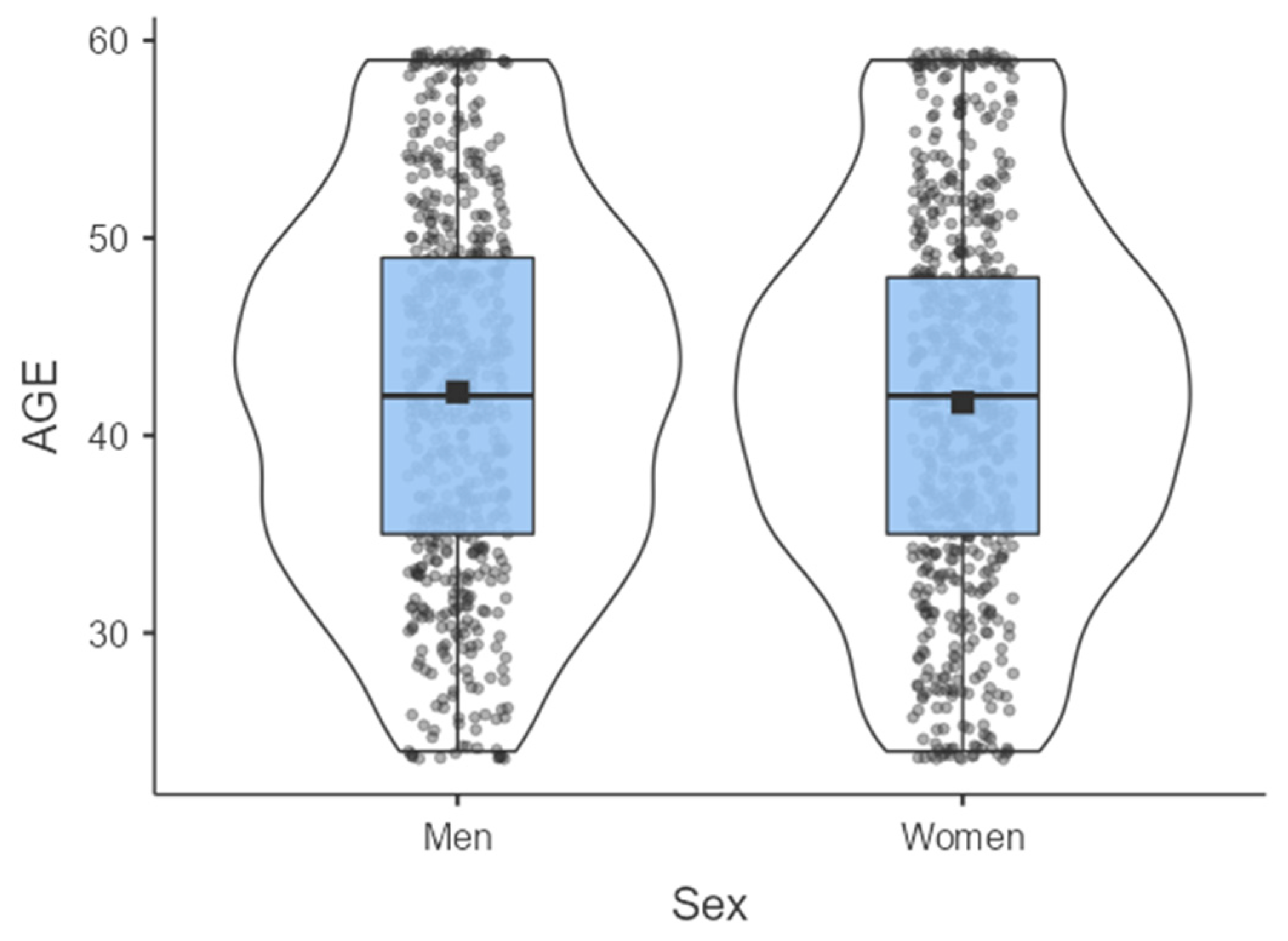
3.1. Sociodemographic Characteristics
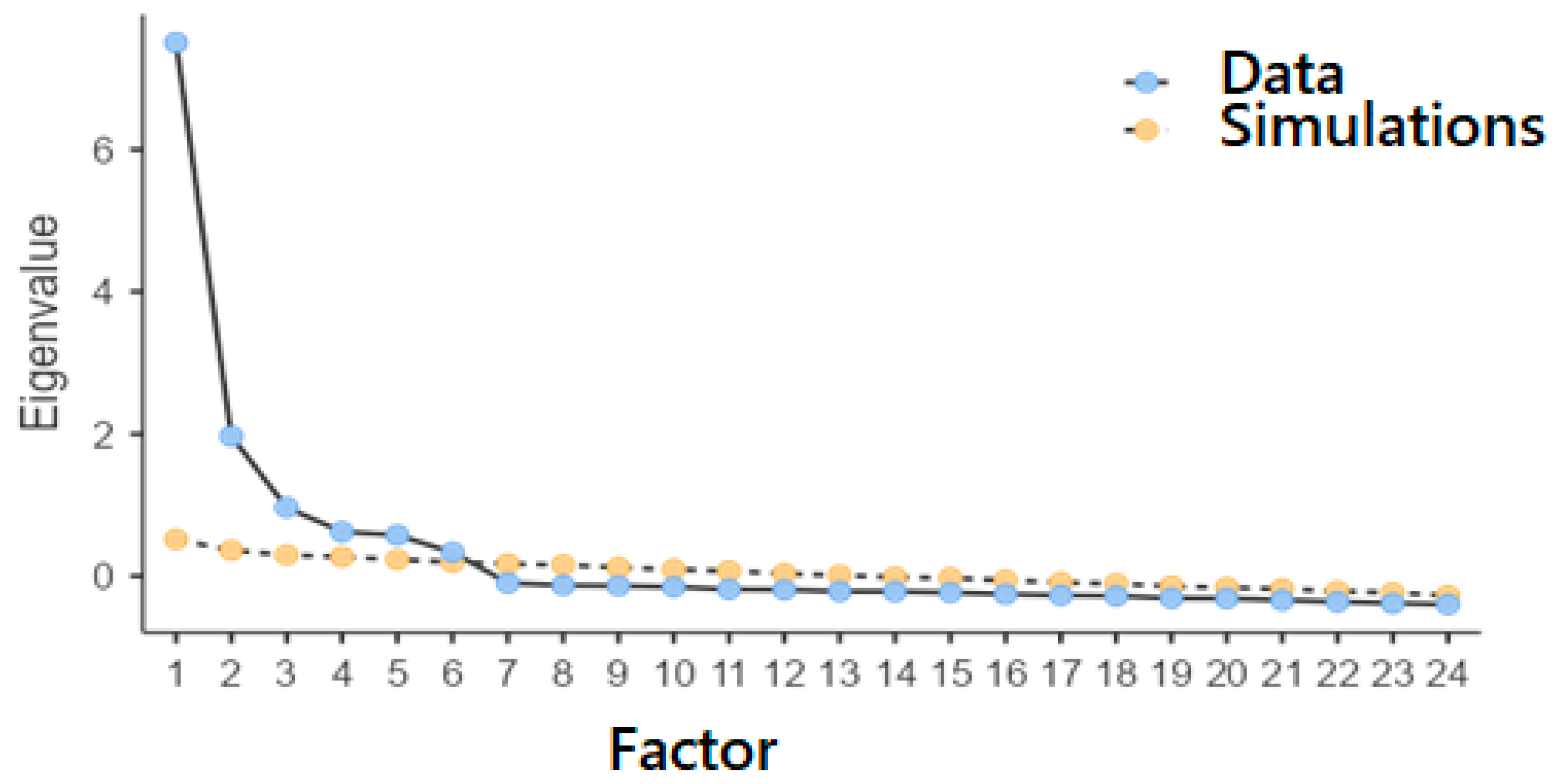
3.2. Exploratory Factor Analysis
- -
- Factor Structure and Variance Explained
- -
- Composite Reliability and Average Variance Extracted
- -
- Sensitivity Analysis
- -
- Convergent and Discriminant Validity
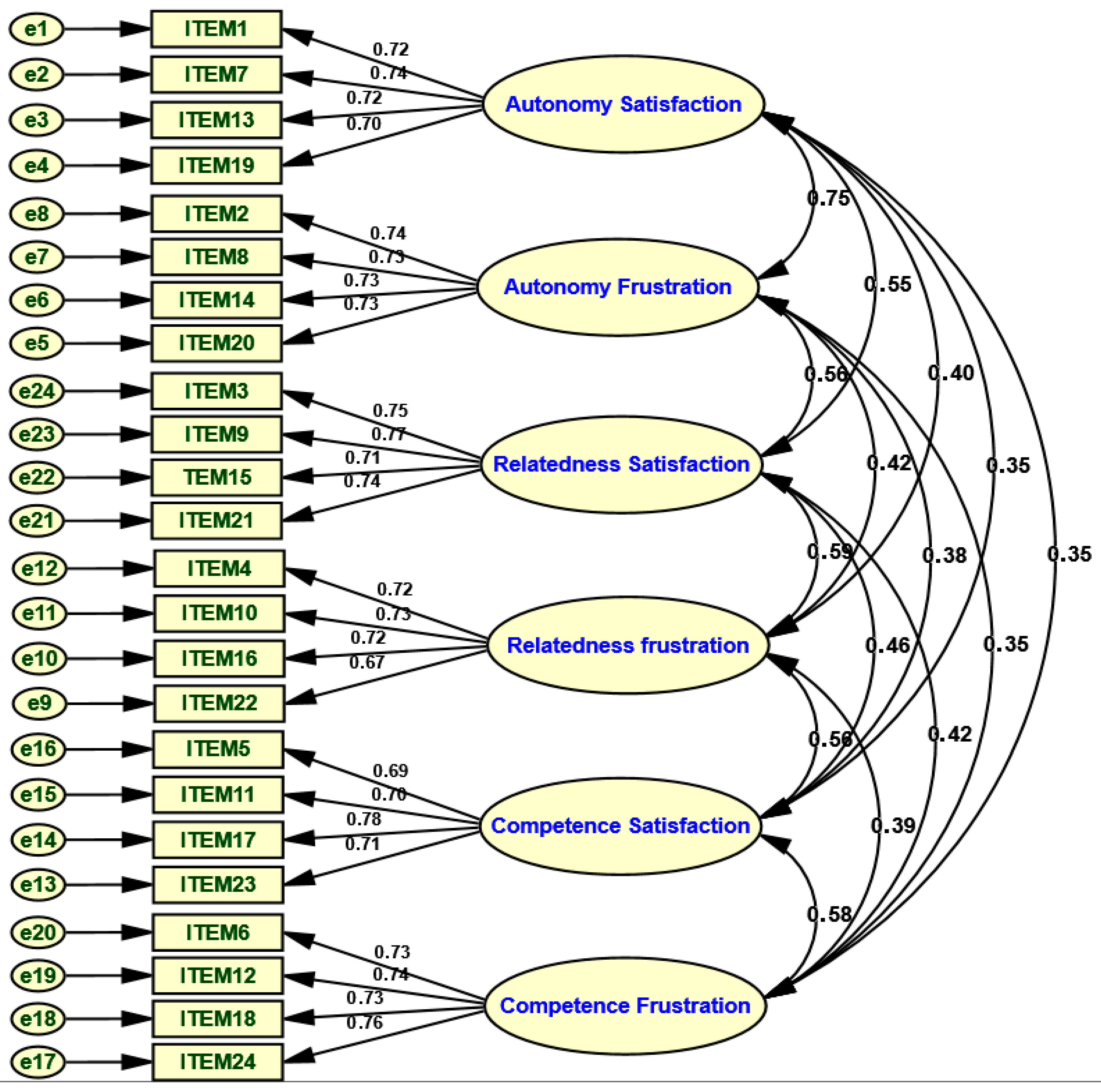
3.3. Confirmatory Factor Analysis
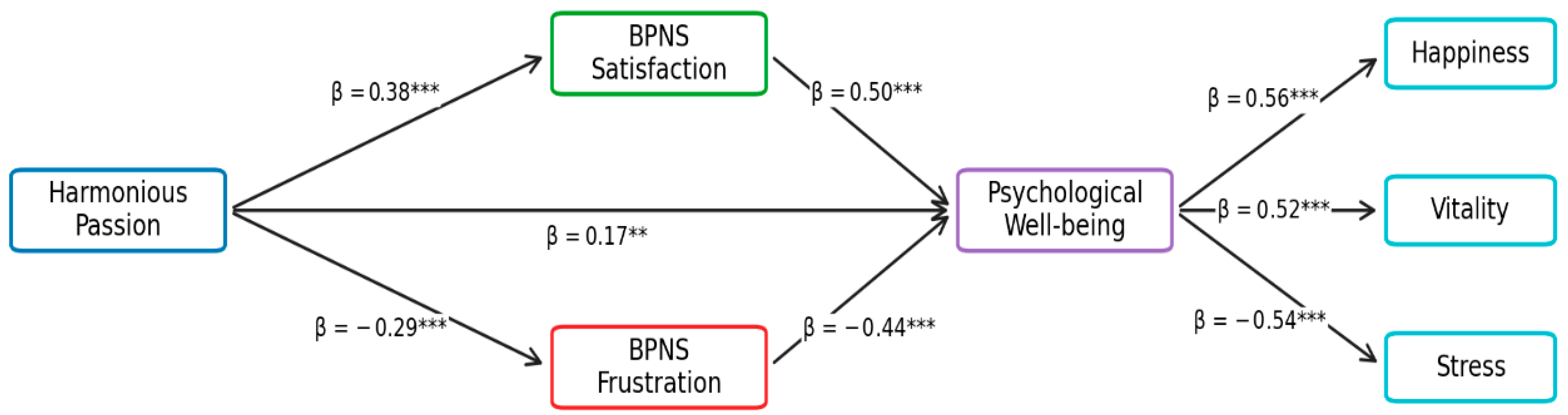
3.4. Structural Equation Modeling
4. Discussion
- Theoretical implication
- Implications for Stress, Vitality, and Happiness
- Limitations and Future Research Directions
5. Conclusions
Author Contributions
Funding
Institutional Review Board Statement
Informed Consent Statement
Data Availability Statement
Acknowledgments
Conflicts of Interest
References
- American Educational Research Association; American Psychological Association; National Council on Measurement in Education. Standards for Educational and Psychological Testing; American Educational Research Association: Washington, DC, USA, 2014. [Google Scholar]
- Deci, E.L.; Ryan, R.M. The “what” and “why” of goal pursuits: Human needs and the self-determination of behavior. Psychol. Inq. 2000, 11, 227–268. [Google Scholar] [CrossRef]
- Van den Broeck, A.; Ferris, D.L.; Chang, C.H.; Rosen, C.C. A review of self-determination theory’s basic psychological needs at work. J. Manag. 2016, 42, 1195–1229. [Google Scholar] [CrossRef]
- Vallerand, R.J. The Psychology of Passion: A Dualistic Model; Oxford University Press: Oxford, UK, 2015. [Google Scholar]
- Curran, T.; Hill, A.P.; Appleton, P.R.; Vallerand, R.J.; Standage, M. The psychology of passion: A meta-analytical review of a decade of research on intrapersonal outcomes. Motiv. Emot. 2015, 39, 631–655. [Google Scholar] [CrossRef]
- Maslach, C.; Schaufeli, W.B.; Leiter, M.P. Job burnout. Annu. Rev. Psychol. 2001, 52, 397–422. [Google Scholar] [CrossRef]
- Vallerand, R.J.; Blanchard, C.; Mageau, G.A.; Koestner, R.; Ratelle, C.; Léonard, M.; Gagné, M.; Marsolais, J. Les passions de l’ame: On obsessive and harmonious passion. J. Pers. Soc. Psychol. 2003, 85, 756. [Google Scholar] [CrossRef]
- Deci, E.L.; Olafsen, A.H.; Ryan, R.M. Self-determination theory in work organizations: The state of a science. Annu. Rev. Organ. Psychol. Organ. Behav. 2017, 4, 19–43. [Google Scholar] [CrossRef]
- Forest, J.; Mageau, G.A.; Sarrazin, C.; Morin, E.M. “Work is my passion”: The different affective, behavioural, and cognitive consequences of harmonious and obsessive passion toward work. Can. J. Adm. Sci. Rev. Can. Sci. Adm. 2011, 28, 27–40. [Google Scholar] [CrossRef]
- Gillet, N.; Morin, A.J.S.; Brault, S.; Becker, M.; Verbeke, I. On the nature, predictors, and outcomes of work passion profiles. Stress Health 2024, 40, e3495. [Google Scholar] [CrossRef]
- Bartholomew, K.J.; Ntoumanis, N.; Ryan, R.M.; Bosch, J.A.; Thøgersen-Ntoumani, C. Self-determination theory and diminished functioning: The role of interpersonal control and psychological need thwarting. Personal. Soc. Psychol. Bull. 2011, 37, 1459–1473. [Google Scholar] [CrossRef] [PubMed]
- Messick, S. Validity of psychological assessment: Validation of inferences from persons’ responses and performances as scientific inquiry into score meaning. Am. Psychol. 1995, 50, 741–749. [Google Scholar] [CrossRef]
- Slemp, G.R.; Kern, M.L.; Patrick, K.J.; Ryan, R.M. Leader autonomy support in the workplace: A meta-analytic review. Motiv. Emot. 2018, 42, 706–724. [Google Scholar] [CrossRef] [PubMed]
- Carbonneau, N.; Vallerand, R.J.; Fernet, C.; Guay, F. The role of passion for teaching in intrapersonal and interpersonal outcomes. J. Educ. Psychol. 2008, 100, 977. [Google Scholar] [CrossRef]
- Ryan, R.M.; Frederick, C. On energy, personality, and health: Subjective vitality as a dynamic reflection of well-being. J. Pers. 1997, 65, 529–565. [Google Scholar] [CrossRef]
- Rousseau, F.L.; Vallerand, R.J.; Ratelle, C.F.; Mageau, G.A.; Provencher, P.J. Passion and gambling: On the validation of the Gambling Passion Scale (GPS). J. Gambl. Stud. 2002, 18, 45–66. [Google Scholar] [CrossRef]
- Ryff, C.D. Happiness is everything, or is it? Explorations on the meaning of psychological well-being. J. Personal. Soc. Psychol. 1989, 57, 1069. [Google Scholar] [CrossRef]
- Bostic, T.J.; Rubio, D.M.; Hood, M. A validation of the subjective vitality scale using structural equation modeling. Soc. Indic. Res. 2000, 52, 313–324. [Google Scholar] [CrossRef]
- Chen, B.; Vansteenkiste, M.; Beyers, W.; Boone, L.; Deci, E.L.; Van der Kaap-Deeder, J.; Duriez, B.; Lens, W.; Matos, L.; Mouratidis, A.; et al. Basic psychological need satisfaction, need frustration, and need strength across four cultures. Motiv. Emot. 2015, 39, 216–236. [Google Scholar] [CrossRef]
- Lyubomirsky, S.; Lepper, H.S. A measure of subjective happiness: Preliminary reliability and construct validation. Soc. Indic. Res. 1999, 46, 137–155. [Google Scholar] [CrossRef]
- Ryff, C.D.; Keyes, C.L.M. The structure of psychological well-being revisited. J. Personal. Soc. Psychol. 1995, 69, 719. [Google Scholar] [CrossRef] [PubMed]
- Cohen, S.; Kamarck, T.; Mermelstein, R. A global measure of perceived stress. J. Health Soc. Behav. 1983, 24, 385–396. [Google Scholar] [CrossRef]
- Beaton, D.E.; Bombardier, C.; Guillemin, F.; Ferraz, M.B. Guidelines for the process of cross-cultural adaptation of self-report measures. Spine 2000, 25, 3186–3191. [Google Scholar] [CrossRef]
- Vallerand, R.J. Vers une méthodologie de validation trans-culturelle de questionnaires psychologiques: Implications pour la recherche en langue française. Can. Psychol./Psychol. Can. 1989, 30, 662. [Google Scholar] [CrossRef]
- Fabrigar, L.R.; Wegener, D.T. Exploratory Factor Analysis; Oxford University Press: Oxford, UK, 2012. [Google Scholar]
- Kline, R.B. Principles and Practice of Structural Equation Modeling; Guilford Publications: New York, NY, USA, 2023. [Google Scholar]
- Worthington, R.L.; Whittaker, T.A. Scale development research: A content analysis and recommendations for best practices. Couns. Psychol. 2006, 34, 806–838. [Google Scholar] [CrossRef]
- Tabachnick, B.G.; Fidell, L.S.; Ullman, J.B. Using Multivariate Statistics; Pearson: Boston, MA, USA, 2007; Volume 5, pp. 481–498. [Google Scholar]
- West, S.G.; Finch, J.F.; Curran, P.J. Structural equation models with nonnormal variables: Problems and remedies. In Structural Equation Modeling: Concepts, Issues, and Applications; Hoyle, R.H., Ed.; Sage Publications Ltd.: Thousand Oaks, CA, USA, 1995. [Google Scholar]
- Hair, J.F., Jr.; Black, W.C.; Babin, B.J.; Anderson, R.E. Multivariate Data Analysis: Pearson New International Edition PDF eBook; Pearson Higher Ed: London, UK, 2013; p. 785. [Google Scholar]
- Archer, J.; Haigh, A.M. Beliefs about aggression among male and female prisoners. Aggress. Behav. 1997, 23, 405–415. [Google Scholar] [CrossRef]
- Kaiser, H.F. An index of factorial simplicity. Psychometrika 1974, 39, 31–36. [Google Scholar] [CrossRef]
- Nunnally, J.C.; Bernstein, I.H. Psychometric Theory, 3rd ed.; McGraw-Hill: New York, NY, USA, 1994. [Google Scholar]
- McDonald, R.P. Test Theory: A Unified Treatment; Psychology Press: New York, NY, USA, 2013. [Google Scholar]
- Hayes, A.F.; Coutts, J.J. Use Omega Rather than Cronbach’s Alpha for Estimating Reliability. But…. Commun. Methods Meas. 2020, 14, 1–24. [Google Scholar] [CrossRef]
- Field, A. Discovering Statistics Using IBM SPSS Statistics, 6th ed.; Sage Publications Ltd.: Thousand Oaks, CA, USA, 2024. [Google Scholar]
- Fornell, C.; Larcker, D.F. Evaluating structural equation models with unobservable variables and measurement error. J. Mark. Res. 1981, 18, 39–50. [Google Scholar] [CrossRef]
- Byrne, B.M. Structural Equation Modeling with AMOS: Basic Concepts, Applications, and Programming; multivariate applications series; Taylor and Francis Group: New York, NY, USA, 2010. [Google Scholar]
- Hu, L.T.; Bentler, P.M. Cutoff criteria for fit indexes in covariance structure analysis: Conventional criteria versus new alternatives. Struct. Equ. Model. Multidiscip. J. 1999, 6, 1–55. [Google Scholar] [CrossRef]
- Browne, M.W.; Cudeck, R.; Bollen, K.A.; Long, J.S. Alternative ways of assessing model fit. Test. Struct. Equ. Model. 1993, 154, 136–162. [Google Scholar] [CrossRef]
- Steiger, J.H. Understanding the limitations of global fit assessment in structural equation modeling. Pers. Individ. Differ. 2007, 42, 893–898. [Google Scholar] [CrossRef]
- Vansteenkiste, M.; Ryan, R.M. On psychological growth and vulnerability: Basic psychological need satisfaction and need frustration as a unifying principle. J. Psychother. Integr. 2013, 23, 263. [Google Scholar] [CrossRef]
- Costa, S.; Ntoumanis, N.; Bartholomew, K.J. Predicting the brighter and darker sides of interpersonal relationships: Does psychological need thwarting matter? Motiv. Emot. 2015, 39, 11–24. [Google Scholar] [CrossRef]
- Deci, E.L.; Ryan, R.M. Facilitating optimal motivation and psychological well-being across life’s domains. Can. Psychol./Psychol. Can. 2008, 49, 14. [Google Scholar] [CrossRef]
- Huta, V.; Ryan, R.M. Pursuing pleasure or virtue: The differential and overlapping well-being benefits of hedonic and eudaimonic motives. J. Happiness Stud. 2010, 11, 735–762. [Google Scholar] [CrossRef]
- Lazarus, R.S.; Folkman, S. Stress, Appraisal, and Coping; Springer: New York, NY, USA, 1984. [Google Scholar]
- Bakker, A.B.; Demerouti, E. Job demands–resources theory: Taking stock and looking forward. J. Occup. Health Psychol. 2017, 22, 273. [Google Scholar] [CrossRef] [PubMed]



| Sex | Men | Women | Total | ||||
|---|---|---|---|---|---|---|---|
| Frequency | % | Frequency | % | Frequency | % | ||
| 578 | 47.42 | 651 | 52.58 | 1238 | 100 | ||
| Age | = 42.2 (σ ± 9.37) | = 41.7 (σ ± 9.49) | = 41.9 (σ ± 9.42) | ||||
| Residence | Urban | 282 | 28.9 | 355 | 28.7 | 637 | 51.5 |
| Rural | 305 | 24.6 | 296 | 23.9 | 601 | 58.5 | |
| Housing district | Carthage | 211 | 17.0 | 204 | 16.5 | 415 | 33.52 |
| Medjerda | 64 | 5.2 | 80 | 6.5 | 144 | 11.63 | |
| Sahel | 176 | 14.2 | 218 | 17.6 | 394 | 31.83 | |
| Atlas | 77 | 6.2 | 76 | 6.15.9 | 153 | 12.36 | |
| Ksour | 59 | 4.8 | 73 | 5.9 | 132 | 10.66 | |
| Civil status | Single | 91 | 7.4 | 104 | 8.4 | 196 | 15.8 |
| Married | 422 | 34.1 | 494 | 39.9 | 915 | 33.9 | |
| Divorced | 50 | 4.0 | 37 | 3.0 | 87 | 7.0 | |
| Widowed | 24 | 1.9 | 16 | 1.3 | 40 | 3.2 | |
| Specialty | Football | 257 | 20.76 | 26 | 2.10 | 283 | 22.86 |
| Handball | 121 | 9.77 | 102 | 8.24 | 223 | 18.01 | |
| Basketball | 55 | 4.44 | 64 | 5.17 | 119 | 9.61 | |
| Volleyball | 30 | 2.42 | 58 | 4.68 | 88 | 7.11 | |
| Athletics | 21 | 1.70 | 30 | 2.42 | 51 | 4.12 | |
| Gymnastics | 28 | 2.26 | 91 | 7.35 | 119 | 9.61 | |
| Swimming | 29 | 2.34 | 87 | 7.03 | 116 | 9.37 | |
| Aerobics | 32 | 2.58 | 175 | 14.14 | 207 | 16.72 | |
| Other | 14 | 1.13 | 18 | 1.45 | 32 | 2.58 | |
| Seniority | Less than 5 years | 83 | 6.7 | 100 | 8.1 | 183 | 14.8 |
| 5 to 10 years | 114 | 9.2 | 129 | 10.4 | 243 | 19.6 | |
| 11 to 15 years | 99 | 8.0 | 134 | 10.8 | 233 | 18.8 | |
| 16 to 20 years | 95 | 7.7 | 112 | 9.0 | 207 | 16.7 | |
| More than 20 years | 196 | 15.8 | 176 | 14.2 | 372 | 30.0 | |
| Children | No Children | 105 | 8.5 | 116 | 9.4 | 221 | 17.85 |
| 1 to 2 Children | 283 | 22.86 | 317 | 25.6 | 600 | 48.47 | |
| 3 to 4 Children | 199 | 16.06 | 218 | 17.6 | 417 | 33.68 | |
| Items | Factor Charges | AVE | ||||||
|---|---|---|---|---|---|---|---|---|
| 1 | 2 | 3 | 4 | 5 | 6 | |||
| 1 | I feel a sense of choice and freedom in the things I undertake | 0.734 | 0.454 | |||||
| أشعر بأن لدي إحساسًا بالاختيار والحرية في الاشياء التي أقوم بها | ||||||||
| 2 | I feel that my decisions reflect what I really want | 0.756 | 0.406 | |||||
| أشعر أن قراراتي تعكس ما أريده حقًا | ||||||||
| 3 | I feel my choices express who I really am | 0.794 | 0.411 | |||||
| أشعر أن اختياراتي تعبّر عن هويتي الحقيقية | ||||||||
| 4 | I feel I have been doing what really interests me | 0.742 | 0.389 | |||||
| أشعر أنني أمارس ما يهمّني ويثير اهتمامي حقًا | ||||||||
| 5 | Most of the things I do feel like “I have to” | 0.753 | 0.393 | |||||
| أشعر أن معظم الأشياء التي أقوم بها تبدو وكأنها واجب مفروض عليّ | ||||||||
| 6 | I feel forced to do many things I wouldn’t choose to do | 0.778 | 0.482 | |||||
| أشعر بأنني مجبر على القيام بأشياء كثيرة لم أختر القيام بها | ||||||||
| 7 | I feel pressured to do too many things | 0.765 | 0.408 | |||||
| أشعر بالضغط للقيام بأشياء كثيرة | ||||||||
| 8 | My daily activities feel like a chain of obligations | 0.784 | 0.440 | |||||
| أشعر أن أنشطتي اليومية عبارة عن سلسلة من الالتزامات المفروضة | ||||||||
| 9 | I feel that the people I care about also care about me | 0.763 | 0.403 | |||||
| أشعر بأن الأشخاص الذين أهتمّ بهم يهتمّون بي أيضًا | ||||||||
| 10 | I feel connected with people who care for me, and for whom I care | 0.703 | 0.463 | |||||
| أشعر بارتباطي بالأشخاص الذين يهتمّون بي والذين أهتمّ بهم | ||||||||
| 11 | I feel close and connected with other people who are important to me | 0.761 | 0.446 | |||||
| أشعر بالقرب والتواصل مع أشخاص آخرين مهمّين في حياتي | ||||||||
| 12 | I experience a warm feeling with the people I spend time with | 0.749 | 0.472 | |||||
| أشعر بدفءٍ عاطفي مع الأشخاص الذين أقضي معهم وقتي | ||||||||
| 13 | I feel excluded from the group I want to belong to | 0.759 | 0.409 | |||||
| أشعر بأنني مُستبعَد من المجموعة التي أرغب في الانتماء إليها | ||||||||
| 14 | I feel that people who are important to me are cold and distant towards me | 0.726 | 0.372 | |||||
| أشعر بأن الأشخاص المهمّين بالنسبة لي يتعاملون معي ببرود وجفاء | ||||||||
| 15 | I have the impression that people I spend time with dislike me | 0.775 | 0.437 | |||||
| لديّ انطباع بأن الأشخاص الذين أقضي معهم وقتي لا يحبّونني | ||||||||
| 16 | I feel the relationships I have are just superficial | 0.712 | 0.538 | |||||
| أشعر بأن العلاقات التي أمتلكها سطحية في غالبتها | ||||||||
| 17 | I feel confident that I can do things well | 0.758 | 0.506 | |||||
| أشعر بالثقة في قدرتي على إنجاز الأمور بشكل جيّد | ||||||||
| 18 | I feel capable at what I do | 0.747 | 0.472 | |||||
| أشعر بأنني قادر على أداء ما أقوم به بكفاءة | ||||||||
| 19 | I feel competent to achieve my goals | 0.758 | 0.439 | |||||
| أشعر بأن لديّ الكفاءة اللازمة لتحقيق أهدافي | ||||||||
| 20 | I feel I can successfully complete difficult tasks | 0.745 | 0.419 | |||||
| أشعر بأنني أستطيع إتمام المهام الصعبة بنجاح | ||||||||
| 21 | I have serious doubts about whether I can do things well | 0.767 | 0.437 | |||||
| لديّ شكوك جدّية حول قدرتي على إنجاز الأمور بشكل جيّد | ||||||||
| 22 | I feel disappointed with many of my performance | 0.730 | 0.466 | |||||
| أشعر بخيبة أمل تجاه العديد من جوانب أدائي | ||||||||
| 23 | I feel insecure about my abilities | 0.724 | 0.445 | |||||
| أشعر بعدم الأمان بشأن قدراتي | ||||||||
| 24 | I feel like a failure because of the mistakes I make | 0.727 | 0.414 | |||||
| أشعر وكأنني فاشل بسبب الأخطاء التي أرتكبه | ||||||||
| Correlation | |||||||
|---|---|---|---|---|---|---|---|
| BPN.Sat | BPN.Fru | PASSION.H | WELL-BEING | HAPPINESS | VITALITY | STRESS | |
| BPN.Sat | - | ||||||
| BPN.Fru | 0.435 ** | - | |||||
| PASSION.H | 0.297 ** | 0.374 ** | - | ||||
| WELL-BEING | 0.367 ** | 0.432 ** | 0.518 ** | - | |||
| HAPPINESS | 0.456 ** | 0.281 ** | 0.599 ** | 0.668 ** | - | ||
| VITALITY | 0.215 ** | 0.247 ** | 0.563 ** | 0.603 ** | 0.548 ** | - | |
| STRESS | −0.124 ** | −0.260 ** | −0.442 ** | −0.478 ** | −0.387 ** | −0.371 ** | 1 |
| Indices | χ2 | df | χ2/df | GFI | NFI | AGFI | RMR | CFI | SRMR | IFI | TLI | RMSEA |
|---|---|---|---|---|---|---|---|---|---|---|---|---|
| Model | 245.49 | 237 | 1.03 | 0.968 | 0.960 | 0.960 | 0.011 | 0.999 | 0.022 | 0.999 | 0.998 | 0.008 |
Disclaimer/Publisher’s Note: The statements, opinions and data contained in all publications are solely those of the individual author(s) and contributor(s) and not of MDPI and/or the editor(s). MDPI and/or the editor(s) disclaim responsibility for any injury to people or property resulting from any ideas, methods, instructions or products referred to in the content. |
© 2026 by the authors. Licensee MDPI, Basel, Switzerland. This article is an open access article distributed under the terms and conditions of the Creative Commons Attribution (CC BY) license.
Share and Cite
Saaidia, S.; Henchiri, H.; Znazen, H.; Chaabeni, A.; Alotaibi, A.; Alliheibi, A.H.; Said, N.M.B.; Azaiez, F. Basic Psychological Needs, Passion, and Well-Being at Work: Evidence from Tunisian Physical Education Teachers. Healthcare 2026, 14, 1171. https://doi.org/10.3390/healthcare14091171
Saaidia S, Henchiri H, Znazen H, Chaabeni A, Alotaibi A, Alliheibi AH, Said NMB, Azaiez F. Basic Psychological Needs, Passion, and Well-Being at Work: Evidence from Tunisian Physical Education Teachers. Healthcare. 2026; 14(9):1171. https://doi.org/10.3390/healthcare14091171
Chicago/Turabian StyleSaaidia, Slim, Hamdi Henchiri, Hela Znazen, Amr Chaabeni, Abdulazeem Alotaibi, Abdullah H. Alliheibi, Noureddine M. Ben Said, and Fairouz Azaiez. 2026. "Basic Psychological Needs, Passion, and Well-Being at Work: Evidence from Tunisian Physical Education Teachers" Healthcare 14, no. 9: 1171. https://doi.org/10.3390/healthcare14091171
APA StyleSaaidia, S., Henchiri, H., Znazen, H., Chaabeni, A., Alotaibi, A., Alliheibi, A. H., Said, N. M. B., & Azaiez, F. (2026). Basic Psychological Needs, Passion, and Well-Being at Work: Evidence from Tunisian Physical Education Teachers. Healthcare, 14(9), 1171. https://doi.org/10.3390/healthcare14091171