Article

Emotional Distress Symptom Networks in Patients with Gynecological Malignancies: A Cross-Sectional Study


1
Department of Gynecologic Oncology, Affiliated Hospital of Jiangnan University, Wuxi 214122, China
2
Wuxi School of Medicine, Jiangnan University, Wuxi 214122, China
3
The Affiliated Hospital of Xuzhou Medical University, Xuzhou 221002, China
*
Authors to whom correspondence should be addressed.
These authors contributed equally to this work.
Healthcare 2026, 14(9), 1136; https://doi.org/10.3390/healthcare14091136
Submission received: 6 February 2026 / Revised: 2 April 2026 / Accepted: 21 April 2026 / Published: 23 April 2026
(This article belongs to the Special Issue Coping with Emotional Distress)

Abstract

Background: Emotional distress (ED) is common among patients with gynecological malignancies and is associated with reduced quality of life and suboptimal health outcomes. Total-score approaches may overlook the complex interrelationships among individual emotional symptoms. Objective: This study provides a theory-informed contextual application and empirical boundary test of symptom network analysis, organized by the Stress Process Model (SPM), to examine not only how ED symptoms cluster and connect with psychosocial correlates and quality-of-life domains, but also whether psychosocial stratification is reflected in altered symptom topology or primarily in differences in distress burden. Methods: A cross-sectional study was conducted among 415 patients with gynecological malignancies recruited from a tertiary hospital in China. ED was assessed using the Brief Profile of Mood States-Short Form (BPOMS-SF30). An exploratory three-track screening strategy was used to derive a focused 16-node set of frequent negative mood symptoms. Gaussian graphical models with EBICglasso regularization were estimated for the symptom network and for extended networks including demographic/clinical variables, SPM-related psychosocial variables, and quality-of-life indicators. Results: The ED network showed dense positive connectivity, with strong within-domain clustering and several cross-domain associations. Exhaustion, restlessness, and irritability were relatively more relationally prominent in the primary network, although centrality stability was low to moderate across models. Fatigue-related symptoms were closely connected with anxiety, depressive symptoms, and impaired quality of life. Among psychosocial variables, self-perceived burden showed the strongest conditional association with fatigue. Adjusting for demographic and clinical variables did not materially alter the core symptom network, and no significant subgroup differences in global strength or overall structure were observed across psychosocial strata. Conclusions: In this sample, psychosocial risk stratification appeared to relate more to the overall severity and burden of distress than to major reorganization of symptom topology. The study therefore contributes primarily as a theory-informed contextual application of network methods and as an empirical boundary test showing that several psychosocial strata did not exhibit major topological differences. Because the retained nodes were selected for prevalence, association strength, and selection stability, the observed prominence of fatigue- and activation-related symptoms should be interpreted as conditional on this focused symptom subset. Overall, the findings are correlational, exploratory, and hypothesis-generating.

1. Introduction

Gynecological malignancies are major threats to women’s health worldwide [1,2]. Emotional distress (ED) in oncology refers to persistent unpleasant emotional experiences related to cancer and its treatment, including anxiety, depression, fear, helplessness, and emotional dysregulation [3]. Across cancer populations, approximately 30–40% of patients experience moderate or severe distress [4,5], and rates in gynecologic oncology may be even higher because the disease can affect fertility, body image, sexuality, and gender-role expectations [6,7,8,9,10,11].
ED is associated with poorer quality of life, treatment burden, and adverse symptom experiences [12,13]. However, ED symptoms seldom occur in isolation. Anxiety, depression, fatigue, anger, and confusion often co-occur and reinforce one another, whereas total-score approaches may obscure these symptom-to-symptom dependencies [14,15,16].
Symptom network analysis conceptualizes symptoms as mutually related components within a system rather than as interchangeable indicators of a single latent construct [15,16,17,18]. This perspective can identify relatively prominent symptoms and cross-domain couplings that may be useful for descriptive clinical monitoring. Despite growing oncology applications, evidence in gynecologic malignancies remains limited, and studies rarely examine emotional distress symptoms together with psychosocial stressors and quality-of-life domains within the same network framework. In this study, we use network methods within an SPM-informed framework to examine how emotional distress symptoms are organized in gynecologic oncology and how they relate to stress-related psychosocial correlates. The Stress Process Model (SPM) provides a useful contextual framework for organizing these correlates [19,20]. In patients with gynecological malignancies, disease burden, treatment, and functional limitations may act as primary stressors, while illness perception, financial strain, role disruption, and self-perceived burden may operate as secondary stressors or stress-related correlates [21,22]. At the same time, SPM and network theory rest on different assumptions: SPM is often articulated as a directional and partially hierarchical process model, whereas Gaussian graphical models estimate undirected conditional dependence among contemporaneously measured variables. We therefore use the SPM to organize variable selection and interpretation at the level of stress exposure, psychosocial appraisal, and functioning. In the extended models, psychosocial variables are conceptualized as external correlates positioned alongside, rather than inside, the core symptom system for purposes of conditional association mapping. More specifically, the subgroup comparisons were intended to examine whether psychosocial stratification—central to the SPM—was accompanied by differences in how symptoms interrelated, or whether symptom organization remained broadly stable while overall distress burden varied.
Accordingly, this study should be understood as a theory-informed contextual application of network analysis in a gynecologic oncology sample rather than a formal extension of the SPM. We aimed to (1) characterize the conditional association structure of ED symptoms; (2) examine how demographic/clinical variables, SPM-related psychosocial variables, and quality-of-life domains are conditionally linked with ED symptoms; and (3) explore whether psychosocial risk strata differ in overall network topology, thereby bearing on the distinction between structural differentiation and severity variation.

2. Methods

2.1. Participants

This study adopted a cross-sectional design. Using a convenience sampling method, a total of 415 patients with gynecological malignancies were consecutively recruited from the gynecological wards of the Affiliated Hospital of Jiangnan University between 1 October 2024 and 31 May 2025. All participants met the inclusion criteria and voluntarily participated in the study. The research protocol was approved by the Ethics Committee of the Affiliated Hospital of Jiangnan University (Approval: No. LS2024284). All procedures were conducted in accordance with the Declaration of Helsinki.
The inclusion criteria were as follows: (1) histologically confirmed gynecological malignancy (including cervical, ovarian, endometrial, vulvar, or vaginal cancer); (2) age ≥ 18 years; (3) normal cognitive function with the ability to read and communicate in Chinese; (4) provision of written informed consent; and (5) having completed at least one major cancer treatment (surgery, chemotherapy, or radiotherapy) and currently being in the treatment or follow-up phase.
The exclusion criteria included the following: (1) a history of severe psychiatric disorders identified through medical records or self-report; (2) major comorbid conditions that could substantially interfere with emotional assessment; and (3) cognitive or language impairments that prevented completion of the questionnaires.

2.2. Sample Size

Based on the planned 16-node symptom network, requiring estimation of 16 threshold parameters and 96 pairwise association parameters [16 × (16 − 1)/2], yielding a total of 120 parameters. Following commonly used guidance for exploratory psychological networks, we aimed for approximately 3–5 participants per parameter, which yielded an estimated minimum sample size of 341–569 after allowing for 20% attrition [23].

2.3. Measurements

2.3.1. General Information Questionnaire

A self-designed questionnaire was used to collect demographic and clinical information. Demographic variables included age, sex, ethnicity, marital status, body mass index (BMI), family economic status, educational level, and employment status. Clinical variables included age at menarche, reproductive history, family history of cancer, surgical history, cancer diagnosis, duration since diagnosis, treatment modality, tumor stage, and comorbid medical conditions.

2.3.2. Brief Profile of Mood States—Short Form (BPOMS-SF30)

The BPOMS-SF30 is a widely used instrument for assessing mood and emotional states [24]. The scale consists of 30 adjectives assessing psychological states over the past week across six dimensions: tension/anxiety, fatigue, vigor, confusion, depression, and anger. Each item is rated on a 5-point Likert scale ranging from 0 (“not at all”) to 4 (“extremely”), with higher total scores indicating greater emotional distress. In this study, the Cronbach’s α coefficient for the BPOMS-SF30 was 0.742.

2.3.3. Brief Illness Perception Questionnaire (IPQR)

The Chinese version of the IPQR has demonstrated acceptable reliability and validity in oncology populations [25]. The questionnaire contains nine items assessing cognitive representation (items 1–5), emotional representation (items 6 and 8), and illness comprehensibility (item 7). Items are scored on an 11-point scale (0–10), with items 3, 4, and 7 reverse-coded. The total score ranges from 0 to 80, with higher scores indicating more negative illness perceptions. Item 9 is an open-ended question and is not scored. In this study, the Cronbach’s α coefficient was 0.721.

2.3.4. Neuroticism Subscale of the Big Five Inventory (BFI-N)

Neuroticism was assessed using the neuroticism subscale of the Big Five Inventory [26]. The subscale consists of eight items rated on a 5-point Likert scale, with items 2, 5, and 7 reverse-coded. Higher scores indicate higher levels of neuroticism. The validated Chinese version was used in this study, yielding a Cronbach’s α coefficient of 0.920.

2.3.5. Positive Psychological Capital Questionnaire (PPQ)

Positive psychological capital was measured using the Positive Psychological Capital Questionnaire revised by Zhang Kuo et al. [27]. The questionnaire consists of 26 items across four dimensions: self-efficacy (7 items), resilience (7 items), hope (6 items), and optimism (6 items). Items are rated on a 5-point Likert scale, with items 8, 10, 12, 14, and 25 reverse-coded. Higher scores indicate higher levels of positive psychological capital. The Cronbach’s α coefficient in this study was 0.725.

2.3.6. Comprehensive Score for Financial Toxicity Based on Patient-Reported Outcome Measure (COST-PROM)

Financial toxicity was assessed using the Chinese version of the COST-PROM [21]. The scale consists of 11 items covering financial expenditure, financial resources, and social response. Each item is scored from 0 to 4, with items 2, 3, 4, 5, 8, 9, and 10 reverse-coded. Total scores range from 0 to 44, with lower scores indicating more severe financial toxicity. In this study, the Cronbach’s α coefficient was 0.743.

2.3.7. Self-Perceived Burden Scale (SPBS)

The SPBS was translated and validated for use in China and has been widely applied among patients with chronic diseases [28]. The scale includes 10 items measuring physical burden (items 1 and 10), emotional burden (items 2, 4, 5, 6, 7, and 9), and financial burden (items 3 and 8). Items are rated on a 5-point Likert scale ranging from 1 (“never”) to 5 (“always”), with higher scores indicating greater perceived burden. Total scores classify burden as none (<20), mild (20–29), moderate (30–39), or severe (≥40). The Cronbach’s α coefficient in this study was 0.744.

2.3.8. European Organization for Research and Treatment of Cancer Quality of Life Questionnaire (EORTC QLQ-C30)

Quality of life was assessed using the Chinese version of the EORTC QLQ-C30 [29]. The questionnaire comprises 30 items covering five functional domains, three symptom domains, one global health status/quality-of-life domain, and six single items. Items 29 and 30 are rated on a 7-point scale, while the remaining items use a 4-point scale. In this study, functional domain scores and the global health status score were calculated and linearly transformed to standardized scores ranging from 0 to 100, with higher scores indicating better quality of life. The Cronbach’s α coefficient was 0.769.

2.3.9. Statistical Analysis

Descriptive statistics were performed using IBM SPSS Statistics 28.0, and network analyses were conducted in R version 4.4.2.
Descriptive statistics were used to summarize demographic and clinical characteristics and emotional distress levels. Normally distributed continuous variables are presented as mean ± standard deviation (SD), non-normally distributed continuous variables as median (Q1, Q3), and categorical variables as frequencies and percentages.
Missing values were handled using multiple imputation by chained equations with predictive mean matching implemented in the mice package in R [30]. Imputation was used as a preprocessing step to reduce information loss before the exploratory network analyses.
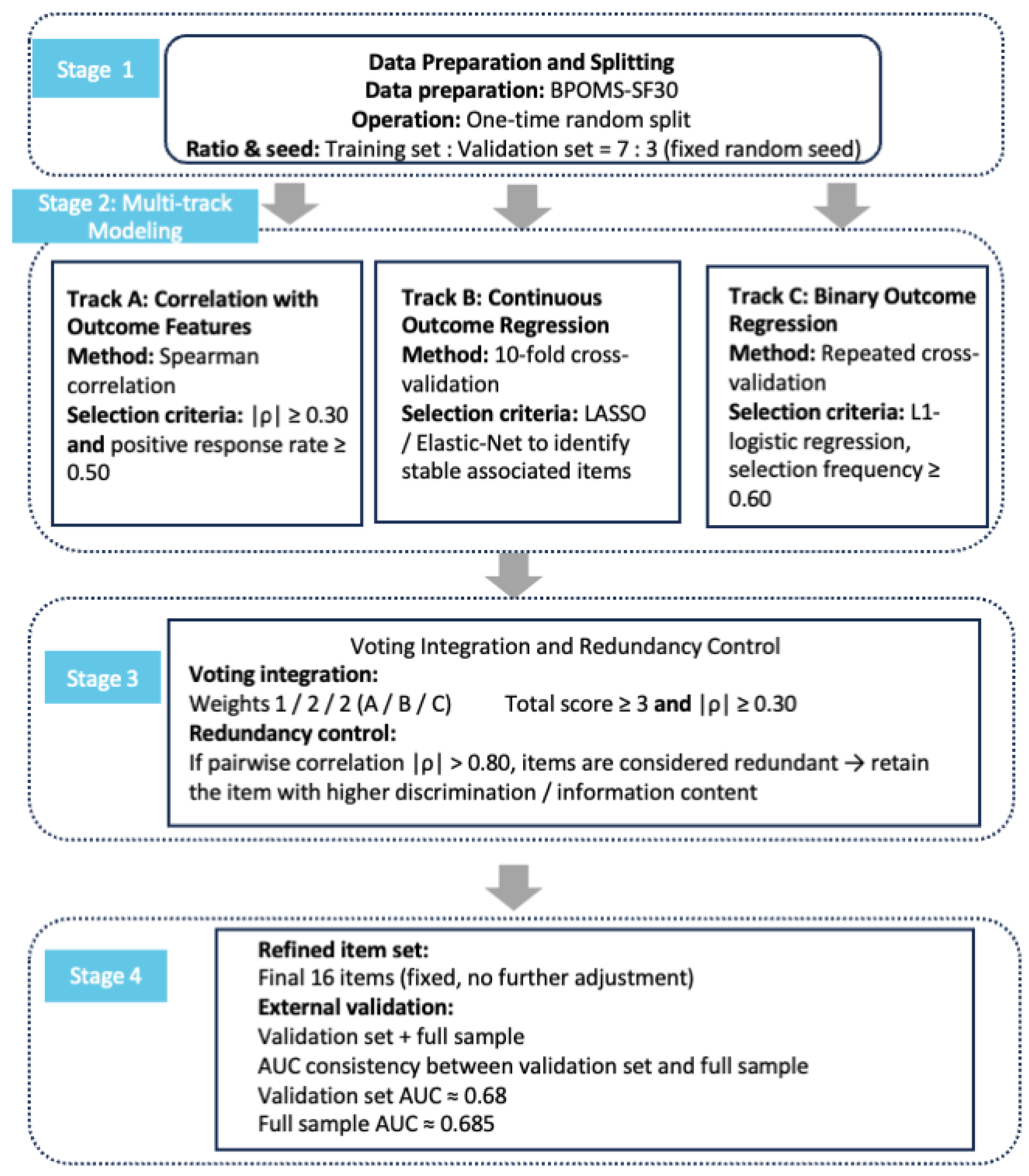
Before network estimation, BPOMS-SF30 items were screened to identify a focused set of clinically frequent negative mood symptoms. The total sample was randomly divided into training and validation sets using a fixed random seed, and screening was performed in the training set only. Because this procedure was exploratory and data-informed rather than confirmatory, the resulting reduced network should be interpreted as a focused symptom subset rather than a full representation of the BPOMS-SF30 construct space. The screening strategy was not preregistered and should therefore be regarded as an exploratory analytic step. Three complementary approaches were combined: (1) Spearman correlation analysis with the core distress indicator, retaining items with |ρ| ≥ 0.30 and a positive response rate ≥ 0.50; (2) 10-fold cross-validated penalized regression with continuous distress as the outcome; and (3) repeated cross-validated L1-penalized logistic regression using a dichotomized distress outcome, with items retained if selected in ≥60% of repetitions [31,32,33]. Items were combined across approaches using predefined weights (1/2/2), and those meeting the overall criteria were retained. In addition to these statistical filters, the final node set was reviewed for clinical interpretability and for its coverage of frequently endorsed negative mood symptoms; excluded items should not be interpreted as clinically irrelevant.
To minimize redundancy, item pairs with Spearman correlations > 0.80 were examined, and the more informative items were retained as final symptom nodes. The selected node set was then frozen and evaluated in the validation set and the full sample, resulting in a final 16-node network. Primary networks were estimated using Gaussian graphical models (GGMs) with EBICglasso regularization [23,34,35]. Edges represent regularized partial correlations after conditioning on all other variables. Networks were visualized using the qgraph (v1.9.8) qgraph package [35].
Centrality analyses focused on node strength and expected influence (EI), because closeness and betweenness are often unstable in psychological networks [23,34]. Network accuracy and stability were evaluated using nonparametric bootstrap procedures with 1000 resamples, including 95% confidence intervals for edge weights and correlation stability (CS) coefficients for centrality metrics. Given that several CS coefficients were below ideal thresholds, centrality rankings were interpreted descriptively and cautiously. Apparent differences among the top-ranked nodes should therefore not be interpreted as statistically established unless supported by dedicated bootstrapped centrality difference testing.
Extended network analyses were conducted by including psychosocial variables as external nodes to examine their conditional associations with emotional symptoms. In addition, residual networks were estimated by regressing each symptom on demographic and clinical covariates, extracting residuals, applying nonparanormal transformations, and re-estimating the networks using EBICglasso (γ = 0.50). Centrality was compared across models.
Group differences in network topology were examined using the Network Comparison Test (NCT). Participants were dichotomized at the median of each SPM-related variable, and differences in global strength and network structure were assessed using 1000 permutation tests. Because median splits may reduce statistical power, subgroup results were interpreted as exploratory.

3. Results

3.1. Participant Characteristics

A total of 415 patients with gynecologic malignancies were included. The mean age was 59.4 years, indicating that the sample was predominantly middle-aged to older adults. Additional demographic and clinical characteristics are presented in Table 1.

3.2. Node Screening and Validation

Node screening was completed in the training set using a three-track parallel strategy. Based on symptom prevalence, 23 symptoms with an occurrence rate > 50% were entered into the screening process [23]. After redundancy control, 16 emotional symptom nodes were retained and subsequently frozen. These retained nodes represented frequently endorsed negative mood symptoms and were kept unchanged in all subsequent analyses (Figure 1). The final frozen nodes covered five negative mood dimensions: Tension–Anxiety (TA2–TA4), Depression–Dejection (DD1–DD4), Anger–Hostility (AH2), Fatigue–Inertia (FI1–FI5), and Confusion–Bewilderment (CB1–CB3). The frozen node set demonstrated acceptable discrimination in the validation set (AUC = 0.680) and the full sample (AUC = 0.685), supporting the robustness of the screening results while still representing a reduced subset rather than the full BPOMS-SF30. As a sensitivity analysis, we reconstructed the network using the 23 symptom items retained after prevalence filtering alone and compared it with the screened 16-node network. The two networks showed broadly consistent overall topology and core structural patterns, indicating that the main findings were not driven entirely by the final screening step (Appendix A).
To assess stability and reproducibility across samples, descriptive consistency testing was performed after node freezing. Specifically, the mean scores and positive response proportions (defined as node score ≥ a prespecified threshold) were calculated for each node in the training and validation sets and compared. Overall, node means and positive response proportions were broadly comparable between the two sets, with no clear systematic shifts, suggesting good distributional stability (Table 2).

3.3. Emotional Distress Symptom Network

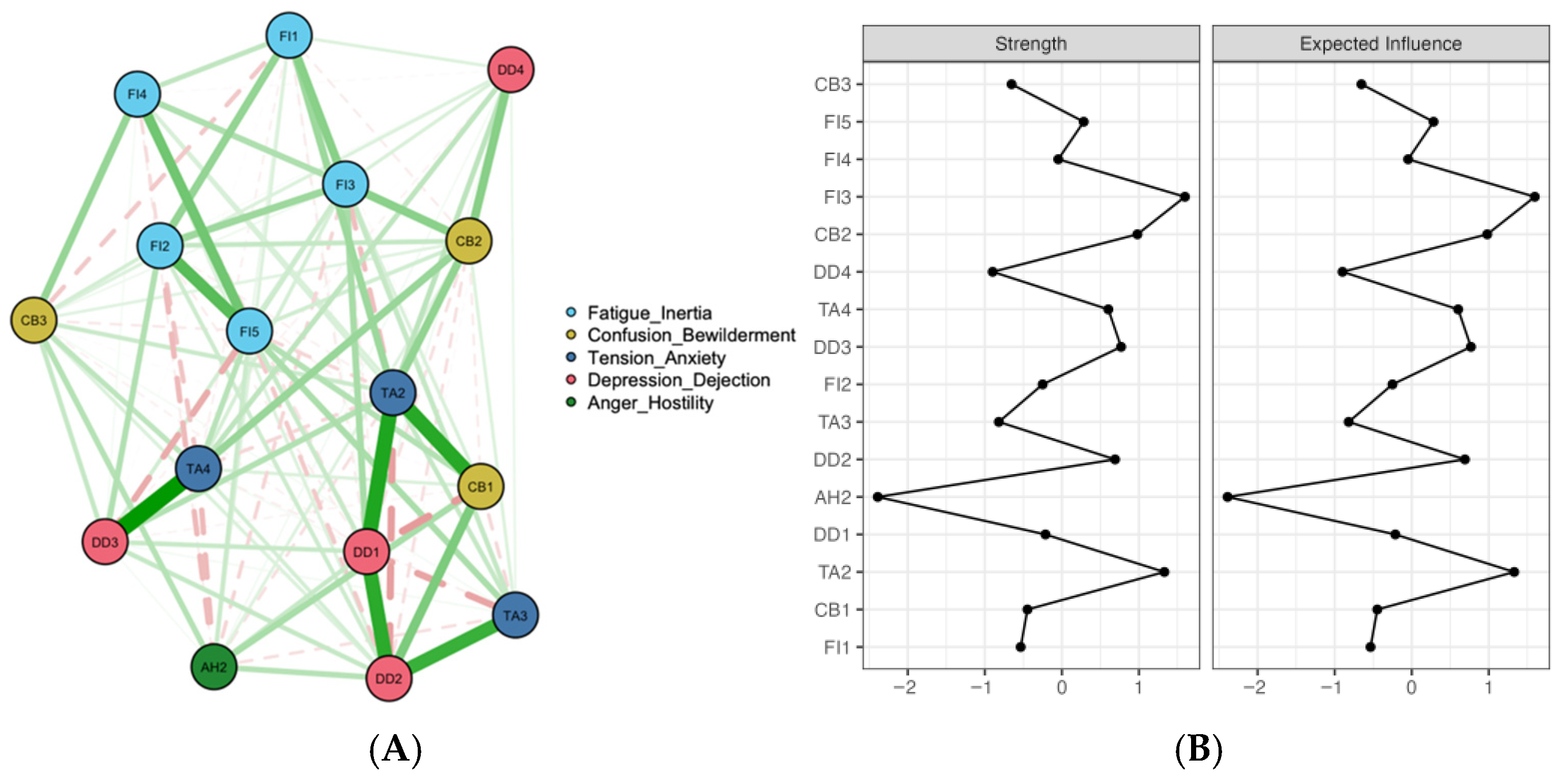
The emotional distress symptom network estimated by EBICglasso showed a dense structure dominated by positive edges, indicating predominantly reinforcing conditional associations among symptoms (Figure 2A). The network included 16 nodes and 66 nonzero edges (out of 120 possible edges). Clear within-dimension clustering was observed, with stronger connections within the same mood dimension and fewer cross-dimension links. The strongest edge was observed between TA4 (Anxious) and FI4 (Cannot get going) (ω = 0.383). Additional relatively strong edges included CB2 (Drowsy) with TA2 (Restless) (ω = 0.265) and DD4 (Blue) with TA2 (Restless) (ω = 0.244), suggesting meaningful cross-domain couplings. Centrality analysis suggested that FI3 (Exhausted) (rs = 1.60; rEI = 1.60), TA2 (Restless) (rs = 1.33; rEI = 1.33), and AH2 (Irritable) (rs = 2.39; rEI = 2.39) were relatively more central than other nodes (Figure 2B). Because the case-dropping bootstrap produced a CS coefficient of 0.27 (cor = 0.7), these centrality rankings should be interpreted cautiously and primarily as descriptive.

3.4. Expanded Network with Demographic and Clinical Variables

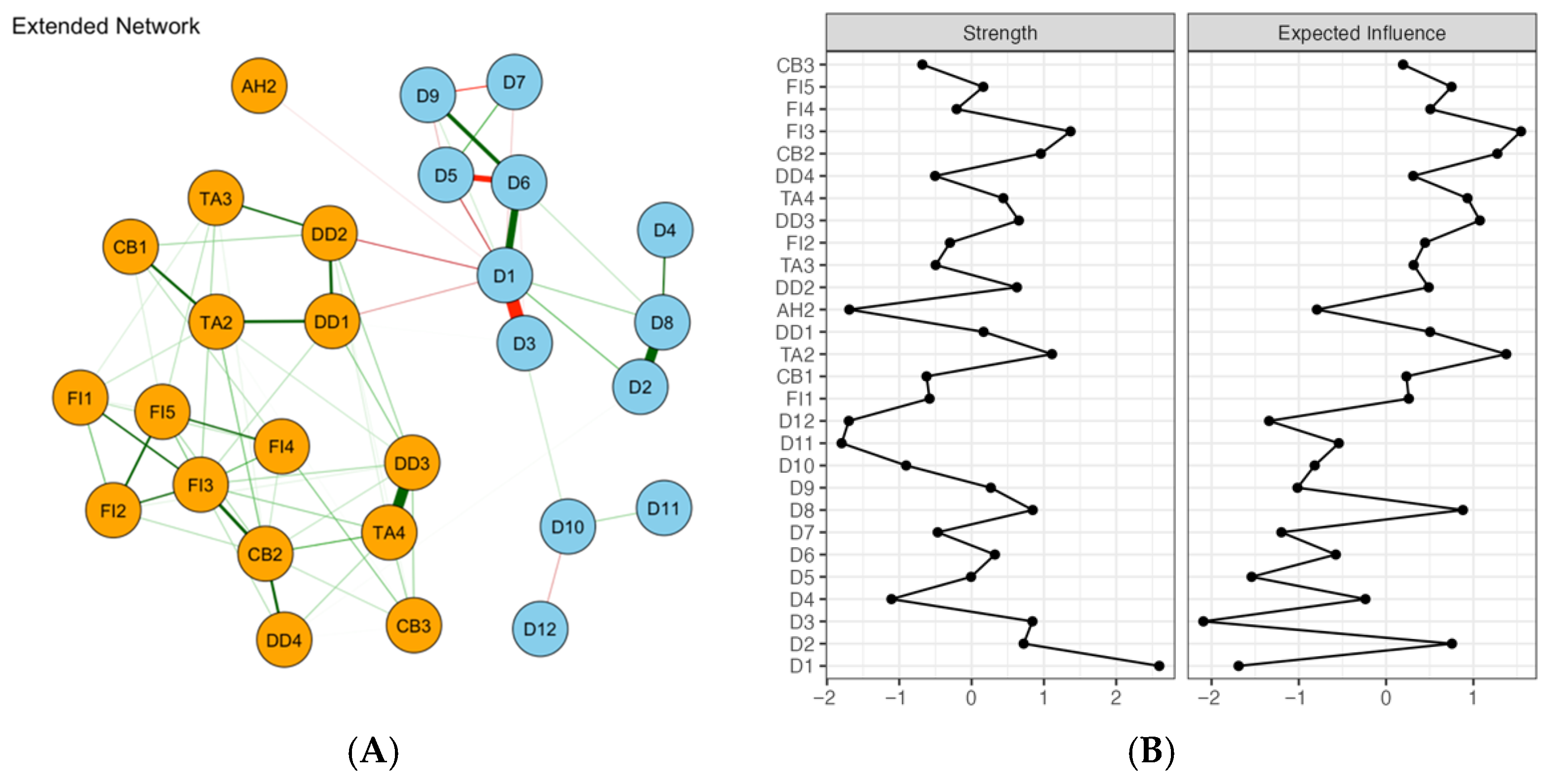
As shown in Figure 3A, an expanded association network was constructed incorporating emotional symptoms and demographic/clinical variables. The model included 28 nodes and 94 nonzero edges (out of 378 possible edges). Age group (D1), monthly income (D7), and tumor stage (D11) exhibited comparatively more connections with emotional symptoms, whereas marital status (D2), parity (D4), and insurance type (D9) showed fewer links. The three strongest edges by absolute weight were education level (D5)-type of surgery (D10) (ω = −0.537), insurance type (D9)-TA2 (Restless) (ω = 0.309), and tumor stage (D11)-TA2 (Restless) (ω = 0.300). After removing covariate effects (residual network; Figure 3B), the overall symptom network structure changed minimally. Centrality results in this expanded network indicated that TA2 (Restless), FI3 (Exhausted), and age group (D1) had relatively higher centrality; however, given the CS coefficient of 0.20 (cor = 0.7), these rankings should be interpreted only descriptively.

3.5. Expanded Network with Stress Process Model–Related Variables

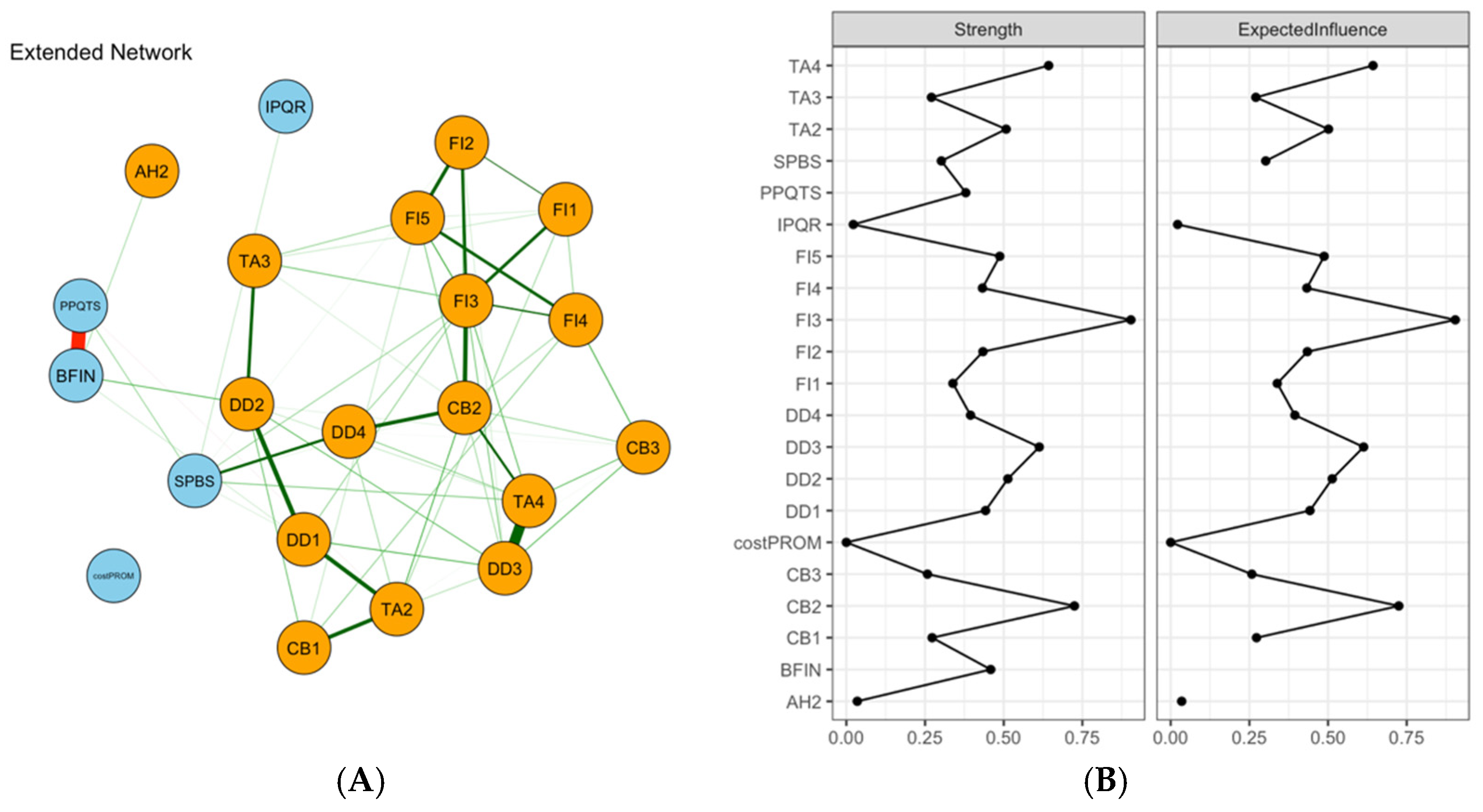
In the association network integrating emotional symptoms with Stress Process Model–related variables (Figure 4A), the network included 21 nodes and 69 nonzero edges (out of 210 possible edges). The strongest positive edge in the entire network was observed between self-perceived burden (SPBS) and FI2 (Fatigued) (ω = 0.342). A relatively strong negative edge was observed between CB1 (Confused) and TA3 (Ill at ease) (ω = −0.313). Other notable edges included CB3 (At a loss)-FI4 (Cannot get going) (ω = 0.226), neuroticism (BFI-N)-FI4 (ω = 0.214), and BIPQ-BFI-N (ω = 0.206), alongside connections involving positive psychological capital and depressive symptoms. Centrality analysis suggested that TA2 (Restless) and FI3 (Exhausted) remained relatively central among symptoms, whereas SPBS showed comparatively strong influence among stress-related variables (Figure 4B). Because the CS coefficient for node strength was 0.15 (cor = 0.7), these rankings should be interpreted with substantial caution.

3.6. Expanded Network with Quality of Life

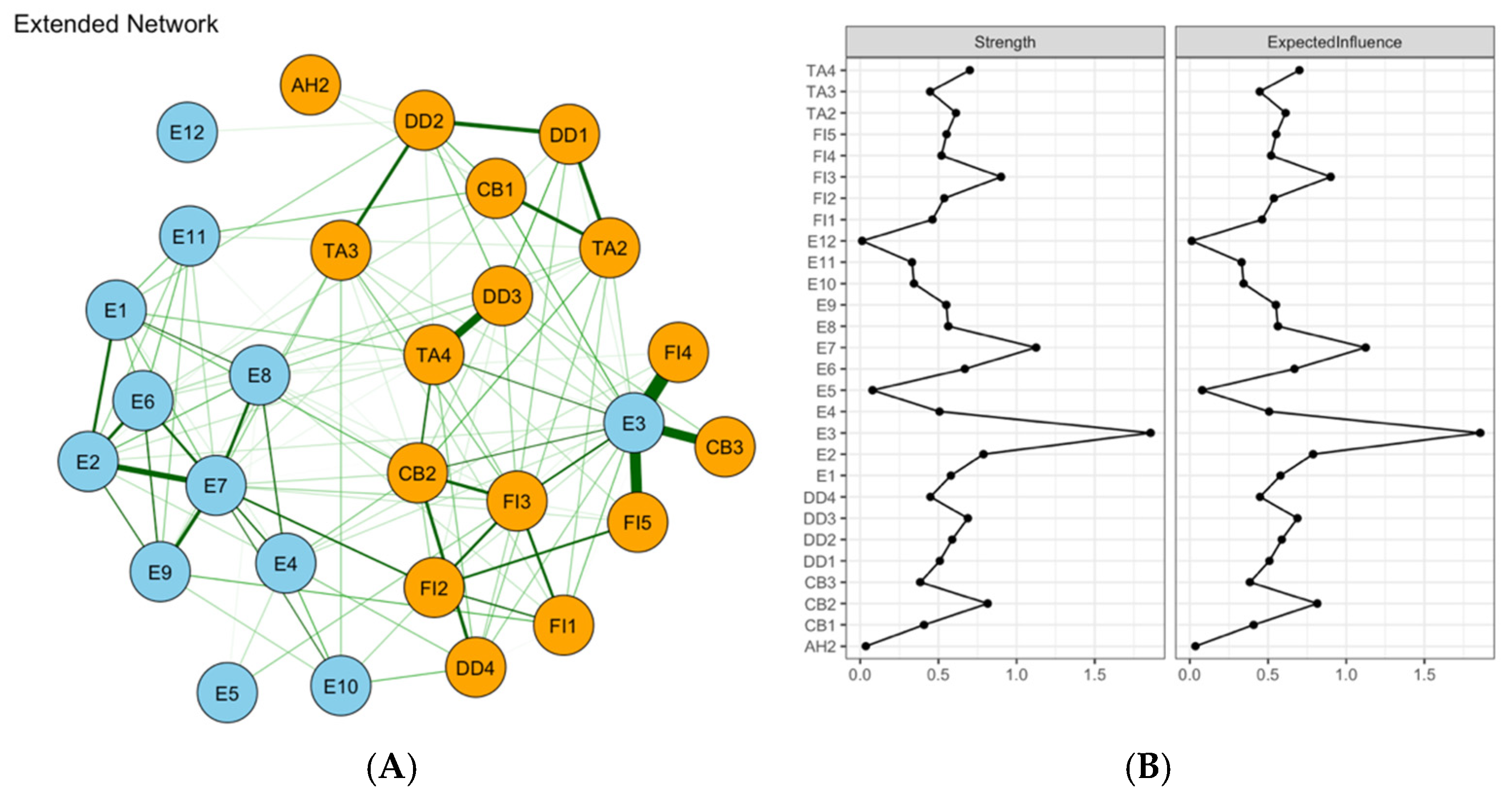
A network was constructed to examine conditional associations between emotional distress symptoms and quality-of-life indicators (Figure 5A). This model included 27 nodes and 146 nonzero edges (out of 351 possible edges), indicating extensive interconnections between emotional distress and quality-of-life domains. Functioning domains were mainly linked to fatigue-, depression-, and anxiety-related symptoms, whereas symptom domains also showed close connections with multiple negative emotional symptoms. The strongest edge in the entire network was between FI4 (Cannot get going) and E7 (Fatigue) (ω = 0.485), followed by FI4-E8 (Dyspnea) (ω = 0.405). Within the emotional symptom set, DD1 (Sad) and FI4 showed a prominent connection (ω = 0.367). After covariate adjustment, the residual network still retained several stable links (Figure 5B), suggesting that these associations were not solely driven by demographic or clinical factors. Centrality analysis indicated that emotional functioning (E3) and fatigue (E7) had relatively high centrality within the quality-of-life component, while FI3 (Exhausted) remained among the more central emotional symptom nodes. Because the CS coefficient for node strength was 0.36 (cor = 0.7), these rankings should still be interpreted conservatively.

3.7. Network Comparison

Results from the NCT indicated that neither global strength nor overall network structure differed significantly between the high- and low-level groups across SPM-related variables, including illness perception (IPQR), neuroticism (BFI-N), positive psychological capital (PPQTS), financial toxicity (COST-PROM), and self-perceived burden (SPBS) (all p > 0.05). These null findings suggest that these variables may be more closely related to overall distress severity than to major changes in network topology, although limited subgroup power and information loss from median splits should be considered. Detailed NCT results are provided in Table 3.

4. Discussion

This study provides a theory-informed contextual application of network analysis to emotional distress in gynecologic malignancies. Rather than treating ED as a single total score, we modeled a focused set of frequently endorsed negative mood symptoms and then examined how these symptoms were conditionally linked with demographic/clinical characteristics, SPM-related psychosocial variables, and quality-of-life domains. The manuscript’s primary contribution is therefore contextual and organizational: it shows how an SPM-guided selection of psychosocial correlates can be brought into dialogue with symptom network analysis without claiming that the resulting undirected network is itself a directional stress-process model. Overall, the networks were densely connected and dominated by positive edges, suggesting that emotional symptoms tended to co-occur within a mutually reinforcing system [15,16,17,36]. Within-dimension clustering was evident, but several cross-domain associations also emerged, indicating that fatigue, anxiety, depressive mood, and confusion were not isolated domains.
One of the strongest symptom-level associations was observed between anxiety (TA4) and difficulty initiating activities (FI4). In a cross-sectional network, this edge should be interpreted as a conditional co-occurrence rather than a directional mechanism. Nevertheless, the pattern is clinically plausible: sustained anxious arousal and reduced behavioral activation often coexist during cancer treatment and may be experienced by patients as a linked symptom pair [37,38].
Exhaustion (FI3), restlessness (TA2), and irritability (AH2) showed relatively greater prominence on the centrality indices in the main network. However, because the CS coefficient for the primary network was modest and the expanded networks showed even lower stability, these nodes are better understood as relatively more relationally prominent within this specific network configuration rather than as precise rank-ordered priorities or intervention leverage points. Their prominence should therefore be read as approximate and hypothesis-generating, especially because bootstrapped difference tests among the top nodes were not used to establish statistically reliable rank separation [23]. This caution also reflects current methodological guidance, which suggests that centrality in cross-sectional psychological networks should be interpreted carefully and not translated too directly into clinical action [39,40].
The demographic/clinical expanded network suggested that age group, monthly income, and tumor stage were more connected with emotional symptoms than other background variables, whereas the residual network indicated that the basic symptom-to-symptom structure changed little after covariate adjustment. This pattern suggests that background characteristics may shape overall distress burden without fully determining the internal organization of symptom associations [16].
In the SPM-related network, self-perceived burden showed the strongest direct association with fatigue. This finding is consistent with the idea that distress in cancer is embedded in patients’ role obligations and appraisal processes [19,20]. In the Chinese clinical context, where family-centered caregiving and reciprocity are highly salient, concerns about burdening relatives may be especially emotionally charged. Thus, self-perceived burden may represent an important contextual correlate of fatigue and broader distress, even though the current design cannot establish whether burden drives fatigue, fatigue drives burden, or both.
Illness perception and neuroticism were also conditionally connected to the symptom network, supporting the relevance of cognitive appraisal and vulnerability traits. At the same time, the absence of significant NCT differences between high- and low-risk subgroups deserves substantive emphasis rather than being treated as merely negative. Taken together, these results suggest that psychosocial burden in this sample may influence how much distress is experienced more than it alters how symptoms relate to one another. In other words, the subgroup analyses favor an interpretation of relative structural stability with variation primarily in overall distress severity, rather than clear topological differentiation across psychosocial strata. These null subgroup findings are therefore informative: they indicate either that between-group heterogeneity was smaller than anticipated or that the current sample and median-split approach had limited power to detect subtler topological differences [23]. In this sense, the subgroup analyses function as an empirical boundary test, indicating that psychosocial risk stratification did not translate into clearly distinct symptom architectures in the present dataset.
The network that integrated quality-of-life domains showed extensive links between emotional symptoms and functional outcomes, especially around fatigue-related nodes. The strongest edges connected difficulty initiating activities (FI4) with QLQ-C30 fatigue and dyspnea, supporting the interpretation that fatigue-related impairment may be an important correlational interface between emotional distress and diminished daily functioning [41].
Several methodological issues also temper interpretation. First, the node-screening strategy emphasized clinically frequent negative mood items and included one track based on a core distress indicator. Although screening was restricted to a training set and the final nodes were frozen and validated, the resulting 16-node network is not a neutral slice of the full BPOMS-SF30 but a focused reconstruction of the most prevalent, strongly associated, and selection-stable symptoms. This selection logic likely contributed to the prominence of fatigue- and activation-related items within the retained network. The supplementary sensitivity analysis using the broader 23-item set partly mitigates this concern, but full-scale replication remains important. Second, although the internal consistency of the main scales was acceptable, it was not uniformly strong, which may have attenuated some partial correlation estimates and should be borne in mind when interpreting weaker edges or close centrality rankings. Third, the sample was recruited from a single tertiary hospital and was overwhelmingly Han Chinese, so the findings may not generalize to more diverse populations or different caregiving cultures. Cultural norms around reciprocity, emotional restraint, and family obligation may also shape how self-perceived burden is experienced and reported in this setting. In particular, within many Chinese family systems, concerns about becoming a burden may carry moral and relational meanings that are not fully captured by generic psychosocial constructs; this cultural specificity may partly explain why self-perceived burden was especially salient in the present networks.
Finally, several CS coefficients were low to moderate, especially in the expanded networks. For this reason, we deliberately interpret edge weights and centrality descriptively rather than mechanistically, and we do not claim that relatively central symptoms are causal treatment leverage points [39,40]. In addition, although the archived workflow does not preserve all missing-data details, the analysis assumed that missingness was compatible with a missing-at-random framework for multiple imputation by chained equations. The recoverable aspects of the procedure include the imputation approach itself, the use of predictive mean matching, and the fact that imputation was conducted as a preprocessing step before the exploratory network analyses; however, variable-level missingness summaries, the exact number of imputations, and pooled diagnostic outputs were not retained and should be documented prospectively in future work.
Future studies should replicate these findings in larger multicenter samples, compare the reduced node set with broader symptom networks, and use longitudinal or complementary path-based models when directional hypotheses are of interest. Such work would align with broader methodological agendas calling for replication, clearer theory-model correspondence, and stronger longitudinal designs in network research [42].

4.1. Implications for Clinical Practice

From a clinical perspective, the present findings support a systems-oriented monitoring strategy. Symptoms such as exhaustion, restlessness, irritability, and difficulty initiating activities may be especially worth routine descriptive monitoring within this sample because they were relatively more prominent in the estimated networks, not because they can be assumed to be definitive leverage points. Fatigue-related impairment and self-perceived burden also appear to be useful correlates for psychosocial screening. In parallel, the structurally stable subgroup findings suggest that psychosocial stratification may help identify patients with greater distress burden even when the basic architecture of symptom interrelations remains similar. Any clinical prioritization should therefore be considered provisional until replicated in more stable and preferably longitudinal networks.

4.2. Limitations

This study has several limitations. First, the cross-sectional, single-center convenience sample precludes causal inference and limits generalizability. In addition, because the sample was predominantly Han Chinese, the findings may not readily generalize to more diverse cultural or clinical settings. Second, several features of the network modeling require cautious interpretation. Some CS coefficients were below recommended levels, especially in the expanded networks, so centrality indices and specific edge estimates should be regarded as approximate rather than precise. In addition, the reduced 16-node network was derived from an exploratory screening pipeline that prioritized frequently endorsed negative symptoms with stronger and more stable associations; consequently, lower-prevalence symptoms from the full BPOMS-SF30 were underrepresented, and the observed network structure should be understood as conditional on this focused selection strategy. Third, some analytic and measurement constraints may also have influenced the findings. The internal consistency of several measures was acceptable rather than strong; subgroup comparisons based on median splits may have reduced statistical power, and although missing data were handled using MICE preprocessing under a working missing-at-random assumption, the archived record did not retain full imputation details, which limits reproducibility.

5. Conclusions

In patients with gynecologic malignancies, emotional distress symptoms formed a densely connected, predominantly positive network. Fatigue- and activation-related symptoms were relatively more prominent within the retained symptom system, and self-perceived burden showed a notable conditional association with fatigue. At the same time, the subgroup analyses did not reveal major topological differences across psychosocial strata, suggesting that psychosocial burden in this sample may be reflected more in the severity of distress than in a reorganization of symptom structure. The study’s main contribution is therefore not a causal extension of the SPM, but a theory-informed contextual application of network methods and an empirical boundary test of whether psychosocial stratification corresponds to altered symptom topology.

Author Contributions

Conceptualization: H.H. and T.L.; Methodology: H.H., L.P. and S.M.; Formal analysis: H.H.; Investigation: L.P. and S.M.; Resources: L.X. and Y.W.; Data curation: H.H. and T.L.; Writing—original draft: H.H. and T.L.; Writing—review and editing: L.P., S.M., L.X. and Y.W.; Supervision: L.X. and Y.W.; Project administration: L.X. and Y.W.; Funding acquisition: Y.W. All authors have read and agreed to the published version of the manuscript.

Funding

This work was supported by the Wuxi Medical Innovation Team Program (CXTD2021023). The funders had no role in study design, data collection and analysis, decision to publish, or preparation of the manuscript.

Institutional Review Board Statement

The research protocol was approved by the Ethics Committee of the Affiliated Hospital of Jiangnan University (Approval: No. LS2024284 on 11 September 2024). All procedures were conducted in accordance with the Declaration of Helsinki.

Informed Consent Statement

Informed consent was obtained from all subjects involved in the study. Participation was voluntary, and all respondents were informed of their right to withdraw at any time without penalty.

Data Availability Statement

The data supporting the findings of this study are not publicly available due to privacy and ethical restrictions, as they contain sensitive information about study participants. The datasets generated during the current study are available from the corresponding author upon reasonable request.

Acknowledgments

We would like to express our sincere gratitude to all of the patients who participated in this study. We also thank the nursing staff from the Department of Gynecology at the Affiliated Hospital of Jiangnan University for their valuable assistance with patient recruitment and data collection.

Conflicts of Interest

The authors declare no conflicts of interest. The funders had no role in the study design, data collection, analysis, interpretation, manuscript preparation, or the decision to publish the results.

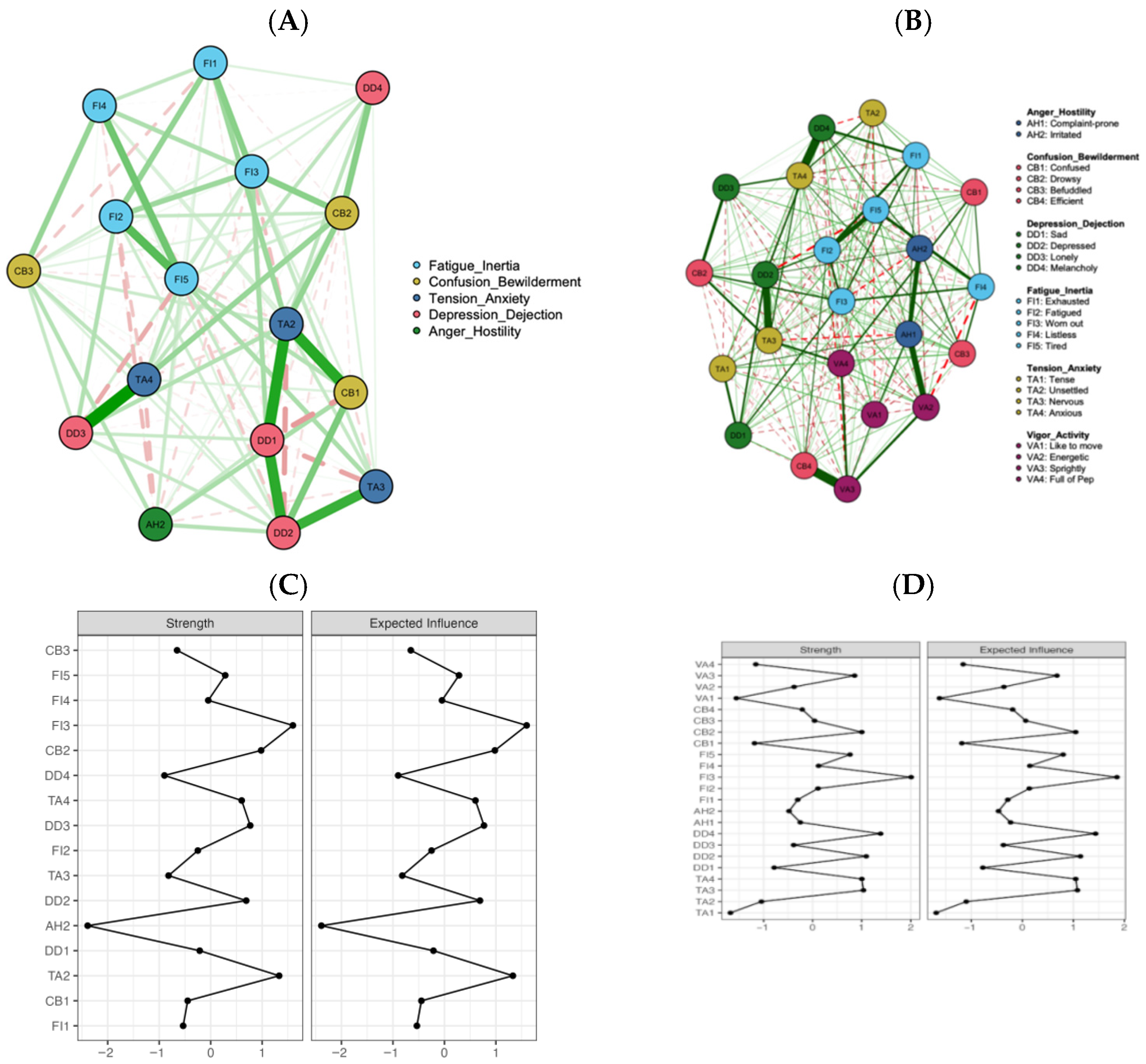
Appendix A. Sensitivity Analysis for Node-Selection Robustness

To examine the robustness of the node-screening strategy, we conducted a sensitivity analysis by constructing a 23-node symptom network after excluding only nodes with prevalence < 50%, and compared it with the primary 16-node network reported in the main text. The results were broadly consistent across the two specifications. In the 23-node network, the most central symptoms were still predominantly fatigue-related and anxious-restlessness symptoms, which was largely consistent with the core symptoms identified in the 16-node network. Likewise, the strongest edges in both networks were concentrated in similar symptom pairs, indicating that the principal connection pattern remained stable. Taken together, these findings suggest that although the number of retained nodes varied depending on the screening rule, the core network structure showed good consistency, supporting the robustness of the main conclusions.
Figure A1. (A) Symptom network with 16 screened nodes; (B) Symptom network with 23 nodes; (C) Centrality analysis for the 16-node net-work; (D) Centrality analysis for the 23-node net-work.
Healthcare 14 01136 g0a1

References

  1. Sung, H.; Ferlay, J.; Siegel, R.L.; Laversanne, M.; Soerjomataram, I.; Jemal, A.; Bray, F. Global cancer statistics 2020: GLOBOCAN estimates of incidence and mortality worldwide for 36 cancers in 185 countries. CA A Cancer J. Clin. 2021, 71, 209–249. [Google Scholar] [CrossRef]
  2. Qi, J.; Li, M.; Wang, L.; Hu, Y.; Liu, W.; Long, Z.; Zhou, Z.; Yin, P.; Zhou, M. National and subnational trends in cancer burden in China, 2005–20: An analysis of national mortality surveillance data. Lancet Public Health 2023, 8, e943–e955. [Google Scholar] [CrossRef]
  3. Holland, J.C.; Andersen, B.; Breitbart, W.S.; Buchmann, L.O.; Compas, B.; Deshields, T.L.; Dudley, M.M.; Fleishman, S.; Fulcher, C.D.; Greenberg, D.B.; et al. Distress management. J. Natl. Compr. Cancer Netw. 2013, 11, 190–209. [Google Scholar] [CrossRef]
  4. Baudry, A.-S.; Charton, E.; Piessen, G.; Vanlemmens, L.; Cortot, A.; Ceban, T.; Anota, A.; Christophe, V. Emotional distress, supportive care needs and age in the prediction of quality of life of cancer patients’ caregivers: A cross-sectional study. Eur. J. Oncol. Nurs. 2023, 64, 102324. [Google Scholar] [CrossRef]
  5. Linden, W.; Vodermaier, A.; MacKenzie, R.; Greig, D. Anxiety and depression after cancer diagnosis: Prevalence rates by cancer type, gender, and age. J. Affect. Disord. 2012, 141, 343–351. [Google Scholar] [CrossRef] [PubMed]
  6. Manne, S.L.; Virtue, S.M.; Ozga, M.; Kashy, D.; Heckman, C.; Kissane, D.; Rosenblum, N.; Morgan, M.; Rodriquez, L. A comparison of two psychological interventions for newly diagnosed gynecological cancer patients. Gynecol. Oncol. 2017, 144, 354–362. [Google Scholar] [CrossRef]
  7. Urbaniec, O.A.; Collins, K.; Denson, L.A.; Whitford, H.S. Gynecological cancer survivors: Assessment of psychological distress and unmet supportive care needs. J. Psychosoc. Oncol. 2011, 29, 534–551. [Google Scholar] [CrossRef]
  8. Heo, J.; Chun, M.; Oh, Y.-T.; Noh, O.K. Psychiatric comorbidities among endometrial cancer survivors in South Korea: A nationwide population-based, longitudinal study. J. Gynecol. Oncol. 2019, 30, e15. [Google Scholar] [CrossRef]
  9. Krebs, J.; Wasner, S.; Egloffstein, S.; Lux, M.P.; Morawa, E.; Beckmann, M.W.; Erim, Y. Resilience, fear of progression, and psychological distress in patients with breast cancer and gynecological tumors seeking a second medical opinion. Psychother. Psychosom. Med. Psychol. 2019, 69, 293–300. [Google Scholar] [CrossRef] [PubMed]
  10. Mell, C.A.; Jewett, P.I.; Teoh, D.; Vogel, R.I.; Everson-Rose, S.A. Psychosocial predictors of fear of cancer recurrence in a cohort of gynecologic cancer survivors. Psycho-Oncol. 2022, 31, 2141–2148. [Google Scholar] [CrossRef] [PubMed]
  11. Nasution, L.; Afiyanti, Y.; Ma’rifah, A.R. The most unmet needs on gynecological and breast cancer survivors: A systematic review. Enferm. Glob. 2023, 22, 497–521. [Google Scholar] [CrossRef]
  12. Deng, J.; Chen, J.; Guo, X.; Xie, C. Factors influencing fertility distress in reproductive-aged gynecologic cancer patients: A narrative overview. J. Clin. Med. 2025, 14, 8512. [Google Scholar] [CrossRef]
  13. McInnerney, D.; Kupeli, N.; Stone, P.; Anantapong, K.; Chan, J.; Flemming, K.; Troop, N.; Candy, B. Emotional disclosure in palliative care: A scoping review of intervention characteristics and implementation factors. Palliat. Med. 2021, 35, 1323–1343. [Google Scholar] [CrossRef] [PubMed]
  14. Beard, C.; Millner, A.J.; Forgeard, M.; Fried, E.I.; Hsu, K.J.; Treadway, M.; Leonard, C.V.; Kertz, S.J.; Björgvinsson, T. Network analysis of depression and anxiety symptom relations in a psychiatric sample. Psychol. Med. 2016, 46, 3359–3369. [Google Scholar] [CrossRef]
  15. Borsboom, D. A network theory of mental disorders. World Psychiatry 2017, 16, 5–13. [Google Scholar] [CrossRef]
  16. Borsboom, D.; Cramer, A.O.J. Network analysis: An integrative approach to the structure of psychopathology. Annu. Rev. Clin. Psychol. 2013, 9, 91–121. [Google Scholar] [CrossRef] [PubMed]
  17. Zhu, Z.; Xing, W.; Hu, Y.; Wu, B.; So, W.K.W. Paradigm shift: Moving from symptom clusters to symptom networks. Asia-Pac. J. Oncol. Nurs. 2022, 9, 5–6. [Google Scholar] [CrossRef] [PubMed]
  18. Chen, F.; Deng, Y.; Li, S.; Zhang, Q.; Xiao, Z.; Knobf, M.T.; Ye, Z. Fear of cancer recurrence and perceived pain in patients with breast cancer: A network analysis approach. Asia-Pac. J. Oncol. Nurs. 2025, 12, 100763. [Google Scholar] [CrossRef]
  19. Pearlin, L.I. The stress process revisited. In Handbook of the Sociology of Mental Health; Aneshensel, C.S., Phelan, J.C., Eds.; Springer: New York, NY, USA, 1999; pp. 395–415. [Google Scholar] [CrossRef]
  20. McLeod, J.D. The meanings of stress: Expanding the stress process model. Soc. Ment. Health 2012, 2, 172–186. [Google Scholar] [CrossRef]
  21. Luo, J. Translation, Validation, and Application of the Comprehensive Score for Financial Toxicity Based on Patient-Reported Outcomes. Master’s Thesis, University of Electronic Science and Technology of China, Chengdu, China, 2024. [Google Scholar] [CrossRef]
  22. Bergerot, C.D.; Philip, E.J.; Bergerot, P.G.; Siddiq, N.; Tinianov, S.; Lustberg, M. Fear of cancer recurrence or progression: What is it and what can we do about it? Am. Soc. Clin. Oncol. Educ. Book 2022, 42, 18–27. [Google Scholar] [CrossRef]
  23. Epskamp, S.; Borsboom, D.; Fried, E.I. Estimating psychological networks and their accuracy: A tutorial paper. Behav. Res. Methods 2018, 50, 195–212. [Google Scholar] [CrossRef]
  24. Chi, S.; Lin, W.J. Preliminary revision of the Brief Profile of Mood States (BPOMS). Chin. J. Ment. Health 2003, 11, 768–770. [Google Scholar]
  25. Mei, Y.Q.; Li, H.P.; Yang, Y.J.; Su, D.; Ma, L.; Zhang, T.; Dou, W.J. Reliability and validity of the Chinese version of the Brief Illness Perception Questionnaire in female patients with breast cancer. J. Nurs. 2015, 22, 11–14. [Google Scholar] [CrossRef]
  26. John, O.P. The Big Five Inventory—Versions 4a and 54; Berkeley Institute of Personality and Social Research, University of California: Berkeley, CA, USA, 1991. [Google Scholar]
  27. Zhang, K.; Zhang, S.; Dong, Y.H. Positive psychological capital: Measurement and its relationship with mental health. Stud. Psychol. Behav. 2010, 8, 58–64. [Google Scholar]
  28. Zhang, M.; Li, S.B.; Chen, Q. Self-perceived burden and its influencing factors among elderly patients with common chronic diseases. Chin. Nurs. Manag. 2017, 17, 63–68. [Google Scholar]
  29. Tan, S.S.; Li, H.; Luo, J.; Chen, N.J.; Song, Y.; Jiang, G.L.; Yang, F.Y. Evaluation of the Chinese version of the EORTC QLQ-C30 quality-of-life questionnaire. Chin. J. Clin. Rehabil. 2006, 4, 23–27. [Google Scholar]
  30. van Buuren, S.; Groothuis-Oudshoorn, K. mice: Multivariate imputation by chained equations in R. J. Stat. Softw. 2011, 45, 1–67. [Google Scholar] [CrossRef]
  31. Tibshirani, R. Regression shrinkage and selection via the lasso. J. R. Stat. Soc. Ser. B 1996, 58, 267–288. [Google Scholar] [CrossRef]
  32. Hastie, T.; Tibshirani, R.; Friedman, J. The Elements of Statistical Learning: Data Mining, Inference, and Prediction, 2nd ed.; Springer: New York, NY, USA, 2009. [Google Scholar]
  33. Spearman, C. The proof and measurement of association between two things. In Classics in the History of Psychology; Thoemmes Press: Bristol, UK, 1961. [Google Scholar] [CrossRef]
  34. Zhu, Z.; Yu, J.W.; Yang, Z.F.; Hu, T.T.; Jin, Y.L.; He, J.M. Introduction to symptom contemporaneous network analysis and its implementation using R software. J. Nurses Train. 2023, 38, 2235–2239. [Google Scholar] [CrossRef]
  35. Epskamp, S.; Cramer, A.O.J.; Waldorp, L.J.; Schmittmann, V.D.; Borsboom, D. qgraph: Network visualizations of relationships in psychometric data. J. Stat. Softw. 2012, 48, 1–18. [Google Scholar] [CrossRef]
  36. Ye, Y.X.; Qin, L.; Zeng, K.; Liang, J.W.; Zhang, L.L. Identification of core symptoms and symptom clusters during treatment intervals in patients with cancer. J. Nurs. Sci. 2022, 37, 20–24. [Google Scholar]
  37. Fereidouni, Z.; Dehghan Abnavi, S.; Ghanbari, Z.; Gashmard, R.; Zarepour, F.; Khalili Samani, N.; Sharma, A.R.; Ghasemi, A. The impact of cancer on mental health and the importance of supportive services. Galen Med. J. 2024, 13, e3327. [Google Scholar] [CrossRef] [PubMed]
  38. Guo, S.J.; Tan, H.Y.; You, Y.L. Research progress on perceived stress and its influencing factors in patients with cancer. Adv. Clin. Med. 2025, 15, 2202. [Google Scholar] [CrossRef]
  39. Bringmann, L.F.; Elmer, T.; Epskamp, S.; Krause, R.W.; Schoch, D.; Wichers, M.; Wigman, J.T.W.; Snippe, E. What do centrality measures measure in psychological networks? J. Abnorm. Psychol. 2019, 128, 892–903. [Google Scholar] [CrossRef] [PubMed]
  40. Rodebaugh, T.L.; Tonge, N.A.; Piccirillo, M.L.; Fried, E.I.; Horenstein, A.; Morrison, A.S.; Goldin, P.; Gross, J.J.; Lim, M.H.; Fernandez, K.C.; et al. Does centrality in a cross-sectional network suggest intervention targets for social anxiety disorder? J. Consult. Clin. Psychol. 2018, 86, 831–844. [Google Scholar] [CrossRef] [PubMed]
  41. Tao, L.; Lv, J.; Zhong, T.; Zeng, X.; Han, M.; Fu, L.; Chen, H. Effects of sleep disturbance, cancer-related fatigue, and psychological distress on breast cancer patients’ quality of life: A prospective longitudinal observational study. Sci. Rep. 2024, 14, 8632. [Google Scholar] [CrossRef]
  42. Robinaugh, D.J.; Hoekstra, R.H.A.; Toner, E.R.; Borsboom, D. The network approach to psychopathology: A review of the literature 2008–2018 and an agenda for future research. Psychol. Med. 2020, 50, 353–366. [Google Scholar] [CrossRef]
Figure 1. Three-Track Parallel Screening Strategy for Symptom Selection.
Healthcare 14 01136 g001
Figure 2. Network analysis visualization for emotional distress (A) and centrality metrics (B). Note: Green edges indicate positive partial correlations and red edges indicate negative partial correlations; thicker lines indicate stronger absolute edge weights. Centrality plots present z-standardized strength and expected influence (EI).
Healthcare 14 01136 g002
Figure 3. Network analysis visualization for emotional distress with demographic and clinical variables (A) and centrality metrics (B). Note: Green edges indicate positive partial correlations and red edges indicate negative partial correlations; thicker lines indicate stronger absolute edge weights. Centrality plots present z-standardized strength and expected influence (EI). D1 = age group; D2 = marital status; D3 = type of menopause; D4 = parity; D5 = educational level; D6 = employment status; D7 = monthly income level; D8 = primary caregiver; D9 = type of medical insurance; D10 = surgical approach; D11 = tumor stage; D12 = treatment modality.
Healthcare 14 01136 g003
Figure 4. Network analysis visualization for emotional distress with Stress Process Model–related variables (A) and centrality metrics (B). Note: Green edges indicate positive partial correlations and red edges indicate negative partial correlations; thicker lines indicate stronger absolute edge weights. Centrality plots present z-standardized strength and expected influence (EI). SPBS = Self-Perceived Burden Scale; BFI-N = Neuroticism subscale of the Big Five Inventory; PPQTS = Positive Psychological Capital Questionnaire; IPQR = Illness Perception Questionnaire–Revised; COST-PROM = Comprehensive Score for Financial Toxicity–Patient-Reported Outcome Measure.
Healthcare 14 01136 g004
Figure 5. Network analysis visualization for emotional distress with quality of life (A) and centrality metrics (B). Note: Green edges indicate positive partial correlations and red edges indicate negative partial correlations; thicker lines indicate stronger absolute edge weights. Centrality plots present z-standardized strength and expected influence (EI). E1 = physical functioning; E2 = role functioning; E3 = emotional functioning; E4 = cognitive functioning; E5 = social functioning; E6 = pain; E7 = fatigue; E8 = dyspnea; E9 = appetite loss; E10 = constipation; E11 = nausea; E12 = diarrhea.
Healthcare 14 01136 g005
Table 1. General Characteristics of Patients with Gynecologic Malignancies (N = 415).
VariableCategoryn (%)
Age (years)<5080 (19.30)
50–59127 (30.60)
60–69120 (28.90)
≥7088 (21.20)
Body Mass Index (kg/m2)<18.5 (Underweight)20 (4.82)
18.5–23.9 (Normal weight)233 (56.14)
24.0–27.9 (Overweight)124 (29.88)
≥28.0 (Obese)38 (9.16)
EthnicityHan409 (98.55)
Ethnic minorities6 (1.45)
Marital statusUnmarried5 (1.20)
Married363 (87.47)
Divorced/Separated8 (1.93)
Widowed39 (9.40)
Parity0 births12 (2.89)
1–2 births341 (82.17)
3–4 births55 (13.25)
≥5 births7 (1.69)
Menopausal statusNatural menopause344 (82.89)
Artificial menopause71 (17.11)
Educational levelPrimary school or below166 (40.00)
Junior high school160 (38.55)
Senior high school/Technical secondary school48 (11.57)
College or above41 (9.88)
Employment statusEmployed105 (25.30)
Retired208 (50.12)
Unemployed88 (21.20)
Agriculture14 (3.37)
Monthly per capita household income (CNY)<200022 (5.30)
2000–4000310 (74.70)
>400083 (20.00)
Primary caregiverSpouse321 (77.35)
Children81 (19.52)
Other caregivers13 (3.13)
Type of medical insuranceEmployee medical insurance198 (47.71)
Resident medical insurance204 (49.16)
Self-paid13 (3.13)
Cancer typeCervical cancer182 (43.86)
Ovarian cancer123 (29.64)
Endometrial cancer83 (20.00)
Vulvar cancer9 (2.16)
Other gynecologic cancers18 (4.34)
Pathological stage (TNM)Stage I137 (33.01)
Stage II139 (33.49)
Stage III109 (26.27)
Stage IV30 (7.22)
Time since diagnosis0–3 months80 (19.28)
3–6 months124 (29.88)
6–12 months80 (19.28)
1–3 years64 (15.42)
≥3 years67 (16.14)
ComorbiditiesHypertension only69 (16.63)
Diabetes mellitus only43 (10.36)
Both hypertension and diabetes52 (12.53)
Neither249 (60.00)
Table 2. Descriptive consistency of frozen nodes between the training and validation sets.
NodeItemTraining MeanTraining Positive (%)Validation MeanValidation Positive (%)
TA3Ill at ease 2.4390.32.4288.8
TA2Restless2.8294.82.8796.8
TA4Anxious 2.4193.82.3892.8
DD1Sad2.3790.32.3284.8
DD2Dejected 2.2990.32.2789.6
DD3Lonely2.2878.32.4183.2
DD4Blue2.2991.72.3591.2
FI1Worn out2.9394.52.8996.8
FI2Fatigued 3.0199.03.0998.4
FI3Exhausted2.9895.53.0493.6
FI4Cannot get going2.4782.12.3780.8
FI5Tired2.4994.82.5296.0
CB1Confused 2.1076.62.1985.6
CB2Drowsy2.3986.22.4184.0
CB3At a loss2.2886.92.2085.6
AH2Irritable1.9165.92.0374.4
Note: Positive response proportion indicates the percentage of participants with node score ≥ the prespecified threshold.
Table 3. Network Comparison Test.
VariableMp_MGS_lowGS_highSp_S
SPBS0.2510.9621.05970.30690.75280.6623
BFI-N0.3220.4300.31571.57451.25880.3956
PPQTS0.1790.8710.10542.42852.32310.7622
IPQR0.3400.2820.28121.99641.7152
COST-PROM0.2640.9350.27840.56660.28810.8092
Note: M represents the test statistic for network structure invariance; p_M indicates the corresponding p value. GS_low and GS_high represent the global strength of the low- and high-level groups, respectively. S denotes the difference in global strength between the two networks, and p_S indicates the corresponding p value. SPBS = Self-Perceived Burden Scale; BFI-N = Neuroticism subscale of the Big Five Inventory; PPQTS = Positive Psychological Capital Questionnaire; IPQR = Illness Perception Questionnaire–Revised; COST-PROM = Comprehensive Score for Financial Toxicity–Patient-Reported Outcome Measure.
Disclaimer/Publisher’s Note: The statements, opinions and data contained in all publications are solely those of the individual author(s) and contributor(s) and not of MDPI and/or the editor(s). MDPI and/or the editor(s) disclaim responsibility for any injury to people or property resulting from any ideas, methods, instructions or products referred to in the content.