Physical Exercise in Myasthenia Gravis: A Systematic Review

 ,
,  ,
,  ,
,  and
and 
Abstract
1. Introduction
2. Materials and Methods
2.1. Search Strategy
2.2. Inclusion and Exclusion Criteria
2.3. Study Selection and Data Extraction
2.4. Methodological Quality Assessment
3. Results
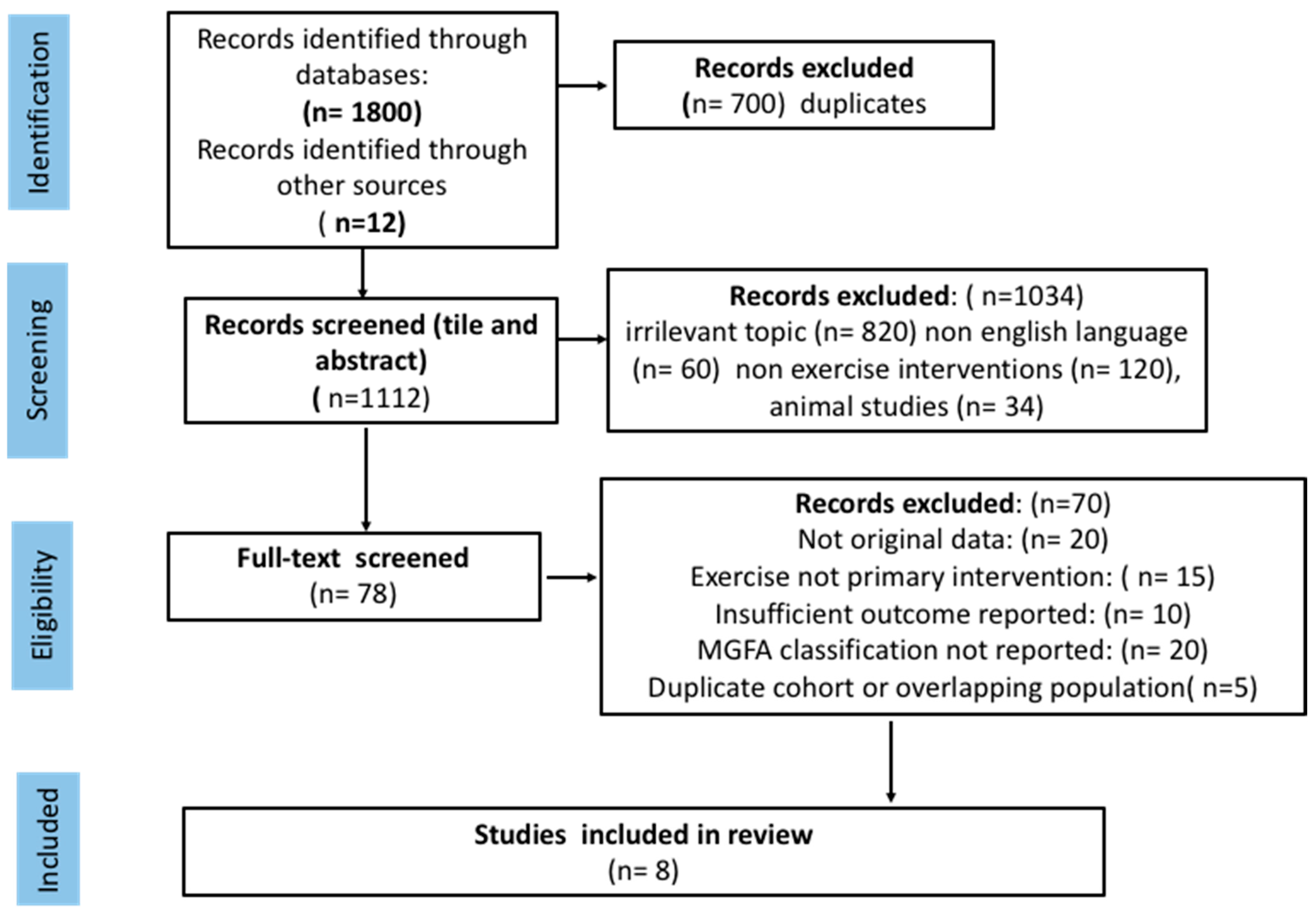
3.1. Study Selection and Overview
3.2. Aerobic Exercise Interventions
3.3. Respiratory Muscle Resistance Training
3.4. Combined Aerobic, Resistance and Respiratory Training Programs
4. Discussion
5. Conclusions
Implications for Clinical Practice
Supplementary Materials
Author Contributions
Funding
Institutional Review Board Statement
Informed Consent Statement
Data Availability Statement
Conflicts of Interest
References
- Gilhus, N.E. Physical Training and Exercise in Myasthenia Gravis. Neuromuscul. Disord. 2021, 31, 169–173. [Google Scholar] [CrossRef] [PubMed]
- O’Connor, L.; Westerberg, E.; Punga, A.R. Myasthenia Gravis and Physical Exercise: A Novel Paradigm. Front. Neurol. 2020, 11, 675. [Google Scholar] [CrossRef] [PubMed]
- Peng, S.; Meng, L.; Fang, R.; Shen, Q.; Tian, Y.; Xiong, A.; Li, S.; Yang, Y.; Chang, W.; Ni, J.; et al. Current State of Research on Exercise for the Treatment of Myasthenia Gravis: A Scoping Review. Complement. Ther. Med. 2024, 81, 103033. [Google Scholar] [CrossRef] [PubMed]
- Andersen, L.K.; Aadahl, M.; Vissing, J. Fatigue, Physical Activity and Associated Factors in 779 Patients with Myasthenia Gravis. Neuromuscul. Disord. 2021, 31, 716–725. [Google Scholar] [CrossRef]
- Lucia, A.; Maté-Muñoz, J.L.; Pérez, M.; Foster, C.; Gutiérrez-Rivas, E.; Arenas, J. Double Trouble (McArdle’s Disease and Myasthenia Gravis): How Can Exercise Help? Muscle Nerve 2007, 35, 125–128. [Google Scholar] [CrossRef]
- Leddy, J.J.; Chutkow, J.G. Myasthenia Gravis in a Collegiate Football Player. Med. Sci. Sports Exerc. 2000, 32, 1975–1979. [Google Scholar] [CrossRef]
- Stout, J.R.; Eckerson, J.M.; May, E.; Coulter, C.; Bradley-Popovich, G.E. Effects of Resistance Exercise and Creatine Supplementation on Myasthenia Gravis: A Case Study. Med. Sci. Sports Exerc. 2001, 33, 869–872. [Google Scholar] [CrossRef]
- Shamseer, L.; Moher, D.; Clarke, M.; Ghersi, D.; Liberati, A.; Petticrew, M.; Shekelle, P.; Stewart, L.A.; Altman, D.G.; Booth, A.; et al. Preferred Reporting Items for Systematic Review and Meta-Analysis Protocols (PRISMA-P) 2015: Elaboration and Explanation. BMJ 2015, 349, g7467. [Google Scholar] [CrossRef]
- Downs, S.H.; Black, N. The feasibility of creating a checklist for the assessment of the methodological quality both of randomised and non-randomised studies of health care interventions. J. Epidemiol. Community Health 1998, 52, 377–384. [Google Scholar] [CrossRef]
- Pas, H.I.; Reurink, G.; Tol, J.L.; Weir, A.; Winters, M.; Moen, M.H. Efficacy of rehabilitation (lengthening) exercises, platelet-rich plasma injections, and other conservative interventions in acute hamstring injuries: An updated systematic review and meta-analysis. Br. J. Sports Med. 2015, 49, 1197–1205. [Google Scholar] [CrossRef]
- Hooper, P.; Jutai, J.W.; Strong, G.; Russell-Minda, E. Age-related macular degeneration and low-vision rehabilitation: A systematic review. Can. J. Ophthalmol. 2008, 43, 180–187. [Google Scholar] [CrossRef] [PubMed]
- Rahbek, M.A.; Mikkelsen, E.E.; Overgaard, K.; Vinge, L.; Andersen, H.; Dalgas, U. Exercise in Myasthenia Gravis: A Feasibility Study of Aerobic and Resistance Training. Muscle Nerve 2017, 56, 700–709. [Google Scholar] [CrossRef] [PubMed]
- Westerberg, E.; Molin, C.J.; Lindblad, I.; Emtner, M.; Punga, A.R. Physical Exercise in Myasthenia Gravis Is Safe and Improves Neuromuscular Parameters and Physical Performance-Based Measures: A Pilot Study. Muscle Nerve 2017, 56, 207–214. [Google Scholar] [CrossRef] [PubMed]
- Birnbaum, S.; Porcher, R.; Portero, P.; Clair, B.; Demeret, S.; Eymard, B.; Gargiulo, M.; Louët, E.; Berrih-Aknin, S.; Le Panse, R.; et al. Home-Based Exercise in Autoimmune Myasthenia Gravis: A Randomized Controlled Trial. Neuromuscul. Disord. 2021, 31, 726–735. [Google Scholar] [CrossRef]
- Freitag, S.; Hallebach, S.; Baumann, I.; Kalischewski, P.; Rassler, B. Effects of Long-Term Respiratory Muscle Endurance Training on Respiratory and Functional Outcomes in Patients with Myasthenia Gravis. Respir. Med. 2018, 144, 7–15. [Google Scholar] [CrossRef]
- Misra, U.K.; Kalita, J.; Singh, V.K.; Kapoor, A.; Tripathi, A.; Mishra, P. Rest or 30-Min Walk as Exercise Intervention (RESTOREX) in Myasthenia Gravis: A Randomized Controlled Trial. Eur. Neurol. 2021, 84, 168–174. [Google Scholar] [CrossRef]
- Chen, S.; Li, X.; Wu, Y.; Li, Y.; Cao, P.; Yin, Y.; Chen, Z. Preoperative Respiratory Muscle Training Combined with Aerobic Exercise Improves Respiratory Vital Capacity and Daily Life Activity Following Surgical Treatment for Myasthenia Gravis. J. Cardiothorac. Surg. 2023, 18, 160. [Google Scholar] [CrossRef]
- Amalina, N.; Poerwandari, D.; Handajani, N.I.; Sudibyo, D.A.; Melaniani, S. Low-Intensity Aerobic Cycle Ergometer Effects on Lung Function of Myasthenia Gravis Patients: A Randomized Controlled Trial. Narra J 2024, 4, e844. [Google Scholar] [CrossRef]
- Chang, C.-L.; Fang, T.-P.; Tsai, H.-M.; Chen, H.-C.; Liu, S.-F.; Lin, H.-L.; Liu, J.-F. Inspiratory Muscle Training and Aerobic Exercise for Respiratory Muscle Strength in Myasthenia Gravis Post-Hospitalization-a Randomized Controlled Trial. BMC Pulm. Med. 2025, 25, 266. [Google Scholar] [CrossRef]
- Di Stefano, V.; Battaglia, G.; Giustino, V.; Gagliardo, A.; D’Aleo, M.; Giannini, O.; Palma, A.; Brighina, F. Significant Reduction of Physical Activity in Patients with Neuromuscular Disease during COVID-19 Pandemic: The Long-Term Consequences of Quarantine. J. Neurol. 2021, 268, 20–26. [Google Scholar] [CrossRef]
- Leale, I.; Giustino, V.; Trapani, P.; Alonge, P.; Rini, N.; Cutrò, I.; Leone, O.; Torrente, A.; Lupica, A.; Palma, A.; et al. Physical Activity in Patients with Neuromuscular Disease Three Years after COVID-19, a Longitudinal Survey: The After-Effects of the Quarantine and the Benefits of a Return to a Healthier Life-Style. J. Clin. Med. 2024, 13, 265. [Google Scholar] [CrossRef] [PubMed]
- Birnbaum, S.; Bachasson, D.; Sharshar, T.; Porcher, R.; Hogrel, J.Y.; Portero, P. Free-Living Physical Activity and Sedentary Behaviour in Autoimmune Myasthenia Gravis: A Cross-Sectional Study. J. Neuromuscul. Dis. 2021, 8, 689–697. [Google Scholar] [CrossRef] [PubMed]
- Lohi, E.L.; Lindberg, C.; Andersen, O. Physical Training Effects in Myasthenia Gravis. Arch. Phys. Med. Rehabil. 1993, 74, 1178–1180. [Google Scholar] [CrossRef] [PubMed]
- Westerberg, E.; Molin, C.J.; Nees, S.S.; Widenfalk, J.; Punga, A.R. The Impact of Physical Exercise on Neuromuscular Function in Myasthenia Gravis Patients: A Single-Subject Design Study. Medicine 2018, 97, e11510. [Google Scholar] [CrossRef]
- De Freitas Fregonezi, G.A.; Resqueti, V.R.; Güell, R.; Pradas, J.; Casan, P. Effects of 8-Week, Interval-Based Inspiratory Muscle Training and Breathing Retraining in Patients with Generalized Myasthenia Gravis. Chest 2005, 128, 1524–1530. [Google Scholar] [CrossRef]
- Rassler, B.; Hallebach, G.; Kalischewski, P.; Baumann, I.; Schauer, J.; Spengler, C.M. The Effect of Respiratory Muscle Endurance Training in Patients with Myasthenia Gravis. Neuromuscul. Disord. 2007, 17, 385–391. [Google Scholar] [CrossRef]
- Punga, A.R.; Westerberg, E.; Åsenlöf, P. Implementation of Tailored Exercise Programs for MG Patients in a Gym Setting: A Pragmatic Feasibility Case Study. Neuromuscul. Disord. 2023, 33, 334–338. [Google Scholar] [CrossRef]
- Tripathi, G.M.; Misra, U.K.; Kalita, J.; Singh, V.K.; Tripathi, A. Effect of Exercise on β-Endorphin and Its Receptors in Myasthenia Gravis Patients. Mol. Neurobiol. 2023, 60, 3010–3019. [Google Scholar] [CrossRef]
- Andersen, L.K.; Vissing, J. Habitual Physical Activity in Patients with Myasthenia Gravis Assessed by Accelerometry and Questionnaire. J. Neuromuscul. Dis. 2022, 9, 161–169. [Google Scholar] [CrossRef]
- Glaubitz, S.; Meyer, S.; Loris, J.; Zeng, R.; Kummer, K.; Garfias-Veitl, T.; Seraji, A.; Hassoun, L.; Rohleder, D.; Hunger, I.; et al. Physical Activity and Its Effects in Myasthenia Gravis: A Patient-Reported Study on Habits and Impact. BMC Neurol. 2025, 26, 38. [Google Scholar] [CrossRef]
- Ambrogi, V.; Mineo, T.C. Benefits of Comprehensive Rehabilitation Therapy in Thymectomy for Myasthenia Gravis: A Propensity Score Matching Analysis. Am. J. Phys. Med. Rehabil. 2017, 96, 77–83. [Google Scholar] [CrossRef] [PubMed]
- Ceren, A.N.; Salcı, Y.; Fil Balkan, A.; Çalık Kütükçü, E.; Armutlu, K.; Erdem Özdamar, S. The Effects of Spinal Stabilization Exercises in Patients with Myasthenia Gravis: A Randomized Crossover Study. Disabil. Rehabil. 2022, 44, 8442–8449. [Google Scholar] [CrossRef] [PubMed]
- Gilhus, N.E.; Verschuuren, J.J. Myasthenia Gravis: Subgroup Classification and Therapeutic Strategies. Lancet Neurol. 2015, 14, 1023–1036. [Google Scholar] [CrossRef] [PubMed]
- Chang, C.-C.; Chen, Y.-K.; Chiu, H.-C.; Yeh, J.-H. Changes in Physical Fitness and Body Composition Associated with Physical Exercise in Patients with Myasthenia Gravis: A Longitudinal Prospective Study. J. Clin. Med. 2021, 10, 4031. [Google Scholar] [CrossRef]
- Mohamed, R.A.; Mohamed, E.S.H.; Basiouny, M.A.; Hamoda, I.M.; Hanoura, E.S.M.; Elhenedi, E.I.; Sherief, A.E.A.A. Effect of Two Different Rehabilitation Approaches on Pulmonary Functional Tests, Neuromuscular Functions and Quality of Life in Juvenile Myasthenia Gravis: A Randomized Controlled Trial Study. Medicina 2022, 58, 374. [Google Scholar] [CrossRef]
- Scheer, B.V.; Valero-Burgos, E.; Costa, R. Myasthenia Gravis and Endurance Exercise. Am. J. Phys. Med. Rehabil. 2012, 91, 725–727. [Google Scholar] [CrossRef]
- Leale, I.; Vinciguerra, C.; Di Stefano, V.; Brighina, F.; Battaglia, G. Effectiveness of Telecoaching and Music Therapy in Neurological Disorders: A Narrative Review and Proposal for a New Interventional Approach. Healthcare 2025, 13, 826. [Google Scholar] [CrossRef]
- Leale, I.; Giustino, V.; Alesi, M.; Gómez-López, M.; Battaglia, G. Enhancing Physical Activity in Health-Impaired Individuals Through Telecoaching: A Systematic Review of Evidence and Practical Applications. Am. J. Phys. Med. Rehabil. 2025, 105, e39–e48. [Google Scholar] [CrossRef]


| PICOs Component | Details |
|---|---|
| Population | Adults with a confirmed diagnosis of myasthenia gravis clinically stable, classified according to MGFA I–III. |
| Intervention | Structured exercise programs, including aerobic exercise; resistance training; combined aerobic-resistance programs; respiratory muscle training. |
| Comparator | Control or comparison groups, including usual care; no intervention; alternative exercise modality or lower-intensity intervention |
| Outcome | Primary outcomes: Functional capacity; Muscle strength; Respiratory function; Fatigue; Quality of life Secondary outcomes: Safety and tolerability (adverse events, disease exacerbation) |
| Study Design | Original interventional studies, including randomized controlled trials and controlled clinical trials, published in English in the last 10 years, enrolling adult patients with myasthenia gravis and including a control group. Studies were required to report pre- and post-intervention outcomes and MGFA classification. Observational studies, case reports, conference abstracts, non-human studies, and studies in which exercise was not the primary intervention were excluded. |
| Study (Author, Year) | Participants (n), Age (Mean ± SD, [Median/Range] MGFA Class | Intervention | Comparator | Outcomes |
|---|---|---|---|---|
| Rahbek et al., 2017 [12] | [15] (8 ATG; 7 RTG) ATG: 50.2 ± 21.6 RTG: 61.0 ± 10.7 II–III | AE + RT | Aerobic vs. resistance groups | Moderate- to high-intensity AE and RT were feasible for patients with mild MG; RT improved maximal strength (p < 0.05), functional capacity (p = 0.08), while AE led to partial improvements in physical function; no significant changes in VO2 peak were observed (p = 0.47). |
| Westerberg et al., 2017 [13] | [10] 65 ± 14 I–IIB | AE + RT + BT | No intervention | Exercise was safe and well tolerated, with no worsening of the MG-composite score or neuromuscular function. Compound motor action potential amplitudes increased in the biceps (p = 0.002) and quadriceps (p = 0.037); and both physical fitness (p = 0.002) and body composition showed positive changes (p = 0.019). |
| Birnbaum et al., 2021 [14] | [43] 45 [16–70] II–III | AE | UC | EG demonstrated significant improvements in physical function (p = 0.01) and Myasthenia Gravis Activities of Daily Living score (p = 0.005). Exercise was well tolerated, with no improvement in QoL (p = 0.72). No exercise-related adverse events were reported. |
| Freitag et al., 2018 [15] | [24] (EG: 18; CG: 6) EG: 59.8 ± 3.1; CG: 55.3 ± 7.3 II | RMRT | CG | EG showed significant improvements in respiratory endurance (p < 0.05) and physical performance (p = 0.022). Additionally, RMRT led to prolonged expiration, reduced respiratory rate, and subjective improvements in MG and respiratory symptoms (p < 0.001). No significant changes were observed in the CG (p > 0.05). Intervention was safe and feasible. |
| Misra et al., 2021 [16] | [38] (19 EG; 19 CG) EG: 59.8 ± 3.1; CG: 55.3 ± 7.3 II–III | AE | RC | EG had significantly improved QoL (p = 0.020) and 6-Minute walking distance (p = 0.007). No intervention-related adverse events. Both groups improved from baseline, but the effect size was greater in EG. |
| Chen et al., 2023 [17] | [80] (40 EG; 40 CG) EG: 39.3 ± 12.8 CG: 42.9 ± 9.5 I–II | AE + RMRT | SC | Postoperative VC, FVC, FEV1, and PEF were significantly higher in the EG than in the CG (p < 0.05). Postoperative Activities of Daily Living score was also significantly higher in the EG (p = 0.001). The intervention was safe, with no reported adverse events. |
| Amalina et al., 2024 [18] | [17] (9 EG; 8 CG) EG: 48.4 ± 5.2; CG: 45.7 ± 6.9 II | AE | CG | After 8 weeks, significant improvements in FVC (p = 0.003) and FEV1 (p = 0.029) in the EG. No significant change in FEVR; post-intervention FVC and FEV1 were significantly higher in the EG compared to CG (p = 0.009; p = 0.029, respectively). |
| Chang et al., 2025 [19] | [54] (EG: 26; CG: 28) EG: 54.9 ± 15.2; CG: 56.2 ± 13.4 II–III | AE + RMRT | CG | The EG demonstrated significantly greater improvements in respiratory muscle strength (p = 0.001), exercise capacity (p = 0.001), and pulmonary function (p = 0.01). |
| First Author, Year | Training Program |
|---|---|
| Rahbek et al., 2017 [12] | 5×/week for 8 weeks AE: 3 sets of 10–12 min cycling on a bicycle ergometer with 3 min rest; intensity progressed from 70% to 85% of maximal heart rate over 8 weeks RT: Full-body program, weighted step-up, Smith bench press, leg press, pull-down, hip-flexion, lateral raises; progressed from 3 sets × 12 reps at 15 RM (week 1) to 3 sets × 8 reps at 8 RM (week 8); 90–120 s rest between sets |
| Westerberg et al., 2017 [13] | 2×/week for 12 weeks AE: Stationary bicycle—5 min warm-up, 7× (2 min high load + 1 min low load), 5 min cool-down; RT: 8 resistance exercises (biceps curl, triceps pushdown, seated leg curl, cable pull-down, leg extension, cable rowing, sit-ups, leg press); 2 sets × 10RM BT: 1-leg standing, 1 min per leg on variable surfaces |
| Freitag et al., 2018 [15] | 5×/week for 4 weeks (IT), then 5 sessions/2 weeks for 12 months, 30 min sessions RMRT: Respiratory muscle exercise with portable rebreathing device; tidal volume 50–60% VC, breathing rate 25–35/min; intensity adjusted to tolerance. |
| Birnbaum et al., 2021 [14] | 3×/week for 12 weeks, 40 min sessions AE: Rowing ergometer, 10 min warm-up to reach individual target HR (70% HRmax), 20 min steady-state rowing at target HR, 5 min power interval phase (5 sets of 10 maximal-effort pulls at the start of each minute followed by regular-intensity strokes), and 5 min active cool-down. |
| Misra et al., 2021 [16] | 1–2 sessions/day for 12 weeks AE: Daily walking, progressed from 10 min/day (week 1) to 20 min/day (week 2) and 30 min/day from week 3 onward, continued for 3 months. Walking was performed at home or outdoors. |
| Chen et al., 2023 [17] | 5×/week for 5 days (pre-operative) and daily post-operative for 5 days AE: Treadmill and stair climbing, 2 × 45 min/day preoperatively; repetitions increased postoperatively RMRT: Inspiratory muscle training with 3-ball trainer, 3 × 15 min/day pre-op; deep inspiratory and abdominal pressure breathing post-op, 10–15 reps per exercise, repetitions increased daily RT: Limb exercises with elastic bands (shoulder, hip, knee), 10 reps × 3 sets/day post-op, repetitions increased by 5/day for 5 days |
| Amalina et al., 2024 [18] | 3×/week for 8 weeks, 30 min sessions AE: Cycle ergometer, 5 min warm-up, 20 min core exercise at 11–12 Borg RPE (target HR = rest HR + 30% HR reserve), 5 min cool-down |
| Chang et al., 2025 [19] | 3×/week for 8 weeks, 30-min sessions AE: upper limb exercises, lower limb stepping warm-up and walking training. Intensity maintained at 50–70% HRmax. 2×/day for 6 weeks, 10–15 min sessions RMRT: 6 sets × 5 breaths per session, inhale deeply against resistance, hold breath for 3 s, controlled exhalation; sessions include warm-up, endurance, and cool-down phases, with additional rest periods as needed to prevent hyperventilation. |
Disclaimer/Publisher’s Note: The statements, opinions and data contained in all publications are solely those of the individual author(s) and contributor(s) and not of MDPI and/or the editor(s). MDPI and/or the editor(s) disclaim responsibility for any injury to people or property resulting from any ideas, methods, instructions or products referred to in the content. |
© 2026 by the authors. Licensee MDPI, Basel, Switzerland. This article is an open access article distributed under the terms and conditions of the Creative Commons Attribution (CC BY) license.
Share and Cite
Vinciguerra, C.; Leale, I.; Rini, N.; Orlando, F.T.; Bevilacqua, L.; Barone, P.; Brighina, F.; Di Stefano, V.; Battaglia, G. Physical Exercise in Myasthenia Gravis: A Systematic Review. Healthcare 2026, 14, 1100. https://doi.org/10.3390/healthcare14081100
Vinciguerra C, Leale I, Rini N, Orlando FT, Bevilacqua L, Barone P, Brighina F, Di Stefano V, Battaglia G. Physical Exercise in Myasthenia Gravis: A Systematic Review. Healthcare. 2026; 14(8):1100. https://doi.org/10.3390/healthcare14081100
Chicago/Turabian StyleVinciguerra, Claudia, Ignazio Leale, Nicasio Rini, Fabio Tiziano Orlando, Liliana Bevilacqua, Paolo Barone, Filippo Brighina, Vincenzo Di Stefano, and Giuseppe Battaglia. 2026. "Physical Exercise in Myasthenia Gravis: A Systematic Review" Healthcare 14, no. 8: 1100. https://doi.org/10.3390/healthcare14081100
APA StyleVinciguerra, C., Leale, I., Rini, N., Orlando, F. T., Bevilacqua, L., Barone, P., Brighina, F., Di Stefano, V., & Battaglia, G. (2026). Physical Exercise in Myasthenia Gravis: A Systematic Review. Healthcare, 14(8), 1100. https://doi.org/10.3390/healthcare14081100