1. Introduction
Equitable allocation of health resources is one of the basic conditions to ensure the equity of health services at the population level [
1]. It is also one of the main objectives of government interventions in the health services market. With the rapid growth of the economy, China’s health spending has increased dramatically [
2]. However, inadequate and unbalanced public health resources are still a challenge. Health professionals (HPs) at the Centers for Disease Control and Prevention (CDC) in China include practitioners, registered nurses, pharmacists, laboratory technicians, imaging technicians and other categories, excluding those engaged in administrative tasks [
3]. An evaluation of the equity of CDC health personnel distribution is in line with the strategic goals of Healthy China 2030 and the ongoing reforms involving disease prevention and control strategies.
Existing studies have mainly focused on the distribution of medical resources, rather than public health. However, the medical system and the disease prevention and control system are equally important in China. The CDC is the backbone of the disease prevention and control system in China. It has a vital responsibility in promoting people’s health, ensuring public health security, and maintaining economic and social stability. However, there are differences between China’s CDC and those in other countries in terms of institutional nature, organizational structure and work functions. For example, the CDC in the United States is a government agency while the CDC in China is a public institution, and the U.S. CDC works more broadly than the Chinese CDC. There are four levels of CDC in China; namely, the national, provincial, city and county levels. Since the COVID-19 outbreak, the CDC has required a growing number of skilled health professionals given its increasingly important role in disease prevention in China. However, there are few studies on the distribution of CDC personnel, and these are limited to the provincial and city levels. There is a lack of nationwide analysis of CDC personnel distribution. At the same time, relevant factors affecting the distribution of CDC health professionals are also rarely reported, and there is a lack of evidence for optimization of the distribution of health professionals in the CDC. Elucidating the distribution characteristics and influencing factors of CDC health professionals is the basis of high-quality development of the disease control system.
Several studies have described methods to evaluate inequity. The study reported by McGrail measured primary healthcare (PHC) accessibility in rural Australia using a new index approach. The primary methodological advantage of this approach resides in its explicit integration of spatial alignment between service delivery and population demand [
4]. Kharazmi investigated the distribution of the nursing workforce around the world using the Gini coefficient and Lorenz curve, thereby empirically confirming substantial inequities in the geographical allocation of nursing personnel worldwide [
5]. The regional disparity and the factors influencing the distribution of high-quality medical resources (HQMRs) were investigated in another study, which represents the first systematic investigation into how multivariate interactions influence the allocation of health resources [
6]. Wu et al. conducted a longitudinal analysis of population-weighted and geographically weighted distribution patterns of health professionals across China from 2002 to 2016, employing widely accepted inequality metrics—including the Gini coefficient and the Theil index—to quantify disparities. Their findings indicate that, while the health workforce distribution exhibits relative equity when adjusted for population size, it demonstrates pronounced spatial inequity across administrative regions. This nuanced characterization of China’s health resource allocation has since served as a foundational reference for policy-oriented and equity-focused health systems research [
7]. However, these methodologies have been predominantly employed in the assessment of healthcare accessibility, whereas their application to the analysis of health human resources—particularly within disease prevention and control—remains limited.
In recent years, scholars worldwide have employed diverse methodological approaches to investigate strategies for optimizing the allocation of health workforce resources. Domestic research has primarily focused on proposing policy recommendations grounded in considerations of equity and fairness. Zhang et al. identified two interrelated challenges undermining the effectiveness of epidemic response: the uneven geographical distribution of public health personnel and the consequent widening of regional disparities in outbreak control capacity. To address these issues, the authors proposed a three-pronged intervention strategy, comprising (1) performance-linked salary incentives to enhance workforce retention in underserved areas; (2) an AI-driven dynamic personnel allocation model to optimize real-time deployment based on epidemiological risk and resource availability; and (3) a standardized cross-regional competency development program to strengthen institutional capacity across jurisdictions [
8]. Upon identifying a critical shortage of human resources in western China, Zhou proposed that staffing allocation criteria should comprehensively integrate demographic and geographic considerations, and that targeted policy adjustments be implemented to improve the competitiveness and appeal of positions in the region [
9]. Shao et al. proposed the development of tiered resource allocation standards calibrated to regional economic development levels, advocating for increased investment in underdeveloped areas and the implementation of enhanced retention mechanisms for key personnel [
10]. International scholarly research provides a range of evidence-based perspectives on potential solutions. Naden et al. demonstrated, through a longitudinal early-career intervention program implemented in rural Australia, that targeted academic and vocational support for students during middle school significantly enhances the likelihood of their subsequent recruitment and long-term retention as local healthcare professionals [
11]. An Australian policy review underscored the need to establish a comprehensive, end-to-end rural training pathway spanning the entirety of medical education. This includes expanding investment in rural clinical schools, fostering students’ long-term professional identification with rural practice, and reinforcing medical colleges’ social mandate to recruit from—and remain committed to—rural communities [
12]. Garg et al. conducted a rigorous empirical analysis of the Indian labor market, systematically identifying key structural determinants—including deficiencies in recruitment practices and insufficient salary competitiveness—as root causes of labor market inefficiencies. Building on these findings, they designed and implemented targeted interventions [
13].
The aforementioned studies offer valuable methodological frameworks and empirical insights for the present research; however, several critical gaps remain to be addressed. First, spatial heterogeneity in health resource allocation has not been systematically examined—existing assessments predominantly rely on aggregate fairness metrics, thereby overlooking localized disparities and failing to identify specific geographical areas where inequities arise. Second, the attribution analysis remains underdeveloped: few studies have quantitatively disentangled the relative contributions of multiple determinants—including institutional, socioeconomic and geographic factors—as well as their synergistic effects on the distribution of public health control resources. Third, policy recommendations lack granularity and contextual grounding, with current proposals emphasizing broad, macro-level investment strategies without integrating spatially explicit diagnostics or evidence-based, factor-specific intervention pathways.
This study defines two foundational dimensions of equity in the context of public health workforce distribution: (1) population-based equity, which assesses the proportional alignment between the number of health professionals and the size of the permanent resident population, thereby reflecting service accessibility across demographic groups; and (2) geographical equity, which evaluates the spatial uniformity of HPs density per unit land area, thereby capturing the physical reachability of services. In China, the delineation of public health service grids is a widely adopted administrative strategy to enhance accountability and effectiveness in disease prevention and control. Consequently, analyzing the geographical distribution density of health professionals holds significant policy and operational relevance. Accordingly, this study adopts a dual-dimensional equity assessment framework encompassing both population and geographical perspectives.
In this study, we proposed a three-stage analytical approach. The Gini coefficient was used to evaluate the equity of CDC HP distribution during 2012–2023, followed by spatial correlation analysis to identify specific regions of inequity. The geographical detector method was also used to analyze the factors influencing the allocation of HPs at CDC sites in different provinces. This approach does not entail the development of novel analytical methodologies; rather, it adapts and applies established analytical methods to the domain of public health workforce management. This study not only provides a reference for improving the policies related to CDC HPs, but also offers theoretical support for the development of HPs in China.
2. Materials and Methods
2.1. Data Source
In this study, the number of HPs at CDC sites was extracted from the 2013–2024 China Health Statistical Yearbook (
http://www.nhc.gov.cn/mohwsbwstjxxzx/tjzxtjsj/tjsj_list.shtml, accessed on 31 October 2025). The data pertaining to permanent resident population and geographical area were obtained from the China Statistical Yearbook for the years 2013 to 2024 (
https://www.stats.gov.cn/sj/ndsj/, accessed on 31 October 2025). The geographical information was obtained from the website of the National Geomatics Center of China (
https://www.ngcc.cn/, accessed on 31 October 2025).
All variable definitions were maintained consistently throughout the study period (2012–2023). Specifically, the indicator “the Number of HPs in CDCs,” as reported in the China Health Statistics Yearbook, encompasses practicing physicians, registered nurses, pharmacists, laboratory technicians, radiological and imaging technicians, and other qualified health professionals; personnel engaged exclusively in administrative or managerial functions are explicitly excluded. This standardized definition was applied uniformly across all provinces and annual reporting cycles, thereby ensuring temporal and geographical comparability of the data. Furthermore, the dataset exhibited no missing values for this indicator at any time point or jurisdiction.
Based on a review of the relevant literature [
14,
15,
16] and available data, demographic structure, population health status, economic development, and health expenses were selected as influencing factors for analysis. The dependent variables include the total number of HPs, the number of HPs per 1000 persons (distribution based on population) and the number of HPs per square kilometer (distribution based on geographical area).
For detailed information, please refer to
Table 1.
2.2. Setting
China has a land area of approximately 9.6 million square kilometers, and its population was about 1.4 billion at the end of 2023. A total of 3376 CDC sites existed in China in 2023. A total of 31 provinces, autonomous regions, and municipalities were considered in this study. The publicly available health workforce data are reported exclusively at the provincial level; granular data disaggregated by prefecture-level and county-level administrative units are not currently accessible. This limitation constrains the feasibility of conducting spatially refined analyses. While provincial-level aggregation may obscure intra-provincial heterogeneity in the distribution and composition of health technical personnel, it nonetheless provides an essential baseline for informing future research with higher geographic resolution.
2.3. Evaluation Methods
A tripartite methodological framework comprising the Gini coefficient, Moran’s I statistic and a geographical detector was adopted in this study to systematically examine the spatial distribution patterns and underlying mechanisms of health human resource allocation across CDC sites. Specifically, these methods jointly address three complementary analytical dimensions: equity assessment, spatial autocorrelation detection and explanatory factor identification.
The Gini coefficient—a widely validated measure of distributional equity—quantifies cumulative inequality in health personnel allocation relative to both population size and geographical area. Its integration with the Lorenz curve offers enhanced visual interpretability compared to alternative indices (e.g., the Theil index or concentration index), facilitating intuitive assessment of disparities in service accessibility and territorial coverage. By computing separate Gini values for population- and area-based denominators, the analysis enables dual-dimensional evaluation of equity performance.
Moran’s I statistic complements the Gini coefficient by explicitly accounting for spatial structure. The global Moran’s I tests for statistically significant spatial autocorrelation in provincial-level health personnel density, distinguishing between random, clustered and dispersed allocation patterns. The local Moran’s I further pinpoints spatial clusters, thereby identifying priority zones for targeted, region-specific policy interventions.
A geographical detector overcomes key limitations of conventional regression approaches, including restrictive linearity assumptions and sensitivity to multicollinearity, by quantifying both the individual explanatory power (q-statistic) of each determinant and the interactive effects between pairs of factors. This capability enables robust detection of nonlinear relationships, synergistic amplifications and potential antagonisms among socioeconomic, demographic and policy-related drivers.
2.4. Gini Coefficient (G)
The Gini coefficient is a quantitative index proposed by Italian economist Corrado Gini to measure the difference in the income distribution of residents in a country (or region) and is frequently combined with the Lorentz curve. The Gini coefficient is calculated according to the size of the area enclosed by the Lorentz curve and the absolute fairness line. The study of equitable allocation of HPs is based on two dimensions of distribution, which represent equality based on population (1000 persons) and geographical (square kilometers) accessibility. The Gini coefficient ranges from 0 to 1 [
17]. A smaller value indicates higher equitable resource distribution. A value below 0.2 indicates an absolute balance in resource distribution, while a value over 0.6 indicates a highly unfair resource distribution [
18].
2.5. Global Moran’s Index and Local Moran’s Index
Global spatial autocorrelation analysis is used to measure the degree of spatial correlation and difference between regions [
19]. In this study, the global spatial autocorrelation is based on the global Moran’s I, the value range of which is [−1, 1] [
20]. A global Moran’s I value greater than 0 suggests positive spatial correlation of the data, with a value closer to 1 indicating stronger spatial aggregation of resources. A global Moran’s I less than 0 implies spatial negative correlation and, the closer it is to −1, the stronger the spatial dispersion of the resource distribution. A global Moran’s I equal to 0 indicates a lack of spatial autocorrelation [
21].
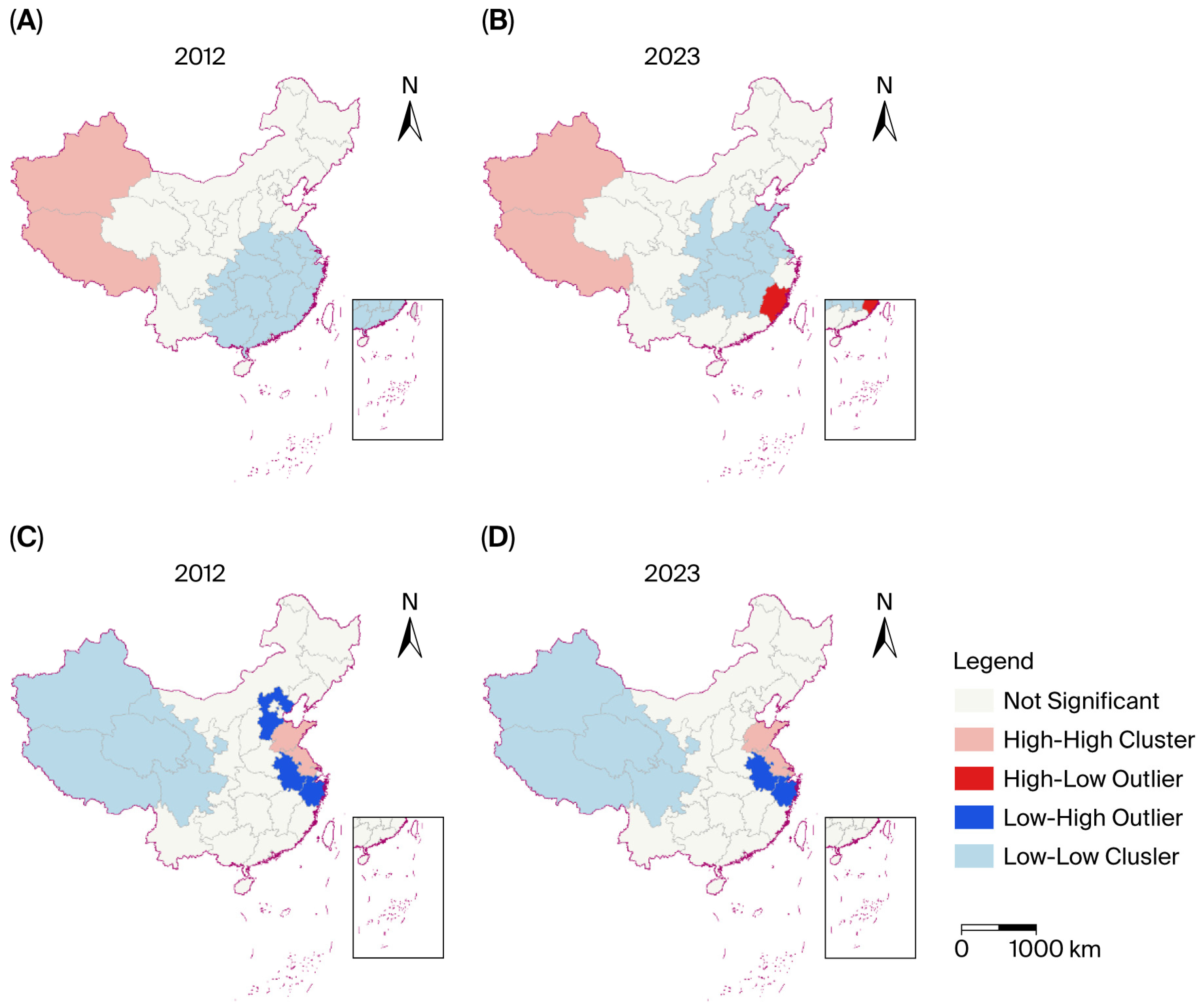
The local Moran’s I was used to analyze the degree of correlation between resource allocation locally in a region and its neighbors. A Local Indicators of Spatial Association (LISA) cluster map of spatial association was used to visualize the agglomeration effect. The analysis of local Moran’s I revealed four significant differences and one insignificant difference. The four significant differences were “high–high”, “high–low”, “low–high” and “low–low” distributions. The “high–high” and “low–low” types represent high/low levels of aggregation of a specific resource in a specific region and the high/low level of resource aggregation in the surrounding region. The “high–low” and “low–high” types represent high/low levels of resource aggregation in a certain region but low/high levels of resource aggregation in the surrounding areas. A statistically non-significant type indicates that the level of resources in a certain region lacks significant correlation with the degree of resource aggregation in the surrounding region, indicating stochastic distribution [
22].
The computation of both the global and local Moran’s I statistics relies on a first-order spatial weight matrix constructed under the Queen contiguity criterion. Under this rule, wij = 1 if provinces i and j share either a common boundary or a vertex; otherwise, wij = 0. To address the topological isolation of Hainan Province, an island jurisdiction, its adjacency was explicitly assigned to Guangdong Province based on geographical proximity, consistent with established practices in spatial econometrics for handling non-contiguous units. Subsequently, the weight matrix underwent row-standardization to ensure that the sum of weights for each province’s spatial neighbors equals unity, thereby mitigating potential bias arising from heterogeneous neighborhood sizes or boundary-length variation. Statistical significance was assessed via 999 Monte Carlo random permutations, yielding empirical p-values for hypothesis testing.
2.6. Geographic Detector
A geographic detector (geodetector) is a tool that utilizes the theory of spatial differentiation to assess the relationship between independent and dependent variables. It analyzes various types of variables on the same spatial scale and can identify the spatial heterogeneity of individual variables [
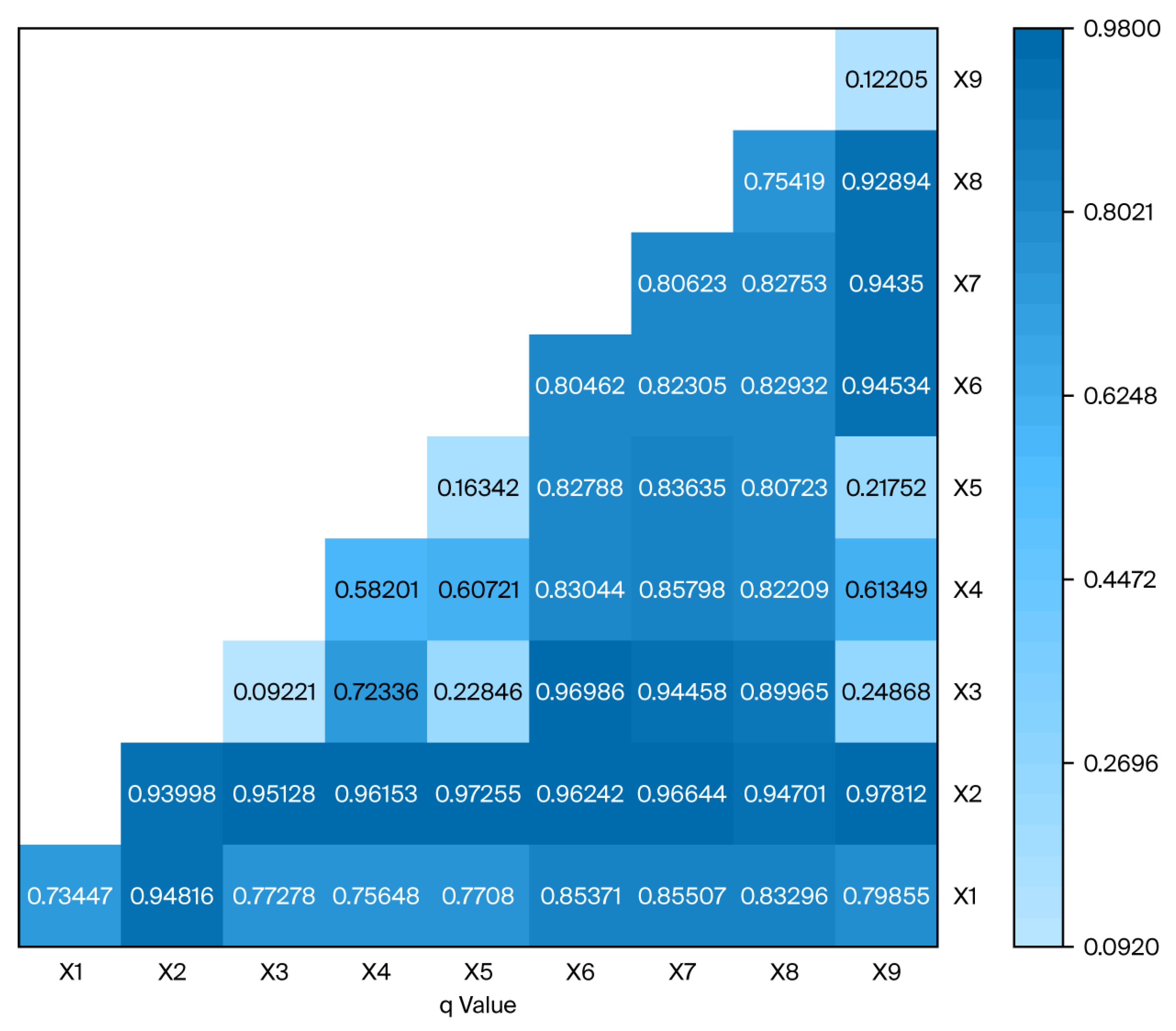
23]. Moreover, interaction detection enables the evaluation of whether the joint explanatory power of any two factors, regarding the spatial heterogeneity of the dependent variable, exceeds the sum of their individual contributions, thereby revealing potential synergistic or antagonistic interactions among the factors. Other commonly used methods, such as logistic regression models, have more restrictions on data distribution and data size than geographic detectors. The geographic detector model is not limited by assumptions of linearity, which means that collinearity among independent variables does not impact the interpretation of the final results. In this study, the relationship between various factors and the distribution of HPs was determined based on factor and interactive detection. Factor detection can be used to detect the extent to which factor X contributes to the spatial differentiation of HP allocation in the CDC. Interactive detection can reveal the relationship between different factors; in particular, to determine whether the combination of factors x1 and x2 increases or decreases the explanatory power of dependent variable Y or whether the effects of these factors on Y are independent of each other. Geographic detectors can be used to measure the explanatory power of independent variables relative to dependent variables with the q value, which ranges from 0 to 1. The larger the value, the stronger the explanatory power of X relative to Y. In this study, the continuous variables x1 through x9 were discretized into four ordinal categories using the K-means clustering algorithm. This unsupervised partitioning approach leverages iterative centroid optimization to group observations with similar values, thereby preserving the underlying distributional characteristics of each variable. All q-statistics reported in the primary analysis were computed based on this consistent discretization framework.
2.7. Data Analysis
SPSS 26.0 was used to analyze the HP distribution in mainland China. The Gini coefficient was calculated using Stata16.0. The spatial autocorrelation analysis was conducted and validated using ArcGis 10.8. Geographical detector analysis was performed using the GeoDetector software package, developed by the research team led by Professor Wang Jinfeng at the Institute of Geographic Sciences and Natural Resources Research, Chinese Academy of Sciences (
http://www.geodetector.cn/, accessed on 3 December 2025). The tool is implemented as an Excel add-in.
p < 0.05 is generally interpreted as indicating statistical significance.
4. Discussion
Firstly, the Gini coefficient based on the population dimension and geographical area indicated different allocation of HPs among CDC sites in China. The distribution based on population was relatively equitable, whereas the geographical distribution showed significant disparity across different regions. This finding is consistent with the results of other studies on the health workforce; for example, Lingying Wang et al. [
24] applied the Gini coefficient and Theil index to evaluate the equity of healthcare technician and nurse allocation between Chinese hospitals and primary healthcare facilities, and concluded that population-based allocation was equitable while geographical area-based allocation showed relative inequity. This difference may be related to the long-term allocation strategy of health resources based on the population in China [
25]. Areas with better economic conditions tend to have larger population density; therefore, the number of HPs allocated by population is lower. In contrast, larger regions tend to be sparsely populated, with a lower number of HPs based on geographical area. Thus, provinces with relative equity by population allocation have low equity based on area allocation. Similar studies were almost unanimous in reporting that the distribution of HPs, including physicians, nurses and pharmacists, was strongly unequal based on geographical area compared to population [
24,
26,
27]. For example, Ola Al Eker and Asma Imam [
27] used the Gini coefficient to assess the equity of resource distribution between hospitals and primary healthcare centers in the West Bank region of Palestine. They found that equity based on population was significantly higher than that based on geographical area. These studies indicated that the uneven geographical distribution of health professionals may be a widespread phenomenon globally.
Based on the spatial analysis of the HP distribution among CDC sites in 2023, four typical regional patterns can be identified. The number of HPs per thousand people and per square kilometer is below the national average (Shanxi, Guangdong, Chongqing, etc.), representing a dual challenge that can be characterized as a “dual-deficit” type, which is the most prevalent category. The second category is characterized by insufficient geographical coverage (e.g., Xinjiang, Xizang and Inner Mongolia). The third category exhibits insufficient population coverage (e.g., Shanghai, Tianjin and Jiangsu). The final category, referred to as the “dual equilibrium type” is defined by values above the national average for both the number of HPs per thousand people and per square kilometer (e.g., Beijing and Fujian). This pattern clearly reflects the practical challenges associated with the distribution of HPs in achieving efficient population service delivery and equitable geographical distribution.
Secondly, the results of spatial correlation analysis showed an obvious spatial aggregation in the distribution of CDC HPs in China. From 2012 to 2023, the spatial aggregation of HPs by population distribution gradually weakened (global Moran’s I index from 0.503 to 0.238). This development partially reflects the positive outcomes of population-centered health policies. In contrast, spatial clustering based on geographical distribution exhibited a slight increase, albeit remaining low overall (global Moran’s I ranging from 0.137 to 0.151), suggesting that HPs have remained broadly dispersed across regions without forming prominent high-density clusters. The marginal rise in geographic clustering further implies a potential entrenchment of regional imbalances. This divergence underscores a critical challenge: despite improvements in population-proportional equity, remote and sparsely populated areas continue to face significant gaps in the geographical accessibility of health workforce resources.
The local Moran’s I index further elucidates the spatial pattern characteristics of the distribution of HPs across China. Geographically, high–high clustering is consistently observed in eastern provinces such as Shandong and Jiangsu, whereas low–low clustering persists in northwestern and southwestern regions, including Xinjiang, Tibet and Qinghai. This spatial distribution is closely associated with regional economic development levels. This finding regarding the distribution of the health workforce and economic level is consistent with the results reported by McDonald et al. in an Australian study [
28]. It is important to emphasize that the observed spatial clustering of HPs and its association with regional economic development levels, as identified in this study, do not imply a unidirectional causal effect of economic factors on health workforce distribution. A potential reverse causal relationship cannot be ruled out. Simultaneously, the use of provincially aggregated data may introduce omitted variable bias, particularly with respect to relevant policy covariates, and is subject to inherent limitations associated with ecological inference. Consequently, the observed spatial concordance between economic indicators and human resource distribution reflects a statistical association only. The directionality, magnitude, and underlying mechanisms of any potential causal relationship require rigorous investigation through longitudinal, multilevel, or quasi-experimental designs. On one hand, the eastern region benefits from robust economic capacity, advanced urbanization, and substantial public health investment, resulting in a high density of the health workforce per unit area. On the other hand, the western region is characterized by vast territorial expanse, complex topography, and dispersed population settlements, which pose significant challenges to the spatial coverage of health resources. The persistent “low–low” spatial clustering observed in western China may also reflect the adverse impact of health workforce outmigration, driven primarily by disparities in material and socioeconomic conditions. Kuhlmann et al. [
29] identified salary disparities and limited career advancement opportunities as the primary determinants of health workforce migration in their systematic analysis of global health labor mobility. Low-income countries frequently experience a paradoxical surplus: although they train substantial numbers of health professionals, retention remains critically low due to large-scale emigration to high-income countries. In China, the western regions face a relative shortage of health technicians, which can be attributed in part to substantial disparities in salary levels, career advancement prospects, and welfare benefits compared with the eastern regions. Despite potentially favorable per capita ratios of HPs, geographical accessibility consequently remains limited. It is critical to emphasize that while the local Moran’s I statistic identifies spatial heterogeneity, it does not serve as a direct indicator of service adequacy or quality.
Thirdly, based on the results of GDM in this study, factors such as population structure, population health level, economic development, and healthcare expenditures had a partial effect on geographical distribution of HPs in CDC sites. The urbanization rate, the proportion of the population with a college education or above, life expectancy, per capita GDP, per capita disposable income and residents’ healthcare expenditure were confirmed to have a substantial influence on the distribution of HPs. The findings are consistent with serval studies. Qian Bai et al., applying a spatial Durbin panel model, confirmed that the urbanization rate and government health expenditure exert a significant positive impact on local nurse allocation [
30]. Similarly, Yingying Yu et al. found that demographic structure (e.g., urbanization rate and proportion of elderly population) and health indicators (e.g., incidence of infectious diseases) significantly affect the distribution of CDC resources [
31]. Employing dynamic convergence and fixed-effects models, Afei Qin et al. demonstrated that per capita GDP growth has a significant nonlinear effect on the regional convergence speed of physician distribution [
32]. Similar to the spatial clustering analysis, the correlation identified herein reflects an associative relationship. The geographical detector method detects spatial associations rather than establishing causal relationships.
Finally, the pairwise interaction generated a stronger explanatory power than the single factor for HP allocation. Among the various pairwise interactions, the proportion of the population with a college education or above and the proportion of older population—two key regional demographic characteristics—exhibit pronounced interaction effects when combined with other factors, particularly economic indicators, thereby substantially enhancing the explanatory power of individual variables. The most significant interaction was observed between the proportion of the population with a college education or above and health expenditure as a percentage of GDP (q = 0.9781), suggesting that the synergy between higher educational attainment and robust health investment can be more effectively translated into improved efficiency in health human resource allocation. Furthermore, the interaction between the older population ratio and per capita GDP demonstrates a markedly increased explanatory capacity (q = 0.9699), indicating that in regions with advanced population aging, a higher level of economic development can mitigate the adverse impacts of demographic aging on the distribution of HPs, with economic strength serving as a critical enabler in addressing structural population challenges. Although this study demonstrates that macroeconomic indicators—such as per capita GDP and per capita disposable income—exert a positive influence on the geographic allocation of health professionals, these aggregate measures fail to capture micro-level dynamics, including individual retention intentions and attrition risks. Notably, even in economically disadvantaged provinces where the population-adjusted distribution ratio of health professionals appears adequate, persistent out-migration may result in acute shortages of actively deployed personnel. Future research should consequently integrate granular, primary survey data to rigorously quantify how compensation levels, benefit packages, and career advancement opportunities shape the retention intentions of public health professionals—particularly those working in disease prevention and control institutions.
These findings collectively underscore that the geographical distribution of HPs is shaped by the interplay of multiple determinants, including demographic composition, educational advancement, economic conditions, and health policy investments. Therefore, future strategies for optimizing human resource allocation in public health should emphasize the synergistic effects of integrated policy interventions. Specifically, comprehensive approaches involving the enhancement of educational standards, strengthening of economic foundations and strategic optimization of health investment structures are essential to systematically promoting equitable spatial distribution of the health workforce. Based on the findings and implications of this study, we propose the following evidence-informed policy recommendations. First, within the framework of the 15th Five-Year Plan, priority should be accorded to designing and implementing targeted recruitment and retention incentive mechanisms specifically for public health professionals in underserved regions. Second, the statistically significant interaction between educational attainment and health expenditure indicates that unilateral increases in health investment yield diminishing returns; rather, such investment must be strategically coupled with enhancements in local medical education capacity and sustained talent development initiatives. Third, the robust interaction between population aging ratio and per capita GDP underscores that economic development serves as a critical mitigating factor against demographic pressures in rapidly aging areas. Consequently, human resource planning and allocation models should integrate both aging indicators and per capita GDP as co-determinants replacing rigid, uniform staffing standards with context-sensitive, dynamic calibration approaches. Fourth, the pronounced interdependence among education level, economic conditions, and health system performance necessitates institutionalized cross-sectoral coordination. Specifically, ministries responsible for education, economic development, and health must jointly formulate integrated human resource planning objectives, moving beyond siloed policymaking toward coherent, system-wide governance.
The study has some limitations. First, we only assessed the equity and spatial pattern of HPs, while other types of health human resources may present different characteristics that require further analysis. The Gini coefficient is also limited in its ability to capture nuances in the allocation of health resources. Second, only the resident population was used to assess the equity of population distribution, which may not reflect the real-life data due to migration or local policy interventions. Thirdly, due to the limited data available, we only discussed the distribution of HPs in CDC sites at the provincial level. The distribution of HPs at the municipal and district levels needs further analysis. Fourth, Descriptive analysis encompasses the full panel dataset spanning 2012–2023, whereas the geographical detector-based factor analysis is conducted exclusively on the 2020 cross-sectional data. Consequently, the identified explanatory factors capture spatial associations specific to 2020 and do not generalize across the entire study period. Finally, several indicators reported in the statistical yearbooks are derived from sample surveys rather than full censuses. Publicly available data also suffer from temporal lags and insufficient spatial granularity—limitations that may obscure sub-provincial or sub-institutional variations in the distribution of health workforce personnel. The yearbook data employed in this study capture only the headcount of on-duty personnel and do not differentiate between permanent and non-permanent staff, nor do they support the tracking of interprovincial or interinstitutional mobility pathways. Consequently, the present analysis may have some potential biases, such as those associated with the process of data collection, the diversity issues of data and the limited level of data available. Future research could advance understanding in this field based on the incorporation of additional factors covering a more precise area, using more advanced and reasonable methods, and the integration of complementary data sources.