Heterogeneity in Dyadic Coping Among Infertile Couples and Its Association with Depression and Fertility Quality of Life: A Latent Profile Analysis
 ,
,
Highlights
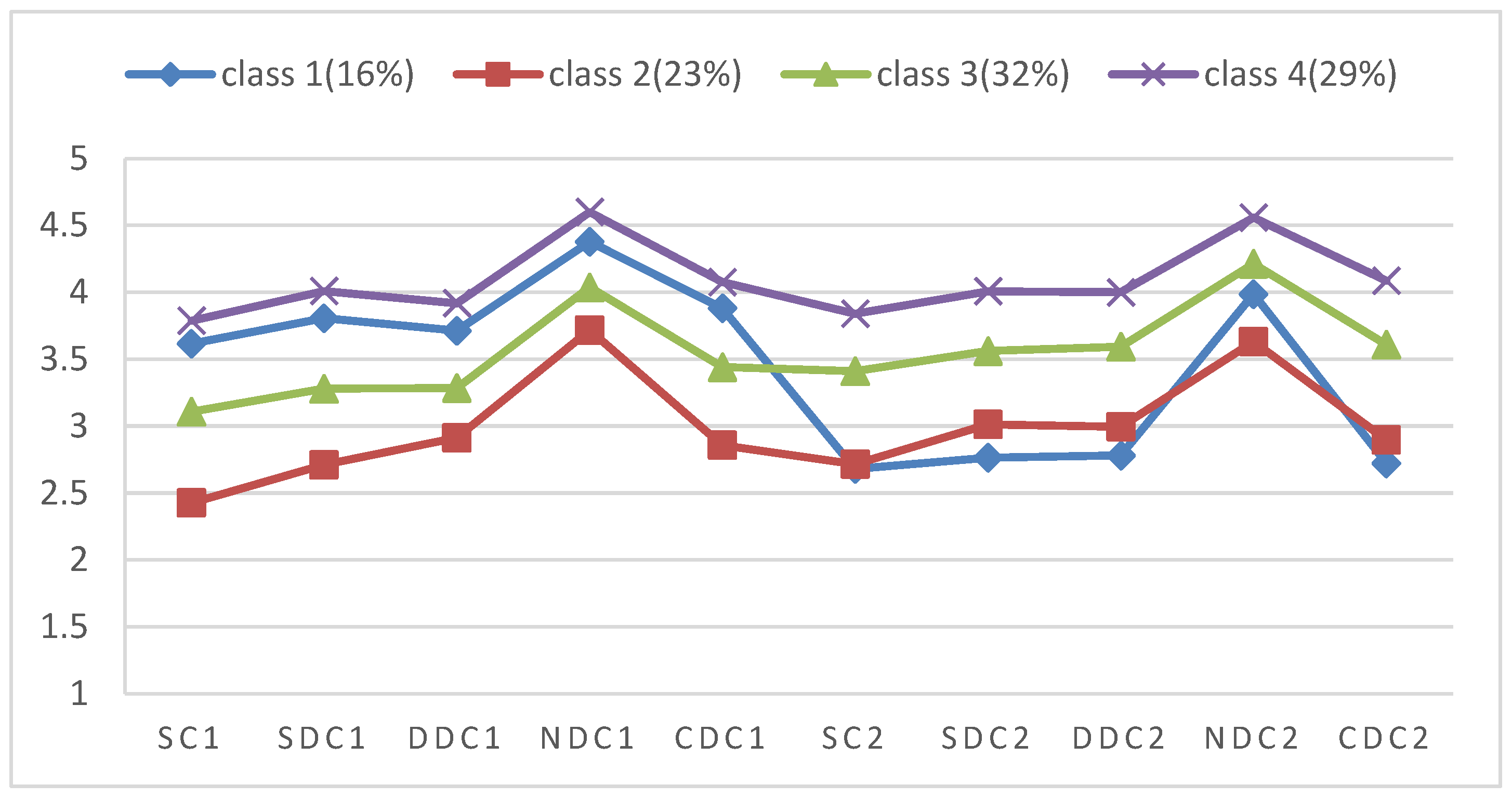
- Four distinct dyadic coping profiles were identified among infertile couples undergoing assisted reproductive technologies.
- Several sociodemographic and clinical characteristics were significant predictors of profile membership.
- Both low and asymmetric dyadic coping profiles were associated with increased depressive symptoms and poorer fertility quality of life, with gender-specific vulnerability.
- These predictors may help identify couples who could benefit from further assessment of their coping patterns.
- Dyadic coping may serve as a protective resource for infertile couples to improve their psychological well-being and quality of life.
- The findings provide evidence to support couple-centered assessment and tailored psychosocial interventions in fertility care practices.
Abstract
1. Introduction
2. Materials and Methods
2.1. Study Setting and Participants
2.2. Measures
2.2.1. Sociodemographic and Clinical Characteristics
2.2.2. The Chinese Version of the Dyadic Coping Inventory (C-DCI)
2.2.3. Patient Health Questionnaire-9 (PHQ-9)
2.2.4. The Fertility Quality of Life Tool (FertiQoL)
2.3. Ethical Considerations and Procedures
2.4. Statistical Analysis
3. Results
3.1. Participant Characteristics
3.2. Depression, Dyadic Coping and Fertility Quality of Life Scores Between Infertile Couples
3.3. Latent Profiles for Dyadic Coping
3.4. Multinomial Logistic Regression Analyses of Factors Affecting the Potential Categories of Dyadic Coping in Infertile Couples Undergoing ART
3.5. Comparisons of Depression and Fertility Quality of Life Among Subgroups
4. Discussion
4.1. Dyadic Coping Heterogeneity in Infertile Couples
4.2. Dyadic Coping Profiles, Depression, and Fertility Quality of Life
4.3. Predictors of Dyadic Coping Profile Membership
4.4. Clinical Implications and Study Limitations
5. Conclusions
Supplementary Materials
Author Contributions
Funding
Institutional Review Board Statement
Informed Consent Statement
Data Availability Statement
Acknowledgments
Conflicts of Interest
References
- World Health Organization. Infertility Prevalence Estimates, 1990–2021; World Health Organization: Geneva, Switzerland, 2023. [Google Scholar]
- Listorti, E.; Torbica, A.; Esposito, G.; Franchi, M.; Parazzini, F. Determinants of the economic burden of ART on the Italian NHS: Insights from the Lombardy region. Health Econ. Rev. 2024, 14, 107. [Google Scholar] [CrossRef]
- Wang, Y.; Fu, Y.; Ghazi, P.; Gao, Q.; Tian, T.; Kong, F.; Zhan, S.; Liu, C.; Bloom, D.E.; Qiao, J. Prevalence of intimate partner violence against infertile women in low-income and middle-income countries: A systematic review and meta-analysis. Lancet Glob. Health 2022, 10, E820–E830. [Google Scholar] [CrossRef]
- Adamson, G.D.; Dyer, S.; Zegers-Hochschild, F.; Chambers, G.; De Mouzon, J.; Ishihara, O.; Kupka, M.; Baker, V.; Banker, M.; Elgindy, E.; et al. ICMART Preliminary World Report 2020. Hum. Reprod. 2024, 39, i67–i68. [Google Scholar] [CrossRef]
- Jiang, L.; Zeng, T.; Wu, M.; Yang, L.; Zhao, M.; Yuan, M.; Zhu, Z.; Lang, X. Infertility psychological distress in women undergoing assisted reproductive treatment: A grounded theory study. J. Clin. Nurs. 2024, 33, 3642–3658. [Google Scholar] [CrossRef] [PubMed]
- Sousa, E.; Nery, S.F.; Casalechi, M.; Thimoteo, L.C.; Paiva, S.P.C.; Silva-Filho, A.L.; Reis, F.M. Characteristics, prevalence and sources of stress in individuals who discontinue assisted reproductive technology treatments: A systematic review [Review]. Reprod. Biomed. Online 2023, 46, 819–825. [Google Scholar] [CrossRef]
- Braverman, A.M.; Davoudian, T.; Levin, I.K.; Bocage, A.; Wodoslawsky, S. Depression, anxiety, quality of life and infertility: A global lens on the last decade of research. Fertil. Steril. 2024, 121, 379–383. [Google Scholar] [CrossRef]
- Yamanaka-Altenstein, M.; Rauch-Anderegg, V.; Heinrichs, N. The link between infertility-related distress and psychological distress in couples awaiting fertility treatment: A dyadic approach. Hum. Fertil. 2022, 25, 924–938. [Google Scholar] [CrossRef] [PubMed]
- Song, X.R.; Zhao, J.; Xiao, Z.N.; Ye, H.H.; Dong, S.S.; Hu, L.L.; Cai, Z.X. The actor-partner interdependence model of fertility stress and marital quality among couples undergoing in vitro fertilization and embryo transfer: The mediating role of dyadic coping. Stress Health 2024, 6, e3483. [Google Scholar] [CrossRef] [PubMed]
- Peloquin, K.; Arpin, V.; Jacmin-Park, S.; Beaulieu, N.; Brassard, A. A Dyadic Study of Attachment, Coping, and Quality of Life in Couples Seeking Fertility Treatment. J. Sex Marital Ther. 2024, 50, 659–674. [Google Scholar] [CrossRef]
- Appleyard, C.B.; Flores, I.; Torres-Reverón, A. The Link Between Stress and Endometriosis: From Animal Models to the Clinical Scenario. Reprod. Sci. 2020, 27, 1675–1686. [Google Scholar] [CrossRef]
- Collura, B.; Hayward, B.; Modrzejewski, K.A.; Mottla, G.L.; Richter, K.S.; Catherino, A.B. Identifying Factors Associated with Discontinuation of Infertility Treatment Prior to Achieving Pregnancy: Results of a Nationwide Survey. J. Patient Exp. 2024, 11, 23743735241229380. [Google Scholar] [CrossRef] [PubMed]
- Purewal, S.; Chapman, S.C.E.; van den Akker, O.B.A. Depression and state anxiety scores during assisted reproductive treatment are associated with outcome: A meta-analysis. Reprod. Biomed. Online 2018, 36, 646–657. [Google Scholar] [CrossRef]
- Bodenmann, G. A systemic-transactional model of coping with stress in couples. Swiss J. Psychol. 1995, 54, 34–49. [Google Scholar]
- Falconier, M.K.; Jackson, J.B.; Hilpert, P.; Bodenmann, G. Dyadic coping and relationship satisfaction: A meta-analysis. Clin. Psychol. Rev. 2015, 42, 28–46. [Google Scholar] [CrossRef]
- Santamaría-Gutiez, R.; Martínez-Corredor, S.; González-Sala, F.; Lacomba-Trejo, L. Relevance of Positive Dyadic Coping for Couples Undergoing Assisted Reproduction Treatments: A Systematic Review. J. Marital Fam. Ther. 2025, 51, e70016. [Google Scholar] [CrossRef]
- Wang, X.; Zang, L.; Hui, X.; Meng, X.; Qiao, S.; Fan, L.; Meng, Q. Dyadic interventions for cancer patient-caregiver dyads: A systematic review and network meta-analysis. Int. J. Nurs. Stud. 2025, 161, 104948. [Google Scholar] [CrossRef]
- Moutzouri, M.; Sarantaki, A.; Koulierakis, G.; Gourounti, K. Coping Strategies Associated with Emotional Adjustment during the Dyadic Experience of Infertility and Its Treatment: A Systematic Review. J. Mother Child 2024, 28, 61–69. [Google Scholar]
- Peterson, B.D.; Newton, C.R.; Rosen, K.H.; Skaggs, G.E. Gender differences in how men and women who are referred for IVF cope with infertility stress. Hum. Reprod. 2006, 21, 2443–2449. [Google Scholar] [CrossRef]
- Morin, A.J.S.; Bujacz, A.; Gagné, M. Person-Centered Methodologies in the Organizational Sciences. Organ. Res. Methods 2018, 21, 803–813. [Google Scholar] [CrossRef]
- Meyer, J.P.; Morin, A.J.S. A person-centered approach to commitment research: Theory, research, and methodology. J. Organ. Behav. 2016, 37, 584–612. [Google Scholar] [CrossRef]
- Cai, T.; Qian, J.; Huang, Q.; Yuan, C. Distinct dyadic coping profiles in Chinese couples with breast cancer. Support. Care Cancer 2021, 29, 6459–6468. [Google Scholar] [CrossRef]
- Zhang, P.; Li, T.; Mei, Y.; Zhang, Z. Status Quo and Influencing Factors of Dyadic Coping in Stroke Patients and Spouses Based on Latent Profile Analysis. Mil. Nurs. 2024, 41, 87–91. [Google Scholar] [CrossRef]
- Reisi, M.; Kazemi, A.; Maleki, S.; Sohrabi, Z. Relationships between couple collaboration, well-being, and psychological health of infertile couples undergoing assisted reproductive treatment. Reprod. Health 2024, 21, 119. [Google Scholar] [CrossRef]
- Yang, C.C. Evaluating latent class analysis models in qualitative phenotype identification. Comput. Stat. Data Anal. 2006, 50, 1090–1104. [Google Scholar] [CrossRef]
- Li, Z.; Liu, Y. Nursing Research Methods; People’s Health Press: Beijing, China, 2018. [Google Scholar]
- Gmelch, S.; Bodenmann, G.; Meuwly, N.; Ledermann, T.; Steffen-Sozinova, O.; Striegl, K. Dyadic Coping Inventory (DCI): A questionnaire assessing dyadic coping in couples. Z. Fam.-J. Fam. Res. 2008, 20, 185–202. [Google Scholar] [CrossRef]
- Xu, F.; Hilpert, P.; Randall, A.K.; Li, Q.P.; Bodenmann, G. Validation of the Dyadic Coping Inventory with Chinese couples: Factorial structure, measurement invariance, and construct validity. Psychol. Assess. 2016, 8, 127–140. [Google Scholar] [CrossRef]
- Kroenke, K.; Spitzer, R.L.; Williams, J.B. The PHQ-9: Validity of a brief depression severity measure. J. Gen. Intern. Med. 2001, 16, 606–613. [Google Scholar] [CrossRef]
- Wang, W.; Bian, Q.; Zhao, Y.; Li, X.; Wang, W.; Du, J.; Zhang, G.; Zhou, Q.; Zhao, M. Reliability and validity of the Chinese version of the Patient Health Questionnaire (PHQ-9) in the general population. Gen. Hosp. Psychiatry 2014, 36, 539–544. [Google Scholar] [CrossRef] [PubMed]
- Boivin, J.; Takefman, J.; Braverman, A. The fertility quality of life (FertiQoL) tool: Development and general psychometric properties. Hum. Reprod. 2011, 26, 2084–2091. [Google Scholar] [CrossRef]
- Yang, X.P. A Validity and Reliability Study of the Fertility Quality of Life (FertiQoL) Tool in Chinese People; Southern Medical University: Guangzhou, China, 2016. [Google Scholar]
- Tang, D.D.; Wen, Z.L. Statistical Approaches for Testing Common Method Bias: Problems and Suggestions. J. Psychol. Sci. 2020, 43, 215–223. [Google Scholar] [CrossRef]
- Spurk, D.; Hirschi, A.; Wang, M.; Valero, D.; Kauffeld, S. Latent profile analysis: A review and “how to” guide of its application within vocational behavior research. J. Vocat. Behav. 2020, 120, 103445. [Google Scholar] [CrossRef]
- Nylund, K.L.; Asparoutiov, T.; Muthen, B.O. Deciding on the number of classes in latent class analysis and growth mixture modeling:A Monte Carlo simulation study. Struct. Equ. Model. Multidiscip. J. 2007, 14, 535–569. [Google Scholar] [CrossRef]
- Nagin, D.S. Group-Based Modeling of Development; Harvard University Press: Cambridge, MA, USA, 2005. [Google Scholar]
- Bolck, A.; Croon, M.; Hagenaars, J. Estimating latent structure models with categorical variables: One-step versus three-step estimators. Political Anal. 2004, 12, 3–27. [Google Scholar] [CrossRef]
- Ying, L.; Wu, L.H.; Loke, A.Y. Gender differences in emotional reactions to in vitro fertilization treatment: A systematic review. J. Assist. Reprod. Genet. 2016, 33, 167–179. [Google Scholar] [CrossRef] [PubMed]
- Peterson, B.D.; Newton, C.R.; Rosen, K.H. Examining congruence between partners’ perceived infertility-related stress and its relationship to marital adjustment and depression in infertile couples. Fam. Process 2003, 42, 59–70. [Google Scholar] [CrossRef]
- Benyamini, Y.; Gozlan, M.; Kokia, E. Women’s and men’s perceptions of infertility and their associations with psychological adjustment: A dyadic approach. Br. J. Health Psychol. 2009, 14, 1–16. [Google Scholar] [CrossRef]
- Tang, N.; Pei, M.; Liu, H.; Chen, J.; Wang, Y.; Xie, L.; Hu, J.; Wang, J.; Gao, Y. Infertility-Related Stress, and Dyadic Coping as Predictors of Quality of Life: Gender Differences Among Couples with Infertility Issues. Int. J. Womens Health 2024, 16, 1265–1276. [Google Scholar] [CrossRef]
- Pasch, L.A.; Sullivan, K.T. Stress and coping in couples facing infertility. Curr. Opin. Psychol. 2017, 13, 131–135. [Google Scholar] [CrossRef] [PubMed]
- Salarfard, M.; Mahmoudinia, M.; Rahimi, M.; Roudsari, R.L. A systematic review of counselling approaches and their impact on marital intimacy among women and couples experiencing infertility. BMC Psychol. 2025, 13, 1089. [Google Scholar] [CrossRef] [PubMed]
- Zurlo, M.C.; Della Volta, M.F.C.; Vallone, F. Predictors of quality of life and psychological health in infertile couples: The moderating role of duration of infertility. Qual. Life Res. 2018, 27, 945–954. [Google Scholar] [CrossRef]
- Moura-Ramos, M.; Gameiro, S.; Canavarro, M.C.; Soares, I.; Almeida-Santos, T. Does infertility history affect the emotional adjustment of couples undergoing assisted reproduction? The mediating role of the importance of parenthood. Br. J. Health Psychol. 2016, 21, 302–317. [Google Scholar] [CrossRef]
- Dolezel, D.; Hewitt, B. Social determinants of health literacy: A cross-sectional exploratory study. Health Promot. Int. 2023, 38, daad127. [Google Scholar] [CrossRef]
- McQuillan, J.; Greil, A.L.; Rybinska, A.; Tiemeyer, S.; Shreffler, K.M.; Colaner, C.W. Is a dyadic stressor experienced as equally distressing by both partners? The case of perceived fertility problems. J. Soc. Pers. Relatsh. 2021, 38, 342–362. [Google Scholar] [CrossRef] [PubMed]
- Zhao, C.X.; Lu, M.T.; Zhong, X.P.; Chen, J.W.; Chen, L.P. Coping strategies and influencing factors among infertile patients: A qualitative meta-synthesis. BMC Public Health 2025, 25, 3144. [Google Scholar] [CrossRef] [PubMed]
- Poulter, M.M.L.; Wahl, T.D.; Kiviharju, M.J.; Campbell, T.S.; Gordon, J.L. Testing the efficacy of a self-guided psychotherapy intervention for infertility-related distress: A randomized controlled trial. Hum. Reprod. 2026, 41, 246–261. [Google Scholar] [CrossRef] [PubMed]
- Hilpert, P.; Randall, A.K.; Sorokowski, P.; Atkins, D.C.; Sorokowska, A.; Ahmadi, K.; Aghraibeh, A.M.; Aryeetey, R.; Bertoni, A.; Bettache, K.; et al. The Associations of Dyadic Coping and Relationship Satisfaction Vary between and within Nations: A 35-Nation Study. Front. Psychol. 2016, 7, 1106. [Google Scholar] [CrossRef]


| Item | Wife (n = 271) | Husband (n = 271) |
|---|---|---|
| Age (years) | 32.08 ± 4.71 (21–47) | 32.96 ± 4.54 (22–48) |
| Years of marriage | 5.71 ± 3.99 (1–23) | |
| Household registration | ||
| Urban | 77 (28.4) | 74 (27.3) |
| Rural | 194 (71.6) | 197 (72.7) |
| Education level | ||
| High school and below | 104 (38.4) | 126 (46.5) |
| College and above | 167 (61.6) | 145 (54.5) |
| Employment status | ||
| Full time | 117 (43.2) | 122 (45.0) |
| Part time | 154 (56.8) | 149 (55.0) |
| Monthly household income per capita | ||
| <3000 RMB | 61 (22.5) | |
| 3000–4999 RMB | 122 (45.0) | |
| ≥5000 RMB | 88 (32.5) | |
| Type of infertility | ||
| Primary | 128 (47.2) | |
| Secondary | 143 (52.8) | |
| Duration of infertility (years) | ||
| <3 | 158 (58.3) | |
| ≥3 | 113 (41.7) | |
| Causes of infertility | ||
| Female factors | 91 (33.6) | |
| Male factors | 52 (19.2) | |
| Both | 35 (12.9) | |
| Unclear | 93 (34.3) | |
| Current treatment regimen | ||
| AI | 47 (17.3) | |
| IVF-ET | 148 (54.6) | |
| ICSI | 50 (18.5) | |
| PGT | 26 (9.6) | |
| Treatment cycle | ||
| 1 | 178 (65.7) | |
| 2 or more | 93 (34.3) | |
| Wife Mean (SD) | Husband Mean (SD) | r | d | 95%CI | Z/t | p | ||
|---|---|---|---|---|---|---|---|---|
| Lower | Upper | |||||||
| Depression | 4.45 (4.18) | 4.51 (4.20) | 0.298 ** | - | - | - | −0.149 | 0.882 |
| DC | 112.38 (15.94) | 111.62 (16.63) | 0.421 ** | 0.76 (17.54) | −1.334 | 2.861 | 0.717 | 0.474 |
| FertiQoL | 66.83 (13.44) | 68.43 (13.38) | 0.414 ** | −1.60 (14.52) | −3.339 | 0.135 | −1.815 | 0.071 |
| Model | Class Sample Size | AIC | BIC | aBIC | Entropy | LMRT | BLRT | Proportion (%) |
|---|---|---|---|---|---|---|---|---|
| 1 | C1 = 271 | 5499.524 | 5571.567 | 5508.153 | - | - | - | - |
| 2 | C1 = 139 C2 = 132 | 4899.589 | 5011.255 | 4912.963 | 0.819 | 0.5093 | <0.001 | 0.51/0.49 |
| 3 | C1 = 107 C2 = 41 C3 = 123 | 4670.570 | 4821.859 | 4688.689 | 0.866 | 0.0128 | <0.001 | 0.40/0.15/0.45 |
| 4 | C1 = 42 C2 = 62 C3 = 88 C4 = 79 | 4510.089 | 4701.002 | 4532.955 | 0.869 | 0.0165 | <0.001 | 0.16/0.23/0.32/0.29 |
| 5 | C1 = 58 C2 = 9 C3 = 81 C4 = 54 C5 = 69 | 4420.440 | 4650.976 | 4448.051 | 0.882 | 0.3494 | <0.001 | 0.21/0.03/0.30/0.20/0.26 |
| Variables | Group | b | OR | 95% CI | p | |
|---|---|---|---|---|---|---|
| 1 vs. 4 | Household registration (wife) | Rural | 1.415 | 4.117 | 1.331–12.735 | 0.014 |
| Urban * | ||||||
| Household registration (husband) | Rural | −1.484 | 0.227 | 0.080–0.646 | 0.005 | |
| Urban * | ||||||
| Type of infertility | Primary | −1.048 | 0.350 | 0.146–0.844 | 0.019 | |
| Secondary * | ||||||
| 2 vs. 4 | Monthly household income per capita | <3000 RMB | 1.336 | 3.805 | 1.250–11.584 | 0.019 |
| 3000–4999 RMB | 0.926 | 2.524 | 1.041–6.120 | 0.041 | ||
| ≥5000 RMB * | ||||||
| Duration of infertility | <3 years | −1.094 | 0.335 | 0.159–0.704 | 0.004 | |
| ≥3 years * | ||||||
| 1 vs. 2 | Household registration (husband) | Rural | −1.090 | 0.336 | 0.116–0.975 | 0.045 |
| Urban * | ||||||
| Type of infertility | Primary | −1.279 | 0.278 | 0.110–0.703 | 0.007 | |
| Secondary * | ||||||
| 3 vs. 2 | Duration of infertility | <3 years | 0.748 | 2.112 | 1.053–4.234 | 0.035 |
| ≥3 years * |
| Profiles | n (%) | Wife | Husband | ||
|---|---|---|---|---|---|
| Depression | FertiQoL | Depression | FertiQoL | ||
| Class 1 | 42 (16%) | 3.48 ± 3.20 | 69.23 ± 12.38 | 6.10 ± 4.93 | 64.12 ± 10.67 |
| Class 2 | 62 (23%) | 6.63 ± 4.64 | 61.74 ± 12.08 | 5.39 ± 4.41 | 61.68 ± 14.54 |
| Class 3 | 88 (32%) | 4.88 ± 3.98 | 62.89 ± 13.58 | 4.53 ± 3.68 | 67.96 ± 11.45 |
| Class 4 | 79 (29%) | 2.80 ± 3.63 | 73.92 ± 11.53 | 2.94 ± 3.66 | 76.53 ± 11.63 |
| χ2 | 33.88 | 50.05 | 20.97 | 58.95 | |
| p | 0.000 | 0.000 | 0.000 | 0.000 | |
| Pairwise differences | Class 4 < 2 and 3; Class 2 > 1, 3 and 4; Class 3 > 1 | Class 4 > 1 > 3 = 2 | Class 4 < 1, 2 and 3; Class 1 > 3 and 4 | Class 4 >1, 2 and 3; Class 3 > 2 | |
Disclaimer/Publisher’s Note: The statements, opinions and data contained in all publications are solely those of the individual author(s) and contributor(s) and not of MDPI and/or the editor(s). MDPI and/or the editor(s) disclaim responsibility for any injury to people or property resulting from any ideas, methods, instructions or products referred to in the content. |
© 2026 by the authors. Licensee MDPI, Basel, Switzerland. This article is an open access article distributed under the terms and conditions of the Creative Commons Attribution (CC BY) license.
Share and Cite
Zhang, X.; Pei, Y.; Dou, S.; Zhang, C.; Duan, Y.; Gao, J. Heterogeneity in Dyadic Coping Among Infertile Couples and Its Association with Depression and Fertility Quality of Life: A Latent Profile Analysis. Healthcare 2026, 14, 1031. https://doi.org/10.3390/healthcare14081031
Zhang X, Pei Y, Dou S, Zhang C, Duan Y, Gao J. Heterogeneity in Dyadic Coping Among Infertile Couples and Its Association with Depression and Fertility Quality of Life: A Latent Profile Analysis. Healthcare. 2026; 14(8):1031. https://doi.org/10.3390/healthcare14081031
Chicago/Turabian StyleZhang, Xian, Yuetong Pei, Shanshan Dou, Chunhui Zhang, Yandan Duan, and Jinling Gao. 2026. "Heterogeneity in Dyadic Coping Among Infertile Couples and Its Association with Depression and Fertility Quality of Life: A Latent Profile Analysis" Healthcare 14, no. 8: 1031. https://doi.org/10.3390/healthcare14081031
APA StyleZhang, X., Pei, Y., Dou, S., Zhang, C., Duan, Y., & Gao, J. (2026). Heterogeneity in Dyadic Coping Among Infertile Couples and Its Association with Depression and Fertility Quality of Life: A Latent Profile Analysis. Healthcare, 14(8), 1031. https://doi.org/10.3390/healthcare14081031