Beyond Single-Platform Adoption: Unpacking Doctors’ Cross-Channel Behavioral Mechanisms in Omni-Channel Medical Practice

Highlights
- Doctors’ adoption of the OCOM service mode is mainly driven by effort expectancy, social influence, habit, and patient volume.
- Performance expectancy is no longer a significant factor in the pandemic context.
- Social platform use promotes doctors’ engagement with professional platforms.
- Platforms should prioritize ease of use and reduce operational complexity.
- Enhancing social influence and cross-platform integration can promote OCOM adoption.
Abstract
1. Introduction
2. Literature Review and Research Hypotheses
2.1. Omni-Channel Services
2.2. Service Adoption Models
3. Research Model and Hypotheses
3.1. UTAUT and the OCOM Service Mode Adoption
3.1.1. Performance Expectancy
3.1.2. Effort Expectancy
3.1.3. Social Influence
3.1.4. Habit
3.2. Platform Experience and the OCOM Service Mode Adoption
3.3. Future Expectancy and the OCOM Service Mode Adoption
3.4. Patient Volume and the OCOM Service Mode Adoption
3.5. Adoption Intention and the Adoption Behavior of the OCOM Service Mode
3.6. Interaction Effects Among Different Channels Use
3.7. Moderating Analysis
4. Research Methodology
4.1. Data Collection and Sample
4.2. Data Analysis
4.3. Model Specification
4.3.1. Measurement Model
4.3.2. Structural Model
4.3.3. Estimation Strategy
5. Results
5.1. Measurement Model Assessment
5.2. Structural Model Assessment
5.3. Multi-Group Analysis
5.4. Impact of the Pandemic
6. Discussion and Implications
7. Conclusions
Author Contributions
Funding
Institutional Review Board Statement
Informed Consent Statement
Data Availability Statement
Conflicts of Interest
Abbreviations
| OCOM | Omni-Channel Online Medical |
| UTAUT | Unified Theory of Acceptance and Use of Technology |
| TRA | Theory of Reasoned Action |
| TPB | Theory of Planned Behavior |
| TAM | Technology Acceptance Model |
| AIP | Adoption Intention to Professional Platform |
| AIS | Adoption Intention to Social Platform |
| PEE | Performance Expectancy |
| EEC | Effort Expectancy |
| SI | Social Influence |
| PE | Platform Experience |
| FE | Future Expectancy |
| PV | Patient Volume |
| HAB | Habit |
References
- Shah, D.; Rani, S.; Shoukat, K.; Kalsoom, H.; Shoukat, M.U.; Almujibah, H.; Liao, S. Blockchain Factors in the Design of Smart-Media for E-Healthcare Management. Sensors 2024, 24, 6835. [Google Scholar] [CrossRef] [PubMed]
- Shoukat, K.; Jian, M.; Umar, M.; Kalsoom, H.; Sijjad, W.; Atta, S.H.; Ullah, A. Use of Digital Transformation and Artificial Intelligence Strategies for Pharmaceutical Industry in Pakistan: Applications and Challenges. Artif. Intell. Health 2023, 1, 32–41. [Google Scholar] [CrossRef]
- Shoukat, M.U.; Yan, L.; Zhang, J.; Cheng, Y.; Raza, M.U.; Niaz, A. Smart Home for Enhanced Healthcare: Exploring Human Machine Interface Oriented Digital Twin Model. Multimed. Tools Appl. 2024, 83, 31297–31315. [Google Scholar] [CrossRef]
- Çakıcı, Ö.E.; Mills, A.F. On the Role of Teletriage in Healthcare Demand Management. Manuf. Serv. Oper. Manag. 2021, 23, 1483–1504. [Google Scholar] [CrossRef]
- Shan, W.; Wang, J.; Shi, X.; David Evans, R. The Impact of Electronic Word-of-Mouth on Patients’ Choices in Online Health Communities: A Cross-Media Perspective. J. Bus. Res. 2024, 173, 114404. [Google Scholar] [CrossRef]
- Telemedicine Market Growth Analysis-Size and Forecast 2025–2029. Available online: https://www.technavio.com/report/telemedicine-market-industry-analysis (accessed on 17 March 2026).
- Li, H.; Zheng, S.; Li, D.; Jiang, D.; Liu, F.; Guo, W.; Zhao, Z.; Zhou, Y.; Liu, J.; Zhao, R. The Establishment and Practice of Pharmacy Care Service Based on Internet Social Media: Telemedicine in Response to the COVID-19 Pandemic. Front. Pharmacol. 2021, 12, 707442. [Google Scholar] [CrossRef] [PubMed]
- Yang, Y.; Guo, X.; Wu, T.; Vogel, D. The Effects of Social Media Use and Consumer Engagement on Physician Online Return: Evidence from Weibo. Internet Res. 2024, 34, 371–397. [Google Scholar] [CrossRef]
- Moreira, A.; Alves, C.; Machado, J.; Santos, M.F. An Overview of Omnichannel Interaction in Health Care Services. Mayo Clin. Proc. Digit. Health 2023, 1, 77–93. [Google Scholar] [CrossRef]
- Jiang, X.; Xie, H.; Tang, R.; Du, Y.; Li, T.; Gao, J.; Xu, X.; Jiang, S.; Zhao, T.; Zhao, W.; et al. Characteristics of Online Health Care Services From China’s Largest Online Medical Platform: Cross-Sectional Survey Study. J. Med. Internet Res. 2021, 23, e25817. [Google Scholar] [CrossRef]
- Moreira, A.; Duarte, J.; Santos, M.F. Case Study of Multichannel Interaction in Healthcare Services. Information 2023, 14, 37. [Google Scholar] [CrossRef]
- Moreira, A.; Santos, M.F. Multichannel Interaction for Healthcare Intelligent Decision Support. Procedia Comput. Sci. 2020, 170, 1053–1058. [Google Scholar] [CrossRef]
- Swan, E.L.; Dahl, A.J.; Peltier, J.W. Health-Care Marketing in an Omni-Channel Environment: Exploring Telemedicine and Other Digital Touchpoints. J. Res. Interact. Mark. 2019, 13, 602–618. [Google Scholar] [CrossRef]
- Antheunis, M.L.; Tates, K.; Nieboer, T.E. Patients’ and Health Professionals’ Use of Social Media in Health Care: Motives, Barriers and Expectations. Patient Educ. Couns. 2013, 92, 426–431. [Google Scholar] [CrossRef]
- Hazzam, J.; Lahrech, A. Health Care Professionals’ Social Media Behavior and the Underlying Factors of Social Media Adoption and Use: Quantitative Study. J. Med. Internet Res. 2018, 20, e12035. [Google Scholar] [CrossRef]
- Park, S.; Woo, K. Military Doctors’ and Nurses’ Perceptions of Telemedicine and the Factors Affecting Use Intention. Telemed. e-Health 2023, 29, 1412–1420. [Google Scholar] [CrossRef]
- Geng, S.; Liang, W.; Niu, B.; Liu, H. The Impact of Physicians’ Health Science Short Video Releasing Behaviour on Online Consultation Volume. In Proceedings of the WHICEB 2022: The 21st Wuhan International Conference on e-Business, Wuhan, China, 27–29 May 2022. [Google Scholar]
- Barua, Z.; Barua, A. Acceptance and Usage of mHealth Technologies amid COVID-19 Pandemic in a Developing Country: The UTAUT Combined with Situational Constraint and Health Consciousness. J. Enabling Technol. 2021, 15, 1–22. [Google Scholar] [CrossRef]
- Venkatesh, V.; Morris, M.G.; Davis, G.B.; Davis, F.D. User Acceptance of Information Technology: Toward A Unified View1. MIS Q. 2003, 27, 425–478. [Google Scholar] [CrossRef]
- Chen, C.-C.; Hsiao, K.-L.; Hsieh, C.-H. Understanding Usage Transfer Behavior of Two Way O2O Services. Comput. Hum. Behav. 2019, 100, 184–191. [Google Scholar] [CrossRef]
- Song, P.; Zhang, C.; Chen, W.; Huang, L. Understanding Usage-Transfer Behavior Between Nonsubstitutable Technologies: Evidence From Instant Messenger and Portal. IEEE Trans. Eng. Manag. 2009, 56, 412–424. [Google Scholar] [CrossRef]
- Cai, Y.-J.; Choi, T.-M. Omni-Channel Marketing Strategy in the Digital Platform Era. J. Bus. Res. 2023, 168, 114197. [Google Scholar] [CrossRef]
- Huang, N.; Yan, Z.; Yin, H. Effects of Online–Offline Service Integration on e-Healthcare Providers: A Quasi-Natural Experiment. Prod. Oper. Manag. 2021, 30, 2359–2378. [Google Scholar] [CrossRef]
- Douglass, R.B. Review of Belief, Attitude, Intention, and Behavior: An Introduction to Theory and Research. Philos. Rhetor. 1977, 10, 130–132. [Google Scholar]
- Kumar, S.; Gupta, K.; Kumar, A.; Singh, A.; Singh, R.K. Applying the Theory of Reasoned Action to Examine Consumers’ Attitude and Willingness to Purchase Organic Foods. Int. J. Consum. Stud. 2023, 47, 118–135. [Google Scholar] [CrossRef]
- Ajzen, I. The Theory of Planned Behavior. Organ. Behav. Hum. Decis. Process. 1991, 50, 179–211. [Google Scholar] [CrossRef]
- Ajzen, I. The Theory of Planned Behavior: Frequently Asked Questions. Hum. Behav. Emerg. Technol. 2020, 2, 314–324. [Google Scholar] [CrossRef]
- Davis, F.D. A Technology Acceptance Model for Empirically Testing New End-User Information Systems: Theory and Results. Ph. D. Thesis, Massachusetts Institute of Technology, Cambridge, MA, USA, 1986. [Google Scholar]
- Holden, R.J.; Karsh, B.-T. The Technology Acceptance Model: Its Past and Its Future in Health Care. J. Biomed. Inform. 2010, 43, 159–172. [Google Scholar] [CrossRef]
- Scherer, R.; Siddiq, F.; Tondeur, J. The Technology Acceptance Model (TAM): A Meta-Analytic Structural Equation Modeling Approach to Explaining Teachers’ Adoption of Digital Technology in Education. Comput. Educ. 2019, 128, 13–35. [Google Scholar] [CrossRef]
- Fan, W.; Liu, J.; Zhu, S.; Pardalos, P.M. Investigating the Impacting Factors for the Healthcare Professionals to Adopt Artificial Intelligence-Based Medical Diagnosis Support System (AIMDSS). Ann. Oper. Res. 2020, 294, 567–592. [Google Scholar] [CrossRef]
- Li, L.; Min, X.; Guo, J.; Wu, F. The Influence Mechanism Analysis on the Farmers’ Intention to Adopt Internet of Things Based on UTAUT-TOE Model. Sci. Rep. 2024, 14, 15016. [Google Scholar] [CrossRef]
- Goethals, F.; Ziegelmayer, J.L. The Greening of IT Use: The Impact of Environmental Concerns on the Use of Internet Systems. Inf. Technol. People 2024, 37, 356–373. [Google Scholar] [CrossRef]
- Ouédraogo, F.; Auger, L.-P.; Moreau, E.; Côté, O.; Guerrera, R.; Rochette, A.; Kairy, D. Acceptability of Telerehabilitation: Experiences and Perceptions by Individuals with Stroke and Caregivers in an Early Supported Discharge Program. Healthcare 2024, 12, 365. [Google Scholar] [CrossRef]
- Maity, M.; Bagchi, K.; Shah, A.; Misra, A. Explaining Normative Behavior in Information Technology Use. Inf. Technol. People 2019, 32, 94–117. [Google Scholar] [CrossRef]
- Duong, C.D.; Bui, D.T.; Pham, H.T.; Vu, A.T.; Nguyen, V.H. How Effort Expectancy and Performance Expectancy Interact to Trigger Higher Education Students’ Uses of ChatGPT for Learning. Interact. Technol. Smart Educ. 2024, 21, 356–380. [Google Scholar] [CrossRef]
- Zhang, T.; Tao, D.; Qu, X.; Zhang, X.; Zeng, J.; Zhu, H.; Zhu, H. Automated Vehicle Acceptance in China: Social Influence and Initial Trust Are Key Determinants. Transp. Res. Part C Emerg. Technol. 2020, 112, 220–233. [Google Scholar] [CrossRef]
- Li, Y.; Othman, M.K. Investigating the Behavioural Intentions of Museum Visitors towards VR: A Systematic Literature Review. Comput. Hum. Behav. 2024, 155, 108167. [Google Scholar] [CrossRef]
- Al-Saedi, K.; Al-Emran, M.; Ramayah, T.; Abusham, E. Developing a General Extended UTAUT Model for M-Payment Adoption. Technol. Soc. 2020, 62, 101293. [Google Scholar] [CrossRef]
- Hsieh, P.-J. An Empirical Investigation of Patients’ Acceptance and Resistance toward the Health Cloud: The Dual Factor Perspective. Comput. Hum. Behav. 2016, 63, 959–969. [Google Scholar] [CrossRef]
- Venkatesh, V.; Thong, J.Y.L.; Xu, X. Consumer Acceptance and Use of Information Technology: Extending the Unified Theory of Acceptance and Use of Technology1. MIS Q. 2012, 36, 157–178. [Google Scholar] [CrossRef]
- Yap, Y.-Y.; Tan, S.-H.; Choon, S.-W. Elderly’s Intention to Use Technologies: A Systematic Literature Review. Heliyon 2022, 8, e08765. [Google Scholar] [CrossRef] [PubMed]
- Yein, N.; Pal, S. Analysis of the User Acceptance of Exergaming (Fall- Preventive Measure)–Tailored for Indian Elderly Using Unified Theory of Acceptance and Use of Technology (UTAUT2) Model. Entertain. Comput. 2021, 38, 100419. [Google Scholar] [CrossRef]
- Pan, J.; Ding, S.; Wu, D.; Yang, S.; Yang, J. Exploring Behavioural Intentions toward Smart Healthcare Services among Medical Practitioners: A Technology Transfer Perspective. Int. J. Prod. Res. 2019, 57, 5801–5820. [Google Scholar] [CrossRef]
- Ullah, N.; Mugahed Al-rahmi, W.; Alkhalifah, A. Predictors for Distributed Ledger Technology Adoption: Integrating Three Traditional Adoption Theories for Manufacturing and Service Operations. Prod. Manuf. Res. 2021, 9, 178–205. [Google Scholar] [CrossRef]
- Saxena, N.; Gera, N.; Taneja, M. An Empirical Study on Facilitators and Inhibitors of Adoption of Mobile Banking in India. Electron. Commer. Res. 2023, 23, 2573–2604. [Google Scholar] [CrossRef]
- Walczuch, R.; Lemmink, J.; Streukens, S. The Effect of Service Employees’ Technology Readiness on Technology Acceptance. Inf. Manag. 2007, 44, 206–215. [Google Scholar] [CrossRef]
- Latinovic, Z.; Chatterjee, S.C. Value Co-Creation: Balancing B2B Platform Value and Potential Reverse-Value Effects. J. Bus. Res. 2024, 175, 114518. [Google Scholar] [CrossRef]
- Katoch, R.; Rana, A. Online Spiritual Meets (OSMs) and User Behavior–A Divine Application of Technology during COVID-19. Comput. Hum. Behav. 2023, 139, 107514. [Google Scholar] [CrossRef]
- Binesh, F.; Baloglu, S. Are We Ready for Hotel Robots after the Pandemic? A Profile Analysis. Comput. Hum. Behav. 2023, 147, 107854. [Google Scholar] [CrossRef]
- Deng, W.; Yang, T.; Deng, J.; Liu, R.; Sun, X.; Li, G.; Wen, X. Investigating Factors Influencing Medical Practitioners’ Resistance to and Adoption of Internet Hospitals in China: Mixed Methods Study. J. Med. Internet Res. 2023, 25, e46621. [Google Scholar] [CrossRef]
- Davis, F.D. Perceived Usefulness, Perceived Ease of Use, and User Acceptance of Information Technology. MIS Q. 1989, 13, 319–340. [Google Scholar] [CrossRef]
- Fornell, C.; Larcker, D.F. Evaluating Structural Equation Models with Unobservable Variables and Measurement Error. J. Mark. Res. 1981, 18, 39–50. [Google Scholar] [CrossRef]
- Goretzko, D.; Siemund, K.; Sterner, P. Evaluating Model Fit of Measurement Models in Confirmatory Factor Analysis. Educ. Psychol. Meas. 2024, 84, 123–144. [Google Scholar] [CrossRef] [PubMed]



| Factors | Items |
|---|---|
| Performance Expectancy | Providing medical services on social (professional) platforms helps me gain more patient trust. Providing medical services on social (professional) platforms boosts recognition of my expertise among a wider audience. I believe providing medical services through social (professional) platforms benefits my career. Medical services on social (professional) platforms drive patients to consult me through professional (social) platforms. |
| Effort Expectancy | Using social (professional) platforms for medical services would be easy for me. I believe I can effectively manage and maintain both my social and professional platform accounts simultaneously. I believe patients recommended by social (professional) platforms fit my specialty. |
| Social Influence | I believe my company wants me to utilize social (professional) platforms for medical services. I think social (professional) platforms encourage me to offer medical services on them. |
| Habit | I regularly share medical content or answer questions on social (professional) platforms. I usually follow the social (professional) media accounts of some peers. Using social (professional) platforms for medical services is suitable for my internet habits. |
| Platform Experience | Experience with social (professional) platform medical accounts aids in managing professional (social) platform accounts. |
| Future Expectancy | I think more people will obtain medical services through social (professional) platforms. I think social (professional) platforms’ medical functions will gradually improve. I think more peers will offer medical services through social (professional) platforms in the future. I think the medical industry will focus more on social (professional) platforms. |
| Patient Volume | I prefer social (professional) platforms with more patient users over those with more peer users. |
| Adoption Intention of Social (Professional) Platform | I would continue using social (professional) platforms for medical services post-pandemic. I would use social (professional) platforms more frequently than before the pandemic. |
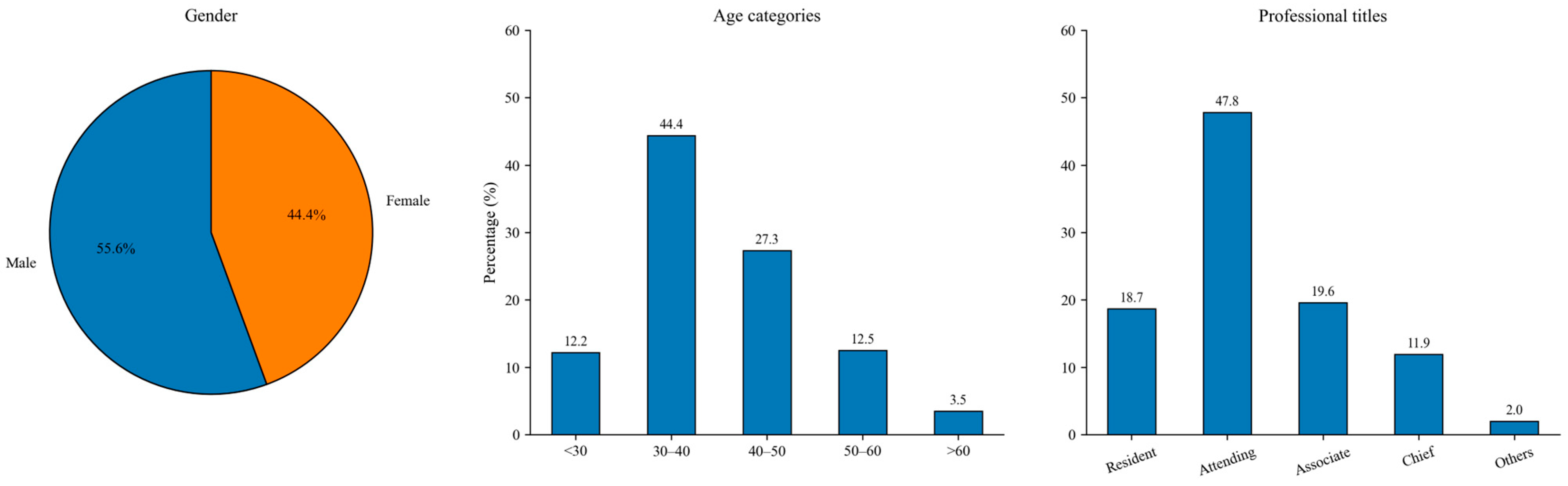
| Respondents’ Demography | Frequencies | Percentage |
|---|---|---|
| Gender | ||
| Male | 533 | 55.6 |
| Female | 425 | 44.4 |
| Age categories (years) | ||
| Young (below 30) | 117 | 12.2 |
| Early Middle-aged (30–40) | 425 | 44.4 |
| Middle-aged (40–50) | 262 | 27.3 |
| Late Middle-aged (50–60) | 120 | 12.5 |
| Old aged (above 60) | 34 | 3.5 |
| Professional titles | ||
| Resident doctor | 179 | 18.7 |
| Attending doctor | 458 | 47.8 |
| Associate chief doctor | 188 | 19.6 |
| Chief doctor | 114 | 11.9 |
| Others | 19 | 2.0 |
| Constructs | Items | Mean | SD | Factor Loadings | Cronbach’s Alpha | CR | AVE |
|---|---|---|---|---|---|---|---|
| Adoption Intention to Professional Platform (AIP) | AIP1 | 3.78 | 1.18 | 0.78 | 0.77 | 0.76 | 0.61 |
| AIP2 | 3.78 | 1.13 | 0.78 | ||||
| Adoption Intention to Social Platform (AIS) | AIS1 | 3.68 | 1.08 | 0.78 | 0.75 | 0.74 | 0.59 |
| AIS2 | 3.69 | 1.08 | 0.78 | ||||
| Performance Expectancy (PEE) | PEE1 | 3.73 | 1.03 | 0.87 | 0.93 | 0.94 | 0.64 |
| PEE2 | 3.79 | 1.18 | 0.77 | ||||
| PEE3 | 3.66 | 1.10 | 0.79 | ||||
| PEE4 | 3.77 | 1.15 | 0.75 | ||||
| PEE5 | 3.69 | 1.14 | 0.81 | ||||
| PEE6 | 3.77 | 1.15 | 0.78 | ||||
| PEE7 | 3.68 | 1.11 | 0.81 | ||||
| PEE8 | 3.73 | 1.17 | 0.77 | ||||
| Effort Expectancy (EEC) | EEC1 | 3.76 | 1.09 | 0.83 | 0.90 | 0.90 | 0.65 |
| EEC2 | 3.67 | 1.12 | 0.79 | ||||
| EEC3 | 3.80 | 1.16 | 0.76 | ||||
| EEC4 | 3.64 | 1.11 | 0.79 | ||||
| EEC5 | 3.79 | 1.14 | 0.77 | ||||
| Future Expectancy (FE) | FE1 | 3.71 | 1.10 | 0.86 | 0.94 | 0.93 | 0.63 |
| FE2 | 3.74 | 1.17 | 0.79 | ||||
| FE3 | 3.66 | 1.11 | 0.79 | ||||
| FE4 | 3.80 | 1.18 | 0.76 | ||||
| FE5 | 3.71 | 1.15 | 0.80 | ||||
| FE6 | 3.77 | 1.19 | 0.79 | ||||
| FE7 | 3.70 | 1.11 | 0.80 | ||||
| FE8 | 3.74 | 1.18 | 0.79 | ||||
| Patient Volume (PV) | PV1 | 3.69 | 1.04 | 0.83 | 0.81 | 0.82 | 0.69 |
| PV2 | 3.82 | 1.15 | 0.81 | ||||
| Habit (HAB) | HAB1 | 3.74 | 1.08 | 0.84 | 0.92 | 0.92 | 0.65 |
| HAB2 | 3.83 | 1.19 | 0.77 | ||||
| HAB3 | 3.70 | 1.14 | 0.80 | ||||
| HAB4 | 3.82 | 1.17 | 0.75 | ||||
| HAB5 | 3.68 | 1.09 | 0.77 | ||||
| HAB6 | 3.82 | 1.19 | 0.77 | ||||
| Social influence (SI) | SI1 | 3.72 | 1.05 | 0.84 | 0.88 | 0.89 | 0.66 |
| SI2 | 3.74 | 1.20 | 0.78 | ||||
| SI3 | 3.67 | 1.09 | 0.80 | ||||
| SI4 | 3.82 | 1.20 | 0.77 | ||||
| Platform Experience (PE) | PE1 | 3.71 | 1.06 | 0.83 | 0.83 | 0.82 | 0.70 |
| PE2 | 3.80 | 1.18 | 0.85 |
| AIP | AIS | PEE | EEC | SI | PE | FE | PV | HAB | |
|---|---|---|---|---|---|---|---|---|---|
| Adoption Intention to Professional Platform (AIP) | (0.78) | ||||||||
| Adoption Intention to Social Platform (AIS) | 0.39 | (0.77) | |||||||
| Performance Expectancy (PEE) | 0.33 | 0.34 | (0.80) | ||||||
| Effort Expectancy (EEC) | 0.41 | 0.41 | 0.43 | (0.81) | |||||
| Social Influence (SI) | 0.47 | 0.47 | 0.26 | 0.27 | (0.81) | ||||
| Platform Experience (PE) | 0.46 | 0.47 | 0.47 | 0.44 | 0.44 | (0.84) | |||
| Future Expectancy (FE) | 0.39 | 0.37 | 0.32 | 0.40 | 0.42 | 0.34 | (0.79) | ||
| Patient Volume (PV) | 0.46 | 0.41 | 0.26 | 0.27 | 0.36 | 0.45 | 0.41 | (0.83) | |
| Habit (HAB) | 0.40 | 0.40 | 0.25 | 0.26 | 0.42 | 0.41 | 0.43 | 0.46 | (0.81) |
| Fitness Indices | Threshold Value | Indices Values | Fitness Achievement |
|---|---|---|---|
| ChiSq/df | ≤3.0 | 2.09 | Achieved |
| TLI | ≥0.9 | 0.96 | Achieved |
| CFI | ≥0.9 | 0.97 | Achieved |
| NFI | ≥0.8 | 0.94 | Achieved |
| GFI | ≥0.8 | 0.93 | Achieved |
| RMSEA | ≤0.08 | 0.03 | Achieved |
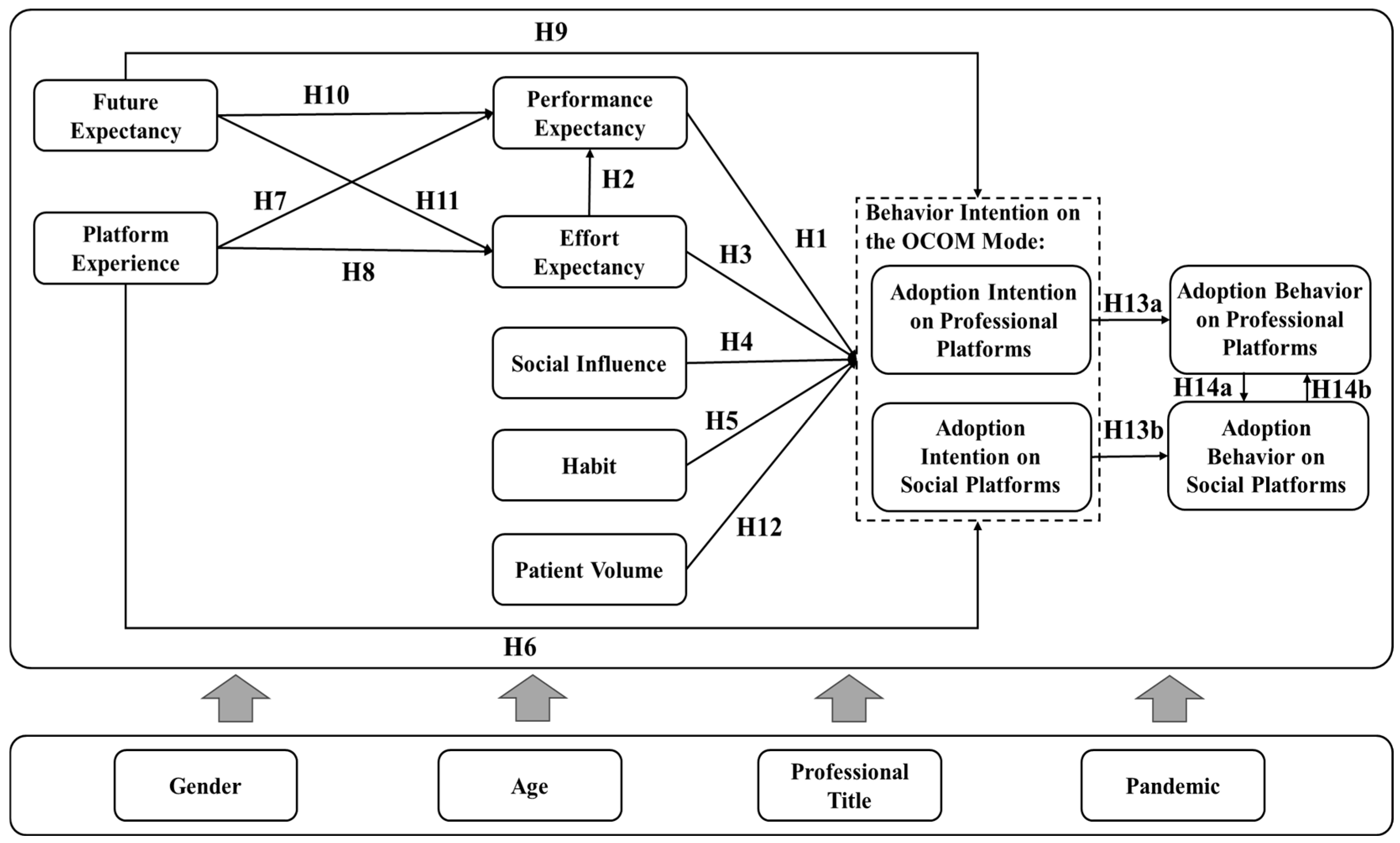
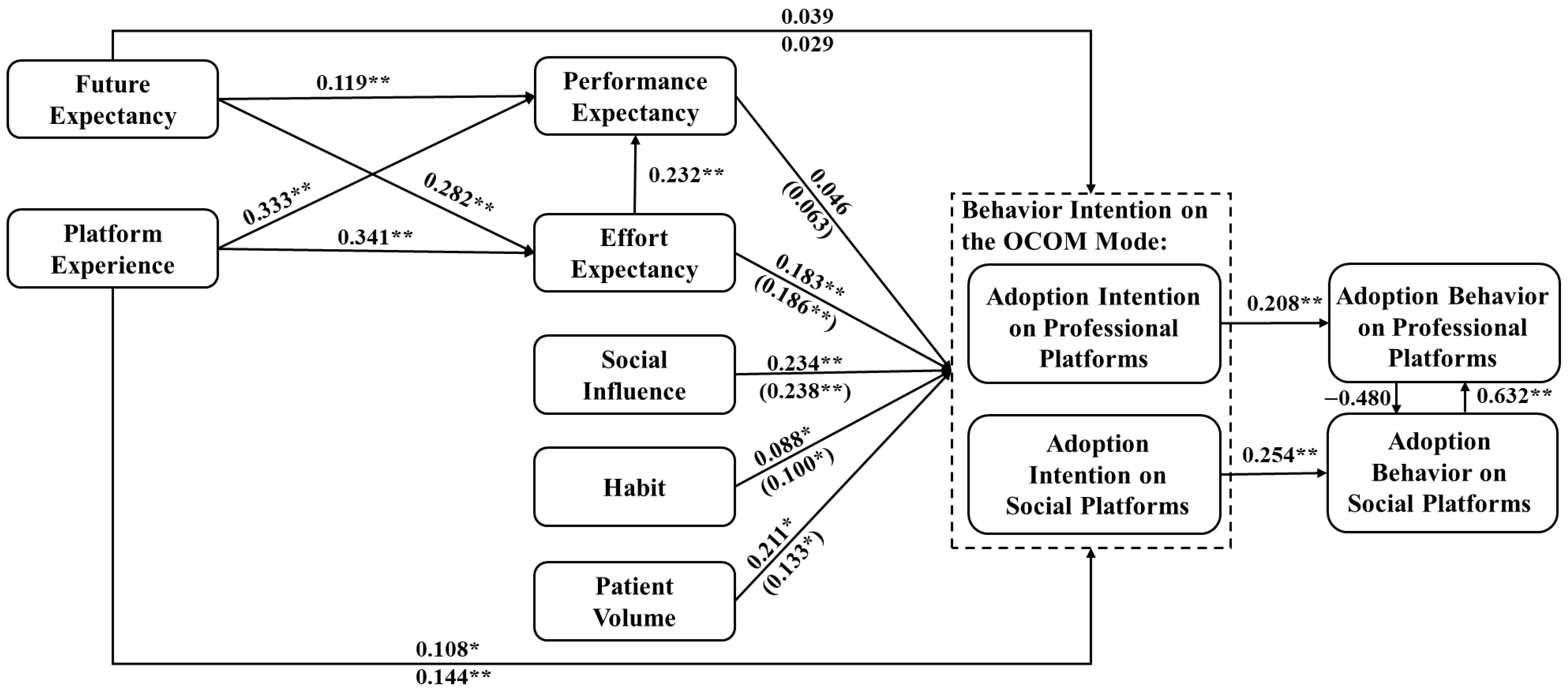
| Hypothesis: Path | Path Coefficient | T-Value | p Value | Supported? (Yes/No) |
|---|---|---|---|---|
| H1: PEE → AIP | 0.046 | 1.126 | 0.26 | No |
| PEE → AIS | 0.063 | 1.514 | 0.13 | No |
| H2: EEC → PEE | 0.232 | 6.2261 | <0.001 | Yes |
| H3: EEC → AIP | 0.183 | 4.299 | <0.001 | Yes |
| EEC → AIS | 0.186 | 4.270 | <0.001 | Yes |
| H4: SI → AIP | 0.234 | 5.419 | <0.001 | Yes |
| SI → AIS | 0.238 | 5.403 | <0.001 | Yes |
| H5: HAB → AIP | 0.088 | 2.057 | 0.040 | Yes |
| HAB → AIS | 0.100 | 2.264 | 0.024 | Yes |
| H6: PE → AIP | 0.108 | 2.206 | 0.027 | Yes |
| PE → AIS | 0.144 | 2.880 | 0.004 | Yes |
| H7: PE → PEE | 0.333 | 8.555 | <0.001 | Yes |
| H8: PE → EEC | 0.341 | 8.829 | <0.001 | Yes |
| H9: FE → AIP | 0.039 | 0.966 | 0.334 | No |
| FE → AIS | 0.029 | 0.699 | 0.484 | No |
| H10: FE → PEE | 0.119 | 3.514 | <0.001 | Yes |
| H11: FE → EEC | 0.282 | 8.005 | <0.001 | Yes |
| H12: PV → AIP | 0.211 | 4.424 | <0.001 | Yes |
| PV → AIS | 0.133 | 2.760 | 0.006 | Yes |
| H13a: AIP → ABP | 0.208 | 4.892 | <0.001 | Yes |
| H13b: AIS → ABS | 0.254 | 2.735 | 0.006 | Yes |
| H14a: ABP → ABS | −0.480 | −1.493 | 0.136 | No |
| H14b: ABS → ABP | 0.632 | 2.644 | 0.008 | Yes |
Disclaimer/Publisher’s Note: The statements, opinions and data contained in all publications are solely those of the individual author(s) and contributor(s) and not of MDPI and/or the editor(s). MDPI and/or the editor(s) disclaim responsibility for any injury to people or property resulting from any ideas, methods, instructions or products referred to in the content. |
© 2026 by the authors. Licensee MDPI, Basel, Switzerland. This article is an open access article distributed under the terms and conditions of the Creative Commons Attribution (CC BY) license.
Share and Cite
Du, J.; Zhu, S. Beyond Single-Platform Adoption: Unpacking Doctors’ Cross-Channel Behavioral Mechanisms in Omni-Channel Medical Practice. Healthcare 2026, 14, 923. https://doi.org/10.3390/healthcare14070923
Du J, Zhu S. Beyond Single-Platform Adoption: Unpacking Doctors’ Cross-Channel Behavioral Mechanisms in Omni-Channel Medical Practice. Healthcare. 2026; 14(7):923. https://doi.org/10.3390/healthcare14070923
Chicago/Turabian StyleDu, Jianmei, and Shuwan Zhu. 2026. "Beyond Single-Platform Adoption: Unpacking Doctors’ Cross-Channel Behavioral Mechanisms in Omni-Channel Medical Practice" Healthcare 14, no. 7: 923. https://doi.org/10.3390/healthcare14070923
APA StyleDu, J., & Zhu, S. (2026). Beyond Single-Platform Adoption: Unpacking Doctors’ Cross-Channel Behavioral Mechanisms in Omni-Channel Medical Practice. Healthcare, 14(7), 923. https://doi.org/10.3390/healthcare14070923