Gaps Between Guidelines and Practice in VTE Prevention for Advanced NSCLC Outpatients: A Nationwide Cross-Sectional Study in China

Highlights
- First nationwide survey reveals conservative use of VTE prophylaxis in advanced NSCLC outpatients in China, with limited adherence to guidelines.
- Direct oral anticoagulants are the most commonly preferred agents.
- Knowledge gaps and safety concerns are commonly perceived barriers to the implementation of thromboprophylaxis.
- Bleeding risk and monitoring challenges significantly influence clinical decision-making.
Abstract
1. Introduction
2. Materials and Methods
2.1. Survey Respondents
2.2. Survey Instrument
- Physician demographics and professional characteristics;
- Training experience in anticoagulation;
- VTE risk assessment practices, including the use of the Khorana score;
- Prophylactic anticoagulation decision-making, anticoagulant preferences and selection criteria;
- Physicians’ concerns about anticoagulation;
- Physicians’ knowledge of the Khorana score.
2.3. Survey Procedure
2.4. Statistical Analysis
2.5. Reporting Guideline
3. Results
3.1. Survey Response and Questionnaire Reliability
3.2. Characteristics of Participating Physicians
3.3. Anticoagulation Training and Knowledge
3.4. Clinical Practice Patterns
3.5. Physicians’ Concerns Regarding Anticoagulation
4. Discussion
4.1. Conservative Use of Prophylactic Anticoagulation
4.2. Physician Knowledge and Risk-Benefit Concerns
4.3. Anticoagulant Selection and Influence Factors
4.4. Future Measures
5. Conclusions
Strengths and Limitations
Author Contributions
Funding
Institutional Review Board Statement
Informed Consent Statement
Data Availability Statement
Acknowledgments
Conflicts of Interest
Abbreviations
| VTE | Venous thromboembolism |
| NSCLC | Non-small-cell lung cancer |
| ISTH | International Society for Thrombosis and Hemostasis |
| ASCO | American Society of Clinical Oncology |
| KMO | Kaiser–Meyer–Olkin |
| STROBE | Strengthening the Reporting of Observational Studies in Epidemiology |
| LMWH | Low molecular weight heparin |
| DOACs | Direct oral anticoagulants |
| AVERT | Apixaban for the Prevention of Venous Thromboembolism in High-Risk Ambulatory Cancer Patients trial |
| CASSINI | Rivaroxaban Thromboprophylaxis in High-Risk Ambulatory Cancer Patients Receiving Systemic Therapy: Results of a Randomized Clinical Trial |
References
- Zer, A.; Moskovitz, M.; Hwang, D.M.; Hershko-Klement, A.; Fridel, L.; Korpanty, G.J.; Dudnik, E.; Peled, N.; Shochat, T.; Leighl, N.B.; et al. ALK -Rearranged Non–Small-Cell Lung Cancer Is Associated with a High Rate of Venous Thromboembolism. Clin. Lung Cancer 2017, 18, 156–161. [Google Scholar] [CrossRef] [PubMed]
- Aguiar De Azevedo, L.; Orione, C.; Tromeur, C.; Couturaud, F.; Descourt, R.; Geier, M. Incidence of Venous Thromboembolism and Association with PD-L1 Expression in Advanced Non-Small Cell Lung Cancer Patients Treated with First-Line Chemo-Immunotherapy. Front. Oncol. 2024, 13, 1221106. [Google Scholar] [CrossRef] [PubMed]
- Zhang, M.; Wu, S.; Hu, C. Do Lung Cancer Patients Require Routine Anticoagulation Treatment? A Meta-Analysis. J. Int. Med. Res. 2020, 48, 0300060519896919. [Google Scholar] [CrossRef] [PubMed]
- Carrier, M.; Abou-Nassar, K.; Mallick, R.; Tagalakis, V.; Shivakumar, S.; Schattner, A.; Kuruvilla, P.; Hill, D.; Spadafora, S.; Marquis, K.; et al. Apixaban to Prevent Venous Thromboembolism in Patients with Cancer. N. Engl. J. Med. 2019, 380, 711–719. [Google Scholar] [CrossRef] [PubMed]
- Khorana, A.A.; Soff, G.A.; Kakkar, A.K.; Vadhan-Raj, S.; Riess, H.; Wun, T.; Streiff, M.B.; Garcia, D.A.; Liebman, H.A.; Belani, C.P.; et al. Rivaroxaban for Thromboprophylaxis in High-Risk Ambulatory Patients with Cancer. N. Engl. J. Med. 2019, 380, 720–728. [Google Scholar] [CrossRef] [PubMed]
- Khorana, A.A.; Kuderer, N.M.; Culakova, E.; Lyman, G.H.; Francis, C.W. Development and Validation of a Predictive Model for Chemotherapy-Associated Thrombosis. Blood 2008, 111, 4902–4907. [Google Scholar] [CrossRef] [PubMed]
- Key, N.S.; Khorana, A.A.; Kuderer, N.M.; Bohlke, K.; Lee, A.Y.Y.; Arcelus, J.I.; Wong, S.L.; Balaban, E.P.; Flowers, C.R.; Gates, L.E.; et al. Venous Thromboembolism Prophylaxis and Treatment in Patients with Cancer: ASCO Guideline Update. J. Clin. Oncol. 2023, 41, 3063–3071. [Google Scholar] [CrossRef] [PubMed]
- Wang, T.; Zwicker, J.I.; Ay, C.; Pabinger, I.; Falanga, A.; Antic, D.; Noble, S.; Khorana, A.A.; Carrier, M.; Meyer, G. The Use of Direct Oral Anticoagulants for Primary Thromboprophylaxis in Ambulatory Cancer Patients: Guidance from the SSC of the ISTH. J. Thromb. Haemost. 2019, 17, 1772–1778. [Google Scholar] [CrossRef] [PubMed]
- Farge, D.; Frere, C.; Connors, J.M.; Khorana, A.A.; Kakkar, A.; Ay, C.; Muñoz, A.; Brenner, B.; Prata, P.H.; Brilhante, D.; et al. 2022 International Clinical Practice Guidelines for the Treatment and Prophylaxis of Venous Thromboembolism in Patients with Cancer, Including Patients with COVID-19. Lancet Oncol. 2022, 23, e334–e347. [Google Scholar] [CrossRef] [PubMed]
- Zou, H.; Tian, D.; Liu, C.; Xiao, J.; Wang, P.; Zhang, Y. Venous Thromboembolism and Prophylactic Anticoagulation Therapy in Patients with Lung Cancer: A Survey and Analysis. J. Clincal Intern. Med. 2018, 35, 273–274. [Google Scholar] [CrossRef]
- Xu, J.; Wang, H. The Current Knowledge and Execution Status of Venous Thromboembolism Prevention and Management among Critical Care Practitioners of Cancer Hospitals in China: A Muticenter Survery. Chin. J. Integr. Tradit. West. Med. Intensive Crit. Care 2019, 2, 201–206. [Google Scholar] [CrossRef]
- Khan, N.A.J.; Yasin, H.; Nwanwene, K.; Abdallah, M.; Gress, T.; Tirona, M. Assessment of Venous Thromboembolism Risk Based on the Khorana Predictive Model and Compliance with Prophylactic Anticoagulation at a Regional Cancer Center- a Quality Improvement Study. Blood 2021, 138, 4951. [Google Scholar] [CrossRef]
- Ekwere, T.; Ino-Ekanem, B.; Ekanem, A. Venous Thromboembolism: Awareness and Practice of Thromboprophylaxis among Physicians in a Tertiary-Care Hospital. Int. J. Med. Biomed. Res. 2015, 4, 14–20. [Google Scholar] [CrossRef]



| Category | Variables | Responses | Number of Responses (%) |
|---|---|---|---|
| Demographics | Title | Resident physician | 48 (20.4) |
| Attending physician | 98 (41.7) | ||
| Associate chief physician | 72 (30.6) | ||
| Chief physician | 17 (7.2) | ||
| Department | Respiratory department | 79 (33.6) | |
| Oncology department | 131 (55.7) | ||
| Other departments | 25 (10.6) | ||
| Time in practice | <5 years | 55 (23.4) | |
| 5–10 years | 64 (27.2) | ||
| 10–15 years | 55 (23.4) | ||
| 15–20 years | 44 (18.7) | ||
| >20 years | 17 (7.2) | ||
| Highest educational qualification | Below bachelor | 1 (0.4) | |
| Bachelor | 56 (23.8) | ||
| Master | 137 (58.3) | ||
| Doctor | 41 (17.4) | ||
| Anticoagulation training | Anticoagulation training experience | Yes | 199 (84.7) |
| No | 36 (15.3) | ||
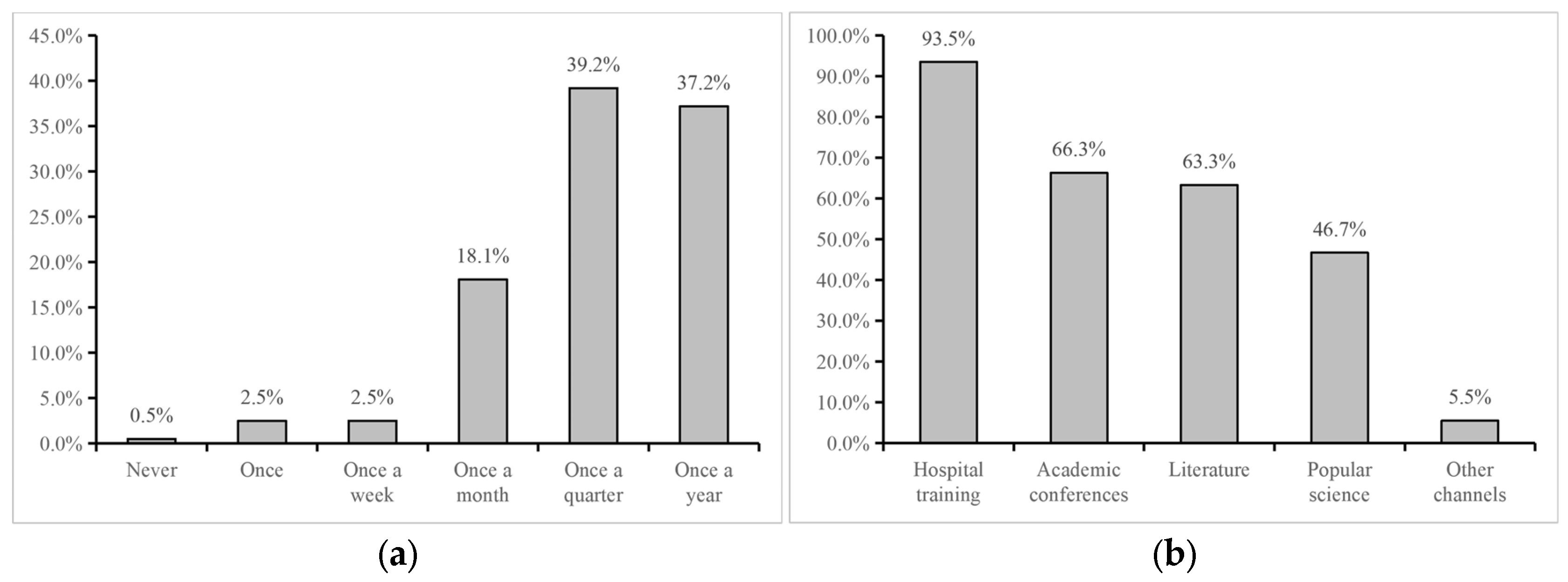
| Anticoagulation training frequency | Never | 1 (0.5) | |
| Once | 5 (2.5) | ||
| Once a week | 5 (2.5) | ||
| Once a month | 36 (18.1) | ||
| Once a quarter | 78 (39.2) | ||
| Once a year | 74 (37.2) | ||
| Training channels (multiple-response question) | Hospital training | 186 (93.5) | |
| Academic conferences | 132 (66.3) | ||
| Literature | 126 (63.3) | ||
| Popular science | 93 (46.7) | ||
| Other channels | 11 (5.5) | ||
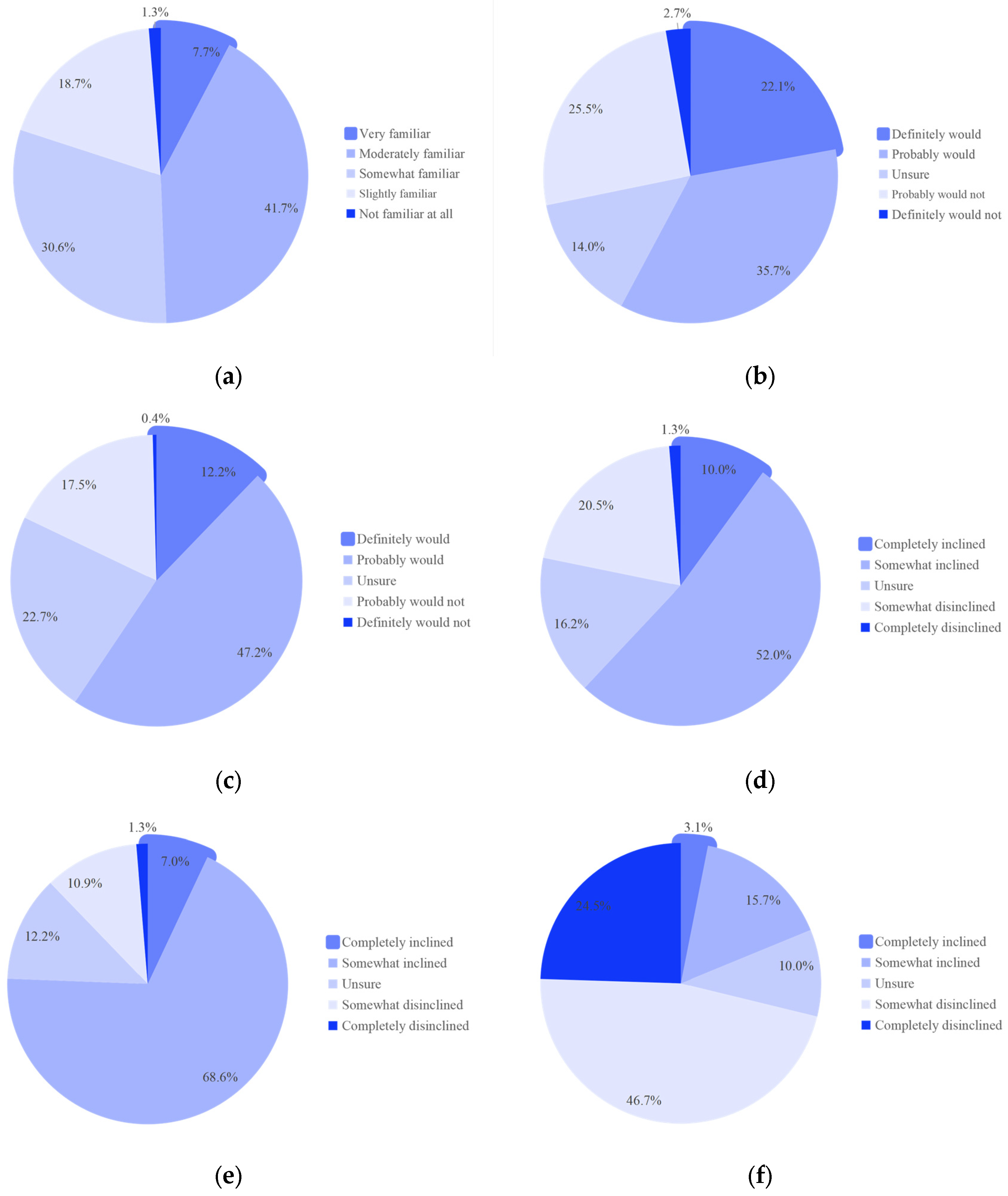
| Knowledge measures | Familiarity with Khorana score | Very familiar | 18 (7.7) |
| Moderately familiar | 98 (41.7) | ||
| Somewhat familiar | 72 (30.6) | ||
| Slightly familiar | 44 (18.7) | ||
| Not familiar at all | 3 (1.3) | ||
| Lung cancer-specific score (“1 point” is correct) | 0 points | 2 (0.9) | |
| 1 point | 130 (55.3) | ||
| 2 points | 79 (33.6) | ||
| 3 points | 23 (9.8) | ||
| 4 points | 1 (0.4) | ||
| Prophylactic anticoagulation threshold (“2 points” is correct) | 0 points | 3 (1.3) | |
| 1 point | 13 (5.5) | ||
| 2 points | 153 (65.1) | ||
| 3 points | 57 (24.3) | ||
| 4 points | 9 (3.8) | ||
| Clinical Practice Patterns | Use of Khorana score | Definitely would | 52 (22.1) |
| Probably would | 84 (35.7) | ||
| Unsure | 33 (14.0) | ||
| Probably would not | 60 (25.5) | ||
| Definitely would not | 6 (2.7) | ||
| Initiation of prophylactic anticoagulation when Khorana score ≥ 2 | Definitely would | 28 (12.2) | |
| Probably would | 108 (47.2) | ||
| Unsure | 52 (22.7) | ||
| Probably would not | 40 (17.5) | ||
| Definitely would not | 1 (0.4) | ||
| Anticoagulant selection—LMWH | Completely inclined | 23 (10.0) | |
| Somewhat inclined | 119 (52.0) | ||
| Unsure | 37 (16.2) | ||
| Somewhat disinclined | 47 (20.5) | ||
| Completely disinclined | 3 (1.3) | ||
| Anticoagulant selection—DOACs | Completely inclined | 16 (7.0) | |
| Somewhat inclined | 157 (68.6) | ||
| Unsure | 28 (12.2) | ||
| Somewhat disinclined | 25 (10.9) | ||
| Completely disinclined | 3 (1.3) | ||
| Anticoagulant selection—warfarin | Completely inclined | 7 (3.1) | |
| Somewhat inclined | 36 (15.7) | ||
| Unsure | 23 (10.0) | ||
| Somewhat disinclined | 107 (46.7) | ||
| Completely disinclined | 56 (24.5) | ||
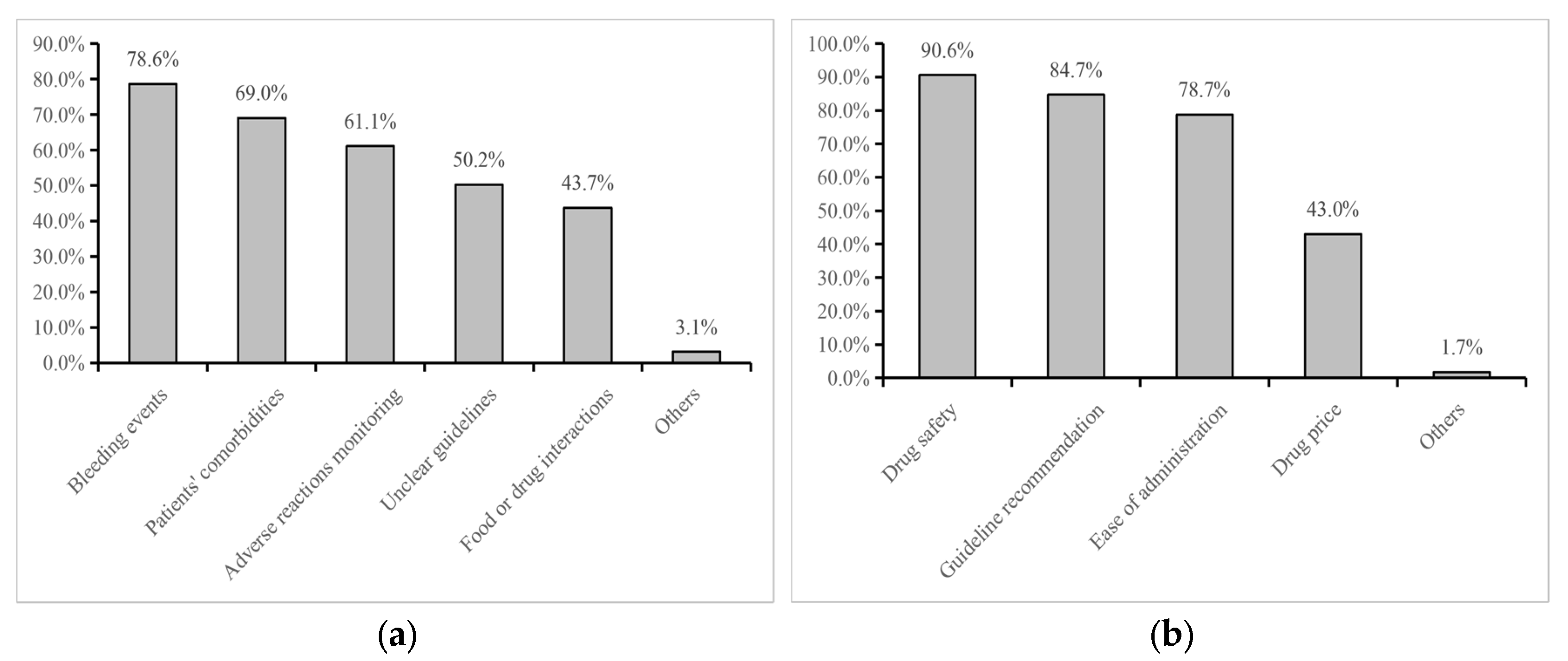
| Factors influencing clinical practice | Anticoagulation concerns (multiple-response question) | Bleeding events | 180 (78.6) |
| Patients’ comorbidities | 158 (69.0) | ||
| Adverse reactions monitoring | 140 (61.1) | ||
| Unclear guidelines | 115 (50.2) | ||
| Food or drug interactions | 100 (43.7) | ||
| Others | 7 (3.1) | ||
| Anticoagulant selection criteria (multiple-response question) | Drug safety | 213 (90.6) | |
| Guideline recommendation | 199 (84.7) | ||
| Ease of administration | 185 (78.7) | ||
| Drug price | 101 (43.0) | ||
| Others | 4 (1.7) |
Disclaimer/Publisher’s Note: The statements, opinions and data contained in all publications are solely those of the individual author(s) and contributor(s) and not of MDPI and/or the editor(s). MDPI and/or the editor(s) disclaim responsibility for any injury to people or property resulting from any ideas, methods, instructions or products referred to in the content. |
© 2026 by the authors. Licensee MDPI, Basel, Switzerland. This article is an open access article distributed under the terms and conditions of the Creative Commons Attribution (CC BY) license.
Share and Cite
Wang, R.; He, Q.; Chen, J.; Tang, K.; Tang, Y. Gaps Between Guidelines and Practice in VTE Prevention for Advanced NSCLC Outpatients: A Nationwide Cross-Sectional Study in China. Healthcare 2026, 14, 910. https://doi.org/10.3390/healthcare14070910
Wang R, He Q, Chen J, Tang K, Tang Y. Gaps Between Guidelines and Practice in VTE Prevention for Advanced NSCLC Outpatients: A Nationwide Cross-Sectional Study in China. Healthcare. 2026; 14(7):910. https://doi.org/10.3390/healthcare14070910
Chicago/Turabian StyleWang, Roujuan, Qiuyi He, Jie Chen, Kejing Tang, and Yubo Tang. 2026. "Gaps Between Guidelines and Practice in VTE Prevention for Advanced NSCLC Outpatients: A Nationwide Cross-Sectional Study in China" Healthcare 14, no. 7: 910. https://doi.org/10.3390/healthcare14070910
APA StyleWang, R., He, Q., Chen, J., Tang, K., & Tang, Y. (2026). Gaps Between Guidelines and Practice in VTE Prevention for Advanced NSCLC Outpatients: A Nationwide Cross-Sectional Study in China. Healthcare, 14(7), 910. https://doi.org/10.3390/healthcare14070910