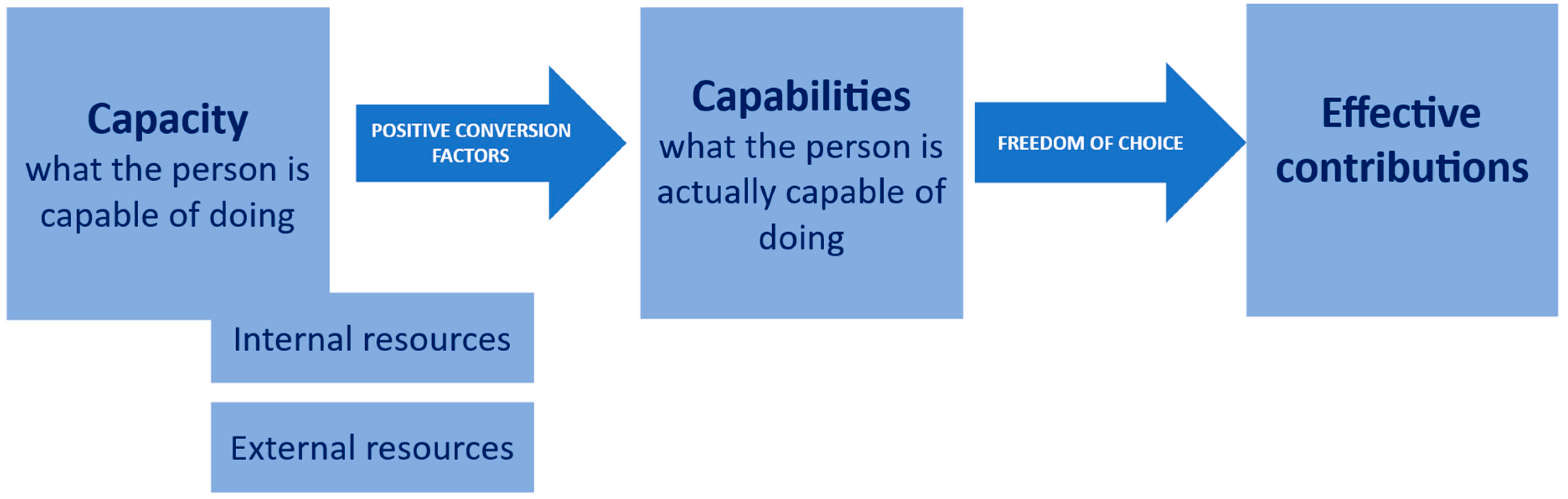
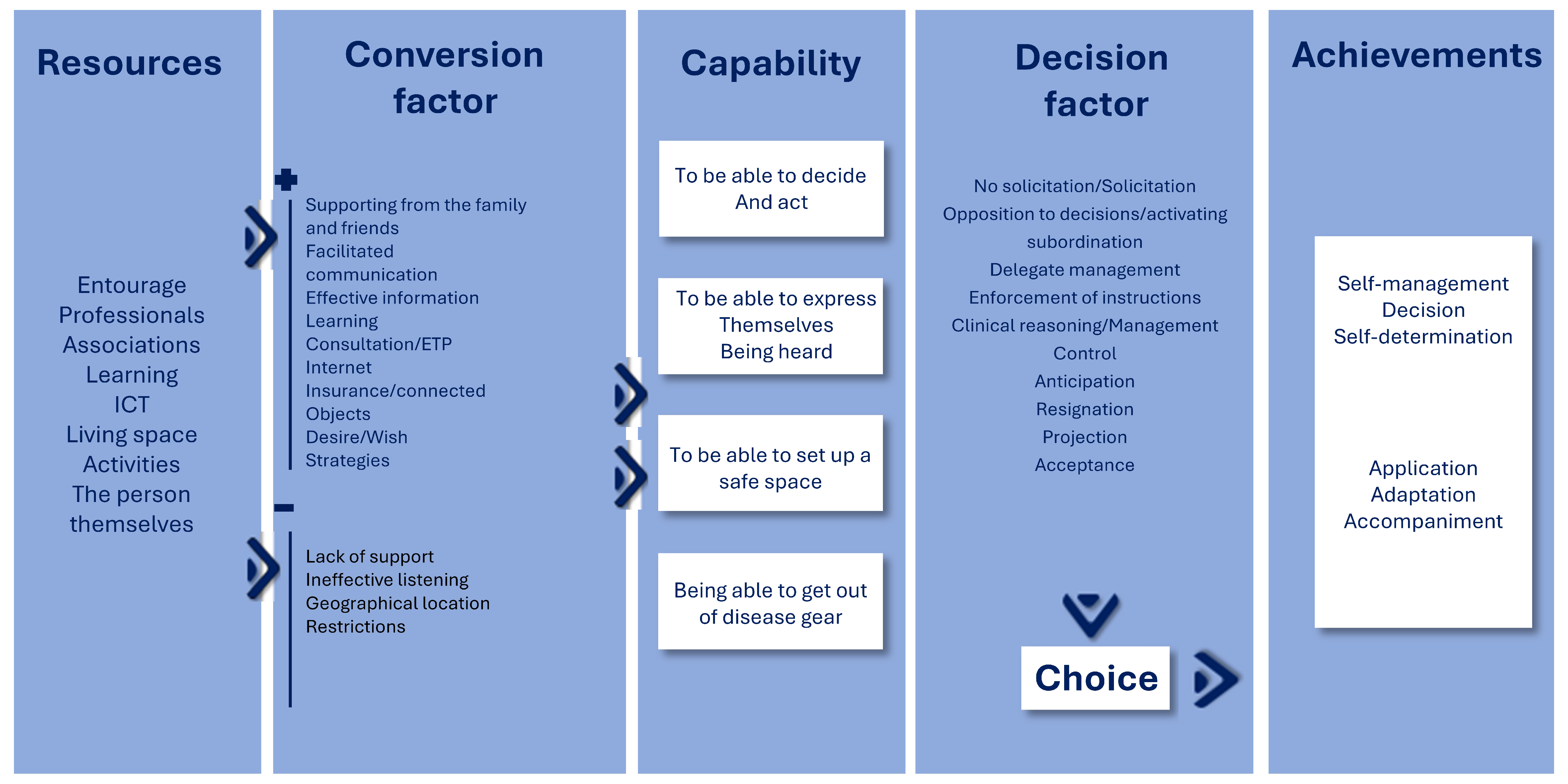
The Meaning of Chronic Disease Management in the Patient’s Environment: A Critical Ethnographic Study

 , , and
Highlights
- Patients need to feel able to express themselves and be heard, and this requires genuine listening to promote a sense of security.
- Encourage autonomy and person-centred leadership through digital medicine.
- Encouraging true autonomy based on people’s needs and desires through co-coaching allows us to follow the objectives of the Ottawa Charter
- Creating spaces for discussion between patients and staff, with genuine listening that fosters a sense of security and promotes person-centred leadership
Abstract
1. Introduction
2. Materials and Methods
2.1. Participants and Sampling
2.2. Data Collection Procedures
2.3. Data Analysis
3. Results
3.1. Socio-Demographic Characteristics
3.2. Summary of Participants’ Experiences
4. Discussion
4.1. Discussion of the Method
4.2. Discussion of the Results
4.3. Limitations
5. Conclusions
Supplementary Materials
Author Contributions
Funding
Institutional Review Board Statement
Informed Consent Statement
Data Availability Statement
Acknowledgments
Conflicts of Interest
References
- Hajat, C.; Stein, E. The global burden of multiple chronic conditions: A narrative review. Prev. Med. Rep. 2018, 12, 284–293. [Google Scholar] [CrossRef] [Scilit] [PubMed]
- GBD 2019 Diseases and Injuries Collaborators. Global burden of 369 diseases and injuries in 204 countries and territories, 1990–2019: A systematic analysis for the Global Burden of Disease Study 2019. Lancet 2020, 396, 1204–1222.
- Vosbergen, S.; Janzen, J.; Stappers, P.J.; van Zwieten, M.C.; Lacroix, J.; Idema, K.; Broek, I.v.D.; Kemps, H.M.; Kraaijenhagen, R.A.; Peek, N. A qualitative participatory study to identify experiences of coronary heart disease patients to support the development of online self-management services. Int. J. Med. Inform. 2013, 82, 1183–1194. [Google Scholar] [CrossRef] [Scilit] [PubMed]
- Gross, O.; Gagnayre, R.; Lombrail, P. Evaluating projects that support health autonomy: Why favor a pragmatic approach? Public Health 2020, 32, 301–313. [Google Scholar]
- De Bonnières, M. Living Better with a Chronic Disease; Larousse: Paris, France, 2022. [Google Scholar]
- Bureau-Point, E.; Hermann-Mesfen, J. Les patients contemporains face à la démocratie sanitaire. Anthr. Sante-Rev. Int. Francoph. D Anthr. de la Sante 2014. [Google Scholar] [CrossRef] [Scilit]
- Porcu, S.; Mandas, A. How to evaluate Quality of Life. Monaldi Arch. Chest Dis. 2019. [Google Scholar] [CrossRef] [Scilit]
- Zurita-Cruz, J.N.; Manuel-Apolinar, L.; Arellano-Flores, M.L.; Gutierrez-Gonzalez, A.; Najera-Ahumada, A.G.; Cisneros-González, N. Health and quality of life outcomes impairment of quality of life in type 2 diabetes mellitus: A cross-sectional study. Health Qual. Life Outcomes 2018, 16, 94. [Google Scholar] [CrossRef] [Scilit]
- Van Wilder, L.; Rammant, E.; Clays, E.; Devleesschauwer, B.; Pauwels, N.; De Smedt, D. A comprehensive catalogue of EQ-5D scores in chronic disease: Results of a systematic review. Qual. Life Res. 2019, 28, 3153–3161. [Google Scholar] [CrossRef] [Scilit]
- Kubincová, A.; Takáč, P.; Kendrová, L.; Joppa, P.; Mikuľáková, W. The Effect of Pulmonary Rehabilitation in Mountain Environment on Exercise Capacity and Quality of Life in Patients with Chronic Obstructive Pulmonary Disease (COPD) and Chronic Bronchitis. Med. Sci. Monit. 2018, 24, 6375–6386. [Google Scholar] [CrossRef] [Scilit]
- Moitra, S.; Foraster, M.; Arbillaga-Etxarri, A.; Marín, A.; Barberan-Garcia, A.; Rodríguez-Chiaradia, D.A.; Balcells, E.; Koreny, M.; Torán-Monserrat, P.; Vall-Casas, P.; et al. Roles of the physical environment in health-related quality of life in patients with chronic obstructive pulmonary disease. Environ. Res. 2022, 203, 111828. [Google Scholar] [CrossRef] [Scilit]
- Sen, A. La possibilité du choix social [Conférence Nobel]. Rev. L’ofce 1999, 70, 7–61. [Google Scholar] [CrossRef] [Scilit]
- Sen, A. Commodities and Capabilities, 13th ed.; Oxford University Press: New Delhi, India, 2008; 89p. [Google Scholar]
- Le Bossé, Y.; Dufort, F.; Vandette, L. L’évaluation De L’empowerment Des Personnes: Développement D’une Mesure D’indices Psychosociologiques Du Pouvoir D’agir (MIPPA). Can. J. Community Ment. Health 2004, 23, 91–114. [Google Scholar] [CrossRef] [Scilit]
- Vallerie, B.; Le Bossé, Y. The development of empowerment in individuals and communities: From experimentation to teaching: Education Sciences—For the New Era. Les Sci. L’éduc. Pour L’ère Nouv. 2006, 39, 87–100. [Google Scholar] [CrossRef] [Scilit]
- Falzon, P. Ergonomics, knowledge development and the design of enabling environments. Eng. Environ. Sci. 2009. [Google Scholar]
- Pernet, A.; Mollo, V.; Falzon, P. Developing patient capabilities to co-produce safe and effective care. Activites 2018. [Google Scholar] [CrossRef] [Scilit]
- Fernagu, S. The capabilities approach in the field of work and training: Towards a definition of enabling environments? Work. Learn. 2022, 23, 40–69. [Google Scholar] [CrossRef] [Scilit]
- Fernagu Oudet, S. Organizations for learning. An attempt to contribute to the idea of the “learning city”. Specif. Features 2010, 3, 19. [Google Scholar] [CrossRef] [Scilit]
- Gross, O.; Gagnayre, R. Une éducation salutogénique basée sur les capabilités des patient: Une nouvelle composante de l’éducation thérapeutique. Educ. Ther. Patient/Ther. Patient Educ. 2018, 10, 10501. [Google Scholar] [CrossRef] [Scilit]
- Madison, D.S. Critical Ethnography: Method, Ethics, and Performance; Sage: Thousand Oaks, CA, USA, 2005; 245p. [Google Scholar]
- Thomas, J. Doing Critical Ethnography; SAGE Publications, Inc.: Newbury Park, CA, USA, 1993; Available online: https://methods.sagepub.com/book/doing-critical-ethnography (accessed on 10 March 2026).
- Bourbonnais, A. L’ethnographie pour la recherche infirmière, une méthode judicieuse pour mieux comprendre les comportements humains dans leur contexte. Rech. Soins Infirm. 2015, 120, 23–34. [Google Scholar] [CrossRef] [Scilit]
- Fetterman, D.M. Ethnography: Step-by-Step, 3rd ed.; Applied social research methods series; SAGE: Los Angeles, CA, USA, 2010; 173p. [Google Scholar]
- WHO. Key Facts About Noncommunicable Diseases; World Health Organization: Geneva, Switzerland, 2018; Available online: www.who.int (accessed on 11 December 2022).
- Fortin, M.; Gagnon, J. Foundations and Stages of the Research Process, 4th ed.; Chenellière: Moncoutant, France, 2022. [Google Scholar]
- Corbin, J.; Strauss, A. Basic of Qualitative Research: Techniques and Procedures for Developing Grounded Theory, 4th ed.; SAGE Publications: Thousand Oaks, CA, USA, 2008; ISBN 978-1-4129-0643-2. Available online: http://methods.sagepub.com/book/basics-of-qualitative-research (accessed on 25 September 2018).
- Martineau, S. Observation in context: Challenges, possibilities, and limitations. Qual. Res. 2005, 2. Available online: https://www.erudit.org/fr/livres/collection-hors-serie-les-actes-de-la-revue-recherches-qualitatives/linstrumentation-dans-la-collecte-des-donnees/5193co/ (accessed on 11 March 2026).
- Waelli, M. Cashier… and Then What? Presses Universitaires de France: Paris, France, 2009; Available online: http://www.cairn.info/caissiere-et-apres--978-2-13-057333-3.htm (accessed on 4 May 2025).
- Loizeau, V.; Morvillers, J.-M.; Bertrand, D.P.; Kilpatrick, K.; Rothan-Tondeur, M. Defining an enabling environment for those with chronic disease: An integrative review. BMC Nurs. 2021, 20, 252. [Google Scholar] [CrossRef] [Scilit]
- Spradley, J. The Ethnographic Interview; Holt, Rinehart and Winston: New York, NY, USA, 1979; ISBN 0-03-044496-9. [Google Scholar]
- Sedlar, N.; Lainscak, M.; Farkas, J. Living with Chronic Heart Failure: Exploring Patient, Informal Caregiver, and Healthcare Professional Perceptions. Int. J. Environ. Res. Public Health 2020, 17, 2666. [Google Scholar] [CrossRef] [Scilit]
- Brown, L.; Gardner, G.; Bonner, A. A randomized controlled trial testing a decision support intervention for older patients with advanced kidney disease. J. Adv. Nurs. 2019, 75, 3032–3044. [Google Scholar] [CrossRef] [Scilit]
- Sheaff, R.; Boaden, R.; Sargent, P.; Pickard, S.; Gravelle, H.; Parker, S.; Roland, M. Impacts of case management for frail elderly people: A qualitative study. J. Heal. Serv. Res. Policy 2009, 14, 88–95. [Google Scholar] [CrossRef] [Scilit] [PubMed]
- Ploeg, J.; Matthew-Maich, N.; Fraser, K.; Dufour, S.; McAiney, C.; Kaasalainen, S.; Markle-Reid, M.; Upshur, R.; Cleghorn, L.; Emili, A. Managing multiple chronic conditions in the community: A Canadian qualitative study of the experiences of older adults, family caregivers and healthcare providers. BMC Geriatr. 2017, 17, 40. [Google Scholar] [CrossRef] [Scilit] [PubMed]
- Dunbar, S.B.R.; Clark, P.C.R.; Quinn, C.R.; Gary, R.A.R.; Kaslow, N.J. Family Influences on Heart Failure Self-care and Outcomes. J. Cardiovasc. Nurs. 2008, 23, 258–265. [Google Scholar] [CrossRef] [Scilit] [PubMed]
- Barry, M.J.; Edgman-Levitan, S. Shared Decision Making—The Pinnacle of Patient-Centered Care. N. Engl. J. Med. 2012, 366, 780–781. [Google Scholar] [CrossRef] [Scilit]
- Joseph-Williams, N.; Williams, D.; Wood, F.; Lloyd, A.; Brain, K.; Thomas, N.; Prichard, A.; Goodland, A.; McGarrigle, H.; Sweetland, H.; et al. A descriptive model of shared decision making derived from routine implementation in clinical practice (‘Implement-SDM’): Qualitative study. Patient Educ. Couns. 2019, 102, 1774–1785. [Google Scholar] [CrossRef] [Scilit]
- Reach, G. For a Humane Medicine: A Philosophical Study of an Encounter; Hermann: Paris, France, 2022; 449p. [Google Scholar]
- Gross, O.; Gagnayre, R. Reducing epistemic injustice through teaching by and with patients: The pragmatic experience of the Bobigny Faculty of Medicine. Can. J. Bioeth. 2021, 4, 70. [Google Scholar] [CrossRef] [Scilit]
- Ripoll, F. (Ed.) The Appropriation of Space: On the Spatial Dimension of Social Inequalities and Power Relations; Presses Universitaires: Rennes, France, 2005; 118p. [Google Scholar]



| Characteristics of Participants | n = 15 |
|---|---|
| Age (mean and standard deviation) | 55.8 (14.4) |
| Female | 8 (53%) |
| Male | 7 (47%) |
| Marital status | |
| Married | 9 (60%) |
| Divorced | 4 (26%) |
| Single | 1 (7%) |
| Widowed | 1 (7%) |
| Level of education | |
| Vocational studies | 8 (53%) |
| Baccalaureate | 1 (7%) |
| Advanced technician’s certificate | 1 (7%) |
| Bachelor’s degree | 3 (19%) |
| Master’s degree | 2 (14%) |
| Administrative position | |
| Activity | 7 (47%) |
| Unemployment | 1 (7%) |
| Disability | 1 (7%) |
| Retired | 6 (40%) |
| Place of residence | |
| House | 8 (53%) |
| Apartment | 7 (47%) |
Disclaimer/Publisher’s Note: The statements, opinions and data contained in all publications are solely those of the individual author(s) and contributor(s) and not of MDPI and/or the editor(s). MDPI and/or the editor(s) disclaim responsibility for any injury to people or property resulting from any ideas, methods, instructions or products referred to in the content. |
© 2026 by the authors. Licensee MDPI, Basel, Switzerland. This article is an open access article distributed under the terms and conditions of the Creative Commons Attribution (CC BY) license.
Share and Cite
Loizeau, V.; Nohra, R.G.; Pougheon-Bertrand, D.; Rothan-Tondeur, M. The Meaning of Chronic Disease Management in the Patient’s Environment: A Critical Ethnographic Study. Healthcare 2026, 14, 882. https://doi.org/10.3390/healthcare14070882
Loizeau V, Nohra RG, Pougheon-Bertrand D, Rothan-Tondeur M. The Meaning of Chronic Disease Management in the Patient’s Environment: A Critical Ethnographic Study. Healthcare. 2026; 14(7):882. https://doi.org/10.3390/healthcare14070882
Chicago/Turabian StyleLoizeau, Valérie, Rita Georges Nohra, Dominique Pougheon-Bertrand, and Monique Rothan-Tondeur. 2026. "The Meaning of Chronic Disease Management in the Patient’s Environment: A Critical Ethnographic Study" Healthcare 14, no. 7: 882. https://doi.org/10.3390/healthcare14070882
APA StyleLoizeau, V., Nohra, R. G., Pougheon-Bertrand, D., & Rothan-Tondeur, M. (2026). The Meaning of Chronic Disease Management in the Patient’s Environment: A Critical Ethnographic Study. Healthcare, 14(7), 882. https://doi.org/10.3390/healthcare14070882