Changes in School-Based Physical Activity and Well-Being Among Adolescents Before and After the COVID-19 Pandemic


Abstract
1. Introduction
- Which types of school-related PA are associated with higher well-being?
- What gender differences exist in the associations between PA types and well-being?
- What gender differences exist in the fulfillment of PA recommendations across PA types?
- What are the associations between participation in organized PA and adolescents’ well-being?
2. Methods
2.1. Study Design and Setting
2.2. Participants
2.3. Procedures and Measurements
2.4. Statistical Analysis
3. Results
3.1. Sample Characteristic
3.2. Differences in the PA of Boys and Girls in the Segments of the School Day Before and After the Pandemic
3.3. Differences in the Well-Being of Boys and Girls Before and After the Pandemic
3.4. Achievement of Physical Activity Recommendations in Segments of the School Day Boys and Girls Before and After the Pandemic
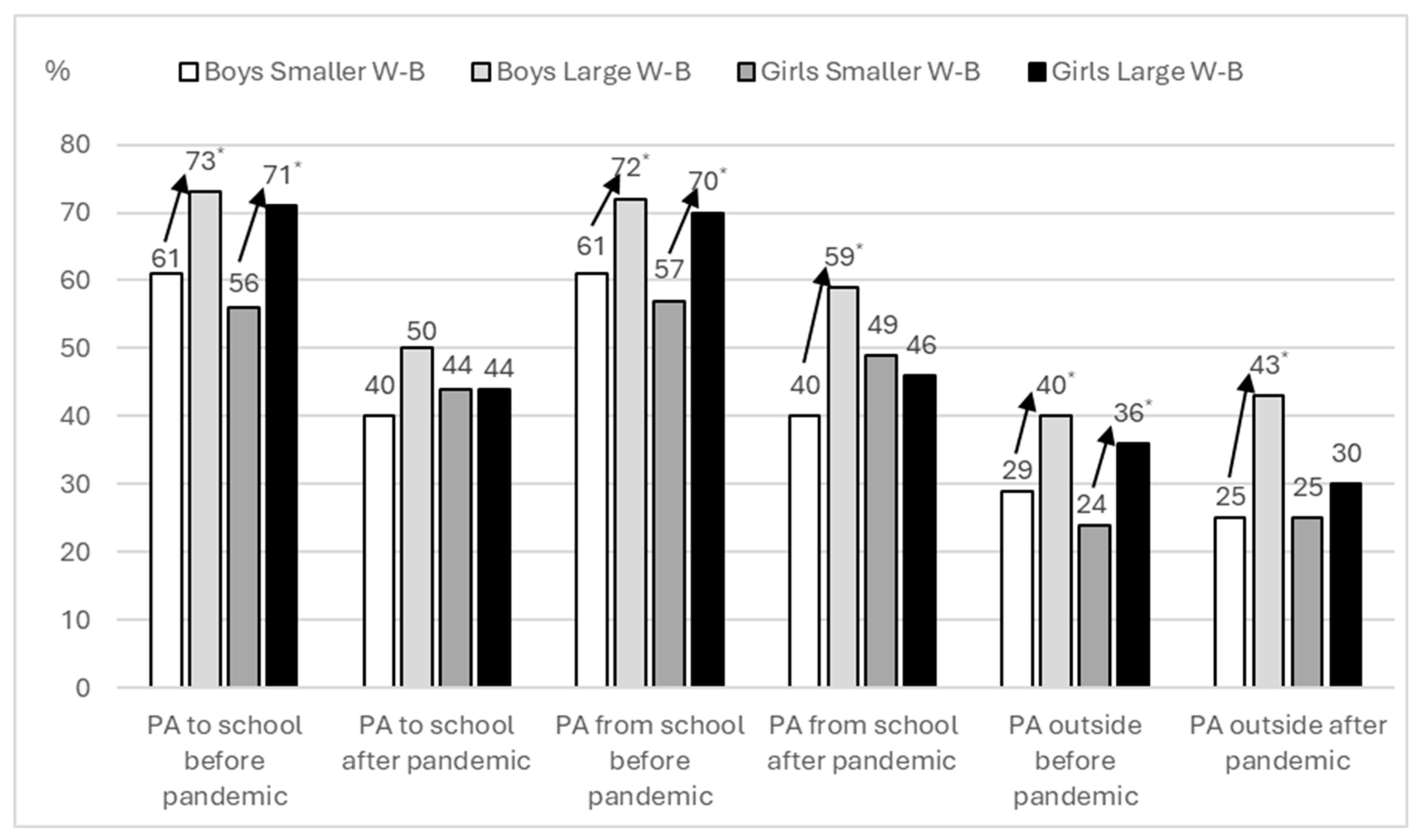
3.5. Differences in the Achievement of PA Recommendations in Boys and Girls with Lower and Higher Well-Being
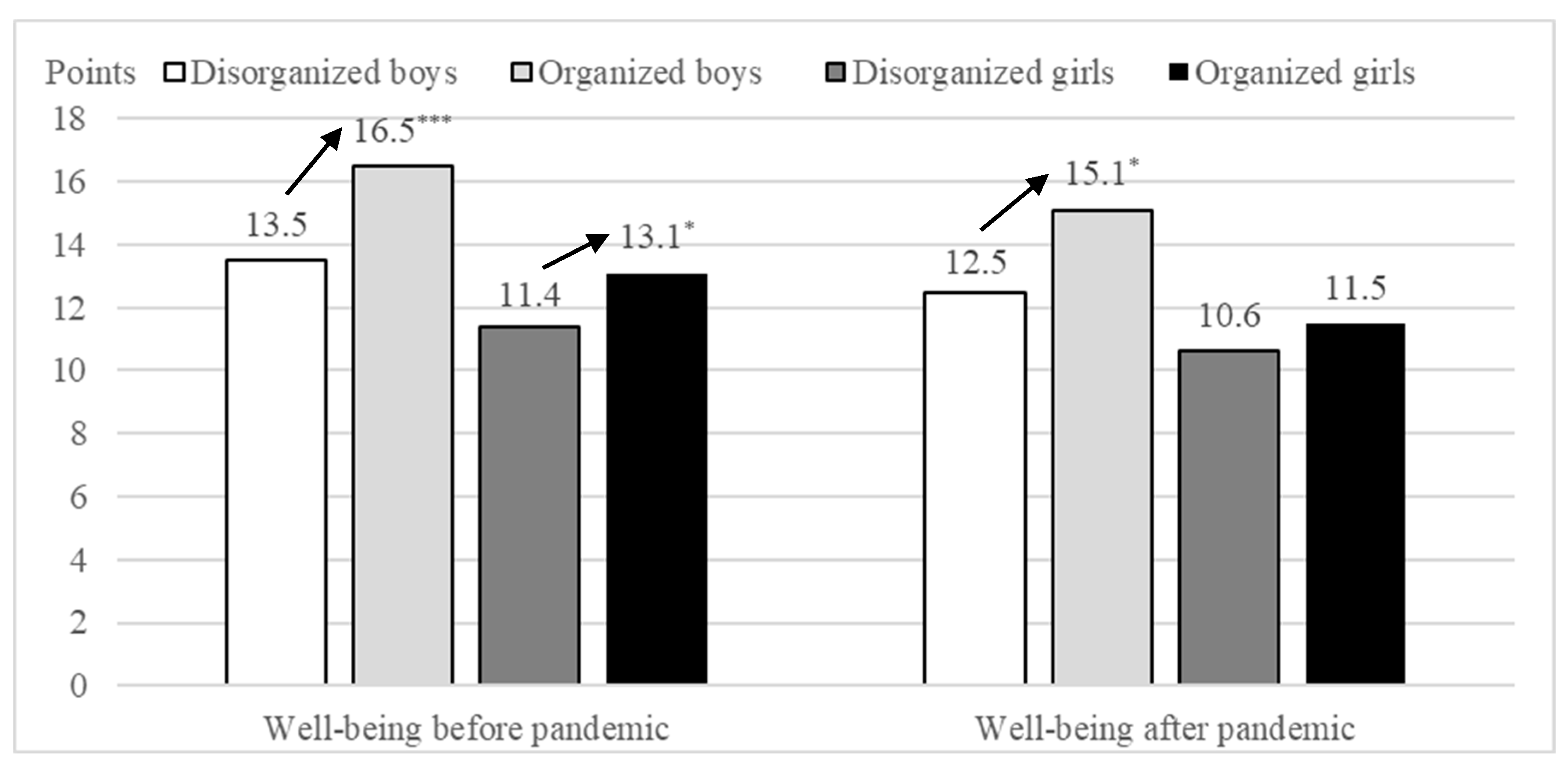
3.6. Well-Being of Boys and Girls Before and After Pandemic According to Participation in Organized Physical Activity
4. Discussion
Strength and Limitations
5. Conclusions
Author Contributions
Funding
Institutional Review Board Statement
Informed Consent Statement
Data Availability Statement
Conflicts of Interest
References
- Strain, T.; Flaxman, S.; Guthold, R.; Semenova, E.; Cowan, M.; Riley, L.M. National, regional, and global trends in insufficient physical activity among adults from 2000 to 2022: A pooled analysis of 507 population-based surveys with 5.7 million participants. Lancet Glob. Health 2024, 12, e123–e134. [Google Scholar] [CrossRef]
- Guthold, R.; Stevens, G.A.; Riley, L.M.; Bull, F.C. Global trends in insufficient physical activity among adolescents: A pooled analysis of 298 population-based surveys with 1.6 million participants. Lancet Child Adolesc. Health 2020, 4, 23–35. [Google Scholar] [CrossRef]
- Aubert, S.; Barnes, J.D.; Demchenko, I.; Hawthorne, M.; Abdeta, C.; Abi Nader, P.; Tremblay, M.S. Global Matrix 4.0 physical activity report card grades for children and adolescents: Results and analyses from 57 countries. J. Phys. Act. Health 2022, 19, 700–728. [Google Scholar] [CrossRef] [PubMed]
- Steene-Johannessen, J.; Hansen, B.H.; Dalene, K.E.; Kolle, E.; Northstone, K.; Møller, N.C.; Grøntved, A.; Wedderkopp, N.; Kriemler, S.; Page, A.S.; et al. Variations in accelerometry measured physical activity and sedentary time across Europe—Harmonized analyses of 47,497 children and adolescents. Int. J. Behav. Nutr. Phys. Act. 2020, 17, 38. [Google Scholar] [CrossRef] [PubMed]
- Do, B.; Kirkland, C.; Besenyi, G.M.; Smock, M.C.; Lanza, K. Youth physical activity and the COVID-19 pandemic: A systematic review. Prev. Med. Rep. 2022, 29, 101959. [Google Scholar] [CrossRef] [PubMed]
- Neville, R.D.; Lakes, K.D.; Hopkins, W.G.; Tarantino, G.; Draper, C.E.; Beck, R. Global changes in child and adolescent physical activity during the COVID-19 pandemic: A systematic review and meta-analysis. JAMA Pediatr. 2022, 176, 886–894. [Google Scholar] [CrossRef]
- Wunsch, K.; Kienberger, K.; Niessner, C. Changes in physical activity patterns due to the COVID-19 pandemic: A systematic review and meta-analysis. Int. J. Environ. Res. Public Health 2022, 19, 2250. [Google Scholar] [CrossRef]
- Stockwell, S.; Trott, M.; Tully, M.; Shin, J.; Barnett, Y.; Butler, L. Changes in physical activity and sedentary behaviours from before to during the COVID-19 pandemic lockdown: A systematic review. BMJ Open Sport Exerc. Med. 2021, 7, e000960. [Google Scholar] [CrossRef]
- Ludwig-Walz, H.; Siemens, W.; Heinisch, S.; Dannheim, I.; Loss, J.; Bujard, M. How the COVID-19 pandemic and related school closures reduce physical activity among children and adolescents in the WHO European region: A systematic review and meta-analysis. Int. J. Behav. Nutr. Phys. Act. 2023, 20, 149. [Google Scholar] [CrossRef]
- Frömel, K.; Groffik, D.; Valach, P.; Šafář, M.; Mitáš, J. The impact of distance education during the COVID-19 pandemic on physical activity and well-being of Czech and Polish adolescents. J. Sch. Health 2022, 92, 1137–1147. [Google Scholar] [CrossRef]
- Bronikowska, M.; Krzysztoszek, J.; Łopatka, M.; Ludwiczak, M.; Pluta, B. Comparison of physical activity levels in youths before and during a pandemic lockdown. Int. J. Environ. Res. Public Health 2021, 18, 5139. [Google Scholar] [CrossRef]
- Artymiak, P.; Żegleń, M.; Kryst, Ł. Analysis of changes in physical fitness in children and adolescents (11–15 years) from Kraków (Poland) during COVID-19 pandemic. J. Phys. Act. Health 2024, 21, 500–507. [Google Scholar] [CrossRef] [PubMed]
- Kauhanen, L.; Wan Mohd Yunus, W.M.A.; Lempinen, L.; Peltonen, K.; Gyllenberg, D.; Mishina, K. A systematic review of the mental health changes of children and young people before and during the COVID-19 pandemic. Eur. Child Adolesc. Psychiatry 2023, 32, 995–1013. [Google Scholar] [CrossRef] [PubMed]
- Samji, H.; Wu, J.; Ladak, A.; Vossen, C.; Stewart, E.; Dove, N. Mental health impacts of the COVID-19 pandemic on children and youth: A systematic review. Child Adolesc. Ment. Health 2022, 27, 173–189. [Google Scholar] [CrossRef] [PubMed]
- Viner, R.; Russell, S.; Saulle, R.; Croker, H.; Stansfield, C.; Packer, J. School closures during social lockdown and mental health, health behaviors, and well-being among children and adolescents during the first COVID-19 wave: A systematic review. JAMA Pediatr. 2022, 176, 400–409. [Google Scholar] [CrossRef]
- Rong, R.; Xu, Q.; Jordan, K.P.; Chen, Y. Perceived epidemic impacts and mental symptom trajectories in adolescents back to school after COVID-19 restriction: A longitudinal latent class analysis. J. Adolesc. Health 2024, 74, 487–495. [Google Scholar] [CrossRef]
- Bozzola, E.; Barni, S.; Ficari, A.; Villani, A. Physical activity in the COVID-19 era and its impact on adolescents’ well-being. Int. J. Environ. Res. Public Health 2023, 20, 3275. [Google Scholar] [CrossRef]
- Frömel, K.; Groffik, D.; Šafář, M.; Mitáš, J. Differences and associations between physical activity motives and types of physical activity among adolescent boys and girls. Biomed Res. Int. 2022, 2022, 6305204. [Google Scholar] [CrossRef]
- Chmelík, F.; Frömel, K.; Groffik, D.; Mitáš, J. Physical activity and life satisfaction among adolescents before and during the COVID-19 pandemic. Acta Psychol. 2023, 241, 104081. [Google Scholar] [CrossRef]
- Dahlen, M.; Thorbjørnsen, H.; Sjåstad, H.; von Heideken Wågert, P.; Hellström, C.; Kerstis, B. Changes in physical activity are associated with corresponding changes in psychological well-being: A pandemic case study. Int. J. Environ. Res. Public Health 2021, 18, 10680. [Google Scholar] [CrossRef]
- Wright, L.J.; Williams, S.E.; Veldhuijzen van Zanten, J.J.C.S. Physical activity protects against the negative impact of coronavirus fear on adolescent mental health and well-being during the COVID-19 pandemic. Front. Psychol. 2021, 12, 580511. [Google Scholar] [CrossRef]
- Abdelbasset, W.K.; Nambi, G.; Eid, M.M.; Elkholi, S.M. Physical activity and mental well-being during COVID-19 pandemic. World J. Psychiatry 2021, 11, 1267–1273. [Google Scholar] [CrossRef] [PubMed]
- Marckhoff, M.; Siebald, M.; Timmesfeld, N.; Janßen, M.; Romer, G.; Föcker, M. Effects of pandemic-related restrictions on physical activity, screen time, and mental well-being in German adolescents. Z. Kinder Jugendpsychiatr. Psychother. 2022, 50, 313–326. [Google Scholar] [CrossRef] [PubMed]
- Lesser, I.A.; Nienhuis, C.P. The impact of COVID-19 on physical activity behavior and well-being of Canadians. Int. J. Environ. Res. Public Health 2020, 17, 3899. [Google Scholar] [CrossRef] [PubMed]
- Hills, A.P.; Dengel, D.R.; Lubans, D.R. Supporting public health priorities: Recommendations for physical education and physical activity promotion in schools. Prog. Cardiovasc. Dis. 2015, 57, 368–374. [Google Scholar] [CrossRef]
- Wang, H.; Pang, J.; Yang, X.; Jia, Y.; Huang, X.; Yu, L.; Hou, X. School-based environment and physical activity in adolescents: A systematic review and meta-analysis. Prev. Med. 2025, 191, 108221. [Google Scholar] [CrossRef]
- Frömel, K.; Svozil, Z.; Chmelík, F.; Jakubec, L.; Groffik, D. The role of physical education lessons and recesses in school lifestyle of adolescents. J. Sch. Health 2016, 86, 143–151. [Google Scholar] [CrossRef]
- Webster, C.A. The comprehensive school physical activity program: An invited review. Am. J. Lifestyle Med. 2023, 17, 762–774. [Google Scholar] [CrossRef]
- Teychenne, M.; Sousa, G.M.; Baker, T.; Liddelow, C.; Babic, M.; Chauntry, A.J.; France-Ratcliffe, M.; Guagliano, J.; Christie, H.E.; Tremaine, E.M.; et al. Domain-specific physical activity and mental health: An updated systematic review and multilevel meta-analysis in a combined sample of 3.3 million people. Br. J. Sports Med. 2026, 60, 267–285. [Google Scholar] [CrossRef]
- Fu, Q.; Li, L.; Li, Q.; Wang, J. The effects of physical activity on the mental health of typically developing children and adolescents: A systematic review and meta-analysis. BMC Public Health 2025, 25, 1514. [Google Scholar] [CrossRef]
- Frömel, K.; Welk, G.; Groffik, D.; Jakubec, L.; Dygrýn, J.; Mitáš, J. Adolescent physical activity during school days: A comparative study before and after COVID-19 pandemic restrictions. Front. Public Health 2025, 13, 1488153. [Google Scholar] [CrossRef] [PubMed]
- Saint-Maurice, P.F.; Welk, G.J. Validity and calibration of the Youth Activity Profile. PLoS ONE 2015, 10, e0143949. [Google Scholar] [CrossRef] [PubMed]
- Cull, A.; Sprangers, M.; Bjordal, K.; Aaronson, N.; West, K.; Bottomley, A. EORTC Quality of Life Group Translation Procedure; EORTC Quality of Life Unit: Brussels, Belgium, 2002. [Google Scholar]
- Jakubec, L.; Dygrýn, J.; Šimůnek, A.; Frömel, K. Validity of the original algorithm for assessing physical activity and sedentary behavior from the Youth Activity Profile in Czech children and adolescents. Tělesná Kultura 2019, 42, 62–69. [Google Scholar] [CrossRef]
- Fairclough, S.J.; Christian, D.L.; Saint-Maurice, P.F.; Hibbing, P.R.; Noonan, R.J.; Welk, G.J. Calibration and validation of the Youth Activity Profile as a physical activity and sedentary behaviour surveillance tool for English youth. Int. J. Environ. Res. Public Health 2019, 16, 3711. [Google Scholar] [CrossRef]
- Saint-Maurice, P.F.; Welk, G.J.; Bartee, R.T.; Heelan, K. Calibration of context-specific survey items to assess youth physical activity behaviour. J. Sports Sci. 2017, 35, 866–872. [Google Scholar] [CrossRef]
- Frömel, K.; Jakubec, L.; Groffik, D.; Chmelík, F.; Svozil, Z.; Šafář, M. Physical activity of secondary school adolescents at risk of depressive symptoms. J. Sch. Health 2020, 90, 641–650. [Google Scholar] [CrossRef]
- Frömel, K.; Groffik, D.; Mitáš, J.; Dygrýn, J.; Valach, P.; Šafář, M. Active travel of Czech and Polish adolescents in relation to their well-being: Support for physical activity and health. Int. J. Environ. Res. Public Health 2020, 17, 2001. [Google Scholar] [CrossRef]
- Topp, C.W.; Østergaard, S.D.; Søndergaard, S.; Bech, P. The WHO-5 well-being index: A systematic review of the literature. Psychother. Psychosom. 2015, 84, 167–176. [Google Scholar] [CrossRef]
- Cohen, J. Statistical Power Analysis for the Behavioral Sciences; Lawrence Erlbaum: Hillsdale, NJ, USA, 1988. [Google Scholar]
- Sheskin, D.J. Handbook of Parametric and Nonparametric Statistical Procedures; Chapman & Hall/CRC: Boca Raton, FL, USA, 2007. [Google Scholar]
- Salway, R.; de Vocht, F.; Emm-Collison, L.; Sansum, K.; House, D.; Walker, R. Comparison of children’s physical activity profiles before and after COVID-19 lockdowns: A latent profile analysis. PLoS ONE 2023, 18, e0289344. [Google Scholar] [CrossRef]
- Matteucci, I.; Corsi, M. Adolescents’ attitudes, habits, identity and social support in relation to physical activity after the COVID-19 pandemic. Sci. Rep. 2024, 14, 11035. [Google Scholar] [CrossRef]
- Eilertsen, M.; Riis, A.; Nielsen, A.; Riel, H. Physical activity levels before and after the COVID-19 restrictions among Danish adolescents: A retrospective cohort study. Scand. J. Public Health 2024, 52, 284–289. [Google Scholar] [CrossRef]
- Hurter, L.; McNarry, M.; Stratton, G.; Mackintosh, K. Back to school after lockdown: The effect of COVID-19 restrictions on children’s device-based physical activity metrics. J. Sport Health Sci. 2022, 11, 530–536. [Google Scholar] [CrossRef]
- Dallolio, L.; Marini, S.; Masini, A.; Toselli, S.; Stagni, R.; Bisi, M.C. The impact of COVID-19 on physical activity behaviour in Italian primary school children: A comparison before and during pandemic considering gender differences. BMC Public Health 2022, 22, 52. [Google Scholar] [CrossRef] [PubMed]
- Greier, K.; Drenowatz, C.; Bischofer, T.; Petrasch, G.; Greier, C.; Cocca, A. Physical activity and sitting time prior to and during COVID-19 lockdown in Austrian high-school students. AIMS Public Health 2021, 8, 531–540. [Google Scholar] [CrossRef] [PubMed]
- Sekulic, D.; Blazevic, M.; Gilic, B.; Kvesic, I.; Zenic, N. Prospective analysis of levels and correlates of physical activity during COVID-19 pandemic and imposed rules of social distancing: A gender-specific study among adolescents from Southern Croatia. Sustainability 2020, 12, 4072. [Google Scholar] [CrossRef]
- Frömel, K.; Mitáš, J.; Groffik, D.; Kudláček, M.; Háp, P. Associations between preference and participation in team sports: Physical activity promotion among adolescents. Front. Public Health 2022, 10, 1024932. [Google Scholar] [CrossRef]
- Groffik, D.; Frömel, K.; Ziemba, M.; Mitáš, J.; Seniow-Chmiel, S. Organized physical activity of secondary school students and university sports science students. Ann. Agric. Environ. Med. 2022, 29, 603–610. [Google Scholar] [CrossRef]
- Groffik, D.; Frömel, K.; Ziemba, M.; Mitáš, J. Trends in physical activity in adolescents participating and not participating in organized team or individual physical activity. Ann. Agric. Environ. Med. 2023, 30, 536–542. [Google Scholar] [CrossRef]
- Lange, K.W.; Nakamura, Y. Lack of physical activity among European children and adolescents following the COVID-19 pandemic. J. Dis. Prev. Health Promot. 2024, 8, 1–4. [Google Scholar] [CrossRef]
- Boden, M.; Zimmerman, L.; Azevedo, K.J.; Ruzek, J.I.; Gala, S.; Abdel Magid, H.S. Addressing the mental health impact of COVID-19 through population health. Clin. Psychol. Rev. 2021, 85, 102006. [Google Scholar] [CrossRef]
- Tilstra, A.M.; Polizzi, A.; Wagner, S.; Akimova, E.T. Projecting the long-term effects of the COVID-19 pandemic on U.S. population structure. Nat. Commun. 2024, 15, 2409. [Google Scholar] [CrossRef] [PubMed]
- Cocca, A.; Greier, K.; Drenowatz, C.; Ruedl, G. Relationship between objectively and subjectively measured physical activity in adolescents during and after COVID-19 restrictions. Behav. Sci. 2021, 11, 177. [Google Scholar] [CrossRef] [PubMed]
- Halldorsdottir, T.; Thorisdottir, I.E.; Meyers, C.C.A.; Asgeirsdottir, B.B.; Kristjansson, A.L.; Valdimarsdottir, H.B. Adolescent well-being amid the COVID-19 pandemic: Are girls struggling more than boys? JCPP Adv. 2021, 1, e12027. [Google Scholar] [CrossRef] [PubMed]
- Myhr, A.; Naper, L.R.; Samarawickrema, I.; Vesterbekkmo, R.K. Impact of COVID-19 pandemic lockdown on mental well-being of Norwegian adolescents during the first wave: Socioeconomic position and gender differences. Front. Public Health 2021, 9, 717747. [Google Scholar] [CrossRef]
- Goto, R.; Piedvache, A.; Hangai, M.; Yamaoka, Y.; Sampei, M.; Sawada, N. Time trends in emotional well-being and self-esteem in children and adolescents during the COVID-19 pandemic. Child Adolesc. Psychiatry Ment. Health 2022, 16, 89. [Google Scholar] [CrossRef]
- Buecker, S.; Simacek, T.; Ingwersen, B.; Terwiel, S.; Simonsmeier, B.A. Physical activity and subjective well-being in healthy individuals: A meta-analytic review. Health Psychol. Rev. 2021, 15, 574–592. [Google Scholar] [CrossRef]
- Costigan, S.A.; Lubans, D.R.; Lonsdale, C.; Sanders, T.; Del Pozo Cruz, B. Associations between physical activity intensity and well-being in adolescents. Prev. Med. 2019, 125, 55–61. [Google Scholar] [CrossRef]
- Wicker, P.; Frick, B. The relationship between intensity and duration of physical activity and subjective well-being. Eur. J. Public Health 2015, 25, 868–872. [Google Scholar] [CrossRef]
- Marques, A.; Peralta, M.; Martins, J.; Catunda, R.; Matos, M.G.; Saboga Nunes, L. Associations between physical activity and self-rated wellbeing in European adults: A population-based, cross-sectional study. Prev. Med. 2016, 91, 18–23. [Google Scholar] [CrossRef]
- McMahon, E.M.; Corcoran, P.; O’Regan, G.; Keeley, H.; Cannon, M.; Carli, V.; Wasserman, C. Physical activity in European adolescents and associations with anxiety, depression and well-being. Eur. Child Adolesc. Psychiatry 2017, 26, 111–122. [Google Scholar] [CrossRef]
- Wan, H.; Huang, W.; Zhang, W.; Hu, C. Exploring adolescents’ social anxiety, physical activity, and core self-evaluation: A latent profile and mediation approach. Int. J. Ment. Health Promot. 2025, 27, 10. [Google Scholar] [CrossRef]



| Physical Activity | Boys | Girls | H | p | η2 | ||||||
|---|---|---|---|---|---|---|---|---|---|---|---|
| Before (n = 306) | After (n = 124) | Before (n = 338) | After (n = 233) | ||||||||
| M | SD | M | SD | M | SD | M | SD | ||||
| Days | |||||||||||
| Before school | 2.20 | 1.50 | 1.66 | 1.20 | 0.81 | 1.28 | 0.71 | 1.30 | 25.50 a | <0.001 | 0.023 * |
| To school | 2.95 | 1.62 | 2.05 | 1.88 | 2.79 | 1.66 | 2.18 | 1.81 | 43.34 a,b | <0.001 | 0.040 * |
| From school | 2.99 | 1.59 | 2.24 | 1.85 | 2.86 | 1.62 | 2.46 | 1.74 | 26.58 a,b | <0.001 | 0.024 * |
| After school | 2.29 | 1.43 | 1.87 | 1.49 | 1.88 | 1.47 | 1.77 | 1.45 | 20.99 a | <0.001 | 0.018 * |
| Evenings | 2.12 | 1.50 | 1.85 | 1.54 | 1.74 | 1.46 | 1.71 | 1.44 | 13.49 a | 0.004 | 0.011 * |
| Time (average use of the time for physical activity) | |||||||||||
| During PE | 4.07 | 1.17 | 3.80 | 1.52 | 3.43 | 1.43 | 3.67 | 1.20 | 47.34 | <0.001 | 0.044 * |
| During breaks | 2.38 | 1.46 | 1.89 | 1.20 | 1.80 | 1.26 | 1.80 | 1.19 | 34.94 a | <0.001 | 0.032 * |
| During lunch breaks | 2.10 | 1.59 | 1.47 | 1.48 | 1.61 | 1.43 | 1.31 | 1.29 | 38.35 a | <0.001 | 0.035 * |
| Statements | Boys | Girls | H | p | η2 | ||||||
|---|---|---|---|---|---|---|---|---|---|---|---|
| Before (n = 306) | After (n = 124) | Before (n = 338) | After (n = 233) | ||||||||
| M | SD | M | SD | M | SD | M | SD | ||||
| 3.51 | 1.14 | 3.16 | 1.14 | 3.10 | 1.27 | 2.76 | 1.14 | 57.05 a,b | <0.001 | 0.054 * |
| 3.08 | 1.27 | 2.84 | 1.20 | 2.38 | 1.35 | 2.03 | 1.21 | 92.93 b | <0.001 | 0.090 ** |
| 3.45 | 1.28 | 2.84 | 1.27 | 2.68 | 1.50 | 2.30 | 1.26 | 97.90 a,b | <0.001 | 0.095 ** |
| 2.26 | 1.56 | 2.10 | 1.43 | 1.61 | 1.45 | 1.50 | 1.38 | 48.64 | <0.001 | 0.046 * |
| 3.17 | 1.43 | 2.95 | 1.40 | 2.61 | 1.56 | 2.50 | 1.37 | 34.96 | <0.001 | 0.032 * |
| Summary raw score | 15.47 | 4.76 | 13.90 | 4.87 | 12.38 | 5.62 | 11.09 | 4.82 | 103.43 a,b | <0.001 | 0.101 * |
| Physical Activity Levels | Boys | Girls | ||||||||
|---|---|---|---|---|---|---|---|---|---|---|
| Before % | After % | χ2 | p | r | Before % | After % | χ2 | p | r | |
| Days | ||||||||||
| Before school (1 day) | 47 | 30 | 10.74 | 0.001 | 0.158 | 36 | 29 | 2.85 | 0.091 | 0.071 |
| To school (≥4 days) | 67 | 44 | 18.92 | <0.001 | 0.210 | 61 | 44 | 15.01 | <0.001 | 0.162 * |
| From school (≥4 days) | 67 | 48 | 12.44 | <0.001 | 0.170 | 61 | 48 | 9.71 | 0.002 | 0.130 * |
| After school or evenings (≥4 days) | 35 | 33 | 0.10 | 0.755 | 0.015 | 28 | 26 | 0.26 | 0.612 | 0.021 |
| Time (use of the time for physical activity) | ||||||||||
| During PE lessons (lot of the time) | 76 | 73 | 0.72 | 0.397 | 0.041 | 57 | 69 | 8.03 | 0.005 | 0.119 * |
| During breaks (moderate/average) | 46 | 31 | 8.30 | 0.004 | 0.139 | 28 | 27 | 0.01 | 0.928 | 0.004 |
| During lunch breaks (moderate/average) | 41 | 24 | 10.62 | 0.001 | 0.157 | 28 | 19 | 6.37 | 0.012 | 0.106 * |
Disclaimer/Publisher’s Note: The statements, opinions and data contained in all publications are solely those of the individual author(s) and contributor(s) and not of MDPI and/or the editor(s). MDPI and/or the editor(s) disclaim responsibility for any injury to people or property resulting from any ideas, methods, instructions or products referred to in the content. |
© 2026 by the authors. Licensee MDPI, Basel, Switzerland. This article is an open access article distributed under the terms and conditions of the Creative Commons Attribution (CC BY) license.
Share and Cite
Groffik, D.; Frömel, K.; Ziemba, M. Changes in School-Based Physical Activity and Well-Being Among Adolescents Before and After the COVID-19 Pandemic. Healthcare 2026, 14, 836. https://doi.org/10.3390/healthcare14070836
Groffik D, Frömel K, Ziemba M. Changes in School-Based Physical Activity and Well-Being Among Adolescents Before and After the COVID-19 Pandemic. Healthcare. 2026; 14(7):836. https://doi.org/10.3390/healthcare14070836
Chicago/Turabian StyleGroffik, Dorota, Karel Frömel, and Mateusz Ziemba. 2026. "Changes in School-Based Physical Activity and Well-Being Among Adolescents Before and After the COVID-19 Pandemic" Healthcare 14, no. 7: 836. https://doi.org/10.3390/healthcare14070836
APA StyleGroffik, D., Frömel, K., & Ziemba, M. (2026). Changes in School-Based Physical Activity and Well-Being Among Adolescents Before and After the COVID-19 Pandemic. Healthcare, 14(7), 836. https://doi.org/10.3390/healthcare14070836