

Ultra-Processed Food Consumption and Domain-Specific Quality of Life in Postmenopausal Women: Associations with Mobility and Mental Health

 , ,
, ,
Highlights
- Higher ultra-processed food consumption was associated with selective impairments in mobility and anxiety/depression among postmenopausal women, while no consistent association was observed for the overall EQ-5D index score.
- Domain-specific quality-of-life assessments revealed associations that were not captured by summary index measures.
- These findings highlight the importance of domain-specific approaches when evaluating diet-related quality-of-life outcomes in postmenopausal women.
- These findings suggest a potential association between higher ultra-processed food intake and poorer mobility and mental health among postmenopausal women.
Abstract
1. Introduction
2. Materials and Methods
2.1. Study Design and Data Source
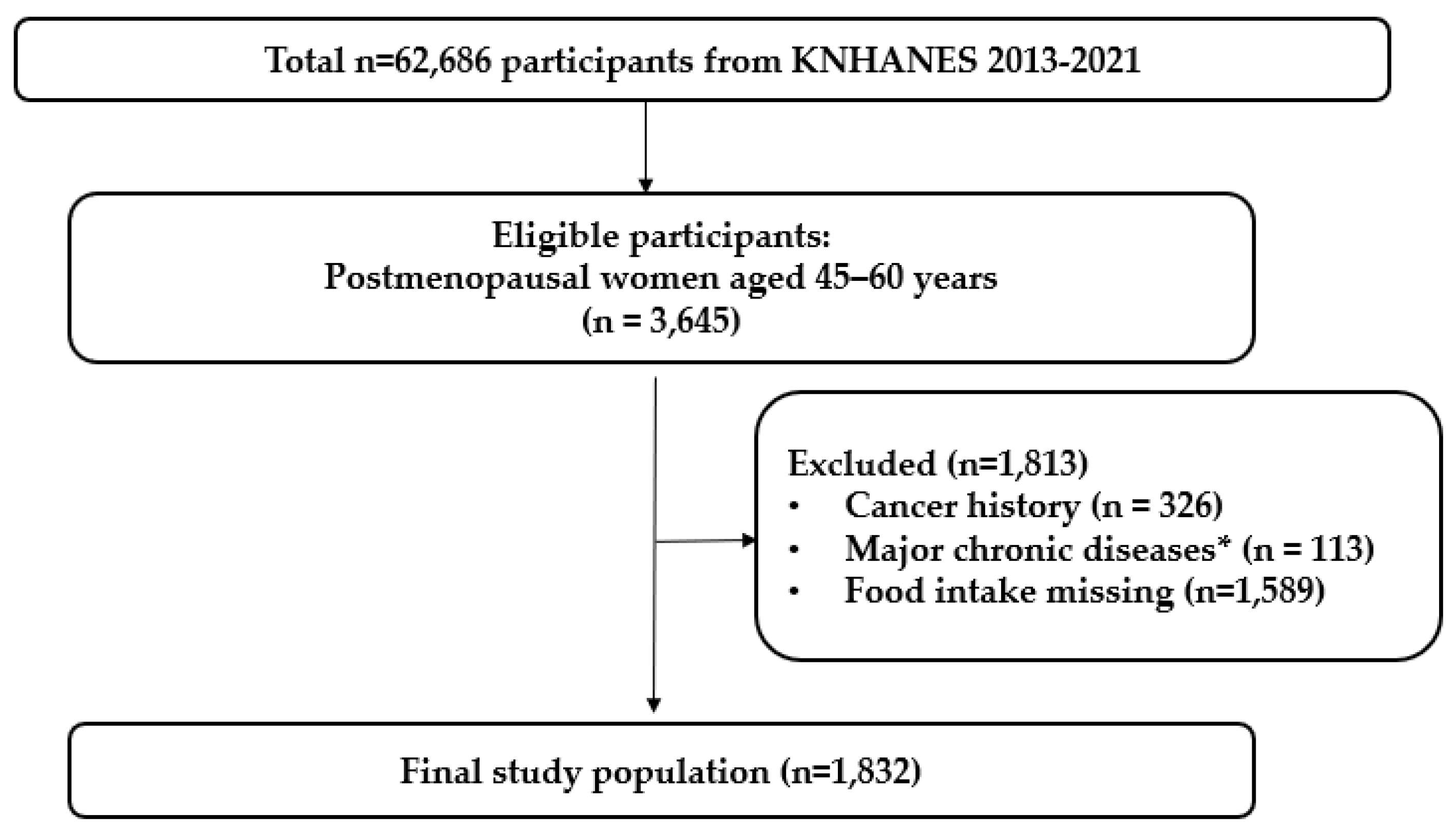
2.2. Study Population
2.3. Assessment of Ultra-Processed Food Consumption
2.4. Assessment of Health-Related Quality of Life
2.5. Main Outcomes: EQ-5D Domains
2.6. Secondary Outcome: EQ-5D Index Score
2.7. Covariates
2.8. Statistical Analysis
- Model 1 adjusted for age, educational attainment, household income, and marital status.
- Model 2 additionally adjusted for smoking status, alcohol consumption, physical activity, and total energy intake.
- Model 3 additionally adjusted for BMI, hypertension, diabetes, dyslipidemia, and menopausal duration.
3. Results
3.1. Baseline Characteristics of the Study Population
3.2. Associations Between Ultra-Processed Food Consumption and Domain-Specific EQ-5D Outcomes
3.2.1. Mobility
3.2.2. Anxiety/Depression
3.2.3. Other EQ-5D Domains
3.3. Secondary Analysis: EQ-5D Index Score
4. Discussion
5. Conclusions
Author Contributions
Funding
Institutional Review Board Statement
Informed Consent Statement
Data Availability Statement
Conflicts of Interest
Abbreviations
| BMI | Body Mass Index |
| CI | Confidence Interval |
| EQ-5D | EuroQol Five-Dimension Questionnaire |
| HRQoL | Health-Related Quality of Life |
| IQR | Interquartile Range |
| KNHANES | Korea National Health and Nutrition Examination Survey |
| NOVA | NOVA Food Classification System |
| OR | Odds Ratio |
| Q1–Q4 | Quartiles 1 to 4 |
| UPF | Ultra-Processed Food(s) |
References
- Monteiro, C.A.; Cannon, G.; Levy, R.B.; Moubarac, J.-C.; Louzada, M.L.; Rauber, F.; Khandpur, N.; Cediel, G.; Neri, D.; Martinez-Steele, E.; et al. Ultra-processed foods: What they are and how to identify them. Public Health Nutr. 2019, 22, 936–941. [Google Scholar] [CrossRef] [Scilit] [PubMed]
- Popkin, B.M.; Miles, D.R.; Taillie, L.S.; Dunford, E.K. A policy approach to identifying food and beverage products that are ultra-processed and high in added salt, sugar and saturated fat in the United States: A cross-sectional analysis of packaged foods. Lancet Reg. Health–Am. 2024, 32, 100713. [Google Scholar] [CrossRef] [Scilit] [PubMed]
- Pagliai, G.; Dinu, M.; Madarena, M.P.; Bonaccio, M.; Iacoviello, L.; Sofi, F. Consumption of ultra-processed foods and health status: A systematic review and meta-analysis. Br. J. Nutr. 2021, 125, 308–318. [Google Scholar] [CrossRef] [Scilit] [PubMed]
- Liang, S.; Zhou, Y.; Zhang, Q.; Yu, S.; Wu, S. Ultra-processed foods and risk of all-cause mortality: An updated systematic review and dose-response meta-analysis of prospective cohort studies. Syst. Rev. 2025, 14, 53. [Google Scholar] [CrossRef] [Scilit]
- Mazloomi, S.N.; Talebi, S.; Mehrabani, S.; Bagheri, R.; Ghavami, A.; Zarpoosh, M.; Mohammadi, H.; Wong, A.; Nordvall, M.; Kermani, M.A.H.; et al. The association of ultra-processed food consumption with adult mental health disorders: A systematic review and dose-response meta-analysis of 260,385 participants. Nutr. Neurosci. 2023, 26, 913–931. [Google Scholar] [CrossRef] [Scilit]
- Lane, M.M.; Gamage, E.; Du, S.; Ashtree, D.N.; McGuinness, A.J.; Gauci, S.; Baker, P.; Lawrence, M.; Rebholz, C.M.; Srour, B.; et al. Ultra-processed food exposure and adverse health outcomes: Umbrella review of epidemiological meta-analyses. BMJ 2024, 384, e077310. [Google Scholar] [CrossRef] [Scilit]
- Hosseininasab, D.; Shiraseb, F.; Bahrampour, N.; da Silva, A.; Hajinasab, M.M.; Bressan, J.; Mirzaei, K. Ultra-processed food consumption and quality of life: A cross-sectional study in Iranian women. Front. Public Health 2024, 12, 1351510. [Google Scholar] [CrossRef] [Scilit]
- Matthews, K.A.; Bromberger, J.T. Does the menopausal transition affect health-related quality of life? Am. J. Med. 2005, 118, 25–36. [Google Scholar] [CrossRef] [Scilit]
- Kuck, M.J.; Hogervorst, E. Stress, depression, and anxiety: Psychological complaints across menopausal stages. Front. Psychiatry 2024, 15, 1323743. [Google Scholar] [CrossRef] [Scilit]
- Megari, K. Quality of life in chronic disease patients. Health Psychol. Res. 2013, 1, e27. [Google Scholar] [CrossRef] [Scilit]
- Devlin, N.J.; Brooks, R. EQ-5D and the EuroQol Group: Past, present and future. Appl. Health Econ. Health Policy 2017, 15, 127–137. [Google Scholar] [CrossRef] [Scilit] [PubMed]
- Janssen, M.F.; Pickard, A.S.; Golicki, D.; Gudex, C.; Niewada, M.; Scalone, L.; Swinburn, P.; Busschbach, J. Measurement properties of the EQ-5D-5L compared to the EQ-5D-3L across eight patient groups: A multi-country study. Qual. Life Res. 2013, 22, 1717–1727. [Google Scholar] [CrossRef] [Scilit] [PubMed]
- Tseng, L.A.; El Khoudary, S.R.; Young, E.A.; Farhat, G.N.; Sowers, M.; Sutton-Tyrrell, K.; Newman, A.B. The association of menopause status with physical function: The Study of Women’s Health across the Nation. Menopause 2012, 19, 1186–1192. [Google Scholar] [CrossRef] [Scilit] [PubMed]
- Bromberger, J.T.; Kravitz, H.M. Mood and menopause: Findings from the Study of Women’s Health across the Nation (SWAN) over 10 years. Obstet. Gynecol. Clin. N. Am. 2011, 38, 609–625. [Google Scholar] [CrossRef] [Scilit]
- Hosseinpour-Niazi, S.; Niknam, M.; Amiri, P.; Mirmiran, P.; Ainy, E.; Izadi, N.; Gaeini, Z.; Azizi, F. The association between ultra-processed food consumption and health-related quality of life differs across lifestyle and socioeconomic strata. BMC Public Health 2024, 24, 1955. [Google Scholar] [CrossRef] [Scilit]
- Ertaş Öztürk, Y.E.; Uzdil, Z. Ultra-processed food consumption is linked to quality of life and mental distress among university students. PeerJ 2025, 13, e19931. [Google Scholar] [CrossRef] [Scilit]
- da Silva, D.C.G.; Fiates, G.M.R.; Botelho, A.M.; Vieira, F.G.K.; Medeiros, K.J.; Willecke, R.G.; Longo, G.Z. Food consumption according to degree of food processing, behavioral variables, and sociodemographic factors: Findings from a population-based study in Brazil. Nutrition 2022, 93, 111505. [Google Scholar] [CrossRef] [Scilit]
- Kweon, S.; Kim, Y.; Jang, M.J.; Kim, Y.; Kim, K.; Choi, S.; Chun, C.; Khang, Y.-H.; Oh, K. Data resource profile: The Korea national health and nutrition examination survey (KNHANES). Int. J. Epidemiol. 2014, 43, 69–77. [Google Scholar] [CrossRef] [Scilit]
- Petrus, R.R.; do Amaral Sobral, P.J.; Tadini, C.C.; Gonçalves, C.B. The NOVA classification system: A critical perspective in food science. Trends Food Sci. Technol. 2021, 116, 603–608. [Google Scholar] [CrossRef] [Scilit]
- Park, H.J.; Park, S.; Kim, J.Y. Development of Korean NOVA food classification and estimation of ultra-processed food intake among adults: Using 2018 Korea National Health and Nutrition Examination Survey. Korean J. Community Nutr. 2022, 27, 455–467. [Google Scholar] [CrossRef] [Scilit]
- Office of Disease Prevention and Health Promotion. Physical Activity Guidelines for Americans. Available online: https://odphp.health.gov/our-work/nutrition-physical-activity/physical-activity-guidelines (accessed on 12 January 2025).
- Pellegrino, A.; Tiidus, P.M.; Vandenboom, R. Mechanisms of estrogen influence on skeletal muscle: Mass, regeneration, and mitochondrial function. Sports Med. 2022, 52, 2853–2869. [Google Scholar] [CrossRef] [Scilit] [PubMed]
- Kityo, A.; Choi, B.; Lee, J.-E.; Kim, C.; Lee, S.-A. Association of ultra-processed food-related metabolites with selected biochemical markers in the UK Biobank. Nutr. J. 2025, 24, 21. [Google Scholar] [CrossRef] [Scilit] [PubMed]
- Tristan Asensi, M.; Napoletano, A.; Sofi, F.; Dinu, M. Low-grade inflammation and ultra-processed foods consumption: A review. Nutrients 2023, 15, 1546. [Google Scholar] [CrossRef] [Scilit] [PubMed]
- Costamagna, D.; Costelli, P.; Sampaolesi, M.; Penna, F. Role of inflammation in muscle homeostasis and myogenesis. Mediat. Inflamm. 2015, 2015, 805172. [Google Scholar] [CrossRef] [Scilit]
- Fink, G.; Sumner, B.E.; Rosie, R.; Grace, O.; Quinn, J.P. Estrogen control of central neurotransmission: Effect on mood, mental state, and memory. Cell. Mol. Neurobiol. 1996, 16, 325–344. [Google Scholar] [CrossRef] [Scilit]
- Verberne, A.J.M.; Sabetghadam, A.; Korim, W.S. Neural pathways that control the glucose counterregulatory response. Front. Neurosci. 2014, 8, 38. [Google Scholar] [CrossRef] [Scilit]
- Tarr, A.J.; Chen, Q.; Wang, Y.; Sheridan, J.F.; Quan, N. Neural and behavioral responses to low-grade inflammation. Behav. Brain Res. 2012, 235, 334–341. [Google Scholar] [CrossRef] [Scilit]
- Minihane, A.M.; Vinoy, S.; Russell, W.R.; Baka, A.; Roche, H.M.; Tuohy, K.M.; Teeling, J.L.; Blaak, E.E.; Fenech, M.; Vauzour, D.; et al. Low-grade inflammation, diet composition and health: Current research evidence and its translation. Br. J. Nutr. 2015, 114, 999–1012. [Google Scholar] [CrossRef] [Scilit]
- Rondinella, D.; Raoul, P.C.; Valeriani, E.; Venturini, I.; Cintoni, M.; Severino, A.; Galli, F.S.; Mora, V.; Mele, M.C.; Cammarota, G.; et al. The detrimental impact of ultra-processed foods on the human gut microbiome and gut barrier. Nutrients 2025, 17, 859. [Google Scholar] [CrossRef] [Scilit]
- Satija, A.; Yu, E.; Willett, W.C.; Hu, F.B. Understanding nutritional epidemiology and its role in policy. Adv. Nutr. 2015, 6, 5–18. [Google Scholar] [CrossRef] [Scilit]
- Lee, K.W.; Cho, M.S. The traditional Korean dietary pattern is associated with decreased risk of metabolic syndrome: Findings from the Korean National Health and Nutrition Examination Survey, 1998–2009. J. Med. Food 2014, 17, 43–56. [Google Scholar] [CrossRef] [Scilit] [PubMed]



| Quartile of %Total Food Intake from UPF | ||||||
|---|---|---|---|---|---|---|
| Total (n = 1832) | Q1 (n = 458) | Q2 (n = 458) | Q3 (n = 458) | Q4 (n = 458) | p-Value | |
| %UPF in total food intake, median (IQR) | 7.99 (3.02, 15.85) | 1.32 (0.63, 2.06) | 5.22 (4.10, 6.37) | 10.82 (9.21, 12.96) | 25.33 (19.27, 36.80) | |
| EQ5D index | 0.95 ± 0.09 | 0.96 ± 0.07 | 0.96 ± 0.07 | 0.94 ± 0.10 | 0.95 ± 0.09 | 0.002 |
| EQ5D domains (any problem), n (%) | ||||||
| Mobility | 182 (9.63) | 38 (7.13) | 35 (6.63) | 57 (11.60) | 52 (13.01) | 0.003 |
| Self-care | 31 (1.57) | 6 (1.44) | 7 (0.97) | 9 (2.01) | 9 (1.85) | 0.640 |
| Usual activities | 85 (4.59) | 18 (4.02) | 21 (3.54) | 23 (4.75) | 23 (6.01) | 0.377 |
| Pain/Discomfort | 490 (27.16) | 111 (23.47) | 125 (28.06) | 126 (27.63) | 128 (29.44) | 0.316 |
| Anxiety/Depression | 189 (10.34) | 39 (8.09) | 42 (8.80) | 58 (13.22) | 50 (11.19) | 0.089 |
| Age (years) | 54.82 ± 3.55 | 54.92 ± 3.38 | 55.09 ± 3.62 | 54.86 ± 3.57 | 54.42 ± 3.58 | 0.033 |
| Educational attainment | 0.032 | |||||
| ≤Elementary school | 239 (11.44) | 51 (9.77) | 53 (9.63) | 64 (12.23) | 71 (14.05) | |
| Middle school | 321 (17.31) | 71 (13.86) | 87 (20.14) | 71 (14.88) | 92 (20.34) | |
| High school | 776 (44.95) | 205 (48.51) | 192 (41.82) | 195 (45.51) | 184 (43.94) | |
| ≥College | 494 (26.30) | 131 (27.87) | 125 (28.41) | 127 (27.39) | 111 (21.67) | |
| Household income | 0.785 | |||||
| Lowest | 153 (8.12) | 31 (8.08) | 38 (8.36) | 39 (8.10) | 45 (9.24) | |
| Lower-middle | 426 (22.94) | 105 (21.39) | 98 (21.48) | 106 (23.15) | 117 (25.61) | |
| Upper-middle | 516 (27.88) | 135 (28.48) | 127 (27.74) | 123 (27.12) | 131 (28.18) | |
| Highest | 731 (41.06) | 187 (43.36) | 191 (42.42) | 189 (41.63) | 164 (36.97) | |
| Marital status | 0.484 | |||||
| Married | 1811 (98.97) | 452 (99.00) | 456 (99.52) | 450 (98.48) | 453 (98.90) | |
| Not married | 21 (1.03) | 6 (1.00) | 2 (0.48) | 8 (1.52) | 5 (1.10) | |
| Smoking status | 0.003 | |||||
| Smokers | 79 (4.44) | 12 (2.49) | 19 (3.70) | 4 (3.48) | 34 (7.98) | |
| Non-smokers | 1753 (95.56) | 446 (97.51) | 439 (96.30) | 444 (96.52) | 424 (92.02) | |
| Alcohol consumption | <0.001 | |||||
| At least once per month | 759 (43.51) | 157 (34.46) | 164 (38.81) | 178 (41.19) | 260 (59.19) | |
| Less than once per month | 1068 (56.49) | 300 (65.54) | 293 (61.19) | 280 (58.81) | 195 (40.81) | |
| Physical activity * | 0.246 | |||||
| High | 804 (44.01) | 187 (41.83) | 203 (44.55) | 222 (48.15) | 192 (41.55) | |
| Low | 1027 (55.99) | 270 (58.17) | 255 (55.45) | 236 (51.85) | 266 (58.45) | |
| Total energy intake, kcal/day | 1816.33 ± 704.40 | 1858.95 ± 724.53 | 1816.59 ± 686.52 | 1837.48 ± 739.00 | 1753.77 ± 660.94 | 0.083 |
| Body mass index (kg/m2) | 23.70 ± 3.31 | 23.38 ± 3.22 | 23.57 ± 3.07 | 23.84 ± 3.52 | 24.02 ± 3.36 | 0.005 |
| Hypertension | 0.038 | |||||
| Yes | 335 (18.54) | 93 (22.09) | 64 (13.79) | 94 (18.83) | 84 (19.34) | |
| No | 1497 (81.46) | 365 (77.91) | 394 (86.21) | 364 (81.17) | 374 (80.66) | |
| Diabetes mellitus | 0.441 | |||||
| Yes | 101 (5.63) | 32 (7.46) | 23 (5.28) | 25 (4.99) | 21 (4.80) | |
| No | 1731 (94.37) | 426 (92.54) | 435 (94.72) | 433 (95.01) | 437 (95.20) | |
| Dyslipidemia | 0.169 | |||||
| Yes | 434 (23.64) | 119 (27.88) | 104 (22.03) | 109 (23.25) | 102 (21.43) | |
| No | 1398 (76.36) | 339 (72.12) | 354 (77.97) | 349 (76.75) | 356 (78.57) | |
| Duration since menopause (years) | 5.66 ± 4.39 | 5.65 ± 4.47 | 5.75 ± 4.29 | 5.67 ± 4.22 | 5.59 ± 4.55 | 0.800 |
| Quartile of %Total Food Intake from UPF | |||||
|---|---|---|---|---|---|
| Q1 | Q2 | Q3 | Q4 | p for Trend | |
| Outcome: EQ-5D index (lowest 20%) * | |||||
| No. of cases (%) | 142 (29.54) | 151 (33.29) | 160 (35.56) | 152 (34.81) | |
| Crude | reference | 1.19 (0.87, 1.63) | 1.32 (0.97, 1.79) | 1.27 (0.93, 1.73) | 0.098 |
| Model 1 | reference | 1.18 (0.86, 1.62) | 1.28 (0.93, 1.75) | 1.18 (0.86, 1.62) | 0.251 |
| Model 2 | reference | 1.15 (0.83, 1.58) | 1.27 (0.92, 1.74) | 1.12 (0.81, 1.54) | 0.407 |
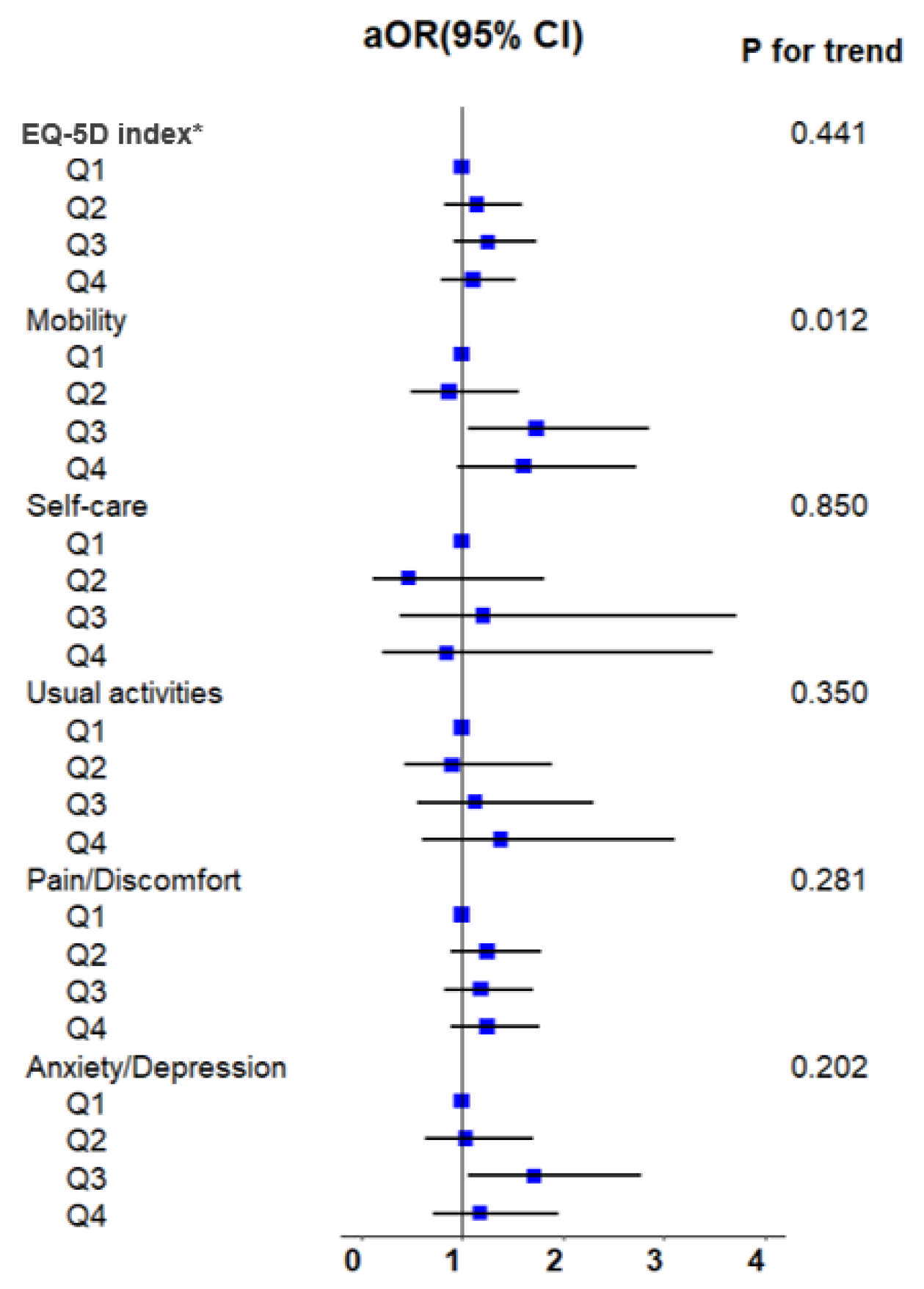
| Model 3 | reference | 1.15 (0.83, 1.60) | 1.26 (0.92, 1.73) | 1.11 (0.80, 1.53) | 0.441 |
| Outcome: EQ-5D domain (Mobility) | |||||
| No. of cases (%) | 38 (7.13) | 35 (6.63) | 57 (11.60) | 52 (13.01) | |
| Crude | reference | 0.93 (0.54, 1.59) | 1.71 (1.08, 2.72) | 1.95 (1.21, 3.13) | <0.001 |
| Model 1 | reference | 0.87 (0.50, 1.51) | 1.66 (1.04, 2.65) | 1.69 (1.04, 2.77) | 0.006 |
| Model 2 | reference | 0.82 (0.47, 1.45) | 1.72 (1.06, 2.77) | 1.54 (0.92, 2.58) | 0.016 |
| Model 3 | reference | 0.87 (0.49, 1.56) | 1.74 (1.06, 2.86) | 1.61 (0.95, 2.73) | 0.012 |
| Outcome: EQ-5D domain (Self-care) | |||||
| No. of cases (%) | 6 (1.44) | 7 (0.97) | 9 (2.01) | 9 (1.85) | |
| Crude | reference | 0.67 (0.20, 2.29) | 1.40 (0.45, 4.39) | 1.30 (0.39, 4.32) | 0.455 |
| Model 1 | reference | 0.66 (0.19, 2.31) | 1.29 (0.42, 4.00) | 1.05 (0.31, 3.61) | 0.694 |
| Model 2 | reference | 0.51 (0.13, 2.02) | 1.27 (0.40, 3.99) | 0.91 (0.21, 3.82) | 0.818 |
| Model 3 | reference | 0.47 (0.12, 1.82) | 1.21 (0.39, 3.72) | 0.85 (0.21, 3.48) | 0.850 |
| Outcome: EQ-5D domain (Usual activities) | |||||
| No. of cases (%) | 18 (4.02) | 21 (3.54) | 23 (4.75) | 23 (6.01) | |
| Crude | reference | 0.88 (0.44, 1.76) | 1.19 (0.60, 2.37) | 1.53 (0.75, 3.12) | 0.177 |
| Model 1 | reference | 0.89 (0.43, 1.82) | 1.12 (0.56, 2.22) | 1.36 (0.64, 2.89) | 0.341 |
| Model 2 | reference | 0.88 (0.42, 1.82) | 1.10 (0.54, 2.23) | 1.32 (0.59, 2.96) | 0.403 |
| Model 3 | reference | 0.90 (0.43, 1.89) | 1.13 (0.55, 2.31) | 1.38 (0.61, 3.11) | 0.350 |
| Outcome: EQ-5D domain (Pain/Discomfort) | |||||
| No. of cases (%) | 111 (23.47) | 125 (28.06) | 126 (27.63) | 128 (29.44) | |
| Crude | reference | 1.27 (0.91, 1.79) | 1.24 (0.88, 1.76) | 1.36 (0.97, 1.90) | 0.098 |
| Model 1 | reference | 1.27 (0.90, 1.79) | 1.20 (0.85, 1.71) | 1.28 (0.91, 1.79) | 0.225 |
| Model 2 | reference | 1.25 (0.88, 1.76) | 1.19 (0.84, 1.70) | 1.25 (0.89, 1.77) | 0.262 |
| Model 3 | reference | 1.25 (0.88, 1.79) | 1.19 (0.83, 1.70) | 1.25 (0.88, 1.77) | 0.281 |
| Outcome: EQ-5D domain (Anxiety/Depression) | |||||
| No. of cases (%) | 39 (8.09) | 42 (8.80) | 58 (13.22) | 50 (11.19) | |
| Crude | reference | 1.10 (0.67, 1.78) | 1.73 (1.08, 2.76) | 1.43 (0.89, 2.30) | 0.043 |
| Model 1 | reference | 1.06 (0.65, 1.74) | 1.67 (1.03, 2.70) | 1.32 (0.81, 2.15) | 0.101 |
| Model 2 | reference | 1.04 (0.63, 1.71) | 1.67 (1.03, 2.72) | 1.16 (0.71, 1.91) | 0.245 |
| Model 3 | reference | 1.04 (0.64, 1.70) | 1.71 (1.06, 2.77) | 1.18 (0.72, 1.95) | 0.202 |
| Quartile of %Total Food Intake from UPF | |||||
|---|---|---|---|---|---|
| Q1 | Q2 | Q3 | Q4 | p for Trend | |
| Crude | reference | −0.004 (−0.01, 0.01) | −0.02 (−0.03, −0.004) | −0.02 (−0.03, −0.004) | 0.002 |
| Model 1 | reference | −0.002 (−0.01, 0.01) | −0.02 (−0.03, −0.003) | −0.01 (−0.02, 0.001) | 0.015 |
| Model 2 | reference | −0.001 (−0.01, 0.01) | −0.01 (−0.03, −0.002) | −0.01 (−0.02, 0.004) | 0.053 |
| Model 3 | reference | −0.001 (−0.01, 0.01) | −0.01 (−0.03, −0.002) | −0.01 (−0.02, 0.005) | 0.060 |
Disclaimer/Publisher’s Note: The statements, opinions and data contained in all publications are solely those of the individual author(s) and contributor(s) and not of MDPI and/or the editor(s). MDPI and/or the editor(s) disclaim responsibility for any injury to people or property resulting from any ideas, methods, instructions or products referred to in the content. |
© 2026 by the authors. Licensee MDPI, Basel, Switzerland. This article is an open access article distributed under the terms and conditions of the Creative Commons Attribution (CC BY) license.
Share and Cite
Kwan, B.S.; Cho, J.-H.; Kim, J.Y.; Kim, H.I.; Ko, N.G.; Park, J.E. Ultra-Processed Food Consumption and Domain-Specific Quality of Life in Postmenopausal Women: Associations with Mobility and Mental Health. Healthcare 2026, 14, 791. https://doi.org/10.3390/healthcare14060791
Kwan BS, Cho J-H, Kim JY, Kim HI, Ko NG, Park JE. Ultra-Processed Food Consumption and Domain-Specific Quality of Life in Postmenopausal Women: Associations with Mobility and Mental Health. Healthcare. 2026; 14(6):791. https://doi.org/10.3390/healthcare14060791
Chicago/Turabian StyleKwan, Byung Soo, Jung-Hwan Cho, Jun Young Kim, Hye In Kim, Nak Gyeong Ko, and Ji Eun Park. 2026. "Ultra-Processed Food Consumption and Domain-Specific Quality of Life in Postmenopausal Women: Associations with Mobility and Mental Health" Healthcare 14, no. 6: 791. https://doi.org/10.3390/healthcare14060791
APA StyleKwan, B. S., Cho, J.-H., Kim, J. Y., Kim, H. I., Ko, N. G., & Park, J. E. (2026). Ultra-Processed Food Consumption and Domain-Specific Quality of Life in Postmenopausal Women: Associations with Mobility and Mental Health. Healthcare, 14(6), 791. https://doi.org/10.3390/healthcare14060791