Scaling up an Evidence-Based Exercise Intervention for Wide-Scale Implementation: A Conceptual Roadmap Using the PRACTIS Framework


Abstract
1. Introduction (Background and Rationale)
2. Step-by-Step Implementation Process Guided by the PRACTIS Framework
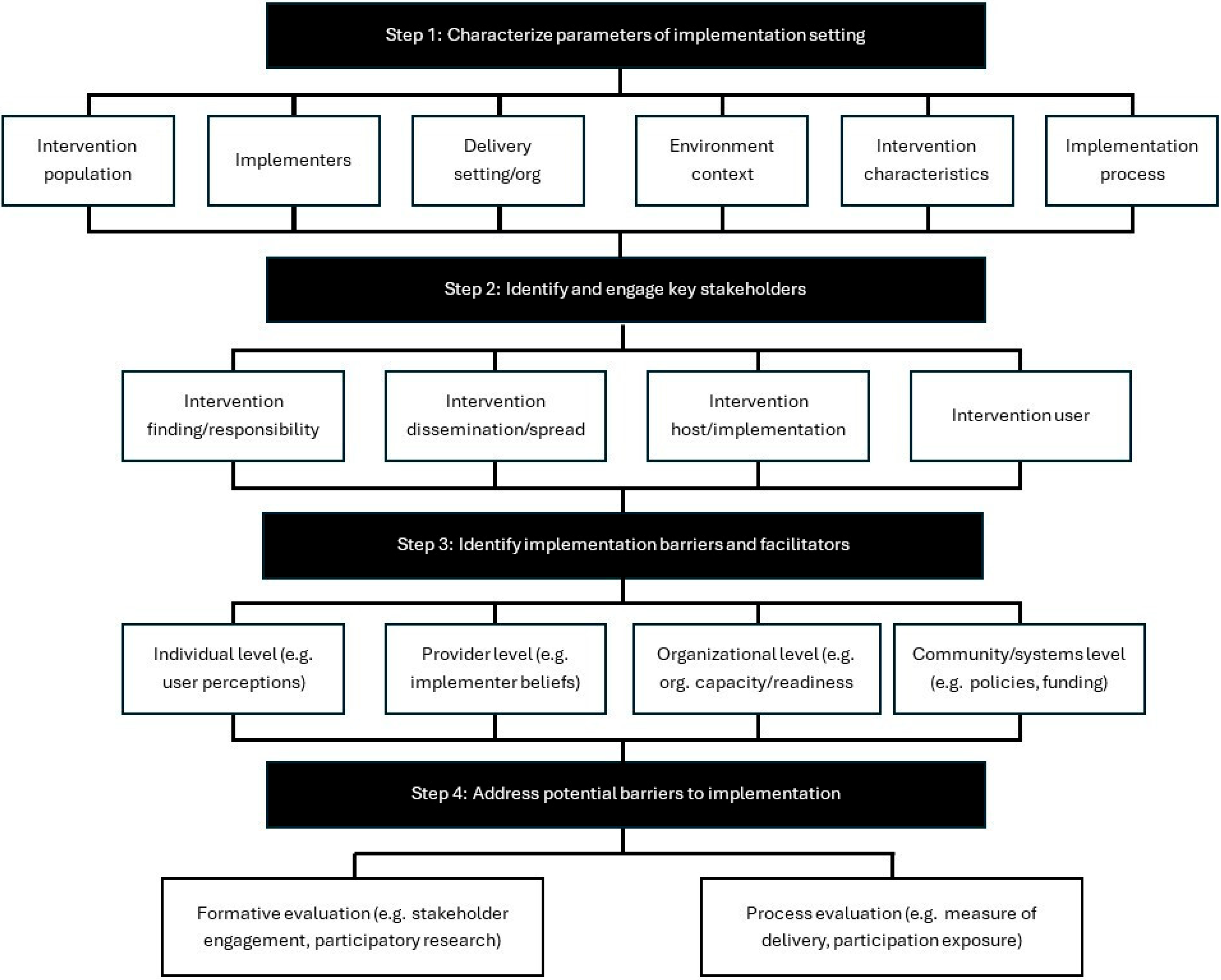
2.1. Step 1: Characterize Implementation Setting Parameters
2.2. Step 2: Identify and Engage Key Stakeholders
2.3. Step 3: Identify Contextual Barriers and Facilitators
2.4. Step 4: Address/Assess Barriers to Effective Implementation
3. Discussion
4. Conclusions
Author Contributions
Funding
Institutional Review Board Statement
Data Availability Statement
Acknowledgments
Conflicts of Interest
References
- Petajan, J.H.; White, A.T. Recommendations for Physical Activity in Patients with Multiple Sclerosis. Sports Med. 1999, 27, 179–191. [Google Scholar] [CrossRef] [PubMed]
- Appenzeller, O. The autonomic nervous system and fatigue. Funct. Neurol. 1987, 4, 473–485. [Google Scholar] [PubMed]
- Selhorst, J.B.; Saul, R.F. Uhthoff and His Symptom. J. Neuro-Ophthalmol. 1995, 15, 63. [Google Scholar] [CrossRef]
- Dalgas, U.; Stenager, E.; Ingemann-Hansen, T. Review: Multiple sclerosis and physical exercise: Recommendations for the application of resistance-, endurance- and combined training. Mult. Scler. 2008, 14, 35–53. [Google Scholar] [CrossRef] [PubMed]
- Motto, S.; Bedford, A.F. Exercise-induced weakness as a presentation of multiple sclerosis. Practitioner 1988, 232, 374–377. [Google Scholar] [PubMed]
- Gehlsen, G.M.; Grigsby, S.A.; Winant, D.M. Effects of an Aquatic Fitness Program on the Muscular Strength and Endurance of Patients with Multiple Sclerosis. Phys. Ther. 1984, 64, 653–657. [Google Scholar] [CrossRef]
- Harvey, L.; Smith, A.D.; Jones, R. The Effect of Weighted Leg Raises on Quadriceps Strength, EMG Parameters and Functional Activities in People with Multiple Sclerosis. Physiotherapy 1999, 85, 154–161. [Google Scholar] [CrossRef]
- Petajan, J.H.; Gappmaier, E.; White, A.T.; Spencer, M.K.; Mino, L.; Hicks, R.W. Impact of aerobic training on fitness and quality of life in multiple sclerosis. Ann. Neurol. 1996, 39, 432–441. [Google Scholar] [CrossRef]
- Schapiro, R.T.; Petajan, J.H.; Kosich, D.; Molk, B.; Feeney, J. Role of Cardiovascular Fitness in Multiple Sclerosis: A Pilot Study. Neurorehabilit. Neural Repair 1988, 2, 43–49. [Google Scholar] [CrossRef]
- Du, L.; Xi, H.; Zhang, S.; Zhou, Y.; Tao, X.; Lv, Y.; Hou, X.; Yu, L. Effects of exercise in people with multiple sclerosis: A systematic review and meta-analysis. Front. Public Health 2024, 12, 1387658. [Google Scholar] [CrossRef]
- Gitman, V.; Moss, K.; Hodgson, D. A systematic review and meta-analysis of the effects of non-pharmacological interventions on quality of life in adults with multiple sclerosis. Eur. J. Med. Res. 2023, 28, 294. [Google Scholar] [CrossRef]
- Yang, J.; Li, H.; Zhang, Y.; Hu, S.; Yu, Z. Effects of exercise on fatigue and quality of life in multiple sclerosis: A network meta-analysis and systematic review. J. Neurol. 2025, 272, 621. [Google Scholar] [CrossRef] [PubMed]
- Dalgas, U.; Stenager, E. Exercise and disease progression in multiple sclerosis: Can exercise slow down the progression of multiple sclerosis? Ther. Adv. Neurol. Disord. 2012, 5, 81–95. [Google Scholar] [CrossRef] [PubMed]
- Hedström, A.K.; Olsson, T.; Piehl, F.; Alfredsson, L. Beneficial impact of physical activity on multiple sclerosis disability progression. J. Neurol. Neurosurg. Psychiatry 2026, 97, 209–216. [Google Scholar] [CrossRef] [PubMed]
- Latimer-Cheung, A.E.; Martin Ginis, K.A.; Hicks, A.L.; Motl, R.W.; Pilutti, L.A.; Duggan, M.; Wheeler, G.; Persad, R.; Smith, K.M. Development of evidence-informed physical activity guidelines for adults with multiple sclerosis. Arch. Phys. Med. Rehabil. 2013, 94, 1829–1836.e7. [Google Scholar] [CrossRef] [PubMed]
- Kalb, R.; Brown, T.R.; Coote, S.; Costello, K.; Dalgas, U.; Garmon, E.; Giesser, B.; Halper, J.; Karpatkin, H.; Keller, J.; et al. Exercise and lifestyle physical activity recommendations for people with multiple sclerosis throughout the disease course. Mult. Scler. 2020, 26, 1459–1469. [Google Scholar] [CrossRef]
- Learmonth, Y.C.; Herring, M.P.; Russell, D.I.; Pilutti, L.A.; Day, S.; Marck, C.H.; Chan, B.; Metse, A.P.; Motl, R.W. Safety of exercise training in multiple sclerosis: An updated systematic review and meta-analysis. Mult. Scler. 2023, 29, 1604–1631. [Google Scholar] [CrossRef] [PubMed] [PubMed Central]
- Jeng, B.; DuBose, N.G.; Martin, T.B.; Šilić, P.; Flores, V.A.; Zheng, P.; Motl, R.W. Updated Systematic Review and Quantitative Synthesis of Physical Activity Levels in Multiple Sclerosis. Am. J. Phys. Med. Rehabil. 2024, 103, 284. [Google Scholar] [CrossRef]
- Macdonald, E.; Buchan, D.; Cerexhe, L.; Renfrew, L.; Sculthorpe, N. Accelerometer measured physical activity and sedentary time in individuals with multiple sclerosis versus age matched controls: A systematic review and meta-analysis. Mult. Scler. Relat. Disord. 2023, 69, 104462. [Google Scholar] [CrossRef] [PubMed]
- Klaren, R.E.; Motl, R.W.; Dlugonski, D.; Sandroff, B.M.; Pilutti, L.A. Objectively Quantified Physical Activity in Persons with Multiple Sclerosis. Arch. Phys. Med. Rehabil. 2013, 94, 2342–2348. [Google Scholar] [CrossRef]
- Vetrovska, R.; Kosova, B.; Prochazkova, R.; Menkyova, I.; Kubala Havrdova, E.; Novotna, K. Differences in physical activity between individuals with multiple sclerosis and healthy adults in Central Europe. Mult. Scler. Relat. Disord. 2025, 99, 106448. [Google Scholar] [CrossRef] [PubMed]
- Brownson, R.C.; Colditz, G.A.; Proctor, E.K. Dissemination and Implementation Research in Health: Translating Science to Practice; Oxford University Press: Oxford, UK, 2018. [Google Scholar]
- Smith, J.; van der Groen, O.; Learmonth, Y. Feasibility Meets Implementation Science: Narrowing the Research-to-Practice Gap for Exercise Activity in Multiple Sclerosis. Int. J. Qual. Methods 2023, 22, 16094069231180162. [Google Scholar] [CrossRef]
- Declerck, L.; Bobitt, J.; Herman, C.; Motl, R.W. Exercise Training in Multiple Sclerosis: Preparing for Dissemination and Implementation Based on Integrating the NIH Stage Model of Intervention Development. Mult. Scler. Relat. Disord. 2025, 102, 106623. [Google Scholar] [CrossRef] [PubMed]
- Adamson, B.C.; Learmonth, Y.C.; Kinnett-Hopkins, D.; Bohri, M.; Motl, R.W. Feasibility study design and methods for Project GEMS: Guidelines for Exercise in Multiple Sclerosis. Contemp. Clin. Trials 2016, 47, 32–39. [Google Scholar] [CrossRef]
- Motl, R.W.; Bombardier, C.H.; Duffecy, J.; Hibner, B.; Wathen, A.; Carrithers, M.; Cutter, G. Study protocol: Exercise training for treating major depressive disorder in multiple sclerosis. BMC Neurol. 2024, 24, 131. [Google Scholar] [CrossRef]
- Kinnett-Hopkins, D.; Motl, R. Results of a feasibility study of a patient informed, racially tailored home-based exercise program for black persons with multiple sclerosis. Contemp. Clin. Trials 2018, 75, 1–8. [Google Scholar] [CrossRef]
- Motl, R.W.; Kinnett-Hopkins, D.; Neal, W.; Flores, E.; Pekmezi, D.; Flores, V. Targeted exercise for African-Americans with multiple sclerosis: Project TEAAMS. Contemp. Clin. Trials 2023, 126, 107088. [Google Scholar] [CrossRef]
- Zheng, P.; DeJonge, S.R.; DuBose, N.G.; Kidwell-Chandler, A.; Martin, T.B.; Huynh, T.L.T.; Phillips, S.A.; Duffecy, J.; Motl, R.W. Remotely-delivered exercise training program among older adults with multiple sclerosis: Feasibility results of a randomized controlled trial. Contemp. Clin. Trials 2026, 161, 108190. [Google Scholar] [CrossRef]
- Flores, V.A.; Silveira, S.L.; Marquez, D.X.; Kinnett-Hopkins, D.; Miravalle, A.; Sierra-Morales, F.; Hernández-Peraza, Z.; Motl, R.W. Rationale for a 4-month, parallel-group, randomized controlled trial to assess the Feasibility and Efficacy of a Remotely delivered exercise training intervention for Hispanics/Latinos with Multiple Sclerosis (FERLA MS). Pilot. Feasibility Stud. 2025, 11, 62. [Google Scholar] [CrossRef]
- Silveira, S.L.; Motl, R.W.; Froehlich-Grobe, K.; Kay, M. Feasibility, acceptability, and initial efficacy of a wheelchair exercise training program in persons with multiple sclerosis: Study protocol for a parallel group randomized controlled trial. Disabil. Rehabil. Assist. Technol. 2024, 19, 2998–3005. [Google Scholar] [CrossRef] [PubMed] [PubMed Central]
- Learmonth, Y.C.; Adamson, B.C.; Kinnett-Hopkins, D.; Bohri, M.; Motl, R.W. Results of a feasibility randomised controlled study of the guidelines for exercise in multiple sclerosis project. Contemp. Clin. Trials 2017, 54, 84–97. [Google Scholar] [CrossRef] [PubMed]
- Motl, R.; Backus, D.; Bethoux, F.; Hebert, J.; Lowman, J.; McBurney, R.; McCully, K.; Ng, A.; Plummer, P.; Schmidt, H.; et al. Results of the STEP for MS Trial-Supervised versus Telerehabilitation Exercise Programs for Multiple Sclerosis. In Multiple Sclerosis Journal; Sage Publications Ltd.: London, UK, 2024; p. 101. [Google Scholar]
- Koorts, H.; Eakin, E.; Estabrooks, P.; Timperio, A.; Salmon, J.; Bauman, A. Implementation and scale up of population physical activity interventions for clinical and community settings: The PRACTIS guide. Int. J. Behav. Nutr. Phys. Act. 2018, 15, 51. [Google Scholar] [CrossRef] [PubMed]
- Ward, D.S.; Vaughn, A.E.; Mazzucca, S.; Burney, R. Translating a child care based intervention for online delivery: Development and randomized pilot study of Go NAPSACC. BMC Public Health 2017, 17, 891. [Google Scholar] [CrossRef] [PubMed] [PubMed Central]
- Berkovich, R.; Fox, E.; Okai, A.; Ding, Y.; Gorritz, M.; Bartolome, L.; Wade, R.L.; Su, W.; Johnson, K.M.; Russo, P. Identifying disability level in multiple sclerosis patients in a U.S.-based health plan claims database. J. Med. Econ. 2021, 24, 46–53. [Google Scholar] [CrossRef]
- Learmonth, Y.C.; Adamson, B.C.; Balto, J.M.; Chiu, C.Y.; Molina-Guzman, I.M.; Finlayson, M.; Barstow, E.A.; Motl, R.W. Investigating the needs and wants of healthcare providers for promoting exercise in persons with multiple sclerosis: A qualitative study. Disabil. Rehabil. 2018, 40, 2172–2180. [Google Scholar] [CrossRef] [PubMed]
- Humphrey, R.A.; Lakomy, J. An evaluation of pre-exercise screening questionnaires used within the health and fitness industry in the United Kingdom. Phys. Ther. Sport 2003, 4, 187–191. [Google Scholar] [CrossRef]
- Hohol, M.J.; Orav, E.J.; Weiner, H.L. Disease Steps in multiple sclerosis. Neurology 1995, 45, 251–255. [Google Scholar] [CrossRef]
- Asano, M.; Duquette, P.; Andersen, R.; Lapierre, Y.; Mayo, N.E. Exercise barriers and preferences among women and men with multiple sclerosis. Disabil. Rehabil. 2013, 35, 353–361. [Google Scholar] [CrossRef] [PubMed]
- Baumann, A.A.; Cabassa, L.J. Reframing implementation science to address inequities in healthcare delivery. BMC Health Serv. Res. 2020, 20, 190. [Google Scholar] [CrossRef]
- McNulty, M.; Smith, J.D.; Villamar, J.; Burnett-Zeigler, I.; Vermeer, W.; Benbow, N.; Gallo, C.; Wilensky, U.; Hjorth, A.; Mustanski, B.; et al. Implementation research methodologies for achieving scientific equity and health equity. Ethn. Dis. 2019, 29, 83. [Google Scholar] [CrossRef]
- Marrie, R.A.; Leung, S.; Tyry, T.; Cutter, G.R.; Fox, R.; Salter, A. Use of eHealth and mHealth technology by persons with multiple sclerosis. Mult. Scler. Relat. Disord. 2019, 27, 13–19. [Google Scholar] [CrossRef]
- McCann, J.; Ridgers, N.D.; Carver, A.; Thornton, L.E.; Teychenne, M. Effective recruitment and retention strategies in community health programs. Health Promot. J. Aust. 2013, 24, 104–110. [Google Scholar] [CrossRef] [PubMed]
- Backus, D. Increasing Physical Activity and Participation in People with Multiple Sclerosis: A Review. Arch. Phys. Med. Rehabil. 2016, 97, S210–S217. [Google Scholar] [CrossRef] [PubMed]
- Schlagheck, M.L.; Hübner, S.T.; Joisten, N.; Walzik, D.; Rademacher, A.; Wolf, F.; Bansi, J.; Warnke, C.; Zimmer, P. Physical activity is related to disease severity and fatigue, but not to relapse rate in persons with relapsing remitting multiple sclerosis—A self-reported questionnaire based study. Front. Neurol. 2023, 14, 1217000. [Google Scholar] [CrossRef] [PubMed]
- Casey, B.; Uszynski, M.; Hayes, S.; Motl, R.; Gallagher, S.; Coote, S. Do multiple sclerosis symptoms moderate the relationship between self-efficacy and physical activity in people with multiple sclerosis? Rehabil. Psychol. 2018, 63, 104–110. [Google Scholar] [CrossRef]
- Kasser, S. Exercising with Multiple Sclerosis: Insights into Meaning and Motivation. Adapt. Phys. Act. Q. 2009, 26, 274–289. [Google Scholar] [CrossRef]
- Sweet, S.N.; Perrier, M.J.; Podzyhun, C.; Latimer-Cheung, A.E. Identifying physical activity information needs and preferred methods of delivery of people with multiple sclerosis. Disabil. Rehabil. 2013, 35, 2056–2063. [Google Scholar] [CrossRef] [PubMed]
- Vanner, E.A.; Block, P.; Christodoulou, C.C.; Horowitz, B.P.; Krupp, L.B. Pilot study exploring quality of life and barriers to leisure-time physical activity in persons with moderate to severe multiple sclerosis. Disabil. Health J. 2008, 1, 58–65. [Google Scholar] [CrossRef]
- McAuley, E.; Jerome, G.J.; Elavsky, S.; Marquez, D.X.; Ramsey, S.N. Predicting long-term maintenance of physical activity in older adults. Prev. Med. 2003, 37, 110–118. [Google Scholar] [CrossRef]
- Williams, D.M.; Dunsiger, S.; Ciccolo, J.T.; Lewis, B.A.; Albrecht, A.E.; Marcus, B.H. Acute affective response to a moderate-intensity exercise stimulus predicts physical activity participation 6 and 12 months later. Psychol. Sport Exerc. 2008, 9, 231–245. [Google Scholar] [CrossRef]
- Donkers, S.J.; Chan, K.; Milosavljevic, S.; Pakosh, M.; Musselman, K.E. Informing the training of health care professionals to implement behavior change strategies for physical activity promotion in neurorehabilitation: A systematic review. Transl. Behav. Med. 2020, 10, 310–323. [Google Scholar] [CrossRef]
- Mavropalias, G.; Baynton, S.L.; Teo, S.; Donkers, S.J.; Van Rens, F.E.; Learmonth, Y.C. Allied health professionals knowledge and clinical practice in telehealth exercise behavioural change for multiple sclerosis. Mult. Scler. Relat. Disord. 2024, 87, 105689. [Google Scholar] [CrossRef] [PubMed]
- Wong, S.; Hassett, L.; Koorts, H.; Grunseit, A.; Tong, A.; Tiedemann, A.; Greaves, C.J.; Haynes, A.; Milat, A.; Harvey, L.A.; et al. Planning implementation and scale-up of physical activity interventions for people with walking difficulties: Study protocol for the process evaluation of the ComeBACK trial. Trials 2022, 23, 40. [Google Scholar] [CrossRef] [PubMed]
- Mun, K.; Lee, M.; Shim, J. Effects of Work Engagement and Barriers on Evidence-Based Practice Implementation for Clinical Nurses: A Cross-Sectional Study. Healthcare 2024, 12, 2223. [Google Scholar] [CrossRef] [PubMed]
- Parmar, J.; Sacrey, L.A.; Anderson, S.; Charles, L.; Dobbs, B.; McGhan, G.; Shapkin, K.; Tian, P.; Triscott, J. Facilitators, barriers and considerations for the implementation of healthcare innovation: A qualitative rapid systematic review. Health Soc. Care Community 2022, 30, 856–868. [Google Scholar] [CrossRef]
- Reis, R.S.; Salvo, D.; Ogilvie, D.; Lambert, E.V.; Goenka, S.; Brownson, R.C. Scaling up physical activity interventions worldwide: Stepping up to larger and smarter approaches to get people moving. Lancet 2016, 388, 1337–1348. [Google Scholar] [CrossRef]
- Curran, G.M.; Bauer, M.; Mittman, B.; Pyne, J.M.; Stetler, C. Effectiveness-implementation Hybrid Designs: Combining Elements of Clinical Effectiveness and Implementation Research to Enhance Public Health Impact. Med. Care 2012, 50, 217. [Google Scholar] [CrossRef] [PubMed]
- Tabak, R.G.; Khoong, E.C.; Chambers, D.A.; Brownson, R.C. Bridging Research and Practice: Models for Dissemination and Implementation Research. Am. J. Prev. Med. 2012, 43, 337–350. [Google Scholar] [CrossRef]
- Glasgow, R.E.; Vogt, T.M.; Boles, S.M. Evaluating the public health impact of health promotion interventions: The RE-AIM framework. Am. J. Public Health 1999, 89, 1322–1327. [Google Scholar] [CrossRef]
- Glasgow, R.E.; Harden, S.M.; Gaglio, B.; Rabin, B.; Smith, M.L.; Porter, G.C.; Ory, M.G.; Estabrooks, P.A. RE-AIM Planning and Evaluation Framework: Adapting to New Science and Practice With a 20-Year Review. Front. Public Health 2019, 7, 64. [Google Scholar] [CrossRef]
- Lobelo, F.; de Quevedo, I.G. The Evidence in Support of Physicians and Health Care Providers as Physical Activity Role Models. Am. J. Lifestyle Med. 2016, 10, 36–52. [Google Scholar] [CrossRef]
- Learmonth, Y.C.; Adamson, B.C.; Balto, J.M.; Chiu, C.Y.; Molina-Guzman, I.; Finlayson, M.; Riskin, B.J.; Motl, R.W. Multiple sclerosis patients need and want information on exercise promotion from healthcare providers: A qualitative study. Health Expect. 2017, 20, 574–583. [Google Scholar] [CrossRef] [PubMed] [PubMed Central]
- Curran, G.M.; Landes, S.J.; McBain, S.A.; Pyne, J.M.; Smith, J.D.; Fernandez, M.E.; Chambers, D.A.; Mittman, B.S. Reflections on 10 years of effectiveness-implementation hybrid studies. Front. Health Serv. 2022, 2, 1053496. [Google Scholar] [CrossRef] [PubMed]
- The Multiple Sclerosis International Federation. Atlas of MS, 3rd ed.; The Multiple Sclerosis International Federation: London, UK, 2020; Available online: https://www.msif.org/wp-content/uploads/2020/10/Atlas-3rd-Edition-Epidemiology-report-EN-updated-30-9-20.pdf (accessed on 5 March 2026).
- Bauman, A.E.; Reis, R.S.; Sallis, J.F.; Wells, J.C.; Loos, R.J.; Martin, B.W. Correlates of physical activity: Why are some people physically active and others not? Lancet 2012, 380, 258–271. [Google Scholar] [CrossRef]
- Rhodes, R.E.; Nigg, C.R. Advancing Physical Activity Theory: A Review and Future Directions. Exerc. Sport Sci. Rev. 2011, 39, 113. [Google Scholar] [CrossRef]



| Automated Home-Based Physical Activity/Exercise Behavioral Intervention for People with MS (GEMS-Auto) | |
| Target outcome Population Setting | PA, exercise Adults with MS (18+ years), EDSS ≤ 5.5 or PDDS ≤ 4; having Internet and email access Clinical setting Home-based/community-based |
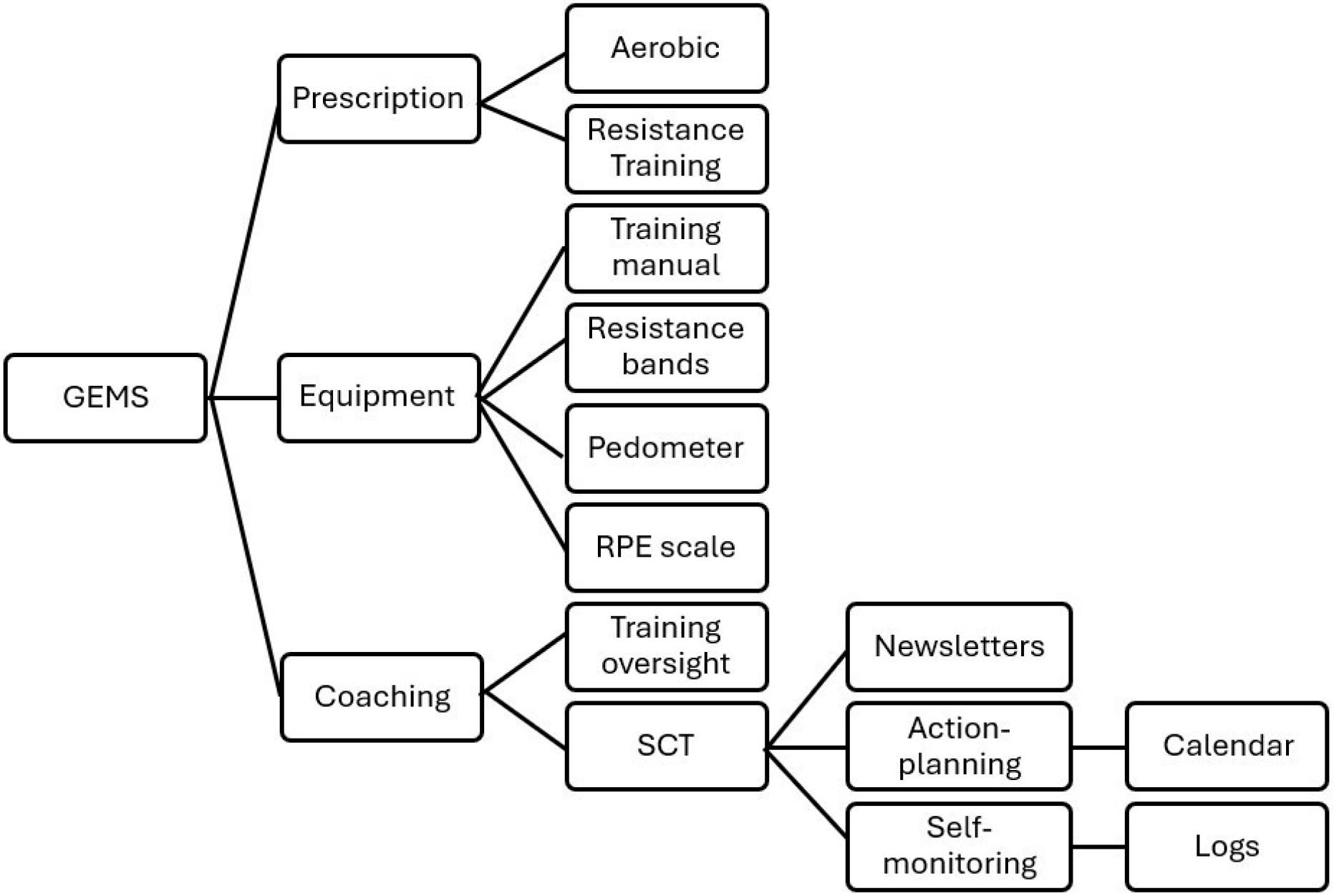
| Step 1: Characterize implementation setting parameters | Place: Healthcare clinics with home-based online components Online platform where the intervention material would be stored and distributed People and Process: Participants referred from MS centers to receive the 4-month intervention The intervention would be a fully automated, self-directed, home-based exercise program involving 3 days/week of 30+ min of aerobic exercise (i.e., moderate-intensity walking) and 3 days per week of resistance exercise (i.e., 1–2 sets, 10–15 repetitions of 5–10 movements targeting the major muscle groups) Provisions: Program manual, exercise prescriptions, and video simulations for SCT-based behavioral coaching sessions and exercise instructions, educational newsletters, exercise equipment (i.e., yoga mat, resistance bands, pedometer), activity log, calendar, and incentives Principles: Intervention—home-based intervention based on SCT and behavioral strategies (i.e., action planning, self-monitoring, goal setting, reviewing behavioral goals, and feedback) to increase physical activity and improve MS health outcomes Implementation—Used an integrated research–practice partnership within an existing care delivery system to increase system-wide scale-up |
| Step 2: Identify and engage key stakeholders | Stakeholders represent people with MS, providers/coordinators (ENRL team) who are responsible for intervention design and adaptation, remote support, and implementation oversight, clinicians, MS clinics/centers, and NMSS as the funding agency and supporting/advocating for implementation of the intervention |
| Step 3: Identify contextual barriers and facilitators | User level: (i) MS-related characteristics (e.g., disability level, symptom severity, symptom fluctuation), (ii) exercise self-efficacy, (iii) perceptions of intervention effectiveness and fit for unaddressed need, (iv) motivation, (v) enjoyment Provider level: (i) awareness and knowledge, (ii) beliefs about safety, (iii) time constraints and competing clinical priorities, (iv) fit with patient demographic, (v) personal experience with exercise Organizational level: (i) cost, (ii) technology Community/system level: (i) partner advocacy group’s capacity, readiness, and network, (ii) visibility and role of advocacy groups |
| Step 4: Address/assess barriers | Formative evaluation: participatory research with stakeholders, focus groups with potential users, advisory group of MS healthcare providers, consultations with advocacy groups Process/outcome evaluation: hybrid effectiveness–implementation, RE-AIM |
| Week 1 Introduction to program | Video 1: Clarification of materials received and initial questions; explanation of program; planning exercise schedule; using the logbook and Qualtrics; Newsletter 1; exercise expectations; exercise outcomes; importance of this knowledge. |
| Week 2 Outcome expectations | Video 2: Compliance with program; using the manual, logbook, and Qualtrics. Identifying personal outcomes. |
| Week 3 Choosing a program | Video 3: Compliance with program; comparison of Orange, Blue, and Green programs; choosing a program; Newsletter 2; self-monitoring defined; benefits of self-monitoring; importance of this knowledge. |
| Week 4 Self-monitoring | Video 4: Compliance with program; using your pedometer; understanding exercise intensity. |
| Week 5 Goal-setting | Video 5: Compliance with program; setting SMAART goals; performing resistance training exercises correctly; tracking progress; Newsletter 3; specific, measurable, adjustable, action-oriented, realistic, and time-limited exercise-related goals defined; importance of this knowledge. |
| Week 7 Self-efficacy | Video 6: Finding your self-confidence; what to do when you feel like quitting; involving family; Newsletter 4; self-efficacy defined; experiencing success, choosing role models, accepting encouragement, and managing physical and emotional responses; reminder that the program is specific to persons with MS. |
| Week 11 Overcoming barriers | Video 7: Identifying your barriers; making plans to overcome obstacles; dealing with MS symptoms; Newsletter 5; exercise barriers defined; common barriers (facilities, social, and symptoms); strategies to overcome barriers. |
| Week 15 Identifying facilitators | Video 8: How to keep going on your own; making adjustments as needed; setting future goals; Newsletter 6; exercise facilitators defined; common facilitators (having a goal, enjoyment, social support, knowledge); using facilitators long-term. |
| RE-AIM Domain | Definition | Example of Specific Outcome Measures to Evaluate in the Automated GEMS Program |
|---|---|---|
| Reach | Number, proportion, and representativeness of the target population who are willing to participate in the intervention | Number of participants at baseline and number of dropouts Demographic and MS-related characteristics of the participants |
| Efficacy | Success rate of the intervention or its impact on subjective or objective outcomes of interest | Participation in leisure-time exercise Adverse events MS symptoms and disability level; this could combine both patient-reported outcome measures (e.g., fatigue severity scale) and objective measures of physical function (e.g., isometric strength assessment, cardiopulmonary exercise test) |
| Adoption | Number, proportion, and representativeness of settings that adopt the intervention | Number and proportion of neurologists who refer their patients to the GEMS-Auto program Demographic characteristics of the neurologists |
| Implementation | Extent to which the intervention is implemented as intended in the real world; includes adaptations to the intervention and costs of implementation; at the user level, includes use of the intervention and implementation strategies | Cost of delivering the GEMS-Auto program Adherence and compliance to the different components (i.e., aerobic and resistance training, SCT-based videos) of the GEMS-Auto program; this could combine both online engagement metrics (e.g., number of videos watched until the end) and logbook data regarding exercise session completion |
| Maintenance | Extent to which behavior is sustained after the intervention and the program becomes part of routine organizational practices and policies | Number and proportion of neurologists who refer their patients to the GEMS-Auto program after 6 months Physical activity levels of participants at 4 months post-intervention follow-up [29]; this could combine both self-reported exercise behavior (e.g., Godin Leisure Time Exercise Questionnaire) and objective measures of physical activity (e.g., accelerometry) |
Disclaimer/Publisher’s Note: The statements, opinions and data contained in all publications are solely those of the individual author(s) and contributor(s) and not of MDPI and/or the editor(s). MDPI and/or the editor(s) disclaim responsibility for any injury to people or property resulting from any ideas, methods, instructions or products referred to in the content. |
© 2026 by the authors. Licensee MDPI, Basel, Switzerland. This article is an open access article distributed under the terms and conditions of the Creative Commons Attribution (CC BY) license.
Share and Cite
Declerck, L.; Huynh, T.L.T.; Motl, R.W. Scaling up an Evidence-Based Exercise Intervention for Wide-Scale Implementation: A Conceptual Roadmap Using the PRACTIS Framework. Healthcare 2026, 14, 720. https://doi.org/10.3390/healthcare14060720
Declerck L, Huynh TLT, Motl RW. Scaling up an Evidence-Based Exercise Intervention for Wide-Scale Implementation: A Conceptual Roadmap Using the PRACTIS Framework. Healthcare. 2026; 14(6):720. https://doi.org/10.3390/healthcare14060720
Chicago/Turabian StyleDeclerck, Louise, Trinh L. T. Huynh, and Robert W. Motl. 2026. "Scaling up an Evidence-Based Exercise Intervention for Wide-Scale Implementation: A Conceptual Roadmap Using the PRACTIS Framework" Healthcare 14, no. 6: 720. https://doi.org/10.3390/healthcare14060720
APA StyleDeclerck, L., Huynh, T. L. T., & Motl, R. W. (2026). Scaling up an Evidence-Based Exercise Intervention for Wide-Scale Implementation: A Conceptual Roadmap Using the PRACTIS Framework. Healthcare, 14(6), 720. https://doi.org/10.3390/healthcare14060720