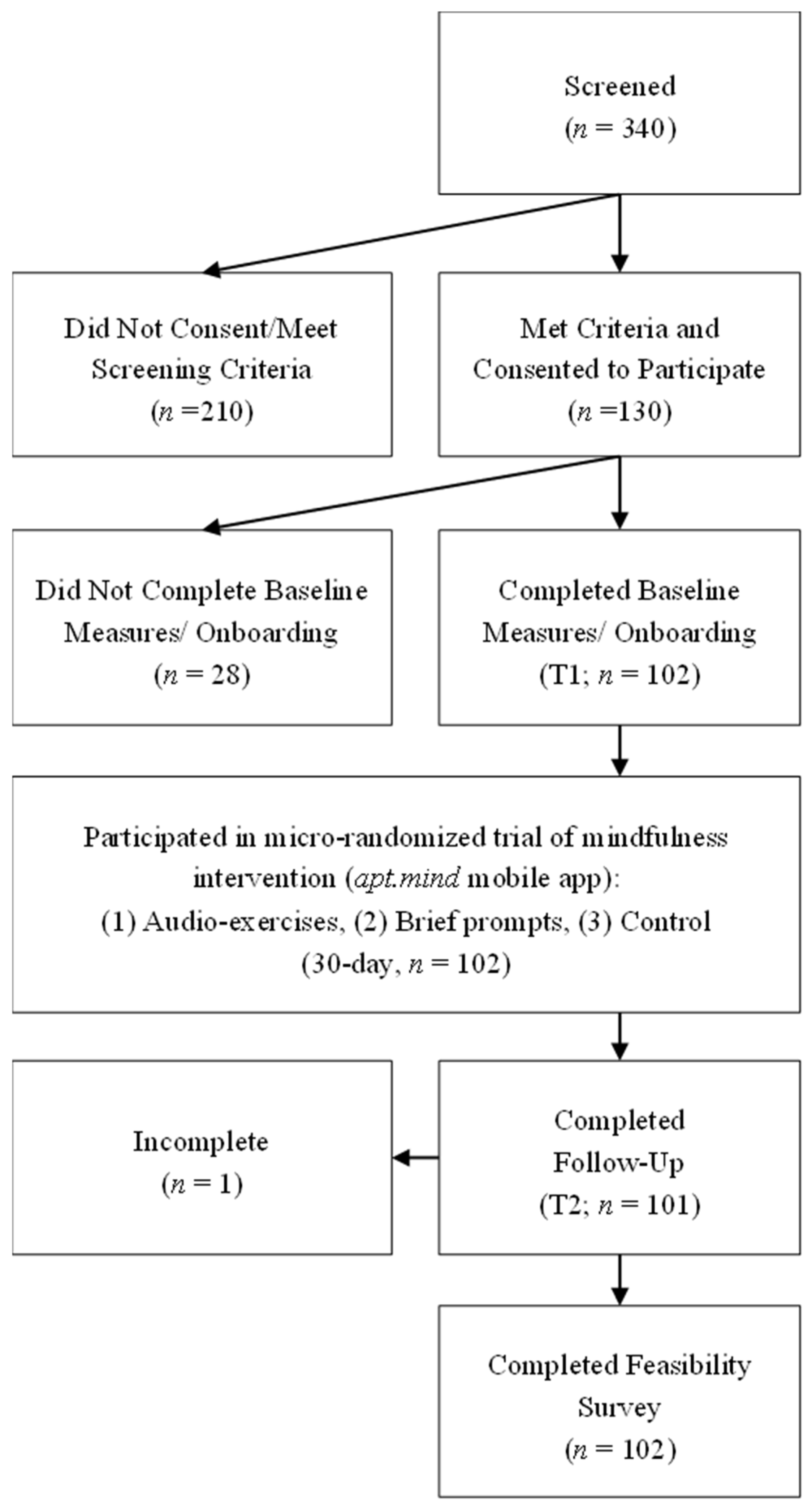
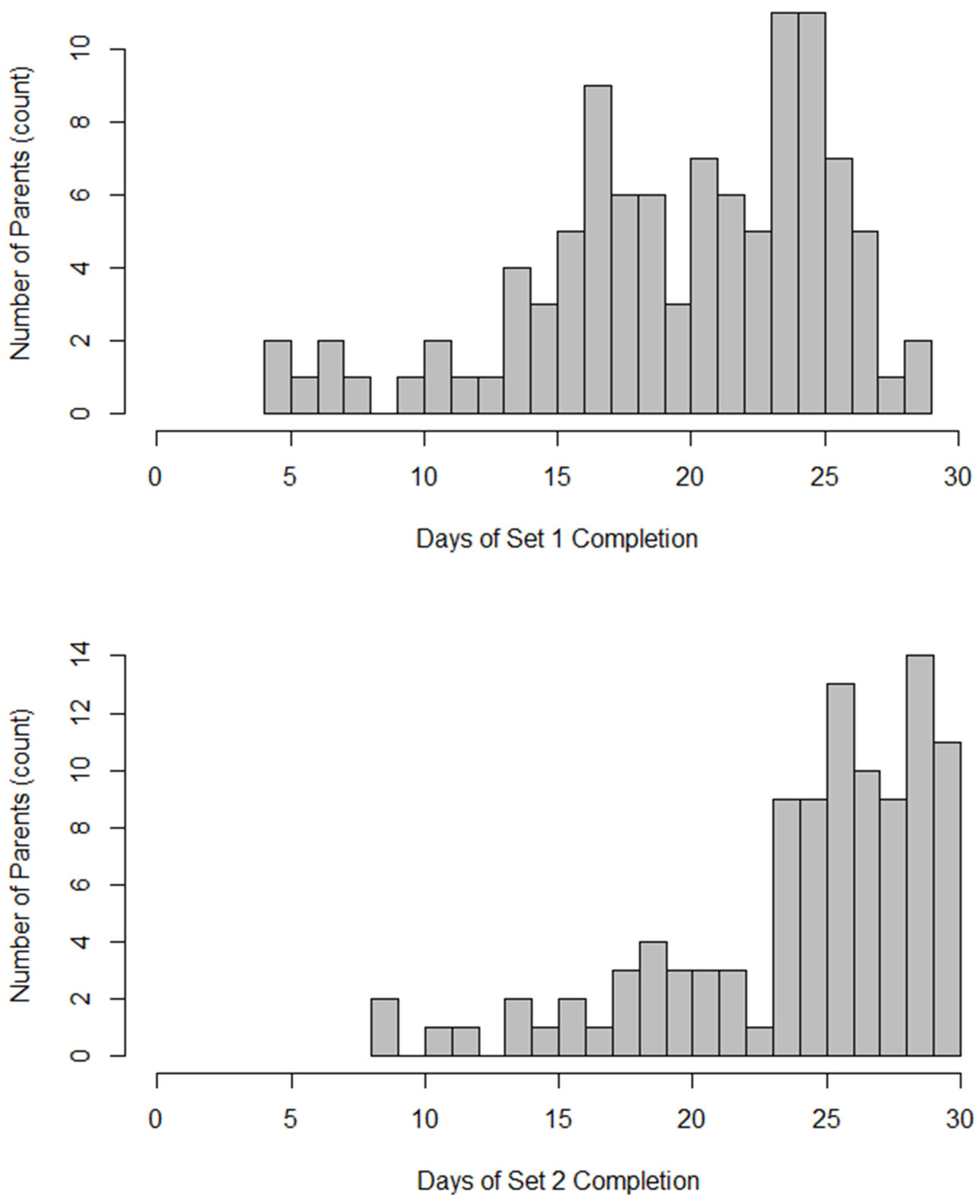
Feasibility and Acceptability of a Mindfulness App Intervention for Healthcare Worker Families Under Stress: A Pilot Micro-Randomized Trial


Abstract
1. Introduction
1.1. Healthcare Worker Families During Pandemic
1.2. Mindfulness-Based Interventions
1.3. Current Study
2. Methods
2.1. Participants
2.2. Procedures
2.3. Onboarding
2.4. Daily Intervention and Assessments
2.5. Exit Session
2.6. Measures
2.7. Data Analyses
3. Results
3.1. Feasibility
3.2. Acceptability
3.3. Usability
3.4. Preliminary Efficacy of the Interventions
3.5. HRV
4. Discussion
5. Conclusions
Author Contributions
Funding
Institutional Review Board Statement
Informed Consent Statement
Data Availability Statement
Acknowledgments
Conflicts of Interest
Appendix A

| Demographic | Total (n = 102) | Females (n = 80) | Males (n = 22) |
|---|---|---|---|
| Age (in years): M (SD) | 39.3 (5.6) | 39.1 (5.5) | 39.9 (5.7) |
| Parent status: % (n) | |||
| Biological parent | 83.3% (n = 85) | 85% (n = 68) | 77.3% (n = 17) |
| Non-biological parent | 4.9% (n = 5) | 2.5% (n = 2) | 13.6% (n = 3) |
| Both | 5.9% (n = 6) | 7.5% (n = 6) | 0% (n = 0) |
| Not provided | 5.9% (n = 6) | 5% (n = 4) | 9.1% (n = 2) |
| Co-parent in the study: % (n) | 39.2% (n = 40) | 25% (n = 20) | 90.9% (n = 20) |
| Employment status: % (n) | |||
| Full-time | 89.2% (n = 91) | 88.8% (n = 71) | 90.9% (n = 20) |
| Part-time | 7.8% (n = 8) | 8.8% (n = 7) | 4.5% (n = 1) |
| Homemaker | 2.9% (n = 3) | 2.5% (n = 2) | 4.5% (n = 1) |
| Employment industry: % (n) | |||
| Healthcare worker | 74.5% (n = 76) | 88.8% (n = 71) | 22.7% (n = 5) |
| Non-healthcare worker | 21.6% (n = 22) | 7.5% (n = 6) | 72.3% (n = 16) |
| Not provided | 2.9% (n = 3) | 3.8% (n = 3) | 0% (n = 0) |
| Race: % (n) | |||
| White/Caucasian | 87.3% (n = 89) | 87.5% (n = 70) | 86.4% (n = 19) |
| Hispanic/Latin | 2.9% (n = 3) | 3.8% (n = 3) | 0% (n = 0) |
| Black/African American | 3.9% (n = 4) | 2.5% (n = 2) | 9.1% (n = 2) |
| Asian | 2.9% (n = 3) | 3.8% (n = 3) | 0% (n = 0) |
| Multiracial | 3.9% (n = 4) | 5% (n = 4) | 0% (n = 0) |
| Not provided | 2% (n = 2) | 1.3% (n = 1) | 4.5% (n = 1) |
| Relationship status: % (n) | |||
| Married | 76.5% (n = 78) | 73.8% (n = 59) | 86.4% (n = 19) |
| Single/never married | 14.7% (n = 15) | 16.3% (n = 13) | 9.1% (n = 2) |
| Divorced | 6.9% (n = 7) | 7.5% (n = 6) | 4.5% (n = 1) |
| Separated | 2% (n = 2) | 2.5% (n = 2) | 0% (n = 0) |
| Annual household income: % (n) | |||
| $25,000–$49,999 | 8.8% (n = 9) | 8.8% (n = 7) | 9.1% (n = 2) |
| $50,000–$74,999 | 9.8% (n = 10) | 10% (n = 8) | 9.1% (n = 2) |
| $75,000–$99,999 | 17.6% (n = 18) | 17.5% (n = 14) | 18.2% (n = 4) |
| $100,000–149,999 | 22.5% (n = 23) | 22.5% (n = 18) | 22.7% (n = 5) |
| $150,000–$199,999 | 17.6% (n = 18) | 18.8% (n = 15) | 13.6% (n = 3) |
| $200,000+ | 18.6% (n = 19) | 18.8% (n = 15) | 18.2% (n = 4) |
| Not provided | 4.9% (n = 5) | 3.8% (n = 3) | 9.1% (n = 2) |
| Education: % (n) | |||
| High school/GED | 7.8% (n = 8) | 2.5% (n = 2) | 27.3% (n = 6) |
| Associate’s degree | 22.5% (n = 23) | 26.3% (n = 21) | 9.1% (n = 2) |
| Bachelor’s degree | 32.4% (n = 33) | 31.3% (n = 25) | 36.4% (n = 8) |
| Master’s degree | 27.5% (n = 28) | 31.3% (n = 25) | 13.7% (n = 3) |
| Doctoral degree | 9.8% (n = 10) | 8.8% (n = 7) | 13.7% (n = 3) |
| Licensed in their field: % (n) | 84.3% (n = 86) | 92.5% (n = 74) | 54.5% (n = 12) |
| Hour | Completed | Missed | Total Delivered | Response Rate |
|---|---|---|---|---|
| 0 | 0 | 1 | 1 | 0.00 |
| 1 | 0 | 0 | 0 | - |
| 2 | 1 | 0 | 1 | 1.00 |
| 3 | 1 | 0 | 1 | 1.00 |
| 4 | 2 | 1 | 3 | 0.67 |
| 5 | 2 | 1 | 3 | 0.67 |
| 6 | 7 | 6 | 13 | 0.54 |
| 7 | 50 | 35 | 85 | 0.59 |
| 8 | 117 | 68 | 185 | 0.63 |
| 9 | 156 | 73 | 229 | 0.68 |
| 10 | 188 | 106 | 294 | 0.64 |
| 11 | 192 | 92 | 284 | 0.68 |
| 12 | 185 | 105 | 290 | 0.64 |
| 13 | 150 | 85 | 235 | 0.64 |
| 14 | 122 | 64 | 186 | 0.66 |
| 15 | 151 | 68 | 219 | 0.69 |
| 16 | 136 | 79 | 215 | 0.63 |
| 17 | 175 | 87 | 262 | 0.67 |
| 18 | 171 | 67 | 238 | 0.72 |
| 19 | 112 | 50 | 162 | 0.69 |
| 20 | 33 | 15 | 48 | 0.69 |
| 21 | 16 | 4 | 20 | 0.80 |
| 22 | 5 | 1 | 6 | 0.83 |
| 23 | 4 | 2 | 6 | 0.67 |
| Acceptability Questions | N | Mean | SD | Range |
|---|---|---|---|---|
| Watch/App | ||||
| How much do you like wearing this watch? | 102 | 2.65 | 0.85 | 1–4 |
| How comfortable was it to wear the watch daily? | 102 | 3.16 | 0.83 | 1–4 |
| Did you enjoy using an app for stress management? | 102 | 0.74 | 0.44 | 0–1 |
| Audio exercises | ||||
| How effective were the audio exercises for managing stress? | 102 | 2.85 | 0.68 | 1–4 |
| Do audio exercises help manage stress when with children? | 99 | 2.49 | 0.97 | 1–4 |
| Do audio exercises help manage stress when with adults? | 102 | 2.88 | 0.88 | 1–4 |
| Do audio exercises help manage stress when alone? | 102 | 3.40 | 0.74 | 1–4 |
| Do audio exercises help manage stress when at home? | 102 | 3.27 | 0.76 | 1–4 |
| Do audio exercises help manage stress when at work? | 100 | 2.62 | 1.01 | 1–4 |
| Do audio exercises help manage stress when outside? | 98 | 2.77 | 0.96 | 1–4 |
| Brief prompts | ||||
| How effective were brief stress reduction activities? | 100 | 3.09 | 0.57 | 1–4 |
| Do brief prompts help manage stress when with children? | 101 | 2.74 | 0.91 | 1–4 |
| Do brief prompts help manage stress when with adults? | 101 | 2.91 | 0.80 | 1–4 |
| Do brief prompts help manage stress when alone? | 101 | 3.49 | 0.69 | 1–4 |
| Do brief prompts help manage stress when at home? | 101 | 3.32 | 0.71 | 1–4 |
| Do brief prompts help manage stress when at work? | 100 | 2.69 | 0.94 | 1–4 |
| Do brief prompts help manage stress when outside? | 101 | 3.05 | 0.75 | 1–4 |
| Notifications/Questions | ||||
| The number of notifications per day was reasonable. | 102 | 3.50 | 0.61 | 1–4 |
| The notifications were easy to read on my mobile device. | 102 | 3.72 | 0.50 | 1–4 |
| The notifications were easy to understand. | 102 | 3.78 | 0.41 | 1–4 |
| The number of daily questions was manageable. | 102 | 3.49 | 0.61 | 1–4 |
| Usability Questions | N | Mean | SD | Range |
|---|---|---|---|---|
| Did you use the calls, texts, emails, and/or calendar features on the watch? | 102 | 0.60 | 0.49 | 0–1 |
| How often, if ever, did you forget to wear your watch? | 101 | 2.25 | 0.85 | 1–5 |
| How often, if ever, did you forget to charge the watch? | 102 | 2.07 | 0.94 | 1–5 |
| How easy was it for you to navigate the app? | 102 | 1.26 | 0.63 | 1–5 |
| How easy or difficult was it to do the audio exercises within the app? | 102 | 1.49 | 0.90 | 1–5 |
| How easy or difficult was it to do the brief prompts? | 100 | 1.41 | 0.78 | 1–5 |
References
- Fang, Y.; Luo, J.; Boele, M.; Windhorst, D.; Van Grieken, A.; Raat, H. Parent, Child, and Situational Factors Associated with Parenting Stress: A Systematic Review. Eur. Child. Adolesc. Psychiatry 2024, 33, 1687–1705. [Google Scholar] [CrossRef]
- Zitzmann, J.; Rombold-George, L.; Rosenbach, C.; Renneberg, B. Emotion Regulation, Parenting, and Psychopathology: A Systematic Review. Clin. Child. Fam. Psychol. Rev. 2024, 27, 1–22. [Google Scholar] [CrossRef]
- Ribas, L.H.; Montezano, B.B.; Nieves, M.; Kampmann, L.B.; Jansen, K. The Role of Parental Stress on Emotional and Behavioral Problems in Offspring: A Systematic Review with Meta-Analysis. J. Pediatr. 2024, 100, 565–585. [Google Scholar] [CrossRef]
- Masarik, A.S.; Conger, R.D. Stress and Child Development: A Review of the Family Stress Model. Curr. Opin. Psychol. 2017, 13, 85–90. [Google Scholar] [CrossRef] [PubMed]
- Eftekhar Ardebili, M.; Naserbakht, M.; Bernstein, C.; Alazmani-Noodeh, F.; Hakimi, H.; Ranjbar, H. Healthcare Providers Experience of Working during the COVID-19 Pandemic: A Qualitative Study. Am. J. Infect. Control 2021, 49, 547–554. [Google Scholar] [CrossRef]
- Putri, N.K.; Melania, M.K.N.; Fatmawati, S.M.Y.; Lim, Y.C. How Does the Work-Life Balance Impact Stress on Primary Healthcare Workers during the COVID-19 Pandemic? BMC Health Serv. Res. 2023, 23, 730. [Google Scholar] [CrossRef]
- Souadka, A.; Essangri, H.; Benkabbou, A.; Amrani, L.; Majbar, M.A. COVID-19 and Healthcare Worker’s Families: Behind the Scenes of Frontline Response. EClinicalMedicine 2020, 23, 100373. [Google Scholar] [CrossRef] [PubMed]
- Pappa, S.; Ntella, V.; Giannakas, T.; Giannakoulis, V.G.; Papoutsi, E.; Katsaounou, P. Prevalence of Depression, Anxiety, and Insomnia among Healthcare Workers during the COVID-19 Pandemic: A Systematic Review and Meta-Analysis. Brain Behav. Immun. 2020, 88, 901–907. [Google Scholar] [CrossRef] [PubMed]
- Li, Y.; Scherer, N.; Felix, L.; Kuper, H. Prevalence of Depression, Anxiety and Post-Traumatic Stress Disorder in Health Care Workers during the COVID-19 Pandemic: A Systematic Review and Meta-Analysis. PLoS ONE 2021, 16, e0246454. [Google Scholar] [CrossRef]
- Weaver, M.D.; Vetter, C.; Rajaratnam, S.M.W.; O’Brien, C.S.; Qadri, S.; Benca, R.M.; Rogers, A.E.; Leary, E.B.; Walsh, J.K.; Czeisler, C.A.; et al. Sleep Disorders, Depression and Anxiety Are Associated with Adverse Safety Outcomes in Healthcare Workers: A Prospective Cohort Study. J. Sleep Res. 2018, 27, e12722. [Google Scholar] [CrossRef]
- Langer, E.J.; Moldoveanu, M. Mindfulness Research and the Future. J. Soc. Issues 2000, 56, 129–139. [Google Scholar] [CrossRef]
- Shapero, B.G.; Greenberg, J.; Pedrelli, P.; De Jong, M.; Desbordes, G. Mindfulness-Based Interventions in Psychiatry. Focus 2018, 16, 32–39. [Google Scholar] [CrossRef] [PubMed]
- Virgili, M. Mindfulness-Based Interventions Reduce Psychological Distress in Working Adults: A Meta-Analysis of Intervention Studies. Mindfulness 2015, 6, 326–337. [Google Scholar] [CrossRef]
- Howarth, A.; Smith, J.G.; Perkins-Porras, L.; Ussher, M. Effects of Brief Mindfulness-Based Interventions on Health-Related Outcomes: A Systematic Review. Mindfulness 2019, 10, 1957–1968. [Google Scholar] [CrossRef]
- Muñoz, R.F.; Chavira, D.A.; Himle, J.A.; Koerner, K.; Muroff, J.; Reynolds, J.; Rose, R.D.; Ruzek, J.I.; Teachman, B.A.; Schueller, S.M. Digital Apothecaries: A Vision for Making Health Care Interventions Accessible Worldwide. mHealth 2018, 4, 18. [Google Scholar] [CrossRef]
- Weisenmuller, C.; Hilton, D. Barriers to Access, Implementation, and Utilization of Parenting Interventions: Considerations for Research and Clinical Applications. Am. Psychol. 2021, 76, 104–115. [Google Scholar] [CrossRef] [PubMed]
- Nahum-Shani, I.; Smith, S.N.; Spring, B.J.; Collins, L.M.; Witkiewitz, K.; Tewari, A.; Murphy, S.A. Just-in-Time Adaptive Interventions (JITAIs) in Mobile Health: Key Components and Design Principles for Ongoing Health Behavior Support. Ann. Behav. Med. 2018, 52, 446–462. [Google Scholar] [CrossRef] [PubMed]
- Klasnja, P.; Hekler, E.B.; Shiffman, S.; Boruvka, A.; Almirall, D.; Tewari, A.; Murphy, S.A. Microrandomized Trials: An Experimental Design for Developing Just-in-Time Adaptive Interventions. Health Psychol. 2015, 34, 1220–1228. [Google Scholar] [CrossRef] [PubMed]
- Shiffman, S.; Stone, A.A.; Hufford, M.R. Ecological Momentary Assessment. Annu. Rev. Clin. Psychol. 2008, 4, 1–32. [Google Scholar] [CrossRef]
- Smyth, J.M.; Heron, K.E. Ecological Momentary Assessment (EMA) in Family Research. In Emerging Methods in Family Research; McHale, S.M., Amato, P., Booth, A., Eds.; National Symposium on Family Issues; Springer International Publishing: Cham, Switzerland, 2014; Volume 4, pp. 145–161. [Google Scholar] [CrossRef]
- Victorson, D.E.; Sauer, C.M.; Wolters, L.; Maletich, C.; Lukoff, K.; Sufrin, N. Meta-Analysis of Technology-Enabled Mindfulness-Based Programs for Negative Affect and Mindful Awareness. Mindfulness 2020, 11, 1884–1899. [Google Scholar] [CrossRef]
- Potharst, E.S.; Boekhorst, M.G.B.M.; Cuijlits, I.; Van Broekhoven, K.E.M.; Jacobs, A.; Spek, V.; Nyklíček, I.; Bögels, S.M.; Pop, V.J.M. A Randomized Control Trial Evaluating an Online Mindful Parenting Training for Mothers with Elevated Parental Stress. Front. Psychol. 2019, 10, 1550. [Google Scholar] [CrossRef] [PubMed]
- Moreira, H.; Gouveia, M.J.; Canavarro, M.C. Is Mindful Parenting Associated with Adolescents’ Well-Being in Early and Middle/Late Adolescence? The Mediating Role of Adolescents’ Attachment Representations, Self-Compassion and Mindfulness. J. Youth Adolesc. 2018, 47, 1771–1788. [Google Scholar] [CrossRef] [PubMed]
- Xie, Q.-W.; Dai, X.; Lyu, R.; Lu, S. Effects of Mindfulness-Based Parallel-Group Interventions on Family Functioning and Child and Parent Mental Health: A Systematic Review and Meta-Analysis. Mindfulness 2021, 12, 2843–2864. [Google Scholar] [CrossRef]
- Mrazek, A.J.; Mrazek, M.D.; Cherolini, C.M.; Cloughesy, J.N.; Cynman, D.J.; Gougis, L.J.; Landry, A.P.; Reese, J.V.; Schooler, J.W. The Future of Mindfulness Training Is Digital, and the Future Is Now. Curr. Opin. Psychol. 2019, 28, 81–86. [Google Scholar] [CrossRef] [PubMed]
- Taylor, C.A.; Patel, K.; Pham, H.; Whitaker, M.; Anglin, O.; Kambhampati, A.K.; Milucky, J.; Chai, S.J.; Kirley, P.D.; Alden, N.B.; et al. Severity of Disease Among Adults Hospitalized with Laboratory-Confirmed COVID-19 Before and During the Period of SARS-CoV-2 B.1.617.2 (Delta) Predominance—COVID-NET, 14 States, January–August 2021. MMWR Morb. Mortal. Wkly. Rep. 2021, 70, 1513–1519. [Google Scholar] [CrossRef]
- De Vries, L.P.; Baselmans, B.M.L.; Bartels, M. Smartphone-Based Ecological Momentary Assessment of Well-Being: A Systematic Review and Recommendations for Future Studies. J. Happiness Stud. 2021, 22, 2361–2408. [Google Scholar] [CrossRef]
- Kroenke, K.; Spitzer, R.L.; Williams, J.B.W. The PHQ-9: Validity of a Brief Depression Severity Measure. J. Gen. Intern. Med. 2001, 16, 606–613. [Google Scholar] [CrossRef]
- Cella, D.; Riley, W.; Stone, A.; Rothrock, N.; Reeve, B.; Yount, S.; Amtmann, D.; Bode, R.; Buysse, D.; Choi, S.; et al. The Patient-Reported Outcomes Measurement Information System (PROMIS) Developed and Tested Its First Wave of Adult Self-Reported Health Outcome Item Banks: 2005–2008. J. Clin. Epidemiol. 2010, 63, 1179–1194. [Google Scholar] [CrossRef]
- Thoresen, S.; Tambs, K.; Hussain, A.; Heir, T.; Johansen, V.A.; Bisson, J.I. Brief Measure of Posttraumatic Stress Reactions: Impact of Event Scale-6. Soc. Psychiat. Epidemiol. 2010, 45, 405–412. [Google Scholar] [CrossRef]
- Bond, F.W.; Hayes, S.C.; Baer, R.A.; Carpenter, K.M.; Guenole, N.; Orcutt, H.K.; Waltz, T.; Zettle, R.D. Preliminary Psychometric Properties of the Acceptance and Action Questionnaire–II: A Revised Measure of Psychological Inflexibility and Experiential Avoidance. Behav. Ther. 2011, 42, 676–688. [Google Scholar] [CrossRef]
- Prime, H.; Wade, M.; May, S.S.; Jenkins, J.M.; Browne, D.T. The COVID-19 Family Stressor Scale: Validation and Measurement Invariance in Female and Male Caregivers. Front. Psychiatry 2021, 12, 669106. [Google Scholar] [CrossRef] [PubMed]
- Hassall, R.; Rose, J.; McDonald, J. Parenting Stress in Mothers of Children with an Intellectual Disability: The Effects of Parental Cognitions in Relation to Child Characteristics and Family Support. J. Intellect. Disabil. Res. 2005, 49, 405–418. [Google Scholar] [CrossRef] [PubMed]
- Neuendorf, K.A. Content Analysis and Thematic Analysis. In Advanced Research Methods for Applied Psychology; Brough, P., Ed.; Routledge: Oxford, UK; New York, NY, USA, 2018; pp. 211–223. [Google Scholar] [CrossRef]
- Drisko, J.W.; Maschi, T. Content Analysis; Pocket Guides to Social Work Research Methods; Oxford University Press: Oxford, UK, 2016. [Google Scholar]


| Mean | Min | 25% Quartile | 50% (Median) | 75% Quartile | Max | |
|---|---|---|---|---|---|---|
| Total PPG Availability (%) | 14.49% | 0.48% | 6.71% | 10.98% | 18.42% | 56.92% |
| Total PPG Availability (hours) | 3.48 | 0.12 | 1.61 | 2.64 | 4.43 | 13.67 |
| Days PPG Available —before EMA1 and after EMA2 | 9.75 (32%) | 0.00 (0%) | 4.35 (14.5%) | 8.70 (29%) | 14.25 (47.5%) | 30.00 (100%) |
| Days PPG Available —before EMA1 | 20.53 (68%) | 0.00 (0%) | 15.90 (53%) | 21.30 (71%) | 25.20 (84%) | 30.00 (100%) |
| Days PPG Available —after EMA2 | 13.80 (46%) | 0.00 (0%) | 8.10 (27%) | 13.20 (44%) | 18.75 (62.5%) | 30.00 (100%) |
| Category | Theme | Positive | Negative | |
|---|---|---|---|---|
| Acceptability | Watch | Watch Style | Watch size/weight (7) Fashionable (8) Durable (1) | Watch was too bulky (9) Not fashionable (1) |
| Wearability | Comfortable (23) Can wear at work (1) | Uncomfortable (19) Cannot wear at work (5) Does not like watch (4) | ||
| Study | Watch reminded them to participate in the study (1) | Wearing the watch for the study was anxiety-inducing (6) | ||
| App | Brief prompts | Brief prompts were easier (7) Brief prompts were effective (21) | Did not receive many brief prompts (2) Did not like brief prompts (2) Brief prompts were not effective (2) | |
| Audio exercises | Liked audio voices (6) Audio was effective (12) Audio was easier (1) Enjoyed guided breathing activity (4) Liked audio exercises (1) | Did not like audio voices (11) Audio was not effective (3) Audio was inconvenient (3) Audio exercises were too long (6) Did not receive many audio prompts (8) Did not enjoy imagination activity (1) Did not like audio activities (1) | ||
| General Activities | Activities were effective (12) Good variety of activities (3) Activities were enjoyable (7) Activities were of good length (2) | Activities diminished in effectiveness over time (1) Not enough variety of activities (9) Activities were uninteresting (1) Activities were not suited to impatient people (1) Activities were anxiety-inducing (3) Activity instructions were unclear (3) Some exercises were better than others (1) | ||
| Survey/ Reminders | Questions | Liked the questions (7) Questions were simple (5) Emotion ratings increased self-awareness (2) | Questions were ambiguous (2) Questions were redundant (4) Questions did not fit the context (2) Questions were uninteresting (1) | |
| Usability | Watch | Technology | Functionality (2) Convenient PPG activation (1) | Poor functionality (7) PPG sensor (76) PPG side button (1) Watch was slow/had a touch delay (12) |
| Battery/ Charging | Charged quickly (2) | Poor battery life (86) General charging difficulties (7) Other features drain battery (5) Unable to keep charged while at work (3) Wanted a wall adapter (1) | ||
| Use | User friendly (8) Liked receiving notifications (5) Watch features (8) Preferred this watch over others (1) Liked the watch (1) | Not user friendly (9) Did not like receiving notifications on watch (4) Could not receive notifications on watch (1) | ||
| App | Context | Easy to incorporate into life (3) | Could not do when around children/others (9) Could not do when at work (23) Activities did not fit the context (6) | |
| Connectivity | Does not work when not connected to Wi-Fi (14) Watch and app disconnected (3) | |||
| App Navigation | User friendly (21) Enjoyed the app (3) | Not user friendly (1) App would freeze/crash (4) The progress feature was unclear (3) Did not use the app unless prompted (2) Notification/prompt issues (8) Audio could not keep the screen awake (16) | ||
| Survey/ Reminders | Process | Easy and straightforward (11) | Difficult survey access (4) Issues with survey loading (4) Issues with confirmation/submission (4) | |
| Length of Survey | Good length of surveys (4) | The second survey was too long (2) | ||
| Timeframe | Timeframe within the window (1) The second survey was timed well (2) | The 10 min window is too short (41) Timeframe was anxiety-inducing (1) Poorly timed (1) Short windows between two surveys (1) Waiting for surveys was anxiety-inducing (5) Missing a survey was stressful (5) Cannot complete survey when at work (7) |
| Time | Mean | SD | N | t | p-Value | Cohen’s d | 95% CI (Lower, Upper) | |
|---|---|---|---|---|---|---|---|---|
| Depression | T1 | 4.61 | 4.46 | 101 | 0.06 | 0.743 | ≈0.01 | −0.20, 0.19 |
| T2 | 4.63 | 4.40 | ||||||
| Anxiety | T1 | 56.18 | 6.64 | 101 | −1.16 | 0.353 | 0.12 | −0.08, 0.31 |
| T2 | 55.53 | 7.24 | ||||||
| Sleep Disturbance | T1 | 51.88 | 8.12 | 101 | −1.43 | 0.231 | 0.14 | −0.06, 0.34 |
| T2 | 51.04 | 7.92 | ||||||
| Post-traumatic stress | T1 | 1.12 | 0.84 | 101 | −0.61 | 0.498 | 0.06 | −0.13, 0.26 |
| T2 | 1.07 | 0.81 | ||||||
| Experiential Avoidance | T1 | 17.89 | 8.34 | 101 | −1.67 | 0.122 | 0.17 | −0.03, 0.36 |
| T2 | 16.80 | 7.39 | ||||||
| COVID-19 Family Stress | T1 | 2.67 | 1.02 | 101 | −2.28 | 0.019 | 0.23 | 0.03, 0.42 |
| T2 | 2.49 | 1.05 | ||||||
| Parental Efficacy | T1 | 4.49 | 0.55 | 98 | −1.56 | 0.136 | 0.10 | −0.10, 0.30 |
| T2 | 4.41 | 0.59 |
| B | SE | 95% CI | t | p | |
|---|---|---|---|---|---|
| Intercept | −0.249 | 0.111 | [−0.467, −0.032] | −2.248 | 0.025 |
| Age (mean-centered) | 0.001 | 0.006 | [−0.011, 0.013] | 0.208 | 0.835 |
| Female | 0.012 | 0.047 | [−0.079, 0.103] | 0.256 | 0.798 |
| White | 0.007 | 0.057 | [−0.105, 0.119] | 0.123 | 0.902 |
| Income | 0.003 | 0.012 | [−0.020, 0.026] | 0.252 | 0.801 |
| Day in Study | 0.002 | 0.002 | [−0.003, 0.006] | 0.748 | 0.454 |
| Stressor Experienced | 0.946 | 0.041 | [0.865, 1.026] | 23.147 | <0.001 |
| Average Stress | 0.892 | 0.032 | [0.830, 0.954] | 28.279 | <0.001 |
| Prior Day Stress Variability | 0.004 | 0.02 | [−0.035, 0.042] | 0.182 | 0.856 |
| Intervention (brief Prompts) | 0.033 | 0.046 | [−0.057, 0.124] | 0.728 | 0.467 |
| Intervention (apt.mind audio app) | 0.008 | 0.046 | [−0.083, 0.099] | 0.17 | 0.865 |
| Brief Prompts x age | −0.004 | 0.009 | [−0.021, 0.012] | −0.518 | 0.604 |
| apt.mind audio app x age | −0.018 | 0.009 | [−0.035, −0.001] | −2.064 | 0.039 |
Disclaimer/Publisher’s Note: The statements, opinions and data contained in all publications are solely those of the individual author(s) and contributor(s) and not of MDPI and/or the editor(s). MDPI and/or the editor(s) disclaim responsibility for any injury to people or property resulting from any ideas, methods, instructions or products referred to in the content. |
© 2026 by the authors. Licensee MDPI, Basel, Switzerland. This article is an open access article distributed under the terms and conditions of the Creative Commons Attribution (CC BY) license.
Share and Cite
Lee, S.-K.; Basha, S.A.J.; Cai, Q.; Gewirtz, A.H. Feasibility and Acceptability of a Mindfulness App Intervention for Healthcare Worker Families Under Stress: A Pilot Micro-Randomized Trial. Healthcare 2026, 14, 681. https://doi.org/10.3390/healthcare14050681
Lee S-K, Basha SAJ, Cai Q, Gewirtz AH. Feasibility and Acceptability of a Mindfulness App Intervention for Healthcare Worker Families Under Stress: A Pilot Micro-Randomized Trial. Healthcare. 2026; 14(5):681. https://doi.org/10.3390/healthcare14050681
Chicago/Turabian StyleLee, Sun-Kyung, Sydni A. J. Basha, Qiyue Cai, and Abigail H. Gewirtz. 2026. "Feasibility and Acceptability of a Mindfulness App Intervention for Healthcare Worker Families Under Stress: A Pilot Micro-Randomized Trial" Healthcare 14, no. 5: 681. https://doi.org/10.3390/healthcare14050681
APA StyleLee, S.-K., Basha, S. A. J., Cai, Q., & Gewirtz, A. H. (2026). Feasibility and Acceptability of a Mindfulness App Intervention for Healthcare Worker Families Under Stress: A Pilot Micro-Randomized Trial. Healthcare, 14(5), 681. https://doi.org/10.3390/healthcare14050681