


Abstract
Background: Appraisal for self-care agency (ASAS) is central to cardiovascular disease (CVD) management, yet the influence of loneliness as a social stressor remains under-characterized. Methods: In patients with CVD (N = 80), cross-sectional predictors for ASAS were assessed via ordinary least squares (OLS) and quantile regression; robust methods are supplemented to buffer the sample size. Interaction effects on ASAS were tested between loneliness and physical activity, and loneliness and self-efficacy. Results: The diminishing effect of loneliness explained 10% of ASAS variance and remained significant when controlling for covariates (ß = −1.05, p = 0.031). Self-efficacy (β = 2.97, p = 0.009) and physical activity (β = 5.13, p = 0.001) were positively associated with ASAS, although quantile models indicated heterogeneity: loneliness exerts its effect at low ASAS (τ = 0.25; ß = −1.95, p < 0.001) whereas physical activity is influential at high ASAS (τ = 0.75; ß = 5.21, p < 0.001) and self-efficacy across all levels. Interactions showed a buffering of loneliness’ negative influence on ASAS via physical activity (ß = 3.29, p = 0.044). Conclusions: Self-efficacy is crucial for self-care agency in CVD. While loneliness exerts its strongest detriment at lower self-care levels, physical activity may attenuate loneliness-related vulnerability. These findings support interventions enhancing self-efficacy, promoting activity, and targeting loneliness to improve self-care.
1. Introduction
Effective self-care is a cornerstone of managing chronic illnesses, particularly cardiovascular diseases (CVD). According to the World Health Organization (WHO), self-care in health describes the general ability to promote and maintain a certain health status, prevent illness, or cope appropriately [1]. Actions for self-care are numerous and vary from person to person but generally include lifestyle- and health-related habits of all kinds. For example, physical activity is an important self-care action reducing mortality risk for various illnesses, while the monitoring of blood pressure is crucial for hypertension patients [1]. Especially for individuals with cardiovascular conditions, self-care is a crucial element in the prevention of complications, the management of symptoms, and the maintenance of quality of life [2,3]. The capacity for self-care (self-care agency, ASAS) has been linked to better health outcomes in chronic disease populations [4,5]. In heart failure, for example, patients who practice adequate self-care experience fewer symptoms and improved well-being compared to those with poor self-care [6]. An expanding body of research has highlighted the significant advantages of self-care interventions ranging from patient education to lifestyle coaching [7,8,9], which has ultimately led to the release of the WHO Guideline on Self-Care Interventions [10,11]. Encouraging self-care not only benefits individual patients but also addresses broader public health goals by improving quality of life and easing the burden on healthcare systems. A critical factor that influences self-care agency is self-efficacy. The concept of self-efficacy, introduced by Bandura (1977), refers to an individual’s belief in their own ability to successfully execute the behaviours necessary to achieve specific outcomes [12]. In essence, it signifies a sense of assurance in one’s ability to exert control over one’s own motivations, behaviour, and environment [13]. Self-efficacy represents a fundamental psychological construct that impacts an individual’s cognitive processes, emotional state, and behavioural responses, particularly in the context of challenging circumstances. A high level of self-efficacy is therefore associated with greater adherence to self-care practices, as individuals with greater confidence in their abilities are more likely to take proactive measures to manage their health [14,15,16]. In the context of cardiovascular disease, self-efficacy can be a pivotal factor in effective disease management, influencing behaviours such as medication adherence, dietary modifications, physical activity, and regular monitoring of symptoms [17]. Thus, self-efficacy is a cornerstone in promoting self-care that can be targeted in clinical interventions, as previous interventions that bolster self-efficacy have shown success in improving patients’ self-care and clinical outcomes [18]. The relationship between self-efficacy and self-care agency is therefore of particular interest in understanding how to promote better health outcomes in this population [17]. In the context of cardiovascular disease, self-efficacy can dictate the transition from passively suffering symptoms to actively adjusting lifestyle and seeking timely care [18].
Self-efficacy can be influenced by various factors. It is essential to know these factors, as these need to be addressed in interventions to improve self-care. Demographic parameters such as age and gender may exert a significant influence on the development of self-care behaviours and capabilities [3,17,19,20]. However, less is known about the influence of loneliness on self-care and self-efficacy in chronically ill patients. First results are contradictive and indicate effects specific to patient groups, with Masoudi et al. [21] showing a strong negative association between loneliness and self-care in community-dwelling older adults, whereas Nejadsadeghi et al. [22] showed a positive link between the variables in patients with chronic kidney disease. Generally, loneliness is often linked to worse physical health outcomes, depression and cognition, but less so to other psychological variables [23]. As part of the broader construct of social connectedness [24], loneliness is defined as the distressing subjective feeling of insufficient companionship [25]. This psychosocial stressor is common in chronic illness; a recent review reported that between 5% and 65% of heart disease patients experience loneliness [25]. As loneliness can be considered an emotional and physical stressor, accumulating evidence links loneliness to adverse health outcomes, especially regarding CVD [26,27]. Individuals who feel lonely are at elevated risk for incident CVD and worse prognoses [28,29]; even among patients with established cardiovascular conditions, those reporting higher loneliness have higher rates of cardiac events and mortality, with a recent review citing a hazard ratio of up to 1.46 [30]. Notably, these associations persist, even after adjusting for depression and biomedical risk factors [31]. In a longitudinal study on women, Chang and colleagues [32] even report elevated risk for fatal and non-fatal myocardial infarction for socially isolated women in comparison to well-integrated women. Such findings underscore that loneliness is a potent psychosocial determinant of cardiovascular health in its own right [28]. Lonely patients often lack the emotional encouragement or practical help that comes from social support networks, potentially making it harder to follow treatment plans [33]. Indeed, robust social support has been shown to bolster self-care confidence and maintenance in heart failure [34]. Loneliness is also closely intertwined with psychological functioning, which in turn can impact self-care. Lonely individuals are more prone to depression, anxiety, and lower psychological well-being [35]. In patients with CVD, this psychosocial burden may erode the motivation and cognitive resources needed for effective self-care [34]. Conversely, the absence of supportive relationships—as reflected by loneliness—can plausibly undermine patients’ capacity to perform beneficial health behaviours [36]. Taken together, these observations suggest that loneliness may negatively affect self-care through increased psychological distress and reduced external support, thereby impacting clinical outcomes.
Given this background, the present study includes loneliness and self-efficacy as variables influencing self-care agency in CVD patients. Patients who feel lonely are expected to exhibit a lower capacity to manage their health, after accounting for other factors. By integrating loneliness into our predictive model, we aim to shed light on this often-neglected psychosocial determinant of self-care. Establishing a link between loneliness and self-care agency would not only deepen our understanding of the challenges faced by CVD patients but also underscore the need to address social well-being in interventions to improve chronic illness self-management. Likewise, we expect patients with low self-efficacy to struggle with self-care, opening up an intervention path promoting psychological support to foster faith in one’s abilities. Such insights align with a broader emphasis on holistic care, recognizing that improving patients’ social and emotional support could enhance their self-care behaviours and ultimately cardiovascular outcomes [37]. We anticipate that our findings will contribute to the growing literature on how psychosocial determinants like loneliness impact chronic illness self-management and may inform future interventions aimed at enhancing self-care by addressing patients’ social connectedness.
2. Materials and Methods
2.1. Study Design and Sample
This cross-sectional observational study was conducted at the Department of Cardiology at the Carl-von-Basedow Hospital in Merseburg, Germany. Data collection took place in January 2025. Written informed consent was obtained from all patients. The study was approved by the local ethics committee of the University Hospital, given on 30 October 2024 (2024-164). Patients were randomly selected from the department wards. Of 102 initially included participants, 80 completed the self-care questionnaire as a key measure of interest and were thus included in the analysis. A post hoc sample size calculation is given in the Supplementary Materials in Supplement Section S1, indicating that effects with medium effect size around 0.20 can be detected with our data, and a STROBE checklist is given in Section 4.
2.2. Dependent Variable: Self-Care Agency
The German version of the Appraisal for Self-Care Agency Scale (ASAS-R) was the main measurement of interest [38]. It comprises 15 items posed on a 5-point Likert scale ranging from 1 = totally disagree to 5 = totally agree. Items 4, 11, 14, and 15 of the ASAS-R were reverse-coded and thus re-scaled to match the scale of the other items. Total scores range from 15 to 75, and higher scores indicate greater self-care agency.
2.3. Independent Variables
- Sex (1 = female, 2 = male)
- Age (years)
- Self-efficacy: The Short Scale for Measuring General Self-Efficacy Beliefs (ASKU) is a brief, three-item tool developed to assess an individual’s belief in their ability to effectively handle challenges and achieve goals. It is reliable, shows strong construct validity, and is well-suited for use in large-scale surveys and interdisciplinary research due to its concise format. Despite its brevity, it captures general self-efficacy accurately and performs consistently across different survey methods. The survey utilized a five-point Likert scale (from 1 = ‘strongly disagree’ to 5 = ‘strongly agree’). To derive a composite score, the responses to all individual items were averaged. The resulting scale value ranges from 1 to 5, with higher values indicating higher self-efficacy [39].
- Psychological distress (SCL) measured with the Mini-Symptom-Checklist (Mini-SCL): It enquires after 18 common physical and psychological symptoms on a five-point scale, rating how much patients have suffered from each symptom over the last seven days [40].
- Loneliness as measured with the 3-Item UCLA Loneliness Scale rated on a four-point Likert scale, culminating in a sum-score between 3 and 12 points. Higher scores indicate higher levels of loneliness [41].
To describe the cohort in more detail, we also collected the following variables:
- education level according to the German education system: low (no degree or up to 8 years), middle (10 years), high (13 years corresponding to A-Levels, university degree)
- employment status: employed (part-time or full-time), unemployed, retired
- living situation: living alone, living with somebody. Previous research indicates that perceived loneliness and living alone are distinct; their co-occurrence may amplify deficits in practical and emotional support, thus living alone is hypothesized to strengthen the association between loneliness and self-care agency [42]
- regular physical activity of at least 30 min/day (yes/no). Physical activity can buffer psychosocial stressors via affect regulation and social connectedness; as many physical activities are performed in groups or pairs and physical activity is known to improve sleep and mood [43], we expect being active to attenuate the adverse association between loneliness and self-care agency [44]
- Health Satisfaction (HS) as measured by item 2 of the WHOQOL-Bref questionnaire. This item enquires after the subjective satisfaction with the current state of health on a five-point Likert scale ranging from 1 = very dissatisfied to 5 = very satisfied [45].
In summary, the present manuscript treats ASAS as a key outcome for cardiovascular patients. All analyses are controlled for standard sociodemographic information such as age, gender, education and living conditions. Additionally, we propose the following variables as predictors for ASAS:
- ASKU, as self-efficacy can be considered a necessary pre-requisite for self-care
- SCL, because mood and symptom burden may influence an individual’s capacity for self-care; for example, higher depressiveness may attenuate self-care agency due to motivational deficits
- Loneliness, as social context is practically linked to self-care in the sense of having physical help, but it also reflects a deeply personal feeling linked with self-worth and mood
- Health satisfaction, as satisfaction with one’s own health may determine the amount of self-care a person deems necessary for themselves
- Physical activity as a reflection of fitness and physical care; we additionally expect physical activity to buffer the negative effects of the other above-mentioned psychosocial and health-related predictor variables and thus include physical activity both as a predictor variable and a moderator variable.
2.4. Statistical Analyses
All analyses were conducted in R Version 4.5.1 (R Foundation for Statistical Computing [46]); all tests were two-sided, with statistical significance indicated at p < 0.05. We initially provide an overview of the included participants with descriptive statistics, in which continuous variables were summarized as mean (SD) and categorical variables as n (%).
To select predictors of self-care agency (ASAS) while balancing parsimony and overfitting with mixed predictor types, we first fit an elastic-net regularization with α = 0.50 and 10-fold cross-validation using the R-package glmnet [47]. Elastic net selects variables based on their reduction in the prediction error. Factors were dummy coded and the cross-validated λmin defined the non-zero coefficient set. These predictors were then re-estimated in a conventional ordinary least squares (OLS) regression model to obtain interpretable coefficients and global fit indices. To examine distributional robustness and effect heterogeneity across ASAS, we estimated quantile regressions at τ = 0.50 (median), τ = 0.75 (upper quartile) and τ = 0.25 (lower quartile) with the same predictor set defined in the elastic net regularization (package quantreg [48]).
We tested for heteroscedasticity with the Breusch–Pagan test and multicollinearity was assessed via VIF/GVIF. Heteroscedasticity-robust inference test and cubic-spline specifications were performed [49] to ensure robustness of the results (Supplement Section S2).
To probe effect modification and plausible departures from linearity in predictors of ASAS, we estimated a moderation model and a spline sensitivity model [50]. For ease of interpretation, in the moderation analysis. continuous psychosocial predictors were z-standardized to yield coefficients per 1 SD and to reduce collinearity in interaction terms. The variables identified in the elastic net regularization were entered into the model with main effects, with additional interaction terms to reflect previous results and indicate the inter-relation between the relevant variables: zUCLA*physical activity, and zUCLA*zASKU. To examine potential nonlinearity in key continuous predictors, we fitted natural cubic splines (df = 3) for numeric variables within an otherwise analogous linear model and compared this to the linear specification using a likelihood-ratio (extra-df) F-test and Akaike’s Information Criterion (AIC). Given the modest sample and to avoid overfitting, we limited flexibility to df = 3 per predictor and treated any incremental fit as supportive only if both the likelihood-ratio test and information criteria indicated a clear advantage for the spline specification (Supplement Section S3).
All Models were estimated on complete cases for the variables involved (listwise deletion).
3. Results
The sample was approximately sex-balanced, predominantly retired, and physically activity was uncommon. Less than a third of patients lived alone, and educational attainment spanned low, medium, and high categories (Table 1). ASAS values were broadly distributed within the possible range; UCLA was concentrated near its lower bound (floor tendency, Table 1, Supplement Figure S1).
Table 1.
Characteristics of patients (N = 80).
3.1. Predictors of ASAS
As a first step, we performed a simple linear regression containing only the UCLA sum score as independent variable to predict the ASAS in order to determine the strength of their association. In the model, the UCLA alone explained 10% of ASAS variance (β = −1.49, 95% CI [−2.45, −0.53], SE = 0.48, p = 0.003, R2 = 0.11, adj R2 = 0.10). This significant inverse relation between UCLA and ASAS remained when adding sociodemographic variables to the model (β = −1.55, 95% CI [−2.45, −0.55], SE = 0.48, p = 0.003, adj R2 = 0.13).
Lastly, to determine the robustness of the UCLA’s influence after including the additional psychosocial variables, we performed an OLS model following variable selection via elastic net regularization with 10-fold cross validation. In the elastic-net model (λmin = 0.894, R2 of approximately 0.31) the non-zero coefficients selected age, UCLA, ASKU, living alone, education (high), job (employed), and physical activity (yes). Refitting these terms in an OLS model produced a statistically significant specification, F(10, 69) = 3.45, R2 = 0.333 (adjusted 0.237; AIC = 537.2). VIF for all included variables was ≤2.6 indicating no collinearity, and Breusch–Pagan test confirmed homoscedasticity (BP = 10.9, p = 0.29). In this mean-based refit, the UCLA remained inversely associated with ASAS (β = −1.05, 95% CI [−2.00, −0.10], SE = 0.48, p = 0.031), whereas ASKU (β = 2.97, 95% CI [0.76, 5.17], SE = 1.10, p = 0.009) and physical activity (β = 5.13, 95% CI [0.65, 9.62], SE = 2.25, p = 0.026) were positively associated with ASAS. Age, SCL and the remaining sociodemographic variables were not statistically significant (Table 2).
Table 2.
OLS regression model after elastic net regularization.
Because UCLA was skewed and the modelling sample was modest (n = 80), we complemented the mean-based analysis with robust distribution-aware checks. The spline model did not improve fit (Δdf = 4, F = 1.85, p = 0.131; AIC 536.6 vs. 537.2) and the associations with the included variables did not change, see Supplement Section S2.
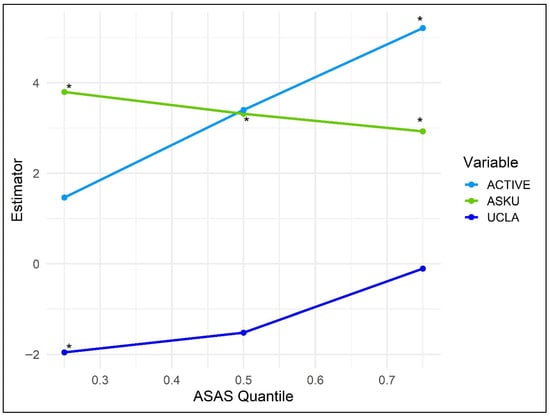
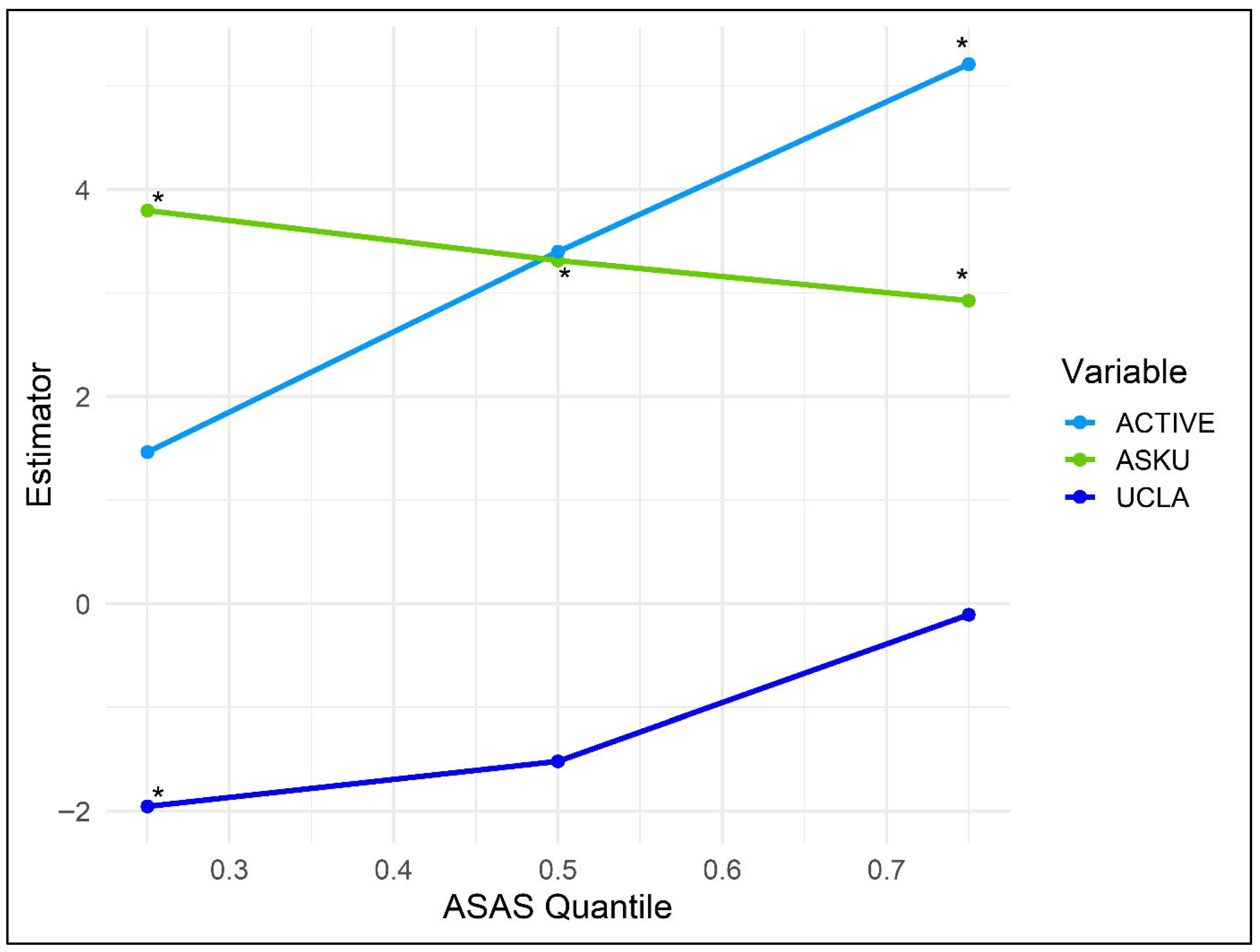
Next, quantile regression was used to examine effect heterogeneity across the ASAS distribution. For this purpose, the selected variables from the elastic net regularization were entered into the model (Table 3, Figure 1). At the lowest quartile of ASAS (τ = 0.25, pseudo-R2 = 0.42), UCLA (ß = −1.95, 95% CI [−2.90, −1.00], p < 0.001) and ASKU (ß = 3.80, 95% CI [0.92, 6.68], p = 0.010) were significantly associated with ASAS, whereas physical activity was not (p = 0.748). At the median of the ASAS (τ = 0.50, pseudo-R2 = 0.16), only the ASKU retained its significant association (ß = 3.31, 95% CI [0.45, 6.18], p = 0.024). In contrast, at the upper quartile (τ = 0.75, pseudo-R2 = 0.27), physical activity obtained significance (ß = 5.21, 95% CI [2.30, 8.12], p = 0.001) while the ASKU retained its influence (ß = 2.93, 95% CI [1.15, 4.71], p = 0.002) and UCLA remained insignificant (p = 0.903). These findings indicate that loneliness is particularly influential among participants with low self-care agency, whereas physical activity exerts its clearest benefit at the upper end of the ASAS distribution and ASKU is continually influential.
Table 3.
Quantile regression for ASAS sum score.
Figure 1.
Quantile regression on ASAS using τ = 0.25, τ = 0.50 and τ = 0.75 based on Table 3 Note: ACTIVE = physical activity, ASKU = self-efficacy, UCLA = loneliness. * indicates significance p < 0.05.
3.2. Moderation
As a last step, we aimed to detect potential moderation effects between UCLA and ASAS depending on the other variables in the model. To assess effect modification and potential departures from linearity in predictors of ASAS, we fit a moderation model and a spline sensitivity model based on the above-specified results. In the moderation model, the significant z-standardized psychosocial predictors (zUCLA, zASKU) in addition to physical activity and the sociodemographic variables from elastic net regularization were entered with main effects on ASAS. Interaction effects were specified between zUCLA*physical activity and zUCLA*zASKU.
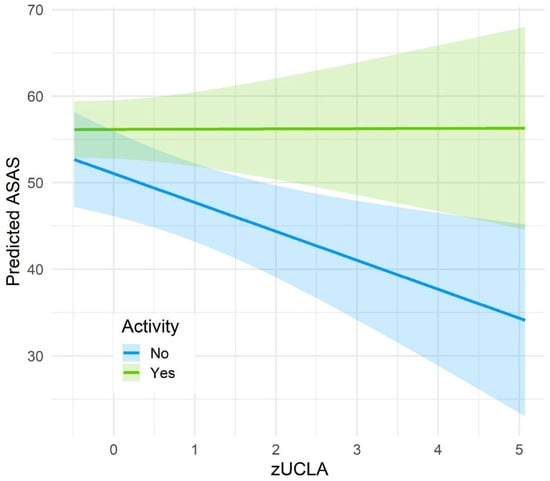
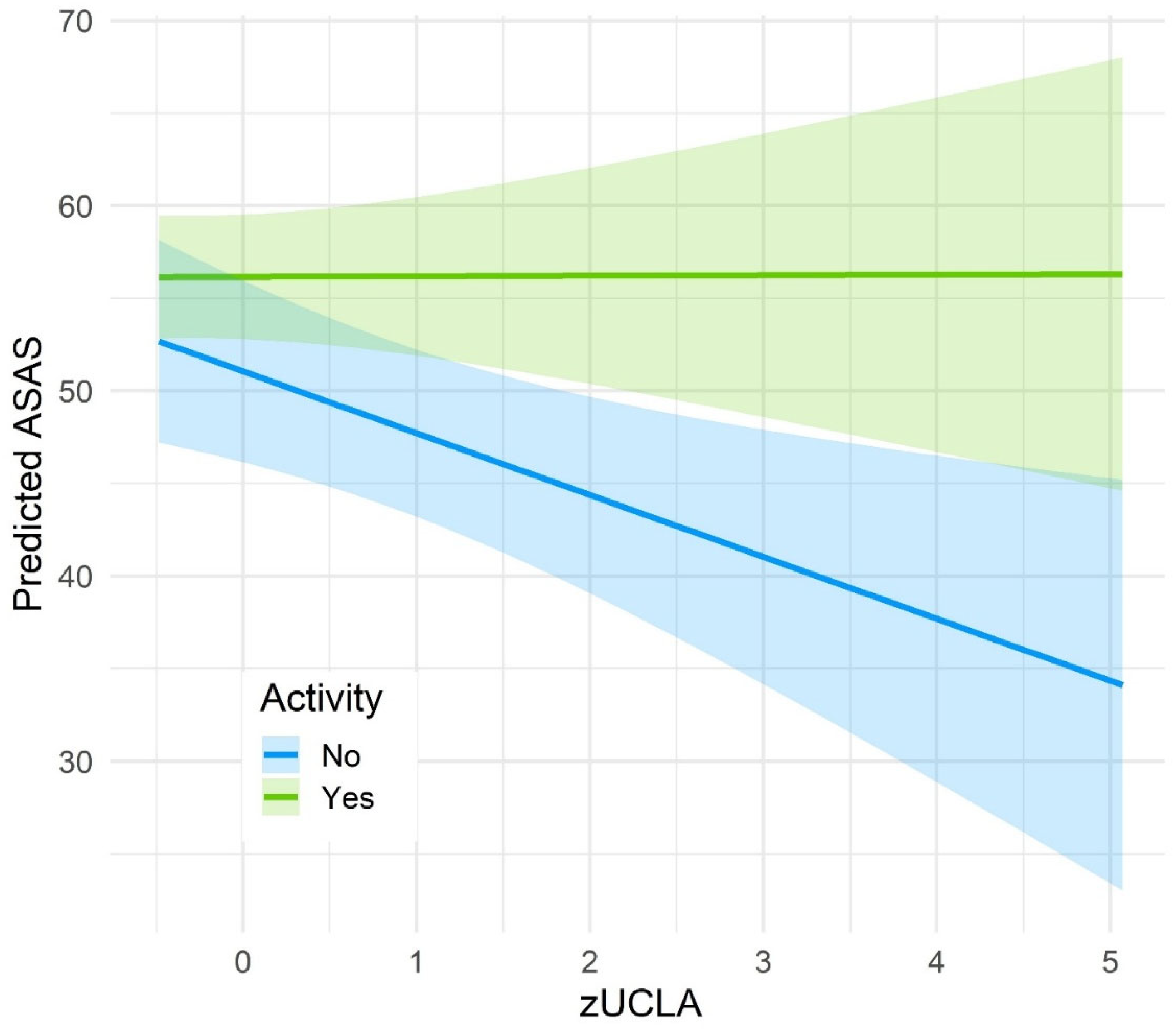
The model (adj. R2 = 0.28) retained the previously identified direct effects of UCLA, ASKU and physical activity on ASAS (Table 4). Even when considering interaction effects, the significant main effect of zUCLA (est = −3.36, 95% CI [−5.72, −0.99], p = 0.006) indicates that higher loneliness is associated with lower self-care, whereas increased activity (est = 4.94, 95% CI [0.56, 9.32], p = 0.028) and higher self-efficacy (est = 2.57, 95% CI [1.05, 4.10], p = 0.001) are linked with better self-care. This means that with each 1 SD increase in UCLA, ASAS is reduced by 3.36 points, whereas each SD increase in self-efficacy increases ASAS by 2.57 points. Of note, while there was no interaction between UCLA and ASKU on ASAS, the interaction between UCLA and physical activity was statistically significant (est = 3.29, 95% CI [0.08, 6.49], p = 0.044). These results indicate that the negative effect of UCLA on ASAS is buffered by physical activity (Figure 2).
Table 4.
Moderation model.
Figure 2.
Interaction effect between loneliness (UCLA) and self-care agency (ASAS) depending on physical activity.
A spline sensitivity analysis (Supplement Section S3) did not improve model fit.
4. Discussion
The aim of the present study was to understand the capacity for self-care in patients with CVD, as self-care is a crucial cornerstone of symptom management and quality of life maintenance [2,3]. Psychosocial stressors are now increasingly recognized in their influence on cardiovascular health [51], and loneliness can be considered a strong psychosocial stressor influencing CVD due to its associations with inflammatory processes [26,27].
In three steps, we aimed to (1) assess the influence of loneliness on self-care agency (ASAS) in patients with CVD while controlling for other psychosocial and sociodemographic variables, (2) understand in-depth whether these associations differ at varying levels of ASAS, and (3) assess potential moderating effects between loneliness and other variables on ASAS.
First, in a simple regression model, loneliness alone explained around 10% of ASAS variance, constituting a small-to-medium effect size. In comparison, after adding sociodemographic and psychosocial variables, the explained variance rose up to 25%, indicating that loneliness explains a substantial portion of ASAS variance in comparison to the six additional variables that were added in the full model. This association between loneliness and ASAS remained even after elastic net regularization and in the presence of other psychosocial and sociodemographic variables. In previous studies, this association between self-care and loneliness has been confirmed: in cross-sectional data on older adults, Masoudi, Sarbazi, Soleimanpour, Abbasian, Ghasemi, Rostami, Azizi and Soleimanpour [21] found a negative association between self-care and loneliness, and in a recent review, Puyané et al. [52] conclude that loneliness is linked to poorer self-care abilities.
As self-care is a crucial cornerstone in the management of both illness and stress, its reduction by loneliness may help explain the strong influence of loneliness on CVD [28,29,30]: as indicated by previous research, loneliness operates both as a psychosocial stressor on a biological level [32], and as a potential inhibitor of self-care in CVD patients as described in our data. However, the exact mechanisms between loneliness and self-care must be causally determined in longitudinal data.
A lack of both practical help and encouragement from a social system in lonely persons may partially explain this effect [33], and potential mental health problems arising due to loneliness [35] may further reduce motivation and ability to perform self-care [34]. Taken together, these results imply that the negative effect of loneliness on self-care may arise through biological and behavioural mechanisms, especially mental health problems and reduced support [51].
Notably, the effect of loneliness on self-care ability remained significant irrespective of self-efficacy and physical activity [31], which further independently influenced self-care. As depressiveness was not retained in the model after elastic net, it can be assumed that in our data, it did not contribute to self-care ability above and beyond the included variables; however, this effect should be confirmed in larger datasets.
Depressiveness is known as a common factor influencing both loneliness and self-care [35,53], as described above. Our results suggest that loneliness is negatively associated with self-care irrespective of co-occurring depressiveness. However, due to the cross-sectional nature of our data, no conclusion on causality can be drawn and longitudinal data is needed to confirm the results.
In contrast, self-efficacy had a profound positive association with self-care in our data. Self-efficacy is often cited as a cornerstone of self-care and self-management abilities: in a review on hypertensive patients, Tan et al. [54] conclude that higher self-efficacy is linked with better self-care and self-management ability, and previous concept analyses on self-care and self-management describe self-efficacy as indispensable for self-care [37,55]. As self-efficacy describes the belief in one’s abilities to handle a situation and achieve the desired outcome, being convinced that the own behaviour can improve health is crucial for self-care [12,13,14]. This importance of self-efficacy as a foundation for self-care is mirrored in the results obtained in our quantile regression, showing the association between higher self-efficacy and higher self-care for all levels of ASAS.
In contrast, the quantile regression suggests that in our data, the negative effect of loneliness on self-care agency is primarily driven by a strong association at low ASAS levels: those who have low self-care agency appear particularly vulnerable to the effect of loneliness, while at higher levels of self-care, loneliness appears to be compensated. Notably, as a limitation of the present data with its cross-sectional design and moderate sample size, alternative explanations such as floor effects or regression to the mean must be considered, and longitudinal data in larger samples is needed to understand the nuances of self-care agency and its association with psychosocial and health-related factors.
The results from our moderation analysis may shed a light on this association by highlighting an interaction between loneliness and physical activity: engaging in physical activity may buffer the negative effect of loneliness on self-care agency. As physical activity exerted its strongest influence at high ASAS levels, it appears possible that for persons with already low self-care agency, loneliness further diminishes self-care. In contrast, physical activity may attenuate the effect of loneliness on self-care at higher self-care levels. However, due to the cross-sectional data, no direction of effects can be determined, and it may also be the case that persons at high self-care agency generally perform more physical activity and are less lonely due to participating in sports groups. Likewise, the interaction effect is only marginally significant (p = 0.044) in a relatively small sample size. In future studies, the effect of activity on the association between loneliness and self-care must be determined longitudinally.
This effect of physical activity on self-care is well-documented. While physical activity itself may be considered an active form of self-care, it is also known to boost self-esteem and motivation for further self-care activities while reducing stress perception [56,57]. Additionally, this inverse association between loneliness and physical activity may also be rooted in practical reasons: loneliness may be associated with a reduced social circle, and many physical activities such as walking and sports are typically enjoyed with others; thus, the capacity for beneficial health behaviours may be reduced in lonely persons [36,58]. In a longitudinal study on coronary heart disease in women [32], the authors conclude that the increased risk for myocardial infarction is delivered both via biological and behavioural mechanism related to beneficial health behaviour.
Taken together, our results highlight loneliness as a serious inhibitor of self-care agency in patients with CVD, especially for those already vulnerable patients at low self-care levels. In addition to strengthening self-efficacy and fostering motivation for self-care, our results suggest that promoting physical activity may attenuate the effect of loneliness on self-care and thus improve not only self-care itself but also health outcomes. While these psychosocial parameters are already increasingly incorporated in the care for patients with CVD, their influence cannot be emphasized enough; in addition to traditional medical care, psychosocial pathways to health via motivation and health behaviour must be considered, and patients must be supported in their ability to care for themselves to achieve best health outcomes.
Limitations
While this study sheds light on first results regarding the association between loneliness as an important psychosocial stressor and self-care as a cornerstone of health management in cardiovascular disease, it is not free of limitations.
First, the cross-sectional data precludes any interpretation of causality. Longitudinal data is required to uncover the direction of effects between loneliness, self-care and the associated variables, and to confirm the robustness of the results. Likewise, the sample size was small, although robust methodological approaches were supplemented to arrive at the most reliable results despite the limited patient number. In concordance, the monocentric study design and the selective study cohort of older patients with cardiovascular illness inhibits the generalizability of the results. Additionally, the UCLA showed a floor tendency with limited variance in our study cohort, potentially attenuating the effects. In future studies, the analyses should be repeated in a cohort with sufficient variance in loneliness scores to confirm the relationships. Likewise, as behavioural data is oftentimes interconnected and the included variables cannot be statistically independent of one another, the moderation analysis should be interpreted in the light of an interconnectedness of all variables.
Lastly, the study relied primarily on self-report measures regarding the key variables. Although loneliness, depressiveness, self-efficacy and self-care are by their definition subjective experiences and can only be measured subjectively, self-report instruments may be prone to bias. Especially the reliance on the same measurement approach for outcome and predictor variables may result in bias due to common method variance. Therefore, future studies should repeat the present analyses with different measurement instruments to confirm the soundness of the results.
5. Conclusions
In patients with cardiovascular disease, loneliness as a psychosocial stressor reduces self-care agency. Especially for persons at the lower spectrum of self-care agency, additional loneliness further reduces self-care abilities. Notably, at higher self-care levels, this diminishing effect of loneliness on self-care agency is buffered by physical activity. These results suggest that loneliness must be taken into consideration in the treatment of cardiovascular illnesses, and longitudinal studies should be designed to fully understand its association with self-care and cardiovascular diseases to arrive at effective intervention strategies. Based on this preliminary cross-sectional data, the upkeep of self-efficacy as well as partaking in physical activity appear as beneficial pathways to improve self-care agency in cardiovascular disease.
Supplementary Materials
The following supporting information can be downloaded at: https://www.mdpi.com/article/10.3390/healthcare14050581/s1, Supplement Section S1. Sample size calculation; Supplement Section S2. Information on heteroscedasticity-robust inference test and cubic-spline specification; Supplement Section S3. Spline-sensitive analyses with nonlinearity. Supplement Section S4. STROBE checklist. Supplement Figure S1. UCLA Histogram.
Author Contributions
Conceptualization, T.P. and R.P.; methodology, T.P. and A.S.; software, T.P. and A.S.; formal analysis T.P., L.B. and A.S.; investigation, L.B.; data curation, L.B.; writing—original draft preparation, L.B. and T.P.; writing—review and editing, A.S. and R.P.; visualization, A.S.; supervision, T.P.; project administration, A.S. and L.B.; funding acquisition, T.P. All authors have read and agreed to the published version of the manuscript.
Funding
This research was funded by the Bundesministerium für Bildung und Forschung (BMBF), grant number 01GY1804 and 01GY2301.
Institutional Review Board Statement
This study was conducted in line with the Declaration of Helsinki, it was approved by the ethics committee of Halle University Hospital (approval number 2024-164) on 30 October 2024.
Informed Consent Statement
Written informed consent was obtained from all individual participants included in the study.
Data Availability Statement
Due to the sensitive nature of the data collected directly from patients, data are available from the corresponding author upon reasonable request.
Conflicts of Interest
The authors declare no conflicts of interest.
Abbreviations
The following abbreviations are used in this manuscript:
| ASAS | Self-Care Agency |
| ASKU | General Self-efficacy Beliefs |
| CI | Confidence Interval (95%) |
| CVD | Cardiovascular Disease |
| OLS | Ordinary Least Squares |
| SCL | Psychological Distress according to Mini-SCL Mini Symptom Checklist |
| UCLA | UCLA Loneliness Scale |
| WHO | World Health Organization |
References
- WHO. Fact Sheet: Self-Care for Health and Well-Being. Available online: https://www.who.int/news-room/fact-sheets/detail/self-care-health-interventions (accessed on 24 October 2025).
- Silva, S.; Csőke, E.; Ng, C.; Taylor, S.; Singh, P.; Sabharwal, M.; Foo, A.; Kee, W.; Wong, R.; Reid, M.J.A. Impact of socioeconomic determinants on outcomes of eight select conditions for which self-care is a modality for prevention and treatment: A scoping review. Curr. Med. Res. Opin. 2024, 40, 1921–1933. [Google Scholar] [CrossRef] [Scilit]
- Gauci, S.; Cartledge, S.; Redfern, J.; Gallagher, R.; Huxley, R.; Lee, C.M.Y.; Vassallo, A.; O’Neil, A. Biology, Bias, or Both? The Contribution of Sex and Gender to the Disparity in Cardiovascular Outcomes Between Women and Men. Curr. Atheroscler. Rep. 2022, 24, 701–708. [Google Scholar] [CrossRef] [Scilit] [PubMed]
- Okpalauwaekwe, U.; Li, C.Y.; Tzeng, H.M. Social Determinants and Self-Care for Making Good Treatment Decisions and Treatment Participation in Older Adults: A Cross-Sectional Survey Study. Nurs. Rep. 2022, 12, 198–209. [Google Scholar] [CrossRef] [Scilit]
- Lukkarinen, H.; Hentinen, M. Self-care agency and factors related to this agency among patients with coronary heart disease. Int. J. Nurs. Stud. 1997, 34, 295–304. [Google Scholar] [CrossRef] [Scilit]
- Osei Baah, F.; Brawner, B.M.; Teitelman, A.M.; Ruger, J.P.; Riegel, B. A Mixed-Methods Study of Social Determinants and Self-care in Adults With Heart Failure. J. Cardiovasc. Nurs. 2023, 38, E59–E71. [Google Scholar] [CrossRef] [Scilit]
- Wilson, R.E.; Burton, L.; Marini, N.; Loewen, P.; Janke, R.; Aujla, N.; Davis, D.; Rush, K.L. Assessing the impact of atrial fibrillation self-care interventions: A systematic review. Am. Heart J. Plus 2024, 43, 100404. [Google Scholar] [CrossRef] [Scilit]
- Bos-Touwen, I.; Jonkman, N.; Westland, H.; Schuurmans, M.; Rutten, F.; de Wit, N.; Trappenburg, J. Tailoring of self-management interventions in patients with heart failure. Curr. Heart Fail. Rep. 2015, 12, 223–235. [Google Scholar] [CrossRef] [Scilit]
- Mei, J.; Tian, Y.; Chai, X.; Fan, X. Gender differences in self-care maintenance and its associations among patients with chronic heart failure. Int. J. Nurs. Sci. 2019, 6, 58–64. [Google Scholar] [CrossRef] [Scilit]
- Loef, M.; Walach, H. The combined effects of healthy lifestyle behaviors on all cause mortality: A systematic review and meta-analysis. Prev. Med. 2012, 55, 163–170. [Google Scholar] [CrossRef] [Scilit]
- WHO. WHO Guidelines Approved by the Guidelines Review Committee. In WHO Consolidated Guideline on Self-Care Interventions for Health: Sexual and Reproductive Health and Rights; World Health Organization: Geneva, Switzerland, 2019. [Google Scholar]
- Bandura, A. Self-efficacy: Toward a unifying theory of behavioral change. Psychol. Rev. 1977, 84, 191–215. [Google Scholar] [CrossRef]
- Barnett, A. Self-Efficacy. In Encyclopedia of Quality of Life and Well-Being Research; Michalos, A.C., Ed.; Springer: Dordrecht, The Netherlands, 2014; pp. 5760–5762. [Google Scholar]
- Bandura, A. Health promotion by social cognitive means. Health Educ. Behav. 2004, 31, 143–164. [Google Scholar] [CrossRef] [Scilit] [PubMed]
- Bohanny, W.; Wu, S.F.; Liu, C.Y.; Yeh, S.H.; Tsay, S.L.; Wang, T.J. Health literacy, self-efficacy, and self-care behaviors in patients with type 2 diabetes mellitus. J. Am. Assoc. Nurse Pract. 2013, 25, 495–502. [Google Scholar] [CrossRef] [Scilit]
- Reisi, M.; Mostafavi, F.; Javadzade, H.; Mahaki, B.; Tavassoli, E.; Sharifirad, G. Impact of Health Literacy, Self-efficacy, and Outcome Expectations on Adherence to Self-care Behaviors in Iranians with Type 2 Diabetes. Oman Med. J. 2016, 31, 52–59. [Google Scholar] [CrossRef] [Scilit] [PubMed]
- Woodgate, J.; Brawley, L.R. Self-efficacy for exercise in cardiac rehabilitation: Review and recommendations. J. Health Psychol. 2008, 13, 366–387. [Google Scholar] [CrossRef] [Scilit] [PubMed]
- Loor-Torres, R.J.; Mateo Chavez, M.B.; Boehmer, K.; Suarez Pardo, L.; Connolly, H.M.; Egbe, A.C.; Passalacqua, K.; Kosec, A.M.; Burchill, L.J. Self-management interventions to improve health outcomes in youth living with congenital heart disease: A systematic review and narrative synthesis. Eur. J. Cardiovasc. Nurs. 2025, 24, 1225–1234. [Google Scholar] [CrossRef] [Scilit]
- Harkness, K.; Heckman, G.A.; Akhtar-Danesh, N.; Demers, C.; Gunn, E.; McKelvie, R.S. Cognitive function and self-care management in older patients with heart failure. Eur. J. Cardiovasc. Nurs. 2014, 13, 277–284. [Google Scholar] [CrossRef] [Scilit]
- Lv, Y.; Cao, X.; Yu, K.; Pu, J.; Tang, Z.; Wei, N.; Wang, J.; Liu, F.; Li, S. Gender differences in all-cause and cardiovascular mortality among US adults: From NHANES 2005–2018. Front. Cardiovasc. Med. 2024, 11, 1283132. [Google Scholar] [CrossRef] [Scilit]
- Masoudi, N.; Sarbazi, E.; Soleimanpour, H.; Abbasian, M.; Ghasemi, M.; Rostami, Z.; Azizi, H.; Soleimanpour, M. Loneliness and its correlation with self-care and activities of daily living among older adults: A partial least squares model. BMC Geriatr. 2024, 24, 621. [Google Scholar] [CrossRef] [Scilit]
- Nejadsadeghi, E.; Vakili-Basir, A.; Moghadasi, A.M.; Papi, S. Association between loneliness and self-care in elderly individuals with chronic kidney disease: A structural equation modeling approach. BMC Public Health 2025, 25, 3303. [Google Scholar] [CrossRef] [Scilit]
- Salari, N.; Najafi, H.; Rasoulpoor, S.; Canbary, Z.; Heidarian, P.; Mohammadi, M. The global prevalence and associated factors of loneliness in older adults: A systematic review and meta-analysis. Humanit. Soc. Sci. Commun. 2025, 12, 985. [Google Scholar] [CrossRef] [Scilit]
- Holt-Lunstad, J. Social connection or loneliness? How we frame the issue may significantly impact public policy. Health Psychol. 2025, 44, 560–562. [Google Scholar] [CrossRef] [Scilit]
- Albasheer, O.; Abdelwahab, S.I.; Zaino, M.R.; Altraifi, A.A.A.; Hakami, N.; El-Amin, E.I.; Alshehri, M.M.; Alghamdi, S.M.; Alqahtani, A.S.; Alenazi, A.M.; et al. The impact of social isolation and loneliness on cardiovascular disease risk factors: A systematic review, meta-analysis, and bibliometric investigation. Sci. Rep. 2024, 14, 12871. [Google Scholar] [CrossRef] [Scilit]
- Zawadzki, M.J.; Gavrilova, L. All the lonely people: Comparing the effects of loneliness as a social stressor to non-lonely stress on blood pressure recovery. Int. J. Psychophysiol. 2021, 167, 94–101. [Google Scholar] [CrossRef] [Scilit]
- Doane, L.D.; Adam, E.K. Loneliness and cortisol: Momentary, day-to-day, and trait associations. Psychoneuroendocrinology 2010, 35, 430–441. [Google Scholar] [CrossRef] [Scilit] [PubMed]
- Cené, C.W.; Beckie, T.M.; Sims, M.; Suglia, S.F.; Aggarwal, B.; Moise, N.; Jiménez, M.C.; Gaye, B.; McCullough, L.D. Effects of Objective and Perceived Social Isolation on Cardiovascular and Brain Health: A Scientific Statement From the American Heart Association. J. Am. Heart Assoc. 2022, 11, e026493. [Google Scholar] [CrossRef] [Scilit]
- Holt-Lunstad, J.; Smith, T.B.; Baker, M.; Harris, T.; Stephenson, D. Loneliness and social isolation as risk factors for mortality: A meta-analytic review. Perspect. Psychol. Sci. 2015, 10, 227–237. [Google Scholar] [CrossRef] [Scilit]
- Long, R.M.; Terracciano, A.; Sutin, A.R.; Creaven, A.M.; Gerstorf, D.; D’Arcy-Bewick, S.; O’Súilleabháin, P.S. Loneliness, Social Isolation, and Living Alone Associations With Mortality Risk in Individuals Living With Cardiovascular Disease: A Systematic Review, Meta-Analysis, and Meta-Regression. Psychosom. Med. 2023, 85, 8–17. [Google Scholar] [CrossRef] [Scilit]
- Foti, S.A.; Khambaty, T.; Birnbaum-Weitzman, O.; Arguelles, W.; Penedo, F.; Espinoza Giacinto, R.A.; Gutierrez, A.P.; Gallo, L.C.; Giachello, A.L.; Schneiderman, N.; et al. Loneliness, Cardiovascular Disease, and Diabetes Prevalence in the Hispanic Community Health Study/Study of Latinos Sociocultural Ancillary Study. J. Immigr. Minor. Health 2020, 22, 345–352. [Google Scholar] [CrossRef] [Scilit]
- Chang, S.C.; Glymour, M.; Cornelis, M.; Walter, S.; Rimm, E.B.; Tchetgen Tchetgen, E.; Kawachi, I.; Kubzansky, L.D. Social Integration and Reduced Risk of Coronary Heart Disease in Women: The Role of Lifestyle Behaviors. Circ. Res. 2017, 120, 1927–1937. [Google Scholar] [CrossRef] [Scilit] [PubMed]
- Yu, Y.; Huang, Q.; Ren, Z.; Ou, Z. The Association Between Social Isolation and Medication Adherence Among Chinese Older Adults With Chronic Diseases: Serial Mediation of Social Support and Loneliness. Ann. Behav. Med. 2024, 58, 670–678. [Google Scholar] [CrossRef] [Scilit] [PubMed]
- Fivecoat, H.C.; Sayers, S.L.; Riegel, B. Social support predicts self-care confidence in patients with heart failure. Eur. J. Cardiovasc. Nurs. 2018, 17, 598–604. [Google Scholar] [CrossRef] [Scilit] [PubMed]
- Erzen, E.; Çikrikci, Ö. The effect of loneliness on depression: A meta-analysis. Int. J. Soc. Psychiatry 2018, 64, 427–435. [Google Scholar] [CrossRef] [Scilit]
- Fan, Y.; Shen, B.J.; Ho, M.R. Loneliness, perceived social support, and their changes predict medical adherence over 12 months among patients with coronary heart disease. Br. J. Health Psychol. 2024, 29, 814–832. [Google Scholar] [CrossRef] [Scilit] [PubMed]
- Van de Velde, D.; De Zutter, F.; Satink, T.; Costa, U.; Janquart, S.; Senn, D.; De Vriendt, P. Delineating the concept of self-management in chronic conditions: A concept analysis. BMJ Open 2019, 9, e027775. [Google Scholar] [CrossRef] [Scilit]
- Schönenberg, A.; Teschner, U.; Prell, T.; Mühlhammer, H.M. Validation and Psychometric Analysis of the German Translation of the Appraisal of Self-Care Agency Scale-Revised. Healthcare 2022, 10, 1785. [Google Scholar] [CrossRef] [Scilit]
- Beierlein, C.; Kemper, C.J.; Kovaleva, A.; Rammstedt, B. Short scale for measuring general self-efficacy beliefs (ASKU). Methods Data Anal. 2013, 7, 28. [Google Scholar]
- Franke, G.H.; Jaeger, S.; Glaesmer, H.; Barkmann, C.; Petrowski, K.; Braehler, E. Psychometric analysis of the brief symptom inventory 18 (BSI-18) in a representative German sample. BMC Med. Res. Methodol. 2017, 17, 14. [Google Scholar] [CrossRef] [Scilit]
- Hughes, M.E.; Waite, L.J.; Hawkley, L.C.; Cacioppo, J.T. A Short Scale for Measuring Loneliness in Large Surveys: Results From Two Population-Based Studies. Res. Aging 2004, 26, 655–672. [Google Scholar] [CrossRef] [Scilit]
- Nakou, A.; Dragioti, E.; Bastas, N.S.; Zagorianakou, N.; Kakaidi, V.; Tsartsalis, D.; Mantzoukas, S.; Tatsis, F.; Veronese, N.; Solmi, M.; et al. Loneliness, social isolation, and living alone: A comprehensive systematic review, meta-analysis, and meta-regression of mortality risks in older adults. Aging Clin. Exp. Res. 2025, 37, 29. [Google Scholar] [CrossRef] [Scilit]
- Mahindru, A.; Patil, P.; Agrawal, V. Role of Physical Activity on Mental Health and Well-Being: A Review. Cureus 2023, 15, e33475. [Google Scholar] [CrossRef] [Scilit] [PubMed]
- Jin, M.J.; Bae, S.M. The Effect of Social Isolation, Loneliness, and Physical Activity on Depressive Symptoms of Older Adults during COVID-19: A Moderated Mediation Analysis. Int. J. Environ. Res. Public Health 2023, 21, 26. [Google Scholar] [CrossRef] [Scilit] [PubMed]
- The WHOQOL Group. Development of the World Health Organization WHOQOL-BREF quality of life assessment. Psychol. Med. 1998, 28, 551–558. [Google Scholar] [CrossRef] [Scilit]
- R Core Team. R: A Language and Environment for Statistical Computing; R Foundation for Statistical Computing: Vienna, Austria, 2021. [Google Scholar]
- Friedman, J.; Hastie, T.; Tibshirani, R. Regularization Paths for Generalized Linear Models via Coordinate Descent. J. Stat. Softw. 2010, 33, 1–22. [Google Scholar] [CrossRef] [Scilit]
- Zeileis, A.; Köll, S.; Graham, N. Various Versatile Variances: An Object-Oriented Implementation of Clustered Covariances in R. J. Stat. Softw. 2020, 95, 1–36. [Google Scholar] [CrossRef] [Scilit]
- Koenker, R. Quantile Regression. R Package Version 6.1. 2025. Available online: https://CRAN.R-project.org/package=quantreg (accessed on 7 October 2025).
- Wang, W.; Yan, J. Shape-Restricted Regression Splines with R Package splines2. J. Data Sci. 2021, 19, 498–517. [Google Scholar] [CrossRef] [Scilit]
- Osborne, M.T.; Shin, L.M.; Mehta, N.N.; Pitman, R.K.; Fayad, Z.A.; Tawakol, A. Disentangling the Links Between Psychosocial Stress and Cardiovascular Disease. Circ. Cardiovasc. Imaging 2020, 13, e010931. [Google Scholar] [CrossRef] [Scilit] [PubMed]
- Puyané, M.; Chabrera, C.; Camón, E.; Cabrera, E. Uncovering the impact of loneliness in ageing populations: A comprehensive scoping review. BMC Geriatr. 2025, 25, 244. [Google Scholar] [CrossRef] [Scilit]
- Derese, A.; Gebreegzhiabhere, Y.; Medhin, G.; Sirgu, S.; Hanlon, C. Impact of depression on self-efficacy, illness perceptions and self-management among people with type 2 diabetes: A systematic review of longitudinal studies. PLoS ONE 2024, 19, e0302635. [Google Scholar] [CrossRef] [Scilit]
- Tan, F.C.J.H.; Oka, P.; Dambha-Miller, H.; Tan, N.C. The association between self-efficacy and self-care in essential hypertension: A systematic review. BMC Fam. Pract. 2021, 22, 44. [Google Scholar] [CrossRef] [Scilit]
- Udlis, K.A. Self-management in chronic illness: Concept and dimensional analysis. J. Nurs. Healthc. Chronic Illn. 2011, 3, 130–139. [Google Scholar] [CrossRef] [Scilit]
- Martland, R.N.; Ma, R.; Paleri, V.; Valmaggia, L.; Riches, S.; Firth, J.; Stubbs, B. The efficacy of physical activity to improve the mental wellbeing of healthcare workers: A systematic review. Ment. Health Phys. Act. 2024, 26, 100577. [Google Scholar] [CrossRef] [Scilit]
- Zamani Sani, S.H.; Fathirezaie, Z.; Brand, S.; Pühse, U.; Holsboer-Trachsler, E.; Gerber, M.; Talepasand, S. Physical activity and self-esteem: Testing direct and indirect relationships associated with psychological and physical mechanisms. Neuropsychiatr. Dis. Treat. 2016, 12, 2617–2625. [Google Scholar] [CrossRef] [Scilit] [PubMed]
- Sherman, D.W.; Alfano, A.R.; Alfonso, F.; Duque, C.R.; Eiroa, D.; Marrero, Y.; Muñecas, T.; Radcliffe-Henry, E.; Rodriguez, A.; Sommer, C.L. A Systematic Review of the Relationship between Social Isolation and Physical Health in Adults. Healthcare 2024, 12, 1135. [Google Scholar] [CrossRef] [Scilit]

Disclaimer/Publisher’s Note: The statements, opinions and data contained in all publications are solely those of the individual author(s) and contributor(s) and not of MDPI and/or the editor(s). MDPI and/or the editor(s) disclaim responsibility for any injury to people or property resulting from any ideas, methods, instructions or products referred to in the content. |
© 2026 by the authors. Licensee MDPI, Basel, Switzerland. This article is an open access article distributed under the terms and conditions of the Creative Commons Attribution (CC BY) license.