Feasibility and Pre–Post Changes Associated with a 12-Week Treadmill Walking Training Programme on Walking Performance, Physical Function, Fatigue, and Quality of Life in People with Multiple Sclerosis: A Single-Arm Pilot Study

 , , ,
, , ,  and
and 
Highlights
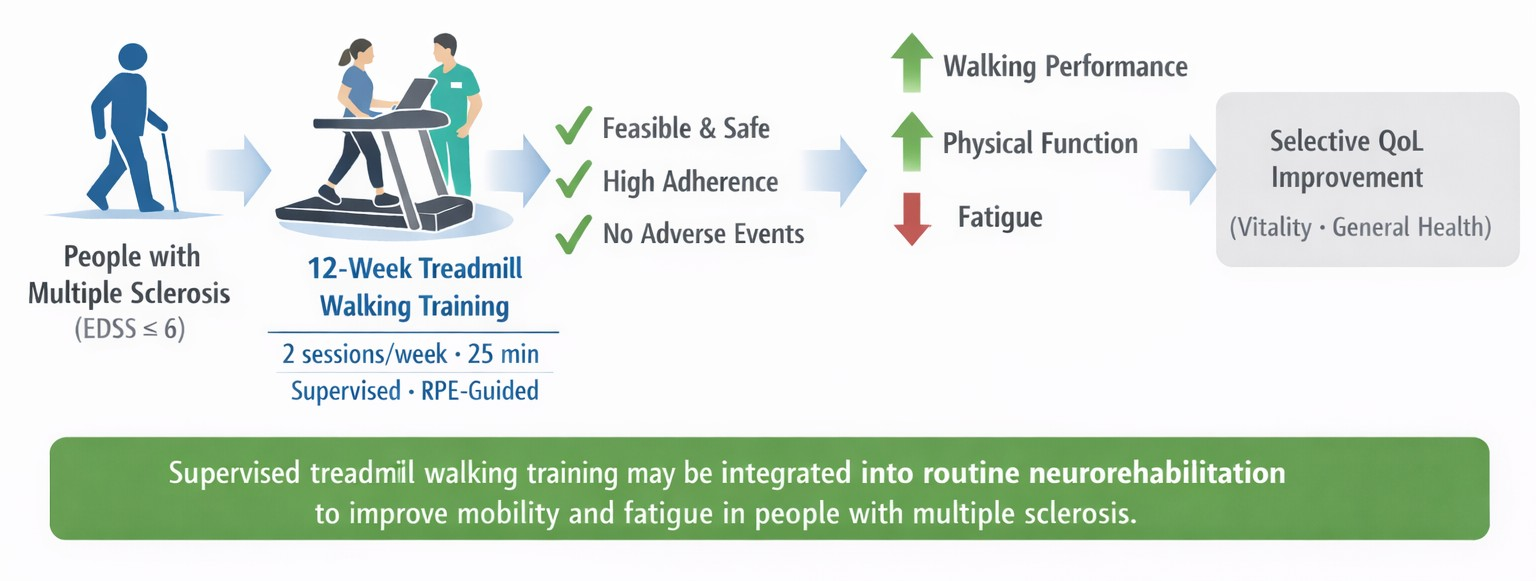
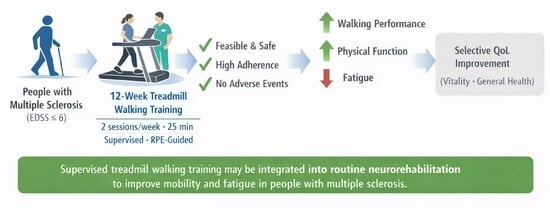
- A 12-week supervised treadmill walking training programme was feasible and safe for people with multiple sclerosis, with high adherence and no adverse events.
- The intervention was associated with improvements in walking performance, functional mobility, physical function, and fatigue, while overall quality of life showed domain-specific changes only.
- These findings suggest that supervised treadmill walking training can be integrated into routine neurorehabilitation settings and was associated with clinically meaningful pre–post changes in mobility and fatigue in people with multiple sclerosis.
- The domain-specific pre–post changes observed in vitality and general health suggest that treadmill-based exercise may preferentially be associated with changes in perceived energy levels and health status, rather than global quality of life, in people with multiple sclerosis.
Abstract
1. Introduction
2. Materials and Methods
2.1. Ethical Considerations
2.2. Study Design
2.3. Participants
- (i)
- Diagnosis of MS according to the most recent revisions of the McDonald criteria [37], regardless of phenotype (relapsing–remitting, primary progressive, or secondary progressive);
- (ii)
- Age ≥ 18 years;
- (iii)
- EDSS score ≤ 6 [38];
- (iv)
- No MS exacerbation within the previous 30 days;
- (v)
- Ability to maintain continuous walking for at least 10 min.
- (i)
- Had cognitive impairment preventing completion of the TWT protocol; Cognitive impairment was determined based on clinical judgment by the treating neurologist and review of the patient’s medical records; no formal neuropsychological screening instrument was administered specifically for study inclusion;
- (ii)
- (iii)
- Had a history of frequent falls (≥4 falls) in the previous 6 months;
- (iv)
- Reported severe symptoms during TWT that compromised safe participation (e.g., vertigo or dizziness).
2.4. Intervention
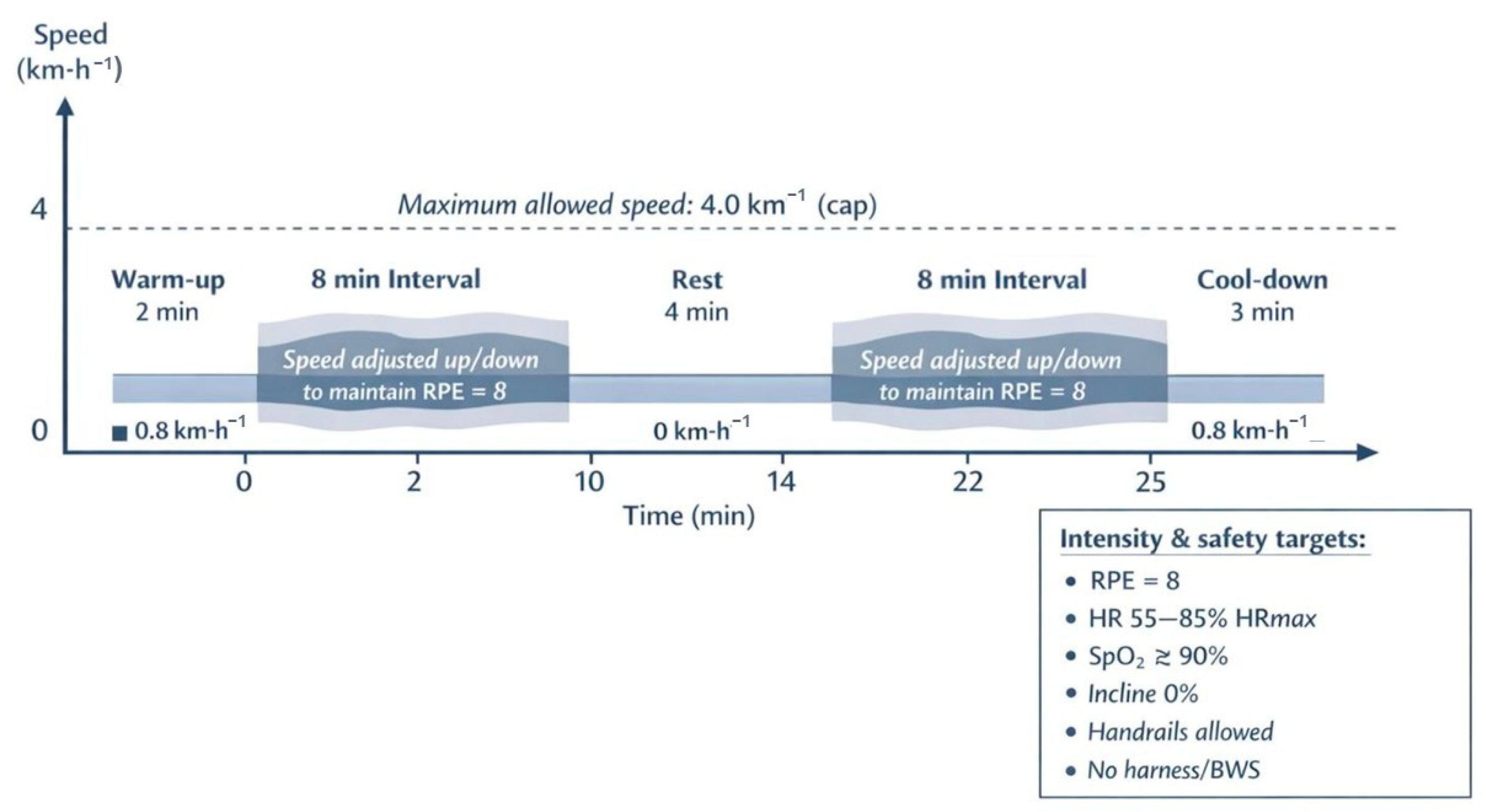
- A 2 min warm-up at 0.8 km·h−1;
- A 20 min main phase consisting of two 8 min walking intervals separated by a 4 min rest period (treadmill stopped);
- A 3 min cool-down at 0.8 km·h−1 (Figure 3).
2.5. Outcome Measures
2.5.1. Quality of Life
2.5.2. Functional Mobility (Timed up and Go)
2.5.3. Walking Speed and Frailty Risk Indicator (4 m Walk Test)
2.5.4. Physical Function (Short Physical Performance Battery)
2.5.5. Fatigue
2.6. Statistical Analysis
2.7. Safety and Adverse Events
3. Results
3.1. Sample Description
3.2. Outcomes After the Intervention
3.2.1. Quality of Life (SF-36)
3.2.2. Mobility, Gait Speed, and Physical Function
3.2.3. Fatigue
3.3. Adherence to the Treadmill Walking Training Programme
3.4. Adverse Events
4. Discussion
4.1. Principal Findings and Clinical Relevance
4.2. Quality of Life: Domain-Specific Changes and Measurement Considerations
4.3. Fatigue: Potential Mechanisms and Comparison with the Literature
4.4. Walking Performance and Functional Mobility: Implications for Falls-Related Outcomes
4.5. Frailty-Related Risk Indicator and Physical Function (SPPB): Positioning the Contribution
4.6. Feasibility, Safety, and Implementation in Routine Care
4.7. Limitations, Strengths, and Future Research
4.8. Practical Applications
5. Conclusions
Supplementary Materials
Author Contributions
Funding
Institutional Review Board Statement
Informed Consent Statement
Data Availability Statement
Acknowledgments
Conflicts of Interest
Abbreviations
| ACSM | American College of Sports Medicine |
| CEIC | Clinical Ethics and Research Committee |
| CONSORT | Consolidated Standards of Reporting Trials |
| EDSS | Expanded Disability Status Scale |
| HR | Heart rate |
| HRmax | Maximum heart rate |
| IQR | Interquartile range |
| MFIS | Modified Fatigue Impact Scale |
| MS | Multiple sclerosis |
| PAR-Q+ | Physical Activity Readiness Questionnaire for Everyone |
| QoL | Quality of life |
| RPE | Rating of Perceived Exertion |
| SD | Standard deviation |
| SF-36 | 36-Item Short Form Health Survey |
| SpO2 | Peripheral oxygen saturation |
| SPPB | Short Physical Performance Battery |
| TUG | Timed Up and Go |
| TWT | Treadmill walking training |
| WHO | World Health Organization |
Appendix A

Appendix B


Appendix C
| Section/Topic | Item No | Checklist Item | Reported on Page Nº |
| Title and abstract | |||
| 1a | Identification as a randomised trial in the title | - | |
| 1b | Structured summary of trial design, methods, results, and conclusions (for specific guidance see CONSORT for abstracts) | 1–2 | |
| Introduction | |||
| Background and objectives | 2a | Scientific background and explanation of rationale | 2–3 |
| 2b | Specific objectives or hypotheses | 3 | |
| Methods | |||
| Trial design | 3a | Description of trial design (such as parallel, factorial) including allocation ratio | 3–4 |
| 3b | Important changes to methods after trial commencement (such as eligibility criteria), with reasons | - | |
| Participants | 4a | Eligibility criteria for participants | 4–5 |
| 4b | Settings and locations where the data were collected | 3 | |
| Interventions | 5 | The interventions for each group with sufficient details to allow replication, including how and when they were actually administered | 5–6 |
| Outcomes | 6a | Completely defined pre-specified primary and secondary outcome measures, including how and when they were assessed | 6–7 |
| 6b | Any changes to trial outcomes after the trial commenced, with reasons | - | |
| Sample size | 7a | How sample size was determined | 4 |
| 7b | When applicable, explanation of any interim analyses and stopping guidelines | - | |
| Randomisation: | |||
| Sequence generation | 8a | Method used to generate the random allocation sequence | - |
| 8b | Type of randomisation; details of any restriction (such as blocking and block size) | - | |
| Allocation concealment mechanism | 9 | Mechanism used to implement the random allocation sequence (such as sequentially numbered containers), describing any steps taken to conceal the sequence until interventions were assigned | - |
| Implementation | 10 | Who generated the random allocation sequence, who enrolled participants, and who assigned participants to interventions | - |
| Blinding | 11a | If done, who was blinded after assignment to interventions (for example, participants, care providers, those assessing outcomes) and how | - |
| 11b | If relevant, description of the similarity of interventions | - | |
| Statistical methods | 12a | Statistical methods used to compare groups for primary and secondary outcomes | - |
| 12b | Methods for additional analyses, such as subgroup analyses and adjusted analyses | 7–8 | |
| Results | |||
| Participant flow (a diagram is strongly recommended) | 13a | For each group, the numbers of participants who were randomly assigned, received intended treatment, and were analysed for the primary outcome | 5 |
| 13b | For each group, losses and exclusions after randomisation, together with reasons | 5 | |
| Recruitment | 14a | Dates defining the periods of recruitment and follow-up | 4 |
| 14b | Why the trial ended or was stopped | - | |
| Baseline data | 15 | A table showing baseline demographic and clinical characteristics for each group | 8–9 |
| Numbers analysed | 16 | For each group, number of participants (denominator) included in each analysis and whether the analysis was by original assigned groups | 5 |
| Outcomes and estimation | 17a | For each primary and secondary outcome, results for each group, and the estimated effect size and its precision (such as 95% confidence interval) | 9–11 |
| 17b | For binary outcomes, presentation of both absolute and relative effect sizes is recommended | - | |
| Ancillary analyses | 18 | Results of any other analyses performed, including subgroup analyses and adjusted analyses, distinguishing pre-specified from exploratory | 9–11 |
| Harms | 19 | All important harms or unintended effects in each group (for specific guidance see CONSORT for harms) | 11 |
| Discussion | |||
| Limitations | 20 | Trial limitations, addressing sources of potential bias, imprecision, and, if relevant, multiplicity of analyses | 13 |
| Generalisability | 21 | Generalisability (external validity, applicability) of the trial findings | 11–13 |
| Interpretation | 22 | Interpretation consistent with results, balancing benefits and harms, and considering other relevant evidence | 11–13 |
| Other information | |||
| Registration | 23 | Registration number and name of trial registry | 3 |
| Protocol | 24 | Where the full trial protocol can be accessed, if available | 3 |
| Funding | 25 | Sources of funding and other support (such as supply of drugs), role of funders | 15 |
References
- García López, F.J.; García-Merino, A.; Alcalde-Cabero, E.; de Pedro-Cuesta, J. Incidence and Prevalence of Multiple Sclerosis in Spain: A Systematic Review. Neurología 2024, 39, 639–650. [Google Scholar] [CrossRef]
- Guamán Vera, L.A.; Bustamente Flor, E.G. Generalidades de La Esclerosis Múltiple. E-IDEA 4.0 Rev. Multidiscip. 2022, 4, 81–91. [Google Scholar]
- Seco Calvo, J.; Rodríguez-Larrad, A.; Gómez Sánchez, J.C.; Rivieira Rodríguez, C.; García Morán, A. Sistema Nervioso: Métodos, Fisioterapia Clínica y Afecciones Para Fisioterapeutas; Editorial Médica Paramericana, Spain, 2020. [Google Scholar]
- Halabchi, F.; Alizadeh, Z.; Sahraian, M.A.; Abolhasani, M. Exercise Prescription for Patients with Multiple Sclerosis; Potential Benefits and Practical Recommendations. BMC Neurol. 2017, 17, 185. [Google Scholar] [CrossRef]
- Bravo-González, F.; Álvarez-Roldán, A. Multiple Sclerosis, Loss of Functionality and Gender. Gac. Sanit. 2019, 33, 177–184. [Google Scholar] [CrossRef] [PubMed]
- Özden, F.; Özkeskin, M.; Tümtürk, İ.; Yüceyar, N. Comparison of Physical Performance, Gait, Balance, Falls Efficacy, and Step Reaction Time in Individuals with Multiple Sclerosis. Clin. Neurol. Neurosurg. 2023, 232, 107872. [Google Scholar] [CrossRef] [PubMed]
- Zanotto, T.; Galperin, I.; Mirelman, A.; Chen, L.; Regev, K.; Kerni, A.; Schmitz-Hübsch, T.; Paul, F.; Lynch, S.G.; Akinwuntan, A.E.; et al. Association Between Frailty and Free-Living Walking Performance in People with Multiple Sclerosis. Phys. Ther. 2023, 103, pzad032. [Google Scholar] [CrossRef]
- Galperin, I.; Mirelman, A.; Schmitz-Hübsch, T.; Hsieh, K.L.; Regev, K.; Karni, A.; Brozgol, M.; Cornejo Thumm, P.; Lynch, S.G.; Paul, F.; et al. Treadmill Training with Virtual Reality to Enhance Gait and Cognitive Function among People with Multiple Sclerosis: A Randomized Controlled Trial. J. Neurol. 2023, 270, 1388–1401. [Google Scholar] [CrossRef] [PubMed]
- Peruzzi, A.; Zarbo, I.R.; Cereatti, A.; Della Croce, U.; Mirelman, A. An Innovative Training Program Based on Virtual Reality and Treadmill: Effects on Gait of Persons with Multiple Sclerosis. Disabil. Rehabil. 2017, 39, 1557–1563. [Google Scholar] [CrossRef]
- LaRocca, N.G. Impact of Walking Impairment in Multiple Sclerosis: Perspectives of Patients and Care Partners. Patient 2011, 4, 189–201. [Google Scholar] [CrossRef]
- Heine, M.; van de Port, I.; Rietberg, M.B.; van Wegen, E.E.; Kwakkel, G. Exercise Therapy for Fatigue in Multiple Sclerosis. Cochrane Database Syst. Rev. 2015, 2015, CD009956. [Google Scholar] [CrossRef]
- Manjaly, Z.M.; Harrison, N.A.; Critchley, H.D.; Do, C.T.; Stefanics, G.; Wenderoth, N.; Lutterotti, A.; Müller, A.; Stephan, K.E. Pathophysiological and Cognitive Mechanisms of Fatigue in Multiple Sclerosis. J. Neurol. Neurosurg. Psychiatry 2019, 90, 642–651. [Google Scholar] [CrossRef]
- Vister, E.; Tijsma, M.E.; Hoang, P.D.; Lord, S.R. Fatigue, Physical Activity, Quality of Life, and Fall Risk in People with Multiple Sclerosis. Int. J. MS Care 2017, 19, 91–98. [Google Scholar] [CrossRef]
- Acosta-Benito, M.Á.; Martín-Lesende, I. Fragilidad En Atención Primaria: Diagnóstico y Manejo Multidisciplinar. Aten. Primaria 2022, 54, 102395. [Google Scholar] [CrossRef] [PubMed]
- Cameron, M.H.; Nilsagard, Y. Balance, gait, and falls in multiple sclerosis. In Handbook of Clinical Neurology; Elsevier: Amsterdam, The Netherlands, 2018; Volume 159, pp. 237–250. [Google Scholar] [CrossRef]
- Scholz, M.; Haase, R.; Trentzsch, K.; Weidemann, M.L.; Ziemssen, T. Fear of Falling and Falls in People with Multiple Sclerosis: A Literature Review. Mult. Scler. Relat. Disord. 2021, 47, 102609. [Google Scholar] [CrossRef] [PubMed]
- Ertekin, Ö.; Kara, T.; Abasıyanık, Z.; Kahraman, T.; Özakbaş, S. Sedentary Behaviour and Related Factors in People with Multiple Sclerosis. Mult. Scler. Relat. Disord. 2024, 81, 105152. [Google Scholar] [CrossRef] [PubMed]
- Cortese, M.; Riise, T.; Bjornevik, K.; Myhr, K.M. Body Size and Physical Exercise, and the Risk of Multiple Sclerosis. Mult. Scler. 2018, 24, 270–278. [Google Scholar] [CrossRef]
- Vaughn, C.B.; Jakimovski, D.; Kavak, K.S.; Ramanathan, M.; Benedict, R.H.B.; Zivadinov, R.; Weinstock-Guttman, B. Epidemiology and Treatment of Multiple Sclerosis in Elderly Populations. Nat. Rev. Neurol. 2019, 15, 329–342. [Google Scholar] [CrossRef]
- Buhse, M. The Elderly Person with Multiple Sclerosis: Clinical Implications for the Increasing Life-Span. J. Neurosci. Nurs. 2015, 47, 333–339. [Google Scholar] [CrossRef]
- Cerqueira, J.J.; Compston, D.A.S.; Geraldes, R.; Rosa, M.M.; Schmierer, K.; Thompson, A.; Tinelli, M.; Palace, J. Time Matters in Multiple Sclerosis: Can Early Treatment and Long-Term Follow-up Ensure Everyone Benefits from the Latest Advances in Multiple Sclerosis? J. Neurol. Neurosurg. Psychiatry 2018, 89, 844–850. [Google Scholar] [CrossRef]
- Pilutti, L.A.; Paulseth, J.E.; Dove, C.; Jiang, S.; Rathbone, M.P.; Hicks, A.L. Exercise Training in Progressive Multiple Sclerosis: A Comparison of Recumbent Stepping and Body Weight-Supported Treadmill Training. Int. J. MS Care 2016, 18, 221–229. [Google Scholar] [CrossRef]
- Johnson, K.A.; Bandera, V.M.; Diehl, M.; Leach, H.J.; Fling, B.W. Walking Performance Differs between People with Multiple Sclerosis Who Perform Distinct Types of Exercise. Neurodegener. Dis. Manag. 2024, 14, 75–85. [Google Scholar] [CrossRef]
- Hubbard, I.J.; Parsons, M.W.; Neilson, C.; Carey, L.M. Task-Specific Training: Evidence for and Translation to Clinical Practice. Occup. Ther. Int. 2009, 16, 175–189. [Google Scholar] [CrossRef]
- Mehrholz, J.; Thomas, S.; Elsner, B. Treadmill Training and Body Weight Support for Walking after Stroke. Cochrane Database Syst. Rev. 2017, 8, CD002840. [Google Scholar] [CrossRef]
- Gervasoni, E.; Cattaneo, D.; Jonsdottir, J. Effect of Treadmill Training on Fatigue in Multiple Sclerosis: A Pilot Study. Int. J. Rehabil. Res. 2014, 37, 54–60. [Google Scholar] [CrossRef]
- Kalron, A. Association between Perceived Fatigue and Gait Parameters Measured by an Instrumented Treadmill in People with Multiple Sclerosis: A Cross-Sectional Study. J. Neuroeng. Rehabil. 2015, 12, 34. [Google Scholar] [CrossRef]
- Willingham, T.B.; Melbourn, J.; Moldavskiy, M.; McCully, K.K.; Backus, D. Effects of Treadmill Training on Muscle Oxidative Capacity and Endurance in People with Multiple Sclerosis with Significant Walking Limitations. Int. J. MS Care 2019, 21, 166–172. [Google Scholar] [CrossRef] [PubMed]
- Robinson, A.G.; Dennett, A.M.; Snowdon, D.A. Treadmill Training May Be an Effective Form of Task-Specific Training for Improving Mobility in People with Parkinson’s Disease and Multiple Sclerosis: A Systematic Review and Meta-Analysis. Physiotherapy 2019, 105, 174–186. [Google Scholar] [CrossRef] [PubMed]
- León Ruiz, M.; Sospedra, M.; Arce, S.A.; Tejeiro-Martínez, J.; Benito-León, J. Current Evidence on the Potential Therapeutic Applications of Transcranial Magnetic Stimulation in Multiple Sclerosis: A Systematic Review of the Literature. Neurologia 2022, 37, 199–215. [Google Scholar] [CrossRef] [PubMed]
- Yalachkov, Y.; Soydaş, D.; Bergmann, J.; Frisch, S.; Behrens, M.; Foerch, C.; Gehrig, J. Determinants of Quality of Life in Relapsing-Remitting and Progressive Multiple Sclerosis. Mult. Scler. Relat. Disord. 2019, 30, 33–37. [Google Scholar] [CrossRef]
- Hernández, M.; Mora, S. Evaluación de La Calidad de Vida Mediante El Cuestionario PRIMUS En Población Española de Pacientes Con Esclerosis Múltiple. Neurología 2013, 28, 340–347. [Google Scholar] [CrossRef]
- Cantín, M. World Medical Association Declaration of Helsinki: Ethical Principles for Medical Research Involving Human Subjects. Reviewing the Latest Version. Int. J. Med. Surg. Sci. 2014, 1, 339–346. [Google Scholar] [CrossRef]
- Sedar, C.C.; Cihan, M.; Yücel, D.; Serdar, M.A. Sample Size, Power and Effect Size Revisited: Simplified and Practical Approachs in Ple-Clinical, Clinical and Laboratory Studies. Biochem. Med. 2021, 31, 010502. [Google Scholar] [CrossRef]
- Hopewell, S.; Chan, A.W.; Collins, G.S.; Hróbjartsson, A.; Moher, D.; Schulz, K.F.; Tunn, R.; Aggarwal, R.; Berkwits, M.; Berlin, J.A.; et al. CONSORT 2025 Statement: Updated Guideline for Reporting Randomised Trials. BMJ 2025, 389, e081123. [Google Scholar] [CrossRef]
- Faul, F.; Erdfelder, E.; Lang, A.G.; Buchner, A. G*Power 3: A Flexible Statistical Power Analysis Program for the Social, Behavioral, and Biomedical Sciences. Behav. Res. Methods 2007, 39, 175–191. [Google Scholar] [CrossRef]
- Montalban, X.; Lebrun-Frénay, C.; Oh, J.; Arrambide, G.; Moccia, M.; Amato, M.P.; Amezcua, L.; Banwell, B.; Bar-Or, A.; Barkhof, F.; et al. Diagnosis of Multiple Sclerosis: 2024 Revisions of the McDonald Criteria. Lancet Neurol. 2025, 24, 850–865. [Google Scholar] [CrossRef]
- Füvesi, J. The Expanded Disability Status Scale Scoring in Patients with Multiple Sclerosis. Ideggyogy. Szle. 2019, 72, 317–323. [Google Scholar] [CrossRef]
- Warburton, D.E.R.; Jamnik, V.; Bredin, S.S.D.; Shephard, R.; Gledhill, N. The 2021 Physical Activity Readiness Qustionnaire for Everyone (PAR-Q+) and Electronic Physical Activity Readiness Medical Examination (EPARmed-X+). Health Fit. J. Can. 2021, 14, 83–87. [Google Scholar] [CrossRef]
- Schwartz, J.; Oh, P.; Takito, M.Y.; Saunders, B.; Dolan, E.; Franchini, E.; Rhodes, R.E.; Bredin, S.S.D.; Coelho, J.P.; dos Santos, P.; et al. Translation, Cultural Adaptation, and Reproducibility of the Physical Activity Readiness Questionnaire for Everyone (PAR-Q+): The Brazilian Portuguese Version. Front. Cardiovasc. Med. 2021, 8, 712696. [Google Scholar] [CrossRef] [PubMed]
- Dawes, H.N.; Barker, K.L.; Cockburn, J.; Roach, N.; Scott, O.; Wade, D. Borg’s Rating of Perceived Exertion Scales: Do the Verbal Anchors Mean the Same for Different Clinical Groups? Arch. Phys. Med. Rehabil. 2005, 86, 912–916. [Google Scholar] [CrossRef] [PubMed]
- Eston, R. Use of Ratings of Perceived Exertion in Sports. Int. J. Sports Physiol. Perform. 2012, 7, 175–182. [Google Scholar] [CrossRef]
- Grummt, M.; Hafermann, L.; Claussen, L.; Herrmann, C.; Wolfarth, B. Rating of Perceived Exertion: Alarge Cross-Sectional Study Defining Intensity Levels for Individual Physical Activity Recommendations. Sports Med. Open 2024, 10, 71. [Google Scholar] [CrossRef]
- Tanaka, H.; Monahan, K.D.; Seals, D.R. Age-Predicted Maximal Heart Rate Revisited. J. Am. Coll. Cardiol. 2001, 37, 153–156. [Google Scholar] [CrossRef]
- American College of Sports Medicine. Guidelines for Graded Exercises Testing and Prescription, 8th ed.; Lippincott Williams & Wilkins: Philadelphia, PA, USA, 2002. [Google Scholar]
- Vilagut, G.; Ferrer, M.; Rajmil, L.; Rebollo, P.; Permanyer-Miralda, G.; Quintana, J.M.; Santed, R.; Valderas, J.M.; Ribera, A.; Domingo-Salvany, A.; et al. El Cuestionario de Salud SF-36 Español: Una Década de Experiencia y Nuevos Desarrollos. Gac. Sanit. 2005, 19, 135–150. [Google Scholar] [CrossRef]
- Vilagut, G.; Valderas, J.M.; Ferrer, M.; Garin, O.; López-García, E.; Alonso, J. Interpretation of SF-36 and SF-12 questionnaires in Spain: Physical and mental components. Med. Clin. 2008, 130, 726–735. [Google Scholar] [CrossRef] [PubMed]
- Sebastião, E.; Sandroff, B.M.; Learmonth, Y.C.; Motl, R.W. Validity of the Timed Up and Go Test as a Measure of Functional Mobility in Persons with Multiple Sclerosis. Arch. Phys. Med. Rehabil. 2016, 97, 1072–1077. [Google Scholar] [CrossRef]
- Motl, R.W.; Learmonth, Y.C.; Wójcicki, T.R.; Fanning, J.; Hubbard, E.A.; Kinnett-Hopkins, D.; Roberts, S.A.; McAuley, E. Preliminary Validation of the Short Physical Performance Battery in Older Adults with Multiple Sclerosis: Secondary Data Analysis. BMC Geriatr. 2015, 15, 157. [Google Scholar] [CrossRef] [PubMed]
- Riskowski, J.L.; Hagedorn, T.J.; Dufour, A.B.; Hannan, M.T. Functional Foot Symmetry and Its Relation to Lower Extremity Physical Performance in Older Adults: The Framingham Foot Study. J. Biomech. 2012, 45, 1796–1802. [Google Scholar] [CrossRef] [PubMed]
- Chung, Y.H.; Jeong, A.; Kim, B.J.; Park, K.; Min, J.H. Validity and Reliability of Korean Version of Modified Fatigue Impact Scale (MFIS) for Korean Patients with Multiple Sclerosis. Mult. Scler. Relat. Disord. 2022, 62, 103811. [Google Scholar] [CrossRef]
- Corrini, C.; Gervasoni, E.; Perini, G.; Cosentino, C.; Putzolu, M.; Montesano, A.; Pelosin, E.; Prosperini, L.; Cattaneo, D. Mobility and Balance Rehabilitation in Multiple Sclerosis: A Systematic Review and Dose-Response Meta-Analysis. Mult. Scler. Relat. Disord. 2023, 69, 104424. [Google Scholar] [CrossRef]
- Lapierre, Y.; Hum, S. Treating Fatigue. Int. MS J. 2007, 14, 64–71. [Google Scholar]
- Robertson, R.J.; Noble, B.J. Perception of Physical Exertion: Methods, Mediators, and Applications. Exerc. Sport Sci. Rev. 1997, 25, 407–452. [Google Scholar] [CrossRef]
- Comber, L.; Galvin, R.; Coote, S. Gait Deficits in People with Multiple Sclerosis: A Systematic Review and Meta-Analysis. Gait Posture 2017, 51, 25–35. [Google Scholar] [CrossRef] [PubMed]
- Sosnoff, J.J.; Sandroff, B.M.; Motl, R.W. Quantifying Gait Abnormalities in Persons with Multiple Sclerosis with Minimal Disability. Gait Posture 2012, 36, 154–156. [Google Scholar] [CrossRef]
- Abasıyanık, Z.; Kahraman, T.; Ertekin, Ö.; Baba, C.; Özakbaş, S. Prevalence and Determinants of Falls in Persons with Multiple Sclerosis without a Clinical Disability. Mult. Scler. Relat. Disord. 2021, 49, 102771. [Google Scholar] [CrossRef]
- Ayvat, F.; Ayvat, E.; Doğan, M.; Kılınç, Ö.O.; Kılınç, M. Can Timed Up and Go Test Discriminate the Risk of Falling in Patients with Multiple Sclerosis with Low to Moderate Impairment? Disabil. Rehabil. 2025, 47, 3189–3194. [Google Scholar] [CrossRef]
- Bayón, M.; Martínez, J. Plasticidad cerebral inducida por algunas terapias aplicadas en el paciente con ictus. Rehabilitación 2008, 42, 86–91. [Google Scholar] [CrossRef]
- Dalgas, U.; Stenager, E. Exercise and Disease Progression in Multiple Sclerosis: Can Exercise Slow down the Progression of Multiple Sclerosis? Ther. Adv. Neurol. Disord. 2012, 5, 81–95. [Google Scholar] [CrossRef] [PubMed]
- Gunn, H.; Markevics, S.; Haas, B.; Marsden, J.; Freeman, J. Systematic Review: The Effectiveness of Interventions to Reduce Falls and Improve Balance in Adults with Multiple Sclerosis. Arch. Phys. Med. Rehabil. 2015, 96, 1898–1912. [Google Scholar] [CrossRef] [PubMed]
- Voigt, I.; Fischer, S.; Proschamann, U.; Konofalska, U.; Richter, P.; Schlieter, T.; Meuth, S.; Hartung, H.-P.; Akgün, K.; Ziemssen, T. Consensus Quality Indicators for Monitoring Multiple Sclerosis. Lancet Reg. Health Eur. 2024, 40, 100891. [Google Scholar] [CrossRef]
- Tsiakiri, A.; Plakias, S.; Giarmatzis, G.; Tsakni, G.; Christidi, F.; Papadopoulou, M.; Bakalidou, D.; Vadikolias, K.; Aggelousis, N.; Vlotinou, P. Gait Analysis in Multiple Sclerosis: A Scoping Review of Advanced Technologies for Adaptative Rehabilitation and Health Promotion. Biomechanics 2025, 5, 65. [Google Scholar] [CrossRef]



| Characteristic | Value |
|---|---|
| Age, years | 51.09 ± 10.02 |
| Sex, n (%) | |
| Female | 9 (81.8) |
| Male | 2 (18.2) |
| Years since MS diagnosis | 12.18 ± 5.91 |
| Weight, kg | 67.18 ± 10.42 |
| Height, m | 1.61 ± 0.09 |
| Certified disability (official), % | 32.0 ± 26.78 |
| EDSS score | 4.59 ± 1.45 |
| MS phenotype, n (%) | |
| Relapsing–remitting | 5 (45.5) |
| Secondary progressive | 4 (36.4) |
| Primary progressive | 2 (18.2) |
| Disease-modifying therapy, n (%) | |
| On DMT | 8 (72.7) |
| No DMT | 3 (27.3) |
| Education level, n (%) | |
| Primary or lower | 2 (18.2) |
| Secondary/vocational | 4 (36.4) |
| University | 5 (45.5) |
| Employment status, n (%) | |
| Employed | 5 (45.5) |
| Unemployed | 3 (27.3) |
| Work disability | 3 (27.3) |
| Smoking status, n (%) | |
| Never | 6 (54.5) |
| Current | 3 (27.3) |
| Former | 2 (18.2) |
| Alcohol consumption, n (%) | |
| No | 11 (100.0) |
| Sleep-related variables, n (%) | |
| Difficulty initiating sleep (yes) | 1 (9.1) |
| Sleep medication (yes) | 2 (18.2) |
| Self-rated sleep quality, n (%) | |
| Difficulty initiating sleep | 1 (9.1) |
| Sleep medication use | 2 (18.2) |
| Self-rated sleep quality (normal–very satisfactory) | 9 (81.8) |
| SF-36 Domain | T1 | T2 | Mean Difference (T1 − T2) | Test | Effect Size | p-Value |
|---|---|---|---|---|---|---|
| SF-36 Total | 57.05 ± 16.70 | 63.47 ± 19.03 | −6.42 ± 20.37 | t = −1.046 | −0.291 | 0.160 |
| Physical functioning | 52.73 ± 23.70 | 61.82 ± 27.23 | −9.09 ± 20.95 | t = −1.439 | −0.400 | 0.090 |
| Role physical | 52.84 ± 30.15 | 61.93 ± 25.23 | −9.09 ± 36.48 | t = −0.826 | −0.230 | 0.214 |
| Bodily pain | 47.50 ± 29.00 | 56.14 ± 37.59 | −8.64 ± 29.44 | t = −0.973 | −0.271 | 0.177 |
| General health | 38.64 ± 14.74 | 47.73 ± 12.27 | −9.09 ± 15.40 | t = −1.958 | −0.545 | 0.039 * |
| Vitality | 37.50 ± 22.54 | 53.41 ± 23.78 | −15.91 ± 27.72 | t = −1.903 | −0.530 | 0.043 * |
| Mental health | 70.00 ± 16.58 | 67.27 ± 26.96 | 2.73 ± 28.14 | t = 0.321 | 0.089 | 0.377 |
| Health transition (current health) | 38.64 ± 34.21 | 45.45 ± 29.19 | −6.82 ± 19.66 | t = −1.150 | −0.320 | 0.138 |
| Role emotional † | 100.00 [33.33] | 100.00 [41.67] | — | Z = −0.845 | r = 0.255 | 0.398 |
| Social functioning † | 75.00 [50.00] | 87.50 [50.00] | — | Z = −1.492 | r = 0.450 | 0.136 |
| Outcome | T1 | T2 | Mean Difference (T1 − T2) | Test | Effect Size | p-Value |
|---|---|---|---|---|---|---|
| TUG, s | 9.27 ± 3.03 | 8.28 ± 2.84 | 0.99 ± 1.10 | t = 2.980 | 0.829 | 0.007 * |
| 4 m gait speed, m·s−1 | 0.79 ± 0.17 | 1.08 ± 0.30 | −0.29 ± 0.20 | t = −4.714 | −1.311 | <0.001 * |
| SPPB total score † | 9 [3] | 12 [2] | — | Z = −2.958 | r = 0.892 | 0.003 * |
| Outcome | T1 | T2 | Mean Difference (T1 − T2) | Test | Effect Size | p-Value |
|---|---|---|---|---|---|---|
| MFIS Total | 45.73 ± 8.79 | 28.82 ± 15.31 | 15.91 ± 21.02 | t = 2.511 | 0.699 | 0.015 * |
| MFIS Physical | 25.00 ± 4.45 | 15.18 ± 9.12 | 9.82 ± 10.84 | t = 3.003 | 0.836 | 0.007 * |
| MFIS Cognitive | 15.82 ± 6.13 | 11.91 ± 9.26 | 3.91 ± 9.17 | t = 1.414 | 0.393 | 0.094 |
| MFIS Psychosocial | 4.91 ± 2.07 | 2.73 ± 2.61 | 2.18 ± 3.28 | t = 2.206 | 0.614 | 0.026 * |
Disclaimer/Publisher’s Note: The statements, opinions and data contained in all publications are solely those of the individual author(s) and contributor(s) and not of MDPI and/or the editor(s). MDPI and/or the editor(s) disclaim responsibility for any injury to people or property resulting from any ideas, methods, instructions or products referred to in the content. |
© 2026 by the authors. Licensee MDPI, Basel, Switzerland. This article is an open access article distributed under the terms and conditions of the Creative Commons Attribution (CC BY) license.
Share and Cite
Santamaría, G.; Román Nieto, N.; Mielgo, R.C.; Celorrio San Miguel, A.M.; Cacharro, L.M.; Mielgo-Ayuso, J.F.; Fernández-Lázaro, D. Feasibility and Pre–Post Changes Associated with a 12-Week Treadmill Walking Training Programme on Walking Performance, Physical Function, Fatigue, and Quality of Life in People with Multiple Sclerosis: A Single-Arm Pilot Study. Healthcare 2026, 14, 552. https://doi.org/10.3390/healthcare14040552
Santamaría G, Román Nieto N, Mielgo RC, Celorrio San Miguel AM, Cacharro LM, Mielgo-Ayuso JF, Fernández-Lázaro D. Feasibility and Pre–Post Changes Associated with a 12-Week Treadmill Walking Training Programme on Walking Performance, Physical Function, Fatigue, and Quality of Life in People with Multiple Sclerosis: A Single-Arm Pilot Study. Healthcare. 2026; 14(4):552. https://doi.org/10.3390/healthcare14040552
Chicago/Turabian StyleSantamaría, Gema, Natalia Román Nieto, Raúl Cobreros Mielgo, Ana M. Celorrio San Miguel, Luis M. Cacharro, Juan F. Mielgo-Ayuso, and Diego Fernández-Lázaro. 2026. "Feasibility and Pre–Post Changes Associated with a 12-Week Treadmill Walking Training Programme on Walking Performance, Physical Function, Fatigue, and Quality of Life in People with Multiple Sclerosis: A Single-Arm Pilot Study" Healthcare 14, no. 4: 552. https://doi.org/10.3390/healthcare14040552
APA StyleSantamaría, G., Román Nieto, N., Mielgo, R. C., Celorrio San Miguel, A. M., Cacharro, L. M., Mielgo-Ayuso, J. F., & Fernández-Lázaro, D. (2026). Feasibility and Pre–Post Changes Associated with a 12-Week Treadmill Walking Training Programme on Walking Performance, Physical Function, Fatigue, and Quality of Life in People with Multiple Sclerosis: A Single-Arm Pilot Study. Healthcare, 14(4), 552. https://doi.org/10.3390/healthcare14040552