Development and Exploratory Validation of the Clinical Research Nursing Competencies-Self-Efficacy Scale

 ,
,  , , , , , and
Highlights
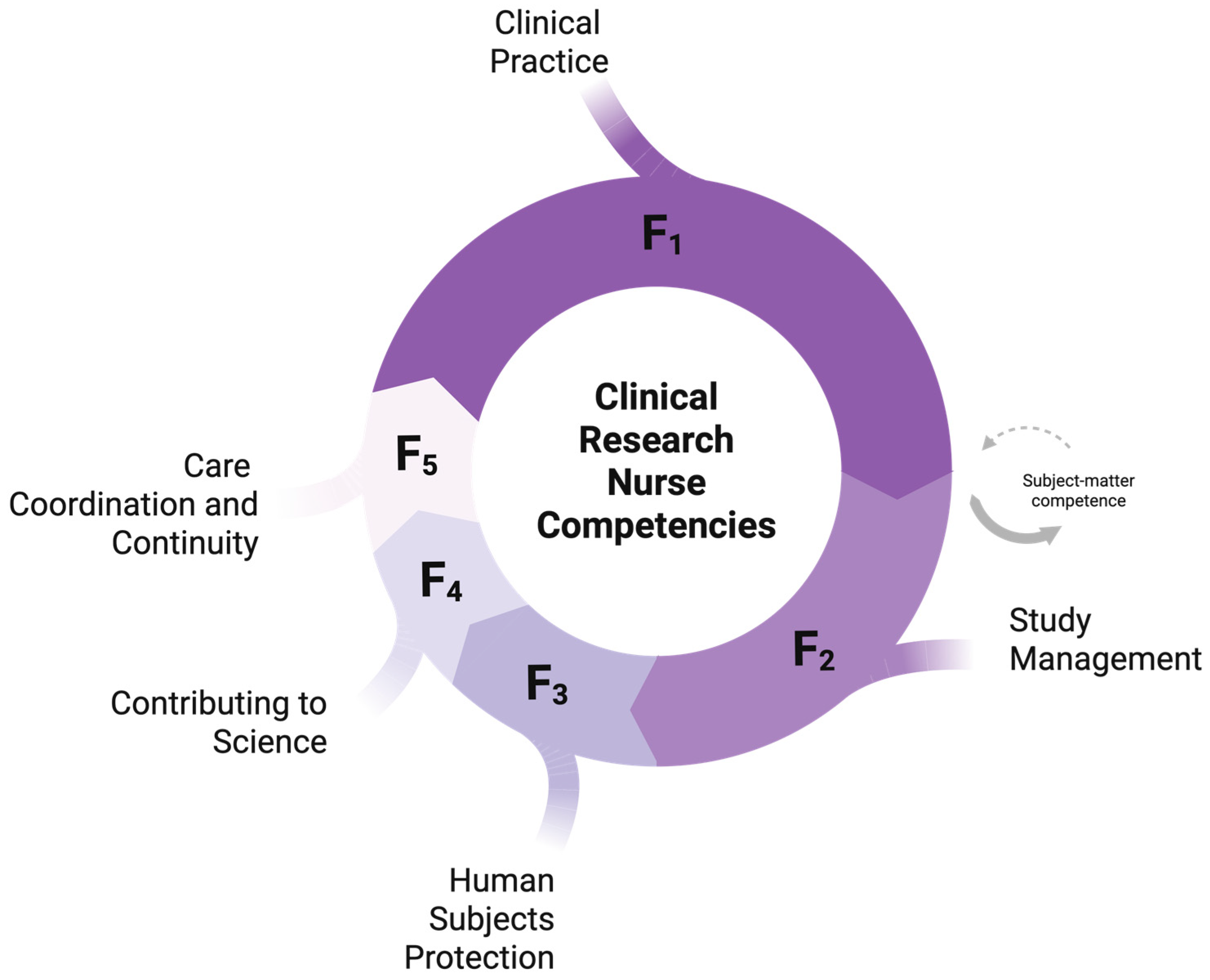
- A new, theory-grounded self-efficacy scale for Clinical Research Nursing (Se-CRN) was developed and validated, supporting a five-domain structure aligned with core CRN practice areas.
- Competency-related self-efficacy was most strongly associated with research-setting experience (and, to a lesser extent, advanced education), with comparatively lower confidence in study management and scientific contribution domains.
- The Se-CRN can support targeted training needs assessment, curriculum design, and workforce planning by identifying domain-specific strengths and gaps in CRN perceived capability.
- The scale enables evaluation of professional development pathways and could be used to monitor growth in CRN competence-related self-efficacy across settings and roles.
Abstract
1. Introduction
2. Materials and Methods
2.1. Design
2.1.1. Theoretical Framework and Item Pooling
2.1.2. Face and Content Validity
2.2. Data Collection
2.3. Inclusion Criteria
2.4. Data Analysis
2.5. Ethical Statement
3. Results
3.1. Content Validity
3.2. Structural Validity
3.3. Reliability
3.4. Self-Efficacy Levels
4. Discussion
4.1. Limitations
4.2. Implications for Practice
5. Conclusions
Supplementary Materials
Author Contributions
Funding
Institutional Review Board Statement
Informed Consent Statement
Data Availability Statement
Acknowledgments
Conflicts of Interest
Abbreviations
| AVE | Average Variance Extracted |
| CFA | Confirmatory Factor Analysis |
| CR | Composite Reliability |
| CRF | Case Report Form(s) |
| CRN | Clinical Research Nurse(s) |
| CRO | Clinical Research Organization(s) |
| CVI | Content Validity Index |
| CVR | Content Validity Ratio |
| ECV | Explained Common Variance |
| EFA | Exploratory Factor Analysis |
| GCP | Good Clinical Practice |
| ICH-GCP | International Council for Harmonisation—Good Clinical Practice |
| IRCCS | Istituto di Ricovero e Cura a Carattere Scientifico (Italian research hospital) |
| KMO | Kaiser–Meyer–Olkin (measure of sampling adequacy) |
| M | Mean |
| ML | Maximum Likelihood |
| MSA | Measure(s) of Sampling Adequacy |
| PA | Parallel Analysis |
| SD | Standard Deviation |
| Se-CRN | Clinical Research Nursing Competencies–Self-Efficacy (scale) |
| S/N | Signal-to-Noise Ratio |
| α | Cronbach’s alpha |
| c | Complexity |
| h2 | Communality |
| u2 | Uniqueness |
| ωh | Omega hierarchical |
| ωt | McDonald’s omega total |
References
- American Nurses Association; International Association of Clinical Research Nurses. Clinical Research Nursing: Scope and Standards of Practice; American Nurses Association: Silver Spring, MD, USA, 2016. [Google Scholar]
- Kalsoom, Z.; Victor, G.; Virtanen, H.; Sultana, N. What really matters for patient safety: Correlation of nurse competence with international patient safety goals. J. Patient Saf. Risk Manag. 2023, 28, 108–115. [Google Scholar] [CrossRef]
- Zaitoun, R.A.; Said, N.B.; de Tantillo, L. Clinical nurse competence and its effect on patient safety culture: A systematic review. BMC Nurs. 2023, 22, 173. [Google Scholar] [CrossRef] [PubMed]
- Stievano, A.; Caruso, R.; Friganović, A. The Specialist Nurse in European Healthcare 2030: ESNO Congress 2024 Highlights. Healthcare 2024, 12, 1623. [Google Scholar] [CrossRef]
- Gumber, L.; Agbeleye, O.; Inskip, A.; Fairbairn, R.; Still, M.; Ouma, L.; Lozano-Kuehne, J.; Bardgett, M.; Isaacs, J.D.; Wason, J.M.; et al. Operational complexities in international clinical trials: A systematic review of challenges and proposed solutions. BMJ Open 2024, 14, e077132. [Google Scholar] [CrossRef]
- Cooper, E.; Spilsbury, K.; McCaughan, D.; Thompson, C.; Butterworth, T.; Hanratty, B. Priorities for the professional development of registered nurses in nursing homes: A Delphi study. Age Ageing 2017, 46, 39–45. [Google Scholar] [CrossRef]
- Park, H.; Yu, S. Effective policies for eliminating nursing workforce shortages: A systematic review. Health Policy Technol. 2019, 8, 296–303. [Google Scholar] [CrossRef]
- Thornton, J. Clinical trials suspended in UK to prioritise COVID-19 studies and free up staff. BMJ 2020, 368, m1172. [Google Scholar] [CrossRef]
- Bozzetti, M.; Guberti, M.; Lo Cascio, A.; Privitera, D.; Genna, C.; Rodelli, S.; Turchini, L.; Amatucci, V.; Giordano, L.N.; Mora, V.; et al. Uncovering the Professional Landscape of Clinical Research Nursing: A Scoping Review with Data Mining Approach. Nurs. Rep. 2025, 15, 8. [Google Scholar] [CrossRef] [PubMed]
- Flinkman, M.; Leino-Kilpi, H.; Numminen, O.; Jeon, Y.; Kuokkanen, L.; Meretoja, R. Nurse Competence Scale: A systematic and psychometric review. J. Adv. Nurs. 2017, 73, 1035–1050. [Google Scholar] [CrossRef]
- Kennedy, E.; Murphy, G.T.; Misener, R.M.; Alder, R. Development and Psychometric Assessment of the Nursing Competence Self-Efficacy Scale. J. Nurs. Educ. 2015, 54, 550–558. [Google Scholar] [CrossRef] [PubMed]
- Magon, A.; Conte, G.; Dellafiore, F.; Arrigoni, C.; Baroni, I.; Brera, A.S.; Avenido, J.; De Maria, M.; Stievano, A.; Villa, G.; et al. Nursing Profession Self-Efficacy Scale-Version 2: A Stepwise Validation with Three Cross-Sectional Data Collections. Healthcare 2023, 11, 754. [Google Scholar] [CrossRef]
- Caruso, R.; Pittella, F.; Zaghini, F.; Fida, R.; Sili, A. Development and validation of the Nursing Profession Self-Efficacy Scale. Int. Nurs. Rev. 2016, 63, 455–464. [Google Scholar] [CrossRef]
- Bandura, A. Social Foundations of Thought and Action: A Social Cognitive; Prentice-Hall: Englewoods Cliffs, NJ, USA, 1986; p. 617. [Google Scholar]
- Bandura, A. Guide for Constructing Self-Efficacy Scales (Revised). Self-Effic. Beliefs Adolesc. 2006, 5, 307–337. [Google Scholar]
- Martín-Parrilla, M.Á.; Durán-Gómez, N.; Montanero-Fernández, J.; Casas-Méndez, C.; López-Jurado, C.F.; Cáceres, M.C. Assessing Emotional Intelligence and Reducing Burnout in Nursing Students Through Simulation-Based Learning Experiences: An Experimental Design. Int. J. Ment. Health Nurs. 2025, 34, e70151. [Google Scholar] [CrossRef] [PubMed]
- Xie, D.; Zhu, X.; Zhang, X.; Jiang, Z.; Wang, X.; Liu, T. Research on the correlation between clinical nurses’ self-efficacy, future time perspective, and occupational burnout. Front. Public Health 2024, 12, 1363450. [Google Scholar] [CrossRef]
- Anastasi, G.; Gravante, F.; Barbato, P.; Bambi, S.; Stievano, A.; Latina, R. Moral injury and mental health outcomes in nurses: A systematic review. Nurs. Ethics 2025, 32, 698–723. [Google Scholar] [CrossRef] [PubMed]
- American Nurses Association. The Nursing: Scope and Standards of Practice, 4th ed.; American Nurses Association: Silver Spring, MD, USA, 2021. [Google Scholar]
- Castro, K.; Bevans, M.; Miller-Davis, C.; Cusack, G.; Loscalzo, F.; Matlock, A.M.; Mayberry, H.; Tondreau, L.; Walsh, D.; Hastings, C. Validating the clinical research nursing domain of practice. Oncol. Nurs. Forum 2011, 38, E72–E80. [Google Scholar] [CrossRef]
- Hastings, C. Putting clinical research nursing on the NIH roadmap. In Proceedings of the American Academy of Nursing Annual Conference, Tahoe City, CA, USA, 7–10 June 2007. [Google Scholar]
- Backman Lönn, B.; Hajdarevic, S.; Olofsson, N.; Hörnsten, Å.; Styrke, J. Clarifying the role of clinical research nurses working in Sweden, using the Clinical Trial Nursing Questionnaire—Swedish version. Nurs. Open 2022, 9, 2434–2443. [Google Scholar] [CrossRef]
- Catania, G.; Poirè, I.; Bernardi, M.; Bono, L.; Cardinale, F.; Dozin, B. The role of the clinical trial nurse in Italy. Eur. J. Oncol. Nurs. 2012, 16, 87–93. [Google Scholar] [CrossRef]
- Ehrenberger, H.E.; Lillington, L. Development of a measure to delineate the clinical trials nursing role. Oncol. Nurs. Forum 2004, 31, E64–E68. [Google Scholar] [CrossRef] [PubMed]
- Milani, A.; Mazzocco, K.; Stucchi, S.; Magon, G.; Pravettoni, G.; Passoni, C.; Ciccarelli, C.; Tonali, A.; Profeta, T.; Saiani, L. How many research nurses for how many clinical trials in an oncology setting? Definition of the Nursing Time Required by Clinical Trial-Assessment Tool (NTRCT-AT). Int. J. Nurs. Pract. 2017, 23, e12497. [Google Scholar] [CrossRef] [PubMed]
- Bozzetti, M.; Lo Cascio, A.; Napolitano, D.; Orgiana, N.; Mora, V.; Fiorini, S.; Petrucci, G.; Resente, F.; Baroni, I.; Caruso, R.; et al. Measuring What Matters in Trial Operations: Development and Validation of the Clinical Trial Site Performance Measure. J. Clin. Med. 2025, 14, 6839. [Google Scholar] [CrossRef]
- Zhou, Y. A Mixed Methods Model of Scale Development and Validation Analysis. Meas. Interdiscip. Res. Perspect. 2019, 17, 38–47. [Google Scholar] [CrossRef]
- von Elm, E.; Altman, D.G.; Egger, M.; Pocock, S.J.; Gøtzsche, P.C.; Vandenbroucke, J.P. The Strengthening the Reporting of Observational Studies in Epidemiology (STROBE) statement: Guidelines for reporting observational studies. J. Clin. Epidemiol. 2008, 61, 344–349. [Google Scholar] [CrossRef]
- Klotz, A.C.; Swider, B.W.; Kwon, S.H. Back-translation practices in organizational research: Avoiding loss in translation. J. Appl. Psychol. 2023, 108, 699–727. [Google Scholar] [CrossRef]
- Connell, J.; Carlton, J.; Grundy, A.; Buck, E.T.; Keetharuth, A.D.; Ricketts, T.; Barkham, M.; Robotham, D.; Rose, D.; Brazier, J. The importance of content and face validity in instrument development: Lessons learnt from service users when developing the Recovering Quality of Life measure (ReQoL). Qual. Life Res. 2018, 27, 1893–1902. [Google Scholar] [CrossRef] [PubMed]
- Netemeyer, R.G.; Bearden, W.O.; Sharma, S. Scaling Procedures: Issues and Applications; Sage Publications: Thousand Oaks, CA, USA, 2003. [Google Scholar] [CrossRef]
- Lawshe, C.H. A Quantitative Approach to Content Validity. Pers. Psychol. 1975, 28, 563–575. [Google Scholar] [CrossRef]
- Polit, D.F.; Beck, C.T. The content validity index: Are you sure you know what’s being reported? Critique and recommendations. Res. Nurs. Health 2006, 29, 489–497. [Google Scholar] [CrossRef]
- R Core Team. R: A Language and Environment for Statistical Computing; R Foundation for Statistical Computing: Vienna, Austria, 2023; Available online: https://www.R-project.org/ (accessed on 13 March 2024).
- Taber, K.S. The Use of Cronbach’s Alpha When Developing and Reporting Research Instruments in Science Education. Res. Sci. Educ. 2018, 48, 1273–1296. [Google Scholar] [CrossRef]
- Benner, P. From novice to expert. Am. J. Nurs. 1982, 82, 402–407. [Google Scholar] [PubMed]
- Cohen, J. A power primer. Psychol. Bull. 1992, 112, 155–159. [Google Scholar] [CrossRef]
- World Medical Association. World Medical Association Declaration of Helsinki: Ethical Principles for Medical Research Involving Human Subjects. JAMA 2013, 310, 2191–2194. [Google Scholar] [CrossRef]
- Morrison, L.; Johnston, B.; Cooper, M. Mixed methods systematic review: Factors influencing research activity among nurses in clinical practice. J. Clin. Nurs. 2022, 31, 2450–2464. [Google Scholar] [CrossRef]
- Jones, C.T.; Liu, X.; Hornung, C.A.; Fritter, J.; Neidecker, M.V. The competency index for clinical research professionals: A potential tool for competency-based clinical research academic program evaluation. Front. Med. 2024, 11, 1291667. [Google Scholar] [CrossRef] [PubMed]
- Bogas, M.; Antas, J.; Magalhães, C.; Revige, M.; Guerra, L.; Ribeiro, C.; Eça, R.C.; Nunes, F.; Lopes, A.; Costa, L.; et al. Assessment of competencies of clinical research professionals and proposals to improve clinical research in Portugal. Front. Pharmacol. 2025, 16, 1578955. [Google Scholar] [CrossRef]
- Napolitano, D.; Lo Cascio, A.; Bozzetti, M.; Guberti, M. Implementing research, improving practice: Synergizing the clinical research nurse and the nurse researcher. Minerva Gastroenterol. 2025, 71, 295–296. [Google Scholar] [CrossRef] [PubMed]
- Chen, L.H.; Edvardsson, D.; Butler, A.E. Becoming, Being and Building: A Qualitative Descriptive Study of the Experiences of Clinical Research Nurses. J. Adv. Nurs. 2026; Online ahead of print. [Google Scholar] [CrossRef]
- Hill, G.; Ellis, M.; Irvine, L. Duality of practice in clinical research nursing. J. Res. Nurs. 2022, 27, 116–127. [Google Scholar] [CrossRef] [PubMed]
- Kunhunny, S.; Salmon, D. The evolving professional identity of the clinical research nurse: A qualitative exploration. J. Clin. Nurs. 2017, 26, 5121–5132. [Google Scholar] [CrossRef]
- Lönn, B.B.; Hörnsten, Å.; Styrke, J.; Hajdarevic, S. Transitioning to the clinical research nurse role—A qualitative descriptive study. J. Adv. Nurs. 2022, 78, 3817–3829. [Google Scholar] [CrossRef]
- Södergård, E.; Juntunen, J.; Kuivila, H.M.; Tomietto, M.; Mikkonen, K. THE Effect of Mentoring Programmes on Newly Graduated Nurses’ Retention and Turnover: An Umbrella Review. J. Adv. Nurs. 2025; Online ahead of print. [Google Scholar] [CrossRef]
- Mollica, G.; Caruso, R.; Conte, G.; Ambrogi, F.; Boveri, S. Analysing Researchers’ Engagement in Research Hospitals: A Pilot Study in IRCCS—Italian Research Hospitals. Healthcare 2022, 10, 2458. [Google Scholar] [CrossRef]
- Mokkink, L.B.; de Vet, H.; Diemeer, S.; Eekhout, I. Sample size recommendations for studies on reliability and measurement error: An online application based on simulation studies. Health Serv. Outcomes Res. Method. 2023, 23, 241–265. [Google Scholar] [CrossRef]



| Variable/Category | Value |
|---|---|
| Age (years) M (SD) | 38.65 (9.18) |
| Experience (years) M (SD) | 14.30 (8.90) |
| Experience in current setting (years) M (SD) | 7.67 (7.65) |
| Sex n (%) | |
| Female | 155 (84.7%) |
| Male | 28 (15.3%) |
| Educational Level n (%) | |
| Post-basic (Master’s, postgraduate, or PhD) | 150 (82.0%) |
| Bachelor’s degree or equivalent | 33 (18.0%) |
| Clinical Setting n (%) | |
| Oncological | 133 (72.7%) |
| Non-oncological | 34 (18.6%) |
| Both * | 16 (8.7%) |
| Item (English) | Clinical Practice (F1) | Study Management (F2) | Human Subject Protection (F3) | Contributing to the Science (F4) | Care Coordination and Continuity (F5) | h2 | u2 | c |
|---|---|---|---|---|---|---|---|---|
| Facilitate research participants’ requests and concerns (Item 7) | 0.787 (0.041) | −0.042 (0.078) | −0.109 (0.075) | −0.014 (0.079) | 0.091 (0.075) | 0.642 | 0.358 | 1 |
| Provide education to study participants and their families regarding study participation. current clinical conditions. and/or disease progression (Item 10) | 0.771 (0.041) | −0.145 (0.073) | 0.016 (0.079) | 0.018 (0.079) | 0.055 (0.077) | 0.620 | 0.380 | 1 |
| Communicate the impact of study procedures to research participants (Item 6) | 0.716 (0.044) | −0.004 (0.080) | −0.055 (0.077) | 0.161 (0.072) | 0.197 (0.070) | 0.581 | 0.419 | 1 |
| Monitor research participants and report any adverse events to a member of the research team (Item 11) | 0.616 (0.049) | −0.093 (0.075) | 0.280 (0.066) | 0.118 (0.074) | −0.191 (0.070) | 0.517 | 0.483 | 1 |
| Facilitate communication within the research team (Item 34) | 0.615 (0.049) | 0.085 (0.076) | 0.236 (0.068) | 0.118 (0.074) | −0.072 (0.076) | 0.460 | 0.540 | 1 |
| Support research participants in defining their motivations and goals for study participation (Item 21) | 0.608 (0.050) | 0.202 (0.070) | −0.096 (0.075) | 0.046 (0.078) | 0.185 (0.071) | 0.457 | 0.543 | 1 |
| Collaborate with the interdisciplinary team to create and communicate a care plan that ensures safety and effective clinical research data collection (Item 2) | 0.564 (0.052) | 0.054 (0.077) | −0.050 (0.077) | 0.228 (0.069) | 0.282 (0.066) | 0.455 | 0.545 | 1 |
| Provide nursing expertise to the research team during study development and implementation (Item 40) | 0.540 (0.053) | 0.109 (0.075) | 0.247 (0.068) | 0.094 (0.075) | −0.117 (0.074) | 0.387 | 0.613 | 1 |
| Identify implications for clinical care during study development (e.g., staff skills and resources, equipment) (Item 48) | 0.537 (0.053) | 0.308 (0.065) | 0.273 (0.066) | −0.105 (0.075) | −0.142 (0.073) | 0.489 | 0.511 | 2 |
| Facilitate the initial and ongoing informed consent or patient assent process (Item 20) | 0.529 (0.054) | 0.146 (0.073) | 0.067 (0.077) | 0.051 (0.077) | 0.027 (0.079) | 0.308 | 0.692 | 1 |
| Collect participant data based on the study endpoints (Item 38) | 0.483 (0.056) | 0.152 (0.072) | 0.342 (0.063) | 0.130 (0.074) | −0.116 (0.074) | 0.404 | 0.596 | 2 |
| Provide advanced tutorial supervision for newly hired staff and students participating as members of the research team (Item 18) | 0.481 (0.056) | −0.001 (0.080) | 0.272 (0.066) | 0.302 (0.065) | 0.022 (0.079) | 0.397 | 0.603 | 2 |
| Coordinate research activities to minimize subjective risk (Item 23) | 0.472 (0.056) | 0.254 (0.067) | 0.035 (0.078) | 0.093 (0.075) | 0.137 (0.073) | 0.316 | 0.684 | 1 |
| Provide nursing leadership within the interdisciplinary team (Item 4) | 0.451 (0.057) | −0.088 (0.076) | 0.072 (0.076) | 0.347 (0.063) | 0.199 (0.070) | 0.377 | 0.623 | 2 |
| Develop specific educational materials for research participants (Item 30) | 0.433 (0.058) | 0.219 (0.069) | 0.163 (0.072) | 0.171 (0.071) | 0.029 (0.079) | 0.292 | 0.708 | 1 |
| Facilitate interdisciplinary team training on study requirements (Item 1) | 0.429 (0.059) | 0.180 (0.071) | −0.034 (0.078) | 0.162 (0.072) | 0.405 (0.060) | 0.408 | 0.592 | 2 |
| Identify resources needed for direct and indirect care delivery with a view to effectiveness. cost-efficiency. and quality of service (Item 44) | 0.094 (0.075) | 0.762 (0.042) | 0.079 (0.076) | −0.194 (0.070) | 0.147 (0.073) | 0.655 | 0.345 | 1 |
| Participate in preparing protocol-related reports for the Ethics Committee and for Sponsors/Clinical Research Organizations (CRO) (Item 32) | −0.107 (0.075) | 0.699 (0.045) | 0.083 (0.076) | 0.201 (0.070) | −0.103 (0.075) | 0.558 | 0.442 | 1 |
| Support the development of study grants and budgets (Item 43) | 0.116 (0.074) | 0.687 (0.046) | −0.045 (0.078) | 0.032 (0.078) | 0.010 (0.080) | 0.489 | 0.511 | 1 |
| Manage potential ethical and financial conflicts of interest for oneself (Item 25) | 0.012 (0.079) | 0.647 (0.048) | −0.001 (0.080) | 0.208 (0.070) | −0.252 (0.067) | 0.525 | 0.475 | 1 |
| Participate in the selection of potential research participants for eligibility (Item 28) | 0.069 (0.077) | 0.640 (0.048) | −0.049 (0.078) | 0.069 (0.077) | 0.329 (0.064) | 0.530 | 0.470 | 2 |
| Participate in the recruitment of research participants (Item 27) | 0.061 (0.077) | 0.616 (0.049) | −0.037 (0.078) | 0.091 (0.075) | 0.320 (0.064) | 0.496 | 0.504 | 2 |
| Participate in drafting the study protocol (Item 26) | 0.059 (0.077) | 0.598 (0.050) | −0.127 (0.074) | 0.378 (0.061) | −0.043 (0.078) | 0.522 | 0.478 | 2 |
| Contribute to the development of CRFs (Item 35) | −0.322 (0.064) | 0.582 (0.051) | 0.304 (0.065) | 0.163 (0.072) | 0.111 (0.074) | 0.574 | 0.426 | 3 |
| Facilitate accurate communication with different research centres (Item 33) | −0.127 (0.074) | 0.564 (0.052) | 0.220 (0.069) | 0.147 (0.073) | 0.209 (0.070) | 0.448 | 0.552 | 1 |
| Supervise human resources involved in the research process (Item 45) | 0.279 (0.066) | 0.517 (0.054) | 0.251 (0.067) | −0.085 (0.076) | 0.023 (0.079) | 0.416 | 0.584 | 1 |
| Serve as a member of the Ethics Committee/Clinical Research Office (Item 24) | 0.138 (0.073) | 0.505 (0.055) | −0.200 (0.070) | 0.348 (0.063) | −0.247 (0.068) | 0.496 | 0.504 | 2 |
| Identify research trends and participate in drafting related reports (Item 49) | 0.253 (0.067) | 0.481 (0.056) | 0.137 (0.073) | 0.250 (0.068) | −0.296 (0.065) | 0.464 | 0.536 | 1 |
| Record data in approved study documents (e.g., CRF, research/study database) (Item 46) | −0.060 (0.077) | 0.438 (0.058) | 0.436 (0.058) | 0.142 (0.073) | −0.157 (0.072) | 0.430 | 0.570 | 2 |
| Collaborate with the interdisciplinary team in managing ethical conflicts (Item 22) | 0.292 (0.065) | 0.398 (0.060) | 0.034 (0.078) | 0.134 (0.073) | 0.194 (0.070) | 0.300 | 0.700 | 1 |
| Comply with International Council for Harmonisation Good Clinical Practice (ICH-GCP) guidelines (Item 37) | −0.006 (0.080) | 0.043 (0.078) | 0.768 (0.042) | 0.014 (0.079) | 0.027 (0.079) | 0.593 | 0.407 | 1 |
| Record research data (e.g., document vital signs, administer investigational products, patient reactions) in approved documents (e.g., medical record, CRF) (Item 12) | −0.092 (0.075) | −0.068 (0.077) | 0.708 (0.045) | 0.240 (0.068) | 0.049 (0.078) | 0.574 | 0.426 | 1 |
| Protect research participants’ data in compliance with regulatory requirements (Item 41) | 0.164 (0.072) | 0.016 (0.079) | 0.688 (0.046) | −0.124 (0.074) | 0.163 (0.072) | 0.542 | 0.458 | 1 |
| Participate in site visits and/or audits (Item 42) | 0.023 (0.079) | 0.131 (0.073) | 0.642 (0.048) | 0.032 (0.078) | 0.171 (0.071) | 0.459 | 0.541 | 1 |
| Coordinate and facilitate the collection of research samples (Item 29) | 0.301 (0.065) | 0.040 (0.078) | 0.627 (0.049) | −0.050 (0.077) | 0.153 (0.072) | 0.512 | 0.488 | 2 |
| Provide direct nursing care to research participants (e.g., deliver nursing care, perform protocol interventions, collect samples) (Item 9) | 0.129 (0.074) | −0.230 (0.069) | 0.622 (0.049) | 0.005 (0.080) | 0.269 (0.067) | 0.529 | 0.471 | 1 |
| Facilitate processing and management (storage and transport) of research samples (Item 47) | −0.112 (0.074) | 0.249 (0.068) | 0.602 (0.050) | 0.023 (0.079) | 0.096 (0.075) | 0.447 | 0.553 | 1 |
| Perform quality control activities to ensure data integrity (Item 31) | 0.280 (0.066) | 0.148 (0.073) | 0.541 (0.053) | 0.073 (0.076) | −0.207 (0.070) | 0.441 | 0.559 | 1 |
| Facilitate scheduling and coordination of study procedures (Item 39) | 0.251 (0.067) | 0.118 (0.074) | 0.462 (0.057) | −0.116 (0.074) | 0.447 (0.058) | 0.503 | 0.497 | 2 |
| Participate in the setup of a study-specific database (Item 36) | −0.282 (0.066) | 0.273 (0.066) | 0.353 (0.062) | 0.340 (0.063) | 0.213 (0.069) | 0.439 | 0.561 | 2 |
| Generate practical questions as a result of a new study procedure or intervention (Item 15) | 0.184 (0.071) | −0.011 (0.079) | −0.041 (0.078) | 0.774 (0.041) | −0.159 (0.072) | 0.660 | 0.340 | 1 |
| Perform data analysis to contribute to the development of new ideas (Item 19) | 0.088 (0.076) | 0.098 (0.075) | −0.048 (0.078) | 0.756 (0.042) | 0.027 (0.079) | 0.592 | 0.408 | 1 |
| Participate in the querying and analysis of research data (Item 14) | 0.094 (0.075) | 0.149 (0.073) | −0.159 (0.072) | 0.696 (0.045) | 0.017 (0.079) | 0.541 | 0.459 | 1 |
| Identify appropriate questions for nursing clinical research as a result of participation in the study team (Item 17) | −0.067 (0.077) | −0.018 (0.079) | 0.159 (0.072) | 0.679 (0.046) | 0.239 (0.068) | 0.547 | 0.453 | 1 |
| Collaborate with the interdisciplinary team to develop innovations in care delivery that may improve outcomes and the accuracy of research data collection (Item 16) | 0.050 (0.077) | 0.081 (0.076) | 0.253 (0.067) | 0.620 (0.049) | 0.134 (0.073) | 0.475 | 0.525 | 1 |
| Disseminate clinical skills and best practices related to clinical research through presentations. publications. and interactions with nursing colleagues (Item 13) | 0.186 (0.071) | 0.151 (0.072) | 0.188 (0.071) | 0.470 (0.057) | 0.151 (0.072) | 0.337 | 0.663 | 1 |
| Coordinate study participant visits (Item 3) | 0.166 (0.072) | 0.022 (0.079) | 0.219 (0.069) | −0.013 (0.079) | 0.677 (0.046) | 0.534 | 0.466 | 1 |
| Provide indirect nursing care (e.g., participate in unit or protocol-related visits; schedule study-related tests) in the context of research participation (Item 8) | 0.159 (0.072) | 0.055 (0.077) | 0.202 (0.070) | 0.050 (0.077) | 0.674 (0.046) | 0.525 | 0.475 | 1 |
| Coordinate interdisciplinary meetings and activities within the study context (Item 5) | 0.007 (0.080) | 0.121 (0.074) | 0.213 (0.069) | 0.299 (0.065) | 0.629 (0.049) | 0.545 | 0.455 | 1 |
| Factor | ω | α | CR | AVE | S/N |
|---|---|---|---|---|---|
| Clinical Practice (F1) | 0.923 | 0.932 | 0.892 | 0.455 | 8.259 |
| Study Management (F2) | 0.945 | 0.935 | 0.903 | 0.492 | 9.309 |
| Human Subject Protection (F3) | 0.899 | 0.917 | 0.884 | 0.495 | 7.621 |
| Contributing to Science (F4) | 0.909 | 0.909 | 0.853 | 0.489 | 5.803 |
| Care Coordination and Continuity (F5) | 0.911 | 0.907 | 0.777 | 0.505 | 3.484 |
| Factor | M (SD) |
|---|---|
| Clinical Practice (F1) | 4.01 (0.46) |
| Study Management (F2) | 3.35 (0.66) |
| Human Subject Protection (F3) | 4.20 (0.60) |
| Contributing to Science (F4) | 3.37 (0.59) |
| Care Coordination and Continuity (F5) | 4.15 (0.66) |
| Total | 3.75 (0.60) |
| Dichotomous Variable | Clinical Practice | Study Management | Human Subject Protection | Contributing to Science | Care Coordination & Continuity | Total |
|---|---|---|---|---|---|---|
| Setting (Oncologic vs. Non) | 0.132 (small) | 0.104 (small) | 0.073 (small) | 0.025 (small) | 0.075 (small) | 0.035 (small) |
| Educational Level (Post-basic vs. Basic) | 0.142 (small) | 0.287 (small) | 0.183 (small) | 0.299 (small) | 0.069 (small) | 0.233 (small) |
| Experience in Setting (≥2 years vs. <2 years) | 0.337 (moderate) | 0.346 (moderate) | 0.302 (moderate) | 0.309 (moderate) | 0.242 (small) | 0.365 (moderate) |
Disclaimer/Publisher’s Note: The statements, opinions and data contained in all publications are solely those of the individual author(s) and contributor(s) and not of MDPI and/or the editor(s). MDPI and/or the editor(s) disclaim responsibility for any injury to people or property resulting from any ideas, methods, instructions or products referred to in the content. |
© 2026 by the authors. Licensee MDPI, Basel, Switzerland. This article is an open access article distributed under the terms and conditions of the Creative Commons Attribution (CC BY) license.
Share and Cite
Bozzetti, M.; Apadula, L.; Magon, A.; Conte, G.; Napolitano, D.; Villa, G.; Guberti, M.; Caruso, R. Development and Exploratory Validation of the Clinical Research Nursing Competencies-Self-Efficacy Scale. Healthcare 2026, 14, 551. https://doi.org/10.3390/healthcare14040551
Bozzetti M, Apadula L, Magon A, Conte G, Napolitano D, Villa G, Guberti M, Caruso R. Development and Exploratory Validation of the Clinical Research Nursing Competencies-Self-Efficacy Scale. Healthcare. 2026; 14(4):551. https://doi.org/10.3390/healthcare14040551
Chicago/Turabian StyleBozzetti, Mattia, Laura Apadula, Arianna Magon, Gianluca Conte, Daniele Napolitano, Giulia Villa, Monica Guberti, and Rosario Caruso. 2026. "Development and Exploratory Validation of the Clinical Research Nursing Competencies-Self-Efficacy Scale" Healthcare 14, no. 4: 551. https://doi.org/10.3390/healthcare14040551
APA StyleBozzetti, M., Apadula, L., Magon, A., Conte, G., Napolitano, D., Villa, G., Guberti, M., & Caruso, R. (2026). Development and Exploratory Validation of the Clinical Research Nursing Competencies-Self-Efficacy Scale. Healthcare, 14(4), 551. https://doi.org/10.3390/healthcare14040551