Is Perceived Family Cohesion Associated with Family Caregiver Role and Caregiver-Related Characteristics? A Comparison of Spousal and Adult-Child Caregivers

Highlights
- Adult-child caregivers reported higher family cohesion than spousal caregivers.
- Caregiver-related characteristics mediate caregiver role and family cohesion.
- Interventions that strengthen caregivers’ physical health, social support, self-efficacy, and family involvement in caregiving can equalize the perception of family cohesion between spousal caregivers and adult-child caregivers.
Abstract
1. Introduction
- O1: To examine whether perceived family cohesion differs by caregiver role (spousal vs. adult-child caregivers).
- O2: To investigate the associations between caregiver-related characteristics and perceived family cohesion.
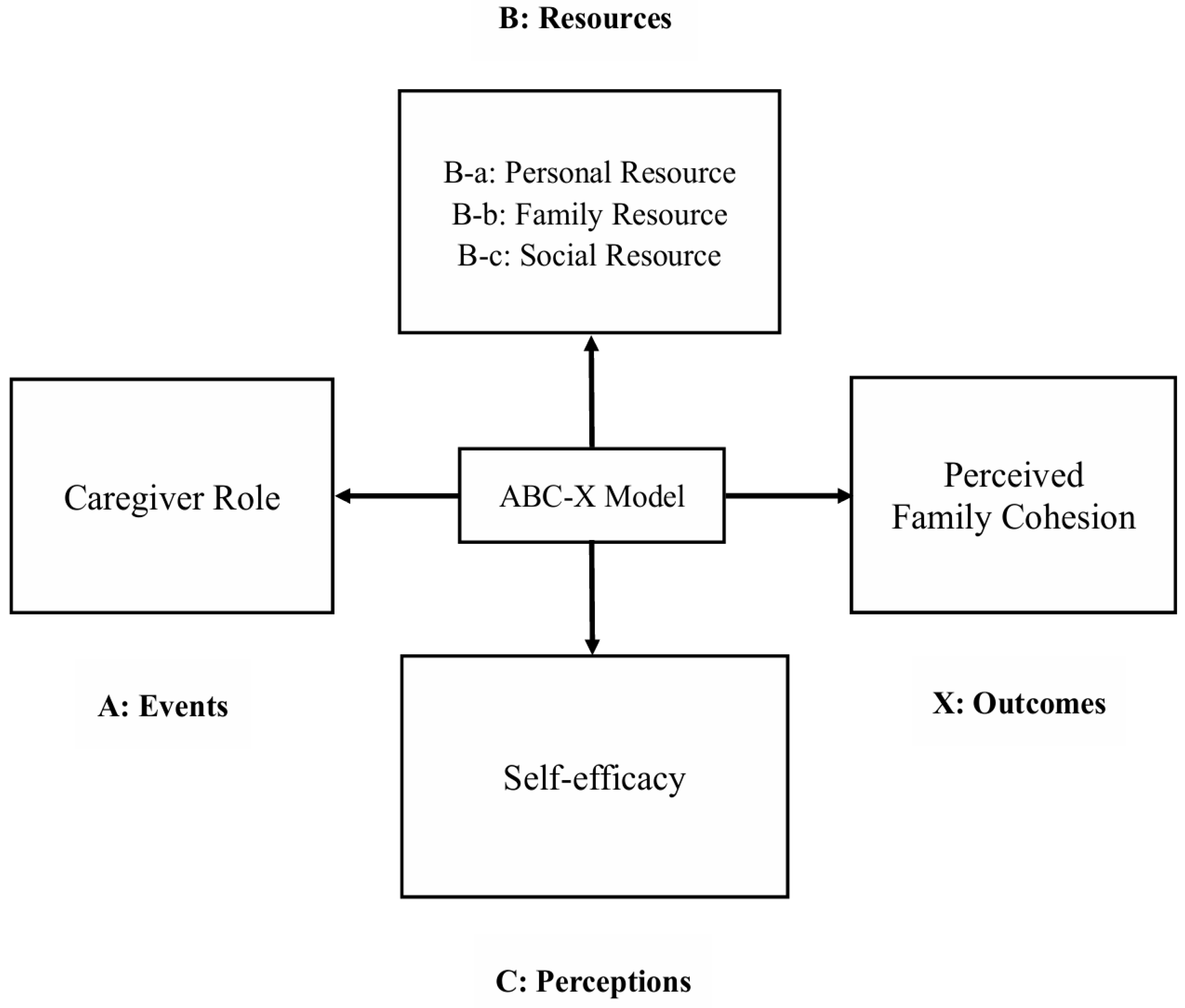
- O3: To test whether caregiver-related characteristics mediate the relationship between caregiver role and perceived family cohesion.
- H1: Caregiver role is significantly associated with perceived family cohesion.
- H2: Caregiver-related characteristics are significantly associated with perceived family cohesion.
- H3: Caregiver-related characteristics mediate the relationship between caregiver role and perceived family cohesion.
2. Materials and Methods
2.1. Participants and Procedure
2.2. Measures
2.3. Data Analysis
3. Results
3.1. Background Information of Participants
3.2. Perceived Family Cohesion Between Spousal Caregivers and Adult-Child Caregivers
3.3. Results of Linear Regression Models
3.4. Results of Mediating Effect Analyses
4. Discussion
Strengths and Limitations
5. Conclusions
Author Contributions
Funding
Institutional Review Board Statement
Informed Consent Statement
Data Availability Statement
Acknowledgments
Conflicts of Interest
References
- Jia, L.; Quan, M.; Fu, Y.; Zhao, T.; Li, Y.; Wei, C.; Tang, Y.; Qin, Q.; Wang, F.; Qiao, Y.; et al. Dementia in China: Epidemiology, Clinical Management, and Research Advances. Lancet Neurol. 2020, 19, 81–92. [Google Scholar] [CrossRef]
- Jia, J.; Wang, F.; Wei, C.; Zhou, A.; Jia, X.; Li, F.; Tang, M.; Chu, L.; Zhou, Y.; Zhou, C.; et al. The Prevalence of Dementia in Urban and Rural Areas of China. Alzheimer’s Dement. 2014, 10, 1–9. [Google Scholar] [CrossRef]
- Huang, Y.; Wang, Y.; Wang, H.; Liu, Z.; Yu, X.; Yan, J.; Yu, Y.; Kou, C.; Xu, X.; Lu, J.; et al. Prevalence of Mental Disorders in China: A Cross-Sectional Epidemiological Study. Lancet Psychiatry 2019, 6, 211–224. [Google Scholar] [CrossRef] [PubMed]
- Li, Y.; Leng, F.; Xiong, Q.; Zhou, J.; Du, A.; Zhu, F.; Kou, X.; Sun, W.; Chen, L.; Wang, H.; et al. Factors Associated with Alzheimer’s Disease Patients’ Caregiving Status and Family Caregiving Burden in China. Front. Aging Neurosci. 2022, 14, 865933. [Google Scholar] [CrossRef]
- del-Pino-Casado, R.; Rodríguez Cardosa, M.; López-Martínez, C.; Orgeta, V. The Association between Subjective Caregiver Burden and Depressive Symptoms in Carers of Older Relatives: A Systematic Review and Meta-Analysis. PLoS ONE 2019, 14, e0217648. [Google Scholar] [CrossRef]
- Zhao, J.; Zeng, Z.; Yu, J.; Xu, J.; Chen, P.; Chen, Y.; Li, J.; Ma, Y. Effect of Main Family Caregiver’s Anxiety and Depression on Mortality of Patients with Moderate-Severe Stroke. Sci. Rep. 2021, 11, 2747. [Google Scholar] [CrossRef]
- Li, L.; Wister, A.V.; Mitchell, B. Social Isolation among Spousal and Adult-Child Caregivers: Findings from the Canadian Longitudinal Study on Aging. J. Gerontol. B Soc. Sci. 2021, 76, 1415–1429. [Google Scholar] [CrossRef]
- Rigby, T.; Ashwill, R.T.; Johnson, D.K.; Galvin, J.E. Differences in the Experience of Caregiving between Spouse and Adult Child Caregivers in Dementia with Lewy Bodies. Innov. Aging 2019, 3, igz027. [Google Scholar] [CrossRef] [PubMed]
- Chappell, N.L.; Dujela, C.; Smith, A. Spouse and Adult Child Differences in Caregiving Burden. Can. J. Aging Rev. Can. Vieil. 2014, 33, 462–472. [Google Scholar] [CrossRef] [PubMed]
- Oldenkamp, M.; Hagedoorn, M.; Slaets, J.; Stolk, R.; Wittek, R.; Smidt, N. Subjective Burden among Spousal and Adult-Child Informal Caregivers of Older Adults: Results from a Longitudinal Cohort Study. BMC Geriatr. 2016, 16, 208. [Google Scholar] [CrossRef]
- Fenton, A.T.H.R.; Ornstein, K.A.; Kent, E.E.; Miller-Sonet, E.; Wright, A.A.; Dionne-Odom, J.N. A Comparison of Adult-Child and Spousal Cancer Caregivers’ Participation in Medical Decisions. PLoS ONE 2024, 19, e0300450. [Google Scholar] [CrossRef]
- Huang, J.; Huang, C.; Mo, Z.; Luo, L.; Chen, W.; Zhong, Q.; Huang, K. Current Situation and Influencing Factors of High-Level Role Conflict among Clinical Teachers: A Cross-Sectional Study. Medicine 2024, 103, e38687. [Google Scholar] [CrossRef] [PubMed]
- Scharlach, A.E. Caregiving and Employment: Competing or Complementary Roles? Gerontologist 1994, 34, 378–385. [Google Scholar] [CrossRef]
- Olson, D.H.; Russell, C.S.; Sprenkle, D.H. Circumplex Model of Marital and Family Systems: Vl. Theoretical Update. Fam. Process 1983, 22, 69–83. [Google Scholar] [CrossRef] [PubMed]
- Minuchin, S. Families & Family Therapy; Harvard University Press: Cambridge, MA, USA, 1974. [Google Scholar]
- Ohannessian, C.M.; Lerner, J.V.; Lerner, R.M.; Von Eye, A. Adolescent-Parent Discrepancies in Perceptions of Family Functioning and Early Adolescent Self-Competence. Int. J. Behav. Dev. 2000, 24, 362–372. [Google Scholar] [CrossRef]
- Xu, Y.; Boyd, R.C.; Butler, L.; Moore, T.M.; Benton, T.D. Associations of Parent-Adolescent Discrepancies in Family Cohesion and Conflict with Adolescent Impairment. J. Child Fam. Stud. 2017, 26, 3360–3369. [Google Scholar] [CrossRef]
- Liu, Z.; Heffernan, C.; Tan, J. Caregiver Burden: A Concept Analysis. Int. J. Nurs. Sci. 2020, 7, 438–445. [Google Scholar] [CrossRef] [PubMed]
- Hansen, L.; Rosenkranz, S.; Wherity, K.; Sasaki, A. Living with Hepatocellular Carcinoma near the End of Life: Family Caregivers’ Perspectives. Oncol. Nurs. Forum 2017, 44, 562–570. [Google Scholar] [CrossRef]
- Dang, S.; Looijmans, A.; Ferraris, G.; Lamura, G.; Hagedoorn, M. Exploring the Needs of Spousal, Adult Child, and Adult Sibling Informal Caregivers: A Mixed-Method Systematic Review. Front. Psychol. 2022, 13, 832974. [Google Scholar] [CrossRef]
- Panganiban-Corales, A.T.; Medina, M.F. Family Resources Study: Part 1: Family Resources, Family Function and Caregiver Strain in Childhood Cancer. Asia Pac. Fam. Med. 2011, 10, 14. [Google Scholar] [CrossRef]
- Tatangelo, G.; McCabe, M.; Macleod, A.; You, E. “I Just Don’t Focus on My Needs.” the Unmet Health Needs of Partner and Offspring Caregivers of People with Dementia: A Qualitative Study. Int. J. Nurs. Stud. 2018, 77, 8–14. [Google Scholar] [CrossRef]
- Silva, M.S.A.; Silva, M.C.P.E.; Sogame, L.C.M. Socioeconomic and Health Conditions Associated with the Family Function of Older Adults. Rev. Gaúcha Enferm. 2022, 43, e20210252. [Google Scholar] [CrossRef]
- Mollica, M.A.; Smith, A.W.; Kent, E.E. Caregiving Tasks and Unmet Supportive Care Needs of Family Caregivers: A U.S. Population-Based Study. Patient Educ. Couns. 2020, 103, 626–634. [Google Scholar] [CrossRef]
- Mei, Y.; Xiang, D.; Zhang, Z.; Budu, J.T.; Lin, B.; Chen, S. Family Function, Self-efficacy, Care Hours per Day, Closeness and Benefit Finding among Stroke Caregivers in China: A Moderated Mediation Model. J. Clin. Nurs. 2023, 32, 506–516. [Google Scholar] [CrossRef]
- Wright, K.B.; Davidson Mhonde, R. Faith-Based Community Members, Family, and COVID-19: The Role of Family Cohesion, Social Support, and Spiritual Support on Quality of Life, Depression, and COVID-19-Prevention Behaviors. Int. J. Environ. Res. Public Health 2022, 19, 12267. [Google Scholar] [CrossRef] [PubMed]
- Lei, X.; Kantor, J. Social Support and Family Quality of Life in Chinese Families of Children with Autism Spectrum Disorder: The Mediating Role of Family Cohesion and Adaptability. Int. J. Dev. Disabil. 2022, 68, 454–461. [Google Scholar] [CrossRef] [PubMed]
- Bandura, A. Self-Efficacy: Toward a Unifying Theory of Behavioral Change. Psychol. Rev. 1977, 84, 191–215. [Google Scholar] [CrossRef] [PubMed]
- Shubayr, N.; Dailah, H. Assessment of Emotional Intelligence, Self-Efficacy, and Perceived Stress among Nursing Students in Clinical Practice: A Cross-Sectional Study. BMC Nurs. 2025, 24, 505. [Google Scholar] [CrossRef]
- Yang, Z.; Sun, F.; Zhao, L.; Hu, T.; Lin, X.; Guo, Y. Self-Efficacy and Well-Being in the Association between Caregiver Burden and Sleep Quality among Caregivers of Elderly Patients Having Multiple Chronic Conditions in Rural China: A Serial Multiple Mediation Analysis. BMC Nurs. 2023, 22, 424. [Google Scholar] [CrossRef]
- Leung, D.Y.P.; Chan, H.Y.L.; Chiu, P.K.C.; Lo, R.S.K.; Lee, L.L.Y. Source of Social Support and Caregiving Self-Efficacy on Caregiver Burden and Patient’s Quality of Life: A Path Analysis on Patients with Palliative Care Needs and Their Caregivers. Int. J. Environ. Res. Public Health 2020, 17, 5457. [Google Scholar] [CrossRef]
- Zakiei, A.; Vafapoor, H.; Alikhani, M.; Farnia, V.; Radmehr, F. The Relationship between Family Function and Personality Traits with General Self-Efficacy (Parallel Samples Studies). BMC Psychol. 2020, 8, 88. [Google Scholar] [CrossRef]
- Hill, R. Families Under Stress: Adjustment to the Crises of War Separation and Return; Harper: New York, NY, USA, 1949. [Google Scholar]
- Appah, J.; Senoo-Dogbey, V.E.; Wuaku, D.A.; Akpagloh, M.C.; Armah, D.; Laari, L. Exploring the Coping Resources of Caregivers with Children Diagnosed with Autism Spectrum Disorders in Southern Ghana. Sage Open Pediatr. 2025, 12, 30502225251374932. [Google Scholar] [CrossRef]
- Xu, X.; Yu, S.; Jing, M.; Liu, Y.; Zhang, W. A Mixed Methods Study of Psychological Distress in Family Caregivers of Ovarian Cancer Patients Based on the ABC-X Model. Eur. J. Oncol. Nurs. 2026, 80, 103088. [Google Scholar] [CrossRef]
- Fei, L.P.; Shen, Q.J.; Zheng, Y.P.; Zhao, J.P.; Jiang, S.A.; Wang, L.W.; Wang, X.D. Preliminary Evaluation of the Family Adaptability and Cohesion Scale and the Family Environment Scale: A Comparative Study of Normal Families and Families of Schizophrenia Patients. Chin. Ment. Health J. 1991, 5, 198–202. [Google Scholar]
- Phillips, M.R.; West, C.L.; Shen, Q.; Zheng, Y. Comparison of Schizophrenic Patients’ Families and Normal Families in China, Using Chinese Versions of FACES-II and the Family Environment Scales. Fam. Process 1998, 37, 95–106. [Google Scholar] [CrossRef]
- Xiao, S.Y. Theoretical Basis and Research Application of the Social Support Rating Scale. J. Clin. Psychiatry 1994, 4, 98. [Google Scholar]
- Schwarzer, R.; Bäßler, J.; Kwiatek, P.; Schröder, K.; Zhang, J.X. The Assessment of Optimistic Self-beliefs: Comparison of the German, Spanish, and Chinese Versions of the General Self-efficacy Scale. Appl. Psychol. 1997, 46, 69–88. [Google Scholar] [CrossRef]
- Wang, C.K.; Hu, Z.F.; Liu, Y. A Study on the Reliability and Validity of the General Self-Efficacy Scale. Chin. J. Appl. Psychol. 2001, 7, 37–40. [Google Scholar]
- Cho, J.; Sands, L.P.; Stevens, A.B.; Allore, H.G.; Horstman, M.J. Profile of Caregiving Activities and Association with Physical Health among Dementia Spousal Caregivers. Innov. Aging 2024, 8, igae017. [Google Scholar] [CrossRef]
- Xu, L.; Liu, Y.; He, H.; Fields, N.L.; Ivey, D.L.; Kan, C. Caregiving Intensity and Caregiver Burden among Caregivers of People with Dementia: The Moderating Roles of Social Support. Arch. Gerontol. Geriatr. 2021, 94, 104334. [Google Scholar] [CrossRef]
- Birditt, K.S.; Hartnett, C.S.; Fingerman, K.L.; Zarit, S.H.; Antonucci, T.C. Extending the Intergenerational Stake Hypothesis: Evidence of an Intra-individual Stake and Implications for Well-being. J. Marriage Fam. 2015, 77, 877–888. [Google Scholar] [CrossRef]
- Pérez, J.C.; Coo, S.; Irarrázaval, M. Is Maternal Depression Related to Mother and Adolescent Reports of Family Functioning? J. Adolesc. 2018, 63, 129–141. [Google Scholar] [CrossRef]
- Korelitz, K.E.; Garber, J. Congruence of Parents’ and Children’s Perceptions of Parenting: A Meta-Analysis. J. Youth Adolesc. 2016, 45, 1973–1995. [Google Scholar] [CrossRef] [PubMed]
- Yan, Y. Money for Time? Evidence from Intergenerational Interactions in China. J. Appl. Gerontol. 2025, 63–74. [Google Scholar] [CrossRef]
- Lee, Y.; Smith, L. Qualitative Research on Korean American Dementia Caregivers’ Perception of Caregiving: Heterogeneity between Spouse Caregivers and Child Caregivers. J. Hum. Behav. Soc. Environ. 2012, 22, 115–129. [Google Scholar] [CrossRef]
- Luo, Y.; Wu, X.; Liao, L.; Zou, H.; Zhang, L. Children’s Filial Piety Changes Life Satisfaction of the Left-behind Elderly in Rural Areas in China? Int. J. Environ. Res. Public Health 2022, 19, 4658. [Google Scholar] [CrossRef] [PubMed]
- Erel, O.; Burman, B. Interrelatedness of Marital Relations and Parent-Child Relations: A Meta-Analytic Review. Psychol. Bull. 1995, 118, 108–132. [Google Scholar] [CrossRef]
- Gao, M.; Papp, L.M.; Cummings, E.M. Typologies of Daily Relationship Quality in Marital and Parent–Child Subsystems: Implications for Child Adjustment. J. Fam. Psychol. 2022, 36, 574–584. [Google Scholar] [CrossRef]
- Larsen, P.D. Geroscience: The Intersection of Basic Aging Biology, Chronic Disease, and Health. Rehabil. Nurs. 2019, 44, 187–188. [Google Scholar] [CrossRef]
- Schulz, R.; Sherwood, P.R. Physical and Mental Health Effects of Family Caregiving. Am. J. Nurs. 2008, 108, 23–27. [Google Scholar] [CrossRef] [PubMed]
- Brites, R.; Brandão, T.; Nunes, O.; Hipólito, J.; Pires, C.T. The Impact of Caregiving on Informal Caregivers of People with Dementia: Family Functioning, Burden, and Burnout. J. Clin. Psychol. Med. Settings 2025, 32, 325–335. [Google Scholar] [CrossRef]
- Kipfer, S.; Mabire, C.; Vézina, J.; Koppitz, A.; Pihet, S. Relationship Quality Perceived by Family Caregivers of People with Dementia in the Context of a Psychoeducational Intervention: A Qualitative Exploration. Dementia 2024, 23, 1263–1291. [Google Scholar] [CrossRef] [PubMed]
- Wang, J.; Liu, W.; Yu, S.; Li, X.; Ma, Y.; Zhao, Q.; Lü, Y.; Xiao, M. Social Networks Effects on Spouse and Adult-Child Dementia Caregivers’ Experiences: A Cross-Sectional Study. J. Am. Med. Dir. Assoc. 2023, 24, 1374–1380.e1. [Google Scholar] [CrossRef] [PubMed]
- Yuan, L.; Du, Y.; Gao, Y.; Wang, W.; Wang, J.; Wang, Y.; Yang, J.; Wang, X.; Li, H. The Role of Parenting Stress and Perceived Social Support in Affecting Family Function among Families of Patients with Cleft Lip and/or Palate: A Path Analysis Based on the Family Adjustment and Adaptation Response Model. BMC Oral Health 2025, 25, 454. [Google Scholar] [CrossRef]
- Yu, Q.; Xu, L.; Zhou, L.; Jiang, X.; Xu, N.; Lang, Z.; Wu, Y.; Yin, C. A Study of the Relationship between Social Support, Caregiving Experience and Depressed Mood of Family Caregivers of Home-Dwelling Older Adults with Disability—A Cross-Sectional Study. BMC Public Health 2025, 25, 1021. [Google Scholar] [CrossRef]
- Tschanz, J.T.; Corcoran, C.D.; Schwartz, S.; Treiber, K.; Green, R.C.; Norton, M.C.; Mielke, M.M.; Piercy, K.; Steinberg, M.; Rabins, P.V.; et al. Progression of Cognitive, Functional, and Neuropsychiatric Symptom Domains in a Population Cohort with Alzheimer Dementia: The Cache County Dementia Progression Study. Am. J. Geriatr. Psychiatry 2011, 19, 532–542. [Google Scholar] [CrossRef]
- Lazarus, R.S. Coping Theory and Research: Past, Present, and Future. Psychosom. Med. 1993, 55, 234–247. [Google Scholar] [CrossRef]


| Variables | Category | Spousal (N = 154) | Adult-Child (N = 256) | Total (N = 410) | p |
|---|---|---|---|---|---|
| N (%) | N (%) | N (%) | |||
| Age | <60 | 3 (1.95) | 121 (47.27) | 124 (30.24) | <0.001 |
| 60~79 | 74 (48.05) | 133 (51.95) | 207 (50.49) | ||
| ≥80 | 77 (50.00) | 2 (0.78) | 79 (19.27) | ||
| Sex | Male | 61 (39.61) | 148 (57.81) | 209 (50.98) | <0.001 |
| Female | 93 (60.39) | 108 (42.19) | 201 (49.02) | ||
| Employment status | Yes | 1 (0.65) | 74 (28.91) | 75 (18.29) | <0.001 |
| No | 153 (99.35) | 182 (71.09) | 335 (81.71) | ||
| Daily caregiving hours | <10 | 17 (11.04) | 83 (32.42) | 100 (24.39) | <0.001 |
| 10~19 | 14 (9.09) | 49 (19.14) | 63 (15.37) | ||
| ≥20 | 123 (79.87) | 124 (48.44) | 247 (60.24) | ||
| Years since patient diagnosis | <5 | 74 (48.05) | 142 (55.47) | 216 (52.68) | 0.173 |
| 5~9 | 41 (26.62) | 68 (26.56) | 109 (26.59) | ||
| ≥10 | 39 (25.32) | 46 (17.97) | 85 (20.73) | ||
| Contracted with a family doctor | Yes | 6 (3.90) | 17 (6.64) | 23 (5.61) | 0.242 |
| No | 148 (96.10) | 239 (93.36) | 387 (94.39) |
| Category | Spousal (N = 154) | Adult-Child (N = 256) | p |
|---|---|---|---|
| N (%)/M (SD) | N (%)/M (SD) | ||
| Total score | 60.64 (11.79) | 66.06 (10.05) | <0.001 |
| Disengaged | 51 (33.12) | 43 (16.80) | <0.001 |
| Separated | 38 (24.68) | 54 (21.09) | |
| Connected | 35 (22.73) | 81 (31.64) | |
| Enmeshed | 30 (19.48) | 78 (30.47) |
| Variables | Model 1 | Model 2 | Model 3 | ||||||
|---|---|---|---|---|---|---|---|---|---|
| B | SE | β | B | SE | β | B | SE | β | |
| (constant) | 60.636 *** | 0.865 | 47.216 *** | 5.957 | 17.329 ** | 6.202 | |||
| Role (ref. = spousal) | 5.422 *** | 1.095 | 0.238 | 6.796 *** | 1.686 | 0.299 | 3.148 * | 1.584 | 0.138 |
| Age | 0.155 * | 0.07 | 0.181 | 0.185 ** | 0.063 | 0.215 | |||
| Sex (ref. = male) | 0.365 | 1.111 | 0.017 | 0.345 | 1.003 | 0.016 | |||
| Daily caregiving hours | −0.102 | 0.07 | −0.076 | 0.023 | 0.065 | 0.017 | |||
| Years since patient diagnosis | −0.207 * | 0.09 | −0.109 | −0.152 | 0.08 | −0.08 | |||
| Contracted with a family doctor (ref. = NO) | 6.945 ** | 2.298 | 0.145 | 6.683 ** | 2.038 | 0.139 | |||
| Employment status (ref. = employed) | −2.618 | 1.722 | −0.092 | −2.489 | 1.531 | −0.087 | |||
| Self-reported physical health | 1.297 * | 0.533 | 0.111 | ||||||
| Social support | 0.561 *** | 0.068 | 0.392 | ||||||
| Self-efficacy | 0.151 * | 0.068 | 0.1 | ||||||
| Family members assisting | 1.071 * | 0.529 | 0.098 | ||||||
| F | 24.533 *** | 7.069 *** | 16.196 *** | ||||||
| R2 (Adjusted R2) | 0.057 (0.054) | 0.110 (0.094) | 0.309 (0.290) | ||||||
| Mediator | Result Variable | Predictor Variable | R | R2 | F | β |
|---|---|---|---|---|---|---|
| Personal resource (Factor B-a) | Physical health | Role | 0.297 | 0.088 | 39.530 *** | 0.613 *** |
| Family cohesion | Role | 0.292 | 0.085 | 18.981 *** | 0.383 *** | |
| Physical health | 0.177 *** | |||||
| Family resource (Factor B-b) | Family members assisting | Role | 0.428 | 0.183 | 91.413 *** | 0.882 *** |
| Family cohesion | Role | 0.297 | 0.088 | 19.718 *** | 0.318 ** | |
| Family members assisting | 0.197 *** | |||||
| Social resource (Factor B-c) | Social support | Role | 0.316 | 0.100 | 45.300 *** | 0.652 *** |
| Family cohesion | Role | 0.489 | 0.239 | 63.885 *** | 0.198 * | |
| Social support | 0.450 *** | |||||
| Self-efficacy (Factor C) | Self-efficacy | Role | 0.208 | 0.043 | 18.440 *** | 0.429 *** |
| Family cohesion | Role | 0.310 | 0.096 | 21.600 *** | 0.404 *** | |
| Self-efficacy | 0.203 *** |
| Path | Effect | Boot SE | Boot LLCI | Boot ULCI | Ratio |
|---|---|---|---|---|---|
| 1. X → Personal resource → Y | 0.109 | 0.034 | 0.048 | 0.182 | 22.2% |
| 2. X → Family resource → Y | 0.174 | 0.049 | 0.082 | 0.277 | 35.4% |
| 3. X → Social resource → Y | 0.293 | 0.049 | 0.200 | 0.391 | 59.7% |
| 4. X → Self-efficacy → Y | 0.087 | 0.031 | 0.034 | 0.154 | 17.7% |
Disclaimer/Publisher’s Note: The statements, opinions and data contained in all publications are solely those of the individual author(s) and contributor(s) and not of MDPI and/or the editor(s). MDPI and/or the editor(s) disclaim responsibility for any injury to people or property resulting from any ideas, methods, instructions or products referred to in the content. |
© 2026 by the authors. Licensee MDPI, Basel, Switzerland. This article is an open access article distributed under the terms and conditions of the Creative Commons Attribution (CC BY) license.
Share and Cite
Huang, J.; Zhou, X.; Yao, J.; Zhang, L. Is Perceived Family Cohesion Associated with Family Caregiver Role and Caregiver-Related Characteristics? A Comparison of Spousal and Adult-Child Caregivers. Healthcare 2026, 14, 472. https://doi.org/10.3390/healthcare14040472
Huang J, Zhou X, Yao J, Zhang L. Is Perceived Family Cohesion Associated with Family Caregiver Role and Caregiver-Related Characteristics? A Comparison of Spousal and Adult-Child Caregivers. Healthcare. 2026; 14(4):472. https://doi.org/10.3390/healthcare14040472
Chicago/Turabian StyleHuang, Jie, Xinjie Zhou, Jun Yao, and Li Zhang. 2026. "Is Perceived Family Cohesion Associated with Family Caregiver Role and Caregiver-Related Characteristics? A Comparison of Spousal and Adult-Child Caregivers" Healthcare 14, no. 4: 472. https://doi.org/10.3390/healthcare14040472
APA StyleHuang, J., Zhou, X., Yao, J., & Zhang, L. (2026). Is Perceived Family Cohesion Associated with Family Caregiver Role and Caregiver-Related Characteristics? A Comparison of Spousal and Adult-Child Caregivers. Healthcare, 14(4), 472. https://doi.org/10.3390/healthcare14040472