1. Introduction
Aphasia is an acquired neurogenic language disorder that impairs various modalities of language such as expressive language, receptive language, reading and writing due to acquired brain injury to the dominant hemisphere. Aphasia is one of the frequently seen disorders in stroke survivors associated with hemiplegia, sensory disturbances, etc. Research studies in the past estimated that approximately one million individuals in the United States, around 80,000 in Australia, and 250,000 in Britain are affected with post-stroke aphasia [
1,
2,
3]. The incidence and prevalence of aphasia in India appear to be significantly higher than in Western contexts, with studies indicating that 21–38% of stroke survivors in India are affected by aphasia, amounting to an estimated two million individuals [
4]. Cerebrovascular disease or stroke is reported to be the primary cause of aphasia; however, it may also result from traumatic brain injury, tumors, and other neuropathological conditions. Persons with aphasia (PWA) may encounter substantial challenges in various language domains, including expressive language, receptive language, naming, repetition, reading, and writing, contingent upon the degree and location of the lesion. Research on spontaneous recovery in aphasia indicates that the most significant recovery occurs within the initial three months post-onset even in severe aphasia, followed by subtle improvement up to nine months, ultimately culminating in a plateau [
5,
6,
7], although depends on several predictive factors such as initial severity [
5], site of lesion [
8,
9], lesion size [
4,
10], age [
11,
12,
13], among others. Nonetheless, the majority of PWA encounter challenges with at least one language component throughout their lives, which may negatively impact both their quality of life and that of their caretakers [
7,
14,
15,
16,
17].
The vast majority of research studies on aphasia rehabilitation have indicated a significant impact of speech and language therapy at acute stages on persons’ recovery from aphasia, consequently enhancing the quality of life for individuals with aphasia [
18,
19,
20,
21,
22,
23]. However, several variables hinder the recovery of PWA, including treatment intensity, duration, patient motivation, and the availability of resources and services [
24,
25].
Several studies carried out worldwide in the past have highlighted the various challenges in aphasia rehabilitation services and they are classified into clinician-related, and patient-related issues. A multinational comparison study conducted by Katz et al. [
26] examined aphasia rehabilitation practices across five healthcare systems: the Private Sector in the United States, Veteran Affairs in the United States, the United Kingdom, Australia, and Canada. The findings revealed that 49% of centers in the United States offer group treatment, while Australia reported the lowest percentage at 24% of centers. Conversely, a notably greater number of sessions were offered to acute patients in Canada, the United States–Private Sector, and the United States–Veteran Affairs, in contrast to the UK and Australia, which provided only one to five sessions at the acute stage. Upon the conclusion of treatment, most respondents indicated that the cessation was attributed to the “patient achieving all goals of treatment”. In contrast, a minority cited “no progress” and “treatment no longer reimbursed” as reasons for the termination of treatment across various countries. A query regarding follow-up practices indicated that 53% of clinicians engage in follow-up with their patients after discharge either ‘some of the time’ or ‘never.’
Similarly, a study conducted by Rose et al. [
2] examined the practices of aphasia rehabilitation in Australia, highlighting considerable challenges faced by clinicians when patients experience dysphagia and physical impairments as related issues in acute care. Conversely, clinicians indicated that group therapy services are underutilized in their practice, primarily due to funding challenges, which are identified as a significant obstacle to the advancement of intensive aphasia rehabilitation services. Notable obstacles were recognized in the realm of aphasia rehabilitation within community settings, particularly stemming from issues like a shortage of professionals, transportation difficulties, and spatial limitations in rural regions. While the study participants indicated a strong understanding, confidence, and application of diverse approaches for aphasia rehabilitation, they also highlighted a critical shortage of sufficient resources, overwhelming workloads, and elevated stress levels as major personal challenges.
The Indian context of aphasia rehabilitation poses various challenges due to large population, limited awareness among PWAs, inadequate number of rehabilitation centers for aphasia rehabilitation, financial burden, and many others. The demographics of India reveal that a significant portion of country’s population lives in rural and semi-urban areas with limited awareness about the treatment services for PWA [
27]. Further, factors such as improper referrals, societal attitudes, accessibility of speech and language therapy services, and economic considerations significantly influence the rehabilitation of PWA in Indian context. Consequently, these factors lead to elevated discontinuation rates from rehabilitation services nationwide [
4].
One of the significant challenges in aphasia rehabilitation across globe and also India is the availability of SLPs and their knowledge, skill levels in offering therapy to PWA. The rehabilitation for PWA involves a multidisciplinary team approach with Speech-Language Pathologists playing an important role. Speech-language therapy services commenced in the early 1960s in India with the establishment of distinguished institutions providing graduate and post-graduate programs in speech-language pathology. Presently, over 6000 audiologists and speech therapists are registered with the Rehabilitation Council of India, a statutory body under the Ministry of Social Justice and Empowerment, Government of India, which regulates training programs at both the bachelor’s and master’s levels in speech-language pathology and is responsible for licensing qualified graduates to practice as audiologists and speech therapists in India.
According to the Rehabilitation Council of India Act, 1992, a Bachelor’s degree in Speech Language Pathology and Audiology is the primary qualification necessary to practice as an independent speech therapist in India, although many graduates pursue post-graduate studies in Speech Language Pathology. The disparities in educational qualifications and the quality of academic and clinical training at various universities in India may significantly affect the overall quality of aphasia rehabilitation services they offer, owing to inequalities in their knowledge, skill level, confidence for various treatment approaches.
Several challenges exist for speech–language pathologists in the rehabilitation of aphasia within the Indian environment as reported by previous studies. Firstly, there is a lack of standardized assessment instruments for the thorough evaluation of aphasia at both acute and chronic stages, despite the translation and adaptation of a limited number of tests into Indian languages, such as the Western Aphasia Battery–Revised [
28]. Nonetheless, the psychometric features of these translated test batteries remain inadequately validated in numerous languages. India’s linguistic diversity encompasses 22 official languages and over 1600 dialectal variants, presenting substantial challenges for speech–language pathologists in doing complete assessments for PWA [
4,
29,
30,
31]. In addition, several obstacles encompass insufficient time for clinicians resulting from excessive demand, inadequate facilities, patients’ desire, and a deficiency in clinical training among graduates, all of which significantly impede aphasia rehabilitation in the Indian environment [
4,
32].
Very few studies have been conducted in Indian context to understand the practices and challenges in aphasia rehabilitation. In a study by Tiwari and Krishnan [
32] conducted a survey study on aphasia rehabilitation in India, highlighting significant client-related concerns such as poor economic status, distant therapy services, inadequate family support, lack of motivation, associated conditions, and a general lack of awareness. The authors identified several factors, including time constraints and the overall inefficiency of therapy techniques, as significant clinician-related concerns within the Indian context. Additionally, the study findings indicated that the absence of epidemiological data, challenges related to multilingualism, illiteracy, limited access to rehabilitation centers, and the unavailability of aphasia support groups are significant obstacles to aphasia rehabilitation in the Indian context. Although the results of this study reported major challenges in Indian context, there are no recent studies to understand the current practices and challenges.
The Expert Group Meeting on Aphasia [
4] highlighted the importance and need for standardized, culturally and linguistically appropriate assessment tools for assessment of aphasia. Further, the group also recommended the need for developing standardized protocols and treatment manuals specifically in Indian languages. Additionally, the Expert group also provided several action plans such as conducting epidemiological surveys on prevalence of aphasia; plan and conduct training workshops to healthcare professionals involved in aphasia rehabilitation such as SLPs, neurologists, clinical psychologists, and others; encourage designing and development of digital assessment batteries, development of mobile applications and software programs to implement tele-therapy services in remote areas.
Considering these complex issues, there is an urgent necessity for research that investigates the current practices, challenges, and explores future directions for aphasia rehabilitation in Indian context as perceived by the SLPs. Understanding these significant challenges in both clinician-oriented and client-oriented domains is essential for devising future aphasia rehabilitation strategies in any nation, including the Indian context. The review of literature distinctly highlights a paucity of research confronting these challenges within Indian context, except for a study conducted by Tiwari and Krishnan [
32]. Consequently, the present study was carried out as an exploratory survey to examine the perceived levels of clinical competence with respect to knowledge, confidence and use of treatment approaches, current practices, and perceived challenges along with future directions for aphasia rehabilitation in Indian context as perceived by Speech language Pathologists (SLPs).
2. Materials and Methods
2.1. Questionnaire Development and Validation
A 45–item questionnaire was initially developed by the authors based on insights from the study by Rose et al. [
2] under six domains namely, (1) Demographic details; (2) knowledge and use of approaches to aphasia rehabilitation; (3) importance of patient education, counselling and follow-up practices; (4) Communication access, availability of aphasia support groups; (5) Bilingual and multilingualism; (6) Challenges in aphasia rehabilitation practices. As part of validation process of the questionnaire, the questionnaire was given to five speech language pathologists with more than 10 years of experience in working with PWA in different parts of India. Based on the feedback from the validation process and based on suggestions from the SLPs, the final questionnaire was prepared with 32 items under five sections:
Demographic and professional details (10 items)
Knowledge and use of aphasia rehabilitation approaches (11 items)
Importance of patient education, counseling, and follow-up (2 items)
Bilingual and multilingual contexts (3 items)
Challenges to aphasia rehabilitation in the Indian context (6 items)
The final questionnaire was sent to five independent SLPs with PhD in the field with experience of working with PWAs to review the questionnaire for content validity. For content validity, Survey Instrument Validation Questionnaire [
33] was used which consists of 14 items with each item rated between 1 (strongly disagree) to 5 (strongly agree) for the overall questionnaire. The content validity index for the questionnaire (S-CVI) was calculated by averaging the cumulative level of agreement between the experts. The analysis revealed S-CVI Scores ranging from 0.85 to 1.0 for the questionnaire.
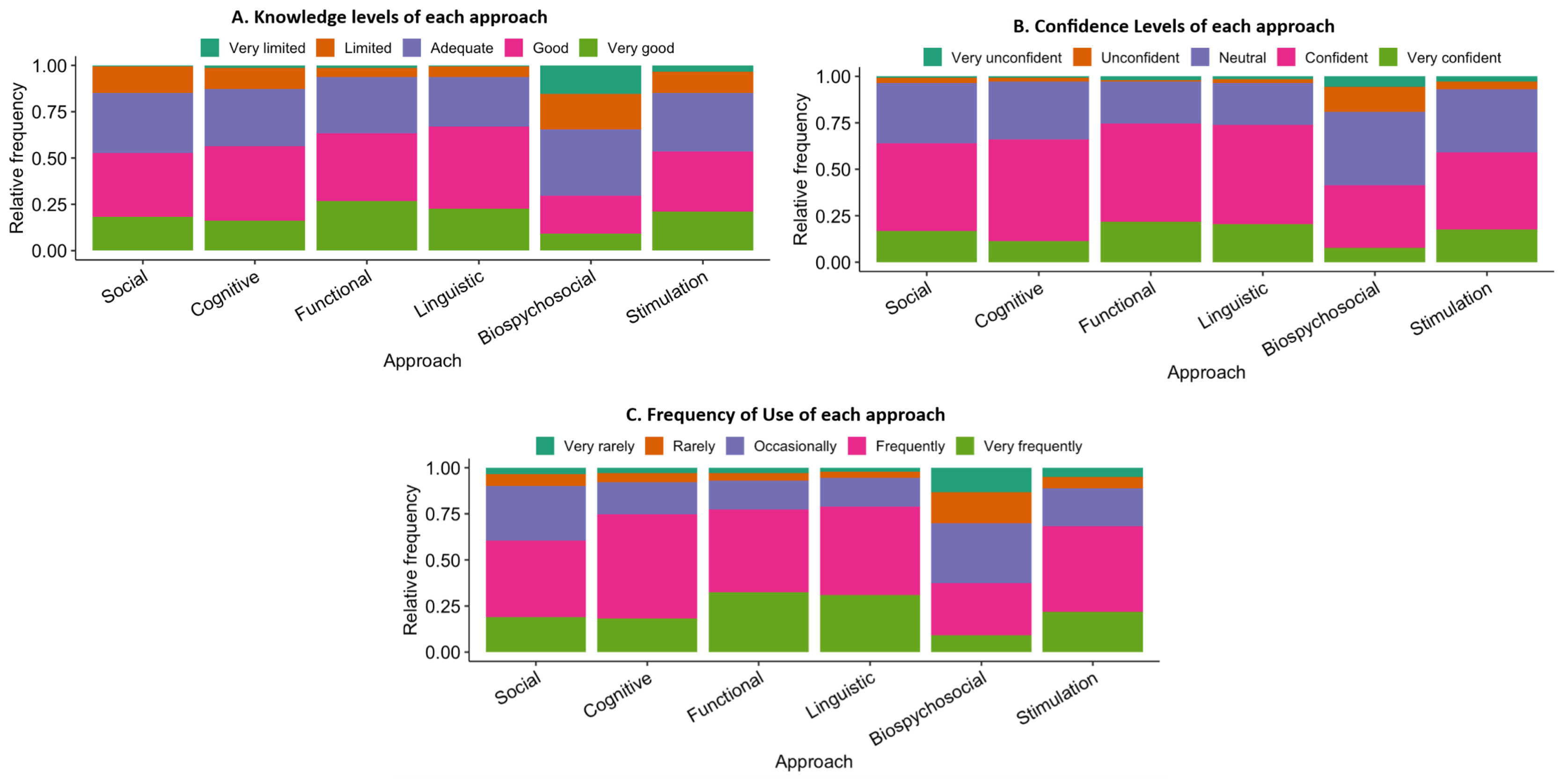
The questionnaire comprised of various forms of items such as yes/no questions, ratings scales, and open-ended questions. The questionnaire consists of few items related to the knowledge (knowing or describing about an approach), confidence (self-efficiency in delivering an approach), and use (actual use of an approach in clinical settings) of various approaches in aphasia rehabilitation on a 5-point Likert scale. As the objectives of the present study were to explore the current practices, challenges and future directions, additional importance was given to these factors in the questionnaire. The questionnaire was uploaded on to Google Forms and was distributed electronically to approximately 1800 speech therapists who have valid registration with Rehabilitation Council of India between September 2024 to November 2024 through emails, social media platforms, and through institutions across India. The ethical clearance was obtained from the IEC of King Khalid University (ECM #2024-3107) and from the IEC of Shravana Institute of Speech and Hearing, India for the study.
2.2. Participants
A total of 198 responses were received from speech therapists within the given time period. Of the 197 speech therapists who participated in survey, 53 speech therapists reported that they are working with other speech and language disorders such as child language disorders, fluency disorders, dysphagia, etc and these responses were removed from the final analysis. Another 2 participants did not provide consent for participation in the study and hence they were removed from the final analysis. Following an initial screening, a total of 142 responses were included for the final analysis of the study. All the participants of the study were given a gift voucher from Amazon India as compensation for their time only after completion of the survey to avoid any potential effects on the results.
The analysis of demographic data revealed that the sample included 32.4% male (n = 46) and 67.6% female (n = 96) speech therapists with mean age of 30.28 years and 27.52 years for male and female groups respectively. The mean experience of participants was 6.13 years and 4.30 years for male and female groups respectively. Further, 43.7% of participants had Bachelors’ degree in Speech-language Pathology (n = 62), 52.1% had master’s degree in speech-language pathology, and 4.2% of participants had Doctoral degree in Speech-language pathology. Of the total participants, 53.5% of participants were from cities (n = 76), 32.4% of participants from metro cities (n = 46), 12.0% of participants from towns (n = 17), and remaining 2.1% of participants were from rural areas (n = 3) indicating wide range distribution of sample. Further, 33.8% of participants worked in multiple settings (n = 48), 20.4% of participants worked in hospital setting (n = 29), 21.9% of participants worked in independent speech and language clinic (n = 31), 14.1% of participants worked as clinician in academic institutions (n = 20), 7.7% of participants worked as teaching faculty in academic institutions, and 2.1% of participants have worked as researchers in aphasia (n = 3). For question on average number of patients with aphasia seen by SLPs, 62.7% of participants reported that they see 0 to 5 aphasia patients; 21.1% reported 6 to 10 aphasia patients; 7% of participants reported 11 to 15 aphasia patients; and 9.2% of participants reported above 15 aphasia patients on an average in a month.
2.3. Data Analysis
The response data of participants were downloaded from google forms and collated into Excel database for further data processing. Data was screened on the basis of consent for the study, type of clinical case load and excluded the data of participants who did not serve aphasia patients in their clinical practice. Data was also screened for any missing data, duplication, and the validity of responses for open-ended questions for each participant. The data was coded with numerical values for questions on knowledge (5—very good; 4—good; 3—adequate; 2—limited; 1—very limited), confidence (5—very confident; 4—confident; 3—neutral; 2—unconfident; 1—very unconfident), use (5—very frequently; 4—frequently; 3—occasionally; 2—rarely; 1—very rarely) for the purpose of descriptive statistics. This categorization facilitated a systematic examination of patterns of therapists’ knowledge, confidence, and practice systems with regard to aphasia rehabilitation. The responses of the participants to the open-ended questions were qualitatively analyzed collaboratively by two independent SLPs with more than 10 years of clinical experience in the field of aphasiology and were not involved in the study using content analysis method. The responses which were agreed by both reviewers using content analysis were reported in the results, while other responses were discarded. Multivariate General Linear Model (GLM) was performed using R Statistical Software (v4.3.3; 2024) for examining predictors of constructs (Knowledge, confidence and use levels) with gender, workplace setting, academic qualifications, experience.




 ,
,