Validity and Reliability of the Korean Version of the Rushton Moral Resilience Scale–16™ in Nurses


Abstract
1. Introduction
2. Methods
2.1. Design and Participants
2.2. Research Instruments
2.2.1. Moral Resilience
2.2.2. Resilience
2.2.3. Burnout
2.3. Procedure
2.3.1. Instrument Permission and Translation
2.3.2. Content Validity of the Preliminary Instrument
2.3.3. Pilot Testing and Cognitive Interviewing
2.3.4. Psychometric Evaluation and Finalization of the K-RMRS-16™
2.4. Data Collection
2.5. Ethical Considerations
2.6. Data Analysis
3. Results
3.1. General Characteristics
3.2. Construct Validity
3.2.1. Item Analysis
3.2.2. EFA
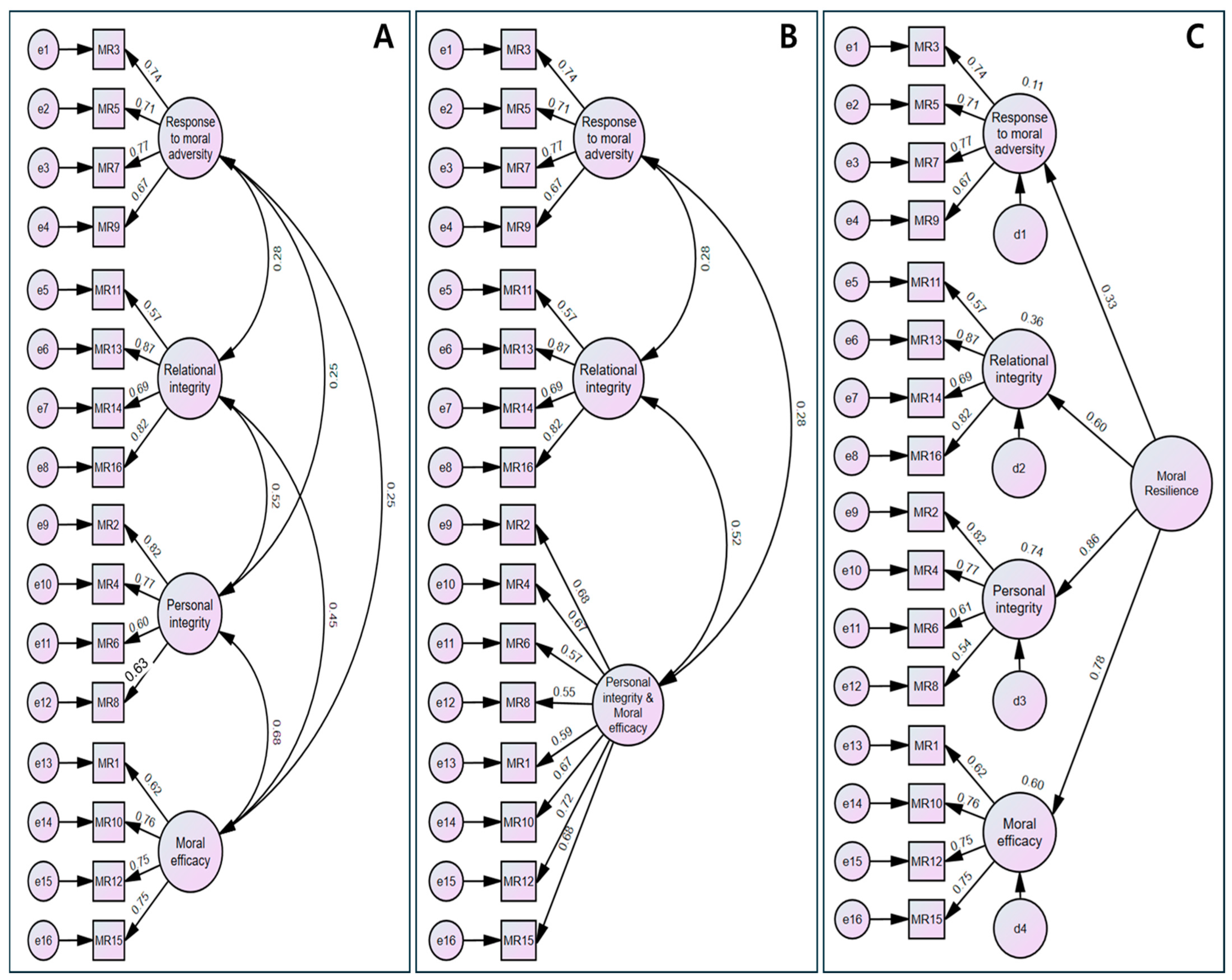
3.2.3. CFA
3.2.4. Convergent and Discriminant Validity
3.3. Hypothesis Testing for Convergent Validity
3.4. Hypothesis Testing for Known-Groups Validity
3.5. Reliability
4. Discussion
5. Conclusions
Author Contributions
Funding
Institutional Review Board Statement
Informed Consent Statement
Data Availability Statement
Conflicts of Interest
References
- Rainer, J.; Schneider, J.K.; Lorenz, R.A. Ethical dilemmas in nursing: An integrative review. J. Clin. Nurs. 2018, 27, 3446–3461. [Google Scholar] [CrossRef] [PubMed]
- Mewborn, E.K.; Fingerhood, M.L.; Johanson, L.; Hughes, V. Examining moral injury in clinical practice: A narrative literature review. Nurs. Ethics 2023, 30, 960–974. [Google Scholar] [CrossRef] [PubMed]
- Kim, E.A.; Kim, N.Y. Mediation effect of biomedical ethics awareness between moral sensitivity and perceived ethical confidence among nursing students. J. Korean Acad. Nurs. Adm. 2020, 26, 511–520. [Google Scholar] [CrossRef]
- Noguchi, Y. Trauma on the pandemic’s front line leaves health workers reeling. Natl. Public Radio 2020. Available online: https://www.npr.org/sections/healthshots/2020/04/23/840986735/trauma-on-the-pandemics-front-line-leaves-health-workers-reeling (accessed on 20 May 2025).
- Usset, T.J.; Baker, L.D.; Griffin, B.J.; Harris, J.I.; Shearer, R.D.; Munson, J.; Smith, A.J. Burnout and turnover risks for healthcare workers in the United States: Downstream effects from moral injury exposure. Sci. Rep. 2024, 14, 24915. [Google Scholar] [CrossRef]
- Kwon, S.B.; Ahn, H.Y.; Kwak, M.H.; Yun, S.H. Conflicts experienced by nurses in hospital nursing organizations. J. Korean Acad. Nurs. Adm. 2019, 25, 499–509. [Google Scholar] [CrossRef]
- Jung, H.G.; Yang, Y.K. Hospital nurses’ experiences of conflict and conflict resolution. Korean J. Occup. Health Nurs. 2018, 27, 13–24. [Google Scholar] [CrossRef]
- Williamson, V.; Stevelink, S.A.M.; Greenberg, N. Occupational moral injury and mental health: A systematic review and meta-analysis. Br. J. Psychiatry 2018, 212, 339–346. [Google Scholar] [CrossRef]
- Heinze, K.E.; Hanson, G.; Holtz, H.; Swoboda, S.; Rushton, C.H. Measuring healthcare interprofessionals’ moral resilience: Validation of the Rushton Moral Resilience Scale. J. Palliat. Med. 2021, 24, 865–872. [Google Scholar] [CrossRef]
- Alimoradi, Z.; Jafari, E.; Lin, C.Y.; Rajabi, R.; Marznaki, Z.H.; Soodmand, M.; Pakpour, A.H. Estimation of moral distress among nurses: A systematic review and meta-analysis. Nurs. Ethics 2023, 30, 334–357. [Google Scholar] [CrossRef]
- Young, P.D.; Rushton, C.H. A concept analysis of moral resilience. Nurs. Outlook 2017, 65, 579–587. [Google Scholar] [CrossRef]
- Rushton, C.H. Moral Resilience: Transforming Moral Suffering in Health Care; Oxford University Press: New York, NY, USA, 2018; pp. 1–320. [Google Scholar]
- Chu, B.W. A systematic analysis of moral resilience research. Korean Elem. Moral Educ. Soc. 2022, 79, 123–150. [Google Scholar] [CrossRef]
- Go, H.Y. Cyber Violence Prevention Education through the Enhancement of Moral Resilience. Ph.D. Dissertation, Gyeongsang National University, Jinju-si, Republic of Korea, 2021; pp. 1–90. [Google Scholar]
- American Nurses Association. A Call to Action: Exploring Moral Resilience toward a Culture of Ethical Practice; ANA: Silver Spring, MD, USA, 2017; Available online: https://www.nursingworld.org/globalassets/docs/ana/ana-call-to-action—exploring-moral-resilience-final.pdf (accessed on 22 May 2024).
- Kubitza, J.; Große, G.; Schütte-Nütgen, K.; Frick, E. Influence of spirituality on moral distress and resilience in critical care staff: A scoping review. Intensive Crit. Care Nurs. 2023, 76, 103377. [Google Scholar] [CrossRef]
- Rushton, C.; Nelson, K.; Antonsdottir, I.; Hanson, G.; Boyce, D. Perceived organizational effectiveness, moral injury, and moral resilience among nurses during the COVID-19 pandemic: Secondary analysis. Nurs. Manag. 2022, 53, 12–22. [Google Scholar] [CrossRef] [PubMed]
- Spilg, E.; Rushton, C.; Phillips, J.; Kendzerska, T.; Saad, M.; Gifford, W.; Gautam, M.; Bhatla, R.; Edwards, J.; Quilty, L.; et al. The new frontline: Exploring the links between moral distress, moral resilience, and mental health in healthcare workers during the COVID-19 pandemic. BMC Psychiatry 2022, 22, 19. [Google Scholar] [CrossRef]
- Antonsdottir, I.; Rushton, C.H.; Nelson, K.E.; Heinze, K.E.; Swoboda, S.M.; Hanson, G.C. Burnout and moral resilience in interdisciplinary healthcare professionals. J. Clin. Nurs. 2021, 31, 196–208. [Google Scholar] [CrossRef]
- Galanis, P.; Moisoglou, I.; Katsiroumpa, A.; Vraka, I.; Siskou, O.; Konstantakopoulou, O.; Kaitelidou, D. Moral resilience reduces quiet quitting, job burnout, and turnover intention among nurses in the post-COVID-19 era. Nurs. Rep. 2024, 14, 254–266. [Google Scholar] [CrossRef] [PubMed]
- Park, C.S. National and international trends in research on moral distress in nursing: Text-network analysis and topic modeling. Korean J. Med. Ethics 2023, 26, 133–149. [Google Scholar] [CrossRef]
- Hyun, J.W.; Kim, D.Y.; Park, J.S.; Choi, Y.S.; Choi, Y.Y.; Kim, S. Factors influencing clinical nurses’ moral courage. Korean J. Med. Ethics 2021, 24, 45–58. [Google Scholar] [CrossRef]
- Albaqawi, H.; Alrashidi, M.S. Perceived stress and its relationship to moral resilience among nurses in the Hail region, Saudi Arabia. Makara J. Health Res. 2022, 26, 159–164. [Google Scholar] [CrossRef]
- Tian, X.; He, Q.; Liu, X.; Gan, X.; Jiménez Herrera, M.F. Moral resilience in registered nurses: Cultural adaptation and validation study. Nurs. Ethics 2024, 31, 355–370. [Google Scholar] [CrossRef] [PubMed]
- Kovanci, M.S.; Ozbas, A.A. Examining the effect of moral resilience on moral distress. Nurs. Ethics 2023, 30, 1156–1170. [Google Scholar] [CrossRef] [PubMed]
- Jalali, A.; Soltany, B.; Sharifi, A.; Naghibzadeh, A.; Karami, M.; Mohammadi, M.M.; Moradi, K. Cultural adaptation and psychometric evaluation of the Persian version of the Rushton Moral Resilience Scale. BMC Nurs. 2025, 24, 372. [Google Scholar] [CrossRef]
- Rushton, C.H.; Hanson, G.C.; Boyce, D.; Holtz, H.; Nelson, K.E.; Spilg, E.G.; Robillard, R. Reliability and validity of the revised Rushton Moral Resilience Scale for healthcare workers. J. Adv. Nurs. 2023, 80, 1177–1187. [Google Scholar] [CrossRef]
- Katsiroumpa, A.; Moisoglou, I.; Konstantakopoulou, O.; Tapaskou, T.; Gallos, P.; Tsiachri, M.; Tsakalaki, A.; Galanis, P. Translation and validation of the revised Rushton Moral Resilience Scale in Greek. Res. Sq. 2023; Preprint. [Google Scholar] [CrossRef]
- Wataya, K.; Ujihara, M.; Kawashima, Y.; Sasahara, S.; Takahashi, S.; Matsuura, A.; Lebowita, A. Development of the Japanese version of the Rushton Moral Resilience Scale for healthcare professionals: Assessing reliability and validity. J. Nurs. Manag. 2024, 2024, 7683163. [Google Scholar] [CrossRef]
- Hinkin, T.R. A brief tutorial on the development of measures for use in survey questionnaires. Organ. Res. Methods 1998, 1, 104–121. [Google Scholar] [CrossRef]
- Howard, M.C. A systematic literature review of exploratory factor analyses in management. J. Bus. Res. 2023, 164, 113969. [Google Scholar] [CrossRef]
- Park, M.M.; Park, J.W. Development of a resilience scale for nurses. J. Korean Acad. Fundam. Nurs. 2016, 23, 32–41. [Google Scholar] [CrossRef]
- Stamm, B.H. The Concise ProQOL Manual, 2nd ed.; ProQOL.org: Pocatello, ID, USA, 2010; Available online: https://proqol.org/proqol-manual (accessed on 15 May 2024).
- World Health Organization. Process of Translation and Adaptation of Instruments; WHO: Geneva, Switzerland, 2015; Available online: https://www.coursehero.com/file/30372721/WHO-Process-of-translation-and-adaptation-of-instrumentspdf/ (accessed on 13 March 2024).
- Kwon, J.; Kim, E.Y. Impact of nursing organizational culture and practice environment on generational conflict among hospital nurses. J. Korean Acad. Nurs. Adm. 2023, 29, 45–54. [Google Scholar] [CrossRef]
- Polit, D.F.; Beck, C.T.; Owen, S.V. Is the CVI an acceptable indicator of content validity? Appraisal and recommendations. Res. Nurs. Health 2007, 30, 459–467. [Google Scholar] [CrossRef]
- DeVellis, R.F. Scale Development: Theory and Applications, 4th ed.; Sage Publications: Thousand Oaks, CA, USA, 2017; pp. 1–256. [Google Scholar]
- Kline, R.B. Principles and Practice of Structural Equation Modeling, 4th ed.; Guilford Press: New York, NY, USA, 2023; pp. 1–515. [Google Scholar]
- Bae, B.R. Structural Equation Modeling with Amos 27; Cheongram Publishing: Seoul, Republic of Korea, 2021; pp. 1–572. [Google Scholar]
- Henseler, J.; Ringle, C.M.; Sarstedt, M. A new criterion for assessing discriminant validity in variance-based structural equation modeling. J. Acad. Mark. Sci. 2015, 43, 115–135. [Google Scholar] [CrossRef]
- Rushton, C.H.; Batcheller, J.; Schroeder, K.; Donohue, P. Burnout and resilience among nurses practicing in high-intensity settings. Am. J. Crit. Care 2015, 24, 412–420. [Google Scholar] [CrossRef] [PubMed]
- Lee, E.H. Psychometric properties of an instrument III: Convergent, discriminant, known-groups, and criterion validity. Korean J. Women Health Nurs. 2021, 27, 176–179. [Google Scholar] [CrossRef] [PubMed]
- Rushton, C.H. Transforming moral suffering by cultivating moral resilience and ethical practice. Am. J. Crit. Care 2023, 32, 238–248. [Google Scholar] [CrossRef]


| Characteristics | Categories | Total (n = 417) | EFA (n = 208) | CFA (n = 209) | χ2 or t | p |
|---|---|---|---|---|---|---|
| Sex | Female | 395 (94.7) | 199 (95.7) | 196 (93.8) | 7.48 | 0.387 |
| Male | 22 (5.3) | 9 (4.3) | 13 (6.2) | |||
| Age (yrs) | 36.3 ± 8.16 | 36.0 ± 8.02 | 36.5 ± 8.30 | −0.54 | 0.591 | |
| 24–29 | 94 (22.5) | 45 (21.6) | 49 (23.4) | 1.56 | 0.669 | |
| 30–39 | 190 (45.6) | 101 (48.6) | 89 (42.6) | |||
| 40–49 | 100 (24.0) | 47 (22.6) | 53 (25.4) | |||
| ≥50 | 33 (7.9) | 26 (7.2) | 18 (8.6) | |||
| Marital status | Unmarried | 192 (46.0) | 96 (46.2) | 96 (45.9) | 0.00 | 0.964 |
| Married | 225 (54.0) | 112 (53.8) | 113 (54.1) | |||
| Level of | Diploma | 35 (8.4) | 15 (7.2) | 20 (9.6) | 0.99 | 0.610 |
| education | Bachelor’s | 303 (72.7) | 155 (74.5) | 148 (70.8) | ||
| ≥Master’s degree | 79 (18.9) | 38 (18.3) | 41 (19.6) | |||
| Total clinical | 12.07 ± 7.84 | 11.84 ± 7.71 | 12.30 ± 7.98 | −0.60 | 0.274 | |
| career (yrs) | <5 | 67 (16.1) | 29 (13.9) | 38 (18.2) | 4.47 | 0.346 |
| 5–<10 | 141 (33.8) | 80 (38.5) | 61 (29.1) | |||
| 10–15 | 76 (18.2) | 37 (17.8) | 39 (18.7) | |||
| 15–<20 | 72 (17.3) | 33 (15.9) | 39 (18.7) | |||
| ≥20 | 61 (14.6) | 29 (13.9) | 32 (15.3) | |||
| Work experience | 4.69 ± 4.70 | 4.62 ± 4.40 | 4.75 ± 4.99 | −0.28 | 0.780 | |
| in present | <1 | 56 (15.2) | 25 (12.0) | 31 (14.8) | 1.41 | 0.843 |
| unit (yrs) | 1–<3 | 142 (32.3) | 71 (34.1) | 71 (34.0) | ||
| 3–<5 | 71 (17.1) | 39 (18.8) | 32 (15.3) | |||
| 5–<7 | 54 (12.7) | 26 (12.5) | 28 (13.4) | |||
| ≥7 | 94 (22.7) | 47 (22.6) | 47 (22.5) | |||
| Position | Staff nurse | 334 (80.1) | 168 (80.8) | 166 (79.4) | 0.95 | 0.623 |
| Physician assistant | 54 (12.9) | 28 (13.4) | 26 (12.5) | |||
| Charge nurse | 29 (7.0) | 12 (5.8) | 17 (8.1) | |||
| Working unit | Ward | 253 (60.7) | 124 (59.6) | 129 (61.7) | 1.10 | 0.577 |
| ICU & ER | 111 (26.6) | 54 (26.0) | 57 (27.3) | |||
| OR & RR | 53 (12.7) | 30 (14.4) | 23 (11.0) | |||
| Hospital type | Advanced general | 269 (64.5) | 133 (63.9) | 136 (65.1) | 0.06 | 0.810 |
| General | 148 (35.5) | 75 (36.1) | 73 (34.9) | |||
| Region of | Capital | 120 (28.8) | 57 (27.4) | 63 (30.1) | 1.50 | 0.682 |
| hospital | Central | 90 (21.6) | 43 (20.7) | 47 (22.5) | ||
| Gyeongsang | 79 (18.9) | 44 (21.1) | 35 (16.8) | |||
| Honam | 128 (30.7) | 64 (30.8) | 64 (30.6) |
| Factors/Items | ITC | Communality | Structure Matrix | Pattern Matrix | |||||||
|---|---|---|---|---|---|---|---|---|---|---|---|
| r | F1 | F2 | F3 | F4 | F1 | F2 | F3 | F4 | |||
| Response to moral adversity (F1) | |||||||||||
| 7 | After facing a challenging ethical situation, lingering distress weighs me down. (R) | 0.49 | 0.66 | 0.80 | 0.27 | 0.25 | 0.26 | 0.84 | −0.12 | 0.12 | −0.05 |
| 5 | I am overwhelmed by persistent ethical conflicts. (R) | 0.46 | 0.62 | 0.79 | 0.28 | 0.15 | 0.24 | 0.81 | −0.02 | −0.04 | −0.02 |
| 9 | When confronted with an ethical challenge, I push myself beyond what is healthy for me. (R) | 0.53 | 0.61 | 0.77 | 0.38 | 0.20 | 0.34 | 0.72 | 0.09 | −0.09 | 0.10 |
| 3 | Difficult ethical situations leave me feeling powerless. (R) | 0.49 | 0.52 | 0.72 | 0.35 | 0.22 | 0.23 | 0.70 | 0.07 | 0.03 | −0.06 |
| Relational integrity (F2) | |||||||||||
| 16 | My fear can cause me to act in a way that compromises my values. (R) | 0.58 | 0.69 | 0.32 | 0.82 | 0.40 | 0.26 | −0.01 | 0.86 | −0.05 | −0.04 |
| 13 | When others criticize my opinions, I compromise my values. (R) | 0.64 | 0.66 | 0.36 | 0.80 | 0.45 | 0.36 | 0.02 | 0.77 | −0.01 | 0.08 |
| 14 | I would rather avoid conflict with those who have more authority than I do than act in accordance with my values. (R) | 0.54 | 0.56 | 0.23 | 0.75 | 0.44 | 0.27 | −0.09 | 0.75 | 0.06 | 0.00 |
| 11 | I tend to be distracted by others’ strong emotions when ethical conflicts occur. (R) | 0.60 | 0.50 | 0.16 | 0.39 | 0.82 | 0.43 | 0.28 | 0.51 | 0.00 | 0.01 |
| Personal integrity (F3) | |||||||||||
| 4 | I have the conviction to act in accordance with my values. | 0.51 | 0.70 | 0.16 | 0.39 | 0.82 | 0.43 | −0.04 | −0.07 | 0.86 | 0.01 |
| 2 | No matter the situation I do what is consistent with my values. | 0.57 | 0.68 | 0.16 | 0.61 | 0.78 | 0.34 | 0.09 | −0.12 | 0.69 | 0.12 |
| 8 | I have the courage to take action when others resist. | 0.50 | 0.51 | 0.26 | 0.33 | 0.70 | 0.46 | −0.12 | 0.32 | 0.68 | −0.10 |
| 6 | I take responsibility for my choices. | 0.54 | 0.41 | 0.30 | 0.44 | 0.62 | 0.38 | 0.12 | 0.09 | 0.53 | 0.02 |
| Moral efficacy (F4) | |||||||||||
| 10 | When I am confronted with an ethical challenge, I can articulate the ethical conflict. | 0.43 | 0.57 | 0.24 | 0.27 | 0.33 | 0.76 | −0.03 | 0.05 | −0.11 | 0.81 |
| 12 | I am confident in my ability to reason through ethical challenges in my professional role. | 0.44 | 0.58 | 0.21 | 0.23 | 0.46 | 0.75 | −0.05 | −0.09 | 0.14 | 0.72 |
| 15 | I can think clearly when confronting an ethical challenge, even when I feel pressured. | 0.44 | 0.46 | 0.26 | 0.25 | 0.38 | 0.68 | 0.02 | −0.02 | 0.03 | 0.66 |
| 1 | I voice my ethical concerns in a way that others take seriously. | 0.48 | 0.40 | 0.27 | 0.35 | 0.40 | 0.59 | 0.02 | 0.13 | 0.06 | 0.51 |
| Eigenvalue | 3.34 | 3.82 | 3.64 | 2.25 | |||||||
| % of variance | 32.42 | 11.30 | 8.15 | 4.58 | |||||||
| Cumulative explained variance (%) | 32.42 | 43.72 | 51.87 | 56.45 | |||||||
| Cronbach’s α | 0.85 | 0.83 | 0.82 | 0.78 | |||||||
| Total Chronbach’s α = 0.87, Kaiser-Meyer-Olkin values = 0.85, Bartlett’s test of sphericity: χ2 = 1467.61 (p < 0.001) | |||||||||||
| Inter-factor correlations: F1 ⟷ F2 (0.41), F1 ⟷ F3 (0.26), F1 ⟷ F4 (0.35), F2 ⟷ F3 (0.54), F2 ⟷ F4 (0.37), F3 ⟷ F4 (0.52) | |||||||||||
| Convergent Validity | Items | Standardized Estimate (β) | Unstandardized Estimate (β) | SE | C.R. | AVE | CR | Cronbach’s α | ||
| Factors | ||||||||||
| Response to moral | 9 | 0.67 | 1.00 | - | - | 0.52 | 0.81 | 0.81 | ||
| adversity | 7 | 0.77 | 1.10 | 0.13 | 8.80 | |||||
| 5 | 0.71 | 0.98 | 0.12 | 8.37 | ||||||
| 3 | 0.74 | 0.98 | 0.11 | 8.62 | ||||||
| Relational integrity | 16 | 0.82 | 1.00 | - | - | 0.56 | 0.83 | 0.82 | ||
| 14 | 0.69 | 0.98 | 0.10 | 10.20 | ||||||
| 13 | 0.87 | 1.13 | 0.09 | 12.74 | ||||||
| 11 | 0.57 | 0.69 | 0.08 | 8.18 | ||||||
| Personal integrity | 8 | 0.63 | 1.00 | - | - | 0.51 | 0.80 | 0.77 | ||
| 6 | 0.60 | 0.96 | 0.15 | 6.39 | ||||||
| 4 | 0.77 | 1.30 | 0.18 | 7.31 | ||||||
| 2 | 0.82 | 1.32 | 0.18 | 7.48 | ||||||
| Moral efficacy | 15 | 0.75 | 1.00 | - | - | 0.52 | 0.81 | 0.81 | ||
| 12 | 0.75 | 0.97 | 0.10 | 9.89 | ||||||
| 10 | 0.76 | 0.97 | 0.10 | 9.98 | ||||||
| 1 | 0.62 | 0.67 | 0.09 | 8.19 | ||||||
| Discriminant Validity | Φ (Φ2) | SE | Φ – (2 × SE) | Φ + (2 × SE) | HTMT [95% CI] | |||||
| Relations | ||||||||||
| Response to moral adversity ⟷ Relational integrity | 0.28 (0.08) | 0.03 | 0.22 | 0.34 | 0.48 [0.31~0.63] | |||||
| Response to moral adversity ⟷ Personal integrity | 0.25 (0.06) | 0.02 | 0.22 | 0.29 | 0.35 [0.18~0.51] | |||||
| Response to moral adversity ⟷ Moral efficacy | 0.25 (0.06) | 0.02 | 0.21 | 0.29 | 0.31 [0.16~0.47] | |||||
| Relational integrity ⟷ Personal integrity | 0.52 (0.27) | 0.02 | 0.48 | 0.56 | 0.43 [0.29~0.56] | |||||
| Relational integrity ⟷ Moral efficacy | 0.45 (0.20) | 0.02 | 0.41 | 0.49 | 0.62 [0.48~0.74] | |||||
| Personal integrity ⟷ Moral efficacy | 0.68 (0.46) | 0.02 | 0.64 | 0.72 | 0.60 [0.45~0.72] | |||||
| Fitness Index | CMIN/df | SRMR | RMSEA | GFI | CFI | TLI | NFI | |||
| Model 1 (4 factors) | 1.77 | 0.05 | 0.06 | 0.91 | 0.94 | 0.93 | 0.90 | |||
| Model 2 (3 factors) | 2.45 | 0.03 | 0.08 | 0.87 | 0.89 | 0.87 | 0.82 | |||
| Model 3 (Higher-order) | 1.76 | 0.03 | 0.06 | 0.91 | 0.94 | 0.93 | 0.90 | |||
| Criteria | ≤2 | ≤0.08 | ≤0.08 | ≥0.90 | ≥0.90 | ≥0.90 | ≥0.90 | |||
| Variable | Sub-Factors or Categories | Moral Resilience | |||||
|---|---|---|---|---|---|---|---|
| Response to Moral Adversity | Relational Integrity | Personal Integrity | Moral Efficacy | Total | |||
| Moral Resilience | Response to moral adversity | 1 | |||||
| Relational integrity | 0.32 (<0.001) | 1 | |||||
| Personal integrity | 0.25 (<0.001) | 0.47 (<0.001) | 1 | ||||
| Moral efficacy | 0.25 (<0.001) | 0.36 (<0.001) | 0.52 (<0.001) | 1 | |||
| Total | 0.50 (<0.001) | 0.64 (<0.001) | 0.58 (<0.001) | 0.51 (<0.001) | 1 | ||
| Resilience (Mean ± SD: 3.89 ± 0.46) | 0.32 (<0.001) | 0.31 (<0.001) | 0.35 (<0.001) | 0.40 (<0.001) | 0.51 (<0.001) | ||
| Mean ± SD | 2.78 ± 0.57 | 2.81 ± 0.65 | 3.05 ± 0.46 | 2.91 ± 0.40 | 2.89 ± 0.38 | ||
| Cronbach’s α | 0.83 | 0.83 | 0.80 | 0.81 | 0.86 | ||
| Burnout (T-score) | Low (≤43) a | 100 (24.0%) | 3.02 ± 0.59 | 3.12 ± 0.64 | 3.24 ± 0.53 | 3.09 ± 0.41 | 3.16 ± 0.43 |
| Moderate (44–56) b | 220 (52.8%) | 2.82 ± 0.49 | 2.83 ± 0.60 | 3.09 ± 0.37 | 2.95 ± 0.32 | 2.90 ± 0.26 | |
| High (≥57) c | 97 (23.2%) | 2.41 ± 0.56 | 2.45 ± 0.60 | 2.78 ± 0.45 | 2.63 ± 0.43 | 2.57 ± 0.30 | |
| F (p) | 29.72 (<0.001) † | 29.99 (<0.001) * | 24.89 (<0.001) † | 31.93 (<0.001) † | 71.92 (<0.001) † | ||
| Post hoc | a > b > c | a > b > c | a > b > c | a > b > c | a > b > c | ||
Disclaimer/Publisher’s Note: The statements, opinions and data contained in all publications are solely those of the individual author(s) and contributor(s) and not of MDPI and/or the editor(s). MDPI and/or the editor(s) disclaim responsibility for any injury to people or property resulting from any ideas, methods, instructions or products referred to in the content. |
© 2026 by the authors. Licensee MDPI, Basel, Switzerland. This article is an open access article distributed under the terms and conditions of the Creative Commons Attribution (CC BY) license.
Share and Cite
Kim, E.A.; Kim, H.R. Validity and Reliability of the Korean Version of the Rushton Moral Resilience Scale–16™ in Nurses. Healthcare 2026, 14, 424. https://doi.org/10.3390/healthcare14040424
Kim EA, Kim HR. Validity and Reliability of the Korean Version of the Rushton Moral Resilience Scale–16™ in Nurses. Healthcare. 2026; 14(4):424. https://doi.org/10.3390/healthcare14040424
Chicago/Turabian StyleKim, Eun A., and Hae Ran Kim. 2026. "Validity and Reliability of the Korean Version of the Rushton Moral Resilience Scale–16™ in Nurses" Healthcare 14, no. 4: 424. https://doi.org/10.3390/healthcare14040424
APA StyleKim, E. A., & Kim, H. R. (2026). Validity and Reliability of the Korean Version of the Rushton Moral Resilience Scale–16™ in Nurses. Healthcare, 14(4), 424. https://doi.org/10.3390/healthcare14040424