Nurses’ Experience in Providing End-of-Life Care in Intensive Care Unit: A Scoping Review


Abstract
1. Introduction
2. Materials and Methods
2.1. Study Design
2.2. Eligibility Criteria
2.3. Search Strategy
2.4. Study Screening and Selection Process
2.5. Data Extraction and Quality Appraisal
2.6. Data Analysis and Thematic Synthesis
3. Results
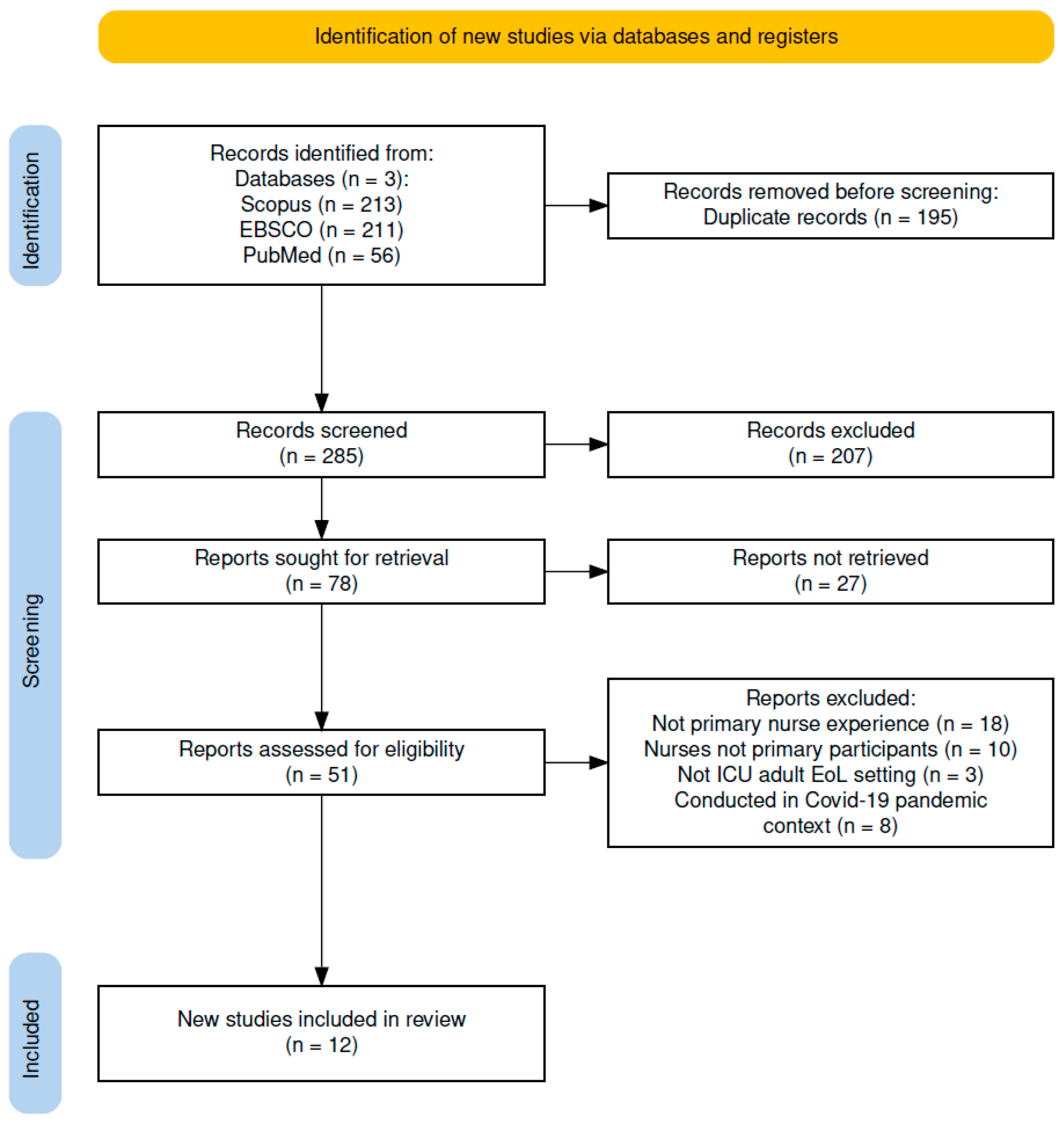
3.1. Study Selection
3.2. Study Characteristics
3.3. Experiences and Challenges of ICU Nurses in Providing EoLC
3.3.1. Emotional and Moral Challenges
3.3.2. Cultural and Spiritual Influences
3.3.3. Interprofessional Communication and Collaboration
3.3.4. Professional Development and Organizational Support
3.3.5. Organizational and Resource-Related Factors
4. Discussion
4.1. Main Findings
4.2. Study Limitations
4.3. Implications for Practice and Research
5. Conclusions
Supplementary Materials
Author Contributions
Funding
Institutional Review Board Statement
Informed Consent Statement
Data Availability Statement
Acknowledgments
Conflicts of Interest
References
- Myburgh, J.; Abillama, F.; Chiumello, D.; Dobb, G.; Jacobe, S.; Kleinpell, R.; Koh, Y.; Martin, C.; Michalsen, A.; Pelosi, P.; et al. End-of-life care in the intensive care unit: Report from the Task Force of World Federation of Societies of Intensive and Critical Care Medicine. J. Crit. Care 2016, 34, 125–130. [Google Scholar] [CrossRef]
- Avidan, A.; Sprung, C.L.; Schefold, J.C.; Ricou, B.; Hartog, C.S.; Nates, J.L.; Jaschinski, U.; Lobo, S.M.; Joynt, G.M.; Lesieur, O.; et al. Variations in end-of-life practices in intensive care units worldwide (Ethicus-2): A prospective observational study. Lancet Respir. Med. 2021, 9, 1101–1110. [Google Scholar] [CrossRef]
- Martin-Loeches, I.; Sprung, C.L.; Wolsztynski, E.; Cusack, R.; Lobo, S.M.; Protti, A.; Avidan, A. End-of-life decision disparities according to the gross national income in critically ill patients: A secondary analysis of the ETHICUS-2 study. Ann. Intensive Care 2025, 15, 29. [Google Scholar] [CrossRef] [PubMed]
- Brooks, L.A.; Manias, E.; Nicholson, P. Communication and decision-making about end-of-life care in the intensive care unit. Am. J. Crit. Care 2017, 26, 336–341. [Google Scholar] [CrossRef] [PubMed]
- Xu, D.D.; Li, J.; Ding, X.B.; Ma, J.; Hou, R.T.; Chen, N.N.; Cheng, X.L.; Hu, F. Experiences of providing end-of-life care in adult intensive care units: A qualitative study. BMC Nurs. 2025, 24, 768. [Google Scholar] [CrossRef]
- Vincent, J.-L. End-of-life issues in the intensive therapy unit: 10 important points to remember. Eur. Heart J. Acute Cardiovasc. Care 2025, 14, 245–249. [Google Scholar] [CrossRef]
- McCurry, I.; Jennett, P.; Oh, J.; White, B.; Delisser, H.M. Chaplain Care in the Intensive Care Unit at the End of Life: A Qualitative Analysis. Palliat. Med. Rep. 2021, 2, 280–286. [Google Scholar] [CrossRef] [PubMed]
- Gallagher, A.M.; Szylit, R.; McCarthy, J.; Kohlen, H.; Andrews, T.; Paganini, M.C.; Abu-El-Noor, N.I.; Cox, A.C.; Haas, M.; Arber, A. Negotiated reorienting: A grounded theory of nurses’ end-of-life decision-making in the intensive care unit. Int. J. Nurs. Stud. 2015, 52, 794–803. [Google Scholar] [CrossRef]
- Bandini, J.I. Beyond the hour of death: Family experiences of grief and bereavement following an end-of-life hospitalization in the intensive care unit. Health 2022, 26, 267–283. [Google Scholar] [CrossRef]
- Yuan, L.; Chaudhari, V.; Rabin, S.; McClintic, M.; Desai, P.; Beck, T.; Chen, E.; Rojas, J.C. Discussing End-of-Life in the Intensive Care Unit: Education Practices in Pulmonary and Critical Care Medicine Fellowship Programs. Am. J. Hosp. Palliat. Med. 2025. [Google Scholar] [CrossRef]
- Romanò, M.; Bertona, R.; Zorzoli, F.; Villani, R. Palliative care in the intensive cardiac care unit: A new competence for the cardiac intensivist. G. Ital. Cardiol. 2017, 18, 685–695. [Google Scholar] [CrossRef]
- Romanò, M. Palliative Care in Cardiac Intensive Care Units; Springer: Cham, Switzerland, 2021; pp. 1–195. [Google Scholar] [CrossRef]
- Bennett, S.R. End-of-life care in the intensive care unit. Surgery 2018, 36, 728–731. [Google Scholar] [CrossRef]
- Gams, P.; Lozar, A.K.; Gradišek, P.; Šoštarič, M. End-of-life decisions and palliative care in surgical intensive care units. Lijec. Vjesn. 2024, 146, 391–396. [Google Scholar] [CrossRef]
- Akgün, K.M.; Kapo, J.M.; Siegel, M.D. Critical Care at the End of Life. Semin. Respir. Crit. Care Med. 2015, 36, 921–933. [Google Scholar] [CrossRef]
- Darfelt, I.S.; Neergaard, M.A.; Klepstad, P.; Hästbacka, J.; Thorarensen, G.; Robertson, A.C.; Valsø, Å.; Jensen, H.I.; Segerlantz, M.; Lehto, J.T.; et al. Consensus statements on end-of-life care in ICU—A Scandinavian multidisciplinary Delphi study. Acta Anaesthesiol. Scand. 2025, 69, e70015. [Google Scholar] [CrossRef]
- Yin, J.; Zhao, L.; Zhang, N.; Xia, H. Understanding the interplay of compassion fatigue and moral resilience on moral distress in ICU nurses: A cross-sectional study. Front. Public Health 2024, 12, 1402532. [Google Scholar] [CrossRef]
- Cerela-Boltunova, O.; Millere, I.; Nagle, E. Moral Distress, Professional Burnout, and Potential Staff Turnover in Intensive Care Nursing Practice in Latvia—Phase 1. Int. J. Environ. Res. Public Health 2025, 22, 1261. [Google Scholar] [CrossRef]
- Mathew, M.; John, A.; Vazhakkalayil Ramachandran, R. Nurse stress and patient safety in the ICU: Physician-led observational mixed-methods study. BMJ Open Qual. 2025, 14, e003109. [Google Scholar] [CrossRef] [PubMed]
- Grant, M. Resolving communication challenges in the intensive care unit. AACN Adv. Crit. Care 2015, 26, 123–130. [Google Scholar] [CrossRef] [PubMed]
- Hang, A.T.; Faria, B.G.; Ribeiro, A.C.R.; Valadares, G.V. Challenges to patient safety in intensive care: A grounded theory. ACTA Paul. Enferm. 2023, 36, eAPE03221. [Google Scholar] [CrossRef]
- Kamath, R.R.; Kumar, A.A.; Seshadri, V. Exploring the Impact of Disengagement on the Burnout Among ICU Nurses of Indian Private Hospitals: The Influence of Perceived Organization Support. In Studies in Big Data; Springer International Publishing: Berlin/Heidelberg, Germany, 2025; Volume 158, pp. 111–126. [Google Scholar] [CrossRef]
- Bani Hani, S.; Abu Aqoulah, E.A. Relationship Between Alarm Fatigue and Stress Among Acute Care Nurses: A Cross-Sectional Study. SAGE Open Nurs. 2024, 10, 23779608241292584. [Google Scholar] [CrossRef]
- Haroen, H.; Mirwanti, R.; Windani, C.; Sari, M. Knowledge and attitude toward end-of-life care of nursing students after completing the multi-methods teaching and learning palliative care nursing course. Sustainability 2023, 15, 4382. [Google Scholar] [CrossRef]
- Dakka, F.J. Nurses’ Experience With End-of-Life Care in Geriatric Centers: A Systematic Review. SAGE Open Nurs. 2025, 11, 23779608241279107. [Google Scholar] [CrossRef] [PubMed]
- Jung, M.Y.; Matthews, A.K. Understanding Nurses’ Experiences and Perceptions of End-of-Life Care for Cancer Patients in Korea: A Scoping Review. J. Palliat. Care 2021, 36, 255–264. [Google Scholar] [CrossRef] [PubMed]
- Tricco, A.C.; Lillie, E.; Zarin, W.; O’Brien, K.K.; Colquhoun, H.; Levac, D.; Moher, D.; Peters, M.D.J.; Horsley, T.; Weeks, L.; et al. PRISMA Extension for Scoping Reviews (PRISMA-ScR): Checklist and Explanation. Ann. Intern. Med. 2018, 169, 467–473. [Google Scholar] [CrossRef] [PubMed]
- Alanazi, N.H. Intensive Care Unit Nurses’ Experiences in Caring for End-of-Life Patients in Saudi Arabia: A Qualitative Study. Int. J. Environ. Res. Public Health 2024, 21, 931. [Google Scholar] [CrossRef]
- Baliza, M.F.; Bousso, R.S.; Poles, K.; Dos Santos, M.R.; Silva, L.; Paganini, M.C. Factors influencing Intensive Care Units nurses in end-of-life decisions. Rev. Esc. Enferm. 2015, 49, 571–578. [Google Scholar] [CrossRef]
- Dartey, A.F.; Johnson, B.B.; Klutsey, E.E.; Zigah, J.; Okai, B.; Ahorli, R.; Appati, J.A.; Essiakoh, B.; Afaya, A. Experiences of intensive care unit nurses in end-of-life care at Ho Teaching Hospital, Ghana: A qualitative study. BMC Nurs. 2025, 24, 699. [Google Scholar] [CrossRef]
- Jang, S.; Park, W.; Kim, H.; Chang, S. Exploring nurses’ end-of-life care for dying patients in the ICU using focus group interviews. Intensive Crit. Care Nurs. 2019, 52, 3–8. [Google Scholar] [CrossRef]
- Langley, G.C.; Kisorio, L.; Schmollgruber, S. Moral distress experienced by intensive care nurses. S. Afr. J. Crit. Care 2015, 31, 36–41. [Google Scholar] [CrossRef]
- Mani, Z.A. Bridging cultural gaps in end-of-life care: The experiences of international charge nurses in Saudi Arabia. BMC Nurs. 2024, 23, 865. [Google Scholar] [CrossRef] [PubMed]
- Palmryd, L.; Rejnö, Å.C.U.; Godskesen, T.E. Integrity at end of life in the intensive care unit: A qualitative study of nurses’ views. Ann. Intensive Care 2021, 11, 23. [Google Scholar] [CrossRef]
- Palmryd, L.; Rejnö, Å.C.U.; Alvariza, A.; Godskesen, T.E. Critical care nurses’ experiences of ethical challenges in end-of-life care. Nurs. Ethics 2025, 32, 424–436. [Google Scholar] [CrossRef] [PubMed]
- Taylor, E.; Moeke-Maxwell, T.; Anderson, N.E. Māori end-of-life care in the intensive care unit: A qualitative exploration of nursing perspectives. Aust. Crit. Care 2024, 37, 106–110. [Google Scholar] [CrossRef]
- Velarde-García, J.F.; Luengo González, R.; González Hervias, R.; Cardenete-Reyes, C.; Álvarez-Embarba, B.; Palacios-Ceña, D. Limitation of therapeutic effort experienced by intensive care nurses. Nurs. Ethics 2018, 25, 867–879. [Google Scholar] [CrossRef] [PubMed]
- Wu, T.W.; Oliffe, J.L.; Bungay, V.; Johnson, J.L. Male ICU Nurses’ Experiences of Taking Care of Dying Patients and Their Families: A Gender Analysis. Am. J. Mens. Health 2015, 9, 44–52. [Google Scholar] [CrossRef]
- Mani, R.K.; Bhatnagar, S.; Butola, S.; Gursahani, R.; Mehta, D.; Simha, S.; Divatia, J.V.; Kumar, A.; Iyer, S.K.; Deodhar, J.; et al. Indian Society of Critical Care Medicine and Indian Association of Palliative Care Expert Consensus and Position Statements for End-of-life and Palliative Care in the Intensive Care Unit. Indian J. Crit. Care Med. 2024, 28, 200–250. [Google Scholar] [CrossRef]
- Alanazi, M.A.; Shaban, M.M.; Ramadan, O.M.E.; Zaky, M.E.; Mohammed, H.H.; Amer, F.G.M.; Shaban, M. Navigating end-of-life decision-making in nursing: A systematic review of ethical challenges and palliative care practices. BMC Nurs. 2024, 23, 467. [Google Scholar] [CrossRef]
- Henrich, N.J.; Dodek, P.M.; Alden, L.; Keenan, S.P.; Reynolds, S.; Rodney, P. Causes of moral distress in the intensive care unit: A qualitative study. J. Crit. Care 2016, 35, 57–62. [Google Scholar] [CrossRef]
- Browning, E.D.; Cruz, J.S. Reflective Debriefing: A Social Work Intervention Addressing Moral Distress among ICU Nurses. J. Soc. Work End-of-Life Palliat. Care 2018, 14, 44–72. [Google Scholar] [CrossRef]
- Payongayong, J.V.; Thomas-Hawkins, C.; Jarrín, O.F.; Barberio, J.; Hain, D.J. Effects of End-of-Life Com-munication Knowledge, Attitudes, and Perceived Behavioral Control on End-of-Life Communica-tion Behaviors Among Nephrology Nurse Practitioners. Nephrol. Nurs. J. 2022, 49, 213–225. [Google Scholar] [CrossRef]
- Gjessing, K.; Steindal, S.A.; Kvande, M.E. Collaboration between nurses and doctors in the decision-making process when considering ending the life-prolonging treatment of intensive care patients. Nurs. Open 2023, 10, 306–315. [Google Scholar] [CrossRef]
- Ghaemizade Shushtari, S.S.; Molavynejad, S.; Adineh, M.; Savaie, M.; Sharhani, A. Effect of end-of-life nursing education on the knowledge and performance of nurses in the intensive care unit: A quasi-experimental study. BMC Nurs. 2022, 21, 102. [Google Scholar] [CrossRef] [PubMed]
- O’Shea, E.R.; Mager, D. End-of-life nursing education: Enhancing nurse knowledge and attitudes. Appl. Nurs. Res. 2019, 50, 151197. [Google Scholar] [CrossRef]
- Tang, M.L.; Lee, C.N.; Goh, H.S. Effectiveness of End-of-Life Training Program for Nurses in a Long-Term Palliative Care Setting: A Pilot Study. Malays. J. Nurs. 2022, 14, 25–29. [Google Scholar] [CrossRef]
- Anderson, W.G.; Puntillo, K.; Cimino, J.; Noort, J.; Pearson, D.; Boyle, D.; Grywalski, M.; Meyer, J.; O’Neil-Page, E.; Cain, J.; et al. Palliative care professional development for critical care nurses: A multicenter program. Am. J. Crit. Care 2017, 26, 361–371. [Google Scholar] [CrossRef] [PubMed]
- Barker, R.; Wilson, P.; Butler, C. Does national policy in England help deliver better and more consistent care for those at the end of life? J. Health Serv. Res. Policy 2020, 25, 238–245. [Google Scholar] [CrossRef]
- Shih, Y.-A.; Wang, C.; Ding, J.; Zhou, Y.; Lu, Q. Cultural and ethical barriers to implementing end-of-life advance care planning among oncology nursing professionals: A content analysis of open-ended questions. BMC Med. Ethics 2025, 26, 96. [Google Scholar] [CrossRef]
- Cheng, S.-Y.; Lin, C.-P.; Chan, H.Y.-L.; Martina, D.; Mori, M.; Kim, S.-H.; Ng, R. Advance care planning in Asian culture. Jpn. J. Clin. Oncol. 2020, 50, 976–989. [Google Scholar] [CrossRef]
- Saunders, R.; Glass, C.; Seaman, K.; Gullick, K.; Andrew, J.; Wilkinson, A.; Davray, A. Clinical staff perceptions on the quality of end-of-life care in an Australian acute private hospital: A cross-sectional survey. Aust. Health Rev. 2021, 45, 771–777. [Google Scholar] [CrossRef]
- Morley, G.; Horsburgh, C.C. Reflective Debriefs as a Response to Moral Distress: Two Case Study Examples. HEC Forum 2023, 35, 1–20. [Google Scholar] [CrossRef] [PubMed]
- Watson, A.L.; Young, C.; Whitham, A.; Prescott, S.; Flynn, E.J. Enhancing Nursing Practice Through Peer Support: Strategies for Engagement in the Nursing Workforce. J. Radiol. Nurs. 2025, 44, 31–35. [Google Scholar] [CrossRef]
- Rushton, C.H.; Swoboda, S.M.; Reller, N.; Skarupski, K.A.; Prizzi, M.; Young, P.D.; Hanson, G.C. Mindful ethical practice and resilience academy: Equipping nurses to address ethical challenges. Am. J. Crit. Care 2021, 30, e1–e11. [Google Scholar] [CrossRef] [PubMed]
- Haroen, H.; Mirwanti, R.; Agustina, H.R.; Pahria, T.; Harun, H.; Akuoko, C.P.; Nadirawati, N. A Qualitative Study of Perception and Experience Toward End-of-Life Care Among Nursing Students Who Witnessed Dying People in Their Family. J. Multidiscip. Healthc. 2023, 16, 2261–2270. [Google Scholar] [CrossRef]
- Jeon, Y.; Choi, H.; Lee, U.; Kim, H. Technology-based interactive communication simulation addressing challenging communication situations for nursing students. J. Prof. Nurs. 2024, 53, 71–79. [Google Scholar] [CrossRef] [PubMed]
- Osmancevic, S.; Steiner, L.M.; Großschädl, F.; Lohrmann, C.; Schoberer, D. The effectiveness of cultural competence interventions in nursing: A systematic review and meta-analysis. Int. J. Nurs. Stud. 2025, 167, 105079. [Google Scholar] [CrossRef]
- Kashyap, K.; Gielen, J. Improving Access and Health Outcomes in Palliative Care through Cultural Competence: An exploration of opportunities and challenges in India. Indian J. Palliat. Care 2022, 28, 331–337. [Google Scholar] [CrossRef]
- Flannery, L.; Peters, K.; Ramjan, L.M. The differing perspectives of doctors and nurses in end-of-life decisions in the intensive care unit: A qualitative study. Aust. Crit. Care 2020, 33, 311–316. [Google Scholar] [CrossRef]
- Wang, Y.-Y.; Wan, Q.-Q.; Lin, F.; Zhou, W.-J.; Shang, S.-M. Interventions to improve communication between nurses and physicians in the intensive care unit: An integrative literature review. Int. J. Nurs. Sci. 2018, 5, 81–88. [Google Scholar] [CrossRef]
- Sung, T.-C.; Hsu, H.-C. Improving Critical Care Teamwork: Simulation-Based Interprofessional Training for Enhanced Communication and Safety. J. Multidiscip. Healthc. 2025, 18, 355–367. [Google Scholar] [CrossRef]
- Kubbara, A.; Wong, J.; Capp, K.; Woldegerima, S.; Sundberg, M.A.; Olson, A.P.J.; Pendleton, K. Moving toward Interprofessional Teaching in the Intensive Care Unit A Mixed Methods Study. ATS Sch. 2024, 5, 559–574. [Google Scholar] [CrossRef] [PubMed]
- Guo, J.; Jiang, S.; Dai, Y.; Xu, X.; Liu, C.; Chen, Y. Shared decision-making competency and its associated factors among palliative care nurses: A cross-sectional study in China. BMC Nurs. 2025, 24, 141. [Google Scholar] [CrossRef] [PubMed]
- Garman, A.N.; Standish, M.P.; Carter, C.; Anderson, M.M.; Lambert, C. Nchl’s “best organizations for leadership development” program: A case study in improving evidence-based practice through benchmarking and recognition. In Advances in Health Care Management; Emerald Publishing Limited: England, UK, 2021; Volume 20, pp. 221–230. [Google Scholar] [CrossRef]
- Tzenalis, A.; Papaemmanuel, H.; Kipourgos, G.; Elesnitsalis, G. End-of-life Care in the Intesive Care Unit and Nursing Roles in Communicating with Families. J. Crit. Care Med. 2023, 9, 116–121. [Google Scholar] [CrossRef]
- O’Neill, K.; Bloomer, M.J. What are the perceived barriers for nurses providing end-of-life care for patients and their families from culturally diverse backgrounds in ICU? An integrative review. Intensive Crit. Care Nurs. 2025, 87, 103883. [Google Scholar] [CrossRef]
- Songwathana, P.; Chunuan, S.; Balthip, K.; Purinthrapibal, S.; Hui, T.; Ibrahim, K.; Thuy, L.T. Cultural competence perspectives from nurses in four Asian countries: A qualitative descriptive study. J. Health Sci. Med. Res. 2021, 39, 57–66. [Google Scholar] [CrossRef]
- Xie, P.; Liu, Z.; Chen, H.; Wu, Y.; Xie, P.; Liu, H.; Ying, W. Exploring the barriers and facilitators of palliative care in the adult intensive care unit from nurses’ perspectives in China: A qualitative study. Nurs. Crit. Care 2024, 29, 756–764. [Google Scholar] [CrossRef]
- Belk, W.; Balboni, T.A. Impact of Spiritual Care on Patient Outcomes at the End of Life. In Spiritual Care in Palliative Care: What it is and Why it Matters; Springer: Cham, Switzerland, 2024; pp. 187–196. [Google Scholar] [CrossRef]
- Page, M.J.; McKenzie, J.E.; Bossuyt, P.M.; Boutron, I.; Hoffmann, T.C.; Mulrow, C.D.; Shamseer, L.; Tetzlaff, J.M.; Akl, E.A.; Brennan, S.E.; et al. The PRISMA 2020 statement: An updated guideline for reporting systematic reviews. BMJ 2021, 372, n71. [Google Scholar] [CrossRef] [PubMed]


| Author(s), Year | Country | Study Design | Participants | Setting | ICU Type | Data Collection Method | Key Findings |
|---|---|---|---|---|---|---|---|
| [27] | Saudi Arabia | Qualitative, exploratory–descriptive | 10 ICU nurses | Tertiary hospital | Adult ICU | Semi-structured individual interviews |
|
| [28] | Brazil | Ethnography (medical anthropology) | 10 ICU nurses | Public and private hospitals | Adult ICU | Semi-structured interviews |
|
| [29] | Ghana | Qualitative, exploratory | 20 ICU nurses | Teaching Hospital | Adult ICU | Semi-structured individual interviews |
|
| [30] | South Korea | Qualitative | 12 ICU nurses | University Hospital in South Korea | GICU | Focus-group interviews |
|
| [31] | South Africa | Exploratory–descriptive design | 100 ICU nurses | Tertiary public hospitals | Adult ICU | Short survey/ interview guide |
|
| [32] | Saudi Arabia | Qualitative, descriptive | 8 ICU nurses | Tertiary hospital | Adult ICU | Semi-structured interviews |
|
| [33] | Sweden | Qualitative, descriptive | 16 ICU nurses | Two university hospitals and two non-university hospitals. | Adult ICU | Individual semi-structured interviews |
|
| [34] | Sweden | Qualitative, interpretive–descriptive | 20 ICU nurses | Eight ICUs (general + specialized) in Sweden | GICU and specialized ICUs (neuro, trauma, thoracic) | Individual interviews |
|
| [35] | New Zealand | Qualitative | 9 ICU nurses | Single-center adult ICU in a large metropolitan hospital providing regional and nationally specialized ICU services | Adult ICU | Semi-structured interviews |
|
| [36] | Spain | Qualitative, phenomenological | 22 ICU nurses | PARU, GICU, CPCU, and CICU |
|
| |
| [37] | Canada | Qualitative, interpretive–descriptive | 15 male ICU nurses | Multi-center ICU setting in urban acute care hospitals | Adult Intensive Care Units |
|
|
| [5] | China | Descriptive phenomenological qualitative study | 13 ICU nurses | Tertiary hospital | Adult ICU |
|
|
| Main Themes | Subthemes | Brief Description | Reference |
|---|---|---|---|
| Emotional and moral challenges | Moral distress, emotional burden, value conflicts | Feelings of guilt and helplessness in EoL decision-making | [27,29,31,34,36,37] |
| Cultural and spiritual influences | Religious beliefs, family values, cultural sensitivity | Influence of spirituality on decision-making and family support | [28,32,33,35] |
| Interprofessional communication and collaboration | Nursing roles, team dynamics, decision-making conflicts | Team collaboration and open interprofessional communication. | [5,27,31,36] |
| Professional development and organizational support | Training, mentoring, ethical reflection | Enhancing preparedness and institutional support | [5,29,30] |
| Organizational and resource-related factors | Limited staffing, EoLC policies, ICU protocols | Impact of policies and resources on EoLC quality | [5,28,29,31] |
Disclaimer/Publisher’s Note: The statements, opinions and data contained in all publications are solely those of the individual author(s) and contributor(s) and not of MDPI and/or the editor(s). MDPI and/or the editor(s) disclaim responsibility for any injury to people or property resulting from any ideas, methods, instructions or products referred to in the content. |
© 2026 by the authors. Licensee MDPI, Basel, Switzerland. This article is an open access article distributed under the terms and conditions of the Creative Commons Attribution (CC BY) license.
Share and Cite
Setyawan, Y.D.; Susanti, I.A.; Kosasih, C.E.; Haroen, H. Nurses’ Experience in Providing End-of-Life Care in Intensive Care Unit: A Scoping Review. Healthcare 2026, 14, 417. https://doi.org/10.3390/healthcare14030417
Setyawan YD, Susanti IA, Kosasih CE, Haroen H. Nurses’ Experience in Providing End-of-Life Care in Intensive Care Unit: A Scoping Review. Healthcare. 2026; 14(3):417. https://doi.org/10.3390/healthcare14030417
Chicago/Turabian StyleSetyawan, Y. Dodi, Indah Ayu Susanti, Cecep Eli Kosasih, and Hartiah Haroen. 2026. "Nurses’ Experience in Providing End-of-Life Care in Intensive Care Unit: A Scoping Review" Healthcare 14, no. 3: 417. https://doi.org/10.3390/healthcare14030417
APA StyleSetyawan, Y. D., Susanti, I. A., Kosasih, C. E., & Haroen, H. (2026). Nurses’ Experience in Providing End-of-Life Care in Intensive Care Unit: A Scoping Review. Healthcare, 14(3), 417. https://doi.org/10.3390/healthcare14030417