Results and Future Perspectives of the Sustainable Anesthesia Project: A Large-Scale, Real-World Implementation Study at the Largest Spanish Private Healthcare Provider

 ,
,
Abstract
1. Introduction
2. Materials and Methods
2.1. Study Design
2.2. Data Collection and Analysis
2.3. Parameters and Measurements
2.4. Description of the Project Phases
3. Results
3.1. Characteristics and Environmental Impact of the Anesthetic Gases
3.2. Analysis of Suppliers and Product Delivery Formats
3.3. Comparative Analysis of Anesthetic Gas Emissions
3.4. Time Evolution of Emissions During the Year of Project Implementation
3.5. Impact of the Project Implementation on the Group’s Carbon Footprint
4. Discussion
5. Conclusions
Supplementary Materials
Author Contributions
Funding
Institutional Review Board Statement
Informed Consent Statement
Data Availability Statement
Conflicts of Interest
References
- Sulbaek Andersen, M.P.; Nielsen, O.J.; Sherman, J.D. Assessing the potential climate impact of anaesthetic gases. Lancet Planet. Health 2023, 7, e622–e629. [Google Scholar] [CrossRef] [Scilit] [PubMed]
- Available online: https://www.sedar.es/index.php/secciones-y-grupos-de-trabajo/gt-sostenibilidad (accessed on 1 October 2025).
- Sherman, J.D.; Chesebro, B.B. Inhaled anaesthesia and analgesia contribute to climate change. BMJ 2022, 377, o1301. [Google Scholar] [CrossRef] [Scilit] [PubMed]
- Ravishankara, A.R.; Daniel, J.S.; Portmann, R.W. Nitrous oxide (N2O): The dominant ozone-depleting substance emitted in the 21st century. Science 2009, 326, 123–125. [Google Scholar] [CrossRef] [Scilit] [PubMed]
- Sulbaek Andersen, M.P.; Nielsen, O.J.; Karpichev, B.; Wallington, T.J.; Sander, S.P. Atmospheric chemistry of isoflurane, desflurane, and sevoflurane: Kinetics and mechanisms of reactions with chlorine atoms and OH radicals and global warming potentials. J. Phys. Chem. A 2012, 116, 5806–5820. [Google Scholar] [CrossRef] [Scilit] [PubMed]
- Lehmann, F.; Mader, J.; Koch, C.; Markmann, M.; Leicht, D.; Sander, M. Minimising the usage of desflurane only by education and removal of the vaporisers—A before-and-after-trial. BMC Anesthesiol. 2025, 25, 108. [Google Scholar] [CrossRef] [Scilit] [PubMed]
- Available online: https://www.ipcc.ch/assessment-report/ar5/ (accessed on 1 October 2025).
- Available online: https://cima.aemps.es/cima/dochtml/ft/67444/FichaTecnica_67444.html (accessed on 1 October 2025).
- Available online: https://cima.aemps.es/cima/dochtml/ft/72200/FT_72200.html (accessed on 1 October 2025).
- Available online: https://cima.aemps.es/cima/dochtml/ft/88348/FT_88348.html (accessed on 1 October 2025).
- Available online: https://cima.aemps.es/cima/pdfs/es/ft/60378/FT_60378.html (accessed on 1 October 2025).
- Available online: https://www.sanidad.gob.es/ciudadanos/saludAmbLaboral/docs/anestesicos.pdf (accessed on 1 October 2025).
- Abdi, A.; Imani, B.; Zarei, M.; Abdolmaleki, S.; Zandi, S.; Vosough, R.N. The effect of isoflurane versus propofol-based total intravenous anesthesia on hemodynamic stability, intraoperative blood loss, surgical field quality, recovery characteristics, and complications in posterior lumbar fusion surgery. BMC Anesthesiol. 2025, 25, 373. [Google Scholar] [CrossRef] [Scilit] [PubMed]
- Aijima, R.; Miura, D.; Takamori, A.; Kamohara, A.; Danjo, A.; Sakaguchi, Y.; Yamashita, Y. Impact of general anesthesia on postoperative complications in orthognathic surgery: A retrospective comparison of total intravenous anesthesia versus volatile anesthesia. Sci. Rep. 2024, 14, 16075. [Google Scholar] [CrossRef] [Scilit] [PubMed]
- Lennox, S. Total Intravenous Anesthesia (TIVA) versus inhalational agents: A meta-analysis of outcomes. J. Clin. Anesthesiol. 2025, 9, 276. [Google Scholar]
- Kim, H.J.; Kim, J.Y.; Park, H.S.; Kim, H.; Ro, Y.-J.; Koh, W.U. Effect of remimazolam- versus propofol-based total intravenous anesthesia on intraoperative hemodynamic stability in prone spine surgery. Medicina 2024, 60, 432. [Google Scholar] [CrossRef] [Scilit] [PubMed]
- Kampman, J.M.; Hermanides, J.; Hollmann, M.W.; Gilhuis, C.N.; Bloem, W.A.; Schraag, S.; Pradelli, L.; Repping, S.; Sperna Weiland, N.H. Mortality and morbidity after total intravenous anaesthesia versus inhalational anaesthesia: A systematic review and meta-analysis. eClinicalMedicine 2024, 72, 102636. [Google Scholar] [CrossRef] [Scilit] [PubMed]
- Kim, M.K.; Lee, O.H.; Kang, H. Two paths, one goal—Uniting regional and general anesthesia for optimal surgical care: A narrative review. Ewha Med. J. 2025, 48, e61. [Google Scholar] [CrossRef] [Scilit] [PubMed]
- Colquhoun, D.A.; Hovord, D.; Rachel, R.; Yuan, Y.; Mentz, G.B.; Koppera, P.; Dubovoy, T.Z.; Picton, P.; Mashour, G.A. Environmental and patient safety outcomes of a health-system Green Anesthesia Initiative (GAIA): A retrospective observational cohort study. Lancet Planet. Health 2025, 9, e124–e133. [Google Scholar] [CrossRef] [Scilit] [PubMed]
- Greener NHS. Available online: https://www.england.nhs.uk/greenernhs/whats-already-happening/nhs-organisations-cut-desflurane-in-drive-for-greener-surgery/ (accessed on 1 October 2025).
- Martínez Ruíz, A.; Maroño Boedo, M.J.; Guereca Gala, A.; Escontrela Rodríguez, B.A.; Bergese, S.D. Zero Emissions. A shared responsibility. Gas capture and recycling project at the Cruces University Hospital (Spain). Rev. Esp. Salud Publica 2023, 97, e202301001. [Google Scholar] [PubMed]
- Hammer, S.; Eichlseder, M.; Klivinyi, C.; Lang-Illievich, K.; Moser, A.; Pichler, A.; Schreiber, N.; Zoidl, P.; Bornemann-Cimenti, H. Effects of departmental green anaesthesia interventions on carbon dioxide equivalent emissions: A systematic review. Br. J. Anaesth. 2025, 135, 79–88. [Google Scholar] [CrossRef] [Scilit] [PubMed]
- Available online: https://us.noharm.org/news/healing-patients-and-planet-1-cost-saving-anesthesia-adjustment (accessed on 1 October 2025).
- Kampman, J.M.; Plasmans, K.Y.Q.; Hermanides, J.; Hollmann, M.W.; Repping, S.; Weiland, N.H.S. Influence of nitrous oxide added to general anaesthesia on postoperative mortality and morbidity: A systematic review and meta-analysis. Br. J. Anaesth. 2024, 133, 1419–1426. [Google Scholar] [CrossRef] [Scilit] [PubMed]
- Neuman, M.D.; Feng, R.; Carson, J.L.; Gaskins, L.J.; Dillane, D.; Sessler, D.I.; Sieber, F.; Magaziner, J.; Marcantonio, E.R.; Samir Mehta, S.; et al. Spinal anesthesia or general anesthesia for hip surgery in older adults. N. Engl. J. Med. 2021, 385, 2025–2035. [Google Scholar] [CrossRef] [Scilit] [PubMed]
- Breivik, H.; Borchgrevink, P.C.; Allen, S.M.; Rosseland, L.A.; Romundstad, L.; Breivik Hals, E.K.; Kvarstein, G.; Stubhaug, A. Assessment of pain. Br. J. Anaesth. 2008, 101, 17–24. [Google Scholar] [CrossRef] [Scilit] [PubMed]
- Chou, R.; Gordon, D.B.; de Leon-Casasola, O.A.; Rosenberg, J.M.; Bickler, S.; Brennan, T.; Carter, T.; Cassidy, C.L.; Chittenden, E.H.; Degenhardt, E.; et al. Management of postoperative pain: A clinical practice guideline from the American Pain Society, the American Society of Regional Anesthesia and Pain Medicine, and the American Society of Anesthesiologists’ Committee on Regional Anesthesia, Executive Committee, and Administrative Council. J. Pain. 2016, 17, 131–157. [Google Scholar] [CrossRef] [Scilit] [PubMed]
- El-Boghdadly, K.; Levy, N.; Fawcett, W.J.; Knaggs, R.D.; Laycock, H.; Baird, E.; Cox, F.J.; Eardley, W.; Kemp, H.; Malpus, Z. Peri-operative pain management in adults: A multidisciplinary consensus statement from the Association of Anaesthetists and the British Pain Society. Anaesthesia 2024, 79, 1220–1236. [Google Scholar] [CrossRef] [Scilit] [PubMed]
- van Boekel, R.L.M.; Vissers, K.C.P.; van der Sande, R.; Bronkhorst, E.; Lerou, J.G.C.; Steegers, M.A.H. Moving beyond pain scores: Multidimensional pain assessment is essential for adequate pain management after surgery. PLoS ONE 2017, 12, e0177345. [Google Scholar] [CrossRef] [Scilit] [PubMed]



| Phase | Description |
|---|---|
| I | Presentation of the sustainable anesthesia project to medical directors. |
| II | Presentation of the project by the medical directors to the anesthesia services of the hospitals. |
| III | Feedback to the ESG department from medical directorates regarding potential problems in the implementation of project measures and achievement milestones specific to each center. |
| IV | Creation of a Technical Committee to support project implementation. This committee will address controversial issues related to anesthetic gases and clinical practice and will monitor consumption trends on a quarterly basis for the first year of implementation. |
| V | Eliminate the use of Nitrous Oxide in all the hospitals. |
| VI | Prioritize the use of Sevoflurane in case of inhalational anesthesia, progressively eliminating the use of Desflurane. |
| VII | Apply the low fresh gas flow technique in all inhalational anesthesia. |
| VIII | Promote the use of non-inhalational anesthesia, such as Total Intravenous Anesthesia (TIVA), regional and/or local anesthesia, whenever clinically feasible and safe for the patient. |
| Gas | Chemical Formula | GWP 100 * | Metabolization |
|---|---|---|---|
| Nitrous Oxide | N2O | 265 | 0% |
| Sevoflurane | C4H3F7O | 216 | <5% |
| Desflurane | C3H2F6O | 1790 | 0.02% |
| Isoflurane | C3H2ClF5O | 491 | 0.17% |
| Gas | Cons. in 2023 (mL) | Cons. in 2024 (mL) | Density (g/mL) | Cons. in 2023 (kg) | Cons. in 2024 (kg) |
|---|---|---|---|---|---|
| Sevoflurane | 7,208,107 | 7,233,532 | 1.52 | 10,956 | 10,995 |
| Desflurane | 1,548,208 | 573,433 | 1.47 | 2276 | 843 |
| Isoflurane | 60,269 | 61,870 | 1.50 | 90 | 93 |
| Gas | Cons. in 2023 (kg) | Cons. in 2024 (kg) | Not Metab. | GWP100 (kgCO2e/kg) | tCO2e. 2023 | tCO2e. 2024 |
|---|---|---|---|---|---|---|
| Nitrous Oxide | 34,377 | 12,373 | 100% | 265 | 9110 | 3279 |
| Sevoflurane | 10,956 | 10,995 | 97% | 216 | 2296 | 2304 |
| Desflurane | 2276 | 843 | 99.98% | 1790 | 4073 | 1509 |
| Isoflurane | 90 | 93 | 99.83% | 491 | 44 | 45 |
| CO2 Emission Levels (tCO2e) * | |||
|---|---|---|---|
| Gas | Year 2023 | Year 2024 | Variation |
| Nitrous Oxide | 9110 | 3279 | −64.01% |
| Sevoflurane | 2296 | 2304 | +0.34% |
| Desflurane | 4073 | 1509 | −62.96% |
| Isoflurane | 44 | 45 | +2.27% |
| Total | 15,523 | 7137 | −54.02% |
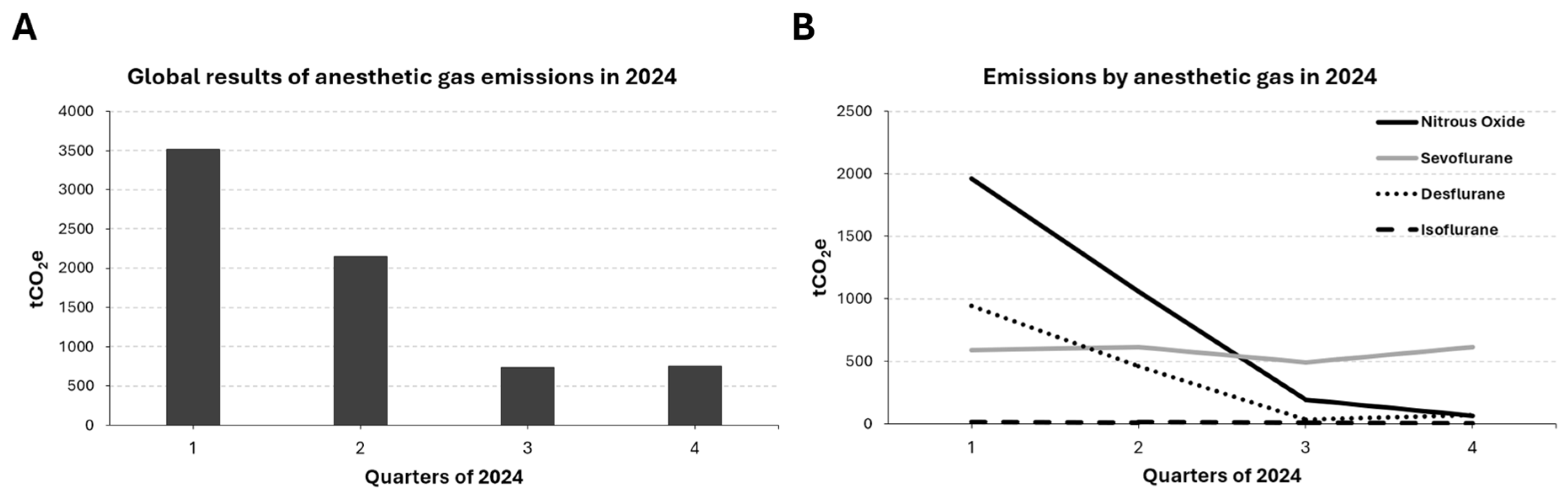
| Gas | Q12024 (tCO2e) | Q2 2024 (tCO2e) | Q3 2024 (tCO2e) | Q4 2024 (tCO2e) | Total 2024 (tCO2e) |
|---|---|---|---|---|---|
| Nitrous Oxide | 1963 | 1060 | 192 | 65 | 3279 |
| Sevoflurane | 587 | 613 | 489 | 614 | 2304 |
| Desflurane | 944 | 461 | 36 | 68 | 1509 |
| Isoflurane | 15 | 14 | 10 | 6 | 45 |
| Total | 3,509 | 2,148 | 727 | 753 | 7137 |
Disclaimer/Publisher’s Note: The statements, opinions and data contained in all publications are solely those of the individual author(s) and contributor(s) and not of MDPI and/or the editor(s). MDPI and/or the editor(s) disclaim responsibility for any injury to people or property resulting from any ideas, methods, instructions or products referred to in the content. |
© 2026 by the authors. Licensee MDPI, Basel, Switzerland. This article is an open access article distributed under the terms and conditions of the Creative Commons Attribution (CC BY) license.
Share and Cite
Acha-Ganderias, J.; Henríquez-de Armas, M.d.P.; Muñoz-Alameda, L.E.; Cristóbal, I.; Caramés, C.; Moral-Iglesias, L. Results and Future Perspectives of the Sustainable Anesthesia Project: A Large-Scale, Real-World Implementation Study at the Largest Spanish Private Healthcare Provider. Healthcare 2026, 14, 300. https://doi.org/10.3390/healthcare14030300
Acha-Ganderias J, Henríquez-de Armas MdP, Muñoz-Alameda LE, Cristóbal I, Caramés C, Moral-Iglesias L. Results and Future Perspectives of the Sustainable Anesthesia Project: A Large-Scale, Real-World Implementation Study at the Largest Spanish Private Healthcare Provider. Healthcare. 2026; 14(3):300. https://doi.org/10.3390/healthcare14030300
Chicago/Turabian StyleAcha-Ganderias, Juan, María del Pino Henríquez-de Armas, Luis Enrique Muñoz-Alameda, Ion Cristóbal, Cristina Caramés, and Leticia Moral-Iglesias. 2026. "Results and Future Perspectives of the Sustainable Anesthesia Project: A Large-Scale, Real-World Implementation Study at the Largest Spanish Private Healthcare Provider" Healthcare 14, no. 3: 300. https://doi.org/10.3390/healthcare14030300
APA StyleAcha-Ganderias, J., Henríquez-de Armas, M. d. P., Muñoz-Alameda, L. E., Cristóbal, I., Caramés, C., & Moral-Iglesias, L. (2026). Results and Future Perspectives of the Sustainable Anesthesia Project: A Large-Scale, Real-World Implementation Study at the Largest Spanish Private Healthcare Provider. Healthcare, 14(3), 300. https://doi.org/10.3390/healthcare14030300