Facilitators and Barriers of Using an Artificial Intelligence Agent in Chronic Disease Management: A Normalization Process Theory-Guided Qualitative Study of Older Patients with COPD


Abstract
1. Introduction
2. Materials and Methods
2.1. Design
2.2. Participants and Recruitment
2.3. Research Framework
2.4. Data Collection
2.5. Data Analysis
3. Results
3.1. Demographic Characteristics of Participants
3.2. Thematic Analysis
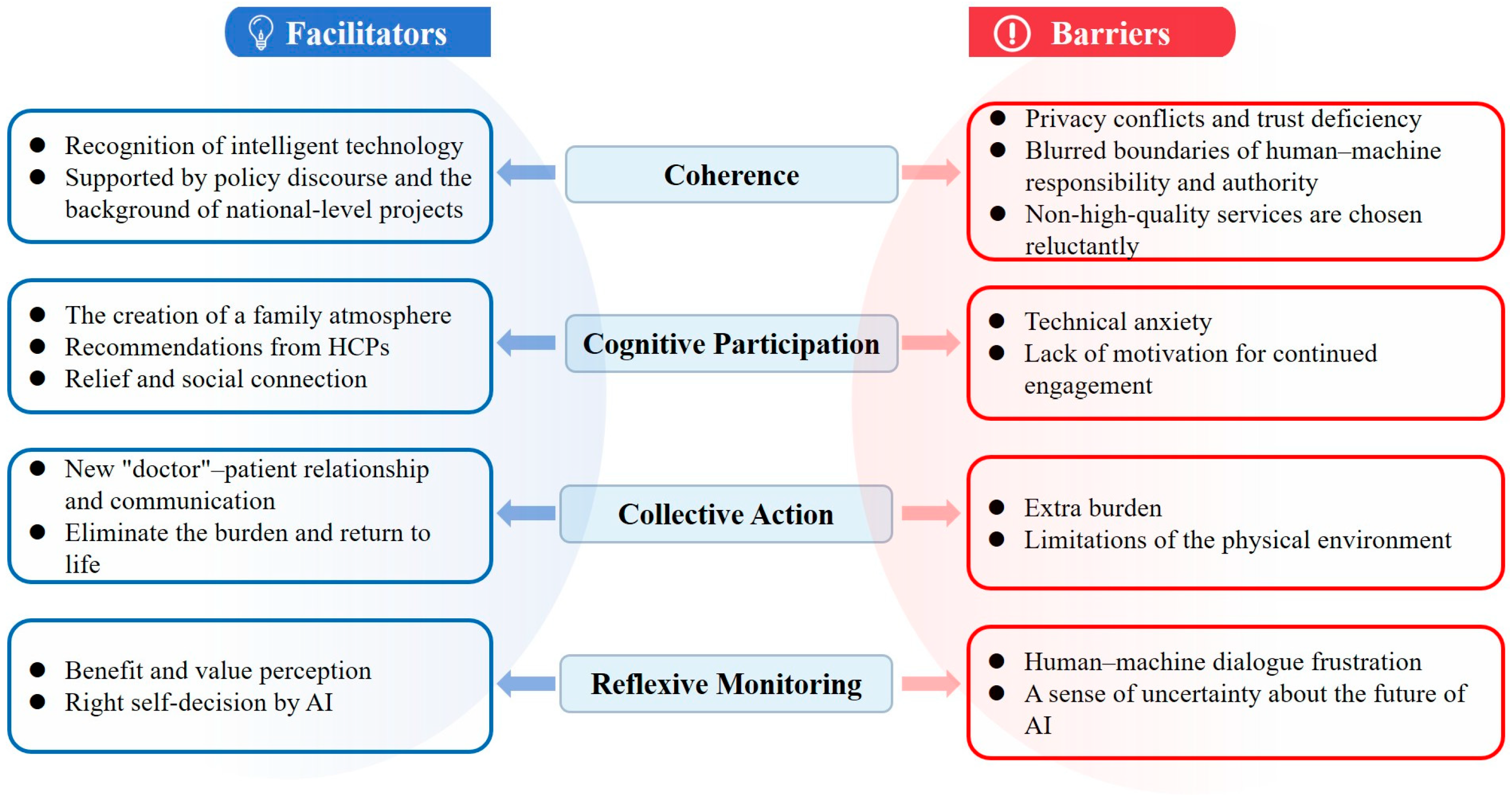
3.2.1. Facilitators
- Theme 1: Coherence
- Recognition of intelligent technology
I have known about AI for a long time. It said on TV that it can win the world championship in chess, which I think is really impressive.(P4)
AI is really convenient, just like my Tmall genie or Siri. I just speak, and it answers immediately.(P4)
Didn’t the TV say we already have smart hospitals? I think that’s pretty great.(P19)
- Supported by policy discourse and the background of national-level projects
I’ve seen many documents and news reports saying that we should promote AI technologies, and it seems the government is quite supportive. So I wanted to give it a try.(P20)
The project is funded by the state, so it’s very secure, and I don’t worry about security and privacy.(P15)
This is not a commercial software downloaded from the Internet, but a public welfare AI tool provided by professional scientific research institutions... I’d rather use a tool like this.(P16)
- Theme 2: Cognitive Participation
- The creation of a family atmosphere
Since I saw my grandchildren using AI, I wanted to try it too.(P10)
I didn’t want to use it, but my kids pushed me to try it and helped me download Deepseek on my phone.(P2)
My kids and my wife were talking about AI, so I immediately asked my kids to help me with it, so I could talk about it next time.(P9)
- Recommendations from HCPs
My attending doctor personally helped me register, and because of trusted him, I chose to trust that there would be no risk in using AI and that my privacy would not be compromised.(P23)
The nurse in charge of me said I could keep using this tool, so I figured it must be legitimate and reliable. Others recommended what I did not believe. I did not think so much about the risks of AI.(P6)
- Theme 3: Collective Action
- Relief and social connection
I used to think that I was the only one with this disease, but now I know that there are many people like me, and I don’t feel lonely.(P16)
... I’ve come to realize that I’m just a drop in the ocean.(P20)
AI is so powerful, just like a kaleidoscope, let me see what I did not know before, I feel that I am not out of the world.(P1)
- New “doctor”–patient relationship and communication
I used to be overcautious when seeing a doctor, and I didn’t dare to say much to the doctor. This specialized AI is not a real person. I can talk freely, express opinions, say what I think, and even lose my temper, and feel like I am the master of it.(P19)
I never thought that doctor-patient communication could be like this...(P11)
With the AI report, the doctor could quickly and fully understand me, and I could explain my symptoms and needs more clearly. I believe this leads to the best treatment plan.(P15)
- Eliminate and return to life
In the past, my daughter kept asking on the phone, “Dad, how are you?” The more she cared, the more pressure and indebted I felt. Now she can see my data directly on her phone—it reassures her, and it puts my mind at ease too.(P16)
In the past, my wife took care of me blindly, like a powerless outsider. Now AI often gives us practical rehabilitation advice, so that my wife is like a half-expert, easy to handle and targeted.(P1)
Every conversation at home was about my illness previously. Now, AI has helped me set clear goals, which naturally shifted our focus from the disease to how to accomplish goals. The topic of conversation at home has finally returned to daily necessities and family life.(P20)
- Theme 4: Reflexive Monitoring
- Benefit and value perception
After using this AI, I used to be able to stay at home, but now I can go out for a stroll and buy food. I feel that I have not insisted on exercise in vain, and I have hope for life.(P11)
It always answers my questions and cares about me like my friends and family... Every time I finish talking about my pain with it, my mood is much better, and I feel that the future is full of hope. I think the value of AI in the future is immeasurable.(P23)
- Right self-decision by AI
In the past, whenever I wheezed, I would worry and be afraid. Now, AI has helped me to make risk warnings and plans early, and I was able to cope with them with ease and prepare in advance. I couldn’t appreciate the feeling of having my health in my own hands, which was the most valuable change brought by this decision.(P11)
Surprisingly, my decision not only stabilized my condition but also alleviated my family’s anxiety.(P1)
A compliment, an extra few meters of walking... The growth that AI has brought to me is the most powerful proof of my decision.(P23)
3.2.2. Barriers
- Theme 1: Coherence
- Privacy conflicts and trust deficiency
The thought of my physical data being constantly recorded, uploaded, and analyzed makes me feel like a lab rat under 24-h surveillance, which makes me extremely uneasy and resistant. I’m also concerned that my data may be used for commercial purposes.(P5)
I think it’s probably just another gimmick for a hospital or a tech company. How could I entrust my health, or even my life, to an AI that I can neither see nor touch?(P14)
- Blurred boundaries of human–machine responsibility and authority
I can’t tell whether it is my assistant or my leader. I also don’t know whether I should listen to the doctor or the AI when their advice differs.(P24)
But it was like a black box, and I didn’t know what it could and couldn’t do.(P12)
I’m worried that if something goes wrong with it, who will be responsible?(P18)
- Non-high-quality services are chosen reluctantly
An experienced doctor who shakes my hand and looks me in the eye will make me feel warm, which is high-quality service.(P2)
It is said that handmade is luxury and high quality. I hope that the service provided by human beings, machine service is a kind of helpless choice.(P8)
- Theme 2: Cognitive Participation
- Technical anxiety
Faced with these new things, I was like a schoolboy, and I didn’t know where to start.(P12)
I’m afraid what if I make a mistake... I’ve been using it very cautiously.(P13)
Now I can follow the steps, but sometimes I still wonder: Am I using the right one? If one step is wrong, will the AI be wrong?(P18)
- Lack of motivation for continued engagement
At first, I checked in diligently every day, but after a month, the constant reminders felt meaningless, so I gradually got lazy and lost the motivation to use it.(P24)
I follow the AI’s instructions and keep exercising, but I don’t see any improvement in myself, and no one tells me I’m doing well, so I start to feel discouraged.(P5)
I have to do housework and accompany my children every day, and I really can’t stick to using AI.(P12)
- Theme 3: Collective Action
- Extra burden
Every time you open it, you have to verify, log in, etc., which is too complicated... I have to fill in all kinds of questionnaires and cumbersome data, which is annoying, and I think it is completely unnecessary.(P14)
Every time I clocked in, every task reminder, it was like reminding me that I was a patient and brought me a great burden.(P17)
- Limitations of the physical environment
My phone is quite old, and this app keeps lagging. It takes a long time just to open a single page.(P18)
Sometimes the network is not good, it does not respond for a long time, so I just turn it off.(P7)
Using this drains both battery and data, so I don’t dare keep it running all the time.(P27)
- Theme 4: Reflexive Monitoring
- Human–machine dialogue frustration
Sometimes it just doesn’t understand what I’m saying and gives advice that doesn’t fit my situation at all.(P27)
I feel like it keeps asking the same questions over and over, and after a while, I get too lazy to respond because it doesn’t feel meaningful.(P14)
It sometimes can’t remember what I said before, every time I have to answer again, I have to ask the same question, really tired.(P3)
- A sense of uncertainty about the future of AI
It looks good now, but will it become useless later? COPD is five years, ten years, if it stops, all my records will be gone, I will be wasted.(P2)
At first, I was really impressed, but I’m worried that if my condition becomes more complex, it will reach the limits of what it can do.(P25)
4. Discussion
4.1. The Role of NPT in Study
4.2. Key Factors Driving the Integration of AI into Patients’ Daily Lives
4.3. Barriers of Coherence Dimension Deserve Attention
4.4. Cross-Cultural Perspectives on Older Adults’ AI Experiences
4.5. Limitations and Future Prospects
5. Conclusions
Supplementary Materials
Author Contributions
Funding
Institutional Review Board Statement
Informed Consent Statement
Data Availability Statement
Acknowledgments
Conflicts of Interest
References
- Christenson, S.A.; Smith, B.M.; Bafadhel, M.; Putcha, N. Chronic obstructive pulmonary disease. Lancet 2022, 39910342, 2227–2242. [Google Scholar] [CrossRef] [Scilit] [PubMed]
- Boers, E.; Barrett, M.; Su, J.G.; Benjafield, A.V.; Sinha, S.; Kaye, L.; Zar, H.J.; Vuong, V.; Tellez, D.; Gondalia, R.; et al. Global Burden of Chronic Obstructive Pulmonary Disease Through 2050. JAMA Netw. Open 2023, 612, e2346598. [Google Scholar] [CrossRef] [Scilit]
- Dong, J.; Li, Z.; Luo, L.; Xie, H. Efficacy of pulmonary rehabilitation in improving the quality of life for patients with chronic obstructive pulmonary disease: Evidence based on nineteen randomized controlled trials. Int. J. Surg. 2020, 73, 78–86. [Google Scholar] [CrossRef] [Scilit]
- Méndez, A.; Labra, P.; Pizarro, R.; Baeza, N. Low rates of participation and completion of pulmonary rehabilitation in patients with chronic obstructive pulmonary disease in primary health care. Rev. Med. Chil. 2018, 14611, 1304–1308. [Google Scholar] [CrossRef] [Scilit] [PubMed]
- Hansen, H.; Bieler, T.; Beyer, N.; Kallemose, T.; Wilcke, J.T.; Østergaard, L.M.; Frost Andeassen, H.; Martinez, G.; Lavesen, M.; Frølich, A.; et al. Supervised pulmonary tele-rehabilitation versus pulmonary rehabilitation in severe COPD: A randomised multicentre trial. Thorax 2020, 755, 413–421. [Google Scholar] [CrossRef] [Scilit]
- Vogiatzis, I.; Rochester, C.L.; Spruit, M.A.; Troosters, T.; Clini, E.M. Increasing implementation and delivery of pulmonary rehabilitation: Key messages from the new ATS/ERS policy statement. Eur. Respir. J. 2016, 475, 1336–1341. [Google Scholar] [CrossRef] [Scilit]
- Gentili, A.; Failla, G.; Melnyk, A.; Puleo, V.; Tanna, G.L.D.; Ricciardi, W.; Cascini, F. The cost-effectiveness of digital health interventions: A systematic review of the literature. Front. Public Health 2022, 10, 787135. [Google Scholar] [CrossRef] [Scilit]
- Yousefi, F.; Naye, F.; Ouellet, S.; Yameogo, A.R.; Sasseville, M.; Bergeron, F.; Ozkan, M.; Cousineau, M.; Amil, S.; Rhéaume, C.; et al. Artificial Intelligence in Health Promotion and Disease Reduction: Rapid Review. J. Med. Internet Res. 2025, 27, e70381. [Google Scholar]
- Yang, Z.; Xu, Y.; Wang, J.; Li, W.; Zhang, X.; Pan, H. Application of artificial intelligence in medical risk prediction: Bibliometric analysis. Digit. Health 2025, 11, 20552076251380652. [Google Scholar]
- Khosravi, M.; Zare, Z.; Mojtabaeian, S.M.; Izadi, R. Artificial Intelligence and Decision-Making in Healthcare: A Thematic Analysis of a Systematic Review of Reviews. Health Serv. Res. Manag. Epidemiol. 2024, 11, 23333928241234863. [Google Scholar] [CrossRef] [Scilit] [PubMed]
- Sumner, J.; Lim, H.W.; Chong, L.S.; Bundele, A.; Mukhopadhyay, A.; Kayambu, G. Artificial intelligence in physical rehabilitation: A systematic review. Artif. Intell. Med. 2023, 146, 102693. [Google Scholar] [CrossRef] [Scilit]
- Kurniawan, M.H.; Handiyani, H.; Nuraini, T.; Hariyati, R.T.S.; Sutrisno, S. A systematic review of artificial intelligence-powered (AI-powered) chatbot intervention for managing chronic illness. Ann. Med. 2024, 561, 2302980. [Google Scholar] [CrossRef] [Scilit]
- Chen, Z.; Hao, J.; Sun, H.; Li, M.; Zhang, Y.; Qian, Q. Applications of digital health technologies and artificial intelligence algorithms in COPD: Systematic review. BMC Med. Inform. Decis. Mak. 2025, 251, 77. [Google Scholar] [CrossRef] [Scilit]
- Sait, A.R.W.; Shaikh, M.A. Artificial Intelligence-Powered Chronic Obstructive Pulmonary Disease Detection Techniques—A Review. Diagnostics 2025, 15, 2562. [Google Scholar] [CrossRef] [Scilit] [PubMed]
- Wang, M.; Li, L.; Feng, M.; Liu, Z. Advances in artificial intelligence applications for the management of chronic obstructive pulmonary disease. Front. Med. 2025, 12, 1685254. [Google Scholar] [CrossRef] [Scilit] [PubMed]
- Sivakumar, A.; Pan, R.Y.; Choi, D.; Wang, A.H.; Yu, C.H. “If We Got a Win-Win, You Can Sell It to Everybody”: A Qualitative Study Employing Normalization Process Theory to Identify Critical Factors for eHealth Implementation and Scale-up in Primary Care. Can. J. Diabetes 2022, 462, 181–188. [Google Scholar] [CrossRef] [Scilit] [PubMed]
- Murray, E.; Burns, J.; May, C.; Finch, T.; O’Donnell, C.; Wallace, P.; Mair, F. Why is it difficult to implement e-health initiatives? A qualitative study. Implement. Sci. 2011, 6, 6. [Google Scholar] [CrossRef] [Scilit]
- Ross, J.; Stevenson, F.; Lau, R.; Murray, E. Factors that influence the implementation of e-health: A systematic review of systematic reviews (an update). Implement. Sci. 2016, 111, 146. [Google Scholar] [CrossRef] [Scilit]
- Khairat, S.; Mehraby, H.; Masoumi, S.; Coffel, M.; Rockey-Bartlett, C.; Huang, A.; Wood, W.; Basch, E. Evaluation of Cancer Survivors’ Experience of Using AI-Based Conversational Tools: Qualitative Study. JMIR Cancer 2025, 11, e77390. [Google Scholar] [CrossRef] [Scilit]
- Baillie, L.; Stewart-Lord, A.; Thomas, N.; Frings, D. Patients’, clinicians’ and developers’ perspectives and experiences of artificial intelligence in cardiac healthcare: A qualitative study. Digit. Health 2025, 11, 20552076251328578. [Google Scholar] [CrossRef] [Scilit]
- Jiang, Y.; Gao, J.; Sun, P.; Nan, J.; Zou, X.; Sun, M.; Song, X. Factors Associated with the e-Health Literacy Among Older Adults with Chronic Obstructive Pulmonary Disease: A Cross-Sectional Study. Telemed. J. E Health 2024, 304, e1138–e1147. [Google Scholar] [CrossRef] [Scilit]
- Fernandez, M.E.; Ruiter, R.A.C.; Markham, C.M.; Kok, G. Intervention Mapping: Theory- and Evidence-Based Health Promotion Program Planning: Perspective and Examples. Front. Public Health 2019, 7, 209. [Google Scholar] [CrossRef] [Scilit] [PubMed]
- Murray, E.; Treweek, S.; Pope, C.; MacFarlane, A.; Ballini, L.; Dowrick, C.; Finch, T.; Kennedy, A.; Mair, F.; O’Donnell, C.; et al. Normalisation process theory: A framework for developing, evaluating and implementing complex interventions. BMC Med. 2010, 8, 63. [Google Scholar] [CrossRef] [Scilit] [PubMed]
- Tong, A.; Sainsbury, P.; Craig, J. Consolidated criteria for reporting qualitative research (COREQ): A 32-item checklist for interviews and focus groups. Int. J. Qual. Health Care 2007, 196, 349–357. [Google Scholar] [CrossRef] [Scilit] [PubMed]
- Agustí, A.; Celli, B.R.; Criner, G.J.; Halpin, D.; Anzueto, A.; Barnes, P.; Bourbeau, J.; Han, M.K.; Martinez, F.J.; Montes de Oca, M.; et al. Global Initiative for Chronic Obstructive Lung Disease 2023 Report: GOLD Executive Summary. Eur. Respir. J. 2023, 61, 2300239. [Google Scholar] [CrossRef] [Scilit]
- May, C. A rational model for assessing and evaluating complex interventions in health care. BMC Health Serv. Res. 2006, 6, 86. [Google Scholar] [CrossRef] [Scilit]
- May, C.R.; Mair, F.; Finch, T.; MacFarlane, A.; Dowrick, C.; Treweek, S.; Rapley, T.; Ballini, L.; Ong, B.N.; Rogers, A.; et al. Development of a theory of implementation and integration: Normalization Process Theory. Implement. Sci. 2009, 4, 29. [Google Scholar] [CrossRef] [Scilit]
- May, C.; Finch, T. Implementing, embedding, and integrating practices: An outline of normalization process theory. Sociology 2009, 433, 535–554. [Google Scholar] [CrossRef] [Scilit]
- Tazzyman, A.; Ferguson, J.; Hillier, C.; Boyd, A.; Tredinnick-Rowe, J.; Archer, J.; de Bere, S.R.; Walshe, K. The implementation of medical revalidation: An assessment using normalisation process theory. BMC Health Serv. Res. 2017, 171, 749. [Google Scholar] [CrossRef] [Scilit]
- McEvoy, R.; Ballini, L.; Maltoni, S.; O’Donnell, C.A.; Mair, F.S.; Macfarlane, A. A qualitative systematic review of studies using the normalization process theory to research implementation processes. Implement. Sci. 2014, 9, 2. [Google Scholar] [CrossRef] [Scilit]
- Huddlestone, L.; Turner, J.; Eborall, H.; Hudson, N.; Davies, M.; Martin, G. Application of normalisation process theory in understanding implementation processes in primary care settings in the UK: A systematic review. BMC Fam. Pract. 2020, 211, 52. [Google Scholar] [CrossRef] [Scilit] [PubMed]
- Kang, Y.; Choi, N.; Kim, S. Searching for New Model of Digital Informatics for Human-Computer Interaction: Testing the Institution-Based Technology Acceptance Model (ITAM). Int. J. Environ. Res. Public Health 2021, 18, 5593. [Google Scholar] [CrossRef] [Scilit]
- Dearing, J.W.; Cox, J.G. Diffusion of Innovations Theory, Principles, and Practice. Health Aff. 2018, 372, 183–190. [Google Scholar] [CrossRef] [Scilit]
- Larsson, I.; Siira, E.; Nygren, J.M.; Petersson, L.; Svedberg, P.; Nilsen, P.; Neher, M. Integrating AI-based triage in primary care: A qualitative study of Swedish healthcare professionals’ experiences applying normalization process theory. BMC Prim. Care 2025, 261, 340. [Google Scholar] [CrossRef] [Scilit]
- Xu, Z.; Lee, Y.C.; Stasiak, K.; Warren, J.; Lottridge, D. The Digital Therapeutic Alliance with Mental Health Chatbots: Diary Study and Thematic Analysis. JMIR Ment. Health 2025, 12, e76642. [Google Scholar] [CrossRef] [Scilit]
- Hindelang, M.; Sitaru, S.; Zink, A. Transforming Health Care Through Chatbots for Medical History-Taking and Future Directions: Comprehensive Systematic Review. JMIR Med. Inform. 2024, 12, e56628. [Google Scholar] [CrossRef] [Scilit]
- United Nations Department of Economic and Social Affairs. 2025 UNIDOP Event. 2025. Available online: https://social.desa.un.org/issues/ageing/events/2025-unidop (accessed on 15 November 2025).
- Cadario, R.; Longoni, C.; Morewedge, C.K. Understanding, explaining, and utilizing medical artificial intelligence. Nat. Hum. Behav. 2021, 512, 1636–1642. [Google Scholar] [CrossRef] [Scilit]
- Yaros, J.; de Mortier, C.; Oude Egbrink, M.; Evers, S.; Paulus, A. Cost identification in health professions education: A scoping review. Med. Educ. 2024, 588, 920–929. [Google Scholar] [CrossRef] [Scilit] [PubMed]
- El Arab, R.A.; Al Moosa, O.A. Systematic review of cost effectiveness and budget impact of artificial intelligence in healthcare. NPJ Digit. Med. 2025, 81, 548. [Google Scholar] [CrossRef] [Scilit]
- Gao, S.; He, L.; Chen, Y.; Li, D.; Lai, K. Public Perception of Artificial Intelligence in Medical Care: Content Analysis of Social Media. J. Med. Internet Res. 2020, 227, e16649. [Google Scholar] [CrossRef] [Scilit] [PubMed]
- Tran, V.T.; Riveros, C.; Ravaud, P. Patients’ views of wearable devices and AI in healthcare: Findings from the ComPaRe e-cohort. NPJ Digit. Med. 2019, 2, 53. [Google Scholar] [CrossRef] [Scilit]
- Nelson, C.A.; Pérez-Chada, L.M.; Creadore, A.; Li, S.J.; Lo, K.; Manjaly, P.; Pournamdari, A.B.; Tkachenko, E.; Barbieri, J.S.; Ko, J.M.; et al. Patient Perspectives on the Use of Artificial Intelligence for Skin Cancer Screening: A Qualitative Study. JAMA Dermatol. 2020, 1565, 501–512. [Google Scholar] [CrossRef] [Scilit]
- Cai, Z.; He, H.; Huo, W.; Xu, X. More unique, more accepting? Integrating sense of uniqueness, perceived knowledge, and perceived empathy with acceptance of medical artificial intelligence. Int. J. Hum.–Comput. Interact. 2024, 4024, 8433–8446. [Google Scholar] [CrossRef] [Scilit]
- Richardson, J.P.; Smith, C.; Curtis, S.; Watson, S.; Zhu, X.; Barry, B.; Sharp, R.R. Patient apprehensions about the use of artificial intelligence in healthcare. NPJ Digit. Med. 2021, 41, 140. [Google Scholar] [CrossRef] [Scilit] [PubMed]
- Young, A.T.; Amara, D.; Bhattacharya, A.; Wei, M.L. Patient and general public attitudes towards clinical artificial intelligence: A mixed methods systematic review. Lancet Digit. Health 2021, 39, e599–e611. [Google Scholar] [CrossRef] [Scilit]
- Wong, A.K.C.; Lee, J.H.T.; Zhao, Y.; Lu, Q.; Yang, S.; Hui, V.C.C. Exploring Older Adults’ Perspectives and Acceptance of AI-Driven Health Technologies: Qualitative Study. JMIR Aging 2025, 8, e66778. [Google Scholar] [CrossRef] [Scilit] [PubMed]
- Wolfe, B.H.; Oh, Y.J.; Choung, H.; Cui, X.; Weinzapfel, J.; Cooper, R.A.; Lee, H.N.; Lehto, R. Caregiving Artificial Intelligence Chatbot for Older Adults and Their Preferences, Well-Being, and Social Connectivity: Mixed-Method Study. J. Med. Internet Res. 2025, 27, e65776. [Google Scholar] [CrossRef] [Scilit] [PubMed]
- Jeong, Y.G.; Shin, S.J.; Lee, S.Y. How Older Adults with Chronic Conditions Perceive Artificial Intelligence (AI)-Based Virtual Humans: A Q Methodology Approach. Healthcare 2025, 13, 1525. [Google Scholar] [CrossRef] [Scilit]


| Theoretical Dimension | Question |
|---|---|
| Coherence | What is your understanding of AI? What do you think is the difference between the use of AI for chronic disease management and other rehabilitation methods? Which approach do you prefer? Why? |
| Cognitive participation |
|
| Collective action | How did you feel about your relationships with your health care providers, family, etc., when implementing this model? Can you give me an example? How do you feel about this change? |
| Reflexive monitoring |
|
| Characteristics | Mean (SD)/n (%) |
|---|---|
| Age | 74.04 (5.13) |
| Gender | |
| Male | 25 (89.29) |
| Female | 3 (10.71) |
| Education | |
| Primary school and below | 12 (42.86) |
| Junior high school | 15 (53.57) |
| College or above | 1 (3.57) |
| Marital status | |
| Never married or divorced or widowed | 5 (17.86) |
| Married | 23 (82.14) |
| Monthly income, RMB, ¥ | |
| <5000 | 20 (71.43) |
| ≥5000 | 8 (28.57) |
| Smoking status | |
| Still smoking | 4 (14.29) |
| Quit smoking | 17 (60.71) |
| Never smoked | 7 (25) |
| Disease duration, years | |
| <5 | 5 (17.86) |
| 5–10 | 16 (57.14) |
| >10 | 7 (25) |
| GOLD classification | |
| GOLD Ⅱ | 12 (45.86) |
| GOLD Ⅲ | 9 (32.14) |
| GOLD Ⅳ | 7 (25) |
| Number of hospitalizations in the past year | |
| None | 12 (42.86) |
| One time | 12 (42.86) |
| Two times or more | 4 (14.28) |
| Theme | Subthemes | Representative Quotation |
|---|---|---|
| Coherence | Recognition of intelligent technology | Didn’t the TV say we already have smart hospitals? I think that’s pretty great. (P19) |
| Supported by policy discourse and the background of national-level projects | Nowadays, the country is vigorously developing and promoting AI, and I feel particularly confident. (P20) | |
| Cognitive Participation | The creation of a family atmosphere | My kids pushed me to try it and helped me download Deepseek on my phone. (P2) |
| Recommendations from HCPs | The nurse in charge of me said I could keep using this tool, so I figured it must be legitimate and reliable. (P6) | |
| Collective Action | Relief and social connection | ... I’ve come to realize that I’m just a drop in the ocean. (P20) |
| New “doctor”–patient relationship and communication | I never thought that doctor-patient communication could be like this... (P11) | |
| Eliminate the burden and return to life | It reassures her, and it puts my mind at ease, too. (P16) | |
| Reflexive Monitoring | Benefit and value perception | Now I can go out and buy food, and I have something to look forward to. (P11) |
| Right self-decision by AI | The growth that AI has brought to me is the most powerful proof of my decision. (P23) |
| Theme | Subthemes | Representative Quotation |
|---|---|---|
| Coherence | Privacy conflicts and trust deficiency | I think it’s probably just another gimmick for a hospital or a tech company. (P14) |
| Blurred boundaries of human–machine responsibility and authority | I can’t tell whether it is my assistant or my leader. (P24) | |
| Non-high-quality services are chosen reluctantly | Machine service is a helpless choice. (P8) | |
| Cognitive Participation | Technical anxiety | I’m afraid what if I make a mistake. (P13) |
| Lack of motivation for continued engagement | I have to do housework and accompany my children every day, and I really can’t stick to using AI. (P12) | |
| Collective Action | Extra burden | Every time you open it, you have to verify, log in, etc., which is too complicated. (P14) |
| Limitations of the physical environment | Sometimes the network is not good, and it will not respond for a long time (P7) | |
| Reflexive Monitoring | Human–machine dialogue frustration | Sometimes it doesn’t understand what I’m saying. (P27) |
| A sense of uncertainty about the future of AI | It looks good now, but will it become useless later? (P2) |
Disclaimer/Publisher’s Note: The statements, opinions and data contained in all publications are solely those of the individual author(s) and contributor(s) and not of MDPI and/or the editor(s). MDPI and/or the editor(s) disclaim responsibility for any injury to people or property resulting from any ideas, methods, instructions or products referred to in the content. |
© 2026 by the authors. Licensee MDPI, Basel, Switzerland. This article is an open access article distributed under the terms and conditions of the Creative Commons Attribution (CC BY) license.
Share and Cite
Cui, S.; Wang, S.; Deng, J.; Jia, R.; Jiang, Y. Facilitators and Barriers of Using an Artificial Intelligence Agent in Chronic Disease Management: A Normalization Process Theory-Guided Qualitative Study of Older Patients with COPD. Healthcare 2026, 14, 268. https://doi.org/10.3390/healthcare14020268
Cui S, Wang S, Deng J, Jia R, Jiang Y. Facilitators and Barriers of Using an Artificial Intelligence Agent in Chronic Disease Management: A Normalization Process Theory-Guided Qualitative Study of Older Patients with COPD. Healthcare. 2026; 14(2):268. https://doi.org/10.3390/healthcare14020268
Chicago/Turabian StyleCui, Shiya, Shilei Wang, Jingyi Deng, Ruiyang Jia, and Yuyu Jiang. 2026. "Facilitators and Barriers of Using an Artificial Intelligence Agent in Chronic Disease Management: A Normalization Process Theory-Guided Qualitative Study of Older Patients with COPD" Healthcare 14, no. 2: 268. https://doi.org/10.3390/healthcare14020268
APA StyleCui, S., Wang, S., Deng, J., Jia, R., & Jiang, Y. (2026). Facilitators and Barriers of Using an Artificial Intelligence Agent in Chronic Disease Management: A Normalization Process Theory-Guided Qualitative Study of Older Patients with COPD. Healthcare, 14(2), 268. https://doi.org/10.3390/healthcare14020268