Article

Changes in Frailty Status and Functional Capacity Following a Community-Based Nursing-Led Intervention in Older Women: An Exploratory Uncontrolled Pre–Post Study


by
Candela Ortiz-García
1,
Belinda Basilio-Fernández
2,*,
Sonia Hidalgo-Ruíz
2,
María del Pilar Alfageme-García
2,
María Victoria Cáceres-Madrid
3 and
Manuel Martí Antonio
4
1
Emergency Department, Clínica Zorrotzaurre, 48014 Bilbao, Spain
2
GICISA Research Group, Faculty of Nursing and Occupational Therapy, University of Extremadura, 10600 Plasencia, Spain
3
Faculty of Podiatry, University of Extremadura, 10600 Plasencia, Spain
4
Department of Mathematics, University of Extremadura, 10600 Plasencia, Spain
*
Author to whom correspondence should be addressed.
Healthcare 2026, 14(18), 3060; https://doi.org/10.3390/healthcare14183060

Submission received: 18 August 2026 / Revised: 10 September 2026 / Accepted: 12 September 2026 / Published: 17 September 2026

Abstract

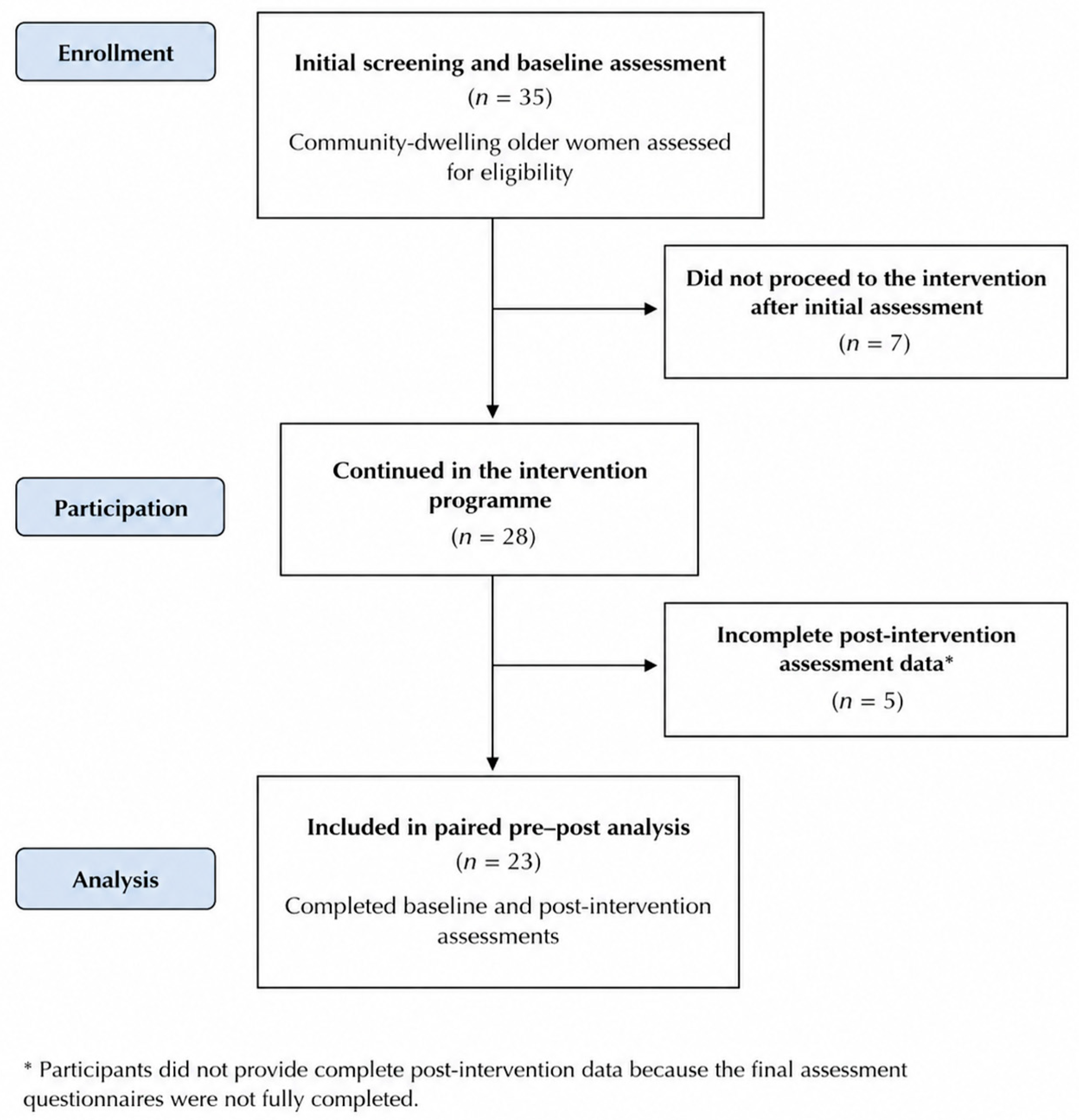
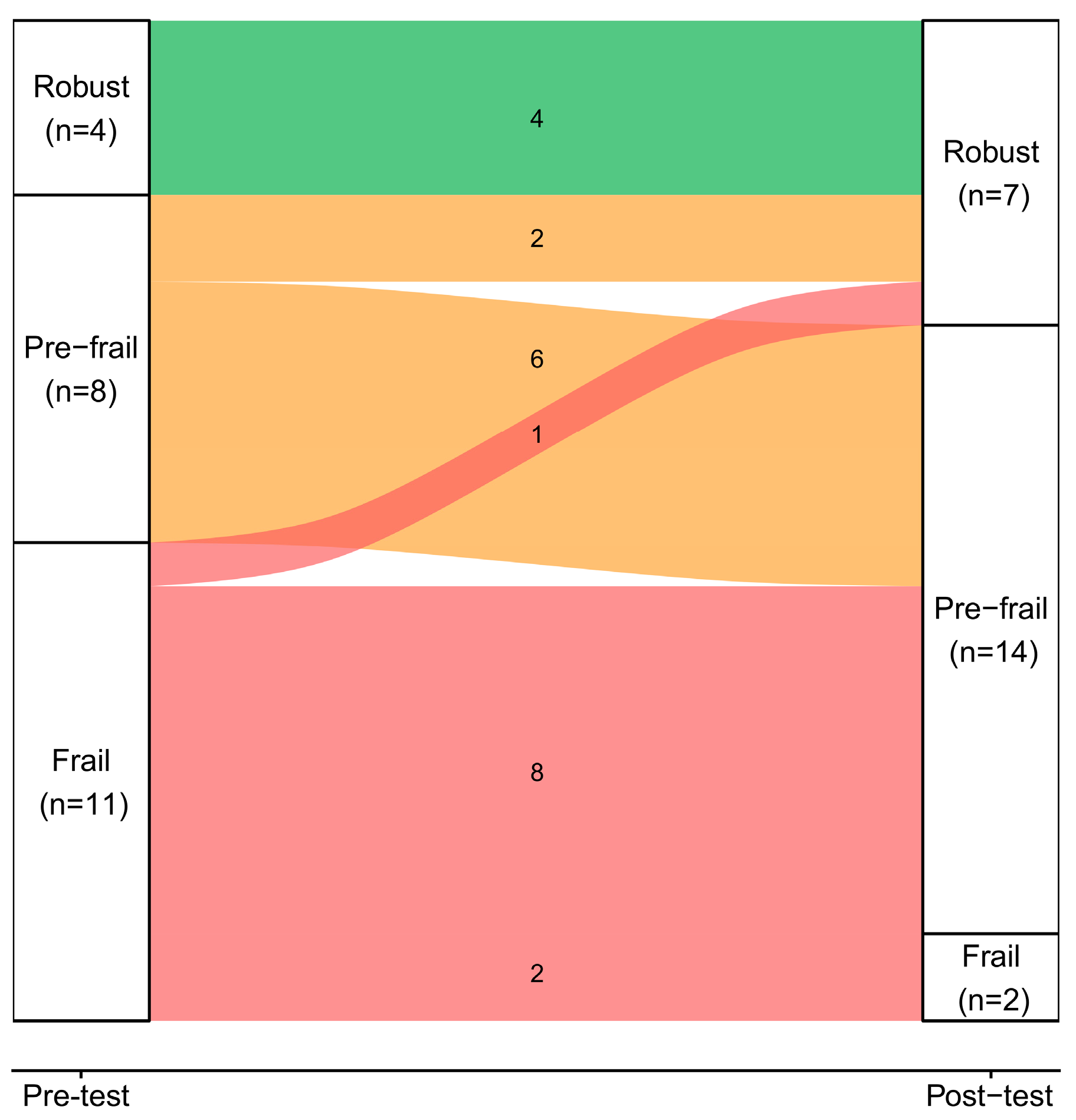
Background/Objectives: Frailty is a common geriatric syndrome associated with functional decline, dependency, and adverse health outcomes in older adults. Community-based nursing interventions may help prevent or delay frailty by promoting physical activity, health education, and self-care. This exploratory study aimed to describe pre–post changes in frailty status and functional capacity following a community-based nursing intervention among community-dwelling older women. Methods: An exploratory uncontrolled pre–post study was conducted in Spain. Of 35 community-dwelling, non-institutionalized women aged ≥65 years who underwent baseline assessment, 23 provided complete baseline and post-intervention data and were included in the final pre–post analysis. The intervention consisted of a 16-week nursing programme with weekly group sessions focused on adapted physical exercise, health education, and self-care. Frailty was assessed using the FRAIL Scale. Four available components of the Fried phenotype were examined as secondary frailty-related measures. Functional capacity was evaluated using the Barthel Index and the Lawton and Brody Scale. Results: Among the 23 participants included in the final paired pre–post analysis, the proportion classified as frail according to the FRAIL Scale decreased from 47.8% at baseline to 8.7% at post-intervention assessment, while the proportion classified as robust increased from 17.4% to 30.4%. Nine of the eleven participants classified as frail at baseline moved to a less severe frailty category at follow-up. Frailty status changed significantly across the three FRAIL categories (p < 0.001). Additional analyses showed a decrease in difficulty walking 100 m (43.5% to 8.7%; p = 0.008) and in low physical activity (60.9% to 26.1%; p = 0.021). Functional capacity did not change significantly. Participants reported high levels of satisfaction with the programme. Conclusions: Favourable pre–post changes in FRAIL status and selected frailty-related measures were observed among participants who completed the study, while functional capacity remained stable. Given the exploratory uncontrolled design, small analytical sample, and participant attrition, these findings should not be interpreted as evidence of intervention effectiveness. Larger controlled studies are required to determine whether the observed changes can be attributed to the intervention.
Keywords: community-dwelling older adults; frailty; functional capacity; healthy ageing; nursing intervention; primary care community-dwelling older adults; frailty; functional capacity; healthy ageing; nursing intervention; primary care