Investigation of Quiet Quitting and Professional Quality of Life Among Nursing Staff at a General Hospital: A Single-Site Cross-Sectional Study

 , , ,
, , ,  , and
, and 
Abstract
1. Introduction
2. Materials and Methods
2.1. Study Design
2.2. Study Population-Survey Instrument
2.3. Ethics
2.4. Statistical Analysis
3. Results
3.1. Demographic and Work-Related Characteristics of Nurses
3.2. Scores of the Quiet Quitting and Professional Quality of Life Scale Scores
4. Discussion
5. Limitations
6. Conclusions
Author Contributions
Funding
Institutional Review Board Statement
Informed Consent Statement
Data Availability Statement
Acknowledgments
Conflicts of Interest
References
- Serenko, A. The great resignation: The great knowledge exodus or the onset of the great knowledge revolution? J. Knowl. Manag. 2023, 27, 1042–1055. [Google Scholar] [CrossRef] [Scilit]
- Formica, S.; Sfodera, F. The great resignation and quiet quitting paradigm shifts: An overview of the current situation and future research directions. J. Hosp. Market. Manag. 2022, 31, 899–907. [Google Scholar] [CrossRef] [Scilit]
- Galanis, P.; Katsiroumpa, A.; Vraka, I.; Siskou, O.; Konstantakopoulou, O.; Katsoulas, T.; Moisoglou, I.; Gallos, P.; Kaitelidou, D. Nurses quietly quit their job more often than other healthcare workers: An alarming issue for healthcare services. Int. Nurs. Rev. 2024, 71, 850–859. [Google Scholar] [CrossRef] [Scilit]
- Geng, R.; Geng, X.; Geng, S. Identifying key antecedents of quiet quitting among nurses: A cross-profession meta-analytic review. J. Adv. Nurs. 2026, 82, 913–933. [Google Scholar] [CrossRef] [Scilit]
- Galanis, P.; Katsiroumpa, A.; Vraka, I.; Siskou, O.; Konstantakopoulou, O.; Katsoulas, T.; Moisoglou, I.; Gallos, P.; Kaitelidou, D. The influence of job burnout on quiet quitting among nurses: The mediating effect of job satisfaction. Int. J. Nurs. Pract. 2025, 31, e70057. [Google Scholar] [CrossRef] [Scilit]
- Gallup. State of the Global Workplace. Available online: https://www.gallup.com/workplace/349484/state-of-the-global-workplace.aspx (accessed on 25 August 2026).
- Boy, Y.; Sürmeli, M. Quiet quitting: A significant risk for global healthcare. J. Glob. Health 2023, 13, 03014. [Google Scholar] [CrossRef] [Scilit]
- Yasin, Y.M.; Al-Hamad, A.; Yasin, L.; Kehyayan, V. Staying but Struggling: A Concept Analysis of Quiet Quitting in Nursing Practice. J. Adv. Nurs. 2025, 1–11. [Google Scholar] [CrossRef] [Scilit]
- Carrière, G.; Park, J.; Deng, Z.; Kohen, D. StatCan COVID-19: Overtime Work Among Professional Nurses During the COVID-19 Pandemic; Catalog No. 45280001; Statistics Canada: Ottawa, ON, Canada, 2020. [Google Scholar]
- Sagherian, K.; McNeely, C.; Cho, H.; Steege, L.M. Nurses’ rest breaks and fatigue: The roles of psychological detachment and workload. West. J. Nurs. Res. 2023, 45, 885–893. [Google Scholar] [CrossRef] [Scilit]
- Harter, J. Is Quiet Quitting Real? Gallup. Available online: https://www.gallup.com/workplace/398306/quiet-quitting-real.aspx (accessed on 17 August 2026).
- Bakker, A.B.; Demerouti, E. Job demands–resources theory. In Wellbeing: A Complete Reference Guide; John Wiley & Sons, Inc.: Hoboken, NJ, USA, 2014; pp. 1–28. [Google Scholar]
- Hidayathulla, N.; Nirmala, M.; Srividhya, C. Impact of Work Stress on Quiet Quitting among Nurses: The Mediating Effect of Job Satisfaction. In Proceedings of the 3rd International Conference on Artificial Intelligence in Economics, Finance and Management (ICAIEFM); Springer Nature: Berlin/Heidelberg, Germany, 2025; p. 403. [Google Scholar]
- Gün, İ.; Balsak, H.; Ayhan, F. Mediating effect of job burnout on the relationship between organisational support and quiet quitting in nurses. J. Adv. Nurs. 2025, 81, 4644–4652. [Google Scholar] [CrossRef] [Scilit]
- Dilig-Ruiz, A.; MacDonald, I.; Varin, M.D.; Vandyk, A.; Graham, I.D.; Squires, J.E. Job satisfaction among critical care nurses: A systematic review. Int. J. Nurs. Stud. 2018, 88, 123–134. [Google Scholar] [CrossRef] [Scilit]
- Gün, İ.; Çetinkaya, F.K.; Söyük, S. Mediating Effect of Turnover Intention on the Relationship Between Job Burnout and Quiet Quitting in Nurses. J. Adv. Nurs. 2025, 81, 6569–6577. [Google Scholar] [CrossRef] [Scilit]
- Danacı, E.; Arıca, E.Ö.; Erdoğan, T.K. The Relationship Between Stress of Conscience and Quiet Quitting in Nurses: The Mediating Role of Compassion Fatigue. Healthcare 2026, 14, 316. [Google Scholar] [CrossRef] [Scilit]
- Cesaro, E.; Daicampi, C. Quiet Quitting in the Healthcare Workforce: A Systematic Review of Organisational Drivers and Managerial Implications. J. Nurs. Manag. 2026, 1, e7319117. [Google Scholar] [CrossRef] [Scilit]
- Timmins, F.; Parissopoulos, S.; Plakas, S.; Fouka, G. Economic recession in Greece and effects on quality nursing care. J. Nurs. Manag. 2017, 25, 163–166. [Google Scholar] [CrossRef] [Scilit]
- Li, M.; Wang, Y.; Du, M.; Wang, H.; Liu, Y.; Richardson, B.N.; Bai, J. Working Hours Associated with the Quality of Nursing Care, Missed Nursing Care, and Nursing Practice Environment in China: A Multicenter Cross-Sectional Study. J. Nurs. Manag. 2023, 1, 8863759. [Google Scholar] [CrossRef] [Scilit]
- Galanis, P.; Moisoglou, I.; Katsiroumpa, A.; Vraka, I.; Siskou, O.; Konstantakopoulou, O.; Kaitelidou, D. Moral resilience reduces levels of quiet quitting, job burnout, and turnover intention among nurses: Evidence in the post COVID-19 era. Nurs. Rep. 2024, 14, 254–266. [Google Scholar] [CrossRef] [Scilit]
- Hayes, L.J.; O’Brien-Pallas, L.; Duffield, C.; Shamian, J.; Buchan, J.; Hughes, F.; Laschinger, H.K.S.; North, N.; Stone, P.W. Nurse turnover: A literature review. Int. J. Nurs. Stud. 2006, 43, 237–263. [Google Scholar] [CrossRef] [Scilit]
- Stankovic, M.; Slavkovic, M. Quality of work life determinants of healthcare professionals’ quiet quitting: Towards individual difference. Healthcare 2025, 13, 1547. [Google Scholar] [CrossRef] [Scilit]
- Ayalew, A.F.; Ma, W.; Tamir, W.; Mitiku, K. Quality of work life and associated factors among health professionals working at private and government health institutions in Awi zone, Amhara regional state, Ethiopia, 2022: A comparative cross-sectional study. Front. Public Health 2024, 12, 1377145. [Google Scholar] [CrossRef] [Scilit]
- Galanis, P.; Katsiroumpa, A.; Vraka, I.; Siskou, O.; Konstantakopoulou, O.; Moisoglou, I.; Gallos, P.; Kaitelidou, D. The quiet quitting scale: Development and initial validation. AIMS Public Health 2023, 10, 828. [Google Scholar] [CrossRef] [Scilit]
- Stamm, B.H. Professional Quality of Life: Compassion Satisfaction and Fatigue Version 5; ProQOL: Pocatello, ID, USA, 2009. [Google Scholar]
- Misouridou, E.; Pavlou, V.; Kasidi, K.; Apostolara, P.; Parissopoulos, S.; Mangoulia, P.; Fradelos, E. Translation and cultural adaptation of the professional quality of life scale (ProQOL V) for Greece. Mater. Sociomed. 2020, 32, 187. [Google Scholar] [CrossRef] [Scilit]
- World Medical Association. World Medical Association Declaration of Helsinki: Ethical principles for medical research involving human subjects. JAMA 2013, 310, 2191–2194. [Google Scholar]
- Toska, A.; Dimitriadou, I.; Togas, C.; Nikolopoulou, E.; Fradelos, E.C.; Papathanasiou, I.V.; Sarafis, P.; Malliarou, M.; Saridi, M. Quiet quitting in the hospital context: Investigating conflicts, organizational support, and professional engagement in Greece. Nurs. Rep. 2025, 15, 38. [Google Scholar] [CrossRef] [Scilit]
- Ghahramani, S.; Nemati, A.; Hazrati, M.; Gholami, M.; Eskandari, A.; Gholami, H.; Bagheri Lankarani, K. Quiet quitting of job in nurses working in hospitals, a multicenter study in Iran. Brain Behav. 2026, 16, e71439. [Google Scholar] [CrossRef] [Scilit]
- Ventura-Silva, J.M.A.; Ribeiro, M.P.; Barros, S.C.D.C.; Castro, S.F.M.D.; Sanches, D.M.M.; Trindade, L.D.L.; Teles, P.J.F.C.; Zuge, S.S.; Ribeiro, O.M.P.L. Quiet Quitting Scale: Adaptation and Validation for the Portuguese Nursing Context. Nurs. Rep. 2025, 15, 411. [Google Scholar] [CrossRef] [Scilit]
- Karakachian, A.; Colbert, A. Nurses’ moral distress, burnout, and intentions to leave: An integrative review. J. Forensic Nurs. 2019, 15, 133–142. [Google Scholar] [CrossRef] [Scilit]
- Moisoglou, I.; Katsiroumpa, A.; Katsapi, A.; Konstantakopoulou, O.; Galanis, P. Poor Nurses’ Work Environment Increases Quiet Quitting and Reduces Work Engagement: A Cross-Sectional Study in Greece. Nurs. Rep. 2025, 15, 19. [Google Scholar] [CrossRef] [Scilit]
- Demerouti, E.; Bakker, A.B.; Nachreiner, F.; Schaufeli, W.B. The job demands-resources model of burnout. J. Appl. Psychol. 2001, 86, 499. [Google Scholar] [CrossRef] [Scilit]
- Jeon, J. A study on the characteristics and improvement plan of ‘quiet quitting’ centered on the MZ generation. HSS21 2022, 13, 5117–5132. [Google Scholar] [CrossRef] [Scilit]
- Martela, F.; Pessi, A.B. Significant work is about self-realization and broader purpose: Defining the key dimensions of meaningful work. Front. Psychol. 2018, 9, 363. [Google Scholar] [CrossRef] [Scilit]
- Bride, B.E.; Radey, M.; Figley, C.R. Measuring compassion fatigue. Clin. Soc. Work. J. 2007, 35, 155–163. [Google Scholar] [CrossRef] [Scilit]
- Søndenaa, E.; Whittington, R.; Lauvrud, C.; Nonstad, K. Job stress, burnout and job satisfaction in staff working with people with intellectual disabilities: Community and criminal justice care. J. Intellect. Disabil. Offending Behav. 2015, 6, 44–52. [Google Scholar] [CrossRef] [Scilit]
- Ng, E.; Stanton, P. The great resignation: Managing people in a post COVID-19 pandemic world. Persl. Rev. 2023, 52, 401–407. [Google Scholar] [CrossRef] [Scilit]
- Ventura-Silva, J.M.A.; Ribeiro, O.M.P.L.; Forte, E.C.N.; Trindade, L.D.L.; Castro, S.F.M.; Ribeiro, M.P.; Sanches, D.M.; Barros, S.C.C.; Almeida, I.A.L.; Lage, D.R.; et al. Quiet Quitting and Professional Burnout: Contemporary Challenges for Nursing Leadership. Nurs. Rep. 2026, 16, 140. [Google Scholar] [CrossRef] [Scilit]
- Park, H.; Kim, H.; Kim, H. A scoping review of secondary traumatic stress in nurses working in the emergency department or trauma care settings. J. Adv. Nurs. 2025, 81, 5304–5314. [Google Scholar] [CrossRef] [Scilit]



| n | % | ||
|---|---|---|---|
| Gender | Males/Females | 18/101 | 15.1/84.9 |
| Age, years | Mean age ± SD | 47.5 ± 9.4 | |
| 50+ | 59 | 49.6 | |
| Marital Status | Single, Divorced, Widowed | 30 | 25.2 |
| Married or cohabiting | 89 | 74.8 | |
| Children | No/Yes | 28/91 | 23.5/76.5 |
| Education | Lyceum/IEK/Nursing School graduates | 28 | 23.5 |
| Technical University | 55 | 46.2 | |
| University | 5 | 4.2 | |
| MSc | 31 | 26.1 | |
| Work experience, years | Mean ± SD | 20.7 ± 10.5 | |
| Position of responsibility | No/Yes | 105/14 | 88.2/11.8 |
| Scales & Subscales | Mean | SD | Median | Skewness | Cronbach’s α |
|---|---|---|---|---|---|
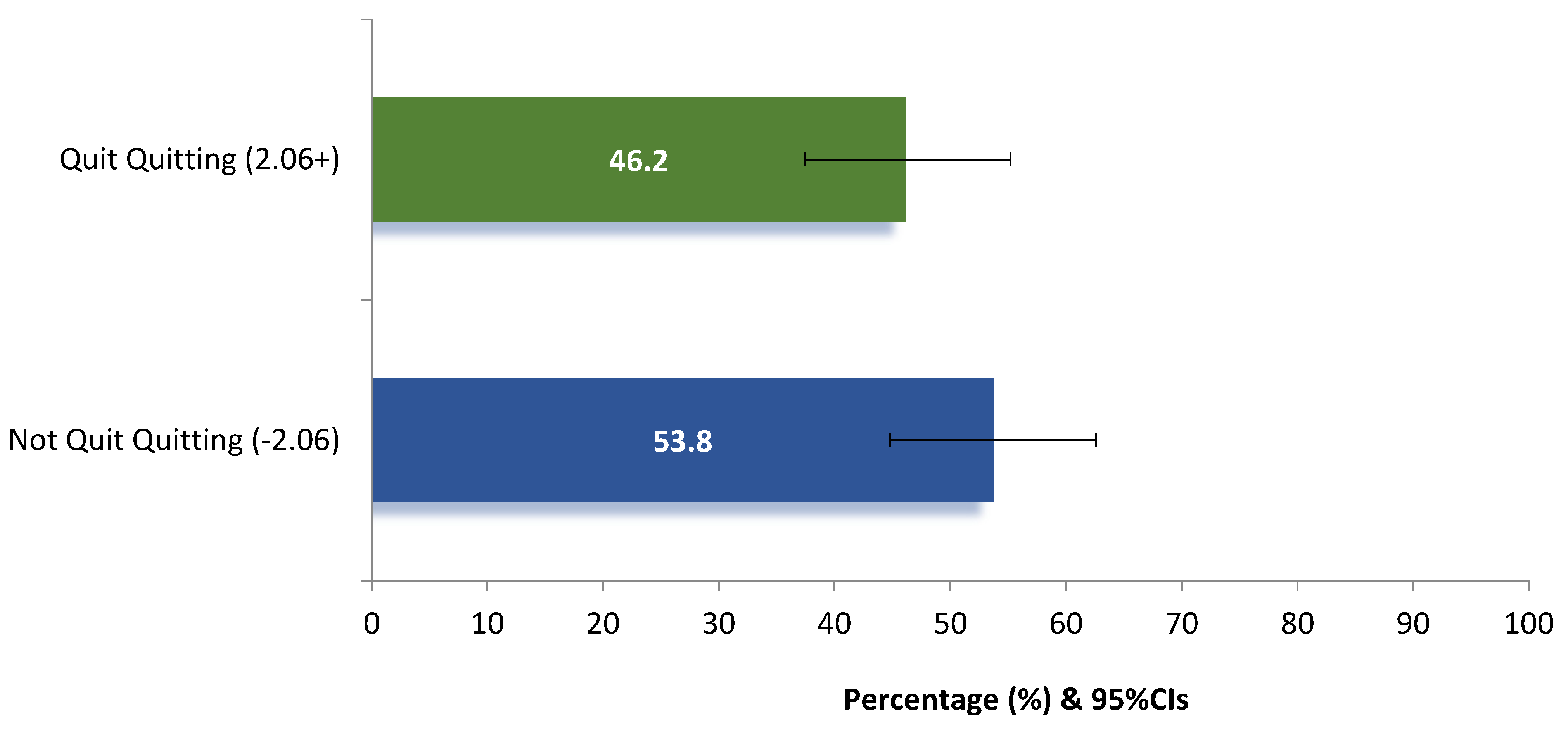
| Total Quiet Quitting (increased score ⇨ higher level of quiet quitting) | 2.06 | 0.59 | 2.00 | 0.77 | 0.803 |
| Detachment-Indifference | 1.75 | 0.62 | 1.75 | 0.93 | |
| Lack of Initiative | 2.11 | 0.67 | 2.00 | 0.56 | |
| Lack of Motivation | 2.58 | 0.97 | 2.50 | 0.48 | |
| Professional Quality of Life (increased score ⇨ a sign of compassion satisfaction but greater burnout & stress) | 0.753 | ||||
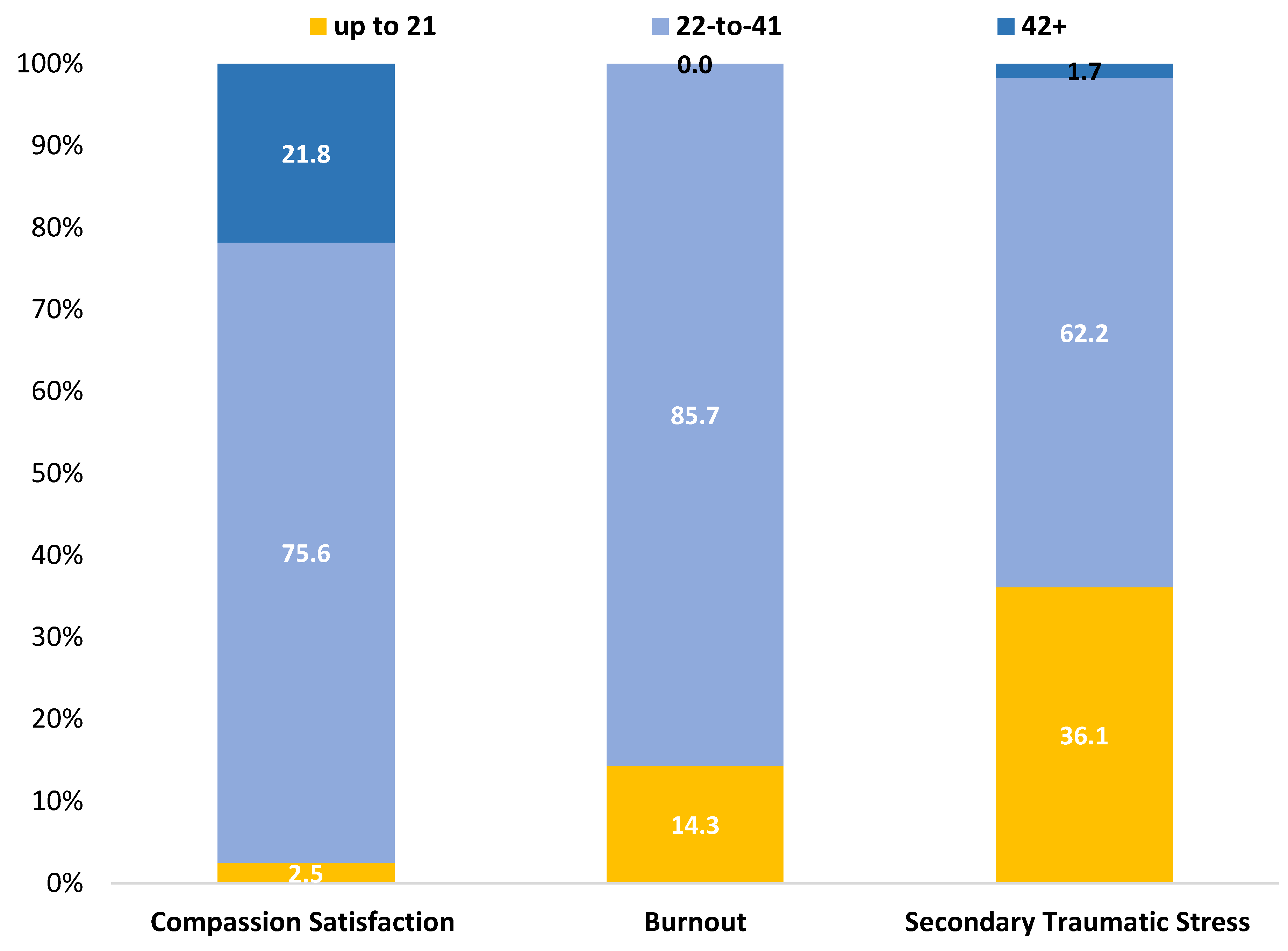
| Compassion Satisfaction | 36.52 | 6.29 | 37.00 | −0.66 | |
| Burnout | 27.60 | 5.56 | 27.00 | 0.04 | |
| Secondary Traumatic Stress | 24.39 | 6.73 | 24.00 | 0.55 |
| Professional Quality of Life (Increased Score is a Sign of Compassion, but Greater Burnout and Stress) | |||
|---|---|---|---|
| Compassion Satisfaction | Burnout | Secondary Traumatic Stress | |
| r-Pearson (95%CIs) | |||
| Total Quiet Quitting (increased score shows higher level of Quiet Quitting) | −0.594 * (−0.699, −0.464) | 0.476 * (0.324, 0.604) | 0.223 * (0.044, 0.387) |
| Detachment-Indifference | −0.399 * (−0.541, −0.236) | 0.308 * (0.135, 0.462) | 0.190 * (0.011, 0.358) |
| Lack of Initiative | −0.465 * (−0.595, −0.311) | 0.322 * (0.151, 0.474) | 0.215 * (0.037, 0.381) |
| Lack of Motivation | −0.622 * (−0.722, −0.498) | 0.566 * (0.430, 0.677) | 0.139 (−0.042, 0.312) |
| Professional Quality of Life (Increased Score is a Sign of Compassion Satisfaction, but Greater Burnout and Stress) | ||||||
|---|---|---|---|---|---|---|
| Compassion Satisfaction | Burnout | Secondary Traumatic Stress | ||||
| Predictive Factors | β (Stand. Error) | p-Value | β (Stand. Error) | p-Value | β (Stand. Error) | p-Value |
| Gender (1: male, 2: female) | 1.89 (1.33) | 0.159 | 0.60 (1.30) | 0.648 | 4.92 (1.65) | 0.004 |
| Children (1: no, 2: yes) | 1.46 (1.21) | 0.229 | −1.29 (1.18) | 0.279 | −0.12 (1.50) | 0.936 |
| Education (1: Lyceum/IEK/Nursing School Graduates, 2: Technical University, 3: University, 4: MSc) | −0.44 (0.46) | 0.340 | 0.41 (0.45) | 0.364 | −0.35 (0.57) | 0.533 |
| Work Experience (years) | −0.26 (0.24) | 0.276 | 0.28 (0.24) | 0.240 | 0.41 (0.30) | 0.171 |
| Position of responsibility (1: no, 2: yes) | 0.43 (1.68) | 0.800 | −0.73 (1.65) | 0.657 | 4.13 (2.09) | 0.050 |
| Total Quiet Quitting (higher score => higher level of quiet quitting) | −6.23 (0.82) | <0.001 | 4.54 (0.81) | <0.001 | 3.40 (1.02) | 0.001 |
| R2 (adjusted) | 0.387 (0.354) | 0.246 (0.205) | 0.175 (0.131) | |||
| F (d.f.) | 11.80 (6, 112) | 6.07 (6, 112) | 3.97 (6, 112) | |||
Disclaimer/Publisher’s Note: The statements, opinions and data contained in all publications are solely those of the individual author(s) and contributor(s) and not of MDPI and/or the editor(s). MDPI and/or the editor(s) disclaim responsibility for any injury to people or property resulting from any ideas, methods, instructions or products referred to in the content. |
© 2026 by the authors. Licensee MDPI, Basel, Switzerland. This article is an open access article distributed under the terms and conditions of the Creative Commons Attribution (CC BY) license.
Share and Cite
Rovithis, M.; Rikos, N.; Zachou, K.; Kritsotakis, G.; Linardakis, M.; Borboudaki, L.; Stavropoulou, A. Investigation of Quiet Quitting and Professional Quality of Life Among Nursing Staff at a General Hospital: A Single-Site Cross-Sectional Study. Healthcare 2026, 14, 3004. https://doi.org/10.3390/healthcare14183004
Rovithis M, Rikos N, Zachou K, Kritsotakis G, Linardakis M, Borboudaki L, Stavropoulou A. Investigation of Quiet Quitting and Professional Quality of Life Among Nursing Staff at a General Hospital: A Single-Site Cross-Sectional Study. Healthcare. 2026; 14(18):3004. https://doi.org/10.3390/healthcare14183004
Chicago/Turabian StyleRovithis, Michael, Nikolaos Rikos, Kalliopi Zachou, George Kritsotakis, Manolis Linardakis, Lena Borboudaki, and Areti Stavropoulou. 2026. "Investigation of Quiet Quitting and Professional Quality of Life Among Nursing Staff at a General Hospital: A Single-Site Cross-Sectional Study" Healthcare 14, no. 18: 3004. https://doi.org/10.3390/healthcare14183004
APA StyleRovithis, M., Rikos, N., Zachou, K., Kritsotakis, G., Linardakis, M., Borboudaki, L., & Stavropoulou, A. (2026). Investigation of Quiet Quitting and Professional Quality of Life Among Nursing Staff at a General Hospital: A Single-Site Cross-Sectional Study. Healthcare, 14(18), 3004. https://doi.org/10.3390/healthcare14183004