
Adaptation Model for Patient and Caregiver Dyads in Hospital-to-Home Transition: Theory Development and Content Validation
 , ,
, ,  , and
, and
Highlights
- This study introduces the Adaptarte Model, a middle-range nursing theory developed through a sequential multimethod design to provide a contextualized conceptual framework for dyadic adaptation during the hospital-to-home transition (H-HT).
- The model establishes high content validity and conceptual coherence, positioning the patient–family caregiver dyad as the primary unit of care and proposing testable theoretical propositions to establish a foundation for subsequent empirical testing in Latin America.
- The content-validated Adaptarte Model offers health institutions a structured theoretical blueprint to conceptualize and design contextualized, dyad-centered transitional care.
- The model provides the conceptual basis for the prospective development of specialized clinical protocols, training programs, and nursing quality indicators focused on transitional care.
- These findings establish a robust theoretical foundation for future empirical studies evaluating the model’s implementation, construct validity, and clinical effectiveness within health systems.
Abstract
1. Introduction
2. Materials and Methods
2.1. Phase 1, Model Design and Theoretical Derivation
2.2. Phase 2, Model Content Validation
2.3. Integration of Phases I and II
3. Results
3.1. Model Design
3.2. Model Overview
3.2.1. Name
3.2.2. Emergence
3.2.3. Conceptual Framework for Development
3.2.4. Purpose of the Model
3.2.5. Scope of Application
3.2.6. Core Concepts of the Model
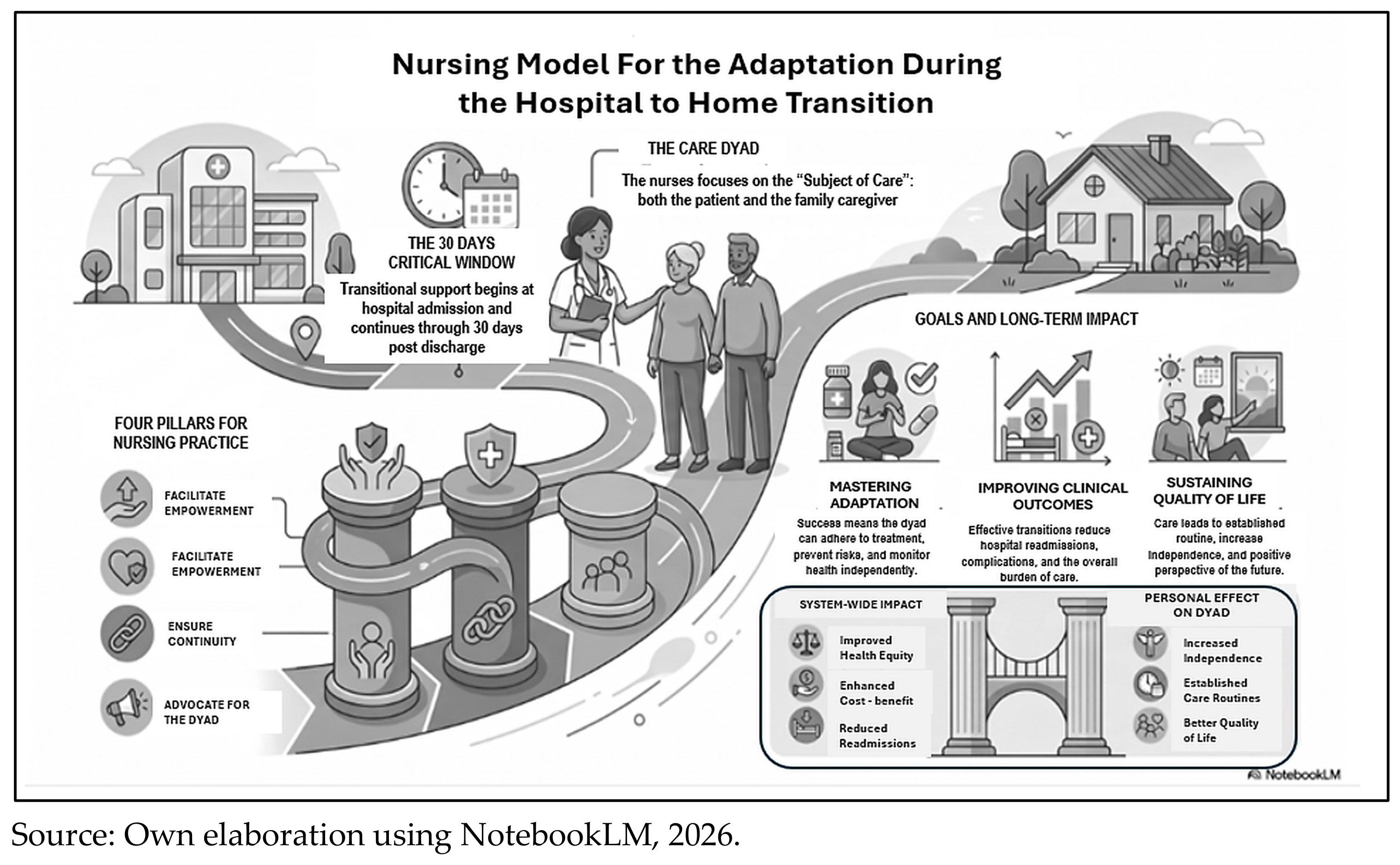
- The subject of care: Within the H-HT, the primary subject of care is the patient–family caregiver dyads. The patient is defined as the individual who has been admitted and received inpatient clinical care, with subsequent discharge to return home. The caregiver is an individual who provides care for the patient and is linked to them by kinship or a close personal relationship. Furthermore, the nursing professional is recognized as a complementary subject of care, highlighting the importance of creating conditions that support their professional well-being and personal well-being while facilitating adaptation within the patient–family caregiver dyad.
- The context of the H-HT: This concept encompasses the continuum between the hospital and the home environment. This transition period commences upon hospital admission and extends to 30 days post discharge. This phase accounts for shifts in clinical conditions and health service utilization. Within this context, the model seeks to ensure continuous, high-quality care through a collaborative network involving the dyad, the interdisciplinary team, healthcare institutions, community networks, and the broader healthcare system.
- The nursing role: Nursing facilitates adaptation within patient–family caregiver dyads by integrating scientific evidence with compassionate care. The professional role operates through four core functions: (a) psychoeducation and coaching to foster dyadic capability; (b) therapeutic accompaniment to motivate and support the dyad; (c) care coordination and longitudinal monitoring to guarantee transitional continuity; and (d) system navigation and advocacy to safeguard the dyad’s needs across the healthcare network.
- The health or goal of nursing: The primary objective is to promote adaptation in the patient–family caregiver dyads. This objective focuses on strengthening the dyad’s capacity to comprehend health challenges, provide mutual support, mitigate risks, and operationalize therapeutic instructions to ensure treatment adherence and effective health monitoring.
3.2.7. Theoretical Structure of the Adaptarte Model
- Assumptions: These establish fundamental beliefs and ontological statements regarding the nature of the individual, health, the environment, and nursing care. The model identifies six core assumptions that characterize the H-HT as a dynamic process of change, requiring continuous adaptation by the dyad in constant interaction with nursing professionals and their environmental context.
- Propositions: These statements articulate the relationships between the model’s central constructs. Nine propositions are defined to guide nursing practice toward measurable outcomes in health status, patient–family caregiver dyad experience, and clinical efficiency. These propositions serve as the basis for designing targeted nursing interventions and establishing evaluative indicators for the adaptation process.
- Hypotheses: Derived directly from the theoretical propositions, the Adaptarte Model proposes seven hypotheses articulated across multiple levels of analysis to guide future empirical research and evidence-based development in transitional care (see Table 2).
3.2.8. Utility of the Model
3.3. Model Content Validation
3.3.1. Experts’ Characteristics
3.3.2. Content Validation Results
4. Discussion
Study Limitations
5. Conclusions
Supplementary Materials
Author Contributions
Funding
Institutional Review Board Statement
Informed Consent Statement
Data Availability Statement
Conflicts of Interest
References
- World Health Organization. Transitions of Care: Technical Series on Safer Primary Care; World Health Organization: Geneva, Switzerland, 2016; Available online: https://iris.who.int/server/api/core/bitstreams/0b80b1aa-50ed-4f6b-8d98-87c5d055534e/content (accessed on 11 December 2025).
- Meleis, A.I. Transitions Theory: Middle-Range and Situation-Specific Theories in Nursing Research and Practice; Springer Publishing Company: New York, NY, USA, 2010. [Google Scholar]
- Howard, A.F.; Lynch, K.; Thorne, S.; Currie, L.M.; Arora, R.C.; McDermid, R.C.; Haljan, G. From Hospital to Home: A Heightened Window of Vulnerability Post-Critical Illness. PLoS ONE 2025, 20, e0334092. [Google Scholar] [CrossRef] [Scilit]
- Fuentes-Ramírez, A.; Carvajal-Carrascal, G.; Roa-Lizcano, K.T.; Peña-Mancera, L.X.; Sánchez-Herrera, B. Adaptación del paciente y su cuidador familiar durante la transición hospital–hogar: Análisis de concepto. Rev. Esc. Enferm. USP 2025, 59, e20240363. [Google Scholar] [CrossRef] [Scilit]
- Manuel, J.I.; Nizza, M.; Herman, D.B.; Conover, S.; Esquivel, L.; Yuan, Y.; Susser, E. Supporting Vulnerable People during Challenging Transitions: A Systematic Review of Critical Time Intervention. Adm. Policy Ment. Health 2023, 50, 100–113. [Google Scholar] [CrossRef] [Scilit]
- van Grootel, J.W.M.; Collet, R.J.; van Dongen, J.M.; van der Leeden, M.; Geleijn, E.; Ostelo, R.; van der Schaaf, M.; Major, M.E.; Wiertsema, S. Continuity and Coordination of Care during Hospital-to-Home Transitions: Healthcare Professionals’ Perspectives. J. Clin. Nurs. 2025; in press. [CrossRef] [Scilit]
- Jin, Y.; Guo, X.; Cadilhac, D.A.; Qiu, Y.; Wang, S.; Zhang, Z.; Zhang, L.; Lin, B. Clinical Staff’s Perceptions of Transitional Care from Hospital to Home for Stroke Patients: A Qualitative Study. BMC Nurs. 2025, 24, 268. [Google Scholar] [CrossRef] [Scilit]
- Sun, M.; Liu, L.; Wang, J.; Zhuansun, M.; Xu, T.; Qian, Y.; Dela Rosa, R. Facilitators and Inhibitors in Hospital-to-Home Transitional Care for Elderly Patients with Chronic Diseases: A Meta-Synthesis of Qualitative Studies. Front. Public Health 2023, 11, 1047723. [Google Scholar] [CrossRef] [Scilit]
- Gheno, J.; Weis, A.H. Care Transition in Hospital Discharge for Adult Patients: Integrative Literature Review. Texto Contexto Enferm. 2021, 30, e20210030. [Google Scholar] [CrossRef] [Scilit]
- Jones, B.; James, P.; Vijayasiri, G.; Li, Y.; Bozaan, D.; Okammor, N.; Jenq, G. Patient Perspectives on Care Transitions from Hospital to Home. JAMA Netw. Open 2022, 5, e2210774. [Google Scholar] [CrossRef] [Scilit]
- Morkisch, N.; Upegui-Arango, L.D.; Cardona, M.I.; van den Heuvel, D.; Rimmele, M.; Sieber, C.C.; Freiberger, E. Components of the Transitional Care Model (TCM) to Reduce Readmission in Geriatric Patients: A Systematic Review. BMC Geriatr. 2020, 20, 345. [Google Scholar] [CrossRef] [Scilit]
- Mertens, F.; Debrulle, Z.; Lindskog, E.; Deliens, L.; Deveugele, M.; Pype, P. Healthcare Professionals’ Experiences of Inter-Professional Collaboration during Patient Transfers between Care Settings in Palliative Care: A Focus Group Study. Palliat. Med. 2021, 35, 355–366. [Google Scholar] [CrossRef] [Scilit]
- Eh, K.X.; Ang, I.Y.H.; Nurjono, M.; Toh, S.A.E.S. Conducting a Cost–Benefit Analysis of Transitional Care Programmes: The Key Challenges and Recommendations. Int. J. Integr. Care 2020, 20, 5. [Google Scholar] [CrossRef] [Scilit]
- Antonacci, G.; Lennox, L.; Barlow, J.; Evans, L.; Reed, J. Process Mapping in Healthcare: A Systematic Review. BMC Health Serv. Res. 2021, 21, 342. [Google Scholar] [CrossRef] [Scilit]
- Di Pumpo, M.; Sommella, L.; Damiani, G. Networks as a Way to Hospital and Primary/Community Care Integration: Findings from a Narrative Review of the Main International Models. Ig. Sanita Pubbl. 2023, 80, 27–48. Available online: https://www.igienesanita.com/wp-content/uploads/2023/05/networks.pdf (accessed on 11 December 2025).
- Kadakia, K.T.; Balatbat, C.A.; Siu, A.L.; Cohen, I.G.; Wilkins, C.H.; Dzau, V.J.; Offodile, A.C., 2nd. Hospital-at-Home: Multistakeholder Considerations for Program Dissemination and Scale. Milbank Q. 2022, 100, 673–701. [Google Scholar] [CrossRef] [Scilit]
- Sakashita, C.; Endo, E.; Ota, E.; Oku, H. Effectiveness of Nurse-Led Transitional Care Interventions for Adult Patients Discharged from Acute Care Hospitals: A Systematic Review and Meta-Analysis. BMC Nurs. 2025, 24, 379. [Google Scholar] [CrossRef] [Scilit]
- Tyler, N.; Hodkinson, A.; Planner, C.; Angelakis, I.; Keyworth, C.; Hall, A.; Panagioti, M. Transitional Care Interventions from Hospital to Community to Reduce Health Care Use and Improve Patient Outcomes: A Systematic Review and Network Meta-Analysis. JAMA Netw. Open 2023, 6, e2344825. [Google Scholar] [CrossRef] [Scilit]
- Tyler, N.; Wright, N.; Gregoriou, K.; Waring, J. Improving mental health care transitions through information capture during admission to inpatient mental health services: A quality improvement study. BMC Health Serv. Res. 2021, 21, 1132. [Google Scholar] [CrossRef] [Scilit]
- Mohamedsharif, A.; Elfeaki, M.; Bushra, R.; Gemperli, A. Effectiveness of Hospital-to-Home Transitional Care Interventions and Components to Reduce Hospital Readmissions: A Systematic Review and Meta-Analysis. Front. Health Serv. 2023, 3, 1288575. Available online: https://www.frontiersin.org/articles/10.3389/frhs.2023.1288575/full (accessed on 11 December 2025).
- Organización Panamericana de la Salud. Cuidados de Largo Plazo; OPS: Washington, DC, USA, 2024; Available online: https://www.paho.org/sites/default/files/2024-08/cd61-8-s-cuidados-largo-plazo.pdf (accessed on 11 December 2025).
- Nakahara-Melo, M.; Conceição, A.P.D.; Cruz, D.D.A.L.M.D.; Püschel, V.A.D.A. Transitional Care from the Hospital to the Home in Heart Failure: Implementation of Best Practices. Rev. Bras. Enferm. 2021, 75, e20210123. [Google Scholar] [CrossRef] [Scilit]
- Schapira, M.; Outumuro, M.B.; Giber, F.; Pino, C.; Mattiussi, M.; Montero-Odasso, M.; Perman, G. Geriatric Co-Management and Interdisciplinary Transitional Care Reduced Hospital Readmissions in Frail Older Patients: Results from a Randomized Controlled Trial. Aging Clin. Exp. Res. 2022, 34, 85–93. [Google Scholar] [CrossRef] [Scilit]
- Varela, T.; Zamorano, P.; Muñoz, P.; Espinoza, M.; Tellez, A.; Irazoqui, E.; Suarez, F. Evaluation of a Transitional Care Strategy Implemented in Adults with High-Risk and Multimorbidity in Chile. Value Health Reg. Issues 2023, 38, 85–92. [Google Scholar] [CrossRef] [Scilit]
- Gallo, L.C.; Fortmann, A.L.; Clark, T.L.; Roesch, S.C.; Bravin, J.I.; Spierling Bagsic, S.R.; Philis-Tsimikas, A. Mi Puente (My Bridge) Care Transitions Program for Hispanic/Latino Adults with Multimorbidity: Results of a Randomized Controlled Trial. J. Gen. Intern. Med. 2023, 38, 2098–2106. [Google Scholar] [CrossRef] [Scilit]
- Creswell, J.W.; Plano Clark, V.L. Designing and Conducting Mixed Methods Research, 3rd ed.; SAGE Publications: Thousand Oaks, CA, USA, 2018. [Google Scholar]
- Khalil, H.; Peters, M.; Godfrey, C.M.; McInerney, P.; Soares, C.B.; Parker, D. An Evidence-Based Approach to Scoping Reviews. Worldviews Evid. Based Nurs. 2016, 13, 118–123. [Google Scholar] [CrossRef] [Scilit]
- LoBiondo-Wood, G.; Haber, J. Nursing Research: Methods and Critical Appraisal for Evidence-Based Practice, 11th ed.; Elsevier: St. Louis, MO, USA, 2025. [Google Scholar]
- Peters, M.D.J.; Marnie, C.; Tricco, A.C.; Pollock, D.; Munn, Z.; Alexander, L.; McInerney, P.; Godfrey, C.M.; Khalil, H. Updated Methodological Guidance for the Conduct of Scoping Reviews. JBI Evid. Synth. 2020, 18, 2119–2126. [Google Scholar] [CrossRef] [Scilit] [PubMed]
- Tristán-López, A. Modificación al Modelo de Lawshe para el Dictamen Cuantitativo de la Validez de Contenido de un Instrumento Objetivo. Av. Medición 2008, 6, 37–48. Available online: https://www.humanas.unal.edu.co/lab_psicometria/application/files/9716/0463/3548/VOL_6._Articulo4_Indice_de_validez_de_contenido_37-48.pdf (accessed on 11 December 2025).
- O’Cathain, A.; Murphy, E.; Nicholl, J. Three techniques for integrating data in mixed methods studies. BMJ 2010, 341, c4587. [Google Scholar] [CrossRef] [Scilit]
- Albert, N.M. A Systematic Review of Transitional-Care Strategies to Reduce Rehospitalization in Patients with Heart Failure. Heart Lung 2016, 45, 100–113. [Google Scholar] [CrossRef] [Scilit]
- Alizadeh, Z.; Rohani, C.; Rassouli, M.; Ilkhani, M.; Hazrati, M. Transitional Cancer Care Program from Hospital to Home in the Health Care System of Iran. Asian Pac. J. Cancer Prev. 2021, 22, 1231. [Google Scholar] [CrossRef] [Scilit]
- Allen, J.; Hutchinson, A.M.; Brown, R.; Livingston, P.M. Quality Care Outcomes Following Transitional Care Interventions for Older People from Hospital to Home: A Systematic Review. BMC Health Serv. Res. 2014, 14, 346. [Google Scholar] [CrossRef] [Scilit]
- Allen, J.; Hutchinson, A.M.; Brown, R.; Livingston, P.M. User Experience and Care Integration in Transitional Care for Older People from Hospital to Home: A Meta-Synthesis. Qual. Health Res. 2017, 27, 24–36. [Google Scholar] [CrossRef] [Scilit]
- Brown, C.L.; Menec, V. Measuring Processes of Integrated Care for Hospital to Home Transitions. Int. J. Integr. Care 2021, 21, 12. [Google Scholar] [CrossRef] [Scilit]
- Bucknall, T.K.; Hutchinson, A.M.; Botti, M.; McTier, L.; Rawson, H.; Hitch, D.; Hewitt, N.; Digby, R.; Fossum, M.; McMurray, A.; et al. Engaging Patients and Families in Communication across Transitions of Care: An Integrative Review. Patient Educ. Couns. 2020, 103, 1104–1117. [Google Scholar] [CrossRef] [Scilit]
- Chen, L.; Xiao, L.D.; Chamberlain, D.; Newman, P. Enablers and Barriers in Hospital-to-Home Transitional Care for Stroke Survivors and Caregivers: A Systematic Review. J. Clin. Nurs. 2021, 30, 2786–2807. [Google Scholar] [CrossRef] [Scilit]
- Cho, J.; Thorud, J.L.; Marishak-Simon, S.; Frawley, L.; Stevens, A.B. A Model Home-Delivered Meals Program to Support Transitions from Hospital to Home. J. Nutr. Gerontol. Geriatr. 2015, 34, 207–217. [Google Scholar] [CrossRef] [Scilit]
- Feil Weber, L.A.; Dias da Silva Lima, M.A.; Marques Acosta, A.; Quintana Maques, G. Care Transition from Hospital to Home: Integrative Review. Cogitare Enferm. 2017, 22, 6. [Google Scholar] [CrossRef] [Scilit]
- Groenvynck, L.; de Boer, B.; Hamers, J.P.; van Achterberg, T.; van Rossum, E.; Verbeek, H. Toward a Partnership in the Transition from Home to a Nursing Home: The TRANSCIT Model. J. Am. Med. Dir. Assoc. 2021, 22, 351–356. [Google Scholar] [CrossRef] [Scilit]
- Hestevik, C.H.; Molin, M.; Debesay, J.; Bergland, A.; Bye, A. Older Persons’ Experiences of Adapting to Daily Life at Home after Hospital Discharge: A Qualitative Metasummary. BMC Health Serv. Res. 2019, 19, 224. [Google Scholar] [CrossRef] [Scilit]
- Hirschman, K.B.; Shaid, E.; McCauley, K.; Pauly, M.V.; Naylor, M.D. Continuity of Care: The Transitional Care Model. Online J. Issues Nurs. 2015, 20, 1. Available online: https://ojin.nursingworld.org/MainMenuCategories/ANAMarketplace/ANAPeriodicals/OJIN/TableofContents/Vol-20-2015/No3-Sept-2015/Continuity-of-Care-Transitional-Care-Model.html (accessed on 15 December 2025). [CrossRef] [Scilit]
- Kim, S.K.; Hwang, Y.S.; Ock, M.; Jo, H.S. Development of Items for Transitional Care Service and Outcome Indicators of Discharged Patients for Improvement in Quality of Care. J. Korean Med. Sci. 2023, 38, e246. [Google Scholar] [CrossRef] [Scilit]
- Liebzeit, D.J.; Jaboob, S.; Bjornson, S.; Geiger, O.; Buck, H.; Ashida, S.; E Werner, N. Unpaid Caregivers’ Process of Collaborating with Others during Older Adult Hospital-to-Home Transitions: A Grounded Theory Study. PLoS ONE 2024, 19, e0310204. [Google Scholar] [CrossRef] [Scilit]
- Miller, K.K.; Lin, S.H.; Neville, M. From Hospital to Home to Participation: A Position Paper on Transition Planning Poststroke. Arch. Phys. Med. Rehabil. 2019, 100, 1162–1175. [Google Scholar] [CrossRef] [Scilit]
- Mitchell, S.E.; Laurens, V.; Weigel, G.M.; Hirschman, K.B.; Scott, A.M.; Nguyen, H.Q.; Howard, J.M.; Laird, L.; Levine, C.; Davis, T.C.; et al. Care Transitions from Patient and Caregiver Perspectives. Ann. Fam. Med. 2018, 16, 225–231. [Google Scholar] [CrossRef] [Scilit]
- Monkong, S.; Krairit, O.; Ngamkala, T.; Pussawiro, W.; Ratchasan, P. Transitional Care for Older People from Hospital to Home: A Best Practice Implementation Project. JBI Evid. Synth. 2020, 18, 357–367. [Google Scholar] [CrossRef] [Scilit]
- Nordmark, S.; Zingmark, K.; Lindberg, I. Process Evaluation of Discharge Planning Implementation in Healthcare Using Normalization Process Theory. BMC Med. Inform. Decis. Mak. 2016, 16, 48. [Google Scholar] [CrossRef] [Scilit]
- O’Donnell, R.; Savaglio, M.; Skouteris, H.; Banaszak-Holl, J.; Moran, C.; Morris, H.; Vicary, D.; Ayton, D. The Effectiveness of Transition Interventions to Support Older Patients from Hospital to Home: A Systematic Scoping Review. J. Appl. Gerontol. 2021, 40, 1628–1636. [Google Scholar] [CrossRef] [Scilit]
- Rathert, C.; Williams, E.S.; McCaughey, D.; Ishqaidef, G. Patient Perceptions of Patient-Centred Care: Empirical Test of a Theoretical Model. Health Expect. 2015, 18, 199–209. [Google Scholar] [CrossRef] [Scilit]
- Rezapour-Nasrabad, R. Transitional Care Model: Managing the Experience of Hospital at Home. Electron. J. Gen. Med. 2018, 15, em73. [Google Scholar] [CrossRef] [Scilit]
- Saragosa, M.; Kuluski, K.; Okrainec, K.; Jeffs, L. “Seeing the Day-to-Day Situation”: A Grounded Theory of How Persons Living with Dementia and Their Family Caregivers Experience the Hospital to Home Transition and Beyond. J. Aging Stud. 2023, 65, 101132. [Google Scholar] [CrossRef] [Scilit]
- Tutar, Ş.; Avcı, Y.D. Assessing the Psycholinguistic and Psychometric Properties of the Turkish Version of the Transition Questionnaire Grounded on the Hospital-to-Home Transition Model. J. Pediatr. Nurs. 2022, 65, 91–97. [Google Scholar] [CrossRef] [Scilit]
- Tyler, N.; Wright, N.; Waring, J. Interventions to Improve Discharge from Acute Adult Mental Health Inpatient Care to the Community: Systematic Review and Narrative Synthesis. BMC Health Serv. Res. 2019, 19, 883. [Google Scholar] [CrossRef] [Scilit]
- Weeks, L.E.; Barber, B.; MacDougall, E.S.; Macdonald, M.; Martin-Misener, R.; Warner, G. An Exploration of Canadian Transitional Care Programs for Older Adults. Healthc. Manag. Forum 2021, 34, 163–168. [Google Scholar] [CrossRef] [Scilit]
- Xu, X.; Chen, H.; Xu, D.; Tan, F.; Li, X. A Scoping Review of Hospital to Home Transitional Care Programmes for Stroke Survivors. J. Clin. Nurs. 2024, 33, 3414–3428. [Google Scholar] [CrossRef] [Scilit]
- Ye, Z.J.; Liu, M.L.; Cai, R.Q.; Zhong, M.X.; Huang, H.; Liang, M.Z.; Quan, X.M. Development of the Transitional Care Model for Nursing Care in Mainland China: A Literature Review. Int. J. Nurs. Sci. 2016, 3, 113–130. [Google Scholar] [CrossRef] [Scilit]
- Berthelsen, C.; Møller, N.; Bunkenborg, G. Transitional Care Model for Older Adults with Multiple Chronic Conditions: An Evaluation of Benefits Utilising an Umbrella Review. J. Clin. Nurs. 2023, 33, 481–496. [Google Scholar] [CrossRef] [Scilit]
- Comin-Colet, J.; Enjuanes, C.; Lupon, J.; Cainzos-Achirica, M.; Badosa, N.; Verdú, J.M. Transitions of Care Between Acute and Chronic Heart Failure: Critical Steps in the Design of a Multidisciplinary Care Model for the Prevention of Rehospitalization. Rev. Esp. Cardiol. (Engl. Ed.) 2016, 69, 951–961. [Google Scholar] [CrossRef] [Scilit]
- Desai, A.D.; Popalisky, J.; Simon, T.D.; Mangione-Smith, R.M. The Effectiveness of Family-Centered Transition Processes from Hospital Settings to Home: A Review of the Literature. Hosp. Pediatr. 2015, 5, 219–231. [Google Scholar] [CrossRef] [Scilit]
- Le Berre, M.; Maimon, G.; Sourial, N.; Gueriton, M.; Vedel, I. Impact of Transitional Care Services for Chronically Ill Older Patients: A Systematic Evidence Review. J. Am. Geriatr. Soc. 2017, 65, 1597–1608. [Google Scholar] [CrossRef] [Scilit]
- Lee, H.J.; Kim, Y.; Oh, E.G. A Systematic Review on Nurse-Led Transitional Care Programs for Discharged Patients from Hospital to Home. J. Korean Clin. Nurs. Res. 2017, 23, 376–387. [Google Scholar] [CrossRef]
- Leithaus, M.; Beaulen, A.; de Vries, E.; Goderis, G.; Flamaing, J.; Verbeek, H.; Deschodt, M. Integrated Care Components in Transitional Care Models from Hospital to Home for Frail Older Adults: A Systematic Review. Int. J. Integr. Care 2022, 22, 28. [Google Scholar] [CrossRef] [Scilit]
- Liebzeit, D.; Rutkowski, R.; Arbaje, A.I.; Fields, B.; Werner, N.E. A Scoping Review of Interventions for Older Adults Transitioning from Hospital to Home. J. Am. Geriatr. Soc. 2021, 69, 2950–2962. [Google Scholar] [CrossRef] [Scilit]
- Murray, J.; Hardicre, N.; Birks, Y.; O’Hara, J.; Lawton, R. How Older People Enact Care Involvement During Transition from Hospital to Home: A Systematic Review and Model. Health Expect. 2019, 22, 883–893. [Google Scholar] [CrossRef] [Scilit]
- Naylor, M.D.; Shaid, E.C.; Carpenter, D.; Gass, B.; Levine, C.; Li, J.; Malley, A.; McCauley, K.; Nguyen, H.Q.; Watson, H.; et al. Components of Comprehensive and Effective Transitional Care. J. Am. Geriatr. Soc. 2017, 65, 1119–1125. [Google Scholar] [CrossRef] [Scilit]
- Naylor, M.D.; Hirschman, K.B.; Toles, M.P.; Jarrín, O.F.; Shaid, E.; Pauly, M.V. Adaptations of the Evidence-Based Transitional Care Model in the US. Soc. Sci. Med. 2018, 213, 28–36. [Google Scholar] [CrossRef] [Scilit]
- Kast, K.; Wachter, C.P.; Schöffski, O.; Rimmele, M. Economic Evidence with Respect to Cost-Effectiveness of the Transitional Care Model among Geriatric Patients Discharged from Hospital to Home: A Systematic Review. Eur. J. Health Econ. 2021, 22, 961–975. [Google Scholar] [CrossRef] [Scilit]
- Paudel, K.; Banstola, R.S. Transitional Care Models for Stroke Survivors to Improve Quality of Care Through Bridging the Care Gap from Hospital to Home: A State of Art Review. J. Nurs. Educ. Nepal 2022, 13, 97–104. Available online: https://portal.tu.edu.np/downloads/2025_01_20_13_33_15.pdf#page=105 (accessed on 15 December 2025). [CrossRef] [Scilit]
- Takahashi, P.Y.; Leppin, A.L.; Hanson, G.J. Hospital to Community Transitions for Older Adults: An Update for the Practicing Clinician. In Mayo Clinic Proceedings; Elsevier: Amsterdam, The Netherlands, 2020; Volume 95, pp. 2253–2262. [Google Scholar] [CrossRef] [Scilit]
- Zupanc, M.L. Models of Transition. In Seminars in Pediatric Neurology; WB Saunders: Philadelphia, PA, USA, 2020; Volume 36, p. 100853. [Google Scholar] [CrossRef] [Scilit]
- Aued, G.K.; Bernardino, E.; Lapierre, J.; Dallaire, C. Liaison Nurse Activities at Hospital Discharge: A Strategy for Continuity of Care. Rev. Lat.-Am. Enferm. 2019, 27, e3162. [Google Scholar] [CrossRef] [Scilit]
- Costa, M.F.B.N.A.D.; Sichieri, K.; Poveda, V.D.B.; Baptista, C.M.C.; Aguado, P.C. Transitional Care from Hospital to Home for Older People: Implementation of Best Practices. Rev. Bras. Enferm. 2020, 73, e20200187. [Google Scholar] [CrossRef] [Scilit]
- Dias da Silva Lima, M.A.; Magalhães, A.M.; Oelke, N.D.; Marques, G.Q.; Lorenzini, E.; Weber, L.A.; Fan, I. Care Transition Strategies in Latin American Countries: An Integrative Review. Rev. Gaúcha Enferm. 2018, 39, e20180119. [Google Scholar] [CrossRef] [Scilit]
- Hewner, S.; Chen, C.; Anderson, L.; Pasek, L.; Anderson, A.; Popejoy, L. Transitional Care Models for High-Need, High-Cost Adults in the United States: A Scoping Review and Gap Analysis. Prof. Case Manag. 2021, 26, 82–98. [Google Scholar] [CrossRef] [Scilit]
- Malley, A.; Kenner, C.; Kim, T.; Blakeney, B. The Role of the Nurse and the Preoperative Assessment in Patient Transitions. AORN J. 2015, 102, 181.e1. [Google Scholar] [CrossRef] [Scilit]
- Salehi, V.; Hanson, N.; Smith, D.; McCloskey, R.; Jarrett, P.; Veitch, B. Modeling and Analyzing Hospital to Home Transition Processes of Frail Older Adults Using the Functional Resonance Analysis Method (FRAM). Appl. Ergon. 2021, 93, 103392. [Google Scholar] [CrossRef] [Scilit]
- Solan, L.G.; Beck, A.F.; Brunswick, S.A.; Sauers, H.S.; Wade-Murphy, S.; Simmons, J.M.; Shah, S.S.; Sherman, S.N.; H2O Study Group. The Family Perspective on Hospital to Home Transitions: A Qualitative Study. Pediatrics 2015, 136, e1539–e1549. [Google Scholar] [CrossRef] [Scilit]
- Testa, L.; Seah, R.; Ludlow, K.; Braithwaite, J.; Mitchell, R.J. Models of Care That Avoid or Improve Transitions to Hospital Services for Residential Aged Care Facility Residents: An Integrative Review. Geriatr. Nurs. 2020, 41, 360–372. [Google Scholar] [CrossRef] [Scilit]
- Thrasher, J.; Baker, J.; Ventre, K.M.; Martin, S.E.; Dawson, J.; Cox, R.; Moore, H.M.; Brethouwer, S.; Sables-Baus, S.; Baker, C.D. Hospital to Home: A Quality Improvement Initiative to Implement High-Fidelity Simulation Training for Caregivers of Children Requiring Long-Term Mechanical Ventilation. J. Pediatr. Nurs. 2018, 38, 114–121. [Google Scholar] [CrossRef] [Scilit]
- Weiss, M.E.; Bobay, K.L.; Bahr, S.J.; Costa, L.; Hughes, R.G.; Holland, D.E. A Model for Hospital Discharge Preparation: From Case Management to Care Transition. JONA J. Nurs. Adm. 2015, 45, 606–614. [Google Scholar] [CrossRef] [Scilit]
- Werner, N.E.; Tong, M.; Borkenhagen, A.; Holden, R.J. Performance-Shaping Factors Affecting Older Adults’ Hospital-to-Home Transition Success: A Systems Approach. Gerontologist 2019, 59, 303–314. [Google Scholar] [CrossRef] [Scilit]
- Chakurian, D.; Popejoy, L. Utilizing the Care Coordination Atlas as a Framework: An Integrative Review of Transitional Care Models. Int. J. Care Coord. 2021, 24, 57–71. [Google Scholar] [CrossRef] [Scilit]
- Zwart, D.L.; Schnipper, J.L.; Vermond, D.; Bates, D.W. How Do Care Transitions Work?: Unraveling the Working Mechanisms of Care Transition Interventions. Med. Care 2021, 59, S387–S397. [Google Scholar] [CrossRef] [Scilit]
- Balaban, R.B.; Galbraith, A.A.; Burns, M.E.; Vialle-Valentin, C.E.; Larochelle, M.R.; Ross-Degnan, D. A Patient Navigator Intervention to Reduce Hospital Readmissions among High-Risk Safety-Net Patients: A Randomized Controlled Trial. J. Gen. Intern. Med. 2015, 30, 907–915. [Google Scholar] [CrossRef] [Scilit]
- Mora, K.; Dorrejo, X.M.; Carreon, K.M.; Butt, S. Nurse Practitioner-Led Transitional Care Interventions: An Integrative Review. J. Am. Assoc. Nurse Pract. 2017, 29, 773–790. [Google Scholar] [CrossRef] [Scilit]
- Eliassen, M.; Arntzen, C.; Nikolaisen, M.; Gramstad, A. Rehabilitation Models That Support Transitions from Hospital to Home for People with Acquired Brain Injury (ABI): A Scoping Review. BMC Health Serv. Res. 2023, 23, 814. [Google Scholar] [CrossRef] [Scilit]
- Morrison, J.; Palumbo, M.V.; Rambur, B. Reducing Preventable Hospitalizations with Two Models of Transitional Care. J. Nurs. Scholarsh. 2016, 48, 322–329. [Google Scholar] [CrossRef] [Scilit]
- Pollack, A.H.; Backonja, U.; Miller, A.D.; Mishra, S.R.; Khelifi, M.; Kendall, L.; Pratt, W. Closing the Gap: Supporting Patients’ Transition to Self-Management after Hospitalization. In Proceedings of the 2016 CHI Conference on Human Factors in Computing Systems; ACM: New York, NY, USA, 2016; pp. 5324–5336. [Google Scholar] [CrossRef] [Scilit]
- Ulin, K.; Olsson, L.-E.; Wolf, A.; Ekman, I. Person-Centred Care—An Approach That Improves the Discharge Process. Eur. J. Cardiovasc. Nurs. 2016, 15, e19–e26. [Google Scholar] [CrossRef] [Scilit]
- De Regge, M.; De Pourcq, K.; Meijboom, B.; Trybou, J.; Mortier, E.; Eeckloo, K. The Role of Hospitals in Bridging the Care Continuum: A Systematic Review of Coordination of Care and Follow-Up for Adults with Chronic Conditions. BMC Health Serv. Res. 2017, 17, 550. [Google Scholar] [CrossRef] [Scilit]
- Green, J.E.; Ang, N.; Harris-Roxas, B.; Baird, K.; Roth, H.; Henry, A. Exploring Australian Knowledge and Practice for Maternal Postnatal Transition of Care between Hospital and Primary Care: A Scoping Review. Women Birth 2025, 38, 101852. [Google Scholar] [CrossRef] [Scilit]
- Markiewicz, O.; Lavelle, M.; Lorencatto, F.; Judah, G.; Ashrafian, H.; Darzi, A. Threats to Safe Transitions from Hospital to Home: A Consensus Study in North West London Primary Care. Br. J. Gen. Pract. 2019, 70, e9–e19. [Google Scholar] [CrossRef] [Scilit]
- Breneol, S.; Belliveau, J.; Cassidy, C.; Curran, J.A. Strategies to Support Transitions from Hospital to Home for Children with Medical Complexity: A Scoping Review. Int. J. Nurs. Stud. 2017, 72, 91–104. [Google Scholar] [CrossRef] [Scilit]
- Wyer, P.; Stojanovic, Z.; Shaffer, J.A.; Placencia, M.; Klink, K.; Fosina, M.J.; Lin, S.X.; Barron, B.; Graham, I.D. Combining Training in Knowledge Translation with Quality Improvement Reduced 30-Day Heart Failure Readmissions in a Community Hospital: A Case Study. J. Eval. Clin. Pract. 2016, 22, 171–179. [Google Scholar] [CrossRef] [Scilit]
- Fawcett, J. Empirical Indicators: Conceptual and Theoretical Origins. Aquichan 2021, 21, 4. [Google Scholar] [CrossRef] [Scilit]
- Yeatts, D.; Tiwari, C.; Coleman, S.; Yeatts, M.; Sobering, K. A qualitative study of unplanned hospital readmissions: Patient perspectives on their hospital to home transition. Nurs. Rep. 2025, 15, 192. [Google Scholar] [CrossRef] [Scilit]
- Marini, G.; Longhini, J.; Ambrosi, E.; Canzan, F.; Konradsen, H.; Kabir, Z.N. Transitional care interventions in improving patient and caregiver outcomes after discharge: A scoping review. Healthcare 2025, 13, 312. [Google Scholar] [CrossRef] [Scilit]
- Harris, R. Sister Callista Roy: Adaptation Model. In Nursing Theorists and Their Work, 23rd ed.; Elsevier: Amsterdam, The Netherlands, 2021; p. 247. [Google Scholar]
- Coleman, E.A.; Smith, J.D.; Frank, J.C.; Min, S.-J.; Parry, C.; Kramer, A.M. Preparing patients and caregivers to participate in care delivered across settings: The Care Transitions Intervention. J. Am. Geriatr. Soc. 2004, 52, 1817–1825. [Google Scholar] [CrossRef] [Scilit]
- Meleis, A.I. Theoretical Nursing: Development and Progress; Lippincott Williams & Wilkins: Philadelphia, PA, USA, 2011. [Google Scholar]
- Fawcett, J. Thoughts about Models of Nursing Practice Delivery. Nurs. Sci. Q. 2021, 34, 328–330. [Google Scholar] [CrossRef] [Scilit]
- Smith, M.J.; Liehr, P.R.; Carpenter, R.D. (Eds.) Middle Range Theory for Nursing; Springer Publishing Company: New York, NY, USA, 2023. [Google Scholar]
- Fontaine, G.; Vinette, B.; Weight, C.; Maheu-Cadotte, M.-A.; Lavallée, A.; Deschênes, M.-F.; Lapierre, A.; Castiglione, S.A.; Chicoine, G.; Rouleau, G.; et al. Effects of Implementation Strategies on Nursing Practice and Patient Outcomes: A Comprehensive Systematic Review and Meta-Analysis. Implement. Sci. 2024, 19, 68. [Google Scholar] [CrossRef] [Scilit]
- Ángeles, J.M.F. Sistemas de Salud en Latinoamérica Durante el Periodo 2020 al 2023. Rev. Climatol. Ed. Esp. Cienc. Soc. 2024, 24, 1375. [Google Scholar] [CrossRef] [Scilit]
- Bédard, M.; Molloy, D.W.; Squire, L.; Dubois, S.; Lever, J.A.; O’Donnell, M. The Zarit Burden Interview: A new short version and screening version. Gerontologist 2001, 41, 652–657. [Google Scholar] [CrossRef] [Scilit]
- Ware, J.E., Jr.; Sherbourne, C.D. The MOS 36-Item Short-Form Health Survey (SF-36): I. Conceptual framework and item selection. Med. Care 1992, 30, 473–483. [Google Scholar] [CrossRef] [Scilit]
- Cid-Ruzafa, J.; Damián-Moreno, F.J. Valoración de la discapacidad física: El índice de Barthel. Rev. Esp. Salud. Publica 1997, 71, 127–137. [Google Scholar] [CrossRef] [Scilit]
- Vivekanand, M.; Radhakrishnan, V. The structure of integrated pulse profiles. J. Astrophys. Astron. 1980, 1, 119–128. [Google Scholar] [CrossRef] [Scilit]
- O’Cathain, A.; Murphy, E.; Nicholl, J. The quality of mixed methods studies in health services research. J. Health Serv. Res. Policy 2008, 13, 92–98. [Google Scholar] [CrossRef] [Scilit] [PubMed]



| Nursing Functions | Core Components | Component Description | Supporting Evidence |
|---|---|---|---|
| Facilitating the empowerment of the patient–family caregiver dyads | Education | Teaching patient–family caregiver dyads about illness, treatments, care procedures, self-care, and caregiving roles to strengthen knowledge and skills. | [11,33,36,38,40,44,48,50,51,55,57,58,60,62,63,67,68,69,71,72,73,74,75,76,77,78,79,80,81,82,83] |
| Demonstration, involvement, and coaching | Showing proper care routines, engaging patient–family caregiver dyads in direct activities and providing guidance throughout the process to foster greater confidence, skill, and independence | [11,33,34,36,37,43,49,52,57,58,68,69,74,78,84,85] | |
| Information, communication, and guidance | Delivering clear, timely, and understandable information about health status, procedures, expectations, and decision-making, helping patient–family caregiver dyads reduce uncertainty and improve understanding. | [8,32,33,36,37,41,43,47,48,50,51,53,55,57,61,63,71,72,74,77,79,83,84,86,87] | |
| Providing therapeutic support | Facilitating care and providing accompaniment | Supporting patient–family caregiver dyads in accessing resources, performing care activities, and coping with hospitalization by easing care tasks with continuous presence and assistance. | [8,33,35,36,37,38,42,43,45,47,51,57,58,60,67,70,71,72,74,75,77,79,80,81,82,83,84,85,88,89,90] |
| Inspiring and motivating through the caring relationship | Promoting hope, emotional strength, and confidence through a therapeutic, empathetic, and supportive nurse–patient–family caregiver dyad relationship. | [8,38,44,47,53,60,68,69,74,83,89,91] | |
| Ensuring continuity of transitional care | Monitoring and follow-up | Continuously assessing care processes, patient–family caregiver dyads adaptation, and goal achievement to identify problems and adjust nursing interventions. | [32,35,40,48,49,55,57,63,65,69,72,74,75,76,78,80,84,85,87,89,92,93] |
| Coordination of services, reporting, and referral | Organizing and integrating health services, communicating relevant information to the care team, and making timely referrals to ensure continuity, safety, and quality of care. | [8,11,36,38,39,40,41,43,44,45,46,47,51,52,54,55,56,57,58,59,60,61,62,63,67,68,69,70,71,72,73,74,76,77,78,80,81,82,83,84,86,87,88,89,92,94,95] | |
| Advocating for the dyad | Advocacy and direct support | Defending the rights and needs of patient–family caregiver dyads, supporting decision-making, and promoting policies or actions that help them adapt to the caregiving role. | [44,49,68,73,77,78,79,84,89,94] |
| Theoretical Component | Component Description | |
|---|---|---|
| Assumptions | 1. The individuals who comprise the patient–family caregiver dyads are primarily responsible for their own health care. 2. The individuals who comprise the patient–family caregiver dyads seek to adapt during the transition to a family home. 3. Self-care can be learned during the transition to the family home. 4. Adapting to caregiving during the transition to a family home is a process that involves preparation, participation, and acceptance. 5. Adaptation in the patient–family caregiver dyads during the H-HT occurs within a changing context. 6. During the H-HT, nursing support facilitates a safe, autonomous, and well-being-focused transition. | |
| Propositions | 1. Adaptation as a Dynamic Process: Adaptation during the H-HT is a multifaceted and dynamic process characterized by continuous adjustments. This process is influenced by individual attributes, clinical conditions, and environmental contexts, often manifesting as periods of stress and uncertainty. 2. Restoration of Equilibrium: Successful transition requires that the patient–family caregiver dyads reassume agency and establish new normalcy, which is essential for optimizing health-related quality of life. 3. Institutional Support for Nursing: The efficacy of the nursing role in facilitating H-HT adaptation is contingent upon supportive institutional conditions that enable nurses to perform essential coordination and clinical support functions. 4. Continuity and Interdisciplinary Coordination: Adaptation necessitates a continuum of high-quality care. Within this framework, the nurses act as the primary coordinator, aligning the dyad with the interdisciplinary team, healthcare institutions, and broader community networks. 5. Facilitation of Adaptation: During the H-HT, the nurse facilitates dyadic adaptation through targeted interventions, including information, health education, motivational support, clinical demonstration, simplification of care, advocacy, and systematic monitoring and referral to specialized services. 6. Mechanisms of Coping: Adaptation during the H-HT requires the dyad to employ effective coping strategies, comprehend complex care instructions, leverage social support networks, adhere to prescribed treatment plans, and proactively monitor health status to anticipate and prevent complications. 7. Impact on Health Outcomes: Enhanced adaptation within the patient–family caregiver dyads promotes positive clinical outcomes and prevents avoidable complications. 8. Promotion of Autonomy and Well-being: Positive adaptation is achieved through continuous care that fosters the dyad’s autonomy, facilitates the re-establishment of daily routines, increases satisfaction with care milestones, and promotes a resilient outlook on the future. 9. Systemic and Clinical Efficiency: Optimal adaptation during the H-HT yields systemic benefits, including enhanced clinical outcomes, improved experiences for both dyads and professionals, improved equity and cost-effectiveness, and a significant reduction in readmission rates and caregiver burden. | |
| Hypotheses | Dyadic Level (Proximal clinical and psychosocial outcomes evaluated directly) | 1. Clinical Outcomes: Higher levels of adaptation within the patient–family caregiver dyads during the H-HT are positively correlated with improved clinical outcomes for the patient. 2. Dyadic Experience: A positive healthcare experience for the patient–family caregiver dyads is significantly associated with their degree of adaptation during the H-HT. 3. Complication Rates: Increased adaptation in the patient–family caregiver dyads during the H-HT is inversely associated with the incidence of health complications. 4. Caregiver Burden: Optimal adaptation in the patient–family caregiver dyads during the H-HT is inversely correlated with the perceived burden of care experienced by the family caregiver. |
| Organizational Level (Distal outcomes related to staff and service delivery) | 5. Professional Meaning: Optimal adaptation of the patient–family caregiver dyads during the H-HT is associated with higher levels of professional satisfaction and a more favorable healthcare experience for the nursing and interdisciplinary staff. | |
| Health-System Level (Macro distal outcomes evaluated via longitudinal and health services designs) | 6. Economic Efficiency: Greater adaptation within patient–family caregiver dyads during the H-HT is associated with an improved cost–benefit ratio for the healthcare system. 7. Resource Utilization: Higher levels of adaptation in the patient–family caregiver dyads during the H-HT are associated with a reduction in hospital readmissions and a decrease in the occupancy of hospital beds. | |
| Model Dimension | Expert Rating of Content Components | CVR′ | ||||
|---|---|---|---|---|---|---|
| Clarity | Coherence | Relevance | Sufficiency | |||
| Attributes | Name | 3.91 | 3.91 | 4.00 | 3.68 | 0.97 |
| Definition of concepts | 3.82 | 3.91 | 3.91 | 0.96 | ||
| Statement of assumptions | 3.64 | 3.91 | 4.00 | 0.95 | ||
| Logical propositions | 3.82 | 3.82 | 3.91 | 0.95 | ||
| Statement of hypotheses | 3.82 | 3.82 | 3.91 | 0.95 | ||
| Illustrative diagram | 3.64 | 3.91 | 3.91 | 0.95 | ||
| Relational significance | Underlying philosophy | 3.73 | 4.00 | 4.00 | 3.81 | 0.97 |
| Purpose of the model | 3.91 | 4.00 | 4.00 | 0.98 | ||
| Scope of application | 4.00 | 4.00 | 4.00 | 0.99 | ||
| Usefulness of the model | 3.91 | 4.00 | 4.00 | 0.98 | ||
| Rigor | Support from theoretical evidence | 3.64 | 3.91 | 4.00 | 3.54 | 0.94 |
| Clarity of limitations | 3.82 | 4.00 | 4.00 | 0.96 | ||
| Support from empirical evidence | 3.45 | 3.73 | 3.73 | 0.90 | ||
| CVI | 0.96 | |||||
| Condition | Expert Ratings of Functionality and Projection | CVR′ |
|---|---|---|
| Support the generation of new knowledge | 3.64 | 0.91 |
| Support for the generation of public policy | 3.64 | 0.91 |
| Support for generation of structural indicators | 3.27 | 0.82 |
| Support for generation of process indicators | 3.36 | 0.84 |
| Support for generation of outcome indicators | 3.55 | 0.89 |
| Support for generation of impact indicators | 3.55 | 0.89 |
| Level of internal coherence | 3.36 | 0.84 |
| Level of external coherence (within a specific context) | 3.64 | 0.91 |
| CVI | 3.50 | 0.88 |
Disclaimer/Publisher’s Note: The statements, opinions and data contained in all publications are solely those of the individual author(s) and contributor(s) and not of MDPI and/or the editor(s). MDPI and/or the editor(s) disclaim responsibility for any injury to people or property resulting from any ideas, methods, instructions or products referred to in the content. |
© 2026 by the authors. Licensee MDPI, Basel, Switzerland. This article is an open access article distributed under the terms and conditions of the Creative Commons Attribution (CC BY) license.
Share and Cite
Carvajal-Carrascal, G.; Fuentes-Ramírez, A.; Sotaquirá-Gutiérrez, R.; Medina-Jutinico, M.A.; Rojas-Rivera, A.; Sánchez-Herrera, B. Adaptation Model for Patient and Caregiver Dyads in Hospital-to-Home Transition: Theory Development and Content Validation. Healthcare 2026, 14, 2905. https://doi.org/10.3390/healthcare14182905
Carvajal-Carrascal G, Fuentes-Ramírez A, Sotaquirá-Gutiérrez R, Medina-Jutinico MA, Rojas-Rivera A, Sánchez-Herrera B. Adaptation Model for Patient and Caregiver Dyads in Hospital-to-Home Transition: Theory Development and Content Validation. Healthcare. 2026; 14(18):2905. https://doi.org/10.3390/healthcare14182905
Chicago/Turabian StyleCarvajal-Carrascal, Gloria, Alejandra Fuentes-Ramírez, Ricardo Sotaquirá-Gutiérrez, Mayerly Andrea Medina-Jutinico, Alejandra Rojas-Rivera, and Beatriz Sánchez-Herrera. 2026. "Adaptation Model for Patient and Caregiver Dyads in Hospital-to-Home Transition: Theory Development and Content Validation" Healthcare 14, no. 18: 2905. https://doi.org/10.3390/healthcare14182905
APA StyleCarvajal-Carrascal, G., Fuentes-Ramírez, A., Sotaquirá-Gutiérrez, R., Medina-Jutinico, M. A., Rojas-Rivera, A., & Sánchez-Herrera, B. (2026). Adaptation Model for Patient and Caregiver Dyads in Hospital-to-Home Transition: Theory Development and Content Validation. Healthcare, 14(18), 2905. https://doi.org/10.3390/healthcare14182905