Artificial Intelligence Applications in Mental Health: A Systematic Review of Clinical Practice, Educational Transformation, and Ethical Governance


Abstract
1. Introduction
2. Materials and Methods
2.1. Study Design
Protocol and Registration
2.2. Search Strategy
2.3. Eligibility Criteria
2.4. Study Selection Process
2.5. Data Extraction
2.6. Methodological Quality Assessment
2.7. Data Synthesis
2.8. Ethical Considerations
3. Results
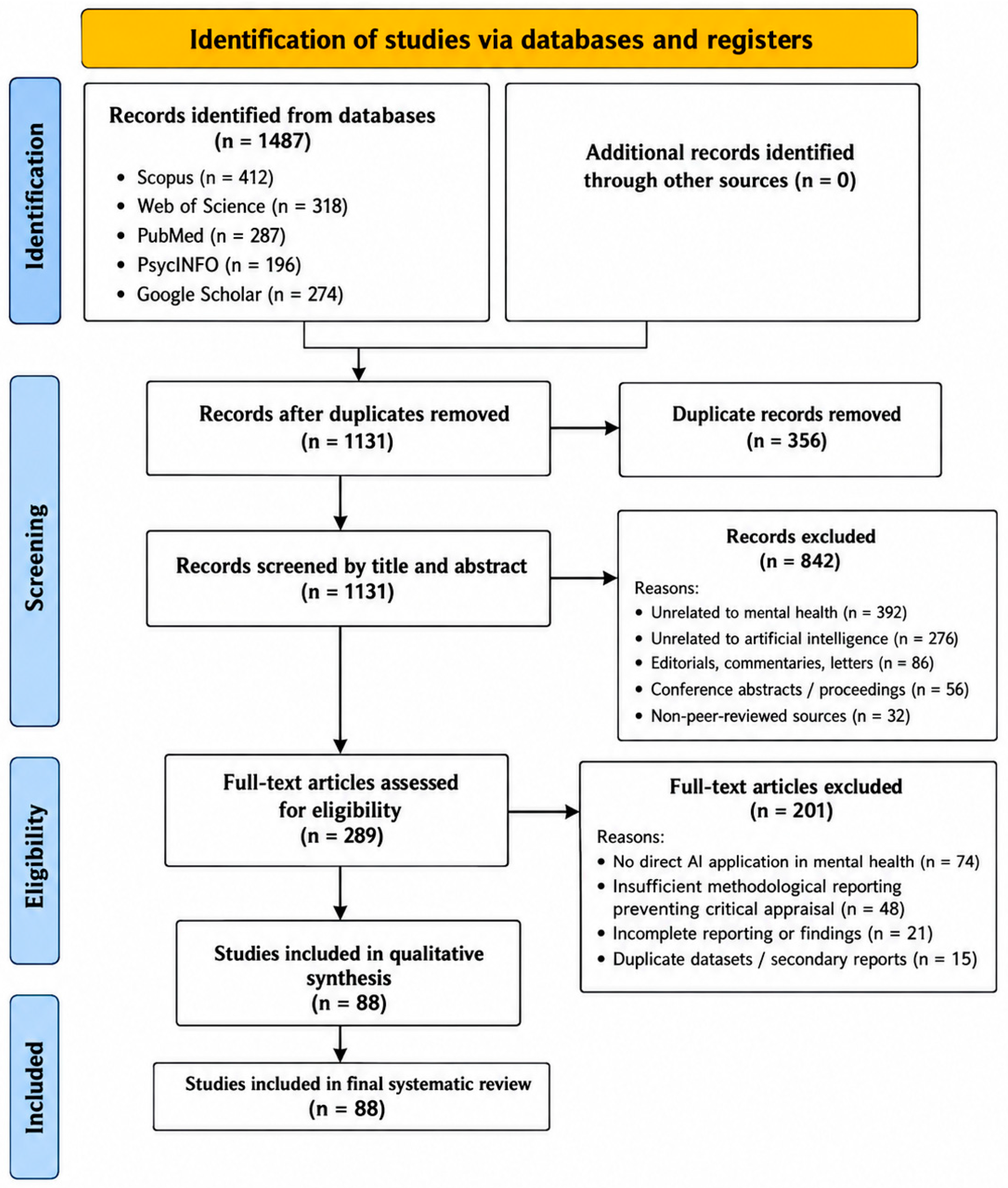
3.1. Study Selection Results
3.2. Quality Assessment
3.3. Characteristics of Included Studies
3.4. AI Applications in Clinical Practice
3.5. AI in Educational Transformation and Professional Training
3.6. Ethical Governance of Artificial Intelligence in Mental Health
4. Discussion
4.1. Interpretation of the Main Results
4.2. Clinical, Educational and Governance Implications
4.3. Interrelationships Among Clinical, Educational, and Governance Domains
4.4. Future Directions and Emerging Challenges
4.5. Theoretical and Practical Contributions
5. Strengths and Limitations
6. Conclusions
Supplementary Materials
Author Contributions
Funding
Institutional Review Board Statement
Informed Consent Statement
Data Availability Statement
Conflicts of Interest
Appendix A. Study Characteristics, AI Applications, Key Contributions, and Main Challenges of the Included Studies

| Authors (Ref.) | Domain | Study Design | AI Technology/Approach | Application Area | Key Contribution/Focus | Key Challenges/Concerns |
|---|---|---|---|---|---|---|
| Abd-Alrazaq et al. (2020) [24] | CP | Systematic Review | Chatbots | Mental health support | Improved depression and anxiety outcomes | Safety concerns |
| D’Alfonso (2020) [38] | CP | Review | Artificial Intelligence | Mental healthcare delivery | Improved access to services | Privacy concerns |
| Fernandes et al. (2020) [39] | CP | Review | Machine Learning | Precision psychiatry | Enhanced diagnostic potential | Validity concerns |
| Le Glaz et al. (2021) [25] | CP | Systematic Review | Natural Language Processing | Mental state detection | Accurate symptom monitoring | Data bias |
| Chekroud et al. (2021) [17] | CP | Machine Learning Study | Machine Learning | Treatment prediction | Improved treatment response prediction | Transparency issues |
| Garcia de la Garza et al. (2021) [23] | CP | Review | Machine Learning | Suicide risk prediction | Effective risk identification | Algorithmic bias |
| Koutsouleris et al. (2022) [10] | CP | Review | Machine Learning | Psychiatric diagnosis | Supported precision psychiatry | Clinical implementation barriers |
| Sun et al. (2023) [44] | CP | Review | Artificial Intelligence | Psychiatric applications | Improved diagnostic performance | Governance requirements |
| Zhong et al. (2024) [53] | CP | Systematic Review and Meta-Analysis | AI-Based Chatbots | Depressive and anxiety symptoms | Evaluated the short-term therapeutic effectiveness of AI chatbots | Heterogeneity, short follow-up, and limited long-term evidence |
| Casu et al. (2024) [54] | CP | Review | Artificial Intelligence | Mental health interventions | Positive intervention outcomes | Ethical oversight |
| Dehbozorgi et al. (2025) [45] | CP | Systematic Review | Artificial Intelligence | Mental health applications | Broad effectiveness across domains | Implementation challenges |
| Omarov et al. (2023) [47] | CP | Systematic Review | Chatbots | Mental healthcare | Promising clinical support | Safety and trust |
| Wang et al. (2025) [55] | EG | Systematic Review | Generative AI | Mental health support | Expanding applications | Ethical implications |
| Fanarioti & Karpouzis (2025) [56] | CP | Review | Artificial Intelligence | Future mental healthcare | Digital transformation opportunities | Governance concerns |
| Wimbarti et al. (2024) [57] | CP | Review | Artificial Intelligence | Self-diagnosis in mental health | Potential for screening | Risk of misuse |
| Ni & Jia (2025) [42] | CP | Scoping Review | Artificial Intelligence | Digital mental health interventions | Broad intervention coverage | Responsible implementation |
| Blease et al. (2019) [32] | CP | Review | Digital AI | Primary mental healthcare | Increased accessibility | Trust concerns |
| Birnbaum et al. (2020) [58] | CP | Feasibility Study/Original Research | Artificial Intelligence | Early psychosis detection | Early identification benefits | Privacy concerns |
| Bracher-Smith et al. (2021) [5] | CP | Review | Machine Learning | Mental health prediction | Strong predictive potential | Bias concerns |
| Brown & Halpern (2021) [59] | CP | Review | Artificial Intelligence | Empathy and mental health | Human–AI interaction insights | Ethical considerations |
| Buchanan et al. (2021) [36] | ET | Scoping Review | Artificial Intelligence | Nursing education | AI may transform nursing education | Educational preparedness |
| Charow et al. (2021) [6] | ET | Scoping Review | Artificial Intelligence | Health professional education | Need for AI competencies | Ethical literacy |
| Ouyang et al. (2022) [20] | ET | Systematic Review | Artificial Intelligence | Higher education | Improved learning outcomes | Data privacy |
| Gray et al. (2022) [60] | ET | Review | Artificial Intelligence | Health workforce education | Skills gap identified | Governance awareness |
| Mir et al. (2023) [61] | ET | Review | Artificial Intelligence | Medical education | Curriculum innovation | Responsible use |
| Kasneci et al. (2023) [16] | ET | Review | Generative AI | Higher education | Educational opportunities | Academic integrity |
| Forero-Corba & Bennasar (2024) [62] | ET | Systematic Review | AI/Machine Learning | Education | Improved educational outcomes | Transparency concerns |
| Tozsin et al. (2024) [27] | ET | Systematic Review | Artificial Intelligence | Medical education | Enhanced training effectiveness | Ethical implementation |
| Hallquist et al. (2025) [63] | ET | Systematic Review | Artificial Intelligence | Medical education | Improved assessment and teaching | Governance needs |
| Shishehgar et al. (2025) [46] | ET | Systematic Review | Artificial Intelligence | Health education | Positive student perceptions | Ethical concerns |
| Luo et al. (2025) [64] | ET | Systematic Review | Artificial Intelligence | Medical student readiness | Moderate readiness for AI integration among medical students | Anxiety concerns |
| Garzon et al. (2025) [28] | ET | Systematic Review | Artificial Intelligence | Education systems | Identified benefits and challenges of AI integration | Responsible implementation |
| Arar et al. (2025) [65] | ET | Systematic Review | Artificial Intelligence | Educational leadership | AI supports educational management and leadership | Governance requirements |
| Rangel-de Lazaro & Duart (2023) [26] | ET | Systematic Review | AI/Extended Reality (XR) | Online education | Improved student engagement | Ethical deployment |
| Gado et al. (2022) [43] | CP | Review | Artificial Intelligence | Mental health practice | Expanded clinical applications of AI | Ethical oversight |
| Parmigiani et al. (2022) [66] | CP | Systematic Review | Artificial Intelligence | Clinical decision support | Improved clinical decision-making | Accountability concerns |
| Rogan et al. (2024) [67] | CP | Systematic Review with Meta-Synthesis | Passive Sensing, AI, Machine Learning | Mental health monitoring | Identified implementation facilitators and barriers from clinicians’ perspectives | Data privacy, clinician acceptance, workflow integration, governance |
| Gooding & Kariotis (2021) [1] | EG | Scoping Review | Artificial Intelligence | Mental health regulation | Identified legal and ethical gaps | Governance framework needed |
| Ienca & Ignatiadis (2020) [34] | EG | Review | Artificial Intelligence | Clinical neuroscience | Documented ethical challenges | Accountability concerns |
| Walsh et al. (2020) [7] | EG | Review | Algorithms | Algorithmic decision-making | Identified bias as a major risk | Fairness concerns |
| Fiske et al. (2020) [29] | EG | Review | Artificial Intelligence | Healthcare ethics | Proposed ethical principles for AI | Governance and trust |
| Jacobson et al. (2020) [68] | EG | Review | Artificial Intelligence | Mental healthcare | Highlighted ethical dilemmas | Transparency concerns |
| Reddy et al. (2020) [30] | EG | Governance Review | Artificial Intelligence | Healthcare governance | Proposed governance model | Regulatory oversight |
| Gerke et al. (2020) [69] | EG | Review | Artificial Intelligence | AI-driven healthcare | Identified legal and ethical risks | Liability issues |
| Char et al. (2020) [70] | EG | Review | Machine Learning | Healthcare applications | Recommended ethical safeguards | Responsible deployment |
| Mörch et al. (2020) [71] | EG | Framework Study | Artificial Intelligence | Suicide prevention | Proposed ethical checklist | Governance standards |
| Straw & Callison-Burch (2020) [72] | EG | Review | Artificial Intelligence | Algorithmic fairness | Recommended bias mitigation strategies | Equity concerns |
| Crossnohere et al. (2022) [73] | EG | Literature Review and Content Analysis | Artificial Intelligence | AI governance frameworks | Frameworks support responsible AI implementation | Ethical compliance |
| Prakash et al. (2022) [74] | EG | Scoping Review | Artificial Intelligence | Healthcare ethics | Identified multiple ethical challenges | Governance gaps |
| Rubeis (2022) [75] | EG | Review | AI & Big Data | Mental healthcare | Discussed ethical implications of intelligent health systems | Privacy and autonomy |
| Salah et al. (2024) [76] | EG | Review | GPT/Large Language Models | Cognitive and mental health impacts | Identified emerging opportunities and risks | Ethical governance required |
| Tavory (2024) [77] | EG | Review | Artificial Intelligence | Mental health regulation | Proposed an ethics-of-care perspective | Regulatory oversight |
| Saeidnia et al. (2024) [31] | EG | Review | Artificial Intelligence | Mental health interventions | Emphasized responsible implementation | Ethical safeguards |
| Ortega-Bolaños et al. (2024) [78] | EG | Systematic Review | Artificial Intelligence | Ethical assessment tools | Identified frameworks for AI evaluation | Responsible AI development |
| Batool et al. (2025) [79] | EG | Systematic Review | Artificial Intelligence | AI governance | Synthesized governance mechanisms | Responsible AI principles |
| Robles & Mallinson (2025) [80] | EG | Systematic Review | Artificial Intelligence | Public governance | Proposed unified governance framework | Accountability |
| Ismail & Ahmad (2025) [81] | EG | Systematic Review | Artificial Intelligence | Ethical governance frameworks | Identified comprehensive governance models | Ethical implementation |
| Blease & Rodman (2025) [48] | EG | Ethical Review | Generative AI | Mental healthcare | Discussed ethical implications of generative AI | Patient trust and safety |
| Abusamra et al. (2025) [82] | EG | Systematic Review | Artificial Intelligence | Pediatric medicine | Identified ethical and practical implications | Governance requirements |
| Vilaza & McCashin (2021) [83] | EG | Review | AI Chatbots | CBT and mental health | Evaluated chatbot-supported CBT | Governance and accountability |
| Murphy et al. (2021) [84] | EG | Scoping Review | Artificial Intelligence | Healthcare ethics | Identified broad ethical themes in AI-enabled healthcare | Equity and justice |
| Yangi et al. (2025) [85] | EG | Review | ChatGPT | Medicine and healthcare | Summarized benefits and limitations of ChatGPT | Ethical risk management |
| Chandler (2020) [86] | CP | Review | Artificial Intelligence | Mental healthcare innovation | AI supports transformation of mental health services | Ethical oversight |
| Boucher et al. (2021) [4] | CP | Review | Chatbots | Digital mental health interventions | Positive outcomes of chatbot-based interventions | Privacy concerns |
| Shatte et al. (2019) [87] | CP | Systematic Review | Machine Learning | Mental health prediction | Demonstrated predictive capability of ML models | Bias concerns |
| Mohr et al. (2021) [40] | CP | Review | Digital Mental Health | Treatment delivery | Technology supports mental healthcare pathways | Ethical implementation |
| Singhal et al. (2023) [51] | CP | Review | Large Language Models | Mental healthcare support | Described potential applications of LLMs in assessment and support | Validation and implementation challenges |
| Chivilgina et al. (2020) [88] | CP | Systematic Review | mHealth & Artificial Intelligence | Schizophrenia management | Mobile AI tools improve monitoring | Privacy concerns |
| Chivilgina et al. (2021) [89] | CP | Review | Digital Technologies | Schizophrenia care | Improved disease management | Ethical considerations |
| Graham et al. (2025) [9] | EG | Commentary Review | Digital Mental Health | Service advocacy | Emphasized equity and accessibility | Safe implementation |
| Jermutus et al. (2022) [90] | CP | Review | Artificial Intelligence | Mental health analytics | Improved symptom monitoring | Data governance |
| Zhou et al. (2022) [91] | CP | Review | Artificial Intelligence | Psychological diagnosis and intervention | Promising clinical applications | Ethical deployment |
| Torous et al. (2021) [3] | CP | Review | Digital AI | Digital psychiatry | Expanded access and continuous monitoring | Regulation and governance |
| Coghlan et al. (2023) [92] | EG | Review | AI Chatbots | Mental health chatbots | Examined ethical implications of chatbot use | Trust, safety, and accountability |
| Demszky et al. (2023) [93] | CP | Review | Large Language Models | Psychology and mental health research | LLMs support psychological assessment and research | Validity and reliability concerns |
| Denecke et al. (2021) [94] | CP | Usability Study | Chatbot | Emotional regulation support | Positive usability and emotional support | User engagement and safety |
| Garcia-Martínez et al. (2023) [23] | CP | Review | Artificial Intelligence | Mental healthcare applications | Expanded opportunities for AI-enabled care | Implementation challenges |
| Garg et al. (2023) [95] | CP | Systematic Review | ChatGPT | Clinical care and medical research | Potential applications in diagnosis and treatment | Accuracy and ethical concerns |
| Garriga et al. (2022) [96] | CP | Original Research/Prospective Validation Study | AI & Predictive Analytics | Psychiatry and mental healthcare | Improved predictive decision-making | Data governance concerns |
| Chelli et al. (2025) [97] | CP | Review | ChatGPT (Hallucination & Reference Accuracy) | Mental health applications | Evaluated potential of LLMs in mental healthcare | Bias and responsible use |
| Lee et al. (2021) [2] | CP | Review | Artificial Intelligence | Mental healthcare delivery | AI supports diagnosis and clinical decision-making | Clinical implementation barriers |
| Lomis et al. (2021) [98] | ET | Perspective/Expert Commentary | Artificial Intelligence | Health professions education | Highlighted need for AI literacy | Curriculum integration challenges |
| Malgaroli et al. (2023) [99] | CP | Review | Artificial Intelligence | Digital mental health | Expanded opportunities for digital mental healthcare | Evidence and governance concerns |
| Mesko & Topol (2023) [50] | EG | Review | Large Language Models | Healthcare governance | Highlighted need for regulatory oversight of LLMs | Accountability and safety |
| Obradovich et al. (2024) [100] | CP | Review | Large Language Models | Psychiatry | Identified opportunities for AI-assisted psychiatric care | Risk management requirements |
| Panesar (2023) [101] | CP | Review | Artificial Intelligence & Machine Learning | Precision mental health diagnostics | Enhanced diagnostic and predictive capabilities | Model transparency concerns |
| Scholich et al. (2025) [102] | CP | Comparative Study | Chatbots | Mental health support | Compared therapists with AI chatbots | Trust and effectiveness concerns |
| Welch et al. (2022) [18] | CP | Scoping Review | Mobile AI & Wearables | Child and adolescent psychiatry | Potential for monitoring and intervention | Privacy and ethical concerns |
References
- Gooding, P.; Kariotis, T. Ethics and law in research on algorithmic and data-driven technology in mental health care: Scoping review. JMIR Ment. Health 2021, 8, e24668. [Google Scholar] [CrossRef] [Scilit]
- Lee, E.E.; Torous, J.; De Choudhury, M.; Depp, C.A.; Graham, S.A.; Kim, H.-C.; Paulus, M.P.; Krystal, J.H.; Jeste, D.V. Artificial intelligence for mental health care: Clinical applications, barriers, facilitators, and artificial wisdom. Biol. Psychiatry Cogn. Neurosci. Neuroimaging 2021, 6, 856–864. [Google Scholar] [CrossRef] [Scilit]
- Torous, J.; Bucci, S.; Bell, I.H.; Kessing, L.V.; Faurholt-Jepsen, M.; Whelan, P.; Carvalho, A.F.; Keshavan, M.; Linardon, J.; Firth, J. The growing field of digital psychiatry: Current evidence and the future of apps, social media, chatbots, and virtual reality. World Psychiatry 2021, 20, 318–335. [Google Scholar] [CrossRef] [Scilit]
- Boucher, E.M.; Harake, N.R.; Ward, H.E.; Stoeckl, S.E.; Vargas, J.; Minkel, J.; Parks, A.C.; Zilca, R. Artificially intelligent chatbots in digital mental health interventions: A review. Expert Rev. Med. Devices 2021, 18, 37–49. [Google Scholar] [CrossRef] [Scilit] [PubMed]
- Bracher-Smith, M.; Crawford, K.; Escott-Price, V. Machine learning for genetic prediction of psychiatric disorders: A systematic review. Mol. Psychiatry 2021, 26, 70–79. [Google Scholar] [CrossRef] [Scilit]
- Charow, R.; Jeyakumar, T.; Younus, S.; Dolatabadi, E.; Salhia, M.; Al-Mouaswas, D.; Anderson, M.; Balakumar, S.; Clare, M.; Dhalla, A.; et al. Artificial intelligence education programs for health care professionals: Scoping review and environmental scan. JMIR Med. Educ. 2021, 7, e31043. [Google Scholar] [CrossRef] [Scilit]
- Walsh, C.G.; Chaudhry, B.; Dua, P.; Goodman, K.W.; Kaplan, B.; Kavuluru, R.; Solomonides, A.; Subbian, V. Stigma, biomarkers, and algorithmic bias: Recommendations for precision behavioral health with artificial intelligence. JAMIA Open 2020, 3, 9–15. [Google Scholar] [CrossRef] [Scilit]
- Jobin, A.; Ienca, M.; Vayena, E. The global landscape of AI ethics guidelines. Nat. Mach. Intell. 2019, 1, 389–399. [Google Scholar] [CrossRef] [Scilit]
- Graham, A.K.; Ortega, A.; Rooper, I.R.; Smith, A.C. Mental Health Clinicians as Advocates for Effective, Equitable, Accessible, and Safe Digital Mental Health Services. Focus 2025, 23, 307–313. [Google Scholar] [CrossRef] [Scilit]
- Koutsouleris, N.; Hauser, T.U.; Skvortsova, V.; De Choudhury, M. From promise to practice: Towards the realisation of AI-informed mental health care. Lancet Digit. Health 2022, 4, E829–E840. [Google Scholar] [CrossRef] [Scilit]
- Bender, E.M.; Gebru, T.; McMillan-Major, A.; Shmitchell, S. On the Dangers of Stochastic Parrots: Can Language Models Be Too Big? In Proceedings of the 2021 ACM Conference on Fairness, Accountability, and Transparency; Association for Computing Machinery: New York, NY, USA, 2021; pp. 610–623. [Google Scholar] [CrossRef] [Scilit]
- Omiyefa, S. Artificial Intelligence and Machine Learning in Precision Mental Health Diagnostics and Predictive Treatment Models. Int. J. Res. Publ. Rev. 2025, 6, 85–99. [Google Scholar] [CrossRef] [Scilit]
- Tangsrivimol, J.A.; Darzidehkalani, E.; Virk, H.U.H.; Wang, Z.; Egger, J.; Wang, M.; Hacking, S.; Glicksberg, B.S.; Strauss, M.; Krittanawong, C. Benefits, limits, and risks of ChatGPT in medicine. Front. Artif. Intell. 2025, 8, 1518049. [Google Scholar] [CrossRef] [Scilit]
- Guo, Z.; Lai, A.; Thygesen, J.H.; Farrington, J.; Keen, T.; Li, K. Large Language Models for Mental Health Applications: Systematic Review. JMIR Ment. Health 2024, 11, e57400. [Google Scholar] [CrossRef] [Scilit]
- Graham, S.; Depp, C.; Lee, E.E.; Nebeker, C.; Tu, X.; Kim, H.C.; Jeste, D.V. Artificial intelligence for mental health and mental illnesses: An overview. Curr. Psychiatry Rep. 2019, 21, 116. [Google Scholar] [CrossRef] [Scilit]
- Kasneci, E.; Sessler, K.; Küchemann, S.; Bannert, M.; Dementieva, D.; Fischer, F.; Gasser, U.; Groh, G.; Günnemann, S.; Hüllermeier, E.; et al. ChatGPT for good? On opportunities and challenges of large language models for education. Learn. Individ. Differ. 2023, 103, 102274. [Google Scholar] [CrossRef] [Scilit]
- Chekroud, A.M.; Bondar, J.; Delgadillo, J.; Doherty, G.; Wasil, A.; Fokkema, M.; Cohen, Z.D.; Belgrave, D.; DeRubeis, R.; Iniesta, R.; et al. The promise of machine learning in predicting treatment outcomes in psychiatry. World Psychiatry 2021, 20, 154–170. [Google Scholar] [CrossRef] [Scilit]
- Welch, V.; Wy, T.J.; Ligezka, A.; Hassett, L.C.; Croarkin, P.E.; Athreya, A.P.; Romanowicz, M. Use of Mobile and Wearable Artificial Intelligence in Child and Adolescent Psychiatry: Scoping Review. J. Med. Internet Res. 2022, 24, e33560. [Google Scholar] [CrossRef] [Scilit]
- Floridi, L.; Cowls, J.; Beltrametti, M.; Chatila, R.; Chazerand, P.; Dignum, V.; Luetge, C.; Madelin, R.; Pagallo, U.; Rossi, F.; et al. AI4People—An ethical framework for a good AI society: Opportunities, risks, principles, and recommendations. Minds Mach. 2018, 28, 689–707. [Google Scholar] [CrossRef] [Scilit] [PubMed]
- Ouyang, F.; Zheng, L.; Jiao, P. Artificial intelligence in online higher education: A systematic review of empirical research from 2011 to 2020. Educ. Inf. Technol. 2022, 27, 7893–7925. [Google Scholar] [CrossRef] [Scilit]
- Page, M.J.; McKenzie, J.E.; Bossuyt, P.M.; Boutron, I.; Hoffmann, T.C.; Mulrow, C.D.; Shamseer, L.; Tetzlaff, J.M.; Akl, E.A.; Brennan, S.E.; et al. The PRISMA 2020 statement: An updated guideline for reporting systematic reviews. BMJ 2021, 372, n71. [Google Scholar] [CrossRef] [Scilit] [PubMed]
- Khatatbeh, Y.; Al-Saliti, R.A.M.N.; Alzahrain, B.S.; Tashtoush, M.A. Cyberchondria as a Digital Predictor of Illness Anxiety Disorder among University Students in Jordan: Evidence from Structural Equation Modeling. J. Stat. Appl. Probab. 2026, 15, 687–700. [Google Scholar] [CrossRef] [Scilit]
- García de la Garza, A.; Blanco, C.; Olfson, M.; Wall, M.M. Identification of suicide attempt risk factors in a National US Survey using machine learning. JAMA Psychiatry 2021, 78, 398–406. [Google Scholar] [CrossRef] [Scilit]
- Abd-Alrazaq, A.A.; Rababeh, A.; Alajlani, M.; Bewick, B.M.; Househ, M. Effectiveness and safety of using chatbots to improve mental health: Systematic review and meta-analysis. J. Med. Internet Res. 2020, 22, e16021. [Google Scholar] [CrossRef] [Scilit] [PubMed]
- Le Glaz, A.; Haralambous, Y.; Kim-Dufor, D.-H.; Lenca, P.; Billot, R.; Ryan, T.C.; Marsh, J.; DeVylder, J.; Walter, M.; Berrouiguet, S.; et al. Machine learning and natural language processing in mental health: Systematic review. J. Med. Internet Res. 2021, 23, e15708. [Google Scholar] [CrossRef] [Scilit]
- Rangel-de Lazaro, G.; Duart, J.M. You Can Handle, You Can Teach It: Systematic Review on the Use of Extended Reality and Artificial Intelligence Technologies for Online Higher Education. Sustainability 2023, 15, 3507. [Google Scholar] [CrossRef] [Scilit]
- Tozsin, A.; Ucmak, H.; Soyturk, S.; Aydin, A.; Gozen, A.S.; Al Fahim, M.; Güven, S.; Ahmed, K. The Role of Artificial Intelligence in Medical Education: A Systematic Review. Surg. Innov. 2024, 31, 415–423. [Google Scholar] [CrossRef] [Scilit]
- Garzon, J.; Patino, E.; Marulanda, C. Systematic review of artificial intelligence in education: Trends, benefits, and challenges. Multimodal Technol. Interact. 2025, 9, 84. [Google Scholar] [CrossRef] [Scilit]
- Fiske, A.; Henningsen, P.; Buyx, A. The Implications of Embodied Artificial Intelligence in Mental Healthcare for Digital Wellbeing; Springer: Berlin/Heidelberg, Germany, 2020; pp. 119–141. [Google Scholar] [CrossRef] [Scilit]
- Reddy, S.; Allan, S.; Coghlan, S.; Cooper, P. A governance model for the application of AI in health care. J. Am. Med. Inform. Assoc. 2020, 27, 491–497. [Google Scholar] [CrossRef] [Scilit]
- Saeidnia, H.R.; Hashemi Fotami, S.G.; Lund, B.; Ghiasi, N. Ethical Considerations in Artificial Intelligence Interventions for Mental Health and Well-Being: Ensuring Responsible Implementation and Impact. Soc. Sci. 2024, 13, 381. [Google Scholar] [CrossRef] [Scilit]
- Blease, C.; Kaptchuk, T.J.; Bernstein, M.H.; Mandl, K.D.; Halamka, J.D.; DesRoches, C.M. Artificial intelligence and the future of primary care: Exploratory qualitative study of UK general practitioners’ views. J. Med. Internet Res. 2019, 21, e12802. [Google Scholar] [CrossRef] [Scilit]
- Vaidyam, A.N.; Wisniewski, H.; Halamka, J.D.; Keshavan, M.S.; Torous, J. Chatbots and conversational agents in mental health: A review of the psychiatric landscape. Can. J. Psychiatry 2019, 64, 456–464. [Google Scholar] [CrossRef] [Scilit]
- Ienca, M.; Ignatiadis, K. Artificial intelligence in clinical neuroscience: Methodological and ethical challenges. AJOB Neurosci. 2020, 11, 77–87. [Google Scholar] [CrossRef] [Scilit]
- Jiang, F.; Jiang, Y.; Zhi, H.; Dong, Y.; Li, H.; Ma, S.; Wang, Y.; Dong, Q.; Shen, H.; Wang, Y. Artificial intelligence in healthcare: Past, present and future. Stroke Vasc. Neurol. 2017, 2, 230–243. [Google Scholar] [CrossRef] [Scilit]
- Buchanan, C.; Howitt, M.L.; Wilson, R.; Booth, R.G.; Risling, T.; Bamford, M. Predicted influences of artificial intelligence on nursing education: Scoping review. JMIR Nurs. 2021, 4, e23933. [Google Scholar] [CrossRef] [Scilit]
- Mittelstadt, B.D. Principles alone cannot guarantee ethical AI. Nat. Mach. Intell. 2019, 1, 501–507. [Google Scholar] [CrossRef] [Scilit]
- D’Alfonso, S. AI in mental health. Curr. Opin. Psychol. 2020, 36, 112–117. [Google Scholar] [CrossRef] [Scilit] [PubMed]
- Fernandes, B.S.; Karmakar, C.; Tamouza, R.; Tran, T.; Yearwood, J.; Hamdani, N.; Laouamri, H.; Richard, J.-R.; Yolken, R.; Berk, M.; et al. Precision psychiatry with immunological and cognitive biomarkers: A multi-domain prediction for the diagnosis of bipolar disorder or schizophrenia using machine learning. Transl. Psychiatry 2020, 10, 162. [Google Scholar] [CrossRef] [Scilit]
- Mohr, D.C.; Riper, H.; Schueller, S.M. A solution-focused research approach to achieve an implementable revolution in digital mental health. JAMA Psychiatry 2021, 75, 113–114. [Google Scholar] [CrossRef] [Scilit]
- Vieira, S.; Pinaya, W.H.L.; Mechelli, A. Using deep learning to investigate the neuroimaging correlates of psychiatric and neurological disorders: Methods and applications. Neurosci. Biobehav. Rev. 2017, 74, 58–75. [Google Scholar] [CrossRef] [Scilit] [PubMed]
- Ni, Y.; Jia, F. A scoping review of AI-driven digital interventions in mental health care: Mapping applications across screening, support, monitoring, prevention, and clinical education. Healthcare 2025, 13, 1205. [Google Scholar] [CrossRef] [Scilit]
- Gado, S.; Kempen, R.; Lingelbach, K.; Bipp, T. Artificial intelligence in psychology: How can we enable psychology students to accept and use artificial intelligence? Psychol. Learn. Teach. 2022, 21, 37–56. [Google Scholar] [CrossRef] [Scilit]
- Sun, J.; Dong, Q.-X.; Wang, S.-W.; Zheng, Y.-B.; Liu, X.-X.; Lu, T.-S.; Yuan, K.; Shi, J.; Hu, B.; Lu, L.; et al. Artificial intelligence in psychiatry research, diagnosis, and therapy. Asian J. Psychiatry 2023, 87, 103705. [Google Scholar] [CrossRef] [Scilit]
- Dehbozorgi, R.; Zangeneh, S.; Khooshab, E.; Nia, D.H.; Hanif, H.R.; Samian, P.; Yousefi, M.; Hashemi, F.H.; Vakili, M.; Jamalimoghadam, N.; et al. The application of artificial intelligence in the field of mental health: A systematic review. BMC Psychiatry 2025, 25, 132. [Google Scholar] [CrossRef] [Scilit]
- Shishehgar, S.; Murray-Parahi, P.; Alsharaydeh, E.; Mills, S.; Liu, X. Artificial intelligence in health education and practice: A systematic review of health students’ and academics’ knowledge, perceptions and experiences. Int. Nurs. Rev. 2025, 72, e70045. [Google Scholar] [CrossRef] [Scilit]
- Omarov, B.; Narynov, S.; Zhumanov, Z. Artificial intelligence-enabled chatbots in mental health: A systematic review. Comput. Mater. Contin. 2023, 74, 5105–5122. [Google Scholar] [CrossRef] [Scilit]
- Blease, C.; Rodman, A. Generative Artificial Intelligence in Mental Healthcare: An Ethical Evaluation. Curr. Treat. Options Psychiatry 2025, 12, 5. [Google Scholar] [CrossRef] [Scilit]
- Bommasani, R.; Hudson, D.A.; Adeli, E.; Altman, R.; Arora, S.; von Arx, S.; Bernstein, M.S.; Bohg, J.; Bosselut, A.; Brunskill, E.; et al. On the Opportunities and Risks of Foundation Models. arXiv 2021, arXiv:2108.07258. [Google Scholar] [CrossRef] [Scilit]
- Meskó, B.; Topol, E.J. The imperative for regulatory oversight of large language models (or generative AI) in healthcare. npj Digit. Med. 2023, 6, 120. [Google Scholar] [CrossRef] [Scilit] [PubMed]
- Singhal, K.; Azizi, S.; Tu, T.; Mahdavi, S.S.; Wei, J.; Chung, H.W.; Scales, N.; Tanwani, A.; Cole-Lewis, H.; Pfohl, S.; et al. Large language models encode clinical knowledge. Nature 2023, 620, 172–180. [Google Scholar] [CrossRef] [Scilit] [PubMed]
- Thirunavukarasu, A.J.; Ting, D.S.J.; Elangovan, K.; Gutierrez, L.; Tan, T.F.; Ting, D.S.W. Large language models in medicine. Nat. Med. 2023, 29, 1930–1940. [Google Scholar] [CrossRef] [Scilit] [PubMed]
- Zhong, W.; Luo, J.; Zhang, H. The therapeutic effectiveness of artificial intelligence-based chatbots in alleviation of depressive and anxiety symptoms in short-course treatments: A systematic review and meta-analysis. J. Affect. Disord. 2024, 356, 459–469. [Google Scholar] [CrossRef] [Scilit]
- Casu, M.; Triscari, S.; Battiato, S.; Guarnera, L.; Caponnetto, P. AI chatbots for mental health: A scoping review of effectiveness, feasibility, and applications. Appl. Sci. 2024, 14, 5889. [Google Scholar] [CrossRef] [Scilit]
- Wang, X.; Zhou, Y.; Zhou, G. The application and ethical implication of generative AI in mental health: Systematic review. JMIR Ment. Health 2025, 12, e70610. [Google Scholar] [CrossRef] [Scilit]
- Fanarioti, A.K.; Karpouzis, K. Artificial intelligence and the future of mental health in a digitally transformed world. Computers 2025, 14, 259. [Google Scholar] [CrossRef] [Scilit]
- Wimbarti, S.; Kairupan, B.R.; Tallei, T.E. Critical review of self-diagnosis of mental health conditions using artificial intelligence. Int. J. Ment. Health Nurs. 2024, 33, 344–358. [Google Scholar] [CrossRef] [Scilit]
- Birnbaum, M.L.; Kulkarni, P.P.; Van Meter, A.; Chen, V.; Rizvi, A.F.; Arenare, E.; De Choudhury, M.; Kane, J.M. Utilizing machine learning on internet search activity to support the diagnostic process and relapse detection in young individuals with early psychosis: Feasibility study. JMIR Ment. Health 2020, 7, e19348. [Google Scholar] [CrossRef] [Scilit]
- Brown, J.E.H.; Halpern, J. AI chatbots cannot replace human interactions in the pursuit of more inclusive mental healthcare. Soc. Sci. Med. Ment. Health 2021, 1, 100012. [Google Scholar] [CrossRef] [Scilit]
- Gray, K.; Slavotinek, J.; Dimaguila, G.L.; Choo, D. Artificial intelligence education for the health workforce: Expert survey of approaches and needs. JMIR Med. Educ. 2022, 8, e35223. [Google Scholar] [CrossRef] [Scilit]
- Mir, M.M.; Mir, G.M.; Raina, N.T.; Mir, S.M.; Miskeen, E.; Alharthi, M.H.; Alamri, M.M.S. Application of Artificial Intelligence in Medical Education: Current Scenario and Future Perspectives. J. Adv. Med. Educ. Prof. 2023, 11, 133–140. [Google Scholar] [CrossRef] [Scilit]
- Forero-Corba, W.; Bennasar, F.N. Techniques and Applications of Machine Learning and Artificial Intelligence in Education: A Systematic Review. Educ. Inf. Technol. 2024, 29, 1759–1793. [Google Scholar] [CrossRef] [Scilit]
- Hallquist, E.; Gupta, I.; Montalbano, M.; Loukas, M. Applications of Artificial Intelligence in Medical Education: A Systematic Review. Cureus 2025, 17, e79878. [Google Scholar] [CrossRef] [Scilit]
- Luo, J.; Peng, Q.; Cao, H.; Li, W.; Tan, S. Medical undergraduate students’ readiness and anxiety toward artificial intelligence: A systematic review and meta-analysis. BMC Med. Educ. 2025, 26, 44. [Google Scholar] [CrossRef] [Scilit]
- Arar, K.; Tili, A.; Schunka, L.; Salha, S.; Saiti, A. Reimagining educational leadership and management through artificial intelligence: An Integrative Systematic Review. Leadersh. Policy Sch. 2025, 24, 4–26. [Google Scholar] [CrossRef] [Scilit]
- Parmigiani, G.; Barchielli, B.; Casale, S.; Mancini, T.; Ferracuti, S. The impact of machine learning in predicting risk of violence: A systematic review. Front. Psychiatry 2022, 13, 1015914. [Google Scholar] [CrossRef] [Scilit]
- Rogan, J.; Bucci, S.; Firth, J. Health care professionals’ views on the use of passive sensing, AI, and machine learning in mental health care: Systematic review with meta-synthesis. JMIR Ment. Health 2024, 11, e49577. [Google Scholar] [CrossRef] [Scilit]
- Jacobson, N.C.; Bentley, K.H.; Walton, A.; Wang, S.B.; Fortgang, R.G.; Millner, A.J.; Coombs, G.; Rodman, A.M.; Coppersmith, D.D.L. Ethical dilemmas posed by mobile health and machine learning in psychiatry research. Bull. World Health Organ. 2020, 98, 270–276. [Google Scholar] [CrossRef] [Scilit]
- Gerke, S.; Minssen, T.; Cohen, G.I. Ethical and legal challenges of artificial intelligence-driven healthcare. npj Digit. Med. 2020, 3, 93. [Google Scholar] [CrossRef] [Scilit]
- Char, D.S.; Abràmoff, M.D.; Feudtner, C. Identifying ethical considerations for machine learning healthcare applications. Am. J. Bioeth. 2020, 20, 7–17. [Google Scholar] [CrossRef] [Scilit]
- Mörch, C.-M.; Gupta, A.; Mishara, B.L. Canada protocol: An ethical checklist for the use of artificial intelligence in suicide prevention and mental health. Artif. Intell. Med. 2020, 108, 101934. [Google Scholar] [CrossRef] [Scilit]
- Straw, I.; Callison-Burch, C. Artificial Intelligence in mental health and the biases of language based models. PLoS ONE 2020, 15, e0240376. [Google Scholar] [CrossRef] [Scilit]
- Crossnohere, N.L.; Elsaid, M.; Paskett, J.; Bose-Brill, S.; Bridges, J.F. Guidelines for artificial intelligence in medicine: Literature review and content analysis of frameworks. J. Med. Internet Res. 2022, 24, e36823. [Google Scholar] [CrossRef] [Scilit]
- Prakash, S.; Balaji, J.N.; Joshi, A.; Surapaneni, K.M. Ethical conundrums in the application of artificial intelligence (AI) in healthcare: A scoping review of reviews. J. Pers. Med. 2022, 12, 1914. [Google Scholar] [CrossRef] [Scilit]
- Rubeis, G. IHealth: The Ethics of Artificial Intelligence and Big Data in Mental Healthcare. Internet Interv. 2022, 28, 100518. [Google Scholar] [CrossRef] [Scilit]
- Salah, M.; Abdelfattah, F.; Al Halbusi, H. The good, the bad, and the GPT: Reviewing the impact of generative artificial intelligence on psychology. Curr. Opin. Psychol. 2024, 59, 101872. [Google Scholar] [CrossRef] [Scilit]
- Tavory, T. Regulating AI in Mental Health: Ethics of Care Perspective. JMIR Ment. Health 2024, 11, e58493. [Google Scholar] [CrossRef] [Scilit]
- Galeano, J.; Ortega-Bolaños, R.; Bernal-Salcedo, J.; Ortiz, M.G.; Ruz, G.A.; Tabares-Soto, R. Applying the Ethics of AI: A Systematic Review of Tools for Developing and Assessing AI-Based Systems. Artif. Intell. Rev. 2024, 57, 110. [Google Scholar] [CrossRef] [Scilit]
- Batool, A.; Zowghi, D.; Bano, M. AI Governance: A Systematic Literature Review. AI Ethics 2025, 5, 3265–3279. [Google Scholar] [CrossRef] [Scilit]
- Robles, P.; Mallinson, D.J. Advancing AI Governance with a Unified Theoretical Framework: A Systematic Review. Perspect. Public Manag. Gov. 2025, 8, 213–227. [Google Scholar] [CrossRef] [Scilit]
- Ismail, O.; Ahmad, N. Ethical and Governance Frameworks for Artificial Intelligence: A Systematic Literature Review. Int. J. Interact. Mob. Technol. 2025, 19, 121–136. [Google Scholar] [CrossRef] [Scilit]
- Abusamra, H.N.J.; Ali, S.H.M.; Elhussien, W.A.K.; Mirghani, A.M.A.; Ahmed, A.A.A.; Ibrahim, M.E.A. Ethical and practical considerations of artificial intelligence in pediatric medicine: A systematic review. Cureus 2025, 17, e79024. [Google Scholar] [CrossRef] [Scilit]
- Vilaza, G.N.; McCashin, D. Is the Automation of Digital Mental Health Ethical? Applying an Ethical Framework to Chatbots for Cognitive Behaviour Therapy. Front. Digit. Health 2021, 12, 6897336. [Google Scholar] [CrossRef] [Scilit]
- Murphy, K.; Di Ruggiero, E.; Upshur, R.; Willison, D.J.; Malhotra, N.; Cai, J.C.; Malhotra, N.; Lui, V.; Gibson, J. Artificial Intelligence for Good Health: A Scoping Review of the Ethics Literature. BMC Med. Ethics 2021, 22, 14. [Google Scholar] [CrossRef] [Scilit]
- Yangi, K.; On, T.J.; Xu, Y.; Gholami, A.S.; Hong, J.; Reed, A.G.; Puppalla, P.; Chen, J.; Tangsrivimol, J.A.; Li, B.; et al. Artificial intelligence integration in surgery through hand and instrument tracking: A systematic literature review. Front. Surg. 2025, 12, 1528362. [Google Scholar] [CrossRef] [Scilit]
- Chandler, C.; Foltz, P.W.; Elvevåg, B. Using Machine Learning in Psychiatry: The Need to Establish a Framework That Nurtures Trustworthiness. Schizophr. Bull. 2020, 46, 11–14. [Google Scholar] [CrossRef] [Scilit]
- Shatte, A.B.R.; Hutchinson, D.M.; Teague, S.J. Machine learning in mental health: A scoping review of methods and applications. Psychol. Med. 2019, 49, 1426–1448. [Google Scholar] [CrossRef] [Scilit]
- Chivilgina, O.; Wangmo, T.; Elger, B.S.; Heinrich, T.; Jotterand, F. MHealth for Schizophrenia Spectrum Disorders Management: A Systematic Review. Int. J. Soc. Psychiatry 2020, 66, 642–665. [Google Scholar] [CrossRef] [Scilit]
- Chivilgina, O.; Elger, B.S.; Jotterand, F. Digital Technologies for Schizophrenia Management: A Descriptive Review. Sci. Eng. Ethics 2021, 27, 25. [Google Scholar] [CrossRef] [Scilit]
- Jermutus, E.; Kneale, D.; Thomas, J.; Michie, S. Influences on User Trust in Healthcare Artificial Intelligence: A Systematic Review. Wellcome Open Res. 2022, 7, 65. [Google Scholar] [CrossRef] [Scilit]
- Zhou, S.; Zhao, J.; Zhang, L. Application of Artificial Intelligence on Psychological Interventions and Diagnosis: An Overview. Front. Psychiatry 2022, 13, 811665. [Google Scholar] [CrossRef] [Scilit]
- Coghlan, S.; Leins, K.; Sheldrick, M.; Cheong, M.; Gooding, P.; D’Alfonso, S. To Chat or Bot to Chat: Ethical Issues with Using Chatbots in Mental Health. Digit. Health 2023, 9, 20552076231183542. [Google Scholar] [CrossRef] [Scilit]
- Demszky, D.; Yang, D.; Yeager, D.S.; Bryan, C.J.; Clapper, M.; Chandhok, S.; Eichstaedt, J.C.; Hecht, C.; Jamieson, J.; Johnson, M.; et al. Using Large Language Models in Psychology. Nat. Rev. Psychol. 2023, 2, 688–701. [Google Scholar] [CrossRef] [Scilit]
- Denecke, K.; Vaaheesan, S.; Arulnathan, A. A Mental Health Chatbot for Regulating Emotions (SERMO): Concept and Usability Test. IEEE Trans. Emerg. Top. Comput. 2021, 9, 1170–1182. [Google Scholar] [CrossRef] [Scilit]
- Garg, R.K.; Urs, V.L.; Agrawal, A.A.; Chaudhary, S.K.; Paliwal, V.; Kar, S.K. Exploring the Role of ChatGPT in Patient Care (Diagnosis and Treatment) and Medical Research: A Systematic Review. Health Promot. Perspect. 2023, 13, 183–191. [Google Scholar] [CrossRef] [Scilit]
- Garriga, R.; Mas, J.; Abraha, S.; Nolan, J.; Harrison, O.; Tadros, G.; Matic, A. Machine learning model to predict mental health crises from electronic health records. Nat. Med. 2022, 28, 1240–1248. [Google Scholar] [CrossRef] [Scilit]
- Chelli, M.; Descamps, J.; Lavoué, V.; Trojani, C.; Azar, M.; Deckert, M.; Raynier, J.-L.; Clowez, G.; Boileau, P.; Ruetsch-Chelli, C. Hallucination Rates and Reference Accuracy of ChatGPT and Bard for Systematic Reviews: Comparative Analysis. J. Med. Internet Res. 2024, 26, e53164. [Google Scholar] [CrossRef] [Scilit] [PubMed]
- Lomis, K.; Jeffries, P.; Palatta, A.; Sage, M.; Sheikh, J.; Sheperis, C.; Whelan, A. Artificial intelligence for health professions educators. NAM Perspect. 2021, 2021, 10.31478/202109a. [Google Scholar] [CrossRef] [Scilit]
- Malgaroli, M.; Schultebraucks, K.; Zweerings, J.; Galatzer-Levy, I.R. Artificial Intelligence and Machine Learning in Mental Health Research: Current Evidence and Future Directions. Mol. Psychiatry 2023, 28, 5095–5112. [Google Scholar]
- Obradovich, N.; Khalsa, S.S.; Khan, W.U.; Suh, J.; Perlis, R.H.; Ajilore, O.A.; Paulus, M.P. Opportunities and Risks of Large Language Models in Psychiatry. npj Digit. Psychiatry Neurosci. 2024, 2, 8. [Google Scholar] [CrossRef] [Scilit]
- Panesar, A. Artificial intelligence and machine learning in precision health. In Precision Health and Artificial Intelligence: With Privacy, Ethics, Bias, Health Equity, Best Practices, and Case Studies; Springer: Berlin/Heidelberg, Germany, 2023; pp. 67–85. [Google Scholar] [CrossRef] [Scilit]
- Scholich, T.; Barr, M.; Stirman, S.W.; Raj, S. A Comparison of Responses From Human Therapists and Large Language Model–Based Chatbots to Assess Therapeutic Communication: Mixed Methods Study. JMIR Ment. Health 2025, 12, e69709. [Google Scholar] [CrossRef] [Scilit]

| Database | Coverage Area | Search Period | Search Date | Search Filters | Search Strategy |
|---|---|---|---|---|---|
| Scopus | Multidisciplinary scientific literature | January 2019–December 2025 | 31 December 2025 | English language, peer-reviewed articles, publication years (2019–2025) | Database-specific strategy adapted to Scopus indexing (see Supplementary Material S1). |
| Web of Science Core Collection | Multidisciplinary scientific literature | January 2019–December 2025 | 31 December 2025 | English language, peer-reviewed articles, publication years (2019–2025) | Database-specific strategy adapted to Web of Science indexing (see Supplementary Material S1). |
| PubMed/MEDLINE | Medicine, Psychiatry, Mental Health | January 2019–December 2025 | 31 December 2025 | English language, human studies where applicable, and publication years (2019–2025) | Database-specific strategy using MeSH terms and free-text keywords (see Supplementary Material S1). |
| PsycINFO | Psychology and Behavioral Sciences | January 2019–December 2025 | 31 December 2025 | English language, peer-reviewed publications, publication years (2019–2025) | Database-specific strategy adapted to PsycINFO indexing (see Supplementary Material S1). |
| Google Scholar | Multidisciplinary scholarly literature | January 2019–December 2025 | 31 December 2025 | First 200 records ranked by relevance; English-language publications This approach has been widely adopted in systematic reviews because of the large volume and ranking algorithm of Google Scholar. | Database-specific strategy adapted for Google Scholar (see Supplementary Material S1). |
| Characteristic | Category | Frequency (n) | Percentage (%) |
|---|---|---|---|
| Publication Year | 2019 | 2 | 2.3 |
| 2020 | 14 | 15.9 | |
| 2021 | 18 | 20.5 | |
| 2022 | 14 | 15.9 | |
| 2023 | 14 | 15.9 | |
| 2024 | 12 | 13.6 | |
| 2025 | 14 | 15.9 | |
| Study Design | Systematic Reviews | 18 | 20.5 |
| Randomized Controlled Trials | 11 | 12.5 | |
| Observational Studies | 19 | 21.6 | |
| Cross-sectional Studies | 15 | 17.0 | |
| Mixed Methods Studies | 10 | 11.4 | |
| Technology Development Studies | 15 | 17.0 | |
| Geographic Region | North America | 31 | 35.2 |
| Europe | 24 | 27.3 | |
| Asia | 20 | 22.7 | |
| Oceania | 8 | 9.1 | |
| Middle East and Africa | 5 | 5.7 | |
| AI Technology | Machine Learning | 34 | 38.6 |
| Deep Learning | 19 | 21.6 | |
| Natural Language Processing | 13 | 14.8 | |
| Conversational Agents/Chatbots | 14 | 15.9 | |
| Large Language Models | 8 | 9.1 | |
| Mental Health Domain | Depression and Anxiety | 32 | 36.4 |
| Suicide Risk Assessment | 12 | 13.6 | |
| Stress and Well-being | 15 | 17.0 | |
| Severe Mental Disorders | 11 | 12.5 | |
| General Mental Health Applications | 18 | 20.5 |
| Clinical Application | Representative Study | AI Technology | Primary Objective | Reported Benefits | Key Challenges |
|---|---|---|---|---|---|
| Mental Health Diagnosis | Koutsouleris et al. (2022) [10] | Machine Learning, Deep Learning | Early detection and diagnostic support for psychiatric disorders | Potential support for precision psychiatry and diagnostic decision-making | Clinical implementation barriers and limited generalizability |
| Suicide Risk Prediction | Garcia de la Garza et al. (2021) [23] | Machine Learning, Predictive Analytics | Identification of individuals at elevated suicide risk | Improved identification of relevant risk patterns | Algorithmic bias, false positives, and ethical concerns |
| Treatment Decision Support | Chekroud et al. (2021) [17] | Machine Learning Models | Prediction of treatment response and personalized treatment selection | Potential improvement in treatment-response prediction | Transparency and external validation requirements |
| Conversational Agents and Chatbots | Abd-Alrazaq et al. (2020) [24] | NLP, Conversational Agents, Chatbots | Delivery of psychological support and psychoeducation | Reported improvements in depression and anxiety outcomes | Safety concerns and limited evidence for high-risk clinical situations |
| Symptom Monitoring | Le Glaz et al. (2021) [25] | Natural Language Processing | Detection and monitoring of mental states and psychiatric symptoms | Potentially accurate symptom monitoring using language-derived data | Data bias and limited cross-population validation |
| Relapse Prediction | — | Predictive Analytics | Forecasting symptom deterioration and relapse | Potential for proactive clinical management | Limited longitudinal and externally validated evidence |
| Educational Application | Representative Study (Example) | AI Technology | Educational Purpose | Reported Benefits | Education-Specific Challenges |
|---|---|---|---|---|---|
| Adaptive Learning Systems | Ouyang et al. (2022) [20] | Machine Learning | Personalized education | Improved learner engagement and adaptive learning | Dependence on algorithm-generated learning pathways and reduced learner autonomy |
| Virtual Patients | Rangel-de Lazaro & Duart (2023) [26] | AI-Simulation/Extended Reality | Clinical skills training | Enhanced clinical reasoning and practical competency | Limited realism and inability to fully replicate complex patient interactions |
| Intelligent Tutoring Systems | Tozsin et al. (2024) [27] | Machine Learning | Individualized feedback | Improved learning efficiency and personalized instruction | Over-reliance on automated feedback and reduced critical thinking |
| Conversational AI Assistants | Kasneci et al. (2023) [16] | NLP, Large Language Models | Educational support | Immediate access to educational resources and self-directed learning | AI hallucinations, inaccurate educational content, and academic integrity concerns |
| Predictive Learning Analytics | Garzon et al. (2025) [28] | Machine Learning | Student performance monitoring | Early identification of learning difficulties and personalized educational support | Student privacy, algorithmic bias, and ethical concerns regarding learner evaluation |
| Ethical Domain | Representative Study | Key Challenge | Potential Consequences | Recommended Governance Strategy |
|---|---|---|---|---|
| Privacy and Data Protection | Fiske et al. (2020) [29] | Sensitive mental health data exposure | Loss of confidentiality and reduced public trust | Robust data governance, encryption, and secure data management |
| Algorithmic Bias | Walsh et al. (2020) [7] | Unequal model performance across populations | Healthcare disparities and discriminatory clinical decisions | Bias auditing, representative datasets, and fairness monitoring |
| Transparency and Explainability | Gooding & Kariotis (2021) [1] | Black-box decision-making | Reduced clinician trust and limited interpretability | Explainable AI frameworks and transparent model reporting |
| Accountability | Reddy et al. (2020) [30] | Unclear responsibility for AI-assisted decisions | Legal uncertainty and ethical ambiguity | Clear regulatory policies and professional accountability frameworks |
| Safety and Reliability | Saeidnia et al. (2024) [31] | Inaccurate predictions or recommendations | Patient harm and reduced clinical effectiveness | Prospective clinical validation and continuous performance monitoring |
| Educational Ethics | Kasneci et al. (2023) [16] | Over-reliance on AI-generated educational content | Reduced critical thinking and threats to academic integrity | Institutional AI governance policies, faculty oversight, and AI literacy training |
| Application Area | Convergent Findings | Divergent Findings | Main Sources of Divergence | Representative Evidence |
|---|---|---|---|---|
| Diagnosis & early detection | ML/DL approaches show consistent potential for detecting depression, anxiety, psychosis, and bipolar disorder using EHR, neuroimaging, speech, and behavioral data. | Performance varies across populations and models, with limited external or prospective validation. | Study design, sample characteristics, data modality, case definitions, and validation strategy. | [5,10,38,41,42,43] |
| Suicide-risk prediction | AI models support large-scale risk stratification and identification of individuals at elevated risk. | False-positive rates, subgroup performance, and limited validation in high-risk populations remain concerns. | Outcome definition, base-rate differences, non-representative training data, and demographic heterogeneity. | [7,22] |
| Treatment-response prediction | ML shows promise for predicting treatment response and supporting personalized treatment selection. | Performance and reproducibility may decline across independent or externally validated cohorts. | Overfitting, site-specific data, outcome definitions, validation strategy, and follow-up duration. | [16,24] |
| Conversational agents & chatbots | Evidence suggests short-term improvement in mild depression/anxiety symptoms and improved accessibility to psychological support. | Effects are heterogeneous, with limited evidence for sustained benefit or use in severe/high-risk conditions. | Follow-up duration, symptom severity, intervention design, and adjunctive versus standalone use. | [15,23,44,45] |
| Symptom monitoring & digital phenotyping | NLP and sensor-based approaches show potential for monitoring mood, sleep, and other mental-state indicators. | Evidence remains predominantly observational, with limited longitudinal and cross-population validation. | Small or homogeneous samples, platform variability, missing data, and data-related bias. | [24,42] |
| Education & training | AI-supported adaptive learning, virtual patients, and tutoring may improve engagement, clinical reasoning, and access to training. | Long-term competency transfer and effects on critical thinking remain uncertain. | Short follow-up, heterogeneous learners, and variation in educational outcomes. | [15,19,25,26,46] |
| Ethics & governance | Strong agreement exists on the importance of privacy, fairness, transparency, accountability, and safety. | Consensus is limited regarding regulatory models, liability, and cross-system implementation. | Jurisdictional differences, limited empirical testing, and rapidly evolving AI technologies. | [1,7,28,29,47] |
Disclaimer/Publisher’s Note: The statements, opinions and data contained in all publications are solely those of the individual author(s) and contributor(s) and not of MDPI and/or the editor(s). MDPI and/or the editor(s) disclaim responsibility for any injury to people or property resulting from any ideas, methods, instructions or products referred to in the content. |
© 2026 by the authors. Licensee MDPI, Basel, Switzerland. This article is an open access article distributed under the terms and conditions of the Creative Commons Attribution (CC BY) license.
Share and Cite
Alhalawany, R.M.; Khatatbeh, Y.M.; Jawkhab, A.A. Artificial Intelligence Applications in Mental Health: A Systematic Review of Clinical Practice, Educational Transformation, and Ethical Governance. Healthcare 2026, 14, 2721. https://doi.org/10.3390/healthcare14172721
Alhalawany RM, Khatatbeh YM, Jawkhab AA. Artificial Intelligence Applications in Mental Health: A Systematic Review of Clinical Practice, Educational Transformation, and Ethical Governance. Healthcare. 2026; 14(17):2721. https://doi.org/10.3390/healthcare14172721
Chicago/Turabian StyleAlhalawany, Rania Maher, Yahya Mubarak Khatatbeh, and Aeshah Ali Jawkhab. 2026. "Artificial Intelligence Applications in Mental Health: A Systematic Review of Clinical Practice, Educational Transformation, and Ethical Governance" Healthcare 14, no. 17: 2721. https://doi.org/10.3390/healthcare14172721
APA StyleAlhalawany, R. M., Khatatbeh, Y. M., & Jawkhab, A. A. (2026). Artificial Intelligence Applications in Mental Health: A Systematic Review of Clinical Practice, Educational Transformation, and Ethical Governance. Healthcare, 14(17), 2721. https://doi.org/10.3390/healthcare14172721