Organisation, Financing, and Implementation of Preconception Care in Primary Care: Implications for Women’s Health and Well-Being



Abstract
1. Introduction
2. Materials and Methods
2.1. Study Design
2.2. Search Strategy
2.3. Eligibility Criteria
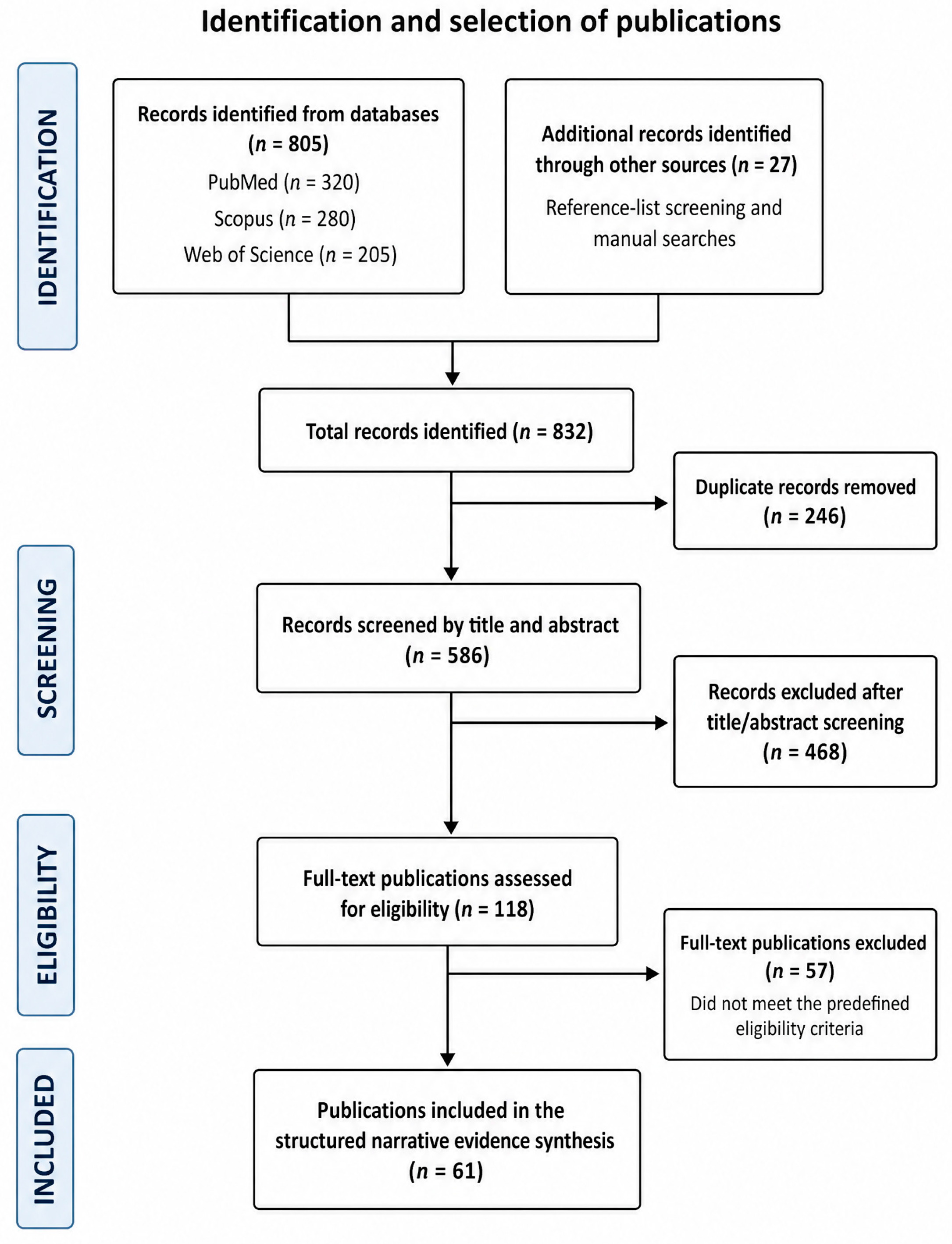
2.4. Study Selection
2.5. Data Extraction and Synthesis
2.6. Methodological Considerations and Search Limitations
3. Results
3.1. Healthcare-Provider Models for PCC Delivery
3.1.1. GPs
3.1.2. OB-GYNs
3.1.3. Midwives and Nurses
3.1.4. Team-Based Models
3.1.5. Women’s Preferences Regarding PCC Providers
3.2. Financing, Affordability, Service Preferences, and WTP for PCC
3.2.1. Current Financing Models
3.2.2. Economic Arguments for PCC
3.2.3. Affordability, Service Preferences, and WTP for PCC
3.2.4. Factors Associated with Affordability, Preferences, and WTP
3.3. Barriers and Facilitators to the Implementation of PCC
3.3.1. Individual-Level Barriers
3.3.2. Organisational Barriers
3.3.3. System-Level Barriers
3.3.4. Digital Solutions and Technological Facilitators
3.3.5. Patient-Level Barriers
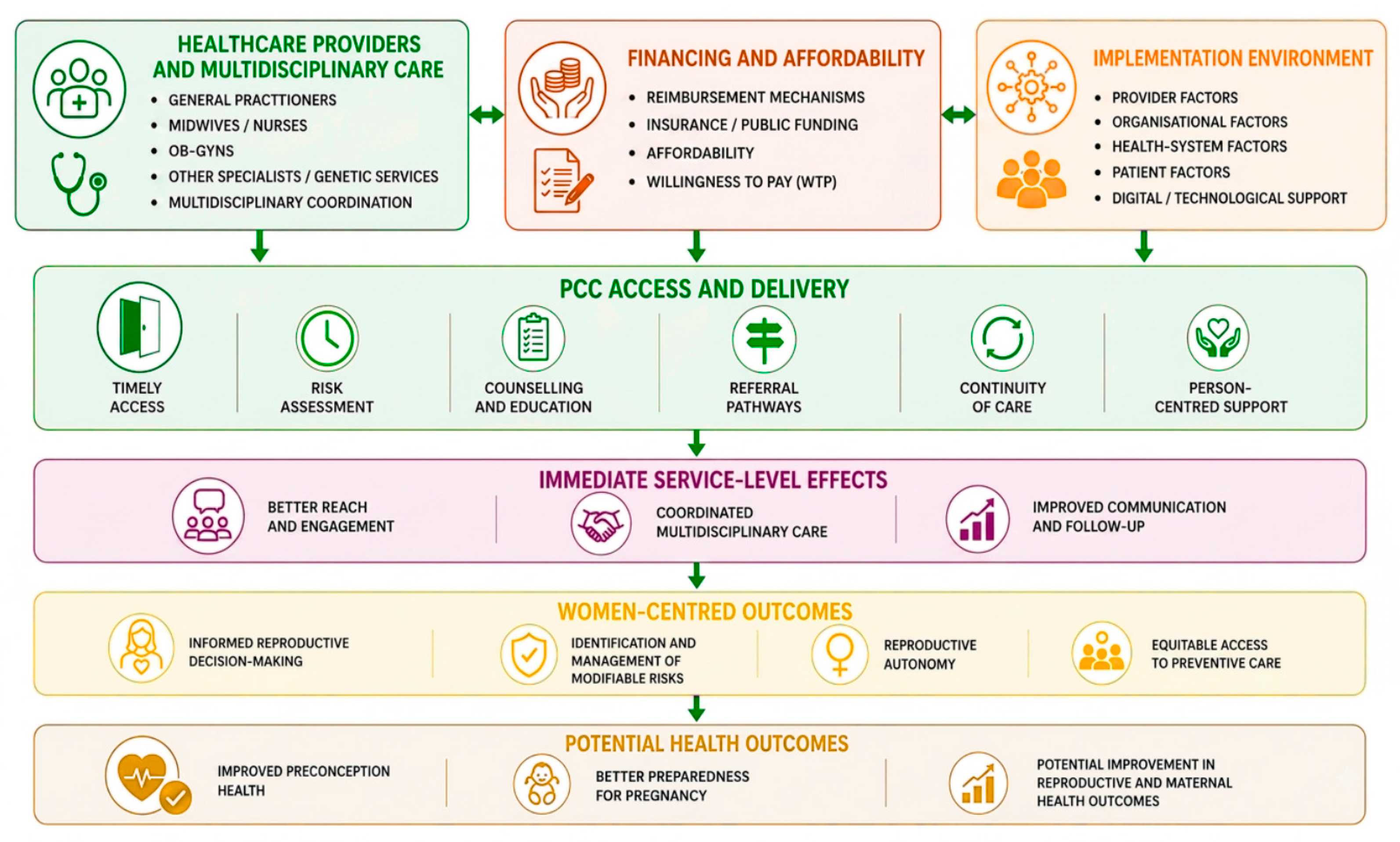
3.4. Integrated PCC Framework
4. Discussion
4.1. Main Findings
4.2. Generalisability and Health-System Context
4.3. Implications for Practice
4.4. Implications for Health Policy
4.5. Future Research
4.6. Strengths and Limitations
5. Conclusions
Supplementary Materials
Author Contributions
Funding
Institutional Review Board Statement
Informed Consent Statement
Data Availability Statement
Conflicts of Interest
Abbreviations
| CPD | Continuing Professional Development |
| DCE | Discrete Choice Experiment |
| EHR | Electronic Health Record |
| GP | General Practitioner |
| LMIC | Low- and Middle-Income Country |
| OB-GYN | Obstetrician–Gynaecologist |
| PCC | Preconception Care |
| WTP | Willingness to Pay |
References
- Khekade, H.; Potdukhe, A.; Taksande, A.B.; Wanjari, M.B.; Yelne, S. Preconception Care: A strategic intervention for the prevention of neonatal and birth disorders. Cureus 2023, 15, e41141. [Google Scholar] [CrossRef] [Scilit]
- Fowler, J.R.; Jenkins, S.M.; Jack, B.W. Preconception Counseling. In StatPearls; StatPearls Publishing: Treasure Island, FL, USA, 2026. Available online: https://www.ncbi.nlm.nih.gov/books/NBK441880/ (accessed on 1 June 2026).
- Hristova-Atanasova, E.; Micallef, M.; Stivala, J.; Iskrov, G.; Gyokova, E. Preconception care and genetic Screening: A global review and strategic perspectives for implementation in Bulgaria. Children 2025, 12, 1538. [Google Scholar] [CrossRef] [Scilit]
- Aynalem, Y.A.; Paul, P.; Olson, J.; Lassi, Z.S.; Meherali, S. Preconception care: A concept analysis of an evolving paradigm. J. Adv. Nurs. 2025, 81, 3674–3691. [Google Scholar] [CrossRef] [Scilit]
- World Health Organization. Preconception Care: Maximizing the Gains for Maternal and Child Health; Policy Brief; World Health Organization: Geneva, Switzerland, 2013; Available online: https://iris.who.int/server/api/core/bitstreams/3561db6c-62f9-4191-91fa-f5afcaf97930/content (accessed on 1 June 2026).
- Goossens, J.; Delbaere, I.; Dhaenens, C.; Willems, L.; Van Hecke, A.; Verhaeghe, S.; Beeckman, D. Preconception-related needs of reproductive-aged women. Midwifery 2016, 33, 64–72. [Google Scholar] [CrossRef] [Scilit]
- Public Health England. Making the Case for Preconception Care: Planning and Preparation for Pregnancy to Improve Maternal and Child Health Outcomes; Public Health England: London, UK, 2018. Available online: https://assets.publishing.service.gov.uk/media/5b585b3a40f0b6338218d6f1/Making_the_case_for_preconception_care.pdf (accessed on 1 June 2026).
- Dorney, E.; Boyle, J.A.; Walker, R.; Hammarberg, K.; Musgrave, L.; Schoenaker, D.; Jack, B.; Black, K.I. A Systematic Review of Clinical Guidelines for Preconception care. Semin. Reprod. Med. 2022, 40, 157–169. [Google Scholar] [CrossRef] [Scilit]
- Rosa-Mangeret, F.; Benski, A.-C.; Golaz, A.; Zala, P.Z.; Kyokan, M.; Wagner, N.; Muhe, L.M.; Pfister, R.E. 2.5 million annual Deaths—Are neonates in low- and Middle-Income countries too small to be seen? A Bottom-Up Overview on Neonatal Morbi-Mortality. Trop. Med. Infect. Dis. 2022, 7, 64. [Google Scholar] [CrossRef] [Scilit]
- Zaçe, D.; Orfino, A.; Viteritti, A.M.; Versace, V.; Di Pietro, M.L.; Ricciardi, W. A Comprehensive Assessment of Preconception Health Needs and Interventions Regarding Women of Childbearing Age: A Systematic Review. J. Prev. Med. Hyg. 2022, 63, E174–E199. [Google Scholar] [CrossRef] [Scilit]
- Hall, J.; Chawla, M.; Watson, D.; Jacob, C.M.; Schoenaker, D.; Connolly, A.; Barrett, G.; Stephenson, J. Addressing reproductive health needs across the life course: An integrated, community-based model combining contraception and preconception care. Lancet Public Health 2023, 8, e76–e84. [Google Scholar] [CrossRef] [Scilit]
- Verbiest, S.; McClain, E.; Woodward, S. Advancing preconception health in the United States: Strategies for change. Upsala J. Med. Sci. 2016, 121, 222–226. [Google Scholar] [CrossRef] [Scilit]
- Goossens, J.; De Roose, M.; Van Hecke, A.; Goemaes, R.; Verhaeghe, S.; Beeckman, D. Barriers and facilitators to the provision of preconception care by healthcare providers: A systematic review. Int. J. Nurs. Stud. 2018, 87, 113–130. [Google Scholar] [CrossRef] [Scilit]
- Doe, P.F.; Alhassan, A.; Otchere, B.A.; Odonkor, F.O.; Erzuah, I.A.; Mintah, Y.D.; Koranteng, H.K.; Amoadu, M. Factors Influencing Preconception Care Awareness and Knowledge among Women in Africa: A Systematic Review. Front. Reprod. Health 2026, 7, 1702378. [Google Scholar] [CrossRef] [Scilit]
- Carrandi, A.; Bull, C.; Callander, E. Health Economics and Equity in Preconception Health Care: A Systematic review. Semin. Reprod. Med. 2022, 40, 205–213. [Google Scholar] [CrossRef] [Scilit]
- Baethge, C.; Goldbeck-Wood, S.; Mertens, S. SANRA—A Scale for the Quality Assessment of Narrative Review Articles. Res. Integr. Peer Rev. 2019, 4, 5. [Google Scholar] [CrossRef] [Scilit] [PubMed]
- Nypaver, C.; Yeager, A. Innovations in Preconception Care: Optimizing health for all individuals. J. Midwifery Women’s Health 2024, 69, 897–905. [Google Scholar] [CrossRef] [Scilit]
- M’hamdi, H.I.; Van Voorst, S.F.; Pinxten, W.; Hilhorst, M.T.; Steegers, E.A.P. Barriers in the uptake and delivery of preconception care: Exploring the views of care providers. Matern. Child Health J. 2017, 21, 21–28. [Google Scholar] [CrossRef] [Scilit]
- Caut, C.; Schoenaker, D.; McIntyre, E.; Steel, A. Health professionals’ beliefs and attitudes towards preconception care: A systematic review. BMC Health Serv. Res. 2025, 25, 1023. [Google Scholar] [CrossRef] [Scilit]
- Bortolus, R.; Oprandi, N.C.; Morassutti, F.R.; Marchetto, L.; Filippini, F.; Agricola, E.; Tozzi, A.E.; Castellani, C.; Lalatta, F.; Rusticali, B.; et al. Why women do not ask for information on preconception health? A qualitative study. BMC Pregnancy Childbirth 2017, 17, 5. [Google Scholar] [CrossRef] [Scilit]
- Maas, V.Y.F.; Poels, M.; Hölscher, I.M.; Van Vliet-Lachotzki, E.H.; Franx, A.; Koster, M.P.H. How to improve preconception care in a local setting? Views from Dutch multidisciplinary healthcare providers. Midwifery 2022, 107, 103274. [Google Scholar] [CrossRef] [Scilit]
- Kizirian, N.V.; Black, K.I.; Musgrave, L.; Hespe, C.; Gordon, A. Understanding and Provision of Preconception Care by General Practitioners. Aust. N. Z. J. Obstet. Gynaecol. 2019, 59, 799–804. [Google Scholar] [CrossRef] [Scilit]
- Hristova-Atanasova, E.; Iskrov, G.; Stefanov, R. Family Planning and Preconception care service management: The key role of Bulgarian GPs. Healthcare 2024, 12, 1096. [Google Scholar] [CrossRef] [Scilit]
- Wilkes, J. AAFP Releases Position Paper on Preconception Care. Am. Fam. Physician 2016, 94, 508–510. [Google Scholar]
- Stephenson, J.; Schoenaker, D.A.; Hinton, W.; Poston, L.; Barker, M.; Alwan, N.A.; Godfrey, K.; Hanson, M.; De Lusignan, S.; Partnership, T.U.P. A wake-up call for preconception health: A clinical review. Br. J. Gen. Pract. 2021, 71, 233–236. [Google Scholar] [CrossRef] [Scilit]
- Van Voorst, S.; Plasschaert, S.; De Jong-Potjer, L.; Steegers, E.; Denktaş, S. Current practice of preconception care by primary caregivers in the Netherlands. Eur. J. Contracept. Reprod. Health Care 2016, 21, 251–258. [Google Scholar] [CrossRef] [Scilit]
- Mazza, D.; Chapman, A.; Michie, S. Barriers to the implementation of preconception care guidelines as perceived by general practitioners: A qualitative study. BMC Health Serv. Res. 2013, 13, 36. [Google Scholar] [CrossRef] [Scilit]
- Nacev, E.C.; Greene, M.Z.; Taboada, M.P.; Ehrenthal, D.B. Factors influencing provider behavior around delivery of preconception care. Matern. Child Health J. 2022, 26, 1567–1575. [Google Scholar] [CrossRef] [Scilit]
- American College of Obstetricians and Gynecologists. ACOG Committee Opinion No. 762: Prepregnancy Counseling. Obstet. Gynecol. 2019, 133, e78–e89. [Google Scholar] [CrossRef] [Scilit]
- Giouleka, S.; Papagera, V.; Siargkas, A.; Michos, G.; Liberis, A.; Kalogiannidis, I.; Mamopoulos, A.; Tsakiridis, I.; Dagklis, T. Preconception care: A comparative review of major guidelines. Obstet. Gynecol. Surv. 2025, 80, 491–505. [Google Scholar] [CrossRef] [Scilit]
- Romero, S.; Rink, B.; Biggio, J.R., Jr.; Saller, D.N., Jr. Committee Opinion No. 690: Carrier Screening in the Age of Genomic Medicine. Obstet. Gynecol. 2017, 129, e35–e40. [Google Scholar] [CrossRef] [Scilit]
- Haas, M.; Church, J.; Dorney, E.; Street, D.J.; Black, K.I. Understanding preferences for preconception care in Australia: Insights from a Discrete Choice experiment. Health Expect. 2026, 29, e70593. [Google Scholar] [CrossRef] [Scilit]
- Dean, S.V.; Lassi, Z.S.; Imam, A.M.; Bhutta, Z.A. Preconception care: Closing the gap in the continuum of care to accelerate improvements in maternal, newborn and child health. Reprod. Health 2014, 11, S1. [Google Scholar] [CrossRef] [Scilit]
- Bradfield, Z.; Leefhelm, E.; Soh, S.-E.; Black, K.I.; Boyle, J.A.; Kuliukas, L.; Harrison, C.; Homer, C.S.E.; Smith, R.M.; Skouteris, H. The MidPIC study: Midwives’ knowledge, perspectives and learning needs regarding preconception and interconception care. PLoS ONE 2023, 18, e0289910. [Google Scholar] [CrossRef] [Scilit]
- Bates, S.M.; Lin, J.; Allen, L.N.; Wright, M.; Kidd, M. Can multidisciplinary teams improve the quality of primary care? A scoping review. EClinicalMedicine 2025, 88, 103497. [Google Scholar] [CrossRef] [Scilit]
- El Hussein, M.T.; Jacoby, S.; Mclarnon, M.; Favell, D.; Dosani, A. A concurrent mixed-method study exploring the experiences of interprofessional collaboration among Canadian midwives and obstetricians. J. Adv. Nurs. 2024, 80, 4323–4332. [Google Scholar] [CrossRef] [Scilit]
- Mason, E.; Chandra-Mouli, V.; Baltag, V.; Christiansen, C.; Lassi, Z.S.; Bhutta, Z.A. Preconception care: Advancing from ‘important to do and can be done’ to ‘is being done and is making a difference. Reprod. Health 2014, 11, S8. [Google Scholar] [CrossRef] [Scilit]
- Ren, M.; Shireman, H.; VanGompel, E.W.; Bello, J.K.; Carlock, F.; McHugh, A.; Stulberg, D. Preconception, Interconception, and reproductive health screening tools: A systematic review. Health Serv. Res. 2023, 58, 458–488. [Google Scholar] [CrossRef] [Scilit]
- American College of Obstetricians and Gynecologists; Society for Maternal-Fetal Medicine. Obstetric Care Consensus No. 8: Interpregnancy care. Obstet. Gynecol. 2019, 133, e51–e72. [Google Scholar] [CrossRef] [Scilit]
- Aynalem, Y.A.; Paul, P.; Kung, J.Y.; Hussain, A.; Lassi, Z.; Meherali, S. Understanding preconception care: A scoping review of knowledge, attitudes and practices among reproductive age individuals, healthcare workers and stakeholders in low- and middle-income countries. BMJ Open 2025, 15, e099143. [Google Scholar] [CrossRef] [Scilit]
- Poels, M.; Koster, M.P.H.; Boeije, H.R.; Franx, A.; Van Stel, H.F. Why do women not use preconception care? A Systematic review on barriers and facilitators. Obstet. Gynecol. Surv. 2016, 71, 603–612. [Google Scholar] [CrossRef] [Scilit]
- Daly, M.P.; Kipping, R.R.; White, J.; Sanders, J. Women’s views on content and delivery methods for interventions to improve preconception health: A qualitative exploration. Front. Public Health 2024, 12, 1303953. [Google Scholar] [CrossRef] [Scilit]
- Sardasht, F.G.; Motaghi, Z.; Keramat, A.; Shariati, M.; Akbari, N. Women’s and care providers’ perspectives of quality Preconception care. Iran. J. Nurs. Midwifery Res. 2022, 27, 337–345. [Google Scholar] [CrossRef] [Scilit]
- Daly, M.P.; White, J.; Sanders, J.; Kipping, R.R. Women’s knowledge, attitudes and views of preconception health and intervention delivery methods: A cross-sectional survey. BMC Pregnancy Childbirth 2022, 22, 729. [Google Scholar] [CrossRef] [Scilit]
- Hidayah, N.; Kasmini H, O.W.; Yuniastuti, A.; Ningrum, D.N.A.; Hasan, F. What influences women’s knowledge, attitudes, and practices toward preconception care? A Systematic Review and Meta-Analysis. F1000Research 2025, 14, 860. [Google Scholar] [CrossRef] [Scilit]
- Craig, A.; Mabetha, K.; Stephenson, J.; Schoenaker, D.; Norris, S.A. Preconception health knowledge, attitudes and behavioural intentions among adults: A multi-country study. Reprod. Health 2025, 22, 66. [Google Scholar] [CrossRef] [Scilit]
- Shawe, J.; Delbaere, I.; Ekstrand, M.; Hegaard, H.K.; Larsson, M.; Mastroiacovo, P.; Stern, J.; Steegers, E.; Stephenson, J.; Tydén, T. Preconception care policy, guidelines, recommendations and services across six European countries: Belgium (Flanders), Denmark, Italy, the Netherlands, Sweden and the United Kingdom. Eur. J. Contracept. Reprod. Health Care 2015, 20, 77–87. [Google Scholar] [CrossRef] [Scilit]
- Berglund, A.; Lindmark, G. Preconception health and care (PHC)—A strategy for improved maternal and child health. Upsala J. Med. Sci. 2016, 121, 216–221. [Google Scholar] [CrossRef] [Scilit]
- Rokicki, S.; McConnell, M. Racial and socioeconomic disparities in preconception health risk factors and access to care. J. Women’s Health 2024, 33, 1063–1071. [Google Scholar] [CrossRef] [Scilit]
- Easter, S.R.; Rosenthal, E.W.; Morton-Eggleston, E.; Nour, N.; Tuomala, R.; Zera, C.A. Disparities in care for publicly insured women with pregestational diabetes. Obstet. Gynecol. 2017, 130, 946–952. [Google Scholar] [CrossRef] [Scilit]
- Grosse, S.D.; Sotnikov, S.V.; Leatherman, S.; Curtis, M. The Business Case for Preconception Care: Methods and issues. Matern. Child Health J. 2006, 10, 93–99. [Google Scholar] [CrossRef] [Scilit]
- Clarke, E.V.; Schneider, J.L.; Lynch, F.; Kauffman, T.L.; Leo, M.C.; Rosales, A.G.; Dickerson, J.F.; Shuster, E.; Wilfond, B.S.; Goddard, K.A.B. Assessment of willingness to pay for expanded carrier screening among women and couples undergoing preconception carrier screening. PLoS ONE 2018, 13, e0200139. [Google Scholar] [CrossRef] [Scilit]
- Nguyen, N.T.T.; Nguyen, L.H.; Nguyen, T.T.; Vu, L.G.; Vu, T.M.T.; Vu, M.N.L.; Vu, G.T.; Latkin, C.A.; Ho, C.S.H.; Ho, R.C.M. Preference and willingness to pay for reproductive health services among adults in Urban–Rural transition settings of a developing country: Evidence from a cross-sectional study in a rural district of Hanoi, Vietnam. BMC Health Serv. Res. 2023, 23, 1196. [Google Scholar] [CrossRef] [Scilit]
- Van Voorst, S.F.; Ten Kate, C.A.; De Jong-Potjer, L.C.; Steegers, E.a.P.; Denktaş, S. Developing social marketed individual preconception care consultations: Which consumer preferences should it meet? Health Expect. 2017, 20, 1106–1113. [Google Scholar] [CrossRef] [Scilit]
- Acharya, J. Are free maternity services completely free of costs? Osong Public Health Res. Perspect. 2016, 7, 26–31. [Google Scholar] [CrossRef] [Scilit]
- Gunarathne, S.P.; Wickramasinghe, N.D.; Agampodi, T.C.; Prasanna, I.R.; Agampodi, S.B. How costly is the first prenatal clinic visit? Analysis of out-of-pocket expenditure in rural Sri Lanka—A country with free maternal health care. BMC Health Serv. Res. 2021, 21, 974. [Google Scholar] [CrossRef] [Scilit]
- Batra, P.; Higgins, C.; Chao, S.M. Previous adverse infant outcomes as predictors of preconception care use: An analysis of the 2010 and 2012 Los Angeles Mommy and Baby (LAMB) surveys. Matern. Child Health J. 2016, 20, 1170–1177. [Google Scholar] [CrossRef] [Scilit]
- Poels, M.; Koster, M.P.H.; Franx, A.; Van Stel, H.F. Healthcare providers’ views on the delivery of preconception care in a local community setting in the Netherlands. BMC Health Serv. Res. 2017, 17, 92. [Google Scholar] [CrossRef] [Scilit]
- McGranahan, M.; Augarde, E.; Schoenaker, D.; Duncan, H.; Mann, S.; Bick, D.; Boardman, F.; Oyebode, O. Preconception health among migrant women in England: A cross-sectional analysis of maternity services data 2018–2019. J. Migr. Health 2024, 10, 100250. [Google Scholar] [CrossRef] [Scilit]
- Williams, M.S.; Urrutia, R.P.; Davis, S.A.; Frayne, D.; Ollendorff, A.; Ramage, M.; Verbiest, S.; White, A. Assessing preconception wellness in the clinical setting using electronic health data. J. Women’s Health 2022, 31, 331–340. [Google Scholar] [CrossRef] [Scilit]
- Smith, S.M.; Bais, B.; M’hamdi, H.I.; Schermer, M.H.; Steegers-Theunissen, R.P. Stimulating preconception care uptake by women with a vulnerable health status through a mobile health app (Pregnant Faster): Pilot Feasibility study. JMIR Hum. Factors 2024, 11, e53614. [Google Scholar] [CrossRef] [Scilit]
- Dunlop, A.L.; Alfonso, S.; Hansen, N.; Williams, D.; Anderson, V. Virtual preconception risk assessment and counseling in primary health care. J. Am. Board Fam. Med. 2025, 38, 223–238. [Google Scholar] [CrossRef] [Scilit]
- Morita, T.; Morita, T.; Ooba, S.; Okawa, J.; Okawa, H.; Hirakawa, T.; Arimura, K.; Okawa, K.; Kobayashi, E.; Dobashi, K. Promoting preconception care through occupational health checkups: Development and pilot evaluation of a digital tool for Japanese women. Cureus 2026, 18, e101300. [Google Scholar] [CrossRef] [Scilit]
- Fransen, M.P.; Hopman, M.E.; Murugesu, L.; Rosman, A.N.; Smith, S.K. Preconception counselling for low health literate women: An exploration of determinants in the Netherlands. Reprod. Health 2018, 15, 192. [Google Scholar] [CrossRef] [Scilit]
- Nypaver, C.; Arbour, M.; Niederegger, E. Preconception care: Improving the health of women and families. J. Midwifery Women’s Health 2016, 61, 356–364. [Google Scholar] [CrossRef] [Scilit]
- Teshome, F.; Kebede, Y.; Abamecha, F.; Birhanu, Z. Why do women not prepare for pregnancy? Exploring women’s and health care providers’ views on barriers to uptake of preconception care in Mana District, Southwest Ethiopia: A qualitative study. BMC Pregnancy Childbirth 2020, 20, 504. [Google Scholar] [CrossRef] [Scilit]
- Munro, S.; Kornelsen, J.; Grzybowski, S. Models of maternity care in rural environments: Barriers and attributes of interprofessional collaboration with midwives. Midwifery 2013, 29, 646–652. [Google Scholar] [CrossRef] [Scilit]
- Steigenberger, C.; Flatscher-Thoeni, M.; Siebert, U.; Leiter, A.M. Determinants of willingness to pay for health services: A systematic review of contingent valuation studies. Eur. J. Health Econ. 2022, 23, 1455–1482. [Google Scholar] [CrossRef] [Scilit]
- Foreit, J.R.; Foreit, K.G.F. The reliability and validity of willingness to pay surveys for reproductive health pricing decisions in developing countries. Health Policy 2002, 63, 37–47. [Google Scholar] [CrossRef] [Scilit]
- Street, D.J.; Burgess, L.; Viney, R.; Louviere, J. Designing Discrete Choice Experiments for Health Care. In Using Discrete Choice Experiments to Value Health and Health Care; Ryan, M., Gerard, K., Amaya-Amaya, M., Eds.; Springer: Dordrecht, The Netherlands, 2008; pp. 47–72. Available online: https://repub.eur.nl/pub/21908/091125_Bekker-Grob,%20Esther%20Wilhelmina%20de.pdf (accessed on 1 June 2026).



| First Author, Year | Country/Region | Study Design/Evidence Type | Population/Data Source and Sample Size | PCC Domain/Main focus | Principal Findings/Contribution | Key Limitations | Role in the Evidence Synthesis |
|---|---|---|---|---|---|---|---|
| Hristova-Atanasova et al., 2025 [3] | Global/Bulgaria | Narrative review | Global evidence with specific consideration of the Bulgarian healthcare context; N/A | Healthcare-system organisation; genetic screening; implementation | Synthesises global evidence on PCC-linked genetic screening and discusses implementation perspectives relevant to Bulgaria. | English-language evidence; limited direct Bulgarian evidence; reliance on heterogeneous international studies. | Narrative/conceptual PCC synthesis; used for comparative health-system and implementation contextualisation. |
| World Health Organization, 2013 [5] | Global | Policy brief | Global PCC policy and intervention framework; N/A | Policy; implementation; service delivery | Provides a global framework for PCC and describes promotive, preventive and curative interventions across the life course. | Policy/consensus source; not a comparative empirical evaluation. | Policy/contextual PCC evidence; used to inform global implementation principles. |
| Goossens et al., 2016 [6] | Belgium | Cross-sectional survey | Women of reproductive age with a desire for future children; n = 242 | Patient needs; provider preferences; uptake | Approximately 75% expressed willingness to use PCC; OB-GYNs were most frequently selected as preferred providers, followed by midwives and GPs. | Self-reported preferences; single-country setting; provider categories were not necessarily mutually exclusive. | Direct empirical PCC evidence; patient needs and provider preferences. |
| Public Health England, 2018 [7] | United Kingdom | Policy report | National PCC policy evidence base; N/A | Financing; economic rationale; implementation | Develops the public-health and economic case for PCC and emphasises coordinated pathways across reproductive and maternal healthcare. | Policy/contextual evidence; limited primary empirical data. | Policy/contextual PCC evidence; financing and national implementation context. |
| Dorney et al., 2022 [8] | International/multi-country | Systematic review of clinical guidelines | 11 clinical PCC guidelines | Guideline quality; PCC recommendations | Identified substantial variation in guideline quality and in the strength of evidence underpinning different PCC recommendations. | Heterogeneity in guideline scope, methodology and supporting evidence. | Synthesis-level PCC guideline evidence; used to assess consistency and strength of clinical recommendations. |
| Hall et al., 2023 [11] | United Kingdom | Evidence-informed conceptual/health-policy model | Community reproductive-health evidence and service-model literature; N/A | Integrated contraception and PCC; life-course delivery | Proposes an integrated community-based approach linking contraception and PCC to reproductive-health needs across the life course. | Conceptual/service-model evidence; no direct comparative effectiveness assessment. | Conceptual/health-policy synthesis; organisational integration and life-course PCC delivery. |
| Verbiest et al., 2016 [12] | United States | Narrative/national strategy paper | US Preconception Health and Health Care Initiative; N/A | Policy; implementation strategy | Reviews progress in US preconception health and identifies strategies for advancing PCC implementation and system change. | Narrative and country-specific; no comparative effectiveness analysis. | Narrative/policy PCC evidence; national implementation and system-change context. |
| Goossens et al., 2018 [13] | Multi-country | Systematic review | Healthcare providers; heterogeneous included studies | Provider barriers and facilitators | Provider-related literature identified recurrent barriers at patient, professional, organisational and societal levels, with barriers generally outweighing facilitators. | Heterogeneous study designs, professions and healthcare settings. | Synthesis-level PCC evidence; major source for the consistency of provider and implementation barriers. |
| Doe et al., 2026 [14] | Africa/multi-country | Systematic review | 27 studies involving women of reproductive age | Awareness; knowledge; access; patient/system barriers | PCC awareness and knowledge varied widely across African settings; education, socioeconomic circumstances, healthcare access and counselling were important determinants. | Substantial methodological and country-level heterogeneity; predominantly observational evidence. | Synthesis-level PCC evidence; African/LMIC patient-barrier and generalisability evidence. |
| Carrandi et al., 2022 [15] | International | Systematic review of economic evaluations | 8 economic evaluations | Health economics; equity; financing | Found a limited PCC economic evidence base and particularly sparse consideration of equity in economic evaluations. | Small and heterogeneous evidence base; limited equity analysis. | Synthesis-level PCC economic evidence; informs economic evidence and research gaps. |
| Nypaver & Yeager, 2024 [17] | International/predominantly US clinical context | Narrative review | General PCC literature; N/A | Innovative delivery; digital PCC | Describes innovations including apps, EHR reminders, group approaches and other strategies as promising methods for expanding PCC delivery. | Narrative evidence; limited comparative and long-term effectiveness evaluation. | Narrative PCC synthesis; emerging digital and service-delivery approaches. |
| M’hamdi et al., 2017 [18] | Netherlands | Qualitative study | Healthcare providers; n = 20 | Provider and organisational barriers | Providers reported organisational and role-related barriers, including ambiguity concerning professional responsibility for PCC delivery. | Small purposive sample; single healthcare-system context. | Direct empirical PCC evidence; provider and organisational barriers. |
| Caut et al., 2025 [19] | Multi-country | Systematic review | Healthcare professionals; multiple included studies | Professional beliefs, attitudes and implementation barriers | Consultation time and other recurrent implementation barriers persisted across professions and settings, while many professionals considered PCC within their role. | Heterogeneous study designs, professional groups and healthcare systems. | Synthesis-level PCC evidence; provider attitudes and consistency of barriers. |
| Bortolus et al., 2017 [20] | Italy | Qualitative focus-group study | 14 women + 12 healthcare professionals | Awareness; provider/patient barriers | Found low awareness of preconception health among both women and professionals, together with practical and communication-related barriers. | Small purposive qualitative sample; single-country setting. | Direct empirical PCC evidence; patient and provider barriers. |
| Maas et al., 2022 [21] | Netherlands | Mixed-methods study | Multidisciplinary healthcare providers; n = 250 | Community implementation; professional roles | Providers emphasised role clarity, collaboration, local organisation and educational support as important for improving PCC implementation. | Local implementation setting; self-reported and consensus-oriented components. | Direct empirical PCC evidence; community-level implementation and multidisciplinary organisation. |
| Kizirian et al., 2019 [22] | Australia | Cross-sectional survey | General practitioners; n = 110 | GP knowledge; provider role; implementation | Only approximately half of surveyed GPs were familiar with contemporary PCC guidance; limited time and resources were recurrent barriers. | Self-reported data; single-country professional sample. | Direct empirical PCC evidence; GP knowledge, readiness and barriers. |
| Hristova-Atanasova et al., 2024 [23] | Bulgaria | Cross-sectional survey | General practitioners; n = 116 of 420 invited; response rate 27.6% | Provider roles; PCC service management | Bulgarian GPs demonstrated partial familiarity with FP/PCC service management and reported gaps in training and organisational support. | Self-report; relatively low response rate; single-country setting. | Direct empirical PCC evidence; Bulgarian/CEE primary-care implementation context. |
| Wilkes, 2016 [24] | United States | Professional policy/position report | AAFP position statement; N/A | Primary-care provider role | Summarises the AAFP position supporting family physicians’ role in PCC delivery. | Professional-position evidence; limited direct comparative evaluation. | Policy/position evidence; contextualises the family-physician/primary-care role. |
| Stephenson et al., 2021 [25] | United Kingdom | Clinical/narrative review | General-practice population; N/A | Primary-care integration | Argues for stronger incorporation of preconception-health promotion into routine primary care and describes existing implementation as inconsistent. | Narrative/clinical review; UK-specific context; no comparative effectiveness evaluation. | Clinical/narrative PCC evidence; primary-care integration context. |
| Van Voorst et al., 2016 [26] | Netherlands | Cross-sectional survey | Primary-care providers; 449 GPs + 250 midwives | Provider roles; current PCC practice | Fewer than half reported having a PCC protocol; risk-factor identification and delivery practices varied substantially between providers. | Self-reported practice; single-country setting; possible non-response bias. | Direct empirical PCC evidence; primary-care organisation and implementation. |
| Mazza et al., 2013 [27] | Australia | Qualitative study | General practitioners; n = 22 | Guideline implementation; provider barriers | GPs identified limited consultation time, insufficient training and competing preventive priorities as major barriers to PCC implementation. | Small qualitative sample; country-specific practice context. | Direct empirical PCC evidence; GP guideline-implementation barriers. |
| Nacev et al., 2022 [28] | United States | Qualitative study | Healthcare providers serving reproductive-age populations; n = 20 | Provider behaviour; implementation | PCC delivery behaviour was influenced by guideline knowledge, workflow, training, professional role and perceived patient receptivity. | Small qualitative sample; US outpatient context. | Direct empirical PCC evidence; determinants of provider PCC delivery behaviour. |
| ACOG, 2019 [29] | United States | Clinical guideline/committee opinion | Expert/committee consensus; N/A | Provider roles; prepregnancy counselling | Provides recommendations concerning the content and delivery of prepregnancy counselling and the role of obstetric-gynaecological care. | Guideline/consensus evidence rather than primary empirical evidence. | Guideline/consensus evidence; informs clinical PCC components and specialist roles. |
| Giouleka et al., 2025 [30] | Multi-country guideline context | Comparative guideline review | Selected major national/international PCC guidelines; N/A | Guideline comparison; service organisation | Demonstrates variation in recommended PCC content, risk assessment and delivery approaches across major guideline sources. | Selected guideline comparison; not a systematic comparative effectiveness evaluation. | Comparative guideline synthesis; demonstrates variation in PCC recommendations and organisation. |
| ACOG Committee Opinion No. 690, 2017 [31] | United States | Clinical guideline/committee opinion | Expert/committee consensus; N/A | Genetic screening; carrier screening | Provides consensus recommendations concerning expanded carrier screening within contemporary reproductive and preconception care. | Guideline/consensus source; not primary empirical evidence. | Guideline/consensus evidence; supports genetic-screening components of PCC. |
| Haas et al., 2026 [32] | Australia | Discrete choice experiment | Australian adults recruited through an online panel; n = 485 | Provider preferences; service design; WTP | Respondents preferred face-to-face PCC, particularly when delivered by specialist obstetricians; lower out-of-pocket costs and financial incentives also influenced stated choices. | Hypothetical/stated choices rather than observed service utilisation. | Direct empirical PCC evidence; stated preference/DCE evidence on provider choice and financing. |
| Dean et al., 2014 [33] | Global | Narrative/commentary | Global PCC evidence; N/A | Implementation; continuum of care | Identifies PCC as an insufficiently implemented component of the maternal–child health continuum and discusses strategies for closing the implementation gap. | Narrative synthesis; no formal comparative appraisal. | Narrative/global PCC synthesis; implementation framing. |
| Bradfield et al., 2023 [34] | Australia | Cross-sectional survey | Midwives; n = 338 | Midwifery role; knowledge; readiness | Most respondents considered PCC within the scope of midwifery, and many wished to provide it more frequently; experience was associated with self-reported competence. | Self-reported data; single-country sample. | Direct empirical PCC evidence; midwifery role, readiness and training needs. |
| Bates et al., 2025 [35] | Global | Scoping review | Multidisciplinary primary-care teams; 27 included studies | Team-based service organisation | Found mixed evidence concerning multidisciplinary primary-care teams, with substantial variation in team composition and implementation across settings. | Not PCC-specific; heterogeneous designs and team models. | Indirect synthesis-level evidence; used only to contextualise multidisciplinary primary-care organisation, not PCC-specific effectiveness. |
| El Hussein et al., 2024 [36] | Canada | Concurrent mixed-methods study | Midwives; survey and semi-structured interviews (n = 18 survey; n = 13 interviews) | OB-GYN–midwife collaboration | Midwives reported generally positive but variable interprofessional collaboration with obstetricians, strongly influenced by trust and communication. | Small sample; maternity rather than PCC-specific setting; single-country context. | Indirect empirical evidence from maternity care; used only to contextualise OB-GYN–midwife collaboration and interprofessional communication. |
| Mason et al., 2014 [37] | Global/multi-country | Narrative/commentary | Global PCC evidence; N/A | Implementation; economic rationale | Discusses moving PCC from recognition toward implementation and highlights potential economic benefits, particularly for defined high-risk groups. | Narrative source; economic estimates largely derived from earlier and context-specific analyses. | Narrative/global PCC synthesis; implementation and economic contextualisation. |
| Ren et al., 2023 [38] | Predominantly United States evidence base | Systematic review | Identified 53 eligible studies representing 22 screening tools or standardised approaches; 10 had evidence from randomised clinical trials. | Preconception/interconception screening tools | Identified substantial heterogeneity in screening-tool content, implementation, and validation; 10 of the 22 tools or standardised approaches had evidence from randomised clinical trials. | Heterogeneous tools, outcomes and validation approaches; limited long-term effectiveness evidence. | Synthesis-level PCC evidence; screening-tool implementation and evidence heterogeneity. |
| Obstetric Care Consensus No. 8, 2019 [39] | United States | Clinical guideline/consensus | Expert/committee consensus; N/A | Interpregnancy care; continuity | Provides recommendations for interpregnancy health management that complement prepregnancy counselling and risk optimisation. | Consensus-based interpregnancy guidance with direct relevance to the preconception–interpregnancy continuum; not comparative empirical evidence. | Guideline/consensus evidence used to inform continuity of care and risk optimisation across the preconception–interpregnancy continuum; not used as comparative effectiveness evidence. |
| Aynalem et al., 2025 [40] | LMICs/multi-country | Scoping review | Reproductive-age individuals, healthcare workers and stakeholders; 62 included studies | Knowledge, attitudes and practices; LMIC barriers | Demonstrates substantial variation in PCC KAP and identifies socioeconomic, cultural, professional and health-system barriers across LMICs. | Heterogeneous countries, populations and study designs; limited direct comparability. | Synthesis-level PCC evidence; principal source for LMIC implementation and generalisability. |
| Poels et al., 2016 [41] | Multi-country/predominantly high-income settings | Systematic review | Women; multiple included studies | Barriers and facilitators to PCC uptake | Identifies limited awareness, access barriers and insufficient provider-initiated discussion among recurrent reasons for low PCC utilisation. | Heterogeneous study designs, populations and settings. | Synthesis-level PCC evidence; patient-level barriers and facilitators. |
| Daly et al., 2024 [42] | England, United Kingdom | Qualitative study | Women recruited from a preceding survey; 20 interviews | Patient preferences; content and delivery of PCC interventions | Women favoured accessible, personalised and non-judgemental approaches to preconception-health communication and intervention delivery. | Small qualitative sample; regional context; limited transferability. | Direct empirical PCC evidence; patient preferences and acceptable delivery approaches. |
| Sardasht et al., 2022 [43] | Iran | Qualitative study | 13 reproductive-age women + 12 midwives | PCC quality; patient/provider preferences | Trust, confidentiality and personalised counselling emerged as important features of acceptable, high-quality PCC. | Small purposive sample; culturally and nationally specific findings. | Direct empirical PCC evidence; trust, privacy and perceived quality. |
| Daly et al., 2022 [44] | England | Cross-sectional survey | Women; n = 835 | Knowledge; attitudes; delivery preferences | PCC knowledge and attitudes varied by sociodemographic characteristics; women expressed interest in receiving information through multiple delivery formats. | Self-reported data; single-country setting. | Direct empirical PCC evidence; patient KAP and delivery preferences. |
| Hidayah et al., 2025 [45] | Multi-country | Systematic review/meta-analysis | Women of reproductive age represented in 13 observational studies | Determinants of PCC KAP | Higher education, older age, previous PCC training or counselling, reproductive experience, and selected indicators of healthcare access were associated with greater PCC knowledge, more favourable attitudes, or better reported practices, although substantial heterogeneity was present for several associations. | Heterogeneity in designs, settings and outcome definitions. | Synthesis-level/meta-analytic PCC evidence; determinants of patient KAP. |
| Craig et al., 2025 [46] | Multi-country | Cross-sectional survey | Adults from five economically diverse countries; n = 5000 | Knowledge; attitudes; behavioural intentions | Preconception-health knowledge, attitudes, behavioural intentions, and preferred sources of information varied significantly across five economically diverse countries, supporting strong context dependence of population-level PCC preferences. | Self-reported data; five-country sample cannot represent all global healthcare contexts. | Direct multi-country PCC evidence; cross-system variation in KAP and behavioural intentions. |
| Shawe et al., 2015 [47] | Belgium (Flanders), Denmark, Italy, Netherlands, Sweden and United Kingdom | Comparative descriptive policy and service review | PCC policies, guidelines and services in six European countries; N/A | Healthcare-system organisation; policy; financing | Identified substantial cross-country variation in PCC policies, professional recommendations, service organisation, and the availability and content of guidance for healthy populations. | Descriptive policy comparison; not an effectiveness evaluation. | Comparative PCC health-system evidence; key source for generalisability and system variation. |
| Berglund & Lindmark, 2016 [48] | Sweden | Narrative/strategy paper | Swedish PCC/PHC context; N/A | Healthcare-system organisation; financing | Describes the Swedish approach to preconception health, including an accessible role for midwifery and preventive reproductive-health services. | Contextual single-country strategy evidence. | Policy/strategy evidence; Scandinavian health-system context. |
| Rokicki & McConnell, 2024 [49] | United States | Secondary-data analysis | Women; n = 123,697 | Equity; preconception-health disparities | Demonstrated persistent racial and socioeconomic differences in preconception-health risks that were not uniformly attenuated by higher income. | Observational secondary data; residual confounding; US-specific social and healthcare context. | Direct preconception-health equity evidence; access and equity contextualisation. |
| Easter et al., 2017 [50] | United States | Retrospective cohort study | Pregnant women with pregestational type 1 or type 2 diabetes receiving multidisciplinary endocrinology and obstetric care; n = 197 | Access; insurance disparities; high-risk PCC | Publicly insured women experienced important gaps in preconception and pregnancy-related care compared with more advantaged insurance contexts. | High-risk clinical population; observational design; insurance-specific US setting. | Direct PCC evidence in a high-risk population; insurance/access disparities. |
| Grosse et al., 2006 [51] | United States/economic-policy context | Economic/methodological analysis | Foundational PCC economic literature; N/A | Economic evaluation; business case for PCC | Examines the evidence and methodology underlying the economic case for PCC, with particularly strong historical rationale for selected high-risk populations. | Older evidence; economic estimates depend on assumptions, population and payer perspective. | Foundational PCC economic evidence; retained under the predefined pre-2010 economic exception. |
| Clarke et al., 2018 [52] | United States | Mixed-methods study | Women/couples undergoing preconception carrier screening; n = 277 WTP survey; n = 58 interview subsample | WTP; genetic screening | Household economic circumstances and individual values were associated with WTP for expanded carrier screening; reassurance was an important perceived benefit. | Stated WTP; selected screening population; context-specific preferences. | Direct empirical PCC evidence; WTP for preconception genetic screening. |
| Nguyen et al., 2023 [53] | Vietnam | Cross-sectional survey | Adults in an urban–rural transition setting; n = 883 | WTP; affordability; reproductive-health services | 59.1% reported willingness to pay for reproductive-health services; average maximum WTP was substantially below the stated market price. | Not PCC-specific; stated rather than observed payment behaviour; single-country context. | Indirect economic evidence from reproductive healthcare; used only to contextualise affordability and WTP in an LMIC setting, not as PCC-specific WTP evidence. |
| Van Voorst et al., 2017 [54] | Netherlands | Qualitative study | Consumers/women; n = 39 | Service design; affordability; provider preferences | Women, particularly those receiving social benefits, indicated that direct consultation fees could lead them to seek free alternatives rather than paid PCC services. | Small purposive sample; stated intentions; context-specific financing environment. | Direct empirical PCC evidence; affordability and patient preferences for service design. |
| Acharya, 2016 [55] | Nepal | Hospital-based cross-sectional study | Postpartum women and families using nominally free maternity services; n = 384 | Financing; out-of-pocket costs; equity | Demonstrated that nominally free maternity services could still generate substantial direct and indirect household expenditure. | Maternity rather than PCC-specific population; hospital-based single-country study; no PCC outcomes. | Indirect financing/equity evidence from maternity care; used only to illustrate residual out-of-pocket burden despite nominally free healthcare. |
| Gunarathne et al., 2021 [56] | Sri Lanka | Cross-sectional study | Women attending their first prenatal clinic visit; n = 1389 | Financing; out-of-pocket expenditure | Despite free maternal healthcare, women incurred measurable out-of-pocket expenditure at the first prenatal visit. | Prenatal rather than PCC-specific population; single-country setting. | Indirect financing/equity evidence from prenatal care; used only to contextualise residual patient costs within publicly funded healthcare. |
| Batra et al., 2016 [57] | United States | Secondary survey-data analysis | Women with a previous adverse infant outcome; sample defined by LAMB survey dataset | PCC uptake; reproductive history | Previous adverse infant outcomes were associated with greater use of PCC before a subsequent pregnancy. | Self-reported survey data; local US population; observational association. | Direct empirical PCC evidence; predictors of PCC utilisation. |
| Poels et al., 2017 [58] | Netherlands | Qualitative Nominal Group Technique study | Community healthcare providers; n = 30 | Provider roles; reimbursement; implementation | Lack of reimbursement and unclear allocation of professional responsibility were identified as major barriers to routine PCC delivery. | Small local professional sample; context-specific service organisation. | Direct empirical PCC evidence; organisational roles and reimbursement barriers. |
| McGranahan et al., 2024 [59] | England | National secondary cross-sectional analysis | Women with an antenatal booking appointment recorded in the NHS Maternity Services Data Set, England; n = 652,880 (migration-category data available for n = 432,022) | Equity; migrant women; preconception health | Identified inequalities in important preconception-health indicators among migrant women, particularly those in vulnerable circumstances. | Reliance on routine maternity data; incomplete migration information; indicators are not equivalent to direct PCC utilisation. | Direct preconception-health equity evidence; vulnerable-population and access context. |
| Williams et al., 2022 [60] | United States | Retrospective EHR data analysis | Patients receiving prenatal or primary care in two North Carolina health systems; n = 15,384 at Site 1 and n = 6983 at Site 2 (total n = 22,367) | Digital/data infrastructure; PCC monitoring | Demonstrated substantial variation in documentation of preconception-wellness indicators between health systems, complicating consistent EHR-based measurement. | Dependent on routine documentation and EHR structure; measures monitoring feasibility rather than PCC effectiveness. | Direct PCC implementation evidence; EHR/data-infrastructure feasibility. |
| Smith et al., 2024 [61] | Netherlands | Pilot feasibility study | 47 women enrolled; 39 completed the 4-week intervention. | Digital PCC; uptake | Among 39 completers, 16 (41%) attended a PCC consultation; usability and satisfaction were high. | Small uncontrolled pilot; original neighbourhood criterion was dropped because of recruitment difficulties; intended effectiveness study not yet performed. | Direct empirical PCC evidence; digital feasibility and acceptability only. |
| Dunlop et al., 2025 [62] | United States | Programme evaluation | Primary-care patients; n = 46 | Virtual PCC risk assessment and counselling | The virtual programme achieved high engagement with digital risk assessment and counselling and increased participants’ confidence in fertility-related discussions. | Small uncontrolled programme; short-term engagement outcomes; no comparative clinical-effectiveness assessment. | Direct empirical PCC evidence; virtual PCC feasibility and engagement only. |
| Morita et al., 2026 [63] | Japan | Pilot feasibility study | Working women; n = 277 | Digital PCC; occupational-health delivery | A PCC digital tool delivered through occupational health check-ups showed high user-reported usefulness and improved understanding of preconception health. | Satisfaction/knowledge outcomes; no long-term behavioural or clinical-effectiveness evidence. | Direct empirical PCC evidence; digital feasibility and acceptability only. |
| Fransen et al., 2018 [64] | Netherlands | Cross-sectional study | Women with low health literacy; n = 139 women; expert input used in study development | Health literacy; access; PCC counselling uptake | Most women (75%) were unaware of preconception counselling despite living in areas where invitations had been disseminated; nevertheless, attitudes towards participation were generally positive and 41% reported that they would participate. Intention was associated with perceived benefits, self-efficacy, subjective norms, and perceptions of existing knowledge and reproductive risk. | Selected population of women with low health literacy; cross-sectional design; self-reported determinants; single-country setting. | Direct empirical PCC evidence; awareness, health-literacy-related accessibility, and determinants of counselling participation. |
| Nypaver et al., 2016 [65] | United States | Narrative review | Women and families; N/A | Patient/population barriers; awareness | Advocates population-level awareness and community education to normalise preconception-health discussions and improve engagement. | Narrative synthesis; limited direct evaluation of proposed population strategies. | Narrative PCC synthesis; patient awareness and population-level implementation context. |
| Teshome et al., 2020 [66] | Ethiopia | Qualitative study | Women and healthcare providers; n = 13 key informant interviews | Barriers to PCC uptake | Low awareness, cultural norms and limited healthcare access were identified as major barriers to PCC uptake. | Small purposive sample; highly context-specific setting. | Direct empirical PCC evidence; LMIC patient/provider implementation barriers. |
| Munro et al., 2013 [67] | Canada | Qualitative exploratory study | Rural maternity-care professionals; 55 interview participants; 18 focus groups | Interprofessional collaboration; roles; funding | Collaboration between physicians, midwives and other maternity professionals was influenced by professional scope, funding arrangements and trust. | Maternity rather than PCC-specific setting; rural Canadian context. | Indirect empirical evidence from maternity care; used only to contextualise role allocation, professional trust and funding-related barriers. |
| PCC Delivery Model | Evidence-Informed Contribution | Reported Strengths and Contextual Limitations | Authors’ Interpretative Synthesis: Potential Role Within PCC | Supporting References |
|---|---|---|---|---|
| GP-led/primary care | Population-level preventive care; early identification of modifiable preconception risk factors; chronic disease optimisation; medication review; continuity across the reproductive life course. | Strengths: high accessibility, continuity of care, holistic management, and established patient–provider relationships. Limitations: restricted consultation time, competing preventive priorities, insufficient PCC-specific training, and variable confidence in initiating reproductive-health discussions. | Potential first-contact role for universal or opportunistic PCC risk identification and initial management, including optimisation of chronic conditions, with referral when specialist reproductive, genetic, or medical assessment is required. | [13,22,27] |
| OB-GYN-led/specialist care | Specialist reproductive risk assessment and optimisation; management of complex reproductive and medical conditions; genetic counselling and carrier screening; preconception medication optimisation. | Strengths: specialised expertise in reproductive medicine, fertility, genetic risk, and management of complex or high-risk conditions. Limitations: accessibility outside pregnancy may be lower; services may be more strongly oriented toward women with established reproductive risk; specialist-led care may require greater healthcare resources and is less suited to population-wide PCC delivery. | Potential specialist role for women with increased reproductive, medical, genetic, or obstetric risk rather than a universally applicable entry point for all PCC. | [20,29,30,31,39] |
| Midwife-/nurse-led care | Person-centred preventive counselling; health promotion; reproductive-health education; identification of reproductive intentions and preconception-health needs. | Strengths: holistic and person-centred care, strong communication, continuity, health education, and preventive counselling. Limitations: professional scope, autonomy, regulation, education requirements, and funding vary substantially across healthcare systems, which may limit transferability of midwife-/nurse-led models between settings. | Potential role in accessible community-based PCC, health promotion, counselling, and continuity of care where professional regulation, training, and healthcare-system organisation support this scope of practice. | [11,17,21,34,40] |
| GP–midwife collaborative model | Integration of primary-care accessibility and continuity with reproductive-health counselling, health promotion, and complementary professional expertise. | Strengths: may combine accessibility with specialised reproductive counselling, facilitate coordinated referral, and strengthen continuity and comprehensiveness of preventive care. Limitations: implementation depends on clear professional roles, effective interprofessional communication, structured referral pathways, and organisational support; direct comparative evidence on model effectiveness remains limited. | Potential integrated primary-care model in systems where GPs and midwives have established complementary roles, appropriate scope of practice, and shared referral pathways. | [13,21,34,35] |
| OB-GYN–midwife collaborative model | Combination of specialist reproductive expertise with person-centred counselling, continuity of care, and coordinated multidisciplinary management. | Strengths: may combine specialist assessment with continuity and coordinated reproductive and genetic counselling, particularly for women with more complex needs. Limitations: broader implementation may be constrained by specialist availability, dependence on referral pathways, higher resource requirements, and costs; evidence specifically evaluating this configuration in PCC remains limited. | Potential targeted model for women with increased reproductive, medical, or genetic risk, particularly within specialist or referral-based services rather than as a universal population-level PCC model. | [29,30,31,36,39] |
| Preference Factor | Evidence Base | Variation Across Healthcare Systems/Study Contexts | Consistency and Directness of Evidence | Evidence-Informed Interpretation | Supporting References |
|---|---|---|---|---|---|
| Professional expertise | Surveys, qualitative studies, and discrete choice experiments | Preference for a specific professional group varies by setting. OB-GYNs were frequently preferred where reproductive specialist expertise was highly valued, whereas acceptance of GPs and midwives varied according to healthcare-system organisation, previous care experiences, accessibility, and continuity. | Relatively consistent evidence for the importance of perceived expertise; provider-specific preferences are context-dependent. | Women appear to value recognised reproductive-health competence more consistently than any single professional category. Provider preference should therefore not be interpreted as universally favouring one profession. | [6,32,46] |
| Accessibility | Qualitative studies, surveys, and discrete choice experiments | The importance of accessibility is shaped by how PCC is organised within routine healthcare, including appointment availability, opportunities for opportunistic counselling, and whether PCC is embedded within primary or reproductive healthcare services. | Relatively consistent evidence across different study designs, although operational definitions of accessibility vary. | Convenient and timely access appears to facilitate PCC uptake regardless of provider type. Integration within existing healthcare contacts may be more transferable across systems than creation of separate PCC services. | [32,42,46] |
| Trust and perceived competence | Qualitative studies and surveys | Although the professional group considered most trustworthy may differ between settings, women repeatedly value confidence in the provider, reliable information, respectful communication, and personalised counselling. | Consistently reported across multiple studies; predominantly observational and qualitative evidence. | Trust and perceived competence appear to be more stable determinants of provider preference than professional title alone. | [41,42,43,44] |
| Affordability and financial incentives | Discrete choice experiment and survey-based preference evidence | The effect of cost is likely to depend strongly on insurance coverage, availability of publicly funded services, household resources, and the extent of out-of-pocket payment within the healthcare system. | Limited and context-dependent evidence; largely based on stated preferences rather than observed utilisation. | Lower patient costs and financial protection may increase acceptability of PCC, but the magnitude of this effect cannot be generalised across financing systems. | [32] |
| Confidentiality and privacy | Qualitative studies | The organisational mechanisms ensuring confidentiality differ between settings, but concerns regarding privacy, non-judgemental communication, and sensitive discussion of reproductive intentions recur across studies. | Relatively consistent qualitative evidence; limited comparative evidence between healthcare systems. | Confidentiality appears to be a broadly relevant condition for acceptable PCC communication, although implementation is context-specific. | [42,43] |
| Continuity of care | Qualitative studies and surveys | Continuity is particularly relevant in systems where patients have established longitudinal relationships with GPs, midwives, or other reproductive-health providers; its importance may be less directly transferable to fragmented or episodic care settings. | Moderately consistent observational and qualitative evidence; direct comparative evidence is limited. | Established patient–provider relationships may facilitate discussion of reproductive intentions and sustained engagement, but the feasibility of continuity depends on healthcare-system organisation. | [41,42,43,44] |
| Level of Implementation | Key Barriers Reported in the Literature | Potential or Commonly Proposed Facilitators | Consistency and Context of Evidence | Supporting References |
|---|---|---|---|---|
| Individual/provider level | Limited knowledge of PCC guidelines; insufficient undergraduate or postgraduate training; low confidence in initiating reproductive-health discussions; reliance on individual clinical experience rather than standardised PCC protocols. | PCC-specific undergraduate and postgraduate education; continuing professional development; structured communication and risk-assessment tools; mentoring and professional support. | Consistently reported across multiple provider-focused studies and settings. Knowledge, training, and confidence barriers recur across the literature, although their magnitude varies by profession and healthcare context. Evidence supporting educational interventions as facilitators is plausible and implementation-oriented, but comparative evidence regarding the most effective training strategy remains limited. | [21,22,23,58] |
| Organisational level | Limited consultation time; high workload; absence of dedicated PCC consultations; fragmented multidisciplinary collaboration; unclear allocation of responsibilities between GPs, midwives, OB-GYNs, and other professionals. | Standardised clinical pathways; dedicated or opportunistic PCC encounters; clearly defined professional responsibilities; structured referral pathways; multidisciplinary collaboration. | Consistently reported but strongly influenced by local service organisation. Time constraints, competing priorities, and unclear professional roles recur across several settings. Proposed organisational facilitators are widely supported conceptually, although specific multidisciplinary configurations have rarely been compared directly. | [18,23,27,28,58,59] |
| Health-system level | Lack of dedicated reimbursement mechanisms or billing codes; limited public funding; absence or inconsistent implementation of national PCC guidance; fragmented integration into primary care; unequal distribution of preventive healthcare resources. | Public or insurance-based reimbursement; dedicated financing mechanisms; national PCC guidance and implementation standards; integration into routine preventive and reproductive healthcare; equity-oriented allocation of resources. | Recurrently reported but highly healthcare-system dependent. Financing and policy barriers are particularly sensitive to insurance coverage, primary-care organisation, national regulation, and resource availability. Evidence supports their importance as structural determinants, but there is insufficient comparative evidence to identify a universally superior financing or policy model. | [3,47,48,57,58] |
| Digital/technological level | Variable digital literacy; unequal access to digital technologies; limited integration of digital tools into routine clinical workflows; insufficient interoperability; data privacy and information-governance concerns. | EHR-based prompts and reminders; telehealth; mobile health applications; digital risk assessment; personalised digital counselling and decision support. | Emerging and context-dependent evidence. Current studies predominantly address feasibility, acceptability, engagement, and implementation rather than sustained clinical effectiveness. Digital facilitators should therefore be considered complementary rather than established substitutes for conventional PCC delivery. | [11,17,60,61,62,63] |
| Patient/population level | Limited awareness of PCC; low health literacy; unplanned pregnancy; financial barriers; cultural and socioeconomic constraints; limited perceived need for care before conception. | Population-level awareness campaigns; community outreach; school- and community-based health education; appropriately designed social-media interventions; normalisation of discussions about reproductive intentions and preconception health. | Several barriers are consistently reported, whereas their relative importance varies across populations. Limited awareness and health literacy recur across different settings, while financial, cultural, and socioeconomic barriers are more strongly context-dependent. Evidence for specific population-level facilitators remains heterogeneous and is less robust than evidence documenting the barriers themselves. | [41,46,64,65,66] |
Disclaimer/Publisher’s Note: The statements, opinions and data contained in all publications are solely those of the individual author(s) and contributor(s) and not of MDPI and/or the editor(s). MDPI and/or the editor(s) disclaim responsibility for any injury to people or property resulting from any ideas, methods, instructions or products referred to in the content. |
© 2026 by the authors. Licensee MDPI, Basel, Switzerland. This article is an open access article distributed under the terms and conditions of the Creative Commons Attribution (CC BY) license.
Share and Cite
Draeva, L.; Hristova-Atanasova, E.; Iskrov, G.; Stefanov, R. Organisation, Financing, and Implementation of Preconception Care in Primary Care: Implications for Women’s Health and Well-Being. Healthcare 2026, 14, 2706. https://doi.org/10.3390/healthcare14172706
Draeva L, Hristova-Atanasova E, Iskrov G, Stefanov R. Organisation, Financing, and Implementation of Preconception Care in Primary Care: Implications for Women’s Health and Well-Being. Healthcare. 2026; 14(17):2706. https://doi.org/10.3390/healthcare14172706
Chicago/Turabian StyleDraeva, Lora, Eleonora Hristova-Atanasova, Georgi Iskrov, and Rumen Stefanov. 2026. "Organisation, Financing, and Implementation of Preconception Care in Primary Care: Implications for Women’s Health and Well-Being" Healthcare 14, no. 17: 2706. https://doi.org/10.3390/healthcare14172706
APA StyleDraeva, L., Hristova-Atanasova, E., Iskrov, G., & Stefanov, R. (2026). Organisation, Financing, and Implementation of Preconception Care in Primary Care: Implications for Women’s Health and Well-Being. Healthcare, 14(17), 2706. https://doi.org/10.3390/healthcare14172706