The Mediating Role of Work Engagement Between Artificial Intelligence Anxiety and Task Performance Among Nurses: A Cross-Sectional Correlational Study


Highlights
- Among nurses in Saudi Arabia, higher AI anxiety is positively associated with higher work engagement and higher task performance, and higher work engagement is positively associated with higher task performance.
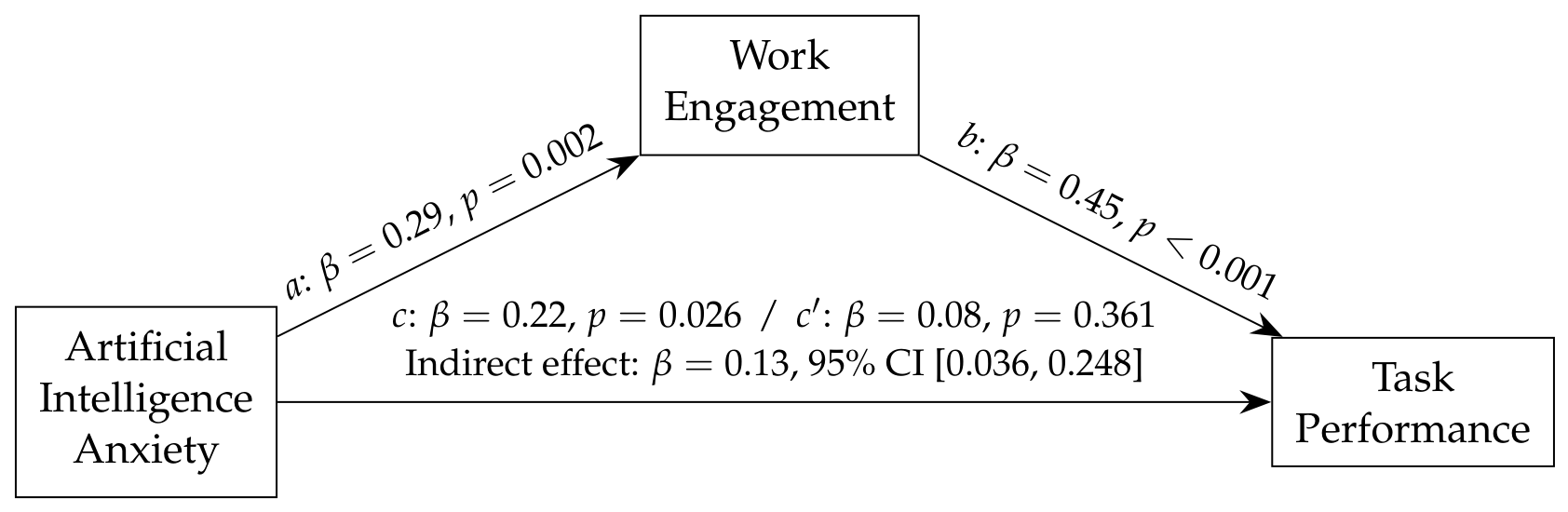
- Work engagement shows a significant indirect (mediating) association between AI anxiety and task performance, suggesting a preliminary mediating pathway in this cross-sectional sample.
- Within the challenge–hindrance stressor framework, AI anxiety may be tentatively interpreted as a challenge rather than a hindrance stressor, with its positive association with task performance appearing to operate through work engagement.
- Strengthening AI utilization and competency, alongside supporting work engagement, may help nurses to better adapt to AI technologies, as moderate AI-related concern may be tentatively associated with favorable task performance.
Abstract
1. Introduction
- AI anxiety is related to work engagement;
- Work engagement is related to task performance;
- AI anxiety is related to task performance;
- Work engagement mediates the relationship between AI anxiety and task performance.
2. Materials and Methods
2.1. Design
2.2. Participants, Setting, and Sample Size
2.3. Data Collection
2.4. Instruments
2.4.1. Artificial Intelligence Anxiety Scale
2.4.2. Utrecht Work Engagement Scale
2.4.3. Individual Work Performance Questionnaire
2.5. Data Analysis
3. Results
3.1. Sociodemographic Information
3.2. Scores on the Main Variables
3.3. Correlations Between AI Anxiety, Work Engagement, and Task Performance
3.4. Mediation Analysis
4. Discussion
Implications for Clinical and Assistive Practice
5. Limitations
6. Conclusions
Supplementary Materials
Funding
Institutional Review Board Statement
Informed Consent Statement
Data Availability Statement
Conflicts of Interest
Abbreviations
| AI | Artificial intelligence |
| AIAS | Artificial Intelligence Anxiety Scale |
| CHSF | Challenge–hindrance stressor framework |
| IWPQ | Individual Work Performance Questionnaire |
| JD-R | Job demands–resources |
| NNTs | Non-nursing tasks |
| UWES-3 | Utrecht Work Engagement Scale (3-item) |
References
- Haenlein, M.; Kaplan, A. A brief history of artificial intelligence: On the past, present, and future of artificial intelligence. Calif. Manag. Rev. 2019, 61, 5–14. [Google Scholar] [CrossRef] [Scilit]
- Duan, Y.; Edwards, J.S.; Dwivedi, Y.K. Artificial intelligence for decision making in the era of Big Data: Evolution, challenges and research agenda. Int. J. Inf. Manag. 2019, 48, 63–71. [Google Scholar] [CrossRef] [Scilit]
- Paschen, J.; Wilson, M.; Ferreira, J.J. Collaborative intelligence: How human and artificial intelligence create value along the B2B sales funnel. Bus. Horiz. 2020, 63, 403–414. [Google Scholar] [CrossRef] [Scilit]
- Belanche, D.; Casaló, L.V.; Flavián, C. Artificial intelligence in FinTech: Understanding robo-advisors adoption among customers. Ind. Manag. Data Syst. 2019, 119, 1411–1430. [Google Scholar] [CrossRef] [Scilit]
- Wei, Q.; Pan, S.; Liu, X.; Hong, M.; Nong, C.; Zhang, W. The integration of AI in nursing: Addressing current applications, challenges, and future directions. Front. Med. 2025, 12, 1545420. [Google Scholar] [CrossRef] [Scilit] [PubMed]
- Frenkenberg, A.; Hochman, G. It’s scary to use it, it’s scary to refuse it: The psychological dimensions of AI adoption, anxiety, motives, and dependency. Systems 2025, 13, 82. [Google Scholar] [CrossRef] [Scilit]
- Wang, Y.Y.; Wang, Y.S. Development and validation of an artificial intelligence anxiety scale: An initial application in predicting motivated learning behavior. Interact. Learn. Environ. 2022, 30, 619–634. [Google Scholar] [CrossRef] [Scilit]
- Koopmans, L.; Bernaards, C.; Hildebrandt, V.; van Buuren, S.; de Vet, H.C.W. Development of an individual work performance questionnaire. Int. J. Prod. Perform. Manag. 2013, 62, 6–28. [Google Scholar] [CrossRef] [Scilit]
- Koopmans, L.; Bernaards, C.M.; Hildebrandt, V.H.; Schaufeli, W.B.; de Vet, H.C.W.; van der Beek, A.J. Conceptual frameworks of individual work performance: A systematic review. J. Occup. Environ. Med. 2011, 53, 856–866. [Google Scholar] [CrossRef] [Scilit] [PubMed]
- Grosso, S.; Longhini, J.; Tonet, S.; Bernard, I.; Corso, J.; de Marchi, D.; Dorigo, L.; Funes, G.; Lussu, M.; Oppio, N.; et al. Prevalence and reasons for non-nursing tasks as perceived by nurses: Findings from a large cross-sectional study. J. Nurs. Manag. 2021, 29, 2658–2673. [Google Scholar] [CrossRef] [Scilit] [PubMed]
- Bahlman-van Ooijen, W.; Roosen, C.; de Jong, D.; de Reuver, P.; van Goor, H.; Vermeulen, H.; Huisman-de Waal, G. Surgical nurses’ perspectives on low-value care and non-nursing tasks: A cross-sectional study. J. Clin. Nurs. 2026, 5, 1303–1317. [Google Scholar] [CrossRef] [Scilit] [PubMed]
- Aldarawsheh, A.A.; Saifan, A.R.; Sawalha, M.A.; Assaf, E.A.; Alrimawi, I.; Elshatarat, R.A.; Saleh, Z.T.; Almagharbeh, W.T.; Mohamed, N.A.; Eltayeb, M.M. Exploring the causes and consequences of non-nursing tasks among nurses in Jordan: An in-depth qualitative investigation. Appl. Nurs. Res. 2024, 77, 151791. [Google Scholar] [CrossRef] [Scilit] [PubMed]
- Al-Akash, H.; Aldarawsheh, A.; Elshatarat, R.; Sawalha, M.; Saifan, A.; Al-Nsair, N.; Saleh, Z.; Almagharbeh, W.; Sobeh, D.; Eltayeb, M. “We do others’ jobs”: A qualitative study of non-nursing task challenges and proposed solutions. BMC Nurs. 2024, 23, 478. [Google Scholar] [CrossRef] [Scilit] [PubMed]
- Hackman, P.; Häggman-Laitila, A.; Hult, M. Exploring the associations of unfinished nursing care with individual, team climate, and organizational factors in nursing homes: An observational study. Int. J. Nurs. Stud. 2025, 172, 105203. [Google Scholar] [CrossRef] [Scilit] [PubMed]
- Gong, F.; Mei, Y.; Wu, M.; Tang, C. Global reasons for missed nursing care: A systematic review and meta-analysis. Int. Nurs. Rev. 2025, 72, e13096. [Google Scholar] [CrossRef] [Scilit] [PubMed]
- Alruwaili, A.N.; Alshammari, A.M.; Alhaiti, A.; Elsharkawy, N.B.; Ali, S.I.; Ramadan, O.M.E. Neonatal nurses experiences with generative AI in clinical decision-making: A qualitative exploration in high-risk NICUs. BMC Nurs. 2025, 24, 386. [Google Scholar] [CrossRef] [Scilit] [PubMed]
- Ramadan, O.M.E.; Alruwaili, M.M.; Alruwaili, A.N.; Elsehrawy, M.G.; Alanazi, S. Facilitators and barriers to AI adoption in nursing practice: A qualitative study of registered nurses perspectives. BMC Nurs. 2024, 23, 891. [Google Scholar] [CrossRef] [Scilit] [PubMed]
- Bodur, G.; Cakir, H.; Turan, S.; Seren, A.K.H.; Goktas, P. Artificial intelligence in nursing practice: A qualitative study of nurses perspectives on opportunities, challenges, and ethical implications. BMC Nurs. 2025, 24, 1263. [Google Scholar] [CrossRef] [Scilit] [PubMed]
- Elgin, C.Y.; Elgin, C. Ethical implications of AI-driven clinical decision support systems on healthcare resource allocation: A qualitative study of healthcare professionals perspectives. BMC Med. Ethics 2024, 25, 148. [Google Scholar] [CrossRef] [Scilit] [PubMed]
- Rony, M.K.K.; Kayesh, I.; Bala, S.D.; Akter, F.; Parvin, M.R. Artificial intelligence in future nursing care: Exploring perspectives of nursing professionals: A descriptive qualitative study. Heliyon 2024, 10, e25718. [Google Scholar] [CrossRef] [Scilit] [PubMed]
- Fazakarley, C.; Breen, M.; Thompson, B.; Leeson, P.; Williamson, V. Beliefs, experiences and concerns of using artificial intelligence in healthcare: A qualitative synthesis. Digit. Health 2024, 10, 20552076241230075. [Google Scholar] [CrossRef] [Scilit] [PubMed]
- Zhang, S.; Guo, P.; Yuan, Y.; Ji, Y. Anxiety or engaged? Research on the impact of technostress on employees’ innovative behavior in the era of artificial intelligence. Acta Psychol. 2025, 259, 105442. [Google Scholar] [CrossRef] [Scilit] [PubMed]
- Zhou, Q.; Yang, L.; Tang, Y.; Yang, J.; Zhou, W.; Guan, W.; Yan, L.; Liu, Y. The mediation of trust on artificial intelligence anxiety and continuous adoption of artificial intelligence technology among primary nurses: A cross-sectional study. BMC Nurs. 2025, 24, 724. [Google Scholar] [CrossRef] [Scilit] [PubMed]
- Pindek, S.; Meyer, K.; Valvo, A.; Arvan, M. A dynamic view of the challenge-hindrance stressor framework: A meta-analysis of daily diary studies. J. Bus. Psychol. 2024, 39, 1107–1125. [Google Scholar] [CrossRef] [Scilit]
- Schaufeli, W.B.; Bakker, A.B. Defining and measuring work engagement: Bringing clarity to the concept. In Work Engagement: A Handbook of Essential Theory and Research; Psychology Press: New York, NY, USA, 2010; Volume 12, pp. 10–24. [Google Scholar]
- Al-Fuqaha, O.N.; Rayan, A.; Baqeas, M.H.; Alqadrie, W.T.; Alhalaiqa, F.; Batiha, A.M.; Rayani, A.M. Job satisfaction and job performance among critical care nurses: The moderating role of work engagement in public hospitals. Risk Manag. Healthc. Policy 2025, 18, 3311–3327. [Google Scholar] [CrossRef] [Scilit] [PubMed]
- Demerouti, E. Job demands-resources and conservation of resources theories: How do they help to explain employee well-being and future job design? J. Bus. Res. 2025, 192, 115296. [Google Scholar] [CrossRef] [Scilit]
- LePine, J.A.; Podsakoff, N.P.; LePine, M.A. A meta-analytic test of the challenge stressor-hindrance stressor framework: An explanation for inconsistent relationships among stressors and performance. Acad. Manag. J. 2005, 48, 764–775. [Google Scholar] [CrossRef] [Scilit]
- LePine, M.A. The challenge-hindrance stressor framework: An integrative conceptual review and path forward. Group Organ. Manag. 2022, 47, 223–254. [Google Scholar] [CrossRef] [Scilit]
- von Elm, E.; Altman, D.G.; Egger, M.; Pocock, S.J.; Gøtzsche, P.C.; Vandenbroucke, J.P.; STROBE Initiative. The Strengthening the Reporting of Observational Studies in Epidemiology (STROBE) statement: Guidelines for reporting observational studies. J. Clin. Epidemiol. 2008, 61, 344–349. [Google Scholar] [CrossRef] [Scilit] [PubMed]
- Sim, M.; Kim, S.Y.; Suh, Y. Sample size requirements for simple and complex mediation models. Educ. Psychol. Meas. 2022, 82, 76–106. [Google Scholar] [CrossRef] [Scilit] [PubMed]
- Fritz, M.S.; MacKinnon, D.P. Required sample size to detect the mediated effect. Psychol. Sci. 2007, 18, 233–239. [Google Scholar] [CrossRef] [Scilit] [PubMed]
- Moafa, H.; Nahari, A.; Almotairy, M. Nurses’ digital competency and task performance in Saudi healthcare settings: The mediating role of work engagement within the job demands–resources (JD-R) model. BMC Med. Educ. 2026, 26, 688. [Google Scholar] [CrossRef] [Scilit] [PubMed]
- Özçevik Subaşi, D.; Akça Sümengen, A.; Semerci, R.; Şimşek, E.; Çakır, G.N.; Temizsoy, E. Paediatric nurses’ perspectives on artificial intelligence applications: A cross-sectional study of concerns, literacy levels and attitudes. J. Adv. Nurs. 2025, 81, 1353–1363. [Google Scholar] [CrossRef] [Scilit] [PubMed]
- Schaufeli, W.B.; Shimazu, A.; Hakanen, J.; Salanova, M.; De Witte, H. An ultra-short measure for work engagement: The UWES-3 validation across five countries. Eur. J. Psychol. Assess. 2019, 35, 577–591. [Google Scholar]
- Koopmans, L.; Bernaards, C.M.; Hildebrandt, V.H.; de Vet, H.C.W.; van der Beek, A.J. Construct validity of the Individual Work Performance Questionnaire. J. Occup. Environ. Med. 2014, 56, 331–337. [Google Scholar] [CrossRef] [Scilit] [PubMed]
- Hayes, A.F. Introduction to Mediation, Moderation, and Conditional Process Analysis: A Regression-Based Approach; Guilford Publications: New York, NY, USA, 2017. [Google Scholar]
- Zhao, X.; Lynch, J.G., Jr.; Chen, Q. Reconsidering Baron and Kenny: Myths and truths about mediation analysis. J. Consum. Res. 2010, 37, 197–206. [Google Scholar] [CrossRef] [Scilit]
- Thiyab, M.A.; Nahari, A. Nurses’ attitudes toward web-based learning and their impact on clinical performance, job satisfaction, and turnover: A cross-sectional study in Saudi Arabia. BMC Nurs. 2025, 24, 1106. [Google Scholar] [CrossRef] [Scilit] [PubMed]
- Galanis, P.; Katsiroumpa, A.; Moisoglou, I.; Derizioti, K.; Gallos, P.; Kalogeropoulou, M.; Papanikolaou, V. Emotional intelligence as critical competence in nurses’ work performance: A cross-sectional study. Healthcare 2024, 12, 1936. [Google Scholar] [CrossRef] [Scilit] [PubMed]
- Liu, S.; Xiao, Y.; Nie, M.; Yuan, X.; Wang, L.; Wang, M.; Wu, Z. Nurses’ attitudes toward artificial intelligence: AI literacy as a predictor and the mediating effect of AI anxiety. BMC Nurs. 2025, 24, 1511. [Google Scholar] [CrossRef] [Scilit] [PubMed]
- Ongun, P.; Sahin Koze, B.; Altinbas, Y. Artificial intelligence anxiety and patient safety attitudes among operating room professionals: A descriptive cross-sectional study. Healthcare 2025, 13, 2021. [Google Scholar] [CrossRef] [Scilit] [PubMed]
- Soysal, G.E.; Calışkan, M.A.; Turgut, A. The relationship between anxiety about artificial intelligence and nurses’ perceptions of job security: The impact of technological transformation. Appl. Nurs. Res. 2025, 86, 152023. [Google Scholar] [CrossRef] [Scilit] [PubMed]
- Tutar, Ş.; Özgörü, H.; Ögür, Z. Determining pediatric nurses’ anxiety levels, concerns, and metaphor perceptions towards artificial intelligence technologies: A mixed-method study. J. Pediatr. Nurs. 2025, 85, 441–450. [Google Scholar] [CrossRef] [Scilit] [PubMed]
- Ayed, A.; Ejheisheh, M.A.; Al-Amer, R.; Aqtam, I.; Ali, A.M.; Othman, E.H.; Farajallah, M.; Qaddumi, J.; Batran, A. Insights into the relationship between anxiety and attitudes toward artificial intelligence among nursing students. BMC Nurs. 2025, 24, 812. [Google Scholar] [CrossRef] [Scilit] [PubMed]
- Wu, J.; Li, Y.; Zhong, X.; Lin, Q.; Xie, G.; Liu, Z.; Rong, X.; He, L. Relationships between professional mission, work engagement, spiritual climate, and job performance among Chinese clinical nurses: A moderated mediation model. PLoS ONE 2025, 20, e0337329. [Google Scholar] [CrossRef] [Scilit] [PubMed]
- Hou, Y.; Fan, L. Working with AI: The effect of job stress on hotel employees’ work engagement. Behav. Sci. 2024, 14, 1076. [Google Scholar] [CrossRef] [Scilit] [PubMed]
- Ni, Y.X.; Xu, Y.; He, L.; Wen, Y.; You, G.Y. Relationship between job demands, work engagement, emotional workload and job performance among nurses: A moderated mediation model. Int. Nurs. Rev. 2024, 71, 924–932. [Google Scholar] [CrossRef] [Scilit] [PubMed]
- Dobson, C. Stress: The Hidden Adversary; Bogden: New York, NY, USA, 1983. [Google Scholar]


| Variable | Category | n | % |
|---|---|---|---|
| Age (years) | <30 | 34 | 32.0 |
| 30–34 | 15 | 14.2 | |
| 35–39 | 30 | 28.3 | |
| 40–44 | 21 | 19.8 | |
| 45–49 | 4 | 3.8 | |
| ≥50 | 2 | 1.9 | |
| Gender | Female | 82 | 77.4 |
| Male | 24 | 22.6 | |
| Level of education | Diploma | 26 | 24.5 |
| Bachelor | 64 | 60.4 | |
| Masters | 16 | 15.1 | |
| Years of experience (years) | <1 | 6 | 5.7 |
| 1–5 | 28 | 26.4 | |
| 6–10 | 17 | 16.0 | |
| 11–15 | 24 | 22.6 | |
| >15 | 31 | 29.2 | |
| Current job position | Staff nurse | 75 | 70.8 |
| Charge nurse | 10 | 9.4 | |
| Nurse manager | 7 | 6.6 | |
| Clinical instructor | 3 | 2.8 | |
| Faculty member | 1 | 0.9 | |
| Other | 10 | 9.4 | |
| Department/unit | Medical surgical | 43 | 40.6 |
| Emergency | 12 | 11.3 | |
| Intensive care unit | 3 | 2.8 | |
| Maternity/obstetrics | 1 | 0.9 | |
| Pediatric | 8 | 7.5 | |
| Outpatient clinic | 9 | 8.5 | |
| Other | 30 | 28.3 | |
| Healthcare facility type | Primary health center | 20 | 18.9 |
| General hospital | 49 | 46.2 | |
| Specialized hospital | 18 | 17.0 | |
| University/academic institution | 9 | 8.5 | |
| Private hospital or clinic | 2 | 1.9 | |
| Other | 8 | 7.5 | |
| Nationality | Saudi | 78 | 73.6 |
| Non-Saudi | 28 | 26.4 | |
| Usual work shift | Morning shift | 45 | 42.5 |
| Evening shift | 3 | 2.8 | |
| Night shift | 7 | 6.6 | |
| Rotating shifts | 47 | 44.3 | |
| Other | 4 | 3.8 |
| Variable | Min | Max | M | SD | 1 | 2 | 3 |
|---|---|---|---|---|---|---|---|
| 1. AI anxiety | 21 | 147 | 80.18 | 31.82 | — | ||
| 2. Task performance | 1 | 5 | 3.28 | 1.06 | 0.216 * | — | |
| 3. Work engagement | 0 | 6 | 3.46 | 1.55 | 0.294 ** | 0.477 *** | — |
| Path | B | SE | p | Boot SE | 95% CI [LL, UL] | |
|---|---|---|---|---|---|---|
| Path a (AI anxiety → work engagement) | 0.014 | 0.005 | 0.29 | 0.002 | — | [0.005, 0.024] |
| Path b (work engagement → task performance) | 0.309 | 0.062 | 0.45 | <0.001 | — | [0.187, 0.431] |
| Total effect (c) | 0.007 | 0.003 | 0.22 | 0.026 | — | [0.001, 0.014] |
| Direct effect () | 0.003 | 0.003 | 0.08 | 0.361 | — | [−0.003, 0.009] |
| Indirect effect | — | — | 0.13 | — | 0.054 | [0.036, 0.248] |
Disclaimer/Publisher’s Note: The statements, opinions and data contained in all publications are solely those of the individual author(s) and contributor(s) and not of MDPI and/or the editor(s). MDPI and/or the editor(s) disclaim responsibility for any injury to people or property resulting from any ideas, methods, instructions or products referred to in the content. |
© 2026 by the author. Licensee MDPI, Basel, Switzerland. This article is an open access article distributed under the terms and conditions of the Creative Commons Attribution (CC BY) license.
Share and Cite
Moafa, H. The Mediating Role of Work Engagement Between Artificial Intelligence Anxiety and Task Performance Among Nurses: A Cross-Sectional Correlational Study. Healthcare 2026, 14, 2560. https://doi.org/10.3390/healthcare14162560
Moafa H. The Mediating Role of Work Engagement Between Artificial Intelligence Anxiety and Task Performance Among Nurses: A Cross-Sectional Correlational Study. Healthcare. 2026; 14(16):2560. https://doi.org/10.3390/healthcare14162560
Chicago/Turabian StyleMoafa, Hamza. 2026. "The Mediating Role of Work Engagement Between Artificial Intelligence Anxiety and Task Performance Among Nurses: A Cross-Sectional Correlational Study" Healthcare 14, no. 16: 2560. https://doi.org/10.3390/healthcare14162560
APA StyleMoafa, H. (2026). The Mediating Role of Work Engagement Between Artificial Intelligence Anxiety and Task Performance Among Nurses: A Cross-Sectional Correlational Study. Healthcare, 14(16), 2560. https://doi.org/10.3390/healthcare14162560