
Clinical Application of Wearable Devices in Stroke Rehabilitation: A Scoping Review of Safety, Feasibility, and Adherence
 , ,
, ,
Highlights
- Wearable devices are generally safe for stroke rehabilitation, with most adverse events being mild and manageable.
- Patient adherence is high in clinical settings but more variable in home-based rehabilitation due to device burden and self-management challenges.
- Wearable devices can enable personalized and high-intensity rehabilitation, highlighting the importance of user-friendly and comfortable designs.
- Successful transition from clinical to home-based rehabilitation requires integrating remote monitoring and structured guidance to optimize adherence and safety.
Abstract
1. Introduction
2. Materials and Methods
2.1. Identifying the Research Question
- (a)
- What evidence exists regarding the safety, feasibility, and adherence of wearable devices used in stroke rehabilitation?
- (b)
- What types of wearable devices are currently used in stroke rehabilitation, and in which rehabilitation settings (clinical, community, or home-based) are they applied?
- (c)
- What characteristics of participants are reported in studies using wearable devices for stroke rehabilitation?
2.2. Inclusion/Exclusion Criteria
2.2.1. Inclusion Criteria
- Participants were adults with a confirmed diagnosis of stroke.
- Wearable devices were used as part of rehabilitation interventions or supportive tools during motor rehabilitation.
- The device was worn on the body (e.g., wrist, trunk, upper or lower limbs).
- The study reported at least one outcome related to safety, feasibility, or adherence, such as adverse events, recruitment rate, dropout rate, adherence rate, or acceptability.
- The study was conducted in rehabilitation settings, including clinical rehabilitation centers, community settings, or home-based rehabilitation.
- The study was an original research article with extractable data.
- Articles were published in peer-reviewed journals between 2020 and 2026.
- Publications were available in English or Chinese.
2.2.2. Exclusion Criteria
- Conference abstracts, educational articles, book chapters, reviews, or other non–peer-reviewed literature.
- Studies focusing solely on the measurement properties of sensors or the association between sensor data and clinical assessment outcomes.
- Studies centered on large fixed equipment, robotic systems, or gaming consoles rather than wearable devices.
2.3. Databases and Systematic Search
2.4. Screening Process
2.5. Data Extraction and Synthesis
2.6. Critical Appraisal
2.7. Generative AI Usage Statement
3. Results
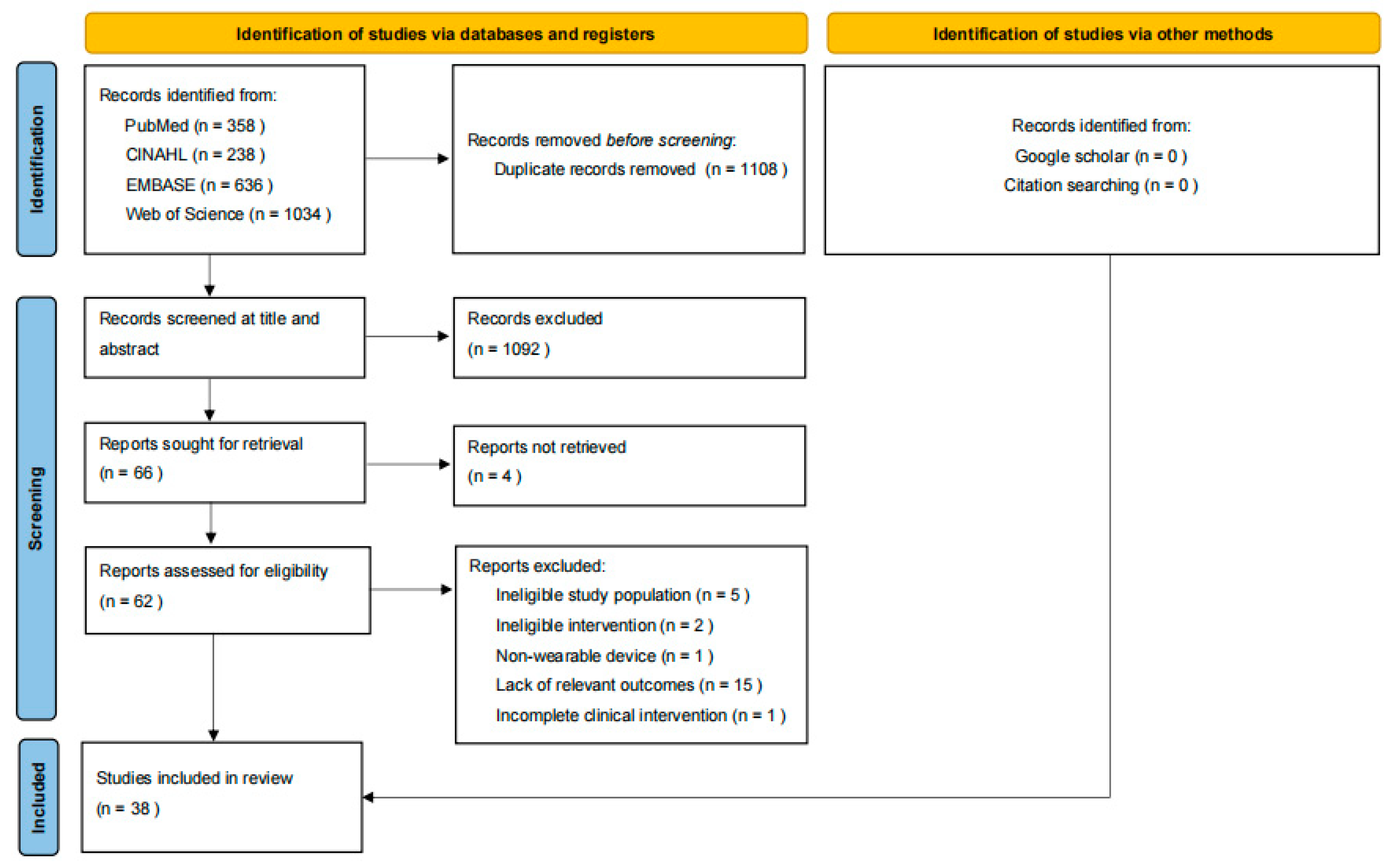
3.1. Results of the Literature Screening
3.2. Basic Characteristics of Included Studies
3.3. Safety
3.4. Feasibility
3.4.1. Recruitment Feasibility
3.4.2. Implementation Feasibility
3.4.3. Technical Feasibility
3.5. Participation- and Adherence-Related Outcomes
3.5.1. Adherence
3.5.2. Completion and Attendance
3.5.3. Dropout and Withdrawal
4. Discussion
4.1. Low Recruitment Rates: Mismatch Between Device Characteristics and Functional Status of Stroke Populations
4.2. Safety Considerations Across Different Device Types
4.3. From Clinical to Home-Based Rehabilitation: Challenges in Real-World Implementation
4.4. Limitations
5. Conclusions
Supplementary Materials
Author Contributions
Funding
Institutional Review Board Statement
Informed Consent Statement
Data Availability Statement
Conflicts of Interest
Abbreviations
| PRISMA-ScR | Preferred Reporting Items for Systematic Reviews and Meta-Analyses Extension for Scoping Reviews |
| RCT | Randomized controlled trial |
| MINT | Myoelectric Interface Neurorehabilitation training |
| IMI | Intrinsic Motivation Inventory |
References
- Global Health Estimates: Life Expectancy and Leading Causes of Death and Disability. Available online: https://www.who.int/data/gho/data/themes/theme-details/GHO/mortality-and-global-health-estimates (accessed on 28 March 2026).
- GBD 2019 Stroke Collaborators Global, Regional, and National Burden of Stroke and Its Risk Factors, 1990-2019: A Systematic Analysis for the Global Burden of Disease Study 2019. Lancet Neurol. 2021, 20, 795–820. [CrossRef] [PubMed]
- Feigin, V.L.; Brainin, M.; Norrving, B.; Martins, S.O.; Pandian, J.; Lindsay, P.; Grupper, M.F.; Rautalin, I. World Stroke Organization: Global Stroke Fact Sheet 2025. Int. J. Stroke Off. J. Int. Stroke Soc. 2025, 20, 132–144. [Google Scholar] [CrossRef] [PubMed]
- Cheng, Y.; Lin, Y.; Shi, H.; Cheng, M.; Zhang, B.; Liu, X.; Shi, C.; Wang, Y.; Xia, C.; Xie, W. Projections of the Stroke Burden at the Global, Regional, and National Levels up to 2050 Based on the Global Burden of Disease Study 2021. J. Am. Heart Assoc. 2024, 13, e036142. [Google Scholar] [CrossRef] [PubMed]
- Eriku, G.A.; Mersha, C.; Takele, M.D.; Merawie, D.M.; Yalew, E.S.; Nigatu, S.G.; Melesse, A.W.; Kassa, T. Level of Disability and Associated Factors among Stroke Survivors in Ethiopia: A Multicenter Cross-Sectional Study. BMC Public Health 2026, 26, 438. [Google Scholar] [CrossRef] [PubMed]
- Winstein, C.J.; Stein, J.; Arena, R.; Bates, B.; Cherney, L.R.; Cramer, S.C.; Deruyter, F.; Eng, J.J.; Fisher, B.; Harvey, R.L.; et al. Guidelines for Adult Stroke Rehabilitation and Recovery: A Guideline for Healthcare Professionals from the American Heart Association/American Stroke Association. Stroke 2016, 47, e98–e169. [Google Scholar] [CrossRef] [PubMed]
- Pollock, A.; Farmer, S.E.; Brady, M.C.; Langhorne, P.; Mead, G.E.; Mehrholz, J.; van Wijck, F. Interventions for Improving Upper Limb Function after Stroke. Cochrane Database Syst. Rev. 2014, 2014, CD010820. [Google Scholar] [CrossRef] [PubMed]
- Kleim, J.A.; Jones, T.A. Principles of Experience-Dependent Neural Plasticity: Implications for Rehabilitation after Brain Damage. J. Speech Lang. Hear. Res. J. Speech Lang. Hear. Res. 2008, 51, S225–S239. [Google Scholar] [CrossRef] [PubMed]
- Le Danseur, M. Stroke Rehabilitation. Crit. Care Nurs. Clin. N. Am. 2020, 32, 97–108. [Google Scholar] [CrossRef] [PubMed]
- Veerbeek, J.M.; van Wegen, E.; van Peppen, R.; van der Wees, P.J.; Hendriks, E.; Rietberg, M.; Kwakkel, G. What Is the Evidence for Physical Therapy Poststroke? A Systematic Review and Meta-Analysis. PLoS ONE 2014, 9, e87987. [Google Scholar] [CrossRef] [PubMed]
- Yin, X.; Chang, J.; Yang, L.; Jia, L.; Han, J.; Chen, L.; Cao, J.; Chen, X.; Xie, N.; Lin, Y.; et al. The ERK Signaling Pathway in Cerebral Ischemic Stroke: Mechanism and Therapeutic Significance. Biomed. Pharmacother. Biomed. Pharmacother. 2026, 196, 119058. [Google Scholar] [CrossRef] [PubMed]
- Harvey, R.L. Improving Poststroke Recovery: Neuroplasticity and Task-Oriented Training. Curr. Treat. Options Cardiovasc. Med. 2009, 11, 251–259. [Google Scholar] [CrossRef] [PubMed]
- French, B.; Thomas, L.H.; Coupe, J.; McMahon, N.E.; Connell, L.; Harrison, J.; Sutton, C.J.; Tishkovskaya, S.; Watkins, C.L. Repetitive Task Training for Improving Functional Ability after Stroke. Cochrane Database Syst. Rev. 2016, 11, CD006073. [Google Scholar] [CrossRef] [PubMed]
- Patel, S.; Park, H.; Bonato, P.; Chan, L.; Rodgers, M. A Review of Wearable Sensors and Systems with Application in Rehabilitation. J. Neuroeng. Rehabil. 2012, 9, 21. [Google Scholar] [CrossRef] [PubMed]
- Louie, D.R.; Eng, J.J. Powered Robotic Exoskeletons in Post-Stroke Rehabilitation of Gait: A Scoping Review. J. Neuroeng. Rehabil. 2016, 13, 53. [Google Scholar] [CrossRef] [PubMed]
- Wang, X.; Yu, H.; Kold, S.; Rahbek, O.; Bai, S. Wearable Sensors for Activity Monitoring and Motion Control: A Review. Biomim. Intell. Robot. 2023, 3, 100089. [Google Scholar] [CrossRef]
- Shnitzer, H.; Chan, J.; Yau, T.; McIntyre, M.; Andreoli, A.; Kua, A.; Bayley, M.; Leochico, C.F.; Guo, M.; Munce, S. The Safety of Telerehabilitation: Systematic Review. JMIR Rehabil. Assist. Technol. 2025, 12, e68681. [Google Scholar] [CrossRef] [PubMed]
- El-Kotob, R.; Giangregorio, L.M. Pilot and Feasibility Studies in Exercise, Physical Activity, or Rehabilitation Research. Pilot Feasibility Stud. 2018, 4, 137. [Google Scholar] [CrossRef] [PubMed]
- Mahmood, A.; Nayak, P.; Deshmukh, A.; English, C.; N, M.; Solomon M, J.; B, U. Measurement, Determinants, Barriers, and Interventions for Exercise Adherence: A Scoping Review. J. Bodyw. Mov. Ther. 2023, 33, 95–105. [Google Scholar] [CrossRef] [PubMed]
- Wei, S.; Wu, Z. The Application of Wearable Sensors and Machine Learning Algorithms in Rehabilitation Training: A Systematic Review. Sensors 2023, 23, 7667. [Google Scholar] [CrossRef] [PubMed]
- Tricco, A.C.; Lillie, E.; Zarin, W.; O’Brien, K.K.; Colquhoun, H.; Levac, D.; Moher, D.; Peters, M.D.J.; Horsley, T.; Weeks, L.; et al. PRISMA Extension for Scoping Reviews (PRISMA-ScR): Checklist and Explanation. Ann. Intern. Med. 2018, 169, 467–473. [Google Scholar] [CrossRef] [PubMed]
- Kim, G.J.; Parnandi, A.; Eva, S.; Schambra, H. The Use of Wearable Sensors to Assess and Treat the Upper Extremity after Stroke: A Scoping Review. Disabil. Rehabil. 2022, 44, 6119–6138. [Google Scholar] [CrossRef] [PubMed]
- Louie, D.R.; Mortenson, W.B.; Durocher, M.; Schneeberg, A.; Teasell, R.; Yao, J.; Eng, J.J. Efficacy of an Exoskeleton-Based Physical Therapy Program for Non-Ambulatory Patients during Subacute Stroke Rehabilitation: A Randomized Controlled Trial. J. Neuroeng. Rehabil. 2021, 18, 149. [Google Scholar] [CrossRef] [PubMed]
- Liang, C.; Wan, C.; Yang, J.; Shen, X.; Yu, C.; Shao, Y.; Che, P.; Zhang, Y.; Li, Y. Effect of the Kickstart Exoskeleton Lower Extremity Walking System on Improving Lower Extremity Walking Ability in Subacute Stroke Patients: A Randomized Controlled Trial. J. Neuroeng. Rehabil. 2025, 22, 155. [Google Scholar] [CrossRef] [PubMed]
- Chen, Z.-J.; He, C.; Guo, F.; Xiong, C.-H.; Huang, X.-L. Exoskeleton-Assisted Anthropomorphic Movement Training (EAMT) for Poststroke Upper Limb Rehabilitation: A Pilot Randomized Controlled Trial. Arch. Phys. Med. Rehabil. 2021, 102, 2074–2082. [Google Scholar] [CrossRef] [PubMed]
- Louie, D.R.; Mortenson, W.B.; Lui, M.; Durocher, M.; Teasell, R.; Yao, J.; Eng, J.J. Patients’ and Therapists’ Experience and Perception of Exoskeleton-Based Physiotherapy during Subacute Stroke Rehabilitation: A Qualitative Analysis. Disabil. Rehabil. 2022, 44, 7390–7398. [Google Scholar] [CrossRef] [PubMed]
- Lambelet, C.; Temiraliuly, D.; Siegenthaler, M.; Wirth, M.; Woolley, D.G.; Lambercy, O.; Gassert, R.; Wenderoth, N. Characterization and Wearability Evaluation of a Fully Portable Wrist Exoskeleton for Unsupervised Training after Stroke. J. Neuroeng. Rehabil. 2020, 17, 132. [Google Scholar] [CrossRef] [PubMed]
- Ambrosini, E.; Gasperini, G.; Zajc, J.; Immick, N.; Augsten, A.; Rossini, M.; Ballarati, R.; Russold, M.; Ferrante, S.; Ferrigno, G.; et al. A Robotic System with EMG-Triggered Functional Eletrical Stimulation for Restoring Arm Functions in Stroke Survivors. Neurorehabil. Neural Repair 2021, 35, 334–345. [Google Scholar] [CrossRef] [PubMed]
- Chang, W.H.; Kim, T.-W.; Kim, H.S.; Hanapiah, F.A.; Lee, J.W.; Han, S.-H.; Jia, C.W.; Kim, D.H.; Kim, D.Y. Efficacy of Wearable Exoskeleton for Gait Recovery in Patients with Stroke: A Multicenter Randomized Controlled Trial. Stroke 2026, 57, 577–586. [Google Scholar] [CrossRef] [PubMed]
- Vaughan-Graham, J.; Brooks, D.; Rose, L.; Nejat, G.; Pons, J.; Patterson, K. Exoskeleton Use in Post-Stroke Gait Rehabilitation: A Qualitative Study of the Perspectives of Persons Post-Stroke and Physiotherapists. J. Neuroeng. Rehabil. 2020, 17, 123–137. [Google Scholar] [CrossRef] [PubMed]
- Hsu, C.-Y.; Wu, C.-M.; Huang, C.-C.; Shie, H.-H.; Tsai, Y.-S. Feasibility and Potential Effects of Robot-Assisted Passive Range of Motion Training in Combination with Conventional Rehabilitation on Hand Function in Patients with Chronic Stroke. J. Rehabil. Med. 2022, 54, jrm00323. [Google Scholar] [CrossRef] [PubMed]
- Tanczak, N.; Plunkett, T.K.; Lin, S.; Kuenzler, L.; Lau, M.; Kuah, W.K.C.; Ng, C.Y.; Gassert, R.; Chua, K.; Lambercy, O. Feasibility of Post-Stroke Hand Rehabilitation Supported by a Soft Robotic Hand Orthosis in-Clinic and at-Home. J. Neuroeng. Rehabil. 2025, 22, 183–193. [Google Scholar] [CrossRef] [PubMed]
- Lejeune, T.; Nuic, D.; Dehem, S.; Previnaire, J.-G.; Cuenot, C.; Debugne, T.; Kaps, J.; Paul, B.; Pean, V.; Perez, S.S.; et al. Hands-Free Atalante Exoskeleton in Post-Stroke Gait and Balance Rehabilitation: A Safety Study. J. Neuroeng. Rehabil. 2025, 22, 82–94. [Google Scholar] [CrossRef] [PubMed]
- Yao, J.; Sado, T.; Wang, W.; Gao, J.; Zhao, Y.; Qi, Q.; Mukherjee, M. The Kickstart Walk Assist System for Improving Balance and Walking Function in Stroke Survivors: A Feasibility Study. J. Neuroeng. Rehabil. 2021, 18, 42–53. [Google Scholar] [CrossRef] [PubMed]
- Proulx, C.E.; Higgins, J.; Vaughan, T.; Hewko, M.; Gagnon, D.H. Poststroke Neurorehabilitation Using a Soft Robotic Glove Combined with a Virtual Environment: Preliminary Study on Feasibility, Safety, Effects, and User Satisfaction. JMIR Neurotechnol. 2025, 4, e69750. [Google Scholar] [CrossRef] [PubMed]
- Awad, L.N.; Esquenazi, A.; Francisco, G.E.; Nolan, K.J.; Jayaraman, A. The ReWalk ReStoreTM Soft Robotic Exosuit: A Multi-Site Clinical Trial of the Safety, Reliability, and Feasibility of Exosuit-Augmented Post-Stroke Gait Rehabilitation. J. Neuroeng. Rehabil. 2020, 17, 80–90. [Google Scholar] [CrossRef] [PubMed]
- Macaluso, R.; Giffhorn, M.; Prokup, S.; Cleland, B.; Lee, J.; Lim, B.; Lee, M.; Lee, H.-J.; Madhavan, S.; Jayaraman, A. Safety & Efficacy of a Robotic Hip Exoskeleton on Outpatient Stroke Rehabilitation. J. Neuroeng. Rehabil. 2024, 21, 127–138. [Google Scholar] [CrossRef] [PubMed]
- Doronzio, S.; Campagnini, S.; Mannini, A.; Basla, C.; Ciapetti, T.; Piazzini, M.; Politi, A.; Pedrini, C.; Guolo, E.; Malloggi, S.; et al. Usability of Myosuit Exosuit and Effects of Devicemediated Rehabilitation on Chronic Stroke Survivors: A Non-Randomized Pilot Study. Arch. Physiother. 2025, 265–276. [Google Scholar] [CrossRef] [PubMed]
- Noronha, B.; Ng, C.Y.; Little, K.; Xiloyannis, M.; Kuah, C.W.K.; Wee, S.K.; Kulkarni, S.R.; Masia, L.; Chua, K.S.G.; Accoto, D. Soft, Lightweight Wearable Robots to Support the Upper Limb in Activities of Daily Living: A Feasibility Study on Chronic Stroke Patients. IEEE Trans. Neural Syst. Rehabil. Eng. 2022, 30, 1401–1411. [Google Scholar] [CrossRef] [PubMed]
- Celian, C.; Ryali, P.; Wilson, V.; Srivatsa, A. A Wearable Anti-Gravity Supplement to Therapy Does Not Improve Arm Function in Chronic Stroke: A Randomized Pilot Trial. Neurorehabilit. Neural Repair 2025, 39, 728–741. [Google Scholar] [CrossRef] [PubMed]
- Xu, L.; Zhang, J.; Liu, Q.; Cao, Y.; Aizezi, N.; Tian, J.; Wu, C.; Fang, L.; Chen, L.; Zhang, Y.; et al. Effects of a Wearable Hand Orthosis on Upper and Lower Limb Motor Recovery in Stroke Patients: A Randomized Controlled Trial. Front. Bioeng. Biotechnol. 2025, 13, 1600706. [Google Scholar] [CrossRef] [PubMed]
- Huizenga, D.; Rashford, L.; Darcy, B.; Lundin, E.; Medas, R.; Shultz, S.T.; DuBose, E.; Reed, K.B. Wearable Gait Device for Stroke Gait Rehabilitation at Home. Top. Stroke Rehabil. 2021, 28, 443–455. [Google Scholar] [CrossRef] [PubMed]
- Seo, N.J.; Coupland, K.; Finetto, C.; Scronce, G. Wearable Sensor to Monitor Quality of Upper Limb Task Practice for Stroke Survivors at Home. Sensors 2024, 24, 554–567. [Google Scholar] [CrossRef] [PubMed]
- Darcy, B.; Rashford, L.; Shultz, S.T.; Tsai, N.T.; Huizenga, D.; Reed, K.B.; Bamberg, S.J.M. Gait Device Treatment Using Telehealth for Individuals with Stroke during the COVID-19 Pandemic: Nonrandomized Pilot Feasibility Study. JMIR Form. Res. 2023, 7, e43008. [Google Scholar] [CrossRef] [PubMed]
- Demers, M.; Bishop, L.; Cain, A.; Saba, J.; Rowe, J.; Zondervan, D.K.; Winstein, C.J. Wearable Technology to Capture Arm Use of People with Stroke in Home and Community Settings: Feasibility and Early Insights on Motor Performance. Phys. Ther. 2024, 104, pzad172. [Google Scholar] [CrossRef] [PubMed]
- Lu, Y.; Ding, K.; Dai, Y.; Yin, J.; Yao, J.; Guo, L.; Wang, J.; Wang, X. Clinical Application Research on Stroke Situational Intelligent Rehabilitation Training System Based on Wearable Devices: A Randomized Controlled Trial. Healthcare 2025, 13, 708–721. [Google Scholar] [CrossRef] [PubMed]
- Marek, K.; Górski, J.; Karolczyk, P.; Redlicka, J.; Zubrycki, I.; Miller, E. Feasibility of Wearable Devices for Motivating Post-Stroke Patients. Sensors 2025, 25, 5204. [Google Scholar] [CrossRef] [PubMed]
- Tse, T.; Mak-Yuen, Y.Y.K.; Young, W.; Darzins, S. Feasibility of Accelerometry in a Self-Directed Upper Limb Activity Program of a Subacute Setting with Stroke Survivors. Brain Impair. 2024, 25, IB24008. [Google Scholar] [CrossRef] [PubMed]
- Chae, S.H.; Kim, Y.; Lee, K.-S.; Park, H.-S. Development and Clinical Evaluation of a Web-Based Upper Limb Home Rehabilitation System Using a Smartwatch and Machine Learning Model for Chronic Stroke Survivors: Prospective Comparative Study. JMIR MHealth UHealth 2020, 8, e17216. [Google Scholar] [CrossRef] [PubMed]
- Nam, J.; Bellinger, G.C.; Li, J.; French, M.A.; Roemmich, R.T. Self-Reported Acceptance of a Wearable Activity Monitor in Persons with Stroke: Usability Study. JMIR Cardio 2025, 9, e70007. [Google Scholar] [CrossRef] [PubMed]
- Mayrhuber, L.; Andres, S.D.; Legrand, M.L.; Luft, A.R.; Ryser, F.; Gassert, R.; Veerbeek, J.M.; Duinen, J.V.; Schwarz, A.; Franinovic, K.; et al. Encouraging Arm Use in Stroke Survivors: The Impact of Smart Reminders during a Home-Based Intervention. J. Neuroeng. Rehabil. 2024, 21, 220–231. [Google Scholar] [CrossRef] [PubMed]
- Langerak, A.J.; Regterschot, G.R.H.; Evers, M.; Van Beijnum, B.-J.F.; Meskers, C.G.M.; Selles, R.W.; Ribbers, G.M.; Bussmann, J.B.J. A Sensor-Based Feedback Device Stimulating Daily Life Upper Extremity Activity in Stroke Patients: A Feasibility Study. Sensors 2023, 23, 5868. [Google Scholar] [CrossRef] [PubMed]
- Toh, F.M.; Lam, W.W.; Gonzalez, P.C.; Fong, K.N. ‘Smart Reminder’: A Feasibility Pilot Study on the Effects of a Wearable Device Treatment on the Hemiplegic Upper Limb in Persons with Stroke. J. Telemed. Telecare 2025, 31, 796–806. [Google Scholar] [CrossRef] [PubMed]
- Toh, S.F.M.; Gonzalez, P.C.; Fong, K.N.K. Usability of a Wearable Device for Home-Based Upper Limb Telerehabilitation in Persons with Stroke: A Mixed-Methods Study. Digit. Health 2023, 9, 20552076231153737. [Google Scholar] [CrossRef] [PubMed]
- Sanders, Q.; Chan, V.; Augsburger, R.; Cramer, S.C.; Reinkensmeyer, D.J.; Do, A.H. Feasibility of Wearable Sensing for In-Home Finger Rehabilitation Early after Stroke. IEEE Trans. Neural Syst. Rehabil. Eng. 2020, 28, 1363–1372. [Google Scholar] [CrossRef] [PubMed]
- Hung, N.-T.; Paul, V.; Prakash, P.; Kovach, T.; Tacy, G.; Tomic, G.; Park, S.; Jacobson, T.; Jampol, A.; Patel, P.; et al. Wearable Myoelectric Interface Enables High-Dose, Home-Based Training in Severely Impaired Chronic Stroke Survivors. Ann. Clin. Transl. Neurol. 2021, 8, 1895–1905. [Google Scholar] [CrossRef] [PubMed]
- Metani, A.; Popović-Maneski, L.; Seguin, P.; Di Marco, J. NeuroSkin®: AI-Driven Wearable Functional Electrical Stimulation for Post-Stroke Gait Recovery—A Multicenter Feasibility Study. Sensors 2025, 25, 5614. [Google Scholar] [CrossRef] [PubMed]
- Egger, M.; Bergmann, J.; Krewer, C.; Jahn, K.; Müller, F. Sensory Stimulation and Robot-Assisted Arm Training after Stroke: A Randomized Controlled Trial. J. Neurol. Phys. Ther. 2024, 48, 178–187. [Google Scholar] [CrossRef] [PubMed]
- Seim, C.E.; Wolf, S.L.; Starner, T.E. Wearable Vibrotactile Stimulation for Upper Extremity Rehabilitation in Chronic Stroke: Clinical Feasibility Trial Using the VTS Glove. J. Neuroeng. Rehabil. 2021, 18, 14–24. [Google Scholar] [CrossRef] [PubMed]
- Wang, H.; Ghazi, M.; Chandrashekhar, R.; Rippetoe, J.; Duginski, G.A.; Lepak, L.V.; Milhan, L.R.; James, S.A. User Participatory Design of a Wearable Focal Vibration Device for Home-Based Stroke Rehabilitation. Sensors 2022, 22, 3308. [Google Scholar] [CrossRef] [PubMed]
- Reicherzer, L.; Scheermesser, M.; Kläy, A.; Duarte, J.E.; Graf, E.S. Barriers and facilitators to the use of wearable robots as assistive devices: Qualitative study with older adults and physiotherapists. JMIR Rehabil. Assist. Technol. 2024, 11, e52676. [Google Scholar] [CrossRef] [PubMed]
- Broderick, M.; O’Shea, R.; Burridge, J.; Demain, S.; Johnson, L.; Bentley, P. Examining Usability, Acceptability, and Adoption of a Self-Directed, Technology-Based Intervention for Upper Limb Rehabilitation after Stroke: Cohort Study. JMIR Rehabil. Assist. Technol. 2023, 10, e45993. [Google Scholar] [CrossRef] [PubMed]
- Popescu, M.N.; Căpeț, C.; Popescu, C.; Berteanu, M. The Elias University Hospital Approach: A Visual Guide to Ultrasound-Guided Botulinum Toxin Injection in Spasticity, Part IV—Distal Lower Limb Muscles. Toxins 2025, 17, 508. [Google Scholar] [CrossRef] [PubMed]


| Authors | Country | Study Design | Sample | Device | Setting |
|---|---|---|---|---|---|
| Louie [23] | Canada | RCT * | n = 17 control n = 19 stroke, subacute | EksoGT | Clinical |
| Liang [24] | China | RCT | n = 23 control n = 23 stroke, subacute | Kickstart® Walk Assist | Clinical |
| Chen [25] | China | RCT | n = 10 control n = 10 stroke, subacute | EAMT upper limb exoskeleton | Clinical |
| Louie [26] | Canada | Qualitative descriptive study | n = 20, subacute | EksoGT | Clinical |
| Lambelet [27] | Switzerland | Wearability evaluation & device characterization | n = 2 stroke, chronic n = 15 healthy | eWrist | Clinical & Home |
| Ambrosini [28] | Italy, Austria, Germany, etc. | RCT | n = 36 control n = 36 stroke, subacute | RETRAINER | Clinical |
| Chang [29] | South Korea, Malaysia | RCT | n = 77 control n = 74 stroke, subacute | ANGEL LEGS M20 | Clinical |
| Vaughan-Graham [30] | Canada | Qualitative study | n = 5 stroke, chronic n = 6 therapists | H2 exoskeleton-assisted | Clinical |
| HSU [31] | Taiwan, China | Single-arm feasibility study | n = 12 stroke, chronic | HS 001 | Clinical |
| Tanczak [32] | Singapore, Switzerland | Two-phase feasibility study | n = 8 stroke, chronic | RELab Tenoexo 2.0 | Clinical & Home |
| Lejeune [33] | France, Belgium, Luxembourg | Prospective multicenter safety study | n = 40 stroke (subacute & chronic) | Atalante | Clinical |
| Yao [34] | China, USA | Single-arm pre–post feasibility study | n = 30 stroke (subacute & chronic) | Kickstart® Walk Assist | Clinical |
| E Proulx [35] | Canada | Prospective non-randomized controlled study | n = 5 control n = 6 stroke | Dexmo glove | Clinical |
| Awad [36] | USA | Multicenter clinical trial | n = 44 stroke (>2 weeks post-stroke) | ReWalk ReStore™ | Clinical |
| Macaluso [37] | USA, South Korea | Prospective single-arm longitudinal study | n = 41 stroke (subacute & chronic) | GEMS-H | Clinical |
| Doronzio [38] | Italy, Switzerland | Non-randomized pilot study | n = 10 stroke, chronic | Myosuit | Clinical |
| Noronha [39] | Singapore, Switzerland, Germany, Belgium | Feasibility single-centre open label clinical trial | n = 10 stroke, (subacute & chronic) | Exoskeleton-assisted | Clinical |
| Celian [40] | USA | RCT | n = 10 control n = 9 stroke, chronic | ExoNET | Clinical |
| Xu [41] | China | RCT | n = 23 control n = 25 stroke, subacute | Wearable hand orthosis | Clinical |
| Huizenga [42] | USA | Single-arm pre–post study | n = 21 stroke, chronic | iStride™ | Home |
| Seo [43] | USA | Feasibility study | n = 19 stroke (acute & subacute) | ActiGraph GT9X Link | Home |
| Darcy [44] | USA | Non-randomized pilot feasibility study | n = 5 stroke, chronic | iStride | Home |
| Demers [45] | USA | Observational study | n = 30 stroke, chronic | MiGo system | Home & Community |
| Lu [46] | China | RCT | n = 34 control n = 45 stroke, subacute | Stroke Intelligent Rehabilitation Training System | Clinical |
| Marek [47] | Poland | RCT | n = 8 control n = 8 stroke, (subacute & chronic) | Przypominajka | Clinical & Home |
| Tse [48] | Australia | Single-group pre-post pilot study | n = 12 stroke, subacute | ActiGraph wGT3X-BT/GT9X Link | Clinical |
| Chae [49] | South Korea | Prospective comparative study | n = 6 control n = 17 stroke, chronic | LG W270 smartwatch | Home |
| Nam [50] | USA | Feasibility study | n = 65 stroke, chronic | Fitbit Inspire 2 | Home |
| Mayrhuber [51] | Singapore, Switzerland, USA | RCT | n = 23 control n = 19 stroke, chronic | ARYS™ me|tracker | Home |
| Langerak [52] | Netherlands | Study Design Crossover study | n = 17 stroke, subacute | Arm Activity Tracker | Clinical |
| Toh [53] | Hong Kong, China, Singapore | RCT | n = 6 control n = 6 stroke, chronic | Smart Reminder | Home |
| Toh [54] | Hong Kong, China, Singapore | Mixed-methods study | n = 11 stroke, chronic | Smart Reminder | Home |
| Sanders [55] | USA | RCT | n = 5 control n = 6 stroke, subacute | MusicGlove | Home |
| Hung [56] | USA | RCT | n = 8 control n = 15 stroke, chronic | MINT * | Home |
| Metani [57] | France, Serbia, Luxembourg, Italy | Multicenter retrospective feasibility study | n = 15 stroke, subacute n = 7 therapists | NeuroSkin® | Clinical |
| Egger [58] | Switzerland | RCT | n = 21 control n = 20 stroke, subacute | RSS + ArmeoPower | Clinical |
| Seim [59] | USA | RCT | n = 8 control n = 8 stroke, chronic | Vibrotactile Stimulation Glove | Home |
| Wang [60] | USA | Pilot study | n = 5 stroke, chronic n = 5 therapists | FoVi | Home & Community |
Disclaimer/Publisher’s Note: The statements, opinions and data contained in all publications are solely those of the individual author(s) and contributor(s) and not of MDPI and/or the editor(s). MDPI and/or the editor(s) disclaim responsibility for any injury to people or property resulting from any ideas, methods, instructions or products referred to in the content. |
© 2026 by the authors. Licensee MDPI, Basel, Switzerland. This article is an open access article distributed under the terms and conditions of the Creative Commons Attribution (CC BY) license.
Share and Cite
Xu, S.; Yin, X.; Tian, S.; Zhang, Y.; Wang, P.; Zhao, Y.; Liu, W. Clinical Application of Wearable Devices in Stroke Rehabilitation: A Scoping Review of Safety, Feasibility, and Adherence. Healthcare 2026, 14, 2400. https://doi.org/10.3390/healthcare14152400
Xu S, Yin X, Tian S, Zhang Y, Wang P, Zhao Y, Liu W. Clinical Application of Wearable Devices in Stroke Rehabilitation: A Scoping Review of Safety, Feasibility, and Adherence. Healthcare. 2026; 14(15):2400. https://doi.org/10.3390/healthcare14152400
Chicago/Turabian StyleXu, Shuchang, Xunna Yin, Shanshan Tian, Yatong Zhang, Peijie Wang, Yangang Zhao, and Wei Liu. 2026. "Clinical Application of Wearable Devices in Stroke Rehabilitation: A Scoping Review of Safety, Feasibility, and Adherence" Healthcare 14, no. 15: 2400. https://doi.org/10.3390/healthcare14152400
APA StyleXu, S., Yin, X., Tian, S., Zhang, Y., Wang, P., Zhao, Y., & Liu, W. (2026). Clinical Application of Wearable Devices in Stroke Rehabilitation: A Scoping Review of Safety, Feasibility, and Adherence. Healthcare, 14(15), 2400. https://doi.org/10.3390/healthcare14152400