_MD__MPH_PhD.png)
Comparison of Milk Removal Efficiency and Maternal Perception Between a Hospital-Grade and Personal-Use Pump

 , , , and
Highlights
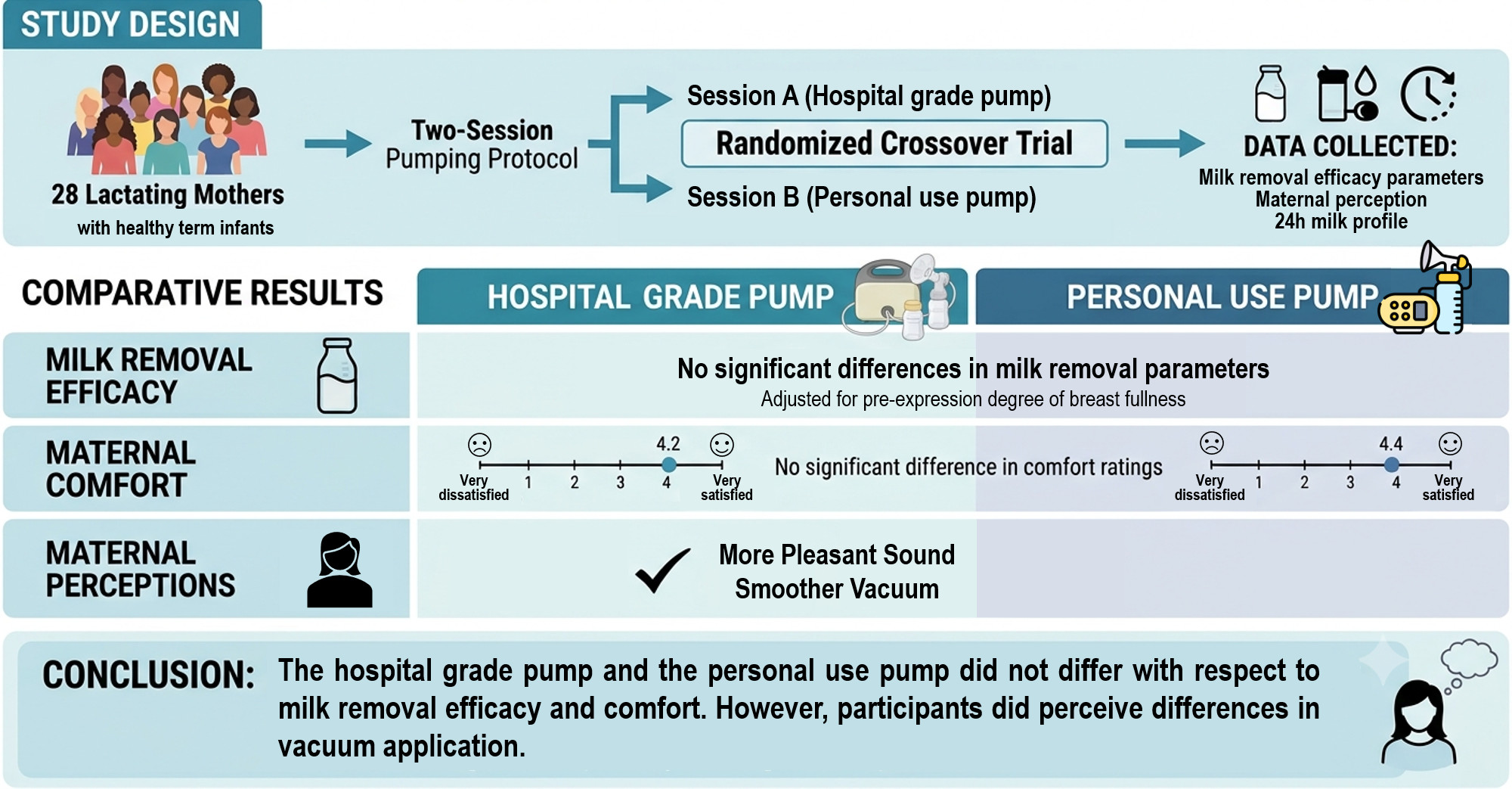
- Hospital-grade pump (Symphony) and personal-use pump (Pump in Style Pro) performance did not show differences in milk removal efficacy and comfort.
- Participants perceived meaningful differences in pump experience, rating the hospital-grade pump’s vacuum as smoother and its sound as more pleasant than the personal-use pump.
- The absence of difference in milk removal efficacy with the personal-use pump (Pump in Style Pro) suggests it may be a viable and more accessible alternative for women when transitioning from a hospital-grade pump.
- Subjective perceptions of vacuum smoothness and pleasantness of sound even in the absence of performance differences may influence maternal pump preference and satisfaction, highlighting the importance of considering user experience alongside efficacy when guiding pump selection.
Abstract
1. Introduction
2. Materials and Methods
2.1. Study Design
2.2. Participants
2.3. Pumping Sessions
2.3.1. Nipple Measurements and Expression Protocol
2.3.2. Vacuum Curves
2.4. Determination of Percentage of Available Milk Removed
2.5. User Experience
2.6. Statistical Analysis
3. Results
3.1. Participants
3.2. Milk Removal Parameters
3.3. Milk Ejection and Flow Characteristics
3.4. Maternal Perceptions
4. Discussion
5. Conclusions
Author Contributions
Funding
Institutional Review Board Statement
Informed Consent Statement
Data Availability Statement
Acknowledgments
Conflicts of Interest
Abbreviations
| HGP | Hospital-grade pump |
| DOF | Degree of fullness |
| PAMR | Percentage of available milk removed |
| PUP | Personal-use pump |
References
- Porta, R.; Miralles, N.; Paltrinieri, A.; Ibáñez, B.; Giménez, J.; Roca, T.; Vega, A. A beast milk pump at the bedside: A project to increase milk production in mothers of very low birth weight infants. Breastfeed. Med. 2021, 16, 309–312. [Google Scholar] [CrossRef] [PubMed]
- Gridneva, Z.; Warden, A.H.; McEachran, J.L.; Perrella, S.L.; Lai, C.T.; Geddes, D.T. Maternal and infant characteristics and pumping profiles of women that predominantly pump milk for their infants. Nutrients 2025, 17, 366. [Google Scholar] [CrossRef] [PubMed]
- Piazza, A.J.; Bixby, C.; Black, A.; Felmet, N.; Hannan, K.; Hulgan, C.M.; Pallotto, E.J. Optimizing human milk provision: Review of QI best practices. Semin. Perinatol. 2026, 50, 152229. [Google Scholar] [CrossRef] [PubMed]
- Snell, J.D.; Gollins, L.A.; Hagan, J.L.; Tucker, K.; Marrinucci, G.; Debuyserie, A.; Hair, A.B. The Pump Matters: An Educational Bundle to Promote a Predominant Mother’s-Own-Milk Diet in Very Low Birthweight Infants. Breastfeed. Med. 2025, 20, 635–644. [Google Scholar] [CrossRef] [PubMed]
- Nardella, D. Pumps: A possible tool to promote more equitable lactation outcomes. Yale J. Biol. Med. 2024, 97, 99–106. [Google Scholar] [CrossRef] [PubMed]
- DiTomasso, D.; Basley, S.; DeSanto-Madeya, S.; Palmer, M. Breast milk expression in mothers of full-term infants: A scoping review of available information. J. Hum. Lact. 2026, 42, 418–443. [Google Scholar] [CrossRef] [PubMed]
- Fok, D.; Aris, I.M.; Ho, J.H.; Chan, Y.H.; Rauff, M.; Lui, J.K.; Cregan, M.D.; Hartmann, P.E.; Chong, Y.S.; Mattar, C.N. Early initiation and regular breast milk expression reduces risk of lactogenesis II delay in at-risk Singaporean mothers in a randomised trial. Singap. Med. J. 2019, 60, 80–88. [Google Scholar] [CrossRef] [PubMed]
- Meier, P.P.; Engstrom, J.L.; Janes, J.E.; Jegier, B.J.; Loera, F. Breast pump suction patterns that mimic the human infant during breastfeeding: Greater milk output in less time spent pumping for breast pump-dependent mothers with premature infants. J. Perinatol. 2012, 32, 103–110. [Google Scholar] [CrossRef] [PubMed]
- Meier, P.P.; Patel, A.L.; Hoban, R.; Engstrom, J.L. Which breast pump for which mother: An evidenced-based approach to individualizing breast pump technology. J. Perinatol. 2016, 36, 493–499. [Google Scholar] [CrossRef] [PubMed]
- Miyauchi, A.; Uchimura, M.; Takahashi, M.; Horiuchi, S.; Ota, E. Effectiveness of breast pumps in early postpartum breastfeeding for women after cesarean section: A systematic review. Jpn. J. Nurs. Sci. 2025, 22, e12643. [Google Scholar] [CrossRef] [PubMed]
- Zinaman, M.J.; Hughes, V.; Queenan, J.T.; Labbok, M.H.; Albertson, B. Acute prolactin and oxytocin responses and milk yield to infant suckling and artificial methods of expression in lactating women. Pediatrics 1992, 89, 437–440. [Google Scholar] [CrossRef] [PubMed]
- Lussier, M.M.; Brownell, E.A.; Proulx, T.A.; Bielecki, D.M.; Marinelli, K.A.; Bellini, S.L.; Hagadorn, J.I. Daily breastmilk volume in mothers of very low birth weight neonates: A repeated-measures randomized trial of hand expression versus electric breast pump expression. Breastfeed. Med. 2015, 10, 312–317. [Google Scholar] [CrossRef] [PubMed]
- Paul, V.; Singh, M.; Deorari, A.; Pacheco, J.; Taneja, U. Manual and pump methods of expression of breast milk. Indian J. Pediatr. 1996, 63, 87–92. [Google Scholar] [CrossRef] [PubMed]
- Jones, E.; Dimmock, P.W.; Spencer, S.A. A randomised controlled trial to compare methods of milk expression after preterm delivery. Arch. Dis. Child. Fetal Neonatal Ed. 2001, 85, F91–F95. [Google Scholar] [CrossRef] [PubMed]
- Slusher, T.; Slusher, I.L.; Biomdo, M.; Bode-Thomas, F.; Curtis, B.A.; Meier, P. Electric breast pump use increases maternal milk volume in African nurseries. J. Trop. Pediatr. 2007, 53, 125–130. [Google Scholar] [CrossRef] [PubMed]
- Green, D.; Moye, L.; Schreiner, R.L.; Lemons, J.A. The relative efficacy of four methods of human milk expression. Early Hum. Dev. 1982, 6, 153–159. [Google Scholar] [CrossRef] [PubMed]
- Francis, J.; Dickton, D. Physical analysis of the breast after direct breastfeeding compared with hand or pump expression: A randomized clinical trial. Breastfeed. Med. 2019, 14, 705–711. [Google Scholar] [CrossRef] [PubMed]
- Manshanden, T.M.N.; Prime, D.K.; Scheele, F.; Velzel, J. An evaluation of patient comfort levels during expression with a modified pumping program: A prospective proof of concept study. Front. Glob. Womens Health 2024, 5, 1378263. [Google Scholar] [CrossRef] [PubMed]
- Reddy, R.; Bellad, R.M. Comparison of breast milk volume and composition: Manual vs. electric breast pump expression in mothers of low birth weight infants—A randomized controlled trial. Indian J. Pediatr. 2025, 92, 1113. [Google Scholar] [CrossRef] [PubMed]
- Fewtrell, M.; Lucas, P.; Collier, S.; Lucas, A. Randomized study comparing the efficacy of a novel manual breast pump with a mini-electric breast pump in mothers of term infants. J. Hum. Lact. 2001, 17, 126–131. [Google Scholar] [CrossRef] [PubMed]
- Liberty, A.; Rubin, E.S.; Bullard, K.A.; Au, K. Human milk–expression technologies: A primer for obstetricians. Obstet. Gynecol. 2022, 139, 1180–1188. [Google Scholar] [CrossRef] [PubMed]
- Fewtrell, M.S.; Lucas, P.; Collier, S.; Singhal, A.; Ahluwalia, J.S.; Lucas, A. Randomized trial comparing the efficacy of a novel manual breast pump with a standard electric breast pump in mothers who delivered preterm infants. Pediatrics 2001, 107, 1291–1297. [Google Scholar] [CrossRef] [PubMed]
- Ozkaya, M.; Korukcu, O.; Ozcan, A.; Sayal, H.B. Effect of VRBaby-Pump on breastmilk expression experiences and milk volume in mothers of preterm infants: A randomized controlled trial. J. Hum. Lact. 2026. Epub ahead of printing. [Google Scholar] [CrossRef] [PubMed]
- Sheffield, V.; Tomlinson, S.; McCaffery, H.; McCormick, A.D. One Pump at a Time: A Wearable Lactation Pump Pilot for Graduate Medical Education Trainees. Breastfeed. Med. 2024, 19, 885–888. [Google Scholar] [CrossRef] [PubMed]
- Colbenson, G.A.; Hoff, O.; Olson, E.M.; Ducharme-Smith, A. The impact of wearable breast pumps on physicians’ breastfeeding experience and success. Breastfeed. Med. 2022, 17, 537–543. [Google Scholar] [CrossRef] [PubMed]
- Becker, G.E. Measuring mothers’ viewpoints of breast pump usage. Int. J. Environ. Res. Public Health 2021, 18, 3883. [Google Scholar] [CrossRef] [PubMed]
- Fewtrell, M.; Kennedy, K.; Lukoyanova, O.; Wei, Z.; Potak, D.; Borovik, T.; Namazova-Baranova, L.; Schanler, R. Short-term efficacy of two breast pumps and impact on breastfeeding outcomes at 6 months in exclusively breastfeeding mothers: A randomised trial. Matern. Child. Nutr. 2019, 15, e12779. [Google Scholar] [CrossRef] [PubMed]
- Prime, D.K.; Geddes, D.T.; Spatz, D.L.; Robert, M.; Trengove, N.J.; Hartmann, P.E. Using milk flow rate to investigate milk ejection in the left and right breasts during simultaneous breast expression in women. Int. Breastfeed. J. 2009, 4, 10. [Google Scholar] [CrossRef] [PubMed]
- Ramsay, D.T.; Mitoulas, L.R.; Kent, J.C.; Cregan, M.D.; Doherty, D.A.; Larsson, M.; Hartmann, P.E. Milk flow rates can be used to Iientify and investigate milk ejection in women expressing breast milk using an electric breast pump. Breastfeed. Med. 2006, 1, 14–23. [Google Scholar] [CrossRef] [PubMed]
- Arthur, P.; Hartmann, P.; Smith, M. Measurement of the milk intake of breast-fed infants. J. Pediatr. Gastroenterol. Nutr. 1987, 6, 758–763. [Google Scholar] [CrossRef] [PubMed]
- Jensen, R.G.; Clark, R.M. Methods of lipid analysis. J. Pediatr. Gastroenterol. Nutr. 1984, 3, 296–299. [Google Scholar] [CrossRef] [PubMed]
- Tie, W.J.; Kent, J.C.; Lai, C.T.; Rea, A.; Hepworth, A.R.; Murray, K.; Geddes, D.T. Reproducibility of the creamatocrit technique for the measurement of fat content in human milk. Food Chem. 2021, 356, 129708. [Google Scholar] [CrossRef] [PubMed]
- Kent, J.C.; Mitoulas, L.R.; Cregan, M.D.; Ramsay, D.T.; Doherty, D.A.; Hartmann, P.E. Volume and frequency of breastfeedings and fat content of breast milk throughout the day. Pediatrics 2006, 117, e387–e395. [Google Scholar] [CrossRef] [PubMed]
- Gridneva, Z.; Warden, A.H.; Jin, X.; McEachran, J.L.; Lai, C.T.; Perrella, S.L.; Geddes, D.T. Maternal adiposity, milk production and removal, and infant milk intake during established lactation. Nutrients 2025, 17, 3726. [Google Scholar] [CrossRef] [PubMed]
- TGA. Australian Clinical Trial Handbook: Guidance on Conducting Clinical Trials in Australia Using ‘Unapproved’ Therapeutic Goods; Therapeutic Goods Administration: Canberra, Australia, 2021.
- Kent, J.C.; Mitoulas, L.R.; Cregan, M.D.; Geddes, D.T.; Larsson, M.; Doherty, D.A.; Hartmann, P.E. Importance of vacuum for breastmilk expression. Breastfeed. Med. 2008, 3, 11–19. [Google Scholar] [CrossRef] [PubMed]
- Ilyin, V.I.; Alekseev, N.P.; Troschkin, M.M.; Uleziko, V.A. Comparative assessment of excretion of milk from two breast pumps with different vacuum strength and duration. Breastfeed. Med. 2019, 14, 177–184. [Google Scholar] [CrossRef] [PubMed]
- Daly, S.E.J.; Kent, J.C.; Owens, R.A.; Hartmann, P.E. Frequency and degree of milk removal and the short-term control of human milk synthesis. Exp. Physiol. 1996, 81, 861–875. [Google Scholar] [CrossRef] [PubMed]
- Daly, S.E.J.; Di Rosso, A.; Owens, R.A.; Hartmann, P.E. Degree of breast emptying explains changes in the fat content, but not fatty acid composition, of human milk. Exp. Physiol. 1993, 78, 741–755. [Google Scholar] [CrossRef] [PubMed]
- Gardner, H.; Lai, C.T.; Ward, L.C.; Geddes, D.T. Thermal physiology of the lactating nipple influences the removal of human milk. Sci. Rep. 2019, 9, 11854. [Google Scholar] [CrossRef] [PubMed]
- Mitoulas, L.R.; Lai, C.T.; Gurrin, L.C.; Larsson, M.; Hartmann, P.E. Efficacy of breast milk expression using an electric breast pump. J. Hum. Lact. 2002, 18, 344–352. [Google Scholar] [CrossRef] [PubMed]
- Dewey, K.G. Maternal and fetal stress are associated with impaired lactogenesis in humans. J. Nutr. 2001, 131, 3012S–3015S. [Google Scholar] [CrossRef] [PubMed]
- Newton, N.R.; Newton, M. Relation of the let-down reflex to the ability to breast feed. Pediatrics 1950, 5, 726–733. [Google Scholar] [CrossRef] [PubMed]
- Ueda, T.; Yokoyama, Y.; Irahara, M.; Aono, T. Influence of psychological stress on suckling-induced pulsatile oxytocin release. Obstet. Gynecol. 1994, 84, 259–262. [Google Scholar] [PubMed]
- Gridneva, Z.; Warden, A.H.; McEachran, J.L.; Lai, C.T.; Perrella, S.L.; Geddes, D.T. Human milk expression technologies: An evaluation of mobility and comfort perception of a hands-free, in-bra, breastmilk collection pump set. Proceedings 2023, 93, 9. [Google Scholar] [CrossRef]
- Kent, J.C.; Ramsay, D.T.; Doherty, D.; Larsson, M.; Hartmann, P.E. Response of breasts to different stimulation patterns of an electric breast pump. J. Hum. Lact. 2003, 19, 179–186. [Google Scholar] [CrossRef] [PubMed]
- Bartels, R.L.; DiTomasso, D.; Macht, G.A. A mother-centered evaluation of breast pumps. Appl. Ergon. 2020, 88, 103123. [Google Scholar] [CrossRef] [PubMed]
- Mitoulas, L.R.; Lai, C.T.; Gurrin, L.C.; Larrson, M.; Hartmann, P.E. Effect of vacuum profile on breast milk expression using an electric breast pump. J. Hum. Lact. 2002, 18, 353–360. [Google Scholar] [CrossRef] [PubMed]
- Meier, P.P.; Engstrom, J.L.; Hurst, N.M.; Ackerman, B.; Allen, M.; Motykowski, J.E.; Zuleger, J.L.; Jegier, B.J. A comparison of the efficiency, efficacy, comfort, and convenience of two hospital-grade electric breast pumps for mothers of very low birthweight infants. Breastfeed. Med. 2008, 3, 141–150. [Google Scholar] [CrossRef] [PubMed]
- Baldassano, C.; Chen, J.; Zadbood, A.; Pillow, J.W.; Hasson, U.; Norman, K.A. Discovering event structure in continuous narrative perception and memory. Neuron 2017, 95, 709–721.e705. [Google Scholar] [CrossRef] [PubMed]
- Uvnäs-Moberg, K.; Handlin, L.; Petersson, M. Self-soothing behaviors with particular reference to oxytocin release induced by non-noxious sensory stimulation. Front. Psychol. 2015, 5, 1529. [Google Scholar] [CrossRef] [PubMed]
- Carter, C.S.; Kenkel, W.M.; MacLean, E.L.; Wilson, S.R.; Perkeybile, A.M.; Yee, J.R.; Ferris, C.F.; Nazarloo, H.P.; Porges, S.W.; Davis, J.M.; et al. Is Oxytocin “Nature’s Medicine”? Pharmacol. Rev. 2020, 72, 829–861. [Google Scholar] [CrossRef] [PubMed]
- Nagel, E.M.; Howland, M.A.; Pando, C.; Stang, J.; Mason, S.M.; Fields, D.A.; Demerath, E.W. Maternal psychological distress and lactation and breastfeeding outcomes: A narrative review. Clin. Ther. 2022, 44, 215–227. [Google Scholar] [CrossRef] [PubMed]
- Keith, D.R.; Weaver, B.S.; Vogel, R.L. The effect of music-based listening interventions on the volume, fat content, and caloric content of breast milk–produced by mothers of premature and critically ill infants. Adv. Neonatal Care 2012, 12, 112–119. [Google Scholar] [CrossRef] [PubMed]
- Gardner, H.; Kent, J.C.; Lai, C.T.; Mitoulas, L.R.; Cregan, M.D.; Hartmann, P.E.; Geddes, D.T. Milk ejection patterns: An intra- individual comparison of breastfeeding and pumping. BMC Pregnancy Childbirth 2015, 15, 156. [Google Scholar] [CrossRef] [PubMed]
- Boss, M.; Gardner, H.; Hartmann, P.E. Normal Human Lactation: Closing the gap. F1000Research 2018, 7, 801. [Google Scholar] [CrossRef] [PubMed]



| Characteristics | Mean ± SD n = 28 |
|---|---|
| Maternal characteristics | |
| Maternal age (years) | 34.3 ± 4.7 1 |
| Parity | 1.7 ± 0.8 |
| Lactation stage (months) | 3.5 ± 1.5 |
| Milk production (g) | 912 ± 386 |
| Infant characteristics | |
| Birth gestation (weeks) | 39.1 ± 2.1 |
| Birth weight (g) | 3416 ± 641 |
| Parameters | HGP Mean ± SD | PUP Mean ± SD | Effect Size (95% CI) | p-Value 1 3 | q-Value 1 4 | Effect Size (95% CI) | p-Value 2 5 | q-Value 2 6 |
|---|---|---|---|---|---|---|---|---|
| Stimulation vacuum (mmHg) | −120.0 ± 37.2 1 | −114.8 ± 34.7 1 | −2.9 (−14.0, 8.2) 2 | 0.45 | 0.62 | 4.3 (−10.4, 19.0) 2 | 0.88 | 0.98 |
| Maximum comfortable vacuum (mmHg) | −189.7 ± 53.8 | −177.8 ± 52.4 | −9.6 (−25.0, 6.2) | 0.43 | 0.62 | −0.4 (−19.6, 18.9) | 0.31 | 0.82 |
| Left breast volume (g) | 75.3 ± 44.9 | 57.5 ± 45.8 | 17.7 (3.2, 32.4) | 0.019 | 0.10 | 3.4 (−12.6, 19.3) | 0.66 | 0.93 |
| Right breast volume (g) | 71.8 ± 43.1 | 67.6 ± 37.5 | 4.2 (−9.4, 17.9) | 0.53 | 0.68 | 3.7 (−9.4, 16.9) | 0.56 | 0.84 |
| Combined volume (g) | 147.1 ± 78.1 | 125.0 ± 73.5 | 22.0 (0.2, 43.9) | 0.048 | 0.19 | 2.8 (−25.5, 31.1) | 0.84 | 0.96 |
| Post-expression cream | 14.4 ± 5.1 | 14.9 ± 4.6 | −0.1 (−2.3, 2.1) | 0.91 | 0.94 | 0.7 (−1.6, 3.1) | 0.52 | 0.84 |
| Post-expression DOF | 0.08 ± 0.10 | 0.11 ± 0.14 | −0.004 (−0.1, 0.1) | 0.91 | 0.94 | −0.01 (−0.1, 0.1) | 0.80 | 0.96 |
| Left breast PAMR (%) | 73.6 ± 71.2 | 68.4 ± 26.9 | 5.3 (−10.0, 20.5) | 0.48 | 0.63 | NA | NA | NA |
| Right breast PAMR (%) | 80.9 ± 23.4 | 81.1 ± 28.2 | −0.2 (−18.6, 18.1) | 0.98 | 0.98 | NA | NA | NA |
| Combined PAMR (%) | 77.1 ± 20.4 | 74.7 ± 28.0 | 4.5 (−5.8, 14.8) | 0.48 | 0.63 | NA | NA | NA |
| Parameters | HGP Mean ± SD | PUP Mean ± SD | Effect Size (95% CI) | p-Value 1 3 | q-Value 1 4 | Effect Size (95% CI) | p-Value 2 5 | q-Value 2 6 |
|---|---|---|---|---|---|---|---|---|
| Nipple temperature change (°C) | −0.8 ± 1.6 1 | −1.0 ± 1.6 1 | −0.1 (−0.8, 0.5) 2 | 0.68 | 0.78 | −0.04 (−0.9, 0.8) 2 | 0.92 | 0.99 |
| Time to first milk ejection (min) | 1.17 ± 0.61 | 1.63 ± 1.18 | −0.5 (−1.0, 0.1) | 0.081 | 0.27 | −1.6 (−3.1, −0.1) | 0.20 | 0.82 |
| Overall flow duration (min) | 13.4 ± 2.8 | 13.5 ± 2.8 | −0.04 (−0.9, 0.8) | 0.91 | 0.94 | 0.05 (−1.1, 1.2) | 0.93 | 0.99 |
| Constant flow duration (min) | 11.0 ± 4.4 | 10.5 ± 4.1 | 0.9 (−1.5, 3.4) | 0.43 | 0.62 | −0.01 (−2.7, 2.6) | 0.79 | 0.96 |
| Milk during constant flow duration (g) | 66.3 ± 41.8 | 51.8 ± 43.8 | 14.9 (−3.4, 33.1) | 0.11 | 0.29 | 3.0 (−17.1, 23.0) | 0.76 | 0.96 |
| Constant flow rate (g/min) | 7.2 ± 3.6 | 5.4 ± 3.0 | 1.9 (0.7, 3.1) | 0.004 | 0.041 | 1.2 (−0.3, 2.7) | 0.11 | 0.82 |
| Milk removal rate (g/min) | 4.9 ± 2.9 | 4.2 ± 2.8 | 0.7 (0.01, 1.4) | 0.047 | 0.18 | 0.29 (−0.5, 1.1) | 0.45 | 0.84 |
| Active flow duration (min) | 11.9 ± 3.3 | 12.0 ± 3.00 | −0.2 (−1.3, 0.9) | 0.70 | 0.79 | −0.7 (−2.0, 0.6) | 0.26 | 0.82 |
| Active milk removal (g/min) | 6.2 ± 3.1 | 4.8 ± 3.2 | 1.6 (0.4, 2.8) | 0.012 | 0.075 | 0.7 (−0.8, 2.1) | 0.33 | 0.84 |
| Maximum flow rate (g/s) | 0.34 ± 0.17 | 0.28 ± 0.16 | 0.1 (−0.03, 0.1) | 0.20 | 0.44 | 0.1 (−0.04, 0.2) | 0.24 | 0.82 |
| Time to 80% milk removed (min) | 7.9 ± 3.1 | 8.6 ± 3.1 | −0.6 (−1.9, 0.7) | 0.34 | 0.61 | −0.2 (−1.9, 1.5) | 0.82 | 0.96 |
| Time to 90% milk removed (min) | 10.2 ± 3.1 | 11.4 ± 3.3 | −1.2 (−2.0, −0.3) | 0.012 | 0.075 | −0.6 (−1.7, 0.5) | 0.27 | 0.82 |
| Time to stop pumping (min) | 12.1 ± 3.6 | 12.9 ± 3.6 | −0.4 (−1.9, 1.1) | 0.61 | 0.72 | −0.1 (−1.7, 1.6) | 0.94 | 0.99 |
| Effectiveness—PAMR to time to stop (%/min) | 6.7 ± 2.1 | 5.3 ± 3.0 | 1.1 (−0.6, 2.9) | 0.19 | 0.44 | 1.1 (−0.8, 2.9) | 0.23 | 0.82 |
| Characteristics | HGP Mean ± SD | PUP Mean ± SD | Effect Size (95% CI) | p-Value 1 3 | q-Value 1 4 | Effect Size (95% CI) | p-Value 2 5 | q-Value 2 6 |
|---|---|---|---|---|---|---|---|---|
| Comfort and sound perception | ||||||||
| Satisfied with comfort | 4.2 ± 1.1 1 | 4.4 ± 0.7 1 | −0.2 (−0.7, 0.2) 2 | 0.32 | 0.61 | −0.1 (−0.7, 0.4) 2 | 0.58 | 0.84 |
| Sound pleasantness | 4.6 ± 0.7 | 3.2 ± 0.8 | 1.4 (1.0, 1.8) | <0.001 | <0.001 | 1.4 (0.9, 1.8) | <0.001 | <0.001 |
| Comparison to home pump | ||||||||
| Comfort compared to home pump | 3.5 ± 1.0 | 3.3 ± 0.9 | 0.2 (−0.3, 0.7) | 0.43 | 0.62 | 0.2 (−0.4, 0.8) | 0.40 | 0.84 |
| Better compared to home pump | 3.8 ± 0.8 | 3.4 ± 0.8 | 0.4 (0.02, 0.8) | 0.039 | 0.17 | 0.4 (−0.1, 0.9) | 0.12 | 0.82 |
| Effectiveness compared to home pump | 3.8 ± 0.9 | 3.5 ± 0.7 | 0.3 (−0.1, 0.7) | 0.14 | 0.36 | 0.2 (−0.3, 0.6) | 0.52 | 0.84 |
| Satisfaction with pump | ||||||||
| Satisfied with milk volume | 4.5 ± 0.9 | 4.3 ± 0.9 | 0.2 (−0.2, 0.6) | 0.33 | 0.61 | 0.3 (0.1, 0.6) | 0.43 | 0.84 |
| Satisfied with vacuum strength | 4.7 ± 0.6 | 4.5 ± 0.7 | 0.1 (−0.1, 0.4) | 0.33 | 0.61 | 0.1 (−0.2, 0.5) | 0.38 | 0.84 |
| Vacuum perception | ||||||||
| Vacuum perceived strong and comfortable | 4.4 ± 0.9 | 4.0 ± 0.8 | 0.3 (−0.1, 0.7) | 0.10 | 0.29 | 0.3 (−0.2, 0.8) | 0.18 | 0.82 |
| Vacuum perceived smooth | 4.7 ± 0.5 | 3.9 ± 1.4 | 0.9 (0.3, 1.3) | 0.003 | 0.041 | 0.6 (0.1, 1.2) | 0.030 | 0.57 |
| Vacuum perceived as gentle | 4.3 ± 0.8 | 3.9 ± 1.0 | 0.4 (0.1, 0.9) | 0.076 | 0.27 | 0.3 (−0.2, 0.8) | 0.28 | 0.82 |
Disclaimer/Publisher’s Note: The statements, opinions and data contained in all publications are solely those of the individual author(s) and contributor(s) and not of MDPI and/or the editor(s). MDPI and/or the editor(s) disclaim responsibility for any injury to people or property resulting from any ideas, methods, instructions or products referred to in the content. |
© 2026 by the authors. Licensee MDPI, Basel, Switzerland. This article is an open access article distributed under the terms and conditions of the Creative Commons Attribution (CC BY) license.
Share and Cite
Warden, A.H.; Gridneva, Z.; McEachran, J.L.; Abelha, S.G.; Perrella, S.L.; Geddes, D.T. Comparison of Milk Removal Efficiency and Maternal Perception Between a Hospital-Grade and Personal-Use Pump. Healthcare 2026, 14, 2251. https://doi.org/10.3390/healthcare14152251
Warden AH, Gridneva Z, McEachran JL, Abelha SG, Perrella SL, Geddes DT. Comparison of Milk Removal Efficiency and Maternal Perception Between a Hospital-Grade and Personal-Use Pump. Healthcare. 2026; 14(15):2251. https://doi.org/10.3390/healthcare14152251
Chicago/Turabian StyleWarden, Ashleigh H., Zoya Gridneva, Jacki L. McEachran, Sarah G. Abelha, Sharon L. Perrella, and Donna T. Geddes. 2026. "Comparison of Milk Removal Efficiency and Maternal Perception Between a Hospital-Grade and Personal-Use Pump" Healthcare 14, no. 15: 2251. https://doi.org/10.3390/healthcare14152251
APA StyleWarden, A. H., Gridneva, Z., McEachran, J. L., Abelha, S. G., Perrella, S. L., & Geddes, D. T. (2026). Comparison of Milk Removal Efficiency and Maternal Perception Between a Hospital-Grade and Personal-Use Pump. Healthcare, 14(15), 2251. https://doi.org/10.3390/healthcare14152251